Introduction: The intravenous glucose tolerance test (IVGTT) is acknowledged as the gold standard for assessing insulin sensitivity, as it provides the glucose clearance rate (Kg) from the bloodstream. The ICARUS panel expert protocol for the implementation of the IVGTT involves the administration of a high dose of glucose over a brief bolus period, which is risky and may result in discomfort. This study aimed to demonstrate the feasibility of a heparin-assisted IVGTT with a lower glucose infusion rate and to determine the glucose clearance rate from blood (Kg) for healthy black African adults using a modified ICARUS protocol. Methods: In a modified ICARUS protocol, heparin was administered to six healthy black African volunteers to prevent clotting in an indwelling catheter. Then, an infusion of 0.33 g/kg glucose was administered over 5–10 min instead of the usual 0.50 g/kg over 3 min. Blood sampling was performed every 5–10 min for up to 95 min. Blood glucose levels were determined using the glucose oxidase method. Timed blood glucose curves were plotted, and the following parameters were determined: area under the curve (AUC), baseline return time, and glucose clearance rate (Kg). Results: No bleeding symptoms or other adverse events were observed. The blood glucose peak ranged from 9.4 to 15.3 mmol/L. The baseline returned time ranged from 45 to 55 minutes. Kg ranged from 1.6 to 2.7, depending on the amount of infused glucose. The AUC varied with the amount of infused glucose and infusion duration. The Staub effect was not observed in this study. The features of the curves were all plausible compared to those obtained in healthy subjects using the original Icarus protocol. Conclusion: Under our experimental conditions, we achieved IVGTT using a heparin-assisted IVGTT protocol with reduced glucose infusion rates, and determined the glucose clearance rate. This protocol is feasible and can potentially be used to assess insulin sensitivity. The protocol can be applied on a larger scale to determine its statistical features.
This is an Open Access article, distributed under the terms of the Creative Commons Attribution 4.0 International License (http://creativecommons.org/licenses/by/4.0/), which permits unrestricted use, distribution and reproduction in any medium or format, provided the original work is properly cited.
Accurate quantification of pancreatic beta cell function and insulin sensitivity is essential for understanding the pathophysiology of diabetes. A range of direct and indirect techniques are used to assess insulin secretion, each offering specific benefits and drawbacks
[1]
Hieronimus B, Medici V, Lee V, Nunez MV, Sigala DM, Bremer AA, et al. Effects of Consuming Beverages Sweetened with Fructose, Glucose, High-Fructose Corn Syrup, Sucrose, or Aspartame on OGTT-Derived Indices of Insulin Sensitivity in Young Adults. Nutrients. 2 janv 2024; 16(1): 151.
. The intravenous glucose tolerance test (IVGTT) is recognized as the gold standard because it directly stimulates beta cells, bypassing the incretin effect mediated by the digestive tract. This dynamic test assesses insulin secretion by measuring the glucose clearance rate (Kg) in the blood
[2]
Borai A, Livingstone C, Kaddam I, Ferns G. Selection of the appropriate method for the assessment of insulin resistance. BMC Med Res Methodol. 23 nov 2011; 11(1): 158.
. Numerous factors contribute to the variations in insulin response. Several studies have demonstrated an association between insulin sensitivity and ethnic factors
[3]
Chiu KC, Chuang LM, Yoon C. Comparison of Measured and Estimated Indices of Insulin Sensitivity and β Cell Function: Impact of Ethnicity on Insulin Sensitivity and β Cell Function in Glucose-Tolerant and Normotensive Subjects 1. [cité 11 mars 2026]. Disponible sur:
Koh HCE, Patterson BW, Reeds DN, Mittendorfer B. Insulin sensitivity and kinetics in African American and White people with obesity: Insights from different study protocols. Obesity. 2022; 30(3): 655-65.
. However, despite its usefulness in research, this protocol is still perceived as a cumbersome and complex dynamic testing method, with limited clinical implementation, particularly in an African limited healthcare context, where reference data on glucose kinetics are still incomplete. The application of the ICARUS protocol raises several safety and tolerance challenges. Rapid injection of highly concentrated glucose solutions can lead to a sudden expansion of plasma volume of approximately 10%, representing significant cardiovascular stress and potentially inducing acute hypotensive episodes
[6]
Coté CJ, Greenhow DE, Marshall BE. The Hypotensive Response to Rapid Intravenous Administration of Hypertonic Solutions in Man and in the Rabbit. Anesthesiology. 1 janv 1979; 50(1): 30.
. Furthermore, repeated blood sampling (often between 12 and 30 samples over two to three hours) causes a high level of discomfort for the patient. Alternatively, an indwelling catheter increases the risk of obstruction due to intraluminal coagulation, which compromises data quality
[7]
Molinari A, Castagnola E, Mazzola C, Piacentino M, Fratino G. Thromboembolic complications related to indwelling central venous catheters in children with oncological/haematological diseases: a retrospective study of 362 catheters. Support Care Cancer. 1 oct 2001; 9(7): 539-44.
. Using lower concentrations and longer infusion times could reduce these risks while improving the technical feasibility of the test. Therefore, it is imperative to verify the feasibility of a modified ICARUS protocol specifically adapted to the low-level healthcare logistics context to ensure reliable and safe testing. We hypothesized that a simplified IVGTT protocol using heparin to maintain catheter intraluminal fluidity, a reduced glucose concentration, and a prolonged infusion time would be feasible and safe. We hypothesized that this simplified protocol would prevent any adverse events or bleeding syndromes while providing a biologically plausible glucose clearance rate (kg) comparable to standard kinetic models. This study aimed to demonstrate the clinical and logistical feasibility of a modified simple IVGTT protocol in healthy Black African adults. Feasibility will be assessed according to three strict criteria: 1. The absence of bleeding syndromes related to heparin use. 2. Absence of adverse events (hypotension, cardiovascular stress, or malaise). 3. The plausibility of the calculated glucose clearance rate (kg) was also assessed.
2. Materials and Method
The study received institutional authorization from the CeDReS Research Committee prior to its commencement.
2.1. Subjects
Six assays were performed on six healthy adults (including four males) aged 27–35 years. Informed consent was obtained from the participants before enrollment. The absence of any chronic endocrine or metabolic disease susceptible to infer blood glucose was assumed based on a normal medical examination and normal oral glucose tolerance test results. Table 1 presents the participants’ anthropometric features. The participants were instructed not to perform any unusual physical exercise the day before the test. Participants were instructed to consume three meals per day for the three days preceding the test. These meals included at least one serving of fruit and at least two servings of starchy foods, such as bread, rice, cassava, plantain, yam, gari, potato, pasta, millet, sorghum, or corn, to ensure a daily intake of at least 150 grams of carbohydrates
[8]
Burke LM, Cox GR, Cummings NK, Desbrow B. Guidelines for Daily Carbohydrate Intake. Sports Med. 1 avr 2001; 31(4): 267-99.
. Table 2 presents a comparison of the features of our protocol with those of the Icarus protocol expert panel. The main differences of our protocol are as follows: administration of a prior heparin injection, a reduced rate of infused glucose, and an extended infusion duration. These modifications aimed to improve patient comfort by reducing the number of needle punctures for blood withdrawal and reducing the clinical discomfort induced by high concentrations of infused glucose. Tests were performed between 6.30 and 10.30 am. Two hours prior to the experiment, each participant was administered a subcutaneous injection of 4500 UI/0.45 ml of tinzaparin (Innohep), a low-molecular-weight heparin, to prevent clot formation following the insertion of an indwelling catheter into the vein of one arm.
Table 2. Compared implementation protocols of intravenous glucose tolerance test.
Icarus protocol
Our Protocol
Number of volunteers
20
6
Diet
3 days (at least 150 g daily of carbohydrate)
Physical activity
Normal
Fasting (hours)
10 - 16
Tests time
6.30 - 10.30
T0 (min)
Start of glucose infusion
Infused glucose concentration (g/kg)
0.50
0.33
Infusion duration
3 min ± 15 sec
5 - 10 min
Arm for perfusion and blood collection
same arm
opposite arm
Anticoagulant
none
heparin
A glucose infusion (0.33 g/kg with a 30% solution)
[9]
Vicini P, Cobelli C. The iterative two-stage population approach to IVGTT minimal modeling: improved precision with reduced sampling. American Journal of Physiology-Endocrinology and Metabolism. janv 2001; 280(1): E179-86.
at room temperature was infused within 5–10 minutes (min) into the vein of one arm. Blood samples were collected from a vein in the opposite arm before the infusion of glucose (time 0 mn). We then collected blood samples nine times at 5 min intervals and then five times at 10 min intervals. Blood samples were collected in tubes containing antiglycolytic fluoride salt as an additive. In order to detect a possible hemorrhage, urine samples were collected to assess for hematuria using dipstick urinalysis Multistix 10 SG (Siemens).
Blood glucose concentration was measured in the plasma using the molecular absorption photometric method with the glucose oxidase enzyme coupled with the Trinder reaction
[10]
Lott JA, Turner K. Evaluation of Trinder’s Glucose Oxidase Method for Measuring Glucose in Serum and Urine. Clin Chem. 1 nov 1975; 21(12): 1754-60.
. Blood glucose concentration was determined at different time points following the infusion of glucose. Blood glucose-timed curves were plotted, and the following parameters were determined: glucose clearance rate (Kg), area under the curve (AUC), and baseline time return. Kg was determined with the following equation with G is glycemia at t time. We varied the infusion duration and the infused glucose quantity to determine their impact on the shape of the curve.
Glycemia varies with time according to the following equation:
G=glycemia at t time
(1)
The intercept of this equation (G) is the glycemia at t=0. The slope of this equation represents the glucose clearance rate (Kg).
(2)
Each subject was used to assess the modification of one aspect of the Icarus protocol. Feasibility was assessed based on the completion of the experiment, the absence of discomfort in the subjects, and the obtaining of analysis constants, such as the glucose clearance rate (Kg), area under the curve (AUC), and baseline time return.
3. Results
3.1. Clinical Observations
Throughout the experiment, we did not observe any instances of blood clotting that resulted in obstruction of the indwelling catheter. No pain, redness, or swelling suggestive of thrombophlebitis was observed in any participant. No hemorrhagic symptoms were observed. Additionally, all urinalysis tests yielded negative results, indicating the absence of hematuria in all participants.
Except for a warm, painless feeling limited to the area of administration, the injection of glucose solution 30% was well tolerated by the subjects. The warm feeling was cooled by slowing the injection of the glucose solution and placing the hand of the infused arm on a hot-water bag.
3.2. Shapes and Features of Glycemia Curves
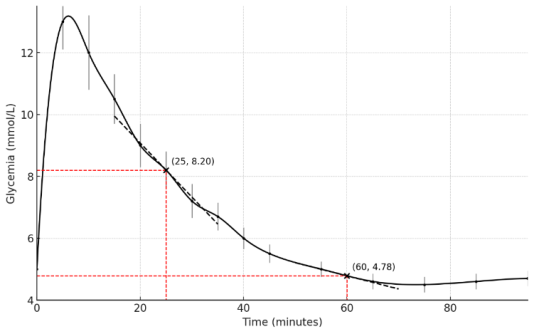
In all experimental conditions, the plotted curves exhibited an exponential shape characterized by a four-phase pattern. The initial phase was a rapid ascent, reaching a peak at the fifth minute. This was followed by a biphasic decline pattern: one at 25 min and the other at 60 min. The final phase was characterized by a plateau, stabilizing around the baseline blood glucose level (Figure 1).
Peak blood glucose levels were more dispersed around the peak times. This blood glucose dispersion decreased with time, as evidenced by the following mean values: 12.84 ± 2.17 mmol/l at 5 min vs. 5.04 ± 0.51 mmol/l at 55 min.
No Staub-Traugott effect, indicating counter-regulation to the insulin response, was observed.
Figure 1. Average timed blood glucose during an intravenous glucose tolerance test.
Glucose Infusion duration: 5 – 8 minutes; Glucose solution concentration 0.33 g/kg (glucose/body weight); Subject effective: 6; Subject body mass index range [19.3 – 24.9]; Trend curve equation Glycemia = 13.2e-0.084time.
The IVGTT curves demonstrated shape characteristics analogous to those identified in healthy adults, as determined by the ICARUS group (Table 3).
Table 3. Statistical features of IVGTT curves (n=6).
Mean
Standard deviation
Minimum value
Maximum value
Glycemia peak (mmol/l)
12.84
2.17
9.38
15.26
Glucose disappearance rate (%/min)
2.1
0.4
1.6
2.7
Baseline time return (minute)
55
5.8
45
65
3.3. Varying Shapes of Glycemia Curves
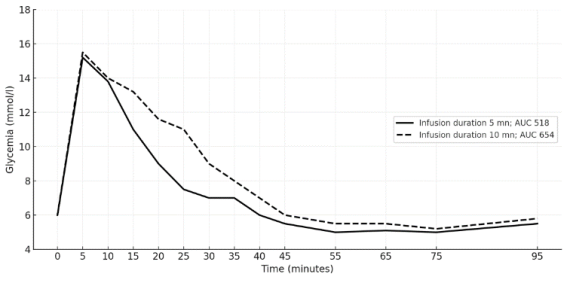
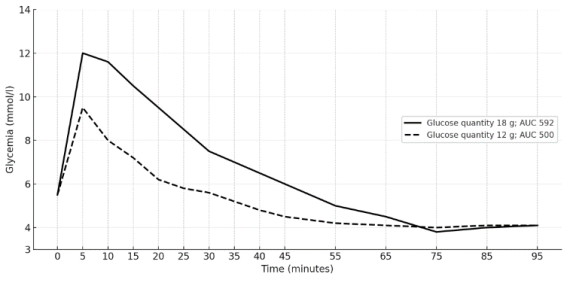
The highest rate was observed when the maximum volume of glucose was injected within the shortest duration. Extending the duration of glucose infusion increased the area under the curve (AUC) (Figure 2). Conversely, reducing the volume of infused glucose led to a decrease in peak maxima, which correspondingly reduced the AUC (Figure 3).
Glucose solution concentration 0.33 g/kg (glucose/body weight); Subject body mass index: 24.9
Figure 3. Comparative plots of intravenous glucose tolerance test with varied infused glucose quantity.
4. Discussion
Several diagnostic tests are available to assess disorders of glucose metabolism, including the oral glucose tolerance test, intravenous glucose tolerance test, and glycated hemoglobin (HbA1c) level. While HbA1c is recognized for its specificity and ease of use in diagnosing diabetes mellitus, IVGTT is considered the most sensitive method for detecting insulin sensitivity in diabetes mellitus and associated diseases
[11]
Farkas GJ, Gordon PS, Trewick N, Gorgey AS, Dolbow DR, Tiozzo E, et al. Comparison of Various Indices in Identifying Insulin Resistance and Diabetes in Chronic Spinal Cord Injury. Journal of Clinical Medicine. 27 nov 2021; 10(23).
. Research indicates that IVGTT is a valuable tool for assessing beta cell function, insulin secretion, and insulin resistance, which are important in the treatment of glucose metabolism disorders
[12]
Godsland IF, Johnston DG, Alberti K, Oliver N. The importance of intravenous glucose tolerance test glucose stimulus for the evaluation of insulin secretion. Sci Rep. 28 mars 2024; 14(1): 7451.
. Unfortunately, IVGTT lacks standardization to compare inter-serial results
[13]
Colman PG, Stewart V, Kean J, Koschmann M, Alford F, Ward G, et al. Comparison of Two Commonly Used Standard IVGTTs. Diabetes Care. 1 août 1992; 15(8): 1053-5.
. Some methodologies use bolus glucose administration, characterized by rapid delivery in under three minutes, while others use slower administrations, with infusion durations exceeding five minutes. Although none of these methods have demonstrated significant differences in diagnostic performance, infusion administration offers enhanced patient comfort and mitigates the risk of thrombophlebitis induced by high concentrations of glucose
[14]
McCulloch DK, Bingley PJ, Colman PG, Jackson RA, Gale EAM, The ICARUS Group. Comparison of Bolus and Infusion Protocols for Determining Acute Insulin Response to Intravenous Glucose in Normal Humans. Diabetes Care. 1 juin 1993; 16(6): 911-5.
. Our methodological choices were based on these considerations.
Given that all participants were in good health, it can be concluded that factors such as infection, diabetes mellitus, and hypertension did not influence the shape of the glucose curve or the rate of glucose clearance in this study. Therefore, we assumed that the observed glucose clearance was solely attributable to the experimental conditions of this study. The protocol modifications included the prior administration of heparin, lower glucose concentrations, and lower infusion rates. Heparin was first used to facilitate the collection of venous blood from an indwelling catheter by preventing needle clogging. And secondly, the heparin can mitigate the inhibitory effect of antithrombin III on hyperglycemia
[15]
Kurahashi K, Inoue S, Yoshida S, Ikeda Y, Morimoto K, Uemoto R, et al. The Role of Heparin Cofactor Ⅱ in the Regulation of Insulin Sensitivity and Maintenance of Glucose Homeostasis in Humans and Mice. Journal of Atherosclerosis and Thrombosis. 2017; 24(12): 1215-30.
. On the one hand, this revised protocol of the Icarus expert group, which involves the pre-administration of heparin prior to glucose infusion and blood sampling, as well as the use of lower glucose concentrations and reduced infusion volumes, succeeded to mitigate the risk of thrombophlebitis associated with high glucose concentrations
[16]
Hansen HR, Wolfs JL, Bruggemann L, Sommeijer DW, Bevers E, Hauer AD, et al. Hyperglycemia accelerates arterial thrombus formation and attenuates the antithrombotic response to endotoxin in mice. Blood Coagulation & Fibrinolysis. oct 2007; 18(7): 627.
. On the other hand, the addition of heparin effectively prevented occlusions in the catheter between blood withdrawal intervals and thromboembolism without altering the curve's shapes. The absence of clots in the catheters and the absence of thrombophlebitis, hemorrhagic symptoms, and hematuria in the participants reflect the correct use of heparin at the correct dosage to prevent clot formation without inducing adverse effects.
The shapes and features of the curves obtained from the IVGTT closely aligned with those documented in the literature for healthy adults without any conditions associated with insulin resistance. These curves exhibit an exponential shape with a Kg ranging between 1.5 and 2.5
[17]
Ascaso JF, Pardo S, Real JT, Lorente RI, Priego A, Carmena R. Diagnosing Insulin Resistance by Simple Quantitative Methods in Subjects With Normal Glucose Metabolism. Diabetes Care. 1 déc 2003; 26(12): 3320-5.
. The absence of the Staub-Traugott effect in our experiments can be attributed to the reduced glucose load compared to the Icarus protocol, given that this effect specifically results from an excessive insulin response triggered by a substantial glucose load
[18]
Bonuccelli S, Muscelli E, Gastaldelli A, Barsotti E, Astiarraga BD, Holst JJ, et al. Improved tolerance to sequential glucose loading (Staub-Traugott effect): size and mechanisms. American Journal of Physiology-Endocrinology and Metabolism. août 2009; 297(2): E532-7.
Toffolo G, Cobelli C. The hot IVGTT two-compartment minimal model: an improved version. American Journal of Physiology-Endocrinology and Metabolism. févr 2003; 284(2): E317-21.
. The biphasic decline observed in the curves indicates distinct dominant metabolic and physiological processes that were not monitored in this study. The absence of timed urine sampling to assess urinary glucose levels precluded our ability to distinguish between the roles of renal clearance from tissue resorption in the decrease in blood glucose levels following the insulin response.
Finally, the modified protocol allowed the preservation of the blood glucose peak and AUC for calculating the rate of glucose uptake (Kg). The results showed that the infusion duration was sufficient to shape the expected glucose metabolism curve response. Similarly, the infused glucose concentration and volume were sufficiently high to give an optimal insulin response so that the glucose peak melted within 55 min. The absence of bleeding symptoms and the Staub effect suggest the safety and reliability of this modified approach. The protocol modifications appear to enhance patient comfort and safety without compromising the ability to measure key parameters, such as the glucose clearance rate. Further research with larger sample sizes is needed to fully validate this modified approach and to compare it directly to the Icarus IVGTT protocol. Additional studies should also examine the applicability of this protocol in individuals with diseases associated with insulin resistance. Overall, this modified IVGTT protocol shows promise as a potentially improved method for assessing insulin sensitivity and glucose metabolism in Black African adults.
5. Conclusions
This study demonstrated the feasibility of implementing a modified intravenous glucose tolerance test (IVGTT) protocol in healthy Black African adults. These changes successfully mitigated risks of thrombophlebitis and thromboembolism while still allowing for assessment of glucose metabolism parameters. Although this small feasibility study had limitations, it provides preliminary evidence that a heparin-assisted IVGTT protocol with reduced glucose infusion rates can safely and effectively assess glucose metabolism in this population. Further investigation is necessary to validate this modified approach and compare it with the Icarus IVGTT protocol.
Abbreviations
AUC
Area Under the Curve
IVGTT
Intravenous Glucose Tolerance Test
Acknowledgments
The authors would like to thank and acknowledge the volunteers of the study and the staff members of the Center for Diagnosis and Research on AIDS and other infectious diseases (CeDReS), University Hospital of Treichville (Abidjan, Ivory Coast).
Health and scientific research ministries of Ivory Coast government provided public funds to the institutions which hosted the study. These funds were allocated to the study design and the collection and analysis of samples. The funding source was not involved in the conduct of the research, interpretation of data, writing of the report, or publication of the present article. Therefore, its contents are solely the responsibility of the authors and do not necessarily represent the official views of the health and scientific research ministries of the Ivory Coast government.
This research did not receive any specific grants from private funding or not-for-profit agencies.
Data Availability Statement
The data is available from the corresponding author upon reasonable request.
The data supporting the outcome of this research work has been reported in this manuscript.
Conflicts of Interest
The authors declare that they have no known competing financial interests or personal relationships that could have appeared to influence the work reported in this paper.
References
[1]
Hieronimus B, Medici V, Lee V, Nunez MV, Sigala DM, Bremer AA, et al. Effects of Consuming Beverages Sweetened with Fructose, Glucose, High-Fructose Corn Syrup, Sucrose, or Aspartame on OGTT-Derived Indices of Insulin Sensitivity in Young Adults. Nutrients. 2 janv 2024; 16(1): 151.
Borai A, Livingstone C, Kaddam I, Ferns G. Selection of the appropriate method for the assessment of insulin resistance. BMC Med Res Methodol. 23 nov 2011; 11(1): 158.
Chiu KC, Chuang LM, Yoon C. Comparison of Measured and Estimated Indices of Insulin Sensitivity and β Cell Function: Impact of Ethnicity on Insulin Sensitivity and β Cell Function in Glucose-Tolerant and Normotensive Subjects 1. [cité 11 mars 2026]. Disponible sur:
Koh HCE, Patterson BW, Reeds DN, Mittendorfer B. Insulin sensitivity and kinetics in African American and White people with obesity: Insights from different study protocols. Obesity. 2022; 30(3): 655-65.
Coté CJ, Greenhow DE, Marshall BE. The Hypotensive Response to Rapid Intravenous Administration of Hypertonic Solutions in Man and in the Rabbit. Anesthesiology. 1 janv 1979; 50(1): 30.
Molinari A, Castagnola E, Mazzola C, Piacentino M, Fratino G. Thromboembolic complications related to indwelling central venous catheters in children with oncological/haematological diseases: a retrospective study of 362 catheters. Support Care Cancer. 1 oct 2001; 9(7): 539-44.
Vicini P, Cobelli C. The iterative two-stage population approach to IVGTT minimal modeling: improved precision with reduced sampling. American Journal of Physiology-Endocrinology and Metabolism. janv 2001; 280(1): E179-86.
Farkas GJ, Gordon PS, Trewick N, Gorgey AS, Dolbow DR, Tiozzo E, et al. Comparison of Various Indices in Identifying Insulin Resistance and Diabetes in Chronic Spinal Cord Injury. Journal of Clinical Medicine. 27 nov 2021; 10(23).
Godsland IF, Johnston DG, Alberti K, Oliver N. The importance of intravenous glucose tolerance test glucose stimulus for the evaluation of insulin secretion. Sci Rep. 28 mars 2024; 14(1): 7451.
Colman PG, Stewart V, Kean J, Koschmann M, Alford F, Ward G, et al. Comparison of Two Commonly Used Standard IVGTTs. Diabetes Care. 1 août 1992; 15(8): 1053-5.
McCulloch DK, Bingley PJ, Colman PG, Jackson RA, Gale EAM, The ICARUS Group. Comparison of Bolus and Infusion Protocols for Determining Acute Insulin Response to Intravenous Glucose in Normal Humans. Diabetes Care. 1 juin 1993; 16(6): 911-5.
Kurahashi K, Inoue S, Yoshida S, Ikeda Y, Morimoto K, Uemoto R, et al. The Role of Heparin Cofactor Ⅱ in the Regulation of Insulin Sensitivity and Maintenance of Glucose Homeostasis in Humans and Mice. Journal of Atherosclerosis and Thrombosis. 2017; 24(12): 1215-30.
Ascaso JF, Pardo S, Real JT, Lorente RI, Priego A, Carmena R. Diagnosing Insulin Resistance by Simple Quantitative Methods in Subjects With Normal Glucose Metabolism. Diabetes Care. 1 déc 2003; 26(12): 3320-5.
Bonuccelli S, Muscelli E, Gastaldelli A, Barsotti E, Astiarraga BD, Holst JJ, et al. Improved tolerance to sequential glucose loading (Staub-Traugott effect): size and mechanisms. American Journal of Physiology-Endocrinology and Metabolism. août 2009; 297(2): E532-7.
Toffolo G, Cobelli C. The hot IVGTT two-compartment minimal model: an improved version. American Journal of Physiology-Endocrinology and Metabolism. févr 2003; 284(2): E317-21.
Ahiboh, H., Koffi, J. A., Kouakou, H. F., Yao-Yapo, C., Ankotche, A., et al. (2026). Feasibility and Outcomes of a Modified Intravenous Glucose Tolerance Test: Implications for Glucose Clearance Rate in Euglycemic Black Adults. Advances in Biochemistry, 14(2), 34-42. https://doi.org/10.11648/j.ab.20261402.13
Ahiboh, H.; Koffi, J. A.; Kouakou, H. F.; Yao-Yapo, C.; Ankotche, A., et al. Feasibility and Outcomes of a Modified Intravenous Glucose Tolerance Test: Implications for Glucose Clearance Rate in Euglycemic Black Adults. Adv. Biochem.2026, 14(2), 34-42. doi: 10.11648/j.ab.20261402.13
Ahiboh H, Koffi JA, Kouakou HF, Yao-Yapo C, Ankotche A, et al. Feasibility and Outcomes of a Modified Intravenous Glucose Tolerance Test: Implications for Glucose Clearance Rate in Euglycemic Black Adults. Adv Biochem. 2026;14(2):34-42. doi: 10.11648/j.ab.20261402.13
@article{10.11648/j.ab.20261402.13,
author = {Hugues Ahiboh and Joelle Akissi Koffi and Henri Francisk Kouakou and Carine Yao-Yapo and Amos Ankotche and Edwige Siransy-Balayssac and Dagui Monnet and Marie-Laure Hauhouot-Attoungbre},
title = {Feasibility and Outcomes of a Modified Intravenous Glucose Tolerance Test: Implications for Glucose Clearance Rate in Euglycemic Black Adults},
journal = {Advances in Biochemistry},
volume = {14},
number = {2},
pages = {34-42},
doi = {10.11648/j.ab.20261402.13},
url = {https://doi.org/10.11648/j.ab.20261402.13},
eprint = {https://article.sciencepublishinggroup.com/pdf/10.11648.j.ab.20261402.13},
abstract = {Introduction: The intravenous glucose tolerance test (IVGTT) is acknowledged as the gold standard for assessing insulin sensitivity, as it provides the glucose clearance rate (Kg) from the bloodstream. The ICARUS panel expert protocol for the implementation of the IVGTT involves the administration of a high dose of glucose over a brief bolus period, which is risky and may result in discomfort. This study aimed to demonstrate the feasibility of a heparin-assisted IVGTT with a lower glucose infusion rate and to determine the glucose clearance rate from blood (Kg) for healthy black African adults using a modified ICARUS protocol. Methods: In a modified ICARUS protocol, heparin was administered to six healthy black African volunteers to prevent clotting in an indwelling catheter. Then, an infusion of 0.33 g/kg glucose was administered over 5–10 min instead of the usual 0.50 g/kg over 3 min. Blood sampling was performed every 5–10 min for up to 95 min. Blood glucose levels were determined using the glucose oxidase method. Timed blood glucose curves were plotted, and the following parameters were determined: area under the curve (AUC), baseline return time, and glucose clearance rate (Kg). Results: No bleeding symptoms or other adverse events were observed. The blood glucose peak ranged from 9.4 to 15.3 mmol/L. The baseline returned time ranged from 45 to 55 minutes. Kg ranged from 1.6 to 2.7, depending on the amount of infused glucose. The AUC varied with the amount of infused glucose and infusion duration. The Staub effect was not observed in this study. The features of the curves were all plausible compared to those obtained in healthy subjects using the original Icarus protocol. Conclusion: Under our experimental conditions, we achieved IVGTT using a heparin-assisted IVGTT protocol with reduced glucose infusion rates, and determined the glucose clearance rate. This protocol is feasible and can potentially be used to assess insulin sensitivity. The protocol can be applied on a larger scale to determine its statistical features.},
year = {2026}
}
TY - JOUR
T1 - Feasibility and Outcomes of a Modified Intravenous Glucose Tolerance Test: Implications for Glucose Clearance Rate in Euglycemic Black Adults
AU - Hugues Ahiboh
AU - Joelle Akissi Koffi
AU - Henri Francisk Kouakou
AU - Carine Yao-Yapo
AU - Amos Ankotche
AU - Edwige Siransy-Balayssac
AU - Dagui Monnet
AU - Marie-Laure Hauhouot-Attoungbre
Y1 - 2026/05/14
PY - 2026
N1 - https://doi.org/10.11648/j.ab.20261402.13
DO - 10.11648/j.ab.20261402.13
T2 - Advances in Biochemistry
JF - Advances in Biochemistry
JO - Advances in Biochemistry
SP - 34
EP - 42
PB - Science Publishing Group
SN - 2329-0862
UR - https://doi.org/10.11648/j.ab.20261402.13
AB - Introduction: The intravenous glucose tolerance test (IVGTT) is acknowledged as the gold standard for assessing insulin sensitivity, as it provides the glucose clearance rate (Kg) from the bloodstream. The ICARUS panel expert protocol for the implementation of the IVGTT involves the administration of a high dose of glucose over a brief bolus period, which is risky and may result in discomfort. This study aimed to demonstrate the feasibility of a heparin-assisted IVGTT with a lower glucose infusion rate and to determine the glucose clearance rate from blood (Kg) for healthy black African adults using a modified ICARUS protocol. Methods: In a modified ICARUS protocol, heparin was administered to six healthy black African volunteers to prevent clotting in an indwelling catheter. Then, an infusion of 0.33 g/kg glucose was administered over 5–10 min instead of the usual 0.50 g/kg over 3 min. Blood sampling was performed every 5–10 min for up to 95 min. Blood glucose levels were determined using the glucose oxidase method. Timed blood glucose curves were plotted, and the following parameters were determined: area under the curve (AUC), baseline return time, and glucose clearance rate (Kg). Results: No bleeding symptoms or other adverse events were observed. The blood glucose peak ranged from 9.4 to 15.3 mmol/L. The baseline returned time ranged from 45 to 55 minutes. Kg ranged from 1.6 to 2.7, depending on the amount of infused glucose. The AUC varied with the amount of infused glucose and infusion duration. The Staub effect was not observed in this study. The features of the curves were all plausible compared to those obtained in healthy subjects using the original Icarus protocol. Conclusion: Under our experimental conditions, we achieved IVGTT using a heparin-assisted IVGTT protocol with reduced glucose infusion rates, and determined the glucose clearance rate. This protocol is feasible and can potentially be used to assess insulin sensitivity. The protocol can be applied on a larger scale to determine its statistical features.
VL - 14
IS - 2
ER -
Faculty of Pharmaceutical and Biological Sciences, Félix Houphouët-Boigny University, Abidjan, Ivory Coast
Biography:
Hugues Ahiboh, PharmD, PhD, is an Associate Professor within the Faculty of Pharmacy and Biological Sciences at Felix Houphouet-Boigny University, specializing in biochemistry and molecular biology. With a career spanning over three decades, Dr. Ahiboh currently serves as the Head of the Biochemistry and Clinical Chemistry Unit at the Centre for Diagnosis and Research in Health of the Treichville Teaching Hospital in Abidjan. His professional expertise is underpinned by advanced certifications in General and Medical Immunology, alongside previous experience as a medical laboratory scientist at the Institut Pasteur of Ivory Coast. Beyond his clinical and pedagogical responsibilities, he contributes to international capacity building as a member of the scientific and teaching board for the Afro Advanced Course on Diagnostics (ACDx), a collaborative initiative by the Merieux Fondation and the Institut Pasteur of Senegal.
Research Fields:
Metabolic biochemistry, molecular genetics of infectious pathogens, Non-infectious diseases biomarkers in tropical socio-genetic contexts, Pharmacological and toxicological biochemistry of vegetal drugs
Center for Health Diagnosis and Research (CeDReS), Treichville University Hospital, Abidjan, Ivory Coast
Biography:
Joelle Akissi Koffi, is a pharmacist and biologist working in the biochemistry unit of Centre for Diagnosis and Research in Health of the Treichville Teaching Hospital in Abidjan. She is also a teacher-research within the Faculty of Pharmacy and Biological Sciences at Felix Houphouet-Boigny University, specializing in biochemistry and molecular biology. Holder of a PhD, her work focuses on the interactions between of genetic factors, nutritional status and infectious diseases with a particular interest in iron metabolism. She is a member of the Ivorian Society of Clinical Biochemistry. Her professional expertise is underpinned by advanced certifications in General and Medical Immunology, Hematology, biochemistry, by a Master Biotechnology, biosafety, bioresource.
Research Fields:
Metabolic biochemistry, molecular genetics of infectious pathogens (microbiome), Non-infectious diseases biomarkers in tropical socio-genetic contexts, pharmacological biochemistry

Center for Health Diagnosis and Research (CeDReS), Treichville University Hospital, Abidjan, Ivory Coast
Biography:
Henri Francisk Kouakou is a pharmacist and biologist at the biochemistry laboratory of the Centre for Diagnosis and Research in Health of the Treichville University Hospital. Dr. KOUAKOU was a hospital intern (top of the 2018 competition) and he obtained his doctorate in pharmacy at the University Felix Houphouet Boigny in 2020, then his Diploma of Higher Studies in Clinical Biology in the same institution in 2022. In addition, he holds a certification on technical verification and biological validation in clinical biochemistry in accordance with ISO 15189. For two years, he was a biochemistry practical work instructor at the University Felix Houphouet Boigny. Dr. KOUAKOU has participated in research projects in recent years on haptoglobin and prostate cancer. He is currently preparing a Master in Reproduction and Development co-accredited by the universities of Paris Cite and Paris-Saclay.
Faculty of Pharmaceutical and Biological Sciences, Félix Houphouët-Boigny University, Abidjan, Ivory Coast
Biography:
Carine Yao-Yapo is a pharmacist biologist, assistant professor in the Department of Biochemistry of the UFR of Pharmaceutical and Biological Sciences of the University Felix Houphouet Boigny in Abidjan, Ivory Coast. She obtained her PhD in Biochemistry in 2024 from the University Félix Houphouet Boigny in Abidjan and a master’s degree in Biochemistry – Biosafety – Bioresources from the said university. She is a member of the Ivorian Society of Clinical Biochemistry and the French Society of Clinical Biology. She has participated in research work in collaboration with international teams mainly on the biological management of chronic kidney disease and its complications.
Research Fields:
Diagnosis of chronic kidney disease in black Africans, PTH cut-off values of black African hemodialysis, vitamin D characteristics of black African hemodialysis, biological management of bone complications, hygienic and dietary prevention of cardiovascular diseases

Diabetes Clinic, Treichville University Hospital, Abidjan, Ivory Coast
Biography:
Amos Ankotche is a distinguished Ivorian endocrinologist and former Head of the Diabetes Clinic at Treichville University Hospital in Abidjan. Dedicated to managing metabolic diseases, he is especially recognized for his commitment to pediatric care. As Coordinator for the Changing Diabetes in Children (CDIC) project, he has been instrumental in providing free insulin and essential monitoring equipment to diabetic youth aged 0 to 25. Under his leadership, the initiative established 22 specialized care centers nationwide and trained hundreds of healthcare professionals. A deeply engaged clinical practitioner, Dr. Ankotche organizes annual educational summer camps to foster self-management and autonomy among young patients. By tirelessly advocating for reduced insulin costs, he demonstrates an unwavering dedication to enhancing both the quality of life and life expectancy of diabetic youth in Ivory Coast.
Research Fields:
Endocrinology, diabetology, pediatric, social education

Faculty of Medical Sciences, Félix Houphouët-Boigny University, Abidjan, Ivory Coast
Biography:
Edwige Siransy-Balayssac is a medical doctor, tenured professor of medical physiology (2022, LAFPT-CAMES) at the Faculty of Medicine and Physiology of Felix Houphouët-Boigny University (Abidjan). She is the head of the UFR SMA's Research and Prevention Center in Medical Physiology and Pathophysiology and the head of the Functional Explorations Department at the Yopougon University Hospital (Abidjan). She obtained her master's degree in physiology (2011, Cheick Anta Diop University of Dakar, Senegal) and her PhD in Tropical Human Biology with a specialization in Physiology (2014, Felix Houphouet-Boigny University). She is a specialist in Cardiology (2004, Felix Houphouet-Boigny University), Sports Biology and Medicine (2005, Felix Houphouet-Boigny University), and Cardiovascular Prevention and Rehabilitation (medical option, 2018, Paris Descartes University,). She was awarded the UNESCO-L’OREAL Fellowship for Women in Science in 2003. She is Vice-President of the African Society of Physiology and Pathophysiology.
Research Fields:
Cardiovascular physiology in Black Africans, Nutrition and blood pressure (salt, cocoa), Respiratory physiology (tobacco, capnography), Exercise physiology (exercise tests, physical rehabilitation), Body composition (fat and lean mass, Black Africans)
Faculty of Pharmaceutical and Biological Sciences, Félix Houphouët-Boigny University, Abidjan, Ivory Coast
Biography:
Dagui Monnet, PharmD, PhD, is a Professor of Biochemistry and Molecular Biology at the University of Abidjan, having earned his doctorate from Paris XI in 1985. A distinguished pharmacist-biologist and hospital chief pharmacist with advanced credentials in public health and clinical biology, Professor Monnet was the directorate of the “École Préparatoire aux Sciences de la Santé d’Abobo-Abidjan” (1998–2001) and the Pharmacy of Public Health of Ivory Caost (2001–2004). he has participated in the creation of the Diploma of Specialized Studies in Clinical Biology, which he oversaw from 2010 to 2021. An active contributor to the international scientific community. He also supervises numerous PhD candidates. He serves as a judge for the CAMES competitive examinations for the aggregation of pharmacy professors.
Research Fields:
Clinical Diagnostics: Nephrology, and clinical biochemistry, Metabolic & Nutritional Science, Biomarkers of inflammatory pathologies, Public health strategy and implementation in Africa

Faculty of Pharmaceutical and Biological Sciences, Félix Houphouët-Boigny University, Abidjan, Ivory Coast
Biography:
Marie-Laure Hauhouot-Attoungbre, is a Pharmacist Biologist, Tenured Professor and Head of the Department of Biochemistry, Molecular Biology, and Reproductive Biology at the Faculty of Pharmacy and Biological Sciences of Félix Houphouët-Boigny University. She earned her doctorate in pharmacy in 1991 from the University of Cocody (Abidjan, Ivory Caost) and her PhD in 2002 from Lyon 1 University (France). Ms. Hauhouot is the Head of the Medical Biology Laboratory at the Abidjan Institute of Cardiology since 1998. She is a founding member and current president of the Ivorian Society of Clinical Biochemistry and a founding member of the Ivorian Fertility Working Group (GEFCI). She has participated in numerous national and international research projects in medical biology.
Research Fields:
Clinical Biology, Molecular Biology, Reproductive Biology, sickle cell disease, nutrition, cardiovascular risks, biomarkers of renal function in Ivorians

Ahiboh, H., Koffi, J. A., Kouakou, H. F., Yao-Yapo, C., Ankotche, A., et al. (2026). Feasibility and Outcomes of a Modified Intravenous Glucose Tolerance Test: Implications for Glucose Clearance Rate in Euglycemic Black Adults. Advances in Biochemistry, 14(2), 34-42. https://doi.org/10.11648/j.ab.20261402.13
Ahiboh, H.; Koffi, J. A.; Kouakou, H. F.; Yao-Yapo, C.; Ankotche, A., et al. Feasibility and Outcomes of a Modified Intravenous Glucose Tolerance Test: Implications for Glucose Clearance Rate in Euglycemic Black Adults. Adv. Biochem.2026, 14(2), 34-42. doi: 10.11648/j.ab.20261402.13
Ahiboh H, Koffi JA, Kouakou HF, Yao-Yapo C, Ankotche A, et al. Feasibility and Outcomes of a Modified Intravenous Glucose Tolerance Test: Implications for Glucose Clearance Rate in Euglycemic Black Adults. Adv Biochem. 2026;14(2):34-42. doi: 10.11648/j.ab.20261402.13
@article{10.11648/j.ab.20261402.13,
author = {Hugues Ahiboh and Joelle Akissi Koffi and Henri Francisk Kouakou and Carine Yao-Yapo and Amos Ankotche and Edwige Siransy-Balayssac and Dagui Monnet and Marie-Laure Hauhouot-Attoungbre},
title = {Feasibility and Outcomes of a Modified Intravenous Glucose Tolerance Test: Implications for Glucose Clearance Rate in Euglycemic Black Adults},
journal = {Advances in Biochemistry},
volume = {14},
number = {2},
pages = {34-42},
doi = {10.11648/j.ab.20261402.13},
url = {https://doi.org/10.11648/j.ab.20261402.13},
eprint = {https://article.sciencepublishinggroup.com/pdf/10.11648.j.ab.20261402.13},
abstract = {Introduction: The intravenous glucose tolerance test (IVGTT) is acknowledged as the gold standard for assessing insulin sensitivity, as it provides the glucose clearance rate (Kg) from the bloodstream. The ICARUS panel expert protocol for the implementation of the IVGTT involves the administration of a high dose of glucose over a brief bolus period, which is risky and may result in discomfort. This study aimed to demonstrate the feasibility of a heparin-assisted IVGTT with a lower glucose infusion rate and to determine the glucose clearance rate from blood (Kg) for healthy black African adults using a modified ICARUS protocol. Methods: In a modified ICARUS protocol, heparin was administered to six healthy black African volunteers to prevent clotting in an indwelling catheter. Then, an infusion of 0.33 g/kg glucose was administered over 5–10 min instead of the usual 0.50 g/kg over 3 min. Blood sampling was performed every 5–10 min for up to 95 min. Blood glucose levels were determined using the glucose oxidase method. Timed blood glucose curves were plotted, and the following parameters were determined: area under the curve (AUC), baseline return time, and glucose clearance rate (Kg). Results: No bleeding symptoms or other adverse events were observed. The blood glucose peak ranged from 9.4 to 15.3 mmol/L. The baseline returned time ranged from 45 to 55 minutes. Kg ranged from 1.6 to 2.7, depending on the amount of infused glucose. The AUC varied with the amount of infused glucose and infusion duration. The Staub effect was not observed in this study. The features of the curves were all plausible compared to those obtained in healthy subjects using the original Icarus protocol. Conclusion: Under our experimental conditions, we achieved IVGTT using a heparin-assisted IVGTT protocol with reduced glucose infusion rates, and determined the glucose clearance rate. This protocol is feasible and can potentially be used to assess insulin sensitivity. The protocol can be applied on a larger scale to determine its statistical features.},
year = {2026}
}
TY - JOUR
T1 - Feasibility and Outcomes of a Modified Intravenous Glucose Tolerance Test: Implications for Glucose Clearance Rate in Euglycemic Black Adults
AU - Hugues Ahiboh
AU - Joelle Akissi Koffi
AU - Henri Francisk Kouakou
AU - Carine Yao-Yapo
AU - Amos Ankotche
AU - Edwige Siransy-Balayssac
AU - Dagui Monnet
AU - Marie-Laure Hauhouot-Attoungbre
Y1 - 2026/05/14
PY - 2026
N1 - https://doi.org/10.11648/j.ab.20261402.13
DO - 10.11648/j.ab.20261402.13
T2 - Advances in Biochemistry
JF - Advances in Biochemistry
JO - Advances in Biochemistry
SP - 34
EP - 42
PB - Science Publishing Group
SN - 2329-0862
UR - https://doi.org/10.11648/j.ab.20261402.13
AB - Introduction: The intravenous glucose tolerance test (IVGTT) is acknowledged as the gold standard for assessing insulin sensitivity, as it provides the glucose clearance rate (Kg) from the bloodstream. The ICARUS panel expert protocol for the implementation of the IVGTT involves the administration of a high dose of glucose over a brief bolus period, which is risky and may result in discomfort. This study aimed to demonstrate the feasibility of a heparin-assisted IVGTT with a lower glucose infusion rate and to determine the glucose clearance rate from blood (Kg) for healthy black African adults using a modified ICARUS protocol. Methods: In a modified ICARUS protocol, heparin was administered to six healthy black African volunteers to prevent clotting in an indwelling catheter. Then, an infusion of 0.33 g/kg glucose was administered over 5–10 min instead of the usual 0.50 g/kg over 3 min. Blood sampling was performed every 5–10 min for up to 95 min. Blood glucose levels were determined using the glucose oxidase method. Timed blood glucose curves were plotted, and the following parameters were determined: area under the curve (AUC), baseline return time, and glucose clearance rate (Kg). Results: No bleeding symptoms or other adverse events were observed. The blood glucose peak ranged from 9.4 to 15.3 mmol/L. The baseline returned time ranged from 45 to 55 minutes. Kg ranged from 1.6 to 2.7, depending on the amount of infused glucose. The AUC varied with the amount of infused glucose and infusion duration. The Staub effect was not observed in this study. The features of the curves were all plausible compared to those obtained in healthy subjects using the original Icarus protocol. Conclusion: Under our experimental conditions, we achieved IVGTT using a heparin-assisted IVGTT protocol with reduced glucose infusion rates, and determined the glucose clearance rate. This protocol is feasible and can potentially be used to assess insulin sensitivity. The protocol can be applied on a larger scale to determine its statistical features.
VL - 14
IS - 2
ER -