Abstract
In addition to having to guarantee imperatives of safety, security, adaptability and modernization, air transport must now ensure environmental performance and a very important socio-economic role. The airport is in no way exempt from this rule as a direct interface of this mode of transport with society. It must thus deal with the priority issues of a population aspiring to sustainable and effective development on their quality of life. This necessarily imposes new constraints on airport managers in terms of mastering impacts, governance of airport activity as well as communication with local residents and the territorial communities of implantation. The consideration of social and environmental concerns, almost absent from the debates during the creation of the majority of airports, constitutes today a responsibility and a major challenge for airport managers. Societal issues thus contribute to a more global appreciation of airport performance and allow rethinking the place of the modern airport in the city. The theme: " Study of the development of Airports in 145 territories of the Republic of the Democratic Republic of the Congo: from Risk to Opportunity " consists of an analysis of the current management of the airports in 145 territories of the Democratic Republic of the Congo, their operation, and the states of airport infrastructures, in order to determine and implement a new management strategy focused on the development of airports by Provinces and Territories. The objective is to establish a contribution to the analysis and reflection on the development of airports in the Democratic Republic of the Congo by fostering a debate on the possibilities and solutions to be implemented to ensure the development and sustainability of airports locally within the framework of air transport.
|
Published in
|
Applied Engineering (Volume 10, Issue 1)
|
|
DOI
|
10.11648/j.ae.20261001.12
|
|
Page(s)
|
6-16 |
|
Creative Commons
|

This is an Open Access article, distributed under the terms of the Creative Commons Attribution 4.0 International License (http://creativecommons.org/licenses/by/4.0/), which permits unrestricted use, distribution and reproduction in any medium or format, provided the original work is properly cited.
|
|
Copyright
|
Copyright © The Author(s), 2026. Published by Science Publishing Group
|
Keywords
Strategic Development, Sustainable Development, Societal Risk, Centralized Management, Decentralization, Opportunity, Airport Infrastructures, Digitization
1. Introduction
The Democratic Republic of Congo, due to its vast territorial extent and the diversity of its 145 territories, relies heavily on air transport to ensure the mobility of people, goods, and essential services. In a context marked by the enclavement of many areas, the insufficiency of road and rail infrastructure, and the growing demands for security and performance, the territorial airports represent a major strategic lever for national development
| [1] | ANSOFF. I, Corporate Development Strategy, Paris, Editions d’Organisation, 1987, 287. |
| [8] | DESREUMAUX. A, Strategy, Paris, Dalloz, 1993, 657 pages. |
| [18] | MERLIN Pierre, Air transport, Paris, Edition PUF, 2002, 127 pages. |
[1, 8, 18]
. However, these infrastructures face multiple risks: highly centralized administrative management, lack of reliable data, obsolescence of equipment, weak planning capacities, and lack of coordination between provincial authorities and the central authority. Faced with these constraints, the decentralization of management through the creation of 26 Provincial Airports Authorities (RPA) taking into account geographical areas, as well as digital transformation, appears as a strategic opportunity.
This work analyzes how the implementation of an integrated digital software, named GESAERO in each decentralized Provincial Airports Authority, grouping within it the airports of the territories of its province, can transform the structural and operational risks of the airports of the 145 territories into opportunities for sustainable development, good governance, and economic performance.
2. Mathematical Approach to Decentralization
2.1. Fundamental Variables
Let for each territory i, with i = 1, 2, …, 145:
1) Aᵢ(t): Airport development level (composite score) at period t;
2) Rᵢ: Perceived risk level (e.g.: security, financial, environmental);
3) Oᵢ: Opportunity level (e.g.: economic flows, tourism, connectivity)
4) Dᵢ: Effective decentralization index (0 to 1);
5) Gᵢ: Local management performance (efficiency, speed, quality);
6) Fᵢ: Funding allocated to the airport;
7) Pᵢ: Population or service demand in territory i.
2.2. Airport Development Model
Airport development is a weighted combination of key factors:
Aᵢ(t)=αDᵢ+βOᵢ−γRᵢ+δGᵢ+εFᵢ
where:
α, β, γ, δ, ε are weighting coefficients calibrated by statistical analysis.
2.3. Dynamic Model (Evolution over Time)
If we measure Aᵢ at several periods:
Aᵢ(t+1)=Aᵢ(t)(1+λ(Dᵢ+θOᵢ−φRᵢ))
1) λ: potential growth rate;
2) θ, φ: impact coefficients.
2.4. Risks and Opportunities Index
The overall Index is given by:
This index gives an idea of the opportunity/risk balance for each territory i. The higher Iᵢ is, the more net opportunities the territory has.
2.5. Management Efficiency Function
Often, local management performance is influenced by decentralization and funding:
k₁, k₂, θ: coefficients;
log: allows modeling a diminishing returns effect of funding.
2.6. Budgetary Constraints (Linear Programming)
If Fi represents the funding allocated to airports and B the total budget:
Possible objective:
Subject to:
Fi ≥ 0
Di ∈ [0, 1]
Social or equity constraints
2.7. Forecasting Models (Multiple Regression) and Sensitivity Analysis
A regression equation to predict Ai:
Ai=
: random error
: parameters to estimate
To study the sensitivity of (A) with respect to each variable:
allows measuring the marginal impact of each factor.
2.8. Model for Transitioning from Risk to Opportunity
Let us define an 'opportunization' function:
Zi = max (0, Oi - Ri)
Zi > 0: More net opportunities than risks
Zi 0: Territory dominated by risks
This model can be used to classify territories according to their transformation potential.
2.9. Global Territorial Performance Index
Si=wDDi+wOOi–wRRi+wGGi+wPPi
With w k weights from multi-criteria analysis such as: the Analytic Hierarchy Process criteria
(AHP) or even the Principal Component Analysis (PCA) criteria.
These equations allow:
1) To assess the impact of decentralization on development;
2) To integrate risks and opportunities into a quantitative model;
3) To forecast and optimize financing decisions;
4) To rank territories according to their potential.
2.10. Quantitative Model Applicable to the 145 Territories
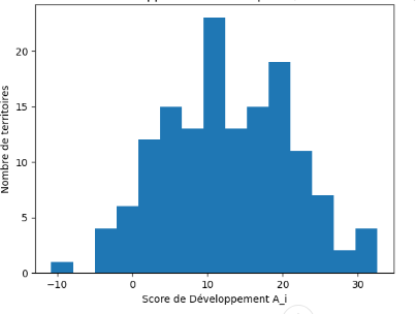
The Figure below represents a quantitative model applicable to the 145 territories with:
1) Generation of variables (decentralization, opportunity, risk, financing);
2) The calculation of management performance Gi;
3) The calculation of the development score Ai;
4) A visualization of the development distribution;
5) A table of the first observations.
Figure 1. Distribution of Airport Development (145 DRC Territories).
Interpretation
1) The distribution shows that some territories have a strong transformation potential (opportunity > risk);
2) Negative or low scores indicate territories dominated by risk;
3) The combined impact of Decentralization + Funding + Opportunity significantly improves development.
This model enables:
1) The ranking of the 145 territories;
2) Budget prioritization;
3) The identification of areas where decentralization is most effective.
In the simulation, the formula used is:
With:
3. Digitization
Digitization represents a true revolution in the way we process and preserve information. This process, which consists of transforming analog data into digital format, has profoundly changed professional and personal practices. Today, digitization is a strategic issue for companies
| [2] | BARTOLI Annie and HERMEL Philippe: « business development: new concepts and practices », Paris, Edition Economica, 1989, 421 pages. |
| [3] | BERNARD GARRETTE, RODOLPHE DURAND and PIERRE DUSSAUGE, STRATEGOR: Strategy, structure, decision, identity, 2nd edition Dunod, 1993, 960 pages. |
| [4] | BIDAULT Francis, the strategic field of the company, Paris, Economica, 1988, 267 pages. |
| [5] | BOITEUX Marcel, « transport: investment choices and birth costs », Paris, General Commissariat of the Plan 2001, 269 pages. |
[2-5]
, cultural institutions, and public administrations public. It offers unprecedented opportunities in terms of accessibility, sharing, and preservation of knowledge. In this section, the objective will be to set up software for digital management of the various RPAs locally, as well as in their collaboration with each other, and between other national and international bodies.
3.1. Choice and Description of the Development Platform
For the implementation of the Software (application) that we will call GESAERO for the 145 Territories of the Democratic Republic of the Congo, we used
| [14] | MAHE DE BOISLANDELLE HENRI, Management Dictionary, Paris, Economica, 1998, 517. |
[14]
:
a) VBA (Visual Basic for Applications);
b) SQL (Structured Query Language) and;
c) Database management system: Microsoft Access.
1) Presentation of VBA (Visual Basic for Applications
Visual Basic for Applications is an object-oriented programming language developed by Microsoft, designed to easily and quickly create Windows applications, particularly thanks to its graphical interface.
2) Presentation of SQL
SQL (Structured Query Language) is the essential standardized language for interacting with relational databases. It allows creating data structures (tables) and manipulating this data via queries to select, insert, update, or delete them. SQL is essential for data management.
3) Microsoft Access
The Access software, published by the American company Microsoft, is a Database Management System (RDBMS). It allows creating, managing, and analyzing data via tables, queries, forms, and reports. It integrates the Jet engine, VBA, and SQL for customizable applications customizable.
3.2. Modeling
The software modeling was carried out around the following three models
| [15] | MAIRE Claude: «business plan methodology » Edition d’Organisation, Paris 2002, 276 pages. MARMUSE Christian, general policy: languages, intelligence, models and strategic choices, Paris, Economica, 2nd edition, 1996, pages 651. |
[15]
:
a) The conceptual data model (MCD);
b) The logical data model (MLD) and;
c) The physical data model (MPD).
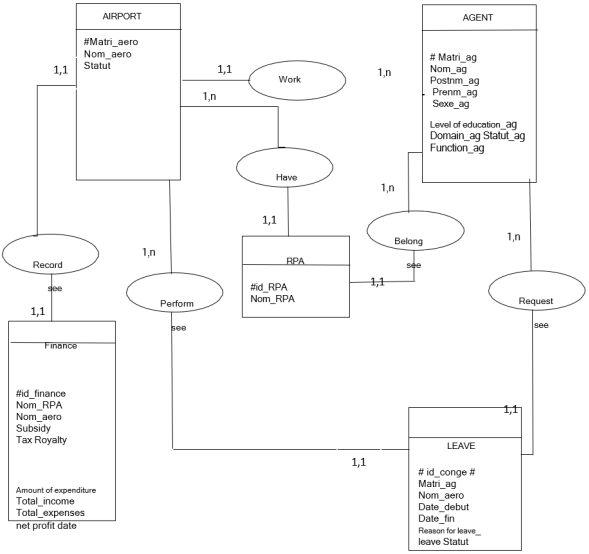
1) Construction of the conceptual data model (MCD)
The MCD is the first design step in MERISE, representing graphically and abstractly the data of a system (objects and relationships) without technical constraints.
Figure 2. Conceptual data model.
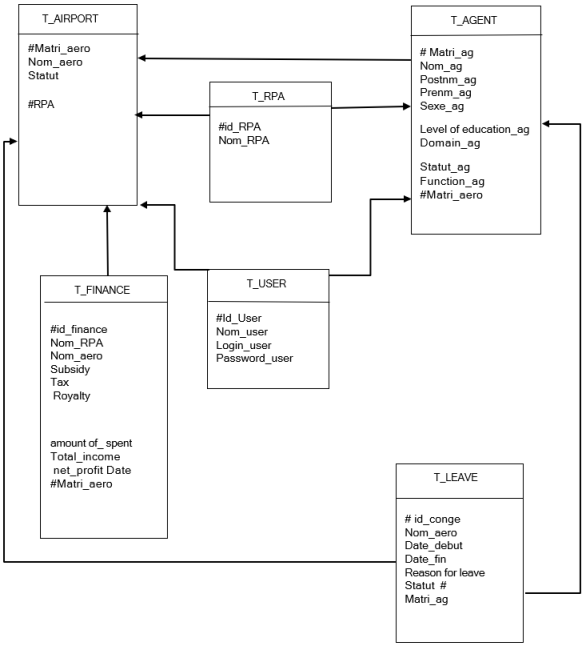
2) Construction of the logical data model (LDM)
In Merise, the LDM is the structuring step that translates the conceptual model of data (CDM) into a structure adapted to DBMS, generally relational (tables, primary keys and foreign keys).
Figure 3. Logical data model.
3) Construction of the physical data model (PDM)
A physical data model is a step of defining data within the physical structure of the computer, that is, the result of the technical decision made based on objects and technical constraints. It is represented as follows
| [16] | MARTINET A. CH., Ahmed Silem, management lexicon, Paris, édition DALLOZ, 2000, 455 pages. |
[16]
:
T_AEROPORT: {#Matri_aero:varchar (10), Nom_aero:varchar (15), statut: varchar (15), #RPA:varchar(15)}
T_AGENT: {#Matri_ag:varchar (10), Nom_ag:varchar (15), Postnm_ag:varchar(15), Prenm_ag:varchar(15), Sexe_ag: varchar(1), Niveau_d’etude_ag;varchar(100), Domaine_ag:varchar(15), Statut_ag:varchar(10), Fonction_ag:varchar(10), #Matri_aero:varchar (10)}
T_RPA: {#id_RPA:varchar (10), Nom_RPA:varchar (15)}
T_FINANCE: {#id_finance:varchar(10), Nom_RPA:varchar(15), Nom_aero:varchar (10), Subsidy:varchar (10), Tax:varchar(10), Fee:varchar(15), Expense amount:varchar(10), Total_revenues:varchar(15), Total expenses:varchar (10),_Net profit:varchar(10), Date:varchar(15), #Matri_aero:varchar (10)}
T_LEAVE: {#id_leave:varchar(10), Nom_aero:varchar(15), Fnd date:varchar (10), Date_fin:varchar (10), Leave reason: varchar(15), Statut: varchar(10), Matri_ag#:varchar (10) }
T_USER: {#id_User: varchar (10), Nom_User: varchar(15), Login_user varchar(10), password_user: varchar (15) }
4. Operation of the GESAERO Software
The GESAERO software constitutes a central tool for the modernization and harmonization of airport management in the Democratic Republic of Congo
| [6] | BRUSSEAU Xavier, Passenger terminal, Edition Techniques de l’Ingénieur T. I, the database documentary: transport infrastructure developments, June 2006, 25 Pages. |
| [7] | CAPET Marcel, CAUSSE Geneviève, MEUNIER Jeanne, Diagnosis, Organization and Business Planning: Diagnosis and General Policy, Volume 1, Paris, Economica, 1986, 587 Pages. |
| [9] | DURAND Rodolphe, strategic management guide, Paris, DUNOD 2003, 392 pages. |
[6, 7, 9]
. Designed to support the administrative, technical and financial management of airports, it ensures integrated monitoring of operations, resources and data within the 145 territories, grouped into 26 provincial airport authorities, airports. Its operation is based on the centralization and digitization of information related to the operation of infrastructure, personnel management, maintenance, revenues and traffic statistics. In a decentralization context, GESAERO facilitates coordination between provincial authorities and central administration, strengthens transparency, improves decision-making and contributes to more efficient, secure and performant management of the national airport network
| [10] | GAUSSANT and COLIN Arnaud: « Transport in the world » Paris, Edition Economica, 1998, 382 pages. |
| [11] | GERVAIS Michel, management control and business planning, Paris, Economica 1989, 774 pages. |
| [12] | GOUSSAUT Michel, transport in the world: geographical syntheses, Armand colin, Paris 1998, 95 pages. HABIB farés, initiation to strategic management, Paris, édition T. S. A, 1990, 192 pages. |
| [13] | HAMMADOUCHE Ahmed, methods and tools for strategic analysis, Algiers, les Editions CHIHAB, 1997, 182 pages. pages. |
| [17] | MARTINET. A. CH, strategy, Paris, VUIBERT, 1983, 320 pages. |
[10-13, 17]
. Its operation is based on the different forms below:
1) Authentication Form;
2) Home Form;
3) Main Menu Form;
4) Airport Form;
5) Agents Form;
6) Leaves Form;
7) Finances Form.
4.1. Authentication Form
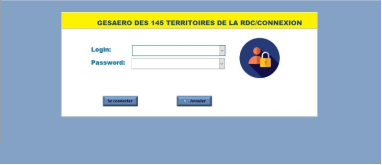
At the start of the application, we have the authentication form which allows users to log in by entering the login (username) and password (personalized password).
4.2. Assignment of Access Signatures
The assignment of signatures is carried out according to the role of each manager based on their power, which is either: view or action. For example, the National Authority will have the signature that will allow it to have viewing rights on the status of airports, the qualifications and skills of agents in order to make them into recommendations as needed; however, he will in no case have the right to modify any status or even have oversight of an RPA's finances. On the other hand, the General Director of an RPA will have the signature that will allow him to have oversight and action rights in the daily management of the company.
The various airport commanders in the RPA airports will have assignments according to their local action powers (
Figure 4).
Figure 4. Authentication Form.
4.3. Welcome Form
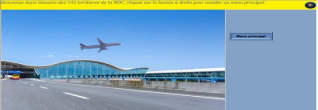
The welcome form allows us to access the application's main menu in order to have access to the forms according to the assignments. By accessing this menu, each form to which we do not have rights will appear obsolete in the implemented software (
Figure 5).
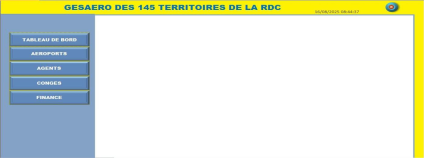
4.4. Main Menu Form
After accessing via the main menu, we will see the interface of 4 main forms constituting the dashboard represented by four main buttons (Sections): airport button, agents button, leave button, and finances button (
Figure 6).
Figure 6. Main menu form.
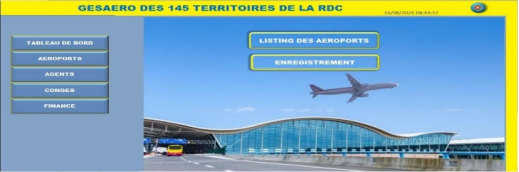
4.5. Airports Form
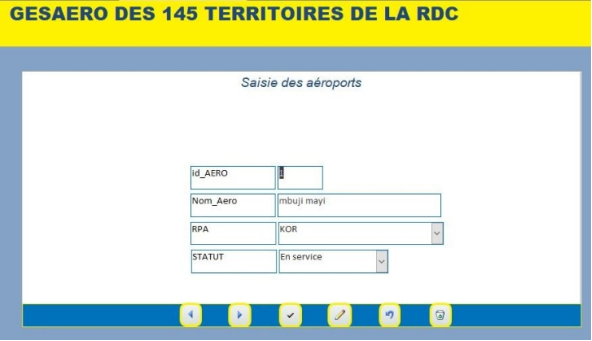
Access to the "Airport form" via the "airports button" allows us to perform actions on the two options: listing of airports and registration (
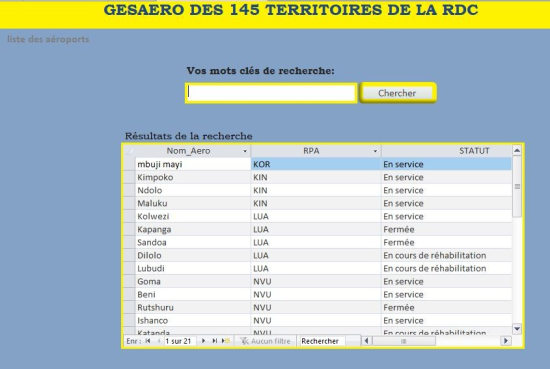
Figure 7). The "Listing of airports" option allows us to search for an airport by its RPA and to know its status in terms of availability and infrastructure condition. The "registration" option allows registering a new airport or updating the status of existing airports according to each RPA by the authorized manager.
The listing of airports will be displayed according to its RPA and the status may be (
Figure 8):
1) In service;
2) Out of service;
3) Under rehabilitation; …
This, after the Board of Directors in an RPA, the development decisions for airports will be made locally in accordance with the revenues (Finance Form) in those airports while following the technical advice of the national authority and international organizations in the matter.
Figure 8. Airport Listing.
After registering a new airport or updating the status of an existing airport in an RPA (
Figure 9); this new status will be available in the listing.
Figure 9. Airport Registration Form.
4.6. Agents Form
Access to the "Agents form" via the "Agents button" allows us to access the two options: Staff Information and Agent Registration (
Figure 10).
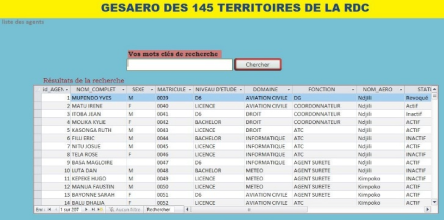
By performing the search on the "staff information button", we have the possibility to obtain the list of agents according to their airports and their RPA, allowing us to know the status, function, qualification, and competence of each agent for any use (
Figure 11).
Figure 11. Agents List Form.
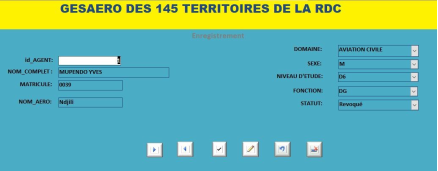
The "Agents Registration" button allows registering a new agent in the database or modifying the information concerning an agent by an authorized manager in an RPA (
Figure 12).
Figure 12. Agent Registration Form.
4.7. Leave Form
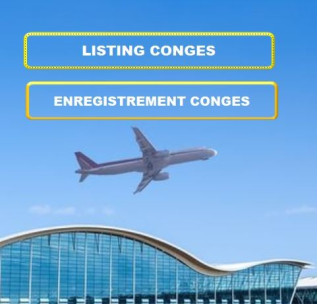
Access to the "Leave Form" via the "Leave" button allows us to access the two options: the leave listing button and the leave registration button (
Figure 13).
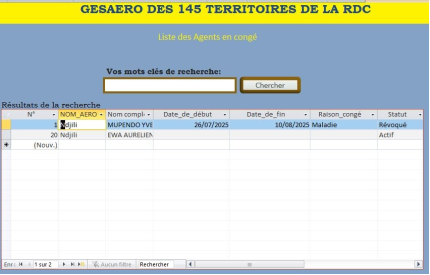
The "leave listing" button takes us to the agent leave search form (
Figure 14). This search is performed once the airport keyword is entered in the search bar. This will allow the authorized instances in each RPA to know the truly active agents and take measures as needed.
Figure 14. Agent Leave Search Form.
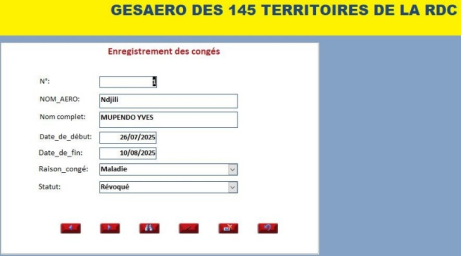
The "leave recording button" takes us to the leave entry form (
Figure 15), which allows the Human Resources Department team to update the agents' availabilities according to their various circumstances.
Figure 15. Leave Recording Form.
4.8. Finance Form
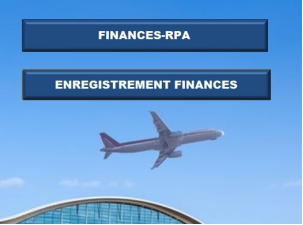
Access to the "Finance Form" via the "Finance" button allows us to access the two options: the RPA finance button and the finance recording button (
Figure 16).
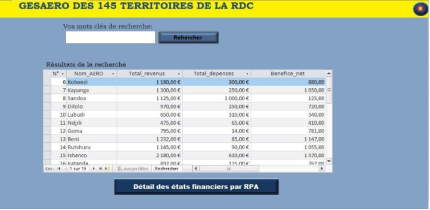
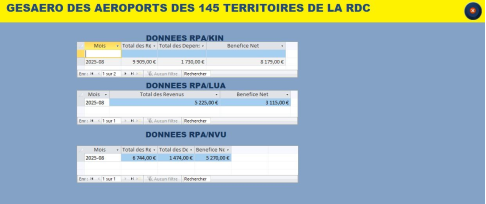
By accessing the RPA finance through managers who have assignments or authorizations according to their functions, we have the details of the financial statements for each airport in an RPA as well as the overall financial situation of the RPA, thus allowing investment decisions to be made locally (
Figures 17 and 18).
Figure 17. Financial Statements Form.
Figure 18. Detailed Financial Statements Form.
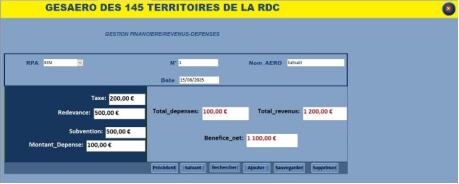
The "enregistrement-finances" option allows updating revenues, grants, and expenses in each airport of an RPA and centralizing net profits at the RPA level in general (
Figure 19).
Figure 19. Revenue and Expense Recording Form by Airport.
5. Conclusion
At the end of this presentation, it clearly appears that the strategic development of the airports of the 145 territories of the Democratic Republic of Congo constitutes a major issue of territorial planning, public governance, and socio-economic development.
This research has demonstrated that territorial airports, long perceived as high-risk infrastructures with low profitability, can become true levers of territorial transformation, provided they are integrated into a coherent, territorialized, and sustainable strategic vision
| [19] | ORSONI J., strategic management: the general policy of the company, Paris, Vuibertentreprise 1990, 186 pages. |
| [20] | ORSONI. J, HELFER Jean-Pierre, strategic management, Paris, Vuibert entreprise, 1994, 256 pages. |
| [21] | PAVAUX Jacques, the economics of air transport: impracticable competition, Paris, Economica, 2nd edition, 1984, 434 pages. |
| [22] | PORTER. M, strategic choices and competition, Paris, Economica, 1982, 426 pages. |
| [23] | QUINET Emile, transport infrastructure and growth, Paris, Economica, 1992, 126 pages. |
| [24] | SICARD Claude, the strategist manager: practical manual of strategic business analysis, Paris, |
| [25] | TARONDEU. J. C, Industrial Strategy, Paris, Vuibert, 1998, 194 Pages. |
| [26] | THIBAUT. J. P, Business diagnosis, Paris, Organisation, 1985, 556 pages. |
| [27] | THIETART Raymond -Alain, business strategy, Paris, EDISCIENCE international, 2nd Editions, 1997, 247 Pages. |
[19-27]
. The shift from risk to opportunity therefore does not result from a simple infrastructural investment, but from a strategic process based on planning, governance, and economic integration. The results have highlighted the main vulnerability factors of territorial airports — financial, institutional, security, and environmental — while emphasizing the conditions necessary for their transformation into development opportunities, particularly through management decentralization, functional specialization, and strengthening of multilevel governance multilevel. On the scientific level, this research makes an original contribution to the literature on territorial development through transport infrastructures, by highlighting the specific role of territorial airports in an African context marked by enclavement and spatial fragmentation spatial. On the operational level, it proposes decision-making tools capable of guiding public policies and investment strategies in the DRC.
In conclusion, this thesis argues that the strategic development of territorial airports can constitute a structuring vector for territorial cohesion, decongestation, and inclusive growth, provided it fits into a long-term vision, supported by a strong political will and effective governance. This conclusion thus opens the way to new reflections and actions, inviting decision-makers, researchers, and territorial actors to rethink the airport not as a burden, but as a strategic opportunity for the sustainable development of the territories of the Democratic Republic of Congo.
Abbreviations
AHP | Analytic Hierarchy Process |
ASEAD | Academy of Sciences & Engineering for Africa Development |
DRC | Democratic Republic of Congo |
IA | Artificial Intelligence |
ISS | Higher Institute of Statistics |
ISTA | Higher Institute of Applied Techniques |
LKM | Léonard Kabeya Mukeba |
MCD | Conceptual Data Model |
MCK | Mbiya Cibasu Kelly |
MLD | Logical Data Model |
MPD | Physical Data Model |
PCA | Principal Component Analysis |
RPA | Provincial Airports Authority |
SQL | Structured Query Language |
SGBD | Database Management System |
SGBDR | Relational Database Management System |
VBA | Visual Basic for Applications |
Acknowledgments
The authors of this article wish to thank the authorities of the Institut Higher Institute of Applied Techniques of Kinshasa, Academy of Sciences & Engineering for Africa Development (ASEAD) Kinshasa, as well as the Higher Institute of Statistics ISS Kinshasa; all from the Democratic Republic of Congo for their considerable scientific contributions during our research.
Author Contributions
Kelly Mbiya Cibasu: Conceptualization, Data curation, Funding acquisition, Investigation, Methodology, Project administration, Resources, Software, Writing – original draft, Writing – review & editing
Leonard Kabeya Mukeba Yakasham: Formal Analysis, Supervision, Validation, Visualization
Conflicts of Interest
The authors declare no conflicts of interest.
References
| [1] |
ANSOFF. I, Corporate Development Strategy, Paris, Editions d’Organisation, 1987, 287.
|
| [2] |
BARTOLI Annie and HERMEL Philippe: « business development: new concepts and practices », Paris, Edition Economica, 1989, 421 pages.
|
| [3] |
BERNARD GARRETTE, RODOLPHE DURAND and PIERRE DUSSAUGE, STRATEGOR: Strategy, structure, decision, identity, 2nd edition Dunod, 1993, 960 pages.
|
| [4] |
BIDAULT Francis, the strategic field of the company, Paris, Economica, 1988, 267 pages.
|
| [5] |
BOITEUX Marcel, « transport: investment choices and birth costs », Paris, General Commissariat of the Plan 2001, 269 pages.
|
| [6] |
BRUSSEAU Xavier, Passenger terminal, Edition Techniques de l’Ingénieur T. I, the database documentary: transport infrastructure developments, June 2006, 25 Pages.
|
| [7] |
CAPET Marcel, CAUSSE Geneviève, MEUNIER Jeanne, Diagnosis, Organization and Business Planning: Diagnosis and General Policy, Volume 1, Paris, Economica, 1986, 587 Pages.
|
| [8] |
DESREUMAUX. A, Strategy, Paris, Dalloz, 1993, 657 pages.
|
| [9] |
DURAND Rodolphe, strategic management guide, Paris, DUNOD 2003, 392 pages.
|
| [10] |
GAUSSANT and COLIN Arnaud: « Transport in the world » Paris, Edition Economica, 1998, 382 pages.
|
| [11] |
GERVAIS Michel, management control and business planning, Paris, Economica 1989, 774 pages.
|
| [12] |
GOUSSAUT Michel, transport in the world: geographical syntheses, Armand colin, Paris 1998, 95 pages. HABIB farés, initiation to strategic management, Paris, édition T. S. A, 1990, 192 pages.
|
| [13] |
HAMMADOUCHE Ahmed, methods and tools for strategic analysis, Algiers, les Editions CHIHAB, 1997, 182 pages. pages.
|
| [14] |
MAHE DE BOISLANDELLE HENRI, Management Dictionary, Paris, Economica, 1998, 517.
|
| [15] |
MAIRE Claude: «business plan methodology » Edition d’Organisation, Paris 2002, 276 pages. MARMUSE Christian, general policy: languages, intelligence, models and strategic choices, Paris, Economica, 2nd edition, 1996, pages 651.
|
| [16] |
MARTINET A. CH., Ahmed Silem, management lexicon, Paris, édition DALLOZ, 2000, 455 pages.
|
| [17] |
MARTINET. A. CH, strategy, Paris, VUIBERT, 1983, 320 pages.
|
| [18] |
MERLIN Pierre, Air transport, Paris, Edition PUF, 2002, 127 pages.
|
| [19] |
ORSONI J., strategic management: the general policy of the company, Paris, Vuibertentreprise 1990, 186 pages.
|
| [20] |
ORSONI. J, HELFER Jean-Pierre, strategic management, Paris, Vuibert entreprise, 1994, 256 pages.
|
| [21] |
PAVAUX Jacques, the economics of air transport: impracticable competition, Paris, Economica, 2nd edition, 1984, 434 pages.
|
| [22] |
PORTER. M, strategic choices and competition, Paris, Economica, 1982, 426 pages.
|
| [23] |
QUINET Emile, transport infrastructure and growth, Paris, Economica, 1992, 126 pages.
|
| [24] |
SICARD Claude, the strategist manager: practical manual of strategic business analysis, Paris,
|
| [25] |
TARONDEU. J. C, Industrial Strategy, Paris, Vuibert, 1998, 194 Pages.
|
| [26] |
THIBAUT. J. P, Business diagnosis, Paris, Organisation, 1985, 556 pages.
|
| [27] |
THIETART Raymond -Alain, business strategy, Paris, EDISCIENCE international, 2nd Editions, 1997, 247 Pages.
|
Cite This Article
-
APA Style
Cibasu, K. M., Yakasham, L. K. M. (2026). Study of the Development of Airports in 145 Territories of the Democratic Republic of the Congo: From Risk to Opportunity. Applied Engineering, 10(1), 6-16. https://doi.org/10.11648/j.ae.20261001.12
 Copy
|
Copy
|
 Download
ACS Style
Cibasu, K. M.; Yakasham, L. K. M. Study of the Development of Airports in 145 Territories of the Democratic Republic of the Congo: From Risk to Opportunity. Appl. Eng. 2026, 10(1), 6-16. doi: 10.11648/j.ae.20261001.12
Copy
|
Download
AMA Style
Cibasu KM, Yakasham LKM. Study of the Development of Airports in 145 Territories of the Democratic Republic of the Congo: From Risk to Opportunity. Appl Eng. 2026;10(1):6-16. doi: 10.11648/j.ae.20261001.12
Copy
|
Download
-
@article{10.11648/j.ae.20261001.12,
  author = {Kelly Mbiya Cibasu and Leonard Kabeya Mukeba Yakasham},
  title = {Study of the Development of Airports in 145 Territories of the Democratic Republic of the Congo: From Risk to Opportunity},
  journal = {Applied Engineering},
  volume = {10},
  number = {1},
  pages = {6-16},
  doi = {10.11648/j.ae.20261001.12},
  url = {https://doi.org/10.11648/j.ae.20261001.12},
  eprint = {https://article.sciencepublishinggroup.com/pdf/10.11648.j.ae.20261001.12},
  abstract = {In addition to having to guarantee imperatives of safety, security, adaptability and modernization, air transport must now ensure environmental performance and a very important socio-economic role. The airport is in no way exempt from this rule as a direct interface of this mode of transport with society. It must thus deal with the priority issues of a population aspiring to sustainable and effective development on their quality of life. This necessarily imposes new constraints on airport managers in terms of mastering impacts, governance of airport activity as well as communication with local residents and the territorial communities of implantation. The consideration of social and environmental concerns, almost absent from the debates during the creation of the majority of airports, constitutes today a responsibility and a major challenge for airport managers. Societal issues thus contribute to a more global appreciation of airport performance and allow rethinking the place of the modern airport in the city. The theme: " Study of the development of Airports in 145 territories of the Republic of the Democratic Republic of the Congo: from Risk to Opportunity " consists of an analysis of the current management of the airports in 145 territories of the Democratic Republic of the Congo, their operation, and the states of airport infrastructures, in order to determine and implement a new management strategy focused on the development of airports by Provinces and Territories. The objective is to establish a contribution to the analysis and reflection on the development of airports in the Democratic Republic of the Congo by fostering a debate on the possibilities and solutions to be implemented to ensure the development and sustainability of airports locally within the framework of air transport.},
 year = {2026}
}
Copy
|
Download
-
TY  - JOUR
T1  - Study of the Development of Airports in 145 Territories of the Democratic Republic of the Congo: From Risk to Opportunity
AU  - Kelly Mbiya Cibasu
AU  - Leonard Kabeya Mukeba Yakasham
Y1  - 2026/05/21
PY  - 2026
N1  - https://doi.org/10.11648/j.ae.20261001.12
DO  - 10.11648/j.ae.20261001.12
T2  - Applied Engineering
JF  - Applied Engineering
JO  - Applied Engineering
SP  - 6
EP  - 16
PB  - Science Publishing Group
SN  - 2994-7456
UR  - https://doi.org/10.11648/j.ae.20261001.12
AB  - In addition to having to guarantee imperatives of safety, security, adaptability and modernization, air transport must now ensure environmental performance and a very important socio-economic role. The airport is in no way exempt from this rule as a direct interface of this mode of transport with society. It must thus deal with the priority issues of a population aspiring to sustainable and effective development on their quality of life. This necessarily imposes new constraints on airport managers in terms of mastering impacts, governance of airport activity as well as communication with local residents and the territorial communities of implantation. The consideration of social and environmental concerns, almost absent from the debates during the creation of the majority of airports, constitutes today a responsibility and a major challenge for airport managers. Societal issues thus contribute to a more global appreciation of airport performance and allow rethinking the place of the modern airport in the city. The theme: " Study of the development of Airports in 145 territories of the Republic of the Democratic Republic of the Congo: from Risk to Opportunity " consists of an analysis of the current management of the airports in 145 territories of the Democratic Republic of the Congo, their operation, and the states of airport infrastructures, in order to determine and implement a new management strategy focused on the development of airports by Provinces and Territories. The objective is to establish a contribution to the analysis and reflection on the development of airports in the Democratic Republic of the Congo by fostering a debate on the possibilities and solutions to be implemented to ensure the development and sustainability of airports locally within the framework of air transport.
VL  - 10
IS  - 1
ER  -
Copy
|
Download






 Share This Article
 Twitter
 Linked In
 Facebook