1. Introduction
Agriculture plays a central role in the Ethiopian economy, contributing significantly to national GDP and providing livelihoods for the majority of the population
. The sector not only sustains the livelihoods of most of the population but also plays a critical role in ensuring food security. However, in Ethiopia and across Sub-Saharan Africa, declining soil fertility is frequently the main challenge affecting agricultural productivity
| [2] | Hailu H, Feyissa S (2023). Role of integrated nutrient management on soil fertility improvement and selected crop production in Ethiopia: A review. International Journal of Applied Agricultural Sciences 9(5): 149-158. |
| [3] | Shumi D (2024). Integrated soil fertility management for improving maize production in Ethiopia. Asian Journal of Research and Review in Agriculture 6(1): 98-108. |
[2, 3]
. In developing countries, intensive agricultural practices often lead to soil degradation due to improper use of inorganic fertilizers and a lack of organic fertilization
| [4] | Bitew B, Molla E, Tadesse T, Bekis D (2024). Effects of organic and inorganic fertilizers on soil properties of lowland rice on Vertisols of Fogera District, Northwestern Ethiopia. American Journal of Applied Chemistry 12(3): 64-76. |
[4]
.
Inorganic fertilizers can alleviate soil fertility limitations and improve crop yields. However, their use is often restricted due to high cost, limited availability, and inefficient management practices. As a result, many smallholder farmers are unable to apply recommended fertilizer rates
| [5] | International Food Policy Research Institute (IFPRI) (2023). Grappling with compounding crises in domestic fertilizer markets in Africa: The case of Ethiopia. Available at:
https://www.ifpri.org |
[5]
. In addition, excessive reliance on chemical nitrogen fertilizers has raised increasing global concerns due to both economic and environmental impacts. Consequently, the development of cost-effective and environmentally sustainable agricultural practices is essential for improving productivity while maintaining soil health in rain-fed farming systems
| [6] | Wang X, Zhao Y, Chen J, Li Y (2024). Environmental impacts of excessive nitrogen fertilizer application and the potential of green alternatives in sustainable crop production. Sustainability 16(3): 1459. |
[6]
.
In smallholder farming systems, cereal-legume intercropping is widely recognized as an effective strategy for improving crop productivity and resource-use efficiency. Intercropping enhances the utilization of common resources, consisting sunlight, water, nutrients, and space, thereby increasing land productivity compared with monocropping systems
| [7] | Fu Z, Chen P, Zhang X, Du Q, Zheng B, Yang H, Luo K, Lin P, Li Y, Pu T, Wu Y (2023). Maize-legume intercropping achieves yield advantages by improving leaf functions and dry matter partition. BMC Plant Biology 23: 438.
https://doi.org/10.1186/s12870-023-04416-3 |
[7]
. Maize-haricot bean intercropping supports smallholder farming by improving nitrogen availability, providing higher protein content, and optimizing spatial and temporal resource utilization to increase land productivity
| [8] | Chala A, Workina M, Kitila K (2024). Effect of intercropping of different varieties of haricot beans (Phaseolus vulgaris L.) and maize (Zea mays L.) on soil fertility and yield at Shashamene, Ethiopia. International Journal of Environmental Chemistry 8(1): 12-17.
https://doi.org/10.11648/j.ijec.20240801.12 |
[8]
. Legumes, such as common bean (bush and climbing types), soybean, groundnut, faba bean, and field pea, are commonly intercropped with major cereals such as maize and sorghum to enhance soil fertility and optimize resource use
| [9] | Agegnehu G, Nelson PN, Bird MI (2015). Crop yield, plant nutrient uptake and soil physicochemical properties under organic soil amendments and nitrogen fertilization on Nitisols. Soil and Tillage Research 141: 20-30.
https://doi.org/10.1016/j.still.2014.02.003 |
[9]
. In the western Oromia Region, haricot bean is commonly intercropped with major cereals such as maize and sorghum to enhance productivity and soil fertility.
Several previous studies have demonstrated that cereal-legume intercropping systems can increase land productivity, improve nutrient cycling, and enhance farm profitability under controlled experimental conditions
| [7] | Fu Z, Chen P, Zhang X, Du Q, Zheng B, Yang H, Luo K, Lin P, Li Y, Pu T, Wu Y (2023). Maize-legume intercropping achieves yield advantages by improving leaf functions and dry matter partition. BMC Plant Biology 23: 438.
https://doi.org/10.1186/s12870-023-04416-3 |
| [10] | Lithourgidis AS, Dordas CA, Damalas CA, Vlachostergios DN (2011). Annual intercrops: An alternative pathway for sustainable agriculture. Australian Journal of Crop Science 5(4): 396-410. |
| [11] | Negassa W, Price RF, Basir A, Snapp SS, Kravchenko A (2015). Cover crop and tillage systems effect on soil CO2 and N2O fluxes in contrasting topographic positions. Soil and Tillage Research 154: 64-74. |
[7, 10, 11]
. However, most of these studies were focused on single agronomic factors in isolation (planting density, variety, or planting time separately), whereas the combined interactive effects of these factors on soil fertility, system productivity, and economic performance remain poorly understood, particularly in the high-rainfall Nitisol regions of western Oromia
| [10] | Lithourgidis AS, Dordas CA, Damalas CA, Vlachostergios DN (2011). Annual intercrops: An alternative pathway for sustainable agriculture. Australian Journal of Crop Science 5(4): 396-410. |
[10]
. This lack of integrated, location-specific information constrains the development of evidence-based recommendations and limits the productivity of maize-haricot bean intercropping in Sibu Sire district. Thus, there is a clear need for systematic research to generate location-specific agronomic recommendations on optimum haricot bean planting density, suitable bean varieties, and appropriate planting time for maize-haricot bean intercropping in Sibu Sire district.
To implement scientific cereal legume intercropping, research was conducted for two main cropping season (2023 and 2024) in the Sibu Sire district by the Nekemte Soil Research Center. However, before the findings can be popularized, demonstrated, or scaled up to stakeholders, careful evaluation and verification of the results are essential. Such verification is mandatory to ensure reliable recommendations and successful adoption of the technology. Therefore, this study was designed with the following objectives:
1) To verify the recommended maize- haricot bean intercropping pattern in Sibu Sire district.
2) To create awareness for stalk holders about use of cereal- legume intercropping for production and soil fertility improvement.
2. Materials and Methods
2.1. Description of the Study Area
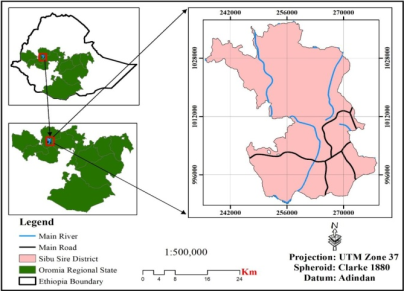
The study area, Sibu Sire District, is located about 270 km west of the capital city of Ethiopia, Finfinne. It lies between 8°56' to 9°23' N latitudes and 36°35' to 36°56' E longitudes (
Figure 1). The altitude of the district varies from 1336 to 2500 meters above sea level. It has an estimated area of 1,132.51 km. About 74.2% of its surface area belongs to Mid-altitude 7.53% of the land is highland agro climate and the remaining 18.27% is classified as low land agro climate. The mean annual temperature and mean annual rain fall is 250
OC and 1050 mm, respectively
| [11] | Negassa W, Price RF, Basir A, Snapp SS, Kravchenko A (2015). Cover crop and tillage systems effect on soil CO2 and N2O fluxes in contrasting topographic positions. Soil and Tillage Research 154: 64-74. |
[11]
.
Figure 1. Location map of the study area.
The terrain is generally undulating to rolling plains. The major soil types are generally described as Nitisols according to FAO soil classification system
| [12] | Food and Agriculture Organization (FAO) (1986). The Ethiopian Highlands Reclamation Study (EHRS). Main Report. FAO, Rome. |
[12]
. This soil is characterized as deep, well-drained, red, tropical soils with diffuse horizon boundaries and a clay-rich nitic subsurface horizon. In general, this soil is highly weathered, well drained, clay in texture and strongly to moderately acidic in reaction
| [13] | Abayneh, E., Ashenafi, A., & Ayele, T. (2006). Soils of Ethiopia and their agricultural potential. Addis Ababa, Ethiopia: Ethiopian Institute of Agricultural Research (EIAR). |
[13]
. The major annual and perennial crops grown in the study area are maize (Zea mays L.), sorghum (Sorghum bicolor L.), teff (Eragrostis tef), hot pepper (Capsicum frutescence L.), sweet potato (Ipomoea batatas L.), coffee (Coffe arabica L.), and sugarcane (Saccharum officinarum L.)
| [14] | Mesfin A (1998). Nature and Management of Ethiopian Soils. Alemaya University of Agriculture, Ethiopia. |
[14]
.
2.2. Treatments and Experimental Design
The trial was conducted on five purposively selected farmers’ fields in Sibu Sire district. Farmers were selected based on their willingness to participate, accessibility of the field, and soil phosphorus status (less than p critical level). Appropriate Improved maize variety (“BH-549”) was used. The experimental plots were plowed and prepared according to farmers’ conventional farming practice. The soil test crop response-based fertilizer recommendation was used. The optimum N, phosphorus critical and requirement factor were 138 kg/ha, 10 and 20.63 respectively. The experiment consisted of three treatments: sole maize planting (Sole), farmers practiced intercropping pattern (FPIP), and research-based intercropping pattern (RBIP). Research based intercropping pattern is intercropping haricot bean variety (Ibado), density (two side planting which is 88,888 plant ha-1) and time of intercropping (during maize planting.
The experiment was arranged using a randomized complete block design (RCBD), where the participating farmers’ fields were considered as blocks to account for field variability among locations. Each treatment was replicated three times within each block. This design allowed the evaluation of treatment effects while controlling for variability in soil properties and management conditions across farmers’ fields. The plot size was 10 m × 10 m. Plots within blocks were separated by 0.5 m, while blocks were separated by 1 m pathways.
Maize and haricot bean were planted during the main cropping season on (25 may 2024). Harvesting of haricot bean was carried out on (20 August 2024), while maize was harvested on (20 September 2024). Maize was planted with 75 cm rows and 30 cm between plants. The beans were planted 15 cm away from maize rows for research-based intercropping while in the rows of maize for farmers practiced intercropping. Nitrogen fertilizer was applied in the form of urea in two splits (1/3 at planting and 2/3 at three weeks after planting) while all recommended P fertilizer was applied at planting.
2.3. Soil Sampling, Preparation and Analysis Procedures
Soil samples were collected from each experimental site before planting and after crop harvest to evaluate changes in soil chemical properties. Prior to planting, soil samples were collected from the experimental fields at a depth of 0-20 cm using a soil auger. From each field, five subsamples were taken randomly following a zigzag sampling pattern across the plot area. These subsamples were thoroughly mixed to form one composite soil sample representing each experimental field.
Similarly, after crop harvest, soil samples were collected from each treatment plot at the same depth (0-20 cm). Five subsamples were taken from different points within each plot and composited to obtain one representative sample per plot. The collected soil samples were air-dried, gently crushed, and passed through a 2-mm sieve prior to laboratory analysis.
The prepared samples were analyzed for soil pH, organic carbon (OC), total nitrogen (TN), available phosphorus (Av.P), exchangeable acidity, exchangeable Ca, exchangeable Mg, and cation exchange capacity (CEC) using standard laboratory procedures.
2.4. Data Collection and Analysis
Important yield and yield related parameters of both components like; Plant height (cm), Cob length (cm), Number of seeds per cob (No); Number of branches per plants (cm), Number pods per plant (No), Number of seeds per pods (No), biomass yield (kg/ha) and grain yield (kg/ha) were collected and analyzed. One composite sub-sample from each of five farmer’s sites before planting and from each plot after harvesting were collected for the determination of important soil properties. All data recorded and collected were subjected to the procedure of analysis of variance (ANOVA) using SAS software program. The comparisons among treatment means were employed by using Least Significance Difference (LSD) at 5% significant level.
3. Results and Discussions
3.1. Soil Properties Before Planting and After Harvest Under Different Treatments
The mean soil pH, organic C, total N, Available P, exchangeable acidity, exchangeable Ca, exchangeable Mg and CEC before and after harvest were presented in (
Table 1). The initial soil condition before planting provides the baseline for evaluating treatment-induced changes. The soil was strongly acidic (pH 4.94), with moderate levels of organic carbon (2.43%) and total nitrogen (0.21%), low available phosphorus (6.40 ppm), relatively high exchangeable acidity (1.98 cmol(+)/kg), and high CEC (25.71 cmol(+)/kg). These characteristics are typical of many tropical soils under continuous cultivation, where nutrient mining, erosion, and limited organic matter inputs contribute to acidification and nutrient depletion
| [15] | Food and Agriculture Organization (FAO) (2006). Guidelines for Soil Description. 4th ed. FAO, Rome. |
| [16] | Brady NC, Weil RR (2017). The Nature and Properties of Soils. 15th ed. Pearson Education, New York. |
[15, 16]
.
The results of after harvest soil chemical properties indicated that both intercropping patterns improved most soil fertility characteristics of experimental sites as compared to sole maize planting and before planting soil parameters (
Table 1). The greatest positive most fertility characteristics of experimental soil were obtained from research based recommended intercropping patterns as compared to both farmers practiced intercropping and sole maize planting. Soil pH increased from 4.94 (strongly acidic) to 5.40 under all treatments (+9.3%). This improvement indicates a reduction in active acidity and exchangeable Al
3+, consistent with the sharp drop in exchangeable acidity. According to
| [16] | Brady NC, Weil RR (2017). The Nature and Properties of Soils. 15th ed. Pearson Education, New York. |
[16]
, increases in soil pH often result from organic matter decomposition releasing basic cations and reduced Al
3+ toxicity. Research based intercropping patterns intercropping patterns improved organic carbon, Total Nitrogen, Available Phosphorus, Exchangeable Acidity, Exchangeable Ca and Exchangeable Mg by about +26.3 +23.8, +10.3, -69.7, +11.9% and +3.9% respectively as compared to before planting soil properties.
The rise in pH is consistent with findings by
| [17] | Zhang, F., Li, L., Sun, J., Christie, P., Zhang, J., Li, X., & Tang, C. (2009). Intercropping and nutrient management in China: Review of agronomic and environmental benefits. Plant and Soil, 321(1-2), 329-341.
https://doi.org/10.1007/s11104-008-9772-4 |
[17]
, who reported that intercropping increases soil pH through increased organic matter and enhanced cation exchange. The highest improvement of organic carbon under research based intercropping pattern indicates greater biomass return and decomposition. Organic carbon increases reflect an improvement in soil organic matter status. According to
| [18] | Havlin JL, Tisdale SL, Nelson WL, Beaton JD (2014). Soil Fertility and Fertilizers: An Introduction to Nutrient Management. 8th ed. Pearson Education. |
[18]
findings, organic inputs improve Soil structure, Microbial activity, Nutrient cycling. Research based on intercropping patterns appears to supply more organic residues, leading to better carbon stabilization. Nitrogen is primarily stored in organic matter; TN closely follows OC increases. Research based intercropping pattern produced the highest TN increase due to enhanced nitrogen mineralization. According to
| [19] | Palm CA, Gachengo CN, Delve RJ, Cadisch G, Giller KE (2001). Organic inputs for soil fertility management in tropical agroecosystems: Application of an organic resource database. Agriculture, Ecosystems and Environment 83: 27-42. |
[19]
, treatments with higher biomass return enhance soil N through decomposition and microbial turnover. The decline in P under the sole maize system shows the risk of nutrient mining and long-term soil degradation under monocropping without replenishment. While the increased available P, under intercropping is likely because organic inputs release P during decomposition, higher pH reduces P fixation by Fe and Al oxides and Root organic acids mobilize P
| [20] | Holford ICR (1997). Soil phosphorus: Its measurement and its uptake by plants. Australian Journal of Soil Research 35(2): 227-240. |
[20]
.
Lower EA means reduced Al
3+ and H
+ toxicity, improving root growth
| [15] | Food and Agriculture Organization (FAO) (2006). Guidelines for Soil Description. 4th ed. FAO, Rome. |
[15]
. Organic matter complexes Al
3+ and reduces acidity. Increases in Ca and Mg reflect Organic inputs releasing base cations. Reduced acidity improving cation retention
| [16] | Brady NC, Weil RR (2017). The Nature and Properties of Soils. 15th ed. Pearson Education, New York. |
[16]
.
The slight variation in soil Cation Exchange Capacity (CEC) among treatments may be attributed to differences in crop residue contribution, root activity, and nutrient cycling under the various intercropping arrangements. Intercropping systems, particularly those involving legumes such as haricot bean, can influence soil chemical properties through biological nitrogen fixation, root exudates, and the addition of organic residues to the soil. Intercropping systems are widely reported to enhance soil fertility through greater biomass return, improved nutrient use efficiency, and increased soil biological activity
| [10] | Lithourgidis AS, Dordas CA, Damalas CA, Vlachostergios DN (2011). Annual intercrops: An alternative pathway for sustainable agriculture. Australian Journal of Crop Science 5(4): 396-410. |
| [21] | Cong, W. F., Hoffland, E., Li, L., Six, J., Sun, J., Bao, X., Zhang, F., & van der Werf, W. (2015). Intercropping enhances soil carbon and nitrogen. Agriculture, Ecosystems & Environment, 213, 1-12. https://doi.org/10.1016/j.agee.2015.07.009 |
[10, 21]
. These processes may enhance soil organic matter content and consequently improve the soil’s capacity to retain exchangeable cations. However, because CEC is a relatively stable soil property and the experiment was conducted over a short period, the differences observed among treatments were small. Similar observations have been reported in intercropping systems where short-term management practices caused only slight changes in soil CEC
| [18] | Havlin JL, Tisdale SL, Nelson WL, Beaton JD (2014). Soil Fertility and Fertilizers: An Introduction to Nutrient Management. 8th ed. Pearson Education. |
[18]
.
Table 1. Soil Chemical Properties Before Planting and after harvest under Different treatments.
| Soil chemical properties |
pH (H2O) | OC (%) | TN (%) | AV.P (ppm) | EA cmol(+)/Kg | E.Ca cmol(+)/Kg | E.Mg cmol(+)/Kg | CEC cmol(+)/Kg |
Before planting | 4.94 | 2.43 | 0.21 | 6.40 | 1.98 | 10.10 | 9.50 | 25.71 |
Treatments (after harvest) | | | | | | | | |
Sole | 5.40 | 2.80 | 0.24 | 6.10 | 0.59 | 10.4 | 9.50 | 26.71 |
FPIP | 5.40 | 2.94 | 0.25 | 6.90 | 0.63 | 11.2 | 9.70 | 26.78 |
RBIP | 5.40 | 3.07 | 0.26 | 7.06 | 0.60 | 11.3 | 9.87 | 26.03 |
Where pH = power of hydrogen; OC = Organic carbon; TN = Total Nitrogen; Av.P = Available Phosphorus; EA = Exchangeable acidity; E. Ca = Exchangeable calcium; E. Mg = Exchangeable magnesium; CEC = Cation exchange capacity; FPIP = Farmers practiced intercropping pattern and Research based intercropping pattern
3.2. Effect of the Treatments on Growth and Yield Related Parameters of Maize
Plant Height (PH):
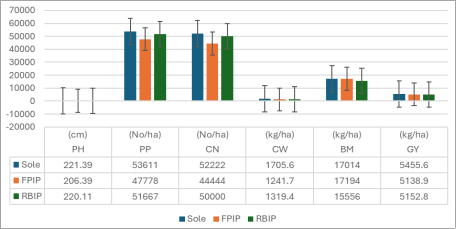
Maize Plant height was not significantly influenced by the treatments (P > 0.05). Mean plant height ranged from 206.39 cm under farmers practiced intercropping system to 221.39 cm under the sole maize planting, while research-based intercropping recorded 220.11 cm (
Figure 2). Although sole maize produced slightly taller plants, the differences among treatments were smaller than the LSD (25.14 cm) and therefore not statistically significant at the 5% probability level.
Figure 2. Yields and yield related parameters of maize as affected by the treatments.
Where Sole = sole maize planting FPIP = farmers practiced intercropping pattern; RBIP = research based intercropping pattern; Sig = significance; LSD = least significance difference; NS= Not significant, CV = Coefficient of variation; PH = plant height; PP = Plant population density; CN = cob number; CW = cob weight; BM = biomass yield and GY = grain yield
The lack of a significant response of plant height to intercropping agrees with previous findings that maize height is often stable even when grown with companion crops, because height is strongly genetically controlled and less sensitive to moderate competition
| [10] | Lithourgidis AS, Dordas CA, Damalas CA, Vlachostergios DN (2011). Annual intercrops: An alternative pathway for sustainable agriculture. Australian Journal of Crop Science 5(4): 396-410. |
| [21] | Cong, W. F., Hoffland, E., Li, L., Six, J., Sun, J., Bao, X., Zhang, F., & van der Werf, W. (2015). Intercropping enhances soil carbon and nitrogen. Agriculture, Ecosystems & Environment, 213, 1-12. https://doi.org/10.1016/j.agee.2015.07.009 |
[10, 21]
. The slightly reduced height under farmers practiced intercropping may reflect higher competition for light, nutrients, or moisture resulting from farmers’ less-optimized intercropping patterns. By contrast, research based intercropping patterns which are structured to minimize spatial competition, maintained height values close to those of sole maize, consistent with research showing that well-designed intercropping reduces competitive stress
| [22] | Willey, R. W. (1979). Intercropping: Its importance and research needs. Part 1. Competition and yield advantages. Field Crop Abstracts, 32(1), 1-10. |
[22]
.
Plant Population (PP): Maize plant population density also showed no significant differences among treatments (P > 0.05). The mean maize plant population varied between 47,778 plants ha
-1 (farmers practiced intercropping patterns) and 53,611 plants ha
-1 (Sole maize planting), with research based intercropping patterns at 51,667 plants ha
-1 (
Figure 2). The similarity in maize plant population indicates good crop establishment across treatments and suggests that the intercropping patterns used did not adversely affect maize emergence. This finding agrees with
| [23] | Workayehu T (2014). Maize-bean intercropping: Effects on maize yield components and productivity. Journal of Agricultural Research 3(2): 45-52. |
[23]
, who reported that properly spaced intercropping systems do not negatively influence maize stand count.
Cob Number (CN): Maize cob number per hectare ranged from 44,444 (farmers practiced intercropping patterns) to 52,222 (Sole maize planting), but again the differences were not statistically significant (P > 0.05) (
Figure 2). Farmers practiced intercropping patterns tended to produce fewer cobs (−14.9% relative to Sole), while research based intercropping patterns were closer to Sole (−4.2%). Cob number is strongly associated with plant vigor and resource availability during the early reproductive phase
| [24] | Tsubo M, Walker S (2014). Shade and fertility effects on maize and bean yields in a tropical agroforestry system. Agricultural and Forest Meteorology 119: 1-17. |
[24]
. The lower maize cob number under farmers practiced intercropping patterns likely reflects the less optimal plant arrangement and greater competitive interactions characteristic of farmers’ traditional methods. However, due to experimental variability (CV = 10.67%), these numerical differences were not statistically reliable.
Maize Cob Weight (CW): Maize cob weight exhibited relatively large numerical differences among treatments 1705.6 kg ha
-1 (Sole maize planting), 1241.7 kg ha
-1 (farmers practiced intercropping), and 1319.4 kg ha
-1 (research based intercropping patterns) (
Figure 2). Farmers practiced intercropping and research based intercropping patterns recorded 27.2% and 22.6% lower maize cob weight than Sole, respectively, but the variation was not statistically significant (P > 0.05). Researchers have reported that cob weight is highly responsive to stress and competition, especially under intercropping
| [25] | Dhima KV, Lithourgidis AS, Vasilakoglou IB, Dordas CA (2007). Competition indices of common vetch and cereal intercrops in two seeding ratios. Field Crops Research 100(2): 249-256. |
| [26] | Egbe OM (2010). Effects of plant density of intercropped soybean with tall sorghum on soybean yield and yield components in Central Guinea Savanna of Nigeria. Journal of Agriculture and Rural Development in the Tropics and Subtropics 111(1): 23-28. |
[25, 26]
, the numerical reduction in farmers practiced intercropping may reflect competitive pressure, but the non-significance implies that the experiment could not detect a treatment-driven effect with confidence.
Aboveground Biomass (BM): The maize total biomass yield ranged from 15,556 kg ha
-1 (research based intercropping system) to 17,194 kg ha
-1 (farmers practiced intercropping system), with sole maize at 17,014 kg ha
-1 (
Figure 2). These differences were also non-significant at the 5% level. Interestingly, farmers practiced intercropping systems which produced slightly higher biomass (+1.06% relative to Sole), though it did not translate into higher grain yield or cob traits. This aligns with findings that biomass can remain high in intercropping systems even when reproductive yield declines, due to increased vegetative competition (Ghosh, 2004).
Grain Yield (GY): Maize grain yield showed no significant response to the treatments (P > 0.05), despite numerical differences (
Figure 2). The highest maize grain yield was obtained under sole maize (5455.6 kg ha
-1), followed by research based (5152.8 kg ha
-1) and farmers practiced intercropping system (5138.9 kg ha
-1). The maximum difference (316.7 kg ha
-1) was far below the LSD (1208.2 kg ha
-1), confirming the statistical similarity of yields across treatments. This result is consistent with previous studies showing that maize yields under well-managed intercropping systems are often comparable to sole cropping
| [10] | Lithourgidis AS, Dordas CA, Damalas CA, Vlachostergios DN (2011). Annual intercrops: An alternative pathway for sustainable agriculture. Australian Journal of Crop Science 5(4): 396-410. |
| [11] | Negassa W, Price RF, Basir A, Snapp SS, Kravchenko A (2015). Cover crop and tillage systems effect on soil CO2 and N2O fluxes in contrasting topographic positions. Soil and Tillage Research 154: 64-74. |
[10, 11]
. The slightly better performance of research based recommended intercropping systems relative to local practiced supports the principle that intercrop design strongly affects maize performance, and optimized arrangements reduce competition
| [27] | Mucheru-Muna M, Pypers P, Mugendi D, Kung’u J, Mugwe J, Merckx R, Vanlauwe B (2010). Enhancing maize productivity and profitability using organic and mineral fertilizers in central Kenya smallholdings. Experimental Agriculture 46(1): 1-22. |
[27]
.
Harvest Index (HI): Maize harvest index ranged from 30.10% (farmers practiced) to 33.96% (research based recommended intercropping system), with sole at 32.46% (
Figure 2). Differences were not statistically significant (P > 0.05). HI values indicate the proportion of assimilates allocated to grain relative to biomass. The slightly higher HI in RBIP suggests more efficient partitioning, which may reflect improved spatial arrangements reducing competitive stress
| [24] | Tsubo M, Walker S (2014). Shade and fertility effects on maize and bean yields in a tropical agroforestry system. Agricultural and Forest Meteorology 119: 1-17. |
[24]
. However, due to non-significant results, this trend should be interpreted cautiously.
3.3. Effect of the Treatments on Growth and Yield Related Parameters of Haricot Bean
The results revealed that all traits except plant height significantly responded to the intercropping patterns, with research based intercropping patterns consistently outperforming farmers practice intercropping system in branches per plant, pods per plant, seeds per pod, biomass yield, and grain yield.
Haricot Bean Plant Height: Although research based recommended intercropping system produced slightly taller plants (38.38 cm) compared to FPIP (37.07 cm), the difference was not statistically significant (
Table 2). This suggests that plant height is a relatively stable trait under the current intercropping arrangements.
Similar observations have been reported in previous studies, where plant height showed limited sensitivity to cropping pattern but yield components varied significantly depending on management practices. While haricot bean height varied among genotypes, it had weak correlation with final grain yield compared with pods per plant and seeds per pod
| [28] | Demessie, F., Gebresilassie, W., Garedew, W., & Shifaraw, G. (2024). Evaluation of common bean (Phaseolus vulgaris L.) cultivars for yield and yield-related traits at Sekoru District, South Western Ethiopia. American Journal of Applied Scientific Research, 10(1), 1-16.
https://doi.org/10.11648/j.ajasr.20241001.11 |
[28]
. Likewise, a study in Yabello indicated that plant height was not a major determinant of yield under phosphorus fertilization, whereas biomass and pod number were strongly correlated with yield
| [29] | Olika, G. I., Ayana, D. T., & Daba, N. A. (2024). Yield components and yield of common bean (Phaseolus vulgaris L.) varieties as influenced by rates of phosphorus at Yabello, Southern Oromia, Ethiopia. Agriculture, Forestry and Fisheries, 13(6), 249-259. https://doi.org/10.11648/j.aff.20241306.14 |
[29]
. These findings agree with the present study, demonstrating that plant height is not a reliable predictor of yield performance in common bean under intercropping.
Branches per Plant, Pods per Plant, and Seeds per Pod: Research based recommended intercropping system as the best practice because of its significantly increased branching (3.85 vs. 3.13), pods per plant (9.58 vs. 7.31), and seeds per pod (3.94 vs. 3.44) of haricot bean as compared to farmers practiced (
Table 2). These components are critical determinants of yield, as each additional branch provides sites for flowering and pod initiation. Some Published studies strongly support this finding. Haricot bean grain yield was strongly linked to pods per plant and seeds per pod, with branching pattern being a major physiological driver
| [30] | Tola, B., Chala, A., & Bekele, A. (2023). Genetic variability and association of yield and yield-related traits under moisture stress in common bean genotypes (Phaseolus vulgaris L.) at Melkassa and Miesso, Ethiopia. Advances in Agriculture, 2023, Article 8697497. https://doi.org/10.1155/2023/8697497 |
[30]
. Optimized spatial arrangement increased branching and pod formation due to reduced shading and competition in an intercropping system with maize
. Improved spacing increased the number of reproductive nodes and ultimately pods per plant
| [32] | Bakure, S., Yoseph, T., & Fenta, B. A. (2023). Effect of interrow spacings on growth, yield, and yield components of common bean (Phaseolus vulgaris L.) varieties in the Central Rift Valley of Ethiopia. Advances in Agriculture, 2023, 7434012.
https://doi.org/10.1155/2023/7434012 |
[32]
. Thus, the enhanced branching and pod set under RBIP likely result from better access to light, nutrients, and moisture due to improved spatial geometry, supporting more effective reproductive development.
Biomass Yield: Biomass yield of haricot bean was significantly higher under RBIP (3,971.7 kg/ha) than FPIP (2,825.0 kg/ha) (
Table 2). Increased vegetative growth under RBIP indicates superior resource utilization efficiency and reduced interspecific and intraspecific competition.
Comparable studies also observed that biomass accumulation increases under optimized intercropping patterns. In Bako, Ethiopia,
| [33] | Natarajan, M., & Willey, R. W. (1985). Effect of row arrangement on light interception and yield in sorghum-pigeonpea intercropping. The Journal of Agricultural Science, 104(2), 263-270. https://doi.org/10.1017/S0021859600043902 |
[33]
found that improved row arrangement in bean cereal intercropping increased dry matter accumulation by enhancing light interception.
| [29] | Olika, G. I., Ayana, D. T., & Daba, N. A. (2024). Yield components and yield of common bean (Phaseolus vulgaris L.) varieties as influenced by rates of phosphorus at Yabello, Southern Oromia, Ethiopia. Agriculture, Forestry and Fisheries, 13(6), 249-259. https://doi.org/10.11648/j.aff.20241306.14 |
[29]
reported that biomass yield of common bean responded strongly to improved fertility and spacing, which reduced competition for soil nutrients. Since biomass is strongly associated with the production of photosynthates required for pod formation and seed filling, its increase under research based recommended intercropping system supports the higher grain yield observed.
Grain Yield: Haricot bean grain yield increased by approximately 48.6% under research-based recommender intercropping system compared with farmers practiced (1,845.7 vs. 1,242.2 kg/ha) (
Table 2). This substantial improvement reflects the cumulative influence of enhanced branching, pod formation, seed development, and biomass production.
Yield gaps between intercropping arrangements have been widely documented.
reported up to 55% yield improvement in haricot bean under optimized maize-bean intercropping compared with farmer practices. In Hosanna,
| [34] | Dagne Y, Bekele D, Adugna A (2021). Intercropping response of haricot bean varieties and cereal crops under different spatial arrangements in Southern Ethiopia. |
[34]
also found that research-recommended intercropping patterns increased bean grain yield by 40-60% through enhanced photosynthetic efficiency. Inappropriate intercropping arrangements can reduce common bean yield because of shading and competition for resources
| [35] | Francis, C. A., Flor, C. A., & Prager, M. (1982). Effects of bean association on yields and yield components of maize. Field Crops Research, 5, 319-328. |
| [36] | Wortmann, C. S., Kirkby, R. A., Eledu, C. A., & Allen, D. J. (1992). Banana and bean intercropping: Factors affecting bean yield and land use efficiency. Experimental Agriculture, 28(3), 287-294. |
[35, 36]
. The present study aligns with research suggesting that intercropping is beneficial only when planting geometry is properly optimized. Research based recommended intercropping system evidently allowed better resource partitioning, leading to more effective assimilating production and distribution to pods and seeds.
Table 2. Yields and yield related parameters of haricot bean as affected by the treatments.
Trt | pH (cm) | BPP (No) | NPPP (No) | NSPP (No) | BM (kg/ha) | GY (kg/ha) |
FPI | 37.07 | 3.13b | 7.31b | 3.44b | 2825.00b | 1242.21b |
RBI | 38.38 | 3.85a | 9.58a | 3.94a | 3971.70a | 1845.70a |
Mean | 37.72 | 3.49 | 7.94 | 3.74 | 2898.34 | 1347.65 |
PV | NS | ** | ** | ** | *** | *** |
LSD (0.5%) | 8.74 | 0.65 | 2.14 | 0.461 | 598.95 | 234.83 |
CV (%) | 23.19 | 18.57 | 29.21 | 12.32 | 20.68 | 17.43 |
Where FPIP = farmers practiced intercropping pattern; RBIP = research based intercropping pattern; Sig = significance; LSD = least significant difference; CV = Coefficient of variation; PH = plant height; BPP = branches per plant; NS = Not significant, NPPP = numbers of pods per plant; NSPP = numbers of seeds per pod; BM= biomass yield and GY = grain yield
3.4. Partial Budget Analysis
The partial budget analysis demonstrated that intercropping haricot beans with maize is more profitable than sole cropping. The Research-Based Intercropping Pattern (RBIP) produced the higher net benefit (187,081 ETB/ha) (
Table 3). Farmers practiced intercropping system also improved profitability compared to sole cropping but remained lower than the recommended system search based. The marginal rate of return (MRR) further confirmed economic superiority the Farmers practiced intercropping achieved 378.11%, while the research-based intercropping achieved a very high 725.63%. Since MRR values above 100% meet recommended economic thresholds, both intercropping practices are profitable; however, the research based intercropping system is clearly the most economically efficient option. These results confirm that properly designed intercropping systems enhance total productivity, income, and resource-use efficiency, making a superior agronomic and financial choice for farmers.
Table 3. Partial budget analysis.
Trt | BGY (qt/ha) | ABGY (qt/ha) | MGY (qt/ha | AMGY (qt/ha) | TGFB (ETB/ha) | TVC (birr/ha) | NB (birr/ha) | MRR (%) |
Sole | 0 | 0 | 54.56 | 49.10 | 171864.00 | 58952.00 | 112912.00 | |
FPI | 12.42 | 11.178 | 51.39 | 46.25 | 228946.50 | 70891.00 | 158055.50 | 378.11 |
RBI | 18.46 | 16.614 | 51.52 | 46.37 | 261972.00 | 74891.00 | 187081.00 | 725.63 |
Where Sole = sole maize planting, FPIP = farmers practiced intercropping pattern; RBIP = research based intercropping pattern; BGY = Bean grain yield; ABGY = Adjusted bean grain yield; MGY = maize grain yield; AMGY = Adjusted maize grain yield; qt/ha = Quintal per hectare; TGFB = Total gross field benefit; TVC =Total variable cost; NB = Net benefit and MRR = Marginal rate of return. While the unit price of maize and haricot bean at farm gate during harvesting time, urea and NPS during the planting time were 35, 60, 42 and 40 birr/kg respectively.
3.5. Potential for Scaling Up the Technology in Other Regions of Ethiopia
The results of this study demonstrate that maize-haricot bean intercropping improved crop productivity and soil fertility compared with sole cropping systems. Given the similar agro-ecological conditions in many parts of Ethiopia, particularly in the western, southwestern, and central highlands, the tested intercropping arrangements could be successfully adapted in other regions with comparable rainfall patterns, soil types, and farming systems. The integration of legumes such as haricot bean with maize can enhance resource use efficiency, improve soil fertility through biological nitrogen fixation, and increase farmers’ income by producing two crops from the same field.
Scaling up this technology may therefore contribute to sustainable crop production and improved soil health in smallholder farming systems. However, successful dissemination requires farmer training, availability of improved seed varieties, and location-specific agronomic recommendations. Further multi-location trials are recommended to validate the performance of the intercropping system under diverse agro-ecological conditions in Ethiopia.





 Share This Article
 Twitter
 Linked In
 Facebook
 Copy
Copy Download