Abstract
Environmental degradation, declining soil fertility and increasing weed pressure are major constraints on sorghum (Sorghum bicolor L. Moench) production in tropical agroecosystems, particularly under erratic climatic. Agroforestry systems provide a climate-smart approach to mitigating these challenges by the application of tree-leaf litter as surface mulch to buffer soil conditions and suppress weed growth. This study synthesizes field-based evidence on the environmental and agronomic implications of agroforestry-derived leaf mulches applied to sorghum production in southwestern Nigeria. Leaf mulches from Leucaena leucocephala, Artocarpus altilis, Sesbania grandiflora, and Moringa oleifera, applied at varying rates, and were evaluated for their effects on soil physico-chemical properties, weed dynamics, and sorghum performance. Mulching significantly improved key soil chemical properties such as organic Carbon, Nitrogen, and exchangeable base cations, supporting findings from previous studies on organic residue management. Weed density and biomass were significantly lower in mulched plots than in the unmulched (control) plots, especially at the early stages of crop establishment, suggesting the effectiveness of organic mulches in weed emergence and growth suppression. However, sorghum growth and yield responses differed across mulch species and application rates, suggesting that the agronomic benefits of mulching depend on the balance between soil fertility improvement, potential nutrient immobilisation, and crop nutrient requirements. Overall, agroforestry-based mulching demonstrated strong potential as an environmentally sustainable soil and weed management strategy capable of reducing reliance on synthetic fertilizers and herbicides while enhancing climate resilience in tropical production systems.
|
Published in
|
Agriculture, Forestry and Fisheries (Volume 15, Issue 6)
|
|
DOI
|
10.11648/j.aff.20261506.11
|
|
Page(s)
|
203-208 |
|
Creative Commons
|

This is an Open Access article, distributed under the terms of the Creative Commons Attribution 4.0 International License (http://creativecommons.org/licenses/by/4.0/), which permits unrestricted use, distribution and reproduction in any medium or format, provided the original work is properly cited.
|
|
Copyright
|
Copyright © The Author(s), 2026. Published by Science Publishing Group
|
Keywords
Agroforestry Residues, Climate-smart Agriculture, Leaf Mulch, Soil Quality, Weed Suppression, Sorghum
1. Introduction
Sorghum (
Sorghum bicolor L. Moench) is a key cereal crop in tropical and semi-arid regions due to its adaptability to drought, marginal soils, and diverse end uses spanning food, feed, and industrial applications
| [10] | Pretty, J., Toulmin, C., & Williams, S. (2011). Sustainable intensification in African agriculture. International Journal of Agricultural Sustainability, 9, 5-24. |
| [11] | Tilman, D., Cassman, K. G., Matson, P. A., Naylor, R., & Polasky, S. (2002). Agricultural sustainability and intensive production practices. Nature, 418, 671-677. |
[10, 11]
. Despite its resilience, sorghum productivity in many tropical agroecosystems remains constrained by declining soil fertility, high weed pressure, and increasing climate variability, particularly in sub-Saharan Africa where land degradation and limited access to external inputs persist
| [3] | Giller, K. E., Witter, E., Corbeels, M., & Tittonell, P. (2009). Conservation agriculture and smallholder farming in Africa. Field Crops Research, 114, 23-34. |
| [5] | Lal, R. (2015). Restoring soil quality to mitigate soil degradation. Sustainability, 7, 5875-5895. |
[3, 5]
.
Climate-smart agriculture (CSA) seeks to enhance productivity, build resilience, and reduce environmental footprints through context-specific, resource-efficient practices
| [2] | FAO (2017). Climate-smart agriculture sourcebook. Food and Agriculture Organization of the United Nations, Rome. |
[2]
. Within this framework, agroforestry has emerged as a multifunctional land-use system capable of improving soil quality, regulating weeds, and enhancing ecosystem services
| [6] | Montagnini, F., & Nair, P. K. R. (2014). Carbon sequestration: An underexploited environmental benefit of agroforestry systems. Agroforestry Systems, 88, 1-8. |
| [8] | Nair, P. K. R. (2011). Agroforestry systems and environmental quality: Introduction. Journal of Environmental Quality, 40, 784-790. |
[6, 8]
. One underutilized pathway through which agroforestry contributes to CSA is the use of tree leaf litter as organic mulch, which modifies the soil microenvironment through nutrient recycling, moisture conservation, and temperature regulation
| [1] | Altieri, M. A., Nicholls, C. I., Henao, A., & Lana, M. A. (2015). Agroecology and the design of climate change-resilient farming systems. Agronomy for Sustainable Development, 35, 869-890. |
| [9] | Olorunfemi, I. E., Fasinmirin, J. T., & Ojo, A. S. (2016). Effect of mulch on soil temperature, moisture content and yield of watermelon in a tropical climate. African Journal of Agricultural Research, 11, 393-401. |
[1, 9]
.
While numerous studies have evaluated mulching effects on individual soil or crop parameters, fewer have adopted an integrative perspective that simultaneously considers soil physico-chemical dynamics, weed regulation, and crop performance within a single production system
| [4] | Kassam, A., Friedrich, T., Derpsch, R., & Kienzle, J. (2015). Overview of the worldwide spread of conservation agriculture. Field Actions Science Reports, 8, 1-11. |
[4]
. Moreover, mulch effectiveness is highly species-specific, depending on litter chemistry, decomposition rates, and potential allelopathic interactions
| [7] | Mutegi, J. K., Mugendi, D. N., Verchot, L. V., & Kung’u, J. B. (2008). Combining napier grass with leguminous shrubs in contour hedgerows controls soil erosion without competing with crops. Agriculture, Ecosystems & Environment, 128, 24-34. |
[7]
. This study provides a novel, integrated assessment of four agroforestry-derived leaf mulches in tropical sorghum production, simultaneously evaluating their impacts on soil quality, weed suppression, and crop yield under varying application rates. By doing so, it addresses a critical gap in the literature regarding species-specific trade-offs and synergies in climate-smart mulch systems. The findings offer evidence-based guidance for mulch selection and management tailored to smallholder systems in West Africa, contributing to the broader discourse on sustainable intensification and climate resilience in tropical agroecosystems.
2. Materials and Methods (Synthesis Overview)
Materials and Methods
Study site and design. The field experiment was conducted at the Teaching and Research Farm of Babcock University, Ilishan‑Remo, Ogun State, Nigeria (latitude 6°53’44” N and longitude 3°43’18” E) 80m elevation in Ikenne Local Government Area of Ogun State (Adeleye & Okezie, 2012).
A 3×3×4 factorial randomized complete block design (RCBD) with three replications was used. Factors were: sorghum variety (NGB05843, NGB05731, NGB06187), mulch species (Leucaena leucocephala, Artocarpus altilis, Sesbania grandiflora, Moringa oleifera), and mulch biomass rate (1.50, 2.00, 2.50 kg per plot). Control plots received no mulch.
The field comprised three blocks, each with 13 raised beds (including a control), giving 39 experimental units. Each bed measured 0.30 m × 0.60 m (0.18 m2) with 0.6 m inter‑bed and 0.9 m inter‑block spacing.
Mulch collection and application. Fresh leaves of the four agroforestry species were collected from research plantations (Forestry Research Institute Nigeria (FRIN) and National Horticultural Research Institute (NIHORT)) from trees of relatively uniform age. Mulch was applied evenly to achieve a 2-5 cm layer and allowed to pre‑decompose for 3 weeks before sowing to avoid transient N immobilization. Applying 1.50, 2.00, and 2.50 kg to a 0.18 m2 bed is equivalent to approximately 8.33, 11.11, and 13.89 kg m⁻2, respectively. Equal fresh‑weight application across species was chosen to reflect farmer‑realistic practice while acknowledging that nutrient inputs differ by species; this is treated as an experimental factor (mulch species) and as a study limitation.
Crop establishment and management. Three sorghum varieties (accessions NGB05843, NGB05731, NGB06187) were sown at the onset of rains. Routine weeding and pest scouting were performed; irrigation and mineral fertilizer were not applied so that mulch effects on soil moisture and nutrient release could be expressed.
Measured variables. Emergence (days to germination), vegetative traits (leaf count, leaf length, stem girth at weeks 2, 4, 6, 8, and 12), and reproductive traits (weeks to 50% flowering, weeks to harvest, tillers per plant, number of panicles, panicle weight, number of grains per plant, and seed weight per plant) were recorded following standard agronomic procedures.
Statistical analysis. Data were analyzed using a three‑way factorial ANOVA (variety x mulch species x mulch rate) under RCBD with block as a random effect. Means were separated with Duncan’s Multiple Range Test (DMRT) at α = 0.05. Where appropriate, main effects and interactions are reported, and emphasis is placed on direction and magnitude of treatment differences rather than p‑values.
Limitations and controls. Because mulch nutrient composition was not analytically quantified for the specific batches used, we interpret species effects as combined outcomes of nutrient release, microclimate modification, and any allelopathic influences.
3. Effects of Agroforestry-Based Mulching on Soil Quality
Across treatments, leaf mulching improved key soil chemical indicators associated with soil health and productivity. Increases in soil organic carbon and nitrogen reflected enhanced organic matter inputs and microbial activity, consistent with earlier findings on organic residue management in tropical systems
| [5] | Lal, R. (2015). Restoring soil quality to mitigate soil degradation. Sustainability, 7, 5875-5895. |
| [6] | Montagnini, F., & Nair, P. K. R. (2014). Carbon sequestration: An underexploited environmental benefit of agroforestry systems. Agroforestry Systems, 88, 1-8. |
[5, 6]
. Elevated levels of exchangeable calcium, magnesium, and potassium further indicated improved nutrient availability and buffering capacity of mulched soils
| [3] | Giller, K. E., Witter, E., Corbeels, M., & Tittonell, P. (2009). Conservation agriculture and smallholder farming in Africa. Field Crops Research, 114, 23-34. |
[3]
.
Differences among mulch species highlighted the role of litter quality and nutrient content, with nitrogen-rich species such as
Leucaena leucocephala exerting stronger effects on soil fertility parameters, as reported in similar agroforestry studies
| [7] | Mutegi, J. K., Mugendi, D. N., Verchot, L. V., & Kung’u, J. B. (2008). Combining napier grass with leguminous shrubs in contour hedgerows controls soil erosion without competing with crops. Agriculture, Ecosystems & Environment, 128, 24-34. |
[7]
. Mulching also influenced soil physical attributes by stabilizing aggregates and reducing surface disturbance, processes known to improve infiltration and reduce erosion risk in degraded tropical soils
| [5] | Lal, R. (2015). Restoring soil quality to mitigate soil degradation. Sustainability, 7, 5875-5895. |
[5]
. Collectively, these soil improvements support CSA objectives by enhancing soil resilience to climatic stressors while reducing dependence on synthetic fertilizer inputs
| [2] | FAO (2017). Climate-smart agriculture sourcebook. Food and Agriculture Organization of the United Nations, Rome. |
[2]
.
4. Weed Suppression as an Ecosystem Service of Mulching
Weed pressure was consistently lower in mulched plots compared to the un-mulched control, particularly during early crop establishment stages. This suppression can be attributed to physical barriers limiting light penetration as well as potential allelopathic effects from decomposing leaf litter, mechanisms widely documented in mulch-based weed management systems
| [1] | Altieri, M. A., Nicholls, C. I., Henao, A., & Lana, M. A. (2015). Agroecology and the design of climate change-resilient farming systems. Agronomy for Sustainable Development, 35, 869-890. |
| [9] | Olorunfemi, I. E., Fasinmirin, J. T., & Ojo, A. S. (2016). Effect of mulch on soil temperature, moisture content and yield of watermelon in a tropical climate. African Journal of Agricultural Research, 11, 393-401. |
[1, 9]
.
Higher mulch application rates generally enhanced weed suppression, although diminishing returns were observed beyond moderate levels, aligning with observations from conservation and residue-based agriculture systems
| [4] | Kassam, A., Friedrich, T., Derpsch, R., & Kienzle, J. (2015). Overview of the worldwide spread of conservation agriculture. Field Actions Science Reports, 8, 1-11. |
[4]
. The temporal nature of weed suppression highlights the strategic value of mulching during critical growth periods when competition for nutrients and moisture most strongly affects sorghum performance
| [11] | Tilman, D., Cassman, K. G., Matson, P. A., Naylor, R., & Polasky, S. (2002). Agricultural sustainability and intensive production practices. Nature, 418, 671-677. |
[11]
. Reduced weed pressure through mulching directly contributes to environmental sustainability by lowering reliance on synthetic herbicides
| [10] | Pretty, J., Toulmin, C., & Williams, S. (2011). Sustainable intensification in African agriculture. International Journal of Agricultural Sustainability, 9, 5-24. |
[10]
.
5. Sorghum Growth and Yield Trade-offs
Sorghum growth and yield responses to mulching were variable, reflecting complex interactions among mulch species, application rate, and crop nutrient demand. While mulching improved vegetative growth parameters in several treatments, grain yield responses were not uniformly positive, with some mulched plots yielding less than the un-mulched control. Similar yield trade-offs have been reported in residue-based and conservation agriculture systems, particularly during initial adoption phases
| [3] | Giller, K. E., Witter, E., Corbeels, M., & Tittonell, P. (2009). Conservation agriculture and smallholder farming in Africa. Field Crops Research, 114, 23-34. |
| [4] | Kassam, A., Friedrich, T., Derpsch, R., & Kienzle, J. (2015). Overview of the worldwide spread of conservation agriculture. Field Actions Science Reports, 8, 1-11. |
[3, 4]
.
This study demonstrates that leaf mulches from agroforestry species can modify sorghum performance in species‑specific ways. The superiority of M. oleifera and A. altilis for panicle weight and grain number suggests a favorable combination of nutrient release and microclimate moderation. The consistently lower seed weight under L. leucocephala, particularly at higher biomass, may reflect allelopathic compounds or temporary nitrogen immobilization during decomposition, mechanisms commonly reported for some leguminous residues.
The finding that the unmulched control produced the greatest seed weight per plant, despite lower panicle weight and grain number, indicates altered assimilate partitioning; with fewer sinks or less intra‑plant competition, grains may become heavier even as total grain number is reduced. Collectively, these patterns explain why different yield components responded in opposite directions and underscore the need to interpret “yield” as a composite of traits rather than a single metric Adediran et al. (2004).
These outcomes are likely linked to short-term nutrient immobilization during early decomposition stages, emphasizing the importance of synchronizing nutrient release with crop uptake
| [5] | Lal, R. (2015). Restoring soil quality to mitigate soil degradation. Sustainability, 7, 5875-5895. |
[5]
. Species such as
Artocarpus altilis and
Moringa oleifera showed comparatively favorable balance between soil improvement and crop performance, suggesting their suitability for environmentally oriented, low-input sorghum systems
| [1] | Altieri, M. A., Nicholls, C. I., Henao, A., & Lana, M. A. (2015). Agroecology and the design of climate change-resilient farming systems. Agronomy for Sustainable Development, 35, 869-890. |
[1]
.
6. Implications for Climate-Smart Agriculture and Sustainable Intensification
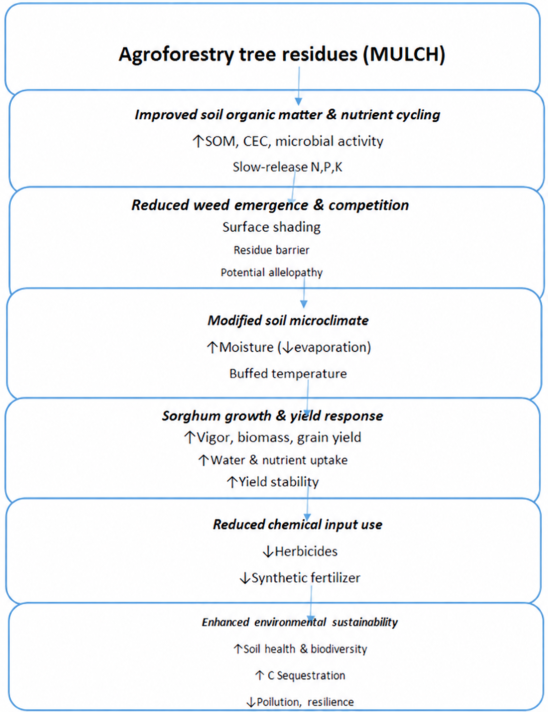
The integrative benefits of agroforestry-based mulching extend beyond individual soil or crop parameters, positioning it as a practical climate-smart agriculture (CSA) strategy. By enhancing soil organic matter, regulating weed pressure, and moderating microclimatic conditions, mulching contributes to productivity and resilience while reducing environmental externalities associated with synthetic fertilizer and herbicide use
| [2] | FAO (2017). Climate-smart agriculture sourcebook. Food and Agriculture Organization of the United Nations, Rome. |
| [10] | Pretty, J., Toulmin, C., & Williams, S. (2011). Sustainable intensification in African agriculture. International Journal of Agricultural Sustainability, 9, 5-24. |
[2, 10]
.
For smallholder farmers in resource-constrained tropical regions, the use of locally available agroforestry residues represents a cost-effective pathway to sustainable intensification
| [1] | Altieri, M. A., Nicholls, C. I., Henao, A., & Lana, M. A. (2015). Agroecology and the design of climate change-resilient farming systems. Agronomy for Sustainable Development, 35, 869-890. |
[1]
. From an environmental perspective, reduced chemical input dependence lowers risks of soil and water contamination and supports broader ecosystem health
| [8] | Nair, P. K. R. (2011). Agroforestry systems and environmental quality: Introduction. Journal of Environmental Quality, 40, 784-790. |
| [11] | Tilman, D., Cassman, K. G., Matson, P. A., Naylor, R., & Polasky, S. (2002). Agricultural sustainability and intensive production practices. Nature, 418, 671-677. |
[8, 11]
. However, effective implementation requires informed mulch species selection, appropriate application rates, and consideration of short-term yield trade-offs, as emphasized in conservation and residue-based agriculture literature
| [3] | Giller, K. E., Witter, E., Corbeels, M., & Tittonell, P. (2009). Conservation agriculture and smallholder farming in Africa. Field Crops Research, 114, 23-34. |
| [4] | Kassam, A., Friedrich, T., Derpsch, R., & Kienzle, J. (2015). Overview of the worldwide spread of conservation agriculture. Field Actions Science Reports, 8, 1-11. |
[3, 4]
.
7. Limitations of the Study
While this study provides valuable insights into agroforestry-based mulching for sorghum systems, certain limitations must be acknowledged. First, the findings are based on a single growing season in a specific agroecological zone (humid forest-savanna transition), which may limit extrapolation to drier or more humid tropical environments. Second, the use of freshly applied leaf litter may not fully represent longer-term mulch decomposition dynamics or cumulative soil organic matter effects, which require multi-season evaluation. Third, although weed suppression was observed, the specific mechanisms (physical barrier versus allelopathy) were not experimentally disentangled. Additionally, the economic feasibility and labor requirements for mulch collection and application were not assessed, which are critical determinants of farmer adoption. Future research should address these gaps through long-term trials, mechanistic weed studies, and integrated socio-economic evaluations to better inform scalable climate-smart mulch strategies.
8. Conclusion
Agroforestry tree leaf mulching represents a multifunctional, climate-smart approach to addressing soil fertility decline and weed pressure in sorghum-based agroecosystems. This study advances the literature by providing an integrated, species-specific evaluation of mulch effects on soil, weeds, and crop yield, highlighting trade-offs and synergies often overlooked in single-factor studies. By enhancing soil chemical quality, suppressing weeds, and moderating the crop microenvironment, agroforestry-derived mulches reduce reliance on synthetic fertilizers and herbicides, thereby mitigating environmental risks associated with conventional intensification pathways. However, crop yield responses remain species and rate dependent, highlighting the need for strategic mulch selection and management. Integrating agroforestry-based mulching into sorghum production systems offers a viable pathway for environmentally sustainable intensification in tropical regions. Long-term, multi-season evaluations are recommended to further elucidate carbon dynamics, nutrient synchronization, and system-level resilience under changing climatic conditions.
Table 1. Effects of agroforestry tree leaf mulches on soil quality, weed suppression and sorghum response.
Mulch species | Soil organic carbon | Nitrogen availability | Exchangeable bases | Weed suppression | Sorghum yield response | Environmental implication |
L. leucocephala | High increase | High | High | Strong | Variable | Improves soil fertility; potential N immobilization risk |
A. altilis | Moderate increase | Moderate | Moderate | Moderate-strong | Positive | Balanced soil improvement and crop response |
S. grandiflora | Moderate increase | High | Moderate | Strong | Neutral | Effective weed control, rapid decomposition |
M. oleifera | Moderate increase | Moderate | Moderate | Moderate | Positive | Environmentally benign, suitable for low-input systems |
Control (no mulch) | Low | Low | Low | Weak | Baseline | Higher erosion and weed pressure |
Table 2. Comparative advantages and trade-offs of agroforestry-based mulching under a climate-smart agriculture framework.
Dimension | Environmental benefit | Potential limitation | Management implication |
Soil quality | Enhanced organic matter and nutrient cycling | Short-term nutrient immobilization | Adjust mulch rate and timing |
Weed management | Reduced weed density and biomass | Reduced effectiveness at low rates | Apply during early crop growth |
Crop response | Improved microclimate and growth | Yield trade-offs depending on species | Species-specific mulch selection |
Environmental impact | Reduced fertilizer and herbicide dependence | Labour requirement for mulch collection | Integrate with existing agroforestry systems |
Figure 1. Conceptual framework linking agroforestry-based mulching to environmental and agronomic outcomes.
Abbreviations
FRIN | Forestry Research Institute |
NIHORT | Nigeria National Horticultural Research Institute |
CSA | Climate Smart Agriculture |
SOM | Soil Organic Matter |
CEC | Cation Exchange Capacity |
Author Contributions
Adeleye Zaccheaus Olufemi: Conceptualization, Data curation, Formal Analysis, Funding acquisition, Investigation, Methodology, Project administration, Resources, Supervision, Writing – original draft, Writing – review & editing
Conflicts of Interest
The authors declare that they have no known competing financial interests or personal relationships that could have appeared to influence the work reported in this paper.
References
| [1] |
Altieri, M. A., Nicholls, C. I., Henao, A., & Lana, M. A. (2015). Agroecology and the design of climate change-resilient farming systems. Agronomy for Sustainable Development, 35, 869-890.
|
| [2] |
FAO (2017). Climate-smart agriculture sourcebook. Food and Agriculture Organization of the United Nations, Rome.
|
| [3] |
Giller, K. E., Witter, E., Corbeels, M., & Tittonell, P. (2009). Conservation agriculture and smallholder farming in Africa. Field Crops Research, 114, 23-34.
|
| [4] |
Kassam, A., Friedrich, T., Derpsch, R., & Kienzle, J. (2015). Overview of the worldwide spread of conservation agriculture. Field Actions Science Reports, 8, 1-11.
|
| [5] |
Lal, R. (2015). Restoring soil quality to mitigate soil degradation. Sustainability, 7, 5875-5895.
|
| [6] |
Montagnini, F., & Nair, P. K. R. (2014). Carbon sequestration: An underexploited environmental benefit of agroforestry systems. Agroforestry Systems, 88, 1-8.
|
| [7] |
Mutegi, J. K., Mugendi, D. N., Verchot, L. V., & Kung’u, J. B. (2008). Combining napier grass with leguminous shrubs in contour hedgerows controls soil erosion without competing with crops. Agriculture, Ecosystems & Environment, 128, 24-34.
|
| [8] |
Nair, P. K. R. (2011). Agroforestry systems and environmental quality: Introduction. Journal of Environmental Quality, 40, 784-790.
|
| [9] |
Olorunfemi, I. E., Fasinmirin, J. T., & Ojo, A. S. (2016). Effect of mulch on soil temperature, moisture content and yield of watermelon in a tropical climate. African Journal of Agricultural Research, 11, 393-401.
|
| [10] |
Pretty, J., Toulmin, C., & Williams, S. (2011). Sustainable intensification in African agriculture. International Journal of Agricultural Sustainability, 9, 5-24.
|
| [11] |
Tilman, D., Cassman, K. G., Matson, P. A., Naylor, R., & Polasky, S. (2002). Agricultural sustainability and intensive production practices. Nature, 418, 671-677.
|
Cite This Article
-
APA Style
Olufemi, A. Z. (2026). Agroforestry-Based Mulching as a Climate-Smart Soil and Weed Management Strategy for Sorghum Production in Tropical Agroecosystems. Agriculture, Forestry and Fisheries, 15(6), 203-208. https://doi.org/10.11648/j.aff.20261506.11
 Copy
|
 Download
ACS Style
Olufemi, A. Z. Agroforestry-Based Mulching as a Climate-Smart Soil and Weed Management Strategy for Sorghum Production in Tropical Agroecosystems. Agric. For. Fish. 2026, 15(6), 203-208. doi: 10.11648/j.aff.20261506.11
Copy
|
Download
AMA Style
Olufemi AZ. Agroforestry-Based Mulching as a Climate-Smart Soil and Weed Management Strategy for Sorghum Production in Tropical Agroecosystems. Agric For Fish. 2026;15(6):203-208. doi: 10.11648/j.aff.20261506.11
Copy
|
Download
-
@article{10.11648/j.aff.20261506.11,
  author = {Adeleye Zaccheaus Olufemi},
  title = {Agroforestry-Based Mulching as a Climate-Smart Soil and Weed Management Strategy for Sorghum Production in Tropical Agroecosystems},
  journal = {Agriculture, Forestry and Fisheries},
  volume = {15},
  number = {6},
  pages = {203-208},
  doi = {10.11648/j.aff.20261506.11},
  url = {https://doi.org/10.11648/j.aff.20261506.11},
  eprint = {https://article.sciencepublishinggroup.com/pdf/10.11648.j.aff.20261506.11},
  abstract = {Environmental degradation, declining soil fertility and increasing weed pressure are major constraints on sorghum (Sorghum bicolor L. Moench) production in tropical agroecosystems, particularly under erratic climatic. Agroforestry systems provide a climate-smart approach to mitigating these challenges by the application of tree-leaf litter as surface mulch to buffer soil conditions and suppress weed growth. This study synthesizes field-based evidence on the environmental and agronomic implications of agroforestry-derived leaf mulches applied to sorghum production in southwestern Nigeria. Leaf mulches from Leucaena leucocephala, Artocarpus altilis, Sesbania grandiflora, and Moringa oleifera, applied at varying rates, and were evaluated for their effects on soil physico-chemical properties, weed dynamics, and sorghum performance. Mulching significantly improved key soil chemical properties such as organic Carbon, Nitrogen, and exchangeable base cations, supporting findings from previous studies on organic residue management. Weed density and biomass were significantly lower in mulched plots than in the unmulched (control) plots, especially at the early stages of crop establishment, suggesting the effectiveness of organic mulches in weed emergence and growth suppression. However, sorghum growth and yield responses differed across mulch species and application rates, suggesting that the agronomic benefits of mulching depend on the balance between soil fertility improvement, potential nutrient immobilisation, and crop nutrient requirements. Overall, agroforestry-based mulching demonstrated strong potential as an environmentally sustainable soil and weed management strategy capable of reducing reliance on synthetic fertilizers and herbicides while enhancing climate resilience in tropical production systems.},
 year = {2026}
}
Copy
|
Download
-
TY  - JOUR
T1  - Agroforestry-Based Mulching as a Climate-Smart Soil and Weed Management Strategy for Sorghum Production in Tropical Agroecosystems
AU  - Adeleye Zaccheaus Olufemi
Y1  - 2026/11/13
PY  - 2026
N1  - https://doi.org/10.11648/j.aff.20261506.11
DO  - 10.11648/j.aff.20261506.11
T2  - Agriculture, Forestry and Fisheries
JF  - Agriculture, Forestry and Fisheries
JO  - Agriculture, Forestry and Fisheries
SP  - 203
EP  - 208
PB  - Science Publishing Group
SN  - 2328-5648
UR  - https://doi.org/10.11648/j.aff.20261506.11
AB  - Environmental degradation, declining soil fertility and increasing weed pressure are major constraints on sorghum (Sorghum bicolor L. Moench) production in tropical agroecosystems, particularly under erratic climatic. Agroforestry systems provide a climate-smart approach to mitigating these challenges by the application of tree-leaf litter as surface mulch to buffer soil conditions and suppress weed growth. This study synthesizes field-based evidence on the environmental and agronomic implications of agroforestry-derived leaf mulches applied to sorghum production in southwestern Nigeria. Leaf mulches from Leucaena leucocephala, Artocarpus altilis, Sesbania grandiflora, and Moringa oleifera, applied at varying rates, and were evaluated for their effects on soil physico-chemical properties, weed dynamics, and sorghum performance. Mulching significantly improved key soil chemical properties such as organic Carbon, Nitrogen, and exchangeable base cations, supporting findings from previous studies on organic residue management. Weed density and biomass were significantly lower in mulched plots than in the unmulched (control) plots, especially at the early stages of crop establishment, suggesting the effectiveness of organic mulches in weed emergence and growth suppression. However, sorghum growth and yield responses differed across mulch species and application rates, suggesting that the agronomic benefits of mulching depend on the balance between soil fertility improvement, potential nutrient immobilisation, and crop nutrient requirements. Overall, agroforestry-based mulching demonstrated strong potential as an environmentally sustainable soil and weed management strategy capable of reducing reliance on synthetic fertilizers and herbicides while enhancing climate resilience in tropical production systems.
VL  - 15
IS  - 6
ER  -
Copy
|
Download




 Share This Article
 Twitter
 Linked In
 Facebook