Abstract
Ground-based CCD observations of comet 67P/Churyumov-Gerasimenko were carried out during October 5-8, 2021 at the Sanglokh International Astronomical Observatory using the Zeiss-1000 reflector telescope equipped with an FLI ProLine 16803 CCD camera and broadband BVRI filters. The morphology and dynamics of gas-dust activity in the near-nucleus region were investigated using image-enhancement and photometric processing techniques. Application of the Larson-Sekanina rotational gradient filter revealed several asymmetric gas-dust jet structures whose morphology and orientation changed during the observing interval. Projected jet lengths, position angles, and particle ejection velocities were estimated from the processed CCD images. Dust-particle velocities were calculated using the Whipple and Jones dynamical models. The obtained results show that particle ejection velocities strongly depend on particle size and thermal conditions near the nucleus surface. According to the Whipple model, the derived velocities vary from approximately 35 m/s to 417 m/s, while the Jones model yielded lower characteristic velocities for larger particles. Thermal characteristics of several volatile species, including H2O, CO, O2, and CO2, were additionally investigated using simplified sublimation relations. Isophotal analysis revealed a pronounced asymmetry of the inner coma and confirmed the presence of anisotropic dust emission associated with localized active regions on the nucleus surface. Temporal variations in jet orientation allowed the rotational period of the nucleus to be estimated within the interval 11.5-12.5 h, which is consistent with previous Rosetta mission measurements. The obtained results demonstrate that medium-aperture ground-based telescopes combined with modern CCD image-processing techniques remain effective tools for investigating cometary activity and dust dynamics. The study also confirms that ground-based observations are capable of reproducing large-scale morphological features previously detected during spacecraft investigations of comet 67P/Churyumov-Gerasimenko.
Keywords
Comets, Gas-dust Jets, Cometary Activity, CCD Observations, Dust Dynamics, Particle Ejection Velocity, Comet Nucleus Rotation, Rosetta Mission
1. Introduction
Comets are among the most primitive remnants of the early Solar System and preserve information about the physical and chemical conditions that existed during the epoch of planet formation. Studies of cometary nuclei, gas activity, and dust ejection processes provide important constraints on the evolution of volatile materials, the structure of small icy bodies, and the interaction between cometary surfaces and solar radiation. Of particular interest are Jupiter-family comets, whose repeated passages through the inner Solar System gradually modify their surface layers and activity mechanisms
| [1] | Vsekhsvyatsky, S. K. Physical Characteristics of Comets 1965-1970. Moscow: Nauka, 1972. |
[1]
.
Comet 67P/Churyumov-Gerasimenko is one of the best investigated Jupiter-family comets due to the European Space Agency Rosetta mission, which performed long-term in situ observations of the nucleus and inner coma between 2014 and 2016
| [2] | Zelenyony, L. M., Ksanfomality, L. V. From the VEGA mission at Comet Halley to the Rosetta mission at Comet 67P/Churyumov-Gerasimenko. Bulletin of Lavochkin Association, 2015, No. 3, pp. 81-93. |
| [3] | Weissman, P. R., Asphaug, E., Lowry, S. C. Structure and density of cometary nuclei. In: Festou, M. C., Keller, H. U., Weaver, H. A. (Eds.), Comets II. Tucson: University of Arizona Press, 2004, pp. 337-357. |
| [4] | Keller, H. U., Kührt, E. Cometary nuclei: From Giotto to Rosetta. Space Science Reviews, 2020, 216, 14.
https://doi.org/10.1007/s11214-020-0633-3 |
| [5] | Snodgrass, C., Feaga, L., Jones, G. H., Küppers, M., Tubiana, C., Dotson, R. Past and future comet missions. In: Meech, K. J., Combi, M. R., Bockelée-Morvan, D., Raymond, S. N., Zolensky, M. E. (Eds.), Comets III. Tucson: University of Arizona Press, 2024, pp. 155-192. |
[2-5]
. These investigations revealed the complex bilobate shape of the nucleus, strong seasonal asymmetry of activity, heterogeneous surface morphology, and numerous localized active regions producing gas-dust jets
| [3] | Weissman, P. R., Asphaug, E., Lowry, S. C. Structure and density of cometary nuclei. In: Festou, M. C., Keller, H. U., Weaver, H. A. (Eds.), Comets II. Tucson: University of Arizona Press, 2004, pp. 337-357. |
| [4] | Keller, H. U., Kührt, E. Cometary nuclei: From Giotto to Rosetta. Space Science Reviews, 2020, 216, 14.
https://doi.org/10.1007/s11214-020-0633-3 |
| [5] | Snodgrass, C., Feaga, L., Jones, G. H., Küppers, M., Tubiana, C., Dotson, R. Past and future comet missions. In: Meech, K. J., Combi, M. R., Bockelée-Morvan, D., Raymond, S. N., Zolensky, M. E. (Eds.), Comets III. Tucson: University of Arizona Press, 2024, pp. 155-192. |
[3-5]
. The Rosetta mission also demonstrated that the nucleus has high porosity and low bulk density, while dust emission strongly depends on local illumination conditions and surface composition
| [4] | Keller, H. U., Kührt, E. Cometary nuclei: From Giotto to Rosetta. Space Science Reviews, 2020, 216, 14.
https://doi.org/10.1007/s11214-020-0633-3 |
| [5] | Snodgrass, C., Feaga, L., Jones, G. H., Küppers, M., Tubiana, C., Dotson, R. Past and future comet missions. In: Meech, K. J., Combi, M. R., Bockelée-Morvan, D., Raymond, S. N., Zolensky, M. E. (Eds.), Comets III. Tucson: University of Arizona Press, 2024, pp. 155-192. |
[4, 5]
.
One of the most important manifestations of cometary activity is the formation of collimated gas-dust jets originating from active regions on the nucleus surface. The morphology and temporal evolution of such jets are controlled by sublimation processes, thermal conditions, nucleus rotation, local topography, and gas dynamics in the near-nucleus region
| [5] | Snodgrass, C., Feaga, L., Jones, G. H., Küppers, M., Tubiana, C., Dotson, R. Past and future comet missions. In: Meech, K. J., Combi, M. R., Bockelée-Morvan, D., Raymond, S. N., Zolensky, M. E. (Eds.), Comets III. Tucson: University of Arizona Press, 2024, pp. 155-192. |
[5]
. Variations in jet orientation may therefore provide indirect information about the rotational state of the nucleus and the physical mechanisms responsible for particle acceleration.
A number of theoretical models have been proposed to describe cometary dust ejection. The classical icy nucleus model developed by Whipple
| [13] | Whipple, F. L. A comet model I: The acceleration of Comet Encke. The Astrophysical Journal, 1950, 111, pp. 375-394.
https://doi.org/10.1086/145272 |
| [14] | Whipple, F. L. A comet model II: Physical relations for comets and meteors. The Astrophysical Journal, 1951, 113, pp. 464-474. https://doi.org/10.1086/145477 |
[13, 14]
explains dust acceleration through gas drag generated by sublimating volatile materials. Later studies incorporated additional thermal and gas-dynamic effects, including the dependence of particle acceleration on heliocentric distance and surface temperature
| [18] | Knight, M. M., Kokotanekova, R., Samarasinha, N. H. Physical and surface properties of comet nuclei from remote observations. In: Meech, K. J., Combi, M. R., Bockelée-Morvan, D., Raymond, S. N., Zolensky, M. E. (Eds.), Comets III. Tucson: University of Arizona Press, 2024, pp. 361-404. |
[18]
. Modern investigations show that particle ejection velocities depend strongly on particle size, molecular composition, illumination geometry, and the physical state of the nucleus surface
| [10] | Agarwal, J., Kim, Y., Kelley, M., Raphael, M. Dust emission and dynamics. In: Meech, K. J., Combi, M. R., Bockelée-Morvan, D., Raymond, S. N., Zolensky, M. E. (Eds.), Comets III. Tucson: University of Arizona Press, 2024, pp. 653-678. |
| [18] | Knight, M. M., Kokotanekova, R., Samarasinha, N. H. Physical and surface properties of comet nuclei from remote observations. In: Meech, K. J., Combi, M. R., Bockelée-Morvan, D., Raymond, S. N., Zolensky, M. E. (Eds.), Comets III. Tucson: University of Arizona Press, 2024, pp. 361-404. |
[10, 18]
.
Despite the extensive spacecraft observations of comet 67P, ground-based CCD observations remain important for studying the large-scale morphology of the coma and for testing theoretical models under different observing conditions. In particular, image-enhancement techniques make it possible to investigate faint jet structures, asymmetries of the inner coma, and temporal changes in cometary activity from Earth-based observatories
| [9] | Ayubov, D. K., Safarov, A. Gh., Khamroev, U. Kh., Burizoda, A. M. Study of physical and dynamic properties of comets 4P/Faye, 6P/d’Arrest and 67P/Churyumov-Gerasimenko. In: Modern Problems of Astrophysics. Dushanbe: Tajik National University, 2024, pp. 108-115. |
[9]
.
The aim of the present study is to investigate the gas-dust activity of comet 67P/Churyumov-Gerasimenko using CCD observations obtained during the 2021 apparition of the comet. Special attention is given to the morphology of gas-dust jets, the estimation of particle ejection velocities, and the analysis of rotational signatures inferred from temporal variations in jet orientation. The obtained results are discussed in the context of modern models of cometary dust dynamics and compared with previous results of the Rosetta mission.
2. Observations and Data Reduction
Observations of comet 67P/Churyumov-Gerasimenko were carried out on October 5-8, 2021 during a favorable observing interval associated with the comet’s relatively small heliocentric and geocentric distances. The observations were performed at the Sanglokh International Astronomical Observatory of the Institute of Astrophysics of the National Academy of Sciences of Tajikistan using the Zeiss-1000 reflector telescope. The Zeiss-1000 telescope operated at the Cassegrain focus with a focal length of 13 m. The FLI ProLine 16803 CCD detector has a format of 4096 × 4096 pixels with an image scale of approximately 0.3 arcsec/pixel.
Table 1. Observational circumstances of comet 67P/Churyumov-Gerasimenko during October 5-8, 2021.
Date | r(AU) | Δ (AU) | Phase angle () | Number of CCD frames | Exposure (s) |
B | V | R | I |
05.10.2021 | 1.257 | 0.479 | 47.665 | 100 | 100 | 100 | 100 | 30-180 |
06.10.2021 | 1.255 | 0.475 | 47.846 | 100 | 100 | 100 | 100 | 30-180 |
07.10.2021 | 1.251 | 0.472 | 48.023 | 100 | 100 | 100 | 100 | 30-180 |
08.10.2021 | 1.248 | 0.468 | 48.195 | 100 | 100 | 100 | 100 | 30-180 |
The comet was observed with an FLI ProLine 16803 CCD camera equipped with broadband Johnson-Cousins BVRI photometric filters. Exposure times ranged from 30 s to 180 s depending on observing conditions and the selected filter. For the analysis of coma morphology and gas-dust jet structures, special attention was given to images obtained in the R filter with an exposure time of 180 s, since these frames provided the highest signal-to-noise ratio and revealed the most distinct inner-coma structures.
To reduce thermal noise, the CCD detector was cooled to approximately − 20°C during observations. Standard calibration procedures were applied to all science frames. Dark-current correction was performed using dark frames obtained during each observing night, while flat-field correction was carried out using twilight flat-field images. Bias frames were additionally used to correct CCD readout offsets.
Astrometric reduction and refinement of cometary coordinates were performed using the Astrometrica software package
together with the APEX-II software system
| [7] | Devyatkin, A. V., Gorshanov, D. L., Kupriyanov, V. V., Vereshchagina, I. A. Software packages “APEX-I” and “APEX-II” for processing astronomical CCD observations. Solar System Research, 2010, 44(1), pp. 68-79.
https://doi.org/10.1134/S0038094610010080 |
[7]
. Orbital refinement was additionally checked using the Find_Orb package
. Photometric processing and image calibration were carried out using MaxIm DL and AstroArt software environments.
To investigate the morphology of the inner coma and detect weak radial structures, the Larson-Sekanina rotational gradient filter was applied to the calibrated CCD images. This image-enhancement technique suppresses the azimuthally symmetric component of the coma and improves the visibility of asymmetric structures such as jets and localized dust emissions. The filtering procedure allowed the identification of several gas-dust jet features whose morphology changed during the observing interval.
For subsequent analysis, combined and stacked images obtained during individual nights were used in order to improve the signal-to-noise ratio and enhance faint structures in the near-nucleus region. The processed images were then used for measurements of jet morphology, isophotal analysis, and determination of particle ejection parameters.
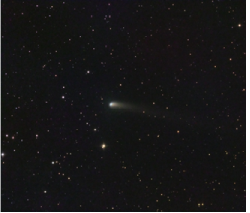
Figure 1. Original CCD image of comet 67P/Churyumov-Gerasimenko obtained on October 6, 2021 in the R filter.
3. Methods
3.1. Larson-Sekanina Image Processing
To investigate the morphology of the inner coma and enhance weak radial structures, the Larson-Sekanina rotational gradient method was applied to the calibrated CCD images. This technique is widely used in cometary studies for detecting asymmetric features such as jets, shells, and localized dust emissions
| [11] | Sekanina, Z. Orientation and origin of dust jets in cometary comae. Icarus, 1981, 47, pp. 20-38.
https://doi.org/10.1016/0019-1035(81)90186-3 |
| [12] | Sekanina, Z. Cometary nucleus and its activity: A synoptic view. In: Newburn, R. L., Neugebauer, M., Rahe, J. (Eds.), Comets in the Post-Halley Era. Dordrecht: Springer, 1991, Vol. 2, pp. 769-823. |
[11, 12]
.
The method is based on subtracting a rotated copy of the original image from the initial frame. As a result, the azimuthally symmetric component of the coma is significantly suppressed, while local brightness variations associated with active regions become enhanced. Such processing improves the visibility of gas-dust jets and allows their spatial orientation and temporal evolution to be analyzed.
The processed images obtained for October 5-8, 2021 revealed distinct jet structures extending from the near-nucleus region into the inner coma. Variations in jet orientation observed during different nights were later used to estimate the rotational period of the cometary nucleus.
3.2. Determination of Jet Lengths
The lengths of the detected gas-dust jets were estimated from the processed CCD images using the AstroArt software package. First, the angular dimensions of the jets were measured in pixels from the nucleus center to the outer visible boundary of the jet structure.
Knowing the image scale in arcseconds per pixel and the geocentric distance of the comet during each observing night, the projected linear size of the jets was calculated: , where (L) is the projected linear size of the jet, (<i></i>) is the geocentric distance of the comet, and (<i></i>) is the angular jet length in arcseconds. The conversion from angular to linear distance was performed using the standard relation between arcseconds and radians.
The obtained jet lengths were subsequently used to estimate characteristic particle ejection velocities. Since the observed structures correspond to projected quantities in the plane of the sky, the derived values represent lower-limit estimates of the true spatial dimensions and velocities. The position angles of the jets were measured counterclockwise from the north direction through east in the plane of the sky.
3.3. Whipple Dust Ejection Model
To estimate the velocities of dust particles emitted from the nucleus surface, the classical cometary ejection model developed by Whipple
| [13] | Whipple, F. L. A comet model I: The acceleration of Comet Encke. The Astrophysical Journal, 1950, 111, pp. 375-394.
https://doi.org/10.1086/145272 |
| [14] | Whipple, F. L. A comet model II: Physical relations for comets and meteors. The Astrophysical Journal, 1951, 113, pp. 464-474. https://doi.org/10.1086/145477 |
[13, 14]
was applied. In this model, dust particles are accelerated by the drag force generated by sublimating volatile gases escaping from the nucleus surface.
The particle ejection velocity depends on the particle size, particle density, heliocentric distance, and physical parameters of the nucleus. Smaller particles experience stronger acceleration and therefore achieve higher terminal velocities than larger particles.
The Whipple model used in this work can be expressed in the following form:
(1)
where (VWh) is the particle ejection velocity in m/s, (s) is the particle radius cm, (d) is the particle density g/cm3, (r) is the heliocentric distance in AU, and (Rc) is the effective radius of the cometary nucleus in km.
In the present calculations, particle sizes in the range from (10
-3) cm to (1) cm were considered. This interval was selected according to modern observational and theoretical studies of cometary dust distributions
| [10] | Agarwal, J., Kim, Y., Kelley, M., Raphael, M. Dust emission and dynamics. In: Meech, K. J., Combi, M. R., Bockelée-Morvan, D., Raymond, S. N., Zolensky, M. E. (Eds.), Comets III. Tucson: University of Arizona Press, 2024, pp. 653-678. |
| [18] | Knight, M. M., Kokotanekova, R., Samarasinha, N. H. Physical and surface properties of comet nuclei from remote observations. In: Meech, K. J., Combi, M. R., Bockelée-Morvan, D., Raymond, S. N., Zolensky, M. E. (Eds.), Comets III. Tucson: University of Arizona Press, 2024, pp. 361-404. |
[10, 18]
.
3.4. Jones Thermal Ejection Model
In addition to the Whipple model, the thermal ejection model proposed by Jones
| [13] | Whipple, F. L. A comet model I: The acceleration of Comet Encke. The Astrophysical Journal, 1950, 111, pp. 375-394.
https://doi.org/10.1086/145272 |
| [14] | Whipple, F. L. A comet model II: Physical relations for comets and meteors. The Astrophysical Journal, 1951, 113, pp. 464-474. https://doi.org/10.1086/145477 |
| [15] | Jones, J. The ejection of meteoroids from comets. Monthly Notices of the Royal Astronomical Society, 1995, 275, pp. 773-780. https://doi.org/10.1093/mnras/275.3.773 |
[13-15]
was also considered. In this approach, the ejection velocity depends on the thermal balance between absorbed solar radiation and energy consumed by sublimation processes on the illuminated side of the nucleus.
The corresponding expression for the particle ejection velocity can be written as:
(2)
where (m) is the particle mass, (<i></i>d) is the particle density, (r) is the heliocentric distance in AU, and (Rc) is the nucleus radius in km.
The Jones model takes into account the dependence of gas production and thermal conditions on heliocentric distance and therefore provides an additional estimate for particle acceleration in the near-nucleus region.
3.5. Estimation of the Rotation Period
The rotational period of the nucleus was estimated from temporal variations in the orientation of the detected gas-dust jets. Since active regions on the nucleus surface rotate together with the nucleus, changes in jet position angle observed during consecutive nights can be used as indicators of nucleus rotation.
A comparative analysis of jet morphology for the observing interval October 5-8, 2021 showed systematic changes in the orientation of several jet structures. Based on the observed angular displacement of the jets, the rotation period of the nucleus was estimated to lie within the interval 11.5-12.5h.
The obtained value is consistent with previously published estimates derived from spacecraft observations of comet 67P/Churyumov-Gerasimenko. The uncertainty of the derived rotational period is estimated to be approximately ±0.5h due to projection effects and uncertainties in jet position-angle measurements.
4. Results
4.1. Morphology of Gas-Dust Jets
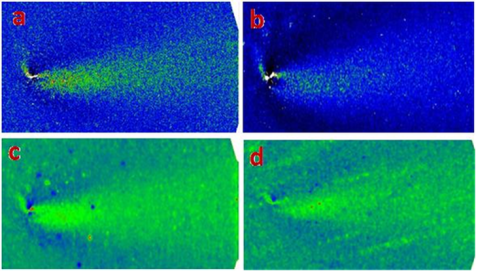
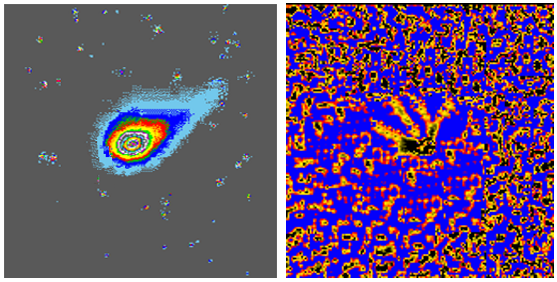
Application of the Larson-Sekanina rotational gradient filter to the CCD images obtained during October 5-8, 2021 revealed several distinct gas-dust jet structures in the inner coma of comet 67P/Churyumov-Gerasimenko. The jets are most clearly visible in the R-filter images with exposure times of 180 s.
Figure 2. Larson-Sekanina processed R-filter images of comet 67P/Churyumov-Gerasimenko obtained during October 5-8, 2021. North is up and east is left. The anti-solar direction is indicated by arrows.
The detected structures originate from the near-nucleus region and extend outward in the anti-solar direction. The morphology of the jets changes noticeably during the four observing nights, indicating temporal variability of activity and possible rotational modulation of active regions on the nucleus surface.
The processed images demonstrate that the jets are not distributed symmetrically around the nucleus. Instead, localized regions of enhanced emission dominate the inner coma structure. Such asymmetry suggests the existence of discrete active areas associated with non-uniform illumination and local topographic features of the nucleus.
Combined images obtained from individual nights additionally reveal variations in jet curvature and brightness distribution. The observed morphology is generally consistent with anisotropic dust emission caused by localized sublimation processes on the illuminated side of the nucleus.
4.2. Particle Ejection Velocities
Using the measured jet dimensions and the applied dynamical models, characteristic ejection velocities of gas-dust particles were estimated.
Table 2. Measured jet parameters and estimated particle ejection velocities.
Date | Jet length (km) | Position angle (°) | Velocity1 (km s⁻¹) | Velocity2 (km s⁻¹) |
05 Oct. 2021 | 3.450 | 118 | 0.350 ± 0.02 | 0.87 ± 0.05 |
06 Oct. 2021 | 3.820 | 126 | 0.381 ± 0.02 | 0.91 ± 0.01 |
07 Oct. 2021 | 4.180 | 134 | 0.412 ± 0.01 | 0.84 ± 0.06 |
08 Oct. 2021 | 4.560 | 142 | 0.417 ± 0.02 | 0.88 ± 0.05 |
Note: 1- The velocity of tail particle ejection from comet nuclei was determined using the Whipple method. 2- The velocity of dust particle ejection from gas-dust jets was determined using the Jones method.
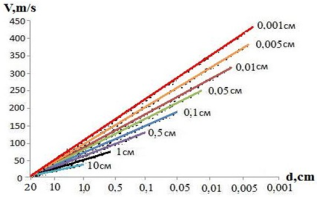
Calculations based on the Whipple model show that the ejection velocities vary within the range from approximately 35.7 m/s to 417 m/s, depending on particle size and assumed physical parameters. Smaller particles exhibit significantly higher velocities due to their lower inertia and more efficient acceleration by sublimating gases.
The calculations performed using the Jones thermal model yielded lower characteristic velocities for larger particles and confirmed the strong dependence of particle acceleration on heliocentric distance and thermal conditions near the nucleus surface.
The obtained results demonstrate that the velocity distribution is highly size-dependent. Fine dust particles are accelerated more efficiently and can escape into the extended coma, whereas larger particles experience lower acceleration and may remain near the nucleus or return to the surface due to gravitational effects.
The derived velocity interval is generally consistent with previous observational and theoretical studies of dust emission from comet 67P, including Rosetta mission measurements and modern cometary dust-dynamics models
| [10] | Agarwal, J., Kim, Y., Kelley, M., Raphael, M. Dust emission and dynamics. In: Meech, K. J., Combi, M. R., Bockelée-Morvan, D., Raymond, S. N., Zolensky, M. E. (Eds.), Comets III. Tucson: University of Arizona Press, 2024, pp. 653-678. |
| [18] | Knight, M. M., Kokotanekova, R., Samarasinha, N. H. Physical and surface properties of comet nuclei from remote observations. In: Meech, K. J., Combi, M. R., Bockelée-Morvan, D., Raymond, S. N., Zolensky, M. E. (Eds.), Comets III. Tucson: University of Arizona Press, 2024, pp. 361-404. |
[10, 18]
. The uncertainties of the derived particle velocities are estimated to be within approximately 10-15%, mainly due to uncertainties in jet-length measurements, projection geometry, and assumed particle densities.
Figure 3. Dependence of particle ejection velocity on particle size according to the Whipple and Jones models.
4.3. Thermal Velocities and Sublimation Conditions
Thermal characteristics of several volatile components, including H
2O, CO, O
2, and CO
2,
| [20] | Läuter, M., Kramer, T., Rubin, M., Altwegg, K. The ice composition close to the surface of comet 67P/Churyumov-Gerasimenko. ACS Earth and Space Chemistry, 2022, 6(5), pp. 1235-1247. https://doi.org/10.1021/acsearthspacechem.1c00371 |
[20]
. were investigated using simplified sublimation models:
where (Vth) is the thermal velocity of molecules,(k) is the Boltzmann constant,(T) is the gas temperature, and(m) is the molecular mass.
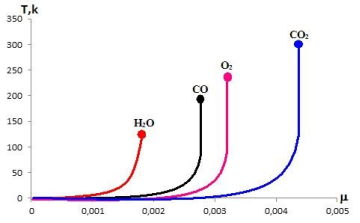
The calculations show that sublimation temperature and molecular mass strongly influence the thermal expansion velocity of gaseous species. Lighter molecules produce more efficient acceleration conditions for dust particles under similar illumination conditions.
The obtained temperature estimates indicate substantial differences between the considered volatile species. Water molecules dominate sublimation processes at relatively lower temperatures, whereas CO and CO2 remain active under colder conditions and may contribute to activity at larger heliocentric distances.
The calculated temperature-velocity relations demonstrate that gas production processes in cometary nuclei are controlled by a complex combination of thermal balance, volatile composition, and local surface conditions.
Figure 4. Dependence of thermal velocity and sublimation temperature on molecular mass for volatile species detected in comet 67P/Churyumov-Gerasimenko.
4.4. Isophotal Structure and Coma Asymmetry
Isophotal analysis of the cometary coma revealed a strongly asymmetric brightness distribution around the nucleus. The central region of the coma is displaced relative to the outer isophotes, indicating anisotropic dust emission and the influence of localized active regions.
The coma brightness gradually decreases from the nucleus toward the periphery, while the dust tail is elongated approximately in the anti-solar direction. The observed isophotal structure confirms the presence of continuous dust activity during the observing interval.
Figure 5. Isophotal structure of comet 67P/Churyumov-Gerasimenko showing asymmetric brightness distribution and dust-tail orientation.
The isophotes are not perfectly concentric and exhibit distortions in the direction of the detected jets. Such deviations are likely associated with non-uniform dust production from active surface regions and temporal variations in emission intensity.
4.5. Rotation of the Nucleus
Comparison of the processed images obtained during different nights revealed systematic variations in the orientation of the gas-dust jets. These positional changes are interpreted as manifestations of nucleus rotation.
Assuming that the detected jets originate from localized active regions fixed on the nucleus surface, the observed displacement of the jets can be used to estimate the rotational period of the nucleus.
Based on the measured variations in jet orientation during October 5-8, 2021, the rotational period of comet 67P/Churyumov-Gerasimenko was estimated to be approximately 11.5-12.5 h.
This value is in good agreement with previously published rotational periods derived from Rosetta spacecraft observations, supporting the reliability of the obtained ground-based measurements.
5. Discussion
The obtained results demonstrate that ground-based CCD observations can successfully reproduce important large-scale manifestations of cometary activity previously detected during spacecraft missions. Despite the significantly lower spatial resolution compared with Rosetta observations, the applied image-processing techniques made it possible to identify stable gas-dust jet structures and investigate their temporal evolution during the observing interval.
One of the principal results of the present study is the detection of asymmetric jet activity in the inner coma of comet 67P/Churyumov-Gerasimenko. The observed asymmetry indicates that dust emission from the nucleus surface is highly non-uniform and originates from localized active regions rather than from homogeneous sublimation over the entire nucleus surface. Such behavior is fully consistent with Rosetta observations, which revealed numerous discrete active areas associated with cliffs, pits, fractures, and regions of enhanced solar illumination
| [18] | Knight, M. M., Kokotanekova, R., Samarasinha, N. H. Physical and surface properties of comet nuclei from remote observations. In: Meech, K. J., Combi, M. R., Bockelée-Morvan, D., Raymond, S. N., Zolensky, M. E. (Eds.), Comets III. Tucson: University of Arizona Press, 2024, pp. 361-404. |
| [19] | Vincent, J.-B., Bodewits, D., Besse, S., et al. Large heterogeneities in comet 67P as revealed by active pits from sinkhole collapse. Nature, 2015, 523, pp. 63-66.
https://doi.org/10.1038/nature14564 |
[18, 19]
.
The detected variations in jet orientation during October 5-8, 2021 most likely reflect the rotational motion of the nucleus. Since active regions remain fixed relative to the rotating nucleus surface, the apparent displacement of jets in the plane of the sky provides indirect information about the rotational state of the nucleus. The derived rotational period of approximately 11.5-12.5 h is in good agreement with previous spacecraft measurements and confirms that ground-based observations can provide reliable constraints on rotational parameters even at relatively moderate angular resolution.
The estimated particle ejection velocities show a strong dependence on particle size. According to both the Whipple and Jones models, smaller particles achieve significantly higher velocities than larger particles. This behavior is physically expected because the ratio of gas drag force to particle mass increases for smaller grains. Fine particles are therefore accelerated more efficiently by sublimating gases and can be transported into the extended coma and tail region, whereas larger particles experience weaker acceleration and may remain gravitationally bound to the nucleus or return to the surface.
The obtained velocity range from approximately 35.7 m/s to 417 m/s corresponds to intermediate dust-emission conditions characteristic of moderately active short-period comets. The derived values are generally consistent with Rosetta measurements and modern theoretical models of dust acceleration in the near-nucleus region
| [10] | Agarwal, J., Kim, Y., Kelley, M., Raphael, M. Dust emission and dynamics. In: Meech, K. J., Combi, M. R., Bockelée-Morvan, D., Raymond, S. N., Zolensky, M. E. (Eds.), Comets III. Tucson: University of Arizona Press, 2024, pp. 653-678. |
| [18] | Knight, M. M., Kokotanekova, R., Samarasinha, N. H. Physical and surface properties of comet nuclei from remote observations. In: Meech, K. J., Combi, M. R., Bockelée-Morvan, D., Raymond, S. N., Zolensky, M. E. (Eds.), Comets III. Tucson: University of Arizona Press, 2024, pp. 361-404. |
[10, 18]
. At the same time, the observed spread in particle velocities indicates that dust acceleration cannot be explained solely by particle size. The physical properties of the particles, including density, porosity, volatile content, and irregular shape, may also significantly influence the acceleration efficiency
| [16] | Dorofeeva, V. A. Chemical and isotopic composition of comet 67P/Churyumov-Gerasimenko. Solar System Research, 2020, 54(2), pp. 110-134.
https://doi.org/10.1134/S0038094620020033 |
| [17] | Filacchione, G., Ciarniello, M., Fornasier, S., Raponi, A. Comet nuclei composition and evolution. In: Meech, K. J., Combi, M. R., Bockelée-Morvan, D., Raymond, S. N., Zolensky, M. E. (Eds.), Comets III. Tucson: University of Arizona Press, 2024, pp. 315-360. |
[16, 17]
.
An important factor controlling the observed activity is the seasonal and geometrical illumination of the nucleus surface. Previous Rosetta studies demonstrated that the southern hemisphere of comet 67P experiences strong seasonal variations associated with long-term illumination asymmetry
| [4] | Keller, H. U., Kührt, E. Cometary nuclei: From Giotto to Rosetta. Space Science Reviews, 2020, 216, 14.
https://doi.org/10.1007/s11214-020-0633-3 |
| [5] | Snodgrass, C., Feaga, L., Jones, G. H., Küppers, M., Tubiana, C., Dotson, R. Past and future comet missions. In: Meech, K. J., Combi, M. R., Bockelée-Morvan, D., Raymond, S. N., Zolensky, M. E. (Eds.), Comets III. Tucson: University of Arizona Press, 2024, pp. 155-192. |
[4, 5]
. Under such conditions, sublimation processes become highly localized and may generate anisotropic gas outflows capable of producing collimated dust jets. The morphology detected in the present observations supports the idea that local topography and illumination geometry strongly affect the direction and intensity of dust emission.
The isophotal analysis additionally confirms that the inner coma structure is highly anisotropic. Deviations from concentric symmetry and displacement of the central brightness region indicate continuous activity of localized emission sources. Similar asymmetric coma structures have been reported for many active Jupiter-family comets and are commonly interpreted as evidence for non-uniform surface activity and rotational modulation of dust emission
| [5] | Snodgrass, C., Feaga, L., Jones, G. H., Küppers, M., Tubiana, C., Dotson, R. Past and future comet missions. In: Meech, K. J., Combi, M. R., Bockelée-Morvan, D., Raymond, S. N., Zolensky, M. E. (Eds.), Comets III. Tucson: University of Arizona Press, 2024, pp. 155-192. |
[5]
.
The comparison between the Whipple and Jones models also demonstrates that different physical assumptions may lead to noticeable differences in derived ejection velocities. The classical Whipple model primarily describes acceleration caused by sublimating volatile gases, whereas the Jones model additionally incorporates thermal effects and heliocentric dependence of sublimation efficiency. The agreement between the two approaches within the same order of magnitude supports the physical reliability of the obtained estimates.
Nevertheless, several limitations should be taken into account. The derived velocities correspond to projected quantities measured in the plane of the sky and therefore may underestimate true three-dimensional velocities. In addition, uncertainties associated with particle density, grain shape, gas production rate, and projection geometry may influence the final velocity estimates. The Larson-Sekanina technique itself may also enhance artificial structures under low signal-to-noise conditions. Consequently, the obtained results should be interpreted as approximate physical estimates rather than exact dynamical parameters.
Table 3. Comparison of physical parameters obtained in the present work with Rosetta mission results.
Parameter | This work | Rosetta mission |
Rotation period | 11.5-12.5 h | ~12.4 h |
Nucleus radius | 4-5 km | ~4.3 km |
Dust velocities | 35-417 m/s | comparable |
Coma asymmetry | detected | detected |
Overall, the present study demonstrates that medium-aperture ground-based telescopes combined with modern CCD processing techniques remain valuable tools for investigating cometary activity. Such observations provide an important complement to spacecraft missions and allow the long-term evolution of cometary dust activity and jet morphology to be investigated under different heliocentric conditions.
Ground-based observations are affected by atmospheric seeing, projection effects, and signal-to-noise limitations. Consequently, the derived jet dimensions and particle velocities should be interpreted as approximate projected estimates rather than exact three-dimensional physical parameters.
6. Conclusions
Ground-based CCD observations of comet 67P/Churyumov-Gerasimenko obtained during October 5-8, 2021 made it possible to investigate the morphology and dynamics of gas-dust activity in the near-nucleus region. Application of the Larson-Sekanina image-enhancement technique revealed distinct asymmetric jet structures whose morphology varied during the observing interval.
Analysis of the detected jets showed that the dust emission from the nucleus surface is strongly anisotropic and most likely associated with localized active regions controlled by illumination geometry and rotational modulation. The observed temporal variations in jet orientation allowed the rotational period of the nucleus to be estimated within the interval 11.5-12.5h, which is consistent with previous spacecraft measurements of comet 67P/Churyumov-Gerasimenko.
Particle ejection velocities derived using the Whipple and Jones models indicate that the acceleration efficiency strongly depends on particle size and thermal conditions near the nucleus surface. The obtained velocity range from approximately 35.7 m/s to 417 m/s is characteristic of moderately active short-period comets and agrees with modern theoretical and observational studies of cometary dust dynamics.
The performed isophotal analysis demonstrated a pronounced asymmetry of the inner coma and confirmed the presence of continuous dust activity during the observing interval. The detected deviations from concentric symmetry support the interpretation of non-uniform surface activity and localized dust emission.
The present study demonstrates that medium-aperture ground-based telescopes equipped with modern CCD systems remain effective instruments for investigating cometary activity and dust dynamics. Such observations are capable of providing valuable complementary information to spacecraft missions, especially for long-term monitoring of morphological and dynamical evolution of cometary comae.
Future investigations should include multi-filter photometric analysis, numerical modeling of dust trajectories, and comparison with three-dimensional gas-dust dynamical simulations in order to better constrain the physical mechanisms responsible for jet formation and particle acceleration in cometary nuclei.
Abbreviations
CCD | Charge Coupled Device |
AU | Astronomical Unit |
Author Contributions
Donish Kosimovich Ayubov: Conceptualization, Data curation, Formal Analysis, Investigation, Visualization, Writing – original draft
Abduljalol Ghafurovich Safarov: Methodology, Supervision, Validation, Writing – review & editing
Conflicts of Interest
The authors declare no conflicts of interest.
References
| [1] |
Vsekhsvyatsky, S. K. Physical Characteristics of Comets 1965-1970. Moscow: Nauka, 1972.
|
| [2] |
Zelenyony, L. M., Ksanfomality, L. V. From the VEGA mission at Comet Halley to the Rosetta mission at Comet 67P/Churyumov-Gerasimenko. Bulletin of Lavochkin Association, 2015, No. 3, pp. 81-93.
|
| [3] |
Weissman, P. R., Asphaug, E., Lowry, S. C. Structure and density of cometary nuclei. In: Festou, M. C., Keller, H. U., Weaver, H. A. (Eds.), Comets II. Tucson: University of Arizona Press, 2004, pp. 337-357.
|
| [4] |
Keller, H. U., Kührt, E. Cometary nuclei: From Giotto to Rosetta. Space Science Reviews, 2020, 216, 14.
https://doi.org/10.1007/s11214-020-0633-3
|
| [5] |
Snodgrass, C., Feaga, L., Jones, G. H., Küppers, M., Tubiana, C., Dotson, R. Past and future comet missions. In: Meech, K. J., Combi, M. R., Bockelée-Morvan, D., Raymond, S. N., Zolensky, M. E. (Eds.), Comets III. Tucson: University of Arizona Press, 2024, pp. 155-192.
|
| [6] |
European Space Agency. Rosetta Mission Archive. Available from:
https://www.cosmos.esa.int/web/psa/rosetta
(accessed 28 May 2026).
|
| [7] |
Devyatkin, A. V., Gorshanov, D. L., Kupriyanov, V. V., Vereshchagina, I. A. Software packages “APEX-I” and “APEX-II” for processing astronomical CCD observations. Solar System Research, 2010, 44(1), pp. 68-79.
https://doi.org/10.1134/S0038094610010080
|
| [8] |
Gray, B. Find_Orb orbit determination software. Available from:
https://www.projectpluto.com/find_orb.htm
(accessed 28 May 2026).
|
| [9] |
Ayubov, D. K., Safarov, A. Gh., Khamroev, U. Kh., Burizoda, A. M. Study of physical and dynamic properties of comets 4P/Faye, 6P/d’Arrest and 67P/Churyumov-Gerasimenko. In: Modern Problems of Astrophysics. Dushanbe: Tajik National University, 2024, pp. 108-115.
|
| [10] |
Agarwal, J., Kim, Y., Kelley, M., Raphael, M. Dust emission and dynamics. In: Meech, K. J., Combi, M. R., Bockelée-Morvan, D., Raymond, S. N., Zolensky, M. E. (Eds.), Comets III. Tucson: University of Arizona Press, 2024, pp. 653-678.
|
| [11] |
Sekanina, Z. Orientation and origin of dust jets in cometary comae. Icarus, 1981, 47, pp. 20-38.
https://doi.org/10.1016/0019-1035(81)90186-3
|
| [12] |
Sekanina, Z. Cometary nucleus and its activity: A synoptic view. In: Newburn, R. L., Neugebauer, M., Rahe, J. (Eds.), Comets in the Post-Halley Era. Dordrecht: Springer, 1991, Vol. 2, pp. 769-823.
|
| [13] |
Whipple, F. L. A comet model I: The acceleration of Comet Encke. The Astrophysical Journal, 1950, 111, pp. 375-394.
https://doi.org/10.1086/145272
|
| [14] |
Whipple, F. L. A comet model II: Physical relations for comets and meteors. The Astrophysical Journal, 1951, 113, pp. 464-474.
https://doi.org/10.1086/145477
|
| [15] |
Jones, J. The ejection of meteoroids from comets. Monthly Notices of the Royal Astronomical Society, 1995, 275, pp. 773-780.
https://doi.org/10.1093/mnras/275.3.773
|
| [16] |
Dorofeeva, V. A. Chemical and isotopic composition of comet 67P/Churyumov-Gerasimenko. Solar System Research, 2020, 54(2), pp. 110-134.
https://doi.org/10.1134/S0038094620020033
|
| [17] |
Filacchione, G., Ciarniello, M., Fornasier, S., Raponi, A. Comet nuclei composition and evolution. In: Meech, K. J., Combi, M. R., Bockelée-Morvan, D., Raymond, S. N., Zolensky, M. E. (Eds.), Comets III. Tucson: University of Arizona Press, 2024, pp. 315-360.
|
| [18] |
Knight, M. M., Kokotanekova, R., Samarasinha, N. H. Physical and surface properties of comet nuclei from remote observations. In: Meech, K. J., Combi, M. R., Bockelée-Morvan, D., Raymond, S. N., Zolensky, M. E. (Eds.), Comets III. Tucson: University of Arizona Press, 2024, pp. 361-404.
|
| [19] |
Vincent, J.-B., Bodewits, D., Besse, S., et al. Large heterogeneities in comet 67P as revealed by active pits from sinkhole collapse. Nature, 2015, 523, pp. 63-66.
https://doi.org/10.1038/nature14564
|
| [20] |
Läuter, M., Kramer, T., Rubin, M., Altwegg, K. The ice composition close to the surface of comet 67P/Churyumov-Gerasimenko. ACS Earth and Space Chemistry, 2022, 6(5), pp. 1235-1247.
https://doi.org/10.1021/acsearthspacechem.1c00371
|
Cite This Article
-
APA Style
Ayubov, D. K., Safarov, A. G. (2026). Morphology and Dynamics of Gas-dust Jets in Comet 67p/Churyumov-Gerasimenko from Ground-based Ccd Observations. American Journal of Astronomy and Astrophysics, 13(3), 97-105. https://doi.org/10.11648/j.ajaa.20261303.12
 Copy
|
 Download
ACS Style
Ayubov, D. K.; Safarov, A. G. Morphology and Dynamics of Gas-dust Jets in Comet 67p/Churyumov-Gerasimenko from Ground-based Ccd Observations. Am. J. Astron. Astrophys. 2026, 13(3), 97-105. doi: 10.11648/j.ajaa.20261303.12
Copy
|
Download
AMA Style
Ayubov DK, Safarov AG. Morphology and Dynamics of Gas-dust Jets in Comet 67p/Churyumov-Gerasimenko from Ground-based Ccd Observations. Am J Astron Astrophys. 2026;13(3):97-105. doi: 10.11648/j.ajaa.20261303.12
Copy
|
Download
-
@article{10.11648/j.ajaa.20261303.12,
  author = {Donish Kosimovich Ayubov and Abduljalol Ghafurovich Safarov},
  title = {Morphology and Dynamics of Gas-dust Jets in Comet 67p/Churyumov-Gerasimenko from Ground-based Ccd Observations},
  journal = {American Journal of Astronomy and Astrophysics},
  volume = {13},
  number = {3},
  pages = {97-105},
  doi = {10.11648/j.ajaa.20261303.12},
  url = {https://doi.org/10.11648/j.ajaa.20261303.12},
  eprint = {https://article.sciencepublishinggroup.com/pdf/10.11648.j.ajaa.20261303.12},
  abstract = {Ground-based CCD observations of comet 67P/Churyumov-Gerasimenko were carried out during October 5-8, 2021 at the Sanglokh International Astronomical Observatory using the Zeiss-1000 reflector telescope equipped with an FLI ProLine 16803 CCD camera and broadband BVRI filters. The morphology and dynamics of gas-dust activity in the near-nucleus region were investigated using image-enhancement and photometric processing techniques. Application of the Larson-Sekanina rotational gradient filter revealed several asymmetric gas-dust jet structures whose morphology and orientation changed during the observing interval. Projected jet lengths, position angles, and particle ejection velocities were estimated from the processed CCD images. Dust-particle velocities were calculated using the Whipple and Jones dynamical models. The obtained results show that particle ejection velocities strongly depend on particle size and thermal conditions near the nucleus surface. According to the Whipple model, the derived velocities vary from approximately 35 m/s to 417 m/s, while the Jones model yielded lower characteristic velocities for larger particles. Thermal characteristics of several volatile species, including H2O, CO, O2, and CO2, were additionally investigated using simplified sublimation relations. Isophotal analysis revealed a pronounced asymmetry of the inner coma and confirmed the presence of anisotropic dust emission associated with localized active regions on the nucleus surface. Temporal variations in jet orientation allowed the rotational period of the nucleus to be estimated within the interval 11.5-12.5 h, which is consistent with previous Rosetta mission measurements. The obtained results demonstrate that medium-aperture ground-based telescopes combined with modern CCD image-processing techniques remain effective tools for investigating cometary activity and dust dynamics. The study also confirms that ground-based observations are capable of reproducing large-scale morphological features previously detected during spacecraft investigations of comet 67P/Churyumov-Gerasimenko.},
 year = {2026}
}
Copy
|
Download
-
TY  - JOUR
T1  - Morphology and Dynamics of Gas-dust Jets in Comet 67p/Churyumov-Gerasimenko from Ground-based Ccd Observations
AU  - Donish Kosimovich Ayubov
AU  - Abduljalol Ghafurovich Safarov
Y1  - 2026/11/06
PY  - 2026
N1  - https://doi.org/10.11648/j.ajaa.20261303.12
DO  - 10.11648/j.ajaa.20261303.12
T2  - American Journal of Astronomy and Astrophysics
JF  - American Journal of Astronomy and Astrophysics
JO  - American Journal of Astronomy and Astrophysics
SP  - 97
EP  - 105
PB  - Science Publishing Group
SN  - 2376-4686
UR  - https://doi.org/10.11648/j.ajaa.20261303.12
AB  - Ground-based CCD observations of comet 67P/Churyumov-Gerasimenko were carried out during October 5-8, 2021 at the Sanglokh International Astronomical Observatory using the Zeiss-1000 reflector telescope equipped with an FLI ProLine 16803 CCD camera and broadband BVRI filters. The morphology and dynamics of gas-dust activity in the near-nucleus region were investigated using image-enhancement and photometric processing techniques. Application of the Larson-Sekanina rotational gradient filter revealed several asymmetric gas-dust jet structures whose morphology and orientation changed during the observing interval. Projected jet lengths, position angles, and particle ejection velocities were estimated from the processed CCD images. Dust-particle velocities were calculated using the Whipple and Jones dynamical models. The obtained results show that particle ejection velocities strongly depend on particle size and thermal conditions near the nucleus surface. According to the Whipple model, the derived velocities vary from approximately 35 m/s to 417 m/s, while the Jones model yielded lower characteristic velocities for larger particles. Thermal characteristics of several volatile species, including H2O, CO, O2, and CO2, were additionally investigated using simplified sublimation relations. Isophotal analysis revealed a pronounced asymmetry of the inner coma and confirmed the presence of anisotropic dust emission associated with localized active regions on the nucleus surface. Temporal variations in jet orientation allowed the rotational period of the nucleus to be estimated within the interval 11.5-12.5 h, which is consistent with previous Rosetta mission measurements. The obtained results demonstrate that medium-aperture ground-based telescopes combined with modern CCD image-processing techniques remain effective tools for investigating cometary activity and dust dynamics. The study also confirms that ground-based observations are capable of reproducing large-scale morphological features previously detected during spacecraft investigations of comet 67P/Churyumov-Gerasimenko.
VL  - 13
IS  - 3
ER  -
Copy
|
Download





 Share This Article
 Twitter
 Linked In
 Facebook
