
 ,
Kemparaju Siddegowda*,
Jagadeesha Ragibychanahalli Devaraju,
Sampath Kumar Poojari Borappa
,
Kemparaju Siddegowda*,
Jagadeesha Ragibychanahalli Devaraju,
Sampath Kumar Poojari Borappa
This study investigates the three-dimensional flow and heat transfer characteristics of a Jeffrey nanofluid flowing through a stretching channel under the influence of a Lorentz force generated by an applied magnetic field. The Jeffrey fluid model is a significant non-Newtonian fluid model that accounts for both relaxation and retardation effects, which are important in describing the viscoelastic behavior of complex fluids. The incorporation of magneto-hydrodynamic (MHD) effects enables the analysis of electrically conducting fluids subjected to magnetic forces, which are widely encountered in industrial and engineering applications such as cooling systems, polymer processing, and biomedical devices. The analysis further considers nonlinear thermal radiation to accurately represent heat transfer at high temperature conditions. In addition, the Soret and Dufour effects are included to examine cross-diffusion phenomena between heat and mass transfer processes. The Soret effect describes mass diffusion caused by temperature gradients, whereas the Dufour effect represents energy flux generated due to concentration gradients. These coupled transport mechanisms significantly influence the thermal and concentration boundary layers. The governing nonlinear PDEs are transformed into ODEs using suitable similarity transformations and solved numerically. The effects of various controlling physical parameters on velocity, temperature, and concentration distributions are examined in detail. The numerical results reveal that an increase in the Dufour number enhances thermal energy transport, leading to higher temperature and velocity profiles while reducing concentration distribution. Conversely, increasing the Soret number strengthens mass diffusion induced by temperature gradients, thereby improving concentration and velocity distributions within the boundary layer region.
| Published in | American Journal of Applied Mathematics (Volume 14, Issue 3) |
| DOI | 10.11648/j.ajam.20261403.15 |
| Page(s) | 148-159 |
| Creative Commons |
This is an Open Access article, distributed under the terms of the Creative Commons Attribution 4.0 International License (http://creativecommons.org/licenses/by/4.0/), which permits unrestricted use, distribution and reproduction in any medium or format, provided the original work is properly cited. |
| Copyright |
Copyright © The Author(s), 2026. Published by Science Publishing Group |
Cross-diffusion, Jeffrey Fluid, Convection, Thermal Radiation
| Hayat et al. [ 36] | Dalir [ 42] | Present Study (RKF-45) |
|---|---|---|---|
0 | -0.91287 | -0.91468 | -0.91299 |
0.2 | -1.00000 | -1.00124 | -1.00006 |
0.4 | -1.08012 | -1.08100 | -1.08016 |
0.6 | -1.15471 | -1.15534 | -1.15472 |
0.8 | -1.22474 | -1.22522 | -1.22476 |
1.0 | -1.29099 | -11.2913 | -1.29110 |
1.2 | -1.35401 | -1.35428 | -1.35401 |
1.4 | -1.41421 | -1.41442 | -1.41422 |
1.6 | -1.47196 | -1.47212 | -1.47196 |
1.8 | -1.52753 | -1.52770 | -1.52753 |
2.0 | -1.58114 | -1.58124 | -1.58114 |
|
|
|
|
|
|
|---|---|---|---|---|---|
0.5 | 0.5 | 0.4 | -0.74483965 | 0.191249 | 0.221236 |
0.5 | -0.74483965 | 0.191249 | 0.221236 | ||
1 | -0.6225689 | 0.248921 | 0.206965 | ||
2 | -0.52738027 | 0.291415 | 0.19724 | ||
0.5 | -0.74483965 | 0.191249 | 0.221236 | ||
1 | -0.69213595 | 0.183588 | 0.314294 | ||
2 | -0.64523425 | 0.176666 | 0.398565 | ||
0.4 | -0.74483965 | 0.191249 | 0.221236 | ||
0.8 | -0.70774344 | 0.172766 | 0.233399 | ||
1.2 | -0.66855528 | 0.150691 | 0.247875 |
|
|
|
|
|
|
|---|---|---|---|---|---|
0.5 | 0.5 | 0.4 | -0.74483965 | 0.191249 | 0.221236 |
0.2 | -0.74483965 | 0.191249 | 0.221236 | ||
0.4 | -0.72166608 | 0.178459 | 0.229087 | ||
0.6 | -0.69969606 | 0.166606 | 0.236329 | ||
0.2 | -0.64440687 | 0.197144 | 0.221235 | ||
0.4 | -0.74483965 | 0.191249 | 0.221236 | ||
0.6 | -0.8385522 | 0.185363 | 0.221462 | ||
0.4 | -0.74483965 | 0.191249 | 0.221236 | ||
0.8 | -0.68576124 | 0.170661 | 0.234171 | ||
1.2 | -0.6407977 | 0.155945 | 0.243598 |
|
|
|
|
|
|
|
|---|---|---|---|---|---|---|
-0.74483965 | 0.191249 | 0.221236 | ||||
-0.74483965 | 0.191249 | 0.221236 | ||||
-0.72017215 | 0.180902 | 0.227303 | ||||
-0.6909948 | 0.169255 | 0.234042 | ||||
-0.74483965 | 0.191249 | 0.221236 | ||||
-0.61197965 | 0.130959 | 0.257429 | ||||
-0.38669165 | 0.034938 | 0.312166 | ||||
-0.72412 | 0.200801 | 0.187354 | ||||
-0.74484 | 0.191249 | 0.221236 | ||||
-0.74943 | 0.179588 | 0.246462 | ||||
-0.7701 | 0.191208 | 0.237908 | ||||
-0.74484 | 0.191249 | 0.221236 | ||||
-0.68726 | 0.189975 | 0.186077 |
PDEs | Partial Differential Equations |
ODEs | Ordinary Differential Equations |
| Mixed Convection Parameter |
| Local Grashof Number |
ₓ | Local Reynolds Number |
| Nonlinear Convection Parameter |
| Thermal Buoyancy Parameter |
| Buoyancy Ratio Parameter |
| Magnetic Parameter |
| Dufour Parameter |
| Prandtl Number |
| Heat Generation/Absorption Parameter |
| Thermal Radiation Parameter |
| Temperature Ratio Parameter |
| Eckert Number |
| Schmidt Number |
| Thermophoretic Parameter |
| Soret Parameter |
| Suction/Injection Parameter |
| Thermal Biot Number |
| Concentration Biot Number |
| Brownian Motion Parameter |
| Thermophoresis Parameter |
| Electrical Conductivity |
| Fluid Density |
| Kinematic Viscosity |
| Thermal Conductivity |
| [1] | M. Turkyilmazoglu and I. Pop, “Soret and heat source effects on the unsteady radiative MHD free convection flow from an impulsively started infinite vertical plate,” International Journal of Heat and Mass Transfer, 55(25–26) (2012) 7635–7644. |
| [2] | Lian-Cun Zheng, Xin Jin, Xin-Xin Zhang, and Jun-Hong Zhang, “Unsteady heat and mass transfer in MHD flow over an oscillatory stretching surface with Soret and Dufour effects,” Acta Mechanica Sinica, 29(5) (2013) 667–675. |
| [3] | P. Sudarsana Reddy and Ali J. Chamkha, “Soret and Dufour effects on MHD convective flow of Al₂O₃–water and TiO₂–water nanofluids past a stretching sheet in porous media with heat generation/absorption,” Advanced Powder Technology, 27(4) (2016) 1207–1218. |
| [4] | P. B. Sampath Kumar, B. J. Gireesha, B. Mahanthesh, and R. S. R. Gorla, “Nonlinear thermal convection in Jeffrey liquid flow with cross diffusion effects past a stretched surface,” Diffusion Foundations, 11 (2017) 84–98. |
| [5] | Tasawar Hayat, Ikram Ullah, Taseer Muhammad, and Ahmed Alsaedi, “Radiative three-dimensional flow with Soret and Dufour effects,” International Journal of Mechanical Sciences, 133 (2017) 829–837. |
| [6] | Q. M. Zaigham Zia, Ikram Ullah, Metal Waqas, A. Alsaedi, and T. Hayat, “Cross diffusion and exponential space dependent heat source impacts in radiated three-dimensional flow of Casson fluid by heated surface,” Results in Physics, 8 (2018) 1275–1282. |
| [7] | R. Madan Kumar, R. Srinivasa Raju, M. Anil Kumar, and B. Venkateswarlu, “A numerical study of thermal and diffusion effects on MHD Jeffrey fluid flow over a porous stretching sheet with activation energy,” Numerical Heat Transfer, Part A: Applications, 86(13) (2025) 4423–4444. |
| [8] | Subhan Ullah, Ikram Ullah, Amir Ali, Kamal Shah, and Thabet Abdeljawad, “Investigation of cross-diffusion effect on radiative Jeffery–Hamel flow in convergent/divergent stretchable channel with Lorentz force and Joule heating,” Alexandria Engineering Journal, 86 (2024) 289–297. |
| [9] | J. V. Ramana Reddy, K. Anantha Kumar, V. Sugunamma, and N. Sandeep, “Effect of cross diffusion on MHD non-Newtonian fluids flow past a stretching sheet with non-uniform heat source/sink: A comparative study,” Alexandria Engineering Journal, 57(3) (2018) 1829–1838. |
| [10] | Gadamsetty Revathi, Mamatha S. Upadhya, Raghunath Kodi, Dhananjay Yadav, Haribabu Kommaddi, and M. Jayachandra Babu, “Influence of cross-diffusion, couple stress, and non-Fourier heat flux on Jeffrey hybrid nanofluid flow and entropy generation in a vertical cylinder,” Phase Transitions, (2025) 1–22. |
| [11] | Saima Noreen, Areeba Riaz, and Dianchen Lu, “Soret–Dufour effects in electroosmotic biorheological flow of Jeffrey fluid,” Heat Transfer, 49(4) (2020) 2355–2374. |
| [12] | C. S. K. Raju and N. Sandeep, “Heat and mass transfer in MHD non-Newtonian bio-convection flow over a rotating cone/plate with cross diffusion,” Journal of Molecular Liquids, 215 (2016) 115–126. |
| [13] | B. Shilpa, V. Leela, B. C. Prasannakumara, and Pulla Nagabhushana, “Soret and Dufour effects on MHD double-diffusive mixed convective heat and mass transfer of couple stress fluid,” Waves in Random and Complex Media, 35(6) (2025) 10980–11001. |
| [14] | Mair Khan, T. Salahuddin, Muhammad Awias, Basem Al Awan, Muyassar Norberdiyeva, and Nidhal Ben Khedher, “Soret and Dufour effects of Bingham plastic fluid flow over a solar radiative heat flux,” Dynamics of Atmospheres and Oceans, (2025) 101600. |
| [15] | Surbhi Sharma, Mamta Goyal, and Amit Dadheech, “Melting, Soret and Dufour effect on MHD Casson fluid flow over a stretching sheet with slip conditions,” Journal of Engineering Mathematics, 146(1) (2024) 18. |
| [16] | Rama Subba Reddy Gorla and Ibrahim Sidawi, “Free convection on a vertical stretching surface with suction and blowing,” Applied Scientific Research, 52(3) (1994) 247–257. |
| [17] | T. Y. Wang, “Mixed convection heat transfer from a vertical plate to non-Newtonian fluids,” International Journal of Heat and Fluid Flow, 16 (1995) 56–61. |
| [18] | Ali J. Chamkha, “Hydromagnetic three-dimensional free convection on a vertical stretching surface with heat generation or absorption,” International Journal of Heat and Fluid Flow, 20 (1999) 84–92. |
| [19] | Mohammad Mehdi Rashidi, Muhammad Ashraf, Behnam Rostami, Taher Mohammad Rastegari, and Sumra Bashir, “Mixed convection boundary-layer flow of a micropolar fluid towards a heated shrinking sheet by homotopy analysis method,” Thermal Science, 20(1) (2016) 21–34. |
| [20] | B. J. Gireesha, B. Mahanthesh, Rama Subba Reddy Gorla, and K. L. Krupalakshmi, “Mixed convection two-phase flow of Maxwell fluid under the influence of nonlinear thermal radiation and non-uniform heat source/sink,” Ain Shams Engineering Journal, 9(4) (2018) 735–746. |
| [21] | F. M. Ali, R. Nazar, N. M. Arifin, and I. Pop, “Mixed convection stagnation-point flow on a vertical stretching sheet with external magnetic field,” Applied Mathematics and Mechanics, 35(2) (2014) 155–166. |
| [22] | M. Y. Malik, I. Khan, A. Hussain, and T. Salahuddin, “Mixed convection flow of MHD Eyring–Powell nanofluid over a stretching sheet: A numerical study,” AIP Advances, 5 (2015) 117–118. |
| [23] | B. Mahanthesh, B. J. Gireesha, and R. S. R. Gorla, “Heat and mass transfer effects on the mixed convective flow of chemically reacting nanofluid past a moving/stationary vertical plate,” Alexandria Engineering Journal, 55(1) (2016) 569–581. |
| [24] | S. Das, R. N. Jana, and O. D. Makinde, “Mixed convective magnetohydrodynamic flow in a vertical channel filled with nanofluids,” Engineering Science and Technology, an International Journal, 18(2) (2015) 244–255. |
| [25] | K. Vajravelu, J. R. Cannon, J. Leto, R. Semmoum, N. Nathan, M. Draper, and D. Hammock, “Nonlinear convection at a porous flat plate with application to heat transfer from a dike,” Journal of Mathematical Analysis and Applications, 277 (2003) 609–623. |
| [26] | P. K. Kameswaran, P. Sibanda, M. K. Partha, and P. V. S. N. Murthy, “Thermophoretic and non-linear convection in non-Darcy porous medium,” Journal of Heat Transfer, 136(4) (2014) 042601. |
| [27] | S. Shaw, G. Mahanta, and P. Sibanda, “Non-linear thermal convection in a Casson fluid flow over a horizontal plate with convective boundary condition,” Alexandria Engineering Journal, 55(2) (2016) 1295–1304. |
| [28] | D. K. Jyoti, V. Nagaradhika, P. B. Sampath Kumar, and Ali J. Chamkha, “Nonlinear convection and radiative heat transfer in kerosene–alumina nanofluid flow between two parallel plates with variable viscosity,” Journal of Nanofluids, 13(5) (2024) 1055–1062. |
| [29] | Muhammad Shoaib, Shafaq Naz, Muhammad Asif Zahoor Raja, Khadeeja Arshad, Iftikhar Ahmad, and Kottakkaran Sooppy Nisar, “Numerical treatment for nonlinear mixed convection and thermal radiative Newtonian fluid flow system,” Journal of Radiation Research and Applied Sciences, 18(3) (2025) 101675. |
| [30] | S. Ramesh Krishnan, “Rheometric analysis of impact of temperature, volume fraction and mass of nanoparticle on the viscosity of water based nanofluids,” Asian Review of Mechanical Engineering, 12(1) (2023) 44–49. |
| [31] | M. S. Sunitha, S. Kemparaju, R. D. Jagadeesha, and P. B. Sampath Kumar, “Comparative performance analysis of Cu and Fe₃O₄ nanofluids in heat transfer applications,” Asian Review of Mechanical Engineering, 14(1) (2025) 39–50. |
| [32] | S. V. Nishandar, Vivek Prabhu, Sandeep Deshpande, Vallabh Apate, Sushant Padalkar, and Avesahemad Husainy, “Performance enhancement of a vapor compression refrigeration system using Al₂O₃, CuO, and hybrid nanoparticles,” Asian Review of Mechanical Engineering, 14(1) (2025) 1–7. |
| [33] | G. Ramasekhar, S. Jakeer, S. R. R. Reddy, S. Alkarni, and N. A. Shah, “Biomedical importance of Casson nanofluid flow with silver and Fe2O3 nanoparticles delivered into a stenotic artery: Numerical study,” AIMS Mathematics, 9(8) (2024) 23142–23157. |
| [34] | G. Ramasekhar and P. B. A. Reddy, “Numerical analysis of significance of multiple shape factors in Casson hybrid nanofluid flow over a rotating disk,” International Journal of Modern Physics B, 37(12) (2023) 2350113. |
| [35] | G. Ramasekhar, “Artificial neural network and numerical simulation for magneto hydrodynamics hybrid nanofluid flow towards a stretching cylinder,” Journal of Nanofluids, 13(3) (2024) 760–771. |
| [36] | T. Hayat, Z. Iqbal, M. Mustafa, and A. Alsaedi, “Unsteady flow and heat transfer of Jeffrey fluid over a stretching sheet,” Thermal Science, 18(4) (2014) 1069–1078. |
| [37] | M. Nandini, G. Saini, S. V. K. Varma, J. V. Tawade, N. V. Satpute, R. Ghodhbani, G. Rasool, M. Gupta, and M. I. Khan, “Non-linear thermal radiation impacts on MHD nanofluid flow in a rotating channel with Darcy-Forchheimer model: An entropy analysis,” Journal of Radiation Research and Applied Sciences, 18(1) (2025) 101228. |
| [38] | D. Lu, M. Ramzan, N. ul Huda, J. D. Chung, and U. Farooq, “Nonlinear radiation effect on MHD Carreau nanofluid flow over a radially stretching surface with zero mass flux at the surface,” Scientific Reports, 8(1) (2018) 3709. |
| [39] | K. Anantha Kumar, A. C. Venkata Ramudu, V. Sugunamma, and N. Sandeep, “Effect of non-linear thermal radiation on MHD Casson fluid flow past a stretching surface with chemical reaction,” International Journal of Ambient Energy, 43(1) (2022) 8400–8407. |
| [40] | K. Sreelatha, J. Girish Kumar, and P. V. Satyanarayana, “Influence of nonlinear radiation on MHD nanofluid flow over a cone with second‐order velocity and thermal slips: A numerical study,” Heat Transfer, 51(8) (2022) 8043–8064. |
| [41] | A. I. Jaafar, I. Waini, A. Jamaludin, R. Nazar, and I. Pop, “MHD flow and heat transfer of a hybrid nanofluid past a nonlinear surface stretching/shrinking with effects of thermal radiation and suction,” Chinese Journal of Physics, 79 (2022) 13–27. |
| [42] | N. Dalir, “Numerical study of entropy generation for forced convection flow and heat transfer of a Jeffrey fluid over a stretching sheet,” Alexandria Engineering Journal, (2014). |
| [43] | M. Qasim, “Heat and mass transfer in a Jeffrey fluid over a stretching sheet with heat source/sink,” Alexandria Engineering Journal, 52(4) (2013) 571–575. |
| [44] | S. A. Shehzad, F. E. Alsaadi, S. J. Monaquel, and T. Hayat, “Soret and Dufour effects on the stagnation point flow of Jeffrey fluid with convective boundary condition,” European Physical Journal Plus, 128 (2013) 56. |
| [45] | G. K. Ramesh, “Numerical study of the influence of heat source on stagnation point flow towards a stretching surface of a Jeffrey nanoliquid,” Journal of Engineering, (2015) 382061. |
| [46] | M. Veera Krishna and Ali J. Chamkha, “Hall and ion slip effects on magnetohydrodynamic convective rotating flow of Jeffreys fluid over an impulsively moving vertical plate embedded in a porous medium,” Numerical Methods for Partial Differential Equations, 37(3) (2021) 2150–2177. |
APA Style
Savithramma, S. M., Siddegowda, K., Devaraju, J. R., Borappa, S. K. P. (2026). Cross-Diffusion Impacts on Jeffrey Nanofluid Flow in a Lorentz Force–Driven Stretchable Channel with Nonlinear Radiation. American Journal of Applied Mathematics, 14(3), 148-159. https://doi.org/10.11648/j.ajam.20261403.15
ACS Style
Savithramma, S. M.; Siddegowda, K.; Devaraju, J. R.; Borappa, S. K. P. Cross-Diffusion Impacts on Jeffrey Nanofluid Flow in a Lorentz Force–Driven Stretchable Channel with Nonlinear Radiation. Am. J. Appl. Math. 2026, 14(3), 148-159. doi: 10.11648/j.ajam.20261403.15
@article{10.11648/j.ajam.20261403.15,
  author = {Sunitha Manchaiah Savithramma and Kemparaju Siddegowda and Jagadeesha Ragibychanahalli Devaraju and Sampath Kumar Poojari Borappa},
  title = {Cross-Diffusion Impacts on Jeffrey Nanofluid Flow in a Lorentz Force–Driven Stretchable Channel with Nonlinear Radiation},
  journal = {American Journal of Applied Mathematics},
  volume = {14},
  number = {3},
  pages = {148-159},
  doi = {10.11648/j.ajam.20261403.15},
  url = {https://doi.org/10.11648/j.ajam.20261403.15},
  eprint = {https://article.sciencepublishinggroup.com/pdf/10.11648.j.ajam.20261403.15},
  abstract = {This study investigates the three-dimensional flow and heat transfer characteristics of a Jeffrey nanofluid flowing through a stretching channel under the influence of a Lorentz force generated by an applied magnetic field. The Jeffrey fluid model is a significant non-Newtonian fluid model that accounts for both relaxation and retardation effects, which are important in describing the viscoelastic behavior of complex fluids. The incorporation of magneto-hydrodynamic (MHD) effects enables the analysis of electrically conducting fluids subjected to magnetic forces, which are widely encountered in industrial and engineering applications such as cooling systems, polymer processing, and biomedical devices. The analysis further considers nonlinear thermal radiation to accurately represent heat transfer at high temperature conditions. In addition, the Soret and Dufour effects are included to examine cross-diffusion phenomena between heat and mass transfer processes. The Soret effect describes mass diffusion caused by temperature gradients, whereas the Dufour effect represents energy flux generated due to concentration gradients. These coupled transport mechanisms significantly influence the thermal and concentration boundary layers. The governing nonlinear PDEs are transformed into ODEs using suitable similarity transformations and solved numerically. The effects of various controlling physical parameters on velocity, temperature, and concentration distributions are examined in detail. The numerical results reveal that an increase in the Dufour number enhances thermal energy transport, leading to higher temperature and velocity profiles while reducing concentration distribution. Conversely, increasing the Soret number strengthens mass diffusion induced by temperature gradients, thereby improving concentration and velocity distributions within the boundary layer region.},
 year = {2026}
}
TY  - JOUR
T1  - Cross-Diffusion Impacts on Jeffrey Nanofluid Flow in a Lorentz Force–Driven Stretchable Channel with Nonlinear Radiation
AU  - Sunitha Manchaiah Savithramma
AU  - Kemparaju Siddegowda
AU  - Jagadeesha Ragibychanahalli Devaraju
AU  - Sampath Kumar Poojari Borappa
Y1  - 2026/06/25
PY  - 2026
N1  - https://doi.org/10.11648/j.ajam.20261403.15
DO  - 10.11648/j.ajam.20261403.15
T2  - American Journal of Applied Mathematics
JF  - American Journal of Applied Mathematics
JO  - American Journal of Applied Mathematics
SP  - 148
EP  - 159
PB  - Science Publishing Group
SN  - 2330-006X
UR  - https://doi.org/10.11648/j.ajam.20261403.15
AB  - This study investigates the three-dimensional flow and heat transfer characteristics of a Jeffrey nanofluid flowing through a stretching channel under the influence of a Lorentz force generated by an applied magnetic field. The Jeffrey fluid model is a significant non-Newtonian fluid model that accounts for both relaxation and retardation effects, which are important in describing the viscoelastic behavior of complex fluids. The incorporation of magneto-hydrodynamic (MHD) effects enables the analysis of electrically conducting fluids subjected to magnetic forces, which are widely encountered in industrial and engineering applications such as cooling systems, polymer processing, and biomedical devices. The analysis further considers nonlinear thermal radiation to accurately represent heat transfer at high temperature conditions. In addition, the Soret and Dufour effects are included to examine cross-diffusion phenomena between heat and mass transfer processes. The Soret effect describes mass diffusion caused by temperature gradients, whereas the Dufour effect represents energy flux generated due to concentration gradients. These coupled transport mechanisms significantly influence the thermal and concentration boundary layers. The governing nonlinear PDEs are transformed into ODEs using suitable similarity transformations and solved numerically. The effects of various controlling physical parameters on velocity, temperature, and concentration distributions are examined in detail. The numerical results reveal that an increase in the Dufour number enhances thermal energy transport, leading to higher temperature and velocity profiles while reducing concentration distribution. Conversely, increasing the Soret number strengthens mass diffusion induced by temperature gradients, thereby improving concentration and velocity distributions within the boundary layer region.
VL  - 14
IS  - 3
ER  -
Department of Mathematics, Government First Grade College, Tumkur, India
Department of Mathematics, Government First Grade College, Ramanagara, India
Department of Mathematics, Government First Grade College for Women, Holenarasipura, India
Department of Mathematics, Ramanagara PG Centre, Ramanagara, India
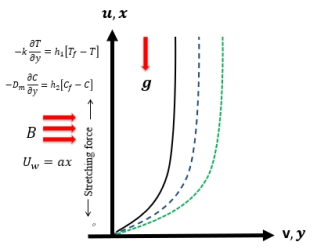
Figure 1. Mathematical flow geometry.
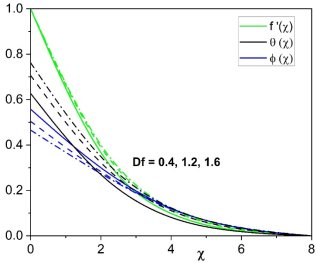
Figure 2. Influence of Dufour number on and .
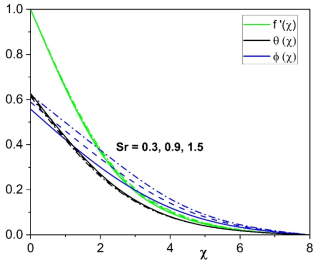
Figure 3. Influence of Soret number on and .
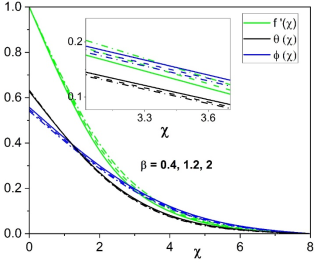
Figure 4. Influence of Deborah number on and .
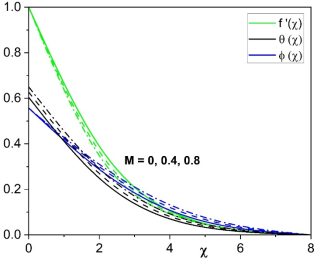
Figure 5. Influence of magnetic field on and .
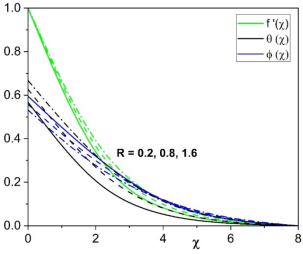
Figure 6. Influence of thermal radiation on and .
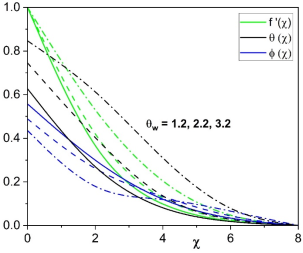
Figure 7. Influence of temperature ratio parameter on and .
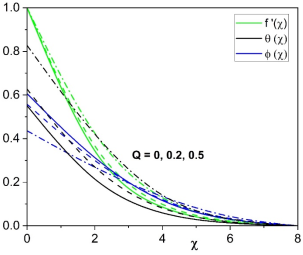
Figure 8. Influence of heat source parameter on and .
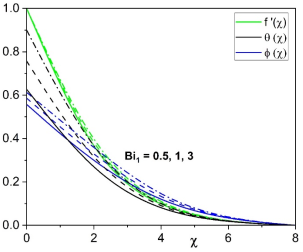
Figure 9. Influence of thermal Biot number on and .
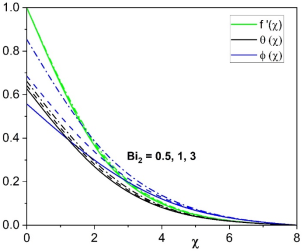
Figure 10. Influence of concentration Biot number on and .
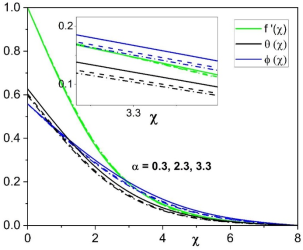
Figure 11. Influence of convection parameter on and .
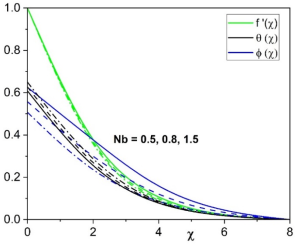
Figure 12. Influence of convection parameter on and .
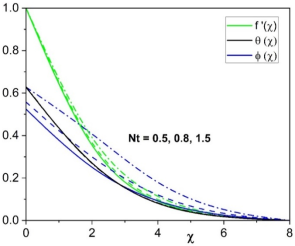
Figure 13. Influence of convection parameter on and .

Information


 Share This Article
 Twitter
 Linked In
 Facebook
 Copy
Copy Download