Research Article | | Peer-Reviewed

Unsupported Hydrogenation Catalysts in Liquid-phase Oil Hydroprocessing Research

Received: 13 July 2026     Accepted: 27 August 2026     Published: 4 September 2026
Views:       Downloads:
Abstract

To meet stringent commercial fuel specifications, direct coal liquefied oil (DCL oil) must undergo comprehensive hydrotreating prior to utilization. However, conventional hydrotreating technologies and catalysts adapted from petroleum refining are often inadequate due to the distinct compositional and structural characteristics of DCL oil—namely, high concentrations of heteroatoms (S, N, O), elevated aromaticity, abundant polycyclic aromatic hydrocarbons (PAHs), and significant levels of unstable olefins and phenolic compounds. Compared to tradition impregnation process, unsupported catalyst is prepared by forming process. For realizing the consistency of active phase before and after forming, active phase should maintains chemical inertness and dispersibility at forming condition. Herein, these active phase property is named as modularized property. The advantage of modularized property is studied by the comparation between unsupported and supported catalyst, which prepared by catalyst forming process and impregnation process, respectively. In catalysts sulfide slab investigation, forming process enhances the distribution ratio of more than two stack layers, which benefit to catalytic activity. Its ratio is 1.5 times of the catalyst prepared by impregnation process. In catalytic activity evaluation, catalyst prepared by forming process maintains a higher catalytic activity.

Published in American Journal of Chemical Engineering (Volume 14, Issue 5)
DOI 10.11648/j.ajche.20261405.12
Page(s) 163-168
Creative Commons

This is an Open Access article, distributed under the terms of the Creative Commons Attribution 4.0 International License (http://creativecommons.org/licenses/by/4.0/), which permits unrestricted use, distribution and reproduction in any medium or format, provided the original work is properly cited.

Copyright

Copyright © The Author(s), 2026. Published by Science Publishing Group

Keywords

Unsupported Catalyst, Modularized Property, Coal Liquefied Oil, Catalytic Activity Promotion

1. Introduction
As the environmental issues are getting valued, automobile fuels standards are getting more and more restricted all around the world . Simultaneously, in order to increase the benefits of refinery enterprises, more and more secondary processing diesel oil is hydrotreated in diesel hydrotreating units . For saving on investment, it is essential to hydrotreat as much secondary processing diesel as possible in diesel hydrotreating unit. It is a big challenge for diesel hydrotreating catalysts to transfer secondary processing diesel into clean fuel under a mild condition, especially under a relatively lower hydrogen partial pressure .
To increase catalyst active sites density, unsupported catalyst was invented to enhance the diesel hydrotreating activity . Different from traditional supported catalysts, unsupported catalyst should comprise at least 60 wt% of metal oxidic particles . More metal oxidic content could increase catalyst active sites content. However, higher metal oxidic content would also lead active phase agglomeration and decrease active sites exposure. Thus, series researches are reported in the investigation of unsupported catalyst active sites dispersion. Liu et al. synthesised unsupported NiMo catalysts with the assistance of PVP . With the existence of PVP, the agglomeration of active sites were under control. Except for PVP, starch could also limit active sites agglomeration, too. In order to construct a proper unsupported framework structure, the sulfuration condition and calcination temperature were studied. Moreover, for enhancing diesel hydrotreating activity, the adjustment of active phase element composition was also studied .
Although extensive research efforts have been devoted to exploring the synthesis and structural modification of unsupported diesel hydrotreating catalysts in existing studies, the unique modularized property that serves as an inherent characteristic of unsupported catalysts has been seldom reported and systematically discussed so far. In the present study, we focus on the systematic comparison between unsupported catalysts and conventional supported catalysts, which are prepared by the catalyst forming process and the traditional impregnation process, respectively. In this work, the advantages of the unique modularized property of unsupported catalysts can be investigated in detail.
2. Experimental Methods
Powder X-ray diffraction (XRD) is performed on a Rigaku SmartLab 3KW diffractometer, with Cu K radiation at 40 kV and 30 mA. Nitrogen adsorption is measured with a Micromeritics ASAP 2460 surface area and porosity analyzer. The specific surface area of the catalyst is calculated from the linear portion of BET plots (P/P0 = 0.05–0.30) at 77 K. The pore volume is acquired by single point at maximal P/P0 adsorption value. The pore size distribution is acquired according to BHJ desorption cumulative. SEM images are acquired using a JEM7610F scanning electron microscope. HAADF−STEM experiments and elemental mapping experiments are carried out on a JEMARM200FNEOARM electron microscope instrument with a probe corrector at 200 kV. The CO chemisorption is performed with Micromeritics chemisorb HD88 gas-adsorption equipment. The sample is loaded into a quartz reactor and pretreated in 10% H2/Ar at 450°C for 3 h. After cooling in He, pulses of 10% CO/He in a He carrier (25 cm3 (NTP) min−1) are injected at 30°C through a loop tube.
3. Results and Discussion
To elucidate the influence of preparation methodology on the physicochemical properties and catalytic performance of the synthesized materials, a systematic comparison was conducted between the unsupported catalysts prepared via the forming process and the supported catalysts prepared via the traditional impregnation process. This section focuses on verifying the "modularized property" hypothesis, specifically examining how the forming process contributes to the consistency and dispersion of the active phase. The structural evolution, morphological characteristics, and active site distribution were comprehensively characterized using XRD, SEM, and HAADF-STEM techniques. Furthermore, the correlation between these structural features and the liquid-phase oil hydroprocessing activity is discussed to demonstrate the advantages of the unsupported catalyst architecture.
3.1. XRD Characterization
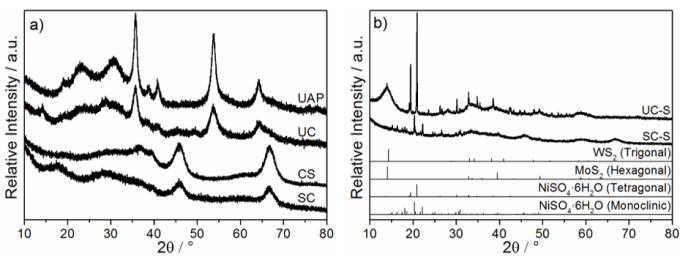
The difference between forming process and impregnation process in crystal structure can be investigated in XRD characterization. Figure 1 shows the XRD patterns of UAP, UC, CS, SC, UC-S and SC-S. For forming process, UAP and UC show a very similar XRD patterns in Figure 1a. In comparison to UAP, UC displays a lower diffraction intensity.
Figure 1. The XRD patterns of a) UAP, UC, CS and SC; b) UC-S and SC-S.
3.2. SEM Characterization
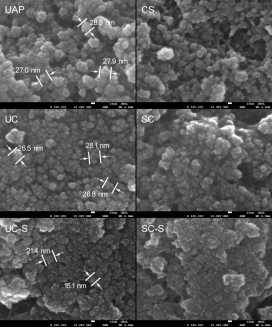
Figure 2. SEM micrographs of UAP, UC, UC-S, CS, SC and SC-S.
The morphology study is performed by SEM characterization. The micrographs of the UAP, UC, UC-S, CS, SC and SC-S are presented in Figure 2. The SEM micrographs comparative study between UAP and UC is performed to investigate the modularized property of UAP during forming process. In UAP micrographs, the active phase is constructed by clusters with diameter about 27-29 nm. Further, it is recognized that the cluster is constituted by several smaller particles. Accordingly, each cluster maintains abundant surface defects, which is beneficial for active site exposure. Moreover, comparing the SEM micrographs between UAP and UC, the morphology and cluster are kept. It proves that UAP maintains a morphological stability during catalyst forming process. This stability proves that UAP preserves a modularized property.
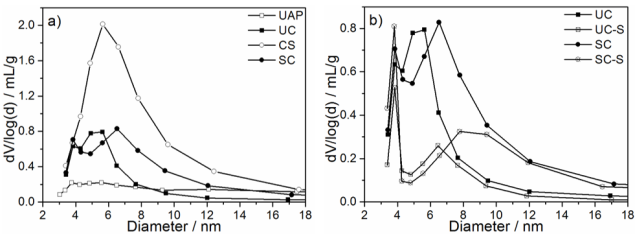
Different preparation process displays a diverse pore size distribution. This distribution before and after catalyst preparation and pre-sulfurization is shown in Figure 3a and Figure 3b, respectively. Despite UAP maintains a proper pore volume, UAP presents a diffuse pore size distribution. Associated with the morphology study, it might ascribe to the unordered cluster construction of UAP. During forming process, a concentrated pore size distribution can be recognized in UC. It proved that forming process could construct a framework, which is beneficial for active site exposure. On the contrary, during impregnation process, the porous structure destroyed obviously from CS to SC. In this process, pore size of CS larger than 3.8 nm is decreased significantly, mainly at 4.8 nm. It indicated that the impregnation solute mainly present in the pore of catalyst support at 4.8 nm, which digital confirms the morphology deduction that smaller pore of CS is filled by impregnation solute. In Figure 3b, it illustrated that pre-sulfurization process have a negative influence on porous structure of both UC and SC. As concluded above, the framework of UC is collapsed during pre-sulfurization process. The pore size between 4.3 and 6.5 nm is destroyed in this collapsion. Correspondingly, active phase in SC is enlarged during pre-sulfurization process. Comparing the pore size difference between SC and SC-S, the enlargement of cluster happened in the pore size between 4.3 and 7.8 nm.
Figure 3. The pore size distribution of UAP, UC, CS, SC, UC-S and SC-S.
3.3. Catalytic Results
In the petroleum hydrotreating process, the catalytic reaction performance of three core reactions, namely hydrodesulfurization (HDS), hydrodenitrogenation (HDN) and hydrodearomatization (HDAr), is the most concerning core indicator for evaluating catalyst quality. To meet the clear specification requirements set in official diesel quality standards, the residual content of polycyclic aromatic hydrocarbon (PAH) in finished diesel products must be strictly controlled within the specified qualified range. Based on this rule, the catalytic performance of HDS, HDN and HDAr is evaluated separately according to the conversion of sulfur, nitrogen and PAH in the reaction feedstock, respectively. In this research, hydrotreating reactions at different reaction temperatures were designed and evaluated to fully compare the performance of different catalysts. After completing all groups of reaction tests, the detailed properties of the initial reaction feed and the final obtained product are systematically sorted out and listed in Table 1 for intuitive comparison. By comparing the corresponding property data recorded in the table, it can be clearly observed that the product properties obtained with UC-S as catalyst are superior to those obtained with SC-S at each evaluation temperature. Thus, it can be reasonably concluded that UC-S exhibits a higher overall catalytic activity in the hydrotreating process.
Table 1. Feed and product properties of SC-S and UC-S.

Sample

Feed

Product

Temperature ℃

340

catalyst

SC-S

UC-S

sulfur content /ppm

1465

24.8

4.4

nitrogen content /ppm

810

1.4

1.2

PAH content* /wt%

33.0

12.8

11.9

*PAH content = bi-aromatics content + tri-aromatics content.
In HDS and HDN study, the sulfur /nitrogen content of UC-S at 300℃ is 33.0/5.7 ppm. That of SC-S at 320℃ is 33.2/4.7 ppm. These two sulfur /nitrogen content is quite similar. Moreover, the sulfur /nitrogen content of UC-S at 320℃ is close to that of SC-S at 340℃. Accordingly, UC-S maintains approx. 20℃ advantage than SC-S at 300-340℃.
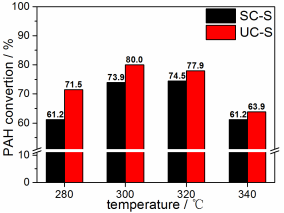
In HDAr study, the conversion of PAH is shown in Figure 4. It is shown that UC-S maintains a higher PAH conversion at each evaluation temperature. With evaluation temperature decreased from 340 to 280, the HDAr performance advantage of UC-S is getting obviously. Typically, UC-S maintains approx. 10% PAH conversion advantage than SC-S at 280℃.
To further reveal the intrinsic correlation between preparation method, pore structure and catalytic performance, we can attribute the superior activity of UC-S to its optimized porous structure derived from the forming preparation process. As confirmed by the previous pore size distribution analysis, the forming process constructs an ordered framework with concentrated pore size, which provides unobstructed mass transfer channels for large reactant molecules in petroleum feedstock, including macromolecular sulfur/nitrogen-containing compounds and polycyclic aromatic hydrocarbons. This allows more reactant molecules to access the internal active sites of the catalyst, rather than only reacting on the external surface of the catalyst, which ultimately improves the conversion of all three target reactions. For SC-S prepared by the traditional impregnation method, the blockage of small pores by impregnation solute and the subsequent aggregation of active phases after pre-sulfurization greatly hinder the diffusion of reactants, leading to lower catalytic activity even at higher reaction temperatures.
To verify the practical application potential of the UC-S catalyst, a 120-hour long-term stability test was carried out at a reaction temperature of 320℃ and a constant weight hourly space velocity. Both catalysts maintain stable catalytic performance during the whole test period, and the activity advantage of UC-S over SC-S is well maintained. The sulfur content of the product obtained by UC-S remains below 5 ppm, the nitrogen content remains below 1.3 ppm, and the PAH conversion remains stable at around 68%, which fully meets the strict requirements of the national V diesel standard for product quality. These results confirm that the catalyst prepared by the new forming route has excellent stability and practical application prospect.
Figure 4. The PAH conversion* of SC-S and UC-S.
*PAH conversion = [1 – (Product PAH content / Feed PAH content)] × 100%
4. Conclusions
In summary, catalyst forming process and impregnation process are studied comparatively by material characterization and catalytic activity evaluation. As a result, it is proved that unsupported active phase maintains a modularized property of chemical inertness and dispersibility at catalyst forming condition. Based on modularized property, the crystalline structure is kept and active site is totally exposed. During forming process, a framework is constructed. The framework construction is beneficial for textural property improving and catalytic active site exposure. In catalytic activity evaluation, it shows a better hydrotreating performance by catalyst forming process. As a result, a catalyst prepared by forming process according to active phase modularized property benefits to catalytic activity promotion.
Abbreviations

PAHs

Polycyclic Aromatic Hydrocarbons

XRD

X-ray Diffraction

BET

Brunauer-Emmett-Teller

BJH

Barrett-Joyner-Halenda

SEM

Scanning Electron Microscope

HAADF-STEM

High-Angle Annular Dark-Field Scanning Transmission Electron Microscopy

HDS

Hydrodesulfurization

HDN

Hydrodenitrogenation

HDAr

Hydrodearomatization

Acknowledgments
The authors gratefully acknowledge the technical assistance and organizational support provided by the Clean Fuels Research Division of PetroChina Petrochemical Research Institute (PRI) during the experimental design and catalyst evaluation phases of this study.
Author Contributions
Yuandong Hou: Conceptualization, Investigation, Writing – review & editing
Rongguan Li: Supervision, Resources, Writing – review & editing
Zihao Li: Data curation, Formal Analysis
Shaohui Ge: Validation
Funding
This work was supported by the National Key R&D Program of China (Grant No. 2021YFA1501200) and the PetroChina National Project Supporting Science and Technology Project (Grant No. 22-01PT-01-05).
Conflicts of Interest
The authors declare no conflicts of interest.
References
[1] S. Dey, N. S. Mehta. Automobile pollution control using catalysis. Resources, Environment and Sustainability. 2020, 2, 100006.
[2] P. Betancourt, S. Marrero, S. Pinto-Castilla. V–Ni–Mo sulfide supported on Al2O3: Preparation, characterization and LCO hydrotreating. Fuel Processing Technology. 2013, 114, 21-25.
[3] P. Vozka, D. Orazgaliyeva, P. Šimáček, J. Blažek, G. Kilaz. Activity comparison of Ni-Mo/Al2O3 and Ni-Mo/TiO2 catalysts in hydroprocessing of middle petroleum distillates and their blend with rapeseed oil. Fuel Processing Technology. 2017, 167, 684-694.
[4] S. M. S. L. Soled, R. Krikak, H. Vroman, T. H. Ho, K. L. Riley. NICKEL MOLYBDUNGSTATE HYDROTREATING CATALYSTS. Patent: 09/518, 741. Oct. 9, 2001.
[5] H. Liu, C. G. Liu, C. L. Yin, Y. M. Chai, Y. P. Li, D. D. Liu, B. Liu, X. H. Li, Y. Y. Wang, X. Z. Li. Preparation of highly active unsupported nickel-zinc-molybdenum catalysts for the hydrodesulfurization of dibenzothiophene. Applied Catalysis B-Environmental. 2015, 174, 264-276.
[6] P. Li, Y. Chen, C. Zhang, B. Huang, X. Liu, T. Liu, Z. Jiang, C. Li. Highly selective hydrodesulfurization of gasoline on unsupported Co-Mo sulfide catalysts: Effect of MoS2 morphology. Applied Catalysis A: General. 2017, 533, 99-108.
[7] H. B. Yu, J. C. Zhang, J. Nan, S. Geng, Y. T. Zhang, Y. L. Shi, X. L. Qu, H. G. Liu. Synthesis and Hydrodesulfurization Performance of Bulk Ni-Mo-W Catalyst with High Surface Area. In: J. M. Zeng, H. X. Zhu, J. Y. Kong (Eds.) Advances in Chemical, Material and Metallurgical Engineering, Pts 1-5. 2013, pp. 604-607.
[8] H. Liu, C. L. Yin, H. Y. Zhang, C. G. Liu. Sustainable synthesis of ammonium nickel molybdate for hydrodesulfurization of dibenzothiophene. Chinese Journal of Catalysis. 2016, 37, 1502-1512.
[9] Y. D. Chen, L. Wang, Y. L. Zhang, T. F. Liu, X. Y. Liu, Z. X. Jiang, C. Li. A new multi-metallic bulk catalyst with high hydrodesulfurization activity of 4,6-DMDBT prepared using layered hydroxide salts as structural templates. Applied Catalysis a-General. 2014, 474, 69-77.
[10] Y. D. Chen, L. Wang, X. Y. Liu, T. F. Liu, B. K. Huang, P. Li, Z. X. Jiang, C. Li. Hydrodesulfurization of 4,6-DMDBT on multi-metallic bulk catalyst NiAlZnMoW: Effect of Zn. Applied Catalysis a-General. 2015, 504, 319-327.
[11] S. EIJSBOUTS, B. LELIVELD, J. SITTERS, M. CERFONTAIN, Bruce, B. OOGJEN, Gerardus. PROCESS FOR THE PREPARATION OF A SHAPED BULK CATALYST. Patent: PCT/EP2006/010293. 2008-10-29.
[12] H. Liu, Q. Liu, J. Zhang, C. Yin, Y. Zhao, S. Yin, C. Liu, W. Sun. PVP-assisted synthesis of unsupported NiMo catalysts with enhanced hydrosulfurization activity. Fuel Processing Technology. 2017, 160, 93-101.
[13] D. Zhang, Y. Xu, M. Li, K. Hou. Synthesis of Mo-Ni bulk catalyst by sol-gel method and its hydrosulfurization performance. Petroleum Processing and Petrochemicals. 2016, 47, 67-73.
[14] C. L. Yin, Y. Y. Wang, S. S. Xue, H. Liu, H. Li, C. G. Liu. Influence of sulfidation conditions on morphology and hydrotreating performance of unsupported Ni-Mo-W catalysts. Fuel. 2016, 175, 13-19.
[15] H. Liu, C. L. Yin, B. Liu, X. H. Li, Y. P. Li, Y. M. Chai, C. G. Liu. Effect of Calcination Temperature of Unsupported NiMo Catalysts on the Hydrosulfurization of Dibenzothiophene. Energy & Fuels. 2014, 28, 2429-2436.
[16] R. Li, Q. Guan, R. Wei, S. Yang, Z. Shu, Y. Dong, J. Chen, W. Li. A Potential Regularity for Enhancing the Hydrogenation Properties of Ni2P. The Journal of Physical Chemistry C. 2015, 119, 2557-2565.
Cite This Article
  • APA Style

    Hou, Y., Li, R., Li, Z., Ge, S. (2026). Unsupported Hydrogenation Catalysts in Liquid-phase Oil Hydroprocessing Research. American Journal of Chemical Engineering, 14(5), 163-168. https://doi.org/10.11648/j.ajche.20261405.12

    Copy | Download

    ACS Style

    Hou, Y.; Li, R.; Li, Z.; Ge, S. Unsupported Hydrogenation Catalysts in Liquid-phase Oil Hydroprocessing Research. Am. J. Chem. Eng. 2026, 14(5), 163-168. doi: 10.11648/j.ajche.20261405.12

    Copy | Download

    AMA Style

    Hou Y, Li R, Li Z, Ge S. Unsupported Hydrogenation Catalysts in Liquid-phase Oil Hydroprocessing Research. Am J Chem Eng. 2026;14(5):163-168. doi: 10.11648/j.ajche.20261405.12

    Copy | Download

  • @article{10.11648/j.ajche.20261405.12,
      author = {Yuandong Hou and Rongguan Li and Zihao Li and Shaohui Ge},
      title = {Unsupported Hydrogenation Catalysts in Liquid-phase Oil Hydroprocessing Research},
      journal = {American Journal of Chemical Engineering},
      volume = {14},
      number = {5},
      pages = {163-168},
      doi = {10.11648/j.ajche.20261405.12},
      url = {https://doi.org/10.11648/j.ajche.20261405.12},
      eprint = {https://article.sciencepublishinggroup.com/pdf/10.11648.j.ajche.20261405.12},
      abstract = {To meet stringent commercial fuel specifications, direct coal liquefied oil (DCL oil) must undergo comprehensive hydrotreating prior to utilization. However, conventional hydrotreating technologies and catalysts adapted from petroleum refining are often inadequate due to the distinct compositional and structural characteristics of DCL oil—namely, high concentrations of heteroatoms (S, N, O), elevated aromaticity, abundant polycyclic aromatic hydrocarbons (PAHs), and significant levels of unstable olefins and phenolic compounds. Compared to tradition impregnation process, unsupported catalyst is prepared by forming process. For realizing the consistency of active phase before and after forming, active phase should maintains chemical inertness and dispersibility at forming condition. Herein, these active phase property is named as modularized property. The advantage of modularized property is studied by the comparation between unsupported and supported catalyst, which prepared by catalyst forming process and impregnation process, respectively. In catalysts sulfide slab investigation, forming process enhances the distribution ratio of more than two stack layers, which benefit to catalytic activity. Its ratio is 1.5 times of the catalyst prepared by impregnation process. In catalytic activity evaluation, catalyst prepared by forming process maintains a higher catalytic activity.},
     year = {2026}
    }
    

    Copy | Download

  • TY  - JOUR
    T1  - Unsupported Hydrogenation Catalysts in Liquid-phase Oil Hydroprocessing Research
    AU  - Yuandong Hou
    AU  - Rongguan Li
    AU  - Zihao Li
    AU  - Shaohui Ge
    Y1  - 2026/09/04
    PY  - 2026
    N1  - https://doi.org/10.11648/j.ajche.20261405.12
    DO  - 10.11648/j.ajche.20261405.12
    T2  - American Journal of Chemical Engineering
    JF  - American Journal of Chemical Engineering
    JO  - American Journal of Chemical Engineering
    SP  - 163
    EP  - 168
    PB  - Science Publishing Group
    SN  - 2330-8613
    UR  - https://doi.org/10.11648/j.ajche.20261405.12
    AB  - To meet stringent commercial fuel specifications, direct coal liquefied oil (DCL oil) must undergo comprehensive hydrotreating prior to utilization. However, conventional hydrotreating technologies and catalysts adapted from petroleum refining are often inadequate due to the distinct compositional and structural characteristics of DCL oil—namely, high concentrations of heteroatoms (S, N, O), elevated aromaticity, abundant polycyclic aromatic hydrocarbons (PAHs), and significant levels of unstable olefins and phenolic compounds. Compared to tradition impregnation process, unsupported catalyst is prepared by forming process. For realizing the consistency of active phase before and after forming, active phase should maintains chemical inertness and dispersibility at forming condition. Herein, these active phase property is named as modularized property. The advantage of modularized property is studied by the comparation between unsupported and supported catalyst, which prepared by catalyst forming process and impregnation process, respectively. In catalysts sulfide slab investigation, forming process enhances the distribution ratio of more than two stack layers, which benefit to catalytic activity. Its ratio is 1.5 times of the catalyst prepared by impregnation process. In catalytic activity evaluation, catalyst prepared by forming process maintains a higher catalytic activity.
    VL  - 14
    IS  - 5
    ER  - 

    Copy | Download

Author Information
  • College of Chemistry and Chemical Engineering, China University of Petroleum (East China), Qingdao, China;Clean Fuels Research Division, PetroChina Petrochemical Research Institute, Beijing, China

  • Clean Fuels Research Division, PetroChina Petrochemical Research Institute, Beijing, China

  • Clean Fuels Research Division, PetroChina Petrochemical Research Institute, Beijing, China

  • Clean Fuels Research Division, PetroChina Petrochemical Research Institute, Beijing, China