
This study presents an enhanced access control management system for edge computing environments using bimodal biometrics, contextual risk analysis, and Chinese Wall policy enforcement. The work addresses a limitation in context-only access control frameworks, namely their inability to confirm that the person requesting access is the genuine enrolled user. To close this identity-verification gap, the proposed system integrates face recognition, fingerprint recognition, and contextual decision support into a unified edge-aware authentication workflow. The implementation was developed in Python using Flask, with MySQL for transactional data storage and IPFS for content-addressed storage of biometric-related artifacts. A hybrid dataset strategy was adopted. Public datasets such as VGGFace2 and SOCOFing supported preliminary experimentation, while locally captured biometric samples were emphasized for operational training and evaluation in order to reduce domain mismatch. A one-dimensional convolutional neural network was used for contextual access analysis, while transfer-learning-based convolutional neural networks were used for face and fingerprint recognition. The datasets were split into 70% training and 30% testing. Experimental results showed strong performance for the biometric and contextual modules. The face model achieved about 0.96 accuracy, the fingerprint model achieved about 93.36% classification accuracy with 95.83% precision, recall, and F1-score for the enrolled-user fingerprint class, and the contextual Conv1D model achieved 84.08% test accuracy. System-level testing further showed that integrating biometric evidence with contextual intelligence and policy enforcement improved access-decision reliability over the earlier context-only model. The study concludes that combining bimodal biometrics with edge-based contextual reasoning can provide stronger identity assurance, better real-time responsiveness, and more dependable access control for distributed computing environments.
| Published in | American Journal of Computer Science and Technology (Volume 9, Issue 4) |
| DOI | 10.11648/j.ajcst.20260904.11 |
| Page(s) | 138-153 |
| Creative Commons |
This is an Open Access article, distributed under the terms of the Creative Commons Attribution 4.0 International License (http://creativecommons.org/licenses/by/4.0/), which permits unrestricted use, distribution and reproduction in any medium or format, provided the original work is properly cited. |
| Copyright |
Copyright © The Author(s), 2026. Published by Science Publishing Group |
Edge Computing, Bimodal Biometrics, Access Control, Fingerprint Recognition, Face Recognition, Contextual Risk Analysis, Chinese Wall Policy, Ipfs
Component | Technology and function |
|---|---|
Backend service | Python for core application logic and system integration |
Web framework | Flask for routing, forms, dashboards, and API handling |
Relational database | MySQL for structured storage of users, logs, and decisions |
Decentralized storage | IPFS for content-addressed storage of biometric-related artifacts |
Face module | MobileNetV2 CNN for face feature learning and identity verification |
Fingerprint module | EfficientNetB0 CNN for primary fingerprint verification |
Context module | Conv1D CNN for contextual risk analysis and decision support |
ABAC | Attribute-Based Access Control |
CNN | Convolutional Neural Network |
CID | Content Identifier |
IPFS | InterPlanetary File System |
MEC | Multi-Access Edge Computing |
RBAC | Role-Based Access Control |
| [1] | Hameed, S., et al. Securing distributed systems: A survey on access control techniques for cloud, blockchain, IoT and SDN. Cyber Security and Applications. 2023, 1, 100015. |
| [2] | Shakarami, A., et al. Contemporary advances in multi-access edge computing: A survey of fundamentals, architecture, technologies, deployment cases, security, challenges, and directions. Journal of Network and Computer Applications. 2023, 219, 103726. |
| [3] | Kaur, N. A systematic review on security aspects of fog computing environment: Challenges, solutions and future directions. Computer Science Review. 2024, 54, 100688. |
| [4] | Chandramouli, R., Butcher, Z. A Zero Trust Architecture Model for Access Control in Cloud-Native Applications in Multi-Cloud Environments. NIST Special Publication 800-207. National Institute of Standards and Technology. 2023. |
| [5] | Alam, T., et al. Differential privacy in edge computing-based smart city applications: Security issues, solutions and future directions. Array. 2023, 19, 100293. |
| [6] | Xu, G., Ren, J., Zhang, Y., Lin, C. A multimodal biometric authentication scheme for mobile edge computing. Information Sciences. 2021, 553, 1-15. |
| [7] | Yao, H., Zhang, J., Liu, X., Wang, Y. Multimodal biometric authentication by federated learning. Biomedical Signal Processing and Control. 2023, 85, 104932. |
| [8] | Hu, V. C., Ferraiolo, D. F., Kuhn, R., Schnitzer, A., Sandlin, K., Miller, R., Scarfone, K. Guide to Attribute Based Access Control (ABAC) Definition and Considerations. NIST SP 800-162. National Institute of Standards and Technology. 2015. |
| [9] | Muhammad, B. A., Garba, M., Gabi, D., Suru, H. U., Argungu, M. S. Dynamic access control at the network edge using an adaptive risk-based access control system (ad-RACs). 2024, 1(2), 12-19. |
| [10] | Goudarzi, H., Liao, X., Zhang, Q. A review on edge computing architecture and its applications in IoT and AI. Future Generation Computer Systems. 2023, 142, 312-328. |
| [11] | Shi, W., Cao, J., Zhang, Q., Li, Y., Xu, L. Edge Computing: Vision and Challenges. IEEE Internet of Things Journal. 2016, 3(5), 637-646. |
| [12] | Satyanarayanan, M. The Emergence of Edge Computing. Computer. 2017, 50(1), 30-39. |
| [13] |
XenonStack. Edge Computing Solutions and Capabilities. Available from:
https://www.xenonstack.com/enterprise/edge-computing/ (accessed 15 September 2026). |
| [14] | Jain, A. K., Ross, A., Prabhakar, S. An Introduction to Biometric Recognition. IEEE Transactions on Circuits and Systems for Video Technology. 2004, 14(1), 4-20. |
| [15] | Ratha, N. K., Connell, J. H., Bolle, R. M. Enhancing security and privacy in biometrics-based authentication systems. IBM Systems Journal. 2001, 40(3), 614-634. |
| [16] | Jain, A. K., Ross, A. Introduction to Biometrics. In Handbook of Biometrics. Springer. 2008, pp. 1-22. |
| [17] | Maltoni, D., Maio, D., Jain, A. K., Prabhakar, S. Handbook of Fingerprint Recognition. 2nd ed. Springer. 2009. |
| [18] | Li, S. Z., Jain, A. K., editors. Handbook of Face Recognition. 2nd ed. Springer. 2011. |
| [19] | Sandler, M., Howard, A., Zhu, M., Zhmoginov, A., Chen, L. C. MobileNetV2: Inverted Residuals and Linear Bottlenecks. Proceedings of the IEEE/CVF Conference on Computer Vision and Pattern Recognition. 2018, pp. 4510-4520. |
| [20] | Tan, M., Le, Q. V. EfficientNet: Rethinking Model Scaling for Convolutional Neural Networks. Proceedings of the 36th International Conference on Machine Learning. 2019, 97, 6105-6114. |
| [21] | Nobi, M. Machine learning in access control systems: A survey. ACM Computing Surveys. 2022, 55(3), 1-36. |
| [22] | Rahman, M. S., Li, X., Chen, J. Risk-adaptive access control using reinforcement learning. IEEE Transactions on Information Forensics and Security. 2023, 18, 408-421. |
| [23] | LeCun, Y., Bengio, Y., Hinton, G. Deep learning. Nature. 2015, 521, 436-444. |
| [24] | Abbas, N., Zhang, Y., Taherkordi, A., Skeie, T. Mobile edge computing: A survey. IEEE Internet of Things Journal. 2018, 5(1), 450-465. |
| [25] | Jahan, N., Reno, S., Ahmed, M. Securing E-Passport Management Using Private-Permissioned Blockchain and IPFS. In 3rd International Conference on Electrical, Computer and Communication Engineering. 2023. |
| [26] | Cao, Q., Shen, L., Xie, W., Parkhi, O. M., Zisserman, A. VGGFace2: A dataset for recognising faces across pose and age. 13th IEEE International Conference on Automatic Face and Gesture Recognition. 2018, pp. 67-74. |
| [27] |
Ruiz Garcia, S. SOCOFing Dataset. Kaggle. Available from:
https://www.kaggle.com/datasets/ruizgara/socofing (accessed 15 September 2026). |
| [28] | Brewer, D. F. C., Nash, M. J. The Chinese Wall Security Policy. Proceedings of the IEEE Symposium on Security and Privacy. 1989, pp. 206-214. |
APA Style
Ohia, P. N., Onuodu, F. E., Okengwu, U. A. (2026). Enhanced Access Control Management System in an Edge Computing Environment Using Bimodal Biometrics Technique. American Journal of Computer Science and Technology, 9(4), 138-153. https://doi.org/10.11648/j.ajcst.20260904.11
ACS Style
Ohia, P. N.; Onuodu, F. E.; Okengwu, U. A. Enhanced Access Control Management System in an Edge Computing Environment Using Bimodal Biometrics Technique. Am. J. Comput. Sci. Technol. 2026, 9(4), 138-153. doi: 10.11648/j.ajcst.20260904.11
@article{10.11648/j.ajcst.20260904.11,
  author = {Paul Ndudiri Ohia and Friday Eleonu Onuodu and Ugochi Adaku Okengwu},
  title = {Enhanced Access Control Management System in an Edge Computing Environment Using Bimodal Biometrics Technique},
  journal = {American Journal of Computer Science and Technology},
  volume = {9},
  number = {4},
  pages = {138-153},
  doi = {10.11648/j.ajcst.20260904.11},
  url = {https://doi.org/10.11648/j.ajcst.20260904.11},
  eprint = {https://article.sciencepublishinggroup.com/pdf/10.11648.j.ajcst.20260904.11},
  abstract = {This study presents an enhanced access control management system for edge computing environments using bimodal biometrics, contextual risk analysis, and Chinese Wall policy enforcement. The work addresses a limitation in context-only access control frameworks, namely their inability to confirm that the person requesting access is the genuine enrolled user. To close this identity-verification gap, the proposed system integrates face recognition, fingerprint recognition, and contextual decision support into a unified edge-aware authentication workflow. The implementation was developed in Python using Flask, with MySQL for transactional data storage and IPFS for content-addressed storage of biometric-related artifacts. A hybrid dataset strategy was adopted. Public datasets such as VGGFace2 and SOCOFing supported preliminary experimentation, while locally captured biometric samples were emphasized for operational training and evaluation in order to reduce domain mismatch. A one-dimensional convolutional neural network was used for contextual access analysis, while transfer-learning-based convolutional neural networks were used for face and fingerprint recognition. The datasets were split into 70% training and 30% testing. Experimental results showed strong performance for the biometric and contextual modules. The face model achieved about 0.96 accuracy, the fingerprint model achieved about 93.36% classification accuracy with 95.83% precision, recall, and F1-score for the enrolled-user fingerprint class, and the contextual Conv1D model achieved 84.08% test accuracy. System-level testing further showed that integrating biometric evidence with contextual intelligence and policy enforcement improved access-decision reliability over the earlier context-only model. The study concludes that combining bimodal biometrics with edge-based contextual reasoning can provide stronger identity assurance, better real-time responsiveness, and more dependable access control for distributed computing environments.},
 year = {2026}
}
TY  - JOUR
T1  - Enhanced Access Control Management System in an Edge Computing Environment Using Bimodal Biometrics Technique
AU  - Paul Ndudiri Ohia
AU  - Friday Eleonu Onuodu
AU  - Ugochi Adaku Okengwu
Y1  - 2026/10/14
PY  - 2026
N1  - https://doi.org/10.11648/j.ajcst.20260904.11
DO  - 10.11648/j.ajcst.20260904.11
T2  - American Journal of Computer Science and Technology
JF  - American Journal of Computer Science and Technology
JO  - American Journal of Computer Science and Technology
SP  - 138
EP  - 153
PB  - Science Publishing Group
SN  - 2640-012X
UR  - https://doi.org/10.11648/j.ajcst.20260904.11
AB  - This study presents an enhanced access control management system for edge computing environments using bimodal biometrics, contextual risk analysis, and Chinese Wall policy enforcement. The work addresses a limitation in context-only access control frameworks, namely their inability to confirm that the person requesting access is the genuine enrolled user. To close this identity-verification gap, the proposed system integrates face recognition, fingerprint recognition, and contextual decision support into a unified edge-aware authentication workflow. The implementation was developed in Python using Flask, with MySQL for transactional data storage and IPFS for content-addressed storage of biometric-related artifacts. A hybrid dataset strategy was adopted. Public datasets such as VGGFace2 and SOCOFing supported preliminary experimentation, while locally captured biometric samples were emphasized for operational training and evaluation in order to reduce domain mismatch. A one-dimensional convolutional neural network was used for contextual access analysis, while transfer-learning-based convolutional neural networks were used for face and fingerprint recognition. The datasets were split into 70% training and 30% testing. Experimental results showed strong performance for the biometric and contextual modules. The face model achieved about 0.96 accuracy, the fingerprint model achieved about 93.36% classification accuracy with 95.83% precision, recall, and F1-score for the enrolled-user fingerprint class, and the contextual Conv1D model achieved 84.08% test accuracy. System-level testing further showed that integrating biometric evidence with contextual intelligence and policy enforcement improved access-decision reliability over the earlier context-only model. The study concludes that combining bimodal biometrics with edge-based contextual reasoning can provide stronger identity assurance, better real-time responsiveness, and more dependable access control for distributed computing environments.
VL  - 9
IS  - 4
ER  -
Department of Information Technology, University of Port Harcourt, Port Harcourt, Nigeria
Biography: Paul Ndudiri Ohia holds B.Sc., M.Sc., and Ph.D. degrees in Computer Science. He has over 12 years of experience in software and web application development.

Department of Information Technology, University of Port Harcourt, Port Harcourt, Nigeria
Department of Computer Science, University of Port Harcourt, Port Harcourt, Nigeria
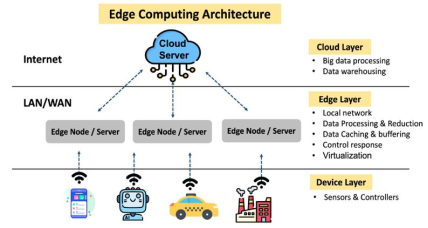
Figure 1. Edge computing architecture adapted from XenonStack [13].
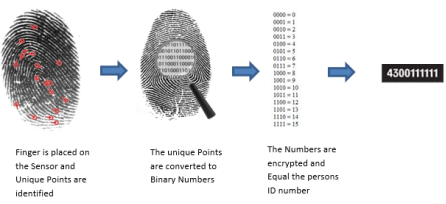
Figure 2. Fingerprint recognition process adapted from Maltoni et al. [17].
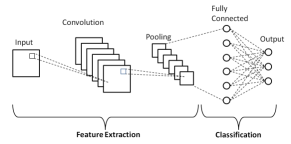
Figure 3. Structure of convolutional neural network (CNN).
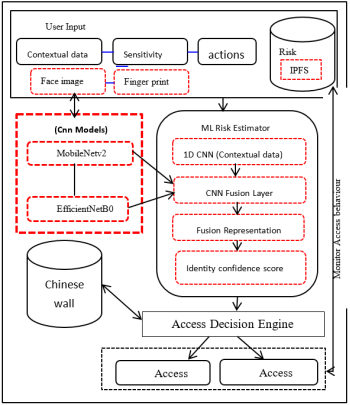
Figure 4. Proposed system architecture for the edge-based bimodal biometric access-control framework.

Figure 5. Public face image dataset (VGGFace2 from Kaggle).
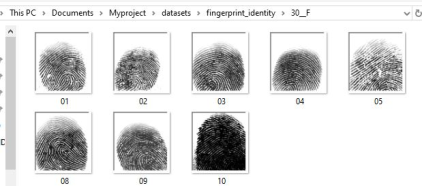
Figure 6. Public fingerprint dataset (SOCOFing from Kaggle).
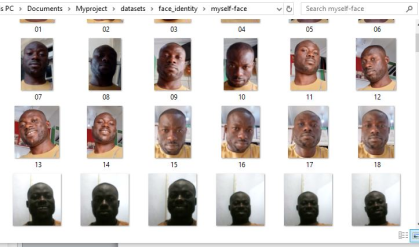
Figure 7. Locally captured face image dataset.
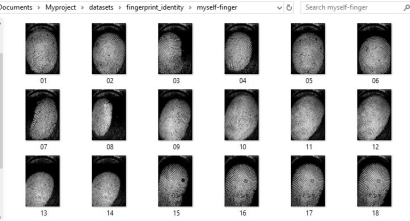
Figure 8. Locally captured fingerprint dataset.
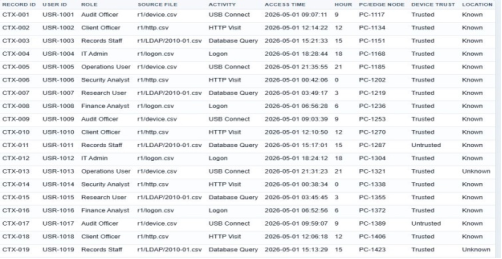
Figure 9. Contextual dataset.
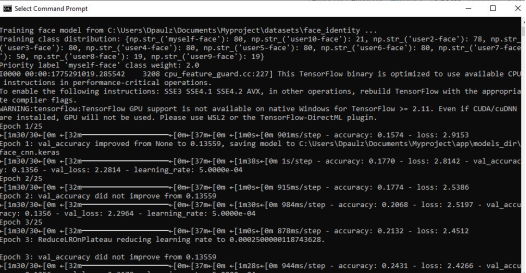
Figure 10. Model training process of facial biometric data.
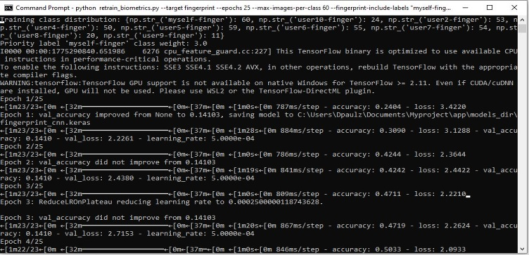
Figure 11. Fingerprint model training.
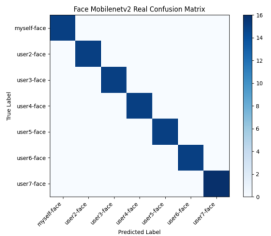
Figure 12. MobileNetV2 real face confusion matrix.
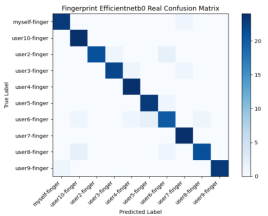
Figure 13. EfficientNetB0 real fingerprint confusion matrix.
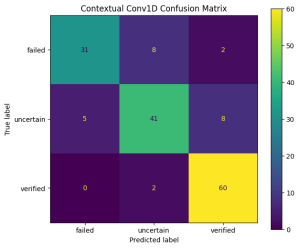
Figure 14. Contextual Conv1D confusion matrix.
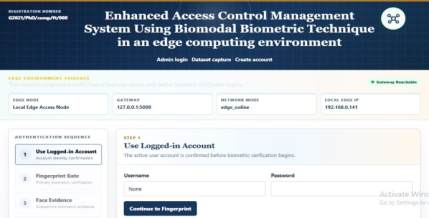
Figure 15. Enrollment form page.
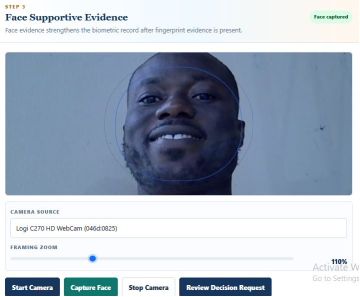
Figure 16. Biometric face-capture page.
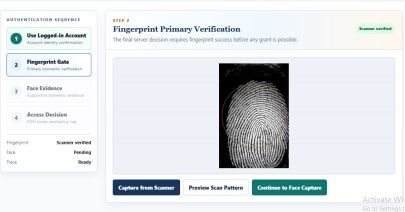
Figure 17. Biometric fingerprint-capture page.
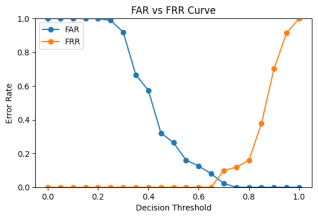
Figure 18. FAR versus FRR curve.
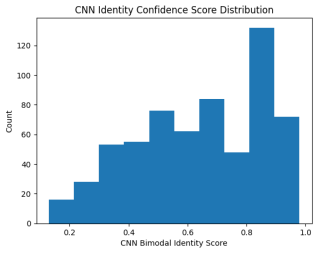
Figure 19. CNN identity confidence score distribution.
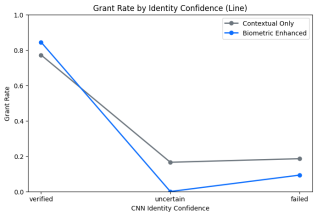
Figure 20. Grant identity confidence score distribution.
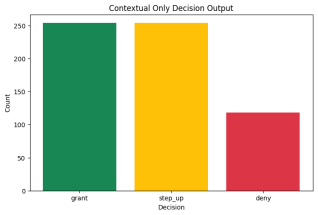
Figure 21. Contextual-only decision output.
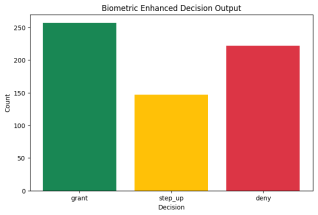
Figure 22. Biometric-enhanced decision output.
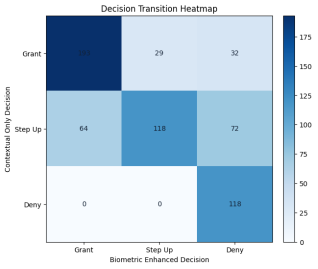
Figure 23. Decision transition heatmap.
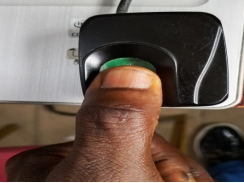
Figure 24. Futronic fingerprint-capture device.
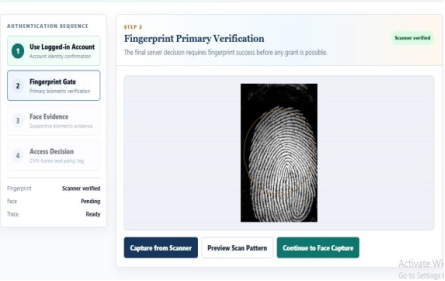
Figure 25. Fingerprint captured dataset.
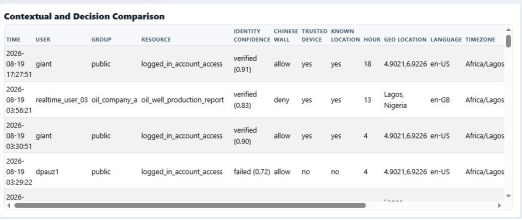
Figure 26. Contextual data interface.
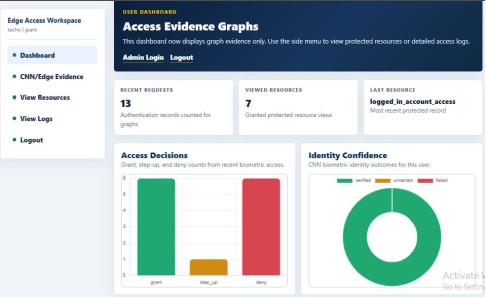
Figure 27. User dashboard page design layout.
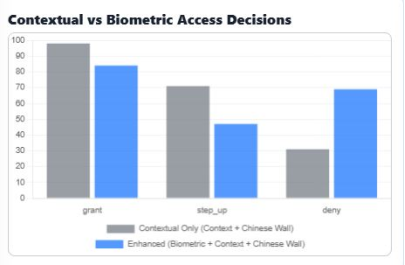
Figure 28. Contextual versus biometric access decisions.

Information



 Share This Article
 Twitter
 Linked In
 Facebook
 Copy
Copy Download