
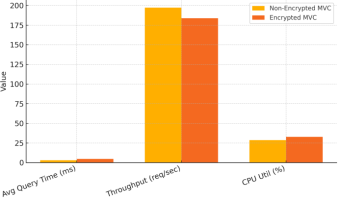
The Model-View-Controller (MVC) architecture is widely used in modern software development due to its modular design, scalability, and clear separation of concerns. Despite these advantages, traditional MVC applications often lack built-in security measures, leaving them vulnerable to data breaches and unauthorized access. This research proposes an enhanced MVC architecture that integrates data encryption to improve security and privacy. The proposed approach incorporates AES and RSA encryption techniques within the Model and Controller layers to protect sensitive data both at rest and during transmission. Secure data handling is also ensured at the View layer to prevent unintended data exposure. This encryption-based enhancement strengthens data confidentiality and integrity while preserving the core MVC structure. An experimental implementation of the proposed architecture was conducted using an MVC-based web application framework. The system was evaluated in terms of response time, computational overhead, and resistance to common security threats. The results indicate that the encryption-enhanced MVC model significantly improves data confidentiality and integrity while introducing only minimal performance overhead. The findings demonstrate that integrating encryption mechanisms into the MVC architecture provides an effective and practical solution for developing secure and privacy-preserving software systems, making the proposed approach suitable for modern applications that require compliance with contemporary cybersecurity and data protection requirements.
| Published in | American Journal of Data Mining and Knowledge Discovery (Volume 11, Issue 1) |
| DOI | 10.11648/j.ajdmkd.20261101.11 |
| Page(s) | 1-7 |
| Creative Commons |
This is an Open Access article, distributed under the terms of the Creative Commons Attribution 4.0 International License (http://creativecommons.org/licenses/by/4.0/), which permits unrestricted use, distribution and reproduction in any medium or format, provided the original work is properly cited. |
| Copyright |
Copyright © The Author(s), 2026. Published by Science Publishing Group |
Model, View, Controller, Security, Database
MVC | Model View Controller |
SQL | Structured Query Language |
XSS | Cross-Site Scripting |
CSRF | Cross-Site Request Forgery |
RSA | Rivest–Shamir–Adleman (RSA) Cryptography |
AES | Advanced Encryption Standard |
RBAC | Role-Based Access Control |
| [1] | Naimnule, F. A., Hanoe, F. A., Banusu, M. N. and Mano, M. O., Implementation of AES Encryption for Data Security on Web-Based Information Systems in FafinesuA Village. Krisnadana Journal, 4(3), pp. 122-130. |
| [2] | Pratiwi, Ade. "Implementation of Modified MVC Model with Integrated Security in E-Procurement Application for Companies." Journal of Technology and Computer 2, no. 3 (2025): 176-183. |
| [3] | M. H. Rahman, M. Naderuzzaman, M. A. Kashem, B. M. Salahuddin, Z. Mahmud, "Comparative Study: Performance of MVC Frameworks on RDBMS", International Journal of Information Technology and Computer Science(IJITCS), Vol. 16, No. 1, pp. 26-34, 2024. |
| [4] | M. H. Rahman, Bin, F., Naderuzzaman, M., Arifur, M., and Masud, M., “Optimizing and Enhancing Performance of MVC Architecture based on Data Clustering Technique”, International Journal of Computer Applications, vol. 134, no. 12, pp. 42-46, 2016. |
| [5] | Egerton, Taylor Onate, and Davies Isobo Nelson., A Model for Enhancing Security and Privacy in Pervasive Computing using Homomorphic Encryption, 2025. |
| [6] | Shah, Parth, Samarth Shah, and Anurag Agrawal. "Advanced Encryption Techniques for Enhancing Data Security and Privacy in Cloud Environments." 2025 1st International Conference on Secure IoT, Assured and Trusted Computing (SATC). IEEE, 2025. |
| [7] | Naik, Apurva R., and Lalit B. Damahe. "Enhancing data security and access control in cloud environment using modified attribute based encryption mechanism." International Journal of Computer Network and Information Security 8.10 (2016): 53. |
| [8] | OWASP Foundation, “OWASP Top Ten Web Application Security Risks,” 2023. Available: |
| [9] | Egerton, Taylor Onate, and Davies Isobo Nelson., A Model for Enhancing Security and Privacy in Pervasive Computing using Homo-morphic Encryption, 2025. |
| [10] | Y. Jiang, M. A. Rezazadeh Baee, L. R. Simpson, P. Gauravaram, J. Pieprzyk, T. Zia, et al., ”Pervasive user data collection from cyberspace: Privacy concerns and counter meaures,” Cryptography, Vol. 8, Issue. 5, pp. 1-5, 2024. |
| [11] |
E. I. Egho-Promise, M. Sitti, "Big data security management in digital environment," American Journal of Multidisciplinary Research & Development (AJMRD), Vol. 6, pp. 01-34, 2024.
http://ajmrd.com/wp-content/uploads/2024/02/ A620134.pdf |
| [12] | E. Mollakuqe, A. Parduzi, S. Rexhepi, V. Dimitrova, S. Jakupi, R. Muharremi, et al., "Applications of Homomorphic Encryption in Secure Computation,"Open Research Europe, Vol. 4, pp. 158, 2024. |
| [13] | A. K. Y. Yanamala, S. Suryadevara, "Adaptive Middleware Framework for Context-Aware Pervasive Computing Environments,"International Journal of Machine Learning Research in Cybersecurity and Artificial Intelligence, Vol. 13, pp. 35-57, 2022. |
| [14] |
S. D. Pasham, "Privacy-preserving data sharing in big data analytics: A distributed computing approach,"The Meta science, Vol. 1, pp. 149-184, 2023.
https://yuktabpublisher.com/index.php/TMS/article/view/130/118 |
| [15] | S. Aswathy, A. K. Tyagi, "Privacy Breaches through Cyber Vulnerabilities: Critical Issues, Open Challenges, and Possible Countermeasures for the Future,"In the Security and Privacy- Preserving Techniques in Wireless Robotics, ed: CRC Press, pp. 163-210, 2022. |
APA Style
Kabir, S. M. A., KumarAcharjee, U. (2026). Enhancing Security and Privacy in MVC Architecture Using a Data Encryption-Based Model. American Journal of Data Mining and Knowledge Discovery, 11(1), 1-7. https://doi.org/10.11648/j.ajdmkd.20261101.11
ACS Style
Kabir, S. M. A.; KumarAcharjee, U. Enhancing Security and Privacy in MVC Architecture Using a Data Encryption-Based Model. Am. J. Data Min. Knowl. Discov. 2026, 11(1), 1-7. doi: 10.11648/j.ajdmkd.20261101.11
@article{10.11648/j.ajdmkd.20261101.11,
  author = {S M Alauddin Kabir and Uzzal KumarAcharjee},
  title = {Enhancing Security and Privacy in MVC Architecture Using a Data Encryption-Based Model},
  journal = {American Journal of Data Mining and Knowledge Discovery},
  volume = {11},
  number = {1},
  pages = {1-7},
  doi = {10.11648/j.ajdmkd.20261101.11},
  url = {https://doi.org/10.11648/j.ajdmkd.20261101.11},
  eprint = {https://article.sciencepublishinggroup.com/pdf/10.11648.j.ajdmkd.20261101.11},
  abstract = {The Model-View-Controller (MVC) architecture is widely used in modern software development due to its modular design, scalability, and clear separation of concerns. Despite these advantages, traditional MVC applications often lack built-in security measures, leaving them vulnerable to data breaches and unauthorized access. This research proposes an enhanced MVC architecture that integrates data encryption to improve security and privacy. The proposed approach incorporates AES and RSA encryption techniques within the Model and Controller layers to protect sensitive data both at rest and during transmission. Secure data handling is also ensured at the View layer to prevent unintended data exposure. This encryption-based enhancement strengthens data confidentiality and integrity while preserving the core MVC structure. An experimental implementation of the proposed architecture was conducted using an MVC-based web application framework. The system was evaluated in terms of response time, computational overhead, and resistance to common security threats. The results indicate that the encryption-enhanced MVC model significantly improves data confidentiality and integrity while introducing only minimal performance overhead. The findings demonstrate that integrating encryption mechanisms into the MVC architecture provides an effective and practical solution for developing secure and privacy-preserving software systems, making the proposed approach suitable for modern applications that require compliance with contemporary cybersecurity and data protection requirements.},
 year = {2026}
}
TY  - JOUR
T1  - Enhancing Security and Privacy in MVC Architecture Using a Data Encryption-Based Model
AU  - S M Alauddin Kabir
AU  - Uzzal KumarAcharjee
Y1  - 2026/01/27
PY  - 2026
N1  - https://doi.org/10.11648/j.ajdmkd.20261101.11
DO  - 10.11648/j.ajdmkd.20261101.11
T2  - American Journal of Data Mining and Knowledge Discovery
JF  - American Journal of Data Mining and Knowledge Discovery
JO  - American Journal of Data Mining and Knowledge Discovery
SP  - 1
EP  - 7
PB  - Science Publishing Group
SN  - 2578-7837
UR  - https://doi.org/10.11648/j.ajdmkd.20261101.11
AB  - The Model-View-Controller (MVC) architecture is widely used in modern software development due to its modular design, scalability, and clear separation of concerns. Despite these advantages, traditional MVC applications often lack built-in security measures, leaving them vulnerable to data breaches and unauthorized access. This research proposes an enhanced MVC architecture that integrates data encryption to improve security and privacy. The proposed approach incorporates AES and RSA encryption techniques within the Model and Controller layers to protect sensitive data both at rest and during transmission. Secure data handling is also ensured at the View layer to prevent unintended data exposure. This encryption-based enhancement strengthens data confidentiality and integrity while preserving the core MVC structure. An experimental implementation of the proposed architecture was conducted using an MVC-based web application framework. The system was evaluated in terms of response time, computational overhead, and resistance to common security threats. The results indicate that the encryption-enhanced MVC model significantly improves data confidentiality and integrity while introducing only minimal performance overhead. The findings demonstrate that integrating encryption mechanisms into the MVC architecture provides an effective and practical solution for developing secure and privacy-preserving software systems, making the proposed approach suitable for modern applications that require compliance with contemporary cybersecurity and data protection requirements.
VL  - 11
IS  - 1
ER  -
Department of Computer Science and Engineering, Jagannath University, Dhaka, Bangladesh
Department of Computer Science and Engineering, Jagannath University, Dhaka, Bangladesh

Information



 Share This Article
 Twitter
 Linked In
 Facebook
 Copy
Copy Download