Research Article | | Peer-Reviewed

Effect of Abiotic and Biotic Factors on Population of Aphis Fabae Solanella (Hemiptera: Aphididae) Pest of Solanum Scabrum (Solanaceae) in Bambili Locality of Cameroon

Received: 14 May 2026     Accepted: 1 June 2026     Published: 29 June 2026
Views:       Downloads:
Abstract

Aphids are sap sucking insects feeding on their host plants which are mostly crops and induce important damages on their host plants affecting crop yield of famers. The aim of this study was to evaluate the impact of biotic and abiotic factors on population dynamic of Aphis fabae solanella pest of Solanum scabrum in Bambili locality of Cameroon. Monthly aphid individuals were collected and counted on the chosen plants in the field also the population of Coccinella sp. was evaluated. In the laboratory the feeding rate of the coccinellid was evaluated. Climatic factors were recorded daily in the meteorological station. The results revealed that A. f. solanella population density increases from the dry season to the beginning of the rainy season and drop during the heavy rainfall. The correlation of Pearson is lightly negative but not statistically significant between population density of A. f. solanella and precipitation, atmospheric relative humidity with r = -0.00231, p = 0.76; r = -0.00517, p = 0.79 respectively. While lightly positive but not statistically significant between population density of A. f. solanella and temperature, wind speed with r = 0.00253, p = 0.14; r = 0.000351, p = 0.77 respectively. For the duration of sun shine the correlation is positive but not statistically significant with r = 9.57, p = 0.54. For the phenology of the host plant, when the host plant is young the pest population increases also the infestation on the host plant increases; when the host plant is mature or old the density of the pest population decreases, pest infestation incidence also decreases. The coccinellid consuming rate was 26.52 aphids / predator / day. In conclusion, the biotic and abiotic factors have positive and negative impact on the population dynamic of A. f. solanella on S. scabrum.

Published in American Journal of Entomology (Volume 10, Issue 2)
DOI 10.11648/j.aje.20261002.12
Page(s) 38-44
Creative Commons

This is an Open Access article, distributed under the terms of the Creative Commons Attribution 4.0 International License (http://creativecommons.org/licenses/by/4.0/), which permits unrestricted use, distribution and reproduction in any medium or format, provided the original work is properly cited.

Copyright

Copyright © The Author(s), 2026. Published by Science Publishing Group

Keywords

Biotic, Abiotic, Factors, Aphid, Population, Pest, Huckleberry

1. Introduction
Aphid is one of the important agricultural insect pests with about 4500 species worldwide . Although its life span is very short (around one month), higher reproduction rate enables them to continue their destructive effect to the crops through maintaining their population in the field. They not only damage crop through feeding on it but also contribute to introduce different viral diseases working as a vector ; therefore, it is becoming a major agricultural pest . In some cases, their status of vectors of pathogens can be even more crucial than their direct feeding damage. Approximately 550 plant pathogens known to be transmitted by vectors, more than half (55%) are transmitted by aphids . Aphids are a group of pests with a very wide host range and are commonly found, causing significant damage to vegetables. They are wide spread in all regions of Cameroon where vegetables are cultivated. Both adult and nymph suck up sap from plants causing deformation of leaves and stunted growth. They cause curling, deformities, and discoloration in fresh leaves and shoots . When population densities are high, plant growth halts, and they cannot develop normally. In Cameroon the main pest insect of Solanum scabrum is the aphid species Aphis fabae solanella which causes leaf curl to the host plant. Aphis solanella and Aphis fabae are morphological similar and share the same primary host plant but there are different in the range of the secondary host plants, physiological and ecological traits. The population dynamics of Aphis fabae solanellais influenced by many factors such as climatic factors, natural enemies’ pressure and the phenology of the host plant. Natural enemies like coccinellid predators are contributing considerably in the regulation of this aphid species population. Solanums cabrum belongs to Solanaceae family and it is leafy green vegetable known as huckleberry and ‘’njama-njama’’ locally in the North-West Region of Cameroon. It is one of African indigenous vegetable and Cameroon in particular. It is also cultivated in Europe, Asia, New Zealand, and North America . The North-West region of Cameroon is where S. scabrum is more cultivated and it is exported in the other regions of the country to generate income to the famers. The leaves are rich in nutrients like proteins, iron, ascorbic acid and riboflavin; it has a variety of bioactive compounds such as phenolic compounds, carotenoids and chlorophyll .
2. Materials and Methods
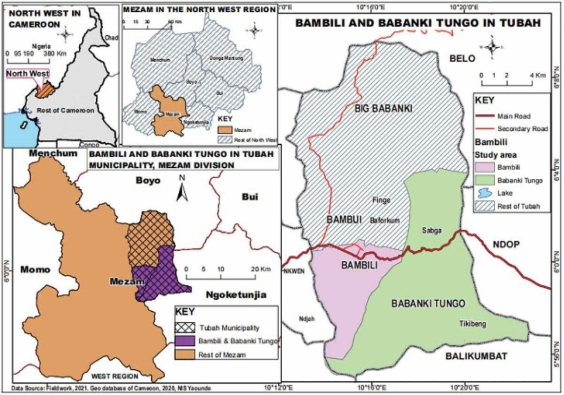
Study site: the study was carried out in Bambili (Figure 1) from March 2025 to March, 2026. Bambili is located in Tubah Sub-division, Mezam Division of the North-West Region of Cameroon. The geographical coordinates are: latitude 5°.98’N; longitude 10°.25’E and altitude 1492 m. There are two seasons: dry season from November to February and the raining season from March to October. Bambili has an annual temperature range from 18.7°C to 21°C; the vegetation is dominated by the savannah.
Figure 1. Site of the study localization.
Field work: October 10, 2025 Solanum scabrum seeds were sown on nursery bed of length 2 m and width 2 m (area of 4 m2) that were tilled and watered. After three weeks the young plants from the nursery were transplanted to the experimental site. The experimental plot was cleared, ploughed forming the furrows and divided into 24 sub-plots each sub-plot measured 3 m length by 2 m width and height of 30 cm for the furrows. Nursed plants were transplanted into experimental farm. Each sub-plot had 6 stands of the plants; the spacing between each plant was one meter. The plants were allowed to naturally grow without the application of any insecticide against any pest insect. Five infested plants were selected at random marked for study. Whole plant sampling was done by collecting adult aphids on leaves and stems from infested plants selected at random from each sub-plot. The insects were picked with flexible forceps and stored in 70% alcohol. The aphid pests of S. scabrum were collected monthly during one year. To evaluate the feeding rate of the coccinellid predator the experimentation was carried out in the laboratory. A total of 12 individuals of Coccinella sp. were chosen for the experimentation a single individual of Coccinella sp. predator was associated with 5 aphids in a Petri dish and a stop watch was used to record the time. After every 60 minutes the number of aphids consumed by the predator was recorded. The consumption rate was calculated as follow: number of aphids consumed/time. Climatic parameters such as precipitation, wind speed, atmospheric humidity, duration of sun shine and temperatures were recorded daily from meteorological station of Regional delegation of transport of the North-West Region of Cameroon from March 2025 to March 2026.
Data analysis was done using GraphPad prism version 9.3 program. The correlation of Pearson analysis was used to assess the relationship between climatic factors and Aphis fabae solanalla population density. The P-value below 0.05 was considered statistically significant.
3. Results and Discussion
3.1. Results
3.1.1. Numerical Variation of Aphis fabae solanella Population on Solanum scabrum During the Year
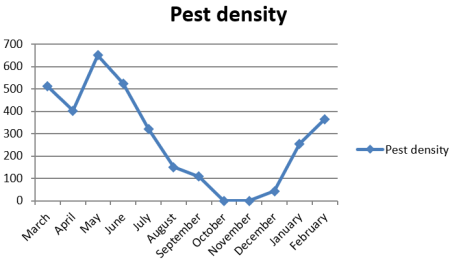
The density of A. f. solanella during the year varies and the peak is observed in the month of May. Gradually the density decreases from the month of May to October and November where the density is zero individual. The density increases gradually from December to March and decreases a bit in April before increases again and reaches the peak on the month of May (Figure 2).
Figure 2. Numerical variation of Aphis fabae solanella population on Solanum scabrum during the year.
3.1.2. Effect of Climatic Factors on Aphis fabae solanella Population in Bambili
1) Atmospheric relative humidity
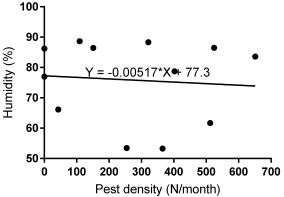
The Pearson correlation is lightly negative but statistically not significant between population density variation of Aphis fabaesolanella on S. scabrum and atmospheric relative humidity (P = 0.79; r = -0.00517; Y = -0.00517X+77.3). When the atmospheric relative humidity increases the population density of Aphis fabae solanella decreases in Bambili (Figure 3). The atmospheric relative humidity induces a lightly negative impact on the aphid population proliferation, pest of huckleberry vegetable during the year.
Figure 3. Correlation between Aphis fabae solanella population density variation on S. scabrum and atmospheric relative humidity in Bambili.
2) Precipitations
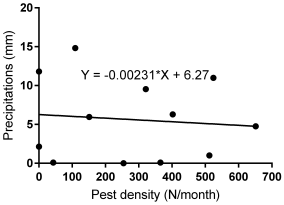
The Pearson correlation is lightly negative but statistically not significant between population density variation of Aphis fabae solanella on S. scabrum and precipitations (P = 0.76; r = -0.00231; Y = -0.00231X+6.27). When the rainfall increases, the population density of Aphis fabae solanella on huckleberry decreases in Bambili (Figure 4). The rainfall induces a lightly negative impact on the aphid population proliferation, pest of huckleberry vegetable during the year.
Figure 4. Correlation between Aphis fabae solanella population density variation on S. scabrum and precipitations in Bambili.
3) Temperature
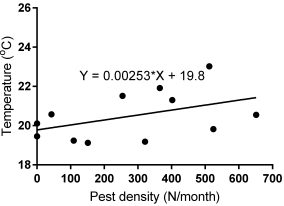
The Pearson correlation is lightly positive but statistically not significant between population density variation of Aphis fabae solanella on S. scabrum and temperature (P = 0.14; r = 0.00253; Y = 0.00253X+19.8). When the temperature increases the population density of Aphis fabae solanella on huckleberry also increases in Bambili (Figure 5). The temperature induces a lightly positive impact on the aphidpopulation proliferation, pest of huckleberry vegetable during the year.
Figure 5. Correlation between Aphis fabae solanella population density variation on S. scabrum and temperature in Bambili.
4) Duration of sun shine
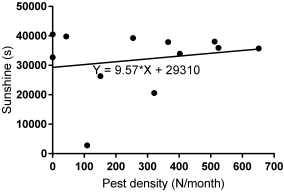
The Pearson correlation is positive but statistically not significant between population density variation of Aphis fabae solanella on S. scabrum and the duration of sun shine (P = 0.54; r = 9.57; Y = 9.57X + 29310). When the duration of sun shine increases the population density of Aphis fabae solanella on huckleberry also increases in Bambili (Figure 6). The duration of sunshine induces a positive impact on the aphid population proliferation, pest of huckleberry vegetable during the year.
Figure 6. Correlation between Aphis fabae solanella density variation on S. scabrum and the duration of sun shine in Bambili.
5) Wind speed
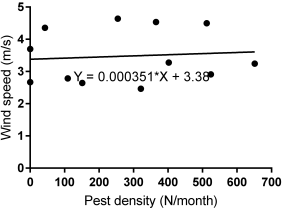
The Pearson correlation is lightly positive but statistically not significant between population density variation of Aphis fabae solanella on S. scabrum and the wind speed (P = 0.77; r = 0.000351; Y = 0.000351X + 3.38). When the wind speed increases the population density of Aphis fabae solanella on huckleberry also increases in Bambili (Figure 7). The wind speed induces a lightly positive impact on the aphid population proliferation, pest of huckleberry vegetable during the year.
Figure 7. Correlation between Aphis fabae solanella density variation on S. scabrum and the wind speed in Bambili.
3.1.3. Effect of Plant Phenology on Aphid Population and Infestation Incidence
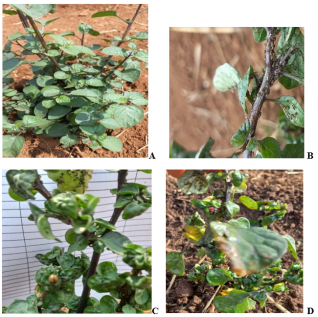
The density and damage of aphids on huckleberry depend of the age of the host plant. When the huckleberry is young the density of aphid population is very low and infestation incidence from the aphids is not perceptible (Figure 8A). When the plant grows and becomes mature, the density of the pest increases, damages are remarkable and pest control becomes necessary (Figure 8B, 8C). When the host plant is old the population density of aphid drops drastically and the infestation incidence remains perceptible as relic of damages and necrosis of leaves can be observed (Figure 8D). Aphids suck up sap of the huckleberry causing deformation of leaves and stunted growth. They cause curling, deformities, and discolouration in fresh leaves and shoots.
Figure 8. Solanum scabrum phenology and damages: A = young plant; B = mature plant; C = more mature plant; D = old plant.
3.1.4. Evaluation of Coccinellid Predation on Aphis fabae solanella Population
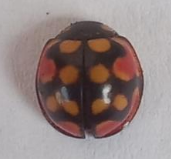
The main natural enemy identified in this work feeding on the larvae and adults of A. f. solanalla is Coccinella sp. (Figure 9). A total number of 60 aphids and 12 coccinellids were carried out for the experiment and 53 aphids were consumed during 4 hours. This means 88.3% of preys were consumed and 11.7% of preys were not consumed. The total mean of consumed aphids during the experiment was 4.42 ± 0.67 and the mean consuming rate is 1.104 aphids/predator/hour. Then in 24 hours, 26.52 aphids /predator/day can be consumed. During the experiment it was observed that the consuming rate was higher in the first hour with 2.00 ± 1.13 aphids/hour consumed while in the third hour the consuming rate decreases with 0.67 ± 0.49 aphids/hour consumed. The consuming rate is affected by the hunger of the predators in the first hour of experimentation.
Figure 9. Coccinella sp. predator of Aphis fabae solanella.
3.2. Discussion
The population dynamic of Aphis fabae solanellaon Solanum scabrumis influenced throughout the year by the climatic factors and the seasons. Bambili locality where the study was carried out presents two seasons: long rainy season from March to October and short dry season from November to February. The aphid population density increases from the dry season to the beginning of the rainy season when the rainfall is not heavy and the peak of the aphids density was observed on the month of May. Heavy rainfall induces the decreasing of aphid population density where in the month of October no aphid individual was recorded. This result is similar to that was observed by in Yaounde for Aphis gossypii pest of Capsicum annuum (pepper) where the highest number of the pest was recorded during the short dry season. Climatic factors have impact on numerical variation of aphid population density. The correlation of Pearson tested in this study shows that atmospheric relative humidity and precipitations of the study locality have a slightly negative impact on the population density of A. f. solanella; but the negative impact is not statistically significant. The increasing of the atmospheric relative humidity and rainfall induce slightly decreasing of the aphid population density on the host plant huckleberry. Similar results were recorded by in Ghana on Lipaphis erysimi pseudobrassicae (Davis) and Myzus persicae (Sulzer) pests of cabbage; where the highest aphid densities were noted to occur during periods with low relative humidity and low rainfall. Also the findings of this work are in concordance of that reported by in India on the population of Aphis gossypii pest of akra, Abelmoschus esculentus where negative correlation was found between aphid count and maximum relative humidity (r = -0.323) and rainfall (r = -0.249). Also in India observed that there is no significant correlation between atmospheric relative humidity and density of population of Aphis craccivora pest of cowpea. Contrary recorded a positive and significant correlation between relative humidity and aphid population density on wheat (Triticum aestivum) in Pakistan where relative humidity contributed 4.8 percent role in population change. For temperature the correlation is lightly positive but not statistically significant this means that the increasing of the temperature also induces the lightly increasing of the aphid population density on the huckleberry. Similar results were observed by in Pakistan with positive and significant correlation between temperature and aphid population density on wheat (Triticum aestivum) and the temperature contributed 12.1 percent role in population change. The findings of this work are contrary to that of in India where average temperature exerted negative and significant correlation on cabbage aphid, Lipaphis erysimi population. Also reported that an increase of temperature to 28°C had a negative effect on the biology of Macrosiphum rosae (pest of plants of the Rosaceae family) by shortening the period of reproduction and longevity, thus reducing the demographic parameters and fecundity. The duration of sun shine is positively correlated with the A. f. solanella population density on S. scabrum during the year but not statistically significant. The findings of this work are partially different of the results obtained by in Yaounde on Aphis gossypii pest of Capsicum annuum (pepper) where the correlation between temperature, atmospheric relative humidity, and precipitations and A. gossypii population density is positive. The difference can be due to the fact that the two localities have different climate. In Bambili there is two seasons long rainy season and short dry season while in Yaounde there are four seasons: short and long rainy seasons; short and long dry seasons. Heavy rainfall inBambili is defavourable for the proliferation of A. f. solanella pest of S. scabrum. The correlation of wind speed and the aphid population is positive but not statistically significant. The wind speed in Bambili locality is not high to induce aphids’ deportation from their host plants as that it is observed where wind speed can transport insects for long distances. The phenology of the host plant has an impact in aphid population density and infestation incidence. When the host plant is young the pest population increases also the infestation on the host plant increases; when the host plant is mature or old the density of the pest population decreases, pest infestation incidence also decreases. Growth and abundance of aphids decline in mature or old plants may be due to reducing turgor pressure of plant cells or prevalence of higher cell sap viscosity. Similar results were obtained by in Egypt on Aphis craccivora pest of faba bean plant (cowpea) where the effects of weather conditions and plant ages on population density and infestation incidence percentages by A. craccivora were highly significant. Also observed that population density of Lipaphis erysimi pseudobrassicae aphid of cabbage was significantly negatively related to plant age in Ghana. In India recorded the peak aphid population on cabbage when the crop was in the 5th week age. Predators of A. f. solanella such as Coccinella sp. contribute to the regulation of this aphid population. The population of coccinellid predator increases when the aphid population also increases similar to that was observed by in India on Aphis craccivora pest of cowpea.
4. Conclusion
The numerical variation of A. f. solanella population on S. scabrum is influenced by abiotic and biotic factors. The rainfall and atmospheric humidity impact negatively the increase of huckleberry aphid population during the year while temperature, duration of sun shine and wind speed impact it positively. The phenology of huckleberry also fluctuates the aphid population where the density increases when the host plant is young and decreases when the plant is old. The main predator of the huckleberry aphid is Coccinella sp. and regulates the aphid population then can be used in biological control as alternative method to fight against the huckleberry aphid pest instead of using insecticides which are harmful in the environment.
5. Recommendations
From the findings of this study it is recommended to the famers to cultivate the huckleberry crop during the heavy rainy season this will reduce the infestation incidence of the aphid. Avoid using chemicals to fight against aphid pest which are toxic to the consumers of the huckleberry but use natural enemies such as Coccinella sp. (predator) to control the huckleberry aphid pest.
Author Contributions
Nyuyki Albert: Data curation, Investigation, Methodology
Otiobo Atibita Esther Nadine: Project administration, Supervision, Validation, Writing – review & editing
Njoya Moses Tita: Supervision, Visualization, Writing – review & editing
Yana Wenceslas: Conceptualization, Supervision, Writing – original draft, Writing – review & editing
Conflicts of Interest
The authors of this manuscript declare that there is no conflict in interest and the manuscript was not been published or submitted elsewhere.
References
[1] Mandal, P., Mondal, F., & Hossain, M. S. (2020). Factors Influences Selection and Adaptation of Aphid to their Host Plant. Journal of Plant Sciences and Crop Protection, 3(1), 102-111.
[2] Stockton, D. G., Martini, X., Patt, J. M., & Stelinski, L. L. (2016). The influence of learning on host plant preference in a significant phytopathogen vector Diaphorina citri. PLoSOne, 11, 1-17.
[3] Bernays, E., & Graham, M. (1988). On the evolution of host specificity in phytophagous arthropods. Ecology, 69, 886-892.
[4] Oerke, E. C. (2006). Crop losses to pests. Journal of Agricultural Sciences, 144, 31-43.
[5] Yalçinkaya, G. & Kaya K. (2025). Determination of pest aphid species (Hemiptera: Aphididae) and their natural enemies on some vegetables (Solanaceae) in Hatay province. Mustafa Kemal University Journal of Agricultural Sciences, 30(3), 854-865.
[6] Namgung, H., Lee, M., & Kim, H. (2023). A New Record of Aphis solanella (Hemiptera: Aphididae) from South Korea. Animal Systematic Evolution and Diversity, 39(4), 155-159.
[7] Fontem, D. A. & Schippers, R. R. (2004). Talinum triangulare (jacq). Plant Resources of Tropical. Africa Resource vegetables, 12 (5), 102-103.
[8] Agunbiade, S. O., Ojezele, M. O., & Alao O. (2015). Evaluation of the nutritional, phytochemical compositions and medicinal benefits of Vernonia amygdalina, Solanum scabrum and Ocimum basilicum leafy-vegetables. Advances in Biological Research, 9(3), 55-151.
[9] Elono Azang, P. S., Heumou, C. R., Alene, D. C., Dounia, Kemgang Danemo, V., Ngassam, P., Tamesse, J. L., & Djieto-Lordon C. (2022). Populations Variations and Impacts of Bemisia tabaci (Genn.) and Aphis gossypii Glov. (Hemiptera), Two Sap-sucking Insects of Pepper Capsicum annuum L. 1753. American Journal of Entomology, 6(4), 124-138.
[10] Forchibe, E. E., Fening, K. O., Narh-Madey, B., Afreh-Nuamah, K. Cobblah, M. A., Wamonje, F. O., & Carr, J. P. (2023). Differential effects of weather, plant phenology and predators on the seasonal variation of aphids on cabbage. Wiley-Journal of Applied Entomology, 147, 261–270.
[11] Munazah, Y., Quratul, A., & Liyaqat, A. (2019). Seasonal incidence of aphid, Aphis gossypii infesting okra and its relation with weather parameters. Journal of Entomology and Zoology Studies, 7(4), 672-674.
[12] Choudhary, A. L., Hussain, A., Samota, R. G., & Sita Nehra, S. (2017). Effect of biotic and abiotic factors on the incidence of aphid, Aphis craccivora Koch on cowpea. Journal of Pharmacognosy and Phytochemistry, 6(4), 1587-1590.
[13] Aheer, G. M., Ali, A., & Ahmad, M. (2008). Abiotic factors effects on population fluctuation of alate aphids in wheat. Journal of Agriculture and Research, 46(4), 367-371.
[14] Bhojeshwari, S., Rajesh, P., RNagasri, N., & Shrikant, P. (2020). Population dynamics of Cabbage aphid, Lipaphis erysimi on cabbage crop (Brassica oleracea var. capitata L.). Journal of Pharmacognosy and Phytochemistry, 9(3), 950-952.
[15] Dampc, J., Moło´n, M., Durak, T., & Durak, R. (2021). Changes in aphid plant interactions under increased temperature. Biology, 10(480), 1-17.
[16] Mohamed Ghada, S., Allam, R. O. H., Heba, A. Mohamed, & Bakry, M. M. S. (2021). Impact of certain weather factors and plant ages on population density of Aphis craccivora (Koch) on faba bean plants in Luxor Governorate, Egypt. International Journal of Agricultural Sciences, 3(4), 84-104.
Cite This Article
  • APA Style

    Albert, N., Nadine, O. A. E., Tita, N. M., Wenceslas, Y. (2026). Effect of Abiotic and Biotic Factors on Population of Aphis Fabae Solanella (Hemiptera: Aphididae) Pest of Solanum Scabrum (Solanaceae) in Bambili Locality of Cameroon. American Journal of Entomology, 10(2), 38-44. https://doi.org/10.11648/j.aje.20261002.12

    Copy | Download

    ACS Style

    Albert, N.; Nadine, O. A. E.; Tita, N. M.; Wenceslas, Y. Effect of Abiotic and Biotic Factors on Population of Aphis Fabae Solanella (Hemiptera: Aphididae) Pest of Solanum Scabrum (Solanaceae) in Bambili Locality of Cameroon. Am. J. Entomol. 2026, 10(2), 38-44. doi: 10.11648/j.aje.20261002.12

    Copy | Download

    AMA Style

    Albert N, Nadine OAE, Tita NM, Wenceslas Y. Effect of Abiotic and Biotic Factors on Population of Aphis Fabae Solanella (Hemiptera: Aphididae) Pest of Solanum Scabrum (Solanaceae) in Bambili Locality of Cameroon. Am J Entomol. 2026;10(2):38-44. doi: 10.11648/j.aje.20261002.12

    Copy | Download

  • @article{10.11648/j.aje.20261002.12,
      author = {Nyuyki Albert and Otiobo Atibita Esther Nadine and Njoya Moses Tita and Yana Wenceslas},
      title = {Effect of Abiotic and Biotic Factors on Population of Aphis Fabae Solanella (Hemiptera: Aphididae) Pest of Solanum Scabrum (Solanaceae) in Bambili Locality of Cameroon},
      journal = {American Journal of Entomology},
      volume = {10},
      number = {2},
      pages = {38-44},
      doi = {10.11648/j.aje.20261002.12},
      url = {https://doi.org/10.11648/j.aje.20261002.12},
      eprint = {https://article.sciencepublishinggroup.com/pdf/10.11648.j.aje.20261002.12},
      abstract = {Aphids are sap sucking insects feeding on their host plants which are mostly crops and induce important damages on their host plants affecting crop yield of famers. The aim of this study was to evaluate the impact of biotic and abiotic factors on population dynamic of Aphis fabae solanella pest of Solanum scabrum in Bambili locality of Cameroon. Monthly aphid individuals were collected and counted on the chosen plants in the field also the population of Coccinella sp. was evaluated. In the laboratory the feeding rate of the coccinellid was evaluated. Climatic factors were recorded daily in the meteorological station. The results revealed that A. f. solanella population density increases from the dry season to the beginning of the rainy season and drop during the heavy rainfall. The correlation of Pearson is lightly negative but not statistically significant between population density of A. f. solanella and precipitation, atmospheric relative humidity with r = -0.00231, p = 0.76; r = -0.00517, p = 0.79 respectively. While lightly positive but not statistically significant between population density of A. f. solanella and temperature, wind speed with r = 0.00253, p = 0.14; r = 0.000351, p = 0.77 respectively. For the duration of sun shine the correlation is positive but not statistically significant with r = 9.57, p = 0.54. For the phenology of the host plant, when the host plant is young the pest population increases also the infestation on the host plant increases; when the host plant is mature or old the density of the pest population decreases, pest infestation incidence also decreases. The coccinellid consuming rate was 26.52 aphids / predator / day. In conclusion, the biotic and abiotic factors have positive and negative impact on the population dynamic of A. f. solanella on S. scabrum.},
     year = {2026}
    }
    

    Copy | Download

  • TY  - JOUR
    T1  - Effect of Abiotic and Biotic Factors on Population of Aphis Fabae Solanella (Hemiptera: Aphididae) Pest of Solanum Scabrum (Solanaceae) in Bambili Locality of Cameroon
    AU  - Nyuyki Albert
    AU  - Otiobo Atibita Esther Nadine
    AU  - Njoya Moses Tita
    AU  - Yana Wenceslas
    Y1  - 2026/06/29
    PY  - 2026
    N1  - https://doi.org/10.11648/j.aje.20261002.12
    DO  - 10.11648/j.aje.20261002.12
    T2  - American Journal of Entomology
    JF  - American Journal of Entomology
    JO  - American Journal of Entomology
    SP  - 38
    EP  - 44
    PB  - Science Publishing Group
    SN  - 2640-0537
    UR  - https://doi.org/10.11648/j.aje.20261002.12
    AB  - Aphids are sap sucking insects feeding on their host plants which are mostly crops and induce important damages on their host plants affecting crop yield of famers. The aim of this study was to evaluate the impact of biotic and abiotic factors on population dynamic of Aphis fabae solanella pest of Solanum scabrum in Bambili locality of Cameroon. Monthly aphid individuals were collected and counted on the chosen plants in the field also the population of Coccinella sp. was evaluated. In the laboratory the feeding rate of the coccinellid was evaluated. Climatic factors were recorded daily in the meteorological station. The results revealed that A. f. solanella population density increases from the dry season to the beginning of the rainy season and drop during the heavy rainfall. The correlation of Pearson is lightly negative but not statistically significant between population density of A. f. solanella and precipitation, atmospheric relative humidity with r = -0.00231, p = 0.76; r = -0.00517, p = 0.79 respectively. While lightly positive but not statistically significant between population density of A. f. solanella and temperature, wind speed with r = 0.00253, p = 0.14; r = 0.000351, p = 0.77 respectively. For the duration of sun shine the correlation is positive but not statistically significant with r = 9.57, p = 0.54. For the phenology of the host plant, when the host plant is young the pest population increases also the infestation on the host plant increases; when the host plant is mature or old the density of the pest population decreases, pest infestation incidence also decreases. The coccinellid consuming rate was 26.52 aphids / predator / day. In conclusion, the biotic and abiotic factors have positive and negative impact on the population dynamic of A. f. solanella on S. scabrum.
    VL  - 10
    IS  - 2
    ER  - 

    Copy | Download

Author Information
  • Department of Zoology, University of Bamenda, Bambili, Cameroon
  • Department of Applied zoology, University of Douala, Douala, Cameroon

  • Department of Zoology, University of Bamenda, Bambili, Cameroon

  • Department of Zoology, University of Bamenda, Bambili, Cameroon