Research Article | | Peer-Reviewed

Determinants of Electronic Assessments Adoption and Usage by Students in Higher Institutions of Learning in Uganda: A Case Study of Kabale University

Received: 30 August 2026     Accepted: 16 November 2026     Published: 27 November 2026
Views:       Downloads:
Abstract

As a result of the Coronavirus Disease 2019 (COVID-19) pandemic, many universities across the globe had to exercise their creativity and innovation during challenging times. Consequently, the pandemic made educational leaders creative in order to sustainably and continuously assess their learners, and this accelerated digital transformation strategies for online assessments in several educational institutions in Uganda, including Kabale University. The study aimed to investigate the determinants of electronic assessments adoption and usage by students in Higher Institutions of Learning (HIL) in Uganda during and after the period of the COVID-19 pandemic. A cross-sectional research design and purposive sampling were used to select a sample of 189 students from a population of 370; 130 responded, giving a response rate of 68.78%. Data analysis was done using descriptive statistics, including mean, standard deviation and exploratory factor analysis (EFA). Descriptive results indicate that technological, organisational, environmental, individual and pedagogical factors influence the adoption and use of e-assessments. EFA indicated that organisational factors and pedagogical factors have the lowest and highest factor loadings, respectively, compared to the other factors considered in the study. Researchers recommend that institutions should devise means of addressing the problem of dishonesty in e-assessment, provide secure online authentication during assessments, consider having e-assessments inside a closed environment, and have a blended mode of e-assessment to cater for the needs of different institutions, faculties, departments, students or course contexts. Further research needs to be conducted to establish the impact of organisational factors in the adoption and use of e-assessments while considering the perspective of lecturers.

Published in American Journal of Education and Information Technology (Volume 10, Issue 2)
DOI 10.11648/j.ajeit.20261002.13
Page(s) 68-84
Creative Commons

This is an Open Access article, distributed under the terms of the Creative Commons Attribution 4.0 International License (http://creativecommons.org/licenses/by/4.0/), which permits unrestricted use, distribution and reproduction in any medium or format, provided the original work is properly cited.

Copyright

Copyright © The Author(s), 2026. Published by Science Publishing Group

Keywords

Electronic Assessments, Online Assessments, Adoption and Use, Higher Institutions of Learning, Uganda, Kabale University

1. Introduction
Coronavirus disease 2019 (COVID-19) pandemic and its resultant effects have caused a massive deterioration of all spheres of life, ranging from the economy, education sector, religion, and socio-cultural aspects, among others. As a result of measures (like lockdowns, quarantines, border closures, physical distancing, avoiding gatherings, school closures, and many others) instituted by various national and state governments across the world (like in Bavaria, Indonesia, Italy and Nigeria, among others) . In the same vein, the Government of Uganda instituted similar measures to regulate the spread of COVID-19, and as a result, the education sector was hit the hardest . National Council for Higher Education (NCHE) set guidelines for the adoption of an emergency Open, Distance and e-Learning (ODeL) System during the COVID-19 Lockdown and this led to the implementation of e-learning and e-assessments under regulated measures aimed at keeping higher education quality standards . As a result, Kabale University implemented online/electronic assessments beginning in the 2020/2021 academic year . Kabale University is a public University in Uganda established under Statutory Instrument No. 36 of 16th July 2015, under the Universities and Other Tertiary Institutions Act 2001 (as amended). Prior to this change in legal status, the University had obtained a Charter in 2014 (Certificate No. UI.CH.008) - the last stage of accreditation by the Uganda National Council for Higher Education .
In 2020, the functioning of academic institutions was affected globally as a result of the closure of schools by many governments across the world . As a result, online/electronic assessments were adopted universally among higher education institutions globally. Their adoption was rapid due to the emergence of the COVID-19 pandemic. The process of conducting e-exams was considered the appropriate way of assessment, while protecting the safety and well-being of learners .
Guinovart noted that the “advent of digital technology has steadily digitised education which has been facilitated by the ubiquitous high-speed internet and laptops; the pervasiveness of technology has enabled a seamless transition to the online ecosystem”. Thus, academic institutions have adapted to Learning Management Systems (LMSs) for tracking, reporting, administering and sharing learning material with students. Online teaching and evaluation facilitate a balanced approach for imparting knowledge and assessing candidates.
In today’s era of digitalisation, the term “information and communication technology (ICT) has expanded to encompass many aspects of computing technology and is more recognisable than ever before”. The increasing use of ICTs in academic institutions is attributed to the need for improving the quality of education. ICT has become part and parcel of the absorption and acquisition of knowledge and improvement of the effectiveness of implementing educational policies . The emergence of COVID-19 forced higher educational institutions globally to adopt open and distance learning mode and subsequently adopted remote electronic/online exams (e-exams) as a way of providing continuous education and assessments to the learners .
E-assessment refers to a “computerised exam through which the student uses a computer for taking his/her exam. It serves as an effective, unbiased, and exciting method for assessing students’ academic level. Using e-exams for the assessment of students at the university level shall increase the objectivity of the assessment process” . Researchers Khan et al. demystified the relationship between computer-based exam and online exam by stating that “computer-based exam (or computer-based test) encompasses online exam/e-exams, and these may be considered as a sub-class of computer-based exam, wherein the exam is conducted online, i.e., via the internet.” Other terms that relate to online exams include digital exam, computer-based exam, electronic exam, e-exam, and e-assessment .
Researchers Natt, Dupras, Schultz, & Mandrekar , cited in Awad Ahmed et al. indicated that assessments are fundamental in education, and educators are concerned with having a credible assessment method that ensures credibility and transparency. E-exam assessment combines assorted questions, including “multiple-choice, true or false, matching, arrangement, fill in the blank, essays, etc. It is designed by specialised software to detect the performance of an individual in all relevant aspects.”
1.1. Purpose of the Study
To investigate the determinants of electronic assessments adoption and usage by students in Higher Institutions of Learning (HIL) in Uganda during and after the period of the COVID-19 pandemic.
1.2. Objectives of the Study
1) To investigate the factors that influence e-assessment adoption and use by students at HIL in Uganda.
2) To determine the strength of the factors that influence e-assessments adoption and Use by University Students.
2. Literature Review
2.1. Conceptual Review
According to McCraw , by 1980, computers moved into other areas of testing beyond scoring, where they were used in the design, construction, delivery, reporting of exam results and more others. Computer-based testing was introduced in the mid-1980s, in the form of an electronic version of the traditional pencil-and-paper method. In the current era, many institutions and certifying bodies use online proctoring as the next step in web-based testing. Online proctoring allows proctors to administer online exams by allowing the monitoring test takers remotely.
Online assessments require lecturers to keep abreast of new developments, allowing them to evaluate tried and tested ones and experiment with their own initiatives, preferably within a supportive learning community of fellow practitioners . This has been evident in various training or Continuing Professional Education (CPE) that lecturers have been engaged in to improve their abilities during the time of the pandemic. According to researchers Gaytan & McEwen , Rastgoo & Namvar , and Sorensen as cited in Alsadoon e-assessment offers significant benefits for students, educators, and institutions. It makes it possible to evaluate key life skills, ensures more reliable scoring, and improves the overall quality of tests. Unlike traditional paper-based systems, it saves grading time, reduces printing costs, and provides accurate, high-quality data for teachers and administrators. Because grading is automated, it eliminates bias linked to names, race, or culture, making the process more objective.
According to Alsadoon , e-assessment has some challenges that may negatively affect its adoption and use. For example, e-assessment is time-consuming in terms of preparing tests, requires technology, and lacks control over tests. Researchers like Moten et al. , as cited in Holden, Norris, & Kuhlmeier , wrote that, like in-person courses, online course environments have ways of cheating in assessments, such as downloading other written work and claiming ownership, using materials without permission during an online exam, or seeking support from others to complete an e-exam or assignment rather than the real student who is doing the assessment.
Researchers McCutcheon, O’Halloran, & Lohan , as cited in Elsalem et al. stated that practical and clinical courses require a supervised interactive experience since they are designed with the primary purpose of ensuring that students acquire skills and competence in routine clinical practice. McCutcheon et al. further write that blended learning offers added value in comparison to full online learning in terms of motivation and attitudes to clinical supervision, learners’ satisfaction and knowledge acquisition. Thus, blended exams and on-campus e-exams offer students similar treatments in terms of suitability of exam environment, technical support, as well as exam invigilation . Further, the Organisation for Economic Co-operation and Development (OECD) reports that after campus closures to limit the spread of the COVID-19 pandemic, institutions and faculties faced several challenges associated with the shift of student examinations online, which exacerbated the challenges that existed during ordinary times, i.e., before campus closures and the COVID-19 pandemic. These challenges include the increase in dishonest behaviours, difficulty in assessing practical knowledge and skills, the need to ensure fair treatment of candidates and the risk of technical failure.
According to Cramp et al. , the literature generally suggests that the performance of students in paper-based and online exams is comparable, but online exams seem to make students more anxious about the online mode of assessment, with the resultant effect of increasing the cognitive load of the exam takers. This is due to the many technicalities surrounding online examinations. In their study of the “Obstacles to Applying Electronic Exams amidst the COVID-19 Pandemic: An Exploratory Study in the Palestinian Universities in Gaza”, researchers Bashitialshaaer, Alhendawi, & Avery highlighted four (4) categories of obstacles to online exams. These included: individual obstacles like “difficulty and poor study under difficult conditions, electronic exams not showing the students’ real level of understanding, parents’ lack of conviction about online exams (parents not being able to cooperate), lack of time, a lot of questions, and a lack of experience”; Pedagogical Obstacles like “the exams not having a high quality of design and preparation, answers being very similar among the students, lack of sufficient experience in preparing and applying electronic exams”; Technical Obstacles like “power cuts (no electricity), weak or unavailable internet, security and confidentiality of data and information, and everything related to the protection from piracy on the internet (which affects the online courses and exams and their results)”; and, Financial and Organizational Obstacles like “lack of financial and technical capabilities of some students, lack of remote communication equipment, difficulty of obtaining computers or similar devices by some students, Lack of training in the use of information technology being problem for both university teachers and students.”.
Electronic assessments have proliferated in the past six (6) years, regardless of the initial attempts coming through in the 1980s, and have taken many forms, which include supervised online examination, unsupervised online examination and hybrid online examination. Considering that many higher institutions started running e-assessment during COVID-19, many of them were challenged by financial, organisational, technological/technical, pedagogical and individual factors.
2.2. Contextual Review
During the COVID-19 pandemic, e-learning became a technological pillar in supporting education that continuously provided 21st-century learners with authentic knowledge acquisition, and as a practical contribution, electronic examination (e-exam) is a novel approach in e-learning designed to counter some of the traditional assessment issues. E-exams combine assorted questions designed in specialised software that is usually part of e-learning platforms to detect learners’ performance. Despite intensive research in this area, the performance of e-exams faces challenges such as authentication of the examinee’s identity and answered papers . Another concern relates to students’ privacy, security and data protection when online proctoring technologies that rely on audio and video recording are used to invigilate online exams .
According to OECD , strategies for implementing exams during COVID-19 pandemic varied from one institution to another and faculty members often relied on a blend of solutions. These solutions included postponement of exams to a later time when physical activities resumed. The reasons for postponement were limited access to stable internet, as some exam takers were located in areas where the internet is not widespread, and students faced difficulties in taking remote/online examinations; some courses required practice-oriented activities to examine students’ acquired knowledge and skills. Some institutions adjusted the academic calendar to examine theoretical courses online and postpone lab-based/practicum courses to a future semester when physical teaching could resume. An online proctoring solution was mentioned as one of the solutions used to supervise remote examinations with the aim of reducing academic dishonesty among students.
It is worth noting that there are several underlying factors that affect the layout of an e-exam, such as the objective of the educational stage, the speciality of the learners (which is determined by the programme of study), skills of the learners, the purpose of the examination, and forms of electronic assessment .
During the COVID-19 pandemic, OECD proposed several innovations to online assessments. These included redesigning examinations to counteract challenges associated with the shift to remote online assessment. The different types of adaptations can be blended to create appropriate examination models for the specific context of institutions, faculties, departments, students or courses. In the study by Shakeel et al. , it was stated that the biggest challenge in online learning was the conduct of online examinations for students’ assessment (in the form of take-home and time-restricted examinations) in higher institutions of learning, especially in India, where there is a rampant digital and economic divide. The study cited the common issues that affected online exams, such as poor internet connectivity and students’ lack of e-resources (such as laptops, Wi-Fi access) and limited teacher-student interaction, among others.
The COVID-19 crisis accelerated the transition from ordinary assessments towards online assessment, including the use of online proctoring, which happened globally in the higher education sector, including countries like Australia . The disruption in the higher education sector due to the pandemic also extended to Indian academic institutions, where the majority of institutions were well accustomed to the traditional closed-book examination. As Ashri & Sahoo elaborated in their paper titled “Open Book Examination and Higher Education During COVID-19: Case of University of Delhi”, COVID-19 pandemic forced higher institutions to adapt to new/alternative methods to assess the students. Many academic units in India, with the exception of the University of Delhi that opted for online open-book examinations, did not conduct examinations in light of public health.
After the declaration of COVID-19 as a pandemic by the World Health Organisation (WHO) , several governments worldwide, including Uganda, were forced to close educational institutions. In the United Nations (UN) news, published by the United Nations Educational, Scientific and Cultural Organisation (UNESCO) , as cited by Bashitialshaaer et al. , it is indicated that by April 2020, at least one point five (1.5) billion learners were affected. Thus, in many countries, educators were abruptly forced to switch to online teaching through electronic learning and assessment systems. Thus, educational institutions had to modify most of their activities as face-to-face learning activities were indefinitely suspended. The crisis forced academic institutions to modify the evaluation format for learners. The use of online proctoring systems quickly became widespread, despite some controversies that arose . Similarly, in their paper “A systematic review of online examinations: A pedagogical innovation for scalable authentication and integrity”, Butler-Henderson & Crawford noted that the prolonged COVID-19 pandemic caused higher education across many countries to move to either an online examination format or an alternative form of assessment.
According to Jadi , UNESCO reported that more than 150 countries declared lockdowns in their respective countries and strictly instructed them to close all educational institutions. School management encouraged online training to complete the uncovered part of the syllabus and implored the staff to continue performing different activities/duties using a variety of online tools (both open-source and licensed ones). According to UNESCO , the outbreak of COVID-19 in Wuhan city in China disrupted education systems globally, affecting the most vulnerable learners the hardest: “It increased inequalities and exacerbated a pre-existing education crisis. School closures ranged from no closures in a handful of countries to up to more than a full school year. Lack of connectivity and devices excluded at least one third of students from pursuing learning remotely.” Regardless of the partial or full reopening, the generational catastrophe on the education sector will be evident for some time in many countries. In order to achieve resilience, equity, and inclusiveness, education systems must transform, leveraging technology to benefit all learners and building on the innovations and partnerships catalysed throughout the crisis.
Butler-Henderson & Crawford indicated that at least 70% of students (on average) prefer online exams to ordinary paper-based exams. The possible reasons for the preference are the increased speed and ease of editing responses; online examinations allow a more authentic assessment experience; online examinations save time and are more economical than paper examinations; e-exams provide greater flexibility for completing examinations with faster access to remote student papers; students trust the results of online over paper-based examinations.
As the COVID-19 pandemic spread over the world in early 2020, several new technologies have been serving education and helping faculties improve the teaching and learning process. These technologies have been adopted in the assessment part of the teaching and learning process. On a positive note, the 21st-century test-takers have benefited from e-assessments since they are used to using emerging technologies. Students’ daily usage of smartphones and other computerised systems makes the execution of e-assessment easier for them. Additionally, the technology minimises expenses for complex elements of the testing cycle. Some e-assessment technologies render the immediate scoring of exams more accurate in some cases than that done by humans. The bias in scoring learners related to handwriting and student identity is minimised and allows learners to check their spelling mistakes, thus lessening the impact of student spelling errors .
2.3. Theoretical Review
The study was guided by the Expectancy-Value Theory and Reference Framework for Determinants of Online/E-Assessment Adoption and Use .
2.3.1. The Expectancy-Value Theory
The study by Sugilar indicated that expectancy-value factors influence students’ participation in online examinations. The study indicated that the importance of online examinations relates to a wider opportunity for students to have more frequent and time flexibility. Considering that value is measured by factors like importance, intrinsic value, and cost, expectancy-value theory gives a basis for the study to identify the determining factors for students to participate or not in online examinations.
2.3.2. Reference Framework for Determinants of Online/E-Assessment Adoption and Use
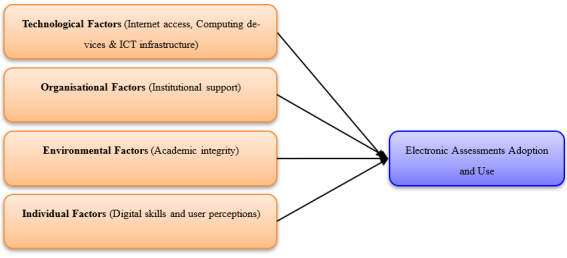
Mahlangu & Makwasha investigated the “factors that affect the adoption and use of online assessment in Polytechnics of Zimbabwe during the COVID-19 era using the Technology-Organisation-Environment (TOE) framework and Technology Acceptance Model (TAM).” The extended TOE framework (TOE-TAM model), in Figure 1, explained the variables influencing adoption and use of online/e-assessment. TOE-TAM combined factors from TOE and TAM to form factors like technological, organisational, environmental and individual factors. These factors can be expounded as “technological factors (internet access, computing devices, and ICT infrastructure), organisational factors (institutional support), environmental factors (academic integrity), and individual factors (digital skills and user perceptions).” It is against this background that the TOE-TAM framework was further extended to incorporate pedagogy to enhance the framework’s valuable point of scaling up the adoption and use of online/e-assessment at HIL.
Figure 1. Extended TOE framework for online assessment adoption and usage [Source: Mahlangu & Makwasha ].
2.3.3. Proposed Framework for Determinants of Online/E-Assessment Adoption and Use
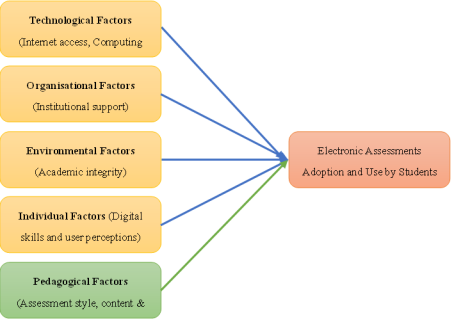
This research adapted the “Extended TOE framework for online assessment adoption and usage” developed by Mahlangu & Makwasha with the addition of pedagogical factors to the independent variables, thus making the studied factors five (5), as seen in Figure 2. The study considered five (5) factors that influence the adoption and use of e-assessments by students at Higher Institutions of Learning (HIL), i.e., technological, Organisational, environmental, individual, and pedagogical.
Figure 2. Proposed framework for E-Assessments Adoption and Use by Students at Higher Learning Institutions in Uganda [Adapted from Mahlangu & Makwasha ].
2.4. Identification of Research Gap
From the literature review, it is evident that research has previously been undertaken to demonstrate the students’ perception towards online/e-assessments. There are very limited empirical studies that have been conducted to study the underlying factors for the adoption of online/e-assessments at higher institutions of learning in Uganda, especially bringing out perceptions during and after COVID-19.
The study by Mahlangu & Makwasha extended the TOE framework indicated in Figure 1 to explain how individual, technology, organisation, and environmental factors affect the adoption and use of e-assessment in tertiary education institutions. However, the framework misses out on a key factor, i.e., pedagogy, since e-assessment cannot be treated like traditional/physical assessments verbatim. Thus, the extended TOE framework by Mahlangu & Makwasha needs to be scaled up to incorporate pedagogy as one of the key determining factors in adoption and use of online/e-assessment at HIL.
3. Materials and Methods
3.1. Research Design
In this study, the researchers aimed to examine the factors that influence students’ participation in e-assessments by students at HIL in Uganda. Quantitative data were collected to help answer the research questions using a descriptive research design. This was a cross-sectional study since cross-sectional data were gathered from the predetermined population by the researchers, who measured the outcome at a given point in time .
Survey questions used in the study were formulated based on the theoretical frameworks and previous related studies . Constructs used in the study included Technology (Internet access, Computing devices & ICT infrastructure), Organisational (Institutional support), Environmental (Academic integrity), Individual (Digital skills and user perceptions) and Pedagogical (exam style, content & quality). Survey questions consisted of a four-point Likert scale .
3.2. Sampling Technique
A purposive sampling technique was used to select the respondents, i.e., third (3rd) year students pursuing different programmes at Kabale University . This category of students started using electronic assessments from their first year, first semester in January 2021. This happened after the University received clearance from the national regulator for higher education in Uganda, i.e., the National Council for Higher Education, to conduct online assessments during the time of the COVID-19 pandemic.
3.3. Population and Sample Size
The study considered a population of three hundred seventy (370) students who were scheduled to sit for their end of third (3rd) year, second (2nd) semester exams on the first day, as per the end of second (2nd) semester, 2022/2023 academic year examinations timetable (also known as December 2023 exams). The desired sample size for the study was determined using the Krejcie and Morgan table . By using the table and formula, the desired sample size for the study was one hundred eighty-nine (189).
3.4. Data Collection
A structured questionnaire (with predefined questions and possible answers) was designed and disseminated to the 189 respondents. The questionnaire was organised into two (2) parts-the social demographic characteristics of respondents, such as the respondent’s gender, age and faculty; and the second part covered the factors that influence students’ adoption and use of e-assessments. These factors included Technology (Internet access, Computing devices & ICT infrastructure), Organisational (Institutional support), Environmental (Academic integrity), Individual (Digital skills and user perceptions) and Pedagogical (Exam style, content & quality). The questionnaire was designed and tested with 20 respondents selected from 3rd-year students from the Faculty of Computing, Library and Information Science. This helped to test the reliability of the questions used and also informed the researchers about the questions that needed modification. The online questionnaire was later disseminated to 189 participants via email, and 130 participants responded by filling out the questionnaire. This resulted in a total response rate of 68.78%.
3.5. Data Analysis
Data collected through the closed-ended questionnaire were utilised using the Statistical Package for the Social Sciences (SPSS). Data were analysed using both descriptive statistics and Exploratory Factor Analysis (EFA) to determine how the sub-constructs contribute to the adoption and use of e-assessments. For the descriptive statistics using a four-point Likert scale , results with mean values above 3.00 were considered significant. Exploratory Factor Analysis helped to uncover factor-variables that had greatly influenced the adoption and use of e-assessment among students at Kabale University.
4. Results
4.1. Reliability of the Study
Reliability (α) of the instrument was in the range of 0.819 to 0.882, which demonstrated that the research instrument was reliable since α was at least 0.7 . The results of the reliability analysis are shown in Table 1.
Table 1. Reliability Analysis of the Data Collection Instrument.

S/N

Variable (Factors)

Cronbach's Alpha (α)

No. of Items

1

Technology (Internet access, Computing devices & ICT infrastructure)

0.827

6

2

Organisational (Institutional support)

0.840

5

3

Environmental (Academic integrity)

0.823

7

4

Individual (Digital skills and user perceptions)

0.819

7

5

Pedagogical (Exam style, content & quality)

0.882

6

Source: Field Data, 2023.
4.2. Demographics of the Respondents
Data were gathered from ten (10) schools/faculties/institutes, i.e., Kabale University School of Medicine (KABSOM), Faculty of Agriculture and Environmental Sciences (FAES), Faculty of Engineering, Technology, Applied Design and Fine Art (FETADF), Faculty of Computing, Library and Information Science (FOCLIS), Faculty of Science (FOS), Faculty of Economics and Management Science (FEMS), Faculty of Social Sciences (FASS), Faculty of Education (FOE), Institute of Language Studies (ILS), and Institute of Tourism and Hospitality (ITH).
The study received responses from 130 participants, 97 males (74.6%) and 33 females (25.4%), from different faculties and age categories shown in Table 2. The age of the participants included 18-20 years (5 participants, 3.8%), 21-25 years (80 participants, 61.5%), 26-30 years (13 participants, 10%), 31-35 years (11 participants, 8.5%), 36-40 years (6 participants, 4.6%), 41-45 years (8 participants, 6.2%), 46-50 (6 participants, 4.6%), 51-55 (1 participant, 0.8%), and 56-60 years (0 participants, 0%). The study received participation from all the faculties and they included KABSOM (22 participants, 16.9%), FAES (4 participants, 3.1%), FETADF (9 participants, 6.9%), FOCLIS (27 participants, 20.8%), FOS (4 participants, 3.1%), FEMS (10 participants, 7.7%), FASS (11 participants, 8.5%), FOE (39 participants, 30%), ILS (2 participants, 1.5%), and ITH (2 participants, 1.5%).
Table 2. Age and Faculties of the Respondents.

Gender

Total (F+M)

Male (#)

Female (#)

Frequency (#)

Percentage (%)

Age of the respondents

18-20

4

1

5

3.8

21-25

59

21

80

61.5

26-30

9

4

13

10.0

31-35

9

2

11

8.5

36-40

5

1

6

4.6

41-45

7

1

8

6.2

46-50

3

3

6

4.6

51-55

1

0

1

0.8

56-60

0

0

0

0.0

Total

97

33

130

100.0

Faculty

KABSOM

18

4

22

16.9

FAES

4

0

4

3.1

FETADF

9

0

9

6.9

FOCLIS

17

10

27

20.8

FOS

2

2

4

3.1

FEMS

5

5

10

7.7

FASS

8

3

11

8.5

FOE

32

7

39

30.0

ILS

1

1

2

1.5

ITH

1

1

2

1.5

Total

97

33

130

100.0

4.3. Factors That Influence the Adoption of and Use of Online Exams/Assessments
The constructs of factors that influence the adoption of and use of online exams/e-assessments were interpreted using the recommendations for the ranges of mean values that are equivalent to vague quantifiers, and these are Strongly Agree 4.0-3.51, Agree 3.5-2.51, Disagree 2.5-1.51, Strongly Disagree 1.5-1.00 . The factors are explained below:
4.3.1. Technological Factors
Table 3 indicates the technological factors that affect the adoption of and use of online exams/e-assessments at Kabale University. All the items considered under the category of technological factors were significant, with mean values ranging from 3.276 to 3.607, implying that the considered items are significant and contribute towards the adoption of assessments. The items included: Accessibility to stable internet connectivity (m = 3.607, = 1.416); Reliability of the technology used in e-assessments (m = 3.523, = 1.324); Availability and access to required computing devices for online exams (m = 3.453, = 1.358); Security of test materials and results in online exams (m = 3.415, = 1.362); and, Equal and inclusive access to digital resources for all students (m = 3.323, = 1.484); Availability of required infrastructure on campus for e-assessments, like network, hardware, software, power supply (m = 3.276, = 1.381).
Table 3. Technological Factors.

S/N

Technological Factors (Internet Access, Computing Devices & ICT Infrastructure)

Mean, m

Std. Dev,

Interpretation

1

Accessibility to stable internet connectivity.

3.607

1.416

Significant

2

Reliability of the technology used in e-assessments.

3.523

1.324

Significant

3

Availability and access to required computing devices for e-assessments.

3.453

1.358

Significant

4

Security of test materials and results in e-assessments.

3.415

1.362

Significant

5

Equal and inclusive access to digital resources for all students.

3.323

1.484

Significant

6

Availability of required infrastructure on campus for e-assessments (network, hardware, software, power supply).

3.276

1.381

Significant

Source: Field Data, 2023.
The standard deviation for technological factors ranged between 1.324 and 1.484. The low standard deviation, = 1.324, indicated consistent opinions regarding the Reliability of the technology used in e-assessments. The high standard deviation, std. = 1.484, indicated inconsistent opinions regarding equal and inclusive access to digital resources for all students.
4.3.2. Organisational Factors
Table 4 indicates the organisational factors that affect the adoption of and use of online exams/e-assessments at Kabale University. All the items considered under the category of Organisational factors were significant, with mean values ranging between 3.007 and 3.569, implying that the considered items are significant and they contribute towards the adoption of e-assessments. These items include: Technology and awareness training for staff and students in online teaching and assessment (m = 3.569, = 1.357); Availability of a secure Learning Management System (LMS) for online exams (m = 3.515, = 1.336), Supportive e-learning policy guiding online exam management (m = 3.500, = 1.342); Competence of staff in supporting students in e-assessments (m = 3.169, = 1.381); and, Presence of technical and teaching staff to invigilate online exams and address student issues (m = 3.007, = 1.433).
Table 4. Organisational Factors.

S/N

Organisational Factors (Institutional Support)

Mean, m

Std. Dev,

Interpretation

1

Technology and awareness training for staff and students in online teaching and assessment.

3.569

1.357

Significant

2

Availability of a secure Learning Management System (LMS) for online exams.

3.515

1.336

Significant

3

Supportive e-learning policy guiding online exam management.

3.500

1.342

Significant

4

Competence of staff in supporting students in e-assessments.

3.169

1.381

Significant

5

Presence of technical and teaching staff to invigilate online exams and address student issues.

3.007

1.433

Significant

Source: Field Data, 2023.
The standard deviation for Organisational factors ranged between 1.342 and 1.433. The low standard deviation, = 1.342, indicated consistent opinions regarding Supportive e-learning policy guiding online exam management. The high standard deviation, std. = 1.433, indicated inconsistent opinions regarding the presence of technical and teaching staff to invigilate online exams and address student issues.
4.3.3. Environmental Factors
Table 5 indicates the Environmental factors that affect the adoption of and use of online exams/e-assessments at Kabale University. Six of the seven items considered under the category of Environmental factors were significant, with mean values ranging between 3.184 and 3.592, implying that these items contribute towards the adoption of e-assessments; the item on perceived increase in academic dishonesty in online exams (m = 2.930) fell below the significance threshold of 3.00. These items include: Students receive compiled formative exam results online (m = 3.592, = 1.286); Use of randomised questions reducing cheating in e-assessments (m = 3.561, = 1.299); Effectiveness of technology in dealing with cheating and plagiarism (m = 3.346, = 1.321); Negative perceptions of teaching staff and students on transparency in e-assessments (m = 3.300, = 1.350); Difficulty in regulating and preventing cheating in online environments (m = 3.292, = 1.360); Lack of awareness about e-assessments among parents and guardians (m = 3.184, = 1.477); and, Perceived increase in academic dishonesty in online exams (m = 2.930, = 1.447).
Table 5. Environmental Factors.

S/N

Environmental Factors (Academic Integrity/ Dishonesty)

Mean, m

Std. Dev,

Interpretation

1

Students receive compiled formative exam results online.

3.592

1.286

Significant

2

Use of randomised questions reducing cheating in e-assessments.

3.561

1.299

Significant

3

Effectiveness of technology in dealing with cheating and plagiarism.

3.346

1.321

Significant

4

Negative perceptions of teaching staff and students on transparency in e-assessments.

3.300

1.350

Significant

5

Difficulty in regulating and preventing cheating in online environments.

3.292

1.360

Significant

6

Lack of awareness about e-assessments among parents and guardians.

3.184

1.477

Significant

7

Perceived increase in academic dishonesty in online exams.

2.930

1.447

Not significant

Source: Field Data, 2023.
The standard deviation for Environmental factors ranged between 1.286 and 1.477. The low standard deviation, = 1.286, indicated consistent opinions regarding students receiving compiled formative exam results online. A high standard deviation, std. = 1.477, indicated inconsistent opinions regarding the lack of awareness about e-assessments among parents and guardians.
4.3.4. Individual Factors
Table 6 indicates the Individual factors that affect the adoption of and use of online exams/e-assessments at Kabale University. All the items considered under the category of Individual factors were significant, with mean values ranging between 3.038 and 3.776, implying that the considered items are significant and contribute towards the adoption of e-assessments. These items include: Automatic grading provides more accurate results (m = 3.776, = 1.202); Importance and value of online examination during the pandemic (m = 3.753, = 1.226); Accessibility and reduced stress in e-assessments (m = 3.446, = 1.264); Confidence in using electronic gadgets (m = 3.438, = 1.329); Financial ability to sustain costs involved in online examinations (m = 3.376, = 1.331); and, Perceived easiness in online exams (m = 3.230, = 1.303); and, Lack of digital skills affects both lecturers and learners (m = 3.038, = 1.464).
Table 6. Individual Factors.

S/N

Individual Factors (Digital Skills and User Perceptions)

Mean, m

Std. Dev,

Interpretation

1

Automatic grading provides more accurate results.

3.776

1.202

Significant

2

Importance and value of online examination during the pandemic.

3.753

1.226

Significant

3

Accessibility and reduced stress in e-assessments.

3.446

1.264

Significant

4

Confidence in using electronic gadgets.

3.438

1.329

Significant

5

Financial ability to sustain costs involved in online examinations.

3.376

1.331

Significant

6

Perceived easiness in online exams.

3.230

1.303

Significant

7

Lack of digital skills affects both lecturers and learners.

3.038

1.464

Significant

Source: Field Data, 2023.
The standard deviation for Individual factors ranged between 1.202 and 1.464. The low standard deviation, = 1.202, indicated consistent opinions regarding Automatic grading, which provides more accurate results. The high standard deviation, std. = 1.464, indicated inconsistent opinions regarding the lack of digital skills affecting both lecturers and learners.
4.3.5. Pedagogical Factors
Table 7 indicates the Pedagogical factors that influence the adoption of and use of e-assessments at Kabale University. All the items considered under the category of Pedagogical factors were significant, with mean values ranging between 3.238 and 3.669, implying that the considered items are significant and they contribute towards the adoption of e-assessments. These items include: Timely feedback in e-assessments for better understanding (m = 3.692, = 1.281); Online exams promoting adaptive learning (m = 3.669, = 1.228); Assessment of high-level cognitive skills in e-assessments (m = 3.569, = 1.287); Approval from national education regulators to conduct e-assessments (m = 3.484, = 1.258); Awareness of digital pedagogy among lecturers (m = 3.484, = 1.240); Flexible exam modes like oral exams, open book exams, varied question sets, etc. (m = 3.238, = 1.379).
Table 7. Pedagogical Factors.

S/N

Pedagogical Factors (Exam Style, Content & Quality)

Mean, m

Std. Dev,

Interpretation

1

Timely feedback in e-assessments for better understanding.

3.692

1.281

Significant

2

Online assessments promote adaptive learning.

3.669

1.228

Significant

3

Assessment of high-level cognitive skills in e-assessments.

3.569

1.287

Significant

4

Approval from national education regulators to conduct e-assessments.

3.484

1.258

Significant

5

Awareness of digital pedagogy among lecturers.

3.484

1.240

Significant

6

Flexible exam modes (oral exams, open book exams, varied question sets, etc.).

3.238

1.379

Significant

Source: Field Data, 2023.
The standard deviation for Pedagogical factors ranged between 1.228 and 1.379. The low standard deviation, = 1.228, indicated consistent opinions regarding Online assessments promoting adaptive learning. The high standard deviation, std. = 1.379, indicated inconsistent opinions regarding Flexible exam modes (oral exams, open book exams, varied question sets, etc.).
4.4. Exploratory Factor Analysis (EFA) of the Proposed Framework
Factor Analysis was conducted on the proposed framework for E-Assessments Adoption and Use by students at Higher Learning Institutions in Uganda. This was aimed at identifying the items that load strongly and the ones that load weakly on others. The analysis suppressed small coefficients with a value less than 0.4 inclusive. From Table 8, the Kaiser-Meyer-Olkin (KMO) measure was 0.884, which indicated good sampling adequacy , and Bartlett’s test was significant (p < 0.05), indicating correlations were sufficient for factor analysis.
Table 8. KMO and Bartlett's Test.

Kaiser-Meyer-Olkin Measure of Sampling Adequacy.

0.884

Bartlett's Test of Sphericity

Approx. Chi-Square

999.938

Df

153

Sig.

0.000

Several items had cross-loadings greater than 0.4 (high) on multiple factors. The items with low loadings, i.e., less than 0.4, were removed, and the re-evaluation was repeated multiple times (13 attempts) before a stable Rotated Component Matrix was obtained, as shown in Table 9. The rotation converged in 6 iterations.
From Table 9, four (4) factors were extracted with high loadings (greater than 0.4): Pedagogical Factors had five (5) items with loading of 0.680-0.804, Technological Factors had six (6) items with loading of 0.495-0.775, Individual Factors had four (4) items with loading of 0.640-0.777, and Environmental Factors had three (3) items with loading of 0.703-0.801. Organisational factors had low loadings of less than 0.4, and the complex items/variables under these factors were removed during the refinement of EFA.
Table 9. Rotated Component Matrix.

Constructs

Sub-Constructs

Component

1

2

3

4

Pedagogical Factors

Awareness of digital pedagogy among lecturers.

0.804

Approval from national education regulators to conduct e-assessments.

0.770

Online assessments promote adaptive learning.

0.756

Timely feedback in e-assessments for better understanding.

0.708

Flexible exam modes (oral exams, open book exams, varied question sets, etc.).

0.680

Technological Factors

Availability of required infrastructure on campus for e-assessments (network, hardware, software, power supply).

0.775

Availability and access to required computing devices for e-assessments.

0.725

Reliability of the technology used in e-assessments.

0.702

Accessibility to stable internet connectivity.

0.554

Security of test materials and results in e-assessments.

0.503

Use of randomised questions reducing cheating in e-assessments.

0.495

Individual Factors

Financial ability to sustain costs involved in e-assessments.

0.777

Importance and value of e-assessments during the pandemic.

0.738

Confidence in using electronic gadgets.

0.682

Perceived easiness in e-assessments.

0.640

Environmental Factors

Lack of awareness about e-assessments among parents and guardians.

0.801

Negative perceptions of teaching staff and students on transparency in e-assessments.

0.801

Perceived increase in academic dishonesty in e-assessments.

0.703

Extraction Method: Principal Component Analysis. Rotation Method: Varimax with Kaiser Normalization.

a. Rotation converged in 6 iterations.

Source: Field Data, 2023.
5. Discussion
Students’ perception of the adoption and use of e-examinations is important in determining the factors that make the adoption and usage successful. Therefore, the purpose of the study was to investigate the determinants for electronic assessments adoption and usage by students in Higher Institutions of Learning (HIL) in Uganda during and after the period of the COVID-19 pandemic. The purpose of the study was achieved through two (2) objectives, and these were: to investigate the factors that influence e-assessment adoption and use by students at HIL in Uganda; and to determine the strength of the factors that influence e-assessment adoption and Use by University students.
The analysis of the factors indicates that all the factors under the study, i.e., technological, Organisational, environmental, individual and pedagogical factors, influence e-assessment adoption and use by students at HIL in Uganda.
Technological factors included: Accessibility to stable internet connectivity; reliability of the technology used in e-assessments; Availability and access to required computing devices for online exams; Security of test materials and results in online exams; Equal and inclusive access to digital resources for all students; and availability of required infrastructure on campus for e-assessments, like network, hardware, software, and power supply. These are similar to the factors studied by researchers .
Organisational factors included: Technology and awareness training for staff and students in electronic teaching and assessment; Availability of a secure LMS for online exams; Supportive e-learning policy guiding online exam management; Competence of staff in supporting students in e-assessments; and Presence of technical and teaching staff to invigilate online exams and address student issues. This is partly because e-assessments give the instructors less control over the exam setting, which makes cheating easier for students . Similar institutional success factors, such as training and support for e-assessment, have been reported from instructors’ perspectives .
Environmental factors included: Students receive compiled formative exam results online; Use of randomised questions reducing cheating in e-assessments; Effectiveness of technology in dealing with cheating and plagiarism; Negative perceptions of teaching staff and students on transparency in e-assessments; Difficulty in regulating and preventing cheating in online environments; and lack of awareness about e-assessments among parents and guardians. Perceived increase in academic dishonesty in online exams fell slightly below the significance threshold (m = 2.930). Awad Ahmed et al. indicated that intensive continuous e-exams supported by appropriate authentication algorithms in place of final exams are a good solution to overcome issues related to academic dishonesty. Online assessments are strongly relevant for formative assessments provided there is adequate authenticity, security, and flexibility .
Holden, Norris, & Kuhlmeier wrote that online environments have ways of cheating in assessments, such as downloading other written work and claiming ownership, using unauthorised material that is permitted in the online exam, communicating with other learners via the internet to obtain solutions for questions during an exam, or impersonating others to complete e-assignments/exam.
Individual factors included: Automatic grading provides more accurate results; Importance and value of online examination during the pandemic; Accessibility and reduced stress in e-assessments; Confidence in using electronic gadgets; Financial ability to sustain costs involved in online examinations; Perceived easiness in online exams; and Lack of digital skills affects both lecturers and learners . These factors affect both online learning and the use of e-assessments, as mentioned by Maphalala et al. , who indicated that the diversity of students and the philosophy of inclusion, ability to use e-assessment technologies, emotional stability and psychological factors individually influence students to adopt and use e-assessments .
Pedagogical factors included: timely feedback in e-assessments for better understanding; Online exams promoting adaptive learning; Assessment of high-level cognitive skills in e-assessments; Approval from national education regulators to conduct e-assessments; Awareness of digital pedagogy among lecturers; Flexible exam modes like oral exams, open book exams, varied question sets, etc. This finding indicates that “the increase in implementation of digital education during the times of COVID-19 has resulted in the invention and generalisation of various methods of assessment. It has been proven that the system of e-exam is a valid method of evaluation due to its continuous availability and interactivity through the internet and other supporting devices” . Adaptability in learning and assessment is also emphasised by Alsadoon who indicated that e-assessment is flexible in terms of time and place and provides immediate feedback, enables personalised evaluation, motivates students to learn, encourages skills practice, and thus provides students with options to participate in solving problems, which indirectly promotes deep learning .
From a descriptive sense, all the technological, organisational, environmental, individual and pedagogical factors discussed above contribute to the framework for e-assessments adoption and use by students at HIL in Uganda, as indicated in Figure 2. Some of these factors were also confirmed by Bashitialshaaer et al. who highlighted the categories of factors from a pessimistic perspective like “electronic exams not showing the students’ real level of understanding, parents’ lack of conviction about online exams, exams not having a high quality of design and preparation, answers being very similar among the students,” infrastructure challenges of “power/electricity, poor internet, insecurity of data and information, inadequate financial and technical capabilities of some students, lack of computers by some students as well as lack of training in the use of technology tool for e-assessments.”
EFA indicated that factors for e-assessments adoption and use by students in Uganda followed the order of Pedagogical Factors, Technological Factors, Individual Factors and Environmental Factors. These factors had a higher loading of at least 0.4. The Organisational factors had low loadings of less than 0.4 and were removed during the refinement of EFA. This implies that students were not clear/sure of the contribution of organisation and far as e-assessment adoption and use. This resulted in receiving inconsistent opinions regarding the contribution of organisation towards e-assessment adoption and use. The factor of pedagogy, like authenticity, reliability, and validity , which has not received much attention in the past, begins to stand out among other factors that influence students’ decision to use e-assessment as opposed to traditional assessments.
6. Conclusion
The study investigated the determinants for electronic assessments adoption and usage by students in Higher Institutions of Learning (HIL) in Uganda during and after the period of the COVID-19 pandemic through descriptive and exploratory factor analysis (EFA). Literature on related studies was reviewed to provide a strong background for the study. It has been evident that online assessments have evolved to improve the process of teaching and learning, mostly in higher institutions of learning. The use of online assessments was accelerated during the COVID-19 pandemic , where academic institutions have been working towards autonomous invigilation of exams through the use of artificial intelligence (AI)-enabled software applications. In Uganda, the process of online examinations has been embraced by a few educational institutions with minimal resistance from some of the stakeholders . The major factors affecting online exams in Uganda and the Kabale University context are technological, organisational, environmental, individual and pedagogical. Despite the Organisational factors having low factor loadings during the exploratory factor analysis (EFA), the descriptive analysis indicated that these factors influence the adoption and use of e-assessments.
It is also concluded that electronic assessment is more relevant for formative assessments than summative assessments, where the “authenticity, security, and flexibility” are fundamental tenets in the implementation of e-exams . It is critical to guarantee the reliability of the technology used in e-assessments, training and awareness of staff and students in online teaching and assessment, compilation of formative exam results, automatic grading with accurate results and timely feedback in e-assessments.
This study has greatly contributed to the literature about online exams from Sub-Saharan African countries and specifically from Uganda. The universities planning to embrace or enhance online exams as an alternative to the ordinary examination process need to review the analysis presented in this paper as part of their preliminary stages for online exam strategy/policy formulation and implementation.
7. Recommendations
To overcome the problem of dishonesty in e-assessment, HIL need to adopt the use of a database of questions where different learners get dynamic and random questions. However, users of this solution need to plan ahead of time to design the pool of questions. Another solution is having online proctoring that supervises remote examinations. This reduces the risk of student academic dishonesty by relying on different technological tools that allow the identity of assessment takers to be verified at the beginning of the examination, student computers to be locked down to prevent access to other applications, and students to be recorded throughout the assessments using webcams and microphones . Several other online anti-cheating methods include secure online authentication identifiers, secured examination browser setup (lockdown browser), preventing mobile phones, auto-proctoring, proctoring using recording and reviews, live proctoring, and using 3600 cameras for proctoring .
It is recommended that e-assessments be conducted inside a controlled environment and, where the situation cannot allow, this requirement can be substituted with intensive continuous e-assessments that are supported by all allowable authentication algorithms. With the availability of appropriate technology and associated resources, the use of facial recognition technology would be the best option for secure e-exam authentication in the future. There’s a need to employ standardised applications that assist in detecting plagiarism and cheating that involves ghostwriters. Such applications are useful in tracing similarities and seeing the usage of specific or foreign words and changes in style like tonality, sentence structure, expression, argumentation, grammar, and format .
During the COVID-19 pandemic, OECD proposed several innovations to online assessments . These included redesigning examinations to counteract challenges associated with the shift to remote online assessment. The different types of adaptations can be blended to create appropriate examination models for the specific context of institutions, faculties, departments, students or courses.
Given that the study considered a smaller population, future research needs to be conducted covering a larger population and preferably across multiple universities in Uganda. In future, empirical studies could be carried out to confirm the EFA results of this study based on hypothesising that technological, organisational, environmental, individual and pedagogical factors have a significant influence on the e-assessment adoption and use by university students .
The study used quantitative data only, and this resulted in responses that cannot be explained. Future research needs to be conducted with both quantitative and qualitative data. This will help to learn about the details to inform the research about the reasons underlying the quantitative sections made against each factor.
Abbreviations

AI

Artificial Intelligence

COVID-19

Coronavirus Disease 2019

CPE

Continuing Professional Education

e-assessments

Electronic Assessments

e-exams

Electronic Examinations

E-Learning

Electronic Learning

EFA

Exploratory Factor Analysis

FAES

Faculty of Agriculture and Environmental Sciences

FASS

Faculty of Social Sciences

FEMS

Faculty of Economics and Management Science

FETADF

Faculty of Engineering, Technology, Applied Design and Fine Art

FOCLIS

Faculty of Computing, Library and Information Science

FOE

Faculty of Education

FOS

Faculty of Science

HIL

Higher Institution of Learning

ICT

Information and Communication Technology

ILS

Institute of Language Studies

ITH

Institute of Tourism and Hospitality

KABSOM

Kabale University School of Medicine

KMO

Kaiser-Meyer-Olkin

LMS

Learning Management System

NCHE

National Council for Higher Education

ODeL

Open, Distance and e-Learning

OECD

Organisation for Economic Co-operation and Development

SPSS

Statistical Package for the Social Sciences

TAM

Technology Acceptance Model

TOE

Technology-Organisation-Environment

TOE-TAM

Technology-Organisation-Environment and Technology Acceptance Model

UN

United Nations

UNESCO

United Nations Educational, Scientific and Cultural Organisation

WHO

World Health Organisation

Acknowledgments
In a special way, the authors appreciate the management of Kabale University, who allowed them to collect data and the students who received and responded to the questionnaire.
Author Contributions
Nicholas Nkamwesiga: Conceptualization, Data curation, Formal Analysis, Investigation, Methodology, Software, Writing – original draft, Writing – review & editing
Robert Tumusiime: Conceptualization, Data curation, Formal Analysis, Investigation, Writing – review & editing
Phelix Mbabazi Businge: Data curation, Formal Analysis, Investigation, Methodology, Supervision, Writing – review & editing
Conflicts of Interest
The authors declare no conflicts of interest.
References
[1] Crawford, J., Butler-Henderson, K., Rudolph, J., Malkawi, B., Glowatz, M., Burton, R., Magni, P. A., & Lam, S. M. S. (2020). COVID-19: 20 countries’ higher education intra-period digital pedagogy responses. Journal of Applied Learning & Teaching, 3(1), 1–20.
[2] Margini, F., Pattnaik, A., Jordanwood, T., Nakyanzi, A., & Byakika, S. (2020). Uganda’s emergency response to the COVID-19 pandemic: A case study. ThinkWell and Ministry of Health Uganda.
[3] National Council for Higher Education. (2020). Guidelines for adoption of an emergency open, distance and e-learning (ODeL) system by the higher education institutions during the COVID-19 lockdown.
[4] Businge, P. M., Nkamwesiga, N., & Basheka, B. (2022). Analysis of e-exams performance under COVID-19 pandemic at Kabale University, Uganda. East African Journal of Science, Technology and Innovation, 3, 1–7.
[5] Jadi, A. (2021). New detection cheating method of online-exams during COVID-19 pandemic. IJCSNS International Journal of Computer Science and Network Security, 21(4), 123.
[6] Khan, M. A., Vivek, V., Khojah, M., Nabi, M. K., Paul, M., & Minhaj, S. M. (2021). Learners’ perspective towards e-exams during COVID-19 outbreak: Evidence from higher educational institutions of India and Saudi Arabia. International Journal of Environmental Research and Public Health, 18(12), Article 6534.
[7] Guinovart, L. (n.d.). Digital revolution in the education space. Mettl. Retrieved February 2, 2022, from
[8] Elsalem, L., Al-Azzam, N., Jum’ah, A. A., Obeidat, N., Sindiani, A. M., & Kheirallah, K. A. (2020). Stress and behavioral changes with remote e-exams during the COVID-19 pandemic: A cross-sectional study among undergraduates of medical sciences. Annals of Medicine and Surgery, 60, 271–279.
[9] Alsadoon, H. (2017). Students’ perceptions of e-assessment at Saudi Electronic University. Turkish Online Journal of Educational Technology, 16(1), 147–153.
[10] Cramp, J., Medlin, J. F., Lake, P., & Sharp, C. (2019). Lessons learned from implementing remotely invigilated online exams. Journal of University Teaching and Learning Practice, 16(1).
[11] Natt, N., Dupras, D. M., Schultz, H. J., & Mandrekar, J. N. (2006). Impact of electronic faculty evaluation on resident return rates and faculty teaching performance. Medical Teacher, 28(2), e43–e48.
[12] Awad Ahmed, F. R., Ahmed, T. E., Saeed, R. A., Alhumyani, H., Abdel-Khalek, S., & Abu-Zinadah, H. (2021). Analysis and challenges of robust e-exams performance under COVID-19. Results in Physics, 23, Article 103987.
[13] McCraw, D. B. (n.d.). A brief history of testing: We’ve come a long way! CompTIA. Retrieved February 12, 2022, from
[14] Brown, S. (2004). Assessment for learning. Learning and Teaching in Higher Education, 4(1), 81–89.
[15] Gaytan, J., & McEwen, B. C. (2007). Effective online instructional and assessment strategies. The American Journal of Distance Education, 21(3), 117–132.
[16] Rastgoo, A., & Namvar, Y. (2010). Assessment approaches in virtual learning. Turkish Online Journal of Distance Education, 11(1), 42–48.
[17] Sorensen, E. (2013). Implementation and student perceptions of e-assessment in a chemical engineering module. European Journal of Engineering Education, 38(2), 172–185.
[18] Moten, J., Fitterer, A., Brazier, E., Leonard, J., & Brown, A. (2013). Examining online college cyber cheating methods and prevention measures. Electronic Journal of e-Learning, 11(2), 139–146.
[19] Holden, O. L., Norris, M. E., & Kuhlmeier, V. A. (2021). Academic integrity in online assessment: A research review. Frontiers in Education, 6, Article 639814.
[20] McCutcheon, K., O’Halloran, P., & Lohan, M. (2018). Online learning versus blended learning of clinical supervisee skills with pre-registration nursing students: A randomised controlled trial. International Journal of Nursing Studies, 82, 30–39.
[21] Organisation for Economic Co-operation and Development. (2020). Remote online exams in higher education during the COVID-19 crisis (OECD Education Policy Perspectives No. 6). OECD Publishing.
[22] Bashitialshaaer, R., Alhendawi, M., & Avery, H. (2021). Obstacles to applying electronic exams amidst the COVID-19 pandemic: An exploratory study in the Palestinian universities in Gaza. Information, 12(6), Article 256.
[23] Peh, L. L. C., Cerimagic, S., & Conejos, S. (2021). Challenges of running online exams and preventing academic dishonesty during the COVID-19 pandemic. Journal of Learning Development in Higher Education, (22).
[24] Shakeel, A., Shazli, T., Salman, M. S., Naqvi, H. R., Ahmad, N., & Ali, N. (2021). Challenges of unrestricted assignment-based examinations (ABE) and restricted open-book examinations (OBE) during COVID-19 pandemic in India: An experimental comparison. Human Behavior and Emerging Technologies, 3(5), 1050–1066.
[25] Reedy, A., Pfitzner, D., Rook, L., & Ellis, L. (2021). Responding to the COVID-19 emergency: Student and academic staff perceptions of academic integrity in the transition to online exams at three Australian universities. International Journal for Educational Integrity, 17(1), 1–32.
[26] Ashri, D., & Sahoo, B. P. (2021). Open book examination and higher education during COVID-19: Case of University of Delhi. Journal of Educational Technology Systems, 50(1), 73–86.
[27] World Health Organisation. (2020, March 11). WHO Director-General’s opening remarks at the media briefing on COVID-19 – 11 March 2020.
[28] United Nations Educational, Scientific and Cultural Organisation. (2020, April). Startling disparities in digital learning emerge as COVID-19 spreads: UN education agency. UN News.
[29] Marín García, P. J., Arnau, A., & Llobat, L. (2021). Preferences and scores of different types of exams during COVID-19 pandemic in faculty of veterinary medicine in Spain: A cross-sectional study of paper and e-exams. Education Sciences, 11(8), Article 386.
[30] Butler-Henderson, K., & Crawford, J. (2020). A systematic review of online examinations: A pedagogical innovation for scalable authentication and integrity. Computers & Education, 159, Article 104024.
[31] United Nations Educational, Scientific and Cultural Organisation. (n.d.). Education: From disruption to recovery. Retrieved February 6, 2022, from
[32] Sugilar, S. (2016). Factors of students participating in online examination. Journal of Education and Learning (EduLearn), 10(2), 119–126.
[33] Mahlangu, G., & Makwasha, L. (2023). Factors affecting the adoption and use of online assessment for learning at polytechnics in Zimbabwe. Cogent Education, 10(1), Article 2177475.
[34] Li, X., Kang, X., Chi, C., Wang, X., Shang, M., Zhou, G., Gao, C., & Pan, Z. (2025). Basics of designing and steps of implementing cross-sectional studies in general practice and primary care. Chinese General Practice Journal, 2(2), Article 100064.
[35] Wang, X., & Cheng, Z. (2020). Cross-sectional studies. Chest, 158(1), S65–S71.
[36] Omari, M. (2025). Assessing e-learning success at the Higher Institute of Nursing Professions and Health Techniques of Casablanca: A cross-sectional study. The Open Nursing Journal, 19(1).
[37] Bansal, D. (2022). Open book examinations: Modifying pedagogical practices for effective teaching and learning. The Law Teacher, 56(3), 354–367.
[38] Guerriero, S. (2014). Teachers’ pedagogical knowledge and the teaching profession: Background report and project objectives. OECD.
[39] Shraim, K. (2018). Online examination practices in higher education institutions: Learners’ perspectives. Turkish Online Journal of Distance Education, 20(4), 185–196.
[40] Dy, E. H. L., Tan, A. J., & Errabo, D. D. (2021). Students’ perceptions and anxieties towards e-assessment: Implications for online classroom delivery. In 2021 IEEE International Conference on Educational Technology (ICET) (pp. 191–195). IEEE.
[41] Kundu, A., & Bej, T. (2021). Experiencing e-assessment during COVID-19: An analysis of Indian students’ perception. Higher Education Evaluation and Development, 15(2), 114–134.
[42] Krejcie, R. V., & Morgan, D. W. (1970). Determining sample size for research activities. Educational and Psychological Measurement, 30(3), 607–610.
[43] Taber, K. S. (2018). The use of Cronbach’s alpha when developing and reporting research instruments in science education. Research in Science Education, 48(6), 1273–1296.
[44] Lindner, J. R., & Lindner, N. (2024). Interpreting Likert-type, summated, unidimensional, and attitudinal scales: I neither agree nor disagree, Likert or not. Advancements in Agricultural Development, 5(2), 152–163.
[45] Bernard, D. T. K., Munasinghe, A. A. S. N., Premarathne, I. K. R. J., & Wijayarathne, S. (2020). The influence of Facebook marketing on consumer buying intention of clothing: Evidence from young adults. Archives of Business Research, 8(9), 37–51.
[46] Fluck, A. E. (2019). An international review of eExam technologies and impact. Computers & Education, 132, 1–15.
[47] Biccard, P., Mudau, P. K., & Van den Berg, G. (2023). Student perceptions of online examinations as an emergency measure during COVID-19. Journal of Learning for Development, 10(2), 222–235.
[48] Alamr, S. M., Leon Urrutia, M., & Carr, L. A. (2025). Success factors of e-assessment in computer science for higher education: Perspectives from instructors. Frontiers in Education, 10, Article 1595171.
[49] Maphalala, M. C., Mpofu, N., & Adigun, O. T. (2024). The dynamics of e-assessment in South African higher education: Narratives for and against proctoring in higher education during COVID-19 and beyond. In M. Akinlolu, M. Makua, & N. Ngubane (Eds.), Online teaching and learning in higher education: Issues and challenges in an African context (pp. 183–199). Springer Nature Switzerland.
[50] Ndiangui, P., Mwangi, F. K., & Zhang, J. (2025). Enhancing student skills through the integration of online learning in Kenya’s competency-based curriculum (CBC). Research in Social Sciences and Technology, 10(2), 1–35.
[51] Shard, Kumar, D., & Koul, S. (2024). Investigating students’ perception about LMS-based online examination practices. The International Journal of Information and Learning Technology, 41(1), 36–60.
[52] Fynn, A., & Mashile, E. O. (2022). Continuous online assessment at a South African open distance and e-learning institution. Frontiers in Education, 7, Article 791271.
[53] Kayanja, W., Kyambade, M., & Kiggundu, T. (2025). Exploring digital transformation in higher education setting: The shift to fully automated and paperless systems. Cogent Education, 12(1), Article 2489800.
[54] Kaguhangire-Barifaijo, M., Kyohairwe, S., Kwemarira, G., Okello, R. R., Nansubuga, R., & Namukasa, J. F. (2023). Adoption complexities of technology innovations in education: Uganda’s COVID-19 experience. Open Journal of Social Sciences, 11(4), 193–215.
[55] Abdelrahim, Y. (2021). The effects of COVID-19 quarantine on online exam cheating: A test of COVID-19 theoretical framework. Journal of Southwest Jiaotong University, 56(2), 1–9.
Cite This Article
  • APA Style

    Nkamwesiga, N., Tumusiime, R., Businge, P. M. (2026). Determinants of Electronic Assessments Adoption and Usage by Students in Higher Institutions of Learning in Uganda: A Case Study of Kabale University. American Journal of Education and Information Technology, 10(2), 68-84. https://doi.org/10.11648/j.ajeit.20261002.13

    Copy | Download

    ACS Style

    Nkamwesiga, N.; Tumusiime, R.; Businge, P. M. Determinants of Electronic Assessments Adoption and Usage by Students in Higher Institutions of Learning in Uganda: A Case Study of Kabale University. Am. J. Educ. Inf. Technol. 2026, 10(2), 68-84. doi: 10.11648/j.ajeit.20261002.13

    Copy | Download

    AMA Style

    Nkamwesiga N, Tumusiime R, Businge PM. Determinants of Electronic Assessments Adoption and Usage by Students in Higher Institutions of Learning in Uganda: A Case Study of Kabale University. Am J Educ Inf Technol. 2026;10(2):68-84. doi: 10.11648/j.ajeit.20261002.13

    Copy | Download

  • @article{10.11648/j.ajeit.20261002.13,
      author = {Nicholas Nkamwesiga and Robert Tumusiime and Phelix Mbabazi Businge},
      title = {Determinants of Electronic Assessments Adoption and Usage by Students in Higher Institutions of Learning in Uganda: A Case Study of Kabale University},
      journal = {American Journal of Education and Information Technology},
      volume = {10},
      number = {2},
      pages = {68-84},
      doi = {10.11648/j.ajeit.20261002.13},
      url = {https://doi.org/10.11648/j.ajeit.20261002.13},
      eprint = {https://article.sciencepublishinggroup.com/pdf/10.11648.j.ajeit.20261002.13},
      abstract = {As a result of the Coronavirus Disease 2019 (COVID-19) pandemic, many universities across the globe had to exercise their creativity and innovation during challenging times. Consequently, the pandemic made educational leaders creative in order to sustainably and continuously assess their learners, and this accelerated digital transformation strategies for online assessments in several educational institutions in Uganda, including Kabale University. The study aimed to investigate the determinants of electronic assessments adoption and usage by students in Higher Institutions of Learning (HIL) in Uganda during and after the period of the COVID-19 pandemic. A cross-sectional research design and purposive sampling were used to select a sample of 189 students from a population of 370; 130 responded, giving a response rate of 68.78%. Data analysis was done using descriptive statistics, including mean, standard deviation and exploratory factor analysis (EFA). Descriptive results indicate that technological, organisational, environmental, individual and pedagogical factors influence the adoption and use of e-assessments. EFA indicated that organisational factors and pedagogical factors have the lowest and highest factor loadings, respectively, compared to the other factors considered in the study. Researchers recommend that institutions should devise means of addressing the problem of dishonesty in e-assessment, provide secure online authentication during assessments, consider having e-assessments inside a closed environment, and have a blended mode of e-assessment to cater for the needs of different institutions, faculties, departments, students or course contexts. Further research needs to be conducted to establish the impact of organisational factors in the adoption and use of e-assessments while considering the perspective of lecturers.},
     year = {2026}
    }
    

    Copy | Download

  • TY  - JOUR
    T1  - Determinants of Electronic Assessments Adoption and Usage by Students in Higher Institutions of Learning in Uganda: A Case Study of Kabale University
    AU  - Nicholas Nkamwesiga
    AU  - Robert Tumusiime
    AU  - Phelix Mbabazi Businge
    Y1  - 2026/11/27
    PY  - 2026
    N1  - https://doi.org/10.11648/j.ajeit.20261002.13
    DO  - 10.11648/j.ajeit.20261002.13
    T2  - American Journal of Education and Information Technology
    JF  - American Journal of Education and Information Technology
    JO  - American Journal of Education and Information Technology
    SP  - 68
    EP  - 84
    PB  - Science Publishing Group
    SN  - 2994-712X
    UR  - https://doi.org/10.11648/j.ajeit.20261002.13
    AB  - As a result of the Coronavirus Disease 2019 (COVID-19) pandemic, many universities across the globe had to exercise their creativity and innovation during challenging times. Consequently, the pandemic made educational leaders creative in order to sustainably and continuously assess their learners, and this accelerated digital transformation strategies for online assessments in several educational institutions in Uganda, including Kabale University. The study aimed to investigate the determinants of electronic assessments adoption and usage by students in Higher Institutions of Learning (HIL) in Uganda during and after the period of the COVID-19 pandemic. A cross-sectional research design and purposive sampling were used to select a sample of 189 students from a population of 370; 130 responded, giving a response rate of 68.78%. Data analysis was done using descriptive statistics, including mean, standard deviation and exploratory factor analysis (EFA). Descriptive results indicate that technological, organisational, environmental, individual and pedagogical factors influence the adoption and use of e-assessments. EFA indicated that organisational factors and pedagogical factors have the lowest and highest factor loadings, respectively, compared to the other factors considered in the study. Researchers recommend that institutions should devise means of addressing the problem of dishonesty in e-assessment, provide secure online authentication during assessments, consider having e-assessments inside a closed environment, and have a blended mode of e-assessment to cater for the needs of different institutions, faculties, departments, students or course contexts. Further research needs to be conducted to establish the impact of organisational factors in the adoption and use of e-assessments while considering the perspective of lecturers.
    VL  - 10
    IS  - 2
    ER  - 

    Copy | Download

Author Information
  • Abstract
  • Keywords
  • Document Sections

    1. 1. Introduction
    2. 2. Literature Review
    3. 3. Materials and Methods
    4. 4. Results
    5. 5. Discussion
    6. 6. Conclusion
    7. 7. Recommendations
    Show Full Outline
  • Abbreviations
  • Acknowledgments
  • Author Contributions
  • Conflicts of Interest
  • References
  • Cite This Article
  • Author Information