Abstract
Background: Genital warts can be transmitted by vaginal, anal, or oral sexual contact with an infected person. Even without warts, the virus can spread. Methodology: This descriptive cross-sectional study was conducted at the Jabarona Health Unit in Western Omdurman City, Sudan. The study encompassed one year of consecutive incidents of genital warts. Approximately 150 women with genital warts were enrolled, irrespective of their demographic characteristics. Results: Among the 150 women surveyed, 68% exhibited poor personal hygiene, while 32% demonstrated acceptable personal hygiene. The prevalence of low-grade squamous intraepithelial lesions (LSIL) in the studied group was 3.3%, with 80% of those affected exhibiting poor personal hygiene. The association of LSIL risk in women exhibiting inadequate personal hygiene is represented by an odds ratio of 1.9184 (95% CI: 0.2086 to 17.6413), with a p-value of 0.565 and a z statistic of 0.575. The prevalence of koilocytic changes associated with HPV was 18.7%, with 19 out of 28 individuals (68%) exhibiting poor personal hygiene. The association between kiolocytosis and inadequate personal hygiene in women is represented by an odds ratio of 1.0165 (95% CI: 0.4215 to 2.4514), with a p-value of 0.9710 and a z statistic of 0.036. Conclusion: Women with poor personal hygiene had higher rates of cytological abnormalities and infections across all outcomes, but none of the associations were statistically significant (LSIL, koilocytosis, viral infection, bacterial infection, Candida albicans, and Döderlein's bacillus all had P-values > 0.05).
|
Published in
|
American Journal of Laboratory Medicine (Volume 11, Issue 2)
|
|
DOI
|
10.11648/j.ajlm.20261102.12
|
|
Page(s)
|
45-50 |
|
Creative Commons
|

This is an Open Access article, distributed under the terms of the Creative Commons Attribution 4.0 International License (http://creativecommons.org/licenses/by/4.0/), which permits unrestricted use, distribution and reproduction in any medium or format, provided the original work is properly cited.
|
|
Copyright
|
Copyright © The Author(s), 2026. Published by Science Publishing Group
|
Keywords
Genital Warts, Koilocytosis, Candida Albicans, Human Papillomavirus, LSIL
1. Introduction
Genital warts (condyloma acuminata) are the clinical symptoms of a sexually transmitted infection (STI) induced by certain strains of human papillomavirus (HPV). Genital warts are a sign of HPV. Only 10% of HPV-infected people can develop genital warts. HPV types 6 and 11 cause 90% of genital warts. The American Cancer Society lists more than 200 HPV types, but only 14 are high-risk for malignancy, including anal, cervical, oropharyngeal, and penile cancers
| [1] | Leslie SW, Sajjad H, Kumar S. Condylomata Acuminata (Genital Warts). 2025 Dec 13. In: StatPearls [Internet]. Treasure Island (FL): StatPearls Publishing; 2026 Jan-. |
| [2] | Coblentz EG, Packee CR, Ky SL, Brubaker AG, Rudd TM, Fritsch A, Kasting ML, Malcolm SD. Prioritization of HPV vaccine-preventable diseases among emerging adults - Implications for health education and communication. Vaccine. 2026 Feb 27; 74: 128223.
https://doi.org/10.1016/j.vaccine.2026.128223 |
[1, 2]
.
Cervical cancer (CC) is the second leading cause of female mortality following breast cancer. CC constitutes almost 7.5% of cancer fatalities among females globally. Human papillomavirus (HPV) is the most prevalent sexually transmitted infection among women and is responsible for over 99% of all cervical cancer occurrences. The HPV vaccination has the potential to prevent up to 70% of HPV-related cervical cancer and 90% of genital warts. The HPV vaccination is fundamental to primary prevention and contributes to the reduction of incidence and mortality rates associated with HPV-related cervical cancer
| [3] | Abuzoor A, Jabin MSR, Jonker C. Health Beliefs and Perspectives of Parents Regarding Human Papillomavirus Vaccination in Kuwait: Qualitative Study. JMIR Form Res. 2026 Apr 2; 10: e85438. https://doi.org/10.2196/85438 |
| [4] | Wang W, Zhang J, Mei C, Dai Q, Cai Y, Wei X, Li Y. Prevalence and genotype distribution of human papillomavirus infection among women in Chengdu, China between 2020 and 2024. Front Public Health. 2026 Jan 5; 13: 1740177.
https://doi.org/10.3389/fpubh.2025.1740177 |
| [5] | de Campos MR, Carvalho LHSB, Campos AJR, Côra GR, Machado RA, Elehamer NMK, Villa LL, Ross JR, Vidal FCB. Knowledge and Perception of Human Papillomavirus in Quilombola Communities in Northeast Brazil. Hisp Health Care Int. 2025 Oct 21: 15404153251383132.
https://doi.org/10.1177/15404153251383132 |
[3-5]
.
Cervical cancer ranks as the second most prevalent cancer among women in Sudan, with over two-thirds of women diagnosed with invasive cervical cancer receiving their diagnosis at advanced stages (III and IV). The absence of a cervical cancer screening program in Sudan may lead to late-stage presentations of the disease; however, other factors potentially linked to advanced stages at diagnosis remain unidentified
| [6] | Ibrahim A, Rasch V, Pukkala E, Aro AR. Predictors of cervical cancer being at an advanced stage at diagnosis in Sudan. Int J Womens Health. 2011; 3: 385-9.
https://doi.org/10.2147/IJWH. S21063 |
[6]
.
Early identification of cervical cancer is critical for slowing disease progression and increasing survival rates. Screening delays raise the risk of advanced cancer and metastases
| [7] | Hachimi SE, Essayagh F, Essayagh M, Kazadi GB, Lemriss H, Addakiri K, Zadran R, Tigaidi H, Lambaki A, Essayagh S, Essayagh T. Assessing the prevalence of non-use of cervical cancer screening in Khouribga, Morocco. Sci Rep. 2026 Mar 27; 16(1): 10858. https://doi.org/10.1038/s41598-026-42469-0 |
[7]
. The vaccination for human papillomavirus (HPV) efficiently prevents cervical cancer; nevertheless, parental hesitation restricts coverage and diminishes the efficacy of prevention efforts
| [8] | Essayagh T, Essayagh M, Lemriss H, Mourad R, Nmila K, Slibani H, Hachimi SE, Boukhari ME, Addakiri K, Zadran R, Tigaidi H, Lemriss S, Essayagh S. Prevalence and determinants of human papillomavirus vaccine hesitancy among parents of young girls in Morocco. Sci Rep. 2026 May 11.
https://doi.org/10.1038/s41598-026-52998-3 |
[8]
. Although the Pap smear test (PST) is significant for preventing and identifying cervical cancer early, it is rarely used in Sudan. A successful cervical cancer screening program faces many challenges, including socio-cultural factors. This study aims to examine the knowledge, attitudes, and behaviors (KAP) of Sudanese women concerning the Pap smear test and cervical cancer
| [9] | Almobarak AO, Elbadawi AA, Elmadhoun WM, Elhoweris MH, Ahmed MH. Knowledge, Attitudes and Practices of Sudanese Women Regarding the Pap Smear Test and Cervical Cancer. Asian Pac J Cancer Prev. 2016; 17(2): 625-30.
https://doi.org/10.7314/apjcp.2016.17.2.625 |
[9]
. As a consequence, the present study was carried out to evaluate the cytopathological cervical patterns of patients with apparent genital warts.
2. Materials and Methods
This was a descriptive cross-sectional study carried out at Jabarona Health Unit in Western Omdurman City, Sudan. The study included consecutive cases with genital warts for a period of one year. About 150 women with genital warts had been enrolled, regardless of any demographic characteristics. Each participant was asked to sign a written ethical consent before inclusion in the study.
Inclusion and exclusion criteria: All women with apparent genital warts who were 18 years or older were included. Cases with an age under 18 years and those without a previous history of sexual activity were excluded.
Statistical Analysis
Data related to this study were initially prepared in a data sheet and then entered into a computer software statistical package for the social sciences (SPSS). Frequencies, percentages, means, and cross-tabulations were obtained.
3. Results
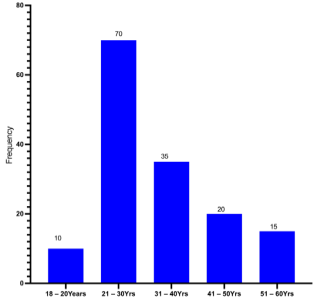
This study investigated 150 women with genital warts, aged from 18 to 60 years, with a mean age of 30 years. Most patients were aged 21-30, followed by 31-40 and 41-50 years, representing 46.7%, 23.3%, and 13.3%, respectively, as indicated in
Figure 1.
Figure 1. Age of the patients.
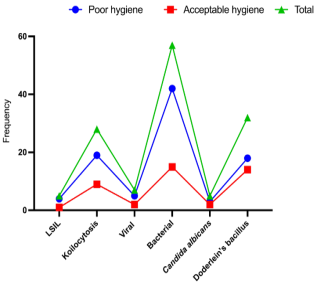
Of the 150 women, 102/150 (68%) had poor personal hygiene, and the remaining 48/150 (32%) had acceptable personal hygiene. The prevalence of low-grade squamous intraepithelial lesions (LSIL) among the studied group was 5/150 (3.3%), of whom 4/5 (80%) had poor personal hygiene. The risk of LSIL among women with poor personal hygiene, OR (95% CI) = 1.9184 (0.2086 to 17.6413), P = 0.565, z statistics = 0.575.
Among the studied group, 28 out of 150 (18.7%) exhibited koilocytosis (HPV), with 19 out of 28 (68%) having poor personal hygiene. The risk of koilocytosis among women with poor personal hygiene was indicated by an odds ratio (OR) of 1.0165 (95% CI: 0.4215 to 2.4514), with a P value of 0.9710 and a z statistic of 0.036.
The prevalence of cytological evidence of non-defined viral infection was 7/150 (4.7%), of whom 5/7 (71.4%) had poor personal hygiene. The risk of viral infection among those with poor hygiene, OR (95% CI) = 1.1856 (0.2216 to 6.3420), P = 0.8423, statistics = 0.199.
57 out of 150 (38%) women exhibited cytological evidence of bacterial infection, with 42 out of 57 (73.7%) displaying poor hygiene. The risk of bacterial infection among those with poor hygiene, OR (95% CI) = 1.5148 (0.7330 to 3.1304), P = 0.2622, statistics = 1.121.
Candida albicans was identified in 5/150 (3.3%), of whom 3/5 (60%) had poor hygiene. The risk of Candida albicans among poor hygiene was OR (95% CI) = 0.697 (0.1126 to 4.3149), P = 0.6979, statistics = 0.388.
Doderlein's bacillus was indicated in 32/150 (21.3%) patients, of whom 18/32 (56.3%) indicated poor hygiene. The risk of Doderlein's bacillus among poor hygiene, OR (95% CI) = 0.5204 (0.2329 to 1.1629), P = 0.1114, statistics = 1.592, as indicated in
Table 1,
Figure 2.
Figure 2. Description of the study subjects by personal hygiene and cervical cytology abnormalities.
Table 1. Distribution of the study subjects by personal hygiene and cervical cytology abnormalities.
Variable | Poor hygiene | Acceptable hygiene | Total |
LSIL | 4 | 1 | 5 |
Koilocytosis | 19 | 9 | 28 |
Viral | 5 | 2 | 7 |
Bacterial | 42 | 15 | 57 |
Candida albicans | 3 | 2 | 5 |
Doderlein's bacillus | 18 | 14 | 32 |
Table 2 and
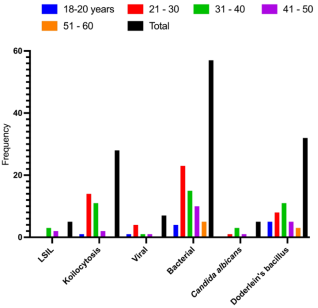
Figure 3 show the distribution of the study subjects by age and cervical cytology abnormalities. The age range of 31-40 saw the highest incidence of LSIL cases, followed by 41-50 years, with 3/5 (60%) and 2/5 (40%), respectively. The age group 21-30 exhibited the highest prevalence of koilocytosis, followed by 31-40, accounting for 14/28 (50%) and 11/28 (39.3%), respectively. Most cytological evidence of viral infections and bacterial infections was in the age group 21-30 years, representing 4/7 (57%) and 23/57 (40.4%), in that order. Candida albicans and Döderlein's bacillus were most common among the age group 31-40 years, representing 3/5 (60%) and 11/32 (34.4%), in that order.
Figure 3. Description of the study subjects by age and cervical cytology abnormalities.
Table 2. Distribution of the study subjects by age and cervical cytology abnormalities.
Variable | 18-20 years | 21 - 30 | 31 - 40 | 41 - 50 | 51 - 60 | Total |
LSIL | 0 | 0 | 3 | 2 | 0 | 5 |
Koilocytosis | 1 | 14 | 11 | 2 | 0 | 28 |
Viral | 1 | 4 | 1 | 1 | 0 | 7 |
Bacterial | 4 | 23 | 15 | 10 | 5 | 57 |
Candida albicans | 0 | 1 | 3 | 1 | 0 | 5 |
Doderlein's bacillus | 5 | 8 | 11 | 5 | 3 | 32 |
4. Discussion
This study evaluated the correlation between personal hygiene practices in women with genital warts and cytological results among 150 participants. Overall, inadequate personal hygiene was prevalent (68%), indicating that hygiene-related behavioral variables may be widespread in the study population. Nevertheless, the cytological abnormalities assessed (LSIL, HPV-related alterations/“koilocytosis,” viral infections, bacterial infections, Candida albicans, and Döderlein’s bacillus) did not demonstrate statistically significant correlations with inadequate hygiene in the majority of analyses.
The incidence of LSIL was 3.3%. Within these LSIL instances, 80% exhibited inadequate hygiene. Notwithstanding this elevated proportion, the calculated risk was not statistically significant (OR 1.9184; 95% CI 0.2086-17.6413; P = 0.565). The broad confidence interval indicates imprecision, possibly attributable to the limited number of LSIL cases (merely five events), which constrains the statistical power to identify an effect. Consequently, while the results indicate a rising trend of LSIL among women with inadequate hygiene, the evidence is insufficient to establish a definitive connection. Poor intimate hygiene can disturb the vaginal microbiome, although it does not directly cause HPV or LSIL. HPV, the main cause of LSIL, increases in these alterations
| [10] | Wang L, Zhu L, Li H, Ma N, Huang H, Zhang X, Li Y, Fang J. Association between asymptomatic sexually transmitted infections and high-risk human papillomavirus in cervical lesions. J Int Med Res. 2019 Nov; 47(11): 5548-5559.
https://doi.org/10.1177/0300060519865633 |
[10]
. The observed pattern may indicate a potential link; however, higher sample sizes or additional LSIL outcomes are necessary for validation.
Koilocytosis was observed in 18.7% of cases. Significantly, 68% of koilocytosis instances were observed in women exhibiting inadequate hygiene. The risk estimate was effectively negligible (OR 1.0165; 95% CI 0.4215-2.4514; P = 0.971). This suggests that inadequate personal cleanliness, as assessed in this study, does not seem to independently affect the probability of HPV-related cytological alterations. The transmission of HPV is predominantly influenced by sexual conduct and exposure rather than cleanliness alone; thus, the absence of a statistical correlation is biologically feasible. Koilocytes are epithelial cells distinguished by perinuclear halos encircling condensed nuclei and are frequently observed in cervical intraepithelial neoplasia. Koilocytosis is recognized as pathognomonic of HPV infection
| [11] | Lawson JS, Glenn WK, Heng B, Ye Y, Tran B, Lutze-Mann L, Whitaker NJ. Koilocytes indicate a role for human papillomavirus in breast cancer. Br J Cancer. 2009 Oct 20; 101(8): 1351-6. https://doi.org/10.1038/sj.bjc.6605328 |
[11]
.
Cytological evidence of an unspecified viral infection was identified in 4.7% of cases, with 71.4% of these instances associated with insufficient hygiene practices. However, the association was not statistically significant (OR 1.1856; 95% CI 0.2216-6.3420; P = 0.8423). Once more, the infrequency of events leads to broad confidence intervals and diminished statistical power. While the majority of viral infection cases were observed in women with inadequate hygiene, the evidence does not indicate a substantial correlation.
Bacteria were prevalent (38%). About 73.7% had poor hygiene, and the estimated risk was higher but not statistically significant (OR 1.5148; 95% CI 0.7330-3.1304; P = 0.2622). The outcome shows a higher risk pattern, but uncertainty remains. Poor hygiene may indirectly influence vaginal microbiota or pathogen clearance, although the study was not statistically significant. Sexual activity, condom use, menstrual hygiene, recent antibiotics, douching, and partner factors may influence the relationship.
More than 30 bacteria, viruses, and parasites can be spread through vaginal, anal, and oral intercourse. STIs can also be passed from mother to kid during pregnancy, childbirth, nursing, and risky blood transfusions. Eight microorganisms cause most STIs. The four treatable diseases are syphilis, gonorrhea, chlamydia, and trichomoniasis. HSV, HIV, HPV, and hepatitis B are the other four viral illnesses.
New sexually transmitted illnesses include mpox, Shigella sonnei, Neisseria meningitidis, Ebola, and Zika, which are also emerging, as are neglected STIs such as lymphogranuloma venereum. These indicate growing difficulties in providing adequate STI prevention and control services
.
Candida albicans was detected in 3.3%; 60% were linked to poor hygiene. The risk estimate was low and non-significant (OR 0.697; 95% CI 0.1126-4.3149; P = 0.6979). The small number of Candida cases produces wide confidence intervals, making the estimate unstable. No evidence of an association between poor hygiene and candidiasis was found in this dataset. Candida albicans is a prevalent commensal fungus that inhabits the oropharyngeal cavity, gastrointestinal tract, vaginal tract, and the skin of healthy individuals. In 50% of the population, C. albicans constitutes a component of the normal microbiota flora. The clinical manifestations of Candida species vary from localized, superficial mucocutaneous disorders to invasive diseases affecting multiple organ systems and posing life-threatening risks
| [13] | Talapko J, Juzbašić M, Matijević T, Pustijanac E, Bekić S, Kotris I, Škrlec I. Candida albicans-The Virulence Factors and Clinical Manifestations of Infection. J Fungi (Basel). 2021 Jan 22; 7(2): 79. https://doi.org/10.3390/jof7020079 |
[13]
.
21.3% of women with inadequate hygiene had Döderlein's bacillus, 56.3%. No significant correlation was found (OR 0.5204; 95% CI 0.2329-1.1629; P = 0.1114). Döderlein's bacillus (lactobacilli) is associated with a protective vaginal environment
| [14] | Asadi N, Yaslianifard S, Hasheminejad M, Qorbani M, Mohammadzadeh M. Population-Specific Diversity of Dominant Vaginal Lactobacillus Species in Healthy Iranian Women and Those with Vaginitis: A Molecular Case-Control Study. Int J Womens Health. 2026 Apr 23; 18: 586988.
https://doi.org/10.2147/IJWH.S586988 |
[14]
and women with poor hygiene may have a reduced prevalence. Although the confidence interval overlaps 1, the P-value is not statistically significant. Poor hygiene decreases Döderlein's bacillus; the study cannot prove it statistically.
Regular counseling on proper personal hygiene is essential for overall genital tract health
; however, these findings suggest that it may not be adequate to prevent HPV-related cytological abnormalities. Screening programs, such as Pap smear and HPV screening, where available, remain crucial, particularly given the notable prevalence of koilocytosis at 18.7%, despite the lack of a statistically significant association with hygiene. Future research should incorporate larger sample sizes and account for significant behavioral and clinical confounders.
The primary limitations of this study are as follows: A limited number of events for multiple outcomes, particularly LSIL, viral infections, and Candida, diminishes statistical power and heightens uncertainty. Potential confounding factors not addressed in the analysis include sexual behavior, contraceptive use, condom use, douching, antibiotic use, partner STI status, and socioeconomic variables. The association between hygiene and HPV-related lesions appears to be indirect, as the risk of HPV is more closely related to sexual exposure than to hygiene practices.
5. Conclusion
Poor hygiene was associated with higher cytological and microbiological outcomes, although none of the correlations were statistically significant (all P values > 0.05). Most likely reasons are: Low statistical power and large confidence intervals due to few "case" outcomes, including LSIL, viral alterations, and Candida. Confounding factors for cervical and vaginal cytology include sexual activity, HPV exposure, menstruation, menstrual hygiene, douching, antibiotic use, socioeconomic status, partner STI status, and contraception.
6. Recommendation
Future studies with larger sample sizes and more event-rich designs are recommended to better estimate the true effect. Meanwhile, improving oral hygiene should be encouraged as a low-cost, potentially beneficial intervention to reduce epithelial irritation and infection-related cytological changes.
Abbreviations
HPV | Human Papillomavirus |
HSV | Herpes Simplex Virus |
HIV | Human Immunodeficiency Virus |
STI | Sexually Transmitted Infection |
LSIL | Low-Grade Squamous Intraepithelial Lesion |
Author Contributions
Ahmed Amin Mohammed Ahmed: Conceptualization, Methodology, Funding acquisition
Elshiekh Babiker Adam Khidir: Conceptualization, Investigation, Methodology, Resources
Taysir Awadelkarim Wedatalla: Conceptualization, Data curation, Methodology
Ali Elsarraj Mustafa Abdelmageed: Conceptualization, Resources, Formal Analysis
Hussain Gadelkarim Ahmed: Conceptualization, Writing – original draft, Writing – review & editing, Supervision
Conflicts of Interest
The authors declare no conflict of interest.
References
| [1] |
Leslie SW, Sajjad H, Kumar S. Condylomata Acuminata (Genital Warts). 2025 Dec 13. In: StatPearls [Internet]. Treasure Island (FL): StatPearls Publishing; 2026 Jan-.
|
| [2] |
Coblentz EG, Packee CR, Ky SL, Brubaker AG, Rudd TM, Fritsch A, Kasting ML, Malcolm SD. Prioritization of HPV vaccine-preventable diseases among emerging adults - Implications for health education and communication. Vaccine. 2026 Feb 27; 74: 128223.
https://doi.org/10.1016/j.vaccine.2026.128223
|
| [3] |
Abuzoor A, Jabin MSR, Jonker C. Health Beliefs and Perspectives of Parents Regarding Human Papillomavirus Vaccination in Kuwait: Qualitative Study. JMIR Form Res. 2026 Apr 2; 10: e85438.
https://doi.org/10.2196/85438
|
| [4] |
Wang W, Zhang J, Mei C, Dai Q, Cai Y, Wei X, Li Y. Prevalence and genotype distribution of human papillomavirus infection among women in Chengdu, China between 2020 and 2024. Front Public Health. 2026 Jan 5; 13: 1740177.
https://doi.org/10.3389/fpubh.2025.1740177
|
| [5] |
de Campos MR, Carvalho LHSB, Campos AJR, Côra GR, Machado RA, Elehamer NMK, Villa LL, Ross JR, Vidal FCB. Knowledge and Perception of Human Papillomavirus in Quilombola Communities in Northeast Brazil. Hisp Health Care Int. 2025 Oct 21: 15404153251383132.
https://doi.org/10.1177/15404153251383132
|
| [6] |
Ibrahim A, Rasch V, Pukkala E, Aro AR. Predictors of cervical cancer being at an advanced stage at diagnosis in Sudan. Int J Womens Health. 2011; 3: 385-9.
https://doi.org/10.2147/IJWH.
S21063
|
| [7] |
Hachimi SE, Essayagh F, Essayagh M, Kazadi GB, Lemriss H, Addakiri K, Zadran R, Tigaidi H, Lambaki A, Essayagh S, Essayagh T. Assessing the prevalence of non-use of cervical cancer screening in Khouribga, Morocco. Sci Rep. 2026 Mar 27; 16(1): 10858.
https://doi.org/10.1038/s41598-026-42469-0
|
| [8] |
Essayagh T, Essayagh M, Lemriss H, Mourad R, Nmila K, Slibani H, Hachimi SE, Boukhari ME, Addakiri K, Zadran R, Tigaidi H, Lemriss S, Essayagh S. Prevalence and determinants of human papillomavirus vaccine hesitancy among parents of young girls in Morocco. Sci Rep. 2026 May 11.
https://doi.org/10.1038/s41598-026-52998-3
|
| [9] |
Almobarak AO, Elbadawi AA, Elmadhoun WM, Elhoweris MH, Ahmed MH. Knowledge, Attitudes and Practices of Sudanese Women Regarding the Pap Smear Test and Cervical Cancer. Asian Pac J Cancer Prev. 2016; 17(2): 625-30.
https://doi.org/10.7314/apjcp.2016.17.2.625
|
| [10] |
Wang L, Zhu L, Li H, Ma N, Huang H, Zhang X, Li Y, Fang J. Association between asymptomatic sexually transmitted infections and high-risk human papillomavirus in cervical lesions. J Int Med Res. 2019 Nov; 47(11): 5548-5559.
https://doi.org/10.1177/0300060519865633
|
| [11] |
Lawson JS, Glenn WK, Heng B, Ye Y, Tran B, Lutze-Mann L, Whitaker NJ. Koilocytes indicate a role for human papillomavirus in breast cancer. Br J Cancer. 2009 Oct 20; 101(8): 1351-6.
https://doi.org/10.1038/sj.bjc.6605328
|
| [12] |
WHO. Sexually transmitted infections (STIs) 2025. Available at:
https://www.who.int/news-room/fact-sheets/detail/sexually-transmitted-infections-(stis)
Accessed on 3/6/2026.
|
| [13] |
Talapko J, Juzbašić M, Matijević T, Pustijanac E, Bekić S, Kotris I, Škrlec I. Candida albicans-The Virulence Factors and Clinical Manifestations of Infection. J Fungi (Basel). 2021 Jan 22; 7(2): 79.
https://doi.org/10.3390/jof7020079
|
| [14] |
Asadi N, Yaslianifard S, Hasheminejad M, Qorbani M, Mohammadzadeh M. Population-Specific Diversity of Dominant Vaginal Lactobacillus Species in Healthy Iranian Women and Those with Vaginitis: A Molecular Case-Control Study. Int J Womens Health. 2026 Apr 23; 18: 586988.
https://doi.org/10.2147/IJWH.S586988
|
| [15] |
Graziottin A. Maintaining vulvar, vaginal and perineal health: Clinical considerations. Womens Health (Lond). 2024 Jan-Dec; 20: 17455057231223716.
https://doi.org/10.1177/17455057231223716
|
Cite This Article
-
APA Style
Ahmed, A. A. M., Khidir, E. B. A., Wedatalla, T. A., Abdelmageed, A. E. M., Ahmed, H. G. (2026). The Impact of Personal Hygiene on Cytopathological Cervical Patterns of Patients with Apparent Genital Warts. American Journal of Laboratory Medicine, 11(2), 45-50. https://doi.org/10.11648/j.ajlm.20261102.12
 Copy
|
Copy
|
 Download
ACS Style
Ahmed, A. A. M.; Khidir, E. B. A.; Wedatalla, T. A.; Abdelmageed, A. E. M.; Ahmed, H. G. The Impact of Personal Hygiene on Cytopathological Cervical Patterns of Patients with Apparent Genital Warts. Am. J. Lab. Med. 2026, 11(2), 45-50. doi: 10.11648/j.ajlm.20261102.12
Copy
|
Download
AMA Style
Ahmed AAM, Khidir EBA, Wedatalla TA, Abdelmageed AEM, Ahmed HG. The Impact of Personal Hygiene on Cytopathological Cervical Patterns of Patients with Apparent Genital Warts. Am J Lab Med. 2026;11(2):45-50. doi: 10.11648/j.ajlm.20261102.12
Copy
|
Download
-
@article{10.11648/j.ajlm.20261102.12,
  author = {Ahmed Amin Mohammed Ahmed and Elshiekh Babiker Adam Khidir and Taysir Awadelkarim Wedatalla and Ali Elsarraj Mustafa Abdelmageed and Hussain Gadelkarim Ahmed},
  title = {The Impact of Personal Hygiene on Cytopathological Cervical Patterns of Patients with Apparent Genital Warts},
  journal = {American Journal of Laboratory Medicine},
  volume = {11},
  number = {2},
  pages = {45-50},
  doi = {10.11648/j.ajlm.20261102.12},
  url = {https://doi.org/10.11648/j.ajlm.20261102.12},
  eprint = {https://article.sciencepublishinggroup.com/pdf/10.11648.j.ajlm.20261102.12},
  abstract = {Background: Genital warts can be transmitted by vaginal, anal, or oral sexual contact with an infected person. Even without warts, the virus can spread. Methodology: This descriptive cross-sectional study was conducted at the Jabarona Health Unit in Western Omdurman City, Sudan. The study encompassed one year of consecutive incidents of genital warts. Approximately 150 women with genital warts were enrolled, irrespective of their demographic characteristics. Results: Among the 150 women surveyed, 68% exhibited poor personal hygiene, while 32% demonstrated acceptable personal hygiene. The prevalence of low-grade squamous intraepithelial lesions (LSIL) in the studied group was 3.3%, with 80% of those affected exhibiting poor personal hygiene. The association of LSIL risk in women exhibiting inadequate personal hygiene is represented by an odds ratio of 1.9184 (95% CI: 0.2086 to 17.6413), with a p-value of 0.565 and a z statistic of 0.575. The prevalence of koilocytic changes associated with HPV was 18.7%, with 19 out of 28 individuals (68%) exhibiting poor personal hygiene. The association between kiolocytosis and inadequate personal hygiene in women is represented by an odds ratio of 1.0165 (95% CI: 0.4215 to 2.4514), with a p-value of 0.9710 and a z statistic of 0.036. Conclusion: Women with poor personal hygiene had higher rates of cytological abnormalities and infections across all outcomes, but none of the associations were statistically significant (LSIL, koilocytosis, viral infection, bacterial infection, Candida albicans, and Döderlein's bacillus all had P-values > 0.05).},
 year = {2026}
}
Copy
|
Download
-
TY  - JOUR
T1  - The Impact of Personal Hygiene on Cytopathological Cervical Patterns of Patients with Apparent Genital Warts
AU  - Ahmed Amin Mohammed Ahmed
AU  - Elshiekh Babiker Adam Khidir
AU  - Taysir Awadelkarim Wedatalla
AU  - Ali Elsarraj Mustafa Abdelmageed
AU  - Hussain Gadelkarim Ahmed
Y1  - 2026/07/17
PY  - 2026
N1  - https://doi.org/10.11648/j.ajlm.20261102.12
DO  - 10.11648/j.ajlm.20261102.12
T2  - American Journal of Laboratory Medicine
JF  - American Journal of Laboratory Medicine
JO  - American Journal of Laboratory Medicine
SP  - 45
EP  - 50
PB  - Science Publishing Group
SN  - 2575-386X
UR  - https://doi.org/10.11648/j.ajlm.20261102.12
AB  - Background: Genital warts can be transmitted by vaginal, anal, or oral sexual contact with an infected person. Even without warts, the virus can spread. Methodology: This descriptive cross-sectional study was conducted at the Jabarona Health Unit in Western Omdurman City, Sudan. The study encompassed one year of consecutive incidents of genital warts. Approximately 150 women with genital warts were enrolled, irrespective of their demographic characteristics. Results: Among the 150 women surveyed, 68% exhibited poor personal hygiene, while 32% demonstrated acceptable personal hygiene. The prevalence of low-grade squamous intraepithelial lesions (LSIL) in the studied group was 3.3%, with 80% of those affected exhibiting poor personal hygiene. The association of LSIL risk in women exhibiting inadequate personal hygiene is represented by an odds ratio of 1.9184 (95% CI: 0.2086 to 17.6413), with a p-value of 0.565 and a z statistic of 0.575. The prevalence of koilocytic changes associated with HPV was 18.7%, with 19 out of 28 individuals (68%) exhibiting poor personal hygiene. The association between kiolocytosis and inadequate personal hygiene in women is represented by an odds ratio of 1.0165 (95% CI: 0.4215 to 2.4514), with a p-value of 0.9710 and a z statistic of 0.036. Conclusion: Women with poor personal hygiene had higher rates of cytological abnormalities and infections across all outcomes, but none of the associations were statistically significant (LSIL, koilocytosis, viral infection, bacterial infection, Candida albicans, and Döderlein's bacillus all had P-values > 0.05).
VL  - 11
IS  - 2
ER  -
Copy
|
Download

 ,
Elshiekh Babiker Adam Khidir
,
Elshiekh Babiker Adam Khidir


 Share This Article
 Twitter
 Linked In
 Facebook