Abstract
Articulating stair systems provide temporary access across changing elevations by allowing the stair frame to rotate while the walking treads remain approximately level. The resulting structure is not geometrically fixed: deployment angle changes effective member length, load path, bending demand, and stability. This study develops an angle-aware structural verification framework for an 18-step, 36 in wide aluminum stair system and compares two documented finite-element design states at 55° and 30°. The baseline structure uses 6061-T6 aluminum and was evaluated in SAP2000 using the load framework and member resistance procedures documented in the source structural calculation package, including ASCE/SEI 7-16, the 2022 California Building Code, and the 2020 Aluminum Design Manual. The governing side beam/stringer combined demand-to-capacity ratio increased from 0.731 at 55° to 0.948 at 30°, corresponding to a 29.7% increase in critical utilization and a reduction in remaining unity margin from 26.9% to 5.2%. Decomposition of the interaction check showed that major-axis bending governed the change: the major bending demand-to-capacity contribution increased from 0.661 to 0.892, while major bending demand increased from 1.353 to 1.785 ft-kip. At the same time, the reported axial-compression capacity of the side member decreased from 1.756 to 0.673 kip because of the longer effective member length and associated buckling response in the shallow configuration. Tread-member utilization remained low, decreasing from 0.034 to 0.017. The results demonstrate that the shallow-angle configuration, rather than the steep-angle configuration, controls the baseline unbraced system. The scientific contribution is a configuration-dependent interpretation of articulating stair behavior in which inclination is treated as an explicit structural design variable. The proposed framework can be extended to full-angle parametric analysis, reinforced configurations, connection assessment, fatigue studies, and experimental validation.
Keywords
Articulating Stair, Adjustable Stair, Aluminum Structure, Variable Inclination, Finite-Element Analysis, Buckling,
Structural Utilization, 6061-T6
1. Introduction
Industrial plants, construction sites, excavation works, transport facilities, and maintenance areas frequently require temporary access between elevations that change during a project. A conventional fixed stair is optimized for a single rise and run, whereas a reconfigurable stair must maintain acceptable tread orientation, strength, stiffness, and stability over multiple deployment geometries. This requirement is especially important for lightweight aluminum structures because their relatively low elastic modulus makes member stability and deflection sensitive to effective length and restraint conditions. Recent research has emphasized the high strength-to-weight ratio and structural potential of aluminum alloys while also identifying buckling, joint behavior, and reliable numerical modeling as central design issues
. Experimental and numerical studies published since 2023 have examined aluminum channel columns, perforated flexural members, beam-column joints, axial-compression members, circular-hollow-section beam-columns, and high-strength square-hollow-section beam-columns
| [10] | Georgantzia, E., Gkantou, M., Kamaris, G. S. Aluminium alloy channel columns: Testing, numerical modelling and design. Thin-Walled Structures. 2023, 182, 110242.
https://doi.org/10.1016/j.tws.2022.110242 |
| [11] | Xiong, Y., Liu, H., Chen, Z., Ouyang, Y. Flexural performance of H-shaped aluminium alloy members with web openings. Thin-Walled Structures. 2023, 185, 110627.
https://doi.org/10.1016/j.tws.2023.110627 |
| [12] | Xing, Z., Wang, G., Lin, X., Pang, J., Zhao, C., Chen, Q. Study of the Mechanical Properties of Beam-Column Joints in a New Type of Aluminum Alloy Portal Frame. Buildings. 2023, 13(11), 2698. https://doi.org/10.3390/buildings13112698 |
| [13] | Zhong, C. J., Feng, R. Q., Huang, Y. Q., Li, H. Y. 6A13-T6 high-strength aluminium alloy columns under axial compression: Experiments, finite element analysis and design recommendations. Structures. 2023, 55, 71-84.
https://doi.org/10.1016/j.istruc.2023.05.126 |
| [14] | Gkantou, M., Tziavos, N. I., Dirar, S., Theofanous, M., Ukpedor, O. P., Foster, A. Assessment of design models for aluminium alloy CHS beam-columns with stocky cross-sections. Structures. 2024, 65, 106681.
https://doi.org/10.1016/j.istruc.2024.106681 |
| [15] | Li, B., He, P., Wang, J., Wang, Y. Behaviour and design of extruded high-strength aluminium alloy SHS beam-columns. Sustainable Structures. 2024, 4(3), 000059.
https://doi.org/10.54113/j.sust.2024.000059 |
[10-15]
. Recent staircase research has likewise combined full-scale testing with finite-element analysis to evaluate lightweight prefabricated stair systems
| [16] | Liu, J., Bao, Y., Qin, K. Experimental and Finite Element Analysis on the Structural Performance of Lightweight Hollow Slab Prefabricated Staircases. Buildings. 2025, 15(2), 245.
https://doi.org/10.3390/buildings15020245 |
| [17] | Yin, L., Zhu, Y., Cai, X., Wu, C., Ding, S. Flexural behavior of lightweight prefabricated stairs: A comparison of prestressed and UHPC composite solutions. Journal of Building Engineering. 2026, 118, 115058.
https://doi.org/10.1016/j.jobe.2025.115058 |
[16, 17]
. These studies provide an important methodological foundation, but they do not quantify the structural response of a portable articulating aluminum stair as a function of deployment angle.
Adjustable stair mechanisms have prior art and should not be treated as a newly discovered mechanical concept. Earlier adjustable-stair patents describe pivotally connected stair supports and variable geometry
, while modern commercial systems use related articulation principles to maintain usable tread orientation over changing elevations
| [8] | SafeSmart Access. AdjustaStairs: The Articulating, Self-Leveling Stair System. Santa Fe Springs, CA: SafeSmart Access; 2026. |
[8]
. Accordingly, the scientific question addressed here is not whether an adjustable stair can be constructed, but how the structural demand and member stability of a lightweight aluminum stair change when the same assembly is deployed at substantially different inclination angles. Recent structural-aluminum research has examined experimentally and numerically validated channel-column buckling
| [10] | Georgantzia, E., Gkantou, M., Kamaris, G. S. Aluminium alloy channel columns: Testing, numerical modelling and design. Thin-Walled Structures. 2023, 182, 110242.
https://doi.org/10.1016/j.tws.2022.110242 |
[10]
, flexural behavior of H-shaped aluminum members
| [11] | Xiong, Y., Liu, H., Chen, Z., Ouyang, Y. Flexural performance of H-shaped aluminium alloy members with web openings. Thin-Walled Structures. 2023, 185, 110627.
https://doi.org/10.1016/j.tws.2023.110627 |
[11]
, beam-column joint response in aluminum portal frames
| [12] | Xing, Z., Wang, G., Lin, X., Pang, J., Zhao, C., Chen, Q. Study of the Mechanical Properties of Beam-Column Joints in a New Type of Aluminum Alloy Portal Frame. Buildings. 2023, 13(11), 2698. https://doi.org/10.3390/buildings13112698 |
[12]
, axial-compression behavior of high-strength aluminum columns
| [13] | Zhong, C. J., Feng, R. Q., Huang, Y. Q., Li, H. Y. 6A13-T6 high-strength aluminium alloy columns under axial compression: Experiments, finite element analysis and design recommendations. Structures. 2023, 55, 71-84.
https://doi.org/10.1016/j.istruc.2023.05.126 |
[13]
, and beam-column response of circular and square hollow aluminum sections
| [14] | Gkantou, M., Tziavos, N. I., Dirar, S., Theofanous, M., Ukpedor, O. P., Foster, A. Assessment of design models for aluminium alloy CHS beam-columns with stocky cross-sections. Structures. 2024, 65, 106681.
https://doi.org/10.1016/j.istruc.2024.106681 |
[14]
and
. These studies demonstrate the importance of section geometry, member slenderness, connection behavior, and validated numerical modeling when interpreting the response of lightweight aluminum structures.
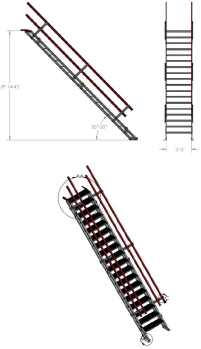
The system examined in this paper is an 18-step, 36-in-wide aluminum stair with folding handrails, top fixing brackets, large support feet, and a documented operating inclination range of approximately 30° to 55°. These configuration details are defined in the controlled engineering drawing
| [6] | SafeSmart Access. 18 Steps Adjustastair Engineering Drawing, Drawing No. 15AS1836. Santa Fe Springs, CA: SafeSmart Access; supplied engineering record. |
[6]
and the manufacturer technical literature
| [8] | SafeSmart Access. AdjustaStairs: The Articulating, Self-Leveling Stair System. Santa Fe Springs, CA: SafeSmart Access; 2026. |
[8]
. The associated structural calculation package evaluates the baseline stair without the optional H-brace using SAP2000 and aluminum-code member checks
| [7] | Structural Report Calculation, Project No. 2023-470, Without H-Braced Structure. Santa Fe Springs, CA; 2023. |
[7]
.
The principal contribution of this study is an angle-aware verification framework that treats inclination as an explicit structural state variable. The work: (1) defines the kinematic relationship among stair rise, horizontal reach, and inclination; (2) compares member utilization at the documented 55° and 30° configurations; (3) decomposes the governing combined interaction into axial and flexural contributions; and (4) formulates a configuration-envelope criterion for future parametric verification. Unlike recent studies that focus on fixed aluminum members or conventional prefabricated stairs
| [10] | Georgantzia, E., Gkantou, M., Kamaris, G. S. Aluminium alloy channel columns: Testing, numerical modelling and design. Thin-Walled Structures. 2023, 182, 110242.
https://doi.org/10.1016/j.tws.2022.110242 |
| [11] | Xiong, Y., Liu, H., Chen, Z., Ouyang, Y. Flexural performance of H-shaped aluminium alloy members with web openings. Thin-Walled Structures. 2023, 185, 110627.
https://doi.org/10.1016/j.tws.2023.110627 |
| [12] | Xing, Z., Wang, G., Lin, X., Pang, J., Zhao, C., Chen, Q. Study of the Mechanical Properties of Beam-Column Joints in a New Type of Aluminum Alloy Portal Frame. Buildings. 2023, 13(11), 2698. https://doi.org/10.3390/buildings13112698 |
| [13] | Zhong, C. J., Feng, R. Q., Huang, Y. Q., Li, H. Y. 6A13-T6 high-strength aluminium alloy columns under axial compression: Experiments, finite element analysis and design recommendations. Structures. 2023, 55, 71-84.
https://doi.org/10.1016/j.istruc.2023.05.126 |
| [14] | Gkantou, M., Tziavos, N. I., Dirar, S., Theofanous, M., Ukpedor, O. P., Foster, A. Assessment of design models for aluminium alloy CHS beam-columns with stocky cross-sections. Structures. 2024, 65, 106681.
https://doi.org/10.1016/j.istruc.2024.106681 |
| [15] | Li, B., He, P., Wang, J., Wang, Y. Behaviour and design of extruded high-strength aluminium alloy SHS beam-columns. Sustainable Structures. 2024, 4(3), 000059.
https://doi.org/10.54113/j.sust.2024.000059 |
| [16] | Liu, J., Bao, Y., Qin, K. Experimental and Finite Element Analysis on the Structural Performance of Lightweight Hollow Slab Prefabricated Staircases. Buildings. 2025, 15(2), 245.
https://doi.org/10.3390/buildings15020245 |
| [17] | Yin, L., Zhu, Y., Cai, X., Wu, C., Ding, S. Flexural behavior of lightweight prefabricated stairs: A comparison of prestressed and UHPC composite solutions. Journal of Building Engineering. 2026, 118, 115058.
https://doi.org/10.1016/j.jobe.2025.115058 |
[10-17]
, the present study evaluates how reconfiguration of a single articulating aluminum stair changes the governing structural limit state.
2. Materials and Methods
2.1. System Architecture and Configuration
The evaluated stair is a portable articulating aluminum assembly containing two longitudinal side beams/stringers, repeated transverse tread members, folding handrails and mid-rails, upper fixing brackets, and lower support feet. The tread assemblies are connected to the articulating frame so that the walking surfaces remain approximately level as the stair inclination changes. The system therefore combines a variable-geometry mechanism with load-bearing structural members and must satisfy both kinematic and structural requirements
| [6] | SafeSmart Access. 18 Steps Adjustastair Engineering Drawing, Drawing No. 15AS1836. Santa Fe Springs, CA: SafeSmart Access; supplied engineering record. |
| [8] | SafeSmart Access. AdjustaStairs: The Articulating, Self-Leveling Stair System. Santa Fe Springs, CA: SafeSmart Access; 2026. |
[6, 8]
.
The product architecture also includes optional structural reinforcement for longer or higher-load configurations. The present paper deliberately isolates the unbraced baseline structure because the supplied structural report provides angle-specific member checks for that state. Reinforced configurations should be treated as a separate structural family because the brace changes load distribution, effective length, and lateral restraint
| [7] | Structural Report Calculation, Project No. 2023-470, Without H-Braced Structure. Santa Fe Springs, CA; 2023. |
| [8] | SafeSmart Access. AdjustaStairs: The Articulating, Self-Leveling Stair System. Santa Fe Springs, CA: SafeSmart Access; 2026. |
[7, 8]
.
2.2. Kinematic Geometry
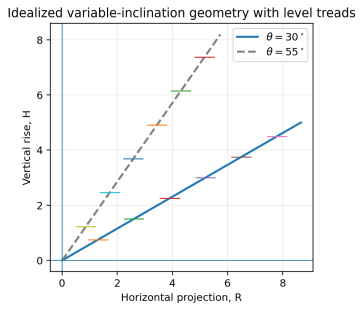
For an idealized stair centerline of effective length L deployed at angle θ above the horizontal, the first-order geometric projections are given by Eqs. (
1)-(
3).
Here H is the vertical rise, and R is the horizontal reach. These equations are used to describe the mechanical role of inclination and are not used to reconstruct proprietary model coordinates. The supplied structural report labels both comparison analyses with a height of 14ft-4in while assigning different inclination angles. Because complete nodal coordinates were not provided, the present manuscript preserves the documented analysis states rather than silently correcting or re-creating the finite-element geometry.
Figure 2. Idealized variable-inclination geometry showing horizontal tread orientation at 30° and 55°. The schematic is explanatory and is not a reconstruction of the proprietary finite-element model.
2.3. Material Properties and Design Basis
The source calculation package specifies 6061-T6 wrought aluminum for the principal members. Structural loading is based on ASCE/SEI 7-16
| [1] | American Society of Civil Engineers. ASCE/SEI 7-16: Minimum Design Loads and Associated Criteria for Buildings and Other Structures. Reston, VA: American Society of Civil Engineers; 2017. https://doi.org/10.1061/9780784414248 |
[1]
and the 2022 California Building Code (CBC)
| [2] | California Building Standards Commission. 2022 California Building Code, Title 24, Part 2. Sacramento, CA: California Building Standards Commission; 2022. |
[2]
, while aluminum member resistance and stability are evaluated using the Aluminum Design Manual 2020
| [3] | The Aluminum Association. Aluminum Design Manual 2020. Arlington, VA: The Aluminum Association; 2020. |
[3]
. The supplied report lists a yield strength of 35,000 psi, an ultimate tensile strength of 42,000 psi, an elastic modulus of 1.0 × 10^7 psi, and a unit weight of 0.284 lb/in
3 | [7] | Structural Report Calculation, Project No. 2023-470, Without H-Braced Structure. Santa Fe Springs, CA; 2023. |
[7]
. These values are consistent with the broader structural use of heat-treated aluminum alloys described in recent literature
| [9] | Sun, Y. The use of aluminum alloys in structures: Review and outlook. Structures. 2023, 57, 105290.
https://doi.org/10.1016/j.istruc.2023.105290 |
| [10] | Georgantzia, E., Gkantou, M., Kamaris, G. S. Aluminium alloy channel columns: Testing, numerical modelling and design. Thin-Walled Structures. 2023, 182, 110242.
https://doi.org/10.1016/j.tws.2022.110242 |
| [11] | Xiong, Y., Liu, H., Chen, Z., Ouyang, Y. Flexural performance of H-shaped aluminium alloy members with web openings. Thin-Walled Structures. 2023, 185, 110627.
https://doi.org/10.1016/j.tws.2023.110627 |
| [12] | Xing, Z., Wang, G., Lin, X., Pang, J., Zhao, C., Chen, Q. Study of the Mechanical Properties of Beam-Column Joints in a New Type of Aluminum Alloy Portal Frame. Buildings. 2023, 13(11), 2698. https://doi.org/10.3390/buildings13112698 |
| [13] | Zhong, C. J., Feng, R. Q., Huang, Y. Q., Li, H. Y. 6A13-T6 high-strength aluminium alloy columns under axial compression: Experiments, finite element analysis and design recommendations. Structures. 2023, 55, 71-84.
https://doi.org/10.1016/j.istruc.2023.05.126 |
| [14] | Gkantou, M., Tziavos, N. I., Dirar, S., Theofanous, M., Ukpedor, O. P., Foster, A. Assessment of design models for aluminium alloy CHS beam-columns with stocky cross-sections. Structures. 2024, 65, 106681.
https://doi.org/10.1016/j.istruc.2024.106681 |
| [15] | Li, B., He, P., Wang, J., Wang, Y. Behaviour and design of extruded high-strength aluminium alloy SHS beam-columns. Sustainable Structures. 2024, 4(3), 000059.
https://doi.org/10.54113/j.sust.2024.000059 |
[9-15]
Table 1.
Material, loading, and member data extracted from the supplied structural calculation package | [7] | Structural Report Calculation, Project No. 2023-470, Without H-Braced Structure. Santa Fe Springs, CA; 2023. |
Property | Documented value | Role in analysis |
Aluminum alloy | 6061-T6 wrought | Primary structural material |
Yield strength, fy | 35,000 psi | Member yielding and stability checks |
Ultimate tensile strength, fu | 42,000 psi | Tension/rupture checks in report summary |
Elastic modulus, E | 1.0 × 10^7 psi | Elastic stiffness and buckling |
Unit weight | 0.284 lb/in3 | Dead-load basis |
Dead load | 5 psf | Documented design action |
Live load | 40 psf | Documented design action |
Side beam nominal section | 3 × 1 × 0.13 in | Primary longitudinal member |
Tread nominal section | 9 × 2 × 0.13 in | Transverse walking member |
2.4. Finite-Element Model and Acceptance Criterion
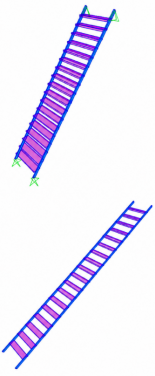
The structural model was developed in SAP2000 using frame representations of the side beams and tread members. Member forces were obtained from the global finite-element solution and checked individually using the aluminum design implementation reported in the structural calculation package
| [7] | Structural Report Calculation, Project No. 2023-470, Without H-Braced Structure. Santa Fe Springs, CA; 2023. |
[7]
. The two documented comparison states are a 55° configuration and a 30° configuration. This global-analysis/local-resistance workflow is consistent with recent aluminum research in which experimentally validated or code-checked finite-element models are used to investigate buckling, combined compression and bending, and connection response
| [10] | Georgantzia, E., Gkantou, M., Kamaris, G. S. Aluminium alloy channel columns: Testing, numerical modelling and design. Thin-Walled Structures. 2023, 182, 110242.
https://doi.org/10.1016/j.tws.2022.110242 |
| [11] | Xiong, Y., Liu, H., Chen, Z., Ouyang, Y. Flexural performance of H-shaped aluminium alloy members with web openings. Thin-Walled Structures. 2023, 185, 110627.
https://doi.org/10.1016/j.tws.2023.110627 |
| [12] | Xing, Z., Wang, G., Lin, X., Pang, J., Zhao, C., Chen, Q. Study of the Mechanical Properties of Beam-Column Joints in a New Type of Aluminum Alloy Portal Frame. Buildings. 2023, 13(11), 2698. https://doi.org/10.3390/buildings13112698 |
| [13] | Zhong, C. J., Feng, R. Q., Huang, Y. Q., Li, H. Y. 6A13-T6 high-strength aluminium alloy columns under axial compression: Experiments, finite element analysis and design recommendations. Structures. 2023, 55, 71-84.
https://doi.org/10.1016/j.istruc.2023.05.126 |
| [14] | Gkantou, M., Tziavos, N. I., Dirar, S., Theofanous, M., Ukpedor, O. P., Foster, A. Assessment of design models for aluminium alloy CHS beam-columns with stocky cross-sections. Structures. 2024, 65, 106681.
https://doi.org/10.1016/j.istruc.2024.106681 |
| [15] | Li, B., He, P., Wang, J., Wang, Y. Behaviour and design of extruded high-strength aluminium alloy SHS beam-columns. Sustainable Structures. 2024, 4(3), 000059.
https://doi.org/10.54113/j.sust.2024.000059 |
[10-15]
. The use of finite-element demand extraction followed by member-level resistance assessment is consistent with recent aluminum-structure studies in which numerical models are used together with experimental or code-based verification to evaluate buckling, flexure, and joint behavior
| [10] | Georgantzia, E., Gkantou, M., Kamaris, G. S. Aluminium alloy channel columns: Testing, numerical modelling and design. Thin-Walled Structures. 2023, 182, 110242.
https://doi.org/10.1016/j.tws.2022.110242 |
| [12] | Xing, Z., Wang, G., Lin, X., Pang, J., Zhao, C., Chen, Q. Study of the Mechanical Properties of Beam-Column Joints in a New Type of Aluminum Alloy Portal Frame. Buildings. 2023, 13(11), 2698. https://doi.org/10.3390/buildings13112698 |
| [13] | Zhong, C. J., Feng, R. Q., Huang, Y. Q., Li, H. Y. 6A13-T6 high-strength aluminium alloy columns under axial compression: Experiments, finite element analysis and design recommendations. Structures. 2023, 55, 71-84.
https://doi.org/10.1016/j.istruc.2023.05.126 |
| [14] | Gkantou, M., Tziavos, N. I., Dirar, S., Theofanous, M., Ukpedor, O. P., Foster, A. Assessment of design models for aluminium alloy CHS beam-columns with stocky cross-sections. Structures. 2024, 65, 106681.
https://doi.org/10.1016/j.istruc.2024.106681 |
| [15] | Li, B., He, P., Wang, J., Wang, Y. Behaviour and design of extruded high-strength aluminium alloy SHS beam-columns. Sustainable Structures. 2024, 4(3), 000059.
https://doi.org/10.54113/j.sust.2024.000059 |
[10, 12-15]
.
For a structural member i at inclination θ, the study defines the utilization ratio U_i(θ) as the ratio of design demand Q_d to available resistance Q_r. Structural adequacy requires U ≤ 1.0. A reserve factor R is used to express the remaining normalized margin to the unity limit.
U_i(θ) = Q_d,i(θ) / Q_r,i(θ) ≤ 1.0(4)
For the complete reconfigurable stair, the governing configuration is defined by the maximum utilization over all admissible angles and checked component groups:
U_max = max_ {θ∈Θ} [U_stringer(θ), U_tread(θ), U_connection(θ), U_rail(θ)](6)
The supplied dataset contains two discrete inclination states, so the present study does not assume a continuous interpolation law between 30° and 55°. The configuration-envelope expression is proposed as the verification framework for future parametric analysis.
2.5. Aluminum Stability Interpretation
The detailed SAP2000 output includes axial compression, flexure, shear, local buckling, lateral-torsional buckling, and combined compression-bending checks under the Aluminum Design Manual
| [3] | The Aluminum Association. Aluminum Design Manual 2020. Arlington, VA: The Aluminum Association; 2020. |
| [7] | Structural Report Calculation, Project No. 2023-470, Without H-Braced Structure. Santa Fe Springs, CA; 2023. |
[3, 7]
. For interpretation of inclination sensitivity, the classical Euler relation is useful because it shows that elastic buckling resistance varies inversely with the square of effective length
| [4] | Gere, J. M., Goodno, B. J. Mechanics of Materials. 9th ed. Boston, MA: Cengage Learning; 2018, pp. 934-977. |
[4]
. Recent aluminum-member studies similarly identifying member slenderness, local buckling, geometric imperfections, and combined axial-flexural interaction as key variables governing structural resistance
| [10] | Georgantzia, E., Gkantou, M., Kamaris, G. S. Aluminium alloy channel columns: Testing, numerical modelling and design. Thin-Walled Structures. 2023, 182, 110242.
https://doi.org/10.1016/j.tws.2022.110242 |
| [13] | Zhong, C. J., Feng, R. Q., Huang, Y. Q., Li, H. Y. 6A13-T6 high-strength aluminium alloy columns under axial compression: Experiments, finite element analysis and design recommendations. Structures. 2023, 55, 71-84.
https://doi.org/10.1016/j.istruc.2023.05.126 |
| [14] | Gkantou, M., Tziavos, N. I., Dirar, S., Theofanous, M., Ukpedor, O. P., Foster, A. Assessment of design models for aluminium alloy CHS beam-columns with stocky cross-sections. Structures. 2024, 65, 106681.
https://doi.org/10.1016/j.istruc.2024.106681 |
| [15] | Li, B., He, P., Wang, J., Wang, Y. Behaviour and design of extruded high-strength aluminium alloy SHS beam-columns. Sustainable Structures. 2024, 4(3), 000059.
https://doi.org/10.54113/j.sust.2024.000059 |
[10, 13-15]
.
Although the final capacities are obtained from the ADM code checks rather than the Euler equation alone, the inverse-square dependence on effective length explains why a shallow configuration can lose compression stability even when its applied axial force decreases. The equation is therefore used as a transparent mechanics-based interpretation of the numerical results, not as a substitute for the code-based member verification.
3. Results
3.1. Angle-Dependent Member Utilization
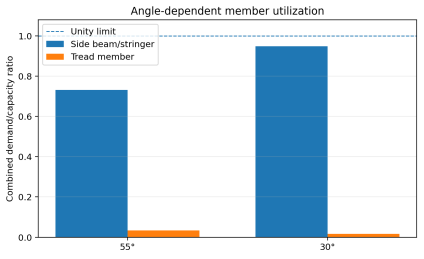
The structural response changes materially with inclination. At 55°, the governing side-beam/stringer combined demand-to-capacity ratio is 0.731. At 30°, the same member family reaches 0.948. The tread-member utilization is small in both cases, with reported ratios of 0.034 and 0.017, respectively
| [7] | Structural Report Calculation, Project No. 2023-470, Without H-Braced Structure. Santa Fe Springs, CA; 2023. |
[7]
. These results show that changing the deployment geometry redistributes structural demand even though the same basic stair assembly is being evaluated.
Table 2.
Reported member utilization at the two documented inclination states | [7] | Structural Report Calculation, Project No. 2023-470, Without H-Braced Structure. Santa Fe Springs, CA; 2023. |
Angle | Side beam U | Tread U | Side-beam reserve, R | Governing observation |
55° | 0.731 | 0.034 | 0.269 | Side beam governs |
30° | 0.948 | 0.017 | 0.052 | Side beam governs; near unity |
The relative increase in critical stringer utilization between the two states is
ΔU_rel = (0.948 −0.731) / 0.731 = 0.297 = 29.7%(8)
Thus, the shallow-angle case is 29.7% more highly utilized than the steep-angle case, while the remaining unity margin contracts from 26.9% to only 5.2%.
3.2. Decomposition of the Governing Side-Beam Interaction
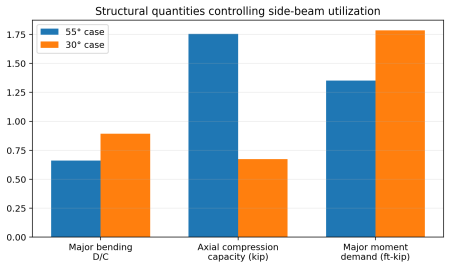
The increase in total utilization is controlled primarily by major-axis bending rather than by an increase in axial compression. The reported axial-compression demand decreases from 0.095 kip at 55° to 0.032 kip at 30°. In contrast, major bending demand increases from 1.353 to 1.785 ft-kip, and the major-axis bending demand-to-capacity contribution increases from 0.661 to 0.892
| [7] | Structural Report Calculation, Project No. 2023-470, Without H-Braced Structure. Santa Fe Springs, CA; 2023. |
[7]
. This interaction between bending and member stability is consistent with the behavior emphasized in recent studies of aluminum beam-columns subjected to combined axial and flexural actions
| [14] | Gkantou, M., Tziavos, N. I., Dirar, S., Theofanous, M., Ukpedor, O. P., Foster, A. Assessment of design models for aluminium alloy CHS beam-columns with stocky cross-sections. Structures. 2024, 65, 106681.
https://doi.org/10.1016/j.istruc.2024.106681 |
| [15] | Li, B., He, P., Wang, J., Wang, Y. Behaviour and design of extruded high-strength aluminium alloy SHS beam-columns. Sustainable Structures. 2024, 4(3), 000059.
https://doi.org/10.54113/j.sust.2024.000059 |
[14, 15]
.
Table 3.
Side-beam interaction quantities extracted from the source SAP2000 member checks | [7] | Structural Report Calculation, Project No. 2023-470, Without H-Braced Structure. Santa Fe Springs, CA; 2023. |
Quantity | 55° case | 30° case | Change / interpretation |
Combined interaction ratio | 0.731 | 0.948 | +29.7% |
Axial compression D/C | 0.054 | 0.047 | Slight decrease |
Major-axis bending D/C | 0.661 | 0.892 | +34.9%; dominant contribution |
Minor-axis bending D/C | 0.015 | 0.008 | Decreases |
Axial compression demand | 0.095 kip | 0.032 kip | Demand decreases |
Axial compression capacity | 1.756 kip | 0.673 kip | 61.7% reduction |
Major bending demand | 1.353 ft-kip | 1.785 ft-kip | 31.9% increase |
Major bending capacity | 2.045 ft-kip | 2.000 ft-kip | Approximately unchanged |
Figure 5. Structural quantities controlling side-beam utilization in the 55° and 30° states.
The documented major effective length of the critical side member increases from 17.205 ft in the 55° analysis to 27.785 ft in the 30° analysis. The corresponding reported axial-compression capacity falls from 1.756 kip to 0.673 kip
| [7] | Structural Report Calculation, Project No. 2023-470, Without H-Braced Structure. Santa Fe Springs, CA; 2023. |
[7]
. This trend is consistent with classical column mechanics
| [4] | Gere, J. M., Goodno, B. J. Mechanics of Materials. 9th ed. Boston, MA: Cengage Learning; 2018, pp. 934-977. |
[4]
and with recent experimental and numerical research showing the strong influence of slenderness and buckling mode on aluminum-member resistance
| [10] | Georgantzia, E., Gkantou, M., Kamaris, G. S. Aluminium alloy channel columns: Testing, numerical modelling and design. Thin-Walled Structures. 2023, 182, 110242.
https://doi.org/10.1016/j.tws.2022.110242 |
| [13] | Zhong, C. J., Feng, R. Q., Huang, Y. Q., Li, H. Y. 6A13-T6 high-strength aluminium alloy columns under axial compression: Experiments, finite element analysis and design recommendations. Structures. 2023, 55, 71-84.
https://doi.org/10.1016/j.istruc.2023.05.126 |
| [14] | Gkantou, M., Tziavos, N. I., Dirar, S., Theofanous, M., Ukpedor, O. P., Foster, A. Assessment of design models for aluminium alloy CHS beam-columns with stocky cross-sections. Structures. 2024, 65, 106681.
https://doi.org/10.1016/j.istruc.2024.106681 |
| [15] | Li, B., He, P., Wang, J., Wang, Y. Behaviour and design of extruded high-strength aluminium alloy SHS beam-columns. Sustainable Structures. 2024, 4(3), 000059.
https://doi.org/10.54113/j.sust.2024.000059 |
[10, 13-15]
.
3.3. Tread Response
The tread members remain lightly utilized. The combined ratios of 0.034 at 55° and 0.017 at 30° indicate substantial local reserve relative to the side beam
| [7] | Structural Report Calculation, Project No. 2023-470, Without H-Braced Structure. Santa Fe Springs, CA; 2023. |
[7]
. The design implication is that structural optimization should not be performed uniformly across all components: the lightly utilized tread members and the near-governing longitudinal member have very different reserve capacities.
3.4. Governing Configuration
Among the two documented analysis states, the 30° configuration governs. The result is important because maximum geometric height or maximum apparent steepness is not automatically the most severe structural state. In this system, increased major bending and reduced stability capacity at the shallower deployment dominate the combined interaction check. Consequently, verification at only one nominal stair angle would not provide a reliable basis for a reconfigurable product family.
4. Discussion
4.1. Structural Meaning of Inclination
The data demonstrates that deployment angle functions as a structural state variable. A reduction in angle changes the relationship between vertical rise and horizontal reach, and in the documented finite-element models it is accompanied by a longer effective side-member length and higher major-axis bending demand. The 30° state therefore approaches the unity limit even though its axial compression demand is lower. The result reinforces a broader finding from recent aluminum research: slenderness, restraint, connection behavior, and combined loading can control lightweight structural members even when material strength is adequate
| [9] | Sun, Y. The use of aluminum alloys in structures: Review and outlook. Structures. 2023, 57, 105290.
https://doi.org/10.1016/j.istruc.2023.105290 |
| [10] | Georgantzia, E., Gkantou, M., Kamaris, G. S. Aluminium alloy channel columns: Testing, numerical modelling and design. Thin-Walled Structures. 2023, 182, 110242.
https://doi.org/10.1016/j.tws.2022.110242 |
| [11] | Xiong, Y., Liu, H., Chen, Z., Ouyang, Y. Flexural performance of H-shaped aluminium alloy members with web openings. Thin-Walled Structures. 2023, 185, 110627.
https://doi.org/10.1016/j.tws.2023.110627 |
| [12] | Xing, Z., Wang, G., Lin, X., Pang, J., Zhao, C., Chen, Q. Study of the Mechanical Properties of Beam-Column Joints in a New Type of Aluminum Alloy Portal Frame. Buildings. 2023, 13(11), 2698. https://doi.org/10.3390/buildings13112698 |
| [13] | Zhong, C. J., Feng, R. Q., Huang, Y. Q., Li, H. Y. 6A13-T6 high-strength aluminium alloy columns under axial compression: Experiments, finite element analysis and design recommendations. Structures. 2023, 55, 71-84.
https://doi.org/10.1016/j.istruc.2023.05.126 |
| [14] | Gkantou, M., Tziavos, N. I., Dirar, S., Theofanous, M., Ukpedor, O. P., Foster, A. Assessment of design models for aluminium alloy CHS beam-columns with stocky cross-sections. Structures. 2024, 65, 106681.
https://doi.org/10.1016/j.istruc.2024.106681 |
| [15] | Li, B., He, P., Wang, J., Wang, Y. Behaviour and design of extruded high-strength aluminium alloy SHS beam-columns. Sustainable Structures. 2024, 4(3), 000059.
https://doi.org/10.54113/j.sust.2024.000059 |
[9-15]
.
This behavior distinguishes an articulating stair from a conventional fixed stair. A fixed system can be verified at one geometry, but a reconfigurable structure must be checked over its intended configuration envelope. The appropriate design question is therefore not simply whether one nominal position is adequate, but which admissible position maximizes demand relative to resistance. Recent prefabricated-stair studies also demonstrate the value of combining numerical analysis with physical validation when evaluating lightweight stair systems
| [16] | Liu, J., Bao, Y., Qin, K. Experimental and Finite Element Analysis on the Structural Performance of Lightweight Hollow Slab Prefabricated Staircases. Buildings. 2025, 15(2), 245.
https://doi.org/10.3390/buildings15020245 |
| [17] | Yin, L., Zhu, Y., Cai, X., Wu, C., Ding, S. Flexural behavior of lightweight prefabricated stairs: A comparison of prestressed and UHPC composite solutions. Journal of Building Engineering. 2026, 118, 115058.
https://doi.org/10.1016/j.jobe.2025.115058 |
[16, 17]
.
4.2. Scientific Novelty and Prior-Art Boundary
The novelty of this work is not the broad concept of adjustable stairs; prior-art adjustable stair mechanisms are documented in the patent literature
. The novelty is the structural-performance interpretation of a portable, multi-tread aluminum stair under discrete deployment angles using code-based aluminum member utilization. The recent literature reviewed for this revision addresses aluminum structural members, aluminum joints, and lightweight prefabricated stairs
| [9] | Sun, Y. The use of aluminum alloys in structures: Review and outlook. Structures. 2023, 57, 105290.
https://doi.org/10.1016/j.istruc.2023.105290 |
| [10] | Georgantzia, E., Gkantou, M., Kamaris, G. S. Aluminium alloy channel columns: Testing, numerical modelling and design. Thin-Walled Structures. 2023, 182, 110242.
https://doi.org/10.1016/j.tws.2022.110242 |
| [11] | Xiong, Y., Liu, H., Chen, Z., Ouyang, Y. Flexural performance of H-shaped aluminium alloy members with web openings. Thin-Walled Structures. 2023, 185, 110627.
https://doi.org/10.1016/j.tws.2023.110627 |
| [12] | Xing, Z., Wang, G., Lin, X., Pang, J., Zhao, C., Chen, Q. Study of the Mechanical Properties of Beam-Column Joints in a New Type of Aluminum Alloy Portal Frame. Buildings. 2023, 13(11), 2698. https://doi.org/10.3390/buildings13112698 |
| [13] | Zhong, C. J., Feng, R. Q., Huang, Y. Q., Li, H. Y. 6A13-T6 high-strength aluminium alloy columns under axial compression: Experiments, finite element analysis and design recommendations. Structures. 2023, 55, 71-84.
https://doi.org/10.1016/j.istruc.2023.05.126 |
| [14] | Gkantou, M., Tziavos, N. I., Dirar, S., Theofanous, M., Ukpedor, O. P., Foster, A. Assessment of design models for aluminium alloy CHS beam-columns with stocky cross-sections. Structures. 2024, 65, 106681.
https://doi.org/10.1016/j.istruc.2024.106681 |
| [15] | Li, B., He, P., Wang, J., Wang, Y. Behaviour and design of extruded high-strength aluminium alloy SHS beam-columns. Sustainable Structures. 2024, 4(3), 000059.
https://doi.org/10.54113/j.sust.2024.000059 |
| [16] | Liu, J., Bao, Y., Qin, K. Experimental and Finite Element Analysis on the Structural Performance of Lightweight Hollow Slab Prefabricated Staircases. Buildings. 2025, 15(2), 245.
https://doi.org/10.3390/buildings15020245 |
| [17] | Yin, L., Zhu, Y., Cai, X., Wu, C., Ding, S. Flexural behavior of lightweight prefabricated stairs: A comparison of prestressed and UHPC composite solutions. Journal of Building Engineering. 2026, 118, 115058.
https://doi.org/10.1016/j.jobe.2025.115058 |
[9-17]
, but it does not report the same combination of an articulating portable stair, angle-specific finite-element states, and Aluminum Design Manual interaction ratios.
The literature-search position should nevertheless be interpreted conservatively. This manuscript does not claim that no related work exists anywhere in proprietary archives, patents, conference proceedings, or unindexed databases. Instead, the engineering contribution is defined by the specific analysis presented here: quantitative comparison of two documented deployment angles, decomposition of the governing interaction ratio, and formulation of a configuration-envelope verification criterion.
4.3. Transferable Design Framework
The configuration-envelope formulation in Eq. (
6) is transferable to other reconfigurable access structures. A practical implementation would parameterize angle, stair length, tread count, brace state, anchorage, and handrail configuration. For each state, the finite-element model would generate force and displacement demand, after which local code checks would return utilization ratios for side members, treads, connections, rails, and support interfaces. The maximum value over the admissible parameter space would define the governing design state.
Such a framework also supports design optimization. Rather than minimizing mass at a single geometry, an optimization routine could minimize structural mass subject to U_max ≤ 1.0, displacement limits, tread-level constraints, transport geometry, and manufacturing restrictions. The present two-angle dataset is sufficient to demonstrate the need for this approach but not to establish a continuous optimum.
4.4. Limitations and Future Validation
The present research is based on supplied engineering drawings and numerical design outputs. It does not include new physical proof-load testing, strain measurements, vibration measurements, or repeated articulation-cycle testing. Connection slip, pin and bushing wear, fatigue, dynamic pedestrian effects, and long-term stiffness changes are therefore outside the verified scope. Because recent staircase studies have shown the value of correlating finite-element models with full-scale experiments
| [16] | Liu, J., Bao, Y., Qin, K. Experimental and Finite Element Analysis on the Structural Performance of Lightweight Hollow Slab Prefabricated Staircases. Buildings. 2025, 15(2), 245.
https://doi.org/10.3390/buildings15020245 |
| [17] | Yin, L., Zhu, Y., Cai, X., Wu, C., Ding, S. Flexural behavior of lightweight prefabricated stairs: A comparison of prestressed and UHPC composite solutions. Journal of Building Engineering. 2026, 118, 115058.
https://doi.org/10.1016/j.jobe.2025.115058 |
[16, 17]
, experimental validation is an important next step before broader generalization. Recent investigations of prefabricated stair systems have combined physical testing with finite-element analysis to evaluate structural performance
| [16] | Liu, J., Bao, Y., Qin, K. Experimental and Finite Element Analysis on the Structural Performance of Lightweight Hollow Slab Prefabricated Staircases. Buildings. 2025, 15(2), 245.
https://doi.org/10.3390/buildings15020245 |
[16]
and have examined the flexural behavior of lightweight prefabricated stair solutions
| [17] | Yin, L., Zhu, Y., Cai, X., Wu, C., Ding, S. Flexural behavior of lightweight prefabricated stairs: A comparison of prestressed and UHPC composite solutions. Journal of Building Engineering. 2026, 118, 115058.
https://doi.org/10.1016/j.jobe.2025.115058 |
[17]
. These studies reinforce the need for experimental correlation before the present angle-dependent numerical findings are generalized beyond the documented configuration.
The strongest next step is a parametric finite-element sweep at intermediate angles, for example 30°, 35°, 40°, 45°, 50°, and 55°, using consistent nodal geometry and exported member-force, displacement, and code-utilization data. Physical validation should then test representative shallow, intermediate, and steep configurations under controlled loading. Strain gauges on the side members and displacement transducers at critical locations would permit direct model correlation, while repeated articulation cycles would provide evidence on connection wear, stiffness retention, and fatigue sensitivity.
5. Conclusions
This study establishes inclination angles as a governing structural parameter for an articulating aluminum stair system. For the documented 18-step, 36-in-wide unbraced configuration, the critical side-beam combined demand-to-capacity ratio increases from 0.731 at 55° to 0.948 at 30°, representing a 29.7% increase in utilization and reducing the remaining unity margin from 26.9% to 5.2%
| [7] | Structural Report Calculation, Project No. 2023-470, Without H-Braced Structure. Santa Fe Springs, CA; 2023. |
[7]
.
The shallow-angle penalty is driven primarily by major-axis bending and stability. Major bending demand increases by 31.9%, from 1.353 to 1.785 ft-kip, while the reported axial-compression capacity decreases by 61.7%, from 1.756 to 0.673 kip
| [7] | Structural Report Calculation, Project No. 2023-470, Without H-Braced Structure. Santa Fe Springs, CA; 2023. |
[7]
. These changes are consistent with the sensitivity of lightweight aluminum members to slenderness, buckling, and combined loading documented in recent research
| [10] | Georgantzia, E., Gkantou, M., Kamaris, G. S. Aluminium alloy channel columns: Testing, numerical modelling and design. Thin-Walled Structures. 2023, 182, 110242.
https://doi.org/10.1016/j.tws.2022.110242 |
| [13] | Zhong, C. J., Feng, R. Q., Huang, Y. Q., Li, H. Y. 6A13-T6 high-strength aluminium alloy columns under axial compression: Experiments, finite element analysis and design recommendations. Structures. 2023, 55, 71-84.
https://doi.org/10.1016/j.istruc.2023.05.126 |
| [14] | Gkantou, M., Tziavos, N. I., Dirar, S., Theofanous, M., Ukpedor, O. P., Foster, A. Assessment of design models for aluminium alloy CHS beam-columns with stocky cross-sections. Structures. 2024, 65, 106681.
https://doi.org/10.1016/j.istruc.2024.106681 |
| [15] | Li, B., He, P., Wang, J., Wang, Y. Behaviour and design of extruded high-strength aluminium alloy SHS beam-columns. Sustainable Structures. 2024, 4(3), 000059.
https://doi.org/10.54113/j.sust.2024.000059 |
[10, 13-15]
.
The governing result is mechanically important: the shallow deployed state controls the baseline structure even though its axial compression demand is lower. Reconfigurable access systems should consequently be verified across a configuration envelope rather than at a single nominal geometry. The very low tread utilization relative to the side-beam utilization also shows that reserve capacity is nonuniform within the assembly.
The proposed novelty is a configuration-dependent structural verification framework for a portable articulating aluminum stair, not a claim to have originated the broad adjustable-stair concept. Future parametric and experimental work should extend the two-state comparison into a validated angle-response model and should quantify connection behavior, fatigue, vibration, and reinforcement effects before the conclusions are generalized to substantially different stair lengths or support conditions.
Abbreviations
ASCE | American Society of Civil Engineers |
CBC | California Building Code |
ADM | Aluminum Design Manual |
FEA | Finite-Element Analysis |
SAP2000 | Structural Analysis Software |
D/C | Demand-to-Capacity Ratio |
U | Utilization Ratio |
R | Reserve Factor |
D | Dead Load |
L | Live Load |
W | Wind Load |
S | Snow Load |
Acknowledgments
The author acknowledges the internal engineering and manufacturing resources that supported the development and documentation of the Adjustable Stair system used in this study. The structural verification documentation also supported the analysis presented in this manuscript. No external funding was received for this research.
Author Contributions
Nikhilkumar Patel: Conceptualization, Formal Analysis, Investigation, Methodology, Project Administration, Resources, Visualization, Writing – original draft, Writing – review & editing
Data Availability Statement
The numerical values reported in this manuscript were extracted from the engineering drawings, product technical literature, and structural calculation package supplied for the study. Detailed model files, proprietary dimensions, and controlled manufacturing information may be subject to owner authorization, confidentiality restrictions, and third-party copyright limitations.
Conflicts of Interest
The author declares no conflicts of interest.
References
| [1] |
American Society of Civil Engineers. ASCE/SEI 7-16: Minimum Design Loads and Associated Criteria for Buildings and Other Structures. Reston, VA: American Society of Civil Engineers; 2017.
https://doi.org/10.1061/9780784414248
|
| [2] |
California Building Standards Commission. 2022 California Building Code, Title 24, Part 2. Sacramento, CA: California Building Standards Commission; 2022.
|
| [3] |
The Aluminum Association. Aluminum Design Manual 2020. Arlington, VA: The Aluminum Association; 2020.
|
| [4] |
Gere, J. M., Goodno, B. J. Mechanics of Materials. 9th ed. Boston, MA: Cengage Learning; 2018, pp. 934-977.
|
| [5] |
Connell, G. L. Adjustable Stairs. U. S. Patent 3,626,438. Available from:
https://patents.google.com/patent/US3626438A/en
(accessed 20 August 2026).
|
| [6] |
SafeSmart Access. 18 Steps Adjustastair Engineering Drawing, Drawing No. 15AS1836. Santa Fe Springs, CA: SafeSmart Access; supplied engineering record.
|
| [7] |
Structural Report Calculation, Project No. 2023-470, Without H-Braced Structure. Santa Fe Springs, CA; 2023.
|
| [8] |
SafeSmart Access. AdjustaStairs: The Articulating, Self-Leveling Stair System. Santa Fe Springs, CA: SafeSmart Access; 2026.
|
| [9] |
Sun, Y. The use of aluminum alloys in structures: Review and outlook. Structures. 2023, 57, 105290.
https://doi.org/10.1016/j.istruc.2023.105290
|
| [10] |
Georgantzia, E., Gkantou, M., Kamaris, G. S. Aluminium alloy channel columns: Testing, numerical modelling and design. Thin-Walled Structures. 2023, 182, 110242.
https://doi.org/10.1016/j.tws.2022.110242
|
| [11] |
Xiong, Y., Liu, H., Chen, Z., Ouyang, Y. Flexural performance of H-shaped aluminium alloy members with web openings. Thin-Walled Structures. 2023, 185, 110627.
https://doi.org/10.1016/j.tws.2023.110627
|
| [12] |
Xing, Z., Wang, G., Lin, X., Pang, J., Zhao, C., Chen, Q. Study of the Mechanical Properties of Beam-Column Joints in a New Type of Aluminum Alloy Portal Frame. Buildings. 2023, 13(11), 2698.
https://doi.org/10.3390/buildings13112698
|
| [13] |
Zhong, C. J., Feng, R. Q., Huang, Y. Q., Li, H. Y. 6A13-T6 high-strength aluminium alloy columns under axial compression: Experiments, finite element analysis and design recommendations. Structures. 2023, 55, 71-84.
https://doi.org/10.1016/j.istruc.2023.05.126
|
| [14] |
Gkantou, M., Tziavos, N. I., Dirar, S., Theofanous, M., Ukpedor, O. P., Foster, A. Assessment of design models for aluminium alloy CHS beam-columns with stocky cross-sections. Structures. 2024, 65, 106681.
https://doi.org/10.1016/j.istruc.2024.106681
|
| [15] |
Li, B., He, P., Wang, J., Wang, Y. Behaviour and design of extruded high-strength aluminium alloy SHS beam-columns. Sustainable Structures. 2024, 4(3), 000059.
https://doi.org/10.54113/j.sust.2024.000059
|
| [16] |
Liu, J., Bao, Y., Qin, K. Experimental and Finite Element Analysis on the Structural Performance of Lightweight Hollow Slab Prefabricated Staircases. Buildings. 2025, 15(2), 245.
https://doi.org/10.3390/buildings15020245
|
| [17] |
Yin, L., Zhu, Y., Cai, X., Wu, C., Ding, S. Flexural behavior of lightweight prefabricated stairs: A comparison of prestressed and UHPC composite solutions. Journal of Building Engineering. 2026, 118, 115058.
https://doi.org/10.1016/j.jobe.2025.115058
|
Cite This Article
-
APA Style
Patel, N. (2026). Structural Performance of an Articulating Aluminum Stair System Under Variable Inclination Angles. American Journal of Mechanical and Industrial Engineering, 11(5), 104-112. https://doi.org/10.11648/j.ajmie.20261105.11
 Copy
|
Copy
|
 Download
ACS Style
Patel, N. Structural Performance of an Articulating Aluminum Stair System Under Variable Inclination Angles. Am. J. Mech. Ind. Eng. 2026, 11(5), 104-112. doi: 10.11648/j.ajmie.20261105.11
Copy
|
Download
AMA Style
Patel N. Structural Performance of an Articulating Aluminum Stair System Under Variable Inclination Angles. Am J Mech Ind Eng. 2026;11(5):104-112. doi: 10.11648/j.ajmie.20261105.11
Copy
|
Download
-
@article{10.11648/j.ajmie.20261105.11,
  author = {Nikhilkumar Patel},
  title = {Structural Performance of an Articulating Aluminum Stair System Under Variable Inclination Angles},
  journal = {American Journal of Mechanical and Industrial Engineering},
  volume = {11},
  number = {5},
  pages = {104-112},
  doi = {10.11648/j.ajmie.20261105.11},
  url = {https://doi.org/10.11648/j.ajmie.20261105.11},
  eprint = {https://article.sciencepublishinggroup.com/pdf/10.11648.j.ajmie.20261105.11},
  abstract = {Articulating stair systems provide temporary access across changing elevations by allowing the stair frame to rotate while the walking treads remain approximately level. The resulting structure is not geometrically fixed: deployment angle changes effective member length, load path, bending demand, and stability. This study develops an angle-aware structural verification framework for an 18-step, 36 in wide aluminum stair system and compares two documented finite-element design states at 55° and 30°. The baseline structure uses 6061-T6 aluminum and was evaluated in SAP2000 using the load framework and member resistance procedures documented in the source structural calculation package, including ASCE/SEI 7-16, the 2022 California Building Code, and the 2020 Aluminum Design Manual. The governing side beam/stringer combined demand-to-capacity ratio increased from 0.731 at 55° to 0.948 at 30°, corresponding to a 29.7% increase in critical utilization and a reduction in remaining unity margin from 26.9% to 5.2%. Decomposition of the interaction check showed that major-axis bending governed the change: the major bending demand-to-capacity contribution increased from 0.661 to 0.892, while major bending demand increased from 1.353 to 1.785 ft-kip. At the same time, the reported axial-compression capacity of the side member decreased from 1.756 to 0.673 kip because of the longer effective member length and associated buckling response in the shallow configuration. Tread-member utilization remained low, decreasing from 0.034 to 0.017. The results demonstrate that the shallow-angle configuration, rather than the steep-angle configuration, controls the baseline unbraced system. The scientific contribution is a configuration-dependent interpretation of articulating stair behavior in which inclination is treated as an explicit structural design variable. The proposed framework can be extended to full-angle parametric analysis, reinforced configurations, connection assessment, fatigue studies, and experimental validation.},
 year = {2026}
}
Copy
|
Download
-
TY  - JOUR
T1  - Structural Performance of an Articulating Aluminum Stair System Under Variable Inclination Angles
AU  - Nikhilkumar Patel
Y1  - 2026/09/09
PY  - 2026
N1  - https://doi.org/10.11648/j.ajmie.20261105.11
DO  - 10.11648/j.ajmie.20261105.11
T2  - American Journal of Mechanical and Industrial Engineering
JF  - American Journal of Mechanical and Industrial Engineering
JO  - American Journal of Mechanical and Industrial Engineering
SP  - 104
EP  - 112
PB  - Science Publishing Group
SN  - 2575-6060
UR  - https://doi.org/10.11648/j.ajmie.20261105.11
AB  - Articulating stair systems provide temporary access across changing elevations by allowing the stair frame to rotate while the walking treads remain approximately level. The resulting structure is not geometrically fixed: deployment angle changes effective member length, load path, bending demand, and stability. This study develops an angle-aware structural verification framework for an 18-step, 36 in wide aluminum stair system and compares two documented finite-element design states at 55° and 30°. The baseline structure uses 6061-T6 aluminum and was evaluated in SAP2000 using the load framework and member resistance procedures documented in the source structural calculation package, including ASCE/SEI 7-16, the 2022 California Building Code, and the 2020 Aluminum Design Manual. The governing side beam/stringer combined demand-to-capacity ratio increased from 0.731 at 55° to 0.948 at 30°, corresponding to a 29.7% increase in critical utilization and a reduction in remaining unity margin from 26.9% to 5.2%. Decomposition of the interaction check showed that major-axis bending governed the change: the major bending demand-to-capacity contribution increased from 0.661 to 0.892, while major bending demand increased from 1.353 to 1.785 ft-kip. At the same time, the reported axial-compression capacity of the side member decreased from 1.756 to 0.673 kip because of the longer effective member length and associated buckling response in the shallow configuration. Tread-member utilization remained low, decreasing from 0.034 to 0.017. The results demonstrate that the shallow-angle configuration, rather than the steep-angle configuration, controls the baseline unbraced system. The scientific contribution is a configuration-dependent interpretation of articulating stair behavior in which inclination is treated as an explicit structural design variable. The proposed framework can be extended to full-angle parametric analysis, reinforced configurations, connection assessment, fatigue studies, and experimental validation.
VL  - 11
IS  - 5
ER  -
Copy
|
Download






 Share This Article
 Twitter
 Linked In
 Facebook