Abstract
With the rapid development of e-commerce, understanding the factors that influence users’ continuous usage intention has become increasingly important for online platforms. Although prior studies have widely examined service quality and user behavior, the underlying mechanisms through which electronic service quality affects users’ continued usage intention remain insufficiently explored. Therefore, this study investigates the relationships among e-service quality (ESQ), e-user satisfaction (EUS), e-user engagement (EUE), and continuous usage intention (CUI). A quantitative research approach was adopted, and data were collected through an online questionnaire survey. A total of 297 valid responses were obtained from individuals with prior experience using e-commerce platforms. The proposed research model and hypotheses were analyzed using Partial Least Squares Structural Equation Modeling (PLS-SEM) with SmartPLS. The empirical results indicate that ESQ has a significant positive impact on both EUS and EUE. Furthermore, EUS and EUE positively influence CUI. The mediation analysis also reveals that both EUS and EUE play significant mediating roles in the relationship between ESQ and CUI. These findings provide important insights for e-commerce platforms by highlighting the critical role of service quality in enhancing user satisfaction and engagement, which ultimately strengthens users’ intention to continue using online services. The study contributes to the existing literature on digital service management and offers practical implications for improving user retention in the e-commerce environment.
Keywords
E-service Quality, E-user Satisfaction, E-user Engagement, Continuous Usage Intention, PLS-SEM
1. Introduction
The rapid evolution of digital technology and widespread internet adoption have made business-to-consumer (B2C) e-commerce platforms a central avenue for consumers to obtain goods and services. Major platforms such as Amazon, Taobao, and eBay have transformed traditional shopping patterns by providing convenient access, diverse product offerings, and efficient purchasing processes. In today’s highly competitive online environment, attracting new users is no longer sufficient; retaining existing users and encouraging their continuous engagement have become equally critical for sustainable platform development.
As a result, continuous usage intention (CUI) has emerged as an important research topic in e-commerce studies. CUI refers to a user’s intention to continue using a platform after initial adoption and is a key determinant of long-term platform success. Prior research suggests that service-related factors play a crucial role in shaping post-adoption user behavior. Among these, e-service quality (ESQ), which reflects users’ overall evaluation of service performance in online environments, has been widely identified as a critical determinant of user perceptions and behavioral intentions.
However, although existing studies have confirmed the significant role of service quality in influencing user satisfaction and continuance intention, the underlying mechanisms through which ESQ affects CUI remain insufficiently explored. In particular, limited research has examined the simultaneous mediating roles of e-user satisfaction (EUS) and e-user engagement (EUE) in explaining how service quality translates into sustained platform usage. Understanding these psychological mechanisms is essential for a more comprehensive explanation of user retention in e-commerce contexts.
To address this gap in the literature, this study develops an integrated research model to investigate the impact of ESQ on CUI in B2C e-commerce. Specifically, the study examines both the direct effect of ESQ on CUI and the indirect effects mediated by EUS and EUE.
This study makes several important contributions. First, it extends the existing literature by incorporating both user satisfaction and user engagement as parallel mediating variables, thereby enriching the application of Expectation Confirmation Theory (ECT) in digital service contexts. Second, it provides empirical evidence on the role of ESQ in shaping users’ long-term behavioral intentions. From a practical perspective, the findings offer valuable insights for e-commerce platform managers seeking to enhance service quality and improve user retention.
2. Theoretical Foundation and Hypotheses Development
2.1. The Direct Effect of ESQ on CUI
ESQ represents a critical determinant of user behavior and platform sustainability in the digital marketplace. It is conceptualized as a multidimensional construct that evaluates the efficiency, fulfillment, and privacy of online interactions
| [1] | Parasuraman, A., Zeithaml, V. A., & Malhotra, A. (2005). ES-QUAL: A multiple-item scale for assessing electronic service quality. Journal of Service Research, 7(3), 213-233.
https://doi.org/10.1177/1094670504271156 |
| [2] | Xiang, W. R., Lee, Y, K, & Wang, W. L. (2024). Does online travel & retail distribution agency’s e-service quality improve customer satisfaction, trust, and loyalty? Journal of Distribution Science, 22(10), 91-102.
https://doi.org/10.15722/jds.22.10.202410.91 |
[1, 2]
. From the perspective of ECT, high-quality digital services constitute a primary source of user validation. When a B2C e-commerce platform delivers reliable information and facilitates seamless transaction processes, it significantly reduces users’ cognitive load and perceived risk associated with online shopping.
Furthermore, superior service quality functions as a positive signal of organizational competence. As users experience consistent service excellence such as rapid system response and robust data security, they develop a sense of cognitive lock-in and trust toward the platform
| [3] | Kim, J., & Yum, K. (2024). Enhancing continuous usage intention in e-commerce marketplace platforms: The effects of service quality, customer satisfaction, and trust. Applied Sciences, 14(17), 7617.
https://doi.org/10.3390/app14177617 |
[3]
. Conversely, technical failures or poor support services generate friction that prompts users to explore alternative platforms, leading to attrition. In competitive e-commerce environments where switching costs are minimal, the superior performance of ESQ becomes a key driver in transforming a one-time transaction into a long-term behavioral habit. Therefore, consistent with the logic that service excellence reinforces user persistence, the following hypothesis is proposed:
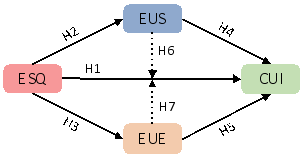
H1: ESQ has a significant positive effect on CUI.
2.2. The Direct Effect of ESQ on EUS
In the contemporary e-commerce environment, the relationship between ESQ and EUS is of substantial theoretical and practical relevance.
Academic literature widely recognizes ESQ as a foundational antecedent of EUS, as the quality of digital interaction directly determines the extent to which actual service performance aligns with user expectations
| [2] | Xiang, W. R., Lee, Y, K, & Wang, W. L. (2024). Does online travel & retail distribution agency’s e-service quality improve customer satisfaction, trust, and loyalty? Journal of Distribution Science, 22(10), 91-102.
https://doi.org/10.15722/jds.22.10.202410.91 |
| [4] | Blut, M. (2016). E-service quality: Development of a hierarchical model. Journal of Retailing, 92(4), 500-517.
https://doi.org/10.1016/j.jretai.2016.09.002 |
[2, 4]
.
As a multidimensional construct encompassing functionality, security, fulfillment, and timeliness, ESQ shapes the overall cognitive and affective evaluation of the platform.
Theoretical frameworks such as the ECT suggest that service quality factors, including delivery efficiency and information usability, significantly enhance user attitudes toward e-commerce platforms, thereby fostering higher levels of satisfaction
| [5] | Grandón, E. E., & Ramírez-Correa, P. (2018). Managers/owners’ innovativeness and electronic commerce acceptance in Chilean SMEs: A multi-group analysis based on a structural equation model. Journal of Theoretical and Applied Electronic Commerce Research, 13(3), 1-16.
https://doi.org/10.4067/S0718-18762018000300102 |
[5]
. Empirical evidence across various digital domains further substantiates this link, suggesting that dimensions such as interface usability and responsive support are critical predictors of user satisfaction
| [6] | Ngo, T. T. A., An, G. K., Dao, D. K., Nguyen, N. Q. N., Nguyen, N. Y. V., & Phong, B. H. (2025). Roles of logistics service quality in shaping generation Z customers’ repurchase intention and electronic word of mouth in e-commerce industry. PLOS One, 20(5), e0323962.
https://doi.org/10.1371/journal.pone.0323962 |
| [7] | Tran, V. D., & Vu, Q. H. (2019). Inspecting the relationship among e-service quality, e-trust, e-customer satisfaction and behavioral intentions of online shopping customers. Global Business and Finance Review, 24(3), 29-42.
https://doi.org/10.17549/gbfr.2019.24.3.29 |
[6, 7]
. When users perceive that a B2C e-commerce platform provides reliable problem-solving and robust privacy protection, their psychological fulfillment increases, reinforcing their overall positive evaluation of the service experience.
Notably, the impact of ESQ on satisfaction extends from general functional attributes, such as order accuracy and delivery speed, to emotional pathways involving personalized support and trust
| [8] | Kosimwidjaja, J. F., & Hadiprawoto, T. (2025). Do loyalty programs actually build customer loyalty? A service quality perspective from Indonesian e-Commerce. The South East Asian Journal of Management, 19(1), 123-147.
https://doi.org/10.7454/seam.v19i1.1784 |
[8]
. Collectively, these theoretical and empirical insights indicate that high-quality service delivery plays a crucial role in generating user satisfaction in competitive digital markets. Building upon this consensus, the current study proposes the following hypothesis:
H2: ESQ has a significant positive effect on EUS.
2.3. The Direct Effect of ESQ on EUE
EUE represents the degree of cognitive, emotional, and behavioral investment that users dedicate during their interactions with a digital platform
| [9] | Brodie, R. J., Hollebeek, L. D., Jurić, B., & Ilić, A. (2011). Customer engagement: Conceptual domain, fundamental propositions, and implications for research. Journal of Service Research, 14(3), 252-271.
https://doi.org/10.1177/1094670511411703 |
| [10] | O'Brien, H. L., & Toms, E. G. (2008). What is user engagement? A conceptual framework for defining user engagement with technology. Journal of The American Society for Information Science and Technology, 59(6), 938-955.
https://doi.org/10.1002/asi.20801 |
[9, 10]
. In the B2C e-commerce landscape, ESQ serves as a fundamental catalyst for fostering such engagement. When a platform excels in core dimensions like system responsiveness, reliability, and technical efficiency, it significantly lowers usage barriers and enhances the perceived value of the interaction
| [2] | Xiang, W. R., Lee, Y, K, & Wang, W. L. (2024). Does online travel & retail distribution agency’s e-service quality improve customer satisfaction, trust, and loyalty? Journal of Distribution Science, 22(10), 91-102.
https://doi.org/10.15722/jds.22.10.202410.91 |
[2]
. This seamless experience encourages users to transcend passive browsing and transition into a more active state of exploration and participation.
Theoretical perspectives on user engagement suggest that superior service quality fulfills both the functional and emotional needs of the user, thereby motivating deeper platform involvement
. For instance, when users perceive that an e-commerce marketplace provides consistent and efficient support, they are more likely to invest sustained attention and develop an emotional connection with the platform interface
| [3] | Kim, J., & Yum, K. (2024). Enhancing continuous usage intention in e-commerce marketplace platforms: The effects of service quality, customer satisfaction, and trust. Applied Sciences, 14(17), 7617.
https://doi.org/10.3390/app14177617 |
[3]
. Conversely, technical instability or poor service delivery can interrupt the user’s flow and discourage engagement.
Empirical studies across various digital service contexts consistently support the role of ESQ as a robust antecedent of EUE. High levels of platform usability and trust, derived from superior service quality, have been shown to facilitate more frequent content interactions and stronger psychological involvement among diverse user segments
| [6] | Ngo, T. T. A., An, G. K., Dao, D. K., Nguyen, N. Q. N., Nguyen, N. Y. V., & Phong, B. H. (2025). Roles of logistics service quality in shaping generation Z customers’ repurchase intention and electronic word of mouth in e-commerce industry. PLOS One, 20(5), e0323962.
https://doi.org/10.1371/journal.pone.0323962 |
| [7] | Tran, V. D., & Vu, Q. H. (2019). Inspecting the relationship among e-service quality, e-trust, e-customer satisfaction and behavioral intentions of online shopping customers. Global Business and Finance Review, 24(3), 29-42.
https://doi.org/10.17549/gbfr.2019.24.3.29 |
[6, 7]
. By providing a reliable and responsive environment, e-commerce platforms can cultivate a state of vigor and dedication in their users, leading to a more profound and enduring engagement. Based on these insights, the current study proposes the following hypothesis:
H3: ESQ has a significant positive effect on EUE.
2.4. The Direct Effect of EUS on CUI
EUS has been widely recognized as a crucial determinant of user behavioral intentions in the digital environment, including loyalty, repurchase intention, and CUI
| [7] | Tran, V. D., & Vu, Q. H. (2019). Inspecting the relationship among e-service quality, e-trust, e-customer satisfaction and behavioral intentions of online shopping customers. Global Business and Finance Review, 24(3), 29-42.
https://doi.org/10.17549/gbfr.2019.24.3.29 |
[7]
. When users are satisfied with their experiences on e-commerce platforms, they are more likely to develop a positive attitude towards the platform and maintain a long-term usage relationship
| [3] | Kim, J., & Yum, K. (2024). Enhancing continuous usage intention in e-commerce marketplace platforms: The effects of service quality, customer satisfaction, and trust. Applied Sciences, 14(17), 7617.
https://doi.org/10.3390/app14177617 |
[3]
. Conversely, dissatisfaction may lead users to reconsider their current choices and seek alternative platforms that better meet their expectations, thereby directly reducing their intention to continue using the incumbent service
| [6] | Ngo, T. T. A., An, G. K., Dao, D. K., Nguyen, N. Q. N., Nguyen, N. Y. V., & Phong, B. H. (2025). Roles of logistics service quality in shaping generation Z customers’ repurchase intention and electronic word of mouth in e-commerce industry. PLOS One, 20(5), e0323962.
https://doi.org/10.1371/journal.pone.0323962 |
[6]
.
Previous research has confirmed a significant positive relationship between user satisfaction and CUI in various online service contexts. In the specific context of e-commerce marketplaces, Kim & Yum
| [3] | Kim, J., & Yum, K. (2024). Enhancing continuous usage intention in e-commerce marketplace platforms: The effects of service quality, customer satisfaction, and trust. Applied Sciences, 14(17), 7617.
https://doi.org/10.3390/app14177617 |
[3]
provided direct empirical evidence with a sample of 311 users, confirming that EUS is a robust predictor of CUI with a statistically significant path coefficient. Similar findings have been reported in cross-cultural e-commerce environments. For instance, satisfaction was found to significantly mediate the path toward behavioral intentions among Vietnamese online shoppers
| [7] | Tran, V. D., & Vu, Q. H. (2019). Inspecting the relationship among e-service quality, e-trust, e-customer satisfaction and behavioral intentions of online shopping customers. Global Business and Finance Review, 24(3), 29-42.
https://doi.org/10.17549/gbfr.2019.24.3.29 |
[7]
. Furthermore, it was verified that satisfaction positively drives repurchase intention (a core component of CUI) among Generation Z consumers in Vietnam
| [6] | Ngo, T. T. A., An, G. K., Dao, D. K., Nguyen, N. Q. N., Nguyen, N. Y. V., & Phong, B. H. (2025). Roles of logistics service quality in shaping generation Z customers’ repurchase intention and electronic word of mouth in e-commerce industry. PLOS One, 20(5), e0323962.
https://doi.org/10.1371/journal.pone.0323962 |
[6]
. Collectively, these studies consistently indicate that satisfaction is a key antecedent of continued usage behavior in digital marketplaces. Therefore, based on the existing literature, this study proposes the following hypothesis regarding the relationship between EUS and CUI in the e-commerce marketplace platform:
H4: EUS has a significant positive effect on CUI.
2.5. The Direct Effect of EUE on CUI
EUE is a critical determinant in shaping users’ behavioral intentions and fostering long-term relationships with digital platforms. It encapsulates the degree of psychological involvement, emotional connection, and active participation during online interactions
| [10] | O'Brien, H. L., & Toms, E. G. (2008). What is user engagement? A conceptual framework for defining user engagement with technology. Journal of The American Society for Information Science and Technology, 59(6), 938-955.
https://doi.org/10.1002/asi.20801 |
[10]
. In the competitive e-commerce landscape, higher engagement levels typically strengthen a user’s affective attachment to a platform. When users are deeply engaged, they show sustained attention and active participation, and develop a sense of familiarity and routine. This increases the psychological cost of switching to alternative platforms
.
Theoretical insights suggest that engagement serves as a precursor to behavioral persistence. As users invest more cognitive and emotional resources into a platform, they move beyond transactional interactions to a state of immersion, which significantly enhances their likelihood of sustained use over time
| [3] | Kim, J., & Yum, K. (2024). Enhancing continuous usage intention in e-commerce marketplace platforms: The effects of service quality, customer satisfaction, and trust. Applied Sciences, 14(17), 7617.
https://doi.org/10.3390/app14177617 |
[3]
. Conversely, low engagement levels often indicate a lack of interest, weakening the user's motivation to maintain ongoing interactions and ultimately leading to platform abandonment
| [6] | Ngo, T. T. A., An, G. K., Dao, D. K., Nguyen, N. Q. N., Nguyen, N. Y. V., & Phong, B. H. (2025). Roles of logistics service quality in shaping generation Z customers’ repurchase intention and electronic word of mouth in e-commerce industry. PLOS One, 20(5), e0323962.
https://doi.org/10.1371/journal.pone.0323962 |
[6]
.
Empirical research across diverse online settings, including digital services and e-commerce marketplaces, consistently indicates that engaged users exhibit a stronger propensity to persist in using relevant platforms. This relationship is particularly evident in environments where user participation and emotional connection reinforce a user’s commitment to the service provider
| [7] | Tran, V. D., & Vu, Q. H. (2019). Inspecting the relationship among e-service quality, e-trust, e-customer satisfaction and behavioral intentions of online shopping customers. Global Business and Finance Review, 24(3), 29-42.
https://doi.org/10.17549/gbfr.2019.24.3.29 |
[7]
. By cultivating a multidimensional engagement state involving both cognitive absorption and emotional identification, e-commerce platforms can effectively retain users and encourage long-term behavioral habits. Accordingly, this study proposes the following hypothesis:
H5: EUE has a significant positive effect on CUI.
2.6. The Mediating Effect of EUS
In digital contexts, EUS is critical to revealing how users convert service performance evaluations into future behavioral intentions. Consumer behavior theories indicate perceived service quality often influences continuance intention indirectly through an evaluative mediation process, where users form affective judgments based on cumulative service interactions that guide their continuance decisions.
High-quality e-commerce platform services confirm user expectations and boost psychological fulfillment; elevated EUS strengthens users’ emotional connection with the platform and reduces the cognitive cost of switching to alternatives, while poor service experiences weaken users’ continuance motivation by undermining this evaluative basis.
Prior research in online service fields verifies EUS as a key intervening variable linking initial service perceptions to long-term loyalty. In B2C e-commerce, ESQ acts as the external functional stimulus, and EUS serves as the internal psychological response driving continuance behavior. Accordingly, this study proposes:
H6: EUS positively mediates the relationship between ESQ and CUI.
Table 1. Sample characteristics.
Control variables | Category | Frequency | Percentage |
Gender | Male | 158 | 53.20% |
| Female | 139 | 46.80% |
Age Group | Under 20 | 21 | 7.07% |
| 20-29 | 85 | 28.62% |
| 30-39 | 93 | 31.31% |
| 40-49 | 45 | 15.15% |
| 50 and above | 53 | 17.85% |
Education | High school | 15 | 5.05% |
| College degree | 126 | 42.42% |
| Bachelor’s degree | 140 | 47.14% |
| Master’s degree and above | 16 | 5.39% |
Occupation | Student | 21 | 7.07% |
| Government staff | 20 | 6.73% |
| Enterprise employee | 114 | 38.38% |
| Individual business owner | 69 | 23.23% |
| Freelancer | 41 | 13.80% |
| Retired | 32 | 10.77% |
Online Shopping Frequency | Almost every day | 30 | 10.10% |
| 3-6 times a week | 42 | 14.14% |
| 1-2 times a week | 48 | 16.16% |
| 1-3 times a month | 96 | 32.32% |
| 1-2 times a quarter | 60 | 20.20% |
| Once every six months or more | 21 | 7.07% |
2.7. The Mediating Effect of EUE
In digital contexts, EUE is a crucial psychological pathway linking perceived service quality to long-term behavioral intentions, reflecting the intensity of users’ cognitive, emotional and behavioral investment in digital service interactions
| [10] | O'Brien, H. L., & Toms, E. G. (2008). What is user engagement? A conceptual framework for defining user engagement with technology. Journal of The American Society for Information Science and Technology, 59(6), 938-955.
https://doi.org/10.1002/asi.20801 |
[10]
. User immersion logic holds that service quality provides environmental cues for deeper user involvement beyond mere transaction facilitation.
High ESQ (e.g., seamless navigation, responsive support) drives users from passive usage to active participation, generating a platform "lock-in" effect that integrates the service into their digital routine and strengthens continuance intention. By contrast, poor service experiences reduce user involvement and weaken their psychological attachment to the platform.
Prior information systems research confirms engagement constructs as essential for converting external service stimuli into behavioral persistence
| [2] | Xiang, W. R., Lee, Y, K, & Wang, W. L. (2024). Does online travel & retail distribution agency’s e-service quality improve customer satisfaction, trust, and loyalty? Journal of Distribution Science, 22(10), 91-102.
https://doi.org/10.15722/jds.22.10.202410.91 |
| [3] | Kim, J., & Yum, K. (2024). Enhancing continuous usage intention in e-commerce marketplace platforms: The effects of service quality, customer satisfaction, and trust. Applied Sciences, 14(17), 7617.
https://doi.org/10.3390/app14177617 |
[2, 3]
. Thus, in e-commerce contexts, EUE acts as an intervening variable reflecting the motivational transition from quality perception to sustained behavior. Accordingly, the following hypothesis is proposed:
H7: EUE positively mediates the relationship between ESQ and CUI.
Figure 1 shows the conceptual model and the hypotheses.
3. Methodology
This section presents the research methodology adopted in this study. It explains the research design, measurement instruments, data collection procedure, and statistical techniques applied for empirical analysis. Partial Least Squares Structural Equation Modeling (PLS-SEM) was employed to examine the relationships among the constructs.
Figure 1. Conceptual model.
3.1. Methodology Design
This research employed PLS-SEM as its primary analytical technique. The objective was to thoroughly investigate the underlying relationships among latent variables using a dataset consisting of 297 responses. PLS-SEM offers considerable benefits over conventional covariance-based SEM, particularly when analyzing intricate theoretical models that involve multiple mediating pathways
| [12] | Nitzl, C., Roldan, J. L., & Cepeda, G. (2016). Mediation analysis in partial least squares path modeling: Helping researchers discuss more sophisticated models. Industrial Management & Data Systems, 116(9), 1849-1864.
https://doi.org/10.1108/IMDS-07-2015-0302 |
[12]
. Furthermore, this method does not impose the strict requirement of normally distributed data, making it exceptionally well-suited for the predictive objectives of this study concerning user behavior in B2C e-commerce.
For the data analysis, the SmartPLS 4.0 software was utilized throughout the study. The analytical procedure encompassed two main phases. Initially, the measurement model was assessed by computing Cronbach's alpha, composite reliability (CR), and average variance extracted (AVE) to confirm the scale's reliability and validity. Subsequently, the structural model was tested. This involved applying a Bootstrapping algorithm with 5,000 resamples to derive T-statistics and significance levels (p-values) for each hypothesized path based on the sample of 297 respondents. The software's statistical capabilities were also used to describe the sample's demographic distribution, ensuring uniformity and methodological rigor across the entire research process.
3.2. Construct Measurement and Control Variables
The measurement instruments employed in this study were adapted from previously validated scales to ensure content validity and contextual relevance within the B2C e-commerce environment. Minor wording modifications were introduced to align the original measurement items with online shopping scenarios while preserving their conceptual meanings.
ESQ was measured using items adapted from
| [2] | Xiang, W. R., Lee, Y, K, & Wang, W. L. (2024). Does online travel & retail distribution agency’s e-service quality improve customer satisfaction, trust, and loyalty? Journal of Distribution Science, 22(10), 91-102.
https://doi.org/10.15722/jds.22.10.202410.91 |
| [3] | Kim, J., & Yum, K. (2024). Enhancing continuous usage intention in e-commerce marketplace platforms: The effects of service quality, customer satisfaction, and trust. Applied Sciences, 14(17), 7617.
https://doi.org/10.3390/app14177617 |
| [7] | Tran, V. D., & Vu, Q. H. (2019). Inspecting the relationship among e-service quality, e-trust, e-customer satisfaction and behavioral intentions of online shopping customers. Global Business and Finance Review, 24(3), 29-42.
https://doi.org/10.17549/gbfr.2019.24.3.29 |
[2, 3, 7]
, focusing on electronic service performance and online platform quality. These scales were originally developed by Kim & Yum
| [3] | Kim, J., & Yum, K. (2024). Enhancing continuous usage intention in e-commerce marketplace platforms: The effects of service quality, customer satisfaction, and trust. Applied Sciences, 14(17), 7617.
https://doi.org/10.3390/app14177617 |
[3]
, Xiang et al
| [2] | Xiang, W. R., Lee, Y, K, & Wang, W. L. (2024). Does online travel & retail distribution agency’s e-service quality improve customer satisfaction, trust, and loyalty? Journal of Distribution Science, 22(10), 91-102.
https://doi.org/10.15722/jds.22.10.202410.91 |
[2]
, and Tran & Vu
| [7] | Tran, V. D., & Vu, Q. H. (2019). Inspecting the relationship among e-service quality, e-trust, e-customer satisfaction and behavioral intentions of online shopping customers. Global Business and Finance Review, 24(3), 29-42.
https://doi.org/10.17549/gbfr.2019.24.3.29 |
[7]
. The selected items capture key service dimensions including responsiveness, problem resolution, after-sales support, and privacy protection.
EUE was assessed using items adapted from established research on user engagement in digital platforms. The items reflect users’ focused attention, aesthetic appeal, and perceived interactivity during platform usage.
EUS was measured using items derived from established satisfaction scales in digital commerce research, primarily adapted from
| [2] | Xiang, W. R., Lee, Y, K, & Wang, W. L. (2024). Does online travel & retail distribution agency’s e-service quality improve customer satisfaction, trust, and loyalty? Journal of Distribution Science, 22(10), 91-102.
https://doi.org/10.15722/jds.22.10.202410.91 |
| [3] | Kim, J., & Yum, K. (2024). Enhancing continuous usage intention in e-commerce marketplace platforms: The effects of service quality, customer satisfaction, and trust. Applied Sciences, 14(17), 7617.
https://doi.org/10.3390/app14177617 |
| [7] | Tran, V. D., & Vu, Q. H. (2019). Inspecting the relationship among e-service quality, e-trust, e-customer satisfaction and behavioral intentions of online shopping customers. Global Business and Finance Review, 24(3), 29-42.
https://doi.org/10.17549/gbfr.2019.24.3.29 |
| [13] | Teo, S. C., Cheng, K. M., & Chow, M. M. (2025). Unlocking repurchase intentions in e-commerce platforms: the impact of e-service quality and gender. Cogent Business & Management, 12(1), 2471535.
https://doi.org/10.1080/23311975.2025.2471535 |
[2, 3, 7, 13]
. These items evaluate users’ overall evaluation of platform performance and fulfillment of shopping expectations.
CUI was operationalized using items adapted from
| [3] | Kim, J., & Yum, K. (2024). Enhancing continuous usage intention in e-commerce marketplace platforms: The effects of service quality, customer satisfaction, and trust. Applied Sciences, 14(17), 7617.
https://doi.org/10.3390/app14177617 |
| [13] | Teo, S. C., Cheng, K. M., & Chow, M. M. (2025). Unlocking repurchase intentions in e-commerce platforms: the impact of e-service quality and gender. Cogent Business & Management, 12(1), 2471535.
https://doi.org/10.1080/23311975.2025.2471535 |
[3, 13]
. Specifically, these scales were developed by Kim & Yum
| [3] | Kim, J., & Yum, K. (2024). Enhancing continuous usage intention in e-commerce marketplace platforms: The effects of service quality, customer satisfaction, and trust. Applied Sciences, 14(17), 7617.
https://doi.org/10.3390/app14177617 |
[3]
and Teo et al.
| [13] | Teo, S. C., Cheng, K. M., & Chow, M. M. (2025). Unlocking repurchase intentions in e-commerce platforms: the impact of e-service quality and gender. Cogent Business & Management, 12(1), 2471535.
https://doi.org/10.1080/23311975.2025.2471535 |
[13]
to capture users’ willingness to continue using and increase purchasing activities through the platform.
Following standard research practice, we included gender, age, education, and online shopping experience as control variables to account for individual differences affecting behavioral intentions. All constructs were measured on a seven-point Likert scale (from 1 = strongly disagree to 7 = strongly agree). This scale captures more nuanced responses and provides greater data variability, thereby improving the sensitivity and robustness of the analysis.
3.3. Data Collection Procedure
This study employed an online questionnaire distributed via “Questionnaire Star” (www.wjx.com), a survey platform widely used for academic research in China. To ensure that participants could provide relevant feedback, the study only included individuals with prior experience using B2C e-commerce platform. After data collection, the dataset underwent a rigorous screening process to maintain high data quality. Responses with missing data, repetitive patterns, or clear inconsistencies were excluded. The remaining valid responses were used in the subsequent empirical analysis.
The final sample size was sufficient for analysis using PLS-SEM. Established methodological guidelines recommend that the number of observations should be at least ten times the largest number of structural paths pointing to any latent variable. The collected sample meets this criterion, thereby ensuring adequate statistical power for model estimation and hypothesis testing.
Prior to launching the main survey, a pilot test was conducted with a small group of e-commerce users to evaluate the clarity and accuracy of the questionnaire items. Based on the feedback received, minor wording adjustments were made to improve comprehension and measurement reliability. The survey was administered anonymously, and all participants were informed of the academic purpose of the study before their participation.
Table 1 summarizes the demographic characteristics of the sample population.
3.4. Common Method Variance
Since all constructs in this study were measured using self-reported data collected through a single questionnaire, the potential issue of common method variance (CMV) was carefully assessed through both procedural and statistical remedies.
At the procedural stage, several measures were implemented to minimize potential bias. Respondents were informed that participation was voluntary and anonymous, thereby reducing evaluation apprehension and socially desirable responding. In addition, measurement items were adapted from established studies and arranged in a mixed order to lessen respondents’ tendency toward consistent answering patterns.
From a statistical perspective, the full collinearity assessment proposed by Kock
was conducted using SmartPLS. Variance inflation factor (VIF) values were calculated for all latent constructs. The results indicated that all VIF values were below the recommended threshold of 3.3, suggesting that common method variance does not pose a serious threat to the validity of the research model.
Therefore, common method bias is unlikely to substantially influence the empirical findings of this study.
4. Results and Discussions
4.1. Evaluating the Measurement Model
The measurement model was tested for internal consistency reliability, convergent validity and discriminant validity (results in
Table 2, and
Table 3) to verify the research instrument’s reliability and validity.
Cronbach’s alpha and CR were used to assess internal consistency reliability. As shown in
Table 2, all Cronbach’s alpha coefficients ranged from 0.705 (CUI) to 0.834 (EUS), all exceeding the 0.70 threshold
| [15] | Hair, J. F., Risher, J. J., Sarstedt, M., & Ringle, C. M. (2019). When to use and how to report the results of PLS-SEM. European Business Review, 31(1), 2-24.
https://doi.org/10.1108/EBR-11-2018-0203 |
[15]
; CR values were 0.835 (CUI) to 0.883 (EUS), falling within the ideal 0.70 - 0.95 range, indicating strong internal consistency and high indicator reliability for all constructs.
Factor loadings (FL) and average variance extracted (AVE) were adopted to evaluate convergent validity per Hair et al. (2019) criteria (FL ≥ 0.708, AVE ≥ 0.50).
Table 2 shows all item FLs ranged from 0.761 (EUS3) to 0.815 (CUI1), above the 0.708 minimum; AVE values of all constructs were 0.602 (EUS) to 0.629 (CUI), exceeding the 0.50 benchmark. This confirms satisfactory convergent validity, as the corresponding latent constructs explain over half the variance of observed indicators.
To assess discriminant validity, which reflects the degree to which a construct is empirically differentiated from other constructs within the model, the Fornell-Larcker criterion was applied
| [16] | Fornell, C., & Larcker, D. F. (1981). Evaluating structural equation models with unobservable variables and measurement error. Journal of Marketing Research, 18(1), 39-50.
https://doi.org/10.1177/002224378101800104 |
[16]
. This approach requires that the square root of the AVE for each latent variable be greater than its absolute correlations with all remaining constructs. As shown in
Table 3, the diagonal elements (in bold) represent the square roots of the AVEs, varying between 0.776 (EUS) and 0.793 (CUI). These values are consistently higher than the correlations observed between constructs, which range from 0.732 to 0.774. The results therefore provide evidence of discriminant validity, indicating that the constructs are distinct both conceptually and empirically.
In summary, the measurement model meets the requirements of reliability and validity, providing a solid foundation for the subsequent assessment of the structural model and hypothesis testing
4.2. Hypotheses Testing by PLS-SEM
After verifying the measurement model’s reliability and validity, the structural model was evaluated to test the hypothesized relationships, including assessments of model fit, predictive accuracy (), effect size (), collinearity, and hypothesis testing.
The Standardized Root Mean Square Residual (SRMR) was used to measure overall model fit. The SRMR values for the saturated and estimated models were 0.062 and 0.074, respectively, both below the 0.08 threshold, indicating the structural model fits the observed data satisfactorily
| [17] | Henseler, J., Ringle, C. M., & Sarstedt, M. (2016). Testing measurement invariance of composites using partial least squares. International Marketing Review, 33(3), 405-431.
https://doi.org/10.1108/IMR-09-2014-0304 |
[17]
.
The coefficient of determination (
) was adopted to assess explanatory capacity (
Table 4). The
values for EUE, EUS and CUI were 0.590, 0.599 and 0.666, respectively, all exceeding the 0.50 benchmark for substantial explanatory strength
| [15] | Hair, J. F., Risher, J. J., Sarstedt, M., & Ringle, C. M. (2019). When to use and how to report the results of PLS-SEM. European Business Review, 31(1), 2-24.
https://doi.org/10.1108/EBR-11-2018-0203 |
[15]
. ESQ explained 59.0% of the variance in EUE and 59.9% in EUS, while ESQ, EUS and EUE together accounted for 66.6% of the variance in CUI, demonstrating the model’s strong explanatory power for endogenous variables.
were used to evaluate the practical significance of path coefficients (
Table 4). The
value of ESQ on EUE (1.442) and ESQ on EUS (1.494) both exceeded 0.35, indicating a large effect
| [15] | Hair, J. F., Risher, J. J., Sarstedt, M., & Ringle, C. M. (2019). When to use and how to report the results of PLS-SEM. European Business Review, 31(1), 2-24.
https://doi.org/10.1108/EBR-11-2018-0203 |
[15]
. By contrast, the
values of ESQ on CUI (0.075) and EUE on CUI (0.056) fell within the 0.02–0.15 range (small effect), and EUS on CUI (0.141) was slightly below the 0.15 cutoff for moderate effect (near-moderate). Overall, ESQ exerts a strong practical impact on EUE and EUS, while the effects of ESQ, EUE and EUS on CUI are relatively minor (small to near-moderate). Fourth, multicollinearity among latent constructs was examined using the VIF. As indicated by the results, all inner model VIF values ranged from 1.000 to 3.084. These figures are well below the conservative threshold of 3.30, confirming that multicollinearity is not a concern
| [14] | Kock, N. (2015). Common method bias in PLS-SEM: A full collinearity assessment approach. International Journal of e-Collaboration, 11(4), 1-10.
https://doi.org/10.4018/ijec.2015100101 |
| [15] | Hair, J. F., Risher, J. J., Sarstedt, M., & Ringle, C. M. (2019). When to use and how to report the results of PLS-SEM. European Business Review, 31(1), 2-24.
https://doi.org/10.1108/EBR-11-2018-0203 |
[14, 15]
. Furthermore, the absence of high collinearity (all VIFs < 3.3) also serves as a robust indicator that CMV does not threaten the study's internal validity.
Finally, the study employed a bootstrapping technique with 5,000 resamples to test the proposed hypotheses. This procedure generated robust t-statistics, corresponding p-values, and bias-corrected 95% confidence intervals (CIs). Consistent with the recommendations of Hair et al., a hypothesis was deemed supported if the 95% CI for its path coefficient did not include zero and the absolute t-value was greater than 1.960 (p < 0.05) or 2.576 (p < 0.01). The outcomes of the hypothesis tests, detailed in
Table 5, show that all hypotheses concerning direct effects received support.
Table 2. Measurement of construct.
Construct | Item | FL | CR | AVE | α |
ESQ | ESQ1 | 0.784 | 0.868 | 0.622 | 0.798 |
ESQ2 | 0.789 | | | |
ESQ3 | 0.796 | | | |
ESQ4 | 0.786 | | | |
EUE | EUE1 | 0.786 | 0.868 | 0.621 | 0.797 |
EUE2 | 0.776 | | | |
EUE3 | 0.800 | | | |
EUE4 | 0.790 | | | |
EUS | EUS1 | 0.804 | 0.883 | 0.602 | 0.834 |
EUS2 | 0.763 | | | |
EUS3 | 0.761 | | | |
EUS4 | 0.784 | | | |
EUS5 | 0.766 | | | |
CUI | CUI1 | 0.815 | 0.835 | 0.629 | 0.705 |
CUI2 | 0.792 | | | |
CUI3 | 0.771 | | | |
Table 3. Result of discriminant validity measures.
| CUI | ESQ | EUE | EUS |
CUI | 0.793 | | | |
ESQ | 0.748 | 0.789 | | |
EUE | 0.732 | 0.768 | 0.788 | |
EUS | 0.768 | 0.774 | 0.760 | 0.776 |
4.3. Mediation Analysis
To further examine the mediating effects in the proposed model, a bootstrapping procedure with 5,000 resamples was conducted using SmartPLS. The results were used to assess the indirect effects of ESQ on CUI through EUS and EUE.
The results indicated that the indirect effect of ESQ on CUI through EUS is significant (β = 0.290, t = 6.017, p < 0.05), supporting the mediating role of EUS. Similarly, the indirect effect of ESQ on CUI through EUE is also significant (β = 0.179, t = 2.988, p < 0.05), confirming the mediating role of EUE.
The mediation effect of EUS indicates that ESQ influences CUI indirectly through users’ post-consumption evaluations. High-quality services enhance users’ satisfaction, which in turn increases their likelihood of continued usage.
Meanwhile, the mediating role of EUE suggests that service quality also promotes continuance intention by enhancing users’ involvement and interaction with the platform. Increased engagement strengthens users’ attachment, thereby encouraging sustained usage behavior.
Overall, these findings demonstrate that ESQ affects CUI not only directly but also through multiple psychological mechanisms, providing a more comprehensive explanation of user behavior in e-commerce contexts.
5. Implications, Limitations and Future Work
5.1. Theoretical Implications
The confirmation of H1 - H3 underscores ESQ’s pivotal role in promoting CUI and enhancing EUS and EUE, consistent with ECT. ESQ influences CUI through two pathways: directly reducing cognitive load and perceived risk, and indirectly via EUS and EUE, which are key to long-term user commitment. The validation of H4 and H5 shows that EUS and EUE have positive effects on CUI. This result is consistent with the findings of Kim & Yum
| [3] | Kim, J., & Yum, K. (2024). Enhancing continuous usage intention in e-commerce marketplace platforms: The effects of service quality, customer satisfaction, and trust. Applied Sciences, 14(17), 7617.
https://doi.org/10.3390/app14177617 |
[3]
. It highlights the synergistic mechanism of ESQ, EUS, and EUE for user retention in competitive e-commerce.
The mediating roles of EUS and EUE in H6 - H7 align with ECT’s focus on psychological validation. The total indirect effect of ESQ on CUI (0.469) exceeds the direct effect (0.278), emphasizing EUS and EUE as core transmission channels. This enriches ECT by revealing that service quality primarily shapes continuance intention through users’ emotional evaluations (satisfaction) and motivational engagement.
Table 4. Model fit, explanatory power and effect size.
Assessment type | Indicator | Value | Criterion | Criterion |
SRMR | Saturated model | 0.062 | < 0.08 | Excellent |
| Estimated model | 0.074 | < 0.08 | Good |
| EUE | 0.590 | > 0.50 = High explanatory power | High |
| EUS | 0.599 | > 0.50 = High explanatory power | High |
| CUI | 0.666 | > 0.50 = High explanatory power | Excellent |
| ESQ → EUE | 1.442 | > 0.35 = Large effect | Large |
| ESQ → EUS | 1.494 | > 0.35 = Large effect | Large |
| ESQ → CUI | 0.075 | 0.02 – 0.15 = Small effect | Small |
| EUE → CUI | 0.056 | 0.02 – 0.15 = Small effect | Small |
| EUS → CUI | 0.141 | Close to 0.15 = Near-moderate effect | Near-moderate |
The mediating roles of EUS and EUE proposed in H6 and H7 further enrich the application of ECT
| [18] | Podsakoff, P. M., MacKenzie, S. B., Lee, J. Y., & Podsakoff, N. P. (2003). Common method biases in behavioral research: a critical review of the literature and recommended remedies. Journal of Applied Psychology, 88(5), 879.
https://doi.org/10.1037/0021-9010.88.5.879 |
| [19] | Preacher, K. J., & Hayes, A. F. (2008). Asymptotic and resampling strategies for assessing and comparing indirect effects in multiple mediator models. Behavior Research Methods, 40(3), 879-891. https://doi.org/10.3758/BRM.40.3.879 |
[18, 19]
. The total indirect effect of ESQ on CUI (0.469) is stronger than the direct effect (0.278), indicating that EUS and EUE serve as key psychological channels. In other words, ESQ mainly promotes CUI by improving users’ emotional evaluation (satisfaction) and motivational state (engagement).
Consistent with theoretical predictions, EUS (β = 0.290) and EUE (β = 0.179) act as parallel mediators, with EUS exerting a stronger effect: satisfaction reflects immediate expectation confirmation, while engagement requires deeper cognitive-emotional investment. This underscores the need for e-commerce platforms to adopt a dual-focused strategy based on the ECT framework.
Notably, the model explains 66.6% of CUI variance (
= 0.666), validating its conceptual soundness and advancing prior single-mediator studies
| [2] | Xiang, W. R., Lee, Y, K, & Wang, W. L. (2024). Does online travel & retail distribution agency’s e-service quality improve customer satisfaction, trust, and loyalty? Journal of Distribution Science, 22(10), 91-102.
https://doi.org/10.15722/jds.22.10.202410.91 |
[2]
. Empirical support for the ESQ-EUS/EUE-CUI pathway among Chinese users reinforces cross-cultural applicability, enhancing ECT’s generalizability across diverse sociocultural contexts.
In summary, the findings advance e-commerce user behavior research by uncovering parallel mediating mechanisms and confirming cross-cultural validity, offering a nuanced understanding of how ESQ fosters long-term user loyalty through the lens of ECT.
5.2. Practical Implications
The empirical results provide actionable insights for B2C e-commerce platform, operational teams, and regulators to enhance user loyalty and sustainable development.
In the competitive landscape of B2C e-commerce, operators must place a high priority on ESQ and EUS as well as EUE to ensure customer retention. Kim & Yum
| [3] | Kim, J., & Yum, K. (2024). Enhancing continuous usage intention in e-commerce marketplace platforms: The effects of service quality, customer satisfaction, and trust. Applied Sciences, 14(17), 7617.
https://doi.org/10.3390/app14177617 |
[3]
indicate that ESQ influences CUI through two pathways: a direct effect by lowering perceived risk, and an indirect effect mediated by EUS and EUE. Notably, the total indirect impact (0.469) is greater than the direct effect (0.278), underscoring ESQ's fundamental role in maintaining a user base. To achieve this, companies should concentrate their investments on essential assets such as enhancing digital infrastructure (for instance, improving system speed), reinforcing data privacy measures, and streamlining after-sales support. Implementing solutions like AI-driven customer support and advanced security systems can directly enhance EUS and EUE, thereby justifying strategic resource investment aimed at fostering long-term loyalty.
For operational teams and frontline staff, EUS (mediating effect = 0.290) and EUE (0.179) require targeted alignment. Teams need training in user-centric communication (proactive problem-solving, empathetic feedback) to elevate satisfaction. Additionally, design concise engagement initiatives (personalized recommendations, interactive feedback channels) to deepen users’ cognitive and emotional involvement, supporting sustained retention.
For regulators, establishing standardized ESQ evaluation frameworks (covering responsiveness, privacy, after-sales) can guide platform service standardization. Initiatives like funding user-centric service tech research and incentivizing high ESQ ratings (e.g., policy preferences) will drive industry progress. Promoting industry-academia collaboration to share best practices ensures e-commerce growth aligns with consumer rights protection and market order.
5.3. Limitations and Future Work
This study enhances the understanding of how ESQ contributes to CUI through the parallel mediation of EUS and EUE, based on ECT, and provides theoretical and empirical insights to refine e-commerce service practices for improved user retention. However, it should be noted that the results may differ due to regional cultural differences, data collection characteristics, and methodological choices. This study also has limitations, such as relying solely on cross-sectional data from Chinese B2C e-commerce users, which may restrict the generalizability of the findings.
Table 5. Hypotheses testing and mediation analysis.
Path | β | SD | t-value | p-value | LLCI | ULCI | Results |
Direct effects |
H1: ESQ→CUI | 0.278 | 0.069 | 4.006 | 0.000*** | 0.145 | 0.419 | Accept |
H2: ESQ→EUS | 0.774 | 0.023 | 33.084 | 0.000*** | 0.726 | 0.818 | Accept |
H3: ESQ→EUE | 0.768 | 0.026 | 29.668 | 0.000*** | 0.716 | 0.817 | Accept |
H4: EUS→CUI | 0.375 | 0.062 | 6.007 | 0.000*** | 0.251 | 0.495 | Accept |
H5: EUE→CUI | 0.233 | 0.076 | 3.046 | 0.002** | 0.082 | 0.385 | Accept |
Indirect effects |
H6: ESQ→EUS→CUI | 0.290 | 0.048 | 6.017 | 0.000*** | 0.195 | 0.386 | Accept |
H7: ESQ→EUE→CUI | 0.179 | 0.060 | 2.988 | 0.003** | 0.062 | 0.299 | Accept |
Total indirect effect |
ESQ→CUI | 0.469 | 0.059 | 7.929 | 0.000*** | 0.355 | 0.585 | Accept |
Future research will investigate the ESQ-CUI mechanism in varied cultural and regional contexts, employ longitudinal datasets to capture long-term dynamic changes in user behavior, and assess the model using mixed methodological approaches (e.g., case studies, quantitative replication) for cross-validation. Furthermore, besides the current parallel mediation framework, future studies could explore potential moderating variables (e.g., user age, platform type, online shopping experience) and investigate potential side effects (e.g., excessive service interactions leading to user fatigue), thereby enhancing the completeness, validity, and generalizability of the findings.
Abbreviations
AVE | Average Variance Extracted |
B2C | Business-to-consumer |
CIs | Confidence Intervals |
CMV | Common Method Variance |
CR | Composite Reliability |
CUI | Continuous Usage Intention |
ECT | Expectation Confirmation Theory |
ESQ | E-Service Quality |
EUE | E-User Engagement |
EUS | E-User Satisfaction |
| Effect Size |
FL | Factor Loadings |
LLCI | Lower Limit of Confidence Interval |
PLS-SEM | Partial Least Squares Structural Equation Modeling |
| Coefficient of Determination |
SRMR | Standardized Root Mean Square Residual |
ULCI | Upper Limit of Confidence Interval |
VIF | Variance Inflation Factor |
| Cronbach’s |
Author Contributions
Haoyang Lv: Writing – original draft, Data curation, Formal analysis, Investigation, Methodology, Validation, Visualization
Xinyang Xiao: Project administration, Visualization, Writing – review & editing
Hanwen Wang: Data curation, Visualization
Data Availability Statement
The data which support the findings of this study can be found at: https://doi.org/10.6084/m9.figshare.31991193
Acknowledgements
Supported by the Undergraduate Training Program on Innovation and Entrepreneurship grant of Zhejiang University of Finance & Economics.
Conflicts of Interest
The authors declare no conflicts of interest.
References
| [1] |
Parasuraman, A., Zeithaml, V. A., & Malhotra, A. (2005). ES-QUAL: A multiple-item scale for assessing electronic service quality. Journal of Service Research, 7(3), 213-233.
https://doi.org/10.1177/1094670504271156
|
| [2] |
Xiang, W. R., Lee, Y, K, & Wang, W. L. (2024). Does online travel & retail distribution agency’s e-service quality improve customer satisfaction, trust, and loyalty? Journal of Distribution Science, 22(10), 91-102.
https://doi.org/10.15722/jds.22.10.202410.91
|
| [3] |
Kim, J., & Yum, K. (2024). Enhancing continuous usage intention in e-commerce marketplace platforms: The effects of service quality, customer satisfaction, and trust. Applied Sciences, 14(17), 7617.
https://doi.org/10.3390/app14177617
|
| [4] |
Blut, M. (2016). E-service quality: Development of a hierarchical model. Journal of Retailing, 92(4), 500-517.
https://doi.org/10.1016/j.jretai.2016.09.002
|
| [5] |
Grandón, E. E., & Ramírez-Correa, P. (2018). Managers/owners’ innovativeness and electronic commerce acceptance in Chilean SMEs: A multi-group analysis based on a structural equation model. Journal of Theoretical and Applied Electronic Commerce Research, 13(3), 1-16.
https://doi.org/10.4067/S0718-18762018000300102
|
| [6] |
Ngo, T. T. A., An, G. K., Dao, D. K., Nguyen, N. Q. N., Nguyen, N. Y. V., & Phong, B. H. (2025). Roles of logistics service quality in shaping generation Z customers’ repurchase intention and electronic word of mouth in e-commerce industry. PLOS One, 20(5), e0323962.
https://doi.org/10.1371/journal.pone.0323962
|
| [7] |
Tran, V. D., & Vu, Q. H. (2019). Inspecting the relationship among e-service quality, e-trust, e-customer satisfaction and behavioral intentions of online shopping customers. Global Business and Finance Review, 24(3), 29-42.
https://doi.org/10.17549/gbfr.2019.24.3.29
|
| [8] |
Kosimwidjaja, J. F., & Hadiprawoto, T. (2025). Do loyalty programs actually build customer loyalty? A service quality perspective from Indonesian e-Commerce. The South East Asian Journal of Management, 19(1), 123-147.
https://doi.org/10.7454/seam.v19i1.1784
|
| [9] |
Brodie, R. J., Hollebeek, L. D., Jurić, B., & Ilić, A. (2011). Customer engagement: Conceptual domain, fundamental propositions, and implications for research. Journal of Service Research, 14(3), 252-271.
https://doi.org/10.1177/1094670511411703
|
| [10] |
O'Brien, H. L., & Toms, E. G. (2008). What is user engagement? A conceptual framework for defining user engagement with technology. Journal of The American Society for Information Science and Technology, 59(6), 938-955.
https://doi.org/10.1002/asi.20801
|
| [11] |
O'Brien, H. L., & McKay, J. (2018). Modeling antecedents of user engagement. The Handbook of Communication Engagement, 73-88.
https://doi.org/10.1002/9781119167600.ch6
|
| [12] |
Nitzl, C., Roldan, J. L., & Cepeda, G. (2016). Mediation analysis in partial least squares path modeling: Helping researchers discuss more sophisticated models. Industrial Management & Data Systems, 116(9), 1849-1864.
https://doi.org/10.1108/IMDS-07-2015-0302
|
| [13] |
Teo, S. C., Cheng, K. M., & Chow, M. M. (2025). Unlocking repurchase intentions in e-commerce platforms: the impact of e-service quality and gender. Cogent Business & Management, 12(1), 2471535.
https://doi.org/10.1080/23311975.2025.2471535
|
| [14] |
Kock, N. (2015). Common method bias in PLS-SEM: A full collinearity assessment approach. International Journal of e-Collaboration, 11(4), 1-10.
https://doi.org/10.4018/ijec.2015100101
|
| [15] |
Hair, J. F., Risher, J. J., Sarstedt, M., & Ringle, C. M. (2019). When to use and how to report the results of PLS-SEM. European Business Review, 31(1), 2-24.
https://doi.org/10.1108/EBR-11-2018-0203
|
| [16] |
Fornell, C., & Larcker, D. F. (1981). Evaluating structural equation models with unobservable variables and measurement error. Journal of Marketing Research, 18(1), 39-50.
https://doi.org/10.1177/002224378101800104
|
| [17] |
Henseler, J., Ringle, C. M., & Sarstedt, M. (2016). Testing measurement invariance of composites using partial least squares. International Marketing Review, 33(3), 405-431.
https://doi.org/10.1108/IMR-09-2014-0304
|
| [18] |
Podsakoff, P. M., MacKenzie, S. B., Lee, J. Y., & Podsakoff, N. P. (2003). Common method biases in behavioral research: a critical review of the literature and recommended remedies. Journal of Applied Psychology, 88(5), 879.
https://doi.org/10.1037/0021-9010.88.5.879
|
| [19] |
Preacher, K. J., & Hayes, A. F. (2008). Asymptotic and resampling strategies for assessing and comparing indirect effects in multiple mediator models. Behavior Research Methods, 40(3), 879-891.
https://doi.org/10.3758/BRM.40.3.879
|
Cite This Article
-
APA Style
Lv, H., Xiao, X., Wang, H. (2026). The Impact of E-Service Quality on Users’ Continuous Usage Intention: The Mediating Roles of E-User Satisfaction and E-User Engagement. American Journal of Management Science and Engineering, 11(2), 62-72. https://doi.org/10.11648/j.ajmse.20261102.12
 Copy
|
Copy
|
 Download
ACS Style
Lv, H.; Xiao, X.; Wang, H. The Impact of E-Service Quality on Users’ Continuous Usage Intention: The Mediating Roles of E-User Satisfaction and E-User Engagement. Am. J. Manag. Sci. Eng. 2026, 11(2), 62-72. doi: 10.11648/j.ajmse.20261102.12
Copy
|
Download
AMA Style
Lv H, Xiao X, Wang H. The Impact of E-Service Quality on Users’ Continuous Usage Intention: The Mediating Roles of E-User Satisfaction and E-User Engagement. Am J Manag Sci Eng. 2026;11(2):62-72. doi: 10.11648/j.ajmse.20261102.12
Copy
|
Download
-
@article{10.11648/j.ajmse.20261102.12,
  author = {Haoyang Lv and Xinyang Xiao and Hanwen Wang},
  title = {The Impact of E-Service Quality on Users’ Continuous Usage Intention: The Mediating Roles of E-User Satisfaction and E-User Engagement},
  journal = {American Journal of Management Science and Engineering},
  volume = {11},
  number = {2},
  pages = {62-72},
  doi = {10.11648/j.ajmse.20261102.12},
  url = {https://doi.org/10.11648/j.ajmse.20261102.12},
  eprint = {https://article.sciencepublishinggroup.com/pdf/10.11648.j.ajmse.20261102.12},
  abstract = {With the rapid development of e-commerce, understanding the factors that influence users’ continuous usage intention has become increasingly important for online platforms. Although prior studies have widely examined service quality and user behavior, the underlying mechanisms through which electronic service quality affects users’ continued usage intention remain insufficiently explored. Therefore, this study investigates the relationships among e-service quality (ESQ), e-user satisfaction (EUS), e-user engagement (EUE), and continuous usage intention (CUI). A quantitative research approach was adopted, and data were collected through an online questionnaire survey. A total of 297 valid responses were obtained from individuals with prior experience using e-commerce platforms. The proposed research model and hypotheses were analyzed using Partial Least Squares Structural Equation Modeling (PLS-SEM) with SmartPLS. The empirical results indicate that ESQ has a significant positive impact on both EUS and EUE. Furthermore, EUS and EUE positively influence CUI. The mediation analysis also reveals that both EUS and EUE play significant mediating roles in the relationship between ESQ and CUI. These findings provide important insights for e-commerce platforms by highlighting the critical role of service quality in enhancing user satisfaction and engagement, which ultimately strengthens users’ intention to continue using online services. The study contributes to the existing literature on digital service management and offers practical implications for improving user retention in the e-commerce environment.},
 year = {2026}
}
Copy
|
Download
-
TY  - JOUR
T1  - The Impact of E-Service Quality on Users’ Continuous Usage Intention: The Mediating Roles of E-User Satisfaction and E-User Engagement
AU  - Haoyang Lv
AU  - Xinyang Xiao
AU  - Hanwen Wang
Y1  - 2026/06/09
PY  - 2026
N1  - https://doi.org/10.11648/j.ajmse.20261102.12
DO  - 10.11648/j.ajmse.20261102.12
T2  - American Journal of Management Science and Engineering
JF  - American Journal of Management Science and Engineering
JO  - American Journal of Management Science and Engineering
SP  - 62
EP  - 72
PB  - Science Publishing Group
SN  - 2575-1379
UR  - https://doi.org/10.11648/j.ajmse.20261102.12
AB  - With the rapid development of e-commerce, understanding the factors that influence users’ continuous usage intention has become increasingly important for online platforms. Although prior studies have widely examined service quality and user behavior, the underlying mechanisms through which electronic service quality affects users’ continued usage intention remain insufficiently explored. Therefore, this study investigates the relationships among e-service quality (ESQ), e-user satisfaction (EUS), e-user engagement (EUE), and continuous usage intention (CUI). A quantitative research approach was adopted, and data were collected through an online questionnaire survey. A total of 297 valid responses were obtained from individuals with prior experience using e-commerce platforms. The proposed research model and hypotheses were analyzed using Partial Least Squares Structural Equation Modeling (PLS-SEM) with SmartPLS. The empirical results indicate that ESQ has a significant positive impact on both EUS and EUE. Furthermore, EUS and EUE positively influence CUI. The mediation analysis also reveals that both EUS and EUE play significant mediating roles in the relationship between ESQ and CUI. These findings provide important insights for e-commerce platforms by highlighting the critical role of service quality in enhancing user satisfaction and engagement, which ultimately strengthens users’ intention to continue using online services. The study contributes to the existing literature on digital service management and offers practical implications for improving user retention in the e-commerce environment.
VL  - 11
IS  - 2
ER  -
Copy
|
Download





 Share This Article
 Twitter
 Linked In
 Facebook