Research Article | | Peer-Reviewed

Newspaper Vendor Problem: Some Insights Concerning the Expected Value of Perfect Information

Received: 4 September 2026     Accepted: 17 September 2026     Published: 14 October 2026
Views:       Downloads:
Abstract

The single-period inventory problem with uncertain demand, also known as the Newspaper Vendor Problem, is a commonly encountered occurrence in industry and significant research literature exists on the subject. The critical ratio or fractile method provides the decision maker with a method for quickly calculating the optimal stock quantity that either maximizes expected profit or minimizes the expected cost. The critical ratio or fractile method is based upon the concept of finding the optimal balance between the opportunity costs of having excess inventory versus having a insufficient supply on hand. Little research publication, however, exists concerning EVPI for the Newspaper Vendor problem. This paper addresses that gap in literature. Market research is often available to more accurately estimate next periods demand but usually it has an attached cost. The Expected Value of Perfect Information (EVPI) represents the most that the decision maker would ever pay for market research. It provides the scale for which all sources of information about future demand can be rated. This paper demonstrates the procedure for finding EVPI for cases where demand is estimated by either a discrete or a continuous probability distribution. Practical examples of both profit maximization and cost minimization are provided in the paper.

Published in American Journal of Management Science and Engineering (Volume 11, Issue 4)
DOI 10.11648/j.ajmse.20261104.12
Page(s) 95-100
Creative Commons

This is an Open Access article, distributed under the terms of the Creative Commons Attribution 4.0 International License (http://creativecommons.org/licenses/by/4.0/), which permits unrestricted use, distribution and reproduction in any medium or format, provided the original work is properly cited.

Copyright

Copyright © The Author(s), 2026. Published by Science Publishing Group

Keywords

Newspaper Vendor Problem, Expected Value of Perfect Information, Expected Value, Expected Opportunity Loss

1. Introduction
The newspaper vendor problem, also known as the newsvendor, newsboy, or single-period inventory problem, determines the optimal order quantity to order or produce of an item when the demand for the item during the period is uncertain. Specifically, the newspaper vendor problem is a single-period inventory problem where the demand for the item during the period is unknown and must be estimated. The decision maker has one chance to order the item on or before the beginning of the period and no chance to reorder the item during the period. If supply exceeds demand, leftover items must be disposed of at the end of the period. If demand exceeds supply, a potential sale is lost, reducing profits, or a more expensive substitute item must be procured, increasing costs.
The newspaper vendor problem has been successfully applied to both profit maximization and cost minimization situations. Profit maximization examples typically involve a retailer that is selling an item that has a high rate of spoilage, deterioration or obsolescence, e.g. bakery goods, periodicals, imported seasonal fashions. Cost minimization examples often involve manufacturers and maintenance companies where the exact usage of a component or a supply item is uncertain due to its a high rate of spoilage/deterioration/obsolescence or that the item is of no further use and will be disposed of at the end of the period, e.g. job shops filling custom orders for unique products and hardware maintenance organizations.
2. Newspaper Vendor Problem Solution
Assumptions:
1) Item is stocked for a single period
2) Demand is uncertain
3) Delivery or production of the item is made at the beginning of the period in advance of demand
4) Overage and underage costs are linear
5) The decision criterion is either to maximize expected profit or to minimize expected cost
Notation:
Q = Quantity
Q* = Quantity that maximizes expected profit or minimizes expected cost
D = Demand for the product during the period
CO = Unit cost of overstock
CU = Unit cost of understock
f(d) = Probability mass or density function of D
F(d) = Cumulative probability distribution of D (Probability of D < d)
F-1(d) = Inverse cumulative probability distribution of D
E(.) = Expected value of (.)
EOL(.) = Expected Opportunity Loss of (.)
An Opportunity Loss occurs when the amount stocked does not equal the demand. It is a missed opportunity to reduce costs or increase profits. Both CU and CO are opportunity losses per unit when supply does not equal demand.
Typically, in cost minimization problems,
CO = Cost of Item – Salvage Value of Item
CU = Cost of Substitute Item – Cost of Item + Shortage Penalty per Unit
If demand exceeds supply, then the decision maker incurs an additional cost of CU for each unit of shortage. If supply exceeds demand, then the decision maker wasted CO for each unit of overage.
Opportunity Loss=COQ* - D,  when D < Q*$0,  when D = Q*CUD - Q*,  when D > Q*
Typically, in profit maximization problems,
CO = Cost of Item – Salvage Value of Item
CU = (Selling Price of Item – Cost of Item) + Shortage Penalty per Unit
If demand exceeds supply, then the decision maker loses an opportunity to make an additional profit of CU for each unit of shortage. If supply exceeds demand, then the decision maker will lose CO for each unit of overage.
The optimal order quantity Q* is the optimal balance between the possible lost profit or increased cost by having overstock versus understock is given by the well-known result:
Q* = the smallest value of D for which F(d) > COCU+CO
Its solution is referred to as the critical-fractile rule:
Q*=F-1(CUCU+CO)[1, 2, 3, 5, 11]
2.1. Expected Value of Perfect Information in Cost Minimization
In a cost minimization setting, the Expected Value of Perfect information (EVPI) is the expected reduction in cost that would result if the decision maker knew what demand would be in advance of stocking or producing the item. Expected Cost with Perfect information (ECPI) is the expected cost when the value of demand (D) is known in advance and the decision maker stocks D units.
EVPI = ECPI - E(Cost of Q*)
Although there are few or no sources of perfect information in most business environments, it remains an important concept. It represents the most that the decision maker would ever pay to eliminate the uncertainty in the business problem. It provides the scale for which market and other sources of imperfect information can be rated.
An infallible predictor of demand (perfect information) would allow the decision maker to minimize costs thus eliminating all opportunity losses. This decrease in total cost is exactly equal to the reduction in opportunity loss that will be generated if the perfect information is obtained. It is a well-known fact that when Q*is stocked, EVPI equals EOL since the perfect information will reduce the EOL from its current value to 0. Therefore,
EVPI = ECPI - E(Cost of Q*) = EOL(Q*)
If probability distribution for estimating demand is discrete, then
EOL(Q*) =∑d=0Q*COQ*-dfd+∑d=Q*+1∞CUd-Q*f(d)
Example: Knotty by Nature is a furniture manufacturer who has just renewed a lease with an equipment rental supplier that provided several lathes that the company currently uses. The term of the lease is for one additional year. The lease is a triple net lease where Knotty by Nature is responsible for all maintenance procedures and repairs of the lathes. At the end of the lease, Knotty by Nature expects to replace the lathes with a newer model. The lathes have a drive belt that sometimes breaks and must be replaced at an average rate of 2 per month for the shop. Breakdowns do not seem to be usage or wear related but rather seem to occur randomly. As a courtesy, the leasing agency stocks and sells replacement belts by the piece to their customers. The regular cost of the belts is $100 each but the equipment supplier has made a one-time offer of a quantity discount of 30% on spare belts purchased as part of the lease renewal. It is estimated that any unused belts at the end of the could be sold on eBay for $55 each. Other vendors also sell these belts for $100 each, but they are only sold by the case which contains 12 belts. Thus, the equipment rental supplier is currently Knotty by Nature’s best source for the belts.
In this example,
CO= Cost of Item – Salvage Value of Item = ($70 - $55) = $15
CU= Cost of Substitute Item – Cost of Item = ($100 – $70) = $30
E(D) = (2per month)(12months) =24 belts
Since belt failures are occurring randomly over time, the Poisson Distribution would provide an appropriate model of belt breakage. The probability mass function for the Poisson Distribution is given by:
f(d) =[(E(D))de-E(D)]/ d!= [(24)de-24]/ d!
The critical fractile is
CUCU - CO=$30$30 + $15=.6667
Looking up the.6667 fractile on the Poisson distribution with E(D) of 24 reveals that
Q*= 26 belts
It was found that
E(Q*) = ($70)(26) +∑d=026-$55Q*-d)[24d ⅇ-24]/ d!
+ ∑d=27∞$30d- Q*[24d ⅇ-24]/ d!
E(Q*) = $1,761.01
If the value of D is known in advance, the decision maker would order D so
ECPI = $70 (E(D)) = $1,680
Therefore,
EVPI = ECPI - E(Cost of Q*)= $1,761.01 – $1,680.00 = $81.01
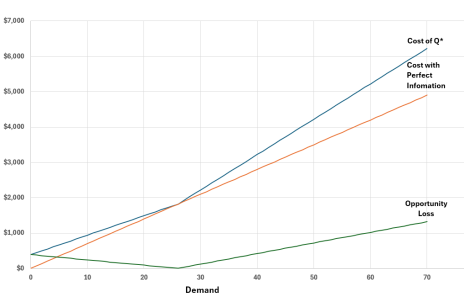
Uncertainty concerning the number of belts needed is costing Knotty by Nature $81.01 in this problem. The opportunity loss function in this example would be
Opportunity Loss=COQ* - D= $1526 - D, when D < 26 $0,  when D = 26CUD - Q*= $30D - 26, when D > 26 
EOL(Q*) =∑d=02615Q*-d[24d ⅇ-24]/ d!+ ∑d=27∞30d- Q*[24d ⅇ-24]/ d!
As expected, EOL of Q* equals the $81.01 found for EVPI.
Figure 1. Knotty by Nature Cost Functions.
Uncertainty concerning actual demand is costing Knotty by Nature $81.01 in this problem.
Although there is likely no way for Knotty by Nature to estimate the exact number of spare belts that will be needed in the next 12 months, EVPI could prove to be exceedingly useful. Consider the following scenario: There is a membership store that sells replacement parts wholesale. At this establishment, the belts are sold by the piece and cost $70 each. The membership fee for one-year costs $60. Should Knotty by Nature join the club and procure the replacement belts there? The wholesale club option is the equivalent of perfect information since the uncertainty of demand is no longer pertinent in determining the optimal course of action. EVPI is worth $81.01 which is greater than the $60 membership cost so that Knotty by Nature expected net cost would be reduced by $21.01 by joining.
2.2. Expected Value of Perfect Information in Profit Maximization
In a profit maximization setting, EVPI is the increase in profit that would result if the decision maker knew what demand would be prior to stocking the item. Expected Payoff with Perfect information (EPPI) is the expected profit when the value of demand (D) is known in advance and the decision maker stocks D units.
EVPI = EPPI – E(Profitof Q*) = EOL(Q*)
If the uncertainty concerning demand happens to be modelled by a continuous random variable, then
EOL(Q*) =∫0Q*COQ*-df(d)dd+∫Q*∞CUd- Q*f(d)dd
If the random variable estimating demand is normally distributed, then
EOL(Q*) =∫0Q*COQ*-d1σ2πⅇ-12d-µσ2dd+∫Q*∞CUd- Q*1σ2πⅇ-12d-µσ2dd
This could be the case if demand is estimated by either regression or statistical estimation for large samples by the Central Limit Theorem. Notice that the first term is the left-hand normal linear loss function and the second is the right-hand normal linear loss function. As such, the Standard Normal Loss Function Table can be used to calculate these 2 values.
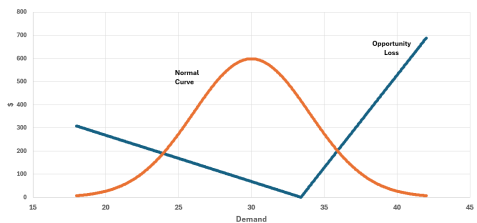
Example: Uni Delight is a sole proprietorship owned by Dave Welch. Uni, sea urchin roe, is a sea food delicacy usually eaten raw, so freshness is of paramount importance. Dave is 3 months into a one-year contract with an Oxnard, California based uni supplier where Uni Delight has exclusive rights to market and sell their Grade A uni in Ventura and Santa Barbara counties. The quality of the uni from the waters around the Channel Islands is second only to that from offshore Japan. Early each morning, Dave picks up a load of Grade A uni for $60 a pound at the supplier and for the rest of the day drives his regular route in the aforementioned counties and sells the fresh uni to high-end sushi restaurants. Dave charges the sushi restaurants $140 a pound. If Dave has any leftover uni, the supplier will buy it back for $40 a pound and it will be downgraded to Grade B and sold. Dave drew a histogram for daily demand over the first 3 months of the contract demand, and it was symmetric, unimodal, and bell shaped with a mean (µ) of 30 pounds and a standard deviation (σ) of 4 pounds.
In this example,
CU= (Selling Price of Item – Cost of Item) + Shortage Penalty per Unit = $140 - $60 = $80
CO= Cost of Item – Salvage Value of Item = $60 - $40 = $20
And
CUCU - CO=$80$80 + $20=.8000
The.8000 fractile for a normal distribution with µ = 30 pounds and σ = 4 pounds is 33.37 pounds, therefore
Q* = 33.37 pounds
E(Profit of Q*) =∫033.37(140-$60+40)33.37- d1σ2πⅇ-12d-µσ2dd+
∫33.37∞(40 -60)d- 33.371σ2πⅇ-12d-µσ2dd= $2,350.96
EVPI = EOL(Q*) =∫033.372033.37-d1σ2πⅇ-12d-µσ2dd+
∫33.37∞8033.37- d1σ2πⅇ-12d-µσ2dd= $38.83
Figure 2. Uni Delight Opportunity Loss and Normal Curve.
Uncertainty concerning demand costs Dave an average of $38.83 profit per day. There are 9 months remaining in the contract between Uni Delight and the supplier. Dave is considering developing a web site with which Dave’s customers would place uni orders for the next day’s delivery. The web site will cost $2,500 to develop and cost $100 a month for internet access. Should Dave launch the web site?
The website would remove all uncertainty concerning daily demand so that its value is equivalent to that of EVPI.
Website Benefit = (39weeks in 9 months)(5days a week)($38.83 per day) = $7,571.85
Website Cost = $2,500 + $100(9Months) = $3,400
Dave should launch the website.
3. Conclusion
The methodology for calculating EVPI for the single-period inventory problem with uncertain demand has been demonstrated in this article and its use and application illustrated.
Abbreviations

EVPI

Expected Value of Perfect Information

EOL

Expected Opportunity Loss

ECPI

Expected Cost with Perfect Information

EPPI

Expected Profit with Perfect Information

Author Contributions
Thomas Wedel: Conceptualization, Data curation, Writing-original draft and Writing-review & editing.
Conflicts of Interest
The author declares no conflict of interest.
References
[1] Arrow, K. J., Harris, T., & Marschak, J. (1951). “Optimal Inventory Policy.” Econometrica, 19(3), 250–272.
[2] Ban, G.-Y., & Rudin, C. (2019). “The Big Data Newsvendor: Practical Insights from Machine Learning.” Operations Research, 67(1), 90–108.
[3] Brzęczek, T. (2025/2026). “Multi-Product Newsvendor with Budget Constraint Including Product Setup Cost.” Central European Journal of Operations Research, 34, 273–291.
[4] Choi, T.-M., ed. (2012). Handbook of Newsvendor Problems: Models, Extensions and Applications. Springer.
[5] Gijsbrechts, J., & Van Staden, H. E. (2024). “Game—Where Did the Demand Go? Teaching Demand Censoring with the Newsvendor Challenge.” INFORMS Transactions on Education.
[6] Levi, R., Perakis, G., & Uichanco, J. (2015). “The Data-Driven Newsvendor Problem: New Bounds and Insights.” Operations Research, 63(6), 1294–1306.
[7] Liu, C., Letchford, A. N., & Svetunkov, I. (2022). “Newsvendor Problems: An Integrated Method for Estimation and Optimization.” European Journal of Operational Research.
[8] Khouja, M. (1999). “The Single-Period (News-Vendor) Problem: Literature Review and Suggestions for Future Research.” Omega, 27(5), 537–553.
[9] Ma, J., & Yang, S. (2024). “High-Dimensional Stochastic Control Models for Newsvendor Problems and Deep Learning Resolution.” Annals of Operations Research, 339, 789–811.
[10] Petruzzi, N. C., & Dada, M. (1999). “Pricing and the Newsvendor Problem: A Review with Extensions.” Operations Research, 47(2), 183–194.
[11] Qin, Y., Wang, R., Vakharia, A. J., Chen, Y., & Seref, M. M. H. (2011). “The Newsvendor Problem: Review and Directions for Future Research.” European Journal of Operational Research, 213(2), 361–374.
[12] Sarker, S. (2024). “Optimal Decision-Making for Newspaper Inventory: Balancing Demand Uncertainty and Profitability.” Journal of Knowledge Learning and Science Technology, 3(3), 261–271.
[13] Scarf, H. (1958). A min-max solution of an inventory problem. In K. J. Arrow, S. Karlin, & H. Scarf (Eds.), Studies in the mathematical theory of inventory and production (pp. 201–209). Stanford University Press.
[14] Yu, M., Yang, Y., and Zhu, H., (2026). “The Data-Driven Multi-Item Newsvendor Problem with Resource Constraints.” OR Spectrum.
Cite This Article
  • APA Style

    Wedel, T. (2026). Newspaper Vendor Problem: Some Insights Concerning the Expected Value of Perfect Information. American Journal of Management Science and Engineering, 11(4), 95-100. https://doi.org/10.11648/j.ajmse.20261104.12

    Copy | Download

    ACS Style

    Wedel, T. Newspaper Vendor Problem: Some Insights Concerning the Expected Value of Perfect Information. Am. J. Manag. Sci. Eng. 2026, 11(4), 95-100. doi: 10.11648/j.ajmse.20261104.12

    Copy | Download

    AMA Style

    Wedel T. Newspaper Vendor Problem: Some Insights Concerning the Expected Value of Perfect Information. Am J Manag Sci Eng. 2026;11(4):95-100. doi: 10.11648/j.ajmse.20261104.12

    Copy | Download

  • @article{10.11648/j.ajmse.20261104.12,
      author = {Thomas Wedel},
      title = {Newspaper Vendor Problem: Some Insights Concerning the Expected Value of Perfect Information},
      journal = {American Journal of Management Science and Engineering},
      volume = {11},
      number = {4},
      pages = {95-100},
      doi = {10.11648/j.ajmse.20261104.12},
      url = {https://doi.org/10.11648/j.ajmse.20261104.12},
      eprint = {https://article.sciencepublishinggroup.com/pdf/10.11648.j.ajmse.20261104.12},
      abstract = {The single-period inventory problem with uncertain demand, also known as the Newspaper Vendor Problem, is a commonly encountered occurrence in industry and significant research literature exists on the subject. The critical ratio or fractile method provides the decision maker with a method for quickly calculating the optimal stock quantity that either maximizes expected profit or minimizes the expected cost. The critical ratio or fractile method is based upon the concept of finding the optimal balance between the opportunity costs of having excess inventory versus having a insufficient supply on hand. Little research publication, however, exists concerning EVPI for the Newspaper Vendor problem. This paper addresses that gap in literature. Market research is often available to more accurately estimate next periods demand but usually it has an attached cost. The Expected Value of Perfect Information (EVPI) represents the most that the decision maker would ever pay for market research. It provides the scale for which all sources of information about future demand can be rated. This paper demonstrates the procedure for finding EVPI for cases where demand is estimated by either a discrete or a continuous probability distribution. Practical examples of both profit maximization and cost minimization are provided in the paper.},
     year = {2026}
    }
    

    Copy | Download

  • TY  - JOUR
    T1  - Newspaper Vendor Problem: Some Insights Concerning the Expected Value of Perfect Information
    AU  - Thomas Wedel
    Y1  - 2026/10/14
    PY  - 2026
    N1  - https://doi.org/10.11648/j.ajmse.20261104.12
    DO  - 10.11648/j.ajmse.20261104.12
    T2  - American Journal of Management Science and Engineering
    JF  - American Journal of Management Science and Engineering
    JO  - American Journal of Management Science and Engineering
    SP  - 95
    EP  - 100
    PB  - Science Publishing Group
    SN  - 2575-1379
    UR  - https://doi.org/10.11648/j.ajmse.20261104.12
    AB  - The single-period inventory problem with uncertain demand, also known as the Newspaper Vendor Problem, is a commonly encountered occurrence in industry and significant research literature exists on the subject. The critical ratio or fractile method provides the decision maker with a method for quickly calculating the optimal stock quantity that either maximizes expected profit or minimizes the expected cost. The critical ratio or fractile method is based upon the concept of finding the optimal balance between the opportunity costs of having excess inventory versus having a insufficient supply on hand. Little research publication, however, exists concerning EVPI for the Newspaper Vendor problem. This paper addresses that gap in literature. Market research is often available to more accurately estimate next periods demand but usually it has an attached cost. The Expected Value of Perfect Information (EVPI) represents the most that the decision maker would ever pay for market research. It provides the scale for which all sources of information about future demand can be rated. This paper demonstrates the procedure for finding EVPI for cases where demand is estimated by either a discrete or a continuous probability distribution. Practical examples of both profit maximization and cost minimization are provided in the paper.
    VL  - 11
    IS  - 4
    ER  - 

    Copy | Download

Author Information
  • Systems and Operations Management, California State University, Northridge, United States

    Biography: Thomas Wedel is a Professor in the Systems and Operations Management department at the California State University, Northridge. He received his Ph.D. from the University of Southern California in Business Administration. His specialty is Statistics and Decision Analysis and has won outstanding teacher awards. He has also extensive consulting experience in information systems development. His publications have appeared in Journal of Information Systems Education, International Journal of Enterprise Network Management and Academy of Information and Management Sciences, California Journal of Operations Management, and Journal of International Academy for Case Studies.