Introduction: Various osteosynthesis techniques exist for trochanteric fractures. The aim of this study was to compare the anatomical and functional outcomes of fixation using an anatomical proximal femoral locking plate (APFLP) versus a dynamic hip screw (DHS) for unstable trochanteric fractures. Materials and Methods: This was an observational, cross-sectional, retrospective study. Patients were hospitalized between February 2024 and May 2025. They were aged 18 years or older and had a recent (≤ 21 days) trochanteric fracture classified according to the AO system. They were divided into two groups: the APFLP group and the DHS group. The parameters evaluated were reduction, bone healing, and functional level. Results: Eighteen patients were treated with APFLP, and 25 with DHS. Patients in the APFLP group were on average 2.36 years younger (p = 0.53; 95% CI [−9.91; 5.19]). Type 31A2 fractures were less frequent in the APFLP group (95% CI [−33.7; 26.6]); conversely, type 31A2 fractures were more frequent (95% CI [−26.6; 33.7]; p = 1). Operative time was on average 8.03 minutes shorter in the APFLP group (95% CI [−14.90; −1.15]; p = 0.02). All fractures were adequately reduced. The neck-shaft angle was on average 1.76° greater in the APFLP group (95% CI [−0.11; 3.63], p = 0.2. Fracture healing was achieved in all patients across both groups. The minimum follow-up was 8 months for both groups, while the maximum was 12 months for the APFLP group and 16 months for the DHS group. Functional outcomes were on average 3.4 points better in the APFLP group; 95% CI [−2.32; 9.12], p = 0.23. Fewer patients experienced complications in the APFLP group: 5 cases (27.8%) versus 9 cases (36%); p = 0.74. Conclusion: The anatomical proximal femoral locked plate and the Dynamic Hip Screw are both effective osteosynthesis techniques for the surgical treatment of unstable trochanteric fractures. Their anatomical outcomes are similar; however, the proximal femoral anatomic locking plate is slightly superior in terms of functional outcomes.
This is an Open Access article, distributed under the terms of the Creative Commons Attribution 4.0 International License (http://creativecommons.org/licenses/by/4.0/), which permits unrestricted use, distribution and reproduction in any medium or format, provided the original work is properly cited.
. The choice of implant should be guided by fracture stability
[2]
Nouri H, Ben Hmida K. Osteosynthesis of trochanteric fractures: choice of implants. Afr J Orthop Trauma 2016; 1: 102-7.
[2]
. The literature contains comparative studies of these implants
[3]
Mohamed AM, Faisel FA, Hesham HR. Comparative study of gamma nail versus dynamic hip screw in fixation of unstable peri-trochanteric fractures regarding operative outcomes. Egypt Orthop J 2024; 59(4): 463-469.
. The most common comparisons focus on intramedullary versus extramedullary implants
[3]
Mohamed AM, Faisel FA, Hesham HR. Comparative study of gamma nail versus dynamic hip screw in fixation of unstable peri-trochanteric fractures regarding operative outcomes. Egypt Orthop J 2024; 59(4): 463-469.
. Stable fractures are the classic indication for extramedullary implants
[2]
Nouri H, Ben Hmida K. Osteosynthesis of trochanteric fractures: choice of implants. Afr J Orthop Trauma 2016; 1: 102-7.
[2]
. Unstable fractures are better stabilized by intramedullary implants
[2]
Nouri H, Ben Hmida K. Osteosynthesis of trochanteric fractures: choice of implants. Afr J Orthop Trauma 2016; 1: 102-7.
[2]
. In practice, however, both types are used for various fracture patterns
[4]
Ide G, Allassane AW, Alfari AA, Diallo NAI, Harissou A. Osteosynthesis of fractures in the trochanteric region in a resource limited context. Surgical procedure and outcomes at the national hospital of Niamey (republic of Niger). EOJ 2025; 60(4): 373-381.
Mikiela A, Abiome R, Mba-Angoue JM, Kassi Bertrand, Obiang-Enguie AC, Larbi M. Treatment of trochanteric fractures with a dynamic hip screw in Libreville. J Afr Chir Orthop Traumatol 2019; 4(1): 36-40.
[4, 5]
. Few studies compare different extramedullary implants with one another
[6]
Naiyer A, Sohail A, Owais AQ, et al. Unstable intertrochanteric fracture fixation - Is proximal femoral locked compression plate better than dynamic hip screw. Journal of clinical and diagnostic research. 2016; 10(1): 09-13.
Kanwarjit SS, Girish S, Avinash CG, Vikas VP, Tajinder B. Dynamic hip screw vs proximal trochanteric contoured plate in proximal end fractures of femur. Indian journal of orthopaedics durgery 2016; 2(3): 223-230.
. Disruption of this lateral wall is a key indicator of TF instability
[9]
Haidukewych GJ. Intertrochanteric fractures: ten tips to Improve results. J Bone Joint Surg Am. 2009; 91: 712-9.
[9]
. Our department uses both the DHS and the APFLP. While the DHS is a standard orthopedic implant
[10]
Tinto S, Diallo M, Saswadogo M, Ouedraogo AJI, Da SC. Osteosynthesis of trochanteric fractures using a dynamic hip screw at Yalgado Ouedraogo University Hospital. J Afr Chir Orthop Traumatol 2021; 6(2): 80-85.
[10]
, the APFLP is increasingly being used. We employ both implants in our surgical practice. The aim of this study was to compare the anatomical and functional outcomes of APFLP fixation versus DHS fixation for unstable trochanteric fractures. We hypothesized that the APFLP would yield better results than the DHS.
2. Materials and Methods
This was a retrospective, cross-sectional, observational study conducted at the Orthopedics and Traumatology Department of the Donka University Hospital (Conakry, Republic of Guinea). Patients were hospitalized between February 2024 and May 2025. Medical records of patients with unstable TF were collected.
Included patients were aged 18 years or older and had a recent TF (≤ 21 days) classified according to the association for the study of osteosynthesis (AO) Foundation criteria as type 31A2 or 31A3 treated via osteosynthesis using either the APFLP or the DHS screw-plate system. Patients with pathological fractures and/or multiple fractures were excluded. Patients were recruited consecutively and assigned to two groups based on the type of osteosynthesis hardware used: Group 1 (treated with APFLP) and Group 2 (treated with DHS screw-plate).
The choice of fixation technique depended on implant availability and surgeon preference; different surgeons performed the procedures.
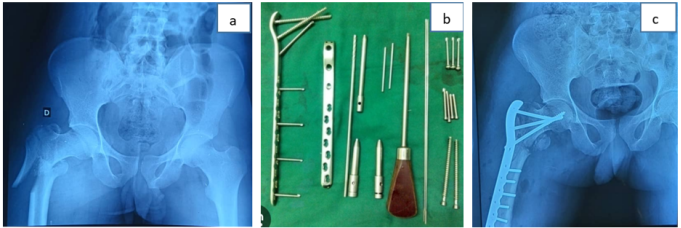
Osteosynthesis using APFLP: The APFLP is a stainless steel implant featuring a proximal section pre-contoured for the proximal femur, two proximal screw holes designed for 7.3 mm locking screws, and a third locking hole designed for a 5 mm locking screw. The 5 mm locking screw hole is angled so that the screw trajectory converges with the proximal 7.3 mm screw; the remaining holes in the plate body are combination holes. The procedure was performed under spinal anesthesia with the patient in the supine position on an orthopedic table. Fractures were initially reduced via closed manipulation under fluoroscopic guidance. A lateral approach was used, extending distally from the tip of the greater trochanter according to the required exposure. The plate was positioned, followed by initial fixation using three proximal, short-threaded, locking cancellous screws (the first placed perpendicular to the femur, and the other two placed obliquely, directed superiorly along the axis of the femoral neck) under fluoroscopic guidance. Cortical screws were then inserted (Figure 1)
[11]
Zhong B, ZhangY, Zhang C, Luo CF. A comparison of proximal femoral locking compression plates with dynamic hip screws in extracapsular femoral fractures. Orthopaedics & Traumatology: Surgery & Research 2014; 100: 663-668.
. Rehabilitation began in the immediate postoperative period with quadriceps-strengthening exercises. Weight-bearing walking was strictly prohibited for 6 weeks. Patients were reviewed at 6 weeks and subsequently every 3 months, with follow-up radiographs to assess fracture healing.
Figure 1. Trochanteric fracture (a) treated by osteosynthesis with the anatomical proximal femoral locked plate (b, c).
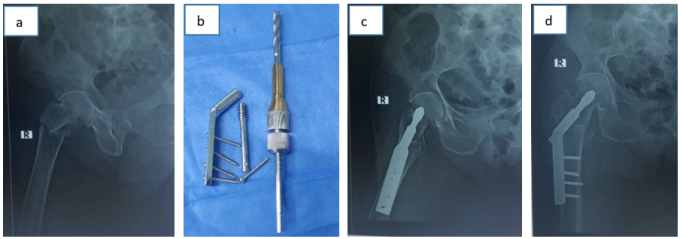
Osteosynthesis using the DHS screw-plate: The DHS screw-plate is an implant consisting of three components: a lag screw (cervical screw), a side plate, and several cortical screws. The type of anesthesia, patient positioning, fracture reduction, wound closure, and postoperative follow-up were identical to those used for APFLP fixation. A lateral approach was used, extending proximally from the base of the greater trochanter and distally as required for exposure. The lag screw guide wire was inserted using the aiming device; the lag screw length was measured, the hole was drilled, and the lag screw was inserted under fluoroscopic guidance. Finally, the DHS plate was positioned and fixed. Closure was performed layer-by-layer over a suction drain (Figure 2)
[11]
Zhong B, ZhangY, Zhang C, Luo CF. A comparison of proximal femoral locking compression plates with dynamic hip screws in extracapsular femoral fractures. Orthopaedics & Traumatology: Surgery & Research 2014; 100: 663-668.
Figure 2. Trochanteric fracture (a) treated by osteosynthesis with the DHS screw plate (b, c, d).
2.1. Data Collection
Data were collected from operating room and hospital admission registers as well as patient medical records. The data were entered into Sphinx V5.1 software (Chavanod, France).
2.2. Variables Collected
Patients were identified, and comprehensive data collection was performed.
These included age, sex, comorbidities, pre-injury functional independence (for patients aged 60 or older), the mechanism and type of fracture, time to surgery, duration of the procedure, the duration of hospitalization and the duration of antibiotic therapy.
The quality of the reduction was assessed on anteroposterior and lateral radiographs by measuring the neck-shaft angle. A reduction was considered satisfactory when this angle was between 125° and 135°. An angle of less than 125° or greater than 135° indicated an unsatisfactory reduction.
Bone healing was confirmed by the presence of lamellar bone formation visible on radiographs. It was assessed between the third and sixth postoperative months. The absence of healing after six months was classified as non-union.
Functional outcomes were evaluated at the final follow-up using the Harris score
[12]
Aubigné RM, Postel M. The classic: functional results of hip arthroplasty with acrylic prosthesis. 1954. Clin Orthop 2009; 467: 7-27.
Prabhat A, Sahil G, Saubhik D, et al. Dynamic hip screw versus proximal femur locking compression plate in intertrochanteric femur fractures (AO 31A1 and 31A2): A prospective randomized study. Journal of natural science, biology and medicine 2017; 8(1): 87-93.
Mohsen MK, Ahmadreza M, Sina KJ, Melina RR. Fixation of intertrochanteric fractures. dynamic hip screw versus locking compression plate. Trauma monthly 2013; 18(2): 67-70.
. Excellent and good results were considered satisfactory, while fair and poor results were considered unsatisfactory. Complications were screened for.
2.3. Statistical Analysis
All statistical analyses were performed using SPSS 25 software. Quantitative variables followed a normal distribution. These variables were presented as means with standard deviations and compared between the two groups using Welch's test for unpaired data. Qualitative variables were presented as frequencies and proportions. Fisher's exact test was used to analyze associations between qualitative variables. Differences in means and proportions were calculated along with their 95% confidence intervals (CI). A p-value less than 0.05 was considered significant.
2.4. Ethical Considerations
The study was approved by the ethics committee of Gamal Abdel Nasser University of Conakry and the authorities of the hospital where the study was conducted. Artificial intelligence was not used. Due to the retrospective nature of this study, the requirement for informed patient consent was waived.
3. Results
Composition of the study population
A total of 67 patients with a trochanteric fracture (TF) underwent reduction and osteosynthesis using either APFLP or DHS. Of these, 24 were excluded. At final follow-up, 43 patients were evaluated: 18 in the APFLP group and 25 in the DHS group.
3.1. Characteristics of the Study Cohort
Patients in the APFLP group were on average 2.36 years younger than those in the DHS group (p = 0.53). The PFALP group comprised 6 women (33.3%) and 12 men (66.7%), compared with 14 women (56%) and 11 men (44%) in the DHS group. The proportion of women was 22.7% lower in the APFLP group (CI: [−51.9; 6.5]; p = 0.21).
Arterial hypertension was more common in the APFLP group, with 9 cases (50%) versus 4 cases (16%) in the DHS group, representing a difference of 34% (CI: [6.8; 61.2]; p = 0.02). Diabetes was less common in the APFLP group, with 6 cases (33.3%) versus 18 cases (72%) in the DHS group, a difference of 38.7% in favor of the DHS group (CI: [−66.7; −10.7]; p = 0.01).
Patients in the APFLP group were, on average, 0.41 points more independent (p = 0.59). Road traffic accidents were more frequently the cause in the APFLP group: 12 cases (66.7%) versus 11 cases (44%) in the DHS group, a difference of 22.7%. Conversely, domestic accidents were more frequent in the DHS group: 13 cases (52%) versus 5 cases (27.8%) in the APFLP group, a difference of 24.2%. Workplace accidents were rare in both groups: 1 case (5.6%) in the PFALP group and 1 case (4%) in the DHS group (p = 0.28).
Type 31A2 fractures were less frequent in the APFLP group (p = 1) (Table 1).
Table 1. Patients treated by osteosynthesis using the DHS screw-plate and the proximal femoral anatomical locking plate.
Variables
APFLP
DHS screw-plate
Difference in means
95% CI
P value
Average age (extreme)/years
58 ± 12.07 [43-78]
60.36 ± 12.01 [42-81]
−2.36
(−9.91- 5.19)
0.53
parker Score
7.5± 1.60
7.91 ± 1.51
−0.41
−1.67 à 0,85
0.59
AO Classification
31A2
8 (44.4%)
12 (48.0%)
−3.6
[−33.7; 26.6]
1.000
31A3
10 (55.6%)
13 (52.0%)
+3.6
[−26.6; 33.7]
3.2. Operative and Postoperative Data
All patients in both groups underwent surgery within 4 days of the injury.
The length of hospital stay was on average 1.16 days longer in the APFLP group (CI: [0.19; 2.14]; p = 0.02). The duration of the procedure was on average 8.03 minutes shorter in this group (CI: [−14.90; −1.15]; p = 0.02). The duration of antibiotic therapy was on average 0.32 days shorter in the APFLP group (p = 0.57); (Table 2).
3.3. Anatomical Results
All fractures were correctly reduced. The neck-shaft angle was on average 1.76° greater in the APFLP group (p = 0.2). Fracture healing was achieved in all patients in both groups (Table 2).
3.4. Functional Results
Minimum follow-up was 8 months in both groups. Maximum follow-up was 12 months in the APFLP group, compared to 16 months in the DHS group. The Harris functional score was on average 3.4 points higher in the APFLP group (p = 0.23); (Table 2).
Table 2. Operative and clinical outcome data for patients treated via osteosynthesis using the DHS screw-plate and the proximal femoral anatomical locking plate.
Variables
APFLP
DHS screw-plate
Difference in means
95% CI
P value
Duration of hospital stay [day]
9.44 ± 1.15 [7-10]
8.28 ± 1.99 [7-15]
+1.16 j
(0.19 - 2.14)
0.02
Duration of surgery [mn]
78.33 ± 9.79 [60-100]
86.36 ± 12.51 [65-112]
−8.03
(−14.90 - −1.15)
0.02
Antibiotic therapy (day)
9 ± 1.46 [7-10]
9.32 ± 2.23 [7-15]
−0.32 j
(−1.46 - 0.82)
0.57
Cervicodiaphyseal angle
130.44 ± 3.71
128.68 ± 2,46
+1.76°
−0.11 à 3.63
0.20
Harris Score
95 ± 7.07 [80-100]
91.60 ± 11.43 [70-100]
+3.40
(−2.32 - 9,12)
0.23
3.5. Complications
Complications were less frequent in the APFLP group: 5 cases (27.8%) versus 9 cases (36%) in the DHS group (p = 0.74). The complications observed were as follows: chronic pain in the APFLP group, versus no cases in the DHS group (p = 0.41); surgical site infection in 2 patients (11.1%) in the APFLP group and 5 patients (20%) in the DHS group (p = 0.68); no cases of lag screw cut-out in the APFLP group, versus 3 cases (12%) in the DHS group (p = 0.25); and finally, phlebitis in 2 patients (11.1%) in the APFLP group and 1 patient (4%) in the DHS group (p = 0.56).
4. Discussion
In this study, the anatomical and functional outcomes of osteosynthesis for TF using the APFLP system were compared with those of the DHS screw-plate system.
Both fixation methods yielded satisfactory results. Operative time was shorter in the APFLP group: CI = −8.03 min [−14.90; −1.15], p = 0.02. Hospital stay duration was longer in the APFLP group: CI= +1,16 [0.19; 2.14]; p = 0.02. Bone healing was achieved with both methods. The neck-shaft angle was satisfactory with both methods: CI = 1.76° [−0.11; 3.63], p = 0.2. Functional outcomes were slightly better in the APFLP group: CI = 3.4 [−2.32; 9.12], p = 0.23. The complication rate was also lower in the APFLP group (27.8% vs. 36%). The research hypothesis is confirmed.
The longer operative time associated with the DHS screw-plate system may be attributed to the time required for cervical screw targeting, whereas with the APFLP, the trajectory of the cervical screws is determined by the plate itself. Similar results were reported by Zhong et al. (p = 0.34)
[11]
Zhong B, ZhangY, Zhang C, Luo CF. A comparison of proximal femoral locking compression plates with dynamic hip screws in extracapsular femoral fractures. Orthopaedics & Traumatology: Surgery & Research 2014; 100: 663-668.
Mohsen MK, Ahmadreza M, Sina KJ, Melina RR. Fixation of intertrochanteric fractures. dynamic hip screw versus locking compression plate. Trauma monthly 2013; 18(2): 67-70.
Prabhat A, Sahil G, Saubhik D, et al. Dynamic hip screw versus proximal femur locking compression plate in intertrochanteric femur fractures (AO 31A1 and 31A2): A prospective randomized study. Journal of natural science, biology and medicine 2017; 8(1): 87-93.
Naiyer A, Sohail A, Owais AQ, et al. Unstable intertrochanteric fracture fixation - Is proximal femoral locked compression plate better than dynamic hip screw. Journal of clinical and diagnostic research. 2016; 10(1): 09-13.
reported shorter operative times with the DHS screw-plate system (p < 0.0001, p = 0.0001, and p = 0.0001, respectively). The duration of the procedure for femoral shaft fractures is influenced by the fracture type and the implant used
[15]
Ma KL, Wang X, Luan FJ, et al. Proximal femoral nails antirotation, gamma nails, and dynamic hip screws for fixation of intertrochanteric fracturesof femur: A meta-analysis. Orthop Traumatol Surg Res 2014; 100: 859-66.
Ralahy Mf, Randimbinirina ZL, Rafidiarison F, Razafimahandry HJC. Benefits of the DHS screw-plate for the osteosynthesis of pertrochanteric fractures at the Traumatology Department of CHU Ampefiloha. Revue tropicale de chirurgie 2018; 11: 1-5.
[17]
Boukhris J, Boussouga M, Jaafar A, Chagar B. Value of surgical treatment for trochanteric fractures using the Gamma nail: a report of 84 cases. Pan Afr Med J 2014; 19: 6.
Rabemazava A, Razafimahatratra R, Rakotomaharo A, Razafimahandry HJC. Aspects of management of fractures of the proximal femur in Antananarivo. Malagasy Orthopedic Surgery and Traumatology Review 2010; 1: 12.
[16-19]
.
The shorter hospital stay associated with the DHS screw-plate construct may be attributed to the patients' advanced age, prompting earlier discharge to avoid complications linked to prolonged bed rest. A shorter duration has been reported by several authors
[11]
Zhong B, ZhangY, Zhang C, Luo CF. A comparison of proximal femoral locking compression plates with dynamic hip screws in extracapsular femoral fractures. Orthopaedics & Traumatology: Surgery & Research 2014; 100: 663-668.
Prabhat A, Sahil G, Saubhik D, et al. Dynamic hip screw versus proximal femur locking compression plate in intertrochanteric femur fractures (AO 31A1 and 31A2): A prospective randomized study. Journal of natural science, biology and medicine 2017; 8(1): 87-93.
Dhamangaonkar AC, Joshi D, Goregaonkar AB, Tawari AA. Proximal femoral locking plate versus dynamic hip screw for unstable intertrochanteric femoral fractures. Journal of orthopaedic surgery 2013; 21(3): 317-22.
[11, 13, 20]
.
Following fracture reduction and stable fixation, the prohibition of early weight-bearing until union may explain the maintenance of the postoperative neck-shaft angle. Similar mean neck-shaft angles (132° and 133°) have been reported
[20]
Dhamangaonkar AC, Joshi D, Goregaonkar AB, Tawari AA. Proximal femoral locking plate versus dynamic hip screw for unstable intertrochanteric femoral fractures. Journal of orthopaedic surgery 2013; 21(3): 317-22.
[20]
. The quality of femoral neck fracture reduction depends primarily on the type of implant used and the fracture type
[21]
Bhandari M, Swiontkowski M. Management of acute Hip fracture. N Engl J Med. 2017; 377(21): 2053-62.
[21]
.
The functional superiority of the APFLP over the DHS screw-plate construct may be explained by the patients' younger age and the predominantly male population, who have higher functional demands. Similar results have been reported, with 88% good or excellent outcomes compared to 60%
[6]
Naiyer A, Sohail A, Owais AQ, et al. Unstable intertrochanteric fracture fixation - Is proximal femoral locked compression plate better than dynamic hip screw. Journal of clinical and diagnostic research. 2016; 10(1): 09-13.
. Conversely, other authors found little to no superiority of one technique over the other (p = 0.78
[13]
Prabhat A, Sahil G, Saubhik D, et al. Dynamic hip screw versus proximal femur locking compression plate in intertrochanteric femur fractures (AO 31A1 and 31A2): A prospective randomized study. Journal of natural science, biology and medicine 2017; 8(1): 87-93.
Mohsen MK, Ahmadreza M, Sina KJ, Melina RR. Fixation of intertrochanteric fractures. dynamic hip screw versus locking compression plate. Trauma monthly 2013; 18(2): 67-70.
The higher complication rate associated with the DHS may be attributed to longer operative times and the patients' advanced age. A higher complication rate has been reported with the DHS screw-plate construct; these complications included non-union, malunion, and implant failure
[6]
Naiyer A, Sohail A, Owais AQ, et al. Unstable intertrochanteric fracture fixation - Is proximal femoral locked compression plate better than dynamic hip screw. Journal of clinical and diagnostic research. 2016; 10(1): 09-13.
Zhong B, ZhangY, Zhang C, Luo CF. A comparison of proximal femoral locking compression plates with dynamic hip screws in extracapsular femoral fractures. Orthopaedics & Traumatology: Surgery & Research 2014; 100: 663-668.
Dhamangaonkar AC, Joshi D, Goregaonkar AB, Tawari AA. Proximal femoral locking plate versus dynamic hip screw for unstable intertrochanteric femoral fractures. Journal of orthopaedic surgery 2013; 21(3): 317-22.
[6, 11, 20]
. Convergent screw breakage
[6]
Naiyer A, Sohail A, Owais AQ, et al. Unstable intertrochanteric fracture fixation - Is proximal femoral locked compression plate better than dynamic hip screw. Journal of clinical and diagnostic research. 2016; 10(1): 09-13.
Dhamangaonkar AC, Joshi D, Goregaonkar AB, Tawari AA. Proximal femoral locking plate versus dynamic hip screw for unstable intertrochanteric femoral fractures. Journal of orthopaedic surgery 2013; 21(3): 317-22.
[20]
, and non-union have also been reported with the APFLP. In elderly patients, trochanteric fractures are associated with an increased risk of thromboembolic, infectious, or hemorrhagic complications
[21]
Bhandari M, Swiontkowski M. Management of acute Hip fracture. N Engl J Med. 2017; 377(21): 2053-62.
[21]
. Cut-out of the cephalic screw is the most common complication of surgical treatment for fractures of the proximal femur using the DHS screw-plate system
[10]
Tinto S, Diallo M, Saswadogo M, Ouedraogo AJI, Da SC. Osteosynthesis of trochanteric fractures using a dynamic hip screw at Yalgado Ouedraogo University Hospital. J Afr Chir Orthop Traumatol 2021; 6(2): 80-85.
[10]
.
This comparative study has certain limitations that should be taken into account when interpreting the results. First, it is retrospective and involves small sample sizes in both groups. Furthermore, there are baseline differences between the groups regarding preoperative and operative data.
This study appears to be one of the first to compare these two osteosynthesis techniques for the treatment of trochanteric fractures in our setting.
This study allows for a comparison of the key radiological and functional aspects of the two osteosynthesis methods. It may help clarify their indications for the management of trochanteric fractures. These data will serve as a basis for multicenter studies involving larger sample sizes.
5. Conclusion
The anatomical proximal femoral locking plate and the Dynamic Hip Screw are two effective osteosynthesis techniques for the surgical treatment of unstable trochanteric fractures. While both techniques yield similar anatomical results, the proximal femoral locking plate offers superior functional outcomes, a shorter operative time (p=0.02), and an absence of mechanical complications.
Abbreviations
AO
Association for the Study of Osteosynthesis
APFLP
Anatomical Proximal Femoral Locking Plate
CI
Confidence Intervals
DHS
Dynamic Hip Screw
TF
Trochanteric Fracture
Author contributions
Diallo Mamadou Moustapha: Conceptualization, Data curation, Methodology, Resources
Conde Mamady Sekou: Funding acquisition, Software, Writing – original draft
Nouri H, Ben Hmida K. Osteosynthesis of trochanteric fractures: choice of implants. Afr J Orthop Trauma 2016; 1: 102-7.
[3]
Mohamed AM, Faisel FA, Hesham HR. Comparative study of gamma nail versus dynamic hip screw in fixation of unstable peri-trochanteric fractures regarding operative outcomes. Egypt Orthop J 2024; 59(4): 463-469.
Ide G, Allassane AW, Alfari AA, Diallo NAI, Harissou A. Osteosynthesis of fractures in the trochanteric region in a resource limited context. Surgical procedure and outcomes at the national hospital of Niamey (republic of Niger). EOJ 2025; 60(4): 373-381.
Mikiela A, Abiome R, Mba-Angoue JM, Kassi Bertrand, Obiang-Enguie AC, Larbi M. Treatment of trochanteric fractures with a dynamic hip screw in Libreville. J Afr Chir Orthop Traumatol 2019; 4(1): 36-40.
[6]
Naiyer A, Sohail A, Owais AQ, et al. Unstable intertrochanteric fracture fixation - Is proximal femoral locked compression plate better than dynamic hip screw. Journal of clinical and diagnostic research. 2016; 10(1): 09-13.
Kanwarjit SS, Girish S, Avinash CG, Vikas VP, Tajinder B. Dynamic hip screw vs proximal trochanteric contoured plate in proximal end fractures of femur. Indian journal of orthopaedics durgery 2016; 2(3): 223-230.
Haidukewych GJ. Intertrochanteric fractures: ten tips to Improve results. J Bone Joint Surg Am. 2009; 91: 712-9.
[10]
Tinto S, Diallo M, Saswadogo M, Ouedraogo AJI, Da SC. Osteosynthesis of trochanteric fractures using a dynamic hip screw at Yalgado Ouedraogo University Hospital. J Afr Chir Orthop Traumatol 2021; 6(2): 80-85.
[11]
Zhong B, ZhangY, Zhang C, Luo CF. A comparison of proximal femoral locking compression plates with dynamic hip screws in extracapsular femoral fractures. Orthopaedics & Traumatology: Surgery & Research 2014; 100: 663-668.
Prabhat A, Sahil G, Saubhik D, et al. Dynamic hip screw versus proximal femur locking compression plate in intertrochanteric femur fractures (AO 31A1 and 31A2): A prospective randomized study. Journal of natural science, biology and medicine 2017; 8(1): 87-93.
Mohsen MK, Ahmadreza M, Sina KJ, Melina RR. Fixation of intertrochanteric fractures. dynamic hip screw versus locking compression plate. Trauma monthly 2013; 18(2): 67-70.
Ma KL, Wang X, Luan FJ, et al. Proximal femoral nails antirotation, gamma nails, and dynamic hip screws for fixation of intertrochanteric fracturesof femur: A meta-analysis. Orthop Traumatol Surg Res 2014; 100: 859-66.
Ralahy Mf, Randimbinirina ZL, Rafidiarison F, Razafimahandry HJC. Benefits of the DHS screw-plate for the osteosynthesis of pertrochanteric fractures at the Traumatology Department of CHU Ampefiloha. Revue tropicale de chirurgie 2018; 11: 1-5.
[17]
Boukhris J, Boussouga M, Jaafar A, Chagar B. Value of surgical treatment for trochanteric fractures using the Gamma nail: a report of 84 cases. Pan Afr Med J 2014; 19: 6.
Rabemazava A, Razafimahatratra R, Rakotomaharo A, Razafimahandry HJC. Aspects of management of fractures of the proximal femur in Antananarivo. Malagasy Orthopedic Surgery and Traumatology Review 2010; 1: 12.
[20]
Dhamangaonkar AC, Joshi D, Goregaonkar AB, Tawari AA. Proximal femoral locking plate versus dynamic hip screw for unstable intertrochanteric femoral fractures. Journal of orthopaedic surgery 2013; 21(3): 317-22.
[21]
Bhandari M, Swiontkowski M. Management of acute Hip fracture. N Engl J Med. 2017; 377(21): 2053-62.
Moustapha, D. M., Sekou, C. M., Kourala, K. F., Mangue, C. N., Amadou, B. P., et al. (2026). Outcomes of Osteosynthesis Using a DHS Screw-plate or an Anatomical Proximal Femoral Locking Plate for Unstable Trochanteric Fractures. American Journal of Orthopaedics and Traumatology, 1(2), 72-78. https://doi.org/10.11648/j.ajot.20260102.14
Moustapha, D. M.; Sekou, C. M.; Kourala, K. F.; Mangue, C. N.; Amadou, B. P., et al. Outcomes of Osteosynthesis Using a DHS Screw-plate or an Anatomical Proximal Femoral Locking Plate for Unstable Trochanteric Fractures. Am. J. Orthop. Traumatol.2026, 1(2), 72-78. doi: 10.11648/j.ajot.20260102.14
Moustapha DM, Sekou CM, Kourala KF, Mangue CN, Amadou BP, et al. Outcomes of Osteosynthesis Using a DHS Screw-plate or an Anatomical Proximal Femoral Locking Plate for Unstable Trochanteric Fractures. Am J Orthop Traumatol. 2026;1(2):72-78. doi: 10.11648/j.ajot.20260102.14
@article{10.11648/j.ajot.20260102.14,
  author = {Diallo Mamadou Moustapha and Conde Mamady Sekou and Keita Fode Kourala and Camara Nouhou Mangue and Ba Papa Amadou and Lamah Leopol},
  title = {Outcomes of Osteosynthesis Using a DHS Screw-plate or an Anatomical Proximal Femoral Locking Plate for Unstable Trochanteric Fractures},
  journal = {American Journal of Orthopaedics and Traumatology},
  volume = {1},
  number = {2},
  pages = {72-78},
  doi = {10.11648/j.ajot.20260102.14},
  url = {https://doi.org/10.11648/j.ajot.20260102.14},
  eprint = {https://article.sciencepublishinggroup.com/pdf/10.11648.j.ajot.20260102.14},
  abstract = {Introduction: Various osteosynthesis techniques exist for trochanteric fractures. The aim of this study was to compare the anatomical and functional outcomes of fixation using an anatomical proximal femoral locking plate (APFLP) versus a dynamic hip screw (DHS) for unstable trochanteric fractures. Materials and Methods: This was an observational, cross-sectional, retrospective study. Patients were hospitalized between February 2024 and May 2025. They were aged 18 years or older and had a recent (≤ 21 days) trochanteric fracture classified according to the AO system. They were divided into two groups: the APFLP group and the DHS group. The parameters evaluated were reduction, bone healing, and functional level. Results: Eighteen patients were treated with APFLP, and 25 with DHS. Patients in the APFLP group were on average 2.36 years younger (p = 0.53; 95% CI [−9.91; 5.19]). Type 31A2 fractures were less frequent in the APFLP group (95% CI [−33.7; 26.6]); conversely, type 31A2 fractures were more frequent (95% CI [−26.6; 33.7]; p = 1). Operative time was on average 8.03 minutes shorter in the APFLP group (95% CI [−14.90; −1.15]; p = 0.02). All fractures were adequately reduced. The neck-shaft angle was on average 1.76° greater in the APFLP group (95% CI [−0.11; 3.63], p = 0.2. Fracture healing was achieved in all patients across both groups. The minimum follow-up was 8 months for both groups, while the maximum was 12 months for the APFLP group and 16 months for the DHS group. Functional outcomes were on average 3.4 points better in the APFLP group; 95% CI [−2.32; 9.12], p = 0.23. Fewer patients experienced complications in the APFLP group: 5 cases (27.8%) versus 9 cases (36%); p = 0.74. Conclusion: The anatomical proximal femoral locked plate and the Dynamic Hip Screw are both effective osteosynthesis techniques for the surgical treatment of unstable trochanteric fractures. Their anatomical outcomes are similar; however, the proximal femoral anatomic locking plate is slightly superior in terms of functional outcomes.},
 year = {2026}
}
TY  - JOUR
T1  - Outcomes of Osteosynthesis Using a DHS Screw-plate or an Anatomical Proximal Femoral Locking Plate for Unstable Trochanteric Fractures
AU  - Diallo Mamadou Moustapha
AU  - Conde Mamady Sekou
AU  - Keita Fode Kourala
AU  - Camara Nouhou Mangue
AU  - Ba Papa Amadou
AU  - Lamah Leopol
Y1  - 2026/11/13
PY  - 2026
N1  - https://doi.org/10.11648/j.ajot.20260102.14
DO  - 10.11648/j.ajot.20260102.14
T2  - American Journal of Orthopaedics and Traumatology
JF  - American Journal of Orthopaedics and Traumatology
JO  - American Journal of Orthopaedics and Traumatology
SP  - 72
EP  - 78
PB  - Science Publishing Group
SN  - 3143-7192
UR  - https://doi.org/10.11648/j.ajot.20260102.14
AB  - Introduction: Various osteosynthesis techniques exist for trochanteric fractures. The aim of this study was to compare the anatomical and functional outcomes of fixation using an anatomical proximal femoral locking plate (APFLP) versus a dynamic hip screw (DHS) for unstable trochanteric fractures. Materials and Methods: This was an observational, cross-sectional, retrospective study. Patients were hospitalized between February 2024 and May 2025. They were aged 18 years or older and had a recent (≤ 21 days) trochanteric fracture classified according to the AO system. They were divided into two groups: the APFLP group and the DHS group. The parameters evaluated were reduction, bone healing, and functional level. Results: Eighteen patients were treated with APFLP, and 25 with DHS. Patients in the APFLP group were on average 2.36 years younger (p = 0.53; 95% CI [−9.91; 5.19]). Type 31A2 fractures were less frequent in the APFLP group (95% CI [−33.7; 26.6]); conversely, type 31A2 fractures were more frequent (95% CI [−26.6; 33.7]; p = 1). Operative time was on average 8.03 minutes shorter in the APFLP group (95% CI [−14.90; −1.15]; p = 0.02). All fractures were adequately reduced. The neck-shaft angle was on average 1.76° greater in the APFLP group (95% CI [−0.11; 3.63], p = 0.2. Fracture healing was achieved in all patients across both groups. The minimum follow-up was 8 months for both groups, while the maximum was 12 months for the APFLP group and 16 months for the DHS group. Functional outcomes were on average 3.4 points better in the APFLP group; 95% CI [−2.32; 9.12], p = 0.23. Fewer patients experienced complications in the APFLP group: 5 cases (27.8%) versus 9 cases (36%); p = 0.74. Conclusion: The anatomical proximal femoral locked plate and the Dynamic Hip Screw are both effective osteosynthesis techniques for the surgical treatment of unstable trochanteric fractures. Their anatomical outcomes are similar; however, the proximal femoral anatomic locking plate is slightly superior in terms of functional outcomes.
VL  - 1
IS  - 2
ER  -
Moustapha, D. M., Sekou, C. M., Kourala, K. F., Mangue, C. N., Amadou, B. P., et al. (2026). Outcomes of Osteosynthesis Using a DHS Screw-plate or an Anatomical Proximal Femoral Locking Plate for Unstable Trochanteric Fractures. American Journal of Orthopaedics and Traumatology, 1(2), 72-78. https://doi.org/10.11648/j.ajot.20260102.14
Moustapha, D. M.; Sekou, C. M.; Kourala, K. F.; Mangue, C. N.; Amadou, B. P., et al. Outcomes of Osteosynthesis Using a DHS Screw-plate or an Anatomical Proximal Femoral Locking Plate for Unstable Trochanteric Fractures. Am. J. Orthop. Traumatol.2026, 1(2), 72-78. doi: 10.11648/j.ajot.20260102.14
Moustapha DM, Sekou CM, Kourala KF, Mangue CN, Amadou BP, et al. Outcomes of Osteosynthesis Using a DHS Screw-plate or an Anatomical Proximal Femoral Locking Plate for Unstable Trochanteric Fractures. Am J Orthop Traumatol. 2026;1(2):72-78. doi: 10.11648/j.ajot.20260102.14
@article{10.11648/j.ajot.20260102.14,
  author = {Diallo Mamadou Moustapha and Conde Mamady Sekou and Keita Fode Kourala and Camara Nouhou Mangue and Ba Papa Amadou and Lamah Leopol},
  title = {Outcomes of Osteosynthesis Using a DHS Screw-plate or an Anatomical Proximal Femoral Locking Plate for Unstable Trochanteric Fractures},
  journal = {American Journal of Orthopaedics and Traumatology},
  volume = {1},
  number = {2},
  pages = {72-78},
  doi = {10.11648/j.ajot.20260102.14},
  url = {https://doi.org/10.11648/j.ajot.20260102.14},
  eprint = {https://article.sciencepublishinggroup.com/pdf/10.11648.j.ajot.20260102.14},
  abstract = {Introduction: Various osteosynthesis techniques exist for trochanteric fractures. The aim of this study was to compare the anatomical and functional outcomes of fixation using an anatomical proximal femoral locking plate (APFLP) versus a dynamic hip screw (DHS) for unstable trochanteric fractures. Materials and Methods: This was an observational, cross-sectional, retrospective study. Patients were hospitalized between February 2024 and May 2025. They were aged 18 years or older and had a recent (≤ 21 days) trochanteric fracture classified according to the AO system. They were divided into two groups: the APFLP group and the DHS group. The parameters evaluated were reduction, bone healing, and functional level. Results: Eighteen patients were treated with APFLP, and 25 with DHS. Patients in the APFLP group were on average 2.36 years younger (p = 0.53; 95% CI [−9.91; 5.19]). Type 31A2 fractures were less frequent in the APFLP group (95% CI [−33.7; 26.6]); conversely, type 31A2 fractures were more frequent (95% CI [−26.6; 33.7]; p = 1). Operative time was on average 8.03 minutes shorter in the APFLP group (95% CI [−14.90; −1.15]; p = 0.02). All fractures were adequately reduced. The neck-shaft angle was on average 1.76° greater in the APFLP group (95% CI [−0.11; 3.63], p = 0.2. Fracture healing was achieved in all patients across both groups. The minimum follow-up was 8 months for both groups, while the maximum was 12 months for the APFLP group and 16 months for the DHS group. Functional outcomes were on average 3.4 points better in the APFLP group; 95% CI [−2.32; 9.12], p = 0.23. Fewer patients experienced complications in the APFLP group: 5 cases (27.8%) versus 9 cases (36%); p = 0.74. Conclusion: The anatomical proximal femoral locked plate and the Dynamic Hip Screw are both effective osteosynthesis techniques for the surgical treatment of unstable trochanteric fractures. Their anatomical outcomes are similar; however, the proximal femoral anatomic locking plate is slightly superior in terms of functional outcomes.},
 year = {2026}
}
TY  - JOUR
T1  - Outcomes of Osteosynthesis Using a DHS Screw-plate or an Anatomical Proximal Femoral Locking Plate for Unstable Trochanteric Fractures
AU  - Diallo Mamadou Moustapha
AU  - Conde Mamady Sekou
AU  - Keita Fode Kourala
AU  - Camara Nouhou Mangue
AU  - Ba Papa Amadou
AU  - Lamah Leopol
Y1  - 2026/11/13
PY  - 2026
N1  - https://doi.org/10.11648/j.ajot.20260102.14
DO  - 10.11648/j.ajot.20260102.14
T2  - American Journal of Orthopaedics and Traumatology
JF  - American Journal of Orthopaedics and Traumatology
JO  - American Journal of Orthopaedics and Traumatology
SP  - 72
EP  - 78
PB  - Science Publishing Group
SN  - 3143-7192
UR  - https://doi.org/10.11648/j.ajot.20260102.14
AB  - Introduction: Various osteosynthesis techniques exist for trochanteric fractures. The aim of this study was to compare the anatomical and functional outcomes of fixation using an anatomical proximal femoral locking plate (APFLP) versus a dynamic hip screw (DHS) for unstable trochanteric fractures. Materials and Methods: This was an observational, cross-sectional, retrospective study. Patients were hospitalized between February 2024 and May 2025. They were aged 18 years or older and had a recent (≤ 21 days) trochanteric fracture classified according to the AO system. They were divided into two groups: the APFLP group and the DHS group. The parameters evaluated were reduction, bone healing, and functional level. Results: Eighteen patients were treated with APFLP, and 25 with DHS. Patients in the APFLP group were on average 2.36 years younger (p = 0.53; 95% CI [−9.91; 5.19]). Type 31A2 fractures were less frequent in the APFLP group (95% CI [−33.7; 26.6]); conversely, type 31A2 fractures were more frequent (95% CI [−26.6; 33.7]; p = 1). Operative time was on average 8.03 minutes shorter in the APFLP group (95% CI [−14.90; −1.15]; p = 0.02). All fractures were adequately reduced. The neck-shaft angle was on average 1.76° greater in the APFLP group (95% CI [−0.11; 3.63], p = 0.2. Fracture healing was achieved in all patients across both groups. The minimum follow-up was 8 months for both groups, while the maximum was 12 months for the APFLP group and 16 months for the DHS group. Functional outcomes were on average 3.4 points better in the APFLP group; 95% CI [−2.32; 9.12], p = 0.23. Fewer patients experienced complications in the APFLP group: 5 cases (27.8%) versus 9 cases (36%); p = 0.74. Conclusion: The anatomical proximal femoral locked plate and the Dynamic Hip Screw are both effective osteosynthesis techniques for the surgical treatment of unstable trochanteric fractures. Their anatomical outcomes are similar; however, the proximal femoral anatomic locking plate is slightly superior in terms of functional outcomes.
VL  - 1
IS  - 2
ER  -





 Share This Article
 Twitter
 Linked In
 Facebook

 Copy
 Download