1. Introduction
In an open system, as applied to living organisms in a stationary state, E. Schrödinger
| [1] | Schrodinger E. What is Life - the Physical Aspect of the Living Cell. Cambridge University Press, 1944. |
[1]
introduced the concept of "negative entropy" to explain the compensation of entropy production. L. Brillouin, justifying the process of obtaining information, called it negentropy
| [2] | Brillouin L. Negentropy Principle of Information /J. of Applied Physics. 1953. V. 24: 9, P. 1152-1163. |
[2]
. At present, negentropy is used mainly as the difference between given and Gaussian distributions with an average value and dispersion
| [3] | Tsvetkov V. Ya. Information uncertainty and certainty in the information sciences // Information technologies. 2015. N. 1. P. 3-7. |
| [4] | Liiv E. X. Infodynamics. Generalized entropy and negentropy. Tallinn. 1998. 200 p. |
| [5] | Wiggins R. A. Minimum entropy deconvolution //Geoexploration. 1978. - 16: 12-35. |
| [6] | Mallat S. G. A Theory of Multiresolution Signal Decomposition: Wavelet Representation /IEEE Trans. on PAMI. 1989. - 11: 674–693. |
| [7] | Delfosse N., Loubaton P. Adaptive blind separation of independent sources: A deflationary approach /Signal Processing – 1995. - 45: 59-83. |
[3-7]
. Negentropy is usually understood as a certain natural process, the reverse of the characteristic process of entropy increase. An increase in negentropy causes a decrease in entropy. However, the patterns of change of each of these quantities and their mutual dependence have not found a proper explanation
| [8] | Pajunen P. Blind source separation using algorithmic information theory //Neurocomputing. 1998. - 22: 35-48. |
| [9] | Olshausen B. A., Field D. J. Natural Image Statistics and Efficient Coding// Network. 1996. - 7(2): 333–340. |
| [10] | Oja E. Neural networks, principal components and subspaces //Int. J. on Neural Systems. 1989. - 1: 61-68. |
| [11] | Nadal J.-P., Parga N. Nonlinear neurons in the low-noise limit: A factorial code maximizes information transfer //Network. 1994. - 5: 565–581. |
| [12] | Molgedey L., Schuster H. G. Separation of a mixture of independent signals using time-delayed correlations //Phys. Rev. Lett. 1994. - 72: 3634–3636. |
[8-12]
.
The entropy approach to information analysis differentiated between substantive information according to N. Wiener and information that removes uncertainty according to K. E. Shannon
| [13] | Donoho D. On minimum entropy deconvolution / Applied Time Series Analysis II. 1981. – P. 565–608. |
| [14] | Daugman J. G. Entropy reduction and decorrelation in visual coding using oriented neural receptive fields /IEEE Trans. on Biomedical Engineering. 1989. - 36: 107–114. |
| [15] | Aapo Hyvarinen. Independent Component Analysis Survey /Helsinki University of Technology. 1999. –V. 2- P. 94-128. |
[13-15]
, but the concepts of entropy and negentropy have not yet been fully systematized and there is still no sufficiently logical theory in this area
| [16] | Martin N., England J. Mathematical theory of entropy. Moscow: Mir, 1988. 350 p. |
| [17] | Sigov А. S., Tsvetkov V. Ya. Tacit knowledge: oppositional logical analysis and typologization // Bulletin of the Russian Academy of Sciences. 2015. V. 85. N. 9, P. 800–804.
https://doi.org/10.7868/S0869587315080319 |
| [18] | Ivannikov A. D., Tikhonov A. N., Tsvetkov V. Ya. Fundamentals of information theory. Moscow. MaxPress. 2007. 356 p. |
| [19] | Deshko I. P. Information approach to modeling // Educational resources and technologies. 2016. N. 5(17). P. 21-26. |
| [20] | Lototsky V. L. Entropy and negentropy //Perspectives of Science & Education. 2017. 1(25). – pp. 20-23. International Scientific Electronic Journal. |
[16-20]
.
The most important is the thermodynamic approach to studying stationary irreversible processes in open systems. In the nonlinear thermodynamics of nonequilibrium processes developed by Nobel Prize laureate I. Prigogine
| [21] | Prigogine I., Kondepudi D. Modern thermodynamics from heat engines to dissipative structures. Moscow: Mir, 2002. 461 p. |
| [22] | Prigogine I. From existing to emerging: time and complexity in physical sciences. Moscow: Nauka, 1985. 327 p. |
[21, 22]
, irreversibility plays an important constructive role. Postulating the second law of thermodynamics as a fundamental physical fact, I. Prigogine puts forward theories of dissipative systems and bifurcations. The nonequilibrium process occurring in such an open system is associated with dissipation, that is, with the production of entropy. Irreversible processes are the driving force that creates order in the system. In chemical reactions far from equilibrium, ordered structures arise under the influence of nonlinear interactions at the bifurcation point and lead to the production of entropy. Nonequilibrium situations according to I. Prigogine
| [22] | Prigogine I. From existing to emerging: time and complexity in physical sciences. Moscow: Nauka, 1985. 327 p. |
[22]
lead to space-time structures – dissipative structures. The production of entropy and its exchange with the environment can lead to the evolution of the system, moving into a self-organization mode.
The second law of thermodynamics represents the change in entropy of an open system in the form of two components
| [21] | Prigogine I., Kondepudi D. Modern thermodynamics from heat engines to dissipative structures. Moscow: Mir, 2002. 461 p. |
[21]
:
1) production of entropy due to irreversible processes;
2) exchange of entropy with the environment.
I. Prigogine noted
| [22] | Prigogine I. From existing to emerging: time and complexity in physical sciences. Moscow: Nauka, 1985. 327 p. |
[22]
that “Nonequilibrium thermodynamics is, first of all, the thermodynamics of a chemical reaction”. By studying the transformations of components during chemical reactions in a region far from equilibrium in the CaO-SiO
2-H
2O system, it was established
that chemical reactions in an open system are accompanied by direct and reverse transformations of the components. With all transformations, the system begins to produce entropy. The production of entropy of reverse transformation is negentropy
. According to the II law of thermodynamics, entropy production is a positive quantity. Therefore, negentropy is also a positive quantity. The difference between the entropy production of direct and reverse transformations (negentropy) is called useful entropy production. The useful production of entropy is spent on exchange with the external environment and on increasing the entropy of dissipative structures. Negentropy is a barrier to the growth of useful entropy production of a system, which not all reactions can overcome. The relationship between useful entropy production and negentropy determines the path of evolution of the system at the bifurcation point.
In chemical reactions, different phases of substances exchange matter and energy, which is the basis of irreversible processes. Processes of evolution in chemical reactions can be described on the basis of the transformation of the phase composition of the compounds of the system as cause-and-effect relationships between phases. At the bifurcation point, the system loses stability and goes into a nonequilibrium state, in which it is possible to acquire a new quality in the evolution of the dynamic system. There is a restructuring of the nature of movement and structure of the system. When a system moves far from equilibrium to a bifurcation point, a significant role is played by the chemical potential and affinity of the system
. At the bifurcation point, the system begins to produce entropy caused by irreversible processes; the passage of the reaction is characterized by a certain rate constant. It is these factors that determine which evolutionary branch the system will follow after passing through the bifurcation point. When chemical reagents interact in a real system, it is possible to determine all paths of evolution of the system. After all, evolutionary processes between two bifurcation points obey deterministic laws
| [22] | Prigogine I. From existing to emerging: time and complexity in physical sciences. Moscow: Nauka, 1985. 327 p. |
[22]
. In the presence of a small displacement of the initial components, the system is capable of abrupt transitions between stable states.
Based on “The Gibbs function normalized to the total number of electrons”
| [23] | Aldabergenov M. Production Entropy and Negentropy /American J. of Physical Chem. 2021. V. 10, N. 2, pp. 25-30.
https://doi.org/10.11648/j.ajpc.20211002.12 |
| [24] | Balakaeva G. T., Aldabergenov M. K. The Gibbs function normalized to the total number of electrons /J. of Materials Science and Engineering B. 2012. 2(6). P. 394-403. |
[23, 24]
and using the example of triangulation
| [25] | Kurnakov N. S. Introduction to physical and chemical analysis. Moscow-Leningrad.: AN SSSR, 1940. 563 p. |
[25]
of the CaO-SiO
2–H
2O system, entropy production, negentropy, entropy flux, total entropy change, affinity, thermodynamic force, transformation temperature, and rate constant were calculated. In chemical reactions, entropy production and negentropy exist in parallel
.
Thus, in the nonlinear thermodynamics of nonequilibrium processes in chemical reactions, a new approach to determining negentropy has been proposed. Negentropy is a positive quantity and characterizes the production of entropy of the reverse process.
2. Methods of Research
In the field of strongly nonequilibrium thermodynamics, two approaches are used:
1. "The Gibbs function normalized to the total number of electrons"
| [23] | Aldabergenov M. Production Entropy and Negentropy /American J. of Physical Chem. 2021. V. 10, N. 2, pp. 25-30.
https://doi.org/10.11648/j.ajpc.20211002.12 |
| [24] | Balakaeva G. T., Aldabergenov M. K. The Gibbs function normalized to the total number of electrons /J. of Materials Science and Engineering B. 2012. 2(6). P. 394-403. |
[23, 24]
.
2. Triangulation of a multicomponent system according to Kurnakov
| [25] | Kurnakov N. S. Introduction to physical and chemical analysis. Moscow-Leningrad.: AN SSSR, 1940. 563 p. |
[25]
.
"The Gibbs function normalized to the total number of electrons" is calculated by dividing the Gibbs energy of formation of a compound by the total number of electrons in the compound and by Avogadro’s number and converted to eV.
. This function determines the energy density of the formation of a compound per electron and, during the formation of bonds, adequately responds to all changes in the structure of the compound, allowing one to judge the reactivity of the compound.
"The Gibbs function normalized to the total number of electrons" is interpreted as the chemical potential of a substance (μ)
. During a phase transition, the chemical potential is an intensity factor, that is, the transition of a component can occur spontaneously only from a phase with a high potential to a phase with a lower potential. According to Lewis, the chemical potential must be considered as a measure of the tendency of a substance to dissipate from the space it occupies, i.e. a measure of the reactivity of a substance.
Based on the principle of continuity and the principle of correspondence, Kurnakov proposed a method for triangulation of multicomponent systems and the possibility of determining the mechanism of reactions
| [25] | Kurnakov N. S. Introduction to physical and chemical analysis. Moscow-Leningrad.: AN SSSR, 1940. 563 p. |
[25]
. The CaO-SiO
2-H
2O system is represented by a diagram (
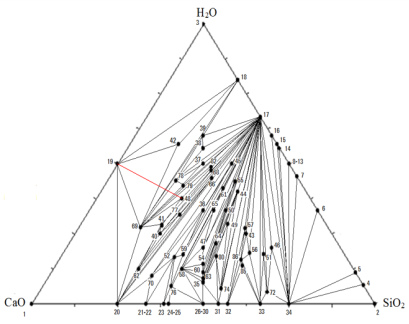
Figure 1), where all 86 compounds are plotted and divided into phase unit blocks (PUB). A feature of PUB is the formation in them only of compounds of eutectic composition. Compounds of the same PUB do not interact with each other and form only eutectic compositions, while compounds of different PUB interact.
Figure 1. Triangulation of the CaO-SiO2-H2O system.
The interaction of Ca(OH)
2 (compound #19) with Ca
3Si
2O
6(OH)
2.2H
2O (compound #48) (
Figure 1) in exchange reactions was considered. To determine the paths of interaction between the poles of these connections, a straight line 19-48 is drawn, which intersects 7 stable secants: 42-69; 18-69; 39-69; 69-78; 69-79; 69-17; 69-82 (
Figure 1, red line). Accordingly, you can write 7 reactions. The points of intersection of lines are bifurcation points. At this point, the system loses stability and new evolution solutions appear due to branching (bifurcation). The line Ca(OH)
2-Ca
3Si
2O
6(OH)
2.2H
2O (19-48) shows that in the presence of a small displacement of the initial components, the system is capable of abrupt transitions between stable states.
Solid-phase reactions occurring at bifurcation points during the interaction of Ca(OH)
2 (#19) and Ca
3Si
2O
6(OH)
2.2H
2O (#48) according to the triangulation of the CaO-SiO
2–H
2O system
| [12] | Molgedey L., Schuster H. G. Separation of a mixture of independent signals using time-delayed correlations //Phys. Rev. Lett. 1994. - 72: 3634–3636. |
[12]
are characterized by the following reactions:
15Ca(OH)2+ 7 [Ca3Si2O6(OH)2.2H2O]= 6 [Ca2SiO4.4H2O] + 4 [Ca6Si2O7(OH)6](1)
15Ca(OH)2+ 11 [Ca3Si2O6(OH)2.2H2O] = 8 [Ca6Si2O7(OH)6] +6H8SiO6(2)
9Ca(OH)2+ 7 [Ca3Si2O6(OH)2.2H2O] = 4 [Ca6Si2O7(OH)6] + 6 [CaSiO3.3H2O](3)
21Ca(OH)2+ 19 [Ca3Si2O6(OH)2.2H2O] = 4[Ca6Si2O7(OH)6] +6 [Ca9(Si3O9H)(Si2O7H)(OH)8.6H2O](4)
6Ca(OH)2+ 11 [Ca3Si2O6(OH)2.2H2O] = 2 [Ca6Si2O7(OH)6] +3 [Ca9Si6O18H2(OH)8.6H2O](5)
3Ca(OH)2+ 7 [Ca3Si2O6(OH)2.2H2O] = 4 [Ca6Si2O7(OH)6] +6H4SiO4(6)
9Ca(OH)2+29 [Ca3Si2O6(OH)2.2H2O] = 11 [Ca6Si2O7(OH)6] +3 [Ca10Si12O31(OH)6.18H2O](7)
A
r is the affinity of the chemical reaction. It is calculated according to T. de Donde
| [26] | De Donde T. L'Affinite; Paris: Gauthiers-Villars, 1927. |
[26]
(for example, for reaction (
1):
The reaction products are dissipative structures.
Thermodynamic parameters of the compounds: "The Gibbs function normalized to the total number of electrons", “Average electron heat capacity”, “Average electron entropy” for the initial compounds in the solid state for the considered examples are given in
Table 1. “Average electron entropy” and “Average electron heat capacity” are calculated similarly to "The Gibbs function normalized to the total number of electrons".
For all transformations, entropy production (d
iS), total entropy (dS), entropy flux (d
eS) and rate constant (K) were calculated according to the method in
.
Table 1. Values of “The Gibbs function normalized to the total number of electrons” (), “Average electron heat capacity” (), “Average electron entropy” () for individual compounds in the solid state.
*Connec-tion no. | Connections | -, eV | eV/K | eV/K |
19 | Са(ОН)2 | 0.245 | 0.239.10-4 | 0.228.10-4 |
69 | Ca6Si2O7(OH)6 | 0.250 | 0.181.10-4 | 0.187.10-4 |
42 | Ca2SiO4.4H2O | 0.252 | 0.230.10-4 | 0.255.10-4 |
48 | Ca3Si2O6(OH)2.2H2O | 0.262 | 0.195.10-4 | 0.211.10-4 |
18 | H8SiO6 | 0.311 | 0.331.10-4 | 0.600.10-4 |
39 | CaSiO3.3H2O | 0.259 | 0.235.10-4 | 0.260.10-4 |
78 | Ca9(Si3O9H)(Si2O7H). (OH)8. 6H2O | 0.256 | 0.204.10-4 | 0.220.10-4 |
17 | H4SiO4 | 0.340 | 0.307.10-4 | 0.658.10-4 |
82 | Ca10Si12O31(ОН)6.18H2O | 0.266 | 0.212.10-4 | 0.231.10-4 |
79 | Ca9Si6O18H2(OH)8.6H2O | 0.258 | 0.201.10-4 | 0.216.10-4 |
3. Results and Discussion
In a highly nonequilibrium state, spatiotemporal formations with a higher degree of organization and orderliness, called dissipative structures by Prigogine, can arise in systems, i.e. organized due to energy dissipation
| [21] | Prigogine I., Kondepudi D. Modern thermodynamics from heat engines to dissipative structures. Moscow: Mir, 2002. 461 p. |
[21]
.
In our example, the compounds Ca(OH)
2 (#19) and Ca
3Si
2O
6(OH)
2.2H
2O (#48), colliding with each other, can form products at bifurcation points in accordance with reactions (
1) - (
7). In this case, on one side the compound Ca
6Si
2O
7(OH)
6 (#69) is formed, and on the other side the compounds Ca
2SiO
4.4H
2O (#42), H
8SiO
6 (#18), CaSiO
3.3H
2O (#39), Ca
9(Si
3O
9H)(Si
2O
7H)(OH)
8.6H
2O (#78), Ca
9(Si
6O
18H
2)(OH)
8.6H
2O (#79), H
4SiO
4 (#17), Ca
10Si
12O
31(OH)
6.18H
2O (#82).
In accordance with the First Law of Thermodynamics, during the transformation of components, their energy change depends only on the initial and final states. The chemical potential of compound #19 [Ca(OH)
2] is characterized by a higher value than for other reaction components (
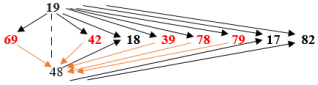
Table 1). Therefore, in all 7 reactions, compound #19 has a direct transformation into all dissipative structures, and transformations 48-18, 48-17, 48-82 are direct (
Figure 2), and entropy production is formed in the forward direction. A symmetrical bifurcation sequence appears; the transformation of the initial components into dissipative structures will depend on the temperature of the process, on the production of entropy, structural changes and the rate constant of transformations.
In addition, negentropy appears at the bifurcation point, that is, reverse transformations of components (69-48, 42-48, 39-48, 78-48, 79-48). Taking into account negentropy, some of the products disappear from this sequence (
Figure 2, shown in red) and a reaction cycle is formed.
Figure 2. Formation of a reaction cycle from a bifurcation sequence.
Entropy production and negentropy are considered together as a state of the system. Entropy production begins under nonequilibrium conditions and acts in a forward direction, while negentropy arises immediately, but in the opposite direction. Entropy production causes the formation of new structures, while negentropy is the force that destroys the formation of these structures. The emergence of negentropy disrupts the symmetry of the bifurcation sequence and creates a reaction cycle. The cycle is characterized by a smaller number of dissipative structures and indicates the possibility of choosing valid attractors. Like entropy production, negentropy is associated with chemical potential, thermodynamic force, affinity, and other parameters
.
Let us consider reaction (
6), the products of which are compounds #17 H
4SiO
4 and #69 Ca
6Si
2O
7(OH)
6.
Upon collision, particles #19 [Ca(OH)
2] and #48 [Ca
3Si
2O
6(OH)
2.2H
2O] exchange kinetic and potential energies (rotational and vibrational), instantly rearranging the outer valence electrons in molecular space. The movement of electrons in a molecule is determined by the average field created by all atomic nuclei and all other electrons
| [28] | Korolkov D. V. Theoretical chemistry. Vol. 1. General principles and concepts. Moscow: ICC "Akademkniga", 2007. 463 p. |
[28]
. In chemical reactions near instability, the distribution of inelastically colliding particles ceases to be random
| [21] | Prigogine I., Kondepudi D. Modern thermodynamics from heat engines to dissipative structures. Moscow: Mir, 2002. 461 p. |
[21]
.
Based on the idea of orbital interactions, which are one of the main components of the elementary act of a chemical reaction, valence orbitals (HOMO and LUMO) are most easily perturbed and play a dominant role in molecular interactions. Naturally, in chemical reactions some bonds are broken in the initial molecules and new bonds are formed in the final molecules. In accordance with the rule of bond symmetry, a reaction is allowed if the symmetry of the formed bonds coincides with the symmetry of the broken bonds
| [28] | Korolkov D. V. Theoretical chemistry. Vol. 1. General principles and concepts. Moscow: ICC "Akademkniga", 2007. 463 p. |
[28]
. In addition, the principle of least motion
| [29] | Pearson R. Rules of symmetry in chemical reactions. Moscow: Mir, 1979. 592 p. |
[29]
states that the lowest activation energy for a reaction is that which requires the least movement of nuclei and the least disruption of the original electron distribution. This principle states that the starting molecules #19 [Ca(OH)
2] and #48 [Ca
3Si
2O
6(OH)
2.2H
2O] approach each other in the most symmetrical way leading to the final molecules.
The final molecules in this reaction are H
4SiO
4 and Ca
6Si
2O
7(OH)
6, the formation of which begins the production of entropy. The second law of thermodynamics allows us to consider two different semigroups that break the symmetry of the transformation
| [22] | Prigogine I. From existing to emerging: time and complexity in physical sciences. Moscow: Nauka, 1985. 327 p. |
[22]
. At each point of phase space there are two manifolds: one is compressed, the other is stretched. Prigogine traces the behavior of contracting and expanding manifolds using the example of the baker’s transformation
| [21] | Prigogine I., Kondepudi D. Modern thermodynamics from heat engines to dissipative structures. Moscow: Mir, 2002. 461 p. |
| [22] | Prigogine I. From existing to emerging: time and complexity in physical sciences. Moscow: Nauka, 1985. 327 p. |
[21, 22]
.
The baker's transformation describes a discrete process occurring at regular intervals leading to the formation of #17 H
4SiO
4 and #69 Ca
6Si
2O
7(OH)
6. These compounds have outer electrons of 32 and 104, respectively, which in phase space lead to various regions of weak stability. The appearance of a particular structure in this area is probabilistic in nature, reflecting the disequilibrium and sensitivity of the system to the environment. Nonequilibrium leads to the formation of dissipative structures. The probability of formation of structures is determined precisely by these external electrons. The baker's transformation comes down to a simple shift of basic functions - “structural units”. The “structural units” of the phase space split into two more “structural units”, which are symmetrical and divided into 2
n+m strips
| [22] | Prigogine I. From existing to emerging: time and complexity in physical sciences. Moscow: Nauka, 1985. 327 p. |
[22]
. In this chemical reaction, the resulting structural units are H
4SiO
4 and Ca
6Si
2O
7(OH)
6. We can consider the formation of a “structural unit” with n = 1 and m = 1 (2
1+1 = 4). In a chemical reaction, the structural unit will be constant and exactly correspond to H
4SiO
4 and Ca
6Si
2O
7(OH)
6. Then the probability of formation of a “structural unit” (W) for our compounds will be determined from the number of electrons:
32/4=8 and 104/4=26.
The total probability number will be W = 34!/8!.26! = 1.815.107.
Since "The Gibbs function normalized to the total number of electrons", “average electron entropy”, “average electron heat capacity” refer to one electron, then the probability must also be related to one electron. Then the probability number per electron will be
A new structure is formed when the entropy production (d
iS) for each transformation becomes maximum (
Table 2-4). Moreover, the more entropy is produced, the more it is transferred to the environment (-d
eS). A certain part of the entropy is transferred to the internal part of the structure. From the material balance of entropy (
Tables 2 and 3) it is clear that the useful production of entropy (d
iS
u) (the difference between the production of entropy of direct transformation and negentropy) for reaction (
6) is 4.970
.10
-4 eV/K (
Table 3), while the transfer of entropy (d
eS) to the environment for direct (
Table 2) and reverse transformations (
Table 3) totals 4.5256
.10
-4 eV/K. The excess amount of entropy production 0.4444
.10
-4 eV/K is absorbed by the reaction products. These provisions are characteristic only for reactions (
2) and (
6); for other reactions, a lack of entropy production is detected. Absorbed entropy results in products with higher entropy and ordered structures. As soon as the path of structuring is chosen, the uncertainty of the system is removed and changes begin, leading to the orderliness of the structures.
Individual transformations of the components transform into a conjugate transformation and the chemical process begins. For the reaction under consideration, a conjugate transformation based on the phenomena of cooperativity via the resonance mechanism is associated with transformations #19-#69, #48-#17, #19-#17. For a single reverse transformation #69–#48, the parameters of the individual and conjugate will be the same.
Taking into account the phenomena of cooperativity, the indicators for the conjugate transformation were calculated for all 7 reactions, both in the forward (
Table 2) and reverse directions (
Table 3). The reaction parameters are given in
Table 4. Since the affinity for reactions (
1) and (
4) is negative, they are not considered.
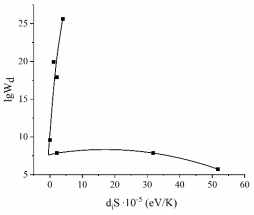
Figure 3. Dependence of the logarithm of the probability of structure formation on entropy production for direct conjugate transformations.
Figure 3 shows the dependence of the logarithm of the probability of structure formation on entropy production for direct conjugate transformations. The same dependence is observed on affinity and rate constant. The dependence is craterial, where one crater wall shows a sharp decrease in the probability of entropy production and characterizes a restructuring of the structure. The second wall has a single-humped appearance. The first wall of the crater represents the compressive and the second wall represents the tensile part of the baker's transformation.
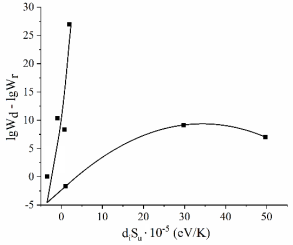
The difference in the logarithm of the probability of the formation of structures during direct and reverse transformations from the useful production of entropy also has a craterial form, where the first wall characterizes a sharper decrease in the probability, and the hump becomes more pronounced (
Figure 4).
Figure 4. Dependence of the difference in logarithms of the probability of structure formation on the useful entropy production.
A feature of chemical reactions is that the entropy production and rate constant of reactions (
2) and (
6) are higher than for other reactions (
Table 4). Moreover, for these two reactions, structures that are simpler than the original ones are formed. These dissipative structures allow the system to transition from a disordered and chaotic state to a new ordered state.
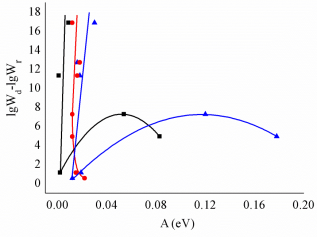
The dependence of the difference in the probability of direct and reverse transformations on affinity (
Figure 5) is also characterized by a craterial appearance, and for direct transformations (
Figure 5, blue line) and for the reaction (
Figure 5, black line) it has a single-humped appearance. For reverse transformations, it forms a steep crater wall (
Figure 5, red line), which is a barrier to the reaction and is associated with the appearance of negentropy
| [12] | Molgedey L., Schuster H. G. Separation of a mixture of independent signals using time-delayed correlations //Phys. Rev. Lett. 1994. - 72: 3634–3636. |
[12]
. This barrier can only be overcome by reactions (
2) and (
6).
Figure 5. Dependence of the difference in the probability of direct and reverse transformations on affinity.
Thus, in an open system, both forward and reverse (negentropy) transformations of components occur at the bifurcation point during a chemical reaction. Transitioning to a probabilistic description of processes allows us to evaluate the action of various forces based on the baker's transformation. It has been established that the probability of the formation of dissipative structures has a craterial form depending on entropy production, affinity, and the rate constant. The appearance of negentropy disrupts the symmetry of the system and enters the reaction cycle. The probability of reverse transformations and negentropy constitute the contracting part of the craterial dependence of dissipative structure formation. This leads to a negentropic barrier. The barrier limits the tendency for entropy to increase and various reactions to complete completion. Furthermore, expanding forces also emerge due to the formation of dissipative structures in accordance with the useful entropy production. Dissipative structures lead to the formation of final compounds with higher entropy and a less complex structure. With the emergence of compressive and tensile forces due to negentropy and entropy production, the symmetry of unitary evolution is broken and it transitions to non-unitary evolution. This symmetry breaking is not due to the emergence of new interactions, but rather results from transformations according to a bifurcation sequence.
Table 2. Parameters of conjugate direct transformations.
Reactions | А, eV | diS, eV/K | dS, eV/K | deS, eV/K | K, 1/c | Ŵd | lgŴd |
1 | 0.012 | 0.828.10-6 | -0.014.10-4 | -0.0223.10-4 | 6.074.1012 | 3.964.109 | 9.598 |
2 | 0.12 | 3.184.10-4 | 0.72.10-4 | -2.464.10-4 | 2.96.1013 | 7.124.107 | 7.853 |
3 | 0.019 | 2.21.10-5 | -0.009.10-4 | -0.222.10-4 | 9.485.1012 | 7.124.107 | 7.853 |
4 | 0.016 | 1.224.10-5 | -0.049.10-4 | -0.171.10-4 | 8.029.1012 | 8.395.1019 | 19.924 |
5 | 0.018 | 2.219.10-5 | -0.053.10-4 | -0.275.10-4 | 9.797.1012 | 8.931.1017 | 17.921 |
6 | 0.178 | 5.178.10-4 | 0.836.10-4 | -4.342.10-4 | 4.657.1013 | 5.338.105 | 5.727 |
7 | 0.03 | 4.02.10-5 | -0.018.10-4 | -0.42.10-4 | 1.032.1013 | 4.201.1025 | 25.623 |
Table 3. Parameters of conjugate inverse transformations.
Reactions | А, eV | NegE, eV/K | diSu, eV/K | dS, eV/K | deS, eV/K | K, 1/c | Ŵr | lgŴr | lgŴd- lgŴr |
1 | 0.022 | 3.483.10-5 | -3.400.10-5 | -0.02.10-4 | -0.368.10-4 | 1.173.1013 | 3.445.109 | 9.537 | 0.061 |
2 | 0.012 | 0.208.10-4 | 2.976.10-4 | 0.024.10-4 | -0.184.10-4 | 1.275.1013 | 0.05 | -1.301 | 9.154 |
3 | 0.015 | 1.139.10-5 | 1.071.10-5 | 0.025.10-4 | -0.114.10-4 | 8.008.1012 | 3.445.109 | 9.537 | -1.684 |
4 | 0.018 | 2.144.10-5 | -0.92.10-5 | -0.015.10-4 | -0.229.10-4 | 9.61.1012 | 3.445.109 | 9.537 | 10.387 |
5 | 0.016 | 1.467.10-5 | 0.752.10-5 | 0.019.10-4 | -0.128.10-4 | 8.528.1012 | 3.445.109 | 9.537 | 8.384 |
6 | 0.012 | 2.076.10-5 | 4.970.10-4 | 0.024.10-4 | -1.836.10-5 | 1.279.1013 | 0.05 | -1.301 | 7.028 |
7 | 0.012 | 2.076.10-5 | 1.944.10-5 | 0.024.10-4 | -1.836.10-5 | 1.279.1013 | 0.05 | -1.301 | 26.924 |
Table 4. Reaction parameters.
Reactions | A, eV | diS, eV/K | dS, eV/K | deS, eV/K | K, 1/c | Ŵ | lgŴ |
2 | 0.054 | 1.3.10-4 | 0.348.10-4 | -0.952.10-4 | 2.194.1013 | 7.124.107 | 7.853 |
3 | 0.002 | 3.495.10-5 | 0.008.10-4 | -3.415.10-5 | 9.984.1011 | 7.124.107 | 7.853 |
5 | 0.001 | 3.51.10-5 | -0.036.10-4 | -0.387.10-4 | 5.408.1011 | 8.931.1017 | 17.921 |
6 | 0.083 | 2.297.10-4 | 0.406.10-4 | -1.891.10-4 | 3.538.1013 | 5.338.105 | 5.727 |
7 | 0.009 | 0.91.10-5 | -0.021.10-4 | 1.1199.10-5 | 4.763.1012 | 4.201.1025 | 25.623 |
In chemical systems, the process of structural ordering is molecular in nature, characterized by the exchange of interaction energies, limited degrees of freedom, and the dependence of ordering indices on the intrinsic properties of the emerging structure. Due to the exchange of energy and entropy with the external environment, irreversible processes proceed in one direction. Moreover, the more intense the entropy flows propagating through the system, the more strongly they change the process parameters.





 Share This Article
 Twitter
 Linked In
 Facebook
 Copy
Copy Download