Research Article | | Peer-Reviewed

Exploration of Aloe Vera Gel Extract as a Bio-based Additive for Self-healing and Anti-corrosive Performance in Alkyd Resin Coatings

Received: 20 October 2025     Accepted: 4 January 2026     Published: 4 June 2026
Views:       Downloads:
Abstract

The effectiveness of Aloe Vera (AV) gum extract as a corrosion-inhibiting and self-healing agent in alkyd-based coatings was investigated in the present study with the aim of developing environmentally friendly protective coatings. To identify the active chemical constituents responsible for corrosion inhibition, phytochemical screening of the AV gum extract was carried out and revealed the presence of bioactive compounds capable of enhancing coating performance. In this work, both urea-formaldehyde (UF) and melamine-formaldehyde (MF) resins were employed as wall materials for the encapsulation of the AV gum extract through microencapsulation techniques. The prepared microcapsules were characterized using Fourier Transform Infrared Spectroscopy (FTIR) to confirm successful encapsulation and the presence of functional groups associated with the extract and polymer matrices. In addition, the surface morphology and dispersion of the microcapsules within the alkyd coating matrix were examined using Scanning Electron Microscopy (SEM). Experimental design analysis and outdoor immersion tests demonstrated that the AV gum extract exhibited remarkable anticorrosion efficiency, improved barrier performance, and effective self-healing capability on damaged or scribed coating surfaces. The coatings containing AV-loaded UF microcapsules showed superior performance compared to MF-based systems. Overall, the study established that Aloe Vera gum extract can serve as an effective, sustainable, and low-cost additive for producing eco-friendly self-healing alkyd-based anticorrosive coatings without reliance on expensive synthetic co-reactants.

Published in American Journal of Polymer Science and Technology (Volume 12, Issue 1)
DOI 10.11648/j.ajpst.20261201.11
Page(s) 1-16
Creative Commons

This is an Open Access article, distributed under the terms of the Creative Commons Attribution 4.0 International License (http://creativecommons.org/licenses/by/4.0/), which permits unrestricted use, distribution and reproduction in any medium or format, provided the original work is properly cited.

Copyright

Copyright © The Author(s), 2026. Published by Science Publishing Group

Keywords

Self-healing, Anti-corrosive, Aloe Vera Gum Extract, Alkyd-based Coatings

1. Introduction
Alkyd resin is an oil-based coating used in the protection of metal from corrosion in the industry. These coatings experience large failure with time during service life thereby causing irreplaceable damage to life and property. However, several efforts have been made by coating researchers to improve the barrier performance of alkyd-based coating using particulate fillers and/or natural exudates . Among the particulate fillers and natural exudates reportedly used includes natural gum exudates , Linseed oil , neem oil , vegetable oil , etc. These natural exudates have certain properties that are also found in Aloe Vera and more which could be utilized for formulation of oil-based coatings .
Aloe Vera is a perennial plant of the Xanthorrhoeaceae family , which can be found in most part of African countries especially Nigeria. The choice of Aloe Vera is occasioned by the rich content, minerals and vitamins, which can be deployed in the inhibition of mild steel during service life . For instance, the pharmaceutical scientists have proven Aloe Vera gel in its use for treatment of choice for burn injuries, , and , healing cutaneous wounds in rats , improve the speed of episiotomy wound healing, . All these recorded successes could be attributed to the antimicrobial and anti-inflammatory effect . Additionally, antioxidants enzymatic systems such as glutathione peroxidase, catalase, and superoxide dismutase (SOD) – metabolize oxidative toxic intermediates [24-26] and the presence of minerals like calcium, sodium magnesium, zinc, copper together with vitamins B1, B2, B6, C, E and folic acid, richly found in Aloe Vera gel facilitates in catalysing the reactions in treatment of wound in human body and animals. In view of the above advantages, some literatures have reportedly used Aloe Vera in corrosion control of some metallic materials.
For instance, Mehdipour et al., 2015 and Ardakani et al., 2020 evaluated Aloe Vera as a Green inhibitor of steel in HCl and H2SO4 medium and observed its efficiency in forming protective layer on the metals like mild steel and aluminum against the acid attack but more protective in sulphuric acid . Similarly, Benzidia, B., et al, 2019 investigated Aloe Vera as a natural inhibitor in NaCl mild steel attack and noted that the efficiency and coverage ratio increased with an increase in aloe vera content up to (75μml) to reach (81.81%) and (0.818) respectively. Vashi, R. and Chaudhari H., 2017 studied and found out that Aloe-Vera gel Extract is a Green Corrosion Inhibitor for Mild Steel in Acetic acid. According to their findings, the presence of Glucose, Mannose, and Cellulose in Aloe Vera makes its reactivity in other materials remarkable, effective, efficient, as well as its deployment for corrosion inhibition. Furthermore, the extracted compounds of Aloe Vera especially the tannin compound can adsorb on the metal surface and block the active sites on the surface thereby reducing the corrosion rate . The impact of Aloe Vera as a biopolymer has found wide application .
In spite of all these recorded successes, the life span of Aloe Vera during its inhibiting function remains a challenge as decrease in inhibition efficiency was observed with increase in Aloe Vera concentration above 75μml, . This could be attributed to the fact that they are readily soluble in water thereby exhibiting uncontrolled release of their contents, thus resulting in durability challenge. Hence, the need to increase the service life and preserve the inhibitor (Aloe Vera gum extract) by encapsulating it for higher and longer performance. In other words, this research is focused in embedding the inhibitor into a coating formulation and controlled released performance when incorporated into a microcapsule. More so, such functional coating with Aloe Vera loaded microcapsule gives the mild steel maximum protection with self-healing capabilities during service operation .
Few studies on the use of Aloe Vera gum extract for corrosion inhibition in aggressive medium have been reported, however, to the best of the authors knowledge, little or no study has been reported in the open literature in incorporating Aloe Vera gel in an alkyd-based protective coating of metallic surfaces for corrosion inhibition and self-healing application except the one emanating from our laboratory. Interestingly, Aloe Vera has not only found suitable applications in healing of wounds and for medical purposes but also in the inhibition of corrosion attack and more effective when incorporated into a coating formulation for self-healing and controlled release during service life in marine application.
The purpose of the study is to for deepen in a confirmatory way the use of Aloe Vera to inhibit metal corrosion. Additionally, Aloe Vera will be used embedded in coating formulation for corrosion studies which has not been reported anywhere except the one emanating from our laboratory. Its significance is seen in the rich content of Aloe Vera.
In favor of the rich chemical content of Aloe Vera, this present study seeks to investigate the use of Aloe Vera gel extract for self-healing and anti-corrosive capabilities in alkyd-based coating. This is done by microencapsulating the inhibitor with both urea and melamine formaldehyde using the in situ-polymerization method. Surface morphologies of the microcapsules were evaluated using the Scan electron microscope (SEM) and examined by Fourier transform Infrared Spectroscopy (FTIR). Furthermore, the microcapsule loaded with inhibitor was incorporated into an alkyd-based coating for corrosion testing, self healing evaluation and inhibition.
2. Experiments
2.1. Materials
Aloe Vera gum extract was collected manually from the plant by pressing the leaves and extracting the gel. The Aloe Vera was locally sourced from Anambra State, Nigeria. Identification of the plant was done in Crop Science Technology Laboratory, Federal University of Technology, Owerri, Nigeria. The extracted Aloe Vera (AV) gum was stabilized using ammonia solution and then stored in a dessicator prior to its use as healing and anti-corrosive agents.
The microcapsule’s shell was formed using Urea, melamin and formaldehyde (37 wt% formaldehyde in water) solution by in situ-polymerization method. The solution dodecyl benzene sulfonate (SDBS) and poly (vinyl alcohol) (PVA) were used as surfactants and stabilizers, respectively. To increase the mechanical strength of the capsule, resorcinol and ammonium chloride were used as cross-linker and co-reactants respectively. Sodium hydroxide (NaOH) and sulphuric acid (H2SO4) were used to control pH. The coating was prepared using alkyd resin while calcium carbonate (CaCO3) and linseed oil were used as extenders and solvent. Litharge was added to the paint to quicken the drying time. Prepared coatings were applied on Q235 steel which was used as substrate. Sodium chloride (NaCl) was used for the preparation of simulated marine water (electrolyte). All these reagents and chemicals were of analytical grade.
2.2. Methods
2.2.1. Encapsulation Process
The following procedures as already established by Arukalam I. O et al., 2021, Njoku C. N. et al, 2018 and Arukalam et al., 2020 [40-42] was carried out. Firstly, urea-formaldehyde (UF) and melamine-formaldehyde (MF) were each prepared by mixing 20.0 g of urea and 20.0 g of formaldehyde; 20.0 g of melamine and 20.0 g of formaldehyde separately in 250 ml beakers and stirred at 250 rpm until clear solutions were obtained. The pH of the solutions was adjusted to 8.5 with NaOH. The resulting mixtures in separate beakers were heated to 70°C for 1 hour in a thermostatic water bath. Consequently, urea formaldehyde and melamine formaldehyde pre-polymers were produced.
Secondly, each of the pre-polymers was mixed with 0.5 g PVA and 0.1 g SDBS in the presence of water (water phase). Subsequently, the appropriate amount of the extracted Aloe Vera gum was dispersed in the water phase by vigorously stirring the mixture at 500 rpm for 20 minutes to allow the Aloe Vera gum to be incorporated into the pre-polymer. Additionally, of 0.5 g of resorcinol and 0.5 g ammonium chloride were incorporated into the reaction medium. Also, two drops of 0.5 M H2SO4 acid catalyst were added to the emulsion to adjust the pH to 2.5 and the overall mixture was placed on a hot plate magnetic stirrer equilibrated at 70°C and 500 rpm. The set-up was allowed for 3 hours to ensure adequate interfacial polymerization and encapsulation process. At the end of the allotted time, the beakers containing the capsules were retrieved and allowed to cool at room temperature. The capsules were separated from the aqueous phase by filtration technique using filter paper and funnel. The obtained capsules were washed with water and oven dried at 50°C for 5 hours. Thereafter, they were gently ground in a mortar and sieved using the 50 micron-sized mesh to obtain free flowing powdered microcapsules.
2.2.2. Characterization of UF-Aloe and MF-Aloe Capsules
The Aloe Vera capsules loaded in both melamine and urea formaldehyde were characterized using both Scan electron microscope (SEM) and Fourier transform infrared spectroscopy (FTIR). The samples were dispersed in appropriate quantity of xylene using ultra-sonicator, which was further kept on a silicon surface and air dried. INSPECT F50 Filed Emission SEM were used to check for the surface morphology of the microcapsules. The use of Nicolet Corporation Model magna IR560 infrared Spectrophotometer was also employed in determining the IR Spectra of the microcapsules in the range of 400 to 4000 cm-1 wavelength.
2.2.3. Coating Preparation
A little portion 10.0 g of MF loaded microcapsule of Aloe Vera was dispersed in 10 ml of xylene with the help of an ultrasonicator water bath for 20 mins to get a uniform solution. Alkyd resin solution was furthermore prepared by dissolving 10.0 g alkyd resin with 5 ml xylene. A proper mixture of both solutions (resin and particle) was obtained after 30 mins of using magnetic stirrer. Curing agent in the ratio of 3:2 was further added to the resulting solution and was properly mixed for 2 h. The above listed procedure was carefully repeated for the UF loaded microcapsule of Aloe Vera. For a control sample, alkyd coating without the microcapsule was also prepared to serve as a point of reference and following similar steps outlined above.
The 3 different resulting coatings viz plain alkyd, MF + Aloe Vera and UF + Aloe Vera were carefully applied using a brush on Q235 steel substrates. To achieve proper curing of the coating, the coated substrate was allowed to air dry for 7 days. At the expiration of 7 days, (PosiTector 6000 of Defelsko, USA) handheld electronic guage was used to ascertain the average film thickness of the coatings and it was measured to be 55 ± 12 μm. Furthermore, gravimetric weight loss/gain method was first employed to check the impact of the NaOH solution on the coated substrate. The substrate was subsequently retrieved for 21 days and the outcome duly noted. Additionally and as described in Njoku C. N. et al, 2018 and Arukalam et al., 2020 Jadhav et al., 2011 [41-43], the coated substrate was carefully scribed with a knife and exposed to the NaOH medium to check for the self-healing capabilities of the Aloe Vera loaded microcapsules.
2.3. Experimental Design
Central composite design (CCD) of response surface methodology was used to study effects of the dosage of UF-Aloe or MF-Aloe and days as independent variables on the dependent variables (weight loss). The factors and levels of the experimental design are displayed in Table 1. The 20 experimental runs were obtained using the CCD with alpha (𝛼) value of 1.68. These formulations consist of six centre points, six axial points and eight factorial points. The experiments were conducted randomly, and the data were analyzed by using Design Expert Software version 13.
Table 1. Experimental design range and levels of independent variables using central composite design of experiment.

Factor

-1

0

1

UF-Aloe or MF-Aloe

0

1

5

9

10

Days (time)

7

10

18

25

28

Anti-corrosion and Self-healing Performance of the Coating
To ascertain the anti-corrosion and self-healing performance of the coatings loaded with the microcapsules, the scribed and unscribed coated substrate was clamped between the O-ring seal and a glass tube. 3.5% of NaOH was used to fill the tube and was covered with a rubber stopper. Mounted over the stopper was a platinum counter electrode (PCE) and a saturated colomel electrode (SCE) which served as a reference. At a room temperature of (25 ± 1°C) with an Autolab electrochemical station, Electrochemical Impedance Spectroscopy (EIS) tests were carried out on the samples in the frequency range of 100 kHz to 10 mHz with a 20 mCAV perturbation at open circuit potential. The various coated samples were immersed in the corrosive medium and periodically monitored for 24, 72, 120, 240, 360 and 480 h. To ensure reproducibility, the experimental procedures were repeated three times for each coating formulation. The date presented was done in the terms of Bode Impedance Modulus |Z|. Furthermore, for proper analysis of the self-healing ability, the surface morphology was properly observed using the Scan electron Microscope on the plain and the two composite coatings before and after EIS experiment.
2.4. Results and Discussion
2.4.1. Results on the SEM and FTIR Analysis
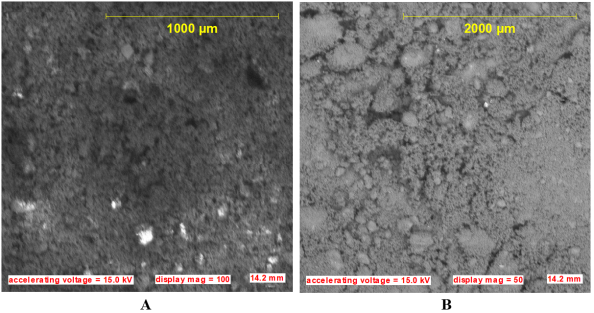
The microcapsules were exposed to SEM analysis Figure 1 of both the Urea and melamine loaded microcapsule to check its surface morphology bearing both the core and shell part as explained in an article . The SEM images were taken at 1000 μm and 2000 μm respectively showing the presence of the core (carrying the microcapsule) and the shell (the urea and melamine). The Shell in aggressive medium breaks open thereby releasing the content of the microcapsule that truly brings about healing in a particular crack on the metal during usage.
Figure 1. SEM images of (A) MF+Aloe vera and (B) UF+Aloe vera.
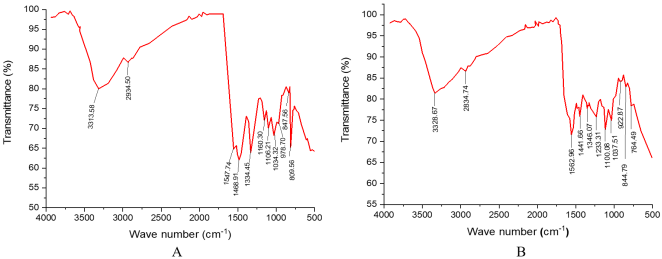
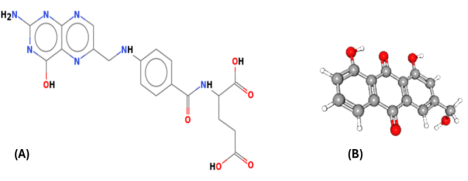
Similarly, in (Table 2) the microcapsules containing Aloe Vera are also seen to contain an amide group both primary and secondary as observed from the FTIR spectra of 3500 and 1680 respectively. The C-H stretch bond is the type of vibration causing IR absorption as seen in Folic acid (A Vitamin seen in Aloe Vera) and C-O stretch bond as seen in Aloe Emodin (An Anthroquinone) which is also seen in Aloe Vera .
Table 2. IR Spectra data of microencapsulated (MF+Aloe Vera) and (UF+Aloe Vera).

Characteristic group

MF+Aloe Vera

UF+Aloe Vera

Remarks

C=O stretching

1803

1815

Strong acid halide

N-H stretching

3500

3450

Medium primary amide

O-H bending

1390

1320

Medium Phenol

C=O stretching

1680

1650

Strong secondary amide

O-H stretching

3326

3316

Strong carboxylic acid

C-H stretching

2855

2922

CH2 group

There is a presence of strong of acid and alkane group that makes the Aloe vera a good inhibitor to corrosion. Furthermore, medium phenolic scaffold was observed in Aloe Vera which gives its antioxidant property and is very suitable for the purpose of corrosion inhibition and self-healing on coatings. Figure 3 Folic acid, a vitamin and Aloe Emodin further portrays the chemical compound most visible in Aloe vera with the bonding sites for reaction.
Figure 2. FTIR Spectra of (A) UF+Aloe Vera and (B) MF+Aloe Vera.
Figure 3. (A) Folic acid and (B) 1, 8-dihydroxy-3-(hydroxymethyl) anthracene-9, 10-dione (Aloe Emodin).
The combination of these peaks in Figure 2 indicates the successful integration of both UF resin and Aloe Vera. The strong O-H stretch indicates the Aloe Vera component, while the carbonyl and N-H stretches are indicative of the urea-formaldehydes resin which confirms encapsulation. The spectrum likely shows overlapping regions because of the combination of the resin and natural polymer in Aloe Vera.
For the MF + Aloe Vera sample (Figure 2B), the FTIR graph also have peaks for the Aloe Vera's O-H groups alongside strong peaks for N-H and C-N vibrations from the melamine component also showing encapsulation. The C=O and C-N bonds in melamine are likely contributing sharper and more defined peaks compared to the UF system due to melamine's more rigid and aromatic nature.
In comparison UF + Aloe Vera may show more prominent N-H and C=O stretches due to the simpler molecular structure of urea compared to melamine while MF + Aloe Vera have sharper peaks due to the aromatic rings in melamine, contributing to stronger, more defined peaks in the C-N region. Both samples show the presence of Aloe Vera, characterized by broad O-H stretches, while the UF and MF resins contribute their respective characteristic peaks.
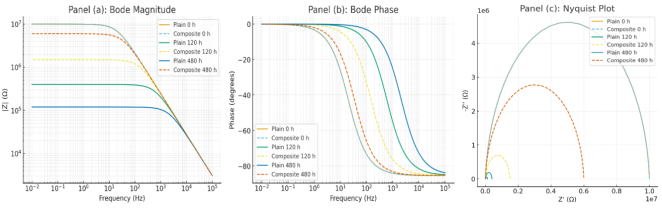
Electrochemical Impedance Spectroscopy (EIS) was employed to evaluate the corrosion protection and self-healing performance of the plain coating and the microcapsule-loaded composite coating during immersion in 3.5 wt% NaCl solution.
Figure 4. Electrochemical Impedance Spectroscopy (EIS) response of plain and microcapsule-loaded composite coatings after immersion in 3.5 wt% NaCl solution for different exposure times. (a) Bode impedance modulus |Z| as a function of frequency, showing a continuous reduction in low-frequency impedance for the plain coating, while the composite coating retains significantly higher |Z| values at prolonged immersion. (b) Bode phase angle plots illustrating the evolution of dielectric behavior; the composite coating maintains a broader and more stable capacitive region compared to the plain coating. (c) Nyquist plots indicating a progressive decrease in charge-transfer resistance (R₍ct₎) for the plain coating, whereas the composite coating exhibits an increase in R₍ct₎ at extended immersion times, confirming effective self-healing behavior.
The combined EIS results demonstrate that while the plain coating undergoes irreversible degradation during immersion, the microcapsule-loaded coating effectively responds to damage by releasing healing agents that seal defects and restore the protective barrier. The recovery of impedance and charge-transfer resistance at long immersion times confirms the self-healing capability of the composite coating and its enhanced corrosion protection performance. The EIS results clearly demonstrate that the microcapsule-loaded coating exhibits autonomous self-healing behavior, evidenced by the recovery of low-frequency impedance, stabilization of phase angle response, and increased charge-transfer resistance during prolonged exposure to a corrosive environment.
2.4.2. Statistical Analysis of Corrosion Weight Loss of UF-Aloe and MF-Aloe Incorporated Coatings
The Central composite response surface method of the experiment was used to examine the effects of independent variables (UF-Aloe/MF-Aloe and time) on corrosion weight loss of epoxy coatings. According to the study, the corrosion weight loss value ranged from 0.053 g to 0.256 g for alkyd coatings incorporated with melamine formaldehyde microencapsulated aloe vera extract (MF-Aloe), and between 0.037 to 0.154 g for alkyd coatings incorporated with urea formaldehyde (UF-Aloe). The design table for the independent variables and the response variable are shown in Tables 3 and 4 below.
Table 3. The corrosion weight loss of alkyd coatings with respect to MF-Aloe and time.

Run

A: MF-Aloe

B: Time

weight loss

mg

days

mg

Residual

1

5

18

0.089

-0.0002

2

0

18

0.248

-0.0008

3

9

10

0.067

-0.0015

4

5

18

0.089

-0.0006

5

5

18

0.089

-0.0008

6

10

18

0.053

0.0007

7

1

10

0.184

-0.0006

8

5

18

0.088

-0.0018

9

9

25

0.062

0.0007

10

1

25

0.256

0.0017

11

5

18

0.093

0.0034

12

5

28

0.137

-0.0017

13

5

7

0.097

0.0016

Table 4. The corrosion weight loss of alkyd coatings with respect to UF-Aloe and time.

Run

A: UF-Aloa

B: Time

weight loss

mg

days

mg

Residual

1

5

18

0.072

0.0002

2

0

18

0.154

0.0000

3

9

10

0.037

0.0004

4

5

18

0.071

-0.0001

5

5

18

0.072

0.0003

6

10

18

0.048

-0.0002

7

1

10

0.124

0.0002

8

5

18

0.071

-0.0003

9

9

25

0.059

-0.0001

10

1

25

0.140

-0.0002

11

5

18

0.072

-0.0000

12

5

28

0.084

0.0002

13

5

7

0.057

-0.0004

Model Summary Statistics
The quadratic model was selected as the best model for analyzing weight loss for both coatings incorporated with MF and UF encapsulated aloe vera. This is because the R2, adjusted R2, and predicted R2 values were maximized by the quadratic model, as can be seen in the table below (Tables 5 and 6). The adjusted R2 value demonstrates the model's descriptive power when more variables are included, whereas the predicted R2 value illustrates how well a regression model predicts the dependent variables. Additionally, the predicted and adjusted R2 values for the weight loss are both near unity for both MF-Aloe alkyd coatings and UF-Aloe alkyd coatings, and the difference between the two (predicted and adjusted R-Squared) is less than 0.2, indicating that there is reasonable agreement between them .
Table 5. Weight loss Model Summary Statistics of MF-Aloe alkyd coatings.

Source

Std. Dev.

Adjusted R²

Predicted R²

PRESS

Linear

0.0320

0.8148

0.7777

0.6769

0.0179

2FI

0.0312

0.8418

0.7890

0.5922

0.0225

Quadratic

0.0020

0.9995

0.9991

0.9978

0.0001

Suggested

Cubic

0.0018

0.9997

0.9993

0.9995

0.0000

Aliased

Table 6. Weight loss Model Summary Statistics of UF-Aloe alkyd coatings.

Source

Std. Dev.

Adjusted R²

Predicted R²

PRESS

Linear

0.0135

0.8809

0.8571

0.7803

0.0033

2FI

0.0142

0.8814

0.8419

0.7071

0.0045

Quadratic

0.0003

0.9999

0.9999

0.9997

4.692E-06

Suggested

Cubic

0.0002

1.0000

1.0000

0.9997

4.022E-06

Aliased

2.4.3. ANOVA for Quadratic Model
The model's analysis of variance (ANOVA) and the related significant model terms for the dependent variable are shown in the table (Tables 7 and 8) below. The weight loss's model F-value of 2641.15 and 34681.87 for both MF-Aloe alkyd coatings and UF-Aloe alkyd coatings, respectively, indicates its significance. Furthermore, there is only a 0.01 per cent chance that a significant F-value is the result of noise. P-values below 0.05 further imply the significance of the model terms. Hence all model terms are important for studying MF-Aloe incorporated alkyd coatings while A, B, AB, A2 are the only significant model terms for studying the weight loss of alkyd coatings incorporated with UF-Aloe.
Table 7. Weight loss ANOVA for Quadratic model of alkyd coatings incorporated with MF-Aloe.

Source

Sum of Squares

df

Mean Square

F-value

p-value

Model

0.0551

5

0.0110

2641.15

< 0.0001

significant

A-MF-Aloa

0.0425

1

0.0425

10195.32

< 0.0001

B-Days

0.0019

1

0.0019

458.18

< 0.0001

AB

0.0015

1

0.0015

355.10

< 0.0001

0.0076

1

0.0076

1815.46

< 0.0001

0.0014

1

0.0014

346.87

< 0.0001

Residual

0.0000

7

4.169E-06

Lack of Fit

0.0000

3

4.662E-06

1.23

0.4092

not significant

Pure Error

0.0000

4

3.800E-06

Cor Total

0.0551

12

Adeq precision

145.47

Table 8. Weight loss ANOVA for Quadratic model of alkyd coatings incorporated with UF-Aloe.

Source

Sum of Squares

df

Mean Square

F-value

p-value

Model

0.0152

5

0.0030

34681.87

< 0.0001

significant

A-UF-Aloa

0.0127

1

0.0127

1.448E+05

< 0.0001

B-Days

0.0007

1

0.0007

8293.41

< 0.0001

AB

8.367E-06

1

8.367E-06

95.24

< 0.0001

0.0018

1

0.0018

20425.58

< 0.0001

7.730E-08

1

7.730E-08

0.8800

0.3794

Residual

6.149E-07

7

8.784E-08

Lack of Fit

3.869E-07

3

1.290E-07

2.26

0.2233

not significant

Pure Error

2.280E-07

4

5.700E-08

Cor Total

0.0152

12

Adeq precision

320.55

The lack of fit F-value for weight loss is 1.23 and 2.26 for MF-Aloe incorporated alkyd coatings and UF-Aloe incorporated coatings respectively, which indicates that it is not statistically significant in comparison to the pure error. A large Lack of Fit F-value has a 40.92% and 22.33 likelihood of being caused by noise in the MF-Aloe incorporated alkyd coatings and UF-Aloe incorporated alkyd coatings respectively. Model fit can be achieved with a non-significant lack of fit. The signal-to-noise ratio is measured using adeq precision. A ratio of at least 4 is preferred. Consequently, a ratio of 145.47 and 320.55 suggests a strong signal for both coatings incorporated with MF-Aloe and UF-Aloe respectively. Therefore, this model can be utilized to explore the design space.
2.4.4. Model Equation
As may be seen in the equations below, it was created to express weight loss. The resulting equations displayed the dependent and independent variables' empirical relationship. By comparing the factor coefficients, the coded equation as it is given below can be used to determine the relative importance of the factors.
Weight lossUF= 0.071-0.037+ 0.009+ 0.0012AB + 0.0149A2 (1)
Weight lossMF=0.088-0.0683+ 0.0154B-0.01681AB + 0.03052A2 + 0.01431B2(2)
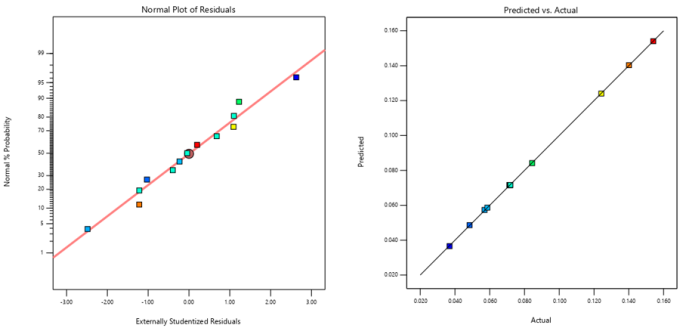
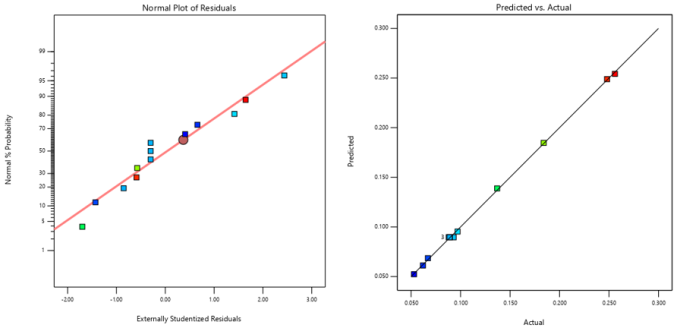
The experimental data were also subjected to analysis to investigate the normal plot of the residue and the association between experimental (actual values) and predicted values for weight loss for both UF-Aloe and MF-Aloe alkyd coatings as shown in Figures 4 and 5. As shown in the figures, the data points on the plot were linearly distributed and not far from the normal, demonstrating a good match between the experimental and predicted values of the responses and the suitability of the underlying assumptions of the aforementioned analysis. The outcome also indicates that the quadratic model chosen was appropriate and sufficient in predicting the response variables for the experimental data.
Figure 5. Normal plot and the predicted versus actual values plot for weight loss of UF-Aloe alkyd coatings.
Figure 6. MF-Normal plot and the predicted versus actual values plot for weight loss of MF-Aloe alkyd coatings.
2.4.5. Effect of the MF-Aloe/UF-Aloe Dosage and Time on the Corrosion Weight Loss
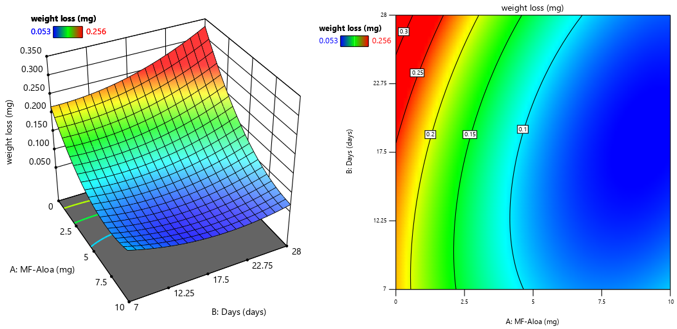
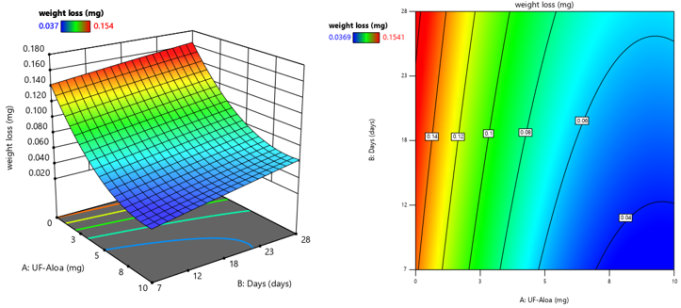
The statistically significant factors found by the statistical analysis were used to create the 3D plots. The graph displayed the combined impacts of two independent variables on corrosion weight loss. Figures 6 and 7 depicts the effects of MF-Aloe dosage and time, and UF-Aloe dosage and time on the corrosion weight loss of the coatings respectively. From the figures below, it was observed that the increase in time (days) and decrease in MF-Aloe/UF-Aloe dosage led to an increase in weight loss while increasing dosage led to a decrease in weight loss. This is as a result of the anticorrosion capabilities of the MF and UF microencapsulated Aloe Vera extract. Similar observation was made by Arukalam I. O et al., 2021 in their study of the corrosion properties of urea and melamine formaldehyde encapsulated Aloe Vera gum extract. Comparing the weight loss of MF-Aloe incorporated alkyd coatings and UF-Aloe incorporated alkyd coatings, it could be observed that the anticorrosion performance of UF-Aloe incorporated alkyd coatings was more stable than that of MF-Aloe incorporated coating which showed gradual decrease of anticorrosion performance with increasing immersion time. This indicates that the reactivity of Aloe Vera extract with Urea formaldehyde (UF) was stronger, more compact and impervious to penetrating corrodent than the reactivity product of Melamine formaldehyde (MF) and Aloe Vera extract.
Figure 7. 3D and contour plots showing the effect of MF-Aloe dosage and Time (days) on weight loss of MF-Aloe alkyd coatings.
Figure 8. 3D and contour plots showing the effect of UF-Aloe dosage and Time (days) on weight loss of UF-Aloe alkyd coatings.
2.4.6. Optimization and Verification of the Experiment
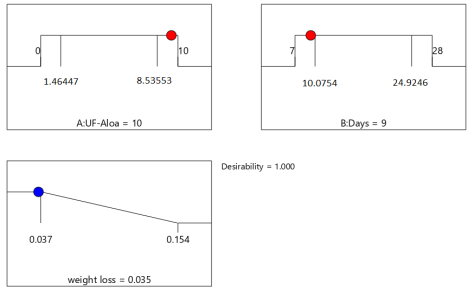
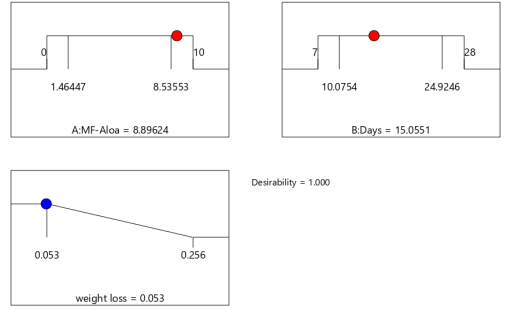
The experimental design was used to optimize (minimize) weight loss. The optimal conditions for UF-Aloe incorporated coatings were UF-Aloe dosage of 10 g, time of 9 days, which corresponded to a weight loss value of 0.035 g, and a desirability level of 100% while the conditions for MF-Aloe incorporated coatings were MF-Aloe dosage of 8.90 g, time of 15 days which corresponded to a weight loss value of 0.053 g, and desirability of 100%. Confirmation experiments were run, and the outcomes were compared to what the model had predicted. The experimental value was 0.039 g for weight loss of UF-Aloe incorporated coatings and 0.050 g for MF-Aloe incorporated coatings. The percentage error between predicted and experimental values was lower than 5%, showing good agreement. Therefore, the design models developed in this study are critical in understanding the weight loss value in corrosion studies of UF-Aloe, and UF-Aloe incorporated alkyd coatings.
Figure 9. Optimized values of the quadratic model for corrosion weight loss using Aloe Vera extract.
Figure 10. Optimized values of the quadratic model for corrosion weight loss using Aloe Vera extract.
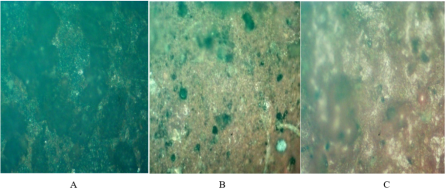
Figure 11. Optical microscopic view of (A) plain coating without microcapsule, (B) MF+Aloe Vera and (C) UF+Aloe Vera of mild steel.
A careful survey of Metals I and II shows a gradual decrease in the weight of the metal which implies obvious corrosion as is further explained in the columns F and G. On the other hand, metals III and IV showed an initial decrease in weight after the first day and subsequent increase in the weight in the remaining days. This could be attributed to the adsorption that took place between the coating matrix and the metal surface thereby preventing the corrosive medium from penetrating. The initial decrease could be the time it took the microcapsule from breaking its shell and releasing its content before forming layers around the coating and hence protecting the metal. Columns F and G of these metals showed that there was no visible corrosion experienced in the metal. Figure 11 further explains the nature of adhesion on the coating showing the inhibitive capabilities of the Aloe Vera while the coating without microcapsule (A) showed obvious corrosion with the corrodant penetrating through the coating.
2.5. Electrochemical Analysis of the Microcapsules Self-healing Performance of the Coating
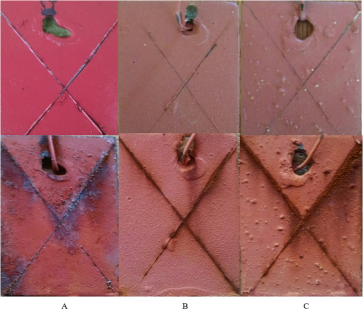
In order to check for the self-healing capabilities of Aloe Vera, the coated substrates were scribed with a knife and exposed to the corrosive medium. The experimental set-up was allowed for 30 days after which it was retrieved and analysed. Figure 12 reveals the pictorial image of the experiment before and after the immersion test. It is obvious that Figure 12A showed obvious corrosion of the metal. By implication, the coating formulations could not protect the metal particularly the scribed part from corroding. Figure 12B and 12C reveals that self-healing of the coating happened after it was exposed to the corrodent. This is due to the Aloe Vera capsules embedded in the coating matrix which allows it to release its content when any scatch or scribbing is noticed thereby healing the coating and covering it up.
Figure 12. Pictoral image of the (A) plain coating without microcapsule, (B) MF+Aloe Vera and (C) UF+Aloe Vera of mild steel after 30 days of immersion.
3. Conclusion
The self-healing and anti-corrosive capabilities of Aloe Vera in alkyd-based coating was investigated. Aloe Vera extract was both encapsulated with Melamine formaldehyde (MF) and Urea formaldehyde (UF) to help control the release of the inhibitor during service life. SEM analysis showed the surface morphology of the microcapsule and proved that Aloe Vera extract was actually encapsulated showing the walls of the capsule. Further characterization of the microcapsule using FTIR showed that Aloe Vera extract will truly encapsulated and possesses requisite chemical components for corrosion inhibition capabilities. The gravimetric weight loss/gain measurement showed that the Aloe Vera extract exhibits remarkable corrosion inhibition potential and barrier performance in the composite coating. The Optical image of the exposed sample was further analyzed to confirm the barrier performance of the composite coating. It was also observed that Aloe Vera extract showed high self-healing performance when exposed to harsh environment. The self-healing capabilities were attributed to the presence of Folic acid and Aloe emodin that is found in Aloe Vera and the cross-linking reaction of these constituents . The microcapsule with the Urea formaldehyde (UF) showed higher efficiency than that of Melamine formaldehyde (MF). Furthermore, Aloe Vera extract embedded microcapsule has proven to be suitable for composite coating in pipeline applications.
4. Recommendation
The author recommends that the antimicrobial and antibacterial properties of Aloe Vera should also be studied. More research on corrosion inhibition using Biomasses are also encouraged.
Abbreviations

AV

Aloe Vera

UF

Urea Formaldehyde

MF

Melanin Formaldehyde

Conflicts of Interest
The authors declares no conflicts of interest.
References
[1] Hasnat, A., A. Moheman, and M. A. Usmani, Alkyd resins: Versatile bio-based coating materials, in Vegetable Oil-Based Polymers and their Surface Applications. 2024, Elsevier. p. 93-107.
[2] Ahmed, S., Alkyds from vegetable oils for surface application, in Vegetable Oil-Based Polymers and their Surface Applications. 2024, Elsevier. p. 33-50.
[3] Ifijen, I. H., et al., Review on solvents based alkyd resins and water borne alkyd resins: impacts of modification on their coating properties. Chemistry Africa, 2022. 5(2): p. 211-225.
[4] Ghani, R. S. M., A review of different barriers and additives to reduce boron movement in boron dual treated wood. Progress in Organic Coatings, 2021. 160: p. 106523.
[5] Holmberg, K., Applications of surfactants in paints, in Surfactants in Polymers, Coatings, Inks and Adhesives. 2020, Blackwell. p. 152-179.
[6] Kyei, S. K., et al., Natural polyhydroxy resins in surface coatings: a review. Journal of Coatings Technology and Research, 2022. 19(3): p. 775-794.
[7] Arukalam, I. O., et al., Inhibition of sulfate-reducing bacteria influenced corrosion on hydrophobic poly (dimethylsiloxane) coatings. Journal of Materials Science & Technology, 2020. 52: p. 198-206.
[8] Yang, Y., et al., Construction of iodine vacancy-rich BiOI/Ag@ AgI Z-scheme heterojunction photocatalysts for visible-light-driven tetracycline degradation: transformation pathways and mechanism insight. Chemical Engineering Journal, 2018. 349: p. 808-821.
[9] Nahlé, A., et al., UAE neem extract as a corrosion inhibitor for carbon steel in HCl solution. International Journal of Corrosion, 2010. 2010.
[10] Kasshanna, S. and P. Rostron, Novel synthesis and characterization of vegetable oil derived corrosion inhibitors. J. Mater. Environ. Sci, 2017. 8(12): p. 4292-4300.
[11] Kumar, N., et al., Characterization of aloe vera gel-based edible coating with orange peel essential oil and its preservation effects on button mushroom (Agaricus bisporus). Food and Bioprocess Technology, 2023. 16(12): p. 2877-2897.
[12] Minwuyelet, T., M. MogesSewalem, and M. Gashe, Review on therapeutic uses of Aloe vera. Global J Pharmacol, 2017. 11(2): p. 14-20.
[13] Pandey, A. and S. Singh, Aloe Vera: A Systematic Review of its Industrial and Ethno-Medicinal Efficacy. International Journal of Pharmaceutical Research & Allied Sciences, 2016. 5(1).
[14] YADAV, A., U. SINGH, and R. CHARAN, 1. Texture analysis of aleo vera-a review by anuj yadav, upendra singh and ravi charan. International research journal of chemistry, 2018. 20: p. 1 to 8-1 to 8.
[15] Adlakha, K., B. Koul, and A. Kumar, Value-added products of Aloe species: Panacea to several maladies. South African Journal of Botany, 2021.
[16] Verma, C., et al., Principles and theories of green chemistry for corrosion science and engineering: design and application. Green Chemistry, 2024. 26(8): p. 4270-4357.
[17] Akhoondinasab, M. R., M. Akhoondinasab, and M. Saberi, Comparison of healing effect of aloe vera extract and silver sulfadiazine in burn injuries in experimental rat model. World journal of plastic surgery, 2014. 3(1): p. 29.
[18] Liang, J., et al., Aloe vera: a medicinal plant used in skin wound healing. Tissue Engineering Part B: Reviews, 2021. 27(5): p. 455-474.
[19] Jamil, M., et al., Review effect of aloe vera on wound healing: Review: Effect of aloe vera on wound healing. Biological Sciences-PJSIR, 2020. 63(1): p. 48-61.
[20] Kashanian, M., et al., Evaluation of the effect of vitamin E on pelvic pain reduction in women suffering from primary dysmenorrhea. The Journal of reproductive medicine, 2013. 58(1-2): p. 34-38.
[21] Oryan, A., S. Monazzah, and A. Bigham-Sadegh, Bone injury and fracture healing biology. Biomedical and environmental sciences, 2015. 28(1): p. 57-71.
[22] Eghdampour, F., et al., The impact of Aloe vera and calendula on perineal healing after episiotomy in primiparous women: a randomized clinical trial. Journal of caring sciences, 2013. 2(4): p. 279.
[23] Somboonwong, J., et al., Therapeutic effects of Aloe vera on cutaneous microcirculation and wound healing in second degree burn model in rats. Journal of the Medical Association of Thailand= Chotmaihet thangphaet, 2000. 83(4): p. 417-425.
[24] Adil, M. F., et al., Zinc alleviates cadmium toxicity by modulating photosynthesis, ROS homeostasis, and cation flux kinetics in rice. Environmental Pollution, 2020. 265: p. 114979.
[25] Ergul, A., et al., Impact of comorbidities on acute injury and recovery in preclinical stroke research: focus on hypertension and diabetes. Translational stroke research, 2016. 7: p. 248-260.
[26] Hajhashemi, V., A. Ghannadi, and A. Heidari, Anti-inflammatory and wound healing activities of Aloe littoralis in rats. Research in Pharmaceutical Sciences, 2012. 7(2): p. 73.
[27] Surjushe, A., R. Vasani, and D. Saple, Aloe vera: a short review. Indian journal of dermatology, 2008. 53(4): p. 163.
[28] Heidarieh, M., et al., Effects of dietary Aloe vera on growth performance, skin and gastrointestine morphology in rainbow trout (Oncorhynchus mykiss). Turkish Journal of Fisheries and Aquatic Sciences, 2013. 13(2).
[29] Mehdipour, M., B. Ramezanzadeh, and S. Arman, Electrochemical noise investigation of Aloe plant extract as green inhibitor on the corrosion of stainless steel in 1 M H2SO4. Journal of Industrial and Engineering Chemistry, 2015. 21: p. 318-327.
[30] Ardakani, E. K., E. Kowsari, and A. Ehsani, Imidazolium-derived polymeric ionic liquid as a green inhibitor for corrosion inhibition of mild steel in 1.0 M HCl: Experimental and computational study. Colloids and Surfaces A: Physicochemical and Engineering Aspects, 2020. 586: p. 124195.
[31] Benzidia, B., et al., Investigation of green corrosion inhibitor based on Aloe vera (L.) Burm. F. for the protection of bronze B66 in 3% NaCl. Anal. Bioanal. Electrochem., 2019. 11: p. 165-177.
[32] Vashi, R. and H. Chaudhari, The study of aloe-vera gel extract as green corrosion inhibitor for mild steel in acetic acid. Int J Innov Res Sci Eng Tech, 2017. 6(11): p. 22081-22091.
[33] Ayoola, A., et al., Inhibitive corrosion performance of the eco-friendly aloe vera in acidic media of mild and stainless steels. Journal of Bio-and Tribo-Corrosion, 2020. 6: p. 1-13.
[34] Jithendra, P., et al., Biopolymer collagen-chitosan scaffold containing Aloe vera for chondrogenic efficacy on cartilage tissue engineering. International Journal of Biological Macromolecules, 2023. 248: p. 125948.
[35] Kaczmarek-Szczepańska, B., et al., Development and Characterization of Biocompatible Chitosan-Aloe Vera Films Functionalized with Gluconolactone and Sorbitol for Advanced Wound Healing Applications. ACS Applied Materials & Interfaces, 2025.
[36] Al–Asadi, A. A., et al., Effect of an Aloe Vera As a Natural Inhibitor on The Corrosion of Mild Steel in 1 wt.% NaCl. Int J Eng Technol, 2015. 2(06).
[37] Ong, G., R. Kasi, and R. Subramaniam, A review on plant extracts as natural additives in coating applications. Progress in Organic Coatings, 2021. 151: p. 106091.
[38] Lu, T., et al., Advances in controlled release of microcapsules and promising applications in self-healing of asphalt materials. Journal of Cleaner Production, 2021. 294: p. 126270.
[39] Xiao, Z., et al., Application of microencapsulation technology in silk fibers. Journal of Applied Polymer Science, 2022. 139(25): p. e52351.
[40] Arukalam, I. O., I. O. Madu, and E. Y. Ishidi, High performance characteristics of Lupinus arboreus gum extract as self-healing and corrosion inhibition agent in epoxy-based coating. Progress in Organic Coatings, 2021. 151: p. 106095.
[41] Njoku, C. N., et al., Optimizing maleic anhydride microcapsules size for use in self‐healing epoxy‐based coatings for corrosion protection of aluminum alloy. Materials and Corrosion, 2018. 69(9): p. 1257-1267.
[42] Arukalam, I. O., et al., Exploitation of natural gum exudates as green fillers in self-healing corrosion-resistant epoxy coatings. Journal of Polymer Research, 2020. 27: p. 1-12.
[43] Jadhav, R. S., D. G. Hundiwale, and P. P. Mahulikar, Synthesis and characterization of phenol–formaldehyde microcapsules containing linseed oil and its use in epoxy for self‐healing and anticorrosive coating. Journal of applied polymer science, 2011. 119(5): p. 2911-2916.
[44] Atkin, R., et al., Preparation of aqueous core/polymer shell microcapsules by internal phase separation. Macromolecules, 2004. 37(21): p. 7979-7985.
[45] Ladeira, B., C. Custodio, and J. Mano, Core-shell microcapsules: Biofabrication and potential applications in tissue engineering and regenerative medicine. Biomaterials Science, 2022.
[46] Rajeswari, R., et al., Aloe vera: the miracle plant its medicinal and traditional uses in India. Journal of Pharmacognosy and Phytochemistry, 2012. 1(4): p. 118-124.
[47] Furkan, M., et al., Aloe emodin, an anthroquinone from Aloe vera acts as an anti aggregatory agent to the thermally aggregated hemoglobin. Spectrochimica Acta Part A: Molecular and Biomolecular Spectroscopy, 2017. 179: p. 188-193.
[48] Akev, N., E. Candoken, and S. E. Kuruca, Comparative study on the anticancer drug potential of a lectin purified from aloe vera and aloe-emodin. Asian Pacific Journal of Cancer Prevention: APJCP, 2020. 21(1): p. 99.
[49] Mandrioli, R., et al., Determination of aloe emodin in Aloe vera extracts and commercial formulations by HPLC with tandem UV absorption and fluorescence detection. Food Chemistry, 2011. 126(1): p. 387-393.
[50] Reza Nazifi, S. M., et al., Antioxidant properties of Aloe vera components: a DFT theoretical evaluation. Free Radical Research, 2019. 53(8): p. 922-931.
[51] Oyeoka, H. C., et al., Packaging and degradability properties of polyvinyl alcohol/gelatin nanocomposite films filled water hyacinth cellulose nanocrystals. Journal of Bioresources and Bioproducts, 2021. 6(2): p. 168-185.
[52] Li, X., et al., Recent progress in hydrogels combined with phototherapy for bacterial infection: A review. International Journal of Biological Macromolecules, 2024: p. 133375.
Cite This Article
  • APA Style

    Madu, I. O., Arukalam, I. O., Oyeoka, H. C., Okpechi, V. U., Madu, M. C., et al. (2026). Exploration of Aloe Vera Gel Extract as a Bio-based Additive for Self-healing and Anti-corrosive Performance in Alkyd Resin Coatings. American Journal of Polymer Science and Technology, 12(1), 1-16. https://doi.org/10.11648/j.ajpst.20261201.11

    Copy | Download

    ACS Style

    Madu, I. O.; Arukalam, I. O.; Oyeoka, H. C.; Okpechi, V. U.; Madu, M. C., et al. Exploration of Aloe Vera Gel Extract as a Bio-based Additive for Self-healing and Anti-corrosive Performance in Alkyd Resin Coatings. Am. J. Polym. Sci. Technol. 2026, 12(1), 1-16. doi: 10.11648/j.ajpst.20261201.11

    Copy | Download

    AMA Style

    Madu IO, Arukalam IO, Oyeoka HC, Okpechi VU, Madu MC, et al. Exploration of Aloe Vera Gel Extract as a Bio-based Additive for Self-healing and Anti-corrosive Performance in Alkyd Resin Coatings. Am J Polym Sci Technol. 2026;12(1):1-16. doi: 10.11648/j.ajpst.20261201.11

    Copy | Download

  • @article{10.11648/j.ajpst.20261201.11,
      author = {Izuchukwu Odinakachi Madu and Innocent Okechi Arukalam and Henry Chukwuka Oyeoka and Victor Ugochukwu Okpechi and Miracle Chisom Madu and Remy Uche},
      title = {Exploration of Aloe Vera Gel Extract as a Bio-based Additive for Self-healing and Anti-corrosive Performance in Alkyd Resin Coatings},
      journal = {American Journal of Polymer Science and Technology},
      volume = {12},
      number = {1},
      pages = {1-16},
      doi = {10.11648/j.ajpst.20261201.11},
      url = {https://doi.org/10.11648/j.ajpst.20261201.11},
      eprint = {https://article.sciencepublishinggroup.com/pdf/10.11648.j.ajpst.20261201.11},
      abstract = {The effectiveness of Aloe Vera (AV) gum extract as a corrosion-inhibiting and self-healing agent in alkyd-based coatings was investigated in the present study with the aim of developing environmentally friendly protective coatings. To identify the active chemical constituents responsible for corrosion inhibition, phytochemical screening of the AV gum extract was carried out and revealed the presence of bioactive compounds capable of enhancing coating performance. In this work, both urea-formaldehyde (UF) and melamine-formaldehyde (MF) resins were employed as wall materials for the encapsulation of the AV gum extract through microencapsulation techniques. The prepared microcapsules were characterized using Fourier Transform Infrared Spectroscopy (FTIR) to confirm successful encapsulation and the presence of functional groups associated with the extract and polymer matrices. In addition, the surface morphology and dispersion of the microcapsules within the alkyd coating matrix were examined using Scanning Electron Microscopy (SEM). Experimental design analysis and outdoor immersion tests demonstrated that the AV gum extract exhibited remarkable anticorrosion efficiency, improved barrier performance, and effective self-healing capability on damaged or scribed coating surfaces. The coatings containing AV-loaded UF microcapsules showed superior performance compared to MF-based systems. Overall, the study established that Aloe Vera gum extract can serve as an effective, sustainable, and low-cost additive for producing eco-friendly self-healing alkyd-based anticorrosive coatings without reliance on expensive synthetic co-reactants.},
     year = {2026}
    }
    

    Copy | Download

  • TY  - JOUR
    T1  - Exploration of Aloe Vera Gel Extract as a Bio-based Additive for Self-healing and Anti-corrosive Performance in Alkyd Resin Coatings
    AU  - Izuchukwu Odinakachi Madu
    AU  - Innocent Okechi Arukalam
    AU  - Henry Chukwuka Oyeoka
    AU  - Victor Ugochukwu Okpechi
    AU  - Miracle Chisom Madu
    AU  - Remy Uche
    Y1  - 2026/06/04
    PY  - 2026
    N1  - https://doi.org/10.11648/j.ajpst.20261201.11
    DO  - 10.11648/j.ajpst.20261201.11
    T2  - American Journal of Polymer Science and Technology
    JF  - American Journal of Polymer Science and Technology
    JO  - American Journal of Polymer Science and Technology
    SP  - 1
    EP  - 16
    PB  - Science Publishing Group
    SN  - 2575-5986
    UR  - https://doi.org/10.11648/j.ajpst.20261201.11
    AB  - The effectiveness of Aloe Vera (AV) gum extract as a corrosion-inhibiting and self-healing agent in alkyd-based coatings was investigated in the present study with the aim of developing environmentally friendly protective coatings. To identify the active chemical constituents responsible for corrosion inhibition, phytochemical screening of the AV gum extract was carried out and revealed the presence of bioactive compounds capable of enhancing coating performance. In this work, both urea-formaldehyde (UF) and melamine-formaldehyde (MF) resins were employed as wall materials for the encapsulation of the AV gum extract through microencapsulation techniques. The prepared microcapsules were characterized using Fourier Transform Infrared Spectroscopy (FTIR) to confirm successful encapsulation and the presence of functional groups associated with the extract and polymer matrices. In addition, the surface morphology and dispersion of the microcapsules within the alkyd coating matrix were examined using Scanning Electron Microscopy (SEM). Experimental design analysis and outdoor immersion tests demonstrated that the AV gum extract exhibited remarkable anticorrosion efficiency, improved barrier performance, and effective self-healing capability on damaged or scribed coating surfaces. The coatings containing AV-loaded UF microcapsules showed superior performance compared to MF-based systems. Overall, the study established that Aloe Vera gum extract can serve as an effective, sustainable, and low-cost additive for producing eco-friendly self-healing alkyd-based anticorrosive coatings without reliance on expensive synthetic co-reactants.
    VL  - 12
    IS  - 1
    ER  - 

    Copy | Download

Author Information
  • Department of Polymer and Textile Engineering, Nnamdi Azikiwe University, Awka, Nigeria
  • Department of Polymer and Textile Engineering, Federal University of Technology, Owerri, Nigeria;Africa Centre of Excellence in Future Energies and Electrochemical Systems (ACE-FUELS), Federal University of Technology, Owerri, Nigeria

  • Department of Polymer and Textile Engineering, Nnamdi Azikiwe University, Awka, Nigeria

  • Department of Polymer and Textile Engineering, Nnamdi Azikiwe University, Awka, Nigeria

  • Department of Agric and Bioresources Engineering, Michael Okpara University of Agriculture, Umudike, Nigeria

  • Department of Mechanical Engineering, Federal University of Technology, Owerri, Nigeria