Abstract
This study investigates the effects of heavy traffic loading on subgrade bearing capacity using field and laboratory data obtained from Jattu Junction along the Okene–Auchi Highway, Nigeria. Manual traffic count data were converted into Equivalent Single Axle Loads (ESAL), resulting in an Index Daily Traffic (IDT) of 7,985 ESAL/day and a corresponding daily axle mass of 2,984.86 tonnes. Heavy vehicles, including trucks and trailers, account for over 95% of the total traffic loading, imposing substantial stresses on the pavement subgrade. Geotechnical laboratory tests revealed specific gravity values ranging from 2.46 to 2.49, liquid limits of 11–35%, plasticity indices of 5–12%, maximum dry density (MDD) values of 1.81–1.95 Mg/m³, optimum moisture content (OMC) of 10.2–11.8%, and soaked California Bearing Ratio (CBR) values between 5% and 45%. The results indicate that more than half of the sampled soils fail to satisfy the minimum soaked CBR requirement of 30% specified for subgrade design, demonstrating inadequate load-bearing capacity under prevailing traffic conditions. The study establishes a strong relationship between heavy traffic loading, moisture susceptibility, and reduced subgrade strength, all of which accelerate pavement deterioration through rutting, deformation, and premature failure. These findings highlight the importance of integrating traffic loading characteristics with geotechnical properties during pavement design and maintenance planning. To enhance pavement durability and long-term service performance, the study recommends appropriate subgrade stabilization techniques, strict enforcement of axle load regulations, and improved drainage systems to minimize moisture-induced weakening of the subgrade.
Keywords
Traffic Loading, Subgrade Strength, Pavement Distress, Subgrade, Stabilization
1. Introduction
Transportation infrastructure is fundamental to national development, serving as a major driver of economic productivity and regional integration. In many developing countries, particularly Nigeria, highways remain the dominant mode of transport because of their accessibility and flexibility. However, this dependence has led to significant challenges, especially as traffic volume and the number of heavy-duty trucks continue to rise. Overloaded vehicles frequently operate beyond their design axle-load limits, causing excessive stresses on pavement structures and accelerating deterioration
| [1] | Bello, J. A. and Gegeleeso, F. M.(2024). Effect of heavy vehicles on road pavement and implication on the environment in North Central. Nigeria. International Journal of Research and Scientific Innovation (IJRSI), 11(2): 42–50,
https://doi.org/10.51244/IJRSI.2024.1102033 |
[1]
. It was observed that uncontrolled overloading on Nigeria’s highways is a major contributor to premature pavement failure, with truck loads often exceeding permissible limits by more than 30%
| [2] | Oyekanmi, T. A. and Ejem, E. J.(2020). Axle-load violations and their impact on pavement service life in Nigerian highway. Journal of Transportation Engineering and Infrastructure, 7(2): 112–124. |
| [8] | Oyekanmi, O. J., Ibe, C. C., Ebiringa, O. T., & Ejem, E. A. (2020). Estimation of the impact of the overloaded truck on the service life of pavement structures in Nigeria. International Journal of Traffic and Transportation Engineering, 9(2), 41–47. https://doi.org/10.5923/j.ijtte.20200902.03 |
[2, 8]
. The consequence is increased maintenance costs and reduced service life of critical highway infrastructure. Similarly, it was demonstrated using axle-load and traffic data from the Gombe–Numan Expressway, that axle loading and the corresponding Equivalent Single Axle Load (ESAL) are important indicators of pavement deterioration
| [9] | Agbonkhese, O. (2024). Effect of axle loads on pavement deterioration: A case of Gombe–Numan Expressway. Nigerian Building and Road Research Institute (NBRRI). The study used classified traffic and axle-load survey data to determine ADT, heavy-vehicle percentages, axle loads and ESAL. |
[9]
. The consequence is increased maintenance costs and reduced service life of critical highway infrastructure.
The performance of a pavement system is largely governed by the engineering quality of its subgrade the foundational soil layer that supports the entire pavement structure. The subgrade’s bearing strength, stability, and deformation characteristics determine how effectively the pavement can distribute and withstand imposed traffic loads. Key geotechnical parameters such as the California Bearing Ratio (CBR), Maximum Dry Density (MDD), Optimum Moisture Content (OMC), and plasticity index are essential for evaluating subgrade performance. When the subgrade is weak, poorly compacted, or moisture-sensitive, the bearing capacity diminishes, resulting in surface cracking, rutting, and structural deformation
| [3] | Adeyanju, O. and Abiola, K.(2023). Moisture variation and subgrade strength behavior of lateritic soils under tropical climatic conditions. World Journal of Engineering, 20(3): 215–227, https://doi.org/10.4236/ojce.2022.124036 |
| [11] | Bolarinwa, A., Adeyeri, J. B., & Okeke, T. C. (2017). Compaction and consolidation characteristics of lateritic soil of a selected site in Ikole Ekiti, Southwest Nigeria. Nigerian Journal of Technology, 36(2), 339–345.
https://doi.org/10.4314/njt.v36i2.3 |
[3, 11]
. The study of a lateritic pavement in Minna, Nigeria, demonstrated that field and laboratory measurements of subgrade strength can provide useful information for assessing pavement quality and structural performance
| [10] | Amadi, A. A., Sadiku, S., Abdullahi, M., & Danyaya, H. A. (2018). Case study of construction quality control monitoring and strength evaluation of a lateritic pavement using the dynamic cone penetrometer. International Journal of Pavement Research and Technology, 11(5), 530–539.
https://doi.org/10.1016/j.ijprt.2018.07.001 |
[10]
. A recent study in the
World Journal of Engineering revealed that many lateritic soils across North-Central Nigeria lose considerable strength when soaked, highlighting the need for improvement before construction of high-traffic pavements
| [4] | Geotechnical Appraisal in North-Central Nigeria (2023). Geotechnical evaluation of lateritic subgrade performance under soaked condition. World Journal of Engineering, 19(4): 355–363. |
[4]
. The effect of moisture variation on lateritic soil in Abeokuta, Ogun State, was investigated and observed reductions in CBR with prolonged soaking, indicating the susceptibility of some lateritic soils to water-induced strength loss
| [12] | Alayaki, F. M., & Bajomo, O. S. (2012). Effect of moisture variation on the strength characteristics of laterite: A case study of Abeokuta, Ogun State, Nigeria. Proceedings of the Environmental Management Conference, Federal University of Agriculture, Abeokuta, 1–8. |
[12]
. Consequently, pavement structures constructed over moisture-sensitive subgrades may experience significant reductions in bearing capacity during periods of heavy rainfall or poor drainage. Similarly, it was reported that subgrade characteristics, drainage conditions, and other geotechnical factors contribute significantly to structural failures along the Akure–Owo highway
| [13] | Falowo, O. O., & Otuaga, M. P. (2023). Highway structural failure and development of parameter prediction models: Case study of Akure–Owo (A-122) pavement, Southwestern Nigeria. International Journal of Earth Sciences Knowledge and Applications. |
[13].
To estimate cumulative pavement loading, the Equivalent Single Axle Load (ESAL) approach has become a standard engineering metric. ESAL translates different axle configurations into a uniform reference load, allowing engineers to predict pavement deterioration over time. Studies such as that of demonstrated that highways with high ESAL values deteriorate faster, especially when subgrade CBR values fall below design specifications
| [5] | Oyekanmi, T. A. Ibe, C. and Ejem, E. J.(2023). Assessment of repeated loading and poor drainage as causes of pavement failure in southwestern Nigeria. Nigerian Journal of Civil and Environmental Systems, 6(3): 84–93. |
[5]
. The problem is further intensified in tropical regions where alternating dry and wet seasons lead to fluctuations in soil moisture, reducing the subgrade’s bearing capacity and amplifying deformation under repetitive loading
| [3] | Adeyanju, O. and Abiola, K.(2023). Moisture variation and subgrade strength behavior of lateritic soils under tropical climatic conditions. World Journal of Engineering, 20(3): 215–227, https://doi.org/10.4236/ojce.2022.124036 |
[3]
. Consequently, understanding the interaction between heavy traffic loading and the mechanical behavior of subgrade soils has become critical for sustainable pavement design. Axle-load spectra from weigh-in-motion data was developed for Nigerian pavement analysis and showed that direct consideration of axle-load distributions can provide important information beyond conventional ESAL-based approaches
| [14] | Awosanya, D. O., Murana, A. A., & Olowosulu, A. A. (2024). Development of axle load spectra for integration in traffic characterization for Nigerian empirical mechanistic pavement analysis and design systems. Arid Zone Journal of Engineering, Technology and Environment, 20(3), 581–600. |
[14]
. Engineering properties of lateritic soils can be improved through stabilization, while their study also highlighted the importance of CBR in evaluating the suitability of lateritic soils for highway pavement applications
Although extensive research on pavement failure mechanisms and traffic overloading, there remains a significant knowledge gap in linking field-measured traffic loads with actual subgrade performance. Most existing studies either focus on geotechnical testing without considering traffic intensity or analyze traffic data without assessing soil properties. For instance, empirical models for predicting CBR was developed from soil index properties in the Niger Delta region, while highlighted repeated loading and poor drainage as dominant causes of structural failure in southwestern highways
| [3] | Adeyanju, O. and Abiola, K.(2023). Moisture variation and subgrade strength behavior of lateritic soils under tropical climatic conditions. World Journal of Engineering, 20(3): 215–227, https://doi.org/10.4236/ojce.2022.124036 |
| [6] | Irokwe, E. U., Nwaogazie, I. L. and Sule, A.(2022). Development of empirical models for estimating subgrade CBR from soil index properties in the Niger Delta region of Nigeria. Open Journal of Civil Engineering (SCIRP), 12(1): 45–58. |
[3, 6]
. However, neither of these studies provided a combined analysis of measured traffic loading (in ESAL terms) and corresponding subgrade strength. The absence of such integrative research limits the accuracy of pavement design and the reliability of maintenance planning in Nigeria’s highway network.
This study addresses that gap by investigating the relationship between measured traffic loads and subgrade bearing capacity along the Okene-Auchi Highway in Edo State, Nigeria.
The highway serves as a major economic corridor connecting southern and northern Nigeria, with heavy daily traffic from trucks transporting goods and industrial materials. Despite periodic rehabilitation, field observations show persistent pavement failure characterized by rutting, cracking, and depressions indicators of inadequate subgrade support. To understand this condition, the study integrates field traffic surveys, ESAL computation, and laboratory analysis of subgrade soil samples to establish how traffic-induced loads influence the mechanical strength and bearing performance of the subgrade layer.
2. Theoretical Analysis
This section presents the theoretical basis for evaluating pavement condition, traffic loading, and laboratory test results, emphasizing how mechanical, environmental, and material factors interact to influence pavement performance.
2.1. Pavement Condition Assessment
Pavement behavior is governed by the Mechanistic–Empirical Pavement Design Guide (MEPDG), which relates traffic loading and material properties to distress development such as rutting and cracking. The tensile strain at the bottom of the asphalt layer determines fatigue potential:
Where:
εr = tensile strain,
P = applied wheel load,
A = contact area,
E = modulus of elasticity.
2.2. Traffic and Axle-Load Summary
Traffic-induced damage is explained by the Fourth Power Law from the AASHO Road Test, showing that pavement deterioration rises sharply with axle load:
Where:
D = relative pavement damage,
W = applied axle load,
Ws = standard axle load (80 kN).
2.3. Laboratory Test Results
2.3.1. Subgrade Strength VS. Regional Models
The bearing strength of the subgrade is evaluated using the California Bearing Ratio (CBR) relationship:
Where:
t = required pavement thickness,
P = design load,
k = regional correction factor.
2.3.2. Traffic Loading, Moisture, and Pavement Distress
The Cumulative Fatigue Damage (CFD) model predicts pavement life under repeated traffic loads:
Where:
ni = number of applied load repetitions,
Ni = allowable repetitions before failure.
Failure occurs when D ≥ 1. Moisture reduces Ni by weakening the subgrade and binder. The resulting subgrade stress can be described by Boussinesq’s Equation:
Where:
σz = vertical stress at depth z,
r = radial distance from load center.
2.3.3 Comparison with Other Nigerian Studies
Regional models use the Reliability Function to estimate pavement serviceability over time:
Where:
R(t) = pavement reliability,
λ = failure rate,
t = time.
Pavement deterioration is governed by mechanical strain behavior Eq(
1), axle-load impact Eq(
2), subgrade bearing capacity Eq(
3), fatigue accumulation Eq(
4), subgrade stress Eq(
5), and reliability decay Eq(
6). These models collectively explain how traffic, soil strength, and environmental conditions influence pavement performance and lifespan.
3. Materials and Methods
3.1. Materials
The materials used in this study consist of both field and laboratory components essential for data collection and geotechnical testing. The materials used for this study include:
3.1.1. Pavement Condition Data
The pavement condition data, representing the condition of the road pavement over a period of time, was obtained from two main sources which include historical records and field survey. Historical records were collected from the Federal Ministry of Works, providing information on past pavement conditions, repairs, and maintenance activities. In addition, field surveys were conducted using digital cameras to capture current pavement distresses such as cracks, potholes, and surface wear along the study route.
3.1.2. Traffic Data Collection Tools
Traffic count sheets, tally counters, and timing devices were employed for the manual traffic survey at Jattu Junction.
3.1.3. Disturbed Soil Samples
Disturbed soil samples were obtained from various locations along the Okene-Auchi highway using hand augers, core cutters, sample bags, moisture tins, and other geotechnical field tools. The samples were collected from depths between 0.5 m and 1.5 m and were stored in moisture-proof containers.
Figure 1. Disturbed Soil sample.
3.1.4. Laboratory Apparatus
Standard geotechnical testing equipment conforming to specifications were utilized
| [7] | British Standards Institution (1990). Methods of Testing Soils for Civil Engineering Purposes (BS 1377) London., British Standards Institution. |
[7]
. These include devices for determining specific gravity, Atterberg limits (liquid limit, plastic limit, and plasticity index), particle size distribution, compaction (Maximum Dry Density and Optimum Moisture Content), and California Bearing Ratio (CBR).
3.2. Methods
3.2.1. Pavement Condition Assessment
The pavement condition was visually accessed by conducting visual inspections to identify and document types of pavement distress such as cracks, potholes, and rutting along the route under survey. This was carried out as follows
1) The road section was divided into different sections at a distance of 20km interval at a total of 60km covering the area of study. This was achieved using a vehicle by programming the distance covered and marking the points in chainages
2) Measure road pavement distress to obtain distress data to quantify severity and extent. The distress data was manually measured using a measuring tape by measuring the depth and width of each type of distress observed along each chainage of the highway and recorded on a pavement distress recording sheet
3) Analyze the distress data. The distress data was analyzed to obtain the pavement condition index (PCI) for each chainage. This was obtained by calculating Pavement Condition Index (PCI) PCI = 100-CDV value By: PCI = Value of pavement conditions CDV = Corrected Deduct Value. For example if CDV is 60%, PCI = 100-60 = 40.
4) Map distress patterns to identify areas requiring immediate attention and long-term monitoring. This was achieved by determining the PCI values of each section and comparing the values to the specified standards required for road maintenance, the type of maintenance required for such PCI values.
5) Recommendations for immediate repairs is made for urgent implementation
3.2.2. Traffic Data Collection and Analysis
A comprehensive manual traffic count was conducted at Jattu Junction over a continuous seven-day period, covering 12 hours per day. Vehicles were categorized into six classes: motorcycles, tricycles, motor cars, buses, trucks, and trailers.
To estimate pavement loading, Equivalent Single Axle Loads (ESAL) conversions were applied using standard load equivalency factors. The results of the analysis yielded an Index Daily Traffic (IDT) of 7,985 ESAL/day and a total daily axle mass of 2,984.86 tonnes, representing the cumulative load effects on the subgrade.
3.2.3. Soil Sampling and Laboratory Testing
Soil samples were collected from multiple pits along the highway alignment for geotechnical evaluation. Each sample was sealed and labeled before being transported to the laboratory. Testing was carried out following
| [7] | British Standards Institution (1990). Methods of Testing Soils for Civil Engineering Purposes (BS 1377) London., British Standards Institution. |
[7]
procedures to determine:
1) Specific gravity: This test determines the ratio of the mass of soil solids to the mass of an equal volume of water. It helps identify the soil type and assess its suitability for construction purposes.
2) Atterberg limits (LL, PL, PI): These limits define the moisture content ranges of fine-grained soils. The Liquid Limit (LL) is when soil changes from plastic to liquid, the Plastic Limit (PL) is when it crumbles upon rolling, and the Plasticity Index (PI = LL – PL) indicates soil plasticity and compressibility.
3) Particle size distribution: This test determines the proportions of different particle sizes in a soil sample. It helps classify soil and evaluate its drainage characteristics and load-bearing capacity.
4) Compaction characteristics (MDD and OMC): Compaction tests determine the Maximum Dry Density (MDD) and Optimum Moisture Content (OMC), which indicate the best moisture level for achieving maximum soil strength and stability.
5) Soaked California bearing ratio (CBR): The CBR test measures the strength of subgrade soil under soaked conditions. It provides an index of the soil’s load-bearing capacity, essential for pavement design.
4. Results and Discusion
4.1. Pavement Condition Assessment Results
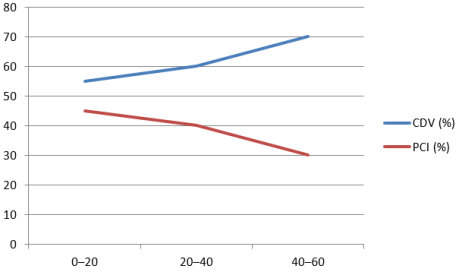
The visual inspection and distress survey of the Okene–Auchi highway revealed varying degrees of pavement deterioration across the study area. The distresses observed included alligator cracking, longitudinal and transverse cracking, rutting, edge break, and potholes. The severity and extent of each distress type were quantified, and the Pavement Condition Index (PCI) was computed for each 20 km section.
Table 1. Pavement condition index (PCI) for the Okene–Auchi highway.
Section (km) | Dominant Distress | CDV (%) | PCI (%) | Pavement Rating |
0–20 | Cracking, potholes | 55 | 45 | Poor |
20–40 | Rutting, potholes | 60 | 40 | Poor |
40–60 | Edge break, cracks | 70 | 30 | Very Poor |
Field Data, 2025
Figure 1. Pavement Condition Along Road Sections.
Table 1 and
Figure 1, present the results obtained from the calculations of the Pavement Condition Index (PCI) conducted along the Okene–Auchi highway. The analysis reveals that the PCI values for the investigated pavement sections fall below 55%, signifying that the pavement condition ranges from poor to very poor. According to the Federal Ministry of Works (FMW) general specification for pavement evaluation, any pavement with a PCI value less than 55% is considered structurally deficient and in need of major rehabilitation rather than routine or preventive maintenance.
This finding implies that the existing pavement structure has suffered significant deterioration due to prolonged exposure to traffic loading, inadequate drainage, and possible subgrade distress. The presence of various surface distresses such as alligator cracking, potholes, rutting, and raveling further substantiates the low PCI rating. Consequently, the studied section of the Okene–Auchi highway can be described as being close to a critical state of structural failure, posing potential safety and serviceability concerns for road users. Immediate and comprehensive rehabilitation measures, including base course reconstruction and asphalt overlay, are therefore recommended to restore the structural integrity and functionality of the pavement.
4.2. Traffic and Axle-Load Summary
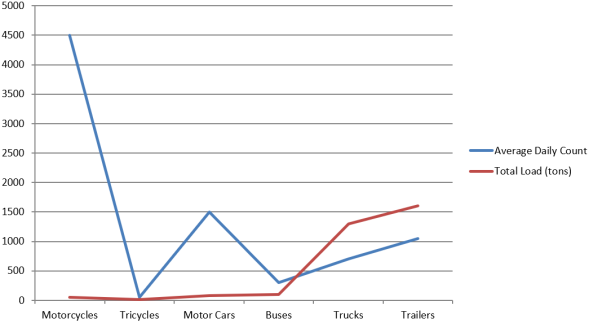
Traffic count data obtained from field observations along the Okene–Auchi Highway provided the basis for estimating average daily traffic volume and corresponding axle loads. The results highlight the dominance of heavy-duty vehicles, which significantly influence total pavement loading. The summary of vehicle distribution, average weights, and total loads is presented in
Table 2.
Table 2. Average Daily Traffic and Load Distribution.
Vehicle Type | Average Daily Count | Average Weight (tons) | Total Load (tons) |
Motorcycles | 4,469 | 0.01 | 44.69 |
Tricycles | 11 | 0.0004 | 0.0044 |
Motor Cars | 1,580 | 0.02 | 31.60 |
Buses | 227 | 0.5 | 45.40 |
Trucks | 632 | 2.0 | 1,264.00 |
Trailers | 1,066 | 1.5 | 1,599.00 |
Total / IDT | 7,985 | — | 2,984.86 |
Field Data, 2025
Figure 2. Average Daily traffic and local Distribution.
Table 2 and
Figure 2, indicate a total average daily traffic of 7,985 vehicles along the Okene–Auchi Highway, comprising 4,469 motorcycles, 11 tricycles, 1,580 motor cars, 227 buses, 632 trucks, and 1,066 trailers. Although motorcycles account for the largest count, their total load is only 44.69 tons, while motor cars and tricycles contribute 31.60 tons and 0.0044 tons, respectively. In contrast, trucks and trailers, with relatively lower counts, impose the greatest stress on the pavement 1,264.00 tons and 1,599.00 tons, respectively representing the majority of the overall 2,984.86 tons daily load. This clearly shows that despite their smaller numbers, heavy vehicles dominate total loading and are the principal contributors to pavement deterioration along the route.
Furthermore, when expressed as a percentage of total traffic volume, motorcycles and motor cars constitute approximately 56% and 20% of the total vehicle population, respectively, while trucks and trailers collectively account for only 21%. However, in terms of load distribution, trucks and trailers together contribute nearly 96% of the total pavement load, underscoring their disproportionate structural impact. This inverse relationship between vehicle count and load intensity highlights that traffic volume alone is not a reliable indicator of pavement stress the axle load and gross vehicle weight of heavy-duty vehicles are the dominant factors influencing subgrade deformation and pavement failure.
The observed trend emphasizes the freight-dependent nature of the Okene–Auchi corridor, which serves as a major route for commercial transport and goods movement in the region. Consequently, the high concentration of heavy trucks and trailers demands robust pavement design considerations, including increased layer thickness, high-quality base materials, and effective drainage systems to mitigate premature failure. Moreover, regular axle load monitoring and enforcement should be implemented to control overloading, which could further exacerbate structural damage.
In essence, the traffic data demonstrate a clear imbalance between vehicle frequency and pavement loading, confirming that while light vehicles dominate in number, heavy vehicles are the key determinants of pavement performance and lifespan along the highway.
4.3. Laboratory Test Results
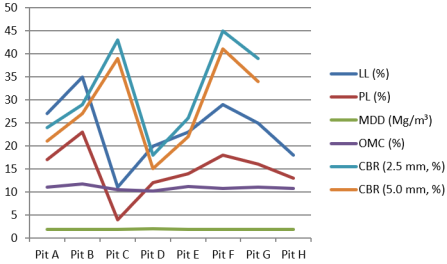
The laboratory tests were conducted to evaluate the physical and mechanical properties of the subgrade soils collected from different pits along the Okene-Auchi Highway. Parameters such as specific gravity, Atterberg limits, compaction characteristics, and California Bearing Ratio (CBR) were determined to assess soil strength and suitability for pavement construction. The summarized results for each soil sample are presented in
Table 3.
Table 3. Sample-by-sample subgrade soil properties.
Sample ID | Specific Gravity (Gs) | LL (%) | PL (%) | PI (%) | MDD (Mg/m³) | OMC (%) | CBR (2.5 mm, %) | CBR (5.0 mm, %) | Remarks |
Pit A | 2.47 | 27 | 17 | 10 | 1.88 | 11.0 | 24 | 21 | Below Spec (30%) |
Pit B | 2.47 | 35 | 23 | 12 | 1.81 | 11.8 | 29 | 27 | Marginal |
Pit C | 2.48 | 11 | 4 | 7 | 1.92 | 10.5 | 43 | 39 | Good |
Pit D | 2.49 | 20 | 12 | 8 | 1.95 | 10.2 | 18 | 15 | Weak |
Pit E | 2.46 | 23 | 14 | 9 | 1.83 | 11.2 | 26 | 22 | Below Spec |
Pit F | 2.47 | 29 | 18 | 11 | 1.91 | 10.7 | 45 | 41 | Good |
Pit G | 2.48 | 25 | 16 | 9 | 1.89 | 11.0 | 39 | 34 | Satisfactory |
Pit H | 2.47 | 18 | 13 | 5 | 1.85 | 10.8 | | | |
Field Data, 2025
Figure 3. Subgrade Soil Properties by Sample.
Table 3 and
Figure 3 show that the specific gravity of the soils ranges from 2.46 to 2.49, indicating a lateritic composition typical of residual tropical soils. The liquid and plastic limits range from 11–35% and 4–23%, respectively, resulting in plasticity indices between 5–12%, which classify the soils as low to medium plastic according to standard soil classification systems. These values suggest that the soils have moderate workability and low compressibility, making them suitable for subgrade use under controlled conditions.
The maximum dry density (MDD) values vary from 1.81 to 1.95 Mg/m³, while the optimum moisture content (OMC) ranges between 10.2–11.8%, indicating that the soils can achieve satisfactory compaction with relatively low moisture requirements. The California Bearing Ratio (CBR) values at 2.5 mm penetration range from 18–45%, with Pits C (43%) and F (45%) rated as good subgrades, while Pits A, B, D, and E, with values below 30%, fall below the recommended specification for pavement subgrade materials.
The results reveal variable subgrade strength along the Okene–Auchi Highway, suggesting that while certain sections possess adequate bearing capacity, weaker sections will require stabilization such as the addition of lime, cement, or other suitable stabilizing agents—to improve load support and ensure uniform pavement performance.
4.3.1. Subgrade Classification and Strength VS. Regional Models
The results of the soil index properties, with plasticity indices ranging from 5% to 12% and liquid limits between 11% and 35%, classify the soils as A-2-6 to A-6 under the AASHTO system. These classifications are consistent with lateritic sandy clays commonly found in tropical regions of Nigeria. Such soils typically exhibit moderate plasticity and variable strength depending on their compaction and moisture condition. Similar observations were reported by
| [6] | Irokwe, E. U., Nwaogazie, I. L. and Sule, A.(2022). Development of empirical models for estimating subgrade CBR from soil index properties in the Niger Delta region of Nigeria. Open Journal of Civil Engineering (SCIRP), 12(1): 45–58. |
[6]
, who established strong correlations between the California Bearing Ratio (CBR) and basic index properties, particularly Maximum Dry Density (MDD) and Optimum Moisture Content (OMC). This relationship reinforces the usefulness of simple laboratory tests for preliminary estimation of subgrade strength in regional pavement design models (
Open Journal of Civil Engineering, SCIRP).
4.3.2. Traffic Loading, Moisture, and Pavement Distress
The traffic analysis shows an average daily traffic (IDT) of 7,985 vehicles, dominated by heavy-duty trucks and trailers. This translates to high Equivalent Single Axle Load (ESAL) values, imposing repetitive stress cycles on the pavement structure. The corresponding soaked CBR results reveal substantial reductions compared to unsoaked values, indicating that moisture infiltration significantly weakens the subgrade and reduces its load-bearing capacity. Field observations confirm that sections with CBR values below 20% align with visible pavement distress features such as rutting, surface cracks, and depressions. This finding attest to the general understanding that high axle-load frequencies and poor drainage accelerate subgrade degradation under tropical climatic conditions.
4.3.3. Comparison with Other Nigerian Studies
The findings of this research are consistent with those of
| [1] | Bello, J. A. and Gegeleeso, F. M.(2024). Effect of heavy vehicles on road pavement and implication on the environment in North Central. Nigeria. International Journal of Research and Scientific Innovation (IJRSI), 11(2): 42–50,
https://doi.org/10.51244/IJRSI.2024.1102033 |
[1]
in their study
“Effect of Heavy Vehicles on Road Pavement and Implication on the Environment in North Central Nigeria” (
IJRSI, RSIS International). Their study also documented extensive environmental and structural damage resulting from overloaded heavy vehicles. Similarly, a predictive model in the Ogbia–Nembe region demonstrating that MDD and OMC can serve as reliable estimators of CBR was developed, allowing for rapid subgrade strength evaluation where full testing may be constrained
| [6] | Irokwe, E. U., Nwaogazie, I. L. and Sule, A.(2022). Development of empirical models for estimating subgrade CBR from soil index properties in the Niger Delta region of Nigeria. Open Journal of Civil Engineering (SCIRP), 12(1): 45–58. |
[6]
. The agreement between these studies reinforces the reliability of assessment across different Nigerian regions.
5. Conclusion
The study assessed the influence of heavy traffic loading on the geotechnical performance of subgrade soils along the Okene–Auchi Highway using both field traffic data and laboratory testing. The results revealed that the highway experiences intense vehicular activity, with an Index Daily Traffic (IDT) of 7,985 vehicles and a total daily load of 2,984.86 tonnes. Although motorcycles and cars dominate traffic volume, heavy trucks and trailers account for over 95% of the total load, indicating that freight transport is the primary contributor to pavement stress.
Laboratory results show that the subgrade soils have specific gravity values ranging from 2.46 to 2.49, liquid limits between 11% and 35%, and plasticity indices of 5–12%, classifying them as A-2-6 to A-6 lateritic soils under AASHTO standards. The Maximum Dry Density (MDD) values range from 1.81 to 1.95 Mg/m³, with corresponding Optimum Moisture Content (OMC) values between 10.2% and 11.8%. The soaked California Bearing Ratio (CBR) values vary from 18% to 45%, with more than half of the samples falling below the 30% minimum requirement for subgrade material. These findings indicate that moisture sensitivity, coupled with heavy axle loading, significantly reduces subgrade bearing capacity, leading to pavement deformation and early failure.
In comparison with related regional studies, the results align with findings by
| [6] | Irokwe, E. U., Nwaogazie, I. L. and Sule, A.(2022). Development of empirical models for estimating subgrade CBR from soil index properties in the Niger Delta region of Nigeria. Open Journal of Civil Engineering (SCIRP), 12(1): 45–58. |
[6]
which reported similar patterns of structural distress caused by overloaded heavy vehicles and moisture-induced weakening of lateritic sub-grades. The observed consistency strengthens the empirical link between high traffic loading, inadequate drainage, and reduced subgrade performance in tropical environments.
Therefore, it is concluded that the subgrade soils along the Okene–Auchi Highway possess moderate natural strength but require improvement to sustain the existing traffic load. Without stabilization or drainage enhancement, the pavement will continue to deteriorate under repetitive heavy-axle movements.
Abbreviations
PCI | Pavement Condition Index |
CBR | California Bearing Ratio |
ESAL | Equivalent Single Axle Load |
IDT | Index Daily Traffic |
Acknowledgments
The authors would like to thank the Department of Civil Engineering, Edo State University, Iyamho, Nigeria, for providing the facilities used in conducting this research. Appreciation is also extended to the laboratory staff for their technical support.
Author Contributions
Ogum Prosper Chukwunweike: Data Curation, Methodology
Wasiu John: Supervision
Ibrahim Abdulrazaq Olayinka: Visualization
Igbadumhe Anthony Oshioke: Validation
Haruna Daud Gussau: Resources
Conflicts of Interest
The authors declare no conflicts of interest.
References
| [1] |
Bello, J. A. and Gegeleeso, F. M.(2024). Effect of heavy vehicles on road pavement and implication on the environment in North Central. Nigeria. International Journal of Research and Scientific Innovation (IJRSI), 11(2): 42–50,
https://doi.org/10.51244/IJRSI.2024.1102033
|
| [2] |
Oyekanmi, T. A. and Ejem, E. J.(2020). Axle-load violations and their impact on pavement service life in Nigerian highway. Journal of Transportation Engineering and Infrastructure, 7(2): 112–124.
|
| [3] |
Adeyanju, O. and Abiola, K.(2023). Moisture variation and subgrade strength behavior of lateritic soils under tropical climatic conditions. World Journal of Engineering, 20(3): 215–227,
https://doi.org/10.4236/ojce.2022.124036
|
| [4] |
Geotechnical Appraisal in North-Central Nigeria (2023). Geotechnical evaluation of lateritic subgrade performance under soaked condition. World Journal of Engineering, 19(4): 355–363.
|
| [5] |
Oyekanmi, T. A. Ibe, C. and Ejem, E. J.(2023). Assessment of repeated loading and poor drainage as causes of pavement failure in southwestern Nigeria. Nigerian Journal of Civil and Environmental Systems, 6(3): 84–93.
|
| [6] |
Irokwe, E. U., Nwaogazie, I. L. and Sule, A.(2022). Development of empirical models for estimating subgrade CBR from soil index properties in the Niger Delta region of Nigeria. Open Journal of Civil Engineering (SCIRP), 12(1): 45–58.
|
| [7] |
British Standards Institution (1990). Methods of Testing Soils for Civil Engineering Purposes (BS 1377) London., British Standards Institution.
|
| [8] |
Oyekanmi, O. J., Ibe, C. C., Ebiringa, O. T., & Ejem, E. A. (2020). Estimation of the impact of the overloaded truck on the service life of pavement structures in Nigeria. International Journal of Traffic and Transportation Engineering, 9(2), 41–47.
https://doi.org/10.5923/j.ijtte.20200902.03
|
| [9] |
Agbonkhese, O. (2024). Effect of axle loads on pavement deterioration: A case of Gombe–Numan Expressway. Nigerian Building and Road Research Institute (NBRRI). The study used classified traffic and axle-load survey data to determine ADT, heavy-vehicle percentages, axle loads and ESAL.
|
| [10] |
Amadi, A. A., Sadiku, S., Abdullahi, M., & Danyaya, H. A. (2018). Case study of construction quality control monitoring and strength evaluation of a lateritic pavement using the dynamic cone penetrometer. International Journal of Pavement Research and Technology, 11(5), 530–539.
https://doi.org/10.1016/j.ijprt.2018.07.001
|
| [11] |
Bolarinwa, A., Adeyeri, J. B., & Okeke, T. C. (2017). Compaction and consolidation characteristics of lateritic soil of a selected site in Ikole Ekiti, Southwest Nigeria. Nigerian Journal of Technology, 36(2), 339–345.
https://doi.org/10.4314/njt.v36i2.3
|
| [12] |
Alayaki, F. M., & Bajomo, O. S. (2012). Effect of moisture variation on the strength characteristics of laterite: A case study of Abeokuta, Ogun State, Nigeria. Proceedings of the Environmental Management Conference, Federal University of Agriculture, Abeokuta, 1–8.
|
| [13] |
Falowo, O. O., & Otuaga, M. P. (2023). Highway structural failure and development of parameter prediction models: Case study of Akure–Owo (A-122) pavement, Southwestern Nigeria. International Journal of Earth Sciences Knowledge and Applications.
|
| [14] |
Awosanya, D. O., Murana, A. A., & Olowosulu, A. A. (2024). Development of axle load spectra for integration in traffic characterization for Nigerian empirical mechanistic pavement analysis and design systems. Arid Zone Journal of Engineering, Technology and Environment, 20(3), 581–600.
|
| [15] |
Edeh, J. E., Agbede, I. O., & Tyoyila, A. (2014). Evaluation of sawdust ash–stabilized lateritic soil as highway pavement material. Journal of Materials in Civil Engineering, 26(2), 367–373.
https://doi.org/10.1061/(ASCE)MT.1943-5533.0000795
|
Cite This Article
-
APA Style
Chukwunweike, O. P., John, W., Olayinka, I. A., Oshioke, I. A., Gussau, H. D. (2026). Geotechnical Evaluation of Traffic-induced Load effects on Pavement Sub-Grade Bearing Capacity Along the
Okene–Auchi Highway, Nigeria. American Journal of Traffic and Transportation Engineering, 11(5), 82-90. https://doi.org/10.11648/j.ajtte.20261105.11
 Copy
|
Copy
|
 Download
ACS Style
Chukwunweike, O. P.; John, W.; Olayinka, I. A.; Oshioke, I. A.; Gussau, H. D. Geotechnical Evaluation of Traffic-induced Load effects on Pavement Sub-Grade Bearing Capacity Along the
Okene–Auchi Highway, Nigeria. Am. J. Traffic Transp. Eng. 2026, 11(5), 82-90. doi: 10.11648/j.ajtte.20261105.11
Copy
|
Download
AMA Style
Chukwunweike OP, John W, Olayinka IA, Oshioke IA, Gussau HD. Geotechnical Evaluation of Traffic-induced Load effects on Pavement Sub-Grade Bearing Capacity Along the
Okene–Auchi Highway, Nigeria. Am J Traffic Transp Eng. 2026;11(5):82-90. doi: 10.11648/j.ajtte.20261105.11
Copy
|
Download
-
@article{10.11648/j.ajtte.20261105.11,
  author = {Ogum Prosper Chukwunweike and Wasiu John and Ibrahim Abdulrazaq Olayinka and Igbadumhe Anthony Oshioke and Haruna Daud Gussau},
  title = {Geotechnical Evaluation of Traffic-induced Load effects on Pavement Sub-Grade Bearing Capacity Along the
Okene–Auchi Highway, Nigeria},
  journal = {American Journal of Traffic and Transportation Engineering},
  volume = {11},
  number = {5},
  pages = {82-90},
  doi = {10.11648/j.ajtte.20261105.11},
  url = {https://doi.org/10.11648/j.ajtte.20261105.11},
  eprint = {https://article.sciencepublishinggroup.com/pdf/10.11648.j.ajtte.20261105.11},
  abstract = {This study investigates the effects of heavy traffic loading on subgrade bearing capacity using field and laboratory data obtained from Jattu Junction along the Okene–Auchi Highway, Nigeria. Manual traffic count data were converted into Equivalent Single Axle Loads (ESAL), resulting in an Index Daily Traffic (IDT) of 7,985 ESAL/day and a corresponding daily axle mass of 2,984.86 tonnes. Heavy vehicles, including trucks and trailers, account for over 95% of the total traffic loading, imposing substantial stresses on the pavement subgrade. Geotechnical laboratory tests revealed specific gravity values ranging from 2.46 to 2.49, liquid limits of 11–35%, plasticity indices of 5–12%, maximum dry density (MDD) values of 1.81–1.95 Mg/m³, optimum moisture content (OMC) of 10.2–11.8%, and soaked California Bearing Ratio (CBR) values between 5% and 45%. The results indicate that more than half of the sampled soils fail to satisfy the minimum soaked CBR requirement of 30% specified for subgrade design, demonstrating inadequate load-bearing capacity under prevailing traffic conditions. The study establishes a strong relationship between heavy traffic loading, moisture susceptibility, and reduced subgrade strength, all of which accelerate pavement deterioration through rutting, deformation, and premature failure. These findings highlight the importance of integrating traffic loading characteristics with geotechnical properties during pavement design and maintenance planning. To enhance pavement durability and long-term service performance, the study recommends appropriate subgrade stabilization techniques, strict enforcement of axle load regulations, and improved drainage systems to minimize moisture-induced weakening of the subgrade.},
 year = {2026}
}
Copy
|
Download
-
TY  - JOUR
T1  - Geotechnical Evaluation of Traffic-induced Load effects on Pavement Sub-Grade Bearing Capacity Along the
Okene–Auchi Highway, Nigeria
AU  - Ogum Prosper Chukwunweike
AU  - Wasiu John
AU  - Ibrahim Abdulrazaq Olayinka
AU  - Igbadumhe Anthony Oshioke
AU  - Haruna Daud Gussau
Y1  - 2026/09/02
PY  - 2026
N1  - https://doi.org/10.11648/j.ajtte.20261105.11
DO  - 10.11648/j.ajtte.20261105.11
T2  - American Journal of Traffic and Transportation Engineering
JF  - American Journal of Traffic and Transportation Engineering
JO  - American Journal of Traffic and Transportation Engineering
SP  - 82
EP  - 90
PB  - Science Publishing Group
SN  - 2578-8604
UR  - https://doi.org/10.11648/j.ajtte.20261105.11
AB  - This study investigates the effects of heavy traffic loading on subgrade bearing capacity using field and laboratory data obtained from Jattu Junction along the Okene–Auchi Highway, Nigeria. Manual traffic count data were converted into Equivalent Single Axle Loads (ESAL), resulting in an Index Daily Traffic (IDT) of 7,985 ESAL/day and a corresponding daily axle mass of 2,984.86 tonnes. Heavy vehicles, including trucks and trailers, account for over 95% of the total traffic loading, imposing substantial stresses on the pavement subgrade. Geotechnical laboratory tests revealed specific gravity values ranging from 2.46 to 2.49, liquid limits of 11–35%, plasticity indices of 5–12%, maximum dry density (MDD) values of 1.81–1.95 Mg/m³, optimum moisture content (OMC) of 10.2–11.8%, and soaked California Bearing Ratio (CBR) values between 5% and 45%. The results indicate that more than half of the sampled soils fail to satisfy the minimum soaked CBR requirement of 30% specified for subgrade design, demonstrating inadequate load-bearing capacity under prevailing traffic conditions. The study establishes a strong relationship between heavy traffic loading, moisture susceptibility, and reduced subgrade strength, all of which accelerate pavement deterioration through rutting, deformation, and premature failure. These findings highlight the importance of integrating traffic loading characteristics with geotechnical properties during pavement design and maintenance planning. To enhance pavement durability and long-term service performance, the study recommends appropriate subgrade stabilization techniques, strict enforcement of axle load regulations, and improved drainage systems to minimize moisture-induced weakening of the subgrade.
VL  - 11
IS  - 5
ER  -
Copy
|
Download





 Share This Article
 Twitter
 Linked In
 Facebook