Abstract
This paper takes the structure-performance relationship and electronic tuning of graphene-based electrocatalysts as its core conceptual framework to systematically review research progress in the field of water electrolysis for hydrogen production. Water electrolysis is a key technology for green hydrogen production and achieving carbon neutrality; it currently faces four major scientific and technological challenges: slow kinetics of the hydrogen evolution and oxygen evolution reactions, reliance on precious metals, insufficient catalyst stability, and high costs associated with large-scale production. Given its high electrical conductivity, ultra-large specific surface area, and tunable electronic structure, graphene can serve both as a metal-free active substrate and as an efficient carrier. Through heteroatom doping, heterostructure construction, defect engineering, and interfacial electronic regulation, the electronic states of active sites and the adsorption energies of hydrogen and oxygen can be optimized, thereby significantly enhancing catalytic activity and stability. This paper reviews mainstream preparation techniques, including chemical vapor deposition, hydrothermal/solvothermal synthesis, and chemical reduction, and compares their performance in proton exchange membrane, alkaline, anion exchange membrane, and seawater electrolysis systems. It highlights that current key bottlenecks remain in controlling doping uniformity, ensuring long-term durability, achieving consistency in large-scale electrodes, and enabling low-cost, large-scale production. Finally, the paper looks ahead to the development of electrodes featuring precise electronic tuning, green large-scale production, and adaptability to multiple scenarios, providing theoretical references and technical insights to help graphene-based catalysts overcome barriers to industrial application.
|
Published in
|
Advances in Materials (Volume 15, Issue 2)
|
|
DOI
|
10.11648/j.am.20261502.14
|
|
Page(s)
|
62-74 |
|
Creative Commons
|

This is an Open Access article, distributed under the terms of the Creative Commons Attribution 4.0 International License (http://creativecommons.org/licenses/by/4.0/), which permits unrestricted use, distribution and reproduction in any medium or format, provided the original work is properly cited.
|
|
Copyright
|
Copyright © The Author(s), 2026. Published by Science Publishing Group
|
Keywords
Graphene, Water Electrolysis, Hydrogen Evolution Reaction, Oxygen Evolution Reaction, Electrocatalyst
1. Introduction
The global energy structure is undergoing a historic transformation from fossil energy to renewable energy. Hydrogen energy, as a clean energy carrier with zero carbon emission and high energy density, is the core of achieving the "2050 carbon neutrality" target. Water electrolysis for hydrogen production can be directly coupled with renewable energy sources such as solar energy, wind energy, and tidal energy to realize the high-efficiency preparation of green hydrogen, becoming a key link connecting renewable energy and the hydrogen energy industry.
At present, mainstream water electrolysis technologies include alkaline water electrolysis (AWE), proton exchange membrane water electrolysis (PEMWE), anion exchange membrane water electrolysis (AEMWE), and solid oxide electrolysis (SOEC). Among them, PEMWE has become the preferred direction for large-scale and modular development due to its advantages of high current density and fast response. However, the high cost of noble metal catalysts limits its widespread application.
Graphene is a two-dimensional crystal material composed of a single layer of carbon atoms, with a theoretical specific surface area of up to 2630 m2/g, an electron mobility of up to 2×105 cm2/(V·s), and its surface chemical properties can be precisely regulated through doping and defect engineering. In the field of electrolytic water for hydrogen production, the advantages of graphene are mainly reflected in three aspects: first, as a catalyst carrier, it can construct a three-dimensional conductive network to accelerate electron transport and inhibit the agglomeration of active components; second, through metal-support interactions (MSI), it can regulate the electronic structure of active sites to optimize the adsorption/desorption energy of hydrogen/oxygen; third, it can be directly used as a metal-free catalyst, and the edge defects and heteroatom doping form active centers.
In the field of electrolytic water, graphene itself can be used as a metal-free catalyst, and its derived materials can also serve as ideal catalyst carriers. Through its unique electronic effect and confinement effect, it significantly improves the catalytic performance of the loaded active components, inhibits their agglomeration, and enhances the stability of the entire electrode.
2. Reaction Mechanism of Electrolytic Water for Hydrogen Production and Action Mechanism of Graphene
Water electrolysis (as shown in
Figure 1) is an electrochemical technology that uses electric energy to decompose water into hydrogen and oxygen. In this process, no carbon-containing substances are emitted, making it a green and efficient hydrogen production technology. As a "star material" in the field of electrocatalysis, the function of graphene is not determined by a single property, but is realized through its interaction with surrounding factors (such as molecules, ions, photons, electrons, etc.), that is, the "action mechanism" determines its performance.
Figure 1. Schematic Diagram of Electrochemical Water Splitting.
2.1. Mechanisms of Hydrogen Evolution Reaction (HER) and Oxygen Evolution Reaction (OER)
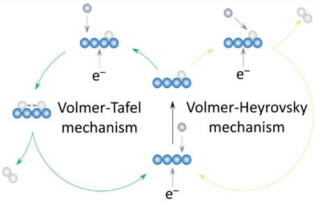
The hydrogen evolution reaction (HER) is a multi-step process occurring on the electrode surface that reduces H
+ or H
2O to H
2, as illustrated in
Figure 2. In acidic electrolytes, the HER mainly involves the following three steps: First, protons adsorb onto the catalyst surface, forming the reaction intermediate H*, known as the Volmer step. Subsequently, the intermediate H* can generate H
2 via two pathways: one involves combining with another H* (the Tafel step), and the other involves reacting with a proton (the Heyrovsky step)
. (* denotes the active site of the catalyst, and H* denotes the adsorbed hydrogen atom on the active site.) The reaction process is as follows:
In an acidic electrolyte:
Overall reaction:
Electrochemical (Volmer) step:
Electrochemical desorption (Heyrovsky) step:
Electrochemical desorption (Tafel) step:
Figure 2. Mechanism Diagram of Hydrogen Evolution Reaction in Acidic.
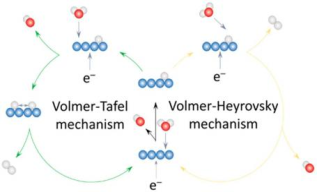
Figure 3. Mechanism Diagram of Hydrogen Evolution Reaction in Alkaline Media.
In alkaline media, the electrochemical reactions and transformation steps involved in the HER are shown in
Figure 3. The reaction process is as follows
| [3] | Dai J, Zhu Y, Tahini H A, et al. Single-phase perovskite oxide with super-exchange induced atomic-scale synergistic active centers enables ultrafast hydrogen evolution [J]. Nature Communications, 2020, 11(1): 5657.
https://doi.org/10.1038/s41467-020-19433-1 |
[3]
:
In alkaline electrolyte:
Volmer step:
Heyrovsky step:
Regardless of acidic or alkaline conditions, HER may involve a Tafel step where two adjacent H* atoms combine to form H2, which then desorbs from the electrode surface:
The oxygen evolution reaction (OER) is a key process in electrochemical water splitting. It serves as a vital energy conversion step in solar energy conversion, fuel cells, and water electrolysis for hydrogen production. The equations for OER in acidic and alkaline solutions are as follows:
In alkaline electrolyte:
In acidic electrolyte:
As evident from the equations above, OER is a four-electron transfer process characterized by a high energy barrier. Typically, several hundred millivolts of overpotential are required for OER to occur, resulting in significantly higher energy consumption compared to the hydrogen evolution reaction (HER). Therefore, developing methods to replace the high-potential OER and reduce the overall energy consumption of water electrolysis is crucial.
2.2. Core Mechanisms of Graphene
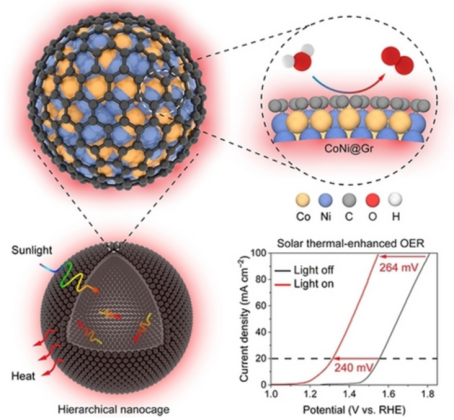
Graphene exhibits multiple core mechanisms in water electrolysis for hydrogen production, with its electronic regulation effects being key to optimizing catalytic activity. As shown in
Figure 4, the “armor-like structure” formed by single-layer graphene encapsulating CoNi nanoalloy where electron transfer from metal to carbon constructs asymmetric π-electron states. This induces an electron confinement effect on deposited single-atom Pt, simultaneously enhancing hydrogen adsorption energy through electron transfer to promote hydrogen evolution and improving stability via strong interaction between π electrons and Pt 5d orbitals. This enables the electrolytic cell to achieve a current density of 4.0 A cm
-2 at an ultra-low Pt loading
| [4] | Deng D, Yu L, et al. Full-Spectrum Light-Harvesting Solar Thermal Electrocatalyst Boosts Oxygen Evolution [J]. Angewandte Chemie International Edition, 2024, 63.
https://doi.org/10.1002/anie.202412049 |
[4]
.
Figure 4. Schematic of the layered nanocage structure composed of graphene-encapsulated CoNi nanoparticles.
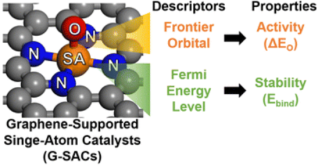
The two-dimensional sheet structure of graphene enables the construction of three-dimensional porous networks, providing anchoring sites for active components while suppressing agglomeration. Jungwoo Choi et al. engineered defects to regulate graphene-supported single-atom catalysts, as shown in
Figure 5. The resulting three-dimensional porous structure enhanced active component dispersion by 40%, demonstrating excellent batch production potential in acidic HER
| [5] | Choi J, Hong D S, Lee H M. Formulating electronic descriptors to rationally design graphene-supported single-atom catalysts for oxygen electrocatalysis. Journal of Materials Chemistry A, 2022, 10(47): 25098-25105.
https://doi.org/10.1039/d2ta05607k |
[5]
. This defect-engineered three-dimensional porous network precisely controls the location and quantity of surface defects on graphene, providing a stable and suitable loading environment for single-atom catalysts. It effectively prevents agglomeration and loss of active components, ensuring the catalyst's stability and activity during prolonged reaction processes.
Figure 5. Graphene-Supported Single-Atom Catalysts (G-SACs).
The multidimensional enhancement of the support function addresses the inherent drawbacks of traditional catalysts, such as low activity and poor stability. The large specific surface area of graphene (≥1000 m
2/g) enables uniform anchoring of active components. As shown in
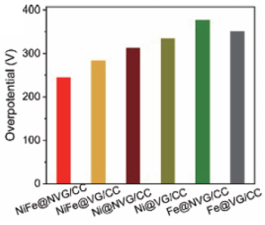
Figure 6, the NiFe alloy loaded onto nitrogen-doped vertical graphene arrays exhibits an overpotential of only 245 mV at 10 mA·cm
-2, with its open structure effectively suppressing particle agglomeration and corrosion
| [6] | Nan J, Ye B, He X, et al. Enhancing alkaline water oxidation with NiFe alloy-encapsulated nitrogen-doped vertical graphene array [J]. Nano Research, 2024, 16(8): 11245-11253.
https://doi.org/10.1007/s12274-024-6431-x |
[6]
. Simultaneously, graphene's exceptional conductivity accelerates electron transport, reduces charge transfer resistance, and enhances reaction kinetics. Furthermore, graphene's mechanical stability withstands volume changes during reactions, preventing catalyst structural collapse and significantly improving cycling stability and service life.
Figure 6. Overpotential of Ni/Fe-based catalyst at a current density of 10 mA cm-2.
3. Preparation Techniques for Graphene-Based Electrocatalysts
Graphene-based electrocatalysts, with their outstanding electronic conductivity, high specific surface area, and chemical stability, have become core materials in energy conversion fields such as water electrolysis, fuel cells, and metal-air batteries. Preparation techniques directly determine their interlayer structure, active site exposure density, and interfacial charge transfer efficiency, profoundly influencing catalytic performance.
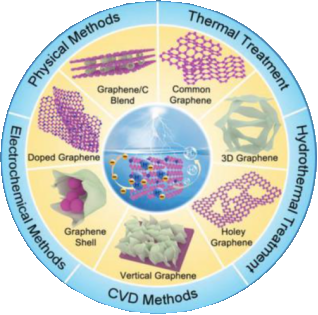
Figure 7 illustrates the preparation techniques for graphene-based electrocatalysts.
Figure 7. Preparation Techniques for Graphene-Based Electrocatalysts.
3.1. Chemical Vapor Deposition (CVD)
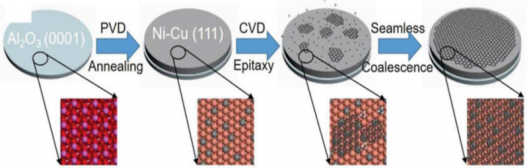
CVD enables the growth of graphene on metal substrates (Cu, Ni, Cu-Ni alloys, etc.) via carbon source decomposition. This method allows precise control over layer number (single-layer to multi-layer), morphology (sheet-like, mesh-like), and defect density, making it the preferred technique for producing high-quality graphene. Alloy film CVD enables precise control over graphene layer number and stacking. As shown in
Figure 8, Cu-Ni alloy (e.g., 600 nm Cu85Ni15(111)/sapphire) can grow wafer-scale single-layer graphene (SLG) at 750°C. By optimizing the Cu-Ni thickness ratio (78:22) and cooling process, bilayer graphene (BLG) coverage reaches 93%, with 80% exhibiting AB stacking and electron mobility ranging from 2400 to 3450 cm
2/(V·s)
.
Figure 8. Preparation of single-crystal Cu-Ni (111) films and graphene growth on their surfaces.
Optimizing process parameters is a key breakthrough direction for CVD. Bimetallic graphene-supported catalysts enhance hydrogen evolution performance by combining CVD with metal deposition. Nitrogen-doped reduced graphene oxide (NH
2-rGO) is prepared via CVD, followed by deposition of Pt
xRu
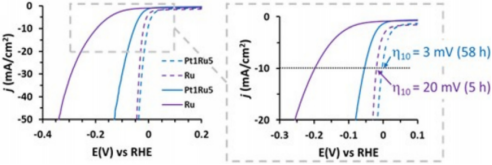
y nanoparticles (1.6-2.1 nm). After 58 h activation, Pt
1Ru
5@NH
2-rGO exhibits an HER onset overpotential η
0 = 0 mV, η
10 = 3 mV at 10 mA·cm
-2, a Tafel slope of 46 mV·dec
-1 (as shown in
Figure 9), and no decay after 12 h
| [8] | Hou H, Cerezo-Navarrete C, Fenoll D A, et al. Enhanced electrocatalytic hydrogen evolution with bimetallic Ru/Pt nanoparticles supported on nitrogen-doped reduced graphene oxide [J]. Inorganic Chemistry Frontiers, 2025, 12(15): 4569-4582.
https://doi.org/10.1039/d5qi00451a |
[8]
.
Figure 9. Linear sweep voltammetry curves of Ru@NH2-rGO and Pt1Ru5@NH2-rGO: solid lines represent initial states, while dashed lines indicate curves obtained after applying a current of j = −10 mA cm−2 until the activation process reaches equilibrium.
3.2. Technologies Hydrothermal / Solvothermal Method
The hydrothermal/solvothermal method achieves graphene functionalization and composites via low-temperature liquid-phase reactions (120-200°C) in sealed reactors, offering advantages of simple operation and easy component control.
Wang et al.
| [9] | Wang, Z.; Zhou, Q.; Zhu, Y.; et al. NiFeMn-Layered Double Hydroxides Linked by Graphene as High-Performance Electrocatalysts for Oxygen Evolution Reaction [J]. Nanomaterials, 2022, 12, 2200. https://doi.org/10.3390/nano12132200 |
[9]
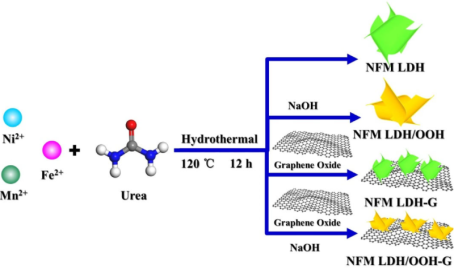
prepared NiFeMn layered double hydroxide (NFM LDH)/graphene composites (NFM LDH-G) via hydrothermal synthesis, as shown in
Figure 10. Urea hydrolysis was employed to regulate system pH, promoting LDH layered growth (micron-scale sheets and nanoscale rod-like structures) while simultaneously reducing GO in situ to graphene, forming a conductive network. Subsequent NaOH treatment constructed an NFM LDH/OOH heterojunction, where graphene further reduced charge transfer resistance. This enabled the catalyst to achieve a low overpotential of 338 mV at 10 mA·cm
-2, with a Tafel slope of 67 mV·dec
-1, outperforming commercial RuO
2. Additionally, Dai et al.
| [10] | Dai, T.; Zhou, Z.; Xiao, H.; et al. In Situ Growth of NiSe2-MoSe2 Heterostructures on Graphene Nanosheets as High-Performance Electrocatalyst for Hydrogen Evolution Reaction [J]. Catalysts, 2022, 12, 701.
https://doi.org/10.3390/catal12070701 |
[10]
synthesized NiSe
2-MoSe
2 heterostructures/graphene (NiSe
2-MoSe
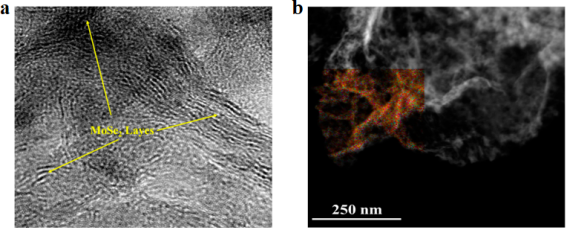
2 HTs/G) as shown in
Figure 11. NiSe
2 nanocrystals embedded within few-layer MoSe
2 nanosheets and supported on graphene surfaces effectively suppressed interlayer stacking of MoSe
2, exposing more active edge sites.
Figure 10. Preparation Processes for NFM LDH, NFM LDH/OOH, NFM LDH-G, and NFM LDH/OOH-G.
Figure 11. (a) TEM image of NiSe2-MoSe2 HTs/G hybrid material, (b) STEM image of NiSe2-MoSe2 HTs/G and corresponding EDS elemental distribution regions.
The solvothermal method, an extension of the hydrothermal approach, enables efficient composite formation between active components and graphene carriers through precise control of reaction parameters (temperature, solvent, precursor). This provides low-cost, highly stable catalytic solutions for energy conversion, environmental remediation, and other fields.
3.3. Technology Chemical Reduction Method
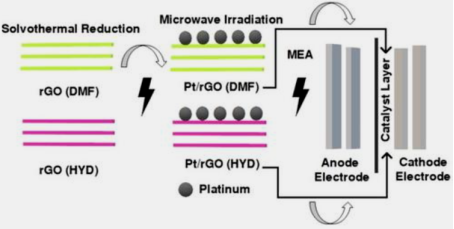
The core principle of the chemical reduction method involves using chemical reducing agents to reduce oxygen-containing functional groups (e.g., hydroxyl, epoxy, carboxyl) on the surface of graphene oxide (GO), as shown in
Figure 12. Simultaneously, active component precursors (e.g., metal salts, metal oxide precursors) are loaded onto the graphene surface and reduced to the target active species. This method offers advantages including simple operation, mild reaction conditions, low cost, and ease of scaling up for industrial production.
Using hydrazine hydrate as the reducing agent, graphene-based catalysts loaded with platinum nanoparticles (Pt/G) were successfully synthesized by simultaneously reducing graphene oxide (GO) and hexachloroplatinic acid (H
2PtCl
6) in an aqueous solution
| [11] | Daş E, et al. Electrocatalytical Application of Platinum Nanoparticles Supported on Reduced Graphene Oxide in PEM Fuel Cell: Effect of Reducing Agents of Dimethylformamide or Hydrazine Hydrate on the Properties [J]. Electroanalysis, 2021, 33(4), 1027-1035. https://doi.org/10.1002/elan.202060588 |
[11]
. By controlling the reaction temperature and reducing agent dosage, the average particle size of Pt nanoparticles was maintained at 2-3 nm, with uniform dispersion on the graphene surface. Electrochemical testing revealed that this catalyst exhibits an oxygen reduction reaction (ORR) half-potential of 0.89 V (vs. RHE) under acidic conditions, with a mass activity of 0.45 A/mg Pt. This performance significantly outperforms commercial Pt/C catalysts (half-potential 0.83 V, mass activity 0.12 A/mg Pt), attributed to the high conductivity of graphene and the small-size effect of Pt nanoparticles.
Figure 12. Flowchart of Graphene-Based Catalyst Preparation via Chemical Reduction Method.
3.4. Technologies Mechanical Exfoliation Method
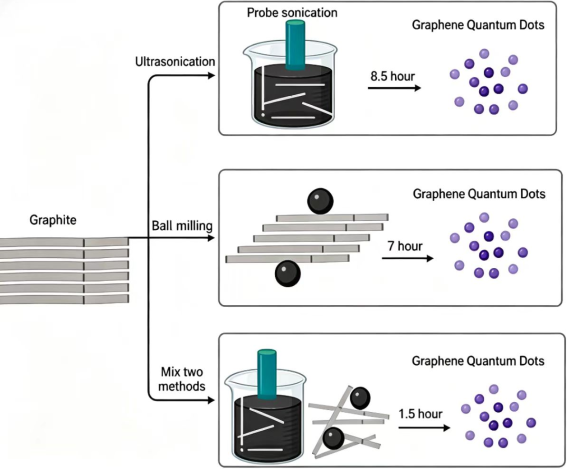
The mechanical exfoliation method disrupts the interlayer van der Waals forces of graphite through physical shearing forces, thereby forming graphene quantum dots, as shown in
Figure 13. This method maximally preserves the intrinsic crystallinity and conductivity of graphene, effectively controlling the number of layers, defect density, and surface chemical state of graphene, laying the foundation for constructing highly efficient catalytic active sites.
Figure 13. Flowchart of Graphene Quantum Dot Preparation via Mechanical Exfoliation.
Using a viscous polymer film as the exfoliation medium, few-layer graphene with a thickness of 1-5 layers and lateral dimensions up to 20 μm was prepared by controlling the exfoliation pressure (0.3 MPa) and rate (5 mm/s). Loaded onto carbon cloth, it was employed for HER catalysis, exhibiting a low onset potential of 23 mV and a Tafel slope of 42 mV/dec, with performance comparable to commercial Pt/C. with a Tafel slope of 42 mV/dec, exhibiting performance comparable to commercial Pt/C. The core advantage of this method lies in its chemical-free nature, but the yield of only 0.5 mg/h makes it difficult to meet industrial demands. For flexible device applications, an in-situ mechanical exfoliation technique on flexible substrates was developed. Graphene was directly exfoliated onto polyimide films to produce bendable HER catalysts. After 1000 bending cycles, the activity retention rate reached 92%, offering a new solution for wearable energy devices. However, overall, mechanical exfoliation remains limited to basic research and high-end small-batch production scenarios
| [12] | Zhang Y, Lin H, et al. Mechanical exfoliation assisted with carbon nanospheres to prepare a few-layer graphene for flexible strain sensor [J]. Applied Surface Science, 2022, 155649.
https://doi.org/10.1016/j.apsusc.2022.155649 |
| [13] | Dubey S, et al. Unveiling the potential of direct graphene patterning via mechanical exfoliation for wearable strain sensors [J]. Diamond and Related Materials, 2025, 112852.
https://doi.org/10.1016/j.diamond.2025.112852 |
[12, 13]
.
3.5. Other Novel Preparation Techniques
Beyond the three mainstream methods, high-temperature thermal shock and sol-gel techniques have also been applied in graphene-based catalyst synthesis. The high-temperature thermal shock method is a preparation technique that achieves material structural regulation and functionalization through brief, rapid heating to high temperatures. By generating a 7-millisecond peak of 2000 K via capacitive discharge, it achieves an extremely fast temperature change rate exceeding 10⁴ K/s
. This enables the instantaneous conversion of cobalt acetate and thiourea into CoS nanoparticles on the GO surface, which are then encapsulated by few-layer graphene. The entire synthesis process takes less than 10 seconds, yielding products with 99.2% purity. The sol-gel method uniformly mixes GO with active component precursors in a sol system, followed by gelation and thermal treatment to form catalysts. This approach offers high compositional uniformity and strong doping controllability. The solution etching method offers a novel approach for fabricating large-scale electrodes. For instance, the NiFe(OH)
2/Fe/graphene catalyst successfully grew hydroxide oxides in situ on graphene surfaces via acid etching of Fe-Ni alloys, enabling the preparation of 10×10 cm
2 electrodes with performance comparable to smaller electrodes, demonstrating industrial application potential.
In summary, the five categories of graphene-based electrocatalyst preparation techniques each have their own strengths. Chemical vapor deposition (CVD) allows for precise control over the number of graphene layers, morphology, and defects, enabling the production of high-quality single-crystal graphene suitable for high-end catalytic systems; however, the process is complex, relatively expensive, and difficult to scale up. Hydrothermal/solvothermal methods are simple to operate and allow for easy control of composition and structure, making them suitable for the batch synthesis of composite catalysts; however, there is still room for improvement in product crystallinity and interfacial bonding strength; chemical reduction methods involve mild conditions, are low-cost, and are easy to scale up for production, allowing for the simultaneous reduction of graphene oxide and loading of active components; however, the reducing agent can introduce contamination, and product uniformity and conductivity need to be improved; Mechanical exfoliation maximally preserves the intrinsic structure and conductivity of graphene, making it suitable for flexible devices and basic research; however, it suffers from significant drawbacks such as extremely low yield and difficulty in industrialization; novel technologies such as high-temperature thermal shock and sol-gel offer advantages including rapid synthesis, uniform composition, and the ability to fabricate large-sized electrodes, providing new pathways for scaling up and functionalization; however, process stability and equipment compatibility still need improvement. Overall, existing preparation technologies have formed a diversified landscape capable of meeting R&D and production needs across various scenarios. However, achieving synergistic breakthroughs in high quality, low cost, environmental sustainability, and large-scale production remains the core key to advancing graphene-based catalysts toward industrial applications in water electrolysis for hydrogen production.
4. Performance Regulation Strategies for Graphene-Based Catalysts
Graphene, as an ideal carrier and active substrate for water electrolysis catalysts, faces practical limitations due to excessively high hydrogen adsorption free energy and insufficient active site density. Consequently, achieving performance breakthroughs through strategies such as heteroatom doping, composite structure construction, and interfacial electron regulation has become a research hotspot. Developing precise performance regulation strategies is key to overcoming the bottlenecks in the industrial application of graphene-based catalysts.
4.1. Heterogeneous Atom Doping Modification
Heterogeneous atom doping disrupts charge neutrality by replacing carbon atoms in the graphene lattice, thereby creating active sites. This alters the electron density distribution of graphene, optimizing its catalytic activity and metal-support interactions. The hydrogen adsorption free energy (ΔG
H*) of undoped graphene is approximately 1.6 eV, significantly deviating from the optimal value for HER activity (≈0 eV)
| [15] | Wang H X, et al. Hydrogen adsorption on the vertical heterostructures of graphene and two-dimensional electrides: A first-principles study [J]. ACS Omega, 2022, 7(25): 22043-22050. https://doi.org/10.1021/acsomega.2c01324 |
[15]
. Among single-element doping strategies, nitrogen doping is most prevalent, forming pyridine N, pyrrole N, and graphitic N configurations. Pyridine N significantly enhances the density of states near the Fermi level, boosting H* adsorption capacity. Nitrogen doping concentrations can reach up to 7.52 wt.%
| [16] | Marinoiu A, et al. Nitrogen-doped graphene oxide as efficient metal-free electrocatalyst in PEM fuel cells [J]. Nanomaterials, 2023, 13(7): 1233. https://doi.org/10.3390/nano13071233 |
[16]
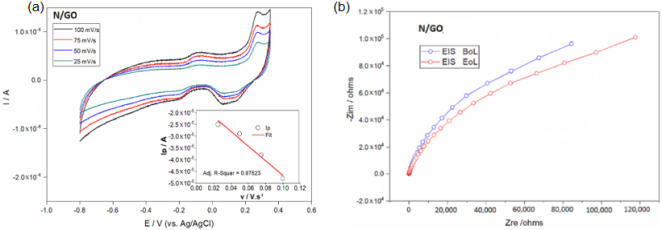
, exhibiting a reasonable nitrogen species distribution, good thermal stability, and mesoporous structure. As shown in
Figure 14, N/GO demonstrates excellent electrochemical activity and reversibility.
Figure 14. (a) CV curves of N/GO at different scan rates, with the inset at bottom right showing the dependence of the oxidation peak current on the square root of the scan rate; (b) Nyquist plot of N/GO.
The synergistic effect of dual doping can further enhance performance. In N,S-doped graphene (N,S-G), the 3p orbital of S atoms couples with the 2p orbital of N atoms, bringing the density of states peak near active sites closer to the Fermi level. The cobalt phosphide-modified N,S-doped three-dimensional graphene (CoP@N,S-3D-GN) electrocatalyst exhibits an overpotential of only 118 mV at 10 mA·cm
-1, with a Tafel slope of 50 mV·dec
-1. exhibited an overpotential of only 118 mV at 10 mA·cm
-1, with a Tafel slope of 50 mV·dec
-1. After 1000 cyclic voltammetry cycles at a scan rate of 100 mV·s
-1, it maintained electrocatalytic activity with an exchange current density above 2.2×10
-10 mA·cm
-2 | [17] | Karaman C, et al. Tailoring of cobalt phosphide anchored nitrogen and sulfur co-doped three dimensional graphene hybrid: Boosted electrocatalytic performance towards hydrogen evolution reaction [J]. Electrochimica Acta, 2021, 378: 138262.
https://doi.org/10.1016/j.electacta.2021.138262 |
[17]
. Triple-doped systems (e.g., N,P,S-G) precisely modulate graphene's Fermi level, charge distribution, and π-conjugated electron system through multi-atom electron synergy, significantly enhancing the catalyst surface's adsorption/desorption energy barrier compatibility with reaction intermediates.
4.2. Composite Structure Design
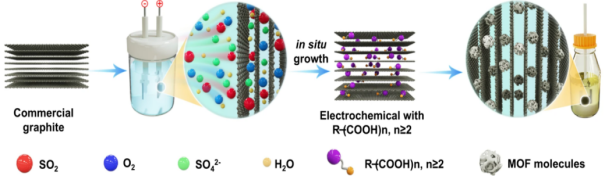
Integrating graphene with transition metal compounds (oxides, sulfides, nitrides, etc.) combines the advantages of “high conductivity from carbon carriers” and “high activity from metal compounds,” simultaneously optimizing active site density and conductivity. The two-dimensional graphene-confined NiFe-MOF catalyst (NiFe-MOF//G) developed by Zhang Tao's team at the Chinese Academy of Sciences (synthesis process shown in
Figure 15) confines MOFs between graphene layers via a dual-electrode electrochemical system, resolving the inherent low electrical conductivity issue of MOFs. Transmission electron microscopy reveals that multilayer graphene confinement enables the formation of highly active NiO
6₋FeO
5 distorted octahedral species within the MOF, achieving a specific surface area more than double that of the pristine NiFe-MOF.
Figure 15. Electrochemical Synthesis Process.
Electrochemical testing reveals that this catalyst exhibits an overpotential of only 106 mV at a current density of 10 mA cm
-2, significantly lower than that of the pristine NiFe-MOF (280 mV) and commercial RuO
2 (290 mV). Its Tafel slope drops to 59 mV dec
-1, indicating markedly accelerated reaction kinetics. More importantly, the protective graphene layer enabled stable operation at 10 mA cm
-2 for over 150 h with only 5% decay. DFT calculations confirmed that the graphene-MOF interface interaction lowered the limiting potential for water oxidation, demonstrating the universality of this “two-dimensional confined active site-graphene carrier” design paradigm
| [18] | Zhang T, et al. Exceptional catalytic activity of oxygen evolution reaction via two-dimensional graphene multilayer confined metal-organic frameworks [J]. Nature Communications, 2022, 13(1): 6892.
https://doi.org/10.1038/s41467-022-33847-z |
[18]
.
Furthermore, multidimensional designs of composite structures—such as core-shell architectures, layered heterostructures, and porous sandwich structures—can further construct diverse pore systems. These enhance electrolyte wetting and gas product (H2, O2) desorption efficiency while preventing active site shielding by bubble agglomeration during reactions. simultaneously, graphene's flexible framework buffers volume expansion and structural collapse during long-term cycling. Combined with strong intercomponent interactions that suppress active component leaching and agglomeration, this significantly enhances catalyst cycling stability.
4.3. Nterfacial Electronic Regulation
Interfacial electron regulation is the key to unlocking synergistic enhancement of high activity and stability in graphene-based water-splitting catalysts. Its core logic lies in precisely controlling electron transfer behavior between graphene and active components (transition metal alloys, oxides, single atoms, etc.) to optimize the compatibility between active site electronic states and reaction intermediate adsorption energies. Based on the electronegativity difference between graphene and active components, electrons spontaneously undergo directed transfer at the interface—For instance, when graphene coats NiMo alloys, electrons flow from the metal substrate toward the graphene shell. Doping NiMo with low-electronegativity Ti further enhances this transfer effect, creating electron-rich regions on the graphene surface. This significantly boosts proton adsorption and conversion capabilities, enabling the catalyst to exhibit hydrogen evolution reaction (HER) activity comparable to Pt/C under acidic conditions.
This interfacial electron restructuring not only optimizes catalytic kinetics but simultaneously addresses the stability challenge of active components: the electron buffering effect of the graphene shell suppresses metal substrate dissolution in acidic environments. For instance, the Ti-doped G/Ti-NiMo catalyst exhibited extremely low metal dissolution rates during 120-hour continuous testing, with current decay of only 3.8%. Furthermore, interfacial electronic properties synergize with structural design. For instance, within hierarchical nanocages formed by graphene-encapsulated CoNi alloys, metal-graphene electronic interactions enhance graphene's photothermal conversion efficiency. Localized high temperatures further accelerate interfacial electron transfer and reaction processes, reducing water electrolysis voltage by over 240 mV.
5. Graphene in Diverse Water Electrolysis Systems
Significant differences exist in electrolyte environments across various water electrolysis systems (acidic, alkaline, neutral/seawater), imposing distinct demands on catalyst structural stability and active site design. Investigating design strategies, mechanisms of action, and performance optimization pathways for graphene-based catalysts across these systems, while analyzing structure-activity relationships between material architecture and catalytic performance, is crucial for developing versatile, high-efficiency water-splitting catalysts.
5.1. Proton Exchange Membrane Water Electrolysis (PEMWE) System
PEMWE (as shown in
Figure 16) is a mainstream industrial hydrogen production technology due to its high current density and low energy consumption. However, the strongly acidic environment imposes stringent corrosion resistance requirements on catalysts, while traditional Pt/C catalysts face issues such as high cost and susceptibility to agglomeration and deactivation.
Figure 16. Proton Exchange Membrane Water Electrolysis.
The Deng team proposed the “armor-like catalysis” concept, encapsulating CoNi nanoalloy with monolayer graphene to construct an asymmetric π-electron-rich structure on the surface, enabling precise deposition of single-atom Pt. The electron confinement effect generated by this structure maintains Pt in an electron-rich state, optimizing hydrogen adsorption energy. Simultaneously, the strong interaction between graphene and Pt's 5d orbitals suppresses Pt agglomeration. A PEMWE electrolyzer based on this catalyst achieved a current density of 4.0 A·cm-2 at 2.02 V with a Pt loading of only 1.2 μg·cm-2, maintaining stable operation for over 1000 hours at 2.0 A cm-2, offering a novel approach for developing low-cost catalysts in acidic systems.
Co-doping with N and P modulates graphene's electronic structure, enhancing its interaction with metallic active components. To improve electrocatalyst performance, Balaji et al.
| [19] | Balaji D, et al. Phosphorus co-doped reduced graphene oxide embedded flower-like CoS/CoS2 heterostructure as an efficient electrocatalyst for hydrogen evolution reaction in acidic media [J]. Journal of Alloys and Compounds, 2022, 907: 164506.
https://doi.org/10.1016/j.jallcom.2022.164506 |
[19]
employed a one-step hydrothermal method to prepare a flower-like CoS/CoS
2 heterostructure with phosphorus co-doping and embedded reduced graphene oxide (rGO) by adjusting the phosphorus source molar ratio. The synergistic effects at the heterointerfaces formed by rGO on CoS/CoS
2 active sites, coupled with rapid charge transfer, endow the catalyst with outstanding HER performance under acidic conditions. It exhibits an overpotential of only 148 mV and a Tafel slope of 44 mV·dec
-1, maintaining excellent stability after 1000 cycles.
5.2. Alkaline Water Electrolysis (AWE) System
The alkaline system offers low equipment corrosion and controllable costs, making it the mainstream choice for industrial hydrogen production. However, the high energy barrier of the OER reaction necessitates highly efficient catalysts. Composite systems combining graphene with transition metals demonstrate outstanding performance in alkaline OER.
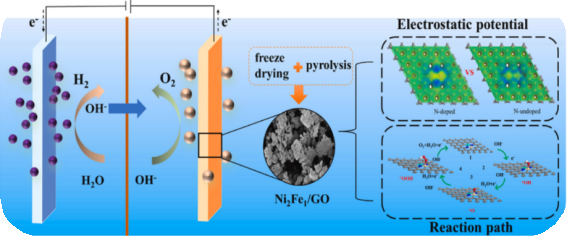
Nitrogen-doped graphene oxide (GO) loaded with NiFe nanoparticles (Ni
xFe
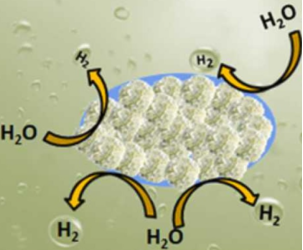
y/GO) possesses abundant mesoporous structures that enhance mass transfer, while Ni and Fe synergistically reduce the OER energy barrier. The hydrogen production process is illustrated in
Figure 17. The optimized Ni
2Fe
1/GO (Ni/Fe molar ratio 2) exhibits outstanding OER activity, with an overpotential of only 273 mV at a current density of 10 mA·cm
-2 and a Tafel slope of 51.45 mV·dec
-1. It also exhibits outstanding stability at high current densities of 100 and 500 mA·cm
-2, achieving a Faradaic efficiency of 99.3% for hydrogen production at 500 mA·cm
-2 | [20] | Guo P, et al. Nitrogen-doped graphene oxide-supported NiFe nanoparticles for enhanced oxygen evolution reaction in alkaline water electrolysis [J]. International Journal of Hydrogen Energy, 2025, 75: 151515.
https://doi.org/10.1016/j.ijhydene.2025.151515 |
[20]
. This provides an effective strategy for developing highly efficient, low-cost OER electrocatalysts for water electrolysis hydrogen production.
Boron-doped graphene (BGO) nanosheets loaded with nickel nitride (Ni
3N) nanoparticles form a BGO/Ni
3N interfacial catalyst suitable for alkaline electrolyte environments. The strong electron coupling between p-type BGO and n-type Ni
3N, coupled with BGO's conductivity enhancement, collectively facilitates excellent electrical conductivity and rapid charge transfer. Consequently, this noble-metal-free catalyst exhibits outstanding electrocatalytic activity and kinetic performance in 1 M KOH solution: At a current density of 10 mA·cm
-2, the overpotential is as low as 290 mV with a Tafel slope of only 77.9 mV·dec
-1, while also demonstrating outstanding stability and durability
| [21] | Li B, Song F, et al. Boron-Doped Graphene Oxide-Supported Nickel Nitride Nanoparticles for Electrocatalytic Oxygen Evolution in Alkaline Electrolytes [J]. ACS Applied Nano Materials. Nano Mater., 2020, 3(12): 12034-12042.
https://doi.org/10.1021/acsanm.0c01963 |
[21]
.
Figure 17. Hydrogen Production Process of Ni2Fe1/GO in the AWE System.
5.3. Neutral/Seawater Electrolysis (NEW/SWE) Systems
Neutral and seawater systems (e.g., 3.5 wt.% NaCl solution) offer abundant resources but face challenges such as Cl- corrosion and slow reaction kinetics. Graphene-based catalysts demonstrate unique advantages through electronic regulation and structural design.
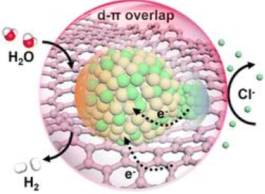
Leveraging graphene's two-dimensional conjugated structure to construct electronic regulation networks, such as Ni/PtNi heterojunction catalysts supported on graphene, enhances the d-π hybridization effect between Pt and graphene through Ni-mediated stepwise work function gradients
| [22] | Yang X, et al. Enhanced d–π overlap in a graphene supported Ni/PtNi heterojunction for efficient seawater hydrogen evolution [J]. Chem. Commun., 2024, 59(89): 13676-13679.
https://doi.org/10.1039/d3cc05959f |
[22]
. as shown in
Figure 18. This creates an electron-rich active surface that optimizes hydrogen adsorption/desorption kinetics while resisting Cl
- erosion through charge repulsion, maintaining high activity comparable to alkaline systems in real seawater.
Figure 18. Hydrogen Production Process in Seawater Systems.
By forming a physical barrier through coating structures, such as nitrogen-doped graphene-coated NiMo alloys and defect-rich graphene-encapsulated NiFe alloys, can shield the active core from seawater ion corrosion. Among these, the NiFe@DG catalyst achieves a current density of 10 mA·cm
-2 with only 218 mV overpotential in alkaline seawater, exhibiting a mere 1.0% activity decay after 2000 h of continuous operation
| [23] | Gong Z, Liu G, et al. Highly Durable and Efficient Seawater Electrolysis Enabled by Defective Graphene-Confined Nanoreactor [J]. ACS Nano, 2023, 17(23): 12345-12356.
https://doi.org/10.1021/acsnano.3c05749 |
[23]
. The core advantages of graphene-based catalysts in seawater electrolysis systems lie primarily in interface engineering and corrosion-resistant mechanisms. Through surface charge regulation, defect site design, and strong metal–carbon interactions, graphene can establish an electronic barrier that resists Cl
- adsorption, thereby suppressing chloride ion corrosion and chloride evolution side reactions, while simultaneously optimizing the adsorption energy of intermediates to enhance reaction kinetics. Its two-dimensional sheets and three-dimensional porous structure create physical barriers and steric hindrance, protecting active components from dissolution, agglomeration, or structural collapse. This provides a systematic interface control solution to address key bottlenecks in seawater electrolysis, such as corrosion, scaling, and poor stability.
6. Conclusion
Thanks to its excellent electrical conductivity, ultra-high specific surface area, and precisely tunable electronic structure, graphene has emerged as the core substrate for overcoming performance bottlenecks in catalysts for water electrolysis. It possesses the dual properties of a metal-free catalyst and a highly efficient support. It can create active sites through defects and heteroatom doping, while also forming a three-dimensional conductive network. By leveraging metal-support interactions to optimize the adsorption energy of reaction intermediates, it significantly enhances the activity and stability of the catalytic system. Currently, the preparation techniques for graphene-based catalysts have diversified. Processes such as chemical vapor deposition (CVD) and hydrothermal/solvothermal methods each offer distinct technical advantages. Strategies including heteroatom doping, composite structure design, and interfacial electronic regulation have significantly optimized hydrogen and oxygen evolution performance, enabling these catalysts to demonstrate excellent performance in proton exchange membrane, alkaline, and neutral/ seawater electrolysis systems. Meanwhile, progress has been made in the greening and scaling up of preparation processes; the micro-liquid-film electrolysis method enables the continuous production of uniform, single-layer graphene oxide (GO) at a cost of only one-seventh that of traditional methods
| [24] | Guo G, Pei F, et al. Control of water for high-yield and low-cost sustainable electrochemical synthesis of uniform monolayer graphene oxide [J]. Nat. Commun., 2025, 16: 1234.
https://doi.org/10.1038/s41467-025-56121-4 |
[24]
.
Currently, this field still faces numerous industrialization bottlenecks, including difficulties in controlling doping uniformity, insufficient long-term cycling stability of catalysts, high costs associated with large-scale production, and challenges in ensuring performance consistency for large-sized electrodes, all of which limit the practical application of graphene-based catalysts. Future research must deeply integrate defect engineering with precise control of electronic structures to further optimize the number and energy level compatibility of active sites, thereby approaching the peak of the catalytic activity volcano plot. Concurrently, the development of efficient, low-cost, large-scale preparation processes is needed to enhance the structural stability and multi-system adaptability of catalysts. This will facilitate the transition of graphene-based electrocatalysts from laboratory research to industrial-scale applications, providing core material support for the high-quality development of the green hydrogen industry under the carbon neutrality goal.
Abbreviations
HTs | Heterostructures |
DG | Defective Graphene |
BGO | Boron-Doped Graphene Oxide |
RHE | Reversible Hydrogen Electrode |
EDS | Energy Dispersive Spectroscopy |
NEW | Neutral Water Electrolysis |
SWE | Seawater Electrolysis |
ORR | Oxygen Reduction Reaction |
MOF | Metal-Organic Framework |
DFT | Density Functional Theory |
3D-GN | Three-Dimensional Graphene Nanosheets |
G-SACs | Graphene-Supported Single-Atom Catalysts |
NH2-rGO | Amino-modified Reduced Graphene Oxide |
NFM LDH | NiFeMn Layered Double Hydroxide |
Author Contributions
Lulin Sun: Conceptualization, Supervision, Writing – original draft
Anyang Shi: Data curation, Writing – review & editing
Jiaming Han: Resources, Writing – review & editing
Yufei Liu: Formal Analysis
Wenbo Gong: Methodology
Haoran Cui: Investigation
Jianliang Liu: Visualization
Jialuo Yin: Validation
Huihui Wang: Validation
Shiwei Liu: Funding acquisition
Conflicts of Interest
There is no conflict of interest with other units, businesses, affiliates, and other authors in the work of this study.
References
| [1] |
Satheesh D, et al. Efficient electrochemical hydrogen evolution activity of nanostructured Ag3PO4/MoS2 heterogeneous composite catalyst [J]. Chemosphere, 2024, 352: 141220.
https://doi.org/10.1016/j.chemosphere.2024.141220
|
| [2] |
Miao L, Jia W, Cao X, et al. Computational chemistry for water-splitting electrocatalysis [J]. Chemical Society Reviews, 2024, 53(6): 2771-2807.
https://doi.org/10.1039/d2cs01068b
|
| [3] |
Dai J, Zhu Y, Tahini H A, et al. Single-phase perovskite oxide with super-exchange induced atomic-scale synergistic active centers enables ultrafast hydrogen evolution [J]. Nature Communications, 2020, 11(1): 5657.
https://doi.org/10.1038/s41467-020-19433-1
|
| [4] |
Deng D, Yu L, et al. Full-Spectrum Light-Harvesting Solar Thermal Electrocatalyst Boosts Oxygen Evolution [J]. Angewandte Chemie International Edition, 2024, 63.
https://doi.org/10.1002/anie.202412049
|
| [5] |
Choi J, Hong D S, Lee H M. Formulating electronic descriptors to rationally design graphene-supported single-atom catalysts for oxygen electrocatalysis. Journal of Materials Chemistry A, 2022, 10(47): 25098-25105.
https://doi.org/10.1039/d2ta05607k
|
| [6] |
Nan J, Ye B, He X, et al. Enhancing alkaline water oxidation with NiFe alloy-encapsulated nitrogen-doped vertical graphene array [J]. Nano Research, 2024, 16(8): 11245-11253.
https://doi.org/10.1007/s12274-024-6431-x
|
| [7] |
Xu S, Zhang L, Wang B, et al. Chemical vapor deposition of graphene on thin-metal films [J]. Cell Reports Physical Science, 2021, 2(3): 100372.
https://doi.org/10.1016/j.xcrp.2021.100372
|
| [8] |
Hou H, Cerezo-Navarrete C, Fenoll D A, et al. Enhanced electrocatalytic hydrogen evolution with bimetallic Ru/Pt nanoparticles supported on nitrogen-doped reduced graphene oxide [J]. Inorganic Chemistry Frontiers, 2025, 12(15): 4569-4582.
https://doi.org/10.1039/d5qi00451a
|
| [9] |
Wang, Z.; Zhou, Q.; Zhu, Y.; et al. NiFeMn-Layered Double Hydroxides Linked by Graphene as High-Performance Electrocatalysts for Oxygen Evolution Reaction [J]. Nanomaterials, 2022, 12, 2200.
https://doi.org/10.3390/nano12132200
|
| [10] |
Dai, T.; Zhou, Z.; Xiao, H.; et al. In Situ Growth of NiSe2-MoSe2 Heterostructures on Graphene Nanosheets as High-Performance Electrocatalyst for Hydrogen Evolution Reaction [J]. Catalysts, 2022, 12, 701.
https://doi.org/10.3390/catal12070701
|
| [11] |
Daş E, et al. Electrocatalytical Application of Platinum Nanoparticles Supported on Reduced Graphene Oxide in PEM Fuel Cell: Effect of Reducing Agents of Dimethylformamide or Hydrazine Hydrate on the Properties [J]. Electroanalysis, 2021, 33(4), 1027-1035.
https://doi.org/10.1002/elan.202060588
|
| [12] |
Zhang Y, Lin H, et al. Mechanical exfoliation assisted with carbon nanospheres to prepare a few-layer graphene for flexible strain sensor [J]. Applied Surface Science, 2022, 155649.
https://doi.org/10.1016/j.apsusc.2022.155649
|
| [13] |
Dubey S, et al. Unveiling the potential of direct graphene patterning via mechanical exfoliation for wearable strain sensors [J]. Diamond and Related Materials, 2025, 112852.
https://doi.org/10.1016/j.diamond.2025.112852
|
| [14] |
Li G, et al. N-doped graphene film prepared by rapid thermal shock for ultra-sensitive temperature reading [J]. Applied Surface Science, 2022, 154117.
https://doi.org/10.1016/j.apsusc.2022.154117
|
| [15] |
Wang H X, et al. Hydrogen adsorption on the vertical heterostructures of graphene and two-dimensional electrides: A first-principles study [J]. ACS Omega, 2022, 7(25): 22043-22050.
https://doi.org/10.1021/acsomega.2c01324
|
| [16] |
Marinoiu A, et al. Nitrogen-doped graphene oxide as efficient metal-free electrocatalyst in PEM fuel cells [J]. Nanomaterials, 2023, 13(7): 1233.
https://doi.org/10.3390/nano13071233
|
| [17] |
Karaman C, et al. Tailoring of cobalt phosphide anchored nitrogen and sulfur co-doped three dimensional graphene hybrid: Boosted electrocatalytic performance towards hydrogen evolution reaction [J]. Electrochimica Acta, 2021, 378: 138262.
https://doi.org/10.1016/j.electacta.2021.138262
|
| [18] |
Zhang T, et al. Exceptional catalytic activity of oxygen evolution reaction via two-dimensional graphene multilayer confined metal-organic frameworks [J]. Nature Communications, 2022, 13(1): 6892.
https://doi.org/10.1038/s41467-022-33847-z
|
| [19] |
Balaji D, et al. Phosphorus co-doped reduced graphene oxide embedded flower-like CoS/CoS2 heterostructure as an efficient electrocatalyst for hydrogen evolution reaction in acidic media [J]. Journal of Alloys and Compounds, 2022, 907: 164506.
https://doi.org/10.1016/j.jallcom.2022.164506
|
| [20] |
Guo P, et al. Nitrogen-doped graphene oxide-supported NiFe nanoparticles for enhanced oxygen evolution reaction in alkaline water electrolysis [J]. International Journal of Hydrogen Energy, 2025, 75: 151515.
https://doi.org/10.1016/j.ijhydene.2025.151515
|
| [21] |
Li B, Song F, et al. Boron-Doped Graphene Oxide-Supported Nickel Nitride Nanoparticles for Electrocatalytic Oxygen Evolution in Alkaline Electrolytes [J]. ACS Applied Nano Materials. Nano Mater., 2020, 3(12): 12034-12042.
https://doi.org/10.1021/acsanm.0c01963
|
| [22] |
Yang X, et al. Enhanced d–π overlap in a graphene supported Ni/PtNi heterojunction for efficient seawater hydrogen evolution [J]. Chem. Commun., 2024, 59(89): 13676-13679.
https://doi.org/10.1039/d3cc05959f
|
| [23] |
Gong Z, Liu G, et al. Highly Durable and Efficient Seawater Electrolysis Enabled by Defective Graphene-Confined Nanoreactor [J]. ACS Nano, 2023, 17(23): 12345-12356.
https://doi.org/10.1021/acsnano.3c05749
|
| [24] |
Guo G, Pei F, et al. Control of water for high-yield and low-cost sustainable electrochemical synthesis of uniform monolayer graphene oxide [J]. Nat. Commun., 2025, 16: 1234.
https://doi.org/10.1038/s41467-025-56121-4
|
Cite This Article
-
APA Style
Sun, L., Shi, A., Han, J., Liu, Y., Gong, W., et al. (2026). Heteroatom Doped Graphene Catalysts: Synthesis and Application in Electrochemical Hydrogen Evolution. Advances in Materials, 15(2), 62-74. https://doi.org/10.11648/j.am.20261502.14
 Copy
|
Copy
|
 Download
ACS Style
Sun, L.; Shi, A.; Han, J.; Liu, Y.; Gong, W., et al. Heteroatom Doped Graphene Catalysts: Synthesis and Application in Electrochemical Hydrogen Evolution. Adv. Mater. 2026, 15(2), 62-74. doi: 10.11648/j.am.20261502.14
Copy
|
Download
AMA Style
Sun L, Shi A, Han J, Liu Y, Gong W, et al. Heteroatom Doped Graphene Catalysts: Synthesis and Application in Electrochemical Hydrogen Evolution. Adv Mater. 2026;15(2):62-74. doi: 10.11648/j.am.20261502.14
Copy
|
Download
-
@article{10.11648/j.am.20261502.14,
  author = {Lulin Sun and Anyang Shi and Jiaming Han and Yufei Liu and Wenbo Gong and Haoran Cui and Jianliang Liu and Jialuo Yin and Huihui Wang and Shiwei Liu and Sai Geng},
  title = {Heteroatom Doped Graphene Catalysts: Synthesis and Application in Electrochemical Hydrogen Evolution},
  journal = {Advances in Materials},
  volume = {15},
  number = {2},
  pages = {62-74},
  doi = {10.11648/j.am.20261502.14},
  url = {https://doi.org/10.11648/j.am.20261502.14},
  eprint = {https://article.sciencepublishinggroup.com/pdf/10.11648.j.am.20261502.14},
  abstract = {This paper takes the structure-performance relationship and electronic tuning of graphene-based electrocatalysts as its core conceptual framework to systematically review research progress in the field of water electrolysis for hydrogen production. Water electrolysis is a key technology for green hydrogen production and achieving carbon neutrality; it currently faces four major scientific and technological challenges: slow kinetics of the hydrogen evolution and oxygen evolution reactions, reliance on precious metals, insufficient catalyst stability, and high costs associated with large-scale production. Given its high electrical conductivity, ultra-large specific surface area, and tunable electronic structure, graphene can serve both as a metal-free active substrate and as an efficient carrier. Through heteroatom doping, heterostructure construction, defect engineering, and interfacial electronic regulation, the electronic states of active sites and the adsorption energies of hydrogen and oxygen can be optimized, thereby significantly enhancing catalytic activity and stability. This paper reviews mainstream preparation techniques, including chemical vapor deposition, hydrothermal/solvothermal synthesis, and chemical reduction, and compares their performance in proton exchange membrane, alkaline, anion exchange membrane, and seawater electrolysis systems. It highlights that current key bottlenecks remain in controlling doping uniformity, ensuring long-term durability, achieving consistency in large-scale electrodes, and enabling low-cost, large-scale production. Finally, the paper looks ahead to the development of electrodes featuring precise electronic tuning, green large-scale production, and adaptability to multiple scenarios, providing theoretical references and technical insights to help graphene-based catalysts overcome barriers to industrial application.},
 year = {2026}
}
Copy
|
Download
-
TY  - JOUR
T1  - Heteroatom Doped Graphene Catalysts: Synthesis and Application in Electrochemical Hydrogen Evolution
AU  - Lulin Sun
AU  - Anyang Shi
AU  - Jiaming Han
AU  - Yufei Liu
AU  - Wenbo Gong
AU  - Haoran Cui
AU  - Jianliang Liu
AU  - Jialuo Yin
AU  - Huihui Wang
AU  - Shiwei Liu
AU  - Sai Geng
Y1  - 2026/04/25
PY  - 2026
N1  - https://doi.org/10.11648/j.am.20261502.14
DO  - 10.11648/j.am.20261502.14
T2  - Advances in Materials
JF  - Advances in Materials
JO  - Advances in Materials
SP  - 62
EP  - 74
PB  - Science Publishing Group
SN  - 2327-252X
UR  - https://doi.org/10.11648/j.am.20261502.14
AB  - This paper takes the structure-performance relationship and electronic tuning of graphene-based electrocatalysts as its core conceptual framework to systematically review research progress in the field of water electrolysis for hydrogen production. Water electrolysis is a key technology for green hydrogen production and achieving carbon neutrality; it currently faces four major scientific and technological challenges: slow kinetics of the hydrogen evolution and oxygen evolution reactions, reliance on precious metals, insufficient catalyst stability, and high costs associated with large-scale production. Given its high electrical conductivity, ultra-large specific surface area, and tunable electronic structure, graphene can serve both as a metal-free active substrate and as an efficient carrier. Through heteroatom doping, heterostructure construction, defect engineering, and interfacial electronic regulation, the electronic states of active sites and the adsorption energies of hydrogen and oxygen can be optimized, thereby significantly enhancing catalytic activity and stability. This paper reviews mainstream preparation techniques, including chemical vapor deposition, hydrothermal/solvothermal synthesis, and chemical reduction, and compares their performance in proton exchange membrane, alkaline, anion exchange membrane, and seawater electrolysis systems. It highlights that current key bottlenecks remain in controlling doping uniformity, ensuring long-term durability, achieving consistency in large-scale electrodes, and enabling low-cost, large-scale production. Finally, the paper looks ahead to the development of electrodes featuring precise electronic tuning, green large-scale production, and adaptability to multiple scenarios, providing theoretical references and technical insights to help graphene-based catalysts overcome barriers to industrial application.
VL  - 15
IS  - 2
ER  -
Copy
|
Download

 ,
Jiaming Han
,
Jiaming Han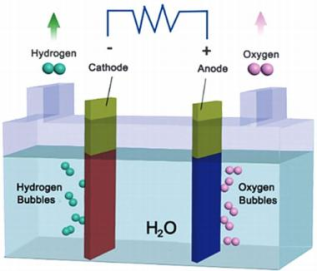



 Share This Article
 Twitter
 Linked In
 Facebook