
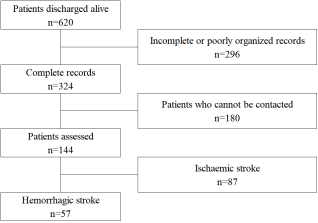
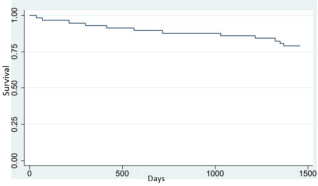
Introduction. Long-term survival of hemorrhagic strokes remains poorly evaluated in our context. They represent the most severe type of stroke, accounting for 10 to 20% of all stroke cases. These rates are elevated in sub-Saharan Africa, potentially accounting for as much as 35% of all strokes. This study’s purpose was to analyze the long-term mortality of stroke survivors at the Souro Sanou University Hospital in Bobo-Dioulasso. Methods. This was a retrospective cohort of patients hospitalized from January 1, 2017 to December 31, 2019, discharged alive from the neurology department after haemorrhagic stroke. Data were analyzed using STATA 17.0 software. The 4-year survival probability was estimated. Predictors of mortality were identified using Cox regression. Results. A total of 57 patients were involved in this study. The mean age was 58.4 years (±12.4). The sex ratio was 1.19. Hypertension was the main cardiovascular risk factor (71.9%). Four patients had a history of heart disease. The level of consciousness was normal in 50 patients. The average length of hospital stay was 11.3 days. Cumulative post-hospital mortality was 21.1% at 4 years. Predictors of mortality were Glasgow coma scale>9 (p=0.001; HR = 0.09; CI 95%: 0.02-0.40) and presence of heart disease (p=0.015; HR = 5.87; CI 95%: 1.42-24.29). Conclusion. The long-term mortality associated with haemorrhagic stroke is high. Targeted interventions such as specialist hypertension clinics, cardiological follow-up and structured outpatient programmes could improve this long-term mortality considerably.
| Published in | Clinical Neurology and Neuroscience (Volume 10, Issue 3) |
| DOI | 10.11648/j.cnn.20261003.11 |
| Page(s) | 71-76 |
| Creative Commons |
This is an Open Access article, distributed under the terms of the Creative Commons Attribution 4.0 International License (http://creativecommons.org/licenses/by/4.0/), which permits unrestricted use, distribution and reproduction in any medium or format, provided the original work is properly cited. |
| Copyright |
Copyright © The Author(s), 2026. Published by Science Publishing Group |
Hemorrhagic Stroke, Mortality, Long-term Survival, Bobo-Dioulasso, Burkina Faso
Features | n (%) |
|---|---|
Age (years) | |
≤60 | 36 (63,2) |
>60 | 21 (36,8) |
Gender | |
Male | 31 (63,2) |
Female | 26 (36,8) |
Residential | |
Urban | 31 (51,7) |
Rural | 26 (48,3) |
Admission timeframe | |
<6 hours | 3 (5,3) |
6–24 hours | 10 (17,5) |
>24 hours | 44 (77,2) |
Vascular risk factors | |
High blood pressure | 41 (71,9) |
Alcohol | 11 (19,3) |
Smoking | 6 (10,5) |
Diabetes | 4 (7,0) |
History of heart disease | 4 (7,0) |
Sedentary lifestyle | 4 (7,0) |
History of stroke | 3 (5,2) |
Overweight/Obesity | 2 (3,5) |
Length of hospital stay | |
≤7 days | 14 (24,6) |
>7 days | 43 (75,4) |
ICH score | |
0-1 | 47 (82,5) |
2-3 | 10 (17,5) |
Rankin's score on discharge | |
0-2 | 18 (31,6) |
3-5 | 39 (68,4) |
Caracteristiques | Anivariate analyseis | Multivariate analysis | ||||
|---|---|---|---|---|---|---|
p-value | Hazard ratio | IC 95% | p-value | Hazard ratio | IC 95% | |
Age (years) | 0,62 | - | - | - | ||
≤60 | 1 | |||||
>60 | 1,34 | 0,42-4,22 | ||||
Gender | 0,7 | - | - | - | ||
Male | 1 | |||||
Female | 0,3 | 0,25-2,52 | ||||
Glasgow coma scale | <0,001 | 0,001 | ||||
3-9 | 1 | 1 | ||||
10-15 | 0,08 | 0,02-0,31 | 0,09 | 0,02-0,40 | ||
ICH score | 0,94 | |||||
0-1 | 1 | |||||
2-3 | 0,94 | 0,20-4,31 | ||||
Rankin score | 0,2 | - | - | - | ||
0-2 | 1 | |||||
3-5 | 2,68 | 0,59-12,28 | ||||
Length of hospital stay | 0.98 | - | - | - | ||
≤7 days | 1 | |||||
˃7 days | 0,98 | 0,26- 3,64 | ||||
Bedsore complications | 0,46 | - | - | - | ||
Yes | 1 | |||||
No | 0,46 | 0,06-3,59 | ||||
High blood pressure | 0,85 | |||||
No | 1 | - | - | - | ||
Yes | 1,13 | 0,31-4,18 | ||||
Smoking | 0,81 | - | - | - | ||
No | 1 | |||||
Yes | 0,77 | 0,09-5,99 | ||||
Alcohol | 0,32 | - | - | - | ||
No | 1 | |||||
Yes | 0.35 | 0,04-2,27 | ||||
History of heart disease | 0,004 | 0,015 | ||||
No | 1 | 1 | ||||
Yes | 7,23 | 1,91-27,35 | 5,87 | 1,42-24,29 | ||
History of stroke | 0,07 | - | - | - | ||
No | 1 | |||||
Yes | 4,1 | 0,89-18,78 | ||||
ICH | Intracerebral Hemorrhage |
HS | Hemorrhagic Stroke |
GCS | Glasgow Coma Scale |
| [1] | Koivunen RJ, Tatlisumak T, Satopää J, Niemelä M, Putaala J. Intracerebral hemorrhage at young age: long-term prognosis. Eur J Neurol 2015; 22: 1029-37. |
| [2] | Global Burden of Disease Study Collaborators. Global, regional, and national burden of stroke, 1990–2016: a systematic analysis for the Global Burden of Disease Study 2016. Lancet Neurol 2019; 18: 439-58. |
| [3] | Qureshi AI, Tuhrim S, Broderick JP, Batjer HH, Hondo H, Hanley DF. Spontaneous intracerebral hemorrhage. N Engl J Med 2001; 344; 1450-60. |
| [4] | Smith EE, Nandavar S, David D, DaiWai MO, Mathew JR, Jeffrey LS, et al. A Risk Score for In-Hospital Death in Patients Admitted With Ischemic or Hemorrhagic Stroke. Journal of the American Heart Association 2013; 2(1). e005207. |
| [5] | Abdourahaman NA, Diagne SN, Basse AM, Sow AD, Ndiaye M, Diop GA, et al. Prognosis of hemorrhagic stroke in hospitalized patients at the ibrahima pierre ndiaye neurosciences clinic, Dakar, Senegal in 2018. Afr J Neurol Sci 2020; 39(1): 12-20. |
| [6] | Nyangui MJ, Gnigone MP, Mambila MGA, Kots’a-Yuminy LC, Mboumba C, Nsounda A et al. haemorrhagic stroke in Gabon (Libreville): prognostic factors. Afr J Neurol Sci 2023; 42(1): 47-63. |
| [7] | Ouedraogo PV, Bagbila WPAH, Drave A, Ouedraogo LA, Boudzoumou DE, Millogo A. Epidemiological, clinical and prognostic aspects of haemorrhagic strokes in older people in Bobo-Dioulasso, Burkina Faso. JNNP Guinee 2022; 1(22): 47-53. |
| [8] | Peng Y, Ngo L, Hay K, Alghamry A, Colebourne K, Ranasinghe I. Long-Term Survival, Stroke Recurrence, and Life Expectancy After an Acute Stroke in Australia and New Zealand From 2008–2017: A Population-Wide Cohort Study. Stroke 2022; 53(8). |
| [9] | Namale G, Kamacooko O, Makhoba A, Mugabi T, Ndagire M, Ssanyu P, et al. Predictors of 30-day and 90-day mortality among hemorrhagic and ischemic stroke patients in urban Uganda: a prospective hospital-based cohort study. BMC Cardiovasc Disord. 2020 Oct 8; 20(1): 442. |
| [10] | Adoukonou T, Agbetou M, Bangbotche R, Kossi O, Fotso P, Magne J, et al. Long-term mortality of stroke survivors in Parakou: 5-year follow-up. J Stroke Cerebrovasc Dis 2020; 29: 104785. |
| [11] | Sarfo FS, Akassi J, Kyem G, Adamu S, Awuah D, Kantanka O-S, et al. Long-term outcomes of stroke in a ghanaian outpatient clinic. J Stroke Cerebrovasc Dis 2018; 27(4): 1090-9. |
| [12] | Hansen BM, Nilsson OG, Anderson H, Norrving B, Säveland H, Lindgren A. Long term (13 years) prognosis after primary intracerebral haemorrhage: a prospective population based study of long term mortality, prognostic factors and causes of death. J Neurol Neurosurg Psychiatry 2013; 84: 1150-5. |
| [13] | Smajlović D, Kojić B, Sinanović O. Five-Year Survival After First-Ever Stroke. osn. J Basic Med Sci 2006; 6(3): 17-22. |
| [14] | Akani AF, Kouame-Assouan AE, Gnazegbo A, Bony KE, Karidioula HA, Sylla A, et al. ICH score and vital prognosis of intracerebral hemorrhage in Bouake, Cote d’Ivoire. Afr J Neurol Sci 2018; 37(2): 17‑23. |
| [15] | Kuate-Tegueu C, Mapoure-Njankouo Y, Gopdjim-Massu L, Doumbe J, Noubissi-Dada G, Dissongo J II, et al. Stroke mortality and its determinants in a tertiary care Hospital at Douala (Cameroon). Health Sci Dis 2016; 17(1): 1-6. |
| [16] | Börü ÜT, Gül L, Taşdemir M. A hospital-based study on long-term mortality and predictive factors after spontaneous intracerebral hemorrhage from Turkey. Neurol Asia 2009; 14: 11-4. |
| [17] | Pana TA, Wood AD, Perdomo-Lampignano JA, Tiamkao S, Clark AB, Kongbunkiat K, et al. Impact of heart failure on stroke mortality and recurrence. Heart Asia 2019; 11: e011139. |
| [18] | Collins TC, Petersen NJ, Menke TJ, Souchek J, Foster W, Ashton CM. Short-term, intermediate-term, and long-term mortality in patients hospitalized for stroke J Clin Epidemiol 2003; 56: 81–7. |
| [19] | Hoad KL, Jones H, Miller G, Abdul-Rahim AH, Lip GY, Buckley BJ. Stroke-heart syndrome: Incidence and clinical outcomes of cardiac complications following intracerebral haemorrhage. Eur Stroke J. 2025 Mar; 10(1): 100-107. |
| [20] | Carlsson M, Wilsgaard T, Johnsen SH, Johnsen L-H, Løchen M-L, Njølstad I, et al. Long-Term Survival, Causes of Death, and Trends in 5-Year Mortality After Intracerebral Hemorrhage. Stroke 2021; 52: 3883-90. |
APA Style
Victor, O. P., Alassane, D., Estelle, B. D. B., Aziz, S. A., Abaz, O., et al. (2026). Long-Term Mortality of Hemorrhagic Stroke Survivors in Bobo-Dioulasso, Burkina Faso: A Retrospective Hospital-Based Cohort Study. Clinical Neurology and Neuroscience, 10(3), 71-76. https://doi.org/10.11648/j.cnn.20261003.11
ACS Style
Victor, O. P.; Alassane, D.; Estelle, B. D. B.; Aziz, S. A.; Abaz, O., et al. Long-Term Mortality of Hemorrhagic Stroke Survivors in Bobo-Dioulasso, Burkina Faso: A Retrospective Hospital-Based Cohort Study. Clin. Neurol. Neurosci. 2026, 10(3), 71-76. doi: 10.11648/j.cnn.20261003.11
@article{10.11648/j.cnn.20261003.11,
  author = {Ouedraogo Pingdewende Victor and Drave Alassane and Boudzoumou Diagambana Bertandrie Estelle and Savadogo Abdoul Aziz and Ouedraogo Abaz and Kagone Amos Wendyam and Napon Christian},
  title = {Long-Term Mortality of Hemorrhagic Stroke Survivors in Bobo-Dioulasso, Burkina Faso: A Retrospective
Hospital-Based Cohort Study},
  journal = {Clinical Neurology and Neuroscience},
  volume = {10},
  number = {3},
  pages = {71-76},
  doi = {10.11648/j.cnn.20261003.11},
  url = {https://doi.org/10.11648/j.cnn.20261003.11},
  eprint = {https://article.sciencepublishinggroup.com/pdf/10.11648.j.cnn.20261003.11},
  abstract = {Introduction. Long-term survival of hemorrhagic strokes remains poorly evaluated in our context. They represent the most severe type of stroke, accounting for 10 to 20% of all stroke cases. These rates are elevated in sub-Saharan Africa, potentially accounting for as much as 35% of all strokes. This study’s purpose was to analyze the long-term mortality of stroke survivors at the Souro Sanou University Hospital in Bobo-Dioulasso. Methods. This was a retrospective cohort of patients hospitalized from January 1, 2017 to December 31, 2019, discharged alive from the neurology department after haemorrhagic stroke. Data were analyzed using STATA 17.0 software. The 4-year survival probability was estimated. Predictors of mortality were identified using Cox regression. Results. A total of 57 patients were involved in this study. The mean age was 58.4 years (±12.4). The sex ratio was 1.19. Hypertension was the main cardiovascular risk factor (71.9%). Four patients had a history of heart disease. The level of consciousness was normal in 50 patients. The average length of hospital stay was 11.3 days. Cumulative post-hospital mortality was 21.1% at 4 years. Predictors of mortality were Glasgow coma scale>9 (p=0.001; HR = 0.09; CI 95%: 0.02-0.40) and presence of heart disease (p=0.015; HR = 5.87; CI 95%: 1.42-24.29). Conclusion. The long-term mortality associated with haemorrhagic stroke is high. Targeted interventions such as specialist hypertension clinics, cardiological follow-up and structured outpatient programmes could improve this long-term mortality considerably.},
 year = {2026}
}
TY  - JOUR
T1  - Long-Term Mortality of Hemorrhagic Stroke Survivors in Bobo-Dioulasso, Burkina Faso: A Retrospective
Hospital-Based Cohort Study
AU  - Ouedraogo Pingdewende Victor
AU  - Drave Alassane
AU  - Boudzoumou Diagambana Bertandrie Estelle
AU  - Savadogo Abdoul Aziz
AU  - Ouedraogo Abaz
AU  - Kagone Amos Wendyam
AU  - Napon Christian
Y1  - 2026/07/24
PY  - 2026
N1  - https://doi.org/10.11648/j.cnn.20261003.11
DO  - 10.11648/j.cnn.20261003.11
T2  - Clinical Neurology and Neuroscience
JF  - Clinical Neurology and Neuroscience
JO  - Clinical Neurology and Neuroscience
SP  - 71
EP  - 76
PB  - Science Publishing Group
SN  - 2578-8930
UR  - https://doi.org/10.11648/j.cnn.20261003.11
AB  - Introduction. Long-term survival of hemorrhagic strokes remains poorly evaluated in our context. They represent the most severe type of stroke, accounting for 10 to 20% of all stroke cases. These rates are elevated in sub-Saharan Africa, potentially accounting for as much as 35% of all strokes. This study’s purpose was to analyze the long-term mortality of stroke survivors at the Souro Sanou University Hospital in Bobo-Dioulasso. Methods. This was a retrospective cohort of patients hospitalized from January 1, 2017 to December 31, 2019, discharged alive from the neurology department after haemorrhagic stroke. Data were analyzed using STATA 17.0 software. The 4-year survival probability was estimated. Predictors of mortality were identified using Cox regression. Results. A total of 57 patients were involved in this study. The mean age was 58.4 years (±12.4). The sex ratio was 1.19. Hypertension was the main cardiovascular risk factor (71.9%). Four patients had a history of heart disease. The level of consciousness was normal in 50 patients. The average length of hospital stay was 11.3 days. Cumulative post-hospital mortality was 21.1% at 4 years. Predictors of mortality were Glasgow coma scale>9 (p=0.001; HR = 0.09; CI 95%: 0.02-0.40) and presence of heart disease (p=0.015; HR = 5.87; CI 95%: 1.42-24.29). Conclusion. The long-term mortality associated with haemorrhagic stroke is high. Targeted interventions such as specialist hypertension clinics, cardiological follow-up and structured outpatient programmes could improve this long-term mortality considerably.
VL  - 10
IS  - 3
ER  -
Department of Neurology,Souro Sanou University Hospital, Bobo-Dioulasso, Burkina Faso;Department of Medicine, Nazi Boni University, Bobo-Dioulasso, Burkina Faso
Department of Medicine, Ledea Bernard Ouedraogo University, Ouahigouya, Burkina Faso

Information



 Share This Article
 Twitter
 Linked In
 Facebook
 Copy
Copy Download