Research Article | | Peer-Reviewed

Physico-Chemical Characteristics of Fruits, Nuts, Kernels and Oils of Desert Date (Balanites aegyptiaca) from Three Locations in Northern Cameroon: Industrial Potential

Received: 27 October 2025     Accepted: 10 November 2025     Published: 8 December 2025
Views:       Downloads:
Abstract

The objective of this work is to study the food and technological potential of Balanites aegyptiaca through the physico-chemical properties of fruits, nuts, kernels and oils in the northern zone of Cameroon (Garoua, Maroua and Kousseri). The fruits, nuts and kernels were characterized. The physico-chemical properties of kernels and oils were determined by standardized methods. The kernel mass to fruit mass ratio is 11.67% for the samples from Garoua, 11.12% for those from Maroua and 13.40% for those from Kousseri. The oil content is higher than 44% regardless of the provenance of the kernels. The acid index values (1.21±0.07 mg KOH/g of oil for Maroua, 1.25±0.09 mg KOH/g of oil for Kousseri and 1.36±0.16 mg KOH/g of oil for Garoua) are lower than the standard of 4 mg KOH/g of oil recommended by CODEX standard for edible oils. The iodine index values are 114.30±0.05 mgI2/g for Maroua, 114.82±2.6 mgI2/g for Garoua and 115.42±1.95 mgI2/g for Kousseri. These values are close to those of cottonseed oil. The peroxide index values in meqO2/Kg for the three localities are lower than 10 meqO2/Kg, the recommended standard for edible oils. The saponification index gave the values of 189.33±4.8 for Kousseri, 186.52±2.4 for Maroua and 190.73±2.43 for Garoua. These values are lower than those of some conventional oils (copra, palm seed) used in soap making. Balanites aegyptiaca oil was found to be a stable oil with good preservation. It is semi siccative and less susceptible to oxidation than some conventional oils. This oil could be used as a main component for soap production.

Published in Engineering and Applied Sciences (Volume 10, Issue 5)
DOI 10.11648/j.eas.20251005.12
Page(s) 123-133
Creative Commons

This is an Open Access article, distributed under the terms of the Creative Commons Attribution 4.0 International License (http://creativecommons.org/licenses/by/4.0/), which permits unrestricted use, distribution and reproduction in any medium or format, provided the original work is properly cited.

Copyright

Copyright © The Author(s), 2025. Published by Science Publishing Group

Keywords

Balanites aegyptiaca, Fruits, Oil, Food Potential, Technological Potential
1. Introduction
Forecasts estimate a growth of 0.5% per year in vegetable oil consumption per person . With this high demand for edible oils, it is important to seek new sources of oilseeds. This is all the more important since populations, especially rural ones, live in poverty. Indeed, the survival of the world population and especially the African population depends on the production of these plant species for the lipid part of their diet. Due to their high lipid content, the fruits of these plant species are already processed into a large number of products: butter, oil, soap .
Thus, while urban populations with low purchasing power tended to consume imported cooking oils due to their lower cost, the sudden surge in prices led to an improvement in the competitiveness of local products and a return of consumers to them . Particular interest has also arisen for other oilseeds whose regional importance is proven. These include shea, sesame, neem and other lesser-known species such as the desert date which populates the savannahs of the sahel. Balanites aegyptiaca or desert date is a shrub widely distributed in the Sudano-Sahelian zone whose fruit production amounts to approximately 25,000t/year . The seeds can be used for the extraction of kernel oil, for the pulp in pharmacology and food (confectionery), for the nut as fuel. The well-conducted extraction of fats would increase the supply of edible oil and reduce poverty in rural areas . However, the valuable and profitable exploitation of the desert date suffers from the lack of information concerning the fruits of interest and also of equipment adapted to the properties of local fruits for the different processing methods.
To our knowledge, Balanites aegyptiaca is still largely unknown to the general public regarding its use and processing. The studies of focused on the geographical distribution and ethnobotanical knowledge of Balanites aegyptiaca among the populations of northern Senegal. In Chad, some studies were devoted to understanding peasant practices and perceptions in the use of Balanites aegyptiaca among local populations in the Ouaddaï region . Some researchers have worked on the characaterization of kernels and oils. These include in Burkina Faso, in Nigeria and in Uganda. used Balanites kernel powder in the formulation of bio-insecticides. In Cameroon, worked on the main uses of Balanites and the description of its population structure in four localities in the far north region (Diamare, Mayo-Kani and Mayo-Danay divisions). It appears that studies on the properties of these fruits and their oils in the three northern regions of Cameroon have not yet been carried out.
The study of the nutritional and technological potential of oils from desert date fruits will inform scientists and industrial companies on these fruits in relation to the place where they were harvested in order to effectively give guidance to their artisanal and industrial exploitation.
2. Material and Methods
2.1. Material
The biological material was constituted of the fruits of Balanites aegyptiaca. They were collected in two northern regions. For the far north region, the fruits were harvested in the localities of Kousseri and Maroua. For the northern region, the fruits were collected in the locality of Garoua. The city of Kousseri is located at 12°09’N latitude and 15°01’E longitude. The city of Maroua is located at 10°59’N latitude and 14°32’E longitude. Finally, the city of Garoua has the following geographical coordinates: 9°32’N latitude and 13°39’E longitude. The fruits were transported to the laboratory in Maroua in within eight hours for those from Kousseri and in four hours for those from Garoua. They were finally labeled and arranged by locality.
2.2. Methods
2.2.1. Morphological and Physical Characterization of Fruits, Nuts and Kernels
Harvested fruits were manually cleaned to remove foreign matter. Fifty fruits were the randomly sampled for the determination of physical properties. Finally, the fruits were depulped using a razor blade and then manually crushed using a stone and hammer. The kernel was gently extracted after crushing the fruit.
(i). Morphological Characterization of Fruits, Nuts and Kernels
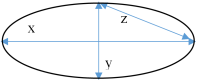
The major diameter (x), average diameter (y), minor diameter (z), sphericity (Φ), mass of a thousand fruits (M1000), apparent density, true density, porosity and surface area were used to physically characterize fruits, nuts and kernels using the methods described by .
(a) Determination of the major diameter (x), average diameter (y) and minor diameter (z) of fruits, nuts and kernels
All diameters were determined using a Schlenker Ltd USA caliper with an accuracy of 0.01. They were measured so that each measuring axis was perpendicular to the other two axes.
Figure 1. Measurement axis (x=major diameter; y=average diameter; z=minor diameter).
(b) Determination of the average geometric diameter and sphericity of fruits, shell and kernels
The formulas below were used to calculate the geometric diameter and sphericity from the values of x, y et z.
- Average geometric diameter (Dg):
Dg = xyz3(1)
- Sphericity (Φ): Sphericity is used to describe the shape of particles (spherical, ellipsoïdal). Its formula is as follows:
Φ =xyz3x(2)
(c) Determination of the surface area of fruits, nuts and kernels
The surface area was determined by analogy with a sphere of the same geometric average diameter using the following formula:
S=πDg2(3)
Where S is the surface area in mm2 and Dg is the average geometric diameter in mm.
(ii). Physical Characterization of Fruits, Nuts and Kernels
(a) Determination of the mass of fruits, nuts and kernels
The mass was determined using a Sartorius precision balance (10-2). The corresponding mass of 50 fruits was determined by weighing fruit by fruit. Subsequently, the fruits were depulped and similar measurements were made on the nuts. After shelling the nuts, the same measurements were made on the kernels.
(b) Determination on the mass of 1000 fruits (M1000), 1000 nuts and 1000 kernels
This measurement provided an indication of the yield and any problems the plant may have encountered during its development (scalding, insect or disease attacks). To perform this measurement, 100 fruits were weighed using a Sartorius precision balance (10-2). The mass obtained was multiplied by 10.
The mass of 1000 nuts and 1000 kernels was determined in an identical manner.
(c) Determination of apparent density (ρa)
Density (ρ) is a physical quantity that defines the amount of mass (m) per unit volume (v). It is an indicator of the purity and concentration levels of certain products. The method was used to determine this parameter. Density was calculated according to the following relationship:
ρa=mv(4)
With ρa: apparent density in Kg/m3
m: mass of the fruit in Kg and V: volume of the container in m3
(d) Determination of real density (ρr)
The real density (ρr) was determined using the water displacement method. The fruits were weighed using a Sartorius precision balance (10-2). Fruits with a known mass were placed in a graduated cylinder containing a known volume of water. The volume of water displaced by the fruit was recorded. The ration of the fruit mass to the fruit volume was considered the actual density.
ρr = mv(5)
Where ρr is the real density, m is the fruit mass in Kg and v is the volume of water displaced by the fruit in m3.
(e) Determination of porosity (ε)
Porosity is the ratio of pore volume to the total volume of the material. It is calculated as a percentage of the substrate volume. It indicates the degree of compactness of the material. The porosity of fruits, nuts and kernels was calculated from the true density and the apparent density using the relationship:
ε=1-ρaρr 100(6)
Where ε is the porosity in %, ρa is the apparent density in Kg.m-3 and ρr is the true density in Kg. m-3 respectively.
2.2.2. Chemical Characterization of Kernels
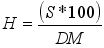
The kernels were ground using a Binatone hand-operated domestic grinder and the resulting ground kernels were used for chemical characterization. The method was used to determine the water and ash contents of the kernels. The protein content was carried out using . Sugar content was determined using colorimetric method of . The extraction of oil was carried out according to the method. The oil content (H) is given as a percentage of dry matter based on the following formula:
(7)
With S = percentage by mass of oil.
DM = dry matter content deducted from water content.
2.2.3. Physical Characterization of Oil
Colour is the visual sensation produced by light radiation absorbed or reflected by substances. A tintometer (Lovibond Tintometer 180000 Model F) was used to determine the colour of the oil samples. This determination is based on the variation of red, yellow and blue colours, the function of the coloured constituents in the sample and the quality of refining. Cottonseed oil is the reference oil. The standard for Diamaor brand cottonseed oil is ≤ 7.
Density is useful for measuring the quantities of vegetable oil. It provides information on the nature of the fatty acid component and is used to convert mass to volume and vice versa. The relative density of the oils was determined using the method.
The method described by was used to determine the refractive index of the oils.
2.2.4. Chemical Characterization of Oil Extracted from B. aegyptiaca
The acid, iodine, peroxide and saponification index were determined on the oils extracted from kernel powders according to the method.
2.2.5. Statistical Analyses
The parameters were determined in triplicate. Analysis of variance (ANOVA) was performed on the results obtained using . The difference between means was detected using the DUNCAN comparison test at the 5% risk threshold.
3. Results and Discussion
3.1. Morphological and Physical Characteristics of Fruits, Nuts and Kernels
3.1.1. Morphological Characteristics of Fruits, Nuts and Kernels
Table 1 presents the morphological characteristics of the fruits, nuts and kernels of the desert date from the localities of Garoua, Maroua and Kousseri. For the fruits, those from Garoua have the highest property values, regardless of the parameter (X=31.50 mm; Y=27.26 mm; Z=25.41 mm; Dg=27.92 mm; Φ=0.89 and S=2475.19 mm2). It is also noted that the values of all parameters of the fruits from Maroua and Kousseri are close. Furthermore, the fruits from the three localities have sphericity values greater than 0.7. The low parameter values for the fruits from Maroua and Kousseri could be explained by the low water retention capacity of their soils . They also indicate that the fruits from Maroua and Kousseri are smaller than those from Garoua. The presence of some fruits from Kousseri bigger than those from Maroua can be explained by the influence of a microclimate in the areas where B. aegyptiaca grows in the town of Kousseri. Indeed, observed, in Sudan, small fruits in the savannahs of dry areas compared to humid areas. Similar values of length (26 mm) and width (21 mm) were obtained in Senegal by in Sudano-Sahelian zones. In view of the values of the sphericities of the fruits, it can be considered that the fruits of all localities are ellipsoïdal in the shape . This « oval » shape corroborates that cited by .
As for nuts, it was observed that Maroua nuts had the shortest length (24.46 mm) while Garoua nuts (27.41 mm) and Kousseri nuts (26.13 mm) had similar and longer lengths. The sphericity values for all nuts were greater than 0.7. For the other characteristics, the nuts of Garoua fruits were seen to have the highest values (Y=20.35 mm; Z=20.33 mm; Dg=22.40 mm; S=1591.68 mm2). Maroua fruits have the smallest nuts. The low values of other parameters for the fruits of Maroua and Kousseri could also be explained by the low water retention capacity of their soils . The nuts from all localities were also observed to be ellipsoïdal in shape.
Concerning the kernels of B. aegyptiaca, we noted that the length of the fruits of Garoua (20.43 mm) was significantly greater than those of Maroua (16.42 mm) and Kousseri (17.27 mm). The values of other parameters were significantly decreasing according to the direction Garoua, Maroua and Kousseri. These results indicated that the fruits of Garoua had the biggest kernels while those of Kousseri had the smallest kernels. Thus, if we want big kernels, we will have to take Garoua as the source. We also noted that the sphericity values for the kernels of the fruits of the three study areas were less than 0.7. This would suggest that not all kernels are ellipsoïdal in shape.
Table 1. Morphological characteristics of fruits, nuts and kernels of B. Aegyptiaca.

Morphological characteristic

Location

Element

Garoua

Maroua

Kousseri

X (mm)

31.50±2.69a

27.06±1.94b

28.79±0.83b

Fruits

Y (mm)

27.26±3.18a

21.15±1.92b

22.44±2.69b

Z (mm)

25.42±3.21a

20.13±1.92b

20.89±1.42b

Dg (mm)

27.92±2.89a

22.57±1.85b

23.74±1.28b

Φ

0.89±0.04a

0.84±0.04b

0.83±0.07b

S (mm2)

2475.19±461.70a

1610.47 ± 255.52b

1777.17 ± 181.20b

X (mm)

27.41±2.69a

24.46±2.02b

26.13±3.05a

Nuts

Y (mm)

20.35±2.69a

17.54±1.64b

17.17±2.71b

Z (mm)

20.33±2.69a

16.47±1.71b

15.81±2.76b

Dg (mm)

22.40±2.29a

19.16 ±1.43b

19.11±2.23b

Φ

0.82±0.10a

0.79±0.06a

0.83±0.08a

S (mm2)

1591.68±295.17a

1159.55±177.55b

1162.18±262.56b

X (mm)

20.43±2.26a

16.42±2.18b

17.27±2.19b

Kernels

Y (mm)

10.87±0.83a

9.70±0.99b

8.32±1.47c

Z (mm)

9.29±0.81a

8.13±0.99b

6.86±1.41c

Dg (mm)

12.71±0.89a

10.87±1.02b

9.92 ±1.51c

Φ

0.63±0.05a

0.67±0.07b

0.58±0.07c

S (mm2)

509.53±71.22a

374.32±67.15b

316.13±97.46c

X= Major diameter; Y= Average diameter; Z= Minor diameter; Dg = Geometric diameter; Φ= Sphericity; S=Surface
The values in the rows with the different letters in the exponent are significantly different (p < 0.05)
3.1.2. Physical Characteristics of Fruits, Nuts and Kernels
Table 2 presents the physical characteristics of the fruits, nuts and kernels of B. aegyptiaca. The values of the masses of the fruits showed a decrease following the trend Garoua (14.13g), Kousseri (12.76g) and Maroua (11.68g). as for the nuts, we observed that the highest mass was that of the nuts of Garoua (6.79g) and the smallest mass was that of Kousseri (5.93g). we also observed that the values of the masses of the kernels were higher in Kousseri (1.70g) and Garoua (1.63g), followed by those of Maroua (1.28g). The high value of the mass of the fruits, nuts and kernels of Garoua could be linked to the high humidity of the soils. Indeed, the city of Garoua is located in a basin and is drained by the Benue river. Furthermore, these values were higher than that of 4.68g found by . This difference would be due to the harsher Sahelian weather conditions in Senegal.
Regarding 1000 fruits, the highest mass was that of Garoua (13856.25g), followed by that of Kousseri (12872.25g) and that of Maroua (11776.47g). These results could be explained by the humidity of the soils of Garoua which favors high yields. While the less humid soils in Maroua probably lead to low yields. The masses of 1000 nuts indicated that the values decrease from Garoua (6911.5g), Maroua (6296.65g) to Kousseri (5918.5g). The problems that occured in their development would explain the low masses obtained in Kousseri. Regading the kernels, the masses of 1000 kernels were lower in Maroua (1278.5g). This low value for Maroua could be explained by the drier soils in this city . These important results for understanding the development of the plant were, to our knowledge, the first concerning B. aegyptiaca.
The apparent density values of the fruits showed that they were higher for the fruits of Garoua (732.2 Kg/m3) and Maroua (730.6 Kg/m3). On the other hand, they were lower for the fruits of Kousseri (703.8 Kg/m3). The high values of the fruits of Garoua could be explain by the fact that the constituent particles of these fruits were closer to each other. Anything that would increase the density of the fruits. On the other hand, the low value for the fruits of Kousseri, could be explained by a high proportion of voids in these fruits. This trend was also observed in the values of the apparent density of the nuts and kernels. The values of the real density of the fruits, nuts and kernels followed the same trend as the apparent density.
The porosity values of fruits (43.96%), nuts (27.10%) and kernels (59.52%) showed that they were higher for Kousseri. These observations could be explained by the higher proportions of voids in Kousseri fruits. These values were also consistent with the trends observed in the density values. Indeed, a high density value indicates a material with a low proportion of voids. Porosity being inversely proportional to density.
It was observed that the fruits of Maroua (53.58%) had the highest proportion of nuts while the fruits of Kousseri (46.31%) had the lowest proportion. However, the fruits of Kousseri (13.40%) contained more kernels than the other fruits. In addition, the fruits of the Kousseri locality were richer in pulp (53.69%). These values (46.42% to 53.69%) were lower than 57% reported by , but higher than the values (35% to 43%) of the total weight of the fruit found by for fruits of Senegal. This value was similar to the values (43% à 53%) found by . The highest proportion of hull was that of Maroua fruits (42.46%), and the lowest was that of Kousseri fruits (32.91%).
Table 2. Physical characteristics of fruits, nuts and kernels of B. Aegyptiaca.

Physical characteristic

Location

Garoua

Maroua

Koussseri

Mass (g)

Fruits

14.13±1.59a

11.68±1.38b

12.76±2.95a

Nuts

6.79±0.77a

6.26±0.62ab

5.93±0.83b

Kernels

1.63 ±0.11a

1.28 ±0.14b

1.70±0.26a

Mass of 1000(g)

Fruits

13856.25±1722.71a

11776.47±1626.55b

12872.25±1706.67ab

Nuts

6911.50±455.17a

6296.65±326.55b

5918.50±357.35c

Kernels

1652.50±157.35a

1278.5±187.22b

1726.50±254.56a

Apparent density (Kg/m3)

Fruits

732.20±24.22a

730.60±19.73a

703.80±18.24b

Nuts

839.30±18.35a

833.30±20.18a

816.60±17.88b

Kernels

731.50±15.35a

730.50±16.61a

726.60±15.16b

Real density (Kg/m3)

Fruits

1 268.50±35.35a

1271.20±37.75a

1233.90±35.59b

Nuts

1769.70±42.76a

1771.10±40.52a

1765.30±40.66b

Kernels

1280.90±23.34a

1261.90±28.17a

1159.90±31.82b

Porosity (%)

Fruits

42.29±1.37b

42.52±1.60b

43.96±1.05a

Nuts

22.28±2.57c

25.71±3.56b

27.10±3.12a

Kernels

58.64±2.75b

58.70±2.35b

59.52±4.18a

Proportions between masses (%)

Nut/fruit

48.05±1.31b

53.59±1.35a

46.47±1.85b

Kernel/fruit

11.54±1.25b

10.96±1.51b

13.32±1.41a

Pulp/fruit

52.20±0.64b

46.42±1.14c

53.69±1.39a

Hull/fruit

36.13±0.78b

42.46±0.83a

32.91±0.46c

The values in the rows with the different letters in the exponent are significantly different (p < 0.05)
3.2. Chemical Characteristics of Kernels
Table 3 presents the chemical characteristics of B. aegyptiaca kernels. It is observed that the water content of Garoua kernels (4.38%) was significantly higher than that of Maroua (3.89%) and Kousseri (3.75%). The same was found to be true for lipid content, except that in this case, Maroua kernels had the lowest (44.4%). This trend in lipid content was identical to that obtained for sugar content, namely 18.25%, 17.87% and 17.69% for Garoua, Kousseri and Maroua, respectively. The same was true for the protein content of the kernels. As for ash content, it was observed that the locality of the kernels had no significant influence on the values of these contents.
The high water content of kernels from Garoua could be due to the high humidity of the soils in the town drained by the Benue river. The other results could be explained by the agroclimatic and pedological conditions of the three localities. Indeed, the humidity of the soils in Garoua would favor high contents while the less humid soils would lead to low contents in Maroua. The observed water contents were higher than those obtained by and , namely 3.6% and 3.14% on B. aegyptiaca, respectively. However, they were lower than the value of 18.1% obtained by . These differences could be explained by the Sahelian climate of Chad which would make the soil drier. Furthermore, the values obtained by were the average of the values of samples from several origins. This could explain the difference with the results of this study. The differences between the other chemical characteristics could also be due to the varied agro-climatic and soil conditions of the different localities. The lipid content values were higher than those of 41% and 39.33% obtained by and , respectively. However, they correspond to those between 46.93% and 49.32% mentioned by and for the values of Garoua and Kousseri. On the contrary, this range of values was higher than the value of Maroua. This difference could be explained by the different soil conditions. The sugar content values were lower than those of 21%, 33% and 25.53% obtained by and , respectively. This difference could be explained by the difference in soil conditions of Chad for the first and in the calculation method (average of the values of samples from several origins) for the others. As for the protein content, our values were not far from those between 24.5% and 25.3% recorded by . The proximity of the results could be explained by the fact that we used the same quantification method as these authors: the total nitrogen quantification method. Our values were lower than those of 27% and 28.28% obtained by and , respectively. Agro-climatic and soil differences would induce this difference in value. On the contrary, our values were higher than that of 4.7% obtained by . The origin of the samples of the said authors could be at the origin of this difference. The ash contents were higher than the 3% obtained by but lower than the values in the range of 3.92% to 4.06% and 3.72% mentioned by and . The difference in climatic and pedological conditions of each country could explain these differences. These results showed that the kernels of Kousseri contained more dry matter than the kernels of other cities. The kernels of the northern region (Garoua) were therefore more interesting for their chemical characteristics.
Table 3. Chemical characteristics of B. aegyptiaca kernels.

Chemical characteristic

Location

Garoua

Maroua

Koussseri

Water content (%)

4.38±0.95a

3.89±0.29b

3.75±0.54b

Lipid content (% DM)

49.20±1.03a

44.40±0.52c

46.10±0.45b

Sugar content (% DM)

18.25±0.11a

17.69 ±0.14c

17.87±0.26b

Protein content (% DM)

24.55±1.71a

23.18±1.55b

24.13±1.67ab

Ash content (% DM)

3.35±0.17a

3.24±0.35a

3.13±0.45a

The values in the rows with the different letters in the exponent are significantly different (p < 0.05)
3.3. Physical and Chemical Characteristics of Kernel Oils
3.3.1. Physical Characteristics of Kernel Oils
Table 4 shows the physical properties of desert date kernel oil. It was noted that the oils extracted from the kernels obtained from the three localities has a light yellow colour. According to many authors , the colour of B. aegyptiaca oil was close to that of peanut oil, that is to say light yellow. This colour was also consistent with that found by and .
The density of the oils was not significantly influenced by the originating locality of the kernels. The values of these densities were within the required range (0.91-0.93 Kg/m3) according to and similar to those of quality edible oils (olive, peanut, sesame and soybean oils) . However, these values were lower than that of 0.954 mentioned by . This difference could come from the solvent (petroleum ether) used by this author and which has a low selectivity for triglycerides compared to hexane.
The provenance of the kernels didn’t have a significant influence on the refractive index values of the oils. These values were higher than those of 1.461, 1.45 and 1.458 obtained by and , respectively. This difference could be due to the higher measurement temperature for these authors. Indeed, the refractive index of oils decreases with increasing temperature . These values were close to that of peanut oil (1.470 to 1.472) .
Table 4. Physical characteristics of desert date kernel oil.

Location

Garoua

Maroua

Kousseri

Colour

Light yellow

Light yellow

Light yellow

Density at 22°C (kg/m3)

0.916±0.005a

0.916±0.008a

0.917±0.003a

Refractive index at 20°C

1.473±0.009a

1.474±0.005a

1.474±0.002a

The values in the rows with the different letters in the exponent are significantly different (p < 0.05)
3.3.2. Chemical Characteristics of Kernel Oils
Table 5 lists the chemical characteristics of B. aegyptiaca kernel oils. It appeared that the originating locality of the kernels had no significant influence on the values of all oil quality index. Regarding the acid index, the values obtained were lower than the standard of 4 recommended by the for edible oils. This was an indicator of the good purity and stability of B. agyptiaca oils. These results were also consistent with the range of values (0.9 to 1.27) mentioned by . However, these values were lower than those of 1.56, 2.14 and 3.06, obtained by and , respectively. This difference could be explained by the fact that the fruits and kernels were dried on the one hand, and on the other hand by the use of petroleum ether as a solvent. These values were higher than that of 0.4 mentioned by . The treatment of the kernel powder could explain this difference. Indeed, these authors sieved the powder after drying and grinding the kernels.
As for the iodine index of the oils, the values were higher than those of (96 to 111) obtained by , that of 100.52 obtained by , that of 104.39 mentioned by , that of 98.73 mentioned by and finally that of 104.86 obtained by . The extraction solvent and the treatment of the samples could explain this difference. The iodine index values obtained attest to the food potential of this oil. These iodine index obtained were comparable to those of other common oils, such as soybean oil (117 to 143), cottonseed oil (90 to 119) and sesame oil (104 to 120) . These results demonstrate the semi-siccative properties of these oils because semi-drying oils have an iodine value between 100 and 130.
The peroxide index were lower than the standard of 10 recommended by the for edible oils. They indicated the stability and a good level of oxidation of the oils . These values were higher than those of 2.95, 3.71 and 4 mentioned by and , respectively. The extraction solvent and sample treatment could also explain this difference.
The saponification index values were lower than the standard of 195 to 205 recommended by the for edible oils. These values were lower than those of coconut and palm kernel oils, which have a maximum saponification index of 264 and 254, respectively, and are commonly used as raw materials for the manufacture foaming soaps . The lower saponification index values indicated that this oil could be used as the main component for soap production. They would also indicate a good shelf live of this oil with a lower risk of oxidation (low proportion of short-chain fatty acids). These results were also in line with the values range (190 to 198) and (180.50 to 192.80) obtained by and . However, these values were lower than those of 200.02 and 198 obtained by and , respectively. This difference could be explained by the use of petroleum ether as a solvent. These values were higher than that of 181.96 mentioned by . The treatment of the kernel powder could explain this difference.
Table 5. Chemical characteristics of desert date kernel oil.

Location

Garoua

Maroua

Kousseri

Acid index (mg KOH/g)

1.36±0.16a

1.21±0.07a

1.25±0.09a

Iodine index (mgI2/g)

114.82±2.60a

114.30±0.05a

115.42 ±1.95a

Peroxide index (meqO2/Kg)

5±0.06a

5±0.19a

5±0.50a

Saponification index (mg KOH/g)

190.73±2.43a

186.52±2.43a

189.30±4.80a

The values in the rows with the different letters in the exponent are significantly different (p < 0.05)
4. Conclusion
The objective of this work was to evaluate the food and technological potential of B. aegyptiaca by determining the physicochemical properties of fruits, nuts, kernels and oil from the northern region of Cameroon (Garoua, Maroua and Kousseri). The fruits, nuts and kernels, as well as the extracted oils were characterized.
The fruits and nuts were ellipsoïdal in shape, while the kernels were not. The fruits, nuts and kernels from Garoua had the highest morphological property values, regardless of the parameter. These results indicated that the fruits, nuts and kernels from Garoua were biggest. The kernels from Kousseri were the smallest. For kernel exploitation, it was found that the best source for fruits was from Garoua. The highest mass per 1000 fruits was from Garoua (13856.25g) and the weights of 1000 nuts and 1000 kernels were also among the highest. This was indicative of high yields. To our knowledge, these important results for understanding the plant’s development were the first concerning B. aegyptiaca. The densities of fruits, nuts and kernels from Garoua were also the highest since they were denser than those from Maroua and Kousseri.
The lipid content was greater than 44% regardless of the originating locality of the kernels. Garoua kernels had the highest water, lipid, sugar and protein contents. However, the ash content was the same for the kernels from all three localities. Garoua kernels were more interesting for their chemical characteristics.
The acid index values were lower than the standard of 4 mg KOH/g recommended by CODEX for edible oils. The iodine index values were close to those of cottonseed oil. The peroxide index values for all three localities were lower than 10 meqO2/Kg oil which is the standard for edible oils. The saponification index values gave values lower than those of certain conventional oils (coconut, palm kernel) used in soap making. B. aegyptiaca oil is stable and has a good shelf live. It is semi-siccative and less susceptible to oxidation than some conventional oils. This oil could be used as the main component for soap production. These results indicate that the exploitation of B. aegyptiaca fruits could be more interesting in the North region.
Abbreviations

M1000

Mass of 1000

DM

Dry Matter

mgKOH/g

Milligrams of Potassium Hydroxide per Gram

mgI2/g

Milligrams of Diiodine per Gram

meqO2/Kg

Mili Equivalent Oxygen per Kilogram

Author Contributions
Gaston Zomegni: Investigation, Methodology, Supervision, Validation, Writing – original draft, Writing – review & editing
Gilles Bernard Nkouam: Conceptualization, Data curation, Investigation, Methodology, Software, Supervision, Validation, Writing – original draft, Writing – review & editing
Musongo Balike: Formal Analysis, Methodology, Software, Validation, Writing – original draft, Writing – review & editing
Heukwa-Tefoung Anne: Formal Analysis, Methodology, Software, Validation
Lamine Said Baba-Moussa: Supervision, Validation, Visualization
Crépin Ella Missang: Supervision, Validation, Visualization
César Kapseu: Supervision, Visualisation
Danielle Barth: Supervision, Visualisation
Conflicts of Interest
The authors declare that there is no conflict of interest for this article.
References
[1] OCDE/FAO. Perspectives agricoles de l’OCDE et de la FAO 2025-2034 – Chapitre 9: oléagineux et produits oléagineux, OCDE/FAO, 2025, 12p.
[2] Ribier, D. La transformation artisanale des plantes à huile, Guide pratique. GRET, Paris, 1993, 105p.
[3] Grandval, F. Introduction aux enjeux de valorisation des produits locaux en Afrique de l’Ouest, Grain de sel. nº 58. Bourkina Faso, 2012, pp. 12-14.
[4] Eyog Matig, O, Gandé Gaoué, O, Dossou, B. Programme des ressources génétiques forestières en Afrique au sud du Sahara. Réseau «Espèces Ligneuses Alimentaires». Compte rendu de la première réunion. Ouagadougou, 2000, 243p.
[5] Tayeau, F., Faure, F., Séchet-Sirat, J. Etude sur le Soumpe (Balanites aegyptiaca). Valeur alimentaire de ses protéines. J. Agric. Trop. Bot. Appl. 1955, 2(1-2), 40-49.
[6] ERA. Situation énergétique du Cameroun, rapport pour le projet enefibio. 2008, 113p.
[7] Dahouenon-Ahoussi, E., Djenontin, T. S., Codjia, D. R. M., Tchobo, F. P., Alitonou, A. G., Dangou, J., Avlessi, F., Sohounhloue, D. C. K. Morphologie des fruits et quelques propriétés physiques et chimiques de l’huile et des tourteaux de Irvingia gabonensis (Irvingiaceae), Int. J. Biol. Chem. Sci. 2012, 6(5), 2263-2273.
[8] Sagna, M. B., Niang, K. S., Guisse, A., Goffner, D. Balanites aegyptiaca (L.) Delile: geographical distribution and ethnobotanical knowledge by local populations in the Ferlo (north Senegal). Biotechnol. Agron. Soc. Environ. 2014, 18(4), 503-511.
[9] Abdoulaye, B., Bechir, A. B., Mapongmetsem, P. M. Utilités socioéconomiques et culturelles du Balanites aegyptiaca (L.) Del. (Famille Zygophyllaceae) chez les populations locales de la Région du Ouaddaï au Tchad. J. Appl. Biosci. 2017, 111, 10854-10866.
[10] Bazongo, P., Ouedraogo, L., Samadoulougou-Kafando, P. M. J., Kiendrebeogo, M., Barro, N. Physicochemical and Biochemical Composition of Balanites aegyptiaca Seed and Seed Oil from Burkina Faso. Food Nutr. Sci. 2023, 14, 1206-1220.
[11] Datti, Y., Tijjani, Y. A., Koki, I. B., Ali, U. L., Labaran, M., Ahmad, U. U., Tasi’u, N. Phytochemical composition of desert date kernel (Balanites aegyptiaca) and the physical and chemical characteristics of its oil, GSC Biol. and Pharm. Sci. 2020, 11(03), 197-207.
[12] Okia, C. A., Kwetegyeka, J., Okiror, P., Kimondo, J. M., Teklehaimanot, Z., Obua, J. Physico-chemical characteristics and fatty acid profile of desert date kernel oil, Afr. Crop Sci. J. 2013, 21(3), 723-734.
[13] Mano, E., Nana, J. Bios efficacités et innocuité de bioinsecticides à base de poudres de Balanites aegyptiaca L. Drel. et de Moringa oleifera Lam. sur Helicoverpa armigera (Hübner) et ses ennemis naturels, J. Appl. Biosci. 2022. 175, 18171-18181.
[14] Yougouda, H., Tchatchoua Tchapda, D., Arbonnier, M., Mapongmetsem, P. M. Ethnobotany and population structure of Balanites aegyptiaca (L.) Delile in Sahelian zone of Cameroon. Int. J. Biodivers. Conserv. 2018, 10(2), 92-99.
[15] Mohsenin Nuri, N. Physical properties of plant and animal materials. New York, Routledge: Taylor and Francis Group; 2019, 76p.
[16] AOAC International. Official Methods of Analysis of the Association of Official Analytical Chemists. Association of Official Analytical Chemists. Méthode 988.10. 1988.
[17] AFNOR (Association Française de NORmalisation). Recueil de normes françaises des corps gras graines oléagineuses produits dérivés/Compendium of French standards for fats and oils, 2eme Edition. 1981.
[18] AOAC. Official Methods of Analysis 15th Edition. Association of Official Analytical Chemist. Washington DC, USA; 1990.
[19] Dubois, M., Gilles, K. A., Hamilton, J. K., Roberts, P. A., Smith, F., 1956. “Colorimetric method for determination of sugars and related substances”. Anal. Chem. 1956, 28(3), 350-356.
[20] UICPA (Union Internationale de Chimie Pure et Appliquée). Méthode d’analyse des matières grasses/Analysis methods of fat matter, sixième édition. Int. Dig. Health Legis. 1979, 46(2), 214p.
[21] Rheims, J., Kösery, J., Wriedt, T. Refractive-index measurements in the near-IR using an Abbe refractometer, Meas. Sci. Technol. 1997, 8, 601–605.
[22] Statgraphics Centurion XVI (1982-2012), version 16.1.18, Statpoint Technologies, Inc.
[23] Sighomnou, D. Analyse et redéfinition des régimes climatiques et hydrologiques du Cameroun: perspectives d’évolution des ressources en eau. Thèse de Doctorat d’Etat ès-Sciences Naturelles. Université de Yaoundé 1, 2004.
[24] Vogt, K., 1995. A field worker’s guide to the identification, propagation and uses of common trees and shrubs of dryland Sudan. SOS Sahel International. UK; 1995, 167p.
[25] Soloviev, P., Niang, T., Gaye, A., Totte, A. Variabilité des caractères physico-chimiques des fruits de trois espèces ligneuses de cueillette, récoltés au Séné^pgal: Adansonia digitata, Balanites aegyptiaca; Tamarindus indica. Fruits. 2004, 59(2), 109-119.
[26] UNIDO Technical report/10.494; Balanites aegyptiaca: An unutilized raw material potential ready for agro-industrial exploitation; TF/ INT /77 /021. 1983, pp. 1-100.
[27] Brabant, P., Gavaud, M. Les sols et les ressources en terres du nord-Cameroun. IFRSDS/MESRES-IRA, Ed., ORSTOM, Paris, 1985, 365p.
[28] INS (Institut National de la Statistique). Annuaire statistique 2018 de la Région de l’extrême-nord. Edition 2019, 2018, 276p.
[29] Favier, J-C., Ireland-Ripert, J., Laussucq, C., Feinberg, M. Répertoire général des aliments, tome 3: table de composition des fruits exotiques, fruits de cueillette d’Afrique. Technique & Documentation – Lavoisier, Institut National De La Recherche Agronomique, Institut Français De La Recherche Scientifique Pour Le Développement, Paris. 1993, 263p.
[30] Elfeel A. A., Sherif, Z., Hindi. Balanites aegyptiaca (L.) Del. var. aegyptiaca seed composition and variability among three different intraspecific sources. Life Sci. J. 2014, 11(7), 160-166.
[31] Zang, C. U., Jock, A. A., Garba, H. I., Chindo, Y. I. Application of Desert Date (Balanites aegyptiaca) Seed Oil as Potential Raw Material in the Formulation of Soap and Lotion. Am. J. Anal. Chem. 2018, 9, 423-437.
[32] Abu-Al-Futuh I. M. Balanites aegyptiaca: an unutilized raw material potential ready for agro-industrial exploitation. UNIDO Document no 12419 project TF/INT/77/021. UNIDO of the United Nations. 1983.
[33] Dial Ndiaye, F. Contribution à l'étude chimique et biochimique des graines de Balanites aegyptiaca (L.) Del. (simarubaceae) et de Parinari macrophylla sabine (rosaceae). Thèse de Doctorat, Faculté des Sciences et Techniques, Université Cheikh Anta Diop, 1997.
[34] Subrahmanyam, M. S. R., Vedanayagam, H. S., Venkatacharyulu, P. Estimation de la constante de Sharma et des propriétés thermoacoustiques des huiles végétales. J. Am. Oil Chem. Soc. 1994, 71, 901–905.
[35] Mohammed, A. M., Wolf, W., Spiess, W. E. Physical, morphological and chemical characteristics, oil recovery fatty acid composition of Balanites aegyptiaca Del Kernels. Plant Food Hum. Nutr. 2002, 57, 179-189.
[36] Obidah, W., Nadro, M. S., Tiyafo, G. O., Wurochekke, A. U. Toxicity of Crude Balanites aegyptiaca Seed Oil in Rats. J. Am. Sci. 2009, 5(6), 13-165.
[37] Codex Alimentarius International Foods Standards. Standard for named vegetable oils. CODEX STAN 210-1999. FAO, WHO, 2015, 13p.
[38] Lambert, J. Les huiles végétales: 2000 plantes oléagineuses répetorieés. Institut Français Des Huiles Vegetales Pures. 2005, 23p.
[39] Rossell, B. Measuring resistance to oxidative rancidity Food. Sci Technol. 1993, 4, 220-225.
[40] CEE. Règlement portant établissement d’une organisation commune des marchés dans le secteur des matières grasses. Journal officiel n°L039 du 15/02/, n°356/9. 1992, pp. 0001-0002.
Cite This Article
  • APA Style

    Zomegni, G., Nkouam, G. B., Balike, M., Anne, H., Baba-Moussa, L. S., et al. (2025). Physico-Chemical Characteristics of Fruits, Nuts, Kernels and Oils of Desert Date (Balanites aegyptiaca) from Three Locations in Northern Cameroon: Industrial Potential. Engineering and Applied Sciences, 10(5), 123-133. https://doi.org/10.11648/j.eas.20251005.12

    Copy | Download

    ACS Style

    Zomegni, G.; Nkouam, G. B.; Balike, M.; Anne, H.; Baba-Moussa, L. S., et al. Physico-Chemical Characteristics of Fruits, Nuts, Kernels and Oils of Desert Date (Balanites aegyptiaca) from Three Locations in Northern Cameroon: Industrial Potential. Eng. Appl. Sci. 2025, 10(5), 123-133. doi: 10.11648/j.eas.20251005.12

    Copy | Download

    AMA Style

    Zomegni G, Nkouam GB, Balike M, Anne H, Baba-Moussa LS, et al. Physico-Chemical Characteristics of Fruits, Nuts, Kernels and Oils of Desert Date (Balanites aegyptiaca) from Three Locations in Northern Cameroon: Industrial Potential. Eng Appl Sci. 2025;10(5):123-133. doi: 10.11648/j.eas.20251005.12

    Copy | Download

  • @article{10.11648/j.eas.20251005.12,
      author = {Gaston Zomegni and Gilles Bernard Nkouam and Musongo Balike and Heukwa-Tefoung Anne and Lamine Said Baba-Moussa and Crépin Ella Missang and César Kapseu and Danielle Barth},
      title = {Physico-Chemical Characteristics of Fruits, Nuts, Kernels and Oils of Desert Date (Balanites aegyptiaca) from Three Locations in Northern Cameroon: Industrial Potential},
      journal = {Engineering and Applied Sciences},
      volume = {10},
      number = {5},
      pages = {123-133},
      doi = {10.11648/j.eas.20251005.12},
      url = {https://doi.org/10.11648/j.eas.20251005.12},
      eprint = {https://article.sciencepublishinggroup.com/pdf/10.11648.j.eas.20251005.12},
      abstract = {The objective of this work is to study the food and technological potential of Balanites aegyptiaca through the physico-chemical properties of fruits, nuts, kernels and oils in the northern zone of Cameroon (Garoua, Maroua and Kousseri). The fruits, nuts and kernels were characterized. The physico-chemical properties of kernels and oils were determined by standardized methods. The kernel mass to fruit mass ratio is 11.67% for the samples from Garoua, 11.12% for those from Maroua and 13.40% for those from Kousseri. The oil content is higher than 44% regardless of the provenance of the kernels. The acid index values (1.21±0.07 mg KOH/g of oil for Maroua, 1.25±0.09 mg KOH/g of oil for Kousseri and 1.36±0.16 mg KOH/g of oil for Garoua) are lower than the standard of 4 mg KOH/g of oil recommended by CODEX standard for edible oils. The iodine index values are 114.30±0.05 mgI2/g for Maroua, 114.82±2.6 mgI2/g for Garoua and 115.42±1.95 mgI2/g for Kousseri. These values are close to those of cottonseed oil. The peroxide index values in meqO2/Kg for the three localities are lower than 10 meqO2/Kg, the recommended standard for edible oils. The saponification index gave the values of 189.33±4.8 for Kousseri, 186.52±2.4 for Maroua and 190.73±2.43 for Garoua. These values are lower than those of some conventional oils (copra, palm seed) used in soap making. Balanites aegyptiaca oil was found to be a stable oil with good preservation. It is semi siccative and less susceptible to oxidation than some conventional oils. This oil could be used as a main component for soap production.},
     year = {2025}
    }
    

    Copy | Download

  • TY  - JOUR
    T1  - Physico-Chemical Characteristics of Fruits, Nuts, Kernels and Oils of Desert Date (Balanites aegyptiaca) from Three Locations in Northern Cameroon: Industrial Potential
    AU  - Gaston Zomegni
    AU  - Gilles Bernard Nkouam
    AU  - Musongo Balike
    AU  - Heukwa-Tefoung Anne
    AU  - Lamine Said Baba-Moussa
    AU  - Crépin Ella Missang
    AU  - César Kapseu
    AU  - Danielle Barth
    Y1  - 2025/12/08
    PY  - 2025
    N1  - https://doi.org/10.11648/j.eas.20251005.12
    DO  - 10.11648/j.eas.20251005.12
    T2  - Engineering and Applied Sciences
    JF  - Engineering and Applied Sciences
    JO  - Engineering and Applied Sciences
    SP  - 123
    EP  - 133
    PB  - Science Publishing Group
    SN  - 2575-1468
    UR  - https://doi.org/10.11648/j.eas.20251005.12
    AB  - The objective of this work is to study the food and technological potential of Balanites aegyptiaca through the physico-chemical properties of fruits, nuts, kernels and oils in the northern zone of Cameroon (Garoua, Maroua and Kousseri). The fruits, nuts and kernels were characterized. The physico-chemical properties of kernels and oils were determined by standardized methods. The kernel mass to fruit mass ratio is 11.67% for the samples from Garoua, 11.12% for those from Maroua and 13.40% for those from Kousseri. The oil content is higher than 44% regardless of the provenance of the kernels. The acid index values (1.21±0.07 mg KOH/g of oil for Maroua, 1.25±0.09 mg KOH/g of oil for Kousseri and 1.36±0.16 mg KOH/g of oil for Garoua) are lower than the standard of 4 mg KOH/g of oil recommended by CODEX standard for edible oils. The iodine index values are 114.30±0.05 mgI2/g for Maroua, 114.82±2.6 mgI2/g for Garoua and 115.42±1.95 mgI2/g for Kousseri. These values are close to those of cottonseed oil. The peroxide index values in meqO2/Kg for the three localities are lower than 10 meqO2/Kg, the recommended standard for edible oils. The saponification index gave the values of 189.33±4.8 for Kousseri, 186.52±2.4 for Maroua and 190.73±2.43 for Garoua. These values are lower than those of some conventional oils (copra, palm seed) used in soap making. Balanites aegyptiaca oil was found to be a stable oil with good preservation. It is semi siccative and less susceptible to oxidation than some conventional oils. This oil could be used as a main component for soap production.
    VL  - 10
    IS  - 5
    ER  - 

    Copy | Download

Author Information