Research Article | | Peer-Reviewed

Impact of Social Protection on Poverty Reduction and Income Distribution in Nigeria: A Computable General Equilibrium Microsimulation Approach

Published in Economics (Volume 15, Issue 2)
Received: 6 May 2026     Accepted: 20 May 2026     Published: 4 June 2026
Views:       Downloads:
Abstract

Social protection has emerged as a crucial instrument for reducing poverty and income inequality in many low- and middle-income countries across the world. In Nigeria, several social protection programmes and interventions have been introduced and implemented over the last decade with the aim of improving the welfare of vulnerable households, promoting inclusive growth, and addressing rising levels of poverty and inequality. Despite these efforts, there are increasing indications that such investments have not produced the expected or desired reductions in poverty and income disparities. This suggests that social protection investments may not have been sufficiently effective in addressing the structural causes of poverty and inequality in the country. Against this background, this paper assesses the impact of social protection on poverty and income distribution in Nigeria by taking into account the general equilibrium effects associated with at-scale financing mechanisms. The study adopts a Computable General Equilibrium (CGE) microsimulation model calibrated with a combined dataset comprising the 2018 Social Accounting Matrix (SAM) for Nigeria and the Nigeria General Household Survey 2015–2016. Findings from the study reveal that social protection investments can contribute significantly to reductions in poverty and income inequality under favourable economic and policy conditions. In particular, the foreign aid financing channel was found to be the most effective in reducing poverty. The paper therefore emphasizes the importance of strengthening North–South collaborations in the design, implementation, and financing of anti-poverty social protection programmes in line with Sustainable Development Goal 17 (Partnerships for the Goals).

Published in Economics (Volume 15, Issue 2)
DOI 10.11648/j.eco.20261502.13
Page(s) 49-57
Creative Commons

This is an Open Access article, distributed under the terms of the Creative Commons Attribution 4.0 International License (http://creativecommons.org/licenses/by/4.0/), which permits unrestricted use, distribution and reproduction in any medium or format, provided the original work is properly cited.

Copyright

Copyright © The Author(s), 2026. Published by Science Publishing Group

Keywords

Social Protection, Poverty Reduction, Income Distribution, Nigeria, CGE Microsimulation

1. Introduction
Social protection has become an increasingly important aspect of development policy, particularly in low- and middle-income countries where vulnerability to poverty and income shocks remains high. It broadly refers to a set of public interventions designed to reduce poverty, protect households against economic shocks, and enhance income distribution through income support, access to essential services, and labour market inclusion . In addition to its protective function, social protection is also viewed as an instrument for promoting more inclusive and equitable development.
Over the past two decades, many developing countries have expanded their social protection systems, with increasing fiscal commitments directed toward both conditional and unconditional cash transfer interventions. Nigeria has followed a similar trajectory, with rising public expenditure on social protection reflecting policy efforts to address persistent poverty and inequality challenges . However, despite this expansion, poverty outcomes have remained a central concern, raising important questions about the effectiveness of rising social protection spending in achieving intended objectives .
This concern is particularly important in developing economies where limited fiscal space, price transmission effects and other structural constraints may shape the ultimate welfare impacts of social protection investments. In such contexts, the impact of social protection may extend beyond direct income transfers to households and operate through broader general equilibrium channels, including adjustments in prices, wages, production incentives, and government budget balances. These economy-wide adjustments may, in turn, shape the net distributional impact of social protection policies.
While partial equilibrium approaches often focus on direct impacts found across countries , such approaches may not fully capture indirect transmission channels that operate through markets and macroeconomic feedback mechanisms, especially when programmes are implemented at a large scale. As a result, they may provide an incomplete picture of the net welfare effects of large-scale social protection interventions, particularly when financing mechanisms and market adjustments are taken into account. Addressing this limitation is particularly important for assessing national-level social protection systems where financing and scale can reshape household responses. In particular, computable general equilibrium (CGE) models allow for the simultaneous representation of production, consumption, and fiscal behaviour, therefore enabling a more comprehensive assessment of how policy shocks are transmitted through the economy and ultimately affect household welfare and income distribution.
This paper undertakes an analysis of the impact of social protection investments on poverty and income inequality, with a focus on the potential general equilibrium effects of at scale financing in Nigeria. Using a comparative-static CGE model, the paper assesses the economy-wide consequences of social protection investments, taking into account their potential unintended consequences. By incorporating both macroeconomic adjustments and household-level heterogeneity, the analysis provides a comprehensive assessment of the economy-wide implications of social protection expenditure and financing policies. In line with ongoing debates about the effectiveness of social protection, the study provides a more complete understanding of how national-scale interventions translate into distributional outcomes. This is pertinent for the design of more effective and fiscally sustainable social protection strategies in Nigeria.
Despite the growing body of literature on the distributional impacts of social protection investments, few studies have considered their potential general equilibrium effects using the CGE framework. Furthermore, the paper employs a novel approach which integrates a CGE model with a household microsimulation model, which accounts for heterogeneity across income quintiles. The application of a CGE microsimulation technique is particularly useful for the execution of well targeted policy interventions and their individual effects on households, thus providing new insights for researchers and policymakers.
2. Literature Review
Social protection is a broad term encompassing a wide range of public and private interventions aimed at reducing poverty and enhancing income distribution. Social protection programmes provide safety nets against idiosyncratic and covariate shocks while promoting consumption smoothing, human capital development and social inclusion . At its core, social protection seeks to improve the welfare and resilience of vulnerable groups while fostering more equitable income distribution and inclusive development outcomes. A growing body of literature across low- and middle-income countries demonstrates that both conditional and unconditional social transfer programmes can generate significant improvements in household welfare, expand access to education, healthcare, and nutrition, and improve labour market outcomes .
Empirical evidence on the impact of social protection on poverty and income distribution has been documented extensively across diverse contexts. For instance, Evans and Popova conducted a meta-analysis of unconditional cash transfer programmes across different countries, with findings indicating improvements in household consumption and significant reductions in poverty levels . This evidence supports the conjecture recognizing cash transfers among the most effective policy tools for enhancing welfare in low- and middle-income settings. In a related study of unconditional cash transfers in Kenya, Haushofer and Shapiro found rigorous evidence of significant increases in household consumption, asset ownership, and psychological well-being, demonstrating that such interventions can lead to improvements in both economic and social outcomes simultaneously . Another study of South Africa’s social grants rollout found evidence of substantial reductions in poverty and income inequality, further highlighting the redistributive role of targeted government transfers . In the case of Nigeria, the evidence is equally suggestive of desirable long-term poverty and inequality impacts of sustained investment in social protection [1, 30]. However, despite these large benefits, the authors point to the need to address challenges such as weak targeting mechanisms, inadequate funding, and implementation inefficiencies for more effective social safety nets.
While these findings suggest substantial welfare gains, they are derived from reduced-form partial equilibrium models which are often limited to specific programme areas, thereby limiting their external validity on the broader economy. Unlike partial equilibrium evaluations, CGE frameworks explicitly model interactions among households, production sectors, factor markets, and government institutions, thereby allowing for endogenous adjustments in prices, wages, and fiscal balances that reshape real income distributions. In fact, observations from general equilibrium evaluations provide strong evidence suggesting that social protection interventions can have unintended macroeconomic consequences with broader implications on output, consumption and income distribution.
Available evidence from CGE studies indicates that while cash transfer programmes generate positive welfare effects at the household level, these gains are partially offset by relative price changes, labour market adjustments, and fiscal financing pathways. In particular, the poverty-reducing effects are attenuated once economy-wide feedback mechanisms are considered. For example, a general equilibrium study of targeting programmes in Côte d’Ivoire found limited impacts due to price rises of goods consumed by the poor and the corresponding financing burden of tax-based financing . Similarly, integrated CGE-microsimulation analysis of redistribution policies in Brazil shows that although cash transfers significantly reduce income inequality, their net poverty impact is moderated once financing structures and economy-wide adjustments are taken into account . When transfers are financed through taxation or expenditure reallocation, additional general equilibrium effects arise through production distortions and crowding-out of private consumption, further dampening the net poverty-reducing impact of social protection interventions.
More generally, SAM-based CGE applications in several developing countries demonstrate that transfer-induced increases in household demand can induce upward pressure on prices of non-tradable goods, thereby attenuating real income gains for both beneficiary and non-beneficiary households . In addition, labour market segmentation and wage adjustments further contribute to heterogeneous distributional outcomes across household groups, leading to partial restructuring of welfare positions within the income distribution. This evidence reflects a broader pattern in the CGE literature, where fiscal and behavioural responses reduce the magnitude of welfare gains observed under partial equilibrium assumptions.
Collectively, the literature suggests that while social protection generates poverty and distributional impacts, their net effect is structurally mediated once economy-wide feedbacks are incorporated, especially when financing instruments are taken into account. Unlike partial equilibrium evaluations, CGE models explicitly account for interactions among households, production sectors, factor markets, and government institutions, thereby allowing for endogenous adjustments in prices, wages, and fiscal balances that reshape real income distributions. This feature provides a strong appeal for the use of a CGE model in the present study to capture the full set of economy-wide transmission channels related to poverty and income dynamics. The study extends the literature by documenting the fiscal mechanism that maximizes the poverty-reducing impacts of social protection in the context of developing economies such as Nigeria.
3. Methodology
3.1. Model Description
In assessing the economy-wide impacts of social protection investments on poverty and income distribution, this paper employs the PEP-1-1 standard model as a well-established comparative-static national CGE modelling framework for the analysis of policy interventions and economic shocks in developing countries . The model has been employed in various recent studies, including assessments of cash transfer programs in Ecuador and Colombia . By leveraging this robust modelling framework, this research aims to contribute to the existing literature on the distributional effects of social protection investments.
The default structure of the PEP-1-1 model encompasses various definitions of activities, commodities, factors, and agents, which comprises four sectors of activity, five commodity classifications, and four factors of production as outlined in Robichaud et al. . The model also contains four discrete agents comprising Households (H), Firms (F), Government (GVT), and the Rest of the World (ROW), each with distinct behavioural characteristics. The universal set of all agents (AG) in the economy is represented by equation (1), while the algebraic formulations of each agent's economic behaviour are presented in Appendix I, adhering to the notation conventions established in Decaluwé et al. for clarity and consistency.
ag, agjAG=HFGVT,ROW=H1,,Hh,, F1,,Ff,GVT, ROW(1)
where ag, agj are type j agents which are members of the universal set AG. The set AG comprises any number of households and firms as expressed in equations (2) and (3), with a and a specific type of government and the rest of the world.
(H1,,Hh)(2)
(F1,,Ff)(3)
It is assumed that households follow the Stone-Geary utility function in their consumption demand, which implies a linear expenditure system (LES) and the absence of homothetic preferences . Firms are assumed to produce in a perfectly competitive environment maximizing profits subject to the properties of a Leontief production technology . Government revenue is sourced from various taxes (on products and imports) and non-tax sources, including capital remuneration and transfers from other economic agents. These streams of income sources to the government are formally specified in equations (2, 3).
The ROW is primarily engaged in trading activities, involving the supply of exports and the demand for imports. The supply behaviour of domestic producers is characterized by a constant elasticity of transformation (CET) that describes how a profit-maximizing firm adjusts its product mix in response to price changes . The small-country assumption applies so that the world prices of traded goods are exogenous. The equilibrium conditions in the model describe the interactions among agents and economic activities, leading to various economic states. Ultimately, the model ensures supply and demand equilibrium in all markets.
3.2. Poverty Module
The poverty module is an extension of the PEP 1-1 model developed in this paper, wherein the CGE model and the microsimulation component are integrated following the methodology outlined in Bussolo et al., Cockburn et al. and Zhang . The embedded poverty module within the CGE microsimulation framework enables the execution of social protection directly on low-income households. Subsequently, the effects on monetary poverty and income inequality are quantified separately, leveraging the simulation outcomes of the integrated CGE microsimulation model. While macroeconomic outcomes such as gross domestic product (GDP), inflation, government revenue, and welfare changes are generated directly from the CGE simulation output, the poverty and income inequality changes are generated from the poverty module. The measurement of poverty rates is based on the headcount poverty index (FGT0) approach, which is calculated based on the international poverty line of $2 per day . Similarly, the assessment of income distribution is quantified across the population based on the Gini index as a widely recognized measure of income inequality which ranges from 0 (perfect equality) to 1 (perfect inequality) following the techniques outlined in Gastwirth .
3.3. Data and Calibration
This paper uses a harmonized dataset combining the 2018 Social Accounting Matrix (SAM) for Nigeria, published by the International Food Policy Research Institute , and the Nigeria General Household Survey, Panel 2015-2016 (GHS) datasets, released by the National Bureau of Statistics . The 2018 SAM provides a timely snapshot of the Nigerian economy, capturing its post-2008 global financial crisis recovery and pre-COVID-19 pandemic stability, characterized by relative macroeconomic calm and minimal external shocks. Moreover, the SAM reflects the economy's recent structural transformation from an agrarian to a service-driven economy. Conversely, the GHS dataset, a nationally representative survey, serves as the foundation for disaggregating households by income quintiles and labour by skill levels within the microsimulation component of the model. The model is calibrated using values for various elasticity and share parameters adapted from Decaluwé et al. , although slightly modified in line with the economic realities of Nigeria.
3.4. Simulation Scenarios and Closure
The social protection intervention simulated in this paper entails the implementation of unconditional social transfers from the government to low-income households, with beneficiary identification and targeting informed by the ratio of household income to total national income as shown in Table 1. Specifically, households situated within the bottom 40th percentile of the population distribution (quintiles 1 and 2) in both rural (hhd-r1, hhd-r2) and urban (hhd-u1, hhd-u2) areas are deemed eligible for cash transfer grants. The transfer amounts are calibrated based on standard estimates of annual budgetary allocations required to achieve Sustainable Development Goal (SDG) 1.3 targets for middle-income countries like Nigeria . Consequently, it is posited that scaling up and sustaining cash transfers in Nigeria would require public investments approximating 2.5 percent of GDP annually, equivalent to a cumulative increase in social transfers by 25 percent of GDP over a decade (2020-2030).
Table 1. Household income share.

Households

Income (billions of NGN)

Share in total income (%)

hhd-r1

5,758

4.8

hhd-r2

9,502

7.9

hhd-r3

10,815

9.0

hhd-r4

12,542

10.4

hhd-r5

21,552

17.9

hhd-u1

602

0.5

hhd-u2

1,809

1.5

hhd-u3

5,360

4.5

hhd-u4

12,335

10.2

hhd-u5

40,081

33.3

Source: Calculated based on NBS (2016)
Specifically, the model introduces variations in social protection investments based on financing conditions. The paper evaluates three alternative financing scenarios to generate fiscal space for social protection. These include mobilizing government savings, implementing Value-Added Tax (VAT) reform, and leveraging foreign aid. It is hypothesized that drawing on government savings will exclusively impact Nigeria's fiscal position, whereas VAT reform has the potential to enhance progressivity in tax burden and foster fiscal consolidation. In contrast, increased foreign aid inflows are anticipated to improve the economy's balance of payments position. In terms of closure choices, the model adopts a flexible approach, where, except for the numeraire (the nominal exchange rate) and labour mobility, closure rules are swapped according to the financing requirements of each scenario, allowing for a tailored assessment of the fiscal implications of different financing options.
4. Results and Discussion
The original output file in the PEP 1-1 model generates results comprising 113 variables, encompassing diverse activities, products, and markets. However, presenting and analyzing all variables would be onerous. Consequently, this paper focuses on a subset of 18 key variables, selectively reported in Table 2, which are directly pertinent to the objective of this paper. This approach aligns with the conventional practice in CGE studies, where a condensed presentation of results facilitates a more focused and insightful discussion. Each simulation scenario represents a unique social protection intervention that affects various economic and distributional outcomes. The first column shows the baseline value of each variable, reflecting the pre-simulation situation. The second (Sim1), third (Sim2), and fourth (Sim3) columns show the percentage changes for each variable relative to their baseline values.
Table 2. Simulation results.

Baseline

Sim1

Sim2

Sim3

GDP (at market prices)

137,204.79

-13.77

-13.17

30.23

Government income

1343.67

-14.57

-13.96

45.95

Government consumption

2,217.55

5.75

4.88

-24.26

Total investment expenditures

24,863.74

-27.56

-26.86

-137.98

Capital formation (gross, real)

23,705.91

-21.1

-20.87

93.33

Prices (CPI)

1.00

-2.82

-1.84

37.75

Price of value added

1.00

-14.78

-14.21

28.89

GDP deflator

1.00

-13.83

-13.22

-28.88

Wage rate

1.00

-14.38

-13.79

29.14

Labour demand

10451.17

4.53

4.23

0.18

Total exports

5,796.15

8.95

7.96

-25.68

Total imports

4,968.95

1.97

-11.28

109.62

Indirect tax revenue

474.89

-7.90

-7.53

44.30

Capital tax revenue

2,917.83

-14.13

-13.54

28.56

Household income

12,035.68

-11.42

-10.73

29.09

Equivalent variation

0.00

-1302.69

-1238.34

2945.60

Poverty headcount

30.31

14.81

13.99

-22.57

Income distribution (SD)

11,569

9,659.9

9,719.8

14,967

Gini

0.46

-2.87

-2.01

0.10

Source: Simulation output file (2023)
Notes: Disaggregated variables are transformed as averages; Changes are cumulative over a ten-year period (2020-2030)
The simulation results highlighted above reveal differences in outcomes across the three scenarios. Notably, Sim1 and Sim2 exhibit a decline in Gross Domestic Product (GDP) by 13.8 percent and 13.2 percent respectively, whereas Sim3 shows a significant increase of 30.2 percent. Similarly, total government income declines by 14.5 and 13.9 percent under Sim1 and Sim2, respectively, while Sim3 displays a substantial increase of 45.9 percent. By contrast, total government consumption slightly increases under Sim1 and Sim2 but decreases significantly by 24.3 percent in Sim3. Trade-related changes indicate that total exports increase under Sim1 and Sim2, while total imports show a slight increase in Sim1, a decline in Sim2, and a significant increase in Sim3. Indirect tax revenue declines under Sim1 and Sim2 but increases by 44.3 percent in Sim3.
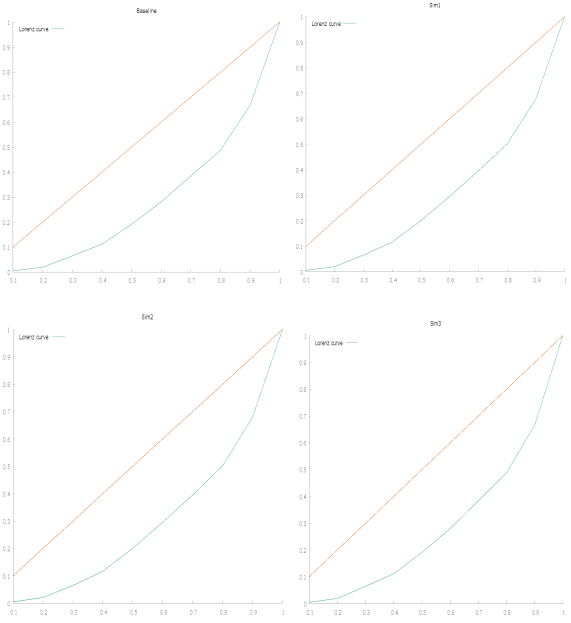
In terms of price and wage changes, Sim1 and Sim2 show a decline in inflation, as measured by the Consumer Price Index (CPI), by 2.8 percent and 1.8 percent, respectively. In contrast, Sim3 exhibits a more pronounced increase of 37.8 percent. The price of value-added declines under Sim1 and Sim2 but increases by 28.8 percent in Sim3. Wage rates also decline under sim1 and sim2 but increase by 29.1 percent in Sim3. Household welfare and poverty outcomes reveal that household income declines under Sim1 and Sim2 but increases by 29.1 percent in Sim3. This corresponds with the estimates of equivalent variation, indicating welfare losses under Sim1 and Sim2, and a welfare gain in Sim3. Poverty headcount increases under Sim1 and Sim2 but decreases by 22.6 percent in Sim3. The Gini coefficient shows small difference relative to baseline, with Sim1 and Sim2 individually leading to a decrease in inequality by -2.87 and -2.81 percentage Gini points respectively, while Sim3 shows a very small increase in the Gini coefficient (0.10 percent), indicating a limited impact. Although the Gini coefficient shows minor differences across scenarios, Sim1 and Sim2 may be considered more desirable outcomes in narrowing income disparities (see Figure 1).
Figure 1. Lorez curves for different scenarios.
Overall, the results suggest that: (i) social protection investments financed through domestic financing instruments, such as government savings and taxes, generate significant macroeconomic distortions (declines in GDP, government income, and household welfare), ultimately leading to an increase in poverty headcount; (ii) social protection investments financed using foreign aid have a positive impact on output, poverty reduction, and income distribution, with a substantial reduction in poverty headcount; (iii) despite indications of a decrease in inequality, the paper did not find any significant impacts on income distribution. On the basis of these findings, foreign aid-financed social protection investments appear to be the most effective means for reducing poverty and generating welfare gains.
The findings from this paper are broadly consistent with strands of the literature on the economy-wide effects of social protection investments. In particular, the deterioration in poverty outcomes observed under Sim1 (government savings) and Sim2 (VAT) resonates with evidence from Chia, Cury et al., and Sanchez , which collectively suggest that the poverty-reducing effects of social protection programmes may be offset once financing mechanisms and broader general equilibrium adjustments are taken into account. While Chia’s analysis of Côte d’Ivoire highlights how tax-financed transfers can generate price and financing pressures that erode welfare gains among vulnerable households , Cury et al. demonstrate for the case of Brazil, that the net distributive effects of social transfers are conditioned by fiscal financing structures and economy-wide responses . Consistent with these insights, the results indicate that the method used to create fiscal space for social protection shapes poverty outcomes, with financing-induced adjustments capable of weakening the intended welfare gains of social protection investments.
5. Conclusion/Recommendations
This paper demonstrates that social protection investments can have varying effects on poverty reduction and income distribution, depending on the underlying economic and financing conditions. While social protection investments financed through government savings or VAT reforms may countervail the intended poverty reduction impacts, those funded through foreign aid can significantly reduce poverty, increase GDP, and enhance household welfare, with minimal impact on income distribution. The findings suggest that a strategy leveraging external financing through foreign aid can optimize the effectiveness of social protection investments in reducing poverty, particularly in the short term. The paper emphasizes the importance of North-South collaborations in the design and financing of anti-poverty social protection programmes in line with SDG 17 (partnership for the goals). However, it is crucial to consider the potential risks and limitations associated with foreign aid, such as dependency and volatility, to ensure sustainable and equitable social protection programs.
Abbreviations

ARDL

Autoregressive Distributed Lag

CGE

Computable General Equilibrium

CET

Constant Elasticity of Substitution

CPI

Consumer Price Index

GDP

Gross Domestic Product

IFPR

International Food Policy Research Institute

LES

Linear Expenditure System

NBS

National Bureau of Statistics

NGN

Nigerian Naira

OLS

Ordinary Least Squares

PEP

Partnership for Economic Opportunity

RCT

Randomized Controlled Trial

SAM

Social Accounting Matrix

SDG

Sustainable Development Goal

SD

Standard Deviation

VAT

Value Added Tax

Author Contributions
Ismail Hayatu Sanusi: Conceptualization, Data Curation, Formal Analysis, Investigation, Methodology, Software, Visualization, Writing – original draft
Maryam Bala Adamu: Resources, Writing – review & editing
Mohammed Isa Shuaibu: Supervision, Validation
Conflicts of Interest
The authors declare no conflict of interest.
References
[1] Adebayo, A., & Ogunrinola, I. (2020). Social safety nets and poverty reduction in Nigeria. Journal of Economic Policy Analysis, 12(2), 45–62.
[2] Alatas, V., Banerjee, A., Hanna, R., Olken, B. A., & Tobias, J. (2012). Targeting the poor: Evidence from a field experiment in Indonesia. American Economic Review, 102(4), 1206-1240.
[3] Banerjee, A., Duflo, E., Goldberg, N., Karlan, D., Osei, R. D., Parienté, W., Shapiro, J. P., Thuysbaert, B., & Udry, C. (2015). A multifaceted program causes lasting progress for the very poor: Evidence from six countries. Science, 348(6236), 1260799.
[4] Banerjee, A., Hanna, R., Kreindler, G. E., & Olken, B. A. (2017). Debunking the Stereotype of the Lazy Welfare Recipient: Evidence from Cash Transfer Programs. World Bank Research Observer, 32(2), 155-184.
[5] Boateng, E., Ofori, E., & Ampofo, A. (2016). Assessing the impact of social protection on poverty reduction in Ghana. Journal of Economic Studies, 43(2), 242-255.
[6] Bussolo, M., De Hoyos, R., & Medvedev, D. (2010). Economic growth and income distribution: Linking macroeconomic models with household survey data at the global level. International Journal of Microsimulation, 3(1), 92–103.
[7] Chia, N. (1994). Poverty-Reducing Targeting Programme: A General Equilibrium Approach. Journal of African Economies, 3(2), pp. 309-338.
[8] Chitiga, M., Mabugu, R., Fofana, I., Abidoye, B., & Mbanda, V. (2014). Assessing the general equilibrium effect of social grants in South Africa. A Paper presented at the GTAP Conference.
[9] Cockburn, J., Corong, E. L., & Cororaton, C. (2010). Integrated Computable General Equilibrium (CGE) Microsimulation Approach. The International Journal of Microsimulation, 3(1), 60-71.
[10] Cury, S., Pedrozo, E., & Coelho, A. M. (2016). Cash transfer policies, taxation and the fall in inequality in Brazil: An integrated microsimulation-CGE analysis. International Journal of Microsimulation, 9(1), 55-85.
[11] Decaluwé, B., Lemelin, A., Maisonnave, H., & Robichaud, V. (2013). PEP-1-1: The PEP Standard Single-country Static CGE Model. Partnership for Economic Policy PEP-1-1, Version 2.1 Documentation. Québec: PEP.
[12] Devereux, S. & Sabates-Wheeler, R. (2004). Transformative social protection. IDS (Institute of Development Studies), Manchester.
[13] Dreze, J. & Sen, A. (1990). Public Action and Social Security: Foundations and Strategy. In Ahmad, E., Dreze, J., Hills, J. and Sen, A. (Eds). Social Security in Developing Countries. Clarendon Press, Oxford.
[14] Durán-Valverde, F., Pacheco-Jimenez, T. M., & Elizondo-Barboza, H. (2019). Measuring financing gaps in social protection for achieving SDG target 1.3: Global estimates and strategies for developing countries. International Labour Office, Geneva.
[15] Evans, D. K., & Popova, A. (2017). Cash transfers and temptation goods. World Bank Economic Review, 31(3), 766–790.
[16] Evans, M., & Ngau, P. (2013). The effect of social protection on poverty reduction in Kenya. Journal of Development Studies, 49(1), 123-136.
[17] Foster, J., Greer, J. and Thorbecke, E. (1984). A class of decomposable poverty measures. Econometrica, 3(52), 761-766.
[18] Foster, J., Seth, S., Lokshin, M. and Sajaia, Z. (2013). A Unified Approach to Measuring Poverty and Inequality: Theory and Practice. Washington, DC: The World Bank.
[19] Gastwirth, J. L. (1972). The Estimation of the Lorenz Curve and Gini Index. The Review of Economics and Statistics, 54(3), 306-316.
[20] Geary, R. C. (1950). A note on the theory of consumer's behaviour. Economic Journal, 60(238), 317-320.
[21] Hagen-Zanker, J. and Tavakoli, H. (2012). An analysis of fiscal space for social protection in Nigeria. Overseas Development Institute Report.
[22] Haushofer, J., & Shapiro, J. (2016). The short-term impact of unconditional cash transfers. Quarterly Journal of Economics, 131(4), 1973–2042.
[23] International Food Policy Research Institute (IFPRI) (2021). 2018 Social Accounting Matrix for Nigeria. IFPRI, Washington DC.
[24] International Labour Office (ILO) (2021). World Social Protection Report 2020-22: Social Protection at the Crossroads - in Pursuit of a Better Future. ILO.
[25] Leibbrandt, M., Woolard, I., & de Villiers, L. (2013). The effect of social protection on poverty reduction in South Africa. South African Journal of Economics, 81(3), 351-365.
[26] Leontief, W. (1947). Introduction to a Theory of the Internal Structure of Functional Relationships. Econometrica, 15(4), 361-373.
[27] Mathers, N. & Slater, R. (2014). Social protection and growth: Research synthesis. Barton ACT: Department of Foreign Affairs and Trade, Australia.
[28] NBS (National Bureau of Statistics) (2016). LSMS-Integrated Surveys on Agriculture General Household Survey Panel 2015/2016. NBS, Abuja, Nigeria.
[29] Osabohien, R., Matthew, O., Ohalete, P., & Osabuohien, E. (2020). Population–poverty–inequality nexus and social protection in Africa. Social Indicators Research, 151(2), 575–598.
[30] Oyinlola, M. A., & Adedeji, A. A. (2019). Government expenditure and income inequality in Nigeria. African Development Review, 31(2), 200–214.
[31] Robichaud, V., Lemelin, A., Maisonnave, H. & Decaluwé, B. (2012). PEP-1-1: A User Guide. IFPRI (International Food Policy Research Institute) and PEP (Partnership for Economic Policy).
[32] Robles et al. (2017). The Effect of Social Protection on Poverty Reduction in Latin America: A CGE Analysis. Latin American Journal of Economics, 54(2), 1-22.
[33] Sanchez, F., et al. (2017). The Impact of Conditional Cash Transfers on Poverty Reduction in Colombia. Revista de Economía del Rosario, 20(1), 1-25.
[34] Skoufias, E., Di Maro, V., & Gonzalez-Corzo, M. (2011). The impact of cash transfers on poverty reduction in Mexico. Journal of Development Effectiveness, 3(1), 37-55.
[35] Stone, J. R. N. (1954). Linear expenditure systems and demand analysis: An application to the pattern of British demand. Economic Journal, 64(255), 511-527.
[36] Uzawa, H. (1962). Production Functions with Constant Elasticities of Substitution. Review of Economic Studies, 29(3), 291-299.
[37] World Bank (1990). World Development Report 1990: Poverty. New York: Oxford University Press.
[38] World Bank (2023). Poverty and Inequality Platform (version 20230328_2017_01_02_PROD) [data set]. Accessed from
[39] Zhang, X. (2015). Incorporating household survey data into a CGE model. Presented at the 18th Annual Conference on Global Economic Analysis, Melbourne, June 17-19, 2015.
Cite This Article
  • APA Style

    Sanusi, I. H., Adamu, M. B., Shuaibu, M. I. (2026). Impact of Social Protection on Poverty Reduction and Income Distribution in Nigeria: A Computable General Equilibrium Microsimulation Approach. Economics, 15(2), 49-57. https://doi.org/10.11648/j.eco.20261502.13

    Copy | Download

    ACS Style

    Sanusi, I. H.; Adamu, M. B.; Shuaibu, M. I. Impact of Social Protection on Poverty Reduction and Income Distribution in Nigeria: A Computable General Equilibrium Microsimulation Approach. Economics. 2026, 15(2), 49-57. doi: 10.11648/j.eco.20261502.13

    Copy | Download

    AMA Style

    Sanusi IH, Adamu MB, Shuaibu MI. Impact of Social Protection on Poverty Reduction and Income Distribution in Nigeria: A Computable General Equilibrium Microsimulation Approach. Economics. 2026;15(2):49-57. doi: 10.11648/j.eco.20261502.13

    Copy | Download

  • @article{10.11648/j.eco.20261502.13,
      author = {Ismail Hayatu Sanusi and Maryam Bala Adamu and Mohammed Isa Shuaibu},
      title = {Impact of Social Protection on Poverty Reduction and Income Distribution in Nigeria: A Computable General Equilibrium Microsimulation Approach},
      journal = {Economics},
      volume = {15},
      number = {2},
      pages = {49-57},
      doi = {10.11648/j.eco.20261502.13},
      url = {https://doi.org/10.11648/j.eco.20261502.13},
      eprint = {https://article.sciencepublishinggroup.com/pdf/10.11648.j.eco.20261502.13},
      abstract = {Social protection has emerged as a crucial instrument for reducing poverty and income inequality in many low- and middle-income countries across the world. In Nigeria, several social protection programmes and interventions have been introduced and implemented over the last decade with the aim of improving the welfare of vulnerable households, promoting inclusive growth, and addressing rising levels of poverty and inequality. Despite these efforts, there are increasing indications that such investments have not produced the expected or desired reductions in poverty and income disparities. This suggests that social protection investments may not have been sufficiently effective in addressing the structural causes of poverty and inequality in the country. Against this background, this paper assesses the impact of social protection on poverty and income distribution in Nigeria by taking into account the general equilibrium effects associated with at-scale financing mechanisms. The study adopts a Computable General Equilibrium (CGE) microsimulation model calibrated with a combined dataset comprising the 2018 Social Accounting Matrix (SAM) for Nigeria and the Nigeria General Household Survey 2015–2016. Findings from the study reveal that social protection investments can contribute significantly to reductions in poverty and income inequality under favourable economic and policy conditions. In particular, the foreign aid financing channel was found to be the most effective in reducing poverty. The paper therefore emphasizes the importance of strengthening North–South collaborations in the design, implementation, and financing of anti-poverty social protection programmes in line with Sustainable Development Goal 17 (Partnerships for the Goals).},
     year = {2026}
    }
    

    Copy | Download

  • TY  - JOUR
    T1  - Impact of Social Protection on Poverty Reduction and Income Distribution in Nigeria: A Computable General Equilibrium Microsimulation Approach
    AU  - Ismail Hayatu Sanusi
    AU  - Maryam Bala Adamu
    AU  - Mohammed Isa Shuaibu
    Y1  - 2026/06/04
    PY  - 2026
    N1  - https://doi.org/10.11648/j.eco.20261502.13
    DO  - 10.11648/j.eco.20261502.13
    T2  - Economics
    JF  - Economics
    JO  - Economics
    SP  - 49
    EP  - 57
    PB  - Science Publishing Group
    SN  - 2376-6603
    UR  - https://doi.org/10.11648/j.eco.20261502.13
    AB  - Social protection has emerged as a crucial instrument for reducing poverty and income inequality in many low- and middle-income countries across the world. In Nigeria, several social protection programmes and interventions have been introduced and implemented over the last decade with the aim of improving the welfare of vulnerable households, promoting inclusive growth, and addressing rising levels of poverty and inequality. Despite these efforts, there are increasing indications that such investments have not produced the expected or desired reductions in poverty and income disparities. This suggests that social protection investments may not have been sufficiently effective in addressing the structural causes of poverty and inequality in the country. Against this background, this paper assesses the impact of social protection on poverty and income distribution in Nigeria by taking into account the general equilibrium effects associated with at-scale financing mechanisms. The study adopts a Computable General Equilibrium (CGE) microsimulation model calibrated with a combined dataset comprising the 2018 Social Accounting Matrix (SAM) for Nigeria and the Nigeria General Household Survey 2015–2016. Findings from the study reveal that social protection investments can contribute significantly to reductions in poverty and income inequality under favourable economic and policy conditions. In particular, the foreign aid financing channel was found to be the most effective in reducing poverty. The paper therefore emphasizes the importance of strengthening North–South collaborations in the design, implementation, and financing of anti-poverty social protection programmes in line with Sustainable Development Goal 17 (Partnerships for the Goals).
    VL  - 15
    IS  - 2
    ER  - 

    Copy | Download

Author Information