Abstract
Against the backdrop of growing uncertainty in the global trading system, enhancing regional economic resilience through alternative trade channels—particularly in response to tariff-induced disruptions and the protracted U.S.–China trade conflict—has emerged as a pressing issue for both policy and academic inquiry. This study integrates theoretical analysis with multi-scenario computable general equilibrium (CGE) modeling to rigorously assess the combined macroeconomic and sectoral impacts of U.S.–China trade tensions and the Regional Comprehensive Economic Partnership (RCEP) on Shandong Province. Drawing on these findings, the paper advances a set of forward-looking, evidence-based, and operationally feasible policy recommendations. The analysis indicates that regional economies should strategically harness industrial internet platforms and advanced digital technologies; strengthen institutional coordination—including interdepartmental governance and cross-sectoral industrial planning; and foster synergistic integration of “personal AI” and “physical AI” systems to enable flexible, scalable, and demand-responsive manufacturing. Moreover, policymakers must proactively cultivate diversified, non-traditional trade substitution pathways—such as nearshoring, third-country intermediation, and digital trade facilitation—to generate sustainable trade diversion effects; accelerate the reconfiguration of regional supply chain networks; optimize spatial industrial layouts; and advance inclusive, green, and technologically driven industrial upgrading. Collectively, these measures enhance adaptive capacity to domestic and international market volatility while reinforcing local agency within global value chains.
|
Published in
|
Economics (Volume 15, Issue 3)
|
|
DOI
|
10.11648/j.eco.20261503.13
|
|
Page(s)
|
81-98 |
|
Creative Commons
|

This is an Open Access article, distributed under the terms of the Creative Commons Attribution 4.0 International License (http://creativecommons.org/licenses/by/4.0/), which permits unrestricted use, distribution and reproduction in any medium or format, provided the original work is properly cited.
|
|
Copyright
|
Copyright © The Author(s), 2026. Published by Science Publishing Group
|
Keywords
Tariff Shocks, Trade Substitute, Sino-us Trade Dispute, RCEP, Supply Chain Resilience, Personal AI + Physical AI
1. Introduction
Since 2020, against the backdrop of escalating Sino-US trade frictions and the entry into force of the RCEP agreement, scholars worldwide have conducted extensive research on the impacts of Sino-US economic and trade disputes as well as regional trade cooperation. These studies have documented the evolution and consequences of the trade war while assessing how emerging regional agreements, such as RCEP, are reshaping trade patterns and supply chain configurations. During his second term, President Trump intensified bilateral trade disputes and broadened them into a global tariff confrontation, which can be categorized into three types: country-specific tariffs, sector-specific tariffs, and global reciprocal tariffs. In the face of an increasingly complex international political and economic environment and growing future uncertainties, scholars argue for the application of advanced CGE models and GTAP models to quantitatively assess the economic impacts of tariff conflicts, thereby identifying critical pathways to mitigate the global effects of both existing and emerging trade disputes
| [1] | Ken Itakura. Evaluating the Impact of the US–China Trade War. Asian Economic Policy Review, Japan Center for Economic Research, 2020, vol. 15(1), pages 77-93.
https://doi.org/10.1111/aepr.12286 |
| [2] | Li M, Balistreri E J, Zhang W. The US–China trade war: Tariff data and general equilibrium analysis. Journal of Asian Economics, 2020, 69: 101216.
https://doi.org/10.1016/j.asieco.2020.101216 |
[1, 2]
.
Recent scholarship highlights the need for rigorous empirical analysis of tariff shocks and their multifaceted consequences—including welfare outcomes, GDP impacts, and trade diversion effects
| [1] | Ken Itakura. Evaluating the Impact of the US–China Trade War. Asian Economic Policy Review, Japan Center for Economic Research, 2020, vol. 15(1), pages 77-93.
https://doi.org/10.1111/aepr.12286 |
| [2] | Li M, Balistreri E J, Zhang W. The US–China trade war: Tariff data and general equilibrium analysis. Journal of Asian Economics, 2020, 69: 101216.
https://doi.org/10.1016/j.asieco.2020.101216 |
[1, 2]
. Concurrently, growing attention has been devoted to structural transformations in global production systems, particularly global value chain (GVC) reconfiguration
| [1] | Ken Itakura. Evaluating the Impact of the US–China Trade War. Asian Economic Policy Review, Japan Center for Economic Research, 2020, vol. 15(1), pages 77-93.
https://doi.org/10.1111/aepr.12286 |
| [3] | Zheng Yuwen, Shao Jingfeng. The Transformation and Upgrading Path of China’s Textile Industry Based on the Reconstruction of Value Network under the Double Cycle Pattern. Journal of Technology Economics, 2023, 42(11): 161-177. |
[1, 3]
and supply chain spillovers
| [4] | Bao Qun, Liao Sainan. Domestic Production Networks and Indirect Export Spillovers: Evidence from Customer-Supplier Relationships. Journal of Management World, 2023, 39(08): 20-45.
https://doi.org/10.19744/j.cnki.11-1235/f.2023.0100 |
| [5] | Liu Juan, Kang Maonan, Zhao Liting. Demand-driven Incentives or Suppression on Innovations: OFDI Supply-chain Spillover and Domestic Firms’ Digital Transformation—Based on Customer-Supplier Relationships. Journal of Finance and Economics, 2024, 50(12): 122-136.
https://doi.org/10.16538/j.cnki.jfe.20240813.301 |
[4, 5]
. These dynamics may serve as critical mitigating mechanisms—helping to buffer or attenuate the adverse macroeconomic effects triggered by tariff-induced disruptions.
The Regional Comprehensive Economic Partnership (RCEP) is widely characterized in the academic literature as a “value chain accelerator.” Sun et al. (2024), utilizing a Global Value Chain-Computable General Equilibrium (GVC-CGE) model, demonstrated that member countries significantly strengthened their integration into regional value chains under the framework established by the agreement
. Similarly, Park, Petri, and Plummer, through state-of-the-art CGE simulations modeling full RCEP implementation, projected that by 2030, China, Japan, South Korea, and Southeast Asian nations would emerge as the primary beneficiaries
| [7] | Park, Cyn-Young and Petri, Peter A. and Plummer, Michael G. The Economics of Conflict and Cooperation in the Asia-Pacific: RCEP, CPTPP and the US-China Trade War. East Asian Economic Review, 2021, Vol. 25 No. 3 (September 2021) 233-272, https://dx.doi.org/10.11644/KIEP.EAER.2021.25.3.397 |
[7]
. Their analysis anticipates a substantial expansion in trade volumes, particularly within the manufacturing and food processing sectors. The findings further indicate that RCEP tariff concessions facilitate consolidated export growth and enhance local value-added within industrial sectors among member states, thereby reshaping the architecture of regional production networks to a considerable extent.
Building on the modeling frameworks presented above, this study selects Shandong Province as a representative case to examine the effects of tariff shocks on regional economic and trade dynamics, as well as potential substitution strategies. A mathematical modeling framework is constructed to simulate policy adjustments in Shandong under a range of contingency scenarios.
2. Literature Review
This literature review aims to systematically organize the pertinent research contributions from recent years and examine them across four dimensions: policy analysis, enterprise response, regional comparison, and quantitative economic models.
2.1. Policy Analysis
Yao and Sun conducted a systematic analysis of policy instruments employed by China’s central and local governments in response to escalating trade frictions and the implementation of the Regional Comprehensive Economic Partnership (RCEP)
| [8] | Yao Hongxin, Sun Ning. Research on the Binding Force of WTO Rules on Export Subsidies under the Condition of Complete Information. Economic Science, 2004, (04): 110-117.
https://doi.org/10.19523/j.jjkx.2004.04.013 |
[8]
. Their study indicates that, during the initial phase of trade tensions, China primarily resorted to reciprocal tariff measures
| [8] | Yao Hongxin, Sun Ning. Research on the Binding Force of WTO Rules on Export Subsidies under the Condition of Complete Information. Economic Science, 2004, (04): 110-117.
https://doi.org/10.19523/j.jjkx.2004.04.013 |
[8]
. However, structural trade imbalances constrained the effectiveness and symmetry of such retaliatory actions, and the imposition of tariffs inadvertently undermined the international competitiveness of certain export sectors. In response to the intensification of Sino-U.S. trade tensions-particularly from 2025 onward-the Chinese government adopted a more integrated and multi-dimensional regulatory approach
. Illustrative measures include initiating antitrust investigations against multinational technology firms (e.g., Google), designating entities on the Unreliable Entity List, and tightening export controls on strategically critical minerals
. These actions collectively reflect a deliberate expansion and coordination of policy tools across legal, regulatory, and industrial domains. Concurrently, the government prioritized indigenous innovation and high-end industrial upgrading as core strategies to bolster systemic resilience and long-term economic autonomy. Empirical findings by Zhou further demonstrate that the Sino-U.S. trade conflict exerted significant and multifaceted impacts on Shandong Province-particularly on its external trade performance, industrial structure transformation, and household welfare
| [11] | Zhou Yujie. Analysis of the Impact of the Trade War Between China and the United States on the Economy of Shandong Province and Countermeasures. In: Dang, C. T., Cifuentes-Faura, J.. Li, X. (eds) Proceedings of the 2nd International Conference on Business and Policy Studies. CONF-BPS. Applied Economics and Policy Studies. Springer, Singapore. 2023, https://doi.org/10.1007/978-981-99-6441-3_106 |
[11]
.
2.2. Corporate Response Strategies
In response to the Sino-U.S. trade dispute and the full implementation of the Regional Comprehensive Economic Partnership (RCEP), corporate-level strategic adjustments have emerged as a prominent focus in academic research. Scholars consistently identify four interrelated dimensions of corporate adaptation: (i) supply chain reconfiguration, (ii) market and investment diversification, (iii) industrial upgrading and technological innovation, and (iv) strategic utilization of RCEP’s preferential rules-particularly its rules of origin-to mitigate trade and tariff-related disruptions
.
First, enterprises have proactively diversified export markets and foreign direct investment (FDI) destinations to reduce overreliance on the U.S. market. Empirical evidence indicates that, following the escalation of trade tensions, Asian and European markets have become increasingly attractive for Chinese outbound investment, whereas U.S.-bound investment by Chinese firms has declined markedly
| [12] | LI You-shu, TANG Jia-yu. Local Market Demand, Domestic Substitution of Intermediate Input and Upgrading of Global Value Chain. Modern Finance and Economics-Journal of Tianjin University of Finance and Economics, 2025, 45(05): 20-37. https://doi.org/10.19559/j.cnki.12-1387.2025.05.002 |
| [13] | JIANG Guanhong, FAN Rui. External Demand Shock and Chinese Enterprises’ Third Party OFDI: Evidence from Antidumping Investigations. Journal of Quantitative & Technological Economics, 2026, 43 (02): 1-27.
https://doi.org/10.13653/j.cnki.jqte.20260204.006 |
| [14] | ZHAO Chun-ming, ZHONG Xiao-huan, BAN Yuan-hao. The Risk of Global Supply Chain and Domestic Capital Flows: Novel Insights into Corporate Cross-Regional Investment. China Industrial Economics, 2025, (03): 154-173.
https://doi.org/10.19581/j.cnki.ciejournal.2025.03.009 |
[12-14]
. Notably, this downward trend in U.S.-focused investment predates the formal onset of the trade war, suggesting that private-sector actors anticipated geopolitical risks well in advance
| [15] | Li Yong. Political Risk, Risk Perception and Overseas Investment of Enterprises. Journal of CUPL, 2026, (01): 46-62. |
[15]
.
Second, supply chain reorganization is being pursued in a measured and regionally calibrated manner. GTAP model simulations demonstrate that RCEP enhances the resilience of regional production networks, enabling China, South Korea, Australia, and other member economies to partially offset the adverse effects of Sino-U.S. tariff shocks on domestic industries
| [16] | Cui, W., Qiao, C., & Song, Y.. The influence of the Regional Comprehensive Economic Partnership on agricultural value chain participation: insights from a global trade analysis project model simulation. Applied Economics, 2025, 57(59): 10802-10815.
https://doi.org/10.1080/00036846.2024.2446592 |
[16]
. Consequently, firms are advised to align global production layouts with regional comparative advantages-such as factor endowments and infrastructure capacity-to strengthen supply chain robustness and attenuate tariff exposure
| [6] | Cheng Bo-wen, Gong Liu-tang. Tariff Shocks, Financial Frictions, and Economic Growth in China. Contemporary Finance & Economics, 2026, 1-13.
https://doi.org/10.13676/j.cnki.cn36-1030/f.20260122.002 |
| [17] | He Zhiyi, Wu Ke, Ye Chen, et al. Global Industrial Structure and China’s Industrial Strength: A Special Report on China’s Industrial Development Based on Global Listed Company Data. Nankai Business Review, 2025, 28(04): 196-208. |
[6, 17]
. This dynamic also underscores an urgent need for enterprises to systematically enhance supply chain resilience through risk mapping, dual-sourcing strategies, and digital traceability systems.
Third, RCEP serves as a catalyst for industrial upgrading and innovation-driven growth. By deepening economic integration with ASEAN and East Asian partners, RCEP facilitates the consolidation of regional production networks, stabilizes industrial and supply chains, and elevates value-added activities across sectors
. The agreement’s phased tariff reductions further incentivize firms to upgrade product quality, integrate advanced technologies, and improve operational efficiency-thereby reinforcing long-term competitiveness and fostering structural innovation advantages
.
Finally, RCEP’s rules of origin-especially the “regional cumulation” provision-encourage intra-regional sourcing of raw materials and intermediate goods
| [20] | Ling, D., & Qian, K.. Research on the impact of RCEP rules of origin on China’s manufacturing industry. SHS Web of Conferences, 2023, 169, 01010.
https://doi.org/10.1051/shsconf/202316901010 |
| [21] | Liu Zhuguang, Cheng Shijie. Research on the Current Situation, Problems and Countermeasures of China's Automotive Industry Cooperation with Other RCEP Member Countries. Social Sciences in Guangxi, 2022, (08): 72-80.
https://doi.org/10.3969/j.issn.1004-6917.2022.08.009 |
[20, 21]
. Firms leveraging these provisions not only qualify for preferential tariffs but also deepen participation in regional value chains, thereby enhancing export market flexibility and strategic positioning.
2.3. Comparative Analyses of Regional Economic Impacts
Against the backdrop of ongoing U.S.-China trade tensions
, recurrent tariff shocks
| [10] | HAN Shuang, CHENG Hui. Evaluation of Gallium and Germanium Export Control Policies from the Perspectives of Coordinated Development and Security. Intertrade, 2025, (08): 15-24. https://doi.org/10.14114/j.cnki.itrade.2025.08.002 |
| [22] | SUN Jiaze, HE Zilong, SUN Yuanchen. The Impact of Tariff Shocks on the Global and Chinese Regional Economy: An Analysis Based on the Trade Policies of the New U.S. Administration. Economic Geography, 2025, 45(09): 1-10.
https://doi.org/10.15957/j.cnki.jjdl.2025.09.001 |
| [23] | SUN Hanqing, CHENG Zhongming. Crisis or opportunity: heterogeneous trade barriers and overseasmergers and acquisitions. Industrial Economics Research, 2024, (04): 129-142.
https://doi.org/10.13269/j.cnki.ier.2024.04.006 |
[10, 22, 23]
, and trade diversion induced by the Regional Comprehensive Economic Partnership (RCEP)
, comparative studies across China’s subnational regions reveal pronounced spatial disparities in RCEP-related economic outcomes. Empirical evidence indicates that the agreement has accelerated the agglomeration of production factors-particularly capital and skilled labor-in coastal provinces, resulting in disproportionately higher GDP growth and productivity gains in these areas relative to inland regions
. Moreover, the RCEP has partially offset the adverse “crowding-out” effects associated with heightened tariff barriers while simultaneously generating a positive “inducement effect” on innovation investment and technological upgrading
.
Drawing on a China-specific global computable general equilibrium (CGE) model incorporating all 31 provincial administrative units, Sun et al. demonstrate that, although certain export-oriented sectors experienced short-term contraction following tariff adjustments, regional economies with mature industrial ecosystems-especially those along the eastern seaboard-exhibited robust adaptive capacity
| [22] | SUN Jiaze, HE Zilong, SUN Yuanchen. The Impact of Tariff Shocks on the Global and Chinese Regional Economy: An Analysis Based on the Trade Policies of the New U.S. Administration. Economic Geography, 2025, 45(09): 1-10.
https://doi.org/10.15957/j.cnki.jjdl.2025.09.001 |
[22]
. Over the medium to long term, supply chain reconfiguration fostered net output expansion and enhanced interprovincial specialization. Under full RCEP implementation, CGE simulations project aggregate GDP increases of 0.3% for China (equivalent to approximately USD 37.8 billion) and statistically significant gains across other member economies; in contrast, non-member countries registered negligible GDP impacts. Complementing this, Park et al. argue that synergistic ratification of the RCEP and the Comprehensive and Progressive Agreement for Trans-Pacific Partnership (CPTPP) could substantially mitigate the macroeconomic drag of bilateral trade frictions and further consolidate East Asia’s integrated production networks-thereby elevating regional productivity, employment quality, and value-chain sophistication
| [7] | Park, Cyn-Young and Petri, Peter A. and Plummer, Michael G. The Economics of Conflict and Cooperation in the Asia-Pacific: RCEP, CPTPP and the US-China Trade War. East Asian Economic Review, 2021, Vol. 25 No. 3 (September 2021) 233-272, https://dx.doi.org/10.11644/KIEP.EAER.2021.25.3.397 |
[7]
.
2.4. Quantitative Economic Modeling Approaches
In recent years, scholars have increasingly applied quantitative economic models-particularly computable general equilibrium (CGE) frameworks and the Global Trade Analysis Project (GTAP) model-to rigorously assess the macroeconomic and sectoral implications of major trade developments, including the Sino-U.S. trade tensions and the Regional Comprehensive Economic Partnership (RCEP). These models typically simulate alternative policy scenarios-such as phased tariff reductions, enhanced trade facilitation measures, and liberalized factor mobility-to quantify their effects on key outcomes, including regional GDP growth, structural transformation across industries, and household welfare.
Zhang and Zhou integrated the standard GTAP framework with the China Regional CGE model (Sino-TERM) to evaluate how RCEP-driven liberalization would reshape China’s interprovincial economic landscape under distinct scenario assumptions
. Ling et al. employed the GTAP model to estimate the impact of post-RCEP tariff cuts on China’s manufacturing output and trade flows, reporting statistically significant increases in both output and export volumes across most manufacturing subsectors
| [26] | Ling, D. and Lv, C.. Research on the Impact of RCEP on China’s Manufacturing Output and Trade: Based on GTAP Simulation. iBusiness, 2022, 14, 41-55.
https://doi.org/10.4236/ib.2022.142004 |
[26]
. Similarly, Zhou et al. utilized GTAP to conduct a provincial-level analysis, concluding that the RCEP would generate net positive growth effects in nearly all Chinese provinces-with disproportionately larger gains observed in coastal regions due to their higher trade openness and export intensity
| [27] | Zhou, L., Pan, C., He, J., & Li, S.. The Impact of RCEP on Chinese Regional Economy from Global Value Chains Perspective (Presented during the 24th Annual Conference on Global Economic Analysis (Virtual Conference)). Purdue University, West Lafayette, IN: Global Trade Analysis Project (GTAP)., 2021, Retrieved from
https://www.gtap.agecon.purdue.edu/resources/res_display.asp?RecordID=6280 |
[27]
. Park et al. adopted a multi-region CGE model to comparatively assess the RCEP and the Comprehensive and Progressive Agreement for Trans-Pacific Partnership (CPTPP), finding that the RCEP is projected to raise average income growth in the Asia-Pacific region at nearly twice the rate of the CPTPP-thereby partially mitigating the adverse macroeconomic consequences of the Sino-U.S. trade conflict
| [7] | Park, Cyn-Young and Petri, Peter A. and Plummer, Michael G. The Economics of Conflict and Cooperation in the Asia-Pacific: RCEP, CPTPP and the US-China Trade War. East Asian Economic Review, 2021, Vol. 25 No. 3 (September 2021) 233-272, https://dx.doi.org/10.11644/KIEP.EAER.2021.25.3.397 |
[7]
.
The extant literature encompasses a diverse array of analytical frameworks-including both static and dynamic modeling approaches-alongside applications within industrial economics and regional trade analysis. These studies collectively provide empirically validated insights into the economic ramifications of trade frictions and tariff shocks, thereby equipping policymakers and enterprises with a robust evidentiary basis for evaluating the impacts of trade conflicts and regional economic integration. A prevailing scholarly consensus indicates that governments can alleviate the adverse effects of trade shocks through coordinated deployment of diversified policy instruments, while firms may enhance resilience via strategic adaptations such as market diversification and industrial upgrading. Nonetheless, substantial research gaps remain, particularly regarding the mechanisms, efficacy, and forward-looking formulation of substitution strategies in response to tariff shocks. Within the context of ongoing global value chain restructuring, this study addresses a critical yet underexplored question: How can Shandong Province effectively implement trade substitution strategies-including market reorientation and industrial chain upgrading-to mitigate the repercussions of U.S.-China trade tensions? Current scholarship remains predominantly qualitative and lacks region-specific, quantitative assessments of feasible substitution pathways. Consequently, there is an imperative to integrate structural transformation theory with empirical evidence from trade conflict scenarios to develop a locally adaptive, theoretically informed policy framework. Capitalizing on the institutional opportunities presented by the Regional Comprehensive Economic Partnership (RCEP), Shandong Province is strategically positioned to broaden its trade substitution channels and stimulate new growth momentum. This paper systematically investigates viable trade substitution pathways for Shandong Province within an environment of deepening regional integration, identifies key facilitating and constraining factors, and offers theoretically grounded, actionable recommendations for local policy formulation.
3. Current Situation Exploration and Analysis
Against the backdrop of a rapidly transforming global trade environment, Shandong Province-one of China’s foremost coastal regions in manufacturing and foreign trade-serves as a representative case study for analyzing trade structural dynamics and policy development. This research employs a dual analytical framework: first, it examines the evolutionary trajectory of Shandong’s bilateral trade with the United States from 2015 to 2025, along with concomitant shifts in its industrial composition; second, it explores the expansion of Shandong’s trade with RCEP member nations and the parallel restructuring of regional supply chains. Through a comparative assessment of the opportunities and constraints intrinsic to these two distinct trade models, the study demonstrates how strengthened compliance with multilateral trade frameworks-as opposed to reliance on tariff-based measures-can facilitate industrial upgrading and foster diversified and resilient trade development.
3.1. Evolution of Shandong Province’s Trade Relations with the United States (2015–2025)
Over the past decade, the trade relations between Shandong Province and the United States have evolved through three distinct developmental phases: a period of robust expansion (2015-2017), a phase characterized by tariff-induced disruptions and structural recalibration (2018-2020), and an ongoing period of diversified strategic adaptation (2021-2025).
1) Period of Robust Expansion (2015-2017): This phase was characterized by sustained growth in bilateral trade volume and a relatively stable export composition. Firstly, the scale of trade exhibited steady expansion, with the United States maintaining its position as Shandong Province’s primary export destination. By 2017, the total value of bilateral imports and exports reached RMB 230.26 billion. Secondly, exports were predominantly concentrated in four key categories: mechanical and electrical equipment (including CNC machine tools and automotive components), textiles and apparel, garlic, and apples, which collectively accounted for over 60% of Shandong’s total exports to the United States. This export profile demonstrates the province’s competitive advantages in terms of cost efficiency, industrial scale, and regional agro-industrial specialization, particularly in mid- to low-tier manufacturing and distinctive agricultural products.
2) Tariff Shock and Structural Adjustment Period (2018-2020): This phase was characterized by two interrelated developments. First, a significant escalation in U.S. import tariffs on Chinese goods-initiated in 2018, wherein the United States imposed a 25% tariff on a wide array of products imported from China-precipitated a sharp decline in Shandong Province’s exports to the U.S. The annual growth rate fell from 8.5% in 2017 to merely 2.1% in 2018. Second, sectoral disruptions intensified across key export-oriented industries. For instance, in the mechanical and electrical equipment sector, exports of laser equipment decreased by 12% year-on-year; in response, Jinshengxing Machinery shifted its market focus toward the European Union. In textiles and apparel, orders destined for the U.S. dropped by 30%, leading Qingdao Jifa Group to relocate part of its production capacity to Vietnam to alleviate tariff-related risks. Within agricultural products, garlic exports declined by 18%, prompting Shouguang Vegetable Group to proactively expand into emerging markets, including the Middle East, in order to diversify its export destinations.
3) Diversification Strategy Implementation Phase (2021-present): In reaction to sustained trade tensions and market volatility induced by tariffs, Shandong Province has systematically pursued an export market diversification strategy since 2021. The strategy aims to achieve two primary objectives: reducing excessive reliance on the U.S. market and accelerating the transition toward higher value-added exports. Notable initiatives include: (i) BYD’s Jinan manufacturing base generating electric bus export revenues exceeding RMB 5 billion; (ii) Lino Group establishing a production facility in Mexico, thereby increasing its North American revenue share to 15%; and (iii) Blue Sail Medical deriving 70% of its global glove sales from markets outside the U.S., while maintaining a 20% market share in the U.S. for its high-end medical devices.
Table 1 summarizes the tariff-related impacts on Shandong’s key industries, corresponding strategic adaptations, and representative enterprise cases.
Table 1. The Key Industries Affected by Tariffs.
Industry | The Extent of the Impact of Tariffs (2018-2025) | Existing Response Strategies | Representative Enterprise Cases |
Mechanical and Electrical Equipment | ★★★★☆ (high) | Overseas factory construction (Haier Smart Home's factory in Mexico), technological upgrading (Jinshengxing's research and development of intelligent laser cutting) | Haier Smart Home, Jinshengxing Machinery |
Textile | ★★★★☆ (high) | FOB terms for cost transfer and domestic sales transformation (Cotte Intelligent C2M Model) | Qingdao Jifa, Cotte Intelligent |
Agricultural | ★★★☆☆ (middle) | Emerging market development (Central Asia fresh produce channel), upgrading of cold chain logistics | Shouguang Vegetable Group, Weifang Sheng 'an Food |
Chemical Products | ★★☆☆☆ (low) | Extension of the industrial chain (integration of refining and chemical industries), regional collaboration (cooperation with South Korea's petrochemical industry) | Wanhua Chemical, Dongming Petrochemical |
Data Source: Compiled based on reports from the Department of Commerce of Shandong Province, enterprise annual reports and public reports.
3.2. Evolution of Shandong Province’s Trade with RCEP Member States
From 2015 to 2021-coinciding with the initial implementation phase of bilateral free trade agreements such as the China-South Korea and China-Australia FTAs-Shandong Province’s exports of machinery and electrical products to South Korea grew at an average annual rate of 9%. In contrast, trade with Japan remained relatively restricted, largely due to insufficient adherence to the Rules of Origin (ROO) requirements under the RCEP prior to its enactment. Following the full implementation of the Regional Comprehensive Economic Partnership (RCEP) on 1 January 2022, Shandong’s trade with RCEP member states demonstrated substantial growth. During the first three quarters of 2023, the total bilateral trade volume reached RMB 905.69 billion, accounting for 38.0% of the province’s total foreign trade. By 2024, the total trade between Shandong and other RCEP member states amounted to RMB 1.27 trillion, reflecting a year-on-year increase of 23.9% and comprising 38.3% of the province’s overall trade. This expansion was accompanied by enhanced industrial complementarity, with trade in intermediate goods emerging as a strategically significant sector: such exports constituted 47.4% of Shandong’s total exports to RCEP partners in 2024. In the first half of 2025, trade volume reached RMB 634.09 billion, representing 36.7% of provincial trade. Cumulatively, 107,000 RCEP Certificates of Origin were issued, covering export goods worth RMB 25.21 billion that received preferential tariff treatment, yielding tariff savings exceeding RMB 500 million for enterprises. This illustrates the quantified enhancements in rule-of-origin synergy across key industries in Shandong Province under the RCEP framework.
Table 2. Optimization of Cooperation among RCEP Member States in Key Industries.
Industry | Cooperation Model among RCEP Member States | Typical Cases |
Mechanical and Electrical Equipment | China-Japan-South Korea technological collaboration (Import tariffs on engines reduced to 6.8%) | Shandong Lingong Construction Machinery imports diesel engines from Japan and enjoys a benefit of 1.29 million yuan per batch. |
Agricultural | Origin accumulation rules (Southeast Asian raw materials are regarded as regional components) | The tariff on canned fruits exported by Qingdao Chuangkai Food to Australia has been reduced from 5% to 0, and its export volume has increased by 20 million yuan. |
Chemical Products | Regional capacity coordination (Korean petrochemical intermediate supply) | Samsung (Tianjin) Battery imported nickel cobalt aluminum anode materials through Longyan Port in Shandong Province and enjoyed preferential benefits amounting to 260 million yuan. |
Textile | Self-declaration system (1.5 million yuan reduction in export tariffs to Japan) | Shandong Zhongdi Import and Export has enjoyed preferential benefits of 370 million yuan for its textile products exported to Japan. |
Data sources: Qingdao Customs, Jinan Customs and publicly available information from enterprises.
3.3. Comparative Analysis of Shandong Province’s Trade with the United States and RCEP Member States
This section provides a comparative analysis of Shandong Province's bilateral trade with both the United States and the member states of the Regional Comprehensive Economic Partnership (RCEP), utilizing official customs statistics from Shandong Province and aggregated macroeconomic data from the China Statistical Yearbook. As delineated in
Table 3, the analysis systematically examines three interconnected dimensions: (1) the temporal evolution of trade volume and structural composition between Shandong Province and these two partner groupings; (2) firm-level strategic adaptations, particularly those aimed at mitigating escalating operational costs; and (3) the degree and efficacy of policy instrument deployment within extant national and regional trade frameworks.
Table 3. Trade Data Analysis of Shandong with the United States and RCEP.
Index | Trade with U.S. | Trade with RCEP |
Proportion of total import and export volume | Export 11.5% | Import & Export 38% |
Main export products | Electromechanical 35%, Textile 20% | Electromechanical 33.3%, labour intensive 25% |
Tariff effect | Average surcharge 25% | The average reduction is 3 to 5 percentage points. |
Enterprise cost response | Overseas factory construction / Switching to domestic sales (cost increase of 15-20%) | Optimization of rules of origin (cost reduction of 8-12%) |
policy instrument | Tariff compensation fund, FOB terms | Authorized exporter, regional industrial chain collaboration |
Data sources: Shandong Provincial Customs Statistics, WIND.
Building upon the foregoing analysis, this study proposes that, in response to U.S.-China trade frictions and tariff shocks, Shandong Province ought to prioritize two strategic imperatives: first, identifying high-value-added sectors-particularly new energy vehicles and advanced medical devices-as key catalysts for export diversification and industrial upgrading; and second, actively mitigating risks associated with technological decoupling and extraterritorial regulatory enforcement, such as “long-arm jurisdiction.” Simultaneously, the study emphasizes the necessity of conducting a systematic examination of how RCEP’s trade substitution provisions can be harnessed to deepen regional value chain integration-specifically through the design of an efficient, policy-coordinated framework for resource allocation and institutional support. Furthermore, this paper explores the pathways, instrumental facilitators, and governance mechanisms essential for advancing a sustainable, high-quality dual-circulation strategy-one that promotes the comprehensive transformation of “Shandong Manufacturing”toward innovation-driven, environmentally sustainable, and globally competitive development. Grounded in these interconnected dimensions, the study constructs and elaborates a dynamic analytical model for formulating resilient and adaptive responses to external shocks induced by tariffs.
4. Theoretical Framework and Core Quantitative Indicators
4.1. Theoretical Framework
Building upon a systematic review of the extant literature, this study constructs a theoretically grounded analytical framework centered on three interrelated transmission mechanisms. This framework elucidates the dynamic interactions among (i) persistent U.S. tariff shocks impacting China’s economy and trade, (ii) the regional substitution effect arising from the Regional Comprehensive Economic Partnership (RCEP) agreement, and (iii) China’s endogenous industrial upgrading momentum. These mechanisms are conceptualized as follows: the shock transmission mechanism, the endogenous upgrading mechanism, and the substitution buffer mechanism.
The shock transmission mechanism-occupying the initial node of the framework-posits that trade disputes and sustained tariff shocks influence bilateral and regional economic and trade relations primarily through two complementary channels: price transmission and demand suppression. Specifically, the sustained imposition of tariffs raises procurement costs of imported intermediate inputs for domestic firms, which are then passed on-either partially or fully-to final consumer prices. Simultaneously, deteriorating trade conditions suppress external demand for the exporting country’s goods, particularly in markets facing elevated trade barriers. Crucially, the magnitude and direction of these effects exhibit significant sectoral heterogeneity, contingent upon three key factors: (a) industry-level export dependence; (b) the substitutability of exported products in destination markets; and (c) the industry’s functional position and specialization pattern within the global value chain.
The substitute buffer mechanism (illustrated on the right) involves the proactive formulation and cross-border alignment of trade-related regulations-such as rules of origin, frameworks for tariff liberalization, and regulatory cooperation agreements-among participating nations and regional economic and trade organizations. This mechanism facilitates the establishment of a more resilient, diversified, and adaptable global supply chain network, thereby generating strategic policy space to absorb and mitigate disruptions arising from trade disputes and tariff-related shocks. For instance, the Regional Comprehensive Economic Partnership (RCEP) employs phased tariff reductions and cumulative rules of origin to reduce intra-regional trade costs and promote sustained expansion of bilateral trade.
The endogenous upgrading mechanism (centered) emphasizes technology-driven structural transformation and industrial upgrading within participating economies and regional blocs. Rather than relying exclusively on reactive trade substitution, this mechanism pursues deliberate, innovation-led upgrading pathways-including investments in research and development (R&D), the enhancement of digital infrastructure, and deeper integration into global value chains-to transition domestic industries toward higher value-added activities. Essential to this process is the coherent alignment of industrial policies, innovation support systems, and trade facilitation measures, ensuring their efficacy in accelerating structural transformation.
Critically, these three mechanisms are neither isolated nor sequential; they constitute an interdependent and dynamically coupled system characterized by mutual reinforcement and feedback loops. Together, they shape the capacity of participating countries and regional economic and trade organizations to strategically respond to tariff adjustments and trade diversion pressures, govern the trajectory and quality of industrial transformation, and reinforce long-term economic resilience.
4.2. Construction of Core Quantitative Indicators
To implement the theoretical framework delineated above, two primary quantitative metrics are constructed: the Tariff Shock Index (TSI) and the RCEP Substitution Effect Coefficient (REC). These indicators are designed to assess the intensity of disruptions resulting from tariff adjustments and the degree of trade diversion engendered by the Regional Comprehensive Economic Partnership (RCEP), respectively.
The TSI measures the comprehensive impact of U.S. tariff shocks on a specific industry or region. It incorporates three principal dimensions: (i) the scale of tariff rate adjustments implemented by the United States; (ii) the degree of export reliance of the sector or region on the U.S. market; and (iii) the price elasticity of demand for its exported products. The formal mathematical representation of the TSI is delineated as follows:
(1)
In the formula, denotes the tariff shock index for industry i; represents the ad valorem tariff change imposed by the United States on industry i; signifies the share of industry i’s exports to the United States in its total exports, its export dependence on the U.S. market; α is a regulatory coefficient (α> 0, typically ranging between 0.5 and 1) that captures the nonlinear effect of export dependence on tariff sensitivity; and denotes the absolute value of the price elasticity of export demand for industry i. A higher implies greater responsiveness of export demand to price changes, thereby amplifying the adverse impact of tariff-induced price increases and intensifying the overall tariff shock.
The REC (RCEP Export Reorientation Coefficient) quantifies an industry’s potential to reallocate its export flows-from the United States toward RCEP member countries-under the preferential trade framework established by the Regional Comprehensive Economic Partnership (RCEP). Its formal definition is as follows:
(2)
In the formula, RECi denotes the RCEP substitution effect coefficient for industry i; ΔTCij represents the change in trade costs associated with exporting industry i’s products to RCEP member country j following the agreement’s entry into force-specifically, a negative value reflects a reduction in trade costs, attributable to both tariff reductions and enhanced customs efficiency facilitated by the RCEP rules of origin; signifies the pre-RCEP trade cost of exporting industry i’s products to the United States under prevailing high-tariff conditions; denotes the ratio of the market size of RCEP member country j to that of the United States, serving as a proxy for relative market attractiveness; β is a positive scale adjustment coefficient (β > 0); and σij quantifies the supply–demand alignment between industry i’s output and the import demand of member country j’s market-this parameter may be empirically approximated using either the historical trade complementarity index or the Revealed Comparative Advantage (RCA) index. A higher RECi value indicates greater potential for RCEP-driven substitution of U.S.-bound trade, thereby offering a robust quantitative basis for prioritizing industrial policy interventions and forecasting structural shifts in trade flows.
5. Model Construction and Methodology
This study employs a customized Computable General Equilibrium (CGE) model-grounded in established methodological frameworks (Itakura
| [1] | Ken Itakura. Evaluating the Impact of the US–China Trade War. Asian Economic Policy Review, Japan Center for Economic Research, 2020, vol. 15(1), pages 77-93.
https://doi.org/10.1111/aepr.12286 |
[1]
; Sun et al.
; Park et al.
| [7] | Park, Cyn-Young and Petri, Peter A. and Plummer, Michael G. The Economics of Conflict and Cooperation in the Asia-Pacific: RCEP, CPTPP and the US-China Trade War. East Asian Economic Review, 2021, Vol. 25 No. 3 (September 2021) 233-272, https://dx.doi.org/10.11644/KIEP.EAER.2021.25.3.397 |
[7]
; Sun et al.
| [22] | SUN Jiaze, HE Zilong, SUN Yuanchen. The Impact of Tariff Shocks on the Global and Chinese Regional Economy: An Analysis Based on the Trade Policies of the New U.S. Administration. Economic Geography, 2025, 45(09): 1-10.
https://doi.org/10.15957/j.cnki.jjdl.2025.09.001 |
[22]
; Zhang & Zhou
) -as the primary quantitative analytical tool, adapted specifically for provincial-level analysis. Data are drawn from authoritative sources, including official government statistics, China Customs trade records, and peer-reviewed computed datasets published by international organizations (e.g., OECD, WTO) and reputable domestic research institutions. Notably, according to an independent assessment by the China Minsheng Banking Corporation Research Institute, Shandong Province’s export dependence on the United States stands at 27.1%. This relatively diversified industrial structure has contributed to a partial mitigation of regional export reliance on the U.S. market.
5.1. Model Construction
To examine the implications of global economic shifts for Shandong Province within an integrated international context, this study develops a customized computable general equilibrium (CGE) model-termed CGE-GTAP-SD_IO-by implementing a “soft-link” integration strategy. This approach bridges the global multi-regional GTAP-based CGE framework with a high-resolution provincial input-output (IO) table for Shandong. The construction proceeds in four methodologically coherent stages:
First, the baseline dynamic GTAP model serves as the foundational architecture.
Second, regional aggregation is refined to distinguish Shandong Province (SD), the rest of China (ROC), the United States (USA), RCEP member economies-subdivided into Japan (JPN), South Korea (KOR), ASEAN, and Australia & New Zealand (ANZ)-and the rest of the world (ROW).
Third, sectoral aggregation prioritizes industries of strategic and structural significance to Shandong’s economy, consolidating them into eleven detailed categories: agriculture (AGR), food processing (FOD), textiles and apparel (TEX), chemicals (CHM), metal products (MET), general and special-purpose machinery (MAC), electronic equipment (ELE), transport equipment (TRN), other manufacturing (OMF), and services (SRV).
Fourth, soft-link aggregation is applied to ensure consistency between the global GTAP structure and Shandong’s provincial IO system, thereby enabling policy simulations that preserve both global interdependence and provincial specificity. To further enhance empirical fidelity, the model is calibrated using the Cross-Entropy Method, embedding province-specific data-including industrial composition, value-added distribution, interprovincial trade flows, and international trade linkages-into the aggregated GTAP database. As a result, the final model retains full capacity to trace global policy shock transmission while delivering granular, province-level impact assessments.
5.2. Core Behavioral Equations and Key Elasticity Parameters
This core behavioral model is grounded in standard neoclassical economic assumptions and employs the Constant Elasticity of Substitution (CES) and Constant Elasticity of Transformation (CET) functional forms to characterize production, consumption, and trade decisions.
The production module centers on a multi-level nested CES production function. In the manufacturing sector, for instance, the top-tier decision entails allocating total output between value added and a composite bundle of intermediate inputs. Value added itself is aggregated from capital and labor via a CES function. Intermediate inputs are procured under the Armington framework-i.e., domestic goods (distinguished by origin: Shandong Province versus other Chinese regions) and imported goods (categorized by country or region of origin)-with cost-minimizing input choice across these differentiated sources. As an illustration, the nested production structure for a representative sector in Shandong Province yields the following core behavioral equation:
(3)
In the formula, VA represents value added, MID represents the synthetic bundle of intermediate inputs, and is related to the substitution elasticity , with .
Second, a nested Armington structure is implemented to characterize consumer behavior within the trade module. Specifically, consumers in Shandong-encompassing both intermediate and final demand agents-first allocate their expenditure between a domestic bundle (i.e., goods produced within Shandong) and an import bundle. Subsequently, within the import bundle, expenditure is distributed across countries of origin-including the United States, Japan, and South Korea-contingent upon relative prices and preferences. The pivotal parameter governing this two-stage decision-making process is the Armington elasticity of substitution, which quantifies the sensitivity of import demand shares to changes in relative import prices (e.g., price increases resulting from U.S. tariffs).
Finally, the core behavioral equations are formally specified, and their key elasticity parameters are calibrated. These elasticity values are predominantly sourced from the Global Trade Analysis Project (GTAP) database and peer-reviewed empirical studies (e.g., [1,2]). Armington elasticities are assigned numerical values ranging from 1.5 to 4.0, reflecting the degree of product differentiation: higher values (e.g., 3.0-4.0) correspond to differentiated manufactured products, whereas lower values (e.g., 1.5-2.0) are applied to homogeneous bulk commodities. Factor substitution elasticities are set within an empirically supported range of 0.8 to 1.2. To evaluate the reliability of the model, a sensitivity analysis of these critical elasticities is conducted as part of the robustness assessment.
5.3. Scenario Design
This study constructs five sets of contrast static scenarios to analyze the independent impact of different policies. The specific trade policy scenario settings (S0-S4) are shown in
Table 4:
Table 4. Scenario Analysis of Trade Policies.
Number | Title | Description |
S0 | Baseline Scenario | There are no new trade frictions, and the RCEP has not come into effect (or the benchmark-year tariffs are maintained), which serves as the basis for result comparison. |
S1 | Enhanced US Tariffs | The United States imposed a 25% ad valorem tariff on all goods imported from Shandong (and China). This is a simplified reenactment of the trade frictions in 2018-2019. |
S2 | The RCEP Takes Effect | The RCEP has come into full effect. For goods exported from Shandong to RCEP member countries that meet the rules of origin (with a regional value content RVC of 40% or more), tariffs have been reduced to the agreed rates (most goods will be reduced to zero within 10 to 20 years); at the same time, corresponding goods imported from RCEP member countries to Shandong also enjoy reciprocal benefits. |
S3 | Comprehensive Impact | The simultaneous imposition of the US tariffs and the entry into force of RCEP. This is the scenario that is closest to reality and is used to assess the "buffering" or "substitution" effect of RCEP. |
S4 | Strengthening the Utilization of RCEP | Based on S3, further consider the possibility of Shandong enterprises increasing the proportion of intermediate goods purchased from the RCEP region (the origin accumulation effect), so that more products can meet the RVC rules and thus enjoy deeper tariff preferences than in S2/S3. At the same time, conduct a more in-depth assessment of the strategies adopted by enterprises and the government to proactively optimize supply chains to maximize the benefits of RCEP. |
5.4. Model Closure and Solution Strategy
The model adopts a neoclassical closure framework, consistent with standard neoclassical growth theory. This closure ensures long-run equilibrium by imposing theoretically grounded behavioral and institutional constraints. Specifically, capital mobility across regions is modeled as incomplete—reflecting realistic frictions such as adjustment costs, regulatory barriers, and information asymmetries in cross-regional investment. The labor market is assumed to clear continuously via flexible real wage adjustment, sustaining full employment in the long run. Fiscal balance is maintained through lump-sum transfers, thereby isolating the model from endogenous fiscal imbalances and preserving its structural stability.
Regarding the external sector, the model assumes a floating exchange rate regime with the US dollar serving as the numéraire currency. Global capital account equilibrium is imposed as an exogenous condition, enabling exchange rates to respond endogenously to shifts in trade flows, relative productivity, and monetary conditions. This specification enhances the model’s capacity to capture external adjustment dynamics and the transmission of monetary policy in an open-economy context.
For numerical solution, the model is implemented and solved using GEMPACK-a widely validated general equilibrium modeling platform-or alternatively GAMS, both of which support large-scale nonlinear systems, multiple closure options, scenario-based counterfactual analysis, and robust numerical solvers. Their algorithmic reliability and extensive documentation in applied policy modeling further ensure result reproducibility and analytical rigor.
6. Quantitative Model Analysis
Building upon the established model framework and scenario design, simulation experiments were conducted to generate key quantitative findings. Unless otherwise stated, all reported changes are expressed as percentage deviations from the baseline scenario (S0). The model system systematically evaluates dynamic shifts across three interrelated dimensions-economic, environmental, and social-with specific attention to regional GDP growth trajectories, structural transformations in industry composition, and associated distributional implications. Furthermore, the analysis explicitly examines substitution effects arising from macroeconomic reallocation, industrial upgrading, trade redirection, and regional value chain reconfiguration. To ensure methodological rigor, sensitivity and robustness analyses were integrated into the experimental design. All results derive from a structured multi-scenario comparative approach, enabling assessment of the systemic, time-differentiated impacts of policy interventions and technological progress.
6.1. Macroeconomic Impacts
Table 5. Impacts on Major Macroeconomic Indicators in Shandong Province under Different Scenarios (%).
Macro Economic Index | S1: Enhanced US Tariffs | S2: The RCEP Takes Effect | S3: Comprehensive Impact | S4: Strengthening the Utilization of RCEP |
R-GDP | -1.21 | +0.58 | -0.72 | -0.41 |
Total Export Value | -4.35 | +2.17 | -2.55 | -1.88 |
Total Import Value | -2.89 | +1.84 | -1.22 | -0.65 |
Trade Terms | -0.75 | +0.32 | -0.48 | -0.30 |
Resident Welfare (Equivalent Variation, EV) | -0.93 | +0.45 | -0.55 | -0.32 |
CPI | +0.31 | -0.15 | +0.18 | +0.11 |
Based on the foregoing simulation results, the unilateral imposition of U.S. tariff measures (Scenario S1) exerts substantial adverse effects on Shandong Province’s economy: real GDP declines by 1.21%, exports contract by 4.35%, the terms of trade deteriorate markedly, and aggregate resident welfare falls. These findings corroborate Li Xin’s empirical conclusion that the U.S.-China trade conflict imposes a net negative impact on China’s macroeconomic performance
. Concurrently, the consumer price index (CPI) registers a modest upward adjustment-consistent with Schmitt-Grohé and Uribe’s
| [29] | Stephanie Schmitt-Grohé and Martín Uribe. Transitory and Permanent Import Tariff Shocks in the United States: An Empirical Investigation. NBER Working Paper 33997, 2025,
https://doi.org/10.3386/w33997 |
[29]
theoretical prediction that permanent tariffs tend to elevate domestic price levels-though the magnitude remains limited, likely reflecting partial offsetting by demand-side contraction counteracting cost-push pressures.
In contrast, the unilateral entry into force of the Regional Comprehensive Economic Partnership (RCEP) (Scenario S2) generates uniformly positive outcomes: real GDP expands by 0.58%, both exports and imports increase, the terms of trade improve, and resident welfare rises. This pattern substantiates Zhao Qingsong and Wang Wenqian’s
assertion that the RCEP yields significant net economic benefits for participating economies.
Under the combined shock scenario (S3)-i.e., simultaneous U.S. tariffs and RCEP implementation-the RCEP serves a clear mitigating function. Relative to S1, the GDP contraction narrows from −1.21% to −0.72%, and the export decline attenuates from −4.35% to −2.55%. Quantitatively, this implies that the RCEP offsets approximately 40-50% of the tariff-induced output and trade losses, underscoring a pronounced substitution effect across preferential and non-preferential markets.
Finally, Scenario S4-representing enhanced strategic utilization of RCEP provisions, particularly through proactive supply chain reconfiguration to comply with rules of origin-further dampens adverse impacts. Under this scenario, the GDP contraction diminishes to −0.41%, indicating that optimized RCEP implementation can neutralize over half of the initial tariff shock. Collectively, these results underscore the critical role of coordinated enterprise-level adaptation and targeted government policy support in maximizing the developmental dividends of regional trade agreements.
6.2. Industry-level Impact
Table 6. Output Changes of Key Industries in Shandong Province under Different Scenarios (%).
Industry | S1: The United States increases tariffs | S2: The RCEP Takes Effect | S3: Comprehensive Impact | S4: Strengthening the Utilization of RCEP |
Textile | -5.82 | +1.95 | -4.10 | -3.02 |
Electronics | -3.45 | +3.21 | -0.85 | +0.12 |
General and Special Equipment | -2.98 | +2.05 | -1.15 | -0.45 |
Chemical Products | -1.05 | +0.88 | -0.25 | +0.05 |
Agricultural | -1.88 | +2.34 | +0.15 | +0.68 |
Food Processing | -0.75 | +1.56 | +0.62 | +0.95 |
Based on the foregoing analytical results (see
Table 6), the following conclusions can be drawn:
(1) Shandong Province exhibits pronounced industrial heterogeneity. Specifically, under the impact of the United States’ elevated tariff policy, the textile and apparel industry experienced the most severe contraction-declining by 5.82%-a result attributable to its high export dependence, strong product substitutability, and low value-added structure. This finding aligns with the empirical observations presented in
Table 1. Similarly, the electronic equipment and mechanical equipment manufacturing industries were also significantly affected.
(2) The RCEP Agreement generates heterogeneous sectoral impacts, offering distinct development opportunities across industries. Notably, the electronic equipment industry experiences the strongest positive effect (+3.21%), attributable to its highly regionalized supply chain and robust production synergies among China, Japan, and the Republic of Korea. Similarly, the agricultural and food processing sectors register substantial gains (+2.34% and +1.56%, respectively), primarily driven by tariff reductions on agricultural products and enhanced market access conditions under the Agreement.
(3) Against the backdrop of compounded external shocks, inter-industry divergence has intensified. The textile and apparel industry falls into the “loss-mitigation” category: while RCEP’s buffering effect narrows its contraction from −5.82% to −4.10%, it remains in negative territory. In contrast, the agricultural and food processing industries exemplify the “loss-to-gain” category, achieving modest yet positive growth (+0.15% and +0.62%, respectively) despite broad-based adverse shocks-indicating that RCEP-induced market expansion fully offsets the adverse impact of U.S. market withdrawal and successfully enables trade substitution. Meanwhile, the electronic equipment (−0.85%) and chemical (−0.25%) industries operate near breakeven. Under Scenario S4-which assumes intensified regional supply chain integration-both sectors transition to weakly positive growth, classifying them as “benefit-enhancement” industries. This underscores how strategic supply chain reconfiguration can transform external challenges into sustainable competitive advantages.
6.3. Trade Diversion and Reconfiguration of Regional Value Chains
The simulation results provide robust evidence of trade diversion, particularly in response to shifting preferential trade arrangements. With respect to exports to the United States, Shandong Province experienced pronounced declines under Scenarios S1 and S3; notably, the steepest reductions occurred in product categories strongly associated with industries exhibiting a high Trade Specialization Index (TSI), suggesting heightened vulnerability to external tariff and non-tariff barriers. Conversely, exports to RCEP member countries-specifically Japan, the Republic of Korea, and ASEAN nations-expanded across Scenarios S2, S3, and S4. Growth was especially marked in electronics, mechanical equipment, and agricultural products. This expansion reflects not only newly unlocked market access under the RCEP framework but also the strategic reallocation of export capacity previously directed toward the U.S. market-partly driven by constrained market access following recent trade policy adjustments. In intermediate goods trade, Scenario S4 reveals a notable increase in Shandong’s imports of electronic components from Japan and the Republic of Korea, as well as agricultural raw materials from Australia; simultaneously, exports of locally manufactured components to Southeast Asia rose substantially. Collectively, these patterns signal a structural deepening and functional reconfiguration of regional value chains within the RCEP bloc: Shandong is increasingly embedded in a cross-border production network wherein Japan and the Republic of Korea specialize in upstream activities such as R&D and design, Shandong assumes a pivotal role in midstream component manufacturing, and Southeast Asia serves as the primary hub for downstream final assembly.
6.4. Sensitivity Analysis and Robustness Checks
We performed a ±20% perturbation analysis on key structural parameters-including the Armington elasticity of substitution and the elasticity of factor substitution-to assess the robustness of our baseline findings. The results indicate the following:
(1) Under all perturbed parameter configurations, the directional effects of the US tariff scenario (S1) and the RCEP scenario (S2) on GDP remain unchanged: S1 consistently yields a negative impact, whereas S2 generates a positive effect.
(2) The magnitude of these effects exhibits notable sensitivity to the elasticity parameters. Specifically, a 20% increase in the Armington elasticity leads to an expansion of the GDP contraction under S1-from −1.21% to −1.45%-and an amplification of the GDP gain under S2-from 0.58% to 0.70%. This pattern underscores the pronounced responsiveness of trade diversion and trade creation effects to relative price signals.
(3) Varying the regional value content (RVC) threshold in the rules of origin-from the baseline 40% to alternative thresholds of 30% and 50%-alters the quantitative estimates but does not overturn the qualitative conclusions. A lower RVC threshold (30%) strengthens the estimated welfare gains from RCEP, while a higher threshold (50%) attenuates them. Crucially, even under the most conservative specification (50% RVC), the buffering role of RCEP against external shocks-as captured in the S3 scenario-remains statistically and economically significant.
7. Multi-Tiered Response Strategy Framework
Xing et al. argue that, leveraging China’s scale advantages and distinctive institutional features in digital trade, scholarly inquiry should be reoriented toward a four-dimensional research framework-encompassing theory, technology, rules, and industry-to synergistically integrate the strengths of the Chinese research paradigm
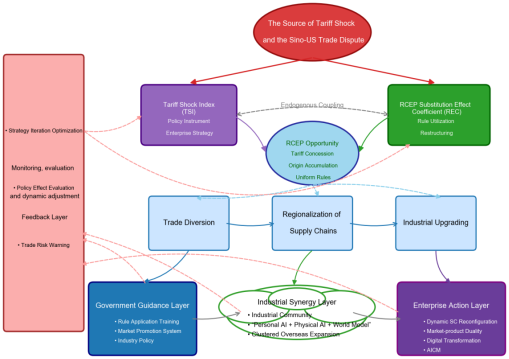
. This approach aims to establish a discourse system grounded in Chinese characteristics and foster a market-oriented mechanism for the co-evolution of technological innovation and regulatory development. Building upon these insights, this paper proposes a systematic “four-dimensional, three-tiered response strategy framework” designed to address challenges arising from trade tariffs and trade substitution mechanisms, as illustrated in
Figure 1.
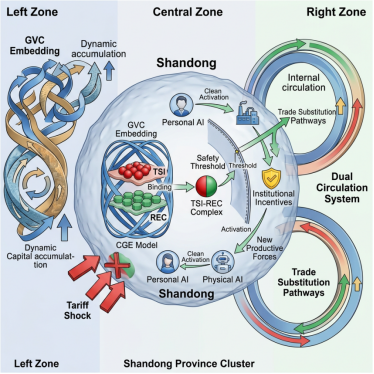
Building on this foundation, we will systematically integrate global value chains (GVCs) into the dynamic process of capital accumulation and leverage the TSI-REC fusion parameters—calibrated for high precision and policy relevance—to establish empirically grounded trade security thresholds. Concurrently, we will synergistically incorporate both personal AI (e.g., AI-augmented decision support for managers and innovators) and physical AI (e.g., AI-enabled automation and intelligent infrastructure) into green innovation initiatives across the industrial chain, thereby unlocking new momentum from emerging production factors. Complementary institutional incentives—including targeted fiscal instruments, regulatory sandboxes, and innovation procurement mechanisms—will be implemented to reinforce this integration. As a result, a dual-circulation–oriented trade development and innovation system will emerge, comprising two complementary pathways: domestic substitution through enhanced internal trade linkages and international substitution via upgraded export competitiveness. This integrated framework underpins a regionally embedded economic and trade development mechanism, as illustrated in
Figure 2.
Figure 1. “Four-dimensional and Three-layer Response Strategy System” for Coping with Trade Tariff Shocks and Trade Substitution Strategies Mechanism.
Figure 2. A regionally embedded economic and trade development mechanism.
As illustrated in
Figure 1 and
Figure 2, the first tier constitutes the Government Guidance Layer, designed to foster a conducive policy environment and mitigate systemic risks associated with RCEP implementation. This layer comprises four interrelated strategic initiatives:
First, enhancing institutional capacity for RCEP rule application and compliance. This includes deepening targeted training programs on RCEP rules for government officials, industry associations, and enterprises; establishing provincial-level “RCEP Rules Commercial Service Centers” to deliver integrated services-including origin certification assistance, regulatory compliance advisory, and tariff optimization planning-specifically tailored to small- and medium-sized enterprises (SMEs); and conducting regular, sector-specific rule interpretation workshops for priority industries.
Second, building a diversified, multi-channel market expansion system. A unified regional branding and promotion platform-“Shandong Manufacturing”-will be launched to coordinate both online and offline promotional activities, including specialized trade fairs and industrial matchmaking events hosted across RCEP member states. Enterprises demonstrating measurable success in penetrating emerging RCEP markets will be eligible for performance-based financial incentives, such as export credit insurance premium subsidies or direct grants.
Third, strengthening the resilience and adaptability of industrial and supply chains. Domestically, dynamic regional supply chain mapping will be conducted for key Shandong industries, enabling real-time identification of critical vulnerabilities and bottlenecks; this intelligence will inform targeted guidance for intra-provincial complementary investment and cross-enterprise technological collaboration. Internationally, leading enterprises will be encouraged to establish overseas logistics infrastructure-including distribution centers, bonded warehouses, and localized after-sales service networks-in RCEP markets; additionally, policy support will be provided for strategic integration into the regional high-value-added ecosystem via mergers and acquisitions, joint ventures, and technology licensing arrangements.
Finally, implementing precision-targeted industrial policies and innovation support mechanisms. For traditional sectors disproportionately affected by RCEP-related tariff adjustments-such as textiles-dedicated fiscal subsidies and preferential low-interest loans will be allocated to accelerate intelligent upgrading and green transition. Concurrently, strategic sectors presenting high-potential RCEP synergies-including high-end equipment manufacturing, electronics, and new chemical materials-will receive enhanced policy guidance, dedicated industrial innovation funds, and facilitated collaborative R&D partnerships with research institutions in Japan and the Republic of Korea.
The second layer is the Industrial Synergy Layer, designed to coordinate and advance cross-sectoral industrial collaboration and the internationalization of industrial clusters. Its core objective is to foster an integrated ecosystem comprising distinctive and competitive industries. Concrete initiatives include the establishment of the “Shandong Agricultural Products RCEP Export Alliance”, which harmonizes branding, technical standards, and logistics frameworks, while facilitating direct supply linkages with major supermarkets and e-commerce platforms in Japan and South Korea; and the formation of the “China-Japan-South Korea High-End Equipment Innovation Cooperation Alliance”, which institutionalizes regular technical exchanges and standards alignment. Furthermore, this layer promotes an intelligent industrial cluster development model grounded in personal AI and physical AI, advances the standardization and implementation of an AI Maturity Assessment Framework tailored for industrial clusters, and refines AI-enabled governance tools to support regionally coordinated development. It also operationalizes a cluster-based “going global” strategy-enabling Shandong’s key industrial clusters (e.g., chemicals and machinery) to jointly develop overseas economic and trade cooperation zones with RCEP member countries through a “park-to-park” cooperation model. This approach establishes comprehensive upstream-downstream industrial linkages, thereby mitigating risks and lowering entry costs for individual enterprises pursuing international expansion.
The third tier-enterprise-level action-centers on establishing and refining proactive adaptation and transformation mechanisms to bolster organizational innovation capacity in artificial intelligence (AI) and digital intelligence. A core priority is the strategic reconfiguration of supply chains to enhance enterprise resilience. Specifically, enterprises should conduct a comprehensive audit of existing supply chain architectures and rigorously evaluate the feasibility of diversifying procurement sources-shifting, where appropriate, from the United States or other high-risk jurisdictions toward high-quality intermediate goods sourced from RCEP member states, particularly Japan and South Korea. This realignment leverages the RCEP’s rules of origin accumulation to mitigate supply chain vulnerabilities. Concurrently, enterprises should adopt a dual-dimension differentiation strategy: (1) market-wise, pursuing a tripartite approach-maintaining premium positioning in the U.S. market, capturing incremental growth opportunities within RCEP markets, and unlocking latent demand in the domestic market; and (2) product-wise, implementing context-sensitive value propositions-offering high-value-added, technologically entrenched products for the U.S. market, while delivering cost-competitive, standards-compliant solutions tailored to RCEP regional requirements. Furthermore, accelerating digital transformation is imperative to strengthen agile manufacturing capabilities. Drawing insights from Cotte Intelligent’s transformation framework, enterprises should harness industrial internet platforms and advanced digital technologies to advance the convergence of “personal AI” (e.g., AI-driven decision support and human augmentation) and “physical AI” (e.g., intelligent robotics and cyber-physical systems), thereby enabling flexible production, personalized customization, and rapid responsiveness to evolving domestic and global market dynamics. Ultimately, this supports enhanced value-chain governance and dynamic, AI-enabled resource allocation under the holistic AICM (Artificial Intelligence-Integrated Capability Management) framework.
This mechanism comprises four interrelated dimensions: (1) the Monitoring and Evaluation Layer, (2) the RCEP Buffer Mechanism Layer, (3) the Support Unit Layer, and (4) the Dynamic Monitoring, Evaluation, and Adjustment Layer.
The Monitoring and Evaluation Layer integrates signal sources-including the Trade Substitution Index (TSI), the Regional Economic Connectivity Index (REC), and RCEP-related opportunity indicators-to systematically assess implementation outcomes and emerging trends. The RCEP Buffer Mechanism Layer consists of three functional modules: trade diversion mitigation, regional supply chain reconfiguration, and industrial upgrading facilitation. The Support Unit Layer encompasses three coordinated tiers: government-led strategic guidance, cross-sectoral industrial collaboration, and enterprise-level implementation. The fourth dimension-the Dynamic Monitoring, Evaluation, and Adjustment Layer-aims to establish a provincial “Trade Risk and Opportunity Monitoring and Early Warning Platform” for Shandong Province. This platform will integrate multi-source administrative data from customs, commerce, and financial authorities; enable real-time tracking of key performance indicators (e.g., TSI and REC); conduct dynamic impact assessments-including substitution effects on priority industries; deliver actionable intelligence to inform evidence-based policymaking and corporate strategy formulation; and institutionalize periodic review cycles coupled with iterative strategy refinement.
Building upon this framework, this paper contends that advancing the sustainable liberalization of RCEP service trade-and strengthening the enforceability of investment commitments-is imperative. It further recommends prioritizing the development of a balanced innovation portfolio, integrating both developmental (exploitative) and exploratory capabilities
| [32] | Manjiang Xing, Chi Gong, Gyu-Hyen Moon, Xiaohong Ge. Digital economy, dual innovation capability and enterprise labor productivity, International Review of Financial Analysis, 2025, Volume 101, 104005.
https://doi.org/10.1016/j.irfa.2025.104005 |
[32]
. Industrial policy should be calibrated to favor sectors with high participation in global value chains (GVCs). Moreover, diversified trade substitution pathways-beyond tariff reduction alone-must be actively pursued to enhance regional resilience against external shocks, particularly those arising from the U.S.-China trade conflict’s spillover effects on Shandong’s economic and trade activities.
8. Conclusion and Outlook
8.1. Summary of Key Findings
This study systematically examines the economic implications of the China-U.S. trade friction and the Regional Comprehensive Economic Partnership (RCEP) for Shandong Province, employing a rigorous methodological framework that integrates theoretical analysis with multi-scenario computable general equilibrium (CGE) modeling. Based on the simulation results and analytical insights, the study formulates evidence-based, policy-relevant recommendations. The principal findings are summarized as follows:
First, regarding the impact assessment of U.S. tariff hikes on regional economic sectors in Shandong Province, empirical analysis indicates a substantial adverse effect on provincial economic performance, with real GDP projected to contract by approximately 1.2%. Export-intensive industries-including textiles, electronics, and mechanical equipment-have borne disproportionate pressure. In contrast, the implementation of the Regional Comprehensive Economic Partnership (RCEP) is expected to generate a net positive contribution to GDP growth of roughly 0.6%, with particularly pronounced benefits accruing to electronics, agriculture, and mechanical equipment sectors.
Second, confirmatory analysis of RCEP’s substitution effect reveals that, under a realistic coexistence scenario-where both U.S. tariffs and RCEP preferences apply-the agreement mitigates approximately 40-50% of the tariff-induced shock. Notably, certain sectors-such as agriculture and food processing-demonstrate the capacity to achieve net export growth through strategic market reallocation toward RCEP partners, thereby realizing effective trade substitution. The magnitude of this effect varies systematically across industries, contingent upon sectoral characteristics (e.g., product complexity, supply chain integration) and enterprises’ proficiency in leveraging RCEP rules of origin and preferential tariff provisions.
Third, mechanism testing identifies three primary channels through which trade shock substitution operates: (i) trade diversion-evidenced by the reorientation of export orders from the U.S. market to RCEP member economies; (ii) deepening of regional value chains-reflected in increased intra-regional trade of intermediate goods; and (iii) industrial upgrading-driven by competitive pressures that incentivize productivity enhancement, technological adoption, and product diversification.
Finally, the findings underscore the strategic imperative for institutional actors-including government agencies, industry associations, and enterprises-to jointly cultivate a dynamic, adaptive governance framework for trade resilience. This entails establishing an integrated “monitoring-early warning-response-optimization” system; prioritizing proactive, rule-based strategies-such as supply chain reconfiguration and targeted industrial upgrading-over reactive, cost-intensive measures; and fostering synergistic alignment between innovation capability development (encompassing both exploratory and exploitative dimensions, per Xing et al.
| [32] | Manjiang Xing, Chi Gong, Gyu-Hyen Moon, Xiaohong Ge. Digital economy, dual innovation capability and enterprise labor productivity, International Review of Financial Analysis, 2025, Volume 101, 104005.
https://doi.org/10.1016/j.irfa.2025.104005 |
[32]
)and regionally embedded factor endowments. Collectively, these efforts constitute a foundational pathway to strengthening Shandong Province’s structural economic resilience in an era of escalating trade volatility.
8.2. Research Limitations and Future Directions
The computable general equilibrium (CGE) model developed in this study employs a comparative static framework, which inherently constrains its capacity to capture long-term dynamic adjustment processes-particularly those driven by endogenous technological change and capital accumulation. While sensitivity analyses were conducted to assess robustness, parameter calibration remains subject to empirical uncertainty, owing partly to data constraints. Moreover, the scarcity of granular, enterprise-level microdata limits both the precision of model calibration and the depth of firm-level case analysis.
To address these limitations, future research may advance along four interrelated directions:
(1) Extending the analytical framework to a dynamic stochastic general equilibrium (DSGE) model that incorporates endogenous innovation and firm heterogeneity, thereby enabling more rigorous simulation of the long-term, path-dependent effects of trade policy reforms.
(2) Leveraging enterprise-level customs declaration data in conjunction with big data analytics and machine learning techniques to refine the measurement of key indicators-including the Trade Substitution Index (TSI) and Re-export Capacity (REC)-and to systematically identify firm-level attributes associated with successful substitution and structural transformation.
(3) Broadening the evaluative scope beyond trade flows to encompass multidimensional sustainability outcomes, such as environmental externalities, labor market adjustments (e.g., sectoral employment shifts), and distributive impacts on social welfare, thus facilitating a holistic assessment of trade policy’s systemic implications.
(4) Incorporating emerging structural variables-such as AI-driven supply chain reconfiguration and adaptive tariff responses-into scenario-based analyses, particularly under conditions of heightened geopolitical and institutional uncertainty.
This study further underscores that, amid growing volatility in the global trading system, coastal provinces in China-including Shandong Province as a representative case-should proactively engage in high-level regional economic integration initiatives (e.g., the Regional Comprehensive Economic Partnership, RCEP). Such engagement should be strategically coupled with domestic institutional reform and industrial upgrading, transforming exogenous pressures into catalysts for endogenous development. A resilience-oriented strategy-grounded in “replacing ad hoc tariffs with transparent, rules-based governance,” “driving growth through innovation-led productivity gains,” and “fostering cross-border synergies via open, inclusive cooperation” is essential to achieving high-quality, sustainable development.
Abbreviations
RCEP | Regional Comprehensive Economic Partnership |
CGE | Computable General Equilibrium |
TSI | Tariff Shock Index |
REC | RCEP Export Reorientation Coefficient |
CES | Constant Elasticity of Substitution |
CET | Constant Elasticity of Transformation |
Author Contributions
Manjiang Xing: Writing – review & editing, Writing – original draft, Software, Resources, Project administration, Methodology, Investigation, Formal analysis, Data curation, Conceptualization, Validation and Visualization, Funding acquisition.
Yunhui Zhang: Writing – review & editing, Visualization, Project administration, Methodology, Formal Analysis, Software, Data curation, Funding acquisition.
Chi Gong: Writing – review & editing, Resources, Investigation, Methodology, Formal analysis, Supervision, Software.
Wenxu Dou: Writing – review & editing, Resources, Investigation, Methodology, Formal analysis.
Zhaoqian Liu: Writing – review & editing, Resources, Investigation, Methodology, Formal analysis.
Data Availability Statement
The datasets analysed in this study were obtained from Shandong Statistical Yearbook, Shandong Provincial Customs Statistics and Wind databases. The data that support the findings of this study are available on request from the corresponding author.
Funding
This work is supported by the Shandong Province Higher Education Institution Philosophy and Social Sciences Research Project (Grant No. 2025ZSYB180 and 2025ZSYB179), and the Key Project of Jinan City Philosophy and Social Sciences Planning Research Program (Grant No. JNSK2026B052), and Research Program of Qilu Institute of Technology (Grant No. QIT25TP010).
Conflicts of Interest
The authors declare no competing interests.
References
| [1] |
Ken Itakura. Evaluating the Impact of the US–China Trade War. Asian Economic Policy Review, Japan Center for Economic Research, 2020, vol. 15(1), pages 77-93.
https://doi.org/10.1111/aepr.12286
|
| [2] |
Li M, Balistreri E J, Zhang W. The US–China trade war: Tariff data and general equilibrium analysis. Journal of Asian Economics, 2020, 69: 101216.
https://doi.org/10.1016/j.asieco.2020.101216
|
| [3] |
Zheng Yuwen, Shao Jingfeng. The Transformation and Upgrading Path of China’s Textile Industry Based on the Reconstruction of Value Network under the Double Cycle Pattern. Journal of Technology Economics, 2023, 42(11): 161-177.
|
| [4] |
Bao Qun, Liao Sainan. Domestic Production Networks and Indirect Export Spillovers: Evidence from Customer-Supplier Relationships. Journal of Management World, 2023, 39(08): 20-45.
https://doi.org/10.19744/j.cnki.11-1235/f.2023.0100
|
| [5] |
Liu Juan, Kang Maonan, Zhao Liting. Demand-driven Incentives or Suppression on Innovations: OFDI Supply-chain Spillover and Domestic Firms’ Digital Transformation—Based on Customer-Supplier Relationships. Journal of Finance and Economics, 2024, 50(12): 122-136.
https://doi.org/10.16538/j.cnki.jfe.20240813.301
|
| [6] |
Cheng Bo-wen, Gong Liu-tang. Tariff Shocks, Financial Frictions, and Economic Growth in China. Contemporary Finance & Economics, 2026, 1-13.
https://doi.org/10.13676/j.cnki.cn36-1030/f.20260122.002
|
| [7] |
Park, Cyn-Young and Petri, Peter A. and Plummer, Michael G. The Economics of Conflict and Cooperation in the Asia-Pacific: RCEP, CPTPP and the US-China Trade War. East Asian Economic Review, 2021, Vol. 25 No. 3 (September 2021) 233-272,
https://dx.doi.org/10.11644/KIEP.EAER.2021.25.3.397
|
| [8] |
Yao Hongxin, Sun Ning. Research on the Binding Force of WTO Rules on Export Subsidies under the Condition of Complete Information. Economic Science, 2004, (04): 110-117.
https://doi.org/10.19523/j.jjkx.2004.04.013
|
| [9] |
Yang Dong, Hu Yuhang. Construction of a "Function-Penetrating" Regulatory Framework for Payment-Type Stablecoins. SJTU Law Review, 2026, (01): 34-48.
https://doi.org/10.19375/j.cnki.31-2075/d.2026.01.003
|
| [10] |
HAN Shuang, CHENG Hui. Evaluation of Gallium and Germanium Export Control Policies from the Perspectives of Coordinated Development and Security. Intertrade, 2025, (08): 15-24.
https://doi.org/10.14114/j.cnki.itrade.2025.08.002
|
| [11] |
Zhou Yujie. Analysis of the Impact of the Trade War Between China and the United States on the Economy of Shandong Province and Countermeasures. In: Dang, C. T., Cifuentes-Faura, J.. Li, X. (eds) Proceedings of the 2nd International Conference on Business and Policy Studies. CONF-BPS. Applied Economics and Policy Studies. Springer, Singapore. 2023,
https://doi.org/10.1007/978-981-99-6441-3_106
|
| [12] |
LI You-shu, TANG Jia-yu. Local Market Demand, Domestic Substitution of Intermediate Input and Upgrading of Global Value Chain. Modern Finance and Economics-Journal of Tianjin University of Finance and Economics, 2025, 45(05): 20-37.
https://doi.org/10.19559/j.cnki.12-1387.2025.05.002
|
| [13] |
JIANG Guanhong, FAN Rui. External Demand Shock and Chinese Enterprises’ Third Party OFDI: Evidence from Antidumping Investigations. Journal of Quantitative & Technological Economics, 2026, 43 (02): 1-27.
https://doi.org/10.13653/j.cnki.jqte.20260204.006
|
| [14] |
ZHAO Chun-ming, ZHONG Xiao-huan, BAN Yuan-hao. The Risk of Global Supply Chain and Domestic Capital Flows: Novel Insights into Corporate Cross-Regional Investment. China Industrial Economics, 2025, (03): 154-173.
https://doi.org/10.19581/j.cnki.ciejournal.2025.03.009
|
| [15] |
Li Yong. Political Risk, Risk Perception and Overseas Investment of Enterprises. Journal of CUPL, 2026, (01): 46-62.
|
| [16] |
Cui, W., Qiao, C., & Song, Y.. The influence of the Regional Comprehensive Economic Partnership on agricultural value chain participation: insights from a global trade analysis project model simulation. Applied Economics, 2025, 57(59): 10802-10815.
https://doi.org/10.1080/00036846.2024.2446592
|
| [17] |
He Zhiyi, Wu Ke, Ye Chen, et al. Global Industrial Structure and China’s Industrial Strength: A Special Report on China’s Industrial Development Based on Global Listed Company Data. Nankai Business Review, 2025, 28(04): 196-208.
|
| [18] |
Wang Chunyu, Wang Haicheng. The Main Impacts of RCEP Tariff Reductions on China's Trade and Countermeasures Macroeconomic Management, 2022, (06): 74-81+90.
https://doi.org/10.19709/j.cnki.11-3199/f.2022.06.012
|
| [19] |
Deng Wei. The Current Situation, Problems and Improvement of Tariff Reduction and Exemption System: From the Perspective of Fair Competition Review, Social Sciences in Guangxi, 2023, (06): 101-109.
https://doi.org/10.3969/j.issn.1004-6917.2023.06.013
|
| [20] |
Ling, D., & Qian, K.. Research on the impact of RCEP rules of origin on China’s manufacturing industry. SHS Web of Conferences, 2023, 169, 01010.
https://doi.org/10.1051/shsconf/202316901010
|
| [21] |
Liu Zhuguang, Cheng Shijie. Research on the Current Situation, Problems and Countermeasures of China's Automotive Industry Cooperation with Other RCEP Member Countries. Social Sciences in Guangxi, 2022, (08): 72-80.
https://doi.org/10.3969/j.issn.1004-6917.2022.08.009
|
| [22] |
SUN Jiaze, HE Zilong, SUN Yuanchen. The Impact of Tariff Shocks on the Global and Chinese Regional Economy: An Analysis Based on the Trade Policies of the New U.S. Administration. Economic Geography, 2025, 45(09): 1-10.
https://doi.org/10.15957/j.cnki.jjdl.2025.09.001
|
| [23] |
SUN Hanqing, CHENG Zhongming. Crisis or opportunity: heterogeneous trade barriers and overseasmergers and acquisitions. Industrial Economics Research, 2024, (04): 129-142.
https://doi.org/10.13269/j.cnki.ier.2024.04.006
|
| [24] |
Tian Ze, Song Ruijie, Yang Jingyi. Study on the Efficiency and Influencing Factors of China's Outward Foreign Direct Investment in RCEP. Journal of Industrial Technological Economics, 2021, 40(11): 94-101.
https://doi.org/10.3969/j.issn.1004-910X.2021.11.012
|
| [25] |
ZHANG Keyu, ZHOU Lingling. RCEP’s Impact on China's Economy and Regional Economic Structure. Journal of International Trade, 2021, (11): 37-53.
https://doi.org/10.13510/j.cnki.jit.2021.11.003
|
| [26] |
Ling, D. and Lv, C.. Research on the Impact of RCEP on China’s Manufacturing Output and Trade: Based on GTAP Simulation. iBusiness, 2022, 14, 41-55.
https://doi.org/10.4236/ib.2022.142004
|
| [27] |
Zhou, L., Pan, C., He, J., & Li, S.. The Impact of RCEP on Chinese Regional Economy from Global Value Chains Perspective (Presented during the 24th Annual Conference on Global Economic Analysis (Virtual Conference)). Purdue University, West Lafayette, IN: Global Trade Analysis Project (GTAP)., 2021, Retrieved from
https://www.gtap.agecon.purdue.edu/resources/res_display.asp?RecordID=6280
|
| [28] |
LI Xin. The Scenarios of Sino-US Trade War: Based on the GTAP CGE Model. Journal of International Trade, 2012, (11): 50-65.
https://doi.org/10.13510/j.cnki.jit.2012.11.003
|
| [29] |
Stephanie Schmitt-Grohé and Martín Uribe. Transitory and Permanent Import Tariff Shocks in the United States: An Empirical Investigation. NBER Working Paper 33997, 2025,
https://doi.org/10.3386/w33997
|
| [30] |
ZHAO Qing-song, WANG Wen-qian. Research on RCEP’s trade effect and its influence-Analysis based on partial equilibrium model. Prices Monthly, 2021, (12): 52-59.
https://doi.org/10.14076/j.issn.1006-2025.2021.12.08
|
| [31] |
Xing Manjiang, Kim Yang Gi, Zhang Ling. The Evolutionary Path and Future of Digital Trade Research: A Perspective from CNKI Literature. Foreign Economic Relations & Trade, 2025, (09): 6-10+19.
https://doi.org/10.20216/j.cnki.fert1987.2025.09.031
|
| [32] |
Manjiang Xing, Chi Gong, Gyu-Hyen Moon, Xiaohong Ge. Digital economy, dual innovation capability and enterprise labor productivity, International Review of Financial Analysis, 2025, Volume 101, 104005.
https://doi.org/10.1016/j.irfa.2025.104005
|
Cite This Article
-
APA Style
Xing, M., Zhang, Y., Gong, C., Dou, W., Liu, Z. (2026). Uncertainty in Trade Tariff Impacts and Strategic Responses Through Trade Substitution: Empirical Evidence from Shandong. Economics, 15(3), 81-98. https://doi.org/10.11648/j.eco.20261503.13
 Copy
|
Copy
|
 Download
ACS Style
Xing, M.; Zhang, Y.; Gong, C.; Dou, W.; Liu, Z. Uncertainty in Trade Tariff Impacts and Strategic Responses Through Trade Substitution: Empirical Evidence from Shandong. Economics. 2026, 15(3), 81-98. doi: 10.11648/j.eco.20261503.13
Copy
|
Download
AMA Style
Xing M, Zhang Y, Gong C, Dou W, Liu Z. Uncertainty in Trade Tariff Impacts and Strategic Responses Through Trade Substitution: Empirical Evidence from Shandong. Economics. 2026;15(3):81-98. doi: 10.11648/j.eco.20261503.13
Copy
|
Download
-
@article{10.11648/j.eco.20261503.13,
  author = {Manjiang Xing and Yunhui Zhang and Chi Gong and Wenxu Dou and Zhaoqian Liu},
  title = {Uncertainty in Trade Tariff Impacts and Strategic Responses Through Trade Substitution: Empirical Evidence from Shandong},
  journal = {Economics},
  volume = {15},
  number = {3},
  pages = {81-98},
  doi = {10.11648/j.eco.20261503.13},
  url = {https://doi.org/10.11648/j.eco.20261503.13},
  eprint = {https://article.sciencepublishinggroup.com/pdf/10.11648.j.eco.20261503.13},
  abstract = {Against the backdrop of growing uncertainty in the global trading system, enhancing regional economic resilience through alternative trade channels—particularly in response to tariff-induced disruptions and the protracted U.S.–China trade conflict—has emerged as a pressing issue for both policy and academic inquiry. This study integrates theoretical analysis with multi-scenario computable general equilibrium (CGE) modeling to rigorously assess the combined macroeconomic and sectoral impacts of U.S.–China trade tensions and the Regional Comprehensive Economic Partnership (RCEP) on Shandong Province. Drawing on these findings, the paper advances a set of forward-looking, evidence-based, and operationally feasible policy recommendations. The analysis indicates that regional economies should strategically harness industrial internet platforms and advanced digital technologies; strengthen institutional coordination—including interdepartmental governance and cross-sectoral industrial planning; and foster synergistic integration of “personal AI” and “physical AI” systems to enable flexible, scalable, and demand-responsive manufacturing. Moreover, policymakers must proactively cultivate diversified, non-traditional trade substitution pathways—such as nearshoring, third-country intermediation, and digital trade facilitation—to generate sustainable trade diversion effects; accelerate the reconfiguration of regional supply chain networks; optimize spatial industrial layouts; and advance inclusive, green, and technologically driven industrial upgrading. Collectively, these measures enhance adaptive capacity to domestic and international market volatility while reinforcing local agency within global value chains.},
 year = {2026}
}
Copy
|
Download
-
TY  - JOUR
T1  - Uncertainty in Trade Tariff Impacts and Strategic Responses Through Trade Substitution: Empirical Evidence from Shandong
AU  - Manjiang Xing
AU  - Yunhui Zhang
AU  - Chi Gong
AU  - Wenxu Dou
AU  - Zhaoqian Liu
Y1  - 2026/08/26
PY  - 2026
N1  - https://doi.org/10.11648/j.eco.20261503.13
DO  - 10.11648/j.eco.20261503.13
T2  - Economics
JF  - Economics
JO  - Economics
SP  - 81
EP  - 98
PB  - Science Publishing Group
SN  - 2376-6603
UR  - https://doi.org/10.11648/j.eco.20261503.13
AB  - Against the backdrop of growing uncertainty in the global trading system, enhancing regional economic resilience through alternative trade channels—particularly in response to tariff-induced disruptions and the protracted U.S.–China trade conflict—has emerged as a pressing issue for both policy and academic inquiry. This study integrates theoretical analysis with multi-scenario computable general equilibrium (CGE) modeling to rigorously assess the combined macroeconomic and sectoral impacts of U.S.–China trade tensions and the Regional Comprehensive Economic Partnership (RCEP) on Shandong Province. Drawing on these findings, the paper advances a set of forward-looking, evidence-based, and operationally feasible policy recommendations. The analysis indicates that regional economies should strategically harness industrial internet platforms and advanced digital technologies; strengthen institutional coordination—including interdepartmental governance and cross-sectoral industrial planning; and foster synergistic integration of “personal AI” and “physical AI” systems to enable flexible, scalable, and demand-responsive manufacturing. Moreover, policymakers must proactively cultivate diversified, non-traditional trade substitution pathways—such as nearshoring, third-country intermediation, and digital trade facilitation—to generate sustainable trade diversion effects; accelerate the reconfiguration of regional supply chain networks; optimize spatial industrial layouts; and advance inclusive, green, and technologically driven industrial upgrading. Collectively, these measures enhance adaptive capacity to domestic and international market volatility while reinforcing local agency within global value chains.
VL  - 15
IS  - 3
ER  -
Copy
|
Download





 Share This Article
 Twitter
 Linked In
 Facebook