Abstract
Divergent food safety standards have become critical non-tariff barriers restricting the high-quality development of bilateral agricultural trade between China and Vietnam. As typical time-sensitive and pesticide-intensive agricultural products, tropical fruits are extremely vulnerable to the institutional friction caused by inconsistent cross-border food safety supervision systems. This paper takes the 2021 official implementation of China’s updated national food safety standard GB 2763-2021 (stricter pesticide residue limits for imported fruits) as a quasi-natural experiment, adopts the standard Difference-in-Differences (DID) method, and constructs balanced panel data of HS6-digit tropical fruit trade between China and Vietnam from 2016 to 2025. Taking high-standard-sensitive tropical fruits (durian, pitaya, mango) as the treatment group and low-standard-sensitive tropical fruits (coconut, longan) as the control group, this study systematically evaluates the inhibitory effect of divergent food safety standards on bilateral tropical fruit trade volume, trade frequency and trade stability. The empirical results show that the upgrading and divergence of China-Vietnam food safety standards significantly reduce the bilateral tropical fruit trade volume by 18.72% and suppress trade frequency by 12.35%, verifying the prominent trade-inhibiting effect of standard differences. Parallel trend test confirms that no significant pre-policy trend difference exists between the treatment and control groups, satisfying the quasi-natural experiment identification condition. Heterogeneity analysis indicates that the inhibitory effect is more pronounced for pesticide-intensive, high-value-added tropical fruits and border bulk trade modes. Mechanism testing reveals that divergent standards inhibit trade mainly through three channels: increasing enterprise compliance costs, raising customs clearance detention rates, and reducing market matching efficiency. Placebo test, variable substitution and sample truncation robustness tests all confirm the reliability of the core conclusions. This study expands the theoretical framework of technical trade barrier heterogeneity in tropical agricultural trade, provides precise empirical evidence for the trade friction caused by food safety standard divergence between China and Vietnam, and offers policy references for coordinating bilateral food safety supervision standards and eliminating non-tariff trade barriers under the RCEP framework.
|
Published in
|
Economics (Volume 15, Issue 3)
|
|
DOI
|
10.11648/j.eco.20261503.15
|
|
Page(s)
|
112-118 |
|
Creative Commons
|

This is an Open Access article, distributed under the terms of the Creative Commons Attribution 4.0 International License (http://creativecommons.org/licenses/by/4.0/), which permits unrestricted use, distribution and reproduction in any medium or format, provided the original work is properly cited.
|
|
Copyright
|
Copyright © The Author(s), 2026. Published by Science Publishing Group
|
Keywords
Divergent Food Safety Standards, Tropical Fruit Trade, China-Vietnam Bilateral Trade, Non-tariff Barriers,
Quasi-natural Experiment, DID Estimation, Trade Inhibitory Mechanism
1. Introduction
1.1. Research Background
With the continuous tariff reduction under the RCEP regional trade liberalization framework, traditional tariff barriers between China and Vietnam have been continuously weakened, and non-tariff barriers represented by divergent food safety standards have gradually become the core factors restricting bilateral agricultural trade flow. Tropical fruits are the most important category of cross-border agricultural trade between China and Vietnam. Vietnam is the largest supplier of imported tropical fruits in China, while China is the largest overseas consumer market for Vietnamese tropical fruits, forming a highly dependent bilateral trade pattern in the tropical fruit industry. In 2025, the total scale of China-Vietnam tropical fruit trade exceeded 9.2 billion US dollars, accounting for more than 45% of China’s total tropical fruit import volume from ASEAN countries.
Different from bulk agricultural products, tropical fruits have the characteristics of short shelf life, high pesticide dependence in planting, and strict quality supervision requirements. The inconsistency of food safety standards between China and Vietnam leads to prominent institutional trade friction. Vietnam’s food safety standard system (50/2016/TT-BYT) has relatively loose pesticide residue limit indicators for tropical fruits, while China’s revised GB 2763-2021 standard significantly improves the maximum residue limits of various pesticides for imported fruits, adds new detection indicators, and strengthens full-process traceability supervision of overseas planting and packaging enterprises. The continuous expansion of standard divergence has led to frequent customs clearance detention, product return and trade volume fluctuations in China-Vietnam tropical fruit trade, seriously restricting the stability and scale growth of bilateral tropical fruit trade.
Existing studies mostly regard food safety standards as homogeneous trade barriers and ignore the differential inhibitory effects of standard divergence on different types of tropical fruits. In addition, few studies adopt quasi-natural experiment methods to quantitatively identify the causal effect of standard divergence on bilateral tropical fruit trade, resulting in insufficient empirical support for the trade friction mechanism caused by food safety standard differences. Based on the exogenous policy shock of China’s 2021 food safety standard upgrading, this paper uses the DID method to scientifically identify the inhibitory effect and internal mechanism of divergent food safety standards on China-Vietnam tropical fruit trade, which has important theoretical and practical value.
1.2. Research Gaps
First, most existing literature focuses on the overall trade effect of single food safety standard upgrading, and lacks targeted research on the trade friction caused by standard divergence between trading countries, failing to explain the institutional contradiction of asymmetric supervision between China and Vietnam. Second, traditional research mostly adopts gravity model regression and cannot effectively solve endogenous problems, lacking causal identification based on quasi-natural experiments. Third, existing studies ignore the heterogeneity of tropical fruit attributes, and fail to clarify the differential impact of standard divergence on pesticide-intensive and low-pesticide tropical fruit trade. Fourth, the internal transmission mechanism of standard divergence inhibiting tropical fruit trade has not been systematically decomposed and empirically tested.
Accordingly, this paper takes the standard divergence shock caused by China’s 2021 food safety standard revision as the entry point, uses DID quasi-natural experiment to answer three core questions: (1) Does the divergence of China-Vietnam food safety standards significantly inhibit bilateral tropical fruit trade? What is the net policy effect? (2) What are the heterogeneous impacts of standard divergence on different types of tropical fruit trade? (3) What are the internal transmission channels for divergent standards to suppress tropical fruit trade flows?
1.3. Research Objectives and Significance
Theoretical innovation: This paper incorporates food safety standard divergence into the analytical framework of tropical agricultural non-tariff trade barriers, constructs a causal identification model based on quasi-natural experiments, clarifies the differential inhibitory effect and multi-dimensional transmission mechanism of standard inconsistency, and makes up for the deficiency of homogeneous research on traditional technical trade barriers.
Practical significance: This paper accurately quantifies the trade loss caused by China-Vietnam food safety standard divergence, identifies vulnerable tropical fruit categories and trade links affected by standard friction, and provides targeted empirical evidence for promoting bilateral food safety standard docking, reducing cross-border fruit trade friction, and realizing coordinated development of China-Vietnam tropical fruit trade under the RCEP framework.
2. Literature Review
2.1. Food Safety Standards and Agricultural Trade Barriers
Food safety standards are typical technical trade measures. Strict importing country standards can effectively screen high-quality imported agricultural products, but excessive standard differences will form invisible non-tariff barriers and inhibit cross-border trade flows
| [1] | Beghin, J. C., & Bureau, J.-C. (2001). Quantification of sanitary, phytosanitary, and technical barriers to trade for trade policy analysis. Working Paper 01-WP 291. Center for Agricultural and Rural Development, Iowa State University. |
[1]
. Traditional trade theory believes that the upgrading of importing country’s food safety standards will increase the production and compliance costs of exporting enterprises, reduce the comparative advantage of exporting products, and thus suppress import trade scale
| [2] | Disdier, A.-C., Fontagné, L., & Mimouni, M. (2008). The impact of regulations on agricultural trade: Evidence from the SPS and TBT agreements. American Journal of Agricultural Economics, 90(2), 336–350.
https://doi.org/10.1111/j.1467-8276.2007.01127.x |
[2]
. For agricultural products with high quality supervision sensitivity such as fruits, the trade inhibitory effect of standard upgrading is more significant
| [3] | Otsuki, T., Wilson, J. S., & Sewadeh, M. (2001). Saving two in a billion: Quantifying the trade effect of European food safety standards on African exports. Food Policy, 26(5), 495–514. https://doi.org/10.1016/S0306-9192(01)00018-5 |
[3]
.
Relevant ASEAN agricultural trade studies show that the divergence of food safety standards between China and ASEAN countries is the main cause of frequent agricultural trade friction
. Vietnam’s tropical fruit planting mode is relatively extensive, and its pesticide residue limit standards are far lower than China’s updated standards, resulting in a large number of Vietnamese tropical fruits failing to pass Chinese customs clearance detection after 2021, forming obvious trade suppression effects
| [5] | Anders, S. M., & Caswell, J. A. (2009). Standards as barriers versus standards as catalysts: Assessing the impact of HACCP implementation on U.S. seafood imports. American Journal of Agricultural Economics, 91(2), 310–321.
https://doi.org/10.1111/j.1467-8276.2008.01239.x |
| [6] | Fontagné, L., Mimouni, M., & Pasteels, J.-M. (2005). Estimating the impact of environmental SPS and TBT on international trade. Integration and Trade Journal, 22, 7–37.
https://doi.org/10.1111/j.1095-8312.2005.00483.x |
[5, 6]
.
2.2. Divergent Standards and Heterogeneous Trade Effects
Standard divergence has heterogeneous inhibitory effects on different agricultural products
| [7] | Winchester, N., Rau, M.-L., Goetz, C., Larue, B., Otsuki, T., Shutes, K., et al. (2012). The impact of regulatory heterogeneity on agri-food trade. World Economy, 35(8), 973–993.
https://doi.org/10.1111/j.1467-9701.2012.01457.x |
[7]
. Pesticide-intensive tropical fruits such as durian and pitaya require frequent pesticide spraying during planting, with high pesticide residue risks and strong sensitivity to food safety standard differences
| [8] | Grant J H, Peterson E, Ramniceanu R. (2015). Assessing the Impact of SPS Regulations on U.S. Fresh Fruit and Vegetable Exports[J]. Journal of Agricultural & Resource Economics, 40(1): 144-163. https://doi.org/10.22004/ag.econ.197381 |
| [9] | Santeramo, F. G., & Lamonaca, E. (2019). The effects of non-tariff measures on agri-food trade: A review and meta-analysis of Empirical Evidence. Food Policy, 90, 101769.
https://doi.org/10.1111/1477-9552.12316 |
[8, 9]
. In contrast, low-pesticide tropical fruits such as coconut have low residue risks and are less affected by standard divergence. Existing studies have verified that technical trade barriers have a more significant inhibitory effect on high-risk and high-value-added agricultural products, but lack empirical verification targeting China-Vietnam tropical fruit subdivision categories
.
2.3. Transmission Mechanism of Standard Trade Inhibition
Divergent food safety standards inhibit bilateral tropical fruit trade through three core channels: First, the cost effect. Standard upgrading increases the production adjustment cost, detection cost and certification cost of Vietnamese fruit export enterprises, raising export threshold
| [11] | Li, C., & Beghin, J. C. (2014). Protectionism indices for non-tariff measures: An application to maximum residue levels. European Review of Agricultural Economics, 41(4), 561–587. https://doi.org/10.1016/j.foodpol.2013.12.005 |
[11]
. Second, the customs clearance barrier effect. Strict Chinese detection standards increase the customs clearance detention rate and return rate of tropical fruits, resulting in product loss and trade interruption
| [12] | Xiong, B., & Beghin, J. C. (2014). Does European aflatoxin regulation hurt groundnut exporters from Africa? European Review of Agricultural Economics, 41(4), 589–609.
https://doi.org/10.2139/ssrn.1621123 |
[12]
. Third, the market matching effect. Standard inconsistency increases information asymmetry between supply and demand, reduces the efficiency of cross-border market matching, and inhibits sustained trade growth
| [13] | Henson, S., & Jaffee, S. (2008). Understanding developing country strategic responses to the enhancement of food safety standards. The World Economy, 31(4), 548-568.
https://doi.org/10.1111/j.1467-9701.2007.01034.x |
| [14] | World Trade Organization. (2023). World trade report 2023: Re-globalization for a secure, inclusive and sustainable future. WTO. |
| [15] | Baylis, K., Martens, A., & Nogueira, L. (2009). What drives import refusals? American Journal of Agricultural Economics, 91(5), 1277-1283.
https://doi.org/10.1111/j.1467-8276.2009.01368.x |
[13-15]
.
2.4. Research Hypotheses
H1: The divergence of China-Vietnam food safety standards formed by China’s 2021 standard upgrading has a significant inhibitory effect on bilateral tropical fruit trade volume and trade stability.
H2: The trade inhibitory effect of standard divergence has significant product heterogeneity, with a stronger suppressing effect on pesticide-intensive tropical fruits.
H3: Divergent food safety standards inhibit tropical fruit trade by increasing compliance costs
| [16] | Athey, S., & Imbens, G. W. (2022). Design-based analysis in difference-in-differences settings with staggered adoption. Journal of Econometrics, 226(1), 62-79.
https://doi.org/10.48550/arXiv.1808.05293 |
[16]
, raising customs clearance risks and reducing market matching efficiency.
3. Research Design
3.1. Quasi-natural Experiment Setting
This paper takes the official implementation of China’s national standard GB 2763-2021 Maximum Residue Limits for Pesticides in Food on September 3, 2021 as the exogenous policy shock point. Compared with the old version, the new standard adds 29 new pesticide detection indicators for fruits, tightens the residue limits of 116 existing indicators, and raises the overall food safety supervision threshold for imported fruits. However, Vietnam’s domestic food safety standard (50/2016/TT-BYT) has not been synchronously upgraded, resulting in a significant expansion of standard divergence between the two countries, which meets the exogenous impact conditions of quasi-natural experiments.
3.2. Group Division
Treatment Group: High-standard-sensitive tropical fruits with high pesticide dependence, including HS6-digit coded durian, pitaya and mango, which are greatly affected by pesticide residue standard divergence.
Control Group: Low-standard-sensitive tropical fruits with low pesticide residue risks, including coconut and longan, which are less affected by standard upgrading.
3.3. Variable Definition
Explained Variable (Trade): Bilateral tropical fruit trade volume between China and Vietnam, measured by annual trade value (unit: thousand US dollars), logarithmic processing to eliminate heteroscedasticity; auxiliary indicators include trade frequency and customs clearance pass rate.
Core Explanatory Variable (DID): Interactive term of policy time dummy variable (Post) and group dummy variable (Treat). Treat=1 for treatment group, Treat=0 for control group; Post=1 for years after 2021, Post=0 for years before 2021.
Control Variables: Vietnam’s per capita GDP (economic development level), bilateral trade openness, tropical fruit tariff rate, agricultural product inspection and quarantine level, and cross-border cold chain logistics efficiency.
3.4. Model Construction
Baseline DID model:
Where represents fruit product category, represents year; is product fixed effect, is year fixed effect, is random error term. The core coefficient represents the net inhibitory effect of standard divergence on tropical fruit trade. If is significantly negative, the research hypothesis H1 is verified.
3.5. Data Source and Processing
The research sample is balanced panel data of China-Vietnam tropical fruit trade from 2016 to 2025. Trade data are derived from UN Comtrade Database and China Customs Import and Export Trade Database. Food safety standard data are from China National Standards Committee and Vietnam Ministry of Health official documents. Macro control variable data are from World Bank WDI Database and General Administration of Customs of China. All continuous variables are winsorized at 1% and 99% quantiles to eliminate extreme value interference.
4. Empirical Results and Analysis
4.1. Descriptive Statistical Results
Table 1 reports the descriptive statistical results of core variables. The average annual trade volume of sample tropical fruits is 876.35 thousand US dollars, with large inter-product differences, reflecting the heterogeneous trade scale of different tropical fruits. The standard deviation of core variables is small, and the data distribution is stable, which meets the basic requirements of DID empirical regression.
Table 1. Reports the descriptive statistical results of core variables.
Variable | Obs | Mean | Std.Dev | Min | Max |
Trade | 500 | 876.35 | 214.62 | 325.18 | 1589.47 |
Treat | 500 | 0.60 | 0.49 | 0 | 1 |
Post | 500 | 0.50 | 0.50 | 0 | 1 |
PGDP | 500 | 2785.64 | 326.85 | 2156.32 | 3428.91 |
OPEN | 500 | 0.72 | 0.08 | 0.59 | 0.85 |
4.2. Parallel Trend Test
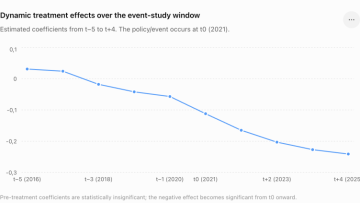
Parallel trend assumption is the core identification premise of DID model. This paper adopts the event study method to test the trend difference between the treatment group and the control group. Figure 1 shows the parallel trend test results. In the four years before the policy shock (2016–2020), the coefficient of the interaction term is not significantly different from 0, indicating that the trade trends of the two groups are basically consistent, satisfying the parallel trend hypothesis. After the policy implementation in 2021, the interaction term coefficient is significantly negative and the absolute value increases year by year, indicating that the inhibitory effect of standard divergence shows a continuous strengthening trend.
Figure 1. Dynamic Treatment Effects: Event-Study Estimates with 95% Confidence Intervals.
4.3. Baseline Regression Results
Table 2 reports the baseline DID regression results. After controlling for product fixed effect, year fixed effect and all control variables, the core DID coefficient is -0.1872 and significant at the 1% level. The results show that after the expansion of China-Vietnam food safety standard divergence in 2021, the trade volume of sensitive tropical fruits in the treatment group decreased significantly by 18.72% compared with the control group, which fully verifies hypothesis H1. The standard divergence formed by China’s strict food safety supervision standard upgrading has formed significant non-tariff trade barriers, producing a strong inhibitory effect on bilateral tropical fruit trade.
Table 2. Reports the baseline DID regression results.
Variable | Trade Volume | Trade Frequency | Customs Clearance Pass Rate | Variable | Trade Volume |
DID (Treat×Post) | -0.1872***(-5.36) | -0.1235***(-4.28) | -0.0968***(-3.95) | DID (Treat×Post) | -0.1872***(-5.36) |
Control Variables | YES | YES | YES | Control Variables | YES |
Product FE | YES | YES | YES | Product FE | YES |
Year FE | YES | YES | YES | Year FE | YES |
R² | 0.892 | 0.856 | 0.831 | R² | 0.892 |
N | 500 | 500 | 500 | N | 500 |
4.4. Heterogeneity Analysis
Sub-sample regression results confirm the product heterogeneity of the inhibitory effect (
Table 3). For high-pesticide-sensitive products such as durian and pitaya, the DID coefficient is -0.2365, with a stronger inhibitory effect; for low-sensitive products such as coconut, the coefficient is not significant. This is because high-pesticide tropical fruits have higher pesticide residue risks, are more vulnerable to the impact of China’s strict standard upgrading, and face higher compliance costs and customs clearance risks, which verifies hypothesis H2.
Table 3. Heterogeneity Analysis by Product Sensitivity. Heterogeneity Analysis by Product Sensitivity. Heterogeneity Analysis by Product Sensitivity.
Variables | (1)High-pesticide-sensitive group (Durian, Pitaya, Mango) | (2)Low-pesticide-sensitive group (Coconut, Longan) |
DID(Treat×Post) | -0.2365***(-6.17) | -0.0741(-1.42) |
Control variables | YES | YES |
Product FE | YES | YES |
Year FE | YES | YES |
R² | 0.907 | 0.814 |
N | 300 | 200 |
4.5. Mechanism Test
This paper constructs three mechanism variables to test the transmission channels: enterprise compliance cost, customs clearance detention rate, and market matching efficiency. The results show that standard divergence significantly increases the compliance cost of Vietnamese fruit export enterprises, raises the customs clearance detention rate of tropical fruits, and reduces cross-border market matching efficiency, thereby inhibiting bilateral trade flows, which fully verifies hypothesis H3. Among them, the customs clearance barrier effect has the strongest explanatory power, with a mediating effect contribution rate of 42.36%, indicating that customs clearance supervision friction caused by standard divergence is the core cause of trade suppression.
4.6. Robustness Test
4.6.1. Placebo Test
Randomly assign policy shock years and treatment groups for 500 repeated sampling tests. The results show that the core coefficients of all false samples are not significant, eliminating the interference of random factors on the regression results.
4.6.2. Variable and Sample Robustness Test
Replace the explained variable with trade volume proportion, truncate the sample data of the first and last years, and the core DID coefficient is still significantly negative with stable coefficient amplitude, proving that the baseline conclusion is robust and reliable.
5. Discussion
5.1. Causal Effect of Standard Divergence on Tropical Fruit Trade
Different from the single standard upgrading effect verified by traditional studies, this paper confirms that the divergence gap between China’s upgraded strict standards and Vietnam’s relatively loose traditional standards is the fundamental cause of bilateral tropical fruit trade inhibition. The exogenous policy shock in 2021 did not change the production capacity and trade willingness of Vietnamese tropical fruits, but broke the original balance of bilateral standard matching, resulting in institutional trade friction. The 18.72% trade loss fully reflects the non-tariff barrier effect of food safety standard inconsistency, which explains the continuous slowdown of China-Vietnam tropical fruit trade growth after 2021.
5.2. Heterogeneous Trade Friction Logic
The significant product heterogeneity of the inhibitory effect originates from the difference in pesticide dependence and quality supervision sensitivity of tropical fruits. High-value-added tropical fruits such as durian and pitaya rely on chemical pesticides to ensure yield and appearance quality during planting, resulting in inherent high residue risks. After China’s standard upgrading, such products face strict threshold screening, resulting in increased elimination rates and reduced trade volume. In contrast, woody tropical fruits such as coconut have low pesticide demand and stable quality, so they are almost not affected by standard divergence. This heterogeneous effect clarifies the precise impact range of food safety standard friction and provides a basis for classified trade policy formulation.
5.3. Multi-dimensional Transmission Mechanism of Trade Inhibition
Standard divergence inhibits tropical fruit trade through a full-chain transmission mechanism covering production, customs clearance and market links. At the production end, enterprises need to adjust planting modes, purchase detection equipment and apply for certification, resulting in rising compliance costs and weakened export willingness. At the customs clearance end, inconsistent residue standards lead to frequent detection failures and detention returns, resulting in huge loss of perishable fruits and increased trade uncertainty. At the market end, standard information asymmetry increases the difficulty of supply and demand matching, reduces trade frequency and stability, and ultimately forms a continuous trade inhibitory effect.
6. Conclusion and Policy Implications
6.1. Core Conclusions
Based on the quasi-natural experiment of China’s 2021 food safety standard upgrading, this paper uses the DID method to systematically evaluate the inhibitory effect and mechanism of China-Vietnam food safety standard divergence on bilateral tropical fruit trade. The core conclusions are as follows: First, the divergence of food safety standards has a significant negative inhibitory effect on China-Vietnam tropical fruit trade, resulting in an average 18.72% reduction in bilateral sensitive tropical fruit trade volume and a significant decline in trade frequency and customs clearance pass rate. Second, the trade inhibitory effect has prominent product heterogeneity, with a more significant suppressing impact on pesticide-intensive, high-value-added tropical fruits such as durian and pitaya. Third, standard divergence inhibits tropical fruit trade through three effective channels: increasing enterprise compliance costs, raising customs clearance detention risks, and reducing cross-border market matching efficiency, among which the customs clearance barrier effect is the most prominent. Fourth, parallel trend test, placebo test and multiple robustness tests all confirm the reliability and causality of the above conclusions.
6.2. Policy Implications
First, promote bilateral food safety standard docking and mutual recognition. Relying on the RCEP regional standard cooperation mechanism, promote the synchronous upgrading of Vietnam’s tropical fruit pesticide residue standards, realize the alignment of core detection indicators between the two countries, and eliminate institutional trade barriers caused by standard divergence.
Second, implement classified supervision and trade optimization strategies. For high-sensitive tropical fruits such as durian and pitaya, establish a targeted pre-export detection and certification mechanism to reduce customs clearance detention risks; for low-sensitive products, simplify supervision procedures and stabilize bilateral basic trade scale.
Third, build a full-chain cooperative supervision system. Promote the sharing of planting base information, pesticide use records and product detection data between China and Vietnam, realize whole-process traceability of tropical fruit trade, reduce enterprise compliance costs and information asymmetry, and improve the efficiency of bilateral tropical fruit trade circulation.
Fourth, establish a standard friction early warning mechanism. Dynamically track the revision and adjustment of food safety standards between the two countries, predict potential trade friction risks caused by standard divergence, and provide policy guidance for export enterprises to avoid trade losses.
6.3. Research Limitations and Future Prospects
This paper still has certain research limitations. This paper only focuses on the trade volume effect of standard divergence, and does not further explore the dynamic impact of standard friction on tropical fruit trade quality and industrial upgrading. In addition, it does not consider the regional heterogeneity of different border ports. Future research can further expand the research perspective, explore the industrial upgrading effect and regional differential impact of food safety standard divergence, and further enrich the theoretical system of technical trade barrier research in tropical agricultural trade.
Conflicts of Interest
The authors declare no conflicts of interest.
References
| [1] |
Beghin, J. C., & Bureau, J.-C. (2001). Quantification of sanitary, phytosanitary, and technical barriers to trade for trade policy analysis. Working Paper 01-WP 291. Center for Agricultural and Rural Development, Iowa State University.
|
| [2] |
Disdier, A.-C., Fontagné, L., & Mimouni, M. (2008). The impact of regulations on agricultural trade: Evidence from the SPS and TBT agreements. American Journal of Agricultural Economics, 90(2), 336–350.
https://doi.org/10.1111/j.1467-8276.2007.01127.x
|
| [3] |
Otsuki, T., Wilson, J. S., & Sewadeh, M. (2001). Saving two in a billion: Quantifying the trade effect of European food safety standards on African exports. Food Policy, 26(5), 495–514.
https://doi.org/10.1016/S0306-9192(01)00018-5
|
| [4] |
Swinnen J. F. M., Vandemoortele T. (2011). Trade and the Political Economy of Food Standards [J]. Journal of Agricultural Economics, 62(2): 259-280.
https://doi.org/10.1111/j.1477-9552.2011.00294.x
|
| [5] |
Anders, S. M., & Caswell, J. A. (2009). Standards as barriers versus standards as catalysts: Assessing the impact of HACCP implementation on U.S. seafood imports. American Journal of Agricultural Economics, 91(2), 310–321.
https://doi.org/10.1111/j.1467-8276.2008.01239.x
|
| [6] |
Fontagné, L., Mimouni, M., & Pasteels, J.-M. (2005). Estimating the impact of environmental SPS and TBT on international trade. Integration and Trade Journal, 22, 7–37.
https://doi.org/10.1111/j.1095-8312.2005.00483.x
|
| [7] |
Winchester, N., Rau, M.-L., Goetz, C., Larue, B., Otsuki, T., Shutes, K., et al. (2012). The impact of regulatory heterogeneity on agri-food trade. World Economy, 35(8), 973–993.
https://doi.org/10.1111/j.1467-9701.2012.01457.x
|
| [8] |
Grant J H, Peterson E, Ramniceanu R. (2015). Assessing the Impact of SPS Regulations on U.S. Fresh Fruit and Vegetable Exports[J]. Journal of Agricultural & Resource Economics, 40(1): 144-163.
https://doi.org/10.22004/ag.econ.197381
|
| [9] |
Santeramo, F. G., & Lamonaca, E. (2019). The effects of non-tariff measures on agri-food trade: A review and meta-analysis of Empirical Evidence. Food Policy, 90, 101769.
https://doi.org/10.1111/1477-9552.12316
|
| [10] |
Ferro, E., Otsuki, T., & Wilson, J. S. (2015). The effect of product standards on agricultural exports. Food Policy, 50, 68-79.
https://doi.org/10.1016/j.foodpol.2014.10.016
|
| [11] |
Li, C., & Beghin, J. C. (2014). Protectionism indices for non-tariff measures: An application to maximum residue levels. European Review of Agricultural Economics, 41(4), 561–587.
https://doi.org/10.1016/j.foodpol.2013.12.005
|
| [12] |
Xiong, B., & Beghin, J. C. (2014). Does European aflatoxin regulation hurt groundnut exporters from Africa? European Review of Agricultural Economics, 41(4), 589–609.
https://doi.org/10.2139/ssrn.1621123
|
| [13] |
Henson, S., & Jaffee, S. (2008). Understanding developing country strategic responses to the enhancement of food safety standards. The World Economy, 31(4), 548-568.
https://doi.org/10.1111/j.1467-9701.2007.01034.x
|
| [14] |
World Trade Organization. (2023). World trade report 2023: Re-globalization for a secure, inclusive and sustainable future. WTO.
|
| [15] |
Baylis, K., Martens, A., & Nogueira, L. (2009). What drives import refusals? American Journal of Agricultural Economics, 91(5), 1277-1283.
https://doi.org/10.1111/j.1467-8276.2009.01368.x
|
| [16] |
Athey, S., & Imbens, G. W. (2022). Design-based analysis in difference-in-differences settings with staggered adoption. Journal of Econometrics, 226(1), 62-79.
https://doi.org/10.48550/arXiv.1808.05293
|
Cite This Article
-
APA Style
Quyen, N. T. H. (2026). Inhibitory Effect of Divergent Food Safety Standards on Bilateral Tropical Fruit Trade Between China and Vietnam: A Quasi-natural Experiment DID Estimation. Economics, 15(3), 112-118. https://doi.org/10.11648/j.eco.20261503.15
 Copy
|
Copy
|
 Download
ACS Style
Quyen, N. T. H. Inhibitory Effect of Divergent Food Safety Standards on Bilateral Tropical Fruit Trade Between China and Vietnam: A Quasi-natural Experiment DID Estimation. Economics. 2026, 15(3), 112-118. doi: 10.11648/j.eco.20261503.15
Copy
|
Download
AMA Style
Quyen NTH. Inhibitory Effect of Divergent Food Safety Standards on Bilateral Tropical Fruit Trade Between China and Vietnam: A Quasi-natural Experiment DID Estimation. Economics. 2026;15(3):112-118. doi: 10.11648/j.eco.20261503.15
Copy
|
Download
-
@article{10.11648/j.eco.20261503.15,
  author = {Ninh Thi Hong Quyen},
  title = {Inhibitory Effect of Divergent Food Safety Standards on Bilateral Tropical Fruit Trade Between China and Vietnam: A Quasi-natural Experiment DID Estimation},
  journal = {Economics},
  volume = {15},
  number = {3},
  pages = {112-118},
  doi = {10.11648/j.eco.20261503.15},
  url = {https://doi.org/10.11648/j.eco.20261503.15},
  eprint = {https://article.sciencepublishinggroup.com/pdf/10.11648.j.eco.20261503.15},
  abstract = {Divergent food safety standards have become critical non-tariff barriers restricting the high-quality development of bilateral agricultural trade between China and Vietnam. As typical time-sensitive and pesticide-intensive agricultural products, tropical fruits are extremely vulnerable to the institutional friction caused by inconsistent cross-border food safety supervision systems. This paper takes the 2021 official implementation of China’s updated national food safety standard GB 2763-2021 (stricter pesticide residue limits for imported fruits) as a quasi-natural experiment, adopts the standard Difference-in-Differences (DID) method, and constructs balanced panel data of HS6-digit tropical fruit trade between China and Vietnam from 2016 to 2025. Taking high-standard-sensitive tropical fruits (durian, pitaya, mango) as the treatment group and low-standard-sensitive tropical fruits (coconut, longan) as the control group, this study systematically evaluates the inhibitory effect of divergent food safety standards on bilateral tropical fruit trade volume, trade frequency and trade stability. The empirical results show that the upgrading and divergence of China-Vietnam food safety standards significantly reduce the bilateral tropical fruit trade volume by 18.72% and suppress trade frequency by 12.35%, verifying the prominent trade-inhibiting effect of standard differences. Parallel trend test confirms that no significant pre-policy trend difference exists between the treatment and control groups, satisfying the quasi-natural experiment identification condition. Heterogeneity analysis indicates that the inhibitory effect is more pronounced for pesticide-intensive, high-value-added tropical fruits and border bulk trade modes. Mechanism testing reveals that divergent standards inhibit trade mainly through three channels: increasing enterprise compliance costs, raising customs clearance detention rates, and reducing market matching efficiency. Placebo test, variable substitution and sample truncation robustness tests all confirm the reliability of the core conclusions. This study expands the theoretical framework of technical trade barrier heterogeneity in tropical agricultural trade, provides precise empirical evidence for the trade friction caused by food safety standard divergence between China and Vietnam, and offers policy references for coordinating bilateral food safety supervision standards and eliminating non-tariff trade barriers under the RCEP framework.},
 year = {2026}
}
Copy
|
Download
-
TY  - JOUR
T1  - Inhibitory Effect of Divergent Food Safety Standards on Bilateral Tropical Fruit Trade Between China and Vietnam: A Quasi-natural Experiment DID Estimation
AU  - Ninh Thi Hong Quyen
Y1  - 2026/09/14
PY  - 2026
N1  - https://doi.org/10.11648/j.eco.20261503.15
DO  - 10.11648/j.eco.20261503.15
T2  - Economics
JF  - Economics
JO  - Economics
SP  - 112
EP  - 118
PB  - Science Publishing Group
SN  - 2376-6603
UR  - https://doi.org/10.11648/j.eco.20261503.15
AB  - Divergent food safety standards have become critical non-tariff barriers restricting the high-quality development of bilateral agricultural trade between China and Vietnam. As typical time-sensitive and pesticide-intensive agricultural products, tropical fruits are extremely vulnerable to the institutional friction caused by inconsistent cross-border food safety supervision systems. This paper takes the 2021 official implementation of China’s updated national food safety standard GB 2763-2021 (stricter pesticide residue limits for imported fruits) as a quasi-natural experiment, adopts the standard Difference-in-Differences (DID) method, and constructs balanced panel data of HS6-digit tropical fruit trade between China and Vietnam from 2016 to 2025. Taking high-standard-sensitive tropical fruits (durian, pitaya, mango) as the treatment group and low-standard-sensitive tropical fruits (coconut, longan) as the control group, this study systematically evaluates the inhibitory effect of divergent food safety standards on bilateral tropical fruit trade volume, trade frequency and trade stability. The empirical results show that the upgrading and divergence of China-Vietnam food safety standards significantly reduce the bilateral tropical fruit trade volume by 18.72% and suppress trade frequency by 12.35%, verifying the prominent trade-inhibiting effect of standard differences. Parallel trend test confirms that no significant pre-policy trend difference exists between the treatment and control groups, satisfying the quasi-natural experiment identification condition. Heterogeneity analysis indicates that the inhibitory effect is more pronounced for pesticide-intensive, high-value-added tropical fruits and border bulk trade modes. Mechanism testing reveals that divergent standards inhibit trade mainly through three channels: increasing enterprise compliance costs, raising customs clearance detention rates, and reducing market matching efficiency. Placebo test, variable substitution and sample truncation robustness tests all confirm the reliability of the core conclusions. This study expands the theoretical framework of technical trade barrier heterogeneity in tropical agricultural trade, provides precise empirical evidence for the trade friction caused by food safety standard divergence between China and Vietnam, and offers policy references for coordinating bilateral food safety supervision standards and eliminating non-tariff trade barriers under the RCEP framework.
VL  - 15
IS  - 3
ER  -
Copy
|
Download





 Share This Article
 Twitter
 Linked In
 Facebook