Abstract
Against the backdrop that Artificial Intelligence (AI) is rapidly reshaping the ecosystem of Vocational Education (VE), the fast iteration of industrial skill demands has exposed deep-rooted bottlenecks in traditional VE models: outdated curricula, disjointed practical training, and structural mismatch between talent cultivation outputs and market needs. While governments across China and globally have rolled out intensive policy initiatives to advance VE digital transformation, existing studies mostly focus on scattered cases of ad-hoc technology application, lacking systematic analytical frameworks, with notable research gaps in inquiries into ethical risks and long-term collaborative governance mechanisms. This study aims to clarify the core operational logic of AI-empowered VE transformation, identify risk boundaries during the transition, develop actionable systematic solutions, and address the longstanding talent supply-demand mismatch. Adopting sociotechnical systems theory as its meta-framework, the study integrates mediation theory from educational technology and work process theory in vocational education to construct the Vocational Augmentation Education (VAE) model and the "technology-education-industry" double-helix analytical framework. Drawing on cross-sector empirical cases, it unpacks the internal mechanisms and practical barriers of VE transformation. The study finds that AI can systematically enhance VE efficacy through three core mechanisms—cognitive augmentation, contextual expansion, and step-change efficiency improvement—yet the transformation faces deep-seated risks including the polarizing effect of the digital divide. Accordingly, it proposes targeted transformation pathways across four dimensions: top-level policy design, deep industry-education collaboration, stakeholder capacity building, and embedded ethical governance, to provide theoretical references and evidence-based decision support for building a new human-AI collaborative VE paradigm.
|
Published in
|
Higher Education Research (Volume 11, Issue 5)
|
|
DOI
|
10.11648/j.her.20261105.11
|
|
Page(s)
|
131-141 |
|
Creative Commons
|

This is an Open Access article, distributed under the terms of the Creative Commons Attribution 4.0 International License (http://creativecommons.org/licenses/by/4.0/), which permits unrestricted use, distribution and reproduction in any medium or format, provided the original work is properly cited.
|
|
Copyright
|
Copyright © The Author(s), 2026. Published by Science Publishing Group
|
Keywords
Artificial Intelligence, Vocational Education, Double-Helix Framework, Vocational Augmentation Education (VAE) Model, Industry-education Integration
1. Introduction
Artificial intelligence (AI) is profoundly reshaping the vocational education ecosystem. As a new technological revolution accelerates changes in skill demand, traditional training models face growing pressure from outdated curricula and weak connections between instruction and workplace practice. In intelligent manufacturing, for example, 60 percent of positions reportedly require cross-disciplinary capabilities. Policy initiatives have also accelerated in China and abroad. China's "20 Measures for Vocational Education" calls for establishing 300 institutions with distinctive AI programs, while the European Union's Digital Education Action Plan promotes adaptive learning systems. Existing research, however, has concentrated largely on individual applications and offers limited systemic theorization. Ethical risks and long-term institutional mechanisms also remain underdeveloped
| [1] | Deutscher, V., Thomann, H., Zlatkin-Troitschanskaia, O., Weyland, U., Abele, S., Danek, A. H., Greiff, S., Rausch, A., Seeber, S., Seifried, J., & Winther, E. (2026). Artificial intelligence in vocational education and training: A systematic review of educational purposes, theoretical conceptualizations, and empirical effectiveness. Computers and Education: Artificial Intelligence, 11, 100628.
https://doi.org/10.1016/j.caeai.2026.100628 |
| [2] | OECD. (2026). Developing Vocational Education and Training with Artificial Intelligence. OECD Reviews of Vocational Education and Training. OECD Publishing.
https://doi.org/10.1787/e9f76b4e-en |
| [3] | Nakar, S., Park, E., Misselke, L., & Khan, S. I. (2026). Leveraging AI in vocational education: A systematic review of theory, barriers and opportunities. Marketing Intelligence & Planning, advance online publication, 1-26.
https://doi.org/10.1108/MIP-03-2025-0244 |
| [4] | Prasetya, F., Fortuna, A., Samala, A. D., Latifa, D. K., Andriani, W., Gusti, U. A., Raihan, M., Criollo-C, S., Kaya, D., & Cabanillas García, J. L. (2025). Harnessing artificial intelligence to revolutionize vocational education: Emerging trends, challenges, and contributions to SDGs 2030. Social Sciences & Humanities Open, 11, 101401.
https://doi.org/10.1016/j.ssaho.2025.101401 |
| [5] | Bond, M., Khosravi, H., De Laat, M., Bergdahl, N., Negrea, V., Oxley, E., Pham, P., Chong, S. W., & Siemens, G. (2024). A meta systematic review of artificial intelligence in higher education: A call for increased ethics, collaboration, and rigour. International Journal of Educational Technology in Higher Education, 21, Article 4.
https://doi.org/10.1186/s41239-023-00436-z |
[1-5]
. This study develops an integrated technology-education-industry model to explain the deeper mechanisms through which AI augments cognition, aggregates resources, and transforms vocational education. It also identifies practical pathways for institutional change and school-enterprise collaboration, with the goal of addressing persistent problems such as the misalignment between training objectives and labor-market demand.
2. Theoretical Framework: A Vocational Augmentation Education Model Based on Sociotechnical Systems Theory
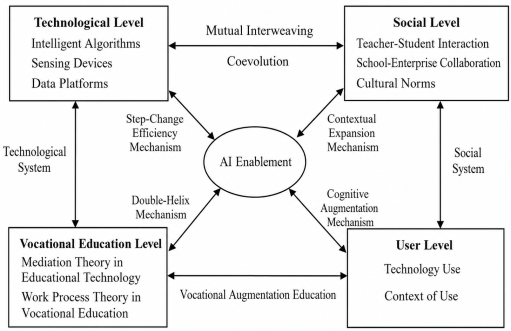
This study adopts sociotechnical systems theory as its overarching framework and proposes a Vocational Augmentation Education (VAE) model, as shown in
Figure 1. The model explains how artificial intelligence can systematically reconstruct the vocational education paradigm through three core mechanisms: cognitive augmentation, contextual expansion, and step-change efficiency gains. VAE treats the relationship between AI and vocational education as deeply symbiotic. Technology improves instructional processes and also reshapes occupational competency standards and training objectives. For example, it can establish human-AI collaboration as a new core criterion for evaluating vocational competence.
Figure 1. A Vocational Augmentation Education Model Based on Sociotechnical Systems Theory.
The model combines mediation theory from educational technology with work process theory from vocational education to construct a double-helix analytical framework. This framework shows how flows of industry data can drive iterative curricular renewal. It also incorporates algorithmic fairness and ethical constraints into institutional design. Together, these elements provide a theoretical foundation for innovative vocational education in an intelligent era.
2.1. Theoretical Foundation: The Evolution of Vocational Education from a Sociotechnical Systems Perspective
Sociotechnical systems theory views technological and social subsystems as interwoven components of an organic whole that coevolves through sustained interaction. In vocational education, artificial intelligence is embedded in instructional organization, industry demand, policy institutions, and social norms. The technological subsystem includes intelligent algorithms, sensing devices, and data platforms. The social subsystem includes teacher-student interaction, school-enterprise collaboration, and cultural norms.
Continuous mutual adaptation between these subsystems produces new patterns of interaction and a new systemic equilibrium. The introduction of an AI teaching assistant, for example, can alter the distribution of authority in the classroom and change the pathways through which knowledge is communicated. These changes encourage teachers to become learning designers and mentors. The sociotechnical perspective therefore offers a systemic framework for understanding the deep integration of AI and vocational education.
2.2. Core Mechanisms of the VAE Model: Three Forms of Augmentation in Vocational Education
2.2.1. Cognitive Augmentation
The cognitive augmentation mechanism draws on cognitive load theory and uses technological interventions to improve the allocation of learners' cognitive resources. Augmented and virtual reality technologies can decompose complex procedures into coherent visual steps
| [6] | Liu, Y., Zhan, Q., & Zhao, W. (2024). A systematic review of VR/AR applications in vocational education: Models, affects, and performances. Interactive Learning Environments, 32(10), 6375-6392. https://doi.org/10.1080/10494820.2023.2263043 |
[6]
. Neurofeedback devices, including brain-computer interfaces, can monitor learners' attention in real time and adjust the intensity and sequence of instructional stimuli.
Empirical studies indicate that this mechanism can substantially improve the conversion of knowledge into practical capability. At the Bayerische Motoren Werke (BMW) training center, for example, guidance delivered through HoloLens 2 during engine disassembly and assembly reduced trainees' operational error rates.
2.2.2. Contextual Expansion
The contextual expansion mechanism derives from situated learning theory. It extends and creates embodied learning environments through digital technology. Digital twins can generate high-fidelity replicas of production environments, while multimodal interaction can simulate high-risk, high-cost, or irreversible operations found in real workplaces. These tools overcome the spatial, temporal, safety, and resource constraints of conventional practical training.
This mechanism can increase access to training in essential skills from approximately 35 percent under traditional models to 89 percent. It gives all students an opportunity to develop near-authentic proficiency within a safe virtual environment.
2.2.3. Step-Change Efficiency Gains
This mechanism combines the technology acceptance model with skill acquisition curve theory and focuses on systemwide changes in effectiveness generated by human-AI collaboration. Adaptive learning systems deliver content based on each learner's progress and can shorten the time required to master a skill. Statistics from Guangdong's vocational education big-data platform indicate an average reduction of 35 percent. AI-enabled automated grading and learning analytics can operate at up to 20 times the speed of manual processes. These applications can release teachers from approximately 60 percent of routine work and allow them to devote more attention to instructional innovation and individualized guidance.
The mechanism also has clear boundary conditions. An excessive emphasis on efficiency can fragment skills and knowledge. At one vocational institution, heavy reliance on microlecture videos disrupted the structure of students' knowledge. This example shows why technological applications must serve systemic and integrated competency-development goals.
2.3. The Double-Helix Analytical Framework: Theoretical Integration and Dynamic Interaction
The VAE model combines mediation theory from educational technology with work process theory from vocational education to explain complex interactions between technological and social subsystems. The resulting double-helix framework identifies artificial intelligence as a central link that simultaneously improves teaching and learning and strengthens coordination between industry and education. It also places ethical constraints within this dynamic process.
2.3.1. Mediation Theory in Educational Technology: AI as a Dual Mediator of Cognition and Transfer
Mediation theory originates in Vygotsky's cultural-historical activity theory. Its central claim is that tools and signs mediate individual cognitive development and knowledge construction. In intelligent vocational education, AI performs two distinct mediating functions.
First, AI serves as a cognitive mediator in teaching and learning. Personalized pathway recommendations and adaptive content delivery create intelligent scaffolding that corresponds to each learner's cognitive structure and improves the transmission of knowledge and skills. Second, AI serves as a mediator between learning and application. Simulated workplace tasks and real-time competency diagnosis make tacit knowledge more explicit and facilitate the transfer of skills to actual work settings
| [7] | Zhang, Y., & Song, X. (2025). Technology empowerment and ecological reshaping: Reflections and practice on AI-enabled curriculum development in vocational education. Hunan Education (D Edition), (11), 30. |
[7]
. An intelligent welding training system, for example, can use visual sensing to capture and correct a trainee's posture in real time. This immediate and precise human-machine interaction bridges the gap between theoretical knowledge and muscle memory, allowing skills and cognition to develop together in a spiral process.
2.3.2. AI-Driven Innovation in Work Process Theory: From Task Analysis to the Reconstruction of Standards
Work process theory holds that vocational curricula should derive from the typical tasks performed within an occupational field. Artificial intelligence transforms the application of this theory in two major ways.
First, AI enables dynamic task analysis at the point of curriculum development. Natural language processing and knowledge graphs can automatically analyze large volumes of real-time enterprise work orders, technical standards, and fault reports. The system can then generate highly contextualized and current instructional projects. Tesla's electric-vehicle maintenance work orders, for example, could be converted directly into modular practical-training tasks for a new-energy vehicle program.
Second, AI compels institutions to reconstruct standards of occupational competence. Human-AI production environments require traditional skill frameworks to incorporate new forms of literacy, including human-machine collaboration, data interpretation and decision-making, and the operation and maintenance of AI tools. This change has already moved into practice. The German Chambers of Industry and Commerce (Industrie- und Handelskammern, IHK), for example, have formally incorporated competence in collaborating with digital systems into current certification standards for mechatronics and other occupations.
2.3.3. The Spiral Interaction Between Industry and Education and Its Ethical Constraints
The integration of industry and education generates a spiral interaction in which the two systems become deeply embedded in one another. Real-time industry data and technological requirements form the first helix. They continually update curricular content, practical-training environments, and evaluation standards. Graduates with new skills form the second helix. They return to industry and contribute to technological improvement and process innovation. Production-optimization data from Haier's smart factories, for example, create a feedback loop with curricular updates at partner institutions, while graduates further support the factories' digital transformation.
This upward spiral contains significant ethical constraints. Bias in algorithm design and unequal data can reproduce or intensify existing social inequalities. A career-interest recommendation system trained on historical gender data, for example, may reinforce occupational segregation by directing men toward engineering and women toward service-sector work. Proactive technological governance must therefore form part of the institutional foundation of the double-helix framework. Algorithmic audits, data ethics reviews, and inclusive design can align technological progress with educational equity.
3. Current Practices and Multidimensional Forms of AI-Enabled Vocational Education
AI-enabled vocational education involves a systemic transformation across instruction, curricula, practical training, faculty development, and educational management. Current practices reveal a clear shift from conventional approaches toward an intelligent vocational education paradigm.
3.1. Reconstructing the Instructional Paradigm: From Standardized Delivery to Personalized Adaptive Learning
Artificial intelligence is reshaping the core processes of instruction by supporting a learner-centered model of personalized and adaptive learning. This transformation proceeds along three principal pathways.
The first pathway combines intelligent diagnosis with individualized learning-path design based on multimodal data. AI can integrate eye-tracking data, operational logs, speech interactions, and physiological signals to create dynamic and precise digital learner profiles. Cognitive diagnostic models such as deep knowledge tracing can evaluate a learner's mastery of dozens or even hundreds of discrete micro-skills in real time and predict specific learning difficulties. A personalized recommendation engine based on reinforcement learning can then plan and continuously adjust the optimal learning sequence and progression of difficulty for each learner within Vygotsky's zone of proximal development. Empirical evidence indicates that this approach can significantly reduce the time required to reach a defined proficiency standard
| [1] | Deutscher, V., Thomann, H., Zlatkin-Troitschanskaia, O., Weyland, U., Abele, S., Danek, A. H., Greiff, S., Rausch, A., Seeber, S., Seifried, J., & Winther, E. (2026). Artificial intelligence in vocational education and training: A systematic review of educational purposes, theoretical conceptualizations, and empirical effectiveness. Computers and Education: Artificial Intelligence, 11, 100628.
https://doi.org/10.1016/j.caeai.2026.100628 |
| [8] | Muttaqin, M. F., Sukrawan, Y., & Rosyadi, M. I. (2024). Exploring the role of artificial intelligence in learning media for vocational education: A systematic literature review. Journal of Vocational Education Studies, 7(2), 181-190.
https://doi.org/10.12928/joves.v7i2.10364 |
| [9] | OECD. (2026). OECD Digital Education Outlook 2026: Exploring Effective Uses of Generative AI in Education. OECD Publishing. https://doi.org/10.1787/062a7394-en |
[1, 8, 9]
.
The second pathway is an AI-enabled dual-teacher classroom that supports a new hybrid instructional ecosystem. Artificial intelligence facilitates a three-part teaching community composed of human teachers, AI agents, and industry experts. Technologies such as fifth-generation (5G) mobile communications and holographic projection allow industry experts to participate remotely and immersively alongside local teachers and AI assistants. This ecosystem supports a clearer division of labor. AI can efficiently handle standardized tasks such as knowledge delivery, procedural demonstrations, and routine question answering. Human teachers can concentrate on higher-order interaction, including cultivating critical thinking, guiding the solution of complex problems, and providing emotional support. Human and machine capabilities can therefore complement one another
| [10] | Wu, D., & Feng, Q. (2025). Educational transformation in the age of artificial intelligence: Development trends and practical pathways. Journal of Central China Normal University (Humanities and Social Sciences), 64(6), 136-145. |
[10]
.
The third pathway combines immersive intelligent guidance with emotionally responsive interaction. Metaverse, extended-reality, and affective-computing technologies can create immersive and bidirectional cognitive environments. Haptic feedback, visual augmentation, and natural-language interaction converge in a multimodal setting, allowing learners to undertake high-fidelity skills training in conditions that closely resemble real work. The system can also identify emotional signals through facial expression and vocal tone, detect frustration or excessive cognitive load, and adapt the presentation of content or the difficulty of a task. These adjustments can improve skill acquisition while supporting learners' psychological well-being and maintaining a positive learning experience.
3.2. Evolving the Curriculum: From a Static Structure to Dynamic and Agile Response
Artificial intelligence enables vocational curricula to respond more rapidly to technological change in industry. The curriculum becomes a dynamic and agile system.
The first change involves the intelligent renewal and continuous adjustment of program structures. The central principle is to establish a dynamic correspondence among clusters of emerging technologies, groups of future occupations, and modular curriculum packages. Institutions can use technology-readiness models to modernize established programs systematically and incorporate new modules in areas such as artificial intelligence and the industrial internet. Natural language processing can also analyze official reports on industry workforce demand and large volumes of job postings in real time. These analyses can identify emerging skill requirements and trigger early-warning and updating mechanisms for programs and course content, allowing curriculum development to evolve alongside industry.
The second change involves modular curriculum development based on occupational competency graphs. Artificial intelligence can decompose a target occupation into fine-grained components and construct a detailed knowledge graph of occupational competencies. The graph divides comprehensive vocational competence into hundreds of measurable and combinable competency units. Curriculum development then becomes a process of intelligent assembly around these units. When combined with personalized skill wallets recorded through blockchain technology, an AI system can recommend and generate a customized curriculum pathway for each learner, making an individualized schedule possible.
The third change concerns new forms of instructional materials and self-evolving knowledge bases. Generative AI is transforming the linear organization of conventional textbooks. Intelligent systems can dynamically produce localized and contextualized teaching materials and practical-training projects based on a learner's professional background, the industrial characteristics of a region, and current cases from industry. Shared collaborative platforms also allow teachers and enterprise engineers to update curricular resources continuously. Resource-renewal cycles can shrink from months or years to days, producing a dynamic knowledge ecosystem that grows and improves over time.
3.3. Transforming Practical Training: From Physical Constraints to Integrated Virtual and Physical Environments
The combination of artificial intelligence and virtual simulation can overcome longstanding constraints related to cost, safety, time, and space in vocational practical training [6, 8].
First, high-fidelity virtual simulation training centers are becoming more widespread. Game engines, digital twins, and high-performance computing can create virtual environments with a one-to-one correspondence to physical equipment and highly realistic physical properties. Learners can practice high-risk, high-cost, or irreversible operations, including spacecraft assembly and emergency responses in chemical production. These environments provide nearly authentic operational experience and skills feedback with no physical risk and no consumption of materials, substantially improving the cost-effectiveness of training.
Second, embedded intelligent assistance systems can provide real-time, closed-loop feedback during hands-on practice. Intelligent sensing and guidance can be embedded in physical or simulated equipment to support learning through practice. Computer vision can monitor a learner's operational trajectory, force-feedback devices can help build correct muscle memory, and augmented reality can overlay fault information and maintenance instructions. The system functions as a continuously available expert that provides immediate guidance and correction, improving the precision and efficiency of skills training.
Third, cloud-based training and remote operation can expand access to real equipment. Through 5G and the industrial internet, geographically dispersed production equipment can connect to a cloud-based pool of shared training resources. Learners can reserve and remotely operate advanced precision equipment located elsewhere while gaining access to frontline production data and cases. Subject to legal compliance and privacy safeguards, deidentified training-process data can also improve AI models. This creates a reinforcing cycle in which practical training strengthens AI and AI improves practical training.
3.4. Innovating Faculty Development, Evaluation, and Management: Toward Routine Human-AI Collaboration
Educational transformation ultimately depends on how people adapt and develop. Artificial intelligence is changing both the role of teachers and the governance of education.
The first change concerns teachers' professional roles and development. AI teaching assistants can assume many routine tasks, shifting teachers' core contribution toward instructional design, emotional communication, and the cultivation of innovative thinking. A systematic framework for teachers' digital and AI literacy is essential to this transition. Such a framework should cover data interpretation, understanding of algorithmic logic, strategies for human-AI collaboration, and ethical judgment about technology
| [11] | Schmitt, C., & Brutzer, A. (2025). Generative artificial intelligence in vocational education and training: A framework for sustainable teacher competence development. Vocation, Technology & Education, advance online publication.
https://doi.org/10.54844/vte.2025.0940 |
| [12] | Sperling, K., Stenberg, C.-J., McGrath, C., Åkerfeldt, A., Heintz, F., & Stenliden, L. (2024). In search of artificial intelligence (AI) literacy in teacher education: A scoping review. Computers and Education Open, 6, 100169.
https://doi.org/10.1016/j.caeo.2024.100169 |
| [13] | Burneo-Arteaga, P., Lira, Y., Murzi, H., Balula, A., & Costa, A. P. (2025). Capability-based training framework for generative AI in higher education. Frontiers in Education, 10, 1594199. https://doi.org/10.3389/feduc.2025.1594199 |
[11-13]
. Digital twins based on large-scale data about teaching behavior, together with intelligent teaching-research assistants, can provide individualized professional diagnostics and resource recommendations that support lifelong faculty learning.
The second change concerns intelligent innovation in educational management and evaluation. In instructional management, the Internet of Things and big data can support comprehensive monitoring and early warning throughout the educational process, facilitating a shift from outcome-only assessment toward formative and developmental evaluation. Multimodal assessment can evaluate tacit capacities that conventional written examinations measure poorly, including teamwork, problem-solving, and consistency in hands-on performance. In campus governance, operations-research and optimization algorithms can improve scheduling, resource allocation, and safety management. These applications can make educational administration more evidence-based and precise while supporting a safe, efficient, and humane smart-campus environment.
4. Fundamental Challenges and Risks in AI-Enabled Vocational Education
Artificial intelligence is driving systemic change in vocational education while generating multilevel structural challenges and potential risks. These challenges extend beyond technical implementation. They reach into educational agency, institutional structures, and ethical values, making them central concerns in the intelligent transformation of vocational education.
4.1. Structural Tensions in Technology and Resources
The integration of artificial intelligence and vocational education exposes and can intensify existing digital divides and technological dependence. Three structural tensions are especially important.
The first is the polarizing effect of the digital divide. Regional inequalities in infrastructure, data resources, and digital capacity can produce a pronounced Matthew effect. At the level of hardware access, vocational institutions in eastern and western China differ by several multiples in access to AI-enabled devices and digitized practical-training equipment. Some institutions in developed regions have established fully connected 5G smart-factory training environments, while institutions in less-developed regions still face limited basic network coverage. At the level of data resources, differences in regional industrial concentration produce major disparities in access to real enterprise production data. These disparities directly affect the quality of AI model training and the fidelity of simulated training environments. At the level of human capacity, assessments of teachers' digital instructional competence reveal systematic differences between eastern and western regions. The result is a self-reinforcing cycle of inadequate hardware, scarce data, and limited capacity
| [14] | Qi, Z., & Zhan, M. (2025). The internal mechanisms and action pathways of AI-enabled vocational education under the techno-economic paradigm. Journal of Southwest University (Social Sciences Edition), 51(6), 211-222, 283. |
[14]
.
The second tension concerns technological autonomy and controllability. The intelligent transformation of vocational education faces serious chokepoint risks. High-end industrial robots, precision computer numerical control systems, and other core training equipment have low domestic sourcing rates, and key controllers depend on imports. The software ecosystem also relies heavily on foreign open-source deep-learning frameworks and platforms, while China's domestic foundational-software ecosystem remains comparatively weak. This dependence creates supply-chain security concerns and risks associated with cross-border data transfers. At the content level, virtual simulation projects that directly reuse foreign models and cases often fit poorly with Chinese industrial settings, process standards, and workplace cultures. The resulting content can become detached from local practice and offer limited preparation for solving problems in Chinese industry. More broadly, evidence from developing nations shows that perceptions of foreign origin can shape policy preferences through corruption beliefs
| [15] | Shi, D., & Rosas, G. (2024). "If Foreign, Then Cleaner": Individual corruption perceptions and support for free trade in developing nations. International Studies Quarterly, 68(3), sqae079. https://doi.org/10.1093/isq/sqae079 |
[15]
.
The third tension is the systemic absence of effective data governance. Data are the core input for intelligent education, and weak governance sharply limits their value. Fragmented standards prevent interoperability across platforms and impose high conversion and integration costs on institutions. Ownership is also unclear, especially for mixed datasets generated through school-enterprise collaboration. The absence of legal and institutional rules governing ownership, use rights, and the distribution of benefits reduces willingness to share and develop data. Data quality presents an additional problem. Unstructured practical-training data constitute a large share of vocational education data, yet they are costly to label and lack professional standards. Large volumes of data therefore remain dormant and cannot support model improvement or precise evaluation.
4.2. Systemic Difficulties for Educational Actors
Technological intervention disrupts established educational relationships and creates systemic challenges for teachers, students, and school-enterprise collaboration.
Teachers first face multidimensional capability gaps. Many remain in a state of reactive digital survival as they attempt to adapt to new technologies. At the level of tools, teachers may learn to operate interfaces without understanding the underlying algorithmic logic, which can lead to poorly grounded instructional adjustments. At the methodological level, digital tools may simply be layered onto conventional instruction, leaving the instructional model fundamentally unchanged. At the ethical level, many teachers lack AI ethics literacy and have limited capacity to identify or address algorithmic bias, discrimination, and long-term effects on students. This gap can become a blind spot in efforts to protect educational equity.
Students face a corresponding risk of diminished agency. Excessive or poorly designed technological intervention can erode core learning processes. At the cognitive level, dependence on augmented-reality guidance and intelligent prompts can weaken students' ability to analyze and solve complex, unfamiliar problems independently, encouraging cognitive passivity. At the emotional and social level, extensive human-machine interaction can displace sustained dialogue and collaboration among students and between teachers and students. This displacement can hinder the development of social-emotional competence, teamwork, and other essential vocational qualities, undermining the goal of educating the whole person.
School-enterprise collaboration also encounters deep institutional barriers during AI-enabled transformation. Three barriers are especially important: incentives, property rights and data security, and organizational culture. Capital-intensive smart training centers provided by enterprises may remain underused because teaching schedules and management arrangements do not align with business operations. Weak returns can reduce firms' willingness to sustain participation. Collaboration involving core production processes and data often lacks clear sharing agreements and protective mechanisms, creating risks of data leakage, interrupted partnerships, and legal disputes. Industry emphasizes efficiency, precision, and standardization, while education emphasizes gradual development, tolerance for error, and foundational learning. Different definitions of qualified skill can therefore perpetuate a gap between training and demand
| [16] | Shi, G., & Yu, X. (2025). AI-driven dual integration of industry-education and science-education to empower talent development at application-oriented universities. Journal of Nanjing Institute of Technology (Social Science Edition), 25(1), 1-8. |
[16]
.
4.3. Deeper Ethical and Social Risks
The deep integration of artificial intelligence raises ethical questions and social consequences that extend beyond the instrumental value of technology. These issues require critical philosophical and sociological analysis.
The first concern is a glass-house dilemma involving data privacy and algorithmic fairness. The practical and process-oriented character of vocational education makes data collection especially intrusive. Misuse of biometric information, including facial expressions and body posture, can violate students' dignity. Algorithmic decisions based on historical data, including intelligent class assignment and employment recommendations, can entrench and amplify existing social bias. Such decisions may create opaque forms of discrimination that are difficult to trace or correct, leaving students inside an environment that is transparent to the system yet fundamentally unfair.
The second concern is the philosophical risk of distorting education's core purpose. An unchecked expansion of instrumental rationality can narrow educational goals. When AI decomposes skilled work into measurable standardized steps and maximizes efficiency, education can become narrowly focused on task training. Critical thinking, creativity, craft ethics, and judgment in complex situations may receive less attention. Virtual interaction also cannot fully reproduce the transmission of tacit knowledge and emotional connection that emerges from physical copresence and shared context in traditional apprenticeship. A decline in communicative rationality may follow.
The third concern is a chain reaction across employment and the world of work. Artificial intelligence is changing skill requirements and reshaping labor-market structures. Job displacement requires educational programs to anticipate future demand, while institutional adjustment often proceeds slowly enough to contribute to structural unemployment. Skill inflation adds digital requirements to established occupations and heightens workers' anxiety about transition. Occupational responsibility is also being redefined. Workers may become accountable for both their operation of equipment and the consequences of algorithmic decisions. This change presents new challenges for occupational qualification standards, training content, and legal frameworks for responsibility.
5. Strategic Pathways and Optimization Measures for Deep AI Enablement in Vocational Education
Deep AI enablement in vocational education requires systemic strategic planning and a multilayered educational ecosystem. Fragmented technological experiments cannot adequately address the challenges identified above. Progress depends on national-level planning, institutional innovation at the regional and sectoral levels, capacity building within institutions, and ethical governance throughout the process. Together, these elements form an integrated strategy.
5.1. National Level: Strengthening Strategic Design and Systemic Planning
The central government should provide forward-looking planning and sustained investment to establish strategic direction, resource guarantees, and foundational support for integrating artificial intelligence with vocational education.
First, China should develop a clear national strategy and a phased roadmap. The roadmap can follow three stages aligned with technological maturity and educational development. The near-term stage, from 2026 to 2028, should focus on widespread infrastructure access and interoperability. Its central objective should be to close the hard digital divide in network and AI-enabled device coverage and establish a physical foundation for nationwide use. The medium-term stage, from 2029 to 2031, should digitize educational knowledge systems and integrate intelligent capabilities. Priorities should include national knowledge graphs and repositories of atomic skill units that cover major occupational fields, enabling dynamic and fine-grained governance of curricular content and competency standards. The long-term stage, from 2032 to 2035, should establish a mature and stable paradigm of human-AI collaborative education in which artificial intelligence is integrated throughout instruction and serves as a central means of improving educational quality.
Second, fiscal allocation should promote digital equity. Recent experimental evidence that rural descriptive representation can shape policy support further underscores the value of place-sensitive implementation
| [17] | Alexander, L. K., & Shi, D. (2026). The power of place: Rural descriptive representation and policy support. Journal of Experimental Political Science, 1-17.
https://doi.org/10.1017/XPS.2026.10029 |
[17]
. A differentiated investment mechanism based on a digital equity index can direct a higher subsidy share toward intelligent training equipment in less-developed regions and reduce regional hardware disparities. Regional shared-computing centers can lower the marginal cost of advanced AI models for individual institutions and address affordability constraints. Targeted capacity-building initiatives, such as an "Eastern Digital Resources for Western Training" program, can systematically strengthen teachers' digital instructional capabilities in less-developed areas and interrupt the intergenerational reproduction of the digital divide.
Third, China should accelerate the development of an open and shared national platform for digital educational resources. A coordinated three-tier system linking national, provincial, and institutional platforms should apply common standards for resource management and service delivery. The immediate priority is to develop and enforce core standards for vocational education data elements and interface protocols so that information can move across existing barriers. Blockchain and related technologies can support a trusted and traceable repository of high-quality curricular resources and encourage contributions across institutions and regions. A shared service platform that integrates general AI capabilities, including intelligent lesson preparation and learning diagnosis, can then provide low-code or modular technical support to local vocational institutions and lower barriers to adoption.
5.2. Regional and Sectoral Levels: Deepening Industry-Education Integration and Collaborative Innovation
Regional and industry actors must address the shallow character of many existing industry-education partnerships. Effective collaboration should be jointly driven by real industry demand and technological innovation.
The first priority is to establish substantive joint innovation organizations operated by vocational institutions and enterprises. Drawing on the model of German applied-science research institutes, major industrial regions could create industry-education innovation centers jointly led by leading firms and high-quality vocational institutions. These centers would follow a demand-led cycle of technological problem-solving and applied feedback. Enterprises would provide deidentified production data and current technological problems. Faculty and students would develop corresponding digital-twin teaching modules and technical solutions. Partners would share the resulting intellectual property according to agreed proportions, creating a sustainable model of mutual benefit.
The second priority is to develop sector-specific educational large models, or industry agents. A general large model can be enriched with industry knowledge, including national standards, process manuals, and representative cases, to create a dedicated AI system with deep sectoral and technical expertise. An intelligent welding-coach model, for example, could use visual sensing to identify operational defects precisely and guide corrective action. A nursing virtual-patient model could use a physiological engine to simulate complex and changing clinical situations for interactive history-taking and care training. These systems can convert cutting-edge knowledge and professional experience into educational resources more efficiently.
The third priority is to develop a collaborative training model based on triple-helix theory. Government, industry, and educational institutions should each provide distinct sources of support. Governments or industry organizations can periodically publish lists of unresolved industrial-technology problems and convert them into challenging instructional projects. Evaluation reforms can promote blockchain-based digital skills passports that allow employers to verify and recruit students who have attained defined competencies. Fiscal incentives can further reduce the cost of participation. Tax credits for industry-education integration, for example, can strengthen firms' internal incentives to invest in education and training.
5.3. Institutional Level: Building Capacity and Cultivating a New Educational Ecosystem
Implementation ultimately depends on substantial changes within institutions and among teachers and students. The central task is to rebuild the capacities of these actors and cultivate a new instructional ecosystem.
The first priority is to strengthen teachers' AI literacy systematically. Institutions should create a tiered and targeted development system. All teachers should complete baseline assessments and training in digital literacy before receiving certification for relevant instructional responsibilities. AI master-teacher studios can develop a cadre of faculty who are able to integrate disciplinary pedagogy with AI applications. Technology sabbaticals can place accomplished teachers in technology companies for intensive professional learning, helping them remain current with technological developments and translate new knowledge into teaching practice.
The second priority is to implement a human-centered approach to AI in education. Efficiency gains should be accompanied by active safeguards for human agency. Courses should include technology-analysis components that teach students to understand algorithms and evaluate their outputs critically. Evaluation systems should assess technological restraint and the independent capacity to solve problems, reducing dependence on intelligent assistance. Competitions, extracurricular activities, and campus culture can further develop critical thinking, creativity, communication, collaboration, and humanistic literacy. These higher-order capacities remain essential in an AI-rich workplace.
The third priority is to create demonstration projects that establish visible standards and diffuse successful practices. A three-level demonstration system covering institutions, programs, and classrooms can translate local successes into broader improvements. Institutions with strong foundations can receive support to build smart campuses in which AI permeates all major functions. Exemplary cases can guide the digital renewal of established programs. Institutions can also recognize and disseminate high-quality courses that deeply integrate emerging technologies. These observable, adaptable, and replicable models can accelerate the spread of effective practice.
5.4. Governance Level: Establishing Ethical Norms and Safety Safeguards
Healthy technological development requires a strong governance framework. Vocational education needs forward-looking ethical rules and risk-prevention systems designed for educational settings
| [2] | OECD. (2026). Developing Vocational Education and Training with Artificial Intelligence. OECD Reviews of Vocational Education and Training. OECD Publishing.
https://doi.org/10.1787/e9f76b4e-en |
| [5] | Bond, M., Khosravi, H., De Laat, M., Bergdahl, N., Negrea, V., Oxley, E., Pham, P., Chong, S. W., & Siemens, G. (2024). A meta systematic review of artificial intelligence in higher education: A call for increased ethics, collaboration, and rigour. International Journal of Educational Technology in Higher Education, 21, Article 4.
https://doi.org/10.1186/s41239-023-00436-z |
| [9] | OECD. (2026). OECD Digital Education Outlook 2026: Exploring Effective Uses of Generative AI in Education. OECD Publishing. https://doi.org/10.1787/062a7394-en |
[2, 5, 9]
.
First, policymakers should establish an operational framework for ethical governance of AI in education. A Negative List and Standards Guide for the Use of Artificial Intelligence in Education should define prohibited practices and receive regular updates. The rules should strictly limit the collection and use of students' sensitive personal information and specify retention periods for biometric data. High-risk algorithms used for class assignment, assessment, and related decisions should meet clear requirements for transparency and explainability. The framework should also define responsibility in advance when errors or accidents occur during AI-assisted instruction.
Second, policymakers can establish inclusive and prudent regulatory sandboxes. Designated regions or institutions can host controlled zones for experimentation that encourage innovation while containing risk. Entry should depend on a combined technological and ethical risk assessment. Approved applications could undergo limited testing in authentic yet controlled educational settings and receive temporary exemptions from specific rules that do not fit the experimental context. Each sandbox should have a defined observation period, clear exit procedures, and immediate stopping rules when an application crosses an ethical boundary. This structure can support innovation while maintaining effective risk control.
Third, governance should build broad social consensus and sustained collaboration. Public educational materials and structured dialogue can improve understanding of AI in education and promote realistic expectations. Ethics review committees should include educators, technical experts, legal professionals, parents, and student representatives and should conduct hearings and evaluations for major applications. China should also participate in international discussions on ethical rules and standards for educational AI, protect its interests through cross-national coordination, and contribute lessons from Chinese practice.
In sum, AI-enabled vocational education follows a three-part logic of transformation. First, it drives the coevolution of technology and education. AI becomes a structural force in the educational ecosystem by augmenting cognition, aggregating resources, and redesigning processes. These changes can yield substantial gains, including a reported 22 percent increase in the rate at which graduates obtain employment related to their field of study. They also require safeguards against an unchecked expansion of instrumental rationality. Second, the transformation exposes multidimensional difficulties in integration. Surface-level applications such as smart campuses often remain disconnected from deeper changes in dynamic curricular renewal and teachers' capacity for innovation. Institutional inertia and the digital divide jointly sustain this gap. Third, successful transformation requires a clear value anchor. Technology must serve the educational mission. Ethical design and cultural adaptation can preserve the core purposes of education while institutions pursue greater efficiency, making sustainable human-AI symbiosis possible.
Abbreviations
5G | Fifth-Generation Mobile Communications Technology |
AI | Artificial Intelligence |
BMW | Bayerische Motoren Werke |
IHK | Industrie- und Handelskammern (German Chambers of Industry and Commerce) |
VAE | Vocational Augmentation Education |
VE | Vocational Education |
Author Contributions
Guizhou Shi: Conceptualization, Funding acquisition, Investigation, Methodology, Visualization, Writing – original draft, Writing – review & editing
Xia Yu: Conceptualization, Funding acquisition, Investigation, Methodology, Visualization, Writing – original draft, Writing – review & editing
Funding
This article presents findings from the following projects: Career Planning for Applied Talent and Training Pathways for Top Innovative Talent from the Perspective of Industry-Education Integration (Project No. 2025XGZD02); the Nanjing Institute of Technology Distinguished Online Educator "Sailing the Sea of Learning" Studio (Project No. WLSZ202401); 2026 Special Project on AI Empowering a New Ecosystem in Higher Education (Project No. 2026XST148): Research on Innovative 'AI Industry-Education Integration' Talent Training Models for High-Quality Development of the Sports Industry; Research on Deepening Industry-Education Integrated Collaborative Talent Cultivation Mechanisms and Innovating Representative Models: A Practical Exploration Based on Provincial-Level First-Class Majors and First-Class Courses (Project No.: TC2025-002); and An Industry-Education Integrated Training Model for Sport Management Professionals: Practical Exploration Based on Nanjing Sport Institute's Provincial First-Class Major in Industry-Education Integration (Project No. 2025CJ-03).
Conflicts of Interest
The authors declare no conflicts of interest.
References
| [1] |
Deutscher, V., Thomann, H., Zlatkin-Troitschanskaia, O., Weyland, U., Abele, S., Danek, A. H., Greiff, S., Rausch, A., Seeber, S., Seifried, J., & Winther, E. (2026). Artificial intelligence in vocational education and training: A systematic review of educational purposes, theoretical conceptualizations, and empirical effectiveness. Computers and Education: Artificial Intelligence, 11, 100628.
https://doi.org/10.1016/j.caeai.2026.100628
|
| [2] |
OECD. (2026). Developing Vocational Education and Training with Artificial Intelligence. OECD Reviews of Vocational Education and Training. OECD Publishing.
https://doi.org/10.1787/e9f76b4e-en
|
| [3] |
Nakar, S., Park, E., Misselke, L., & Khan, S. I. (2026). Leveraging AI in vocational education: A systematic review of theory, barriers and opportunities. Marketing Intelligence & Planning, advance online publication, 1-26.
https://doi.org/10.1108/MIP-03-2025-0244
|
| [4] |
Prasetya, F., Fortuna, A., Samala, A. D., Latifa, D. K., Andriani, W., Gusti, U. A., Raihan, M., Criollo-C, S., Kaya, D., & Cabanillas García, J. L. (2025). Harnessing artificial intelligence to revolutionize vocational education: Emerging trends, challenges, and contributions to SDGs 2030. Social Sciences & Humanities Open, 11, 101401.
https://doi.org/10.1016/j.ssaho.2025.101401
|
| [5] |
Bond, M., Khosravi, H., De Laat, M., Bergdahl, N., Negrea, V., Oxley, E., Pham, P., Chong, S. W., & Siemens, G. (2024). A meta systematic review of artificial intelligence in higher education: A call for increased ethics, collaboration, and rigour. International Journal of Educational Technology in Higher Education, 21, Article 4.
https://doi.org/10.1186/s41239-023-00436-z
|
| [6] |
Liu, Y., Zhan, Q., & Zhao, W. (2024). A systematic review of VR/AR applications in vocational education: Models, affects, and performances. Interactive Learning Environments, 32(10), 6375-6392.
https://doi.org/10.1080/10494820.2023.2263043
|
| [7] |
Zhang, Y., & Song, X. (2025). Technology empowerment and ecological reshaping: Reflections and practice on AI-enabled curriculum development in vocational education. Hunan Education (D Edition), (11), 30.
|
| [8] |
Muttaqin, M. F., Sukrawan, Y., & Rosyadi, M. I. (2024). Exploring the role of artificial intelligence in learning media for vocational education: A systematic literature review. Journal of Vocational Education Studies, 7(2), 181-190.
https://doi.org/10.12928/joves.v7i2.10364
|
| [9] |
OECD. (2026). OECD Digital Education Outlook 2026: Exploring Effective Uses of Generative AI in Education. OECD Publishing.
https://doi.org/10.1787/062a7394-en
|
| [10] |
Wu, D., & Feng, Q. (2025). Educational transformation in the age of artificial intelligence: Development trends and practical pathways. Journal of Central China Normal University (Humanities and Social Sciences), 64(6), 136-145.
|
| [11] |
Schmitt, C., & Brutzer, A. (2025). Generative artificial intelligence in vocational education and training: A framework for sustainable teacher competence development. Vocation, Technology & Education, advance online publication.
https://doi.org/10.54844/vte.2025.0940
|
| [12] |
Sperling, K., Stenberg, C.-J., McGrath, C., Åkerfeldt, A., Heintz, F., & Stenliden, L. (2024). In search of artificial intelligence (AI) literacy in teacher education: A scoping review. Computers and Education Open, 6, 100169.
https://doi.org/10.1016/j.caeo.2024.100169
|
| [13] |
Burneo-Arteaga, P., Lira, Y., Murzi, H., Balula, A., & Costa, A. P. (2025). Capability-based training framework for generative AI in higher education. Frontiers in Education, 10, 1594199.
https://doi.org/10.3389/feduc.2025.1594199
|
| [14] |
Qi, Z., & Zhan, M. (2025). The internal mechanisms and action pathways of AI-enabled vocational education under the techno-economic paradigm. Journal of Southwest University (Social Sciences Edition), 51(6), 211-222, 283.
|
| [15] |
Shi, D., & Rosas, G. (2024). "If Foreign, Then Cleaner": Individual corruption perceptions and support for free trade in developing nations. International Studies Quarterly, 68(3), sqae079.
https://doi.org/10.1093/isq/sqae079
|
| [16] |
Shi, G., & Yu, X. (2025). AI-driven dual integration of industry-education and science-education to empower talent development at application-oriented universities. Journal of Nanjing Institute of Technology (Social Science Edition), 25(1), 1-8.
|
| [17] |
Alexander, L. K., & Shi, D. (2026). The power of place: Rural descriptive representation and policy support. Journal of Experimental Political Science, 1-17.
https://doi.org/10.1017/XPS.2026.10029
|
Cite This Article
-
APA Style
Shi, G., Yu, X. (2026). Empowering and Reshaping Vocational Education:
A Theoretical Framework and Pathways for AI-Driven Transformation. Higher Education Research, 11(5), 131-141. https://doi.org/10.11648/j.her.20261105.11
 Copy
|
Copy
|
 Download
ACS Style
Shi, G.; Yu, X. Empowering and Reshaping Vocational Education:
A Theoretical Framework and Pathways for AI-Driven Transformation. High. Educ. Res. 2026, 11(5), 131-141. doi: 10.11648/j.her.20261105.11
Copy
|
Download
AMA Style
Shi G, Yu X. Empowering and Reshaping Vocational Education:
A Theoretical Framework and Pathways for AI-Driven Transformation. High Educ Res. 2026;11(5):131-141. doi: 10.11648/j.her.20261105.11
Copy
|
Download
-
@article{10.11648/j.her.20261105.11,
  author = {Guizhou Shi and Xia Yu},
  title = {Empowering and Reshaping Vocational Education:
A Theoretical Framework and Pathways for AI-Driven Transformation},
  journal = {Higher Education Research},
  volume = {11},
  number = {5},
  pages = {131-141},
  doi = {10.11648/j.her.20261105.11},
  url = {https://doi.org/10.11648/j.her.20261105.11},
  eprint = {https://article.sciencepublishinggroup.com/pdf/10.11648.j.her.20261105.11},
  abstract = {Against the backdrop that Artificial Intelligence (AI) is rapidly reshaping the ecosystem of Vocational Education (VE), the fast iteration of industrial skill demands has exposed deep-rooted bottlenecks in traditional VE models: outdated curricula, disjointed practical training, and structural mismatch between talent cultivation outputs and market needs. While governments across China and globally have rolled out intensive policy initiatives to advance VE digital transformation, existing studies mostly focus on scattered cases of ad-hoc technology application, lacking systematic analytical frameworks, with notable research gaps in inquiries into ethical risks and long-term collaborative governance mechanisms. This study aims to clarify the core operational logic of AI-empowered VE transformation, identify risk boundaries during the transition, develop actionable systematic solutions, and address the longstanding talent supply-demand mismatch. Adopting sociotechnical systems theory as its meta-framework, the study integrates mediation theory from educational technology and work process theory in vocational education to construct the Vocational Augmentation Education (VAE) model and the "technology-education-industry" double-helix analytical framework. Drawing on cross-sector empirical cases, it unpacks the internal mechanisms and practical barriers of VE transformation. The study finds that AI can systematically enhance VE efficacy through three core mechanisms—cognitive augmentation, contextual expansion, and step-change efficiency improvement—yet the transformation faces deep-seated risks including the polarizing effect of the digital divide. Accordingly, it proposes targeted transformation pathways across four dimensions: top-level policy design, deep industry-education collaboration, stakeholder capacity building, and embedded ethical governance, to provide theoretical references and evidence-based decision support for building a new human-AI collaborative VE paradigm.},
 year = {2026}
}
Copy
|
Download
-
TY  - JOUR
T1  - Empowering and Reshaping Vocational Education:
A Theoretical Framework and Pathways for AI-Driven Transformation
AU  - Guizhou Shi
AU  - Xia Yu
Y1  - 2026/09/04
PY  - 2026
N1  - https://doi.org/10.11648/j.her.20261105.11
DO  - 10.11648/j.her.20261105.11
T2  - Higher Education Research
JF  - Higher Education Research
JO  - Higher Education Research
SP  - 131
EP  - 141
PB  - Science Publishing Group
SN  - 2578-935X
UR  - https://doi.org/10.11648/j.her.20261105.11
AB  - Against the backdrop that Artificial Intelligence (AI) is rapidly reshaping the ecosystem of Vocational Education (VE), the fast iteration of industrial skill demands has exposed deep-rooted bottlenecks in traditional VE models: outdated curricula, disjointed practical training, and structural mismatch between talent cultivation outputs and market needs. While governments across China and globally have rolled out intensive policy initiatives to advance VE digital transformation, existing studies mostly focus on scattered cases of ad-hoc technology application, lacking systematic analytical frameworks, with notable research gaps in inquiries into ethical risks and long-term collaborative governance mechanisms. This study aims to clarify the core operational logic of AI-empowered VE transformation, identify risk boundaries during the transition, develop actionable systematic solutions, and address the longstanding talent supply-demand mismatch. Adopting sociotechnical systems theory as its meta-framework, the study integrates mediation theory from educational technology and work process theory in vocational education to construct the Vocational Augmentation Education (VAE) model and the "technology-education-industry" double-helix analytical framework. Drawing on cross-sector empirical cases, it unpacks the internal mechanisms and practical barriers of VE transformation. The study finds that AI can systematically enhance VE efficacy through three core mechanisms—cognitive augmentation, contextual expansion, and step-change efficiency improvement—yet the transformation faces deep-seated risks including the polarizing effect of the digital divide. Accordingly, it proposes targeted transformation pathways across four dimensions: top-level policy design, deep industry-education collaboration, stakeholder capacity building, and embedded ethical governance, to provide theoretical references and evidence-based decision support for building a new human-AI collaborative VE paradigm.
VL  - 11
IS  - 5
ER  -
Copy
|
Download






 Share This Article
 Twitter
 Linked In
 Facebook