3. Literature Review
3.1. Environmental Scanning as an Emerging Youth Competency
Recent research has highlighted the need for future-oriented consciousness among youngsters, especially considering climate change, digitalization, political crises and labor market transformations
| [2] | Abina, A., Kovačič, D., Prucnal, M., Kiratzouli, V., & Zidanšek, A. (2025). Building sustainable career skills in youth through adaptive learning and competency self-assessment tools. Sustainability, 17(2), 412.
https://doi.org/10.3390/su17020412:contentReference[oaicite:0]{index=0} |
| [9] | Jenkins, J., Schwab, B., & Green, A. (2020). Youth foresight in civic participation: Emerging trends and participatory approaches. OECD Education Working Papers, No. 224. OECD Publishing. |
[2, 9]
. These forces require not just reactive responses, but preemptive pattern identification, system thinking and contextual framing – all of which are core components of environmental scanning.
Moreover, environmental scanning aligns with global education priorities that emphasize “future literacies” and social foresight
. Within youth development, it supports critical transitions: from education to employment, from identity confusion to coherence, and from passive consumption of information to active engagement with complex realities. It empowers youth to become actors, not merely observers, in shaping their environments.
This paper positions environmental scanning not as a managerial tool, but as a teachable and assessable competency that enhances youth resilience, innovation, and decision-making. Reframing it in this way allows for integration into life skills education, digital learning models, and ethical leadership programs, especially within contexts like the ZAT framework, where youth development is both spiritually grounded and future-facing.
3.2. Definitions and Modes of Environmental Scanning
Environmental scanning can be broadly defined as the ability to observe, interpret, and respond to patterns, trends, and signals emerging in one’s internal and external environment. While traditionally applied in strategic planning and organizational development
| [4] | Choo, C. W. (2001). Environmental scanning as information seeking and organizational learning. Information Research, 7(1), 7–22. |
[4]
, the concept has evolved into a transferable cognitive skill, especially critical for youth who must navigate fast-changing socio-political, economic, and digital landscapes
| [2] | Abina, A., Kovačič, D., Prucnal, M., Kiratzouli, V., & Zidanšek, A. (2025). Building sustainable career skills in youth through adaptive learning and competency self-assessment tools. Sustainability, 17(2), 412.
https://doi.org/10.3390/su17020412:contentReference[oaicite:0]{index=0} |
[2]
.
At the core of this competency is the capacity for anticipatory learning—understanding that environments are dynamic, and that one’s current decisions must be informed by both present realities and likely future trajectories. For youth, environmental scanning supports not only academic and career decisions, but also broader identity formation, ethical judgment, and socio-political engagement. It enables a shift from passive adaptation to proactive positioning.
One of the most cited models of scanning, originally developed by Aguilar and refined by Choo
| [4] | Choo, C. W. (2001). Environmental scanning as information seeking and organizational learning. Information Research, 7(1), 7–22. |
[4]
, identifies four primary modes of scanning that are now frequently adapted for learning purposes:
1) Undirected Viewing: Passive exposure to information with no specific objective. For youth, this might involve browsing news or social media with a general interest in understanding the world.
2) Conditioned Viewing: Focused observation based on prior interests or perceived relevance (e.g., tracking updates on climate activism or emerging career fields).
3) Informal Search: Active but unstructured efforts to gather information, often through peer networks or online sources.
4) Formal Search: Systematic, goal-directed investigation using reliable data, research tools, and strategic questioning.
These modes are not mutually exclusive and often occur fluidly in real-life youth experiences. For example, a young person concerned about mental health might start by viewing content on social media (undirected), then begin following specific pages or campaigns (conditioned), ask questions in peer groups (informal), and eventually consult research articles or experts (formal).
In the ZAT context, environmental scanning is reinterpreted as a structured meta-competence: a deliberate habit of sense-making applied to personal growth, vocational exploration, and civic awareness. Unlike general curiosity or critical thinking alone, it is a practice of reading one’s environment for meaning, direction, and actionability.
By training youth to move fluidly between scanning modes and to ground their observations in values, ethical frameworks, and long-term purpose, environmental scanning becomes a developmental gateway toward reflective leadership and responsible decision-making.
3.3. Applications in Youth Development, Education & Policy
As global uncertainty increases, education systems and youth-focused institutions have begun to recognize environmental scanning not as a specialized managerial task but as a vital learning competency. It enables young people to understand trends, anticipate risks, and engage proactively with social, economic, and environmental shifts. Recent applications illustrate how environmental scanning has moved from institutional strategy to youth development, community education, and participatory policymaking.
One example is found in the
Columbia Basin College Environmental Scan | [10] | Knutzen, J. (2000). Focus on the future: Environmental scanning at Columbia Basin College. Columbia Basin College. |
[10]
, where students were not only subjects of community demographic analysis but also contributors to identifying workforce development gaps and local economic signals. The college involved diverse stakeholders—including youth representatives—in scanning efforts to ensure alignment between educational programming and regional needs. This marked an early recognition that young people are both affected by and capable of shaping their environments when equipped with proper tools for awareness and action.
Similarly, the Richland Community College FY2003 Environmental Scan incorporated youth and educational data to refine academic offerings and social support services, emphasizing the importance of interpreting population trends, infrastructure limitations, and student feedback as a basis for institutional planning. In both cases, scanning was not merely top-down but informed by students’ lived realities, especially around career aspirations, access to resources, and community inclusion.
In public health, Melstad’s
| [14] | Melstad, S. (2018). Using technology to deliver public health messaging: An environmental scan of coordinated chronic disease prevention in South Dakota. South Dakota Department of Health. |
[14]
environmental scan in South Dakota integrated tribal, community, school, and healthcare perspectives to identify communication gaps in chronic disease prevention. Though the study focused on health systems, it highlights an important shift: youth are often at the intersection of multiple sectors—health, education, digital media—and environmental scanning offers a framework for navigating overlapping pressures and fragmented services.
Jenkins et al.
| [9] | Jenkins, J., Schwab, B., & Green, A. (2020). Youth foresight in civic participation: Emerging trends and participatory approaches. OECD Education Working Papers, No. 224. OECD Publishing. |
[9]
extend this relevance to participatory policy frameworks, advocating for youth-centered foresight and scanning as part of civic education. Their findings suggest that young people trained to monitor political, technological, and climate-related trends are more likely to contribute meaningfully to public discourse, community resilience, and democratic renewal. Environmental scanning in this context becomes a civic practice—teaching youth not only how to see the future but how to shape it through critical awareness and informed participation.
Within these varied settings—education, health, and civic life—environmental scanning emerges as a cross-cutting capability that strengthens youth readiness. It reinforces the value of slow observation in a fast-moving world, builds data interpretation skills, and empowers ethical decision-making by linking present actions with emerging realities. For marginalized and underrepresented youth, especially, scanning offers a pathway to reclaim agency in systems that often exclude their voices.
These applications underscore the need to formalize environmental scanning in youth development curricula—not as an abstract tool but as a habit of mind that equips young people to lead with insight, resilience, and purpose in uncertain times.
3.4. Psychological and Educational Foundations
Environmental scanning considered as a competence aimed at youth is based on a variety of theories in psychology and education that see this capacity as a capability that springs from cognitive flexibility, reflexive awareness, and intentional interaction with evolving contexts. Its development is based on basic principles derived from the social learning, motivation, and metacognition literatures and is consequently teachable and transferable
| [1] | Adelmohiman, M., & Salem, A. H. (2025). ZAT: A Psychospiritual -Developmental Diagnosis Framework for Youth Empowerment: Integrating Brain, Heart, Spirit, and Coaching Dimensions for Holistic Growth, International Journal of Contemporary Education, Vol. 8, No. 2. https://doi.org/10.11114/ijce.v8i2.7649 |
[1]
.
In terms of psychology, Bandura’s Social Cognitive Theory
places young people as agentic learners, able to manage their behaviour by problematising the future and modifying their behaviour to match it. That forward-looking self-regulation is at the heart of environmental scanning, prompting young people to not just observe and catalog their environment, but also to project it into the future as a set of outcomes from which some observant individuals, at least, can forecast the future. Close to the latter concept this lies loOßFKLDWLRQ±the growth mindset
| [7] | Dweck, C. S. (2006). Mindset: The new psychology of success. New York: Random House. |
[7]
which generates the belief that abilities „ including the ability to analyze and respond to changing circumstances „can be cultivated and produced by active adaptation and analysis.
From an educational perspective, experiential learning theory of John Dewey is a classic. Dewey
| [6] | Dewey, J. (1938/1997). Experience and education. New York: Simon & Schuster. |
[6]
stated that learning involved the relationship between the learner and the environment, hence observation, questioning, and reflecting were necessary. Environmental scanning is fitted into this loop as a continuously running cycle: picking up signals, interpreting these by the individual through social lenses, and reorienting goals or action.
This cycle of learning is enhanced through metacognitive consciousness, which Flavell
describes as the capacity to manage and control one’s own cognitive functions. Young people who are able to monitor their targeting, question their convictions and assess the reliability of information are more likely to apply scanning practices. Commensurate with Paul and Elder’s
| [17] | Paul, R., & Elder, L. (2014). The miniature guide to critical thinking concepts and tools (7th ed.). Foundation for Critical Thinking. |
[17]
model of critical thinking for that matter – however – – are metacognitive skills that underlie purposeful, self-regulated judgment
—a necessary aspect for interpreting environmental cues and issuing ethical decisions.
In other words, the importance of open, context sensitive attention in dealing with complexity is further supported by Ellen Langer’s work on mindful learning
| [12] | Langer, E. J. (2000). Mindful learning. Da Capo Press. |
[12]
. She contrast mindless absorption with mindful engagement — an especially pertinent dichotomy in this era of surfeit of information, when young people need to be taught not only how to read and consume data, but how to filter and synthesize meaning from it.
From a motivational perspective, intrinsic motivation is considered critical for long-term learning and behavioral engagement according to Self-Determination Theory
. If young people relate personally to environmental scanning because it is relevant to their identities, goals or social responsibilities, they are more likely to carry environmental scanning with them throughout life. Indirecting the scan (e.g., for compliance) tends to weaken its cognitive and ethical quality.
Literature in educational reform also corroborates the benefit of systems thinking in competency-based learning. According to Senge
| [20] | Senge, P. M. (2006). The fifth discipline: The art and practice of the learning organization (Rev. ed.). Doubleday. |
[20]
, systems thinking, or the capacity to see feedback loops, interdependencies and long term consequences, is critical for helping students to prepare for complexity. Environmental scanning offers youth a concrete entry point to systems thinking: an opportunity to zoom out from individual incidents and make sense at the level of systems and over time.
This is further supported by a number of global competency frameworks. “Anticipatory learning” is described by UNESCO
as one of the critical sustainability competences. The report stresses that youth must be capable of “discerning trends and fantasizing about multiple futures in order to make informed choices.” Likewise, future literacy, resilience, and student agency are among the key pillars of the OECD Future of Education and Skills 2030 project
—all of which are directly connected to the skills being developed through scanning practices.
Practice-based cases, including the GAIA energy education effort
| [13] | Maurer, M., Koulouris, P., & Bogner, F. X. (2020). Green awareness in action—How energy conservation action fosters environmental knowledge, values, and behavior in adolescents’ school life. Sustainability, 12(3), 955.
https://doi.org/10.3390/su12030955 |
[13]
and the South Dakota public health scan
| [14] | Melstad, S. (2018). Using technology to deliver public health messaging: An environmental scan of coordinated chronic disease prevention in South Dakota. South Dakota Department of Health. |
[14]
, further suggest that ecological scanning, when integrated into school or community programs, can increase both individual empowerment and collective problem-solving. Such apps continue the practice of scanning as reflective, but also as a communal competence connected to leadership and social engagement.
On the whole, these psychological and educational assumptions about the cognitive processes that are going on when scanning the environment for relevant cues place scanning as a higher-order developmental skill. It is not something that is born but it is available to specialist—it's a skill that develops through deliberate design, reflection, practice, and value-oriented action. When taught in such supportive, feedback-rich contexts youth tend to see more clearly, think more critically and feel more responsible in times of change.
3.5. Models and Frameworks
The usefulness of environmental scanning as a capability is also supported through an emergence of structural models that have been transferred across domains including education, public policy, sustainability, and systems. These frameworks explain both cogni- tive and behavioral avenues to teaching, practicing, and assessing scanning—particularly for teaching youth to be prepared for complexity and long-term decision making.
One of the most influential is Choo’s
| [4] | Choo, C. W. (2001). Environmental scanning as information seeking and organizational learning. Information Research, 7(1), 7–22. |
[4]
categorisation of scanning modes as four episodic forms of scanning: unguided viewing, conditioned viewing, informal search, formal search. They enable varying levels of intentionality— from passive intake of information to intentional pursuit of research. Educational: for educating youth, this modell enables the organisation of the experiences of scanning and allows for it that young people search in their environment in a different way, in relation to the developmental phase, purpose and digital literacy of the learner. These are so called weak search activities that are very typical for adolescents searching for potential career paths or dealing with (peer-related) social problems: These search activities actually happen through their peers or the world wide web and not comprehensively analyzed data.
In the field of public health, Rowel et al.
| [19] | Rowel, R., Moore, N. D., Nowrojee, S., Memiah, P., & Bronner, Y. (2005). The utility of the environmental scan for public health practice: Lessons from an urban program to increase cancer screening. Journal of the National Medical Association, 97(4), 527–534. |
[19]
designed a participatory environmental scanning model in order to facilitate community involvement in health promotion planning. Their model values inclusivity, gathering local data, and the co-production of knowledge—three values that are obtaining more and more importance in youth development programming. When youth are engaged in mapping social or environmental challenges and recognizing community priorities, environmental scanning is transformed into a technique of inquiry and a form of civic empowerment.
A comparable participatory approach is used in the GAIA project
| [13] | Maurer, M., Koulouris, P., & Bogner, F. X. (2020). Green awareness in action—How energy conservation action fosters environmental knowledge, values, and behavior in adolescents’ school life. Sustainability, 12(3), 955.
https://doi.org/10.3390/su12030955 |
[13]
which incorporated environmental scanning in school-based sustainability education. The intervention integrated live sensor data feeding into classrooms with guided reflection to help students make sense of their energy use patterns and identify preliminary behavioral interventions. This model defined scanning as a four part process: detection, comprehension, diagnosis and action. It also provided evidence on the value of youth-friendly interfaces, digital dashboards and problem-based learning to promote scan literacy.
According to systems thinking, the OECD Learning Compass 2030 model, incorporates ‘anticipation’ and ‘future literacy’ within its transversal competences. Conceptual overlap is evident, even if it wasn’t given the name “environmental scanning.” The OECD model prompts students to recognize the systemic underpinnings of change, to imagine alternative futures and to adapt actions
. This change in thinking— from episodic scanning to systems scanning— is key for enacting scanning as a disposition, rather than an isolated event.
In a more limited application, Melstad’s
| [14] | Melstad, S. (2018). Using technology to deliver public health messaging: An environmental scan of coordinated chronic disease prevention in South Dakota. South Dakota Department of Health. |
[14]
environmental scan in South Dakota included youth and adult perceptions and practices to explore the use of technology in chronic disease messaging. The screening matrix was organized across five domains (tribal, school, healthcare, worksite, and community), and semistructured interviews were used to identify digital communication barriers. This policy-oriented approach illustrated opportunities for an environmental scanning framework to unearth areas of inequity, access, and readiness that have an impact on youth.
New educational models are moving toward the scaffolding of environmental scanning throughout competency levels, from observing and being aware, through reflective practice and pattern recognition, to insight-based action. This scaffolding corresponds to Bloom’s taxonomy, Kolb’s experiential cycle, and more recent action-oriented rubrics in global education
. When accompanied by resources like concept mapping, journaling and AI-enabled feedback, scanning is quantifiable and iterative.
In conclusion, and despite differences in terms and domains, the structural logic across these frameworks assumes that environmental scanning is a structure of perception, interpretation, and agency. In order to be developed in young people, it requires them to have a sequence of stages to guide their thinking, a set of tools to enable their thinking, and a set of purposes that are ethical. Whether to sustainability, health, or educational design, these models confirm scanning is not a theoretical construct, it is a systematic and teachable learning process with real consequences.
3.6. Literature Gaps and Future Directions
Although the role of environmental scanning continues to be more widely accepted by policy, education, and community planning, there is still relatively little research that conceptually and empirically articulates this as a formed major developmental youth competence. Existing literature tends to conceptualize scanning as either an institutional-level activity (e.g., in strategic planning or risk assessment) or an implicit aspect of higher-order cognitive or civic skills, such as critical thinking or participatory engagement
| [9] | Jenkins, J., Schwab, B., & Green, A. (2020). Youth foresight in civic participation: Emerging trends and participatory approaches. OECD Education Working Papers, No. 224. OECD Publishing. |
| [19] | Rowel, R., Moore, N. D., Nowrojee, S., Memiah, P., & Bronner, Y. (2005). The utility of the environmental scan for public health practice: Lessons from an urban program to increase cancer screening. Journal of the National Medical Association, 97(4), 527–534. |
[9, 19]
. Very few models render environmental scanning in the form of explicit learning objective that can be scaffolded, taught, or assessed at different age and various cultural contexts.
Furthermore, although the theoretical underpinnings of environmental scanning (i.e., systems thinking, anticipatory learning, and metacognition) are well established in educational theory, their practical features within the context of youth-oriented programs are dispersed. Some efforts such as GAIA
| [13] | Maurer, M., Koulouris, P., & Bogner, F. X. (2020). Green awareness in action—How energy conservation action fosters environmental knowledge, values, and behavior in adolescents’ school life. Sustainability, 12(3), 955.
https://doi.org/10.3390/su12030955 |
[13]
and OECD’s Future Literacy work, present promising instruments for such a task, but remain pilot and policy advisory-oriented; i.e, without long-term evaluations or the corresponding tracking of competencies. Future research should also explore scanning skills development over time and its relationship to youth decision-making, flexibility, and long-term civic behavior.
Furthermore, there exists an evident vacuum in culturally sensitive scanning models for learners in the Global South, particularly faith-integrated education systems. International frameworks—like those of the OECD and UNESCO—are global scaffolding, but they do not offer instruments of local appropriation that draw on the experiences, beliefs and socioeconomic conditions of marginalized youth. This makes it difficult to apply such models to Islamic, African, and post-conflict schooling contexts, where scanning has to navigate both visible and invisible threats, from climate vulnerability to political instability, and moral disorientation.
Also, there are no digital, AI-facilitated tools to develop Scanning as an adaptive learning habit. While project-based learning has incorporated digital dashboards, sensor data feeds or open data sets, such efforts have typically not been connected to behavioral assessments, reflection tools or competency diagnostics. Scanning cannot stay a hopeful ideal and even a practical personal growth path if it’s not integrated into AI systems -- such as what is being woven into the ZAT framework.
To close these gaps, future works should follow on several directions:
1) Operationalisation: Create specific ‘scan progression’ criteria per age, context and level of competency, pertaining to behavioural benchmarks and developmental rubrics.
2) Empirical Testing: Perform longitudinal studies to evaluate the effect of scanning practice on youth outcomes such as resilience, ethical forethought, and civic preparedness.
3) Continued Adaptation: Develop contextually relevant scanning training for learners in Muslim-majority societies, fragile states, and low-resource settings.
4) AI Integration: Utilize digital resources and AI to diagnose scanning while users are scanning, deliver adaptive learning advice, and personalize development plans.
5) Synthesis across Domains: Have students practice inquiry to other competencies (e.g., critical thinking, digital literacy, reflexive learning, entrepreneurship) to build holistic models of growth.
In summary, and despite its increasing conceptual relevance in the education and youth development literature, the field of environmental scanning is under-structured in pedagogy, assessment, and scalability. Addressing these needs provides an opportunity to elevate what has been a hidden 21st century skill set among youth to a developmental core competency—one that is both anticipatory and value-based, and that targets lifestyle domains more broadly.
4. Theoretical Framework
4.1. Purpose of the Theoretical Framework
The theoretical framework provides the foundation for understanding environmental scanning as a developmental competency within the ZAT Framework. Unlike traditional views that treat it as a strategic or organizational process, this research redefines it as a youth-centered cognitive, behavioral, and moral capacity grounded in learning and purposeful engagement.
The framework serves two main purposes: it integrates key theories to explain how environmental scanning develops in youth, and it supports the design of developmental indicators and assessments aligned with broader goals like youth agency and future-readiness.
4.2. Core Constructs Informing the Model
Theoretical foundations The framing of environmental scanning as a youth skill is grounded in three interrelated theories: cognitive constructivism, anticipatory self-regulation, and socio-ethical orientation. Taken together, these constructs offer multi-level insight into how youth may attend to, interpret, and respond to environmental cues in purposeful, value-driven ways.
4.2.1. Cognitive Constructivism: Learning as Pattern Recognition and Contextualization
Based on the ideas of Dewey
| [6] | Dewey, J. (1938/1997). Experience and education. New York: Simon & Schuster. |
[6]
, Piaget
| [18] | Piaget, J. (1970). Science of education and the psychology of the child. Viking Press. |
[18]
, and Kolb
| [11] | Kolb, D. A. (1984). Experiential learning: Experience as the source of learning and development. Prentice Hall. |
[11]
, cognitive constructivism believes learners to construct knowledge through direct experience with their environment. Environmental scanning fits this perspective well, by putting the learner in a role of inquirer looking for trends, outliers, and emerging features. Youth develop the ability to make sense of complex information, translate disconnected data points into concrete understanding by experiencing learning cycles of perception, reflection, conceptualization, and experimentation. It is this process of interpretation that is key to the development of situational awareness, an essential feature of scanning.
4.2.2. Anticipatory Self-regulation: Foresight, Mindfulness, and Growth
Drawing on Bandura’s
theory of human agency, anticipatory self-regulation refers to the capacity of individuals to project future outcomes and adjust behavior accordingly. In the context of environmental scanning, youth are not only reacting to present conditions but proactively anticipating shifts and preparing responses. Complementary insights from Langer
| [12] | Langer, E. J. (2000). Mindful learning. Da Capo Press. |
[12]
on mindfulness reinforce the importance of open, attentive engagement with changing environments, while Dweck’s
| [7] | Dweck, C. S. (2006). Mindset: The new psychology of success. New York: Random House. |
[7]
growth mindset framework supports the idea that adaptive foresight can be strengthened through feedback and intentional practice. Environmental scanning, in this sense, is a future-oriented competence grounded in the cognitive-emotional readiness to respond to uncertainty.
4.2.3. Socio-ethical Orientation: Purpose-driven, Community-aware Scanning
Environmental scanning is not purely cognitive; it is also an ethical act. Self-Determination Theory
and reflective learning models
| [15] | Moon, J. A. (1999). Reflection in learning and professional development: Theory and practice. Routledge. |
[15]
emphasize the importance of aligning knowledge and behavior with internalized values and social purpose. Youth who are trained to scan ethically learn to identify not just opportunities for self-advancement but areas of social risk, exclusion, or injustice. This orientation is particularly significant within the ZAT framework, where competencies are cultivated not only for individual success but for community cohesion, moral clarity, and contribution to the common good.
Environmental scanning is a holistic practice: understanding change, preparing for the future, and acting ethically with awareness and intention.
4.3. Conceptual Framework Diagram
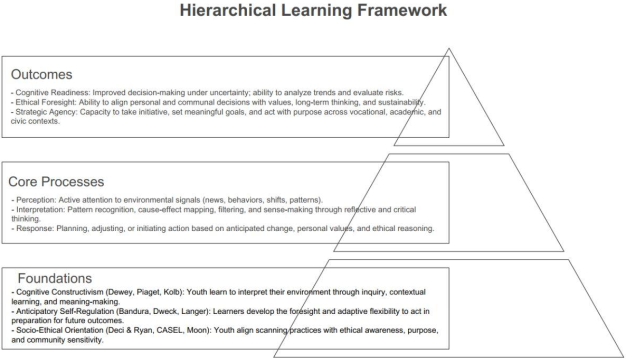
This three-tiered framework presents environmental scanning as a developmental behavior in youth, moving from internal dispositions to observable actions. It consists of three levels:
1) Foundations: Built on cognitive constructivism, anticipatory self-regulation, and socio-ethical orientation—forming the internal mindset for scanning.
2) Processes: Involves perception, interpretation, and response—key skills developed through reflection and practice.
3) Outcomes: Leads to cognitive readiness, ethical foresight, and strategic agency—enabling youth to act effectively in social, vocational, and civic contexts.
The model aligns vertically with theory-to-practice progression and laterally with skills like critical thinking and accountability. It emphasizes that environmental scanning is an intentional, value-driven process that equips young people to navigate complex environments confidently.
Figure 1. Hierarchical Learning Framework.
4.4. Application to Research
This study proposes a theoretical model of environmental scanning that informs both the research design and analysis of its role in youth development. Rooted in cognitive constructivism, anticipatory self-regulation, and socio-ethical orientations, the model views learners as active, reflective, and ethically aware agents of change. It offers a structured way to connect theoretical concepts to observable developmental outcomes and supports the use of scanning behaviors—reading, interpreting, and responding—as key indicators of competency.
These behaviors align with the study’s learning objectives and can guide future assessment design, especially when integrated with AI-enhanced feedback on the ZAT platform. For example, interpretation might be evaluated through scenario-based tasks, while response could involve reflective journals or simulations. The framework also emphasizes links between environmental scanning and youth outcomes such as cognitive readiness, ethical foresight, and strategic agency—goals aligned with the ZAT Brain Dimension to foster resilience and leadership in complex or uncertain contexts.
Operationally, this orientation conditions what the research highlights as:
1) Creating rubrics of competence development related to the three scan processes.
2) Articulation of motivators and barriers compatible with anticipatory learning and sensitization for ethical commitment.
3) Investigating the role of cultural context in shaping expression of scanning behaviors, especially in Global South or faith-based contexts.
The developmental history emphasis in the framework, also echoed in Bandura
, Dweck
| [7] | Dweck, C. S. (2006). Mindset: The new psychology of success. New York: Random House. |
[7]
, and Kolb
| [11] | Kolb, D. A. (1984). Experiential learning: Experience as the source of learning and development. Prentice Hall. |
[11]
, supports the use of longitudinal designs, and adaptive assessment designs. That way, scanning becomes not just a skill learned once, but a constant habit of learning, reflecting, and acting on one’s values.
In conclusion, the theory base presented here serves both the hypotheses and framework of the study as well as guarantees that environmental scanning can be meaningfully used, tested, and scaled with a variety of youth populations. It is consistent with the larger vision of ZAT to raise youth that are not only prepared for the future but able to create the future with wisdom, boldness and moral clarity.





 Share This Article
 Twitter
 Linked In
 Facebook
 Copy
Copy Download