Review Article | | Peer-Reviewed

Angola in the Context of Bantu Civilization

Received: 16 January 2026     Accepted: 27 January 2026     Published: 4 March 2026
Views:       Downloads:
Abstract

This literature review essay explores Angola's insertion into the cultural plurality of Bantu civilization, analysing how migratory dynamics, language, and complex socio-political structures shaped the identity of the present-day nation. The central objective is to understand Angola not as an isolated entity, but as one of the fundamental pillars of Bantu expansion in Southern Africa, highlighting the cultural continuities and kinship systems that, resisting colonial ruptures, still define the daily life and social praxis of this territory. In terms of methodology, this work is based on a qualitative bibliographic review of a descriptive nature with a reflective focus. Works by historians, anthropologists, and linguists were consulted, cross-referencing data from oral tradition with contemporary written records. The approach prioritizes language that oscillates between scientific rigor and the proximity of a reflective essay, avoiding certain ambiguities and technical dualities to allow for an organic reading. It is concluded that Angolan identity is a living expression of Bantu heritage, manifested both in community organization and spirituality. The study reinforces that looking to the territory's pre-colonial past is not a step backward, but a necessary step to lay the foundations for the future of an Angola that recognizes itself in its own history and its deep connection with the African continent.

Published in Humanities and Social Sciences (Volume 14, Issue 2)
DOI 10.11648/j.hss.20261402.11
Page(s) 74-78
Creative Commons

This is an Open Access article, distributed under the terms of the Creative Commons Attribution 4.0 International License (http://creativecommons.org/licenses/by/4.0/), which permits unrestricted use, distribution and reproduction in any medium or format, provided the original work is properly cited.

Copyright

Copyright © The Author(s), 2026. Published by Science Publishing Group

Keywords

Angola, Bantu Civilization, Migrations

1. Introduction
Discussing the formation of Angola implies understanding how colonial penetration and occupation occurred, as well as the ethnolinguistic diversity of the peoples who, throughout the 15th century, constituted this country. However, considering the objective set out in this essay, it was decided not to discuss the colonial occupation of the territory itself. Thus, according to Santos, etymologically the term/toponym "Angola" derives from the word "Ngola ," a name attributed to a dynasty of the Ambundu people, established in the central Kwanza region . The independence of this territory was achieved on November 11, 1975, maintaining all the territorial borders drawn by the then Portuguese colonial government. From then on, the geography of this country was configured at the following coordinates: between the parallels 4° 22' and 18° 02' and the meridians 4° 05' and 11° 41' east of Greenwich, in the Southern Hemisphere, in the western part of Southern Africa, and occupies an area of 1,246,700 km² .
However, within its contemporary sociocultural plurality, the territory has consolidated itself as a fundamental actor in the southern region of the continent, standing out both for its political stability and active diplomacy, as well as for the economic recovery resulting from the oil sector and other economic policies carried out by the government that seek to diversify the local economy with investments in sectors such as agriculture, fishing, livestock, etc., which rekindles the economic foundations of this people's ancestral power.
2. Prehistory and the Subsequent Settlement of the Territory
Prehistory, also known as the era of the early Angolan community, is the period of humanity that begins with the Stone Age around 600,000 BC and ends with the discovery of metals in the presumed year of 1500 BC.
Charles refers to the existence of three ecological zones that favoured the development stages of the first communities to inhabit the territory, which produced all the lithic material that characterized this period: the Congo Zone, the Zambezi Zone and the Southwest Zone. In each of these three zones, lithic cultures developed, revealing the presence in Angola of a Stone Age with its intermediate phases: the First Intermediate Period, which marks the transition between the Old Stone Age and the Middle Stone Age; from the Middle Stone Age to the most recent period, we find the Second Intermediate Period, followed by the Late Stone Age; and traces of the Iron Age were also identified, associated with some areas that constitute the habitat of the communities that produced lithic tools and the north/south coastal strip .
From the human vestige described above, within the same logic, Kajibanga, argues that the settlement of Angolan territory is based on the existence of three sociocultural spaces, all of them with transnational characteristics, and the first two to inhabit the territory that today corresponds to Angola, namely: Khoisan or Hottentot - Bushman: Kede, Nkung, Bushmen and Kazama; Vátwa or Pre-Bantu: Cuissis and Cuepes; Bantu .
2.1. Pre-Bantu: Way of Life, Habits and Customs
As mentioned above, the pre-Bantu peoples include all those who occupied Angolan territory before the arrival of the Bantu peoples.
Non-Bantu or pre-Bantu peoples are understood to be those who, within their linguistic structure, do not use UNTU/MUNTU to designate people, according to studies developed by Wilhelm Bleek.
In African philosophical roots, the term NTU designates the essential part of everything that exists and everything that is given to us to know of existence. The Muntu is the person, constituted by the body, mind, culture and, above all, by the word. This cultural unity, which rests on a single principle, is called unity in diversity.
In general, these end up presenting, in the most varied cases, a way of life (habits and customs) different from the Bantu, as can be seen in the writings of . The Khoi - sans, located in the southeast and southwest regions of Angola, are nomadic peoples; they survived by hunting and gathering as a means of subsistence, their weapons being small bows and poisoned arrows. From a political point of view, they were not organized into kingdoms or states but lived in tribes (in the form of a primitive community) guided by a group chief chosen from among them.
According to Redinha, the Vátwa groups, also known as Curocas, formed by two important subgroups: the Ovakwandu (Kwisi) and the Ovakwépe, currently found in Angola, in the provinces of Namibe and Benguela (Dombe Grande and Baía-Farta), presented somatic characteristics and ways of life identical to those of the Khoisan. Currently, they are confused with the Vakuvale, due to the adaptation of the language and culture of these peoples. Therefore, one of the aspects of great importance is that the two groups did not form kingdoms or states, one of the elements considered crucial for the conquest of their territories and civilization by the Bantu .
Despite the particularities presented by the Pre-Bantu peoples that differentiate them from the Bantu, the texts presented above offer a classic and necessary perspective, but one that should be read with caution. The transition from Pre-Bantu to Bantu hegemony in Angola should not be seen only from a linear perspective, but as a complex process of replacing models of existence. However, classifying their nomadism, lack of mastery of metallurgy, and currently their distance from large cities as a primitive community —a common approach in some contemporary studies—ultimately amounts to academic reductionism.
2.2. The Migration (Invasion) of Bantu Peoples into Angolan Territory
According to the writings of Silva, around the year 1000 AD (Anno Domini), with the arrival of the Bantu peoples, an industrial complex of the Early Iron Age entered Southern Africa, characterized by the introduction of new elements: metallurgy, ceramics and agriculture, which caused a rupture with the old societies. From that moment on, Neolithic communities fought for possession of the land, giving rise to the gradual and progressive composition of ethnic formations, the structuring of communities and the formation of kingdoms .
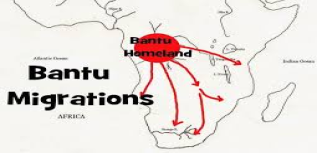
Thus, the migration of these first farmers within Angola followed three directions: northward, down the rivers and the coast, crossing the Lower Congo; eastward and northeastward, along the Zambezi River and the Katanga Plateau; and finally, southward, from the northern Kalahari Mountains to the southwestern lands of Angola. This movement occurred over many centuries, giving rise to the different ethnic groups that are distributed throughout the territory. Each ethnolinguistic group is characterized by a set of values, where similarities are recognized between the different groups, detectable in the sociopolitical structure and in the identification of languages with the same origin.
2.2.1. To the Establishment of Borders via Linguistic Matrix
In Bantu societies, language transcends communication, becoming a consolidated element of ethnic identification and assertion of power over territory, aligned with the idea, Redinha describes that, “people of Bantu origin speak the following languages: Umbundu, Mbundu or Tyambundu, Kikongo, Tshokwe and Lunda, Ongangela, Vaambo or Xicuanyama, Vanyaneka and Lumkumbi, Tjiherero and Oshindonga”. These groups are subdivided into several related subgroups, loosely differentiated by linguistic variations, which in some cases are associated with the name of the geographical space they occupy within the group's territorial area. Furthermore, the elements of linguistic and spatial combination are decisive in the division and classification of the various ethnic subgroups that form the three sociocultural spaces that today constitute Angolan society .
This process resulted in the emergence of the following ethnolinguistic groups within the current population of Angola: the Bakongo, the Ambundu, the Lunda- Cokwe, the Ovimbundu, the Ganguela, the Nhaneka -Humbe, the Ovambo, the Herero, the Okavambo, and the Xindonga.
Based on the ideas above, it can be inferred that the classification of ethnolinguistic groups in Angola as: Ovimbundu, Ambundu or Lunda- Cokwe, is not merely a natural inheritance, but a construction based on the relationship between language and land. This reality indicates that Bantu supremacy was not imposed solely by force or mastery of metallurgy, but by the capacity to emancipate their culture. Thus, by naming spaces in their own language and with their own words, it becomes clear that the Bantu erased the nomadic presence of the Pre-Bantu, who did not link their identity to fixed borders, as Altuna writes, “Bantu and Black African culture springs forth, expands and remains through the word (…) the word is the greatest instrument of thought, emotion and action”. Now, it is worth noting that this supremacy mentioned here resulted in a social standardization that, today, by unifying the large Bantu groups, has ended up marginalizing and archiving the existence of the Pre-Bantu.
2.2.2. Bantu Migration Routes
Figure 1. Bantu migration routes in the Southern region of Africa: Specific case of Angola: Source: UNILAB - Practical Manual (2017) .
The historical process of the migratory emancipation of the Bantu in African territory is still interpreted through various hypotheses, but it is suggested that their starting point was in the northern and eastern region of the Niger Valley and the Great Lakes; accounts linked to tradition indicate that this group originated from regions connected to Cameroon. The same idea is found in the writings of Silva, this author argues that the Bantu, coming from the Cameroon region, progressed slowly through Central, Eastern and Southern Africa .
Upon reaching Angolan territory, as illustrated in the figure above, the migration process occurred in three main zones of influence, with migrants entering the territory from the north, east, and south of the country between the years 1300 and 1600; these included, in particular, the territories that today comprise Cabinda, Zaire, Luanda, Malanje, Lunda, Bailundo, and Huambo .
2.3. Bantu Supremacy and the Subsequent Civilizing Process in Angola
The history of humanity is the history of civilizations. It is impossible to think of the development of humanity in other terms. The narrative extends through generations of civilizations, from the ancient Sumerian and Egyptian civilizations, through the classical Mesoamerican civilizations, to the Western and Islamic civilizations. Throughout history, civilizations have provided the broadest identifications for peoples. As a result, the causes, the emergence, the growth, the interactions and the achievements .
In this sense, the idea of civilization was developed by 18th-century French thinkers, in opposition to the concept of barbarism. Civilized society differed from primitive society by being established, urban, and, in some cases, already literate. In this context, considering the perspective of the settlement and formation of Bantu states/kingdoms in Angola, the idea or principle presented supports the civilizing power of the Bantu over the autochthonous (pre-Bantu) peoples in the territory that today corresponds to Angola.
From the perspective of Martins, the Bantu kingdoms emerged through the establishment, within a given group of villages, of a centralized power exercised by a lineage chief, thanks to the economic power and prestige he had acquired, gathering around him the community that respected him . The states that were formed constitute evidence of the political organization of the communities.
In the case of the Bantu kingdoms or states, Pelissier he argues that the first to be formed was the Kingdom of Kongo, probably founded in the 13th century by peoples belonging to the Bakongo ethnic group. This kingdom was in the central-western region of Africa . It was a vast territory that stretched from the Atlantic Ocean to the Zaire or Congo River in the east, and from the Oguwé River, in present-day Gabon, in the north, to the right bank of the Kwanza River in the south. Currently, this area corresponds to northwestern and northern Angola, including the Cabinda enclave, the Republic of Congo, the western part of the Democratic Republic of Congo, and the south-central region of Gabon. Moreover, the other states that emerged already had a structured political-administrative organization, with a political system that was often semi-centralized or centralized in the figure of their sovereigns.
In this logic, Pelissier highlights that, as migrations occurred, each of these peoples organized themselves until they formed important kingdoms, such as: The Kingdom of Ndongo, located south of the Kingdom of Kongo, was composed of the Mbundu or Akwakimbundu people, speakers of the Kimbundu language, and the king held the title of Ngola .
According to Ponte:
Initially, the name and title Ngola applied only to the potentates and regions along the upper reaches of the Lucala and Cuanza rivers. However, over time, the use of the term came to be applied to other regions and neighboring chiefs. Ndongo. Therefore, the kingdom of Ndongo came to be called by the Portuguese "lands of Ngola"; later, "lands of Angola" .
Ovimbundu kingdoms also stand out. They occupied the current regions of the Central-South, that is, the Central Plateau, and the adjacent areas in the western part of the Central Plateau (currently the provinces of Benguela, Bié and Huambo) and spoke the Umbundu language.
In the writings of Malumbu we read that:
The formation of these kingdoms likely occurred around the 16th century. This large group, the largest ethnolinguistic group in Angola, like the others, is composed of several subgroups and were considered state formations, among which the Mbalundu, Wambo, Vye, Ndalu, Sambo, Kakonda, and others stand out .
From these three groups or kingdoms, others emerged, such as Matamba, Cassanje, Lunda, Kwanyama or Ovambo, etc., which, each in its own way, ensured the dominance and supremacy of the Bantu civilization in Angola.
2.3.1. Bantu Social Structure
The way Bantu societies are structured inherently carries a principle of homogeneity. The presence of the father as the central figure of the family and the Olo-soma or Soba as the entity holding the community's mystical power is common in all Angolan social groups and strata. The organization of society is based on kinship systems and affiliation groups based on real or mystical consanguinity, which requires the transmission of inheritance and preferably links them to one of the biological genealogies that every person receives or transmits: paternal and/or maternal. This system of descent or kinship is unilateral, with two systems existing: patrilineal and matrilineal. Even so, the matrilineal system ends up being the determining factor, which causes serious problems in inheritance situations, since it excludes children and recognizes nephews and nieces.
2.3.2. The Power of Bantu Leadership in Community Life
Altuna, it argues that there is a very relevant cultural aspect to the situation, relating to Bantu chiefs. This hierarchy is based on ancestral law and a simultaneously religious and secular conception and participates in the sacredness that permeates this society. Among the Bantu, the head of the family makes the direct connection with the ancestors, present in community life, whose influence, beneficial or harmful, must be cared for. Due to their proximity to them, superior quality, power and knowledge, they can obtain favours or make them propitious. They resolve conflicts and are responsible for family well-being. Their authority extends to the social, political, judicial and religious fields .
Today, Angola, being a Republic and despite the strong influence of colonization and the process of acculturation, still registers Bantu supremacy in this territory through language, certain endogenous habits that characterize the people, and without losing sight of the fact that a large part of the population inhabiting the territory is Bantu. However, it is thus characterized by a multi-ethnic society, whose formation results from the union of various African kingdoms and peoples, the "Pre-Bantu" and "Bantu" peoples.
3. Final Considerations
Understanding Bantu roots allows us to decipher kinship systems, philosophies of life, and forms of political organization that have withstood time and colonization. Ultimately, it is an exercise in intellectual sovereignty and self-knowledge.
Thus, in light of the analyses presented, it can be inferred that the settlement of the current Angolan territory is linked to three socio-cultural spaces, all with transnational characteristics (Khoi - sans, Vatwas and Bantu), and that, as a result of the opening of the Mediterranean and the Age of Discovery (15th century), peoples from other parts of the world arrived and eventually settled in this land.
Although the Bantu were not the rightful owners of this territory, thanks to their superior technical skills, linked to their mastery of metallurgy, they ended up spreading in a process that history has recorded as the Bantu migrations, and supplanted the true owners of the territory (the non-Bantu) in a civilizing process, forming states, implementing their cultures, habits and customs that endure to this day, from Cabinda to Cunene, from Lobito to Luau.
Abbreviations

BC

Before Christ

AD

Anno Domini

Author Contributions
Eduardo Ernesto Vicente is the sole author. The author read and approved the final manuscript.
Conflicts of Interest
The author declares that this research was conducted in the absence of any commercial, financial, or personal relationships that could be interpreted as a potential conflicts of interest.
References
[1] ALTUNA, RRA (2006). Traditional Bantu Culture. Missionary Institute of Sociology, Daughter of St. Paul – Angola, Publisher Paulinas – Legal Deposit No. 245 279/06.
[2] ALTUNAGA, JZ and FERNANDES, MC (2008). Angola, geographical atlas. 1st edition, Malaysia.
[3] CHARLES, E. (1980). Angolan Archaeology. Lisbon, Edições 70.
[4] DIOP. CA. (1990). The Cultural Unity of Black Africa. 5th Ed. Chicago: Third World Press.
[5] HUNTINGTON, SP (1997). The clash of civilizations and the reshaping of world order. Côntes, Objetiva. Journal of Regional History, [S. l.], v. 5, n. 1, 2007. Available at:
[6] KAJIBANGA, V. (2003). Racial and Ethnic Groups, Races, Society and Ethnic Communities of Angola. Moscow, Lean Publishers.
[7] MALUMBU, M. (2006). The Ovimbundu of Angola: Tradition, Economy and Organizational Culture. Italy, Ed. Vívere.
[8] MARTINS, JV (2010). Beliefs, divination and traditional medicine of the Tuchokwe of northeastern Angola.
[9] PELISSIER, R. (1986). History of Angolan campaigns. Resistances and revolts 1845-1941. Vol. II, Lisbon, Ed. Estampa.
[10] PONTE, H. (2016). Where does the name Angola come from? An introduction to the study of Angolan history.
[11] REDINHA, J. (1974). Ethnic Distribution of Angola. Luanda, CITA.
[12] SANTOS, E. (1969). Religions of Angola. Lisbon, Overseas Research Board.
[13] SILVA, R. C (1997). Angola and its potential. History.
[14] UNILAB (2017). Bantu Expansion: Origin, Cultures and Traditions. Practical Manual. Available at:
[15] VIII State Meeting of History (2016). The Formation of Angola and African Resistances. Feira de Santana. Available at:
[16] WHEELER, D. & PELISSIER, R. (2011). History of Angola. Lisbon, Ink China. Legal Deposit No. 322664/11.
Cite This Article
  • APA Style

    Vicente, E. E. (2026). Angola in the Context of Bantu Civilization. Humanities and Social Sciences, 14(2), 74-78. https://doi.org/10.11648/j.hss.20261402.11

    Copy | Download

    ACS Style

    Vicente, E. E. Angola in the Context of Bantu Civilization. Humanit. Soc. Sci. 2026, 14(2), 74-78. doi: 10.11648/j.hss.20261402.11

    Copy | Download

    AMA Style

    Vicente EE. Angola in the Context of Bantu Civilization. Humanit Soc Sci. 2026;14(2):74-78. doi: 10.11648/j.hss.20261402.11

    Copy | Download

  • @article{10.11648/j.hss.20261402.11,
      author = {Eduardo Ernesto Vicente},
      title = {Angola in the Context of Bantu Civilization},
      journal = {Humanities and Social Sciences},
      volume = {14},
      number = {2},
      pages = {74-78},
      doi = {10.11648/j.hss.20261402.11},
      url = {https://doi.org/10.11648/j.hss.20261402.11},
      eprint = {https://article.sciencepublishinggroup.com/pdf/10.11648.j.hss.20261402.11},
      abstract = {This literature review essay explores Angola's insertion into the cultural plurality of Bantu civilization, analysing how migratory dynamics, language, and complex socio-political structures shaped the identity of the present-day nation. The central objective is to understand Angola not as an isolated entity, but as one of the fundamental pillars of Bantu expansion in Southern Africa, highlighting the cultural continuities and kinship systems that, resisting colonial ruptures, still define the daily life and social praxis of this territory. In terms of methodology, this work is based on a qualitative bibliographic review of a descriptive nature with a reflective focus. Works by historians, anthropologists, and linguists were consulted, cross-referencing data from oral tradition with contemporary written records. The approach prioritizes language that oscillates between scientific rigor and the proximity of a reflective essay, avoiding certain ambiguities and technical dualities to allow for an organic reading. It is concluded that Angolan identity is a living expression of Bantu heritage, manifested both in community organization and spirituality. The study reinforces that looking to the territory's pre-colonial past is not a step backward, but a necessary step to lay the foundations for the future of an Angola that recognizes itself in its own history and its deep connection with the African continent.},
     year = {2026}
    }
    

    Copy | Download

  • TY  - JOUR
    T1  - Angola in the Context of Bantu Civilization
    AU  - Eduardo Ernesto Vicente
    Y1  - 2026/03/04
    PY  - 2026
    N1  - https://doi.org/10.11648/j.hss.20261402.11
    DO  - 10.11648/j.hss.20261402.11
    T2  - Humanities and Social Sciences
    JF  - Humanities and Social Sciences
    JO  - Humanities and Social Sciences
    SP  - 74
    EP  - 78
    PB  - Science Publishing Group
    SN  - 2330-8184
    UR  - https://doi.org/10.11648/j.hss.20261402.11
    AB  - This literature review essay explores Angola's insertion into the cultural plurality of Bantu civilization, analysing how migratory dynamics, language, and complex socio-political structures shaped the identity of the present-day nation. The central objective is to understand Angola not as an isolated entity, but as one of the fundamental pillars of Bantu expansion in Southern Africa, highlighting the cultural continuities and kinship systems that, resisting colonial ruptures, still define the daily life and social praxis of this territory. In terms of methodology, this work is based on a qualitative bibliographic review of a descriptive nature with a reflective focus. Works by historians, anthropologists, and linguists were consulted, cross-referencing data from oral tradition with contemporary written records. The approach prioritizes language that oscillates between scientific rigor and the proximity of a reflective essay, avoiding certain ambiguities and technical dualities to allow for an organic reading. It is concluded that Angolan identity is a living expression of Bantu heritage, manifested both in community organization and spirituality. The study reinforces that looking to the territory's pre-colonial past is not a step backward, but a necessary step to lay the foundations for the future of an Angola that recognizes itself in its own history and its deep connection with the African continent.
    VL  - 14
    IS  - 2
    ER  - 

    Copy | Download

Author Information