
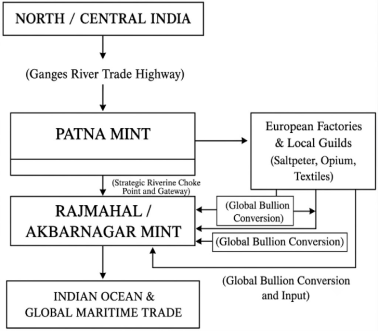
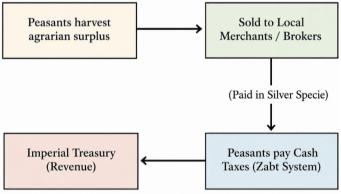
This study examines the operation of provincial mints (dar al-darb) in Suba Bihar during the classic period of the Mughal Empire, spanning from the administrative reorganizations of Akbar in 1580 to the death of Aurangzeb in 1707. Traditionally, Mughal numismatic history has focused on the central mints of Delhi, Agra, and Lahore as the primary drivers of imperial monetization. By analyzing the administrative, fiscal, and economic functions of the mints at Patna and Rajmahal, this paper argues that provincial mints were not merely mechanical replicas of the center, but active instruments of state formation and economic integration. The establishment of a unified, high-purity tri-metallic currency system the silver rupiya, gold muhar, and copper dam served a dual purpose: it facilitated the extraction and transmission of agricultural surplus from the fertile Bihari hinterland to the imperial treasury, and it integrated regional agrarian markets into the expanding Indian Ocean commercial network. Drawing upon contemporary Persian chronicles such as the Ain-i-Akbari and Akbarnama, alongside English and Dutch factory records and extant numismatic evidence, this study demonstrates that the expansion of monetization in Bihar fundamentally transformed the region's economic landscape. The proliferation of Mughal coinage progressively displaced localized barter networks, standardized transactional practices across diverse markets, and reduced regional transaction costs. More significantly, the integration of Bihar into a uniform monetary regime strengthened fiscal extraction, facilitated commercial expansion, and reinforced Mughal authority over a strategically sensitive and politically volatile frontier. By linking monetary circulation with processes of state formation, the paper argues that coinage functioned not merely as an economic medium but as a crucial instrument of imperial consolidation and governance.
| Published in | Humanities and Social Sciences (Volume 14, Issue 4) |
| DOI | 10.11648/j.hss.20261404.16 |
| Page(s) | 356-364 |
| Creative Commons |
This is an Open Access article, distributed under the terms of the Creative Commons Attribution 4.0 International License (http://creativecommons.org/licenses/by/4.0/), which permits unrestricted use, distribution and reproduction in any medium or format, provided the original work is properly cited. |
| Copyright |
Copyright © The Author(s), 2026. Published by Science Publishing Group |
Mughal Empire, Suba Bihar, Provincial Mints, Numismatics, State Formation
Dimension | Description / Dynamics |
|---|---|
The Sarraf Monopoly | Europeans rarely dealt with the mint directly; they sold bullion to indigenous sarrafs who managed the refining and minting process at Patna [49] . |
The "Sikka" Premium | Sarrafs leveraged the state’s sikka policy, demanding steep discounts on foreign silver while charging high premiums for fresh Mughal rupees [50] . |
Seasonal Delays | During peak trade seasons, the Patna mint became severely bottlenecked. Delays in stamping coins could stall European procurement for months, threatening their shipping schedules in Hugli and Balasore [51] . |
VOC | Vereenigde Oostindische Compagnie |
EIC | English East India Company |
| [1] | Habib, I. (1999). The Agrarian System of Mughal India, 1556–1707 (2nd ed.). Oxford University Press, pp. 434–442. |
| [2] | Moosvi, S. (1987). The Economy of the Mughal Empire c. 1595: A Statistical Study. Oxford University Press, pp. 351–361. |
| [3] | Abul-Fazl. (1927). The Ain-i-Akbari (H. Blochmann, Trans.; Vol. 1). Asiatic Society of Bengal, pp. 31–38. |
| [4] | Nathan, M. (1936). Baharistan-i-Ghaybi: A History of the Mughal Campaigns in Bengal, Bihar, Orissa, Assam and Hajo (M. I. Borah, Trans.; Vol. 1). Government of Assam, pp. 11–18. |
| [5] | Habib, I. (1986). An Atlas of the Mughal Empire: Political and Economic Maps with Detailed Notes, Bibliography and Index. Oxford University Press, pp. xii–xiii. |
| [6] | Ansari, T. H. (2019). Mughal Administration and the Zamindars of Bihar. Routledge, pp. 2–15. |
| [7] | Chatterjee, K. (1996). Merchants, Politics and Society in Early Modern India: Bihar, 1733–1820. Brill, pp. 13–24. |
| [8] | Prasad, R. C. (1980). Early English Travellers in India: A Study in the Travel Literature of the Elizabethan and Jacobean Periods with Particular Reference to India. Motilal Banarsidass, pp. 68–82. |
| [9] | Sarkar, J. N. (1978). Glimpses of Medieval Bihar Economy (Thirteenth to Eighteenth Century). Ratna Prakashan, pp. 24–41. |
| [10] | Habib, I. (1999). The Agrarian System of Mughal India, 1556–1707 (2nd ed.). Oxford University Press, pp. 190–211. |
| [11] | Prakash, O. (2004). Bullion for Goods: European and Indian Merchants in the Indian Ocean Trade, 1500–1800. Oxford University Press, pp. 122–138. |
| [12] | Chaudhury, S. (1995). From Prosperity to Decline: Eighteenth Century Bengal. Manohar Publishers, pp. 143–161. |
| [13] | Kumar, N. (1962). The Rise and Fall of the East India Company in Bihar. Motilal Banarsidass, pp. 1–18. |
| [14] | Deyell, John S. Living Without Silver: The Monetary History of Early Medieval North India. Oxford University Press. 1990, pp. 202–218. |
| [15] | Abul-Fazl. (1927). The Ain-i-Akbari (H. Blochmann, Trans.; Vol. 1). Asiatic Society of Bengal, pp. 31–34. |
| [16] | Abul-Fazl. (1927). The Ain-i-Akbari (H. Blochmann, Trans.; Vol. 1). Asiatic Society of Bengal, pp. 35–38. |
| [17] | Tavernier, J.-B. (1925). Travels in India (V. Ball, Trans.; W. Crooke, Ed.; Vol. 1). Oxford University Press, pp. 24–29. |
| [18] | Ali Muhammad Khan. (1927). Mirat-i-Ahmadi (Syed Nawab Ali, Ed.; Vol. 1). Oriental Institute, pp. 304–312. |
| [19] | Moosvi, S. (1987). The Economy of the Mughal Empire c. 1595: A Statistical Study. Oxford University Press, pp. 362–371. |
| [20] | Haider, N. (1996). Precious Metal Flows and Currency Circulation in the Mughal Empire. Journal of the Economic and Social History of the Orient, 39(3), pp. 312–325. |
| [21] | Tavernier, J.-B. (1925). Travels in India (Vol. II, Trans. V. Ball, 2nd ed., edited by W. Crooke). Oxford University Press, London, pp. 15–23. |
| [22] | Gordon, S. (2007). The New Cambridge History of India II.4: The Marathas 1600–1818. Cambridge University Press, pp. 24–31. |
| [23] |
Roy, V. K. (2015). Rajmahal: A medieval town in Subah Bengal. Karatoya: NBU Journal of History, 9, 147–156.
https://ir.nbu.ac.in/bitstreams/b1ea55d5-e5a8-4c76-90de-1eec42f185cc/download |
| [24] | Mukherjee, T. (2009). The co-ordinating state and the economy: The Nizamat in eighteenth-century Bengal. Modern Asian Studies, 43(2), 389–436. |
| [25] | Richards, J. F. (1987). The Imperial Monetary System of Mughal India. Oxford University Press, pp. 1–12. |
| [26] | Hodivala, S. H. (1923). Historical Studies in Mughal Numismatics. Journal of the Numismatic Society of India, pp. 53–74. |
| [27] | Habib, I. (1960). The Systems of Coinage in the Mughal Empire. Journal of the Numismatic Society of India, 22, pp. 4–11. |
| [28] | Hodivala, S. H. (1923). Historical Studies in Mughal Numismatics. Numismatic Society of India, pp. 115–130. |
| [29] | Haider, N. (2012). Currency Contraction and Economic Growth in Mughal India. The Indian Economic & Social History Review, 49(4), pp. 463–481. |
| [30] | Brennig, J. J. (1983). Silver in Seventeenth-Century Surat: Monetary System and Foreign Trade. Geld mit Wert: Münzen und Edelmetalle in der Frühen Neuzeit, pp. 273–296. |
| [31] | Hasan, A. (1967). Mints and Minting in the Mughal Empire. Proceedings of the Indian History Congress, 29(1), pp. 319–329. |
| [32] | Prakash, O. (1994). Precious Metals and Commerce: The Dutch East India Company in the Indian Ocean Trade, 1600–1800. Variorum, pp. 185–204. |
| [33] | Habib, I. (1999). The Agrarian System of Mughal India, 1556–1707 (2nd ed.). Oxford University Press, pp. 230–259. |
| [34] | Moosvi, Shireen. The Economy of the Mughal Empire c. 1595: A Statistical Study. Oxford University Press. 2015, 2nd ed., pp. 95–110. |
| [35] | Siddiqi, N. A. (1970). Land Revenue Administration under the Mughals, 1700–1750. Asia Publishing House, pp. 38–54. |
| [36] | Singh, C. (1991). Region and Empire: Punjab in the Seventeenth Century. Oxford University Press, pp. 242–255. [Note: Discusses the macro-level systemic patterns of rural monetization applicable across northern Mughal subas] |
| [37] | Fukazawa, H. (1991). The Medieval Deccan: Peasants, Social Systems and States: Sixteenth to Eighteenth Centuries. Oxford University Press, pp. 112–130. |
| [38] | Habib, I. (1999). The Agrarian System of Mughal India, 1556–1707 (2nd ed.). Oxford University Press, pp. 82–93. |
| [39] | Subrahmanyam, S. (Ed.). (1994). Money and the Market in India 1100–1700. Oxford University Press, pp. 186–210. |
| [40] | Richards, J. F. (1993). The Mughal Empire. Cambridge University Press, pp. 181–190. |
| [41] | Chandra, S. (1998). Medieval India: From Sultanat to the Mughals, Part II: Mughal Empire (1526–1748). Har-Anand Publications, pp. 146–156. |
| [42] | Qaisar, A. J. (1982). The Role of the Mughal Mints in the Monetary System. Proceedings of the Indian History Congress. 43, pp. 286–294. |
| [43] | Sarkar, J. N. (1941). The Saltpetre Industry of India in the Seventeenth Century. The Journal of the Bihar Research Society, 27(3), pp. 328–332. |
| [44] | Chaudhury, S. (1995). From Prosperity to Decline: Eighteenth-Century Bengal. Manohar Publishers, pp. 134–141. |
| [45] | Habib, I. (1999). The Agrarian System of Mughal India, 1556–1707 (2nd ed.). Oxford University Press, pp. 78–84. |
| [46] | Prakash, O. (1985). The Dutch East India Company and the Economy of Bengal, 1630–1720. Princeton University Press, pp. 145–153. |
| [47] | Richards, J. F. (1993). The Mughal Empire. Cambridge University Press, pp. 191–197. |
| [48] | Habib, I. (1982). The Cambridge Economic History of India: Volume 1, c. 1200–c. 1750. Cambridge University Press, pp. 360–381. |
| [49] | Haider, N. (1999). The Market for Bullion in Mughal India: A Case Study of Bengal and Bihar. The Indian Economic & Social History Review, 36(4), pp. 415–431. |
| [50] | Habib, I. (1960). Banking in Mughal India. Contributions to Indian Economic History, 1(1), pp. 1–20. |
| [51] | Raychaudhuri, T., & Habib, I. (Eds.). (1982). The Cambridge Economic History of India: Volume 1, c. 1200–c. 1750. Cambridge University Press, pp. 382–407. |
| [52] | Foster, W. (Ed.). (1911). The English Factories in India, 1634–1636. Clarendon Press, pp. 182–189. |
| [53] | Foster, W. (Ed.). (1906). The English Factories in India, 1634–1636. Oxford: Clarendon Press, pp. 74–79. |
| [54] | Moosvi, S. (1987). The Economy of the Mughal Empire c. 1595: A Statistical Study. Oxford University Press, pp. 362–369. |
| [55] | Brennig, J. J. (1983). Silver in Seventeenth-Century Surat: Monetary Circulation and the Price Revolution in Mughal India. Kredit und Kapital, 7(1), pp. 477–496. |
| [56] | Chaudhury, S. (1995). From Prosperity to Decline: Eighteenth-Century Bengal. Manohar Publishers, pp. 108–115. |
| [57] | Perlin, F. A. (1983). State Formation Reconsidered. Modern Asian Studies, 17(3), 415–480. |
| [58] | Jahangir. (1909). The Tuzuk-i-Jahangiri; or, Memoirs of Jahangir (A. Rogers, Trans.; H. Beveridge, Ed.; Vol. 1). Royal Asiatic Society, pp. 5–6. |
| [59] | Habib, I. (1999). The Agrarian System of Mughal India, 1556–1707 (2nd ed.). Oxford University Press, pp. 230–242. |
| [60] | Tavernier, J.-B. (1925). Travels in India (V. Ball, Trans.; W. Crooke, Ed.; Vol. 1). Oxford University Press, pp. 24–31. |
| [61] | Nathan, M. (1936). Baharistan-i-Ghaybi: A History of the Mughal Campaigns in Bengal, Bihar, Orissa, Assam and Hajo (M. I. Borah, Trans.; Vol. 1). Government of Assam, pp. 42–49. |
| [62] | Chaudhuri, K. N. (1978). The Trading World of Asia and the English East India Company: 1660–1760. Cambridge University Press, pp. 182–206. |
| [63] | Fawcett, C. (Ed.). (1936). The English Factories in India, 1670–1677 (Vol. 2, New Series). Clarendon Press, pp. 264–271. |
APA Style
Suman, A. (2026). Provincial Mints as Instruments of Empire: State Formation and Economic Integration in Mughal India (A Case Study of Suba Bihar, 1580–1707). Humanities and Social Sciences, 14(4), 356-364. https://doi.org/10.11648/j.hss.20261404.16
ACS Style
Suman, A. Provincial Mints as Instruments of Empire: State Formation and Economic Integration in Mughal India (A Case Study of Suba Bihar, 1580–1707). Humanit. Soc. Sci. 2026, 14(4), 356-364. doi: 10.11648/j.hss.20261404.16
@article{10.11648/j.hss.20261404.16,
  author = {Anshuman Suman},
  title = {Provincial Mints as Instruments of Empire: State Formation and Economic Integration in Mughal India (A Case Study of Suba Bihar, 1580–1707)},
  journal = {Humanities and Social Sciences},
  volume = {14},
  number = {4},
  pages = {356-364},
  doi = {10.11648/j.hss.20261404.16},
  url = {https://doi.org/10.11648/j.hss.20261404.16},
  eprint = {https://article.sciencepublishinggroup.com/pdf/10.11648.j.hss.20261404.16},
  abstract = {This study examines the operation of provincial mints (dar al-darb) in Suba Bihar during the classic period of the Mughal Empire, spanning from the administrative reorganizations of Akbar in 1580 to the death of Aurangzeb in 1707. Traditionally, Mughal numismatic history has focused on the central mints of Delhi, Agra, and Lahore as the primary drivers of imperial monetization. By analyzing the administrative, fiscal, and economic functions of the mints at Patna and Rajmahal, this paper argues that provincial mints were not merely mechanical replicas of the center, but active instruments of state formation and economic integration. The establishment of a unified, high-purity tri-metallic currency system the silver rupiya, gold muhar, and copper dam served a dual purpose: it facilitated the extraction and transmission of agricultural surplus from the fertile Bihari hinterland to the imperial treasury, and it integrated regional agrarian markets into the expanding Indian Ocean commercial network. Drawing upon contemporary Persian chronicles such as the Ain-i-Akbari and Akbarnama, alongside English and Dutch factory records and extant numismatic evidence, this study demonstrates that the expansion of monetization in Bihar fundamentally transformed the region's economic landscape. The proliferation of Mughal coinage progressively displaced localized barter networks, standardized transactional practices across diverse markets, and reduced regional transaction costs. More significantly, the integration of Bihar into a uniform monetary regime strengthened fiscal extraction, facilitated commercial expansion, and reinforced Mughal authority over a strategically sensitive and politically volatile frontier. By linking monetary circulation with processes of state formation, the paper argues that coinage functioned not merely as an economic medium but as a crucial instrument of imperial consolidation and governance.},
 year = {2026}
}
TY  - JOUR
T1  - Provincial Mints as Instruments of Empire: State Formation and Economic Integration in Mughal India (A Case Study of Suba Bihar, 1580–1707)
AU  - Anshuman Suman
Y1  - 2026/08/10
PY  - 2026
N1  - https://doi.org/10.11648/j.hss.20261404.16
DO  - 10.11648/j.hss.20261404.16
T2  - Humanities and Social Sciences
JF  - Humanities and Social Sciences
JO  - Humanities and Social Sciences
SP  - 356
EP  - 364
PB  - Science Publishing Group
SN  - 2330-8184
UR  - https://doi.org/10.11648/j.hss.20261404.16
AB  - This study examines the operation of provincial mints (dar al-darb) in Suba Bihar during the classic period of the Mughal Empire, spanning from the administrative reorganizations of Akbar in 1580 to the death of Aurangzeb in 1707. Traditionally, Mughal numismatic history has focused on the central mints of Delhi, Agra, and Lahore as the primary drivers of imperial monetization. By analyzing the administrative, fiscal, and economic functions of the mints at Patna and Rajmahal, this paper argues that provincial mints were not merely mechanical replicas of the center, but active instruments of state formation and economic integration. The establishment of a unified, high-purity tri-metallic currency system the silver rupiya, gold muhar, and copper dam served a dual purpose: it facilitated the extraction and transmission of agricultural surplus from the fertile Bihari hinterland to the imperial treasury, and it integrated regional agrarian markets into the expanding Indian Ocean commercial network. Drawing upon contemporary Persian chronicles such as the Ain-i-Akbari and Akbarnama, alongside English and Dutch factory records and extant numismatic evidence, this study demonstrates that the expansion of monetization in Bihar fundamentally transformed the region's economic landscape. The proliferation of Mughal coinage progressively displaced localized barter networks, standardized transactional practices across diverse markets, and reduced regional transaction costs. More significantly, the integration of Bihar into a uniform monetary regime strengthened fiscal extraction, facilitated commercial expansion, and reinforced Mughal authority over a strategically sensitive and politically volatile frontier. By linking monetary circulation with processes of state formation, the paper argues that coinage functioned not merely as an economic medium but as a crucial instrument of imperial consolidation and governance.
VL  - 14
IS  - 4
ER  -
Department of History, Tilka Manjhi Bhagalpur University, Bhagalpur, India

Information



 Share This Article
 Twitter
 Linked In
 Facebook
 Copy
Copy Download