Research Article | | Peer-Reviewed

Household’s Willingness to Pay for Conserving Historical and Cultural Heritages in Assosa Zone, Western Ethiopia

Received: 28 January 2026     Accepted: 20 February 2026     Published: 4 March 2026
Views:       Downloads:
Abstract

This study examined smallholder farmers' willingness to pay (WTP) for conserving cultural and historical heritages in Assosa Zone, Ethiopia. Using a multi-stage random sampling technique, 261 farmers were surveyed, employing a double-bounded dichotomous choice and open-ended contingent valuation method. Results showed that 61.69% (161 farmers) were willing to participate in conservation efforts. The Heckman two-stage model revealed key factors influencing participation and WTP. Marital status, extension contact frequency, social organization membership, and credit access positively influenced willingness, while sex, age, household size, and off-farm income had negative effects. In the second stage, off-farm income, extension contact, and social membership increased WTP, whereas age, marital status, and credit access reduced it. Farmers' mean WTP was estimated at 141.92 Birr (closed-ended) and 134.97 Birr (open-ended) per hectare annually. The study recommends government and stakeholders prioritize conservation strategies to enhance farmers' participation and WTP, ensuring sustainable heritage preservation in the region.

Published in Innovation Economics (Volume 1, Issue 1)
DOI 10.11648/j.iecon.20260101.14
Page(s) 35-44
Creative Commons

This is an Open Access article, distributed under the terms of the Creative Commons Attribution 4.0 International License (http://creativecommons.org/licenses/by/4.0/), which permits unrestricted use, distribution and reproduction in any medium or format, provided the original work is properly cited.

Copyright

Copyright © The Author(s), 2026. Published by Science Publishing Group

Keywords

Culture and Heritages, Contingent Valuation, Heckman Two-stage Model

1. Introduction
In an era of holistic and integrative thinking, the potential of culture and heritage as both elements and tools for socio-economic development has been gaining the attention and imagination of scholars and policy makers worldwide. The concept of heritage is evolving as a result of and according to the changing attitudes, needs and demands people convey towards it. There is a clear move toward a people-centered, functional approach in regards to heritage, simultaneously shifting its focus along three interrelated axes: from monuments to people, from objects to functions and consequently from preservation to sustainable use and development .
Heritage monuments are part of human creation, which produces icons for a country, provides local identity, reflects the cultural values and background, represents a source of memory, historical events, and also contributes to the tourism business industry .
Avrami Note that the process of conserving a heritage monuments begins even before a monuments is considered as heritage. It is derived from individuals, institutions, or communities deciding that some historic site is worth preserving and conserving, as it represents something worth remembering about themselves and their past that should be passed to future generations.
Heritage conservation efforts in Ethiopia date back to the 18th century. It was during the last Ethiopian imperial regime that the first initiatives took place to modernize the heritage conservation system in Ethiopia through the creation of cultural institutions in the country . For the first time in Ethiopian history, a cultural policy was endorsed in 1997. This policy was adopted not only for the sake of conserving cultural heritage but also to enhance the role of cultural heritage in the development endeavors of the country; ensuring citizen participation in cultural activities, creating favorable conditions for artists and researchers who are working in the cultural sector, promoting the culture of the different nations, nationalities and peoples of the country, and abolishing harmful traditional practices are amongst the major objectives of the policy (Cultural Policy of Ethiopia, 1997).
Achieving sustainable tourism is a continuous process and it requires constant monitoring of impacts, to enable necessary preventive and/or corrective measures to be taken whenever necessary. In this regard, households have a great role to protect them. So, there is a need to study on their willingness to conservation cultural value, challenges and prospects on the world heritage site of Ethiopia.
Hence, it is imperative to investigate conservation cultural value in world heritage sites of Ethiopia in line with UNESCO‟s guidelines and thereby show the cultural value, challenges and prospects for sustainable tourism development. This study attempts to investigate household’s willingness to conserve practices for heritages by focusing, on Benishangul Gumuz regional state.
Benishagul Gumuz regional state is blessing to have many heritages and cultures. Among those heritages found in BGRs are Sheckhojele hall, shanga watwer fall, phamamathori mountan etc.
It is possible to stop and reverse the threats of the historical and cultural heritages by designing and implementing appropriate conservation practices. The conservation practices include construction of walls around the heritage, hiring permanent forest guards, fencing the forest using local resources (wood and stone), planting new trees, and weeding and watering of young planted trees . This could be done if and only if the households are willing to participate in the conservation practices. The participation could be in terms of cash payment, labor contribution, teaching the community to manage the cultural heritages and taking responsibility to stop illegal activities carried out in the heritage. As a result, understanding the willingness to pay of the households plays a great role to realize these conservation practices. But almost all of the studies conducted regarding church forests focused on the biological aspects of the forest . On the other hand, studies regarding social aspect are limited . estimated households’ willingness to pay to restore church forests in northwestern. Studding on those historical and cultural heritages is limited in Ethiopia in general and in Benishangul Gumuz region in particular. There for it is crucial to understand the household’s willingness to protect those heritages and initiate the community by sharing economic benefits.
2. Methods
Study Design and Data Source
Quantitative and qualitative types of data collected from primary and secondary sources. The primary data was collected from sample households through a structured questionnaire using a face-to-face interview and using focus group discussion. Before the primary data were collected pilot survey and focus group discussion was done to finalize the draft questionnaire for some qualitative data and to have the initial bids. While secondary data was obtained from the analysis of documents band other codes of conduct, and published books and websites.
Table 1. Samples are drawn from each kebeles.

Name of kebele

Total number of households

Sample size

1. Mesfina

940

55

2. Taja

821

48

3. Maserut

716

42

4. Dareselam

726

43

5. Algela

620

36

6. Ashura

637

37

Total

4460

261

Method of Data Analysis
For descriptive statistical analysis, frequencies and percentages used for dummy variables; while mean, minimum and maximum values will be used for describing continuous variables.
Econometrics analysis
The choice of an appropriate econometric model depends largely on the elicitation format used in the CVM design. Following to analyze the DC question buttressed with an OE follow-up elicitation question, a two-step estimation procedure adopted. A two-stage model employed with the assumption that the household’s’ decisions to participate in conserve cultures and heritages and the amount they are willing to pay are two different and sequential decisions (valuation model) .
In such type of analysis, we can probably face the problem of selectivity bias, since those households who have shown their willingness to participate in conserving cultures and heritages selected to be asked about their WTP and those households who will not willing to participate in conserved cultures and heritages will not asked about WTP questions . To correct this sample selectivity bias Heckman two-stage model employed by adding Inverse Mills Ratio (IMR) as an additional explanatory variable in second stage of Heckman two-stage model. Following the two-step model to WTP for conserved cultures and heritages is specified as follows:
In the first stage of the Heckman two-stage model, the probit model is presented as
Pi=γZi+ μ1i Pi=1, if Pi*>00, otherwise (1)
Where, Pi is a binary variable which is (1, if the ith farmer is willing to participate in conserved cultures and heritages scheme; and zero otherwise), representing the individual participation decision. γ, shows a vector of coefficients for independent variables included in the model and Zi is a vector of independent variables that are used to measure that what are the factors that determine the decision of ith farmer to get involved or to participate in conserved cultures and heritages. μ1i, is normally distributed error term. In this case the dependent variable is household’s willingness to participate (purchase) conserving cultures and heritages. The marginal effect for the estimated coefficients can be expressed as;
pr(yi=1Zi;γ)Zij=eZ' γ[1+eZ' γ.Zi(2)
PrD>0Z=PrD=1Z=Φ()(3)
Ф (.) is a standard normal continuous random variable. The outcome equation of MWTP can be written as:
MWTPi=βXi+μ2i if Pi*>0(4)
Where MWTPi measures the maximum amount of households WTP of the ith farmer, β is a vector of coefficients for independent variables. It measures the change in WTP of a farmer by one unit change in independent variables holding other variables constant. Xi is a vector of independent variables which are used to determine the maximum level of WTP of the ith farmer. μ2i, is normally distributed error term.
By applying expectations on equation (3).
EMWTPiPi=1,Xi=EMWTPiXi, Zi,μ1i=E(μ2i|Xi, Zi,μ1i)(5)
The final term can be simplified with the selection equation as
EMWTPiPi=1,Xi=βXi+Eμ2iPi=1=βXi+E(μ2i|μ1i>-γZi(6)
Inverse Mills Ratio (IMR) will be used to correct the selection bias. As one of the estimates that follow bivariate normal distribution can be explained as
Eμ2iμi>-γZi=ρμ2μ1δμ2λi(-γZ)=θλi(-γZ)(7)
By estimating γ of probit model IMR can be obtained as
λi-Zγi=(Ziγ)Φ(Ziγ)(8)
Where, λi-Zγi denotes IMR, ϕ is the normal probability density function (PDF) and Φ (.) is the standard normal cumulative density function (CDF), Zi is a vector of factors known to influence a household’s decision to participate.
The outcome equation (8) below contained a set of independent variables and IMR as follows
MWTPi=βXi+θ λi-Zγi +μ2i(9)
Where λi is Inverse Mills Ratio, θ is the coefficient of IMR, Xi is a vector of independent variables and β represents their coefficient.
Estimation of mean willingness to pay
One of the main objectives of estimating the empirical WTP model based on a CV survey response is to derive mean value of the WTP distribution The mean is an appropriate welfare measure in the cost-benefit analysis . A seemingly unrelated bivariate probit model regressed only by bids (BID1 and BID2) used to estimate the mean WTP for double bounded dichotomous choice questions as follows following the works of .
Mean WTP=µ=-β0β(10)
Where, βo=is the constant or intercept term.
β= is the coefficients of the ‘bids’ posed to the respondent.
The parameter βo and β estimated from bivariate probit model (seemingly unrelated bivariate probit model). The bivariate probit equation for DBDC is defined using equation,
WTP1=β1BID1+ε1, WTP1=1, if a respondent is willing to pay BID1 0, otherwise (11)
WTP2=β2BID2+ε2, WTP2=1, if respondent is willing to pay BID2 0, otherwise(12)
Where, WTP1 and WTP2 are the observed dependent variable for the first initial bid and follow up bid respectively; BID1 and BID2 independent variables; β1 and β2 are vectors of parameters to be estimated and 𝜀1 and 𝜀2 are the error terms that assume normal distribution.
The mean WTP for open-ended CV survey responses estimated by averaging the summation of maximum WTP reported by the respondents to the number of respondents who will willing to participate in the proposed conserving cultures and heritages as follows,
Mean WTP=µ= inMWTPin(13)
Where n =is the number of respondents who have a positive WTP value and each MWTPi is a reported maximum WTP amount by the ith willing farmer.
Definitions of variables
Willingness to participate (WTP): it is a dummy variable equal to 1 if a farmer is willing to participate in the conservation of cultural and historical heritages and 0 otherwise. This variable is a dependent variable for the selection equation in the first stage of Heckman model.
Maximum amount households willing to pay (MWTP): it is a continuous variable measured in Birr. This variable is a dependent variable for the outcome equation in the second stage of Heckman model.
Willingness to pay one (WTP1): it is a dummy variable which is equal to 1 if a farmer is willing to pay for the first bid (bid 1) for conservation and 0 otherwise. It is a dependent variable in a seemingly unrelated bivariate probit model.
Willingness to pay two (WTP2): it is a dummy variable which is equal to 1 if households are willing to pay for the follow-up bid (bid 2) for conservation and 0 otherwise. It is also a dependent variable in a seemingly unrelated bivariate probit model.
Table 2. Summary of dependent variables.

Variable

Code

Type of variable

Definition and measurement

Willingness to participate

WTP

Dummy

Farmers WTP 1, if households are willing to participate and 0, otherwise.

Maximum amount WTP

MWTP

Continuous

The maximum amounts households are willing to pay for conservation

Willingness to pay 1

WTP1

Dummy

Farmers WTP 1, if a farmer is willing to pay for first initial bid (bid 1) and 0, otherwise.

Willingness to pay 2

WTP2

Dummy

Farmers WTP 1, if households are willing to pay for the follow-up bid (bid 2) and 0, otherwise.

3. Results
Results of descriptive and inferential statistics
The descriptive results presented in Table 3 revealed that, total numbers of respondents who had used credit were about 55% whereas about 45% of respondents had not used credit. From respondents who had used credit, about 43% of respondents were willing to join the conservation of cultural and historical heritages scheme whereas about 13% of them were not willing to join. The chi-square test revealed a statistically significant difference in willingness to participate in conservation of cultural and historical heritages among the two groups (credit user and non-user) at 1% level of significance.
Table 3. Dummy variables across willing and not willing respondents.

Characteristics

Categories

Willing to pay (n=161)

Not willing to pay (n=100)

Total (n=261)

N

%

N

%

N

%

χ 2

Sex

Male

154

59.00

88

33.72

242

92.72

5.35**

Female

7

2.69

12

4.59

19

7.28

Marital status

Married

153

58.62

71

27.20

224

85.82

29.28***

Not-married

8

3.07

29

11.11

37

14.18

CREDUSER

Yes

111

42.53

33

12.64

144

55.17

32.24***

No

50

19.16

67

25.67

117

44.83

***, ** significant at 1% and 5% level of significance respectively
The average household size of sample households (both willing and not willing to pay) was 3.79 with a minimum of 1 and a maximum of 7 household members. The average household size for willing and not willing to pay respondents was found to be 3.89 and 3.63 respectively (Table 4). This indicates that willing respondents had relatively lower household size than not willing respondents. The t-test showed a statistically significant mean difference between willing and not willing respondents in terms of their household size at 5% significance level.
Regarding off-farm income, the mean annual off-farm income of sample respondents was found to be about 2269 Birr. In Table 4, it is evident that the mean annual off-farm income for willing respondents (about 1484 Birr) was lower than that of not willing respondents (3533 Birr). There is also a statistically significant mean difference between willing and not willing households in terms of their off-farm income at 1% significance level.
Table 4. Continuous variables across willing and not willing respondents.

Characteristics

Willing to pay (n=161)

Not willing to pay (n=100)

Mean diff.

Std. err

Mean

Std. err

Mean

Std. err

Age

48.19

0.94

54.1

1.49

-5.91***

1.67

Education level

0.92

2.3

0.79

2.19

0.13

0.29

Household size

3.89

0.06

3.63

1.41

0.26**

0.14

OFFINCOME

1484.47

427.41

3533

651.13

-2048.5***

746.5

TLU

3.01

0.14

1.76

0.17

1.25***

0.22

MEMBERSHIP

4.27

0.11

2.96

0.13

1.31***

0.17

FREXTENCONT

1.74

0.94

0.76

0.11

0.98***

0.15

***, ** significant at 1% and 5% level of significance respectively
Farmers’ willingness to pay for the conservation of cultural and historical heritages.
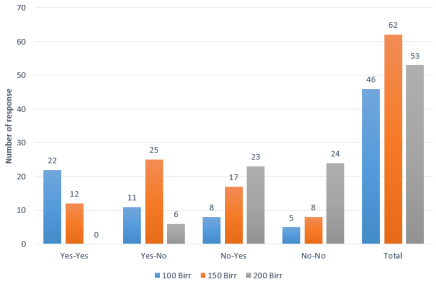
The three initial bids were 100, 150 and 200 Birr per Timad per year. Theirs follow up lower bids were 50, 75 and 100, whereas the follow up higher bids were 150, 225 and 300 Birr per Timad per year.
The following graph (Figure 1) showed the number of responses for the three initial bids and their follow up lower and higher bids. As shown in Figure, the number of responses for each initial bid with their follow up question is illustrated. Based on this 46, 62 and 53 respondents gave responses for 100, 150 and 200 initial bids respectively.
Figure 1. Numbers of response for initial and their follow up bids.
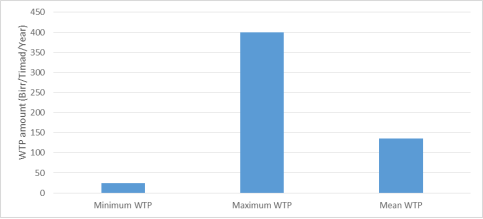
The maximum amount of money farmers willing to pay ranges from 25 Birr per Timad per year to 400 Birr per Timad per year from responses of an open-ended question. The mean amount the respondents are willing to pay for conservation of cultural and historical heritages was estimated at about 135 Birr per Timad per year from responses of an open-ended contingent valuation survey questions (Figure 2).
Figure 2. Minimum, maximum and mean WTP for open-ended question.
Factors affecting farmers’ willingness to participate in conservation of cultural and historical heritages.
Table 5. Estimates of the Heckman’s two-stage model.

Variables

Coefficients

Standard error

Constant

161.719***

46.95887

AGEHH

-1.281187***

.4917849

EDULEVEL

1.592727

2.657664

MASTATUS

-69.20246***

22.19803

DISMARK

.2526371

.1973873

HHSIZE

4.003133

6.79275

OFFINCOME

.0021464*

.0011663

TLU

1.214901

3.067201

FREXTENCON

14.27502***

4.073954

MEMBERSHIP

8.626406**

4.318029

CREDUSER

-18.78379*

10.6274

IMR

-35.93354*

20.9757

Number of observation = 261 Wald chi2(15) = 85.73

Censored observation = 100 Prob>chi2 = 0.0000

Uncensored observation =161

***, **, * significant at 1%, 5%, and 10% respectively
Source: Authors’ analysis, 2024
The second stage of Heckman two-stage model (Table 5) revealed that, seven out of ten variables included in the model were statistically influenced maximum amount farmers were willing to pay for the proposed conservation of cultural and historical heritages. These variables were age of household head (AGEHH), marital status of household head (MASTATUS), off-farm income (OFFINCOME), frequency of extension contact (FREXTENCON), membership in social organizations (MEMBERSHIP) and user of credit (CREDUSER). Unlike the first stage of Heckman two-stage model marital status of household head (MASTATUS), off-farm income (OFFINCOME) and user of credit (CREDUSER) changed the direction of influences on the amount that farmers were willing to pay. The other explanatory variables were found to have insignificant influence on maximum amount of money farmers were willing to pay.
Membership to social organization (MEMBERSHIP): the total number of social organizations in the community that the household is member determines maximum amount farmers were willing to pay. It has a significant positive effect on maximum amount farmers were willing to pay at 5% significance level. Farmers who are members of many social organizations are more likely to pay more amounts of money for conservation of cultural and historical heritages. Farmers who are members of one additional social organization are more likely to pay 8.63 more Birr for crop insurance. This result satisfies a priori expectations of this study and in line with .
User of credit (CREDUSER): use of credit is a significant variable that affected maximum amount farmers would pay negatively unlike in the first stage of the Heckman model at 10% significance level. It was hypothesized to affect positively but the result was coming negative effect on amount of WTP. This may be the fact that, once the households use the credit they are supposed to pay back for their lenders. During this time they may be faced with a cash constraint to pay for crop insurance since they are paying back the amount of money they borrowed and interest. From the result, a farmer who uses credit would pay on average 18.78 less Birr for crop insurance, citrus paribus. The result is in line with the results of who reported a negative relationship between credit access and amount of money farmers were willing to pay.
Estimation of mean willingness to pay
The mean willingness to pay for double bounded dichotomous choice elicitation format was estimated from the result of seemingly unrelated bivariate probit model. The model output presented in Table 6 showed important figures to estimate the mean willingness to pay. The negative of coefficients of constant term for WTP1 and WTP2 were divided to their respective coefficients of bids; then the results were added and divided to two to estimate the mean value farmers’ were willing to pay.
Table 6. Result of a seemingly unrelated bivariate probit model.

Bids

Coefficient

Std. Err.

P-value

WTP1

Constant

2.18881

0.4566799

0.000

BID1

-0.0150653

0.0029353

0.000

WTP2

Constant

1.655358

0.3764563

0.000

BID2

-0.0119478

0.0026252

0.000

Source: Authors’ analysis, 2024
Accordingly, the mean value farmers’ were willing to pay for the proposed conservation of cultural and historical heritages was estimated at 141.92 Birr per Timad per year for double bounded dichotomous choice elicitation format. On the other hand, the mean willingness to pay for an open-ended response was estimated by averaging the maximum willingness to pay stated by the respondents to the number of respondents who were willing to participate in conservation of cultural and historical heritages. As presented in Figure 2, the mean willingness to pay was estimated at 134.97 Birr per Timad per year. The mean value for closed-ended elicitation format was found to be higher than the mean value obtained from open-ended contingent valuation survey questions. This is in line with the result of the study by . Thus the results of the study showed that, respondents were willing to pay between 134.97 and 141.92 Birr per Timad per year for the proposed conservation of cultural and historical heritages.
4. Conclusion
In conclusion, different demographic, socio-economic and institutional variables included in this study to analyze the determinants of smallholder farmers’ willingness to pay and the maximum amount they were willing to pay for conservation of cultural and historical heritages. From the results of Heckman-two stage model three variables such as marital status, off-farm income and user of credit had different effect on farmers’ willingness to participate and the maximum amount they were willing to pay.
In general, the results of the study showed that majority of the respondents (about 62%) were willing to participate (interested) in the proposed conservation of cultural and historical heritages. This indicated that government and other concerned bodies need to give attention to introduce the product for reducing farmers’ vulnerability to conservation of cultural and historical heritages. To this end, the following recommendations under sub-section recommendations below are forwarded based on the findings of the study for the program to be feasible.
5. Recommendations
Based on findings of significant explanatory variables of the study, the following recommendations are forwarded.
Age of household head affected WTP significantly and negatively. Youngers have more probability of paying and they are more willing to pay for conservation of cultural and historical heritages than older farmers. It is suggested that it is better to convince the aged farmers to pay for it before introducing the conservation of cultural and historical heritages.
Off-farm income had a negative and positive relationship with probability of WTP and the maximum amount farmers were willing to pay. Once a farmer is deciding to pay he/she is more willing to pay for conservation of cultural and historical heritages since farmers participating in off-farm income may not face income constraints. So, facilitating off-farm income sources can improve the amount farmers are willing to pay.
Extension worker contact with farmers and farmers WTP were positively related. It is better to strength contact of extension workers with farmers more frequently. Extension workers should give awareness creation about conservation of cultural and historical heritages while contacting farmers.
Farmers’ membership in social organizations influenced the probability of farmer’s willingness to participate and the maximum amount farmers were willing to pay positively. A farmer who is a member of more local social organizations has a high probability of WTP and more willing to pay. It is recommended that the concerned body should have to encourage local social organizations.
Abbreviations

MWTP

Maximum Willingness to Pay

WTP

Willingness to Pay

IMR

Inverse Mills Ratio

EMWTP

Estimation of Mean Willingness to Pay

Author Contributions
Chirotaw Tsegaw: Conceptualization, Methodology, Investigation, Resources, Writing – original draft, Supervision
Alelgn Takele: Conceptualization, Resources, Writing – review & editing
Conflicts of Interest
There is no conflicts of Interest.
References
[1] Abayineh Amare, Belay Simane, Nyangaga, J., Akalu Defisa, Dereje Hamza and Biriki Gurmessa. 2019. Index-based livestock insurance to manage climate risks in the Borena Zone of southern Oromia, Ethiopia: climate risk management, 25, p. 100191.
[2] Abiyou, T., Hailu, T., and Teshome, S. 2015. The contribution of Ethiopian orthodox Tewahido church in forest management and its best practices to be scaled up in North Shewa Zone of Amhara Region. Ethiopia Agriculture, Forestry and Fisheries, 4, 123–137.
[3] Alemayehu, W. E. 2002. Opportunities, constraints and prospects of the Ethiopian orthodox Tewahido churches in conserving forest resources: The case of churches in south Gonder, Northern Ethiopia. Wondo Genet College of Forestry, Ethiopian MSc in Forestry Programme Thesis Report No. 2002: 63.
[4] Alemayehu, W. E., and Demel, T. 2007. Ethiopian church forests: Opportunities and challenges for restoration (Ph. D. Thesis). Wageningen University, Wageningen, The Netherlands.
[5] Alemayehu, W. E., Sterck, F. J., and Bongers, F. 2010. Species and structural diversity of church forests in a fragmented Ethiopian highland landscape. Journal of Vegetation Science, 21(5), 938–948.
[6] Ali, A. 2013. Farmers’ willingness to pay for index-based crop insurance in Pakistan: a case study on food and cash crops of rain-fed areas. Agricultural economics research review, 26(2), p. 241-248.
[7] Amare, D., Mekuria, W., T Wold, T., Belay, B., Teshome, A., Yitaferu, B., & Tegegn, B. (2016). Perception of local community and the willingness to pay to restore church forests: The case of Dera district, northwestern Ethiopia. Forests, Trees and Livelihoods, 25(3), 173–186.
[8] Avrami, E., Mason. R and De La Torre, M. (eds.) (2000). Values and Heritage Conservation, Los Angeles Getty Conservation Institute.
[9] Birara Endalew and Beneberu Assefa |2019. Determinants of households’ willingness to pay for the conservation of church forests in northwestern Ethiopia: A contingent valuation study, Cogent Environmental Science, 5: 1, 1570659,
[10] Daniel, Y. P. (1996). Tourism dance performance: Authenticity and creativity. Annals of Tourism Research, 23(4): 780-797.
[11] Danso-Abbeam, G., Addai, K. N. and Ehiakpor, D. 2014. Willingness to pay for farm insurance by smallholder cocoa farmers in Ghana. Journal of Social Science for Policy Implications, 2(1), 163-183.
[12] Elene, N., and Assefa, W. (2012). Managing World Heritage sites as a tool for development in Ethiopia: the need for sustainable tourism in Lalibela.
[13] Fonta, W. M., Sanfo, S., Kedir, A. M. and Thiam, D. R. 2018. Estimating farmers’ willingness to pay for weather index-based crop insurance uptake in West Africa: Insight from a pilot initiative in Southwestern Burkina Faso. Agricultural and Food Economics, 6(1), p. 11.
[14] Gulseven, O. 2014. Estimating the demand factors and willingness to pay for agricultural insurance. Middle East Technical University, Turkey. Australian Journal of Engineering Research, 1(4), pp. 13-18.
[15] Haab, T. C. and McConnell, K. E. 2002. Valuing environmental and natural resources: the econometrics of non-market valuation. Edward Elgar Publishing.
[16] Hanemann, M., and Kanninen, B. 1998. The Statistical Analysis of Discrete Responses Contingent Valuation Data. Working Paper, No. 798, California.
[17] Heckman, J. J. 1979. Sample selection bias as a specification error. Econometricia: Journal of the Econometric society, pp. 153-161.
[18] Hill, V. R., Hoddinott, J., and Kumar, N. 2013. Adoption of weather-index insurance: Learning from a willingness to pay among a panel of households in rural Ethiopia. Agricultural Economics, 44(4-5), pp. 385–398.
[19] Hiwot Teshome and Ayalneh Bogale. 2014. Willingness to pay for rainfall based insurance by smallholder farmers in Central Rift Valley of Ethiopia: The case of Dugda and Meiso woredas. Asia Pacific Journal of Energy and Environment, 1(2), pp. 121-155.
[20] Hovinen, G. R. (1995). Heritage issues in urban tourism: An assessment of new trends in Lancaster County. Tourism Management, 16(5): 445-452.
[21] Klepeis, P., Orlowska, I. A., Kent, E. F., Cardelús, C., Scull, L., Peter, E., Woods, C. 2016. Ethiopian Church forests: A hybrid model of protection. Human Ecology, 44(6), 715–730.
[22] Kwadzo, G. T., Kuwornu, J. K. and Amadu, I. S. 2013. Food crop farmers’ willingness to participate in market-based crop insurance scheme: Evidence from Ghana. Research in Applied Economics, 5(1), p. 1.
[23] McKercher, B., and du Cros, H. (2002). Cultural tourism: the partnership between tourism and cultural heritage management. New York: The Haworth Hospitality Press.
[24] Mesfin G. (2010). Estimating the Economic Value of a Recreational Wetland Ecosystem with the Travel Cost and Choice Experiment Methods: An Application to Wondo Genet, Unpublished MSC Thesis, Addis Ababa University.
[25] Mladenov, Natalie, Gardner, R. John, Flores, E. Nicholas, Mbaiwa, Joseph, Mmopelwa,
[26] Navrud, S. and Mungatana, E. (1994). Environmental Valuation in Developing Countries: The Recreational Value of Wildlife Viewing. Ecological Economics, 11: 135-151.
[27] Prentice, R. (1993). Tourism and Heritage Attractions: London: Routledge.
[28] Ramasubramanian, A. J. 2012. Willingness to pay for index-based crop microinsurance in India. DPhil candidate (Economics), University of Sussex, United Kingdom.
[29] Reynolds, T., Collins, C. D., Wassie, A., Liang, J., Briggs, W., Lowman, M., & Adamu, E. 2017. Sacred natural sites as mensurative fragmentation experiments in longinhabited multifunctional landscapes. Ecography, 40(1), 144–157.
[30] Sidra, G., Zhang., Q., Muhammad, A., Jalil. A. and Imran, K. 2015. Farmers’ willingness to pay for crop insurance in Pakistan. Journal of Business, Economics, and Finance, 4(2).
[31] Sitotaw E., (2003). Valuation of the Benefits of Out-Door Recreation Using the Travel.
[32] Solomon, G. B. 2010. A history of cultural heritage management in Ethiopia (1944-1974): aspects of cultural heritage management in Ethiopia.
[33] Tesfay Girmay Tsege Berhe and Hiruy Daniel. 2017. Cultural and Natural Heritages and Potential Tourist Route of Astbi Wenberta And Offla Weredas In Ethiopia, International Journal of Advanced Research in Management and Social Sciences.
[34] Timothy, D. J., & Nyaupane, G. P. (2009). Cultural heritage and tourism in the developing world: A regional perspective. London: Routledge.
[35] UNESCO. 1972. Convention Concerning the Protection of the World Cultural and Natural.
[36] UNESCO. (n.d.). The World Heritage Convention. UNESCO World Heritage Centre. Retrieved February 25, 2026, from
Cite This Article
  • APA Style

    Tsegaw, C., Takele, A. (2026). Household’s Willingness to Pay for Conserving Historical and Cultural Heritages in Assosa Zone, Western Ethiopia. Innovation Economics, 1(1), 35-44. https://doi.org/10.11648/j.iecon.20260101.14

    Copy | Download

    ACS Style

    Tsegaw, C.; Takele, A. Household’s Willingness to Pay for Conserving Historical and Cultural Heritages in Assosa Zone, Western Ethiopia. Innov. Econ. 2026, 1(1), 35-44. doi: 10.11648/j.iecon.20260101.14

    Copy | Download

    AMA Style

    Tsegaw C, Takele A. Household’s Willingness to Pay for Conserving Historical and Cultural Heritages in Assosa Zone, Western Ethiopia. Innov Econ. 2026;1(1):35-44. doi: 10.11648/j.iecon.20260101.14

    Copy | Download

  • @article{10.11648/j.iecon.20260101.14,
      author = {Chirotaw Tsegaw and Alelgn Takele},
      title = {Household’s Willingness to Pay for Conserving Historical and Cultural Heritages in Assosa Zone, Western Ethiopia},
      journal = {Innovation Economics},
      volume = {1},
      number = {1},
      pages = {35-44},
      doi = {10.11648/j.iecon.20260101.14},
      url = {https://doi.org/10.11648/j.iecon.20260101.14},
      eprint = {https://article.sciencepublishinggroup.com/pdf/10.11648.j.iecon.20260101.14},
      abstract = {This study examined smallholder farmers' willingness to pay (WTP) for conserving cultural and historical heritages in Assosa Zone, Ethiopia. Using a multi-stage random sampling technique, 261 farmers were surveyed, employing a double-bounded dichotomous choice and open-ended contingent valuation method. Results showed that 61.69% (161 farmers) were willing to participate in conservation efforts. The Heckman two-stage model revealed key factors influencing participation and WTP. Marital status, extension contact frequency, social organization membership, and credit access positively influenced willingness, while sex, age, household size, and off-farm income had negative effects. In the second stage, off-farm income, extension contact, and social membership increased WTP, whereas age, marital status, and credit access reduced it. Farmers' mean WTP was estimated at 141.92 Birr (closed-ended) and 134.97 Birr (open-ended) per hectare annually. The study recommends government and stakeholders prioritize conservation strategies to enhance farmers' participation and WTP, ensuring sustainable heritage preservation in the region.},
     year = {2026}
    }
    

    Copy | Download

  • TY  - JOUR
    T1  - Household’s Willingness to Pay for Conserving Historical and Cultural Heritages in Assosa Zone, Western Ethiopia
    AU  - Chirotaw Tsegaw
    AU  - Alelgn Takele
    Y1  - 2026/03/04
    PY  - 2026
    N1  - https://doi.org/10.11648/j.iecon.20260101.14
    DO  - 10.11648/j.iecon.20260101.14
    T2  - Innovation Economics
    JF  - Innovation Economics
    JO  - Innovation Economics
    SP  - 35
    EP  - 44
    PB  - Science Publishing Group
    UR  - https://doi.org/10.11648/j.iecon.20260101.14
    AB  - This study examined smallholder farmers' willingness to pay (WTP) for conserving cultural and historical heritages in Assosa Zone, Ethiopia. Using a multi-stage random sampling technique, 261 farmers were surveyed, employing a double-bounded dichotomous choice and open-ended contingent valuation method. Results showed that 61.69% (161 farmers) were willing to participate in conservation efforts. The Heckman two-stage model revealed key factors influencing participation and WTP. Marital status, extension contact frequency, social organization membership, and credit access positively influenced willingness, while sex, age, household size, and off-farm income had negative effects. In the second stage, off-farm income, extension contact, and social membership increased WTP, whereas age, marital status, and credit access reduced it. Farmers' mean WTP was estimated at 141.92 Birr (closed-ended) and 134.97 Birr (open-ended) per hectare annually. The study recommends government and stakeholders prioritize conservation strategies to enhance farmers' participation and WTP, ensuring sustainable heritage preservation in the region.
    VL  - 1
    IS  - 1
    ER  - 

    Copy | Download

Author Information