Research Article | | Peer-Reviewed

Response of Soybean to Different Category of Biostimulants Across Contrasting Himalayan Hill Agro-Climatic Zones

Received: 26 May 2026     Accepted: 8 June 2026     Published: 29 June 2026
Views:       Downloads:
Abstract

Biostimulants have been extensively studied in horticultural and high-value crops, particularly in developed countries. However, their application in low-value broad-acre crops under diverse hill agro-ecosystems investigations are limited, especially in developing countries dominated by smallholder farming systems. This study evaluated three biostimulant formulations—seaweed extract + vitamin, seaweed extract + humic and fulvic acids, and protein hydrolysate + humic acids—in soybean across three western Himalayan hill agro-climatic zones: Zone I (Akrot; sub-montane low-hill subtropical), Zone II (Palampur; mid-hill sub-humid), and Zone III (Awarna; high-hill temperate wet). Field experiments were conducted in a randomized block design with ten treatments and three replications. Growth and yield parameters were analysed through individual and pooled ANOVA, while treatment responses across environments were assessed using location × treatment interactions. Significant effects of both location and treatment (p < 0.01) were observed for all measured traits. Palampur was the most favourable environment, followed by Akrot, whereas Awarna imposed relatively constrained conditions. Among treatments, T6 showed the most consistent performance and recorded a 48.5% yield advantage over the control, while T9 and T3 performed statistically at par. The findings demonstrate the potential of biostimulants to enhance soybean productivity across diverse Himalayan hill agro-ecosystems.

Published in International Journal of Applied Agricultural Sciences (Volume 12, Issue 3)
DOI 10.11648/j.ijaas.20261203.13
Page(s) 97-109
Creative Commons

This is an Open Access article, distributed under the terms of the Creative Commons Attribution 4.0 International License (http://creativecommons.org/licenses/by/4.0/), which permits unrestricted use, distribution and reproduction in any medium or format, provided the original work is properly cited.

Copyright

Copyright © The Author(s), 2026. Published by Science Publishing Group

Keywords

Biostimulants, Soybean, Agro-climatic Zones, Seaweed Extract + Vitamin, Seaweed Extract + Humic and Fulvic Acids, Protein Hydrolysate + Humic Acids

1. Introduction
Soybean (Glycine max (L.) Merr.) is one of the most important oilseed and protein crops globally, contributing substantially to human nutrition, livestock feed, and industrial raw materials. Its seeds contain approximately 40% protein and 20% oil, making it a strategic crop for global food and nutritional security . Beyond its economic value, soybean plays a pivotal role in sustainable agriculture through biological nitrogen fixation, which improves soil fertility, enhances nitrogen cycling, and reduces reliance on synthetic fertilizers .
Despite significant advances in breeding and agronomic management, soybean productivity remains highly variable across agro-climatic regions. Environmental factors—including temperature regime, rainfall distribution, soil fertility, moisture availability, and photoperiod sensitivity—interact to regulate vegetative growth, flowering dynamics, pod formation, and seed filling . Plant architectural traits such as plant height and branching influence canopy structure, radiation interception efficiency, and photosynthetic performance, thereby determining biomass accumulation and assimilate supply . Yield components—including pods per plant, seeds per pod, and 100-seed weight—are particularly sensitive during reproductive stages and collectively determine final yield realization . Even moderate heat or drought stress during flowering and seed filling can significantly reduce yield potential by altering photosynthetic efficiency and source–sink balance .
Climate variability has further intensified the need to understand physiological determinants of yield stability. Recent studies emphasize that soybean productivity is closely linked to photosynthetic regulation, canopy temperature dynamics, and stress-adaptive mechanisms under fluctuating environments . Therefore, evaluating treatments across contrasting agro-climatic conditions is essential for identifying management practices that enhance both productivity and resilience.
Recently, the use of biostimulants to improve plant nutrition and growth has gained increasing attention. Biostimulant crop treatments—such as humic and fulvic acids, seaweed extracts, chitosan, plant growth-promoting rhizobacteria, and symbiotic fungi—have been widely studied for their roles in enhancing crop growth and productivity, particularly in horticultural and high-value crops. However, comparatively fewer studies have evaluated their cost–benefit potential and yield impacts in broad-acre crops under diverse field conditions.
The present study evaluates the effects of three distinct biostimulant formulations on soybean yield performance across varying agro-ecological zones of Himachal Pradesh. The treatments included:
(i). Mixture of seaweed extract (Ascophyllum nodosum) & vitamin (folic acid) (Bio Liquid SF);
(ii). Mixture of humic substances (humic and fulvic acids) and seaweed extract (Ascophyllum nodosum) (Bio Liquid HA);
(iii). Mixture of protein hydrolysate & humic acids (Bio Granules FG).
A persistent limitation in agronomic experimentation is the reliance on single-location trials, which often fail to capture environmental heterogeneity characteristic of soybean-growing regions. Treatments that perform well under one environmental condition may not maintain superiority elsewhere, limiting the external validity of recommendations. Multilocation trials provide a statistically robust framework for partitioning variation into location effects, treatment effects, and location × treatment (L × T) interaction components . The L × T interaction is particularly critical: significant interaction indicates environment-specific responses, whereas non-significant interaction suggests stable ranking and broad adaptability suitable for generalized recommendation .
The present study aimed to (i) quantify environmental and biostimulant treatment effects on soybean growth, yield components, and productivity, and (ii) evaluate treatment stability across contrasting agro-climatic environments. It was hypothesized that environmental conditions would significantly influence soybean growth and yield expression, that certain biostimulant treatments would consistently outperform others across locations, and that a non-significant L × T interaction would confirm stable treatment ranking and broad adaptability.
2. Materials and Methods
2.1. Experimental Sites
Field experiments were conducted during the 2022 cropping season across three contrasting agro-climatic zones: Akrot (31°28′05.5″ N, 76°16′10.0″ E; sub-montane low-hill subtropical), Palampur (32°07′11.3″ N, 76°33′19.0″ E; mid-hill sub-humid), and Awarna (31°51′06.8″ N, 77°09′02.7″ E; high-hill temperate wet). These locations differ significantly in altitude, rainfall patterns, and temperature regimes, thereby providing a representative environmental gradient for multilocation evaluation and stability analysis, as recommended in agronomic research .
2.2. Experimental Design and Crop Establishment
The experiment was conducted at each location using a randomized complete block design (RCBD) with ten treatments and three replications. Each plot measured 20 m2. The soybean (Glycine max (L.) Merr.) variety ‘Harit Soya’ was sown at a row spacing of 45 cm and plant spacing of 10–15 cm.
Sowing was carried out on 18 June 2022 (Palampur), 24 June 2022 (Akrot), and 20 June 2022 (Awarna). Standard agronomic practices, including fertilization, irrigation, and plant protection measures, were uniformly followed across all locations. Harvesting was performed on 28 October 2022 (Palampur), 25 October 2022 (Akrot), and 04 November 2022 (Awarna).
2.3. Treatments and Application
The study comprised ten treatments, including three Biostimulant formulations applied at three dosage levels each, along with untreated control. Details of treatments are presented in Table 1.
Liquid formulations (Bio Liquid SF and Bio Liquid HA) were applied as foliar sprays at the 2–3 leaf stage, flowering, and pod formation stages using a knapsack sprayer fitted with a hollow cone nozzle at a spray volume of 500 L ha-1. Granular formulations (Bio Granules FG) were applied directly to the soil at corresponding growth stages. Application protocols were standardized across all sites.
Table 1. Details of treatments and application rates.

Treatment

Biostimulant Description

Dosage

T1

Bio Liquid SF (seaweed extract + vitamin)

250 mL ha-1

T2

Bio Liquid SF (seaweed extract + vitamin)

325 mL ha-1

T3

Bio Liquid SF (seaweed extract + vitamin)

500 mL ha-1

T4

Bio Liquid HA (seaweed extract + humic and fulvic acids)

500 mL ha-1

T5

Bio Liquid HA (seaweed extract + humic and fulvic acids)

750 mL ha-1

T6

Bio Liquid HA (seaweed extract + humic and fulvic acids)

1000 mL ha-1

T7

Bio Granules FG (protein hydrolysate + humic acids)

12.5 kg ha-1

T8

Bio Granules FG (protein hydrolysate + humic acids)

18 kg ha-1

T9

Bio Granules FG (protein hydrolysate + humic acids)

25 kg ha-1

T10

Control (untreated)

2.4. Soil Analysis and Observations
2.4.1. Soil Analysis
Composite soil samples (0–15 cm depth) were collected prior to sowing from each site and analyzed for physicochemical properties following standard procedures. The analytical methods used are summarized in Table 2.
Table 2. Soil attributes and analytical methods used.

Attribute

Method

Reference

pH

Glass electrode pH meter

(Jackson et al., 1967)

8]

EC (dS m-1)

Digital conductivity meter

(Jackson et al., 1973)

19]

Organic carbon (%)

Walkley and Black method

(Walkley et al., 1934)

0]

Available N (kg ha-1)

Alkaline permanganate method

(Subbiah et al., 1956)

1]

Available P (kg ha-1)

Olsen method

(Olsen et al., 1954)

2]

Available K (kg ha-1)

Ammonium acetate extraction

(AOAC., 1970)

23]

2.4.2. Growth and Yield Observations
Growth parameters included plant height measured at 30, 60, and 90 days after sowing (DAS), and at harvest. Yield attributes recorded were number of branches per plant, pods per plant, seeds per pod, and 100-seed weight.
Productivity was evaluated based on seed yield and straw yield, expressed as kg plot-1 and kg ha-1.
2.5. Statistical Analysis
The experimental data were analyzed using analysis of variance (ANOVA) in the Web Agri Stat Package (WASP). Individual ANOVA was performed for each location, followed by combined multilocation ANOVA to assess the effects of location, treatment, and interaction. Replications were treated as blocks nested within locations.
Treatment means were separated using Least Significant Difference (LSD) test at p = 0.05. The significance of the location × treatment interaction was used to evaluate treatment stability across environments, following established methodologies for multilocation trials .
3. Results
3.1. Soil and Climatic Conditions
Across all three zones, temperature remained relatively moderate during the monsoon months (June–August) and gradually declined from September to October. The peak temperatures were observed in June 39.5°C, whereas the lowest temperatures 17.0°C were recorded in October in zone I. Similar pattern observed in Zone II and Zone III. Relative humidity remained consistently above 50% in Zones II and III throughout the cropping period, indicating comparatively more humid conditions. Rainfall distribution showed temporal variation, with October receiving the lowest precipitation among the observed months.
Soil physico-chemical properties of the respective zones are summarized in Table 3 and indicate clear spatial variability. The soil in Zone I was slightly neutral in reaction, while Zones II and III exhibited acidic soil conditions. Electrical conductivity (EC) in Zone I (1.382 dS m-1) suggests moderate salinity, which could potentially restrict water uptake and induce nutrient imbalances. In contrast, Zones II and III recorded low EC values (0.24–0.28 dS m-1), indicating non-saline conditions. Organic carbon content was moderate in Zone I but comparatively higher and adequate in Zones II and III. Available nitrogen levels were sufficient across all zones. Available phosphorus was moderate in Zone I but deficient in Zones II and III, whereas available potassium was found to be adequate in all three zones.
Table 3. Soil analysis of samples collected from the three agro-ecological zones.

Soil parameters

Unit

Zone I (Akrot)

Zone II (Palampur)

Zone III (Awarna)

pH

6.80

5.54

5.43

Electrical conductivity

dS m-1

1.382

0.284

0.248

Organic carbon

g kg-1

7.6

10.6

12.6

Available nitrogen

kg ha-1

245.3

350.4

316.7

Available phosphorus

28.6

18.2

14.6

Available potassium

268.0

246.4

226.2

3.2. Plant Height
3.2.1. Effect of Location
Location significantly affected plant height at all stages (p < 0.01). At 30 DAS, Akrot (37.95 cm) and Palampur (36.05 cm) were superior to Awarna (27.53 cm). Similar trends were observed at 60 DAS (Akrot: 77.13 cm; Palampur: 76.93 cm; Awarna: 59.10 cm). At 90 DAS and harvest, Palampur recorded the highest values (100.77 and 106.50 cm, respectively), followed by Akrot (95.90 and 101.10 cm), while Awarna remained inferior (79.31 and 82.97 cm) (Table 4). Coefficients of variation ranged from 3.4% to 5.1%, indicating high precision.
Table 4. Effect of Location on Plant Height: (pooled over treatments).

Location

Plant height 30 DAS (cm)

Plant height 60 DAS (cm)

Plant height 90 DAS (cm)

Plant height at harvest (cm)

Akrot

37.95±0.33c

77.13±1.35b

95.90±1.40b

101.10±1.35b

Palampur

36.05±0.37b

76.93±1.09b

100.77±1.35c

106.50±1.38c

Awarna

27.53±0.20a

59.10±0.61a

79.31±0.99a

82.97±0.97a

SED (±)

0.316

0.567

0.59

0.6050

CD (P = 0.05)

1.37

2.46

2.57

2.62

3.2.2. Effect of Treatments
Biostimulant application significantly improved soybean growth attributes across all locations compared with the control. Treatment effects were highly significant (p < 0.01). At harvest, T9 (102.20 cm), T6 (101.59 cm), and T3 (101.20 cm) formed the superior group, whereas T10 (80.03 cm) was significantly inferior. Similar trends were observed at 60 and 90 DAS. CV (b) ranged from 2.9% to 4.3%, confirming strong experimental reliability.
Across treatments, plant height increased by 26.4–27.70% over the control, with the maximum response recorded under T9 (protein hydrolysate +humic and fulvic acid), followed by T6 (Ascophyllum nodosum+ Humic and Fulvic acid) and T3 (Ascophyllum nodosum+ Folic acid). (Table 5).
Table 5. Effect of Treatments on Plant Height: (pooled over locations).

Treatment

Plant height 30 DAS (cm)

Plant height 60 DAS (cm)

Plant height 90 DAS (cm)

Plant height at harvest (cm)

T1

33.33bc

70.03±3.21b

90.57±3.63b

95.05±3.82b

T2

34.52bcd

72.18±3.09bc

94.39±3.47bc

99.28±3.95bc

T3

35.26d

74.11±3.36bc

95.99±3.49c

101.20±3.82c

T4

32.82ab

70.21±3.15b

90.63±3.48b

95.36±3.71b

T5

34.14bcd

72.16±3.18bc

94.16±3.39bc

99.26±3.74bc

T6

34.76cd

73.74±3.27bc

96.00±3.44c

101.59±3.85c

T7

33.33bc

71.13±3.30bc

90.67±3.64b

95.46±3.51b

T8

34.48bcd

73.61±3.62bc

95.20±3.72bc

99.12±3.86bc

T9

34.80cd

75.77±3.35c

97.17±3.28c

102.20±3.74c

T10

30.99a

57.60±2.06a

75.16±2.47a

80.03±2.72a

SED

0.316

1.020

1.09

0.9481

CD (P = 0.05)

1.37

4.77

5.10

4.43

Means followed by the same letter within a column are not significantly different at P = 0.05 based on the Critical Difference (CD) test. Values are presented as mean ± standard error (SE).
3.3. Yield Parameters, Seed Yield and Straw Yield
3.3.1. Effect of Location on Yield Components and Productivity of Soybean
Location exerted a highly significant influence (P ≤ 0.05) on all yield attributes and productivity parameters of soybean, indicating a strong environmental effect on crop performance. (Table 6).
Table 6. Effect of Location on Yield Components and Productivity of Soybean.

Location, L

Number of Branches per Plant Average ± SE

No. of Pods per plant (No.) Average ± SE

Number of seeds per pod (No.) Average ± SE

100 seed weight (g) Average ± SE

Seed yield (kg per ha) Average ± SE

Straw yield (kg per ha) Average ± SE

Akrot

7.527±0.101b

58.156±0.637b

2.081±0.029a

17.350±0.161ab

1,429.69±33.28b

2,677.716±41.321b

Palampur

8.343±0.106c

66.944±0.675c

2.252±0.018b

17.799±0.097b

1,863.97±38.45c

3,169.167±57.008c

Awarna

6.719±0.085a

54.037±0.674a

2.049±0.021a

17.007±0.070a

1,145.45±27.03a

2,370.367±51.122a

SED

0.0826

0.4537

0.0187

0.1078

16.6213

32.1242

CD (P = 0.05)

0.3582

1.9688

0.0811

0.4678

72.1197

139.3868

Means followed by the same letter within a column are not significantly different at P = 0.05 based on the Critical Difference (CD) test. Values are presented as mean ± standard error (SE).
Yield Attributes
The number of branches per plant differed significantly across locations, with Palampur recording the highest value (8.343 ± 0.106), followed by Akrot (7.527 ± 0.101), while Awarna recorded the lowest (6.719 ± 0.085). This suggests that favorable environmental conditions at Palampur enhanced vegetative growth and branching.
A similar trend was observed for number of pods per plant, which ranged from 54.037 ± 0.674 at Awarna to 66.944 ± 0.675 at Palampur, with Akrot (58.156 ± 0.637) showing intermediate performance. The magnitude of variation was substantial and statistically significant (CD = 1.9688), indicating that pod formation was highly sensitive to location.
The number of seeds per pod also varied significantly, with Palampur (2.252 ± 0.018) outperforming both Akrot (2.081 ± 0.029) and Awarna (2.049 ± 0.021). However, Akrot and Awarna remained statistically at par, as reflected by similar grouping letters, suggesting that this trait is relatively less plastic compared to other yield components.
Test weight (100-seed weight) followed a similar pattern, with Palampur recording the highest value (17.799 ± 0.097 g), which was significantly superior to Awarna (17.007 ± 0.070 g), while Akrot (17.350 ± 0.161 g) remained statistically comparable to both. This indicates that seed filling was more efficient under the agro-climatic conditions of Palampur.
Yield Performance
Seed yield was markedly influenced by location, with values ranging from 1,145.45 ± 27.03 kg ha-1 at Awarna to 1,863.97 ± 38.45 kg ha-1 at Palampur, while Akrot recorded 1,429.69 ± 33.28 kg ha-1. The differences were statistically significant (CD = 72.12), highlighting the superior productivity potential of Palampur.
A similar trend was observed for straw yield, where Palampur (3,169.17 ± 57.01 kg ha-1) recorded the highest biomass production, followed by Akrot (2,677.72 ± 41.32 kg ha-1) and Awarna (2,370.37 ± 51.12 kg ha-1). The variation was significant (CD = 139.39), indicating that total biomass accumulation was strongly influenced by environmental conditions.
Across all parameters, Palampur consistently outperformed other locations, followed by Akrot, while Awarna exhibited the lowest values. The superiority of Palampur can be attributed to more favorable agro-climatic conditions, which enhanced vegetative growth (branches), reproductive development (pods and seeds), and ultimately yield.
3.3.2. Effect of Treatments on Yield Parameters, Seed Yield and Straw Yield
The application of different biostimulant treatments significantly influenced all yield attributes and productivity parameters of soybean (P ≤ 0.05), indicating a strong treatment effect on crop performance. (Table 7).
Table 7. Effect of Treatments on Yield Attributes and Productivity of Soybean: .

Treatment, T

Number of Branches per Plant (No.) Average ± SE

No. of Pods per plant (No.) Average ± SE

Number of seeds per pod (No.) Average ± SE

100 seed weight (g) Average ± SE

Seed yield (kg per ha) Average ± SE

Straw yield (kg per ha) Average ± SE

T1

7.189±0.229ab

57.640±2.000b

2.057±0.039ab

17.112±0.151b

1336.07±94.82b

2,478.890±108.129b

T2

7.528±0.251bcd

59.757±1.910bc

2.137±0.038bc

17.360±0.125bc

1537.17±111.24cd

2,793.876±133.628cd

T3

7.699±0.266bcd

60.720±1.857bc

2.186±0.034bc

17.580±0.133bc

1584.86±108.52d

2,842.906±121.310cd

T4

7.469±0.238bcd

58.871±2.115b

2.103±0.038bc

17.326±0.196bc

1415.46±95.83bc

2,651.242±115.433bc

T5

7.862±0.257cd

61.667±2.029bc

2.182±0.048bc

17.700±0.165bc

1570.65±113.06d

2,894.157±125.082de

T6

8.064±0.258d

63.399±1.945c

2.230±0.043c

17.986±0.201c

1674.82±117.30d

3,067.997±112.985e

T7

7.300±0.262bc

58.871±1.981b

2.090±0.031bc

17.210±0.171b

1375.55±105.06b

2,633.341±125.167bc

T8

7.693±0.273bcd

61.120±2.166bc

2.167±0.035bc

17.536±0.146bc

1549.20±116.84cd

2,824.416±132.035cd

T9

7.861±0.268cd

61.933±2.066bc

2.205±0.030bc

17.746±0.132bc

1625.66±120.54d

2,975.402±128.941de

T10

6.633±0.336a

53.146±2.549a

1.917±0.086a

16.300±0.382a

1127.61±101.56a

2,228.602±146.630a

SED

0.1382

0.9297

0.0362

0.1639

32.3213

47.1554

CD (P = 0.05)

0.6459

4.3442

0.1689

0.7661

151.0275

220.3433

Means followed by the same letter within a column are not significantly different at P = 0.05 based on the Critical Difference (CD) test. Values are presented as mean ± standard error (SE).
Yield Attributes
Number of Branches per Plant: The number of branches per plant varied significantly among treatments, ranging from 6.633 ± 0.336 (T10) to 8.064 ± 0.258 (T6). Treatment T6 (d) recorded the highest number of branches and was significantly superior to T10 (Control). Treatments such as T2, T3, T4, T5, T8, and T9 (bcd–cd group) remained statistically at par with T6, indicating moderate responsiveness of branching to biostimulant treatments.
Number of Pods per Plant: Pods per plant showed substantial variation, with values ranging from 53.146 ± 2.549 (T10) to 63.399 ± 1.945 (T6). Treatment T6 (c) recorded significantly increased pod numbers by 19.28% compared to T10 (Control). The lowest pod number in T10 (a) indicates poor reproductive development under this treatment. Most Biostimulant treatments (T2–T5, T8, T9) were statistically similar (bc group), suggesting overlapping performance. The biostimulants effect clearly demonstrates dose-dependent effects. The highest effectivity observed under higher doses of each biostimulant.
Number of Seeds per Pod: Seeds per pod ranged from 1.917 ± 0.086 (T10) to 2.230 ± 0.043 (T6). Treatment T6 (c) was significantly superior, while T10 (a) recorded the lowest value. Treatments T2, T3, T4, T5, T7, T8, and T9 (bc group) were statistically at par, indicating relatively low variability for this trait compared to others.
100-Seed Weight: Test weight varied significantly across treatments, with the highest value observed in T6 (17.986 ± 0.201 g; c) and the lowest in T10 (16.300 ± 0.382 g; a). Treatment T6 was significantly superior to T1, T7, and T10, while most other treatments (T2–T5, T8, T9) remained statistically similar (bc group), suggesting different biostimulants treatment influence on seed filling. Treatment T9 increased seed weight by 8.87% compared to untreated plants (T10) followed by T3 with 7.80%.
Yield Performance
Seed Yield: Seed yield exhibited a wide and significant variation among treatments, ranging from 1127.61 ± 101.56 kg ha-1 (T10) to 1674.82 ± 117.30 kg ha-1 (T6). Treatment T6 (d) recorded the highest yield and was statistically superior to T1, T4, T7, and T10. Treatments T3, T5, and T9 (d group) also produced comparably high yields, indicating their effectiveness. Across treatments, Seed yield increased by 40.55 to 48.50% over the control, with the maximum response recorded under T6 (Ascophyllum nodosum +humic and fulvic acid), followed by T9 (Protein Hydrolysate+ Humic and Fulvic acid) and T3 (Ascophyllum nodosum+ Folic acid).
T10 (a) recorded the lowest yield, clearly differing from all other treatments, while T1 (b) and T4 (bc) showed intermediate performance. The differences exceeded the CD value (151.03), confirming statistical significance.
Straw Yield: Straw yield followed a similar trend, with values ranging from 2228.60 ± 146.63 kg ha-1 (T10) to 3067.99 ± 112.99 kg ha-1 (T6). Treatment T6 (e) recorded the highest biomass production and was significantly superior to most treatments.
Treatments T5 and T9 (de) were statistically comparable with T6, while T2, T3, and T8 (cd) formed an intermediate group.
Overall Interpretation
Across all yield attributes and productivity parameters, T6 consistently outperformed other treatments, followed by T3, T5, and T9. In contrast, T10 recorded the lowest values for all traits, indicating suboptimal performance.
3.3.3. Location × Treatment Interaction
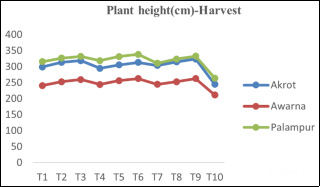
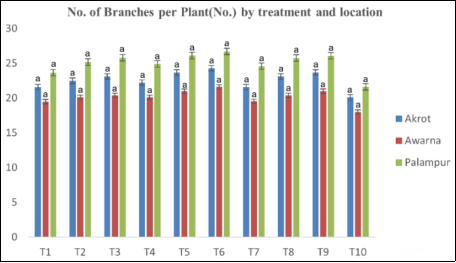
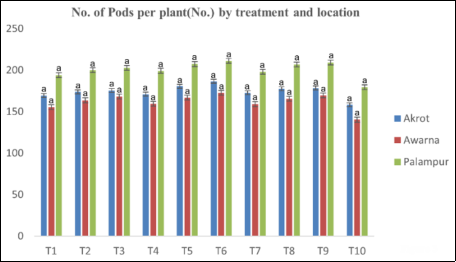
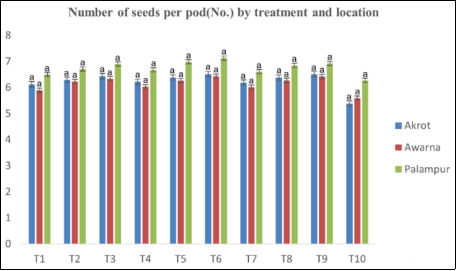
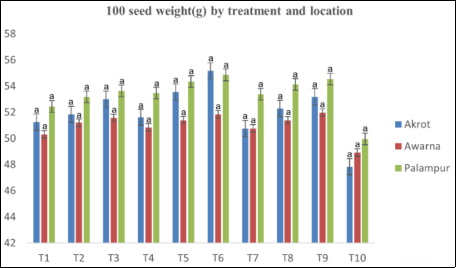
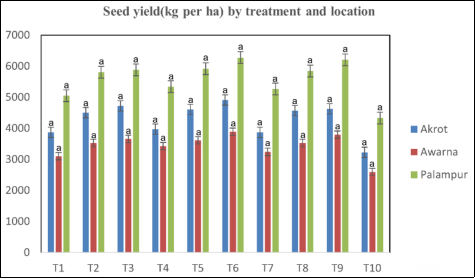
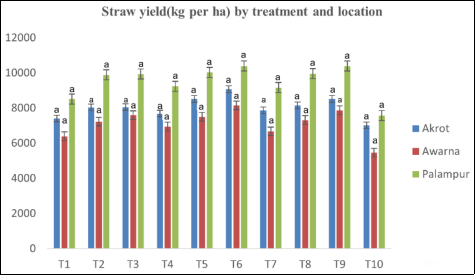
Across all traits, the location × treatment interaction was non-significant, indicating stable treatment ranking across environments. (Table 8, Figures 1-7).
Table 8. The combined analysis of variance for yield components and yield.

Source of Variation

df

Number of Branches

No. of Pods

No. of Seeds/pod

100-seed weight g (F-value)

Seed yield (F-value)

Straw yield (F-value)

Location (L) (F-value)

2

96.707**

211.099**

33.988**

13.547**

473.971**

157.316**

Treatment (T) (F-value)

9

8.942**

9.535**

6.457**

8.008**

26.209**

27.799**

L × T (F-value)

18

0.190ns

0.147ns

0.207ns

0.561ns

0.654ns

0.869ns

Error (a) MS

6

0.2045

6.1766

0.0105

0.3487

8288.0076

30958.8964

Error (b) MS

54

0.1720

7.7792

0.0118

0.2419

9401.9689

20012.7270

CV (a) (%)

6.00

4.16

4.81

3.40

6.15

6.42

CV (b) (%)

5.51

4.67

5.10

2.83

6.55

5.16

** Significant at P ≤ 0.01; * Significant at P ≤ 0.05; NS = non-significant. CV (a) and CV (b) represent coefficients of variation for main plot and sub-plot errors, respectively.
Figures: Effect of location and treatment interaction (location × treatment) on soybean yield attributes and yield. The means not sharing a common letter are significantly different by post hoc least significant difference (LSD) test at 5% level of significance. Data presented are means ± standard errors (p ≤ 0.05, n=3).
Figure 1. Plant Height (cm) at Harvest.
Figure 2. Number of branches per plant (No.).
Figure 3. Number of Pods per plant (No.).
Figure 4. Number of seeds per pod (No.).
Figure 5. 100 seed weight (g).
Figure 6. Seed Yield kg ha-1.
Figure 7. Straw Yield kg ha-1.
4. Discussion
4.1. Environmental Regulation of Soybean Growth and Yield
The multilocation evaluation demonstrated strong environmental control over soybean growth and productivity. Palampur consistently recorded superior vegetative and reproductive performance, whereas Awarna remained comparatively constrained. Environmental dominance in soybean productivity has been widely documented, particularly under contrasting temperature and moisture regimes that regulate canopy expansion, biomass accumulation, and reproductive efficiency .
Plant height and branching are highly responsive to agro-climatic conditions because they determine canopy architecture, radiation interception efficiency, and photosynthetic capacity . Enhanced pod number and seed set under favorable environments reflect improved reproductive stability during flowering and seed filling stages, which are particularly vulnerable to heat and drought stress .
Recent physiological evidence further indicates that yield stability under environmental variability is associated with maintenance of photosynthetic efficiency and canopy temperature regulation . These findings confirm that environmental variability remains a dominant determinant of soybean yield expression and justify the necessity of multilocation evaluation for reliable agronomic recommendations.
4.2. Biostimulants Treatment Effects on Vegetative and Reproductive Traits
Significant treatment effects across plant height, branching, pod number, seeds per pod, and seed weight indicate clear physiological differentiation among treatments. Treatment T6 consistently enhanced both vegetative growth and reproductive performance followed by T9 and T3, suggesting improved assimilate production and partitioning efficiency.
Soybean yield formation is governed by sink strength (pod and seed number) and effective source–sink balance during seed filling . Increased branching likely expanded canopy surface area and photosynthetic activity, while higher pod and seed numbers reflect strengthened sink development. Improved 100-seed weight further suggest enhanced assimilate translocation to developing seeds.
Coordinated enhancement of vegetative vigor and reproductive sink development aligns with recent findings emphasizing integrated physiological regulation as a determinant of yield stability under variable environments . In contrast, the consistently inferior performance of T10 suggests limited physiological responsiveness and reduced adaptability across environmental gradients.
4.3. Yield Stability and Interaction Effects
A key outcome of this study was the non-significant location × treatment (L × T) interaction across all measured traits, indicating stable treatment ranking and broad adaptability.
In multilocation trials, significant interaction complicates recommendation strategies because treatment performance may vary among environments. However, when interaction effects are non-significant, pooled mean-based recommendations become statistically justified and biologically meaningful .
Under increasing climatic variability, yield stability is as critical as yield maximization for sustainable production . The consistent superiority of T6 followed by T3 and T9 across locations suggests that its physiological advantages are robust and not environment-specific, supporting its suitability for broad-scale adoption.
4.4. Relationship Between Growth Traits and Yield Formation
The superiority of T6, followed by T3 and T9 in seed yield was accompanied by enhanced plant height, branching, pod number, and seed weight, indicating coordinated improvement of both source and sink components. Pod number remains the primary yield determinant under favorable conditions, while seed weight contributes to final yield stabilization .
The positive association between biomass accumulation (straw yield) and grain yield observed in this study further suggests efficient assimilate production and partitioning. Maintenance of photosynthetic performance during reproductive stages is essential for sustaining yield under environmental fluctuation .
Therefore, biostimulant treatments that enhance both canopy development and reproductive sink strength are more likely to maintain productivity across diverse agro-climatic environments.
4.5. Statistical Reliability and Experimental Precision
Although minor deviations from homogeneity of variance were observed, the experiment was conducted under a balanced randomized block design with equal replications. ANOVA remains robust under moderate assumption violations when experimental design is balanced, and treatment effects are strong .
Low coefficients of variation (approximately 3–6%) confirm high experimental precision and reliable discrimination among treatments and environments. The consistent treatment ranking across locations further strengthens confidence in the stability inference.
4.6. Agronomic Implications:
Pooled multilocation analysis enhances statistical precision, improves discrimination among treatments, and strengthens inference regarding stability and adaptability under variable climatic conditions . Such integrated evaluation is increasingly important as yield stability has become as critical as yield maximization in modern production systems .
Although multilocation testing is widely advocated, comprehensive analyses integrating vegetative growth, reproductive traits, yield components, grain yield, and biomass production under pooled environmental conditions remain limited in several production systems. Environmental stress or site-specific variability may mask treatment differences at individual locations, reducing statistical power and obscuring true agronomic potential. Therefore, systematic multilocation evaluation is essential to distinguish consistently superior treatments from those exhibiting environment-specific performance and to generate reliable agronomic recommendations.
From a practical standpoint, T6 (Ascophyllum nodosum + humic and fulvic acid) demonstrated consistent superiority across vegetative growth, reproductive traits, seed yield, and biomass production, confirming broad adaptability and physiological robustness. Treatments T9 (protein hydrolysate + humic and fulvic acid), T5, and T3 (Ascophyllum nodosum + folic acid) also exhibited competitive performance with similar statistical significance.
The absence of significant interaction simplifies recommendation strategies and supports uniform adoption across agro-climatic zones. The multilocation approach effectively identified stable and high-performing treatments suitable for large-scale soybean production under variable environmental conditions.
5. Conclusions
The present multilocation evaluation clearly demonstrated that environmental conditions significantly influenced soybean growth, yield components, and productivity. Palampur consistently provided the most favorable agro-climatic conditions, whereas Awarna imposed relative growth constraints. These findings reaffirm the dominant role of environmental factors in regulating soybean performance across production systems .
Despite strong environmental effects, biostimulant treatment ranking remained stable across locations due to the non-significant location × treatment interaction for all measured traits. The absence of crossover interaction confirms broad adaptability and supports pooled mean-based recommendation, consistent with established multilocation evaluation principles .
Among the evaluated treatments, T6, Mixture of seaweed extract (Ascophyllum nodosum) and humic, fulvic acid (Bio Liquid HA) @ 1000 mL ha-1 consistently recorded superior plant height, branching, pod number, seeds per pod, 100-seed weight, seed yield, and straw yield. Its pooled seed yield advantage (1674.82 kg ha-1) and consistent biomass production indicate improved source–sink balance and reproductive efficiency, which are central determinants of soybean yield formation . Treatments T9 Mixture of protein hydrolysate and humic, fulvic acids (Bio Granules FG) @ 25 kg ha-1 and T3 Mixture of seaweed extract (Ascophyllum nodosum) and vitamin (folic acid) (Bio Liquid SF) @ 500 mL ha-1 also demonstrated competitive performance, whereas T10 was consistently inferior across environments.
The low coefficients of variation and balanced experimental design further confirm the robustness and reliability of the statistical inference . Overall, the study successfully identified T6, T5 and T3 as a stable and high-performing biostimulant treatment suitable for large-scale adoption across diverse agro-climatic conditions.
Future research should focus on detailed mechanistic evaluation of physiological responses, including canopy photosynthetic dynamics and stress resilience pathways, along with long-term sustainability assessment under varying climatic scenarios to further strengthen agronomic recommendations.
Abbreviations

ANOVA

Analysis of Variance

RCBD

Randomized Completely Block Design

CD

Critical Difference

DAS

Days After Sowing

Acknowledgments
The authors acknowledge the Department of Agronomy, College of Agriculture, CSKHPKV, Palampur’s support for carrying out the study. The writing assistance provided by Dr. Rathinam swamy is kindly acknowledged.
Author Contributions
Femida Yunus Patel: Conceptualization, Data curation, Visualization, Writing – review & editing
Suresh Kumar: Supervision, Validation
Sandeep Manuja: Data curation, Investigation, Methodology, Validation
Meenakshi: Data curation, Investigation, Methodology
Neil Jaykumar Shah: Conceptualization, Funding acquisition, Visualization, Writing – review & editing
Data Availability Statement
The data supporting the outcome of this research work has been reported in this manuscript.
Conflicts of Interest
The authors declare no conflicts of interest.
References
[1] Hartman, G. L.; West, E. D.; Herman, T. K. Crops that feed the World 2. Soybean—Worldwide production, use, and constraints caused by pathogens and pests. Food Secur. 2011, 3, 5–17.
[2] FAOSTAT. FAO Statistical Database; Food and Agriculture Organization of the United Nations: Rome, Italy, 2023. Available online:
[3] Salvagiotti, F.; Cassman, K. G.; Specht, J. E.; Walters, D. T.; Weiss, A.; Dobermann, A. Nitrogen uptake, fixation and response to fertilizer N in soybean: A review. Field Crops Res. 2008, 108, 1–13.
[4] Peoples, M. B.; Brockwell, J.; Herridge, D. F.; Rochester, I. J.; Alves, B. J. R.; Urquiaga, S.; Boddey, R. M.; Dakora, F. D.; Bhattarai, S. L.; Maskey, S. L.; et al. The contributions of nitrogen-fixing crop legumes to agricultural productivity. Symbiosis. 2009, 48, 1–17.
[5] Sinclair, T. R.; Marrou, H.; Soltani, A.; Vadez, V.; Chandolu, K. C. Soybean production potential and crop physiology. Field Crops Res. 2015, 182, 30–38.
[6] Liu, X.; Jin, J.; Wang, G.; Herbert, S. J. Soybean yield physiology and development under changing climate conditions. Field Crops Res. 2020, 248, 107714.
[7] Board, J. E.; Kahlon, C. S. Soybean yield formation: What controls it and how it can be improved. In Soybean Physiology and Biochemistry; El-Shemy, H. A., Ed.; InTech: Rijeka, Croatia, 2011; pp. 1–36.
[8] Gaspar, A. P.; Conley, S. P.; Naeve, S. L.; Casteel, S. N.; Kovács, P. Response of soybean yield to management and environment. Agron. J. 2017, 109, 1–12.
[9] Egli, D. B. Soybean yield physiology: Principles and processes of yield production. CAB Rev. 2017, 12, 1–13.
[10] Assefa, Y.; Purcell, L. C.; Salmeron, M.; Naeve, S.; Casteel, S. N.; Kovács, P.; Archontoulis, S.; Licht, M.; Below, F. E.; Orlowski, J. M.; et al. Assessing variation in US soybean seed composition (protein and oil). Field Crops Res. 2019, 242, 107580.
[11] Purcell, L. C.; Salmeron, M.; Ashlock, L. Soybean yield formation and environmental stress response mechanisms. Agronomy 2021, 11, 1235.
[12] Zhang, J.; Liu, X.; Wang, G.; Herbert, S. J.; Jin, J. Physiological responses of soybean to heat and drought stress under climate variability. Field Crops Res. 2021, 270, 108197.
[13] Kumagai, E.; Araki, T.; Hamaoka, N.; Ueno, O. Photosynthetic regulation and yield stability of soybean under elevated temperature and variable moisture conditions. Front. Plant Sci. 2022, 13, 873421.
[14] Yan, W.; Kang, M. S. GGE Biplot Analysis: A Graphical Tool for Breeders, Geneticists and Agronomists; CRC Press: Boca Raton, FL, USA, 2003.
[15] Gauch, H. G. Statistical analysis of yield trials by AMMI and GGE. Crop Sci. 2006, 46, 1488–1500.
[16] Smith, A. B.; Cullis, B. R.; Thompson, R. The analysis of crop cultivar breeding and evaluation trials: An overview. Aust. N. Z. J. Stat. 2005, 47, 483–496.
[17] Gauch, H. G. A simple protocol for AMMI analysis of yield trials. Crop Sci. 2013, 53, 1860–1869.
[18] Jackson, M. L. Soil Chemical Analysis; Prentice Hall: New Delhi, India, 1967.
[19] Jackson, M. L. Soil Chemical Analysis; Prentice Hall: New Delhi, India, 1973.
[20] Walkley, A.; Black, I. A. An examination of the Degtjareff method for determining soil organic matter. Soil Sci. 1934, 37, 29–38.
[21] Subbiah, B. V.; Asija, G. L. A rapid procedure for the determination of available nitrogen in soils. Curr. Sci. 1956, 25, 259–260.
[22] Olsen, S. R.; Cole, C. V.; Watanabe, F. S.; Dean, L. A. Estimation of available phosphorus in soils by extraction with sodium bicarbonate. USDA Circ. 1954, 939, 1–19.
[23] AOAC. Official Methods of Analysis; AOAC: Washington, DC, USA, 1970.
[24] Ray, D. K.; Gerber, J. S.; MacDonald, G. K.; West, P. C. Climate variation explains a third of global crop yield variability. Nat. Commun. 2015, 6, 5989.
Cite This Article
  • APA Style

    Patel, F. Y., Kumar, S., Manuja, S., Meenakshi, Shah, N. J. (2026). Response of Soybean to Different Category of Biostimulants Across Contrasting Himalayan Hill Agro-Climatic Zones. International Journal of Applied Agricultural Sciences, 12(3), 97-109. https://doi.org/10.11648/j.ijaas.20261203.13

    Copy | Download

    ACS Style

    Patel, F. Y.; Kumar, S.; Manuja, S.; Meenakshi; Shah, N. J. Response of Soybean to Different Category of Biostimulants Across Contrasting Himalayan Hill Agro-Climatic Zones. Int. J. Appl. Agric. Sci. 2026, 12(3), 97-109. doi: 10.11648/j.ijaas.20261203.13

    Copy | Download

    AMA Style

    Patel FY, Kumar S, Manuja S, Meenakshi, Shah NJ. Response of Soybean to Different Category of Biostimulants Across Contrasting Himalayan Hill Agro-Climatic Zones. Int J Appl Agric Sci. 2026;12(3):97-109. doi: 10.11648/j.ijaas.20261203.13

    Copy | Download

  • @article{10.11648/j.ijaas.20261203.13,
      author = {Femida Yunus Patel and Suresh Kumar and Sandeep Manuja and Meenakshi and Neil Jaykumar Shah},
      title = {Response of Soybean to Different Category of Biostimulants Across Contrasting Himalayan Hill 
    Agro-Climatic Zones},
      journal = {International Journal of Applied Agricultural Sciences},
      volume = {12},
      number = {3},
      pages = {97-109},
      doi = {10.11648/j.ijaas.20261203.13},
      url = {https://doi.org/10.11648/j.ijaas.20261203.13},
      eprint = {https://article.sciencepublishinggroup.com/pdf/10.11648.j.ijaas.20261203.13},
      abstract = {Biostimulants have been extensively studied in horticultural and high-value crops, particularly in developed countries. However, their application in low-value broad-acre crops under diverse hill agro-ecosystems investigations are limited, especially in developing countries dominated by smallholder farming systems. This study evaluated three biostimulant formulations—seaweed extract + vitamin, seaweed extract + humic and fulvic acids, and protein hydrolysate + humic acids—in soybean across three western Himalayan hill agro-climatic zones: Zone I (Akrot; sub-montane low-hill subtropical), Zone II (Palampur; mid-hill sub-humid), and Zone III (Awarna; high-hill temperate wet). Field experiments were conducted in a randomized block design with ten treatments and three replications. Growth and yield parameters were analysed through individual and pooled ANOVA, while treatment responses across environments were assessed using location × treatment interactions. Significant effects of both location and treatment (p < 0.01) were observed for all measured traits. Palampur was the most favourable environment, followed by Akrot, whereas Awarna imposed relatively constrained conditions. Among treatments, T6 showed the most consistent performance and recorded a 48.5% yield advantage over the control, while T9 and T3 performed statistically at par. The findings demonstrate the potential of biostimulants to enhance soybean productivity across diverse Himalayan hill agro-ecosystems.},
     year = {2026}
    }
    

    Copy | Download

  • TY  - JOUR
    T1  - Response of Soybean to Different Category of Biostimulants Across Contrasting Himalayan Hill 
    Agro-Climatic Zones
    AU  - Femida Yunus Patel
    AU  - Suresh Kumar
    AU  - Sandeep Manuja
    AU  - Meenakshi
    AU  - Neil Jaykumar Shah
    Y1  - 2026/06/29
    PY  - 2026
    N1  - https://doi.org/10.11648/j.ijaas.20261203.13
    DO  - 10.11648/j.ijaas.20261203.13
    T2  - International Journal of Applied Agricultural Sciences
    JF  - International Journal of Applied Agricultural Sciences
    JO  - International Journal of Applied Agricultural Sciences
    SP  - 97
    EP  - 109
    PB  - Science Publishing Group
    SN  - 2469-7885
    UR  - https://doi.org/10.11648/j.ijaas.20261203.13
    AB  - Biostimulants have been extensively studied in horticultural and high-value crops, particularly in developed countries. However, their application in low-value broad-acre crops under diverse hill agro-ecosystems investigations are limited, especially in developing countries dominated by smallholder farming systems. This study evaluated three biostimulant formulations—seaweed extract + vitamin, seaweed extract + humic and fulvic acids, and protein hydrolysate + humic acids—in soybean across three western Himalayan hill agro-climatic zones: Zone I (Akrot; sub-montane low-hill subtropical), Zone II (Palampur; mid-hill sub-humid), and Zone III (Awarna; high-hill temperate wet). Field experiments were conducted in a randomized block design with ten treatments and three replications. Growth and yield parameters were analysed through individual and pooled ANOVA, while treatment responses across environments were assessed using location × treatment interactions. Significant effects of both location and treatment (p < 0.01) were observed for all measured traits. Palampur was the most favourable environment, followed by Akrot, whereas Awarna imposed relatively constrained conditions. Among treatments, T6 showed the most consistent performance and recorded a 48.5% yield advantage over the control, while T9 and T3 performed statistically at par. The findings demonstrate the potential of biostimulants to enhance soybean productivity across diverse Himalayan hill agro-ecosystems.
    VL  - 12
    IS  - 3
    ER  - 

    Copy | Download

Author Information
  • Abstract
  • Keywords
  • Document Sections

    1. 1. Introduction
    2. 2. Materials and Methods
    3. 3. Results
    4. 4. Discussion
    5. 5. Conclusions
    Show Full Outline
  • Abbreviations
  • Acknowledgments
  • Author Contributions
  • Data Availability Statement
  • Conflicts of Interest
  • References
  • Cite This Article
  • Author Information