
Background Perioperative myocardial injury in elderly hip fracture patients is usually silent and arises mainly from oxygen supply–demand mismatch. Transthoracic echocardiographic coronary sinus blood flow (CSBF) has been proposed as a non-invasive window on coronary perfusion, but its obtainability in this frail population is unknown. This trial assessed whether a definitive trial of PC6 transcutaneous electrical acupoint stimulation (TEAS) using such monitoring is feasible. Methods Three-phase, single-centre, sham-controlled randomised pilot and feasibility trial (June 2023–May 2025). Phase I (n = 30) assessed CSBF obtainability and acute responses to bilateral PC6 TEAS; Phase II (n = 60) explored stimulation parameters in a 2 × 2 factorial (2 vs. 5 Hz; 15 vs. 25 min); Phase III (n = 40) applied the leading combination under standardised total intravenous anaesthesia. Primary outcomes were feasibility outcomes: CSBF obtainability, predictors of measurement failure, recruitment, retention and safety. Clinical measures were secondary and exploratory, and progression criteria were pre-specified. The study was not powered to detect efficacy effects. Results Adequate CSBF spectra were obtainable in 64% of patients (55/85, Phases I–II). Chronic obstructive pulmonary disease (adjusted odds ratio 3.45), body mass index above 25 kg/m2 (2.87) and thoracic kyphosis (3.21) independently predicted failure; obtainability reached 90.5% when none was present but fell to 56.8% intraoperatively. Recruitment averaged 4.4 patients/month, no patient was lost to follow-up, and no adverse event was attributable to TEAS. Exploratory estimates: coronary sinus velocity–time integral rose 20.8% (95% CI 11.2–30.4) without change in mean arterial pressure; rate-pressure product remained below 12,000 throughout in the TEAS arm, with a pooled between-group separation of 1759 (95% CI 876–2642) at peak-stress time points. Discussion A definitive trial is feasible, but not with transthoracic CSBF as its monitoring backbone: the technique fails in approximately a third of patients, and selectively in those at highest cardiovascular risk. We recommend proceeding with an amended protocol that substitutes pulse-wave analysis. The haemodynamic signals reported here are hypothesis-generating. Trial registration Chinese Clinical Trial Registry (https://www.chictr.org.cn), ChiCTR2600126845; registered 17 June 2026, retrospectively registered. Recruitment ran from June 2023 to May 2025, so registration followed completion of recruitment.
| Published in | International Journal of Anesthesia and Clinical Medicine (Volume 14, Issue 2) |
| DOI | 10.11648/j.ijacm.20261402.18 |
| Page(s) | 181-197 |
| Creative Commons |
This is an Open Access article, distributed under the terms of the Creative Commons Attribution 4.0 International License (http://creativecommons.org/licenses/by/4.0/), which permits unrestricted use, distribution and reproduction in any medium or format, provided the original work is properly cited. |
| Copyright |
Copyright © The Author(s), 2026. Published by Science Publishing Group |
Pilot Study, Transcutaneous Electrical Acupoint Stimulation, PC6, Coronary Sinus Blood Flow, Rate-pressure Product, Hip Fracture, Elderly
Feasibility outcome | Pre-specified progression criterion | Observed value | Criterion met |
|---|---|---|---|
CSBF obtainability, Phases I–II | ≥ 60% of attempted examinations | 64.7% (55/85; 95% CI 54.1–74.1) | Yes |
CSBF obtainability, intraoperative (Phase III) | No separate threshold pre-specified | 56.8% (21/37) | Below overall threshold |
Recruitment rate | ≥ 4 patients randomised per month | 4.4 patients/month (130 over 24 months) | Yes |
Retention | No formal threshold; reported descriptively | 0 lost to follow-up; 122/130 analysable | Yes |
Safety and tolerability | No serious adverse event attributable to TEAS | 0 attributable serious adverse events | Yes |
Candidate parameter identified | Rank ordering across four cells | 2 Hz for 25 min | Yes |
Haemodynamic effect estimate (supportive only) | Lower 95% confidence bound excluding zero | ΔRPP met; ΔCS-VTI met marginally | Partially |
Variable | TEAS (n = 14) | Control (n = 14) | t / χ2 | p |
|---|---|---|---|---|
Age, years | 76.4 ± 4.8 | 75.9 ± 5.2 | 0.264 | 0.793 |
Female, n (%) | 9 (64.3) | 8 (57.1) | 0.155 | 0.694 |
Body mass index, kg/m2 | 23.6 ± 3.1 | 24.1 ± 2.8 | −0.454 | 0.651 |
ASA class II/III/IV, n | 4/8/2 | 5/7/2 | 0.273 | 0.872 |
Hypertension, n (%) | 9 (64.3) | 8 (57.1) | 0.155 | 0.694 |
Diabetes, n (%) | 4 (28.6) | 5 (35.7) | 0.175 | 0.677 |
COPD, n (%) | 2 (14.3) | 3 (21.4) | 0.239 | 0.626 |
Coronary artery disease, n (%) | 3 (21.4) | 2 (14.3) | 0.239 | 0.626 |
Baseline heart rate, beats/min | 74.2 ± 9.8 | 73.5 ± 10.4 | 0.185 | 0.854 |
Baseline mean arterial pressure, mmHg | 91.3 ± 12.1 | 89.7 ± 11.6 | 0.359 | 0.724 |
Baseline rate-pressure product | 10,085 ± 1623 | 9946 ± 1578 | 0.229 | 0.824 |
Femoral neck/intertrochanteric, n | 8/6 | 7/7 | 0.143 | 0.710 |
Predictor | Prevalence, n (%) | Adjusted OR (95% CI) | p |
|---|---|---|---|
COPD | 15/85 (17.6) | 3.45 (1.12–10.64) | 0.031 |
BMI > 25 kg/m2 | 28/85 (32.9) | 2.87 (1.04–7.93) | 0.042 |
Thoracic kyphosis | 12/85 (14.1) | 3.21 (0.98–10.52) | 0.054 |
None of the above | 42/85 (49.4) | Reference | — |
Measure | Cell A 2 Hz/15 min | Cell B 2 Hz/25 min | Cell C 5 Hz/15 min | Cell D 5 Hz/25 min | Cohen's d, B vs A (95% CI) |
|---|---|---|---|---|---|
ΔCS-VTI, % ᵃ | +12.4 ± 7.6 | +20.3 ± 8.7 | +14.1 ± 8.2 | +17.8 ± 9.1 | 0.94 (0.01 to 1.91) |
ΔCardiac output, % ᵃ | +8.7 ± 5.3 | +15.2 ± 6.8 | +9.4 ± 5.9 | +13.1 ± 6.4 | 1.06 (0.10 to 2.02) |
ΔHeart rate, % | −2.1 ± 3.4 | −4.3 ± 3.8 | −1.8 ± 3.1 | −2.9 ± 3.5 | 0.61 (−0.12 to 1.33) |
ΔRate-pressure product, % | −5.8 ± 4.2 | −9.7 ± 5.1 | −4.3 ± 4.5 | −7.2 ± 4.8 | 0.82 (0.07 to 1.55) |
Parameter | TEAS T0 | TEAS T1 | Control T0 | Control T1 | Between-group difference in change (95% CI) |
|---|---|---|---|---|---|
CS-VTI, cm | 10.6 ± 3.8 | 12.8 ± 4.1 | 10.4 ± 3.5 | 10.9 ± 3.6 | +1.7 (+0.4 to +3.0) |
Cardiac output, L/min | 4.21 ± 0.82 | 4.82 ± 0.91 | 4.15 ± 0.79 | 4.31 ± 0.85 | +0.45 (+0.02 to +0.88) |
IVC respiratory variation, % | 38.2 ± 12.4 | 35.6 ± 11.8 | 37.8 ± 11.9 | 37.1 ± 12.1 | −1.9 (−12.2 to +8.4) |
Heart rate, beats/min | 74.2 ± 9.8 | 71.5 ± 8.6 | 73.5 ± 10.4 | 73.1 ± 10.1 | −2.3 (−9.6 to +5.0) |
Mean arterial pressure, mmHg | 91.3 ± 12.1 | 88.7 ± 10.4 | 89.7 ± 11.6 | 90.2 ± 12.3 | −3.1 (−13.6 to +7.4) |
Time point | TEAS heart rate | Control heart rate | TEAS SBP | Control SBP | TEAS RPP | Control RPP | Difference (95% CI) |
|---|---|---|---|---|---|---|---|
B1 preoperative | 73.8 ± 9.2 | 74.6 ± 10.1 | 136 ± 18 | 138 ± 19 | 10,037 ± 1854 | 10,285 ± 2012 | +248 (−1008 to +1504) |
B2 pre-induction | 70.2 ± 8.4 | 72.8 ± 9.6 | 132 ± 16 | 135 ± 17 | 9267 ± 1672 | 9828 ± 1789 | +561 (−541 to +1663) |
B3 post-intubation | 72.4 ± 8.8 | 79.2 ± 10.3 | 141 ± 19 | 153 ± 21 | 10,245 ± 1876 | 12,134 ± 2043 | +1889 (+736 to +3042) |
B4 incision | 68.6 ± 7.9 | 76.4 ± 9.8 | 141 ± 17 | 149 ± 20 | 9687 ± 1654 | 11,423 ± 1897 | +1736 (+604 to +2868) |
B5 post-extubation | 74.8 ± 9.4 | 82.6 ± 11.2 | 145 ± 20 | 152 ± 22 | 10,876 ± 1932 | 12,567 ± 2156 | +1691 (+378 to +3004) |
ASA | American Society of Anesthesiologists |
BIS | Bispectral Index |
BMI | Body Mass Index |
BNP | B-type Natriuretic Peptide |
CO | Cardiac Output |
COPD | Chronic Obstructive Pulmonary Disease |
CSBF | Coronary Sinus Blood Flow |
CS-VTI | coronary Sinus Velocity–Time Integral |
ECG | Electrocardiogram |
FiO2 | Fraction of Inspired Oxygen |
HR | Heart Rate |
MACE | Major Adverse Cardiovascular Events |
MAP | Mean Arterial Pressure |
MINS | Myocardial Injury After Non-Cardiac Surgery |
MMSE | Mini-Mental State Examination |
PEEP | Positive End-Expiratory Pressure |
RPP | Rate-Pressure Product |
SBP | Systolic Blood Pressure |
TEAS | Transcutaneous Electrical Acupoint Stimulation |
TEE | Transoesophageal Echocardiography |
TTE | Transthoracic Echocardiography |
VAS | Visual Analogue Scale |
VT | Tidal Volume |
| [1] | Rostagno C, Peris A, Polidori GL, Ranalli C, Cartei A, Civinini R, Boccaccini A, Prisco D, Innocenti M, Di Mario C. Perioperative myocardial infarction in elderly patients with hip fracture. Is there a role for early coronary angiography? Int J Cardiol. 2019; 284: 1-5. |
| [2] | Wahlstrøm KL, Ekeloef S, Gögenur I, Münster AB. Myocardial injury after non-cardiac surgery and per operative fibrin metabolism in patients undergoing hip-fracture surgery: an observational study. Scand J Clin Lab Invest. 2023 Sep; 83(5): 299-308. |
| [3] | Borges FK, Guerra-Farfan E, Bhandari M, Patel A, Slobogean G, Feibel RJ, Sancheti PK, Tiboni ME, Balaguer-Castro M, Tandon V, Tomas-Hernandez J, Sigamani A, Szczeklik W, McMahon SJ, Ślęczka P, Ramokgopa MT, Adinaryanan S, Umer M, Jenkinson RJ, Lawendy A, Popova E, Nur AN, Wang CY, Vizcaychipi M, Biccard BM, Ofori S, Spence J, Duceppe E, Marcucci M, Harvey V, Balasubramanian K, Vincent J, Tonelli AC, Devereaux PJ; HIP ATTACK Investigators. Myocardial Injury in Patients with Hip Fracture: A HIP ATTACK Randomized Trial Substudy. J Bone Joint Surg Am. 2024; 106(24): 2303-2312. |
| [4] | Sheth T, Natarajan MK, Hsieh V, Valettas N, Rokoss M, Mehta S, Jolly S, Tandon V, Bezerra H, Devereaux PJ. Incidence of thrombosis in perioperative and non-operative myocardial infarction. Br J Anaesth. 2018; 120(4): 725-733. |
| [5] | Ruetzler K, Smilowitz NR, Berger JS, Devereaux PJ, Maron BA, Newby LK, de Jesus Perez V, Sessler DI, Wijeysundera DN. Diagnosis and Management of Patients With Myocardial Injury After Noncardiac Surgery: A Scientific Statement From the American Heart Association. Circulation. 2021; 144(19): e287-e305. |
| [6] | Halvorsen S, Mehilli J, Cassese S, Hall TS, Abdelhamid M, Barbato E, De Hert S, de Laval I, Geisler T, Hinterbuchner L, Ibanez B, Lenarczyk R, Mansmann UR, McGreavy P, Mueller C, Muneretto C, Niessner A, Potpara TS, Ristić A, Sade LE, Schirmer H, Schüpke S, Sillesen H, Skulstad H, Torracca L, Tutarel O, Van Der Meer P, Wojakowski W, Zacharowski K; ESC Scientific Document Group. 2022 ESC Guidelines on cardiovascular assessment and management of patients undergoing non-cardiac surgery. Eur Heart J. 2022; 43(39): 3826-3924. |
| [7] | Thompson A, Fleischmann KE, Smilowitz NR, de Las Fuentes L, Mukherjee D, Aggarwal NR, Ahmad FS, Allen RB, Altin SE, Auerbach A, Berger JS, Chow B, Dakik HA, Eisenstein EL, Gerhard-Herman M, Ghadimi K, Kachulis B, Leclerc J, Lee CS, Macaulay TE, Mates G, Merli GJ, Parwani P, Poole JE, Rich MW, Ruetzler K, Stain SC, Sweitzer B, Talbot AW, Vallabhajosyula S, Whittle J, Williams KA Sr; Peer Review Committee Members. 2024 AHA/ACC/ACS/ASNC/HRS/SCA/SCCT/SCMR/SVM Guideline for Perioperative Cardiovascular Management for Noncardiac Surgery: A Report of the American College of Cardiology/American Heart Association Joint Committee on Clinical Practice Guidelines. Circulation. 2024; 150(19): e351-e442. |
| [8] | Marcucci M, Painter TW, Conen D, Lomivorotov V, Sessler DI, Chan MTV, Borges FK, Leslie K, Duceppe E, Martínez-Zapata MJ, Wang CY, Xavier D, Ofori SN, Wang MK, Efremov S, Landoni G, Kleinlugtenbelt YV, Szczeklik W, Schmartz D, Garg AX, Short TG, Wittmann M, Meyhoff CS, Amir M, Torres D, Patel A, Ruetzler K, Parlow JL, Tandon V, Fleischmann E, Polanczyk CA, Lamy A, Jayaram R, Astrakov SV, Wu WKK, Cheong CC, Ayad S, Kirov M, de Nadal M, Likhvantsev VV, Paniagua P, Aguado HJ, Maheshwari K, Whitlock RP, McGillion MH, Vincent J, Copland I, Balasubramanian K, Biccard BM, Srinathan S, Ismoilov S, Pettit S, Stillo D, Kurz A, Belley-Côté EP, Spence J, McIntyre WF, Bangdiwala SI, Guyatt G, Yusuf S, Devereaux PJ; POISE-3 Trial Investigators and Study Groups. Hypotension-Avoidance Versus Hypertension-Avoidance Strategies in Noncardiac Surgery: An International Randomized Controlled Trial. Ann Intern Med. 2023; 176(5): 605-614. |
| [9] | Saugel B, Meidert AS, Brunkhorst FM, Bischoff R, Esser J, Mattis M, Naue P, Vogel K, Bergholz A, Flick M, Kröker A, Müller DX, Thomsen KK, Vokuhl C, Wegge M, Bratke S, Graeßner M, Jungwirth B, Schmid S, Grundmann CD, Wischermann JM, Kellner P, Steinhaus M, Grüßer L, Coldewey SM, Zacharowski K, Meybohm P, Habicher M, Zarbock A, Zitzmann A, Letz S, Neumann C, Larmann J, Renné T, Krause L, Vettorazzi E, Zapf A, Carlstedt A, Sessler DI, Kouz K; IMPROVE-multi Trial Group. Individualized Perioperative Blood Pressure Management in Patients Undergoing Major Abdominal Surgery: The IMPROVE-multi Randomized Clinical Trial. JAMA. 2025; 334(21): 1893-1904. |
| [10] | Gobel FL, Norstrom LA, Nelson RR, Jorgensen CR, Wang Y. The rate-pressure product as an index of myocardial oxygen consumption during exercise in patients with angina pectoris. Circulation. 1978; 57(3): 549-56. |
| [11] | Wilkinson PL, Moyers JR, Ports T, Chatterjee K, Ullyott D, Hamilton WK. Rate-pressure product and myocardial oxygen consumption during surgery for coronary artery bypass. Circulation. 1979; 60(2 Pt 2): 170-3. |
| [12] | Kang N, Deng Y, Yang N, Li Z, Kuang Z, Yuan Y, Guo X. Association between perioperative rate pressure product and postoperative delirium in geriatric patients with hip fracture. Front Med (Lausanne). 2025; 12: 1651278. |
| [13] | Kal JE, Van Wezel HB, Vergroesen I. A critical appraisal of the rate pressure product as index of myocardial oxygen consumption for the study of metabolic coronary flow regulation. Int J Cardiol. 1999; 71(2): 141-148. |
| [14] | Li H, Wu C, Yan C, Zhao S, Yang S, Liu P, Liu X, Wang M, Wang X. Cardioprotective effect of transcutaneous electrical acupuncture point stimulation on perioperative elderly patients with coronary heart disease: a prospective, randomized, controlled clinical trial. Clin Interv Aging. 2019; 14: 1607-1614. |
| [15] | Wang Q, Liang D, Wang F, Li W, Han Y, Zhang W, Xie Y, Xin W, Zhou B, Sun D, Cao F, Xiong L. Efficacy of electroacupuncture pretreatment for myocardial injury in patients undergoing percutaneous coronary intervention: A randomized clinical trial with a 2-year follow-up. Int J Cardiol. 2015; 194: 28-35. |
| [16] | Feng B, Sun Y, Liu L, Sun Y, Chen L, Wang Y. Transcutaneous Electrical Acupuncture Point Stimulation Is Cardioprotective for Patients With Stable Ischemic Heart Disease. Am J Cardiol. 2023; 206: 202-209. |
| [17] | Lee A, Zhang JZ, Xie J, Cheng V, Wong MKH, Yau DKW. Stimulation of the wrist acupuncture point PC6 for preventing postoperative nausea and vomiting: a network meta-analysis. Cochrane Database Syst Rev. 2025; 9(9): CD003281. |
| [18] | Meenakshi K, Swaminathan S, Manickam R. Role of transthoracic echocardiography in the estimation of coronary sinus blood flow in coronary artery disease. Heart Asia. 2013; 5(1): 168-171. |
| [19] | Lyubarova R, Boden WE, Fein SA, Schulman-Marcus J, Torosoff M. Successful percutaneous coronary intervention significantly improves coronary sinus blood flow as assessed by transthoracic echocardiography. J Echocardiogr. 2018; 16(2): 65-71. |
| [20] | Eldridge SM, Chan CL, Campbell MJ, Bond CM, Hopewell S, Thabane L, Lancaster GA; PAFS consensus group. CONSORT 2010 statement: extension to randomised pilot and feasibility trials. Pilot Feasibility Stud. 2016; 2: 64. |
| [21] | Whitehead AL, Julious SA, Cooper CL, Campbell MJ. Estimating the sample size for a pilot randomised trial to minimise the overall trial sample size for the external pilot and main trial for a continuous outcome variable. Stat Methods Med Res. 2016; 25(3): 1057-73. |
| [22] | Sim J. Should treatment effects be estimated in pilot and feasibility studies? Pilot Feasibility Stud. 2019; 5: 107. |
| [23] | De Hert SG, Turani F, Mathur S, Stowe DF. Cardioprotection with volatile anesthetics: mechanisms and clinical implications. Anesth Analg. 2005; 100(6): 1584-1593. |
| [24] | Futier E, Lefrant JY, Guinot PG, Godet T, Lorne E, Cuvillon P, Bertran S, Leone M, Pastene B, Piriou V, Molliex S, Albanese J, Julia JM, Tavernier B, Imhoff E, Bazin JE, Constantin JM, Pereira B, Jaber S; INPRESS Study Group. Effect of Individualized vs Standard Blood Pressure Management Strategies on Postoperative Organ Dysfunction Among High-Risk Patients Undergoing Major Surgery: A Randomized Clinical Trial. JAMA. 2017; 318(14): 1346-1357. |
| [25] | Salmasi V, Maheshwari K, Yang D, Mascha EJ, Singh A, Sessler DI, Kurz A. Relationship between Intraoperative Hypotension, Defined by Either Reduction from Baseline or Absolute Thresholds, and Acute Kidney and Myocardial Injury after Noncardiac Surgery: A Retrospective Cohort Analysis. Anesthesiology. 2017; 126(1): 47-65. |
| [26] | Schmidt AF, Groenwold R. Adjusting for bias in unblinded randomized controlled trials. Stat Methods Med Res. 2018; 27(8): 2413-2427. |
| [27] | Hilberath JN, Oakes DA, Shernan SK, Bulwer BE, D'Ambra MN, Eltzschig HK. Safety of transesophageal echocardiography. J Am Soc Echocardiogr. 2010; 23(11): 1115-1127. |
| [28] | Kronzon I, Tunick PA, Jortner R, Drenger B, Katz ES, Bernstein N, Chinitz LA, Freedberg RS. Echocardiographic evaluation of the coronary sinus. J Am Soc Echocardiogr. 1995; 8(4): 518-526. |
| [29] | Tsuchiya M, Sato EF, Inoue M, Asada A. Acupuncture enhances generation of nitric oxide and increases local circulation. Anesth Analg. 2007; 104(2): 301-7. |
| [30] | Wittmann M, Dinc T, Kunsorg A, Marcucci M, Ruetzler K. Preventing, identifying and managing myocardial injury after non cardiac surgery - a narrative review. Curr Opin Anaesthesiol. 2025; 38(1): 17-24. |
| [31] | Neuman MD, Feng R, Carson JL, Gaskins LJ, Dillane D, Sessler DI, Sieber F, Magaziner J, Marcantonio ER, Mehta S, Menio D, Ayad S, Stone T, Papp S, Schwenk ES, Elkassabany N, Marshall M, Jaffe JD, Luke C, Sharma B, Azim S, Hymes RA, Chin KJ, Sheppard R, Perlman B, Sappenfield J, Hauck E, Hoeft MA, Giska M, Ranganath Y, Tedore T, Choi S, Li J, Kwofie MK, Nader A, Sanders RD, Allen BFS, Vlassakov K, Kates S, Fleisher LA, Dattilo J, Tierney A, Stephens-Shields AJ, Ellenberg SS; REGAIN Investigators. Spinal Anesthesia or General Anesthesia for Hip Surgery in Older Adults. N Engl J Med. 2021; 385(22): 2025-2035. |
| [32] | Sieber FE, Neufeld KJ, Gottschalk A, Bigelow GE, Oh ES, Rosenberg PB, Mears SC, Stewart KJ, Ouanes JP, Jaberi M, Hasenboehler EA, Li T, Wang NY. Effect of Depth of Sedation in Older Patients Undergoing Hip Fracture Repair on Postoperative Delirium: The STRIDE Randomized Clinical Trial. JAMA Surg. 2018; 153(11): 987-995. |
| [33] | Li T, Li J, Yuan L, Wu J, Jiang C, Daniels J, Mehta RL, Wang M, Yeung J, Jackson T, Melody T, Jin S, Yao Y, Wu J, Chen J, Smith FG, Lian Q; RAGA Study Investigators. Effect of Regional vs General Anesthesia on Incidence of Postoperative Delirium in Older Patients Undergoing Hip Fracture Surgery: The RAGA Randomized Trial. JAMA. 2022; 327(1): 50-58. |
| [34] | Sharples L, Papachristofi O, Rex S, Landau S. Exploring mechanisms of action in clinical trials of complex surgical interventions using mediation analysis. Clin Trials. 2020; 17: 654-663. |
| [35] | Sarnoff SJ, Braunwald E, Welch GH Jr, Case RB, Stainsby WN, Macruz R. Hemodynamic determinants of oxygen consumption of the heart with special reference to the tension-time index. Am J Physiol. 1958; 192(1): 148-56. |
| [36] | Hoffman JI, Buckberg GD. The myocardial oxygen supply: demand index revisited. J Am Heart Assoc. 2014; 3(1): e000285. |
| [37] | Lakatta EG, Levy D. Arterial and cardiac aging: major shareholders in cardiovascular disease enterprises: Part I: aging arteries: a "set up" for vascular disease. Circulation. 2003; 107(1): 139-46. |
| [38] | Chirinos JA, Segers P, Gupta AK, Swillens A, Rietzschel ER, De Buyzere ML, Kirkpatrick JN, Gillebert TC, Wang Y, Keane MG, Townsend R, Ferrari VA, Wiegers SE, St John Sutton M. Time-varying myocardial stress and systolic pressure-stress relationship: role in myocardial-arterial coupling in hypertension. Circulation. 2009; 119(21): 2798-2807. |
| [39] | Salvi P, Baldi C, Scalise F, Grillo A, Salvi L, Tan I, De Censi L, Sorropago A, Moretti F, Sorropago G, Gao L, Rovina M, Simon G, Fabris B, Carretta R, Avolio AP, Parati G. Comparison Between Invasive and Noninvasive Methods to Estimate Subendocardial Oxygen Supply and Demand Imbalance. J Am Heart Assoc. 2021; 10(17): e021207. |
| [40] | Heart rate variability: standards of measurement, physiological interpretation and clinical use. Task Force of the European Society of Cardiology and the North American Society of Pacing and Electrophysiology. Circulation. 1996; 93(5): 1043-65. |
| [41] | Zhao ZQ. Neural mechanism underlying acupuncture analgesia. Prog Neurobiol. 2008; 85(4): 355-375. |
| [42] | Chang S, Chao WL, Chiang MJ, Li SJ, Lu YT, Ma CM, Cheng HY, Hsieh SH. Effects of acupuncture at Neiguan (PC 6) of the pericardial meridian on blood pressure and heart rate variability. Chin J Physiol. 2008; 51(3): 167-77. |
| [43] | Liu S, Wang Z, Su Y, Qi L, Yang W, Fu M, Jing X, Wang Y, Ma Q. A neuroanatomical basis for electroacupuncture to drive the vagal-adrenal axis. Nature. 2021; 598(7882): 641-645. |
| [44] | Trevizan-Baú P, McAllen RM. What is the Vagal-Adrenal Axis? J Comp Neurol. 2024; 532(7): e25656. |
| [45] | Fan AY. Anti-inflammatory mechanism of electroacupuncture involves the modulation of multiple systems, levels and targets and is not limited to "driving the vagus-adrenal axis". J Integr Med. 2023; 21(4): 320-323. |
APA Style
Wu, W., Yang, B., Wu, J., Liu, Y., Xiang, H., et al. (2026). Transthoracic Coronary Sinus Blood Flow Monitoring and PC6 Transcutaneous Electrical Acupoint Stimulation in Elderly Hip Fracture Surgery: A Three-phase Randomised Trial. International Journal of Anesthesia and Clinical Medicine, 14(2), 181-197. https://doi.org/10.11648/j.ijacm.20261402.18
ACS Style
Wu, W.; Yang, B.; Wu, J.; Liu, Y.; Xiang, H., et al. Transthoracic Coronary Sinus Blood Flow Monitoring and PC6 Transcutaneous Electrical Acupoint Stimulation in Elderly Hip Fracture Surgery: A Three-phase Randomised Trial. Int. J. Anesth. Clin. Med. 2026, 14(2), 181-197. doi: 10.11648/j.ijacm.20261402.18
AMA Style
Wu W, Yang B, Wu J, Liu Y, Xiang H, et al. Transthoracic Coronary Sinus Blood Flow Monitoring and PC6 Transcutaneous Electrical Acupoint Stimulation in Elderly Hip Fracture Surgery: A Three-phase Randomised Trial. Int J Anesth Clin Med. 2026;14(2):181-197. doi: 10.11648/j.ijacm.20261402.18
@article{10.11648/j.ijacm.20261402.18,
  author = {Wenzhi Wu and Bangjie Yang and Jing Wu and Yan Liu and Hong Xiang and Shasha Zhu and Yukai Zhou},
  title = {Transthoracic Coronary Sinus Blood Flow Monitoring and PC6 Transcutaneous Electrical Acupoint Stimulation in Elderly Hip Fracture Surgery: A Three-phase Randomised Trial},
  journal = {International Journal of Anesthesia and Clinical Medicine},
  volume = {14},
  number = {2},
  pages = {181-197},
  doi = {10.11648/j.ijacm.20261402.18},
  url = {https://doi.org/10.11648/j.ijacm.20261402.18},
  eprint = {https://article.sciencepublishinggroup.com/pdf/10.11648.j.ijacm.20261402.18},
  abstract = {Background Perioperative myocardial injury in elderly hip fracture patients is usually silent and arises mainly from oxygen supply–demand mismatch. Transthoracic echocardiographic coronary sinus blood flow (CSBF) has been proposed as a non-invasive window on coronary perfusion, but its obtainability in this frail population is unknown. This trial assessed whether a definitive trial of PC6 transcutaneous electrical acupoint stimulation (TEAS) using such monitoring is feasible. Methods Three-phase, single-centre, sham-controlled randomised pilot and feasibility trial (June 2023–May 2025). Phase I (n = 30) assessed CSBF obtainability and acute responses to bilateral PC6 TEAS; Phase II (n = 60) explored stimulation parameters in a 2 × 2 factorial (2 vs. 5 Hz; 15 vs. 25 min); Phase III (n = 40) applied the leading combination under standardised total intravenous anaesthesia. Primary outcomes were feasibility outcomes: CSBF obtainability, predictors of measurement failure, recruitment, retention and safety. Clinical measures were secondary and exploratory, and progression criteria were pre-specified. The study was not powered to detect efficacy effects. Results Adequate CSBF spectra were obtainable in 64% of patients (55/85, Phases I–II). Chronic obstructive pulmonary disease (adjusted odds ratio 3.45), body mass index above 25 kg/m2 (2.87) and thoracic kyphosis (3.21) independently predicted failure; obtainability reached 90.5% when none was present but fell to 56.8% intraoperatively. Recruitment averaged 4.4 patients/month, no patient was lost to follow-up, and no adverse event was attributable to TEAS. Exploratory estimates: coronary sinus velocity–time integral rose 20.8% (95% CI 11.2–30.4) without change in mean arterial pressure; rate-pressure product remained below 12,000 throughout in the TEAS arm, with a pooled between-group separation of 1759 (95% CI 876–2642) at peak-stress time points. Discussion A definitive trial is feasible, but not with transthoracic CSBF as its monitoring backbone: the technique fails in approximately a third of patients, and selectively in those at highest cardiovascular risk. We recommend proceeding with an amended protocol that substitutes pulse-wave analysis. The haemodynamic signals reported here are hypothesis-generating. Trial registration Chinese Clinical Trial Registry (https://www.chictr.org.cn), ChiCTR2600126845; registered 17 June 2026, retrospectively registered. Recruitment ran from June 2023 to May 2025, so registration followed completion of recruitment.},
 year = {2026}
}
TY  - JOUR
T1  - Transthoracic Coronary Sinus Blood Flow Monitoring and PC6 Transcutaneous Electrical Acupoint Stimulation in Elderly Hip Fracture Surgery: A Three-phase Randomised Trial
AU  - Wenzhi Wu
AU  - Bangjie Yang
AU  - Jing Wu
AU  - Yan Liu
AU  - Hong Xiang
AU  - Shasha Zhu
AU  - Yukai Zhou
Y1  - 2026/11/12
PY  - 2026
N1  - https://doi.org/10.11648/j.ijacm.20261402.18
DO  - 10.11648/j.ijacm.20261402.18
T2  - International Journal of Anesthesia and Clinical Medicine
JF  - International Journal of Anesthesia and Clinical Medicine
JO  - International Journal of Anesthesia and Clinical Medicine
SP  - 181
EP  - 197
PB  - Science Publishing Group
SN  - 2997-2698
UR  - https://doi.org/10.11648/j.ijacm.20261402.18
AB  - Background Perioperative myocardial injury in elderly hip fracture patients is usually silent and arises mainly from oxygen supply–demand mismatch. Transthoracic echocardiographic coronary sinus blood flow (CSBF) has been proposed as a non-invasive window on coronary perfusion, but its obtainability in this frail population is unknown. This trial assessed whether a definitive trial of PC6 transcutaneous electrical acupoint stimulation (TEAS) using such monitoring is feasible. Methods Three-phase, single-centre, sham-controlled randomised pilot and feasibility trial (June 2023–May 2025). Phase I (n = 30) assessed CSBF obtainability and acute responses to bilateral PC6 TEAS; Phase II (n = 60) explored stimulation parameters in a 2 × 2 factorial (2 vs. 5 Hz; 15 vs. 25 min); Phase III (n = 40) applied the leading combination under standardised total intravenous anaesthesia. Primary outcomes were feasibility outcomes: CSBF obtainability, predictors of measurement failure, recruitment, retention and safety. Clinical measures were secondary and exploratory, and progression criteria were pre-specified. The study was not powered to detect efficacy effects. Results Adequate CSBF spectra were obtainable in 64% of patients (55/85, Phases I–II). Chronic obstructive pulmonary disease (adjusted odds ratio 3.45), body mass index above 25 kg/m2 (2.87) and thoracic kyphosis (3.21) independently predicted failure; obtainability reached 90.5% when none was present but fell to 56.8% intraoperatively. Recruitment averaged 4.4 patients/month, no patient was lost to follow-up, and no adverse event was attributable to TEAS. Exploratory estimates: coronary sinus velocity–time integral rose 20.8% (95% CI 11.2–30.4) without change in mean arterial pressure; rate-pressure product remained below 12,000 throughout in the TEAS arm, with a pooled between-group separation of 1759 (95% CI 876–2642) at peak-stress time points. Discussion A definitive trial is feasible, but not with transthoracic CSBF as its monitoring backbone: the technique fails in approximately a third of patients, and selectively in those at highest cardiovascular risk. We recommend proceeding with an amended protocol that substitutes pulse-wave analysis. The haemodynamic signals reported here are hypothesis-generating. Trial registration Chinese Clinical Trial Registry (https://www.chictr.org.cn), ChiCTR2600126845; registered 17 June 2026, retrospectively registered. Recruitment ran from June 2023 to May 2025, so registration followed completion of recruitment.
VL  - 14
IS  - 2
ER  -
Department of Anaesthesiology, No. 1 Orthopedics Hospital of Chengdu, Sichuan, China
Department of Anaesthesiology, No. 1 Orthopedics Hospital of Chengdu, Sichuan, China
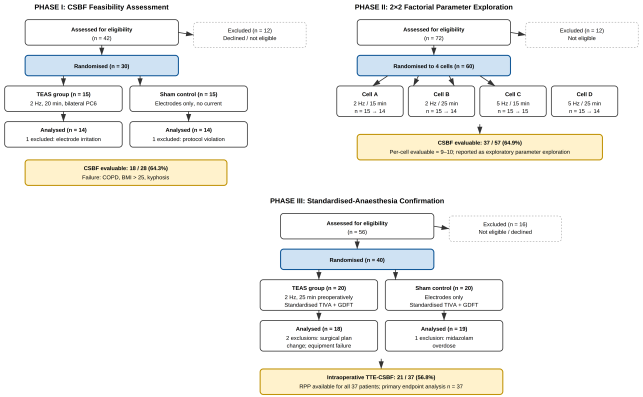
Figure 1. CONSORT flow diagram for the three-phase randomised pilot and feasibility trial.
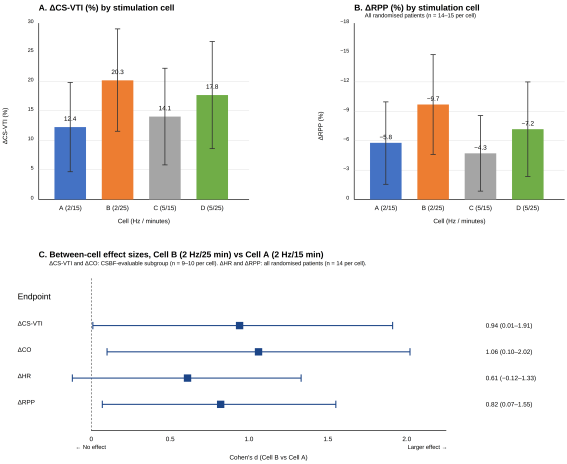
Figure 2. Exploratory parameter-exploration signals in Phase II. (a) ΔCS-VTI (%) by stimulation cell, CSBF-evaluable subgroup (n = 9–10 per cell); (b) ΔRPP (%) by stimulation cell, all randomised patients (n = 14–15 per cell); (c) between-cell Cohen's d with 95% confidence intervals comparing Cell B (2 Hz/25 min) with Cell A (2 Hz/15 min). Bars and points show mean ± SD.
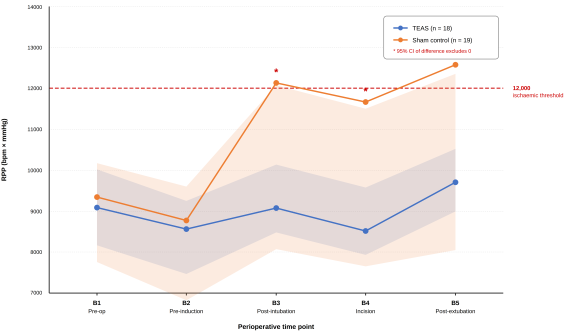
Figure 3. Perioperative rate-pressure product (RPP) trajectories in Phase III. TEAS (n = 18) versus sham control (n = 19). Points are group means ± SD at the five pre-specified perioperative time points (B1–B5; see Methods). The dashed line marks an RPP of 12,000; asterisks denote time points at which the 95% confidence interval of the between-group difference excludes zero.
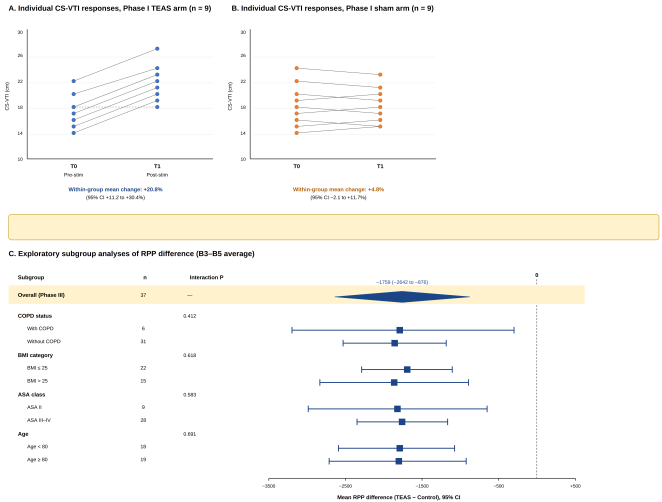
Figure 4. Individual patient data and exploratory subgroup analyses. (a) Paired CS-VTI responses in the Phase I TEAS arm (n = 9); (b) paired CS-VTI responses in the Phase I sham arm (n = 9); (c) forest plot of between-group RPP differences averaged across B3–B5 by pre-specified subgroups, showing the TEAS − control mean difference with 95% confidence interval (negative values favour TEAS).

Information



 Share This Article
 Twitter
 Linked In
 Facebook

 Copy
 Download