Research Article | | Peer-Reviewed

Impact of Ownership Structure and Liability Composition on Financial Performance: Evidence from Listed Food Firms in Bangladesh

Received: 19 January 2026     Accepted: 5 February 2026     Published: 4 March 2026
Views:       Downloads:
Abstract

This study examines the influence of ownership structure and liability management on the financial performance of publicly listed companies in Bangladesh, specifically focusing on return on assets (ROA) and profit after tax (PAT). A balanced panel dataset comprising 18 listed food firms over six years (2018–2023) was used to analyze the relationships between various investor categories- public, institutional, director, foreign, and government investors and financial performance by employing panel data regression models. The findings indicate that government ownership has a statistically significant adverse impact on ROA and PAT, implying possible inefficiencies or political effects linked to state ownership. In addition, public, institutional, director, and international investors have negative although statistically insignificant correlations with firm profitability, suggesting their minimal impact on performance outcomes. In contrast, short-term liabilities exhibit a robust and highly significant positive impact on PAT (p = 0.000), underscoring the importance of effective short-term financing in augmenting profitability, whereas long-term liabilities are statistically negligible. The models exhibit a strong explanatory power, indicating that ownership and liability structure collectively account for significant changes in business performance. These findings highlight the significance of ownership structure and debt maturity management in influencing financial results. The study offers significant insights for policymakers, regulators, and corporate executives aiming to refine governance processes and capital structures to improve business profitability in emerging economies such as Bangladesh.

Published in International Journal of Accounting, Finance and Risk Management (Volume 11, Issue 1)
DOI 10.11648/j.ijafrm.20261101.14
Page(s) 67-79
Creative Commons

This is an Open Access article, distributed under the terms of the Creative Commons Attribution 4.0 International License (http://creativecommons.org/licenses/by/4.0/), which permits unrestricted use, distribution and reproduction in any medium or format, provided the original work is properly cited.

Copyright

Copyright © The Author(s), 2026. Published by Science Publishing Group

Keywords

Ownership Structure, Liability Management, Profitability, Government Ownership, Random-effects GLS, Bangladesh

1. Introduction
1.1. Background of the Study
The stability and success of modern organizations are significantly shaped by capital and ownership structures. Ownership structure is an important component of the corporate governance framework which refers to the distribution of a company's equity among various classes of shareholders and identifies the ultimate controllers and decision-makers because it influences monitoring effectiveness, managerial control, and incentive alignment between owners and managers . Literature uses a variety of typologies and among them, following are some widely referred ownership categories. Public shareholding refers to the proportion of corporate shares owned by the public or community. When the public owns firm shares, it means they are willing to participate in the business because they have recognized its potential for profitability . Institutional ownership is the holding of shares in another business by corporate organizations. Such entities make capital investments for banks, insurance providers, and pension funds, entrusting them with significant fiduciary duties that drive them to perform well . Director’s ownership arises when executive management or the board of directors hold substantial stock, as insiders will be more inclined to enhance the company's success . Foreign ownership is determined by dividing the equity of foreign investors by the total equity of shareholders and the impact of foreign shareholders on business performance showed that a major source of funding and technological resources improves business performance . Government ownership arises when the state owns a major portion of a company. However, profit is not necessarily the primary goal, such ownership frequently ensures a long-term perspective . On the other side, a lot of research has been done on the capital structure decision-making process . However, the vast majority of empirical research focuses on publicly traded corporations that usually provide a variety of securities for trading .
From the previous research, it is concluded that two types of liability specially arise in capital structure. The ratio of current liabilities to total assets can be used to describe the amount of short-term debt which is defined as debt that needs to be paid back in full within a year including principal and interest and Long-term debt is used to finance an organization's assets through long-term loans and other commitments that have a duration longer than a year . However, In the current world, the debate to this day remains unresolved with some theoretical and empirical studies demonstrating that capital structure and ownership patterns positively affect firm performance while others show no such relationship among them . Similarly, the picture of Asia is also controversial where many researchers found a positive, negative and mixed association among ownership pattern, capital structure and firm performance . In Bangladesh, numerous studies on ownership structure have been carried out by scholars who noted that there should be a negative correlation between business performance and the degree of shareholding diffuseness . Ownership structure has a mixed effect on DSE30-listed companies in Bangladesh where ROA increases with foreign and sponsor ownership but decreases with institutional, government, and family ownership, and Tobin's Q is adversely impacted by government and family ownership .
However, food sector is a vital part of Bangladesh’s economy which significantly contribute to employment, food security, and GDP of this developing country. The agro and food-processing sector accounts for roughly 1.7% of the country's GDP, while the larger agriculture and related sector make up over 10.9% in FY2024–2025, according to the Bangladesh Investment Development Authority . Thus, it is clear that Bangladesh's food industry has been essential to the nation's economic growth, and as such, its continued survival is significant. Profitability is one of the most important criteria for evaluating the viability and performance of any industry because increased profitability shows that a business can raise sufficient capital. Since, previous researchers have not conducted broad research on Bangladesh’s food industry, a crucial question arise as how different ownership and capital structures impact business stock returns, profitability, growth, and financial performance. For this reason, this paper aims to explore the effect of ownership structure and liability management on financial performance of food sector, an emerging market, such as Bangladesh which has not been focused on before. There is still a pressing demand for more research in this area even though researchers have contributed to significant progress in understanding the efficacy of capital and ownership policies over the past few decades. Since, several empirical evidence found that the results have been inconclusive in investigating the role of ownership and capital structure on performance of the firm . This study investigates how ownership and liability structure affect business performance.
1.2. Objectives of the Research
The main purpose of the study is to investigate the impact of ownership and liability structure on firm performance of listed food companies in Bangladesh, specifically focusing on return on assets (ROA) and profit after tax (PAT) over the period 2018–2023. Other sub-objectives are:
1) To investigate the impact on ROA and PAT of directors' ownership, government ownership, institutional ownership, foreign ownership, public ownership and capital structure.
2) To examine the influence of liability structure on firm profitability of food companies.
2. Review of Literature and Hypothesis Development
The prior literature on the impact of ownership on firm performance presents a range of contrasting theoretical perspectives and empirical findings. The ownership structure is the unique and fundamental mechanism of corporate governance . Also, it has been a topic of debate among scholars whether there is any connection between it and company performance. The primary categories of ownership include public ownership, institutional ownership, director’s holdings, government ownership and foreign ownership.
2.1. Public Ownership and Firm Performance
Improved governance and resource allocation are key factors in determining firms’ financial performance and this performance is heavily influenced by public investors. Non-insider institutional and public investors often monitor firms closely which address agency concerns and enhance performance, as evidenced in Bangladesh and other emerging markets . Prior studies have found that firms with a significant number of public investors can lead to better-quality market performance and profitability and have a greater tendency to exhibit high levels of financial transparency and reporting standards . Similarly, Increased interaction with public shareholders may reduce a company's cost of capital and minimize information frictions, which improves market value and financial performance . In contrast, a prior literature found that, a higher proportion of public shareholders is associated with less favorable accounting performance and liquidity effects that are consistent with weaker governance . Also, an examination on ownership structure and board characteristics also demonstrates that dispersed public ownership frequently falls short of adequate board supervision, having negligible or negative effects on profitability across a range of criteria . Another empirical evidence shows that in listed manufacturing firms in Bangladesh the distribution of ownership linked with lower performance in terms of return on assets whereas better governance practices are often sought after by public investors. From the discussion above, the hypothesis can be developed in such a way:
H1. There is a positive relationship between public ownership and firm performance.
2.2. Institutional Ownership and Firm Performance
Institutional investors expand firm performance by reducing costs and aligning managers’ goals with shareholders’ interests, . A study examines how institutional ownership affects the financial performance of 150 publicly traded Nigerian companies between 2014 and 2023 using a random effects model and the finding represents a strong and positive correlation between institutional ownership and firm performance as determined by return on assets (ROA) . Another study found a correlation between institutional ownership and ROA as well as stock returns, highlighting the crucial role of public investors in boosting profitability and market valuation . Furthermore, Institutional ownership brings benefits such as improved corporate governance, effective boards, transparent financial statements, and disciplined capital allocation ]. In Addition, sustainable institutional investors “walk the talk” by fostering green innovation . In contrast, prior research reveals that institutional ownership negatively influences firm performance, using 396 firm-year observations and multiple panel data regressions . Furthermore, according to the study, which is based on 200 observations from DSE-listed pharmaceutical and chemical companies in Bangladesh between 2013 and 2022, Institutional ownership is strongly and favorably correlated with business performance whereas report that institutional ownership has negative impact on firm performance, investigating how ownership forms affect the performance of 324 financial institutions in Bangladesh. Therefore, from the empirical studies we posited:
H2. There is a positive relationship between Institutional ownership and firm performance.
2.3. Director’s Ownership and Firm Performance
Directors or top managers who own shares can help improve company performance. Previous studies have presented unstable findings regarding the impact of director’s ownership on firm performance . The study, which uses data from Bangladeshi companies listed on the DSE30, concludes that sponsor ownership has a positive correlation with return on assets (ROA) . According to , director ownership has a significant and positive relation with financial performance whereas another study shows that there is no significant relationship between firm performance and director ownership . Some research finds that higher director’s ownership gives rise to enhanced firm performance and producing a positive relationship . Additionally, based on a sample of 112 publicly traded Malaysian companies in 2006, the study concludes that managerial ownership significantly and favorably affects firm performance as determined by return on assets (ROA) . However, other empirical research reports a negative relationship showing argument that managers maintaining a large ownership stake may be more focused on their own interests than the interests of external shareholder’s and as a result this leads to diminishing firm performance . Also, in a study it is reported that managerial ownership significantly and negatively affects the performance of Nigerian listed companies . Thus, the hypothesis can be developed in such a way:
H3. There is a positive relationship between Director’s ownership and firm performance.
2.4. Foreign Ownership and Firm Performance
Foreign investors participation in a company’s capital structure usually receives favorable feedback from prospective investors. In a prior study, examined the top 50 listed firms in Bangladesh from 2015 to 2019 and the result represent that foreign ownership has a positive and significant effect on firm performance. In addition, foreign ownership increases firm performance and eradicates agency problems . Moreover, Numerous prior research investigations have consistently demonstrated a positive correlation between foreign ownership and business performance . On the other hand, investigating the impact of shareholding structure on the performance of listed conglomerate firm in Nigeria, it was discovered that foreign ownership had no significant effect on performance . However, found that foreign stockholdings are positively and significantly correlated with both market and accounting performance measurements. In contrast examined manufacturing companies in Indonesia and discovered that there is no significant positive effect on financial performance due to foreign ownership. However, according to a study of 264 non-financial companies registered on the Indonesia Stock Exchange, firm performance (ROA and ROE) is significantly improved by foreign ownership . However, foreign investors perform careful evaluations because of their limited information access when compared to their domestic investors before investments. Based on these opinions, the study proposes that:
H4. There is a positive relationship between foreign ownership and firm performance.
2.5. Government Ownership and Firm Performance
The government ownership describes a situation in which the government controls share of a business and appoint a number of powerful representatives to its board of directors . The analysis of 324 financial enterprises listed on the DSE reveals a positive relationship between government ownership and ROE, emphasizing the impact of ownership structures on business performance . Another study finds a U-shaped relationship between government ownership and firm, using data from 47 countries . Similarly, using meta-analysis, previous research examined the relationship between ownership structure variables and business performance in the Middle East, and the main conclusions indicate that the majority of ownership structure variables (for example: government ownership) have a strong positive correlation with firm performance . In contrast, a previous study examines how board composition and ownership structure affect business performance in developing market economies with an emphasis on Bangladesh and the findings indicated that government ownership and business performance metrics like ROA, ROE, and TOBINQ were statistically negatively correlated . Government ownership has been demonstrated to have significant and positive influence on business performance whereas report that both are negatively correlated. However, when the government seems to utilize firms’ wealth for its own ends, government ownership sometimes negatively affects firms’ performance because investors have traditionally seen it as controversial . Another Prior study found a positive and significant relationship between government ownership and firms’ market performance . In contrary, based on these discussions, we posited:
H5. There is a positive relationship between government ownership and firm performance.
2.6. Short Term Liability and Firm Performance
Short-term liabilities provide firms with the necessary working capital to support operational activities, manage liquidity efficiently and invest in growth opportunities . In a prior study, examined listed manufacturing firms in Nigeria and report that short term debt positively influences firm performance. On the other hand, it has been shown that the short-term debt coefficient for ROA and short-term debt in the random effects model is negative and a statistically significant factor in predicting ROA . Another study on Chinese small and medium-sized enterprises (SMEs) indicates that short-term debt (STD) has a favorable and significant effect on company performance, as assessed by return on equity . Similarly, a previous study of listed agricultural enterprises in Nigeria (2014-2023) using robust least squares regression reveals that current liabilities have a positive and substantial influence on market value . However, a study of industrial firms listed on the Ghana Stock Exchange (2015-2023) reveals a significant negative association between short-term debt and firm performance as assessed by return on assets . Moreover, using data from 78 DSE-listed enterprises from 2017 to 2021, it was discovered that short-term debt positively and substantially associated to ROE at the 1% significance level (Ahmed et el., 2024) whereas another empirical analysis of 8,459 observations from 769 Vietnamese listed businesses (2012-2022) reveals that short-term debt ratios have a negative impact on firm performance . Therefore, from this discussion we assert,
H6. There is a positive relationship between short-term liability and firm performance.
2.7. Long Term Liability and Firm Performance
Long-term liabilities refer to the financial obligations that the organization is not expected to pay off within one year . Loans, bonds, leases, and pension obligations are examples of long-term liabilities that are vital component of company's capital structure and provide funding for significant expenditures that support long-term growth. Non-current liabilities had a favorable and statistically significant impact on the market value of Nigerian listed agricultural companies . Likewise, found a considerable impact on a company's success exerted by long-term debt, indicating that if long-term liabilities are used effectively, it may be beneficial. In the same way, it is also found that, long-term debt has a favorable and statistically significant effect on the performance of Nigerian consumer goods enterprises, which support the idea that long-term financing promotes growth and stability . Furthermore, Long-Term Debt Financing (LTDF) has a positive and significant influence on Net Assets Per Share (NAPS), which demonstrates its function in improving business performance and directing investment choices . In contrast, Ahmed et al., found that long-term debt considerably reduces shareholder value in Nigerian oil and gas companies suggesting that the market impact of long-term debt is largely dependent on the sectoral dynamics and the goal for which it is used. Furthermore, noted that long-term debt has an adverse impact on market value in capital-intensive companies, emphasizing the dangers of fixed financial commitments and debt burden. Despite these contrasting findings, Juwono & Santoso observed that companies that used bond financing had higher values because structured debt markets provide clarity and investor trust. Therefore, based on previous study, the hypothesis can be developed in such a way:
H7. There is a positive relationship between long-term liability and firm performance.
2.8. Conceptual Framework
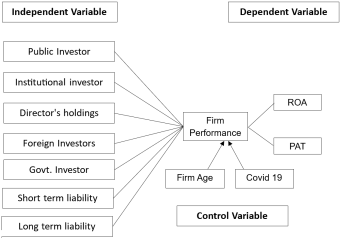
From literature reviews, the following conceptual framework is developed:
Figure 1. Conceptual Framework.
3. Methodology
3.1. Sample Data Sources and Collection Method
The nature of the research is quantitative. Data employed in the study were derived from annual reports of Food and Allied firms listed on Dhaka stock exchange and ranges from 2018 to 2023. From 21 listed food firms, three firms were deleted due to unavailability of data from 2018. For analyzing the data, we used descriptive statistics, correlation and regression techniques.
3.2. Variables Definition
Based on the literature review, the researcher found some factors that represent ownership, liability and firm performance. The explanatory independent variables are public ownership, institutional ownership, director's ownership, foreign ownership and govt. ownership, short term liability, long term liability while return on assets and profit after tax are the dependent variable.
Table 1. Summery for terms of variable measurement.

Variables

Symbol

Details Explanation

Dependent Variables

Return on Assets

ROA

Profit after tax divided by shareholders' Assets

Profit After Tax

PAT

net profits of the company after deduction of taxes

Independent Variables

Public Ownership

PO

Ratio of shares held by public investors

Institutional Ownership

IO

Ratio of shares held by institutional investors

Director's Ownership

DO

Ratio of shares held by Director's holdings

Foreign Ownership

FO

Ratio of shares held by foreign investors

Govt. Ownership

GO

Ratio of shares held by Govt. Investors

Short term liability

STL

Total current liabilities of the firm payable within a year

Long term liability

LTL

Total non-current liabilities of the firm payable after one year

Firm Age

F_age

The number of years since the firm's incorporation

Covid 19

Covid_19

A dummy variable (0/1) to indicate the pre/post-pandemic (0) and pandemic (1) periods

3.3. Regression Models
The models used are in line with past studies on the impact of firm size and shareholdings. A popular statistical technique known as regression analysis is used to determine the relationship between one dependent variable and one or more independent variables . Thus, the models used in this study are the following:
Model 1:
Y(ROAit)= α + b1POit + b2IOit+ b3DOit +b4Foit +b5Goit +B6 STLit +B7LTLit + B8F_age+B9Covid_19+ εi,t
Model 2:
Y(PATit)=α + b1POit + b2IOit+ b3DOit +b4Foit +b5Goit +B6 STLit +B7LTLit + B8F_age+B9Covid_19+εi,t
4. Data Analysis and Results
4.1. Descriptive Statistics
Table 2. Showing the descriptive statistics.

Variables

Minimum

Maximum

Mean

Std. Deviation

ROA

-571.90

65.54

-17.6372

70.95346

PAT

-7.14E8

1.79E10

8.1473E8

3.24014E9

PO

.01

.85

.4149

.20868

IO

.00

.47

.1280

.10974

DO

.00

.99

.3740

.22691

FO

.00

.44

.0283

.08265

GI

.00

.51

.0594

.16035

STL

2437128.00

4.04E10

2.4917E9

6.66454E9

LTL

-4.21E9

9.82E9

7.9149E8

1.92290E9

F_age

7

51

27.888889

9.087666

Covid_19

0

1

0.333333

0.474045

Source: Authors Calculation based on annual reports.
Firm Performance: Table 2 represents overview of the descriptive statistics of all variables. During the research period, the average ROA for Food firms was -17.6372, with the highest at 65.54 and the lowest at almost -571.90. For this time, PAT ranged from -7.14E8 to 1.79E10, with an average of 8.1473E8. In terms of sample variation, the standard errors of ROA and PAT were 70.95346, and 3.24014E9, respectively.
Ownership Structure: According to Table 2, the public ownership is the largest shareholder, holding the highest percentage of average value 41.49%, with minimum value of 1% and the maximum value is 85%. On the other hand, director’s ownership is in second place with an average value of 37.40%, with observed values spanning from a minimum of 0% to maximum 99%. Since the founders of a company are its sponsors and directors, they tend to prioritize holding a larger portion of share as a corporate standard. However, institutional ownership occupies third position with the mean value of ownership 12.80%, where the minimum value varying between 0% and 47%. Institutional owners always grab investment possibilities in a variety of companies since they are concerned with safety and the necessary return. Our findings show that foreign and government ownership are almost identical, with average ownership rates of 2.83% and 5.94%, respectively. Thus, the lower government ownership can be associated to the government's emphasis on state-run enterprises rather than other commercial firms, but minimal foreign ownership may be due to motives such as macroeconomic stability, long-term goals, and investor safety concerns.
Liability Composition: The short-term liability (STL) has an average value of 2.4917E9 and ranges between 2437128 to 4.04E10, whereas the mean of the long-term liability (LTL) is 7.9149E8 and ranges between -4.21E9 to 9.82E9.
However, firm age has an average value of 27.888889 where the minimum and maximum values are 7 and 51 respectively with a standard deviation 9.087666. The mean value of Covid_19 is 0.333333 with standard deviation 0.474045 and minimum and maximum values are 0 and 1 respectively.
4.2. Correlation Matrix
Table 3. Showing the correlation matrix.

Variables

PO

IO

DO

FO

GO

STL

LTL

F_age

Covid_19

PO

1

IO

-.383**

1

DO

-.702**

.124

1

FO

-.429**

.149

.074

1

GO

.121

-.419**

-.576**

-.125

1

STL

-.418**

.060

.288**

.297**

.035

1

LTL

-.345**

.043

.238*

.186

.069

.778**

1

F_age

0.0375

-0.4403**

0.1381

-0.02011

0.0605

0.00907

-0.0652

1

Covid_19

-0.0198

0.05821

-0.01201

0.00386

0.0000

0.00179

-0.0041

-0.000

1

Source: Authors Calculation based on annual reports.
The Pearson correlation matrix has been employed to analyze the connections among the independent variables in Table 3. The findings show that determinants of ownership structure and indicators of debt financing exhibited various degrees of correlation here. Public ownership (PO) has a significant negative correlation with institutional ownership (IO) (r= -0.383, p <0.01), director ownership (DO) (r= -0.702, p <0.01), foreign ownership (FO) (r = -0.429, p <0.01), short-term liabilities (STL) (r= -0.418, p <0.01), and long-term liabilities (LTL) (r = -0.345, p <0.01). These findings indicate that enterprises with larger public ownership have lower concentrations of other ownership types and leverage levels. Also, Institutional ownership (IO) and government ownership (GO) have a significant negative correlation (r = -0.419, p < 0.01) which indicate a substitution effect between institutional and government participation in firm equity. Additionally, IO has minor positive relationships with director ownership (r = 0.124) and foreign ownership (r = 0.149), but these are not significant statistically. Similarly, the correlation between director ownership (DO) and government ownership is significantly negative (r = -0.576, p < 0.01), whereas it is positively associated with both short-term (r = 0.288, p < 0.01) and long-term (r= 0.238, p < 0.05) liabilities. Thus, it suggests that businesses that have more directors may depend more on debt financing. Furthermore, Foreign ownership (FO) positively correlated with both short-term (r= 0.297, p <0.01) and long-term (r= 0.186) liabilities, indicating that foreign investors are more interested to invest in companies that use moderate amounts of leverage. However, a significant positive connection (r= 0.778, p <0.01) is seen between short-term liabilities (STL) and long-term liabilities (LTL), suggesting that companies with larger levels of short-term debt are also likely to have higher levels of long-term commitments. Firm age has a strong negative correlation with Institutional ownerships with co-efficient (r= -0.4403, p <0.01). In contrast, Covid 19 does not have any significant effect on other variables here. Overall, even though some variables show moderate correlations, all of the coefficients remained below the crucial 0.80 threshold , indicating that multicollinearity is not a significant issue and that the variables can be reliably included in further regression analyses.
4.3. Test of Autocorrelation and Multicollinearity
Table 4. Showing the Multicollinearity and Auto Correlation Statistics Using VIF.

Variables

Collinearity-Statistics

Collinearity-Statistics

Tolerance

VIF

Tolerance

VIF

PO

.621

1.610

.288

3.478

IO

.781

1.280

.794

1.260

DO

.542

1.846

.417

2.398

FO

.854

1.171

.674

1.484

GO

.486

2.058

.486

2.058

STL

.201

4.972

.203

4.927

LTL

.221

4.515

.222

4.512

Covid_19

.995

1.005

.995

1.005

F_Age

.638

1.568

.638

1.568

Dependent Variable

ROA

PAT

Durbin-Watson Statistics

1.818

1.837

Source: Authors’ Calculation based on annual reports
Table 4 shows the tolerance and variance inflation factor (VIF) values for all independent variables in the ROA and PAT models. A tolerance value less than 0.10 or a VIF more than 10 suggests the possibility of multicollinearity concerns . The results reveal that all variables had tolerance values more than 0.10 and VIF values remained far below 10, indicating that the independent variables do not exhibit significant multicollinearity. Although VIF values for short term liabilities (STL) and long-term liabilities (LTL) are considerably higher (4.972 and 4.515, respectively, in the ROA model), they remain within an acceptable range, indicating considerable but not severe collinearity. In addition, the ROA and PAT models' Durbin-Watson statistics were 1.818 and 1.837, respectively, which are falling within the acceptable range of 1.5 to 2.5, suggesting that neither regression model's residuals have a substantial autocorrelation issue. Furthermore, in ROA and PAT models, F_age and Covid_19 show no collinearity issues with Tolerance values of (.638,.995) and VIFs of (1.568, 1.005) respectively, which confirm their independence as reliable controls for experience-based stability of the firm’s and pandemic effects in firm performance.
4.4. Regression Results
In Table 5, the results of multiple regression using the "pooled OLS", and "random effects (RE)" models are presented. The Breusch and Pagan LM test validate the random effects model’s reliability over pooled OLS method which revealed significant effects for both ROA (χ² = 219.09, p < 0.01) and PAT (χ² = 2092.88, p < 0.01) whereas the Hausman test results for ROA (χ² = 2.47, p = 0.6502) and PAT (χ² = 3.68, p = 0.4732) were not statistically significant and indicate that the random effects model is reliable and suitable for interpretation the findings. With R² values of 0.6866 for ROA and 0.9798 for PAT, both models exhibit a strong explanatory power, explaining 69% and 98% of performance variation, respectively. However, the F-statistics are statistically significant in both models (F7,100) = 31.30, p < 0.01 for ROA; F(7,100) = 691.56, p < 0.01 for PAT), suggesting that the combined effect of the included independent variables on business performance is statistically significant.
Table 5. Showing the regression results using panel regression models.

Model 1

Model 2

Model

OLS

Random

OLS

Random

Variable

ROA

ROA

PAT

PAT

PO

-53.94621

(-0.26)

62.68

(0.62)

4.61e+08

(-0.19)

-2.02e+09

(-0.84)

IO

-28.38166

(-0.14)

91.40

(0.89)

3.80e+08

(-0.16)

-1.94e+09

(-0.82)

DO

-42.51692

(-0.21)

61.17

(0.60)

1.57e+08

(0.07)

-1.63e+09

(-0.69)

FO

20.64185

(0.10)

99.77

(0.98)

3.99e+08

(0.16)

-5.76e+08

(-0.25)

GO

-390.31330*

(-1.87)

-.0387991**

(-2.25)

3.46e+09

(-1.43)

-5.19e+09**

(-2.17)

STL

4.48e-09***

(3.26)

1.09e-09 (2.29)**

0.4625426***

(28.99)

.447663***

(27.56)

LTL

1.93e-08***

(4.40)

-2.82 e-09

(-1.62)

0.0190812

(0.37)

.0606256

(1.26)

F_Age

.3605***

(3.24 )

.160

(1.02)

4.72e+07

(1.41)

1.09e+07

(1.62)

Covid_19

-5.069**

(-2.59)

-4.312***

(-2.73)

-3.59e+08

(-0.61 )

-5.33e+07

(-0.57)

Breusch and pagan

Waldchi2(7)=219.09

Prob> chi2=0.0000

Waldchi2(7)=2092.88

Prob>chi2=0.0000

Hausman-Test

Chi2 = 2.47

Prob> Chi2=0.6502

Chi 2=3.68

Prob> Chi2 =0.4732

R2

0.6866

0.6798

F Test

F(7,100)=31.30

Prob> F=0.0000

F (7,100)=691.56

Prob >F=0.0000

N

108

108

108

108

Group

18

18

18

18

Source: Authors Calculation based on Annual Reports.
Note:- *, **, and *** are showing significance level at 10%, 5%, and 1%, respectively.
Each model examined the interplay between the ownership structure indicators (PO, IO, DO, FO, GO), Composition of liabilities indicators (STL and LTL) and company performance (ROA and PAT). The results of Model 1, as presented in Table 5, indicate that the govt. ownership (GO) has a negative and statistically significant impact on ROA at the 10% significance level (t = -1.87) in OLS and Random effects indicating that a higher government shareholding is associated with low profitability. However, when examining the short-term liability (STL) and long-term liabilities (LTL), the estimation results show a strong and significant positive relationship with ROA (t = 4.48 and t=4.40) in OLS regression model. There is no significant impact on ROA fluctuations of other ownership variables such as PO, IO, DO, and FO. Moreover, ROA is positively impacted by company age at 0.3605*** (OLS, t=3.24) and 0.160 (random, t=1.02), suggesting that older businesses generate better returns on assets. Covid_19 has a negative impact on ROA at -5.069** (OLS, t=-2.59) and -4.312*** (random, t=-2.73), reflecting losses in profitability brought on by the pandemic.
In contrast, Model 2 (PAT) showed similar findings. When the Random Effects model have employed, the government ownership (GO) is still significant and present a negative relationship with firm performance (β = -5.19e+09, t = -2.17), which support the idea that government intervention may reduce profitability. However, short-term liabilities (STL) show a strong positive correlation with PAT (β = 0.447663, t = 27.56) and indicating that firms can enhance profitability by employing short-term financing successfully. On the other hand, long-term liabilities (LTL) are positively correlated but statistically insignificant. Additionally, PAT regressions show negligible impacts of Covid-19 (t=-0.57 to -0.61) and firm age (t=1.41-1.62), suggesting that maturity and pandemic shocks do not influence absolute profits in these models. Overall, the results demonstrate that government ownership continuously has a negative impact on financial performance, even when most ownership variables do not significantly affect it. Firm profitability is significantly influenced by capital structure variables, especially short-term liabilities.
5. Discussion
The study proved that government ownership negatively influences the profitability of the food firms in emerging markets. Thus, firms that have much government shareholder can hurts firms’ financial performance and the outcome contradicts the hypothesis drawn from agency theory (Hypothesis 5). The reason could be that government representatives appointed to managerial positions through political channels rather than merit-based criteria, may lack the requisite professional expertise, managerial competence, or genuine commitment needed to execute their responsibilities effectively . Thus, when government ownership increases, the corporation may experience weakened financial performance because management may prioritize political aims over profitability . However, according to the results of pooled panel regression analysis, short term liability (STL) is correctly signed in line with the presumed expectation. Short-term liability shows a positive effect on profitability which is measured by PAT, in both the OLS and Random-effects regressions, as reflected in their respective coefficients of 0.4625426 and 0.447663. According to , organizations that rely heavily on short-term liabilities are more likely to be profitable. Conversely, long-term liabilities do not exert any significant effect on firm performance according to the pooled regression analysis in the study where the coefficients are 0.0190812 and .060625 respectively. Thus, long-term borrowing may not effectively impact on firms’ profitability due to ineffective allocation of borrowed funds, higher financing costs, or long project cycles which is in line with the agency theory . However, long-term investments require effective loan utilization to create enough earnings to repay loans, cover costs, and distribute surpluses . Furthermore, Firm age positively increases ROA but it has negligible effects on PAT, while Covid-19 exerts a strong negative impact on ROA but stays non-significant for PAT, which highlighting their divergent roles as controllers in ownership-performance dynamics for Bangladeshi food firms.
6. Conclusion
This study focused on food firms listed on Bangladeshi stock market to examine the impact of different ownership and capital structure measures on firm financial performance during 2018 to 2023. This study concludes that four of the five ownership structure variables, public ownership, director ownership, institutional ownership, and foreign ownership, are not significantly associated with financial performance, whereas the remaining variable, government ownership, is negatively and significantly associated with financial performance. That means, the higher the government ownership, the financial performance will decrease. Therefore, the negative relationship between government ownership and financial performance suggests that government-controlled firms may operate differently from those with other ownership types. In Bangladesh, while an effective ownership structure is intended to foster swift decision-making, in case of driving efficiency and stronger financial outcomes, state-run enterprises often contend with inefficiencies, bureaucratic hurdles, and unresponsive management practices , which can contribute to their relatively lower performance . Additionally, it was found that short-term debt would play important roles in a firm’s financial performance (measured by ROA and PAT). On the contrary, long-term liabilities do not present a notable effect on dependent variables except in OLS model, since their costs and risks may diminish potential benefits and limit their positive impact on profitability. However, when the board of directors propose financial strategies, ownership configuration and debt management are meaningful factors to them in an effort to maximize profit. This study contributes by providing empirical evidence on the relationship between ownership and liability structure and firm performance in Bangladesh, which extend both existing theory and inform future research. Also, the outcomes of the study may hold importance for policymakers, regulators & business leaders in Bangladesh’s food industry. Though government ownership typically has a negative impact on financial performance, to decrease the financial disadvantages associated with state ownership, it's crucial to eliminate bureaucratic inefficiencies and enhance corporate governance standards for state-owned enterprises. Besides, executives or managers may consider utilizing short-term financing, since it provides greater planning flexibility and enhances value performance compared to long-term debt, especially during non-recession periods. The investigation offers important insights for creating better plans that encourage effective decision-making, transparency, and sustainable growth thereby ultimately encouraging stronger economic growth in this sector.
Despite its significant contribution to Bangladesh's food sector, the present study has certain limitations that need to be addressed. Firstly, the findings include only publicly traded Bangladeshi food firms’ and generalizing them to other settings, such as a private sector or foreign restaurant markets, should therefore be done cautiously. Still, our findings can provide managers with insights to make decisions in shaping its ownership structure and debt financing. Moreover, future researchers can widen their research scope by incorporating additional years of data, variables not addressed in this study, various models or industries, and make new expansions in ownership structure and Liability management related issues.
Abbreviations

ROA

Return on Assets

PAT

Profit After Tax

PO

Public Ownership

IO

Institutional Ownership

DO

Director's Ownership

FO

Foreign Ownership

GO

Govt. Ownership

STL

Short Term Liability

LTL

Long Term Liability

F_age

Firm Age

Author Contributions
Masum Mia: Conceptualization, Resources, Writing – original draft, Formal Analysis
Mst. Hasna Banu: Data curation, Methodology, Funding Acquisition
Sumi Saha: Formal Analysis, Investigation, Project Administration
Raj Kumar Moulick: Software, Writing – review & editing, Funding Aquisition
Meharab Khan Syan: Resources, Data Curation, Validation
Md. Sumon Hossain: Visualization, Supervision, Formal Analysis, Writing – review & editing
Funding
The research project is prepared by authors’ self-funding.
Conflicts of Interest
The authors declare that they have no conflicts of interest relevant to this study.
References
[1] Abdulmumin, B. A., Kolawole, D. K., & Yunus, A. B. (2024). Enhancing Corporate Performance through Debt Financing: Evidence from Nigerian Consumer Goods Firms. Economic Studies & Analyses/Acta VSFS, 18(1).
[2] Abedin, S. H., Haque, H., Shahjahan, T., & Kabir, M. N. (2022). Institutional ownership and firm performance: evidence from an emerging economy. Journal of Risk and Financial Management, 15(12), 567.
[3] Ahmed, A. M., Nugraha, D. P., & Hágen, I. (2023). The relationship between capital structure and firm performance: The moderating role of agency cost. Risks, 11(6), 102.
[4] Ahmed, F., Rahman, M. U., Rehman, H. M., Imran, M., Dunay, A., & Hossain, M. B. (2024). Corporate capital structure effects on corporate performance pursuing a strategy of innovation in manufacturing companies. Heliyon, 10(3).
[5] Ahmed, H., Uddin, M., & Masum, M. H. (2021). The inclination of corporate voluntary environmental disclosure in Bangladesh: Effect of size, Industry, and operating performance. Academy of Strategic Management Journal, 20(2), 1-6.
[6] Akinyomi, O. J. (2013). Effect of capital structure on firms performance: Evidence from Nigerian manufacturing company. International Journal of Innovative Research and Studies, 2(9), 783-795.
[7] Al Farooque, O., Van Zijl, T., Dunstan, K., & Karim, A. W. (2007). Corporate governance in Bangladesh: Link between ownership and financial performance. Corporate governance: An international review, 15(6), 1453-1468.
[8] Alabdullah, T. T. Y. (2018). The relationship between ownership structure and firm financial performance: Evidence from Jordan. Benchmarking: An International Journal, 25(1), 319-333.
[9] Al-Janadi, Y. (2021). Ownership structure and firm performance in the middle east: A meta-analysis. Journal of Risk and Financial Management, 14(12), 577.
[10] Anaike, C. L., Frances, C. C., & Nworie, G. O. (2025). Maximising the Market Value of ListedAgricultural Firms in Nigeria: The Additive Role of Firm Debt Level. IIARD International Journal of Economics and Business Management, 11(4), 304-321.
[11] Balagobei, S., Subramaniam, V. A., & Saseela, B. (2024). Ownership Structure and Firm Performance with Moderating Role of Financing Decisions: Evidence from Listed Companies in Sri Lanka.
[12] Bangladesh Investment Development Authority, (2024).
[13] Baum, C. F., Schäfer, D., & Talavera, O. (2006). The effects of short-term liabilities on profitability: the case of Germany (No. 635). DIW Discussion Papers.
[14] Bhakar, S., Sharma, P., & Kumar, S. (2024). Ownership structure and firm performance: A comprehensive review and empirical analysis. Journal of the Knowledge Economy, 15(4), 19824-19865.
[15] Bhuiyan, M. N. U., & Masum, M. H. (2010). Balanced scorecard: A multi-stream performance measurement tool for public sector corporations in Bangladesh. The Cost and Management, 38(5), 19-25.
[16] Bhuiyan, M. R. I., Akter, M. S., & Islam, S. (2025). How does digital payment transform society as a cashless society? An empirical study in the developing economy. Journal of Science and Technology Policy Management, 16(4), 756-774.
[17] Boshnak, H. (2023). The impact of capital structure on firm performance: evidence from Saudi-listed firms. International Journal of Disclosure and Governance, 20(1), 15-26.
[18] Bui, T. N., Nguyen, X. H., & Pham, K. T. (2023). The effect of capital structure on firm value: A study of companies listed on the Vietnamese stock market. International Journal of Financial Studies, 11(3), 100.
[19] Bushee, B. J. (2001). Do institutional investors prefer near‐term earnings over long‐run value? Contemporary accounting research, 18(2), 207-246.
[20] Cao, Y., Li, Y., Xia, Z., & Zhang, Y. (2025). Sustainable institutional investors and green innovation: evidence from Chinese listed firms. Emerging Markets Finance and Trade, 61(4), 925-939.
[21] Chung, R., Firth, M., & Kim, J. B. (2002). Institutional monitoring and opportunistic earnings management. Journal of corporate finance, 8(1), 29-48.
[22] Chen, X., Harford, J., & Li, K. (2007). Monitoring: Which institutions matter? Journal of financial Economics, 86(2), 279-305.
[23] Cornett, M. M., Marcus, A. J., Saunders, A., & Tehranian, H. (2007). The impact of institutional ownership on corporate operating performance. Journal of banking & finance, 31(6), 1771-1794.
[24] Das, S. K., Alam, S., Islam, M. J., Boby, F., & Begum, R. (2024). Does ownership pattern affect firm performance? Empirical evidence from an emerging market. International Journal of Disclosure and Governance, 21(3), 406-420.
[25] Desai, R. (2024). Nexus Between Debt Financing and Market Value Moderated by Firm Size: Panel Data Evidence from India. Vision, 28(5), 633-644.
[26] Ekokotu, R. N. (2025). Capital Structure and Performance of Listed Manufacturing Firms in Nigeria.
[27] Ganiyu, Y. O., Adelopo, I., Rodionova, Y., & Samuel, O. L. (2019). Capital structure and firm performance in Nigeria. African Journal of Economic Review, 7(1), 31-56.
[28] Gujarati, D. N. (2009). Basic econometrics.
[29] Hair Jnr, J. F., Black, W. C., Babin, B. J., & Anderson, R. E. (2010). Multivariate data analysis.
[30] Hassan, S., Othman, Z., & Harun, M. (2020). Ownership structure variation and firm efficiency. arXiv preprint arXiv: 2001.05575.
[31] Hossain, R., Ghose, P., Chowdhury, T. M., Hossen, M. D., Hasan, M. N., & Mani, L. (2024). Ownership Structures and Firm Performance: A Correlation and Regression Analysis of Financial Institutions in Bangladesh. Pak. j. life soc. Sci, 22(2), 6278-6295.
[32] Hossen, M. S., Roy, S., & Masum, M. H. (2023). Financial performance of engineering companies in an emerging economy: Before and after COVID-19. Research In Management and Accounting (RIMA), 6(2), 73-90.
[33] Huang, L., Liu, J., Shi, J., & Ying, Q. (2024). Retail investors matter: The value of corporate interactions. Research in International Business and Finance, 69, 102226.
[34] Ikwuo, A. K., Nwite, I. M., Nworie, G. O., & Nworie, F. N. (2025). Shareholder value diminution through long-term debts: Evidence from the Nigerian oil industry. Annals of Management and Organization Research, 6(3), 271-285.
[35] Islam, M. N. (2023). The Effect of Ownership Structure on Financial Performance of Bangladeshi Listed Pharmaceutical Companies. The Cost and Management, 51(4), 27-39.
[36] Jaffar, R., & Abdul-Shukor, Z. (2016). The role of monitoring mechanisms towards company’s performance: Evidence from politically connected companies in Malaysia. Journal of Accounting in Emerging Economies, 6(4), 408-428.
[37] Juwono, H. P., & Santoso, E. B. (2025). The Effect Of Debt Choice On Firm Value. Jurnal Akuntansi Kontemporer, 17(1), 53-66.
[38] Kaimal, A., & Uzma, S. H. (2024). CSR and ownership structure: Moderating role of board characteristics in an emerging country context. Corporate Social Responsibility and Environmental Management, 31(5), 4933-4955.
[39] Kamardin, H. (2014). Managerial ownership and firm performance: The influence of family directors and non-family directors. In Ethics, governance and corporate crime: challenges and consequences (pp. 47-83). Emerald Group Publishing Limited.
[40] Khan, I., Saha, A. K., Kamal, Y., & Islam, M. S. (2025). Do ownership structure and board composition matter in firm performance? Regulatory influence in developing economy. International journal of disclosure and governance, 22(1), 263-283.
[41] Kumbankyet, J., Anaman, P. D., Donkor, C., & Akyen, B. (2025). The Impact of Short-Term Debt on the Performance of Manufacturing Companies Listed on the Ghana Stock Exchange. International Journal of Latest Technology in Engineering, Management & Applied Science, 14(1), 41-50.
[42] Liu, K. (2018). The relation between government ownership and firm performance: Evidence from cross-country datasets. International Journal of Business, 23(2), 183-197.
[43] Maniruzzaman, M., Hossain, S. Z., & Sayaduzzaman, M. (2024). Ownership concentration and corporate financial performance: A study on listed manufacturing companies in Bangladesh. The cost and management, 51(06), 12-22.
[44] Maverick, J. B. (2022). Is profitability or growth more important for a business. Investopedia. Retrieved November, 4, 2023.
[45] Michaelas, N., Chittenden, F., & Poutziouris, P. (1998). A model of capital structure decision making in small firms. Journal of small business and enterprise development, 5(3), 246-260.
[46] Muttakin, M. B., & Ullah, S. (2012). Corporate governance and bank performance: Evidence from Bangladesh. Corporate Governance and Bank Performance: Evidence from Bangladesh (October 1, 2012). Corporate Board: Role, Duties & Composition, 8(1).
[47] Nanjundaswamy, A., Divyashree, M. S., Suraj, N., Kulal, A., Rahiman, H. U., & Kodikal, R. (2025). Adapting accounting education to evolving business paradigm-an Indian perspective. Journal of Applied Research in Higher Education, 17(5), 1914-1943.
[48] Nazir, M. S., & Afza, T. (2009). Impact of Aggressive Working Capital Management Policy on Firms' Profitability. IUP Journal of Applied Finance, 15(8).
[49] Nie, J., & Ye, S. (2022). Ownership structure, corporate governance, and performance of listed companies—an empirical application of a semi-parametric quantile regression model. Sustainability, 14(24), 16590.
[50] Nugroho, A. C., Febrianto, D., Tyasti, A. E., & Kuswibowo, C. (2020). The impact of foreign investor ownership level on agency problems of manufacturing companies in Indonesia. Journal of Accounting and Investment, 21(1), 61-73.
[51] Ogabo, B., Ogar, G., & Nuipoko, T. (2021). Ownership structure and firm performance: The role of managerial and institutional ownership-evidence from the UK. American Journal of Industrial and Business Management, 11(7), 859-886.
[52] Okanda, T. L., Zhang, J., Sarfo, P. A., & Amankwah, O. (2025). Exploring the Nexus between Debt Financing and Firm Performance: A Robustness Analysis Using Instrumental Variables. International Journal of Advanced Engineering Research and Science, 12(02).
[53] Phi, N. T. M., Taghizadeh-Hesary, F., Tu, C. A., Yoshino, N., & Kim, C. J. (2021). Performance differential between private and state-owned enterprises: An analysis of profitability and solvency. Emerging Markets Finance and Trade, 57(14), 3913-3928.
[54] Prenaj, V., & PULA, L. (2024). FROM KOSOVO. Romanian Journal of Economic Forecasting, 27(1), 87.
[55] Putri, G. A., & Setiawan, D. (2023). Examining the influence of foreign ownership, company website on firm performance: Evidence from Indonesia. Cogent Business & Management, 10(2), 2248759.
[56] Putri, Q. A. R., & Dewi, E. R. C. (2024). The Effect Of Short-Term Debt And Long-Term Debt on The Income of Palm Oil Stock Issuers. Al-Kharaj: Journal of Islamic Economic and Business, 6(2).
[57] Rahaman, M. A., Khan, M. M., Chowdhury, K., & Masum, M. H. (2025). OWNERSHIP STRUCTURE AND FINANCIAL PERFORMANCE: EVIDENCE FROM EMERGING COMPANIES. Research In Management and Accounting (RIMA), 8(1), 39-54.
[58] Rashid, A., Ahmad, A., Khan, M. T., Rehman, Z. U., Rehman, K., & Hussain, F. (2021). The impact of ownership structure on the performance of nonfinancial firms: Evidence from Pakistan. Elementary Education Online, 20(3), 2367-2367.
[59] Salema, S. K. (2023). Ownership structure, board characteristics and firm performance: Evidence from Bangladesh. International Journal of Economics and Finance, 15(3), 1-35.
[60] Saifullahi, M., Mohammed, A., & Hassan, S. (2025). Ownership Diversity and Corporate Performance: Evidence from Nigerian Conglomerates Firms. Journal of Basic and Applied Research in Biomedicine, 1(4), 89-101.
[61] Satt, H., Nechbaoui, S., Hassan, M. K., & Halim, Z. A. (2025). Institutional ownership and firm performance: the case of Morocco. Macroeconomics and finance in emerging market economies, 18(1), 7-23.
[62] Scholtens, B., & Willard, F. (2024). One size does not fit all: Responsible investor motivation and investment performance. Corporate Social Responsibility and Environmental Management, 31(6), 6075-6082.
[63] Setiawan, F. A., & Kurniawati, H. (2023). The Effect Of Foreign Ownership On The Financial Performance of Manufacturing Companies. International Journal of Application on Economics and Business, 1(2), 194-206.
[64] Shakri, I. H., Yong, J., & Xiang, E. (2025). Does capital structure mediate the relationship between corporate governance compliance and firm performance? Empirical evidence from Pakistan. Journal of Asia Business Studies, 19(2), 408-428.
[65] Sheehy, B., & Cortez, R. M. (2023). Distinctive Corporate Governance Challenges in Asian Family Businesses. Available at SSRN 4626349.
[66] Situmorang, H., & Muchtar, S. (2024). The Effect of Corporate Governance on the Financial Performance of State-Owned Enterprises Moderated by The Inflation Rate. JPEKA: Jurnal Pendidikan Ekonomi, Manajemen dan Keuangan, 8(2), 131-158.
[67] Tran, D. L., Pham, D. T., & Nguyen, Q. K. (2025). The Relationship Between Credit Supply, Capital Structure and Firm Performance of Listed Real Estate Firms: Evidence from an Emerging Country. Sage Open, 15(2), 21582440251339290.
[68] Trojanowski, G. (2004). Ownership structure as a mechanism of corporate governance.
[69] Xu, H., Xu, X., & Yu, J. (2021). The impact of mandatory CSR disclosure on the cost of debt financing: Evidence from China. Emerging Markets Finance and Trade, 57(8), 2191-2205.
[70] Yahaya, O. A. (2025). Institutional ownership and firm performance. Available at SSRN 5216573.
[71] Zulkifli, NURUL SYAMIMI, ZALEHA ABDUL Shukor, and M. R. C. A. Rahman. "Intellectual capital efficiency and firm performance in malaysia: The effect of government ownership." Asian Journal of Accounting and Governance 8 (2017): 93-105.
Cite This Article
  • APA Style

    Mia, M., Banu, M. H., Saha, S., Moulick, R. K., Syan, M. K., et al. (2026). Impact of Ownership Structure and Liability Composition on Financial Performance: Evidence from Listed Food Firms in Bangladesh. International Journal of Accounting, Finance and Risk Management, 11(1), 67-79. https://doi.org/10.11648/j.ijafrm.20261101.14

    Copy | Download

    ACS Style

    Mia, M.; Banu, M. H.; Saha, S.; Moulick, R. K.; Syan, M. K., et al. Impact of Ownership Structure and Liability Composition on Financial Performance: Evidence from Listed Food Firms in Bangladesh. Int. J. Account. Finance Risk Manag. 2026, 11(1), 67-79. doi: 10.11648/j.ijafrm.20261101.14

    Copy | Download

    AMA Style

    Mia M, Banu MH, Saha S, Moulick RK, Syan MK, et al. Impact of Ownership Structure and Liability Composition on Financial Performance: Evidence from Listed Food Firms in Bangladesh. Int J Account Finance Risk Manag. 2026;11(1):67-79. doi: 10.11648/j.ijafrm.20261101.14

    Copy | Download

  • @article{10.11648/j.ijafrm.20261101.14,
      author = {Masum Mia and Mst. Hasna Banu and Sumi Saha and Raj Kumar Moulick and Meharab Khan Syan and Md. Sumon Hossain},
      title = {Impact of Ownership Structure and Liability Composition on Financial Performance: Evidence from Listed Food Firms in Bangladesh},
      journal = {International Journal of Accounting, Finance and Risk Management},
      volume = {11},
      number = {1},
      pages = {67-79},
      doi = {10.11648/j.ijafrm.20261101.14},
      url = {https://doi.org/10.11648/j.ijafrm.20261101.14},
      eprint = {https://article.sciencepublishinggroup.com/pdf/10.11648.j.ijafrm.20261101.14},
      abstract = {This study examines the influence of ownership structure and liability management on the financial performance of publicly listed companies in Bangladesh, specifically focusing on return on assets (ROA) and profit after tax (PAT). A balanced panel dataset comprising 18 listed food firms over six years (2018–2023) was used to analyze the relationships between various investor categories- public, institutional, director, foreign, and government investors and financial performance by employing panel data regression models. The findings indicate that government ownership has a statistically significant adverse impact on ROA and PAT, implying possible inefficiencies or political effects linked to state ownership. In addition, public, institutional, director, and international investors have negative although statistically insignificant correlations with firm profitability, suggesting their minimal impact on performance outcomes. In contrast, short-term liabilities exhibit a robust and highly significant positive impact on PAT (p = 0.000), underscoring the importance of effective short-term financing in augmenting profitability, whereas long-term liabilities are statistically negligible. The models exhibit a strong explanatory power, indicating that ownership and liability structure collectively account for significant changes in business performance. These findings highlight the significance of ownership structure and debt maturity management in influencing financial results. The study offers significant insights for policymakers, regulators, and corporate executives aiming to refine governance processes and capital structures to improve business profitability in emerging economies such as Bangladesh.},
     year = {2026}
    }
    

    Copy | Download

  • TY  - JOUR
    T1  - Impact of Ownership Structure and Liability Composition on Financial Performance: Evidence from Listed Food Firms in Bangladesh
    AU  - Masum Mia
    AU  - Mst. Hasna Banu
    AU  - Sumi Saha
    AU  - Raj Kumar Moulick
    AU  - Meharab Khan Syan
    AU  - Md. Sumon Hossain
    Y1  - 2026/03/04
    PY  - 2026
    N1  - https://doi.org/10.11648/j.ijafrm.20261101.14
    DO  - 10.11648/j.ijafrm.20261101.14
    T2  - International Journal of Accounting, Finance and Risk Management
    JF  - International Journal of Accounting, Finance and Risk Management
    JO  - International Journal of Accounting, Finance and Risk Management
    SP  - 67
    EP  - 79
    PB  - Science Publishing Group
    SN  - 2578-9376
    UR  - https://doi.org/10.11648/j.ijafrm.20261101.14
    AB  - This study examines the influence of ownership structure and liability management on the financial performance of publicly listed companies in Bangladesh, specifically focusing on return on assets (ROA) and profit after tax (PAT). A balanced panel dataset comprising 18 listed food firms over six years (2018–2023) was used to analyze the relationships between various investor categories- public, institutional, director, foreign, and government investors and financial performance by employing panel data regression models. The findings indicate that government ownership has a statistically significant adverse impact on ROA and PAT, implying possible inefficiencies or political effects linked to state ownership. In addition, public, institutional, director, and international investors have negative although statistically insignificant correlations with firm profitability, suggesting their minimal impact on performance outcomes. In contrast, short-term liabilities exhibit a robust and highly significant positive impact on PAT (p = 0.000), underscoring the importance of effective short-term financing in augmenting profitability, whereas long-term liabilities are statistically negligible. The models exhibit a strong explanatory power, indicating that ownership and liability structure collectively account for significant changes in business performance. These findings highlight the significance of ownership structure and debt maturity management in influencing financial results. The study offers significant insights for policymakers, regulators, and corporate executives aiming to refine governance processes and capital structures to improve business profitability in emerging economies such as Bangladesh.
    VL  - 11
    IS  - 1
    ER  - 

    Copy | Download

Author Information
  • Abstract
  • Keywords
  • Document Sections

    1. 1. Introduction
    2. 2. Review of Literature and Hypothesis Development
    3. 3. Methodology
    4. 4. Data Analysis and Results
    5. 5. Discussion
    6. 6. Conclusion
    Show Full Outline
  • Abbreviations
  • Author Contributions
  • Funding
  • Conflicts of Interest
  • References
  • Cite This Article
  • Author Information