
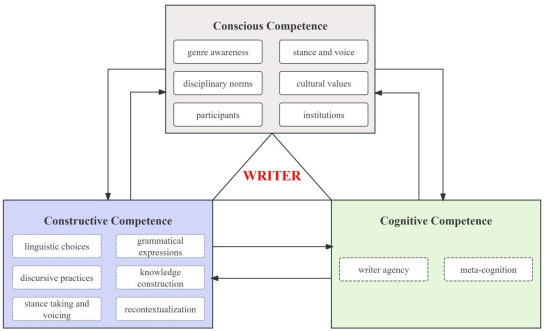
Academic writing plays a crucial role in disseminating scientific knowledge, advancing academic careers and fostering a harmonious academic community. To produce successful academic writing, the competence of writers in this domain is of paramount importance. The success of academic writing is significantly dependent on a writer’s academic writing competence in this specialized form of communication. Despite the recognized importance of academic writing competence, the specific elements or components it should encompass have yet to be rigorously investigated. Based on previous studies and prior exploration into academic writing, this paper attempts to propose a three-core competences (3CC) model for academic writing competence, including conscious competence, cognitive competence and constructive competence. These three competences are interrelated, indicated by conscious competence as a representative of the initial starter, constructive competence as a revelation of the writing process and the final product, and cognitive competence as a bridge and macro-regulator throughout the writing process. Specifically, conscious competence embraces elements as genre awareness, awareness of stance and voice, awareness of disciplinary norms, awareness of cultural values, awareness of putative participants and institutions. Cognitive competence includes writers’ meta-cognition and agency. Constructive competence is composed of linguistic choices, grammatical expression, discursive practice, disciplinary knowledge construction, stance taking and voicing, and recontextualization. It is hoped that this proposed 3CC model could shed lights on enhancing genre-based instruction and academic writing practices.
| Published in | International Journal of Applied Linguistics and Translation (Volume 12, Issue 3) |
| DOI | 10.11648/j.ijalt.20261203.12 |
| Page(s) | 62-67 |
| Creative Commons |
This is an Open Access article, distributed under the terms of the Creative Commons Attribution 4.0 International License (http://creativecommons.org/licenses/by/4.0/), which permits unrestricted use, distribution and reproduction in any medium or format, provided the original work is properly cited. |
| Copyright |
Copyright © The Author(s), 2026. Published by Science Publishing Group |
Academic Writing, Writing Competence, 3CC Model
3CC | Three-Core Competences Including Conscious, Cognitive and Constructive Competences |
RAs | Research Articles |
| [1] | Berkenkotter, C., & Huckin, T. N. Genre knowledge in disciplinary communication: Cognition/culture/power. Hillsdale: Lawrence Erlbaum Associates; 1995. |
| [2] | Deng, L., He, P., & Gao, X. Move-stance connection in Chinese and English research article conclusion sections: A cross-linguistic study. Journal of English for Academic Purposes. 2025, 76, 1-15. |
| [3] | Dewey, M. English as a lingua franca and globalization: An interconnected perspective. International Journal of Applied Linguistics. 2007, 17(3), 332-354. |
| [4] | Hu, G., & Cao, F. Hedging and boosting in abstracts of applied linguistics articles: a comparative study of English- and Chinese-medium journals. Journal of Pragmatics. 2011, 43(11), 2795-2809. |
| [5] | Hyland, K. Authority and invisibility - authorial identity in academic writing. Journal of Pragmatics. 2002, 34(8), 1091-1112. |
| [6] | Bhatia, V. K. Worlds of written discourse: A genre-based approach. London: Continuum; 2004. |
| [7] | Tardy, C. M., Sommer-Farias, B., & Gevers, J. Teaching and researching genre knowledge: Toward an enhanced theoretical framework. Written Communication. 2020, 37(3), 287-321. |
| [8] | Xiong, S., & Zou, W. Developing Chinese undergraduate English-majors’ research article writing competence. Chinese Journal of Applied Linguistics. 2011, 3, 5-24. |
| [9] |
He, P. The genre construction of Chinese scholar’s research articles published in local and international journals during the pandemic period. Advances in Social Science, Education and Humanities Research. 2021, 594, 750-760.
https://www.atlantis-press.com/proceedings/iclahd-21/125964802 |
| [10] | Bhatia, V. K. Taking Swalesian legacy forward: Evolution of genre analysis from textualization to contextualization. English for Specific Purposes. 2026, 84, 166-173. |
| [11] | Tardy, C. M. Genre lessons from the academic writing of John Swales. English for Specific Purposes. 2026, 84, 160-165. |
| [12] | Beaufort, A. Writing in the Real World: Making the Transition from School to Work. New York: Teachers College Press; 1999. |
| [13] | Tardy, C. M., & Swales, J. M. Form, text organisation, genre, coherence, and cohesion. In C. Bazerman (Ed.), Handbook of research on writing (pp. 693-713). New York: Lawrence Erlbaum Associates; 2008. |
| [14] | Bruce, I. Cognitive genre structures in Methods sections of research articles: A corpus study. Journal of English for Academic Purposes. 2008, 7(1), 38-54. |
| [15] | Molle, D., & Prior, P. Multimodal genre systems in EAP writing pedagogy: Reflecting on a needs analysis. TESOL Quarterly. 2008, 42(4), 541-566. |
| [16] | Widdowson, H. Learning purpose and language use. Oxford: Oxford University Press; 1983. |
| [17] | Jiang, F. Stance and voice in academic writing: The “noun+ that” construction and disciplinary variation. International Journal of Corpus Linguistics. 2017, 22(1), 85-106. |
| [18] | Biber, D., & Finegan, E. Styles of stance in English: Lexical and grammatical marking of evidentiality and affect. Text. 1989, 9(1), 93-124. |
| [19] | Charles, M. “This mystery…”: A corpus-based study of the use of nouns to construct stance in theses from two contrasting disciplines. Journal of English for Academic Purposes. 2003, 2(4), 313-326. |
| [20] | Işık-Taş, E. E. Authorial identity in Turkish language and English language research articles in Sociology: The role of publication context in academic writers' discourse choices. English for Specific Purposes. 2018, 49, 26-38. |
| [21] | Matsuda, P. K., & Tardy, C. M. Voice in academic writing: the rhetorical construction of author identity in blind manuscript review. English for Specific Purposes. 2007, 26(2), 235-249. |
| [22] | McCambridge, L. If you can defend your own point of view, you’re good: Norms of voice construction in student writing on an international Master's programme. English for Specific Purposes. 2019, 54, 110-126. |
| [23] | Lim, J. M. H. Commenting on research results in applied linguistics and education: A comparative genre-based investigation. Journal of English for Academic Purposes. 2010, 9(4), 280-294. |
| [24] | Dahl, T. Textual metadiscourse in research articles: a marker of national culture or of academic discipline?. Journal of Pragmatics. 2004, 36, 1807-1825. |
| [25] | Dahl, T. The linguistic representation of rhetorical function: a study of how economists present their knowledge claims. Written Communication. 2009, 26(4), 370-391. |
| [26] | Cava, A. M. Evaluative lexis in science: A corpus-based study in scientific abstracts. Rice Working Papers in Linguistics. 2010, 2, 20-38. oai: repository.rice.edu:1911/27599 |
| [27] | Zou, H., & Hyland, K. “Think about how fascinating this is”: Engagement in academic blogs across disciplines. Journal of English for Academic Purposes. 2020, 43, 1-12. |
| [28] | Lillis, T., & Curry, M. J. Professional academic writing by multilingual scholars: interactions with literacy brokers in the production of English-medium texts. Written Communication. 2006, 23(1), 3-35. |
| [29] | Wei, X. Assessing the metacognitive awareness relevant to L1-to-L2 rhetorical transfer in L2 writing: the cases of Chinese EFL writers across proficiency level. Assessing Writing. 2020, 44, 1-12. |
| [30] | Wei, X., & Zhang, W. Investigating L2 writers’ metacognitive awareness about L1-L2 rhetorical differences. Journal of English for Academic Purposes. 2020, 46, 1-16. |
| [31] | Flavell, J. H. Metacognition and cognitive monitoring: a new area of cognitive-developmental inquiry. American Psychologist. 1979, 34, 906-911. |
| [32] | Kuhn, D. Metacognitive development. Current Directions in Psychological Science. 2000, 9(5), 178-181. |
| [33] | Bhowmik, S. K. Agency, identity and ideology in L2 writing: Insights from the EAP classroom. Writing & Pedagogy. 2016, 8(2), 275-308. |
| [34] | Ahearn, L. M. Language and agency. Annual review of anthropology. 2001, 30(1), 109-137. |
| [35] | Manyukhina, Y., & Wyse, D. Learner agency and the curriculum: a critical realist perspective. The Curriculum Journal. 2019, 30(3), 223-243. |
| [36] | Gao, X. Strategic language learning: The roles of agency and context [M]. Clevedon: Multilingual Matters; 2010. |
| [37] | Bown, J. Self-regulatory strategies and agency in self-instructed language learning: A situated view. The Modern Language Journal. 2009, 93(4), 570-583. |
| [38] | Mercer, S. Understanding learner agency as a complex dynamic system. System. 2011, 39(4), 427-436. |
| [39] | Negretti, R. Metacognition in student academic writing: Longitudinal study of metacognitive awareness and its relation to task perception, self-regulation, evaluation of performance. Written Communication. 2012, 29(2), 142-179. |
| [40] | Flowerdew, J., & Wang, S. H. Identity in academic discourse. Annual Review of Applied Linguistics. 2015, 35, 81-99. |
APA Style
He, P. (2026). A Proposed 3CC Model for Academic Writing Competence. International Journal of Applied Linguistics and Translation, 12(3), 62-67. https://doi.org/10.11648/j.ijalt.20261203.12
ACS Style
He, P. A Proposed 3CC Model for Academic Writing Competence. Int. J. Appl. Linguist. Transl. 2026, 12(3), 62-67. doi: 10.11648/j.ijalt.20261203.12
AMA Style
He P. A Proposed 3CC Model for Academic Writing Competence. Int J Appl Linguist Transl. 2026;12(3):62-67. doi: 10.11648/j.ijalt.20261203.12
@article{10.11648/j.ijalt.20261203.12,
  author = {Ping He},
  title = {A Proposed 3CC Model for Academic Writing Competence},
  journal = {International Journal of Applied Linguistics and Translation},
  volume = {12},
  number = {3},
  pages = {62-67},
  doi = {10.11648/j.ijalt.20261203.12},
  url = {https://doi.org/10.11648/j.ijalt.20261203.12},
  eprint = {https://article.sciencepublishinggroup.com/pdf/10.11648.j.ijalt.20261203.12},
  abstract = {Academic writing plays a crucial role in disseminating scientific knowledge, advancing academic careers and fostering a harmonious academic community. To produce successful academic writing, the competence of writers in this domain is of paramount importance. The success of academic writing is significantly dependent on a writer’s academic writing competence in this specialized form of communication. Despite the recognized importance of academic writing competence, the specific elements or components it should encompass have yet to be rigorously investigated. Based on previous studies and prior exploration into academic writing, this paper attempts to propose a three-core competences (3CC) model for academic writing competence, including conscious competence, cognitive competence and constructive competence. These three competences are interrelated, indicated by conscious competence as a representative of the initial starter, constructive competence as a revelation of the writing process and the final product, and cognitive competence as a bridge and macro-regulator throughout the writing process. Specifically, conscious competence embraces elements as genre awareness, awareness of stance and voice, awareness of disciplinary norms, awareness of cultural values, awareness of putative participants and institutions. Cognitive competence includes writers’ meta-cognition and agency. Constructive competence is composed of linguistic choices, grammatical expression, discursive practice, disciplinary knowledge construction, stance taking and voicing, and recontextualization. It is hoped that this proposed 3CC model could shed lights on enhancing genre-based instruction and academic writing practices.},
 year = {2026}
}
TY  - JOUR
T1  - A Proposed 3CC Model for Academic Writing Competence
AU  - Ping He
Y1  - 2026/08/24
PY  - 2026
N1  - https://doi.org/10.11648/j.ijalt.20261203.12
DO  - 10.11648/j.ijalt.20261203.12
T2  - International Journal of Applied Linguistics and Translation
JF  - International Journal of Applied Linguistics and Translation
JO  - International Journal of Applied Linguistics and Translation
SP  - 62
EP  - 67
PB  - Science Publishing Group
SN  - 2472-1271
UR  - https://doi.org/10.11648/j.ijalt.20261203.12
AB  - Academic writing plays a crucial role in disseminating scientific knowledge, advancing academic careers and fostering a harmonious academic community. To produce successful academic writing, the competence of writers in this domain is of paramount importance. The success of academic writing is significantly dependent on a writer’s academic writing competence in this specialized form of communication. Despite the recognized importance of academic writing competence, the specific elements or components it should encompass have yet to be rigorously investigated. Based on previous studies and prior exploration into academic writing, this paper attempts to propose a three-core competences (3CC) model for academic writing competence, including conscious competence, cognitive competence and constructive competence. These three competences are interrelated, indicated by conscious competence as a representative of the initial starter, constructive competence as a revelation of the writing process and the final product, and cognitive competence as a bridge and macro-regulator throughout the writing process. Specifically, conscious competence embraces elements as genre awareness, awareness of stance and voice, awareness of disciplinary norms, awareness of cultural values, awareness of putative participants and institutions. Cognitive competence includes writers’ meta-cognition and agency. Constructive competence is composed of linguistic choices, grammatical expression, discursive practice, disciplinary knowledge construction, stance taking and voicing, and recontextualization. It is hoped that this proposed 3CC model could shed lights on enhancing genre-based instruction and academic writing practices.
VL  - 12
IS  - 3
ER  -
Basic Education College, National University of Defense Technology, Changsha, China

Information



 Share This Article
 Twitter
 Linked In
 Facebook
 Copy
Copy Download