Review Article | | Peer-Reviewed

Photochemical Dynamics of Surface Ozone (O3), Carbon Monoxide (CO), and Nitrogen Oxides (NOx): Implications for Air Pollution, Health and Climate

Received: 26 February 2026     Accepted: 19 March 2026     Published: 7 April 2026
Views:       Downloads:
Abstract

Atmospheric trace gases such as ozone (O3), carbon monoxide (CO), and nitrogen oxides (NO and NO2, collectively termed NOx) play a central role in tropospheric photochemistry and strongly influence air quality, climate forcing, and ecosystem health. This manuscript explores the current understanding of the sources, chemical transformation pathways, and environmental impacts of these trace gases by integrating from observational studies and atmospheric modeling research. The literature was compiled through a structured review of peer-reviewed research published in science journals, with emphasis on recent advances in photochemical mechanisms, boundary layer dynamics and regional air pollution processes. Particular attention is given to nonlinear O3 formation regimes, radical chemistry involving volatile organic compounds (VOCs), and the interactions between trace gases and climate processes. This manuscript highlights how the balance between NOx and VOC emissions determines O3 production efficiency in different atmospheric environments, ranging from NOx limited rural regions to VOC limited urban areas. Regional perspectives from South Asia illustrate how rapid urbanization, biomass burning, and meteorological variability influence trace gas distributions. The analysis identifies major knowledge gaps related to radical chemistry uncertainties, climate–chemistry feedback mechanisms, and the integration of observational networks with chemical transport models. Improved monitoring strategies and advanced modeling approaches are essential for developing effective air quality management policies and understanding the evolving role of trace gases in the Earth’s climate system.

Published in International Journal of Atmospheric and Oceanic Sciences (Volume 10, Issue 1)
DOI 10.11648/j.ijaos.20261001.12
Page(s) 13-24
Creative Commons

This is an Open Access article, distributed under the terms of the Creative Commons Attribution 4.0 International License (http://creativecommons.org/licenses/by/4.0/), which permits unrestricted use, distribution and reproduction in any medium or format, provided the original work is properly cited.

Copyright

Copyright © The Author(s), 2026. Published by Science Publishing Group

Keywords

Air Pollution, Surface Ozone, Nitrogen Oxides, Carbon Monoxide, Atmospheric Oxidative Capacity

1. Introduction
Air pollution is widely recognized as one of the most critical environmental challenges of the twenty-first century due to its profound impacts on climate systems, ecological balance, and human health . Rapid industrialization, urban expansion, and increasing energy demand have intensified atmospheric emissions, leading to significant degradation of air quality across many regions of the world. Although particulate matter (PM) often receives greater attention in air-quality discussions, gaseous pollutants particularly atmospheric trace gases play an equally important role in atmospheric chemistry and secondary pollutant formation . Trace gases are present in the atmosphere at very low concentrations, typically in the parts-per-billion (ppb) to parts-per-million (ppm) range, yet they exert substantial influence on atmospheric processes due to their chemical reactivity and radiative properties . Key atmospheric trace gases include ozone (O3), carbon monoxide (CO), nitrogen oxides (NO and NO2), volatile organic compounds (VOCs), methane (CH4), and sulfur dioxide (SO2), all of which participate in complex atmospheric chemical cycles that regulate air quality and climate interactions .
Air pollution generally results from a complex interplay between primary emissions and secondary chemical formation processes in the atmosphere. Primary pollutants are directly emitted from sources such as vehicular exhaust, industrial activities, power generation, and biomass burning. In contrast, secondary pollutants are produced through chemical reactions involving precursor gases under favorable atmospheric conditions . Surface O3 is not emitted directly but forms through photochemical reactions involving NOx, VOCs, and solar radiation. Similarly, nitrate aerosols, an important component of fine particulate matter (PM2.5) are produced through the oxidation of nitrogen oxides in the atmosphere . The behavior and distribution of trace gases in the lower atmosphere are largely governed by photochemical processes driven by solar radiation, meteorological conditions, and interactions with aerosols and other atmospheric constituents . These reactions influence the formation, transformation, and removal of atmospheric pollutants, thereby determining the chemical composition of the troposphere.
Among atmospheric trace gases, surface O3, CO, and NOx are particularly important because of their strong influence on atmospheric chemistry and regional air quality. Surface O3 is a secondary pollutant formed through complex photochemical reactions involving precursor emissions from fossil fuel combustion, solvent usage, and biomass burning, as well as natural emissions such as biogenic volatile organic compounds from vegetation . While stratospheric O3 protects life on Earth by absorbing harmful ultraviolet radiation, tropospheric O3 acts as a harmful pollutant that adversely affects human respiratory health, agricultural productivity, and ecosystems, and also contributes to climate forcing as a greenhouse gas .
Carbon monoxide (CO) is a colorless and odorless gas primarily produced through incomplete combustion of carbon-containing fuels. Major anthropogenic sources include motor vehicles, industrial combustion processes, residential fuel use, and open biomass burning, while natural sources include the oxidation of CH4 and other hydrocarbons in the atmosphere . Due to its relatively long atmospheric lifetime, ranging from several weeks to months, CO can be transported over large regional and continental scales, thereby influencing air quality far from its original emission sources .
Nitrogen oxides (NOx) are produced predominantly during high-temperature combustion processes associated with transportation, power generation, and industrial activities . In addition to anthropogenic emissions, natural processes such as lightning and microbial activity in soils also contribute to atmospheric NOx levels, though these sources exhibit strong spatial and seasonal variability . NOx play a crucial role in atmospheric chemistry as key precursors for tropospheric O3 formation and as regulators of the oxidative capacity of the atmosphere through their participation in radical-mediated photochemical reactions . Consequently, comprehensive understanding of the distribution, sources, and chemical interactions of these trace gases is essential for assessing air-quality variability and for formulating effective mitigation strategies aimed at reducing atmospheric pollution and its associated environmental and health impacts.
Understanding the sources, atmospheric lifetimes, chemical transformation pathways, and removal mechanisms of trace gases is therefore essential for improving our knowledge of atmospheric pollution dynamics and for developing effective air-quality management strategies . This manuscript describes the current knowledge on the sources, chemical transformation pathways, and environmental implications of O3, CO, and NOx, with particular emphasis on their contributions to urban and regional air pollution dynamics. It further highlights the complex interactions among emissions, atmospheric chemistry, and meteorological processes that govern the formation, transport, and removal of these trace gases in the troposphere.
2. Photochemical Production of Trace Gases
The photochemical production and destruction of major atmospheric trace gases such as O3, NO, NO2, CO, and CH4 are governed by a complex network of radiation-driven reactions and radical chain mechanisms that determine the oxidative capacity of the troposphere. Atmospheric photochemistry is strongly influenced by free radicals-highly reactive atomic or molecular species possessing unpaired electrons such as hydroxyl radicals (OH), peroxy radicals (RO2), and nitrate radicals (NO3). Among these, the hydroxyl radical is often referred to as the “detergent” of the atmosphere because it initiates the oxidation of numerous trace gases, including CO and VOCs. Meteorological conditions exert a dominant influence on trace gas concentrations and atmospheric chemical transformation rates . While emissions determine the availability of precursor species, meteorological parameters regulate pollutant dispersion, dilution, vertical mixing, chemical reactivity, and removal processes. Consequently, the concentrations of O3, CO, and NOx exhibit strong sensitivity to boundary layer dynamics, temperature, solar radiation, humidity, cloud cover, wind patterns, and large-scale synoptic circulation. Surface O3 formation is governed by nonlinear photochemical interactions between nitrogen NOx and VOCs. The efficiency of O3 production depends strongly on the relative abundance of these precursors, leading to two principal chemical regimes: NOx limited and VOC limited conditions. In NOx limited environments, typically found in rural or remote regions, O3 formation increases with increasing NOx concentrations because the availability of NOx restricts radical propagation cycles. In contrast, VOC limited conditions commonly occur in polluted urban environments where high NOx emissions suppress O3 production through radical termination reactions. Understanding these regimes is essential for effective air quality management, since emission reduction strategies must target the appropriate precursor species to achieve meaningful O3 reductions.
2.1. Photochemistry of Surface O3
Surface O3 forms through a series of reactions in the presence of solar radiation. It begins with the photolysis of NO2 to produce NO and an oxygen atom. The free oxygen atom then combines with molecular oxygen (O2) to form O3. However, for net O3 accumulation, VOCs or CO must participate to oxidize NO back to NO2 without consuming O3. Specifically, oxidation of CO or VOCs yields peroxy radicals (RO2 or HO2), which convert NO to NO2, sustaining O3 production under sunlight. The fundamental photochemical reactions are written separately as follows:
NO2+ hν (λ < 420 nm)→NO + O(3P) (1)
O(3P) + O2+ M→O3+ M (2)
O3+ NO→NO2+ O2(3)
These reactions establish the photo-stationary equilibrium. Net O3 production occurs only when NO is oxidized to NO2 by peroxy radicals without consuming O3. The key radical propagation steps are:
O3+ hν (λ < 320 nm)→O(¹D) + O2(4)
O(¹D) + H2O→2OH (5)
CO + OH + O2→CO2+ HO2(6)
CH4+ OH→CH3+ H2O (7)
CH3+ O2+ M→CH3O2+ M (8)
HO2+ NO→NO2+ OH (9)
RO2+ NO→NO2+ RO (10)
Because HO2 and RO2 convert NO to NO2 without destroying O3, additional NO2 photolysis results in net O3 accumulation. Methane oxidation proceeds through a sequence of intermediates: The destruction of O3 in the troposphere occurs via several pathways:
O3+ OH→HO2+ O2(11)
O3+ HO2→OH + 2O2(12)
O3+ alkene→carbonyl products + radicals (13)
O3→surface deposition (14)
At night, additional chemistry occurs:
NO2+ O3→NO3+ O2(15)
NO3+ NO2+ M→N2O₅ + M (16)
N2O₅ + H2O (aerosol) → 2HNO3(17)
These heterogeneous reactions permanently remove reactive nitrogen and suppress O3 production. Carbon monoxide and methane play crucial roles in regulating the atmospheric oxidizing capacity. Increased CH4 reduces OH availability:
CH4+ OH→CH3+ H2O (18)
Lower OH concentrations prolong CH4 lifetime (~9–12 years) and enhance background O3. Carbon monoxide, with a lifetime of weeks to months, competes for OH and indirectly modifies tropospheric O3 and CH4 lifetimes. The overall photochemical system is highly nonlinear and depends strongly on NOx levels. In low NOx regimes, radical termination processes limit O3 formation, whereas in high-NOx conditions O3 production is enhanced; however, at very high NO concentrations, O3 is reduced through titration. Thus, the coupled photochemistry of O3, NO, NO2, CO, and CH4 links atmospheric composition, air pollution, and climate forcing through radical chain reactions, catalytic cycles, and feedback mechanisms that regulate the oxidative capacity of the atmosphere.
2.2. Impact of CO and VOCs on Atmospheric Oxidative Capacity and O3 Formation
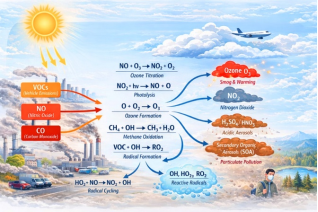
Carbon monoxide (CO) and Volatile Organic Compounds (VOCs) plays an important role in regulating the oxidative capacity of the troposphere through their interactions with hydroxyl radicals (OH), the primary atmospheric oxidant responsible for the removal of many trace gases. CO reacts with OH (CO + OH → CO2 + H), thereby reducing the availability of OH for the oxidation of other species such as methane (CH4) and VOCs. As a result, elevated CO concentrations can decrease the atmosphere’s oxidizing capacity, extend the lifetime of CH4, and alter radical propagation pathways. The oxidation of CO also produces hydroperoxyl radicals (HO2), which convert NO to NO2, indirectly promoting O3 formation under NOx rich conditions. VOC’s further enhance tropospheric photochemistry by generating peroxy radicals (RO2) during their oxidation by OH. These radicals react with NO to form NO2, which subsequently undergoes photolysis to produce atomic oxygen that combines with molecular oxygen to form O3. VOCs originate from both anthropogenic sources, such as transportation emissions and industrial activities, and natural sources including vegetation and soil microbial processes, with biogenic VOCs like isoprene and monoterpenes being particularly significant in tropical regions. Through these interactions, CO and VOCs strongly influence atmospheric radical cycling, ozone production, and the overall chemical balance of the troposphere. Schematic representation of the photochemical and destruction of trace gases in the troposphere is shown in the Figure 1.
Figure 1. Photochemical and destruction of trace gases in the troposphere.
3. Boundary Layer Dynamics and Its Impact on Atmospheric Pollutants
The planetary boundary layer (PBL) represents the lowest portion of the troposphere that is directly influenced by surface forcing through turbulent fluxes of heat, momentum, and moisture. Its depth exhibits pronounced diurnal variability driven by radiative heating and surface energy balance processes, typically ranging from less than 500–800 m under stable nocturnal conditions to more than 1500–3000 m during daytime convective periods . The evolution of the PBL strongly regulates the dispersion, chemical transformation, and vertical redistribution of atmospheric pollutants. Under shallow PBL conditions, particularly during night-time and early morning hours, suppressed turbulence and reduced mixing heights limit vertical dilution, leading to the accumulation of primary pollutants such as NOx, CO, and particulate matter near the surface ). Simultaneously, stable atmospheric stratification and weak ventilation favour the build-up of VOCs and oxidants, promoting secondary aerosol formation through gas-to-particle conversion pathways involving oxidation of VOCs by OH, O3, and NO3 radicals . During daytime, solar heating destabilizes the lower atmosphere and leads to the development of a convective mixed layer, which enhances turbulent transport and promotes efficient vertical mixing of surface emissions. A deep convective PBL significantly increases the dilution volume available for pollutants, thereby reducing near-surface concentrations of primary species while redistributing O3 precursors throughout the mixed layer . This vertical transport can elevate reactive nitrogen species (NOy) and VOCs to higher altitudes, altering regional photochemical regimes and potentially enhancing in situ ozone production aloft through photolysis-driven radical chemistry.
Another critical process influencing surface air quality is entrainment at the PBL top. As the daytime boundary layer grows, it can entrain air from the residual layer or lower free troposphere, which often contains O3 rich air formed during the previous day’s photochemical activity. This entrainment process can significantly enhance late-morning and afternoon surface O3 concentrations, particularly under clear-sky conditions with strong convective mixing . Furthermore, mesoscale meteorological processes such as land–sea breezes, low-level jets, and synoptic-scale subsidence can modify PBL structure and influence pollutant transport over regional scales .
Model sensitivity experiments have demonstrated the critical role of boundary layer dynamics in regulating surface air quality. Numerical simulations indicate that a 30% reduction in PBL height can lead to a 20–35% increase in near-surface NOx and CO concentrations due to reduced dilution capacity, while also intensifying subsequent O3 production rates during photochemically active periods owing to elevated precursor densities . These interactions highlight the strong coupling between boundary layer structure, turbulent transport, and atmospheric chemical processes. Consequently, accurate representation of PBL dynamics including turbulence parameterization, entrainment fluxes, and mixing heights is essential for improving the reliability of regional air quality and atmospheric chemistry models such as WRF-Chem and CMAQ .
4. Long-range Transport and Regional Effects of Air Pollutants
Long-range atmospheric transport plays a critical role in shaping regional air quality by redistributing trace gases and their photochemical precursors far beyond their original emission sources . Carbon monoxide (CO), having a lifetime ranging from several weeks to a few months, serves as an effective tracer for intercontinental pollution transport due to its relative chemical stability in the troposphere . Once emitted from anthropogenic combustion sources, CO can be advected across continents through large-scale circulation systems such as mid-latitude westerlies and tropical Hadley circulation, thereby elevating background pollutant concentrations in downwind regions . Although NOx are comparatively short-lived near the surface, they can be transported over long distances in the form of thermally stable reservoir species such as peroxyacetyl nitrate (PAN), particularly within the colder upper troposphere. During transport to warmer environments, PAN undergoes thermal decomposition, releasing NO2, which subsequently enhances regional O3 production far from the original emission sources . Surface O3 itself possesses a lifetime of several days to weeks, enabling its accumulation and hemispheric-scale transport under favorable meteorological conditions . Synoptic scale systems, including high pressure ridges, frontal boundaries, and jet streams, facilitate both vertical lifting and horizontal advection of polluted air masses across regions . In addition, deep convective processes can inject boundary layer pollutants into the free troposphere, where reduced removal rates allow for widespread dispersion.
Regional topography further modulates transport pathways through mountain valley circulations that either trap pollutants locally or channel them across adjacent regions . Consequently, elevated O3 or CO concentrations observed in rural or remote environments may reflect transported pollution rather than local emissions alone. This transboundary movement of atmospheric pollutants complicates air quality management strategies, as local emission control measures may be offset by imported pollution loads. Effective mitigation therefore necessitates coordinated regional and international emission reduction frameworks supported by satellite observations and chemical transport modelling to distinguish between locally generated and transported pollutant contributions.
5. Review Methodology
The following section is based on a systematic evaluation of peer-reviewed literature addressing the photochemical behavior, sources, and environmental impacts of major atmospheric trace gases in the troposphere. Foundational studies together with recent advances published over the past two decades were examined in order to capture the progression of scientific understanding in atmospheric chemistry and air-quality research. Particular emphasis was placed on studies investigating the formation and transformation of key trace gases such as O3, NOx, CO, and VOCs, which play critical roles in tropospheric photochemistry and secondary pollutant formation. Research encompassing global atmospheric chemistry assessments, regional air-pollution dynamics, long-term monitoring observations, and numerical modeling frameworks was included in the review. The selected literature was systematically analyzed to identify dominant scientific themes, advances in observational and modeling techniques, and emerging research directions. In addition, the review highlights persisting uncertainties associated with chemical reaction mechanisms, emission inventories, and meteorological influences that continue to challenge accurate representation of tropospheric trace gas chemistry in atmospheric models.
The study of air pollution across the globe is essential due to its profound impacts on human health, climate systems, ecosystems, and sustainable development. Air pollutants contribute to millions of premature deaths annually by causing respiratory illnesses, cardiovascular diseases, and other chronic health conditions . Beyond health implications, air pollution significantly influences atmospheric chemistry and the Earth’s radiative balance, thereby accelerating climate change and altering regional and global weather patterns . Since pollutants can travel long distances across national boundaries through atmospheric transport processes, air quality is not merely a local issue but a global concern requiring coordinated international research and policy responses . Comprehensive global studies help in identifying emission sources, understanding chemical transformation mechanisms, assessing meteorological influences, and evaluating long-term trends in air pollutant concentrations . Such scientific investigations are crucial for developing accurate atmospheric models, designing effective mitigation strategies, implementing emission control regulations, and achieving global climate and sustainability goals . In the context of rapid urbanization, industrial growth, and increasing energy demand worldwide, systematic and continuous research on air pollution is indispensable to safeguard public health, protect ecosystems, and ensure a sustainable and resilient future for the planet.
5.1. Global and Regional Perspectives on Trace Gas Air Pollution
Air pollution research over the past several decades has demonstrated significant progress in understanding the sources, chemistry, and impacts of atmospheric trace gases. In North America, regulatory policies have led to substantial reductions in key pollutants. Analyses by the United States Environmental Protection Agency indicate that sulphur dioxide (SO2) and NOx emissions declined dramatically following the implementation of the Clean Air Act and its amendments. Long-term monitoring data reveal reductions exceeding 80% in SO2 emissions since the 1980s, largely attributed to flue gas desulfurization technologies and fuel switching in power plants . O3 transported from Asia and influenced by climate variability contributes to exceedances in western North America . Similar emission reduction trends have been observed across Europe following the adoption of stringent environmental policies. Reports from the European Environment Agency indicate that SO2 emissions across the European Union have decreased by more than 90% since 1990 due to emission standards and the National Emission Ceilings Directive . However, NO2 levels remain elevated along traffic corridors in major cities such as London and Paris. Epidemiological studies across multiple European cohorts have demonstrated strong associations between long-term NO2 exposure and respiratory morbidity . In response to growing evidence of health impacts, the World Health Organization updated its Global Air Quality Guidelines in 2021, recommending stricter limits for pollutants including NO2 and O3.
East Asia has also received considerable scientific attention due to rapid industrialization and urban expansion. Satellite observations from instruments such as OMI and TROPOMI revealed sharp increases in tropospheric NO2 concentrations over eastern China during the early 2000s . Ground-based measurements similarly reported elevated SO2 levels associated with coal combustion . Following the implementation of China’s Air Pollution Prevention and Control Action Plan in 2013, significant reductions in SO2 and particulate matter were observed. Nevertheless, surface O3 concentrations have continued to increase in several Chinese cities, largely due to VOC limited photochemical regimes and changing emission ratios . Transboundary transport of O3 precursors across East Asia has also been documented, particularly affecting regions such as South Korea and Japan .
In many developing regions, biomass burning represents a major source of trace gases. Satellite observations reveal strong seasonal peaks in CO and O3 over central Africa during dry seasons associated with savanna fires . Field campaigns in West Africa demonstrate that biomass burning emissions significantly alter regional atmospheric oxidative capacity by releasing large quantities of NOx and VOCs . However, the lack of long-term ground-based monitoring networks in many African countries creates substantial uncertainties in pollution exposure assessments.
Research in the Middle East highlights the role of hydrocarbon extraction and petrochemical activities in regional air pollution. Satellite inversion studies have identified methane emission hotspots over major oil and gas production regions in countries such as Saudi Arabia and Iran . Urban centres including Riyadh and Tehran exhibit elevated NO2 levels due to traffic emissions and intense photochemistry driven by strong solar radiation . CH4 plays an important role in atmospheric chemistry because it acts both as a greenhouse gas and as a precursor for surface O3 formation. The Sixth Assessment Report of the Intergovernmental Panel on Climate Change emphasizes methane’s strong radiative forcing and the potential climate benefits of rapid emission reductions .
Health impact assessments consistently demonstrate the global burden of trace gas pollution. Long-term cohort studies in the United States have shown that chronic exposure to ozone significantly increases mortality risk . Similar investigations in Europe and Asia have linked NO2 exposure to asthma incidence and respiratory illness in children . According to the Global Burden of Disease study, millions of premature deaths each year are attributable to ambient air pollution, with O3 contributing substantially to respiratory mortality .
The chemical mechanisms underlying trace gas pollution have been extensively studied. Foundational work by established the framework for photochemical smog formation, demonstrating how VOCs and NOx interact under solar radiation to produce secondary pollutants such as O3. Advances in satellite remote sensing and chemical transport modelling have further enhanced the ability to monitor global pollution patterns and quantify emission sources . Overall, global research demonstrates that stringent emission controls can significantly reduce pollutants such as SO2 and NOx. However, the persistence of O3 pollution illustrates the complexity of atmospheric chemistry and the need for integrated emission reduction strategies addressing multiple precursors.
5.2. Trace Gas Air Pollution in South Asia and India
South Asia has emerged as one of the most polluted regions globally due to rapid urbanization, industrial growth, population density, and extensive biomass burning. The Indo-Gangetic Plain (IGP) is widely recognized as a major hotspot of atmospheric pollution, influenced by emissions from transportation, coal based power generation, agricultural burning, and household biomass combustion . Long-term monitoring data from the Central Pollution Control Board indicate that NO2 concentrations in major Indian cities such as Delhi, Mumbai, and Kolkata frequently exceed national air quality standards. While SO2 levels have declined in several cities due to cleaner fuels and emission regulations, NOx emissions continue to increase with expanding transportation demand . Satellite observations from instruments such as OMI and TROPOMI confirm persistent NO2 hotspots across northern India and around major thermal power plants .
Studies indicate that surface O3 levels in India have increased over the past two decades, with frequent exceedances during pre-monsoon and summer periods characterized by high solar radiation and stagnant atmospheric conditions . Chemical transport modelling suggests that surface O3 formation in several Indian cities occurs under VOC limited regimes, implying that reductions in VOC may be more effective for controlling O3 than NOx reductions alone . Biomass burning contributes substantially to trace gas emissions in South Asia. Post-monsoon agricultural residue burning in Punjab and Haryana generates large amounts of CO, NOx, and VOCs that are transported across northern India and Pakistan, often causing severe pollution episodes in Delhi . Household biomass combustion in rural regions also remains a significant source of carbon monoxide and hydrocarbons . CH4 emissions from agriculture, particularly rice paddies and livestock, are another important component of South Asian atmospheric chemistry. Global CH4 budget analyses identify South Asia as a rapidly growing CH4 emission region . Because CH4 contributes to background O3 formation, mitigation strategies targeting CH4 emissions provide co-benefits for both climate stabilization and regional air quality improvement.
5.3. Case Study: Trace Gas Air Pollution in Kerala
Although Kerala is generally perceived as less industrialized compared with many other Indian states, recent studies indicate that trace gas pollution is increasing due to urbanization, vehicular growth, and industrial activities. Monitoring programs conducted by the Central Pollution Control Board and the Kerala State Pollution Control Board under the National Air Quality Monitoring Programme have reported elevated nitrogen dioxide and ozone levels in major urban centres including Thiruvananthapuram, Kochi, and Kozhikode . Research conducted by the SPL, VSSC Thiruvananthapuram has demonstrated that coastal meteorology plays a crucial role in pollutant dispersion across Kerala. Land–sea breeze circulations strongly influence trace gas transport, with marine air masses during monsoon seasons helping dilute urban pollution, while stable atmospheric conditions during summer promote photochemical O3 formation . VOC characterization studies in the Kochi industrial region indicate substantial contributions from petrochemical industries and vehicular emissions .
High-altitude observations from Munnar further reveal the influence of long-range transport on regional atmospheric composition. Observations conducted by , indicate that background O3 levels are affected by pollutant transport from the Indo-Gangetic Plain and Arabian Sea shipping corridors. Satellite analyses using instruments such as OMI and TROPOMI also reveal localized SO2 and NO2 enhancements near industrial clusters such as the Kochi refinery region .
Recent investigations in northern Kerala have focused on trace gas variability in Kannur district. Observational studies conducted at Kannur University report clear diurnal and seasonal variations in O3 and NO2 concentrations, with higher levels during winter months and morning traffic periods . The coastal setting of Kannur introduces strong land–sea breeze circulations that influence the dispersion and chemical transformation of reactive nitrogen species . Simultaneous CO measurements indicate elevated concentrations during peak traffic hours, suggesting vehicular emissions as a dominant local source. These findings demonstrate that air quality in Kerala results from a combination of local emissions, coastal meteorology, and long-range transport processes. Continued integration of ground-based monitoring, satellite observations, and chemical transport modelling is essential for improving emission inventories and developing effective air quality management strategies in the region.
6. Biological and Ecological Effects of Air Quality Degradation
Trace gases exert substantial adverse effects on both human health and ecological systems, even at relatively low ambient concentrations . Surface O3, penetrates deep into the pulmonary system where it induces airway inflammation, impairs lung function, exacerbates asthma, and increases susceptibility to respiratory infections through oxidative damage to epithelial tissues . Prolonged exposure to elevated O3 levels has been associated with chronic obstructive pulmonary disease (COPD), reduced life expectancy, and increased rates of premature mortality due to cardiopulmonary complications . CO, although chemically non-reactive in biological systems, poses serious toxicological risks by binding competitively with haemoglobin to form carboxyhaemoglobin (COHb), thereby impairing oxygen transport and delivery to critical organs such as the brain and heart . Elevated CO exposure can result in neurological impairment, cardiovascular stress, headaches, dizziness, and in extreme cases, fatal hypoxic conditions. NO2 emissions, contributes to respiratory tract irritation and increases vulnerability to pulmonary infections, particularly among children, the elderly, and individuals with pre-existing respiratory conditions . Beyond their direct health impacts, these trace gases participate in atmospheric photochemical reactions leading to the formation of secondary pollutants such as O3 and nitrate-containing fine particulate matter (PM2.5), which are strongly linked to cardiovascular diseases, systemic inflammation, ischemic stroke, and adverse birth outcomes . From an ecological perspective, elevated O3 concentrations impair plant physiological processes by diffusing through stomatal openings and generating reactive oxygen species within leaf tissues, thereby reducing photosynthetic efficiency, crop productivity, and forest biomass accumulation . Furthermore, atmospheric oxidation of NOx results in nitrogen deposition that alters soil nutrient composition, promotes eutrophication in aquatic ecosystems, and disrupts nitrogen cycling processes in sensitive terrestrial habitats . Collectively, the multifaceted health and ecological consequences associated with trace gas pollution underscore the urgent need for integrated emission control strategies targeting both primary emissions and secondary pollutant formation pathways.
7. Climatic Impacts of Trace Gases in the Troposphere
Trace gases exert significant influence on the Earth’s climate system through a combination of direct radiative forcing and indirect chemical feedback mechanisms that alter the atmospheric oxidation capacity and the lifetime of greenhouse gases . Tropospheric O3 is recognized as a short-lived climate pollutant and an important anthropogenically driven greenhouse gas that absorbs outgoing longwave infrared radiation, thereby contributing positively to radiative forcing and enhancing global warming . Unlike long-lived greenhouse gases such CO2, tropospheric ozone exhibits strong spatial and temporal variability because it is not emitted directly into the atmosphere but is formed through photochemical reactions involving precursor gases such as NOx, CO, and VOCs under the influence of solar radiation . As a result, regional emissions of O3 precursors from industrial activities, biomass burning, vehicular exhaust, and fossil fuel combustion can substantially influence regional climate forcing by altering O3 production rates. In addition to its radiative effects, O3 affects climate indirectly by influencing plant physiological processes; elevated O3 levels reduce stomatal conductance and photosynthetic efficiency, thereby diminishing carbon uptake by terrestrial vegetation and weakening the land carbon sink, which in turn amplifies atmospheric CO2 accumulation .
Carbon monoxide, although not an effective greenhouse gas in terms of infrared absorption, plays a crucial indirect role in climate regulation by reacting with hydroxyl radicals (OH), the primary atmospheric oxidant responsible for CH4 removal . The oxidation of CO reduces OH availability, thereby prolonging the atmospheric lifetime of CH4 and enhancing its radiative forcing potential. Since CH4 itself contributes to surface O3 formation through oxidation pathways, elevated CO concentrations can indirectly intensify both CH4 driven warming and secondary O3 production, creating a feedback loop that further amplifies climate forcing . NOx promotes photochemical O3 formation in the troposphere, thereby exerting a warming effect through increased greenhouse gas concentrations . On the other hand, NOx enhances hydroxyl radical production through catalytic reaction cycles, which accelerates CH3 oxidation and shortens its atmospheric lifetime, thereby exerting a cooling influence on climate . Furthermore, atmospheric oxidation of NOx leads to the formation of nitrate aerosols, which scatter incoming solar radiation and contribute to negative radiative forcing, partially offsetting greenhouse warming .
The overall climatic impact of NOx emissions is therefore determined by the balance between these warming and cooling processes, which vary depending on regional chemical regimes and background atmospheric composition. In addition, trace gases influence cloud microphysical properties by modifying aerosol concentrations that act as cloud condensation nuclei (CCN), thereby altering cloud reflectivity, lifetime, and precipitation patterns through aerosol cloud interactions . These indirect effects further complicate the assessment of net radiative forcing associated with trace gas emissions. Long-range transport of O3 and its precursors can extend their climatic influence across continents and oceans, enabling regional emissions to exert hemispheric-scale impacts on atmospheric composition and radiative balance . Moreover, changes in atmospheric circulation patterns, temperature, and humidity driven by climate change can in turn affect the chemical transformation and removal rates of trace gases, establishing feedback interactions between atmospheric chemistry and climate dynamics. Consequently, the net climatic impact of trace gases is highly dependent on emission patterns, atmospheric transport processes, chemical reaction pathways, and interactions with clouds and aerosols .
8. Knowledge Gaps and Future Research Directions
Despite decades of research, significant uncertainties remain in the understanding of surface trace gas chemistry. One major challenge involves accurately quantifying radical reaction pathways that control the atmospheric oxidative capacity. Laboratory experiments and field measurements have revealed discrepancies between modeled and observed radical concentrations, indicating gaps in current chemical mechanisms. Another important research priority is the characterization of nonlinear O3 production regimes across different environments, particularly in rapidly developing regions where emission patterns are changing rapidly. Improved integration of ground-based monitoring networks, satellite observations, and high-resolution chemical transport models is essential for capturing spatial and temporal variability in trace gas concentrations. Additionally, interactions between atmospheric chemistry and climate processes remain poorly constrained. Changes in temperature, humidity, and atmospheric circulation patterns can significantly alter O3 production efficiency and the global distribution of reactive gases. Future research should therefore focus on developing coupled climate–chemistry modeling frameworks capable of resolving these feedback mechanisms.
9. Conclusion
This study highlights the complex and interdependent roles of key atmospheric trace gases O3, CO, and NOx in shaping tropospheric air pollution, atmospheric chemistry, human health risks, ecological impacts, and climate interactions. Despite their relatively low concentrations, these gases exert significant influence due to their high reactivity and involvement in radical-driven photochemical processes. The results emphasize that air pollution is governed not only by emission strengths but also by nonlinear chemical transformations strongly modulated by meteorological and environmental conditions. Surface O3 is a secondary pollutant whose formation depends on the interaction of NOx and VOCs under sunlight. The efficiency of O3 production varies between NOx limited and VOC limited regimes, making the identification of chemical environments essential for designing effective emission control strategies. CO also plays an important atmospheric role by reacting with OH radicals, thereby influencing the oxidative capacity of the atmosphere and altering the lifetime of other trace gases such as CH4. NOx further regulate O3 formation through rapid NO-NO2 cycling and contribute to the formation of nitric acid and nitrate aerosols, linking gaseous pollution to secondary PM formation. Meteorological factors such as boundary layer dynamics, solar radiation, temperature, and atmospheric circulation significantly influence pollutant dispersion, chemical reaction rates, and removal processes. In addition, long-range transport of O3 precursors and reservoir species such PAN demonstrates that air pollution often transcends regional boundaries, requiring coordinated mitigation strategies. The combined health and ecological impacts of these trace gases including respiratory illnesses, oxidative plant damage, and reduced agricultural productivity underscore the importance of integrated air quality management. Overall, the findings demonstrate that effective air pollution control must consider the nonlinear chemistry of trace gases, their interactions with meteorology, and their broader climate implications. Continued advances in observational networks, satellite monitoring, and atmospheric modelling will be essential for improving our understanding of these processes and for developing sustainable strategies to protect air quality, public health, and climate stability.
Abbreviations

O3

Ozone

CO

Carbon Monoxide

NOx

Nitrogen Oxides

VOCs

Volatile Organic Compounds

CH4

Methane

SO2

Sulfur Dioxide

O3

Ozone

CO

Carbon Monoxide

NOx

Nitrogen Oxides

Author Contributions
Keerthi Lakshmi K A: Investigation, Formal Analysis, Validation, Writing – original draft
Nishanth T: Resources, Supervision, Methodology, Writing – review & editing
Rohini Puliyasseri: Investigation, Validation, Formal Analysis
Brinesh R: Visualization, Validation, Resources
Conflicts of Interest
The authors declare that they have no known competing financial interests or personal relationships that could have appeared to influence the work reported in this paper. The authors declare no conflicts of interest.
References
[1] World Health Organization (WHO), 2021. WHO Global Air Quality Guidelines: Particulate Matter (PM2.5 and PM₁₀), Ozone, Nitrogen Dioxide, Sulfur Dioxide and Carbon Monoxide. WHO Press, Geneva.
[2] Intergovernmental Panel on Climate Change (IPCC), 2021. Climate Change 2021: The Physical Science Basis. Cambridge University Press, Cambridge.
[3] Seinfeld, J. H., Pandis, S. N., 2016. Atmospheric Chemistry and Physics: From Air Pollution to Climate Change, 3rd ed. John Wiley & Sons, New York.
[4] Jacob, D. J., 1999. Introduction to Atmospheric Chemistry. Princeton University Press, Princeton.
[5] Pope, C. A., Dockery, D. W., 2006. Health effects of fine particulate air pollution: lines that connect. Journal of the Air & Waste Management Association 56(6), 709–742.
[6] Finlayson-Pitts, B. J., Pitts, J. N., 2000. Chemistry of the Upper and Lower Atmosphere: Theory, Experiments, and Applications. Academic Press, San Diego.
[7] Monks, P. S., Granier, C., Fuzzi, S., Stohl, A., Williams, M. L., Akimoto, H., Amann, M., Baklanov, A., Baltensperger, U., Bey, I., Blake, N., Blake, R. S., Carslaw, K. S., Cooper, O. R., Dentener, F., Fowler, D., Fragkou, E., Frost, G. J., Generoso, S., Zhang, Y., 2009. Atmospheric composition change – global and regional air quality. Atmospheric Environment 43(33), 5268–5350.
[8] Monks, P. S., Archibald, A. T., Colette, A., Cooper, O., Coyle, M., Derwent, R., et al., 2015. Tropospheric ozone and its precursors from the urban to the global scale: from air quality to short-lived climate forcer. Atmospheric Chemistry and Physics 15, 8889–8973.
[9] Myhre, G., Shindell, D., Bréon, F. M., Collins, W., Fuglestvedt, J., Huang, J., Koch, D., Lamarque, J. F., Lee, D., Mendoza, B., Nakajima, T., Robock, A., Stephens, G., Takemura, T., Zhang, H., 2013. Anthropogenic and natural radiative forcing. In: Climate Change 2013: The Physical Science Basis. Cambridge University Press, Cambridge.
[10] Novelli, P. C., et al., 1998. An internally consistent set of global CO measurements and their interpretation. Journal of Geophysical Research: Atmospheres 103(D15), 19285–19308.
[11] Duncan, B. N., et al., 2007. Intercontinental transport of pollution and its impact on air quality. Journal of Geophysical Research: Atmospheres 112, D12S90.
[12] Lelieveld, J., Evans, J. S., Fnais, M., Giannadaki, D., Pozzer, A., 2015. The contribution of outdoor air pollution sources to premature mortality on a global scale. Nature 525(7569), 367–371.
[13] Stull, R. B., 1988. An Introduction to Boundary Layer Meteorology. Kluwer Academic Publishers, Dordrecht.
[14] Garratt, J. R., 1994. The Atmospheric Boundary Layer. Cambridge University Press, Cambridge.
[15] Hallquist, M., Wenger, J. C., Baltensperger, U., Rudich, Y., Simpson, D., Claeys, M., Dommen, J., Donahue, N. M., George, C., Goldstein, A. H., et al., 2009. The formation, properties and impact of secondary organic aerosol: current and emerging issues. Atmospheric Chemistry and Physics 9, 5155–5236.
[16] Jacob, D. J., Winner, D. A., 2009. Effect of climate change on air quality. Atmospheric Environment 43(1), 51–63.
[17] Trainer, M., Parrish, D. D., Buhr, M. P., Norton, R. B., Fehsenfeld, F. C., Anlauf, K. G., Bottenheim, J. W., Tang, Y., Wiebe, H. A., Roberts, J. M., Tanner, R. L., Newman, L., Bowersox, V. C., Meagher, J. F., Olszyna, K. J., Rodgers, M. O., Wang, T., Berresheim, H., Demerjian, K. L., Roychowdhury, U. K., 2000. Correlation of ozone with NOy in photochemically aged air. Journal of Geophysical Research: Atmospheres 105(D17), 22179–22196.
[18] Zhang, J., Tian, W., Xie, F., Tian, H., Luo, J., Zhang, J., Che, H., 2018. Stratospheric ozone loss over the Eurasian continent induced by the polar vortex shift. Nature Communications 9, 206.
[19] Li, K., Jacob, D. J., Shen, L., Lu, X., De Smedt, I., Liao, H., 2020. Increases in surface ozone pollution in China from 2013 to 2019: anthropogenic and meteorological influences. Atmospheric Chemistry and Physics 20, 11423–11433.
[20] Pleim, J. E., 2007. A combined local and nonlocal closure model for the atmospheric boundary layer. Part I: model description and testing. Journal of Applied Meteorology and Climatology 46, 1383–1395.
[21] Stohl, A., 2001. A 1-year Lagrangian climatology of airstreams in the Northern Hemisphere. Journal of Geophysical Research 106, 7263–7279.
[22] Arya, S. P., 1999. Air Pollution Meteorology and Dispersion. Oxford University Press, New York.
[23] IPCC, 2023. Climate Change 2023: Synthesis Report. Intergovernmental Panel on Climate Change, Geneva.
[24] United Nations Environment Programme (UNEP), 2022. Emissions Gap Report 2022: The Closing Window—Climate Crisis Calls for Rapid Transformation of Societies. UNEP, Nairobi.
[25] Lelieveld, J., Klingmüller, K., Pozzer, A., Burnett, R. T., Haines, A., Ramanathan, V., 2019. Effects of fossil fuel and total anthropogenic emission removal on public health and climate. Proceedings of the National Academy of Sciences 116(15), 7192–7197.
[26] Environmental Protection Agency (EPA), 2022. Our Nation’s Air: Trends Through 2021. Office of Air and Radiation, U. S. Environmental Protection Agency, Washington, DC.
[27] Cooper, O. R., Parrish, D. D., Ziemke, J., Balashov, N. V., Cupeiro, M., Galbally, I. E., Gilge, S., Horowitz, L., Jensen, N. R., Lamarque, J. F., Naik, V., Oltmans, S. J., Schwab, J., Shindell, D. T., Thompson, A. M., Thouret, V., Wang, Y., Zbinden, R. M., 2014. Global distribution and trends of tropospheric ozone: an observation-based review. Elementa: Science of the Anthropocene 2, 000029.
[28] European Environment Agency (EEA), 2023. Air Quality in Europe — 2023 Report. European Environment Agency, Copenhagen.
[29] Beelen, R., Raaschou-Nielsen, O., Stafoggia, M., Andersen, Z. J., Weinmayr, G., Hoffmann, B., Wolf, K., Samoli, E., Fischer, P., Nieuwenhuijsen, M. J., Vineis, P., Xun, W. W., Katsouyanni, K., Dimakopoulou, K., Oudin, A., Forsberg, B., Modig, L., Havulinna, A. S., Lanki, T., Hoek, G., 2014. Effects of long-term exposure to air pollution on natural-cause mortality: an analysis of 22 European cohorts within the multicentre ESCAPE project. The Lancet 383(9919), 785–795.
[30] Zheng, B., Tong, D., Li, M., Liu, F., Hong, C., Geng, G., Li, H., Li, X., Peng, L., Qi, J., Yan, L., Zhang, Y., Zhao, H., Zheng, Y., He, K., Zhang, Q., 2018. Trends in China’s anthropogenic emissions since 2010 as the consequence of clean air actions. Nature Sustainability 1(10), 552–559.
[31] Zhao, B., Wang, S., Liu, H., Xu, J., Fu, K., Klimont, Z., Amann, M., Hao, J., 2013. NOx emissions in China: historical trends and future perspectives. Atmospheric Chemistry and Physics 13(19), 9869–9897.
[32] Wang, T., Xue, L., Brimblecombe, P., Lam, Y. F., Li, L., Zhang, L., 2020. Ozone pollution in China: a review of concentrations, meteorological influences, chemical precursors, and effects. Proceedings of the National Academy of Sciences 117(49), 30927–30936.
[33] Itahashi, S., Yumimoto, K., Uno, I., Irie, H., Osada, K., Kurokawa, J., 2020. A 15-year record (2001–2015) of the tropospheric ozone simulation over East Asia using a regional chemical transport model. Atmospheric Chemistry and Physics 20, 8479–8498.
[34] van der Werf, G. R., Randerson, J. T., Giglio, L., van Leeuwen, T. T., Chen, Y., Rogers, B. M., Mu, M., van Marle, M. J. E., Morton, D. C., Collatz, G. J., Yokelson, R. J., Kasibhatla, P. S., 2017. Global fire emissions estimates during 1997–2016. Earth System Science Data 9, 697–720.
[35] Marais, E. A., Jacob, D. J., Wecht, K., Lerot, C., Zhang, L., Yu, K., Kurosu, T. P., Chance, K., Sauvage, B., 2014. Anthropogenic emissions in Nigeria and implications for ozone air quality: a view from space. Atmospheric Environment 99, 32–40.
[36] Maasakkers, J. D., Jacob, D. J., Sulprizio, M. P., Turner, A. J., Weitz, M., Wirth, T., Hight, C., DeFigueiredo, M., Desai, M., Schmeltz, R., Hockstad, L., Bloom, A. A., Bowman, K. W., Jeong, S., Fischer, M. L., 2019. 2010–2015 North American methane emissions, sectoral contributions, and trends: a high-resolution inversion of GOSAT satellite observations. Environmental Science & Technology 53(5), 2387–2397.
[37] Jerrett, M., Burnett, R. T., Pope, C. A., Ito, K., Thurston, G., Krewski, D., Shi, Y., Calle, E., Thun, M., 2009. Long-term ozone exposure and mortality. New England Journal of Medicine 360(11), 1085–1095.
[38] GBD 2019 Risk Factors Collaborators, 2020. Global burden of 87 risk factors in 204 countries and territories, 1990–2019: a systematic analysis for the Global Burden of Disease Study 2019. The Lancet 396(10258), 1223–1249.
[39] Martin, R. V., et al., 2003. Global inventory of nitrogen oxide emissions constrained by space-based observations of NO2 columns. Journal of Geophysical Research: Atmospheres 108(D17), 4537.
[40] Guttikunda, S. K., Gurjar, B. R., 2012. Role of meteorology in seasonality of air pollution in megacity Delhi, India. Environmental Monitoring and Assessment 184, 3199–3211.
[41] Ghude, S. D., Jena, C., Chate, D. M., Beig, G., Kumar, R., Barth, M. C., Pfister, G. G., Fadnavis, S., Pithani, P., 2016. Reductions in India’s crop yield due to ozone. Geophysical Research Letters 41, 5685–5691.
[42] Central Pollution Control Board (CPCB), 2022. National Air Quality Monitoring Programme (NAMP) Annual Report. Ministry of Environment, Forest and Climate Change, Government of India, New Delhi.
[43] Krotkov, N. A., et al., 2016. Aura OMI observations of regional SO2 and NO2 pollution changes. Atmospheric Chemistry and Physics 16, 4605–4629.
[44] Kumar, U., Prakash, A., & Jain, V. K. 2008. A photochemical modelling approach to investigate O3 sensitivity to NOx and VOCs in the urban atmosphere of Delhi. Aerosol and Air Quality Research, 8, 147–159.
[45] Jethva, H., Torres, O., Field, R. D., 2019. Linking crop residue burning to air quality in India using satellite data. Atmospheric Environment 205, 127–138.
[46] Pandey, A., Brauer, M., Cropper, M. L., Balakrishnan, K., Mathur, P., Dey, S., Turkgulu, B., Kumar, G. A., Khare, M., Beig, G., Gupta, T., Krishnankutty, R. P., Causey, K., Cohen, A. J., Dandona, L., 2018. Health and economic impact of air pollution in India. The Lancet Planetary Health 2(7), e301–e312.
[47] Saunois, M., Stavert, A. R., Poulter, B., Bousquet, P., Canadell, J. G., Jackson, R. B., Raymond, P. A., Dlugokencky, E. J., Houweling, S., Patra, P. K., Ciais, P., Arora, V. K., Bastviken, D., Bergamaschi, P., Blake, D. R., Brailsford, G., Bruhwiler, L., Carlson, K. M., Carroll, M., Zhuang, Q., 2020. The global methane budget 2000–2017. Earth System Science Data 12(3), 1561–1623.
[48] Nair, P. R., et al., 2012. Seasonal variability of surface ozone and NOx at a tropical coastal site in India. Journal of Atmospheric Chemistry 69(2), 123–138.
[49] Nair, P. R., et al., 2014. Surface ozone variability over southern India during pre-monsoon season. Atmospheric Environment 94, 540–551.
[50] Srivastava, S., et al., 2016. Characterization of volatile organic compounds over a coastal urban site in India. Environmental Monitoring and Assessment 188, 567.
[51] Revathy, S., Ajayakumar, A., Girach, I. A., Soni, M., Ojha, N., Suresh Babu, S., 2024. Processes governing the surface ozone over a tropical hill station in the Western Ghats. Atmospheric Environment 319, 120286.
[52] Kumar, R., et al., 2020. Satellite observations of NO2 and SO2 over India: implications for regional air quality. Atmospheric Pollution Research 11(6), 1030–1042.
[53] Nishanth, T., Praseed, K. M., Satheesh Kumar, M. K., Valsaraj, K. T., 2014. Influence of ozone precursors and PM₁₀ on the variation of surface O3 over Kannur, India. Atmospheric Research 138, 112–124.
[54] Resmi, C. T., Ye, F., Satheesh, S., Nishanth, T., Satheesh Kumar, M. K., Balachandramohan, M., Manivannan, D., Hu, J., Valsaraj, K. T., 2021. Variation of trace gases in Kannur Town, a coastal South Indian city. Environmental Challenges 5, 100336.
[55] Bell, M. L., McDermott, A., Zeger, S. L., Samet, J. M., Dominici, F., 2004. Ozone and short-term mortality in 95 US urban communities, 1987–2000. JAMA 292(19), 2372–2378.
[56] Raub, J. A., Mathieu-Nolf, M., Hampson, N. B., Thom, S. R., 2000. Carbon monoxide poisoning—A public health perspective. Toxicology 145(1), 1–14.
[57] Brunekreef, B., Holgate, S. T., 2002. Air pollution and health. The Lancet 360(9341), 1233–1242.
[58] Emberson, L. D., Ashmore, M. R., Cambridge, H. M., Simpson, D., Tuovinen, J. P., 2001. Modelling stomatal ozone flux across Europe. Environmental Pollution 115(3), 95–102.
[59] Galloway, J. N., Townsend, A. R., Erisman, J. W., Bekunda, M., Cai, Z., Freney, J. R., Martinelli, L. A., Seitzinger, S. P., Sutton, M. A., 2008. Transformation of the nitrogen cycle: recent trends, questions, and potential solutions. Science 320(5878), 889–892.
[60] Sitch, S., Cox, P. M., Collins, W. J., Huntingford, C., 2007. Indirect radiative forcing of climate change through ozone effects on the land-carbon sink. Nature 448(7155), 791–794.
[61] Fiore, A. M., West, J. J., Horowitz, L. W., Naik, V., Schwarzkopf, M. D., 2008. Characterizing the tropospheric ozone response to methane emission controls and the benefits to climate and air quality. Journal of Geophysical Research: Atmospheres 113, D08307.
[62] Stevenson, D. S., Young, P. J., Naik, V., Lamarque, J. F., Shindell, D. T., Voulgarakis, A., Skeie, R. B., Dalsøren, S. B., Myhre, G., Berntsen, T. K., Folberth, G. A., Rumbold, S. T., Collins, W. J., MacKenzie, I. A., Doherty, R. M., Zeng, G., van Noije, T. P. C., Strunk, A., Bergmann, D., Sudo, K., 2013. Tropospheric ozone changes and radiative forcing from 1850 to 2100. Atmospheric Chemistry and Physics 13(6), 3063–3085.
[63] Wild, O., Prather, M. J., Akimoto, H., 2001. Indirect long-term global radiative cooling from NOx emissions. Nature 410(6826), 295–298.
[64] Bellouin, N., Boucher, O., Haywood, J., Reddy, M. S., 2011. Aerosol forcing of climate. Nature Geoscience 4(6), 379–381.
[65] Andreae, M. O., Rosenfeld, D., 2008. Aerosol–cloud–precipitation interactions. Earth-Science Reviews 89(1–2), 13–41.
[66] Shindell, D., Kuylenstierna, J. C. I., Vignati, E., Van Dingenen, R., Amann, M., Klimont, Z., Anenberg, S. C., Muller, N., Janssens-Maenhout, G., Raes, F., Schwartz, J., Faluvegi, G., Pozzoli, L., Kupiainen, K., Höglund-Isaksson, L., Emberson, L., Streets, D., Ramanathan, V., Hicks, K., Williams, M., 2012. Simultaneously mitigating near-term climate change and improving human health and food security. Science 335(6065), 183–189.
[67] World Health Organization (WHO), 2021. WHO Global Air Quality Guidelines: Particulate Matter (PM2.5 and PM₁₀), Ozone, Nitrogen Dioxide, Sulfur Dioxide and Carbon Monoxide. WHO Press, Geneva.
[68] Intergovernmental Panel on Climate Change (IPCC), 2021. Climate Change 2021: The Physical Science Basis. Cambridge University Press, Cambridge.
[69] Seinfeld, J. H., Pandis, S. N., 2016. Atmospheric Chemistry and Physics: From Air Pollution to Climate Change, 3rd ed. John Wiley & Sons, New York.
[70] Jacob, D. J., 1999. Introduction to Atmospheric Chemistry. Princeton University Press, Princeton.
[71] Pope, C. A., Dockery, D. W., 2006. Health effects of fine particulate air pollution: lines that connect. Journal of the Air & Waste Management Association 56(6), 709–742.
[72] Finlayson-Pitts, B. J., Pitts, J. N., 2000. Chemistry of the Upper and Lower Atmosphere: Theory, Experiments, and Applications. Academic Press, San Diego.
[73] Monks, P. S., Granier, C., Fuzzi, S., Stohl, A., Williams, M. L., Akimoto, H., Amann, M., Baklanov, A., Baltensperger, U., Bey, I., Blake, N., Blake, R. S., Carslaw, K. S., Cooper, O. R., Dentener, F., Fowler, D., Fragkou, E., Frost, G. J., Generoso, S., Zhang, Y., 2009. Atmospheric composition change – global and regional air quality. Atmospheric Environment 43(33), 5268–5350.
[74] Monks, P. S., Archibald, A. T., Colette, A., Cooper, O., Coyle, M., Derwent, R., et al., 2015. Tropospheric ozone and its precursors from the urban to the global scale: from air quality to short-lived climate forcer. Atmospheric Chemistry and Physics 15, 8889–8973.
[75] Myhre, G., Shindell, D., Bréon, F. M., Collins, W., Fuglestvedt, J., Huang, J., Koch, D., Lamarque, J. F., Lee, D., Mendoza, B., Nakajima, T., Robock, A., Stephens, G., Takemura, T., Zhang, H., 2013. Anthropogenic and natural radiative forcing. In: Climate Change 2013: The Physical Science Basis. Cambridge University Press, Cambridge.
[76] Novelli, P. C., et al., 1998. An internally consistent set of global CO measurements and their interpretation. Journal of Geophysical Research: Atmospheres 103(D15), 19285–19308.
[77] Duncan, B. N., et al., 2007. Intercontinental transport of pollution and its impact on air quality. Journal of Geophysical Research: Atmospheres 112, D12S90.
[78] Lelieveld, J., Evans, J. S., Fnais, M., Giannadaki, D., Pozzer, A., 2015. The contribution of outdoor air pollution sources to premature mortality on a global scale. Nature 525(7569), 367–371.
[79] Stull, R. B., 1988. An Introduction to Boundary Layer Meteorology. Kluwer Academic Publishers, Dordrecht.
[80] Garratt, J. R., 1994. The Atmospheric Boundary Layer. Cambridge University Press, Cambridge.
[81] Hallquist, M., Wenger, J. C., Baltensperger, U., Rudich, Y., Simpson, D., Claeys, M., Dommen, J., Donahue, N. M., George, C., Goldstein, A. H., et al., 2009. The formation, properties and impact of secondary organic aerosol: current and emerging issues. Atmospheric Chemistry and Physics 9, 5155–5236.
[82] Jacob, D. J., Winner, D. A., 2009. Effect of climate change on air quality. Atmospheric Environment 43(1), 51–63.
[83] Trainer, M., Parrish, D. D., Buhr, M. P., Norton, R. B., Fehsenfeld, F. C., Anlauf, K. G., Bottenheim, J. W., Tang, Y., Wiebe, H. A., Roberts, J. M., Tanner, R. L., Newman, L., Bowersox, V. C., Meagher, J. F., Olszyna, K. J., Rodgers, M. O., Wang, T., Berresheim, H., Demerjian, K. L., Roychowdhury, U. K., 2000. Correlation of ozone with NOy in photochemically aged air. Journal of Geophysical Research: Atmospheres 105(D17), 22179–22196.
[84] Zhang, J., Tian, W., Xie, F., Tian, H., Luo, J., Zhang, J., Che, H., 2018. Stratospheric ozone loss over the Eurasian continent induced by the polar vortex shift. Nature Communications 9, 206.
[85] Li, K., Jacob, D. J., Shen, L., Lu, X., De Smedt, I., Liao, H., 2020. Increases in surface ozone pollution in China from 2013 to 2019: anthropogenic and meteorological influences. Atmospheric Chemistry and Physics 20, 11423–11433.
[86] Pleim, J. E., 2007. A combined local and nonlocal closure model for the atmospheric boundary layer. Part I: model description and testing. Journal of Applied Meteorology and Climatology 46, 1383–1395.
[87] Stohl, A., 2001. A 1-year Lagrangian climatology of airstreams in the Northern Hemisphere. Journal of Geophysical Research 106, 7263–7279.
[88] Arya, S. P., 1999. Air Pollution Meteorology and Dispersion. Oxford University Press, New York.
[89] IPCC, 2023. Climate Change 2023: Synthesis Report. Intergovernmental Panel on Climate Change, Geneva.
[90] United Nations Environment Programme (UNEP), 2022. Emissions Gap Report 2022: The Closing Window—Climate Crisis Calls for Rapid Transformation of Societies. UNEP, Nairobi.
[91] Lelieveld, J., Klingmüller, K., Pozzer, A., Burnett, R. T., Haines, A., Ramanathan, V., 2019. Effects of fossil fuel and total anthropogenic emission removal on public health and climate. Proceedings of the National Academy of Sciences 116(15), 7192–7197.
[92] Environmental Protection Agency (EPA), 2022. Our Nation’s Air: Trends Through 2021. Office of Air and Radiation, U. S. Environmental Protection Agency, Washington, DC.
[93] Cooper, O. R., Parrish, D. D., Ziemke, J., Balashov, N. V., Cupeiro, M., Galbally, I. E., Gilge, S., Horowitz, L., Jensen, N. R., Lamarque, J. F., Naik, V., Oltmans, S. J., Schwab, J., Shindell, D. T., Thompson, A. M., Thouret, V., Wang, Y., Zbinden, R. M., 2014. Global distribution and trends of tropospheric ozone: an observation-based review. Elementa: Science of the Anthropocene 2, 000029.
[94] European Environment Agency (EEA), 2023. Air Quality in Europe — 2023 Report. European Environment Agency, Copenhagen.
[95] Beelen, R., Raaschou-Nielsen, O., Stafoggia, M., Andersen, Z. J., Weinmayr, G., Hoffmann, B., Wolf, K., Samoli, E., Fischer, P., Nieuwenhuijsen, M. J., Vineis, P., Xun, W. W., Katsouyanni, K., Dimakopoulou, K., Oudin, A., Forsberg, B., Modig, L., Havulinna, A. S., Lanki, T., Hoek, G., 2014. Effects of long-term exposure to air pollution on natural-cause mortality: an analysis of 22 European cohorts within the multicentre ESCAPE project. The Lancet 383(9919), 785–795.
[96] Zheng, B., Tong, D., Li, M., Liu, F., Hong, C., Geng, G., Li, H., Li, X., Peng, L., Qi, J., Yan, L., Zhang, Y., Zhao, H., Zheng, Y., He, K., Zhang, Q., 2018. Trends in China’s anthropogenic emissions since 2010 as the consequence of clean air actions. Nature Sustainability 1(10), 552–559.
[97] Zhao, B., Wang, S., Liu, H., Xu, J., Fu, K., Klimont, Z., Amann, M., Hao, J., 2013. NOx emissions in China: historical trends and future perspectives. Atmospheric Chemistry and Physics 13(19), 9869–9897.
[98] Wang, T., Xue, L., Brimblecombe, P., Lam, Y. F., Li, L., Zhang, L., 2020. Ozone pollution in China: a review of concentrations, meteorological influences, chemical precursors, and effects. Proceedings of the National Academy of Sciences 117(49), 30927–30936.
[99] Itahashi, S., Yumimoto, K., Uno, I., Irie, H., Osada, K., Kurokawa, J., 2020. A 15-year record (2001–2015) of the tropospheric ozone simulation over East Asia using a regional chemical transport model. Atmospheric Chemistry and Physics 20, 8479–8498.
[100] van der Werf, G. R., Randerson, J. T., Giglio, L., van Leeuwen, T. T., Chen, Y., Rogers, B. M., Mu, M., van Marle, M. J. E., Morton, D. C., Collatz, G. J., Yokelson, R. J., Kasibhatla, P. S., 2017. Global fire emissions estimates during 1997–2016. Earth System Science Data 9, 697–720.
[101] Marais, E. A., Jacob, D. J., Wecht, K., Lerot, C., Zhang, L., Yu, K., Kurosu, T. P., Chance, K., Sauvage, B., 2014. Anthropogenic emissions in Nigeria and implications for ozone air quality: a view from space. Atmospheric Environment 99, 32–40.
[102] Maasakkers, J. D., Jacob, D. J., Sulprizio, M. P., Turner, A. J., Weitz, M., Wirth, T., Hight, C., DeFigueiredo, M., Desai, M., Schmeltz, R., Hockstad, L., Bloom, A. A., Bowman, K. W., Jeong, S., Fischer, M. L., 2019. 2010–2015 North American methane emissions, sectoral contributions, and trends: a high-resolution inversion of GOSAT satellite observations. Environmental Science & Technology 53(5), 2387–2397.
[103] Jerrett, M., Burnett, R. T., Pope, C. A., Ito, K., Thurston, G., Krewski, D., Shi, Y., Calle, E., Thun, M., 2009. Long-term ozone exposure and mortality. New England Journal of Medicine 360(11), 1085–1095.
[104] GBD 2019 Risk Factors Collaborators, 2020. Global burden of 87 risk factors in 204 countries and territories, 1990–2019: a systematic analysis for the Global Burden of Disease Study 2019. The Lancet 396(10258), 1223–1249.
[105] Martin, R. V., et al., 2003. Global inventory of nitrogen oxide emissions constrained by space-based observations of NO2 columns. Journal of Geophysical Research: Atmospheres 108(D17), 4537.
[106] Guttikunda, S. K., Gurjar, B. R., 2012. Role of meteorology in seasonality of air pollution in megacity Delhi, India. Environmental Monitoring and Assessment 184, 3199–3211.
[107] Ghude, S. D., Jena, C., Chate, D. M., Beig, G., Kumar, R., Barth, M. C., Pfister, G. G., Fadnavis, S., Pithani, P., 2016. Reductions in India’s crop yield due to ozone. Geophysical Research Letters 41, 5685–5691.
[108] Central Pollution Control Board (CPCB), 2022. National Air Quality Monitoring Programme (NAMP) Annual Report. Ministry of Environment, Forest and Climate Change, Government of India, New Delhi.
[109] Krotkov, N. A., et al., 2016. Aura OMI observations of regional SO2 and NO2 pollution changes. Atmospheric Chemistry and Physics 16, 4605–4629.
[110] Kumar, U., Prakash, A., & Jain, V. K. 2008. A photochemical modelling approach to investigate O3 sensitivity to NOx and VOCs in the urban atmosphere of Delhi. Aerosol and Air Quality Research, 8, 147–159.
[111] Jethva, H., Torres, O., Field, R. D., 2019. Linking crop residue burning to air quality in India using satellite data. Atmospheric Environment 205, 127–138.
[112] Pandey, A., Brauer, M., Cropper, M. L., Balakrishnan, K., Mathur, P., Dey, S., Turkgulu, B., Kumar, G. A., Khare, M., Beig, G., Gupta, T., Krishnankutty, R. P., Causey, K., Cohen, A. J., Dandona, L., 2018. Health and economic impact of air pollution in India. The Lancet Planetary Health 2(7), e301–e312.
[113] Saunois, M., Stavert, A. R., Poulter, B., Bousquet, P., Canadell, J. G., Jackson, R. B., Raymond, P. A., Dlugokencky, E. J., Houweling, S., Patra, P. K., Ciais, P., Arora, V. K., Bastviken, D., Bergamaschi, P., Blake, D. R., Brailsford, G., Bruhwiler, L., Carlson, K. M., Carroll, M., Zhuang, Q., 2020. The global methane budget 2000–2017. Earth System Science Data 12(3), 1561–1623.
[114] Nair, P. R., et al., 2012. Seasonal variability of surface ozone and NOx at a tropical coastal site in India. Journal of Atmospheric Chemistry 69(2), 123–138.
[115] Nair, P. R., et al., 2014. Surface ozone variability over southern India during pre-monsoon season. Atmospheric Environment 94, 540–551.
[116] Srivastava, S., et al., 2016. Characterization of volatile organic compounds over a coastal urban site in India. Environmental Monitoring and Assessment 188, 567.
[117] Revathy, S., Ajayakumar, A., Girach, I. A., Soni, M., Ojha, N., Suresh Babu, S., 2024. Processes governing the surface ozone over a tropical hill station in the Western Ghats. Atmospheric Environment 319, 120286.
[118] Kumar, R., et al., 2020. Satellite observations of NO2 and SO2 over India: implications for regional air quality. Atmospheric Pollution Research 11(6), 1030–1042.
[119] Nishanth, T., Praseed, K. M., Satheesh Kumar, M. K., Valsaraj, K. T., 2014. Influence of ozone precursors and PM₁₀ on the variation of surface O3 over Kannur, India. Atmospheric Research 138, 112–124.
[120] Resmi, C. T., Ye, F., Satheesh, S., Nishanth, T., Satheesh Kumar, M. K., Balachandramohan, M., Manivannan, D., Hu, J., Valsaraj, K. T., 2021. Variation of trace gases in Kannur Town, a coastal South Indian city. Environmental Challenges 5, 100336.
[121] Bell, M. L., McDermott, A., Zeger, S. L., Samet, J. M., Dominici, F., 2004. Ozone and short-term mortality in 95 US urban communities, 1987–2000. JAMA 292(19), 2372–2378.
[122] Raub, J. A., Mathieu-Nolf, M., Hampson, N. B., Thom, S. R., 2000. Carbon monoxide poisoning—A public health perspective. Toxicology 145(1), 1–14.
[123] Brunekreef, B., Holgate, S. T., 2002. Air pollution and health. The Lancet 360(9341), 1233–1242.
[124] Emberson, L. D., Ashmore, M. R., Cambridge, H. M., Simpson, D., Tuovinen, J. P., 2001. Modelling stomatal ozone flux across Europe. Environmental Pollution 115(3), 95–102.
[125] Galloway, J. N., Townsend, A. R., Erisman, J. W., Bekunda, M., Cai, Z., Freney, J. R., Martinelli, L. A., Seitzinger, S. P., Sutton, M. A., 2008. Transformation of the nitrogen cycle: recent trends, questions, and potential solutions. Science 320(5878), 889–892.
[126] Sitch, S., Cox, P. M., Collins, W. J., Huntingford, C., 2007. Indirect radiative forcing of climate change through ozone effects on the land-carbon sink. Nature 448(7155), 791–794.
[127] Fiore, A. M., West, J. J., Horowitz, L. W., Naik, V., Schwarzkopf, M. D., 2008. Characterizing the tropospheric ozone response to methane emission controls and the benefits to climate and air quality. Journal of Geophysical Research: Atmospheres 113, D08307.
[128] Stevenson, D. S., Young, P. J., Naik, V., Lamarque, J. F., Shindell, D. T., Voulgarakis, A., Skeie, R. B., Dalsøren, S. B., Myhre, G., Berntsen, T. K., Folberth, G. A., Rumbold, S. T., Collins, W. J., MacKenzie, I. A., Doherty, R. M., Zeng, G., van Noije, T. P. C., Strunk, A., Bergmann, D., Sudo, K., 2013. Tropospheric ozone changes and radiative forcing from 1850 to 2100. Atmospheric Chemistry and Physics 13(6), 3063–3085.
[129] Wild, O., Prather, M. J., Akimoto, H., 2001. Indirect long-term global radiative cooling from NOx emissions. Nature 410(6826), 295–298.
[130] Bellouin, N., Boucher, O., Haywood, J., Reddy, M. S., 2011. Aerosol forcing of climate. Nature Geoscience 4(6), 379–381.
[131] Andreae, M. O., Rosenfeld, D., 2008. Aerosol–cloud–precipitation interactions. Earth-Science Reviews 89(1–2), 13–41.
[132] Shindell, D., Kuylenstierna, J. C. I., Vignati, E., Van Dingenen, R., Amann, M., Klimont, Z., Anenberg, S. C., Muller, N., Janssens-Maenhout, G., Raes, F., Schwartz, J., Faluvegi, G., Pozzoli, L., Kupiainen, K., Höglund-Isaksson, L., Emberson, L., Streets, D., Ramanathan, V., Hicks, K., Williams, M., 2012. Simultaneously mitigating near-term climate change and improving human health and food security. Science 335(6065), 183–189.
Cite This Article
  • APA Style

    A, K. L. K., T, N., Puliyasseri, R., R, B. (2026). Photochemical Dynamics of Surface Ozone (O3), Carbon Monoxide (CO), and Nitrogen Oxides (NOx): Implications for Air Pollution, Health and Climate. International Journal of Atmospheric and Oceanic Sciences, 10(1), 13-24. https://doi.org/10.11648/j.ijaos.20261001.12

    Copy | Download

    ACS Style

    A, K. L. K.; T, N.; Puliyasseri, R.; R, B. Photochemical Dynamics of Surface Ozone (O3), Carbon Monoxide (CO), and Nitrogen Oxides (NOx): Implications for Air Pollution, Health and Climate. Int. J. Atmos. Oceanic Sci. 2026, 10(1), 13-24. doi: 10.11648/j.ijaos.20261001.12

    Copy | Download

    AMA Style

    A KLK, T N, Puliyasseri R, R B. Photochemical Dynamics of Surface Ozone (O3), Carbon Monoxide (CO), and Nitrogen Oxides (NOx): Implications for Air Pollution, Health and Climate. Int J Atmos Oceanic Sci. 2026;10(1):13-24. doi: 10.11648/j.ijaos.20261001.12

    Copy | Download

  • @article{10.11648/j.ijaos.20261001.12,
      author = {Keerthi Lakshmi K A and Nishanth T and Rohini Puliyasseri and Brinesh R},
      title = {Photochemical Dynamics of Surface Ozone (O3), Carbon Monoxide (CO), and Nitrogen Oxides (NOx): Implications for Air Pollution, Health and Climate},
      journal = {International Journal of Atmospheric and Oceanic Sciences},
      volume = {10},
      number = {1},
      pages = {13-24},
      doi = {10.11648/j.ijaos.20261001.12},
      url = {https://doi.org/10.11648/j.ijaos.20261001.12},
      eprint = {https://article.sciencepublishinggroup.com/pdf/10.11648.j.ijaos.20261001.12},
      abstract = {Atmospheric trace gases such as ozone (O3), carbon monoxide (CO), and nitrogen oxides (NO and NO2, collectively termed NOx) play a central role in tropospheric photochemistry and strongly influence air quality, climate forcing, and ecosystem health. This manuscript explores the current understanding of the sources, chemical transformation pathways, and environmental impacts of these trace gases by integrating from observational studies and atmospheric modeling research. The literature was compiled through a structured review of peer-reviewed research published in science journals, with emphasis on recent advances in photochemical mechanisms, boundary layer dynamics and regional air pollution processes. Particular attention is given to nonlinear O3 formation regimes, radical chemistry involving volatile organic compounds (VOCs), and the interactions between trace gases and climate processes. This manuscript highlights how the balance between NOx and VOC emissions determines O3 production efficiency in different atmospheric environments, ranging from NOx limited rural regions to VOC limited urban areas. Regional perspectives from South Asia illustrate how rapid urbanization, biomass burning, and meteorological variability influence trace gas distributions. The analysis identifies major knowledge gaps related to radical chemistry uncertainties, climate–chemistry feedback mechanisms, and the integration of observational networks with chemical transport models. Improved monitoring strategies and advanced modeling approaches are essential for developing effective air quality management policies and understanding the evolving role of trace gases in the Earth’s climate system.},
     year = {2026}
    }
    

    Copy | Download

  • TY  - JOUR
    T1  - Photochemical Dynamics of Surface Ozone (O3), Carbon Monoxide (CO), and Nitrogen Oxides (NOx): Implications for Air Pollution, Health and Climate
    AU  - Keerthi Lakshmi K A
    AU  - Nishanth T
    AU  - Rohini Puliyasseri
    AU  - Brinesh R
    Y1  - 2026/04/07
    PY  - 2026
    N1  - https://doi.org/10.11648/j.ijaos.20261001.12
    DO  - 10.11648/j.ijaos.20261001.12
    T2  - International Journal of Atmospheric and Oceanic Sciences
    JF  - International Journal of Atmospheric and Oceanic Sciences
    JO  - International Journal of Atmospheric and Oceanic Sciences
    SP  - 13
    EP  - 24
    PB  - Science Publishing Group
    SN  - 2640-1150
    UR  - https://doi.org/10.11648/j.ijaos.20261001.12
    AB  - Atmospheric trace gases such as ozone (O3), carbon monoxide (CO), and nitrogen oxides (NO and NO2, collectively termed NOx) play a central role in tropospheric photochemistry and strongly influence air quality, climate forcing, and ecosystem health. This manuscript explores the current understanding of the sources, chemical transformation pathways, and environmental impacts of these trace gases by integrating from observational studies and atmospheric modeling research. The literature was compiled through a structured review of peer-reviewed research published in science journals, with emphasis on recent advances in photochemical mechanisms, boundary layer dynamics and regional air pollution processes. Particular attention is given to nonlinear O3 formation regimes, radical chemistry involving volatile organic compounds (VOCs), and the interactions between trace gases and climate processes. This manuscript highlights how the balance between NOx and VOC emissions determines O3 production efficiency in different atmospheric environments, ranging from NOx limited rural regions to VOC limited urban areas. Regional perspectives from South Asia illustrate how rapid urbanization, biomass burning, and meteorological variability influence trace gas distributions. The analysis identifies major knowledge gaps related to radical chemistry uncertainties, climate–chemistry feedback mechanisms, and the integration of observational networks with chemical transport models. Improved monitoring strategies and advanced modeling approaches are essential for developing effective air quality management policies and understanding the evolving role of trace gases in the Earth’s climate system.
    VL  - 10
    IS  - 1
    ER  - 

    Copy | Download

Author Information