
Talaromyces marneffei, a thermally dimorphic saprophytic fungus, causes talaromycosis in immunocompromised patients. Differential gene expressions determine the morphology of this species at different growing temperatures. It is known that alternative splicing (AS) is common in eukaryotes, including fungal species, however, there is not a systematic AS analysis yet in T. marneffei. We collected over 2.3 billion paired RNA-sequencing reads and mapped these reads to the reference genome. A total of 36,769 AS events, including 3,512 alternative acceptor sites, 2,216 alternative donor site, 219 exon skipping, 12,442 intron retention, and 18,380 other events were identified by the genome-wide mapping analysis. These AS events were identified from 1,734 protein-coding gene models and 752 newly identified genomic loci, including 46 genes encoding carbohydrate active enzymes. The AS rate was estimated to be ~19.8%. A total of 46,249 unique RNA transcripts were assembled and 45,296 polypeptides were predicted and functionally annotated. Preliminary analysis using data collected from samples grown at 25°C and 37°C or in dimorphic transitions by switching temperatures identified treatment specific events, suggesting that AS may play some roles in establishing specific morphological characteristics in this species. The data collected in the work, including RNA-seq data mapping information, assembled RNA transcripts, identified AS events, and new genomic loci, provide a solid resource for further investigation of the gene regulations in the dimorphism of T. marneffei.
| Published in | International Journal of Biomedical Science and Engineering (Volume 14, Issue 3) |
| DOI | 10.11648/j.ijbse.20261403.12 |
| Page(s) | 68-77 |
| Creative Commons |
This is an Open Access article, distributed under the terms of the Creative Commons Attribution 4.0 International License (http://creativecommons.org/licenses/by/4.0/), which permits unrestricted use, distribution and reproduction in any medium or format, provided the original work is properly cited. |
| Copyright |
Copyright © The Author(s), 2026. Published by Science Publishing Group |
Alternative Splicing, Talaromyces Marneffei, Fungus, RNA-Sequencing, Dimorphism, Carbohydrate Active Enzyme, Protein Family
Projects | Samples | Length (bp) | Treatments | References |
|---|---|---|---|---|
PRJNA1041082 | 3 | 150 | Wildtype (ATCC18224), acuK or acuM deletion strains at 25°C | [9] |
PRJNA1108869 | 3 | 150 | Wildtype (ATCC18224) at 37°C | [10] |
PRJNA1163092 | 4 | 150 | Wildtype (ATCC18224) at 37°C yeast form and 25°C filamentous | [12] |
PRJNA212740 | 4 | 90 | Strain PM1 mycelia at 25°C or yeast cells at 37°C | [5] |
PRJNA251718 | 4 | 90 | Strain PM1 dimorphic transitions by switching (25 or 37°C) | [6] |
PRJNA353903 | 8 | 101 | Strain PM1 TmPV1- free or infected isolates of T. marneffei | [8] |
PRJNA431116 | 8 | 100 | Strain PM1 and the madsA deletion nutant dimorphic transitions at 25°C or at 37°C | [11] |
PRJNA970557 | 60 | 150 | Strain PM1 time-course profiling during dimorphic transitions | [7] |
Project ID | Total Paired Reads (millions) | Mapping Rate (%) |
|---|---|---|
PRJNA1041082 | 63.9 | 95.7 |
PRJNA1108869 | 67.5 | 95.1 |
PRJNA1163092 | 89.0 | 91.0 |
PRJNA212740 | 53.7 | 96.1 |
PRJNA251718 | 53.7 | 93.6 |
PRJNA353903 | 274.8 | 70.3 |
PRJNA431116 | 256.2 | 96.2 |
PRJNA970557 | 1458.2 | 95.0 |
Total | 2316.9 | 92.1 |
Projects | AltA (%) | AltD (%) | ExonS (%) | IntronR (%) | Others (%) | Total |
|---|---|---|---|---|---|---|
PRJNA1041082 | 542 (16.9) | 264 (8.2) | 28 (0.9) | 1566 (48.8) | 808 (25.2) | 3208 |
PRJNA1108869 | 599 (13.7) | 392 (8.9) | 46 (1.0) | 2079 (47.4) | 1267 (28.9) | 4383 |
PRJNA1163092 | 660 (15.9) | 369 (8.9) | 33 (0.8) | 1963 (47.2) | 1132 (27.2) | 4157 |
PRJNA212740 | 693 (14.0) | 415 (8.4) | 47 (1.0) | 2472 (50.0) | 1318 (26.7) | 4945 |
PRJNA251718 | 825 (13.7) | 493 (8.2) | 49 (0.8) | 2966 (49.2) | 1696 (28.1) | 6029 |
PRJNA353903 | 722 (9.2) | 485 (6.2) | 51 (0.7) | 3691 (47.2) | 2865 (36.7) | 7814 |
PRJNA431116 | 1133 (12.4) | 709 (7.7) | 66 (0.7) | 3996 (43.6) | 3262 (35.6) | 9166 |
PRJNA970557 | 2772 (11.2) | 1749 (7.1) | 180 (0.7) | 8662 (34.9) | 11433 (46.1) | 24796 |
All merged | 3512 (9.6) | 2216 (6.0) | 219 (0.6) | 12442 (33.8) | 18380 (50.0) | 36769 |
Features | Counts (%) |
|---|---|
Total genomic loci | 8819 |
Loci with one transcript | 2807 (31.8%) |
Loci with two or more transcripts | 6012 (68.2%) |
Loci mapped to gene model loci | 6265 (71.0%) |
Loci not mapped to gene models | 2554 (29.0%) |
Total unique transcripts | 46249 |
Average transcript length (bp) | 3461 |
Transcripts mapped to gene model loci | 37662 (81.4%) |
BLASTX search against Swiss-Prot dataset | 31524 (68.2%) |
Total predicted ORFs (M20) | 45296 (97.9%) |
Average ORF length (amino acids) | 440 |
Total ORFs match with Pfam | 28053 (61.9%) |
Pfam ID | Pfam Domain | Pfam Description | T. Marneffei | A. niger | A. fumigatus | |||
|---|---|---|---|---|---|---|---|---|
Total | AS | Total | AS | Total | AS | |||
pfam00704 | Glyco_hydro_18 | Glycosyl hydrolases family 18 | 27 | 6 | 9 | 6 | 16 | 9 |
pfam01915 | Glyco_hydro_3_C | Glycosyl hydrolase family 3 C-terminal | 9 | 2 | 13 | 8 | 14 | 4 |
pfam01055 | Glyco_hydro_31 | Glycosyl hydrolases family 31 | 8 | 3 | 7 | 3 | 7 | 4 |
pfam00722 | Glyco_hydro_16 | Glycosyl hydrolases family 16 | 8 | 0 | 5 | 1 | 6 | 2 |
pfam04488 | Gly_transf_sug | Glycosyltransferase sugar-binding | 8 | 0 | 9 | 3 | 5 | 0 |
pfam13641 | Glyco_tranf_2_3 | Glycosyltransferase like family 2 | 7 | 2 | 4 | 2 | 5 | 1 |
pfam04616 | Glyco_hydro_43 | Glycosyl hydrolases family 43 | 7 | 1 | 10 | 4 | 16 | 6 |
pfam00295 | Glyco_hydro_28 | Glycosyl hydrolases family 28 | 7 | 1 | 16 | 5 | 11 | 3 |
pfam03663 | Glyco_hydro_76 | Glycosyl hydrolase family 76 | 7 | 1 | 11 | 6 | 8 | 2 |
pfam03659 | Glyco_hydro_71 | Glycosyl hydrolase family 71 | 7 | 1 | 7 | 2 | 8 | 2 |
pfam01532 | Glyco_hydro_47 | Glycosyl hydrolase family 47 | 7 | 0 | 5 | 3 | 5 | 2 |
pfam00128 | Alpha-amylase | Alpha amylase | 6 | 3 | 14 | 7 | 12 | 4 |
pfam00982 | Glyco_transf_20 | Glycosyltransferase family 20 | 6 | 3 | 6 | 4 | 7 | 4 |
pfam01522 | Polysacc_deac_1 | Polysaccharide deacetylase | 6 | 1 | 7 | 2 | 6 | 1 |
pfam11790 | Glyco_hydro_cc | Glycosyl hydrolase catalytic core | 6 | 0 | 2 | 0 | 2 | 0 |
pfam07971 | Glyco_hydro_92 | Glycosyl hydrolase family 92 | 5 | 3 | 5 | 4 | 4 | 2 |
pfam01793 | Glyco_transf_15 | Glycolipid 2-alpha-mannosyltransferase | 5 | 1 | 3 | 2 | 3 | 3 |
pfam00734 | CBM_1 | Fungal cellulose binding domain | 5 | 1 | 1 | 1 | 3 | 2 |
pfam00150 | Cellulase | Glycosyl hydrolase family 5 | 5 | 0 | 4 | 4 | 8 | 4 |
Total | - | - | 244 | 46 | 251 | 123 | 267 | 86 |
AS | Alternative Splicing |
RNA-seq | RNA-sequencing |
TmPV1 | T. Marneffei partitivirus-1 |
ES | Exon Skipping |
AltD | Alternative Donor Site |
AltA | Alternative Accepter Site |
IR | Intron Retention |
MXE | Mutually Exclusive Exons |
SRA | Sequence Read Archive |
GFF | General Feature Format |
GTF | Gene Transfer Format |
Pfams | Protein Family |
CAZymes | Carbohydrate-active Enzymes |
ORF | Open Reading Frame |
BLAST | Basic Local Alignment Search Tool |
| [1] | Samson, R. A., Yilmaz, N., Houbraken, J., Spierenburg, H., Seifert, K. A., Peterson, S. W., Varga, J., Frisvad, J. C. Phylogeny and nomenclature of the genus Talaromyces and taxa accommodated in Penicillium subgenus Biverticillium. Stud Mycol. 2011, 70: 159–183. |
| [2] | Wang, F., Han, R., Chen, S. An overlooked and underrated endemic mycosis—Talaromycosis and the pathogenic fungus Talaromyces marneffei. Clinical microbiology reviews. 2023. 36(1): e00051-22. |
| [3] | Tsang, C. C., Lau, S. K., Woo, P. C. Sixty years from Segretain’s description: what have we learned and should learn about the basic mycology of Talaromyces marneffei? Mycopathologia, 2019. 184(6): 721-729. |
| [4] | Pruksaphon, K., Nosanchuk, J. D., Ratanabanangkoon, K., Youngchim, S. Talaromyces marneffei infection: virulence, intracellular lifestyle and host defense mechanisms. Journal of Fungi. 2022. 8(2): 200. |
| [5] | Yang, E., Wang, G., Woo, P. C., Lau, S. K., Chow, W. N., Chong, K. T., Tse, H., Kao, R. Y., Chan, C. M., Che, X., Yuen, K. Y. Unraveling the molecular basis of temperature-dependent genetic regulation in Penicillium marneffei. Eukaryotic Cell. 2013. 12(9): 1214-1224. |
| [6] | Yang, E., Chow, W. N., Wang, G., Woo, P. C., Lau, S. K., Yuen, K. Y., Lin, X., Cai, J. J. Signature gene expression reveals novel clues to the molecular mechanisms of dimorphic transition in Penicillium marneffei. PLoS genetics. 2014. 10(10): p. e1004662. |
| [7] | Du, M., Tao, C., Hu, X., Zhang, Y., Kan, J., Wang, J., Yang, E. Unraveling the dynamic transcriptomic changes during the dimorphic transition of Talaromyces marneffei through time-course analysis. Frontiers in Microbiology. 2024. 15: 1369349. |
| [8] | Lau, S. K., Lo, G. C., Chow, F. W., Fan, R. Y., Cai, J. J., Yuen, K. Y., Woo, P. C. Novel partitivirus enhances virulence of and causes aberrant gene expression in Talaromyces marneffei. MBio, 2018. 9(3): 10-1128. |
| [9] | Wangsanut, T., Amsri, A., Kalawil, T., Sukantamala, P., Jeenkeawpieam, J., Andrianopoulos, A., Pongpom, M. (2024). AcuM and AcuK: The global regulators controlling multiple cellular metabolisms in a dimorphic fungus Talaromyces marneffei. PLOS Neglected Tropical Diseases. 2024. 18(9): e0012145. |
| [10] | Dan, J., Wei, W., Ou, W., Gao, G., Song, W., Ye, L., Liang, H., Guo, X., Tan, L., Jiang, J. Excavation of Biomarker Candidates for the Diagnosis of Talaromyces marneffei Infection via Genome-Wide Prediction and Functional Annotation of Secreted Proteins. ACS omega. 2024. 9(25): 27093-27103. |
| [11] | Wang, Q., Du, M., Wang, S., Liu, L., Xiao, L., Wang, L., Li, T., Zhuang, H. and Yang, E. MADS-box transcription factor madsA regulates dimorphic transition, conidiation, and germination of Talaromyces marneffei. Frontiers in Microbiology. 2018. 9: 1781. |
| [12] | Luo, J., Bian, J., Murillo, M., Hau, P. T., Feng, Y., Chau, E. C. T., Yan, Y., Ng, L. C., Parsha, A. S., Siu, G. K. H. and Chow, F. W. N. High-quality genome assembly and comparative analysis reveal extensive genomic variation in Talaromyces marneffei. Microbial genomics. 2025. 11(4): 001400. |
| [13] | Wright, C. J., Smith, C. W. and Jiggins, C. D. Alternative splicing as a source of phenotypic diversity. Nature Reviews Genetics. 2022. 23(11): 697-710. |
| [14] | Verta, J. P., Jacobs, A. The role of alternative splicing in adaptation and evolution. Trends in Ecology & Evolution. 2022. 37(4): 299-308. |
| [15] | Grützmann, K., Szafranski, K., Pohl, M., Voigt, K., Petzold, A., Schuster, S. Fungal alternative splicing is associated with multicellular complexity and virulence: a genome-wide multi-species study, DNA Res. 2014. 21(1): 27-39. |
| [16] | Fang, S., Hou, X., Qiu, K., He, R., Feng, X., Liang, X. Theoccurrence and function of alternative splicing in fungi. Fungal Biol. Rev. 2020. 34(4): 178-188. |
| [17] | Liu, X. Y., Fan, L., Gao, J., Shen, X. Y., Hou, C. L. Global identification of alternative splicing in Shiraia bambusicola and analysis of its regulation in hypocrellin biosynthesis, Appl. Microbiol. Biotechnol. 2020. 104: 211-223. |
| [18] | Min, X., Jones, C., Logan, B., Campean, M., Wekhyan, B., Dasana, C., Patel, A., Mudiyanselage, P., Adeyemo, K. and Yu, F. Genome-Wide Identification and Analysis of Alternative Splicing in Aspergillus niger. Computational Molecular Biology. 2025. 15: 1-12. |
| [19] | Cuomo, C. A., Shea, T., Nguyen, T., Ashton, P., Perfect, J. and Le, T. Complete genome sequences for two Talaromyces marneffei clinical isolates from northern and southern Vietnam. Microbiology Resource Announcements. 2020. 9(2): 1110-1128. |
| [20] | Kim, D., Paggi, J. M., Park, C., Bennett, C. and Salzberg, S. L. 2019, Graph-based genome alignment and genotyping with HISAT2 and HISAT-genotype. Nat. Biotechnol. 2019. 37: 907–915. |
| [21] | Pertea, M., Kim, D., Pertea, G. M., Leek, J. T., Salzberg, S. L. Tran-script-level expression analysis of RNA-seq experiments with HISAT, StringTie and Ballgown. Nat Protoc. 2016. 11(9): 1650-67. |
| [22] | Foissac, S., and Sammeth, M. ASTALAVISTA: dynamic and flexible analysis of alternative splicing events in custom gene datasets, Nucleic Acids Res. 2007. 35: W297–299. |
| [23] | Min, X. J., Butler, G., Storms, R. and Tsang, A. OrfPredictor: predicting protein-coding regions in EST-derived sequences. Nucleic acids research. 2005. 33: W677-W680. |
| [24] | Drula, E., Garron, M. L., Dogan, S., Lombard, V., Henrissat, B., Terrapon, N. The carbohydrate-active enzyme database: functions and literature. Nucleic Acids Res. 2022. 50: D571–D577. |
| [25] | Adeyemo, K. and Min, X. J. Genome-wide Analysis of Alternative Splicing in Aspergillus fumigatus in Response to Different Carbon Sources. Computational Molecular Biology. 2026. 16: 1-10. |
| [26] | Asch, D. K., Ziegler, J., Min, X. J. Molecular evolution of genes involved in quinic acid utilization in fungi. Computational Molecular Biology. 2021. 11(5): 1-15. |
| [27] | Xu, Y., Dong, F., Wang, R., Ajmal, M., Liu, X., Lin, H., Chen, H. Alternative splicing analysis of lignocellulose-degrading enzyme genes and enzyme variants in Aspergillus niger, Appl. Microbiol. Biotechnol. 2024. 108(1): 1-11. |
| [28] | Neves-da-Rocha, J., Lopes, M. E., Santos-Saboya, M. J., Azevedo, M. I., Petrucelli, M. F., Rossi, A., Martinez-Rossi, N. M. Omics-based dissection of alternative splicing and the regulatory architecture in fungal genomes. Current Research in Microbial Sciences. 2026. 10: 100555. |
APA Style
Min, X., Dhungat, T. P., Kasamias, T., Cooper, C. (2026). Systematic Genome-wide Identification and Analysis of Alternative Splicing in the Pathogenic Fungus Talaromyces marneffei. International Journal of Biomedical Science and Engineering, 14(3), 68-77. https://doi.org/10.11648/j.ijbse.20261403.12
ACS Style
Min, X.; Dhungat, T. P.; Kasamias, T.; Cooper, C. Systematic Genome-wide Identification and Analysis of Alternative Splicing in the Pathogenic Fungus Talaromyces marneffei. Int. J. Biomed. Sci. Eng. 2026, 14(3), 68-77. doi: 10.11648/j.ijbse.20261403.12
@article{10.11648/j.ijbse.20261403.12,
  author = {Xiangjia Min and Tanya Pai Dhungat and Theoni Kasamias and Chester Cooper},
  title = {Systematic Genome-wide Identification and Analysis of Alternative Splicing in the Pathogenic Fungus Talaromyces marneffei},
  journal = {International Journal of Biomedical Science and Engineering},
  volume = {14},
  number = {3},
  pages = {68-77},
  doi = {10.11648/j.ijbse.20261403.12},
  url = {https://doi.org/10.11648/j.ijbse.20261403.12},
  eprint = {https://article.sciencepublishinggroup.com/pdf/10.11648.j.ijbse.20261403.12},
  abstract = {Talaromyces marneffei, a thermally dimorphic saprophytic fungus, causes talaromycosis in immunocompromised patients. Differential gene expressions determine the morphology of this species at different growing temperatures. It is known that alternative splicing (AS) is common in eukaryotes, including fungal species, however, there is not a systematic AS analysis yet in T. marneffei. We collected over 2.3 billion paired RNA-sequencing reads and mapped these reads to the reference genome. A total of 36,769 AS events, including 3,512 alternative acceptor sites, 2,216 alternative donor site, 219 exon skipping, 12,442 intron retention, and 18,380 other events were identified by the genome-wide mapping analysis. These AS events were identified from 1,734 protein-coding gene models and 752 newly identified genomic loci, including 46 genes encoding carbohydrate active enzymes. The AS rate was estimated to be ~19.8%. A total of 46,249 unique RNA transcripts were assembled and 45,296 polypeptides were predicted and functionally annotated. Preliminary analysis using data collected from samples grown at 25°C and 37°C or in dimorphic transitions by switching temperatures identified treatment specific events, suggesting that AS may play some roles in establishing specific morphological characteristics in this species. The data collected in the work, including RNA-seq data mapping information, assembled RNA transcripts, identified AS events, and new genomic loci, provide a solid resource for further investigation of the gene regulations in the dimorphism of T. marneffei.},
 year = {2026}
}
TY  - JOUR
T1  - Systematic Genome-wide Identification and Analysis of Alternative Splicing in the Pathogenic Fungus Talaromyces marneffei
AU  - Xiangjia Min
AU  - Tanya Pai Dhungat
AU  - Theoni Kasamias
AU  - Chester Cooper
Y1  - 2026/08/26
PY  - 2026
N1  - https://doi.org/10.11648/j.ijbse.20261403.12
DO  - 10.11648/j.ijbse.20261403.12
T2  - International Journal of Biomedical Science and Engineering
JF  - International Journal of Biomedical Science and Engineering
JO  - International Journal of Biomedical Science and Engineering
SP  - 68
EP  - 77
PB  - Science Publishing Group
SN  - 2376-7235
UR  - https://doi.org/10.11648/j.ijbse.20261403.12
AB  - Talaromyces marneffei, a thermally dimorphic saprophytic fungus, causes talaromycosis in immunocompromised patients. Differential gene expressions determine the morphology of this species at different growing temperatures. It is known that alternative splicing (AS) is common in eukaryotes, including fungal species, however, there is not a systematic AS analysis yet in T. marneffei. We collected over 2.3 billion paired RNA-sequencing reads and mapped these reads to the reference genome. A total of 36,769 AS events, including 3,512 alternative acceptor sites, 2,216 alternative donor site, 219 exon skipping, 12,442 intron retention, and 18,380 other events were identified by the genome-wide mapping analysis. These AS events were identified from 1,734 protein-coding gene models and 752 newly identified genomic loci, including 46 genes encoding carbohydrate active enzymes. The AS rate was estimated to be ~19.8%. A total of 46,249 unique RNA transcripts were assembled and 45,296 polypeptides were predicted and functionally annotated. Preliminary analysis using data collected from samples grown at 25°C and 37°C or in dimorphic transitions by switching temperatures identified treatment specific events, suggesting that AS may play some roles in establishing specific morphological characteristics in this species. The data collected in the work, including RNA-seq data mapping information, assembled RNA transcripts, identified AS events, and new genomic loci, provide a solid resource for further investigation of the gene regulations in the dimorphism of T. marneffei.
VL  - 14
IS  - 3
ER  -
Department of Chemical and Biological Sciences, Youngstown State University, Youngstown, USA
Department of Chemical and Biological Sciences, Youngstown State University, Youngstown, USA
Department of Chemical and Biological Sciences, Youngstown State University, Youngstown, USA
Department of Chemical and Biological Sciences, Youngstown State University, Youngstown, USA
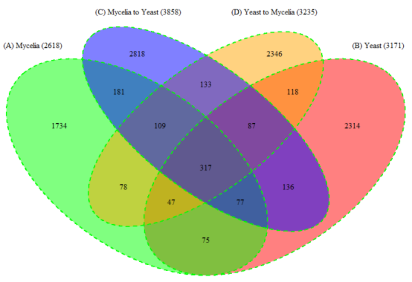
Figure 1. Comparison of alternative splicing events in T. marneffei growing at different temperatures. (A) Mycelia grown at 25°C for one week; (B) Yeast form grown at 37°C for one week; (C) Mycelia from 25°C were transferred to 37°C for 6 hours; (D) Yeast cells from 37°C were transferred to 25°C for 6 hours.
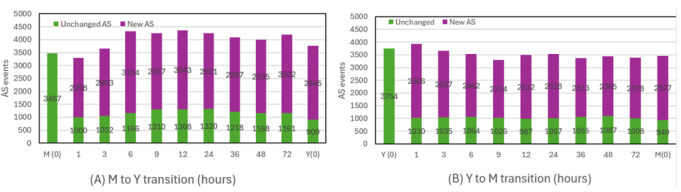
Figure 2. Dynamic changes in alternative splicing during dimorphic transitions of T. marneffei. (A): Time-course of transition of mycelial cells(M) to yeast cells (Y) by transferring growth plates from 25°C to 37°C. (B): Time-course of transition of yeast cells to mycelial cells by transferring growth plates from 37°C to 25°C. The unchanged AS events were obtained by comparing the sample at each time point with the sample collected at immediate previous time point.

Information


 Share This Article
 Twitter
 Linked In
 Facebook
 Copy
Copy Download