Abstract
This study examines how STEM education integrating social issues (STEM-S) has been conceptualized in relation to teacher competence and instructional design. Although integrated STEM education has increasingly been connected with sustainability, socioscientific issues, citizen science, and socially relevant learning, the competence required for teachers to design STEM-S learning units remains insufficiently clarified in the literature. Guided by the PRISMA framework and complemented by snowball sampling, this systematic literature review analyzed 32 empirical, conceptual, policy-oriented, and theoretical sources published between 2005 and March 2026. The selected sources were examined through thematic synthesis to identify research trends, relevant competency frameworks, the role of social issues, design-related elements, and implications for teacher education. The findings indicate that STEM-S reflects a shift from interdisciplinary STEM integration and technical problem solving toward learning that connects STEM knowledge with social context, sustainability values, and responsible action. However, three structural gaps were identified. First, design competence is often treated as one component of broader STEM teacher competence rather than as a central construct in STEM-S teacher education. Second, social issues are frequently used as learning contexts or themes but are not fully embedded as structural components of competence. Third, the pedagogical mechanism through which real-world social issues, learner experience, interdisciplinary STEM knowledge, and sustainability values are transformed into curriculum-aligned learning units remains underdeveloped. Based on these findings, the study proposes that STEM-S design competence can be understood as an integrative professional competence connecting social context analysis, interdisciplinary STEM integration, pedagogical transformation, learning unit design, assessment, and reflection. This review provides a theoretical basis for further developing behavioral indicators, assessment tools, and teacher education activities aimed at preparing teachers to design socially responsive and sustainability-oriented STEM-S learning units.
Keywords
STEM-S Education, Design Competence, Teacher Education, Competency Framework, Pedagogical Transformation, Systematic Literature Review
1. Introduction
STEM education is increasingly expected to address social, environmental, and sustainability-related challenges, rather than focusing only on scientific and technological knowledge or technical problem solving. Integrated STEM education has been widely recognized as an interdisciplinary approach that supports problem solving, inquiry, interdisciplinary knowledge integration, and design-based learning
| [1] | Bybee, R. W. The case for STEM education: Challenges and opportunities. Arlington, Virginia: NSTA press; 2013. |
| [2] | English, L. D. STEM education K-12: perspectives on integration. International Journal of STEM Education. 2016, 3(1), 3.
https://doi.org/10.1186/s40594-016-0036-1 |
| [3] | Kelley, T. R., Knowles, J. G. A conceptual framework for integrated STEM education. International Journal of STEM education. 2016, 3(1), 11.
https://doi.org/10.1186/s40594-016-0046-z |
| [4] | Moore, T. J., Stohlmann, M. S., Wang, H.-H., Tank, K. M., Glancy, A. W., Roehrig, G. H. Implementation and integration of engineering in K-12 STEM education. In Engineering in Pre-College Settings. Purdue University Press; 2014, 35-60.
https://doi.org/10.2307/j.ctt6wq7bh.7 |
[1-4]
. However, several scholars have argued that conventional STEM approaches may remain limited if they insufficiently address the ethical, social, cultural, and environmental dimensions of real-world problems
| [5] | Davis, J., "ESD starts where STEM stops: Integrating the social sciences into STEM," in Proceedings of the 2nd International STEM in Education Conference, S. Yu, Ed., 2012: Beijing Normal University, pp. 177-183. |
| [6] | Garibay, J. STEM Students' Social Agency and Views on Working for Social Change: Are STEM Disciplines Developing Socially and Civically Responsible Students? Journal of Research in Science Teaching. 2015, 52.
https://doi.org/10.1002/tea.21203 |
| [7] | Marcone, G. Humanities and social sciences in relation to sustainable development goals and STEM education. Sustainability. 2022, 14(6), 3279.
https://doi.org/10.3390/su14063279 |
[5-7]
. This shift reflects a broader educational demand: learners need to understand not only how to develop technical solutions but also how such solutions relate to social consequences, stakeholder perspectives, sustainability values, and responsible action.
The convergence of Education for Sustainable Development (ESD), socioscientific issues (SSI), citizen science, and integrated STEM has expanded STEM education toward an approach that connects knowledge with context, values, and action. ESD emphasizes sustainability, responsibility, and transformative action
| [8] | OECD. OECD Future of Education and Skills 2030: OECD Learning Compass 2030. OECD Publishing; 2019. |
| [9] | Rieckmann, M., Gardiner, S., Mindt, L. Education for Sustainable Development Goals: Learning Objectives. Paris: UNESCO-Publishing, United Nations Educational Scientific and Cultural Organization; 2017. |
| [10] | UNESCO. Education for sustainable development: a roadmap. Paris, France; 2020. |
[8-10]
, while SSI-based education foregrounds ethical reasoning, evidence-based argumentation, and decision-making in complex social contexts
| [11] | Sadler, T. D., Barab, S. A., Scott, B. What do students gain by engaging in socioscientific inquiry? Research in science education. 2007, 37(4), 371-391.
https://doi.org/10.1007/s11165-006-9030-9 |
| [12] | Zeidler, D., Sadler, T., Simmons, M., Howes, E. Beyond STS: A research-based framework for socioscientific issues education. Science Education. 2005, 89, 357-377.
https://doi.org/10.1002/sce.20048 |
[11, 12]
. Citizen science further extends this orientation by engaging learners in authentic inquiry, data collection, community-oriented participation, and civic agency
| [13] | Batchelder, M. et al. Experiences from a school–university partnership climate and sustainability education project in England: The value of citizen science and practical STEM approaches. Sustainability. 2023, 15(12), 9401.
https://doi.org/10.3390/su15129401 |
| [14] | Bonney, R. et al. Next steps for citizen science. Science. 2014, 343(6178), 1436-1437. https://doi.org/10.1126/science.125155 |
| [15] | Barragán, C. D. C. Democratizing STEM: Citizen science as a tool for engagement and social change. American Journal of STEM Education. 2025, 11, 1-8.
https://doi.org/10.32674/gznjkg56 |
| [16] | Dalyot, K. E., Golumbic, Y. N. Citizen science in STEM education: engaging students with real life science. In International Encyclopedia of Education. Elsevier; 2023, 224-233.
https://doi.org/10.1016/B978-0-12-818630-5.13004-0 |
| [17] | Jordan, R., Ballard, H., Phillips, T. Key issues and new approaches for evaluating citizen-science learning outcomes. Frontiers in Ecology and the Environment. 2012, 10, 307-309. https://doi.org/10.1890/110280 |
[13-17]
. In this study, STEM education integrating social issues is referred to as STEM-S education. STEM-S is understood not as the superficial addition of social themes to STEM lessons, but as a restructuring of learning activities around socially relevant problems, interdisciplinary STEM knowledge, sustainability values, and responsible action.
Competency frameworks provide important foundations for understanding the professional capacities required for STEM-S education. Broad policy and 21st-century competency frameworks emphasize agency, responsibility, sustainability, and transformative action
| [8] | OECD. OECD Future of Education and Skills 2030: OECD Learning Compass 2030. OECD Publishing; 2019. |
| [9] | Rieckmann, M., Gardiner, S., Mindt, L. Education for Sustainable Development Goals: Learning Objectives. Paris: UNESCO-Publishing, United Nations Educational Scientific and Cultural Organization; 2017. |
| [10] | UNESCO. Education for sustainable development: a roadmap. Paris, France; 2020. |
| [18] | Partnership for 21st Century Skills, "P21 Framework Definitions: Partnership for 21st Century Skills," Washington, 2009. [Online]. Available: http://www.21stcenturyskills.org |
[8-10, 18]
. STEM teacher competence frameworks clarify components such as STEM awareness, interdisciplinary knowledge integration, instructional design, classroom implementation, assessment, and reflection
| [19] | Lien, N. T. A proposed STEM education competence framework for primary school teachers [in Vietnamese]. Vietnam Journal of Education. 2024, 24(21), 7-12. [Online]. Available: https://tcgd.tapchigiaoduc.edu.vn/index.php/tapchi/article/view/2515 |
| [20] | Oanh, D. Integrated STEM Education Competence Framework for University Lecturers. European Journal of Educational Research. 2024, 14, 135-150.
https://doi.org/10.12973/eu-jer.14.1.135 |
| [21] | Thuy, N. T. T., Bien, N. V., Quy, D. X. Fostering teachers’ competence of the integrated STEM education. Jurnal Penelitian Dan Pembelajaran IPA. 2020, 6(2), 166-179.
https://doi.org/10.30870/jppi.v6i2.6441 |
[19-21]
. Emerging STEM-S, STEMS, SSTEM, and STEAM+H models further highlight social relevance, sustainability, community engagement, humanities integration, and responsible action
| [15] | Barragán, C. D. C. Democratizing STEM: Citizen science as a tool for engagement and social change. American Journal of STEM Education. 2025, 11, 1-8.
https://doi.org/10.32674/gznjkg56 |
| [22] | Balyk, N. R., Vasylenko, Y. P., Shmyger, G. P., Oleksiuk, V. P., Balyk, A. V., "STEAM+ H: A model for integrating humanities and sustainable development in the STEAM educational paradigm," in Workshop co-located with XVII International Conference on Mathematics, Science and Technology Education, 2025, vol. 3949, pp. 72-92. Available:
https://ceur-ws.org/Vol-3949/paper15.pdf |
| [23] | Fajrina, S., Lufri, L., Ahda, Y., Alberida, H., "Validity of Project Learning Model Based on STEMS to Improve Creativity in the 21st," in Proceedings of the 3rd International Conference on Biology, Science and Education (IcoBioSE 2021), 2023, vol. 32: Springer Nature, pp. 9-17.
https://doi.org/10.2991/978-94-6463-166-1_3 |
| [24] | Karakaya, V., Ay, T. S. Social studies integrated STEM (SSTEM): a mixed method research. Anadolu Journal of Educational Sciences International. 2024, 14(2), 655-685.
https://doi.org/10.18039/ajesi.1473749 |
[15, 22-24]
. However, these frameworks and models remain fragmented. They provide valuable foundations but have not yet sufficiently clarified STEM-S design competence as a central professional construct in teacher education.
This issue is particularly important because the implementation of STEM-S depends not only on teachers’ awareness of social issues but also on their capacity to transform those issues into curriculum-aligned learning units. Research on STEM implementation shows that teachers and pre-service teachers often face difficulties in designing integrated lessons, connecting disciplinary knowledge, organizing inquiry or project-based learning, and assessing complex learning outcomes
| [21] | Thuy, N. T. T., Bien, N. V., Quy, D. X. Fostering teachers’ competence of the integrated STEM education. Jurnal Penelitian Dan Pembelajaran IPA. 2020, 6(2), 166-179.
https://doi.org/10.30870/jppi.v6i2.6441 |
| [25] | Elbih, R., Miller, E., Sheldon, G., Wilson, M. Integrating Social Studies Education with Mathematics: Pre-Service Teachers' Use of the Pyramids of Giza to Plan a STEM Lesson. Current Issues in Middle Level Education. 2022, 26(2), 1-8. https://doi.org/10.20429/cimle.2022.260204 |
| [26] | Nhung, N. T., Ly, T. H. Uncovering the challenges and requirements of elementary school teachers in implementing STEM educational activities in Vietnam. International Journal of Learning, Teaching and Educational Research. 2024, 23(6), 373-390. https://doi.org/10.26803/ijlter.23.6.17 |
[21, 25, 26]
. In STEM-S education, this design task becomes more complex because teachers must connect scientific knowledge with social issues, sustainability values, learner experience, pedagogical strategies, and assessment. Therefore, teacher education needs to move beyond introducing STEM-S as a concept and prepare teachers to design STEM-S learning units as a professional practice.
A further gap concerns the pedagogical mechanism through which socially relevant issues become teachable. Studies on didactic transposition and pedagogical transformation suggest that teaching involves transforming scientific knowledge, curriculum requirements, learner characteristics, and practical contexts into teachable content and learning activities
. For STEM-S, this transformation extends beyond scientific knowledge to include social context, community experience, ethical considerations, sustainability values, and the potential impacts of solutions. This indicates the need to examine pedagogical transformation as a mediating mechanism through which real-world social issues can be converted into curriculum-aligned STEM-S learning units.
The novelty of this review lies in three dimensions. First, it examines STEM-S-related literature from the perspective of teacher design competence rather than treating STEM-S only as a teaching theme or pedagogical approach. Second, it identifies structural gaps across existing competency frameworks, particularly the marginal position of social issues and design competence. Third, it foregrounds pedagogical transformation as a mediating mechanism through which socially relevant issues can be transformed into curriculum-aligned STEM-S learning units.
This study aims to systematically review research trends in STEM-S education, analyze competency frameworks related to teacher education, and identify structural gaps in order to reconceptualize STEM-S design competence as a foundation for teacher education innovation. The study is guided by the following research questions:
RQ1. What research trends characterize the transition from STEM to STEM-S education?
RQ2. How have existing competency frameworks addressed STEM-S-related teacher competence?
RQ3. What structural gaps need to be addressed to reconceptualize STEM-S design competence for teacher education?
2. Materials and Methods
2.1. Research Design
This study employed a systematic literature review design to examine research trends, competency frameworks, and structural gaps related to STEM education integrating social issues (STEM-S) in teacher education. The review was guided by the PRISMA framework to ensure transparency in identifying, screening, and selecting relevant literature. In addition to database searching, snowball sampling was used to identify foundational and highly relevant studies that might not have been captured through the initial keyword search.
A systematic literature review was considered appropriate for this study because the research objective was not to evaluate the effectiveness of a single intervention, but to synthesize conceptual, empirical, policy-oriented, and framework-based studies in order to clarify how STEM-S design competence has been conceptualized in the literature. The review therefore focused on three analytical dimensions: (i) research trends in the transition from STEM to STEM-S education; (ii) competency frameworks related to STEM, STEM-S, and teacher education; and (iii) structural gaps that need to be addressed in reconceptualizing STEM-S design competence for teacher education.
The final dataset consisted of 32 selected sources, including peer-reviewed journal articles, conference papers, policy documents, and theoretical studies. These sources were analyzed through thematic synthesis to identify convergent themes, conceptual distinctions, and unresolved gaps across the reviewed literature.
2.2. Search Strategy
The search strategy was designed to identify studies related to STEM-S education, social dimensions of STEM education, teacher competence, and instructional design. Scopus was used as the primary database because it indexes peer-reviewed international research across education, social sciences, and interdisciplinary studies. Google Scholar was used as a supplementary source to identify additional theoretical, policy-oriented, and context-specific studies. Snowball sampling was also conducted by examining the reference lists of key articles and policy documents.
The search covered studies published between 2005 and March 2026. This time span was selected to capture foundational work on socioscientific issues and citizen science after 2005, as well as the rapid expansion of integrated STEM, ESD, and competency-based teacher education after 2010.
Search strings combined the three keyword clusters using Boolean operators. A typical search string was: (“STEM-S” OR “STEMS” OR “S-STEM” OR “social issues in STEM” OR “STEM and society”) AND (“teacher competence” OR “pre-service teacher education” OR “design competence” OR “instructional design” OR “STEM teacher education”).
2.3. Eligibility Criteria
The eligibility criteria were established to ensure that the selected literature was relevant to the research aim and sufficiently robust for thematic synthesis. Studies and documents were included if they met at least one of the following criteria: (i) they addressed STEM-S education or related approaches such as STEM integrated with social issues, Education for Sustainable Development, socioscientific issues, citizen science, or socially responsible STEM education; (ii) they discussed teacher competence, pre-service teacher education, professional development, or instructional design in STEM-related education; (iii) they proposed, analyzed, or validated competency frameworks, teaching models, or design-oriented approaches relevant to STEM or STEM-S education; or (iv) they provided policy or theoretical foundations for competency-based education, sustainability-oriented education, or teacher education innovation.
Documents were excluded if they were unrelated to education, focused solely on technical STEM content without connection to social issues or teacher education, lacked conceptual or methodological relevance, or duplicated records already included in the dataset. Studies with insufficient information about their theoretical basis, research design, or educational implications were also excluded unless they were used only as supplementary background sources.
The inclusion of policy documents, conceptual papers, systematic reviews, and empirical studies was intentional. Since the purpose of this study was to reconceptualize STEM-S design competence, it was necessary to integrate different types of evidence, including theoretical frameworks, empirical findings, policy orientations, and teacher education models.
2.4. Screening Process
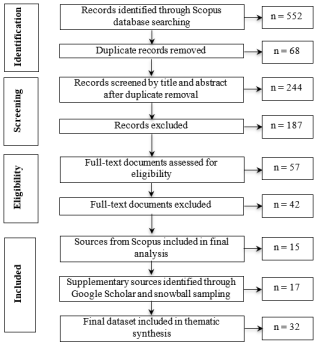
The selection process followed the main stages of PRISMA: identification, screening, eligibility assessment, and inclusion. In the identification stage, 552 records were retrieved from Scopus. After removing 68 duplicate records, 244 records were screened based on titles and abstracts. During this stage, 187 records were excluded because they were not directly related to STEM-S education, teacher competence, instructional design, or the social dimensions of STEM education.
In the eligibility stage, 57 full-text documents were assessed against the inclusion and exclusion criteria. Of these, 42 documents were excluded because they did not sufficiently address the research focus or lacked clear relevance to competency frameworks, teacher education, or STEM-S design competence. As a result, 15 studies from Scopus were included in the final dataset. To strengthen the theoretical and contextual coverage of the review, 19 additional sources were identified through Google Scholar and snowball sampling. The final dataset therefore consisted of 32 sources. The screening process is presented in
Figure 1.
Figure 1. PRISMA flow diagram for the selection of sources.
2.5. Data Extraction and Thematic Synthesis
Data extraction was conducted using a structured analytical framework. For each selected source, information was extracted regarding publication characteristics, research context, theoretical orientation, methodological approach, competency components, role of social issues, design-related elements, teacher education implications, and reported limitations or gaps. This extraction framework enabled the study to compare diverse sources systematically and to identify recurring patterns across conceptual, empirical, and policy-oriented literature.
The extracted data were analyzed through thematic synthesis. The analysis proceeded in three stages. First, the selected sources were coded according to their main focus, including STEM-S education, Education for Sustainable Development, socioscientific issues, citizen science, teacher competence, instructional design, and competency frameworks. Second, descriptive themes were developed by grouping similar codes into broader categories, such as the transition from STEM to STEM-S, the structure of STEM-related teacher competence, the role of social issues in learning design, and teacher education challenges. Third, analytical themes were generated to identify structural gaps and to support the reconceptualization of STEM-S design competence.
To enhance trustworthiness, the coding process was guided by predefined analytical categories but remained open to emerging themes. The reviewed literature was compared across different types of sources, including theoretical studies, empirical studies, policy documents, and previous systematic reviews. Particular attention was paid to whether social issues were treated merely as contexts for STEM learning or as structural components of competence. The synthesis also examined whether existing frameworks explained how teachers transform real-world social issues and experiential learning into curriculum-aligned instructional design. To reduce selection bias and enhance analytical consistency, the screening decisions and extracted data were cross-checked by two members of the research team. Any discrepancies were discussed until agreement was reached.
Table 1. Data extraction framework.
Extracted information | Analytical purpose |
Author, year, and source | To identify publication context and source type |
Type of document | To classify sources as conceptual, empirical, policy-oriented, review-based, or framework-based |
Research context | To determine educational level, national context, and target group |
Theoretical orientation | To identify foundations such as integrated STEM, ESD, SSI, citizen science, or competency-based education |
Methodological approach | To distinguish systematic reviews, empirical studies, conceptual analyses, policy reports, and model-development studies |
Competency components | To analyze how teacher competence or STEM-S competence is structured |
Role of social issues | To examine whether social issues are treated as context, content, values, action, or structural components of competence |
Design-related elements | To identify concepts such as design competence, instructional design, EDP, pedagogical transformation, and learning unit design |
Teacher education implications | To analyze relevance to pre-service teacher education, professional development, and curriculum design |
Reported limitations or gaps | To support the identification of structural gaps and future research directions |
2.6. Source Appraisal and Trustworthiness
To enhance the trustworthiness of the review, the selected sources were appraised according to their relevance to the research questions, clarity of theoretical or methodological contribution, credibility of the publication outlet, and applicability to teacher education and STEM-S design competence. Empirical studies were examined in terms of research design, sample, data collection, and clarity of findings. Conceptual and policy documents were assessed according to their theoretical relevance, institutional credibility, and contribution to competency-based or sustainability-oriented education. This appraisal was not intended to exclude all non-empirical sources, but to ensure that each source included in the synthesis had a clear analytical role.
The selected sources were analytically grouped into six categories: integrated STEM and STEM teacher competence; ESD and sustainability-oriented education; SSI and social reasoning; citizen science and participatory learning; STEM-S/STEMS/SSTEM/STEAM+H models; and pedagogical transformation or didactic transposition. These categories were not mutually exclusive, as some sources contributed to more than one analytical dimension.
3. Results
3.1. Research Trends in the Transition from STEM to STEM-S
The thematic synthesis indicates that the transition from STEM education to STEM-S education is characterized by a gradual shift from interdisciplinary knowledge integration and technical problem solving toward socially situated, value-oriented, and sustainability-oriented learning. Integrated STEM education is commonly conceptualized as an interdisciplinary approach that connects science, technology, engineering, and mathematics through problem solving, inquiry, and the Engineering Design Process
| [1] | Bybee, R. W. The case for STEM education: Challenges and opportunities. Arlington, Virginia: NSTA press; 2013. |
| [2] | English, L. D. STEM education K-12: perspectives on integration. International Journal of STEM Education. 2016, 3(1), 3.
https://doi.org/10.1186/s40594-016-0036-1 |
| [3] | Kelley, T. R., Knowles, J. G. A conceptual framework for integrated STEM education. International Journal of STEM education. 2016, 3(1), 11.
https://doi.org/10.1186/s40594-016-0046-z |
| [4] | Moore, T. J., Stohlmann, M. S., Wang, H.-H., Tank, K. M., Glancy, A. W., Roehrig, G. H. Implementation and integration of engineering in K-12 STEM education. In Engineering in Pre-College Settings. Purdue University Press; 2014, 35-60.
https://doi.org/10.2307/j.ctt6wq7bh.7 |
[1-4]
. However, a number of studies suggest that conventional STEM approaches do not sufficiently address the social, ethical, cultural, and environmental dimensions of real-world problems
| [5] | Davis, J., "ESD starts where STEM stops: Integrating the social sciences into STEM," in Proceedings of the 2nd International STEM in Education Conference, S. Yu, Ed., 2012: Beijing Normal University, pp. 177-183. |
| [6] | Garibay, J. STEM Students' Social Agency and Views on Working for Social Change: Are STEM Disciplines Developing Socially and Civically Responsible Students? Journal of Research in Science Teaching. 2015, 52.
https://doi.org/10.1002/tea.21203 |
| [7] | Marcone, G. Humanities and social sciences in relation to sustainable development goals and STEM education. Sustainability. 2022, 14(6), 3279.
https://doi.org/10.3390/su14063279 |
[5-7]
. This limitation helps explain the emergence of approaches that extend STEM toward social responsibility, sustainability, civic engagement, and community-oriented action.
The first trend concerns the expansion of STEM through ESD. In this strand, sustainability is treated not merely as an additional topic but as a value-oriented aim that connects scientific understanding with environmental responsibility, social action, and transformative competence
| [5] | Davis, J., "ESD starts where STEM stops: Integrating the social sciences into STEM," in Proceedings of the 2nd International STEM in Education Conference, S. Yu, Ed., 2012: Beijing Normal University, pp. 177-183. |
| [8] | OECD. OECD Future of Education and Skills 2030: OECD Learning Compass 2030. OECD Publishing; 2019. |
| [9] | Rieckmann, M., Gardiner, S., Mindt, L. Education for Sustainable Development Goals: Learning Objectives. Paris: UNESCO-Publishing, United Nations Educational Scientific and Cultural Organization; 2017. |
| [10] | UNESCO. Education for sustainable development: a roadmap. Paris, France; 2020. |
| [28] | Fathurohman, I., Amri, M. F., Septiyanto, A. Integrating STEM based Education for Sustainable Development (ESD) to Promote Quality Education: A Systematic Literature Review. Jurnal Penelitian Pendidikan IPA. 2023, 9(11), 1052-1059. https://doi.org/10.29303/jppipa.v9i11.4430 |
[5, 8-10, 28]
.
The second trend is the integration of socioscientific issues (SSI) and humanities/social science perspectives into STEM education. SSI-oriented approaches frame learning around complex problems that require scientific evidence, ethical reasoning, social values, and decision-making
| [7] | Marcone, G. Humanities and social sciences in relation to sustainable development goals and STEM education. Sustainability. 2022, 14(6), 3279.
https://doi.org/10.3390/su14063279 |
| [11] | Sadler, T. D., Barab, S. A., Scott, B. What do students gain by engaging in socioscientific inquiry? Research in science education. 2007, 37(4), 371-391.
https://doi.org/10.1007/s11165-006-9030-9 |
| [12] | Zeidler, D., Sadler, T., Simmons, M., Howes, E. Beyond STS: A research-based framework for socioscientific issues education. Science Education. 2005, 89, 357-377.
https://doi.org/10.1002/sce.20048 |
[7, 11, 12]
. From this perspective, the social dimension is not an external addition to STEM content but an essential context for reasoning, argumentation, and responsible judgment. Studies on the role of humanities and social sciences in STEM also suggest that social sciences help learners understand the human, cultural, ethical, and contextual dimensions of real-world problems, while STEM fields provide tools for analyzing and developing solutions
| [5] | Davis, J., "ESD starts where STEM stops: Integrating the social sciences into STEM," in Proceedings of the 2nd International STEM in Education Conference, S. Yu, Ed., 2012: Beijing Normal University, pp. 177-183. |
| [7] | Marcone, G. Humanities and social sciences in relation to sustainable development goals and STEM education. Sustainability. 2022, 14(6), 3279.
https://doi.org/10.3390/su14063279 |
[5, 7]
.
The third trend relates to the growing use of citizen science and participatory approaches. Citizen science connects STEM learning with real-world inquiry, community data, and public participation
| [13] | Batchelder, M. et al. Experiences from a school–university partnership climate and sustainability education project in England: The value of citizen science and practical STEM approaches. Sustainability. 2023, 15(12), 9401.
https://doi.org/10.3390/su15129401 |
| [14] | Bonney, R. et al. Next steps for citizen science. Science. 2014, 343(6178), 1436-1437. https://doi.org/10.1126/science.125155 |
| [15] | Barragán, C. D. C. Democratizing STEM: Citizen science as a tool for engagement and social change. American Journal of STEM Education. 2025, 11, 1-8.
https://doi.org/10.32674/gznjkg56 |
| [16] | Dalyot, K. E., Golumbic, Y. N. Citizen science in STEM education: engaging students with real life science. In International Encyclopedia of Education. Elsevier; 2023, 224-233.
https://doi.org/10.1016/B978-0-12-818630-5.13004-0 |
| [17] | Jordan, R., Ballard, H., Phillips, T. Key issues and new approaches for evaluating citizen-science learning outcomes. Frontiers in Ecology and the Environment. 2012, 10, 307-309. https://doi.org/10.1890/110280 |
[13-17]
. In this orientation, learners are not positioned merely as recipients of scientific knowledge but as participants in investigation, data collection, reflection, and community-oriented action. This trend is particularly relevant to STEM-S because it links scientific inquiry with civic engagement, environmental responsibility, and social agency.
The fourth trend is the emergence of STEM-S, STEMS, SSTEM, and STEAM+H models, which explicitly integrate STEM with social, humanistic, cultural, and sustainability-oriented dimensions. These models attempt to move beyond interdisciplinary STEM by positioning social issues, community relevance, sustainability, or humanities as structural elements of learning design
| [22] | Balyk, N. R., Vasylenko, Y. P., Shmyger, G. P., Oleksiuk, V. P., Balyk, A. V., "STEAM+ H: A model for integrating humanities and sustainable development in the STEAM educational paradigm," in Workshop co-located with XVII International Conference on Mathematics, Science and Technology Education, 2025, vol. 3949, pp. 72-92. Available:
https://ceur-ws.org/Vol-3949/paper15.pdf |
| [23] | Fajrina, S., Lufri, L., Ahda, Y., Alberida, H., "Validity of Project Learning Model Based on STEMS to Improve Creativity in the 21st," in Proceedings of the 3rd International Conference on Biology, Science and Education (IcoBioSE 2021), 2023, vol. 32: Springer Nature, pp. 9-17.
https://doi.org/10.2991/978-94-6463-166-1_3 |
| [24] | Karakaya, V., Ay, T. S. Social studies integrated STEM (SSTEM): a mixed method research. Anadolu Journal of Educational Sciences International. 2024, 14(2), 655-685.
https://doi.org/10.18039/ajesi.1473749 |
[22-24]
. In several models, social relevance is operationalized through project-based learning, design-based learning, community-oriented products, dissemination, or action-based learning. Taken together, these studies suggest that STEM-S can be interpreted as a structural shift from interdisciplinary knowledge integration toward the integration of knowledge, context, values, and action.
Table 2 summarizes the theoretical approaches that informed the transition from STEM to STEM-S in the reviewed literature.
Table 2. Theoretical approaches in the transition from STEM to STEM-S.
Approach | Main focus | Contribution to STEM-S | Representative sources |
Integrated STEM | Interdisciplinary integration, problem solving, inquiry, and Engineering Design Process | Provides a design-based structure for organizing STEM learning activities | Bybee (2013); English (2016); Kelley & Knowles (2016); Moore et al. (2014) |
ESD-oriented STEM | Sustainability, values, responsibility, and transformative action | Expands STEM toward environmental and social responsibility | Davis (2012); UNESCO (2017, 2020); OECD (2019); Fathurohman et al. (2023) |
SSI-oriented STEM | Socioscientific reasoning, ethical judgment, and decision-making | Positions learning problems within complex social, ethical, and scientific contexts | Zeidler et al. (2005); Sadler et al. (2007); Marcone (2022) |
Citizen science and participatory learning | Participation in real-world inquiry, data collection, and community engagement | Connects STEM learning with authentic social participation and civic agency | Jordan et al. (2012); Bonney et al. (2014); Dalyot & Golumbic (2023); Batchelder et al. (2023); Caballero Barragán (2024) |
STEM-S / STEMS / SSTEM / STEAM+H | Integration of STEM with social, humanistic, cultural, and sustainability-oriented dimensions | Treats social issues as structural elements of learning rather than peripheral contexts | Fajrina et al. (2023); Karakaya & Selanik-Ay (2024); Balyk et al. (2025) |
3.2. Competency Frameworks Related to STEM-S Teacher Education
The second theme concerns how existing competency frameworks and competency-oriented models address teacher competence in STEM-S-related education. The synthesis suggests that the reviewed literature can be organized into five groups: broad policy and 21st-century competency frameworks, STEM teacher competence frameworks, STEM-S/STEMS models, inquiry and self-efficacy frameworks, and pedagogical transformation frameworks.
The first group consists of broad policy and competency-oriented frameworks, including P21, OECD Learning Compass 2030, and UNESCO ESD documents. These frameworks provide orientations toward agency, responsibility, sustainability, and transformative action
-10, 1
8], but they remain too broad to directly define STEM-S design competence in teacher education.
The second group includes STEM teacher competence frameworks, which commonly describe teacher competence through STEM awareness, interdisciplinary knowledge, instructional design, classroom implementation, assessment, and reflection
| [19] | Lien, N. T. A proposed STEM education competence framework for primary school teachers [in Vietnamese]. Vietnam Journal of Education. 2024, 24(21), 7-12. [Online]. Available: https://tcgd.tapchigiaoduc.edu.vn/index.php/tapchi/article/view/2515 |
| [20] | Oanh, D. Integrated STEM Education Competence Framework for University Lecturers. European Journal of Educational Research. 2024, 14, 135-150.
https://doi.org/10.12973/eu-jer.14.1.135 |
| [21] | Thuy, N. T. T., Bien, N. V., Quy, D. X. Fostering teachers’ competence of the integrated STEM education. Jurnal Penelitian Dan Pembelajaran IPA. 2020, 6(2), 166-179.
https://doi.org/10.30870/jppi.v6i2.6441 |
[19-21]
. Although these frameworks identify design as an important component, the social dimension is often treated as a context or theme rather than as a structural component of competence.
The third group includes STEM-S, STEMS, SSTEM, and STEAM+H models. These models make the social dimension of STEM learning more visible by integrating sustainability, humanities, community engagement, social relevance, or responsible action
| [15] | Barragán, C. D. C. Democratizing STEM: Citizen science as a tool for engagement and social change. American Journal of STEM Education. 2025, 11, 1-8.
https://doi.org/10.32674/gznjkg56 |
| [22] | Balyk, N. R., Vasylenko, Y. P., Shmyger, G. P., Oleksiuk, V. P., Balyk, A. V., "STEAM+ H: A model for integrating humanities and sustainable development in the STEAM educational paradigm," in Workshop co-located with XVII International Conference on Mathematics, Science and Technology Education, 2025, vol. 3949, pp. 72-92. Available:
https://ceur-ws.org/Vol-3949/paper15.pdf |
| [23] | Fajrina, S., Lufri, L., Ahda, Y., Alberida, H., "Validity of Project Learning Model Based on STEMS to Improve Creativity in the 21st," in Proceedings of the 3rd International Conference on Biology, Science and Education (IcoBioSE 2021), 2023, vol. 32: Springer Nature, pp. 9-17.
https://doi.org/10.2991/978-94-6463-166-1_3 |
| [24] | Karakaya, V., Ay, T. S. Social studies integrated STEM (SSTEM): a mixed method research. Anadolu Journal of Educational Sciences International. 2024, 14(2), 655-685.
https://doi.org/10.18039/ajesi.1473749 |
[15, 22-24]
. Some models provide concrete learning processes such as project-based learning, social dissemination, citizen science participation, and community-based action. However, their primary focus is often on learning models, pedagogical processes, or student outcomes, while the teacher competence required to design such learning experiences remains less explicitly structured.
The fourth group consists of inquiry-based and self-efficacy frameworks. Yıldırım et al. (2024), for example, developed and validated a scale for inquiry-based teaching self-efficacy in STEM+S education, identifying dimensions such as questioning, investigation and creation, discussion and reflection, and connection with daily life
| [29] | Yıldırım, H. İ., Yokuş, M. B. E. C. E. Development of inquiry based teaching self-efficacy scale for stem+ s education: Validity and reliability study. International Online Journal of Educational Sciences. 2024, 10(3), 42-57.
https://doi.org/10.15345/iojes.2018.03.003 |
[29]
. Such studies are important because they show that STEM+S-related teacher competence can be operationalized and measured. However, these frameworks tend to focus on teachers’ confidence or inquiry-oriented teaching self-efficacy rather than the full design competence required to transform social issues into curriculum-aligned STEM-S learning units.
The fifth group concerns pedagogical or didactic transformation. Studies on didactic transposition and pedagogical transformation provide an important theoretical lens for understanding how teachers transform scientific knowledge, curriculum requirements, learner characteristics, and practical contexts into teachable content and learning activities
| [27] | Van, N. T. T., Tra, D. H. Fostering external didactic transposition capability of students of physics education: a case study in Vietnam. Journal of Science and Technology – Hung Vuong University. 2020, 21(4), 56-69. [Online]. Available:
https://www.hvu.edu.vn/file/1548236183/5.%20Nguy%E1%BB%85n%20Th%E1%BB%8B%20Thanh%20V%C3%A2n.pdf |
| [30] | Tra, D. H., Binh, L. T. A proposed competence framework for designing STEM-S learning units for pre-service primary teachers in response to education for sustainable development goals [in Vietnamese]. Vietnam Journal of Education. 2026, 26(5), 1-6. Available:
https://tcgd.tapchigiaoduc.edu.vn/index.php/tapchi/article/view/4871 |
[27, 30]
. This group is particularly relevant to STEM-S design competence because STEM-S requires teachers not only to understand social issues but also to transform them into pedagogically meaningful learning objectives, tasks, activities, materials, and assessment criteria. However, the reviewed literature suggests that this mechanism has not yet been systematically integrated into STEM-S competency frameworks.
Overall, the findings indicate that existing frameworks provide important foundations but remain fragmented. Broad competency frameworks offer values and future-oriented orientations; STEM teacher competence frameworks clarify design and implementation; STEM-S models foreground social relevance; inquiry/self-efficacy frameworks support measurement; and pedagogical transformation frameworks explain the transformation of knowledge into teaching. What remains insufficiently developed is an integrated framework that positions STEM-S design competence as the central construct connecting social context analysis, interdisciplinary STEM integration, pedagogical transformation, and curriculum-based instructional design.
Table 3 presents the main competency framework groups and their contributions to STEM-S teacher education.
Table 3. Competency frameworks and their contributions to STEM-S teacher education.
Framework group | Main contribution | Limitation identified in the review | Representative sources |
Broad policy and 21st-century competency frameworks | Provide foundations for critical thinking, creativity, collaboration, communication, agency, responsibility, and sustainability | Too broad to directly define STEM-S teacher design competence without adaptation | Partnership for 21st Century Skills (2009); OECD (2019); UNESCO (2017, 2020) |
STEM teacher competence frameworks | Clarify components such as STEM awareness, design, implementation, assessment, and reflection | Social issues are often peripheral or treated as contextual additions | Thuy, Van Bien, & Quy (2020); Oanh (2024); Ngo Thi Lien (2024) |
STEM-S / STEMS / SSTEM / STEAM+H models | Highlight social relevance, sustainability, community engagement, and responsible action | Often focus on learning models rather than structured teacher competence | Fajrina et al. (2023); Karakaya & Selanik-Ay (2024); Balyk et al. (2025); Caballero Barragán (2024) |
Inquiry and self-efficacy frameworks | Provide measurable dimensions of teacher confidence, questioning, investigation, reflection, and real-life connection | Focus more on teaching self-efficacy than on design competence | Yıldırım et al. (2024) |
Pedagogical transformation frameworks | Explain how knowledge, context, curriculum, and learner characteristics are transformed into teachable content | Not yet systematically integrated into STEM-S design competence frameworks | Nguyen Thi Thanh Van & Do Huong Tra (2020); Trà & Bình (2026) |
3.3. Structural Gaps in STEM-S Design Competence
The third theme concerns the structural gaps that need to be addressed in reconceptualizing STEM-S design competence for teacher education. The synthesis identified three major structural gaps and one related methodological gap across the reviewed literature.
The first structural gap is that design competence has not been sufficiently positioned as a central construct in STEM-S teacher education. Although many studies acknowledge the importance of designing STEM lessons, projects, inquiry activities, or learning units, design is often presented as one component within broader teacher competence frameworks
| [19] | Lien, N. T. A proposed STEM education competence framework for primary school teachers [in Vietnamese]. Vietnam Journal of Education. 2024, 24(21), 7-12. [Online]. Available: https://tcgd.tapchigiaoduc.edu.vn/index.php/tapchi/article/view/2515 |
| [20] | Oanh, D. Integrated STEM Education Competence Framework for University Lecturers. European Journal of Educational Research. 2024, 14, 135-150.
https://doi.org/10.12973/eu-jer.14.1.135 |
| [21] | Thuy, N. T. T., Bien, N. V., Quy, D. X. Fostering teachers’ competence of the integrated STEM education. Jurnal Penelitian Dan Pembelajaran IPA. 2020, 6(2), 166-179.
https://doi.org/10.30870/jppi.v6i2.6441 |
[19-21]
. In STEM-S education, however, design competence appears to play a more integrative role because teachers must connect scientific knowledge, engineering design, social issues, curriculum requirements, learner experience, and responsible action. This suggests that STEM-S design competence should be examined not only as a sub-skill of STEM teaching but also as an integrative professional competence.
The second structural gap is that social issues are not yet fully embedded as components of competence. In several studies, social issues are used as topics, contexts, or motivational elements for STEM learning
| [22] | Balyk, N. R., Vasylenko, Y. P., Shmyger, G. P., Oleksiuk, V. P., Balyk, A. V., "STEAM+ H: A model for integrating humanities and sustainable development in the STEAM educational paradigm," in Workshop co-located with XVII International Conference on Mathematics, Science and Technology Education, 2025, vol. 3949, pp. 72-92. Available:
https://ceur-ws.org/Vol-3949/paper15.pdf |
| [23] | Fajrina, S., Lufri, L., Ahda, Y., Alberida, H., "Validity of Project Learning Model Based on STEMS to Improve Creativity in the 21st," in Proceedings of the 3rd International Conference on Biology, Science and Education (IcoBioSE 2021), 2023, vol. 32: Springer Nature, pp. 9-17.
https://doi.org/10.2991/978-94-6463-166-1_3 |
| [24] | Karakaya, V., Ay, T. S. Social studies integrated STEM (SSTEM): a mixed method research. Anadolu Journal of Educational Sciences International. 2024, 14(2), 655-685.
https://doi.org/10.18039/ajesi.1473749 |
[22-24]
. While this represents an important step beyond conventional STEM education, it does not fully explain what teachers need to know and do in order to design socially responsive STEM-S learning units. Treating social issues as structural components of competence would require teachers to analyze social problems, identify stakeholders, consider ethical and sustainability-related dimensions, evaluate the potential social impact of solutions, and transform these dimensions into learning objectives, tasks, criteria, and assessment strategies.
The third structural gap concerns the lack of a clearly articulated pedagogical mechanism linking experiential learning to instructional design. Many studies highlight experiential learning, project-based learning, EDP, citizen science, and community engagement as valuable approaches for STEM-S education
3, 16, 31, 3
2]. However, fewer studies explain how teachers or pre-service teachers transform these experiences into curriculum-aligned learning units. This indicates the need to foreground pedagogical transformation as a mediating mechanism through which real-world social issues, community experiences, interdisciplinary knowledge, and learner characteristics are transformed into teachable content, structured learning activities, and assessment criteria. Studies on didactic transposition and STEM-S teacher education provide a foundation for this interpretation, but the mechanism remains insufficiently integrated into STEM-S competency frameworks
| [27] | Van, N. T. T., Tra, D. H. Fostering external didactic transposition capability of students of physics education: a case study in Vietnam. Journal of Science and Technology – Hung Vuong University. 2020, 21(4), 56-69. [Online]. Available:
https://www.hvu.edu.vn/file/1548236183/5.%20Nguy%E1%BB%85n%20Th%E1%BB%8B%20Thanh%20V%C3%A2n.pdf |
| [30] | Tra, D. H., Binh, L. T. A proposed competence framework for designing STEM-S learning units for pre-service primary teachers in response to education for sustainable development goals [in Vietnamese]. Vietnam Journal of Education. 2026, 26(5), 1-6. Available:
https://tcgd.tapchigiaoduc.edu.vn/index.php/tapchi/article/view/4871 |
[27, 30]
.
In addition to these three structural gaps, a related methodological gap concerns assessment. Existing tools tend to measure general STEM teaching competence, inquiry-based self-efficacy, or teacher readiness
| [20] | Oanh, D. Integrated STEM Education Competence Framework for University Lecturers. European Journal of Educational Research. 2024, 14, 135-150.
https://doi.org/10.12973/eu-jer.14.1.135 |
| [21] | Thuy, N. T. T., Bien, N. V., Quy, D. X. Fostering teachers’ competence of the integrated STEM education. Jurnal Penelitian Dan Pembelajaran IPA. 2020, 6(2), 166-179.
https://doi.org/10.30870/jppi.v6i2.6441 |
| [29] | Yıldırım, H. İ., Yokuş, M. B. E. C. E. Development of inquiry based teaching self-efficacy scale for stem+ s education: Validity and reliability study. International Online Journal of Educational Sciences. 2024, 10(3), 42-57.
https://doi.org/10.15345/iojes.2018.03.003 |
[20, 21, 29]
. Fewer studies provide behavioral indicators specifically for STEM-S design competence. This limits the ability of teacher education programs to diagnose, develop, and evaluate pre-service teachers’ competence in designing STEM-S learning units.
Taken together, these gaps indicate the need to integrate existing insights into a more coherent construct of STEM-S design competence for teacher education.
Table 4 summarizes these gaps and their implications.
Table 4. Structural gaps and implications for reconceptualizing STEM-S design competence.
Structural gap | Meaning | Evidence base | Implication for teacher education |
Design competence is not sufficiently central | Design is often treated as one component within broader STEM teacher competence frameworks | STEM teacher competence frameworks and STEM-S framework studies | Position STEM-S design competence as a core professional construct in teacher education |
Social issues are not fully embedded | Social issues are often treated as topics, contexts, or motivational elements | STEM-S, STEMS, SSTEM, STEAM+H, SSI, and ESD-oriented studies | Treat social issues as competence components involving context analysis, stakeholder consideration, ethical judgment, and impact evaluation |
Pedagogical transformation is underdeveloped | Few frameworks explain how real-world experience becomes curriculum-aligned instructional design | Didactic transposition, pedagogical transformation, experiential learning, and teacher education studies | Develop pedagogical transformation as the mediating mechanism between experience and design |
Related methodological gap: assessment tools remain limited | Existing tools mainly assess STEM teaching competence, inquiry self-efficacy, or general readiness | Inquiry self-efficacy and STEM competence measurement studies | Develop behavioral indicators and assessment tools specifically for STEM-S design competence |
4. Discussion
4.1. From STEM-S as a Teaching Theme to STEM-S as Design Competence
Building on the trends identified in Section 3.1, STEM-S can be interpreted less as a thematic extension of STEM and more as a design problem in teacher education. If social issues become part of the purpose, process, and expected outcomes of learning, then the teacher’s task is not simply to add a social context to a STEM lesson. Rather, teachers need to structure social issues pedagogically so that they can become meaningful learning objectives, inquiry tasks, design challenges, assessment criteria, and opportunities for responsible action.
This interpretation shifts the focus of STEM-S from “what social issue should be included?” to “how should a social issue be transformed into a pedagogically meaningful STEM-S learning unit?” Such a shift is important because social issues are often complex, value-laden, and context-dependent. They cannot be transferred directly into classroom activities without selection, adaptation, simplification, sequencing, and alignment with curriculum goals and learner characteristics. Therefore, STEM-S requires a form of professional competence that integrates social analysis, interdisciplinary STEM knowledge, curriculum interpretation, pedagogical decision-making, and assessment design.
From this perspective, design competence becomes the core mechanism through which STEM-S is made educationally meaningful. Existing STEM teacher competence frameworks have already recognized the importance of lesson design, implementation, assessment, and reflection
| [19] | Lien, N. T. A proposed STEM education competence framework for primary school teachers [in Vietnamese]. Vietnam Journal of Education. 2024, 24(21), 7-12. [Online]. Available: https://tcgd.tapchigiaoduc.edu.vn/index.php/tapchi/article/view/2515 |
| [20] | Oanh, D. Integrated STEM Education Competence Framework for University Lecturers. European Journal of Educational Research. 2024, 14, 135-150.
https://doi.org/10.12973/eu-jer.14.1.135 |
| [21] | Thuy, N. T. T., Bien, N. V., Quy, D. X. Fostering teachers’ competence of the integrated STEM education. Jurnal Penelitian Dan Pembelajaran IPA. 2020, 6(2), 166-179.
https://doi.org/10.30870/jppi.v6i2.6441 |
[19-21]
. However, the synthesis in this study suggests that STEM-S requires design competence to play a more integrative role. It is not only one component of STEM teaching competence, but the professional capacity that enables teachers to connect real-world social issues with curriculum-based STEM learning.
Thus, STEM-S design competence can be conceptualized as a specialized professional competence that enables teachers to transform socially relevant issues into pedagogically structured STEM learning units. This conceptualization is theoretically significant because it moves STEM-S beyond the level of content integration and positions it as a competence-oriented framework for teacher education. It also provides a basis for distinguishing STEM-S design competence from general STEM teaching competence: while STEM teaching competence may focus on interdisciplinary integration and technical problem solving, STEM-S design competence additionally requires social context analysis, ethical consideration, sustainability orientation, and pedagogical transformation.
4.2. Design Competence as a Core Direction for Teacher Education Innovation
The fragmentation of competency frameworks identified in Section 3.2 suggests that teacher education should not rely on isolated modules on STEM, sustainability, social issues, or instructional methods. Although each of these elements is important, they need to be integrated through design-based professional learning. In other words, teacher education innovation should not be limited to adding new theoretical content about STEM-S. It should create structured opportunities for pre-service and in-service teachers to practice designing STEM-S learning units.
This has important implications for how teacher education programs are organized. If STEM-S design competence is the intended outcome, then teacher preparation should involve iterative cycles of analyzing social issues, identifying relevant STEM knowledge, interpreting curriculum requirements, designing learning tasks, developing assessment criteria, receiving feedback, revising design products, and reflecting on pedagogical decisions. This approach is consistent with experiential learning and project-based learning theories, which emphasize learning through authentic tasks, reflection, and the construction of meaningful products
| [31] | Kolb, D. A. Experiential learning: Experience as the source of learning and development. Englewood Cliffs, NJ: Prentice Hall; 1984. |
| [32] | Krajcik, J., Blumenfeld, P. Project-Based Learning. In The Cambridge Handbook of the Learning Sciences. In. New York: Cambridge University Press; 2006, 317-333.
https://doi.org/10.1017/CBO9780511816833.020 |
[31, 32]
.
For pre-service primary teacher education, this issue becomes even more significant. Primary teachers often work with integrated subjects, young learners, and curriculum requirements that demand age-appropriate learning experiences. Designing STEM-S learning units for primary education therefore requires not only simplifying scientific content but also selecting socially meaningful issues, adapting them to children’s cognitive and emotional development, and creating tasks that are both pedagogically manageable and socially meaningful. Teacher education programs should therefore treat STEM-S design as a professional practice to be developed through modeling, guided practice, design rehearsal, peer discussion, and expert feedback.
Theoretically, this discussion suggests that teacher education innovation should be understood as a shift from knowledge acquisition to design capacity building. Knowing about STEM-S, ESD, SSI, or citizen science is necessary but insufficient; teachers also need to organize these ideas into teachable learning structures. In this sense, design competence links theoretical learning with professional action and enables teacher education programs to move from “learning about STEM-S” to “learning to design STEM-S”. This orientation is aligned with future-oriented education frameworks that emphasize agency, responsibility, creativity, collaboration, and the capacity to act in complex situations
| [8] | OECD. OECD Future of Education and Skills 2030: OECD Learning Compass 2030. OECD Publishing; 2019. |
| [9] | Rieckmann, M., Gardiner, S., Mindt, L. Education for Sustainable Development Goals: Learning Objectives. Paris: UNESCO-Publishing, United Nations Educational Scientific and Cultural Organization; 2017. |
| [10] | UNESCO. Education for sustainable development: a roadmap. Paris, France; 2020. |
| [18] | Partnership for 21st Century Skills, "P21 Framework Definitions: Partnership for 21st Century Skills," Washington, 2009. [Online]. Available: http://www.21stcenturyskills.org |
[8-10, 18]
.
4.3. Pedagogical Transformation as the Missing Mechanism
The structural gap identified in Section 3.3 points to pedagogical transformation as the missing mechanism between social experience and instructional design. In teacher education, experience should not be treated as directly equivalent to learning design. A real-world issue, a community problem, a sustainability challenge, or a citizen science activity becomes educationally productive only when it is interpreted, selected, adapted, and transformed into teachable content and structured learning tasks.
In this study, pedagogical transformation is interpreted as the process through which social experience becomes teachable. It involves identifying the educationally meaningful aspects of a social issue, connecting them with relevant STEM knowledge, aligning them with curriculum goals, adapting them to learner characteristics, and organizing them into learning objectives, learning tasks, materials, design criteria, and assessment evidence. This interpretation builds on the logic of didactic transposition, which explains how scientific knowledge is transformed into knowledge to be taught and learned
. However, in STEM-S, the object of transformation is broader than scientific knowledge alone. It also includes social context, community experience, ethical considerations, sustainability values, and potential impacts of solutions.
This mechanism clarifies why STEM-S design competence cannot be reduced to general teaching skills or STEM content knowledge. A teacher may understand a social issue but still be unable to construct it as a learning task. Similarly, a teacher may understand EDP or project-based learning but still fail to embed stakeholder perspectives, ethical reasoning, or sustainability criteria into the learning process. Pedagogical transformation is therefore the process that gives STEM-S its instructional form.
Pedagogical transformation also explains how ESD, SSI, citizen science, and integrated STEM can be reorganized into coherent STEM-S learning units rather than remaining separate theoretical references. In this sense, it functions as the operational mechanism that connects theoretical orientations with teachers’ design decisions, including the selection of social issues, the formulation of learning tasks, the development of design criteria, and the assessment of socially responsible outcomes.
This interpretation has theoretical value because it identifies the mediating process between real-world relevance and instructional design. It suggests that the development of STEM-S design competence should not only involve exposure to authentic experiences but also explicit training in how to transform those experiences into pedagogical structures. Therefore, pedagogical transformation should be treated as a core component in the conceptualization, development, and assessment of STEM-S design competence.
4.4. Implications for Teacher Education and Curriculum Design
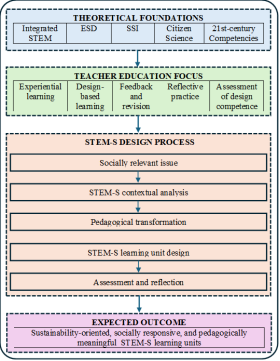
Taken together, the findings provide a basis for proposing a conceptual model of STEM-S design competence for teacher education. At this stage, the model is not intended to function as a validated measurement framework. Rather, it serves as a theoretical synthesis that organizes the main insights of the review into a coherent structure for future curriculum development, teacher education design, and empirical validation.
The first implication is that STEM-S design competence should be made explicit as an intended learning outcome in teacher education programs. If teacher education aims to prepare teachers for socially responsive and sustainability-oriented STEM education, programs need to specify what teachers should know and be able to do when designing STEM-S learning units. This includes analyzing socially relevant issues, integrating interdisciplinary STEM knowledge, applying EDP or other design-based pedagogies, transforming social issues pedagogically, and developing assessment strategies that reflect both learning outcomes and social dimensions. Therefore, STEM-S preparation should be embedded in a sequence of design-based learning experiences rather than being limited to a single lecture, topic, or short-term training session.
The second implication concerns assessment. If STEM-S design competence is conceptualized as an integrative professional competence, assessment should not focus only on whether teachers understand STEM-S concepts. It should also evaluate the quality of their design products and design reasoning. Possible assessment dimensions include the relevance of the selected social issue, the quality of STEM integration, the appropriateness of pedagogical transformation, the alignment with curriculum goals, the feasibility of learning tasks, the integration of social and sustainability criteria, and the coherence of assessment strategies. Existing frameworks for integrated STEM teaching competence and inquiry-based STEM+S teaching self-efficacy provide useful foundations for assessment
0, 21, 2
9]. However, they do not directly capture the specific design processes required for STEM-S learning units, including social issue analysis, pedagogical transformation, design reasoning, and the integration of social and sustainability criteria.
Figure 2 summarizes the proposed conceptual model by positioning socially relevant issues as the starting point of STEM-S design, pedagogical transformation as the mediating mechanism, and STEM-S learning unit design as the core professional outcome. Assessment and reflection function both as outcomes of design and as feedback mechanisms for further competence development. The model is grounded in integrated STEM, ESD, SSI, citizen science, and 21st-century competency frameworks.
Figure 2. A synthesis model of STEM-S design competence for teacher education.
4.5. Limitations and Future Research
This review has several limitations. First, although the review followed a systematic search and screening process, the inclusion of conceptual, policy-oriented, and theoretical sources means that the synthesis involved interpretive judgment. Second, Google Scholar and snowball sampling were used to broaden theoretical coverage, but these strategies may introduce selection bias. Third, the proposed model of STEM-S design competence is conceptual and has not yet been empirically validated. Future research should develop behavioral indicators, validate assessment tools, and examine how STEM-S design competence can be developed through design-based teacher education programs.
5. Conclusions
This study systematically reviewed research trends, competency frameworks, and structural gaps related to STEM education integrating social issues (STEM-S) in teacher education. The findings show that STEM-S reflects a shift from interdisciplinary STEM integration and technical problem solving toward learning that connects STEM knowledge with social context, sustainability values, and responsible action. However, the reviewed literature remains fragmented in explaining how teachers can transform socially relevant issues into curriculum-aligned STEM-S learning units.
Three main gaps were identified. First, design competence is often treated as one component of STEM teacher competence rather than as the organizing core of STEM-S teacher education. Second, social issues are frequently used as learning contexts or themes but are not fully embedded as structural components of competence. Third, the pedagogical mechanism that connects real-world experience with instructional design remains insufficiently articulated. These gaps indicate the need to reconceptualize STEM-S design competence as an integrative professional competence.
Based on the synthesis, STEM-S design competence can be understood as the capacity to analyze socially relevant issues, integrate interdisciplinary STEM knowledge, perform pedagogical transformation, and design curriculum-based learning units with appropriate assessment strategies. This reconceptualization provides a theoretical basis for teacher education programs that aim to move beyond STEM-S awareness toward design-based professional preparation. Future research should develop behavioral indicators, validate assessment tools, and examine how this competence can be fostered through design-based teacher education in different educational contexts.
Abbreviations
STEM | Science, Technology, Engineering and Mathematics |
STEM-S | STEM Education Integrating Social Issues |
ESD | Education for Sustainable Development |
SSI | Socioscientific Issues |
EDP | Engineering Design Process |
PRISMA | Preferred Reporting Items for Systematic Reviews and Meta-Analyses |
Acknowledgments
The authors would like to thank the scholars whose published works provided important theoretical and methodological foundations for this study.
Author Contributions
Le Thi Binh: Conceptualization, Methodology, Formal Analysis, Investigation, Data Curation, Visualization, Writing – original draft, Writing – review & editing
Do Huong Tra: Supervision, Validation, Project Administration, Writing – review & editing
Tran Quang Hieu: Resources, Formal Analysis, Validation, Writing – review & editing
Funding
This study is not supported by any external funding.
Data Availability Statement
The data supporting the findings of this study are available from the corresponding author upon reasonable request.
Conflicts of Interest
The authors declare no conflicts of interest.
References
| [1] |
Bybee, R. W. The case for STEM education: Challenges and opportunities. Arlington, Virginia: NSTA press; 2013.
|
| [2] |
English, L. D. STEM education K-12: perspectives on integration. International Journal of STEM Education. 2016, 3(1), 3.
https://doi.org/10.1186/s40594-016-0036-1
|
| [3] |
Kelley, T. R., Knowles, J. G. A conceptual framework for integrated STEM education. International Journal of STEM education. 2016, 3(1), 11.
https://doi.org/10.1186/s40594-016-0046-z
|
| [4] |
Moore, T. J., Stohlmann, M. S., Wang, H.-H., Tank, K. M., Glancy, A. W., Roehrig, G. H. Implementation and integration of engineering in K-12 STEM education. In Engineering in Pre-College Settings. Purdue University Press; 2014, 35-60.
https://doi.org/10.2307/j.ctt6wq7bh.7
|
| [5] |
Davis, J., "ESD starts where STEM stops: Integrating the social sciences into STEM," in Proceedings of the 2nd International STEM in Education Conference, S. Yu, Ed., 2012: Beijing Normal University, pp. 177-183.
|
| [6] |
Garibay, J. STEM Students' Social Agency and Views on Working for Social Change: Are STEM Disciplines Developing Socially and Civically Responsible Students? Journal of Research in Science Teaching. 2015, 52.
https://doi.org/10.1002/tea.21203
|
| [7] |
Marcone, G. Humanities and social sciences in relation to sustainable development goals and STEM education. Sustainability. 2022, 14(6), 3279.
https://doi.org/10.3390/su14063279
|
| [8] |
OECD. OECD Future of Education and Skills 2030: OECD Learning Compass 2030. OECD Publishing; 2019.
|
| [9] |
Rieckmann, M., Gardiner, S., Mindt, L. Education for Sustainable Development Goals: Learning Objectives. Paris: UNESCO-Publishing, United Nations Educational Scientific and Cultural Organization; 2017.
|
| [10] |
UNESCO. Education for sustainable development: a roadmap. Paris, France; 2020.
|
| [11] |
Sadler, T. D., Barab, S. A., Scott, B. What do students gain by engaging in socioscientific inquiry? Research in science education. 2007, 37(4), 371-391.
https://doi.org/10.1007/s11165-006-9030-9
|
| [12] |
Zeidler, D., Sadler, T., Simmons, M., Howes, E. Beyond STS: A research-based framework for socioscientific issues education. Science Education. 2005, 89, 357-377.
https://doi.org/10.1002/sce.20048
|
| [13] |
Batchelder, M. et al. Experiences from a school–university partnership climate and sustainability education project in England: The value of citizen science and practical STEM approaches. Sustainability. 2023, 15(12), 9401.
https://doi.org/10.3390/su15129401
|
| [14] |
Bonney, R. et al. Next steps for citizen science. Science. 2014, 343(6178), 1436-1437.
https://doi.org/10.1126/science.125155
|
| [15] |
Barragán, C. D. C. Democratizing STEM: Citizen science as a tool for engagement and social change. American Journal of STEM Education. 2025, 11, 1-8.
https://doi.org/10.32674/gznjkg56
|
| [16] |
Dalyot, K. E., Golumbic, Y. N. Citizen science in STEM education: engaging students with real life science. In International Encyclopedia of Education. Elsevier; 2023, 224-233.
https://doi.org/10.1016/B978-0-12-818630-5.13004-0
|
| [17] |
Jordan, R., Ballard, H., Phillips, T. Key issues and new approaches for evaluating citizen-science learning outcomes. Frontiers in Ecology and the Environment. 2012, 10, 307-309.
https://doi.org/10.1890/110280
|
| [18] |
Partnership for 21st Century Skills, "P21 Framework Definitions: Partnership for 21st Century Skills," Washington, 2009. [Online]. Available:
http://www.21stcenturyskills.org
|
| [19] |
Lien, N. T. A proposed STEM education competence framework for primary school teachers [in Vietnamese]. Vietnam Journal of Education. 2024, 24(21), 7-12. [Online]. Available:
https://tcgd.tapchigiaoduc.edu.vn/index.php/tapchi/article/view/2515
|
| [20] |
Oanh, D. Integrated STEM Education Competence Framework for University Lecturers. European Journal of Educational Research. 2024, 14, 135-150.
https://doi.org/10.12973/eu-jer.14.1.135
|
| [21] |
Thuy, N. T. T., Bien, N. V., Quy, D. X. Fostering teachers’ competence of the integrated STEM education. Jurnal Penelitian Dan Pembelajaran IPA. 2020, 6(2), 166-179.
https://doi.org/10.30870/jppi.v6i2.6441
|
| [22] |
Balyk, N. R., Vasylenko, Y. P., Shmyger, G. P., Oleksiuk, V. P., Balyk, A. V., "STEAM+ H: A model for integrating humanities and sustainable development in the STEAM educational paradigm," in Workshop co-located with XVII International Conference on Mathematics, Science and Technology Education, 2025, vol. 3949, pp. 72-92. Available:
https://ceur-ws.org/Vol-3949/paper15.pdf
|
| [23] |
Fajrina, S., Lufri, L., Ahda, Y., Alberida, H., "Validity of Project Learning Model Based on STEMS to Improve Creativity in the 21st," in Proceedings of the 3rd International Conference on Biology, Science and Education (IcoBioSE 2021), 2023, vol. 32: Springer Nature, pp. 9-17.
https://doi.org/10.2991/978-94-6463-166-1_3
|
| [24] |
Karakaya, V., Ay, T. S. Social studies integrated STEM (SSTEM): a mixed method research. Anadolu Journal of Educational Sciences International. 2024, 14(2), 655-685.
https://doi.org/10.18039/ajesi.1473749
|
| [25] |
Elbih, R., Miller, E., Sheldon, G., Wilson, M. Integrating Social Studies Education with Mathematics: Pre-Service Teachers' Use of the Pyramids of Giza to Plan a STEM Lesson. Current Issues in Middle Level Education. 2022, 26(2), 1-8.
https://doi.org/10.20429/cimle.2022.260204
|
| [26] |
Nhung, N. T., Ly, T. H. Uncovering the challenges and requirements of elementary school teachers in implementing STEM educational activities in Vietnam. International Journal of Learning, Teaching and Educational Research. 2024, 23(6), 373-390.
https://doi.org/10.26803/ijlter.23.6.17
|
| [27] |
Van, N. T. T., Tra, D. H. Fostering external didactic transposition capability of students of physics education: a case study in Vietnam. Journal of Science and Technology – Hung Vuong University. 2020, 21(4), 56-69. [Online]. Available:
https://www.hvu.edu.vn/file/1548236183/5.%20Nguy%E1%BB%85n%20Th%E1%BB%8B%20Thanh%20V%C3%A2n.pdf
|
| [28] |
Fathurohman, I., Amri, M. F., Septiyanto, A. Integrating STEM based Education for Sustainable Development (ESD) to Promote Quality Education: A Systematic Literature Review. Jurnal Penelitian Pendidikan IPA. 2023, 9(11), 1052-1059.
https://doi.org/10.29303/jppipa.v9i11.4430
|
| [29] |
Yıldırım, H. İ., Yokuş, M. B. E. C. E. Development of inquiry based teaching self-efficacy scale for stem+ s education: Validity and reliability study. International Online Journal of Educational Sciences. 2024, 10(3), 42-57.
https://doi.org/10.15345/iojes.2018.03.003
|
| [30] |
Tra, D. H., Binh, L. T. A proposed competence framework for designing STEM-S learning units for pre-service primary teachers in response to education for sustainable development goals [in Vietnamese]. Vietnam Journal of Education. 2026, 26(5), 1-6. Available:
https://tcgd.tapchigiaoduc.edu.vn/index.php/tapchi/article/view/4871
|
| [31] |
Kolb, D. A. Experiential learning: Experience as the source of learning and development. Englewood Cliffs, NJ: Prentice Hall; 1984.
|
| [32] |
Krajcik, J., Blumenfeld, P. Project-Based Learning. In The Cambridge Handbook of the Learning Sciences. In. New York: Cambridge University Press; 2006, 317-333.
https://doi.org/10.1017/CBO9780511816833.020
|
Cite This Article
-
APA Style
Binh, L. T., Tra, D. H., Hieu, T. Q. (2026). Reconceptualizing STEM-S Design Competence:
A Systematic Literature Review. International Journal of Education, Culture and Society, 11(5), 194-205. https://doi.org/10.11648/j.ijecs.20261105.11
 Copy
|
Copy
|
 Download
ACS Style
Binh, L. T.; Tra, D. H.; Hieu, T. Q. Reconceptualizing STEM-S Design Competence:
A Systematic Literature Review. Int. J. Educ. Cult. Soc. 2026, 11(5), 194-205. doi: 10.11648/j.ijecs.20261105.11
Copy
|
Download
AMA Style
Binh LT, Tra DH, Hieu TQ. Reconceptualizing STEM-S Design Competence:
A Systematic Literature Review. Int J Educ Cult Soc. 2026;11(5):194-205. doi: 10.11648/j.ijecs.20261105.11
Copy
|
Download
-
@article{10.11648/j.ijecs.20261105.11,
  author = {Le Thi Binh and Do Huong Tra and Tran Quang Hieu},
  title = {Reconceptualizing STEM-S Design Competence:
A Systematic Literature Review},
  journal = {International Journal of Education, Culture and Society},
  volume = {11},
  number = {5},
  pages = {194-205},
  doi = {10.11648/j.ijecs.20261105.11},
  url = {https://doi.org/10.11648/j.ijecs.20261105.11},
  eprint = {https://article.sciencepublishinggroup.com/pdf/10.11648.j.ijecs.20261105.11},
  abstract = {This study examines how STEM education integrating social issues (STEM-S) has been conceptualized in relation to teacher competence and instructional design. Although integrated STEM education has increasingly been connected with sustainability, socioscientific issues, citizen science, and socially relevant learning, the competence required for teachers to design STEM-S learning units remains insufficiently clarified in the literature. Guided by the PRISMA framework and complemented by snowball sampling, this systematic literature review analyzed 32 empirical, conceptual, policy-oriented, and theoretical sources published between 2005 and March 2026. The selected sources were examined through thematic synthesis to identify research trends, relevant competency frameworks, the role of social issues, design-related elements, and implications for teacher education. The findings indicate that STEM-S reflects a shift from interdisciplinary STEM integration and technical problem solving toward learning that connects STEM knowledge with social context, sustainability values, and responsible action. However, three structural gaps were identified. First, design competence is often treated as one component of broader STEM teacher competence rather than as a central construct in STEM-S teacher education. Second, social issues are frequently used as learning contexts or themes but are not fully embedded as structural components of competence. Third, the pedagogical mechanism through which real-world social issues, learner experience, interdisciplinary STEM knowledge, and sustainability values are transformed into curriculum-aligned learning units remains underdeveloped. Based on these findings, the study proposes that STEM-S design competence can be understood as an integrative professional competence connecting social context analysis, interdisciplinary STEM integration, pedagogical transformation, learning unit design, assessment, and reflection. This review provides a theoretical basis for further developing behavioral indicators, assessment tools, and teacher education activities aimed at preparing teachers to design socially responsive and sustainability-oriented STEM-S learning units.},
 year = {2026}
}
Copy
|
Download
-
TY  - JOUR
T1  - Reconceptualizing STEM-S Design Competence:
A Systematic Literature Review
AU  - Le Thi Binh
AU  - Do Huong Tra
AU  - Tran Quang Hieu
Y1  - 2026/09/04
PY  - 2026
N1  - https://doi.org/10.11648/j.ijecs.20261105.11
DO  - 10.11648/j.ijecs.20261105.11
T2  - International Journal of Education, Culture and Society
JF  - International Journal of Education, Culture and Society
JO  - International Journal of Education, Culture and Society
SP  - 194
EP  - 205
PB  - Science Publishing Group
SN  - 2575-3363
UR  - https://doi.org/10.11648/j.ijecs.20261105.11
AB  - This study examines how STEM education integrating social issues (STEM-S) has been conceptualized in relation to teacher competence and instructional design. Although integrated STEM education has increasingly been connected with sustainability, socioscientific issues, citizen science, and socially relevant learning, the competence required for teachers to design STEM-S learning units remains insufficiently clarified in the literature. Guided by the PRISMA framework and complemented by snowball sampling, this systematic literature review analyzed 32 empirical, conceptual, policy-oriented, and theoretical sources published between 2005 and March 2026. The selected sources were examined through thematic synthesis to identify research trends, relevant competency frameworks, the role of social issues, design-related elements, and implications for teacher education. The findings indicate that STEM-S reflects a shift from interdisciplinary STEM integration and technical problem solving toward learning that connects STEM knowledge with social context, sustainability values, and responsible action. However, three structural gaps were identified. First, design competence is often treated as one component of broader STEM teacher competence rather than as a central construct in STEM-S teacher education. Second, social issues are frequently used as learning contexts or themes but are not fully embedded as structural components of competence. Third, the pedagogical mechanism through which real-world social issues, learner experience, interdisciplinary STEM knowledge, and sustainability values are transformed into curriculum-aligned learning units remains underdeveloped. Based on these findings, the study proposes that STEM-S design competence can be understood as an integrative professional competence connecting social context analysis, interdisciplinary STEM integration, pedagogical transformation, learning unit design, assessment, and reflection. This review provides a theoretical basis for further developing behavioral indicators, assessment tools, and teacher education activities aimed at preparing teachers to design socially responsive and sustainability-oriented STEM-S learning units.
VL  - 11
IS  - 5
ER  -
Copy
|
Download





 Share This Article
 Twitter
 Linked In
 Facebook