Abstract
The purpose of this study was to evaluate the factors influencing farmers’ participation in watershed management in the Mugie Sub-watershed, located in the northeastern highlands of Ethiopia. A combination of purposive and random sampling techniques was used to select 200 households from four villages. Data was collected using a structured survey questionnaire, focus group discussions, and key informant interviews. The data were analyzed using a range of statistical techniques, including descriptive statistics, Pearson correlation, and regression analysis. The results revealed that farmers’ perception was strongly correlated (r = 0.612, p < 0.01) with their decision to participate in watershed management programs, followed by stakeholders’ support (r = 0.163, p < 0.05). In contrast, the slope of the farmland and the gender of the household head showed significant negative associations. Binary logistic regression analysis further indicated that six independent variables were important in explaining farmers’ decisions to participate in watershed management programs. These variables included land redistribution, gender, family labor force, educational opportunity, farm size, and land slope. Land redistribution, gender, family labor force, educational opportunity, and land slope had negative effects, whereas farm size had a positive effect. Further analysis also demonstrated the role of individual variables in explaining variation in farmers’ decisions to participate in the program. Among these, two variables were found to be statistically significant: the gender of the household head and land tenure security. Accordingly, the chi-square value for gender (X2 = 9.052) was statistically significant at the 95% confidence level. Similarly, the chi-square value for land tenure security (X2 = 8.691) was also statistically significant at the 95% confidence level. The findings of the study suggest the need to raise farmers’ awareness of the long-term benefits of watershed management programs and to design strategies that help diversify their livelihoods.
Keywords
Binary Logistic Regression Model, Ethiopia, Farmer, Participation, Watershed Management
1. Introduction
Drainage basin worldwide look adding force from ground retrogression, slumping water quality, and decreased ecosystem services. Incorporated Drainage basin management embraces water potential use scheduling, defilement prevention, and confirmable growing furnishes an efficient framework for overcoming these obstacles
| [21] | Heathcote IW (1998) Integrated watershed management: principles and practice. Wiley, New York. |
[21]
. Even though, the success of drainage basin platform always based on the agreement of local communities to take part, and uncertainty in such inclusion comes a main dispute.
In Ethiopia, where farming yields close to 42% of GDP and utilizes greater than 80% of the population
| [30] | MoFED (2010) Growth and transformation plan 2010/11-2014/15. Volume I: main text. Ministry of Finance and Economic Development (MoFED), Federal Democratic Republic of Ethiopia, Addis Ababa. |
[30]
, drainage basin retrogression occurs a sever endanger to farming economic and local living. The Ethiopian highlands are highly influenced by land wearing, decreasing productivity, and deforestation
| [20] | Haregeweyn N, Poesen J, Nyssen J, De Wit J, Mitiku H, Govers G, Deckers S (2005) Reservoirs in Tigray (Northern Ethiopia): characteristics and sediment deposition problems. Land Degrad Dev 17(2): 211–230. https://doi.org/10.1002/ldr.698 |
[20]
. These obstacles are expanded by erratic rainwater, rugged topography, and greater population and living concentration
| [15] | FAO (1986) Ethiopian highlands reclamation study. Report prepared for the Government of Ethiopia by the Food and Agriculture Organization of the United Nations, Ethiopia final report, vol 1 Retrieved on December 6, 2016, from
http://www.fao.org/docrep/field/009/ar863e/ar863e.pdf Accessed 6 Dec 2016. |
[15]
. As an outcome, silt supplies in main large natural stream accomplish 180–900 t year
-1 km
-2 | [34] | Rodeco (2002) Assessment and monitoring of erosion and sedimentation problems in Ethiopia—final report. Rodeco Consulting GmbH, Hydrology Studies Department, Ministry of Water Resources, Addis Ababa. |
[34]
, and edge of large natural stream carry an around 1.3 billion tons of silt yearly
| [32] | MoWR (1993) Improvement of the resource–population sustainability balance. Water Resources Development, MoWR, Addis Ababa. |
[32]
. Land retrogression thus stays a major obstacle to farm growth and economic evolution
| [25] | Lemenih M (2004) Effects of land use changes on soil quality and native flora degradation and restoration in the highlands of Ethiopia: implications for sustainable land management. Ph.D Thesis. Swedish University of Agricultural Sciences, Uppsala. |
[25]
.
Legal drainage basin management openings in Ethiopia started in the 1970s, but too soon interferences principally relied on top-down soil and water preservation (SWP) platforms that defined technical construction with a few community take part
| [13] | Elias E (2002) Farmers’ perceptions of soil fertility change and management. SOS Sahel Ethiopia; and Institute for Sustainable Development, Addis Ababa. |
| [27] | Melaku B (2003) Forest property rights, the role of the state, and institutional exigency: the Ethiopian experience. Ph.D Thesis, Swedish University of Agricultural Sciences. Sveriges lantbruksuniv., Acta Universitatis agriculturae Sueciae. Agraria, Uppsala, pp 1401–6249 409. |
[13, 27]
. Even though these interferences decreased land wearing, they could not made combination with confirmable land management and living constituents
| [33] | Osman M, Sauerborn P (2001) Soil and water conservation in Ethiopia: experiences and lessons. J Soils Sediments 1(2): 117–123. |
[33]
. Realizing these outcomes, Ethiopia follow community-based, collaborated drainage basin growing resembles in the too soon 2000s to good preservations with local social and ecologic facts
| [18] | German L, Mansoor H, Alemu G, Mazengia W, Amede T, Stroud A (2007) Participatory integrated watershed management: evolution of concepts and methods in an eco-regional program of the eastern African highlands. Agric Syst 94(2): 189–204. |
[18]
.
Other than these displacements, drainage basin results stay variable crosswise areas. In the Amhara Region, ground retrogression shows in the deprivation of 2–4 billion tons of soil yearly and rendition 20,000–30,000 ha ungenerative
| [2] | Taffa T (2009) Characteristics of property units in Ethiopia, the case of two pilot projects in Amhara National Regional State. Nord J Survey Real Estate Res 6(2): 7–24.
https://doi.org/10.1017/S0376892900007955 |
[2]
. The Simada District—home to the Upper Mugie sub-watershed is one of the most retrograded, exercising danger wearing, drought, and reducing generativity. Many drainage basin projects have been put through, yet their sustainability differ due to various social and biophysical situations, spotlighting the demand for context-particular participatory designing.
Former studies have emphasized that husbandman participation in drainage basin growing is affected by different personal, physical, and institutional factors. These let in demographic variables such as age, sex, and family size
| [11] | Dolisca F, Douglas RC, Joshua MM, Dennis AS, Curtis MJ (2006) Factors influencing farmers’ participation in forestry management programs: a case study from Haiti. Forest Ecol Manag 236: 324– 331.
https://doi.org/10.1016/j.foreco.2006.09.017 |
[11]
; education and mindfulness
| [14] | Faham E, Hosseini SM, Darvish AK (2008) Analysis of factors influencing rural people’s participation in National Action Plan for Sustainable Management of Land and Water Resources in Hable-Rud Basin, Iran. Am J Agric Biol Sci 3(2): 457–461. |
| [26] | McMillan MB, Hoban TJ, Clifford WB, Brant MR (1996) Social and demographic influences of environmental attitudes. South Rural Sociol 13(1): 89–107. |
[14, 26]
; former taking part in maturation planes
| [23] | Karegar A, Abedi Sarvestani A (2001) Contexts of public participation in natural resources plans (case study). Collection of articles of first convention of natural resources, participation and development. Forests, Range and Watershed Management Organization of Iran, Tehran, pp 371–401. |
[23]
; and making close interaction with propagation stakeholders and focal persons
| [4] | Aboueieh F (2001) Correlation of some factors influencing attraction of animal husbandmen’ participation in range conservation and rehabilitation in Semnan Province, M.Sc. Thesis, Science and Research Unit. Islamic Azad University, Tehran. |
[4]
. Other researches shows that socioeconomic variables, such as financial gain and working class existence, influence inclusivment in protection tasks
| [11] | Dolisca F, Douglas RC, Joshua MM, Dennis AS, Curtis MJ (2006) Factors influencing farmers’ participation in forestry management programs: a case study from Haiti. Forest Ecol Manag 236: 324– 331.
https://doi.org/10.1016/j.foreco.2006.09.017 |
[11]
, while physical factors like ground size, ground tenure protection, and incline also affect taking part. Mindfulness of resource degradation likewise maneuvers a crucial function
| [12] | Ebrahim PM (2000) Status of participation action and factors influencing it in watershed management. Collection of articles of first convention of natural resources, participation and development. Forests, Range and Watershed Management Organization of Iran, Tehran, pp 173–199. |
[12]
. Findings result on the effect of age is fused
| [1] | Shahidi M (1998) Analysis of factors influencing participation in under pressure irrigation from view point of farmers in northwest province of Iran. M.Sc. Thesis, Tehran University: Tehran. |
| [24] | Khalighi N, Ghasemi T (2004) Analysis of effect of socio-economic problems on level of stock breeders’ participation in range management plans in north Golestan Province, Iran. J Agric, Nat Resour Sci 11(1): 181–190. |
| [31] | Motevalli H (2002) Analysis of factors influencing attraction of villagers’ participation in desertification plans in Semnan Province. For Range Qual 56: 50–60. |
[1, 24, 31]
.
Having that farmers’ taking part is a core to the conformability of drainage basin startups, separating the factors directing inclusivement is vital for planning efficient platforms tailored to rural socio-ecological perspectives
. This finding therefore investigates the personal, physical, and institutional constraints of husbandman’s taking part in drainage basin management platforms in the Upper Mugie sub-watershed of Northern Ethiopia.
2. Methodology
2.1. Description of the Study Area
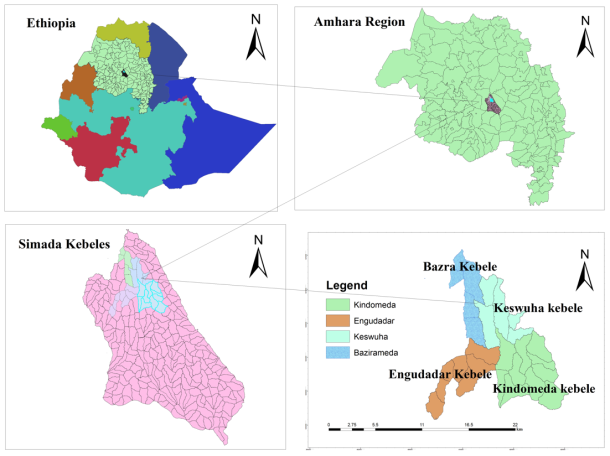
Geographically, upper Mugie sub-watershed is found at 11.42-degree E, 38.25-degree N and 2472 meters above mean sea level (AMSL). Administratively, it is situated in Simada districts, South Gondar Zone, Amhara Regional State (
Figure 1). The sub-watershed is situated just 777 km North of Addis Ababa (the capital city). It masks a total area of 152 km
2. The detailed critical inspection filed is qualified by various topographic stipulations. A mountainous and highly dissected landscape with immerse side qualified many portion of the sub-watershed. The ground is with deficit of wealth in the sub-watershed due to greater population pressing and degradation.
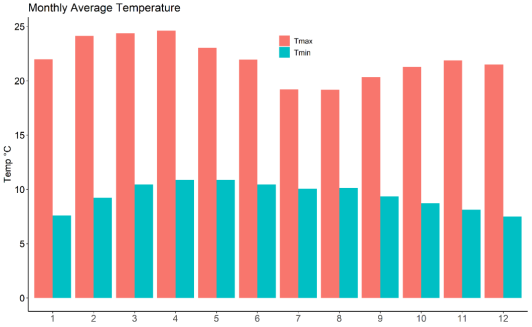
The meteorological data of the work was gained from Debretabor Meteorological Station. Geographically, Debretabor Meteorological Station is found at 11.51-degree E, 38.10-degree N and 2706 meters above mean sea level (AMSL). The study area has the mean minimum and mean maximum temperature of 7.5°C and 24.9°C, respectively. The monthly mean minimum temperature varied from 7.5°C in December to 10.9°C in April (
Figure 3). The monthly mean maximum temperature varied from 19.1°C in July to 24.9°C in March (
Figure 3).
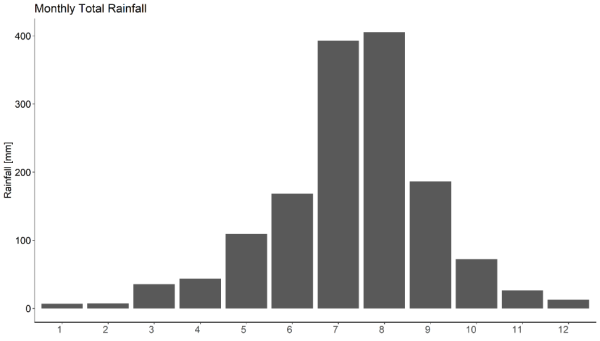
The drainage basin gets 1492.4 mm average rainwater yearly. The monthly modal values for 26 Years (1997-2022) of Climatic Deberetabor Station were gathered from the National Meteorological Agency (
Figure 2). Generally, the rainfalls of the watershed area were described by its high variability in distributions. Meher or Kiremt rainfall is largely gained in the four months (from June to September).
Figure 1. Location map of the study area.
Figure 2. Monthly rainfall, (1997-2022).
Figure 3. Monthly average maximum (Tmax) and minimum (Tmin) temperature.
2.2. Methods of Data Collection and Sampling
Both primary and secondary data sources are used for this study. The primary data lets in household survey questionnaire, focus group discussions (FGDs), field observations, and key informant interviews. Secondary data were also collected from former researches, studies, records, journals, and cyberspace root ages. The household survey questionnaire was done to collect data about demographic and socioeconomic characteristics of sample households, institutional services, biophysical characteristics, plot level characteristics, and various sustainable land management (SLM) activities taken by farmers of the study area. The questions were both closed-ended and open ended types. Accordingly, the survey questionnaire was conducted between December and January 2017. A formal survey instrument was prepared, and trained enumerators gathered the data from the families through personal interviews. This time was selected mostly to prevent interference of farmers’ farming tasks. Thus, it is simple to interview the sample farm house holds and gather the postulated data. The constructed household questionnaire was pre-tested as a pilot survey in the selected villages before full execution. The pilot survey enhances that the current questionnaire is relevant and purposeful to the modal answerer, and to assure which questions were relevant for the purpose of the study. Hence necessary modifications were made standing from the feedback gained from the pre-test. Data on the farmers’ sensing of land degradation, farming productivity, and effectuality of SLM exercise were also gathered.
Field watching was carried in order to validate information gained from the husbandman’s via a survey questionnaire. It includes watching of diverse land degradation characters, such as soil erosion and siltation, the incline of agricultural lands, surface runoff and farming activities, involving the types of crops grown, cropping patterns, and on farm soil preservation structures. The sample family leaders were haggard via multi-stage sampling proficiencies. The sampling proficiencies imply three stages. The names of eight villages (two from Engudadar, two from Keswuha, two from Kindomeda, and two from Bazra kebeles) were chosen meaningfully in the first stage. These kebeles were selected based on their agro ecological zones and accessibility. And also, four sample villages, one from each sample kebele, were selected randomly in the second stage. In the third stage, the numbers of all farm families from each chosen sample villages were listed. Finally, 160 male-headed and 40 femal-headed totals of 200 sample farm households of the study were chosen randomly from the four sample villages in proportional to the cover of each agro-climatic zone as shown
Table 1. These sample farm households were decided using the following formula
| [36] | Robert Slovin; (1967) Determining the sample size for survey research. |
[36]
.
Hence n is the sample size
N is the population size
e is the level of precision (5%).
Based on the above formula, the total sample households were calculated as follows:
n=400/(1+400×0.0025)=200.
Table 1. Distribution of sample farm house holds by district and village level.
Kebele | Village | Total households | Sample farm households | AEZ |
Male | Female | Total | Male | Female | Total |
Engudadar | Woyinye | 18 | 10 | 28 | 1 | 1 | 2 | Moist-wurch |
Kidomeda | Nechilo | 122 | 26 | 148 | 59 | 13 | 72 | Moist-dega |
Keswuha | Gandi | 80 | 21 | 101 | 40 | 11 | 51 | Moist-dega |
Bazra | Mugieras | 143 | 35 | 178 | 60 | 15 | 75 | Moist-weyna-dega |
Total | | 363 | 92 | 455 | 160 | 40 | 200 | |
Level of farmers’ involved in drainage basin management programs is the dependent variable described in this study and the independent variables used in the analysis are given in table below.
Table 2. List of dependent and independent variables.
S.n | Variables |
Dependent variable |
1 | Level of household heads’ involved in a drainage basin management program |
Independent variables |
1 | Off-farm income |
2 | Family livestock ownership |
3 | Periodic land redistribution |
4 | Educational status of the family head |
5 | Land tenure security of a family |
6 | Sex of the family head |
7 | Number of family members involved in farming activities |
8 | Farm size of the family |
9 | Oftenness of farming extension visits gained |
10 | Access to credit services |
11 | Family heads’ productive safety net beneficiary |
12 | Slope of the farmland |
So, a binary logistic regression model was used to investigate factors affecting farmers’ participation in the watershed management programs in the Northeastern highlands of Ethiopia. As out lined above, this model was used because of the binary nature of the dependent variable (level of participation). Hence, the logistic model is specified as follows
| [37] | Nelder, J. A. and Wedderburn, R. W. M. (1972), Generalized Linear Models. Journal of the Royal Statistical Society: Series A (General), 135: 370-384. https://doi.org/10.2307/2344614 |
[37]
.
lnY=lnY/(1−Y)+β0+β1X1+β2X2+β3X3+……+βnXn+ui(2)
Hence,
Y=The predicted probability of the event (farmers’ level of participation in the drainage basin management programs), which is coded with 1= participated; and 0= non-participants
1−Y=The predicted probability of the other decision (non-participants of the watershed management programs)
β0=Constant
βn=Coefficients of explanatory variables
Xn=Predictor variables
Ui=Error term
2.3. Methods of Data Analysis
Both quantitative and qualitative techniques were used to analyze the data of the study. The quantitative data were determined using various statistical tests depend on the level of mensuration of the variables included. According to
| [38] | Norman H. Nie, Dale H. Bent, and C. Hadlai Hull, the Statistical Package for the Social Sciences (SPSS) revolutionized data analysis. |
[38]
, Statistical package for social sciences (SPSS-IBM) software, version 21, and Microsoft excel 2010 was used to analyze both inferential and descriptive statistical data (Jan, 2023). We compared and contrasted different classes of sample units with respect to the trusted characteristics by using descriptive statistics. Thus, to see the relationships between explanatory variables and the level of farmers’ participation in drainage basin management programs, we used descriptive statistics such as mean, standard deviation, and percentages. A binary logistic regression model, Pearson correlation, and chi-square also used to understand the correlational statistics between the dependent and independent variables of the study.
Table 3. List of tools used for study.
S.n | Tools | Function |
1 | (SPSS-IBM) software | To determine both inferential and descriptive statistical data |
2 | Microsoft excel 2010 | To examine both inferential and descriptive statistical data |
3 | Arc Gis 10.8 | To investigate and show Study areas |
The level of farmers’ participation in drainage basin management programs was the dependent variable analyzed. Thus, farmers’ participation in a drainage basin management program was measured as a binary dummy variable (1=participated in a drainage basin management program, 0=otherwise). The details of explanatory variables used in the analysis are given in table below.
This part shows the analyses of the binary logistic regression model and defines the personal, physical, and institutional factors influencing farmers’ taking part drainage basin management programs (
Table 4).
Table 4. Factors affecting the farmers’ decision to taking part in drainage basin management programs.
Dependent variable | Description | Unit |
Y = LFP, Level of Farmers participation | Level of family heads’ taking part in a drainage basin management program | 1 if taking part, 0 otherwise |
Independent variables | Description | Unit |
X1 = OFI, Off-farm income obtained from non-farm activities | Off-farm income | 1 if a household is taking part in off-farm activities, 0 otherwise |
X2 = LSO, Livestock ownership | Households livestock ownership | Number in TLU |
X3 = LRD, Periodic land redistribution | Periodic land redistribution | Yes = 1; No = 2 |
X4 = ES, Educational status | Educational status of the family head | 1 if a family head is literate, 0 otherwise |
X5 = LT, Land tenure security | Land tenure protective of a household | Yes = 1; No = 2 |
X6 = GHH, Gender | Gender of the family head | 1 if a household head is male, 0 otherwise |
X7 = NALF, Agricultural labor force | Number of family members engaged in agricultural activities | Number |
X8 = FS, Farm size | Farm size of the household | Hectare (ha) |
X9 = EV, Oftenness of extension visit | Oftenness of farming extension visits received | At least four times in a year = 1; otherwise = 2 |
X10 = CS, Credit service | Access to credit services | Yes = 1; No= 2 |
X11 = PSNP, productive safety net program | Family heads’ productive safety net beneficiary | 1 if a family head is a PSNP beneficiary, 0 otherwise |
X12 = S, Side | Side of the irrigable land | 1 if the slope is gentle, 0 otherwise |
3. Results
Analyses of factors influencing farmers’ participation in drainage basin management programs
The detailed critical inspection bring out that farmers’ take part in drainage basin management programs is shaped by a complex interplay of personal, physical, institutional, and perceptual factors. Both the econometric and correlation analyses, supported by qualitative insights from focus group discussions (FGDs) and key informant consultations, furnish a comprehensive recognizing of the causal factors act upon take part.
Personal and Household Characteristics
Gender raised as a systematically implication factor crosswise multiple analyses. Both the model outputs and Pearson correlation coefficients indicated an unpleasant and meaningful connection between female-headed families and take part in drainage basin management (
Table 3). The chi-square analysis foster corroborated this kinship (X² = 9.052, p < 0.05), with only 23.9% of female-headed families taking part equated to 76.1% of male-headed families. This result aligns with grounds that structural determinants, like limited access to labor, information, and institutional support, disproportionately influence women, despite their vital function in caring available wealth
| [16] | FAO (2009) FAO’s programme for gender equality in agriculture and rural development. Division, FAO, Rome. |
[16]
. FGDs also pointed that women usually face heightened surrounding loads, such as longer hours spent fetching scarce water and fuel wood
| [29] | MoARD (Ministry of Agriculture and Rural Development) (2005) Community based participatory watershed development: a guideline. Part 1, First edn. Ministry of Agriculture and Rural Development, Addis Ababa. |
[29]
.
Educational status, however, did not significantly affect participation (X² = 2.906, p > 0.05). This may be due to the bottom-up nature of the program, which allows farmers to collectively discuss the long-term importance of drainage startups regardless of formal education levels.
Table 5. The statistical results of the regression analysis.
| B | S.E. | Wald | df | Sig. | Exp (B) | 95%C.I. forEXP (B) |
Lower | Upper |
Off-farm income | 1.145 | 0.55 | 3.155 | 1 | 0.064 | 3.188 | 0.782 | 11.375 |
Livestock holding | 0.267 | 0.133 | 3.470 | 1 | 0.053 | 1.302 | 0.975 | 1.611 |
Land redistribution | -1.178 | 0.588 | 4.000 | 1 | .035* | 0.306 | 0.087 | 0.981 |
Land tenure security | −.877 | 0.510 | 3.001 | 1 | 0.073 | 0.414 | 0.144 | 1.132 |
Educational status | −.852 | 0.469 | 3.223 | 1 | 0.059 | 0.411 | 0.156 | 1.067 |
Gender | −2.588 | 1.010 | 5.456 | 1 | .019* | 0.065 | 0.008 | 0.633 |
Farming labor force | −555 | 0.288 | 3.754 | 1 | .038* | 0.545 | 0.311 | 0.996 |
Access to credit service | −.863 | 0.571 | 2.137 | 1 | 0.129 | 0.414 | 0.120 | 1.331 |
Farming extension service | −.621 | 0.161 | 13.245 | 1 | .000** | 0.522 | 0.370 | 0.750 |
Productive safety net program | 0.963 | 0.652 | 2.074 | 1 | 0.150 | 2.355 | 0.710 | 9.921 |
Farm size | 1.742 | 0.771 | 5.020 | 1 | .025* | 5.705 | 1.250 | 26.993 |
Slope | −1.561 | 0.468 | 11.120 | 1 | .001** | 0.209 | 0.081 | 0.53 |
Constant | 5.611 | 3.045 | 3.411 | 1 | 0.065 | 276.503 | | |
*P<0.05 **P<0.01 |
The agricultural labor force showed a negative relationship with participation, suggesting that households with more labor tend to prioritize immediate production activities over conservation measures with delayed returns. This highlights that attitudes and awareness may be more influential than labor availability alone.
Land Tenure, Redistribution, and Farm Characteristics
Land redistribution exhibited a negative and significant effect on participation (
Table 4). Frequent reallocations appear to reduce incentives for long-term conservation investments by weakening tenure security, an observation consistent with earlier findings that insecure land tenure discourages land-improving investments
| [5] | Admassie Y (2000) Twenty years to nowhere: property rights, land management, and conservation in Ethiopia. the Red Sea Press, Inc, Asmera; Lawrenceville. |
[5]
. Conversely, land tenure security showed a strong and significant association with participation (X² = 8.691, p < 0.05). Households with documented and secure land rights were more motivated to invest in long-term watershed activities, supporting similar findings by
| [17] | Gebremedhin B, Swinton SM (2003) Investment in soil conservation in northern Ethiopia: the role of land tenure security and public programs. Agric Econ 29(1): 69–84. |
| [22] | Holden ST, Deininger K, Ghebru H (2009) Impacts of low-cost land certification on investment and productivity. Am J Agric Econ 91(2): 359 373.
https://doi.org/10.1111/j.1467-8276.2008.01241.x |
[17, 22]
.
Farm size had anticipated positive and significant effect on participation, with larger landholders more willing to invest in watershed activities due to greater expected productivity gains. This outcome concurs with former researches by
| [8] | Arun G, Singh DR, Kumar S, Kumar A (2012) Canal irrigation management through water users associations and its impact on efficiency, equity and reliability in water use in Tamil Nadu. Agric Econ Res Rev 25: 409–419. |
| [9] | Bekele W, Drake L (2003) Soil and water conservation decision behavior of subsistence farmers in the eastern highlands of Ethiopia: a case study of Hunde-Lafto area. Ecol Econ 46(3): 437–451. |
[8, 9]
.
The slope of farmland was negatively associated with participation both in the correlation (
Table 5) analysis (r = –0.159, p < 0.05) and the model results. Farmers were less likely to implement conservation measures on steep plots, possibly due to perceived low returns or limited awareness of erosion impacts. This supports findings by
| [7] | Alemu T (1999) Land tenure and soil conservation: Evidence from Ethiopia. A Ph. D. Thesis. University of Goteborg: Goteborg. |
| [28] | Miheretu BA, Yimer AA (2017) Land use/land cover changes and their environmental implications in the Gelana sub-watershed of northern highlands of Ethiopia. Environ Syst Res 6(7): 1–12. https://doi.org/10.1186/s40068-017-0084-7 |
[7, 28]
.
Table 6. Correlational statistics between continuous independent variables and farmers’ participation.
Variables | (r) | (P) (2-tailed) |
Livestock ownership | 0.068 | 0.331 |
Slope | -0.159ª | 0.013 |
Gender | -0.206b | 0.002 |
Farmland size | 0.121 | 0.079 |
Family size | 0.021 | 0.761 |
Off-farm income | -0.028 | 0.669 |
Perception | 0.6111b | 0.000 |
Government support | 0.159ª | 0.017 |
ªCorrelation is significant at the 0.05 level (2-tailed) bCorrelation is significant at the 0.01 level (2-tailed) |
Institutional Support and Access to Services
Agricultural extension services displayed an unexpected negative association with participation. Although extension should improve farmers’ knowledge and motivation, its effectiveness may be undermined by inadequate staffing, insufficient logistical support, and the frequent engagement of development agents in non-extension activities
| [10] | Davis K, Swanson B, Amudavi D, Ayalew DM, Flohrs A, Riese J (2010) In depth assessment of the public agricultural extension system of Ethiopia and recommendations for improvement. IFPRI discussion paper 01041. International Food Policy Research Institute, Washington, D.C. |
[10]
. This contrasts with studies reporting positive effects of extension on conservation adoption
| [28] | Miheretu BA, Yimer AA (2017) Land use/land cover changes and their environmental implications in the Gelana sub-watershed of northern highlands of Ethiopia. Environ Syst Res 6(7): 1–12. https://doi.org/10.1186/s40068-017-0084-7 |
[28]
, underscoring the importance of service quality.
Access to the Productive Safety Net Program (PSNP) and credit services did not significantly influence participation (X² = 3.645 and X² = 1.346, respectively; p > 0.05). Qualitative findings suggested that credit was underutilized due to farmers’ fear of repayment obligations and potential penalties. Similarly, PSNP participation did not appear to shape decisions related to watershed involvement.
Stakeholder support, including assistance from administrative bodies and development partners, also showed no significant association (
Table 5) with participation (X² = 0.118, p > 0.05), despite its theoretical importance to confirmable drainage basin management
| [19] | Grigg NS (1998) Coordination: the key to integrated water management. Water resources. Update, special issue no. 111. Universities Council on Water Resources, Carbondale. |
| [35] | Said A, Sehlke G, Stevens DK, Glover T, Sorensen D, Walker W, Hardy T (2006) Exploring an innovative watershed management approach: from feasibility to sustainability. Energy 31(13): 2373–2386.
https://doi.org/10.1016/j.energy.2006.02.002 |
[19, 35]
.
Farmers’ Perceptions and Government Support
Perception-related variables showed the strongest influence on participation. Pearson correlation analysis indicated that farmers’ positive perceptions toward watershed programs had a potent and highly meaningful positive correlation with participation (r = 0.612, p < 0.01). Government support also indicated significant convinced association (r = 0.163, p < 0.05). These results highlight that building trust, strengthening communication, and reinforcing perceived benefits are central to improving participation.
Table 7. Descriptive summary of discrete variables.
Variables | Participant (N=164) | Non-participant (N=36) | Chi-square value | Asymp. Sig (2-sided) |
Number | % | Number | % |
Educational status of the HH head |
Literate | 39 | 23.78 | 14 | 38.89 | 2.805 | 0.077 |
Illiterate | 125 | 76.22 | 22 | 61.11 | | |
Gender of the HH head |
Male | 127 | 77.44 | 35 | 97.22 | 9.011* | 0.002 |
Female | 37 | 22.56 | 1 | 2.78 | | |
Access to PSNP |
Yes | 40 | 24.39 | 4 | 11.11 | 3.645 | 0.041 |
No | 124 | 75.61 | 32 | 88.89 | | |
Access to credit services |
Yes | 124 | 75.61 | 30 | 83.33 | 1.346 | 0.211 |
No | 40 | 24.39 | 6 | 16.67 | | |
Land tenure security |
Yes | 50 | 30.49 | 23 | 63.89 | 8.691* | 0.002 |
No | 114 | 69.51 | 13 | 36.11 | | |
Access to off-farm income |
Yes | 34 | 20.73 | 7 | 19.44 | 0.161 | 0.561 |
No | 130 | 79.27 | 29 | 80.56 | | |
Stake holder support |
Yes | 64 | 39.02 | 15 | 41.67 | 0.115 | 0.671 |
No | 100 | 60.98 | 21 | 58.33 | | |
Qualitative Insights from FGDs and Key Informant Interviews
FGDs and interviews identified additional contextual factors affecting participation, including poverty, shortage of farmland, drought, inadequate incentives, and unreliable rainfall. More than 90% of FGD participants highlighted land fragmentation, driven by rapid population growth—as a major constraint. Participants also reported governance issues, such as coercion by local administrators and punitive measures for non-participation, including fines and social sanctions. Such practices undermine voluntary participation and may foster negative attitudes toward the program.
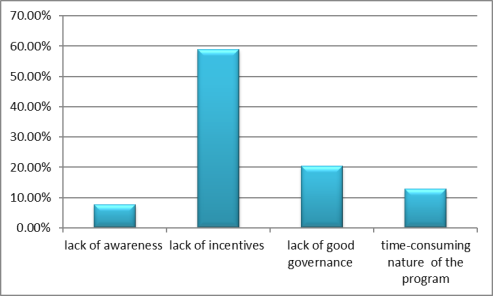
Figure 4 revealed that respondents who did not participate in watershed activities (18.1%) cited reasons including deficiency of mindfulness (7.7%), non-existence of additional payment (59%), weak governance (20.5%), and the time-consuming nature of the activities (12.8%). Crucial informants emphasized that livelihood diversification, such as animal fattening, cash crop production, limited scale supplying dry land by water by means of ditches, and water gathering, could help farmers better balance short-term needs with long-term conservation engagement.
Figure 4. Farmers’ reasons for not taking part in drainage basin management programs at current.
Overall, the results demonstrate that take part in drainage basin management programs is affected by a combination of tenure security, household demographic characteristics, farm attributes, perceptions, and the quality of institutional support. Strengthening tenure security, improving extension service quality, enhancing gender-responsive support systems, and building positive perceptions through targeted awareness programs are essential for increasing farmers’ willingness to take part in sustainable drainage basin management.
4. Discussion
This study highlights the multifaceted nature of farmers’ take part in drainage basin management programs, demonstrating that decisions to engage in such initiatives are shaped by interplay of socio-economic factors, land-related attributes, institutional support, and farmers’ perceptions. The findings reinforce that promoting sustainable watershed management requires interventions that address both structural constraints and behavioral determinants.
The negative influence of land redistribution and the positive role of tenure security undermine the critical benefit of stable farm rights in motivating long-term conservation investments. Frequent reallocations reduce farmers’ confidence in securing future benefits from their labor, thereby discouraging participation. This aligns with previous research showing that insecure tenure suppresses incentives to adopt land-improving practices
| [5] | Admassie Y (2000) Twenty years to nowhere: property rights, land management, and conservation in Ethiopia. the Red Sea Press, Inc, Asmera; Lawrenceville. |
| [17] | Gebremedhin B, Swinton SM (2003) Investment in soil conservation in northern Ethiopia: the role of land tenure security and public programs. Agric Econ 29(1): 69–84. |
| [22] | Holden ST, Deininger K, Ghebru H (2009) Impacts of low-cost land certification on investment and productivity. Am J Agric Econ 91(2): 359 373.
https://doi.org/10.1111/j.1467-8276.2008.01241.x |
[5, 17, 22]
. Strengthening tenure systems, including formal documentation and clear land-use rights, is thus essential for sustaining watershed efforts.
Gender disparities emerged as another significant constraint. Female-headed families were consistently limited right to take part, confirming that gendered inequalities in available source of wealth, working class, information, and institutional support limit women’s engagement in conservation activities. While global evidence shows that closing gender gaps enhances agricultural productivity
| [16] | FAO (2009) FAO’s programme for gender equality in agriculture and rural development. Division, FAO, Rome. |
[16]
. The findings suggest that current watershed programs are not sufficiently gender-responsive. Enhancing women’s participation requires tailored support mechanisms, such as labor-saving technologies, targeted training, and inclusive decision-making processes.
Contrary to expectations, neither household labor force nor access to extension services positively influenced participation. The negative association between labor availability and participation suggests that households with more labor prioritize immediate production needs over conservation activities whose financial assistant in time of need accrue in the long term. This highlights the importance of aligning watershed interventions with farmers’ short-term livelihood demands. Even more surprising was the negative relationship with extension contact. Qualitative evidence revealed that the effectiveness of extension services may be compromised by high workloads, limited staffing, and inadequate logistical support for development agents. This finding contrasts with studies demonstrating that well-functioning extension systems positively influence the uptake of conservation technologies
| [28] | Miheretu BA, Yimer AA (2017) Land use/land cover changes and their environmental implications in the Gelana sub-watershed of northern highlands of Ethiopia. Environ Syst Res 6(7): 1–12. https://doi.org/10.1186/s40068-017-0084-7 |
[28]
, suggesting that improving the quality—not merely the frequency—of extension interactions is crucial.
Farm characteristics also played differentiated roles. Larger farm size increased the likelihood of participation, consistent with former researches
| [8] | Arun G, Singh DR, Kumar S, Kumar A (2012) Canal irrigation management through water users associations and its impact on efficiency, equity and reliability in water use in Tamil Nadu. Agric Econ Res Rev 25: 409–419. |
| [9] | Bekele W, Drake L (2003) Soil and water conservation decision behavior of subsistence farmers in the eastern highlands of Ethiopia: a case study of Hunde-Lafto area. Ecol Econ 46(3): 437–451. |
[8, 9]
, likely because benefits of conservation measures accumulate more noticeably on larger holdings. Conversely, farmers were less likely to implement conservation practices on steep land, possibly due to perceptions of low returns or limited knowledge of erosion risks. This finding confirms earlier reports of farmers’ reluctance to invest in highly erodible fields
| [7] | Alemu T (1999) Land tenure and soil conservation: Evidence from Ethiopia. A Ph. D. Thesis. University of Goteborg: Goteborg. |
| [28] | Miheretu BA, Yimer AA (2017) Land use/land cover changes and their environmental implications in the Gelana sub-watershed of northern highlands of Ethiopia. Environ Syst Res 6(7): 1–12. https://doi.org/10.1186/s40068-017-0084-7 |
[7, 28]
. Though some studies have found the opposite under different contextual conditions
| [3] | Wossen T, Berger T, Di Falco S (2015) Social capital, risk preference and adoption of improved farm land management practices in Ethiopia. Agric Econ 46: 81–97. |
[3]
.
Perception-related variables emerged as the strongest positive predictors of participation. Farmers with favorable attitudes toward watershed management and those who perceived greater government support were more willing to participate. This highlights that beyond structural constraints, behavioral and cognitive factors profoundly shape conservation decisions. Thus, awareness creation, participatory planning, and consistent communication about long-term benefits are vital for sustaining engagement.
Several variables traditionally considered important—such as educational status, access to credit, stakeholder support, and PSNP participation—did not show significant associations with participation. The limited effect of credit access may stem from farmers’ fear of repayment risks, while the non-significance of PSNP suggests that food security assistance alone does not ensure engagement in watershed activities. The low influence of stakeholder support may reflect gaps in coordination, communication, or perceived legitimacy of supporting institutions.
Perceptive from FGDs and key informant interviews foster illuminate contextual barriers shaping participation. Poverty, land scarcity due to fragmentation, drought, weak governance, and lack of incentives were frequently identified constraints. Reports of coercive participation practices, including fines and social sanctions, suggest governance challenges that may undermine trust and voluntary engagement. Improving program governance, ensuring transparency, and fostering genuine community participation are therefore essential for strengthening watershed initiatives.
Overall, the discussion indicates that successful watershed management requires a holistic approach that integrates secure land rights, gender-responsive strategies, improved extension quality, and enhanced farmer perceptions. Addressing short-term livelihood priorities through diversification options—such as small-scale irrigation, water harvesting, and livestock fattening—could further support long-term conservation goals. Sustainable watershed management will depend not only on technical interventions but also on social equity, institutional effectiveness, and farmers’ belief in the long-term value of their efforts.
5. Conclusions
This study examined the determinants of farmers’ take part in drainage basin management programs in the Upper Mugie sub-drainage basin, Ethiopia, using econometric investigation, correlation assessment, and qualitative penetrations from focus group discussions and key informant interviews. The determinations exhibit that taking part is formed by a combination of personal, land-related, institutional, and perceptual factors.
From twelve intelligible variables included in the regression model, six significantly influenced farmers’ decisions to participate. Land spread, sex of the family head, farming working class force, extension assistance access, and gradient of agricultural land all exerted significant disconfirming effects on participation. These results highlight the inhibiting roles of tenure insecurity, gender disparities, labor constraints, ineffective extension services, and perceived low returns from conservation on steep land. Conversely, farm size was the only variable showing a good and meaningful effect, showing that families with larger landholdings are much inclined in order to invest at long-term drainage basin conservation activities.
The analysis of discrete variables showed that gender and land tenure security was strongly associated with participation. Female-headed families were significantly limited to take part, reflecting underlying socio-economic constraints that limit their involvement. Likewise, farmers with stronger tenure security were more willing to participate, reinforcing the central role of secure land rights in motivating long-term conservation investments.
Qualitative findings enriched these results by revealing additional contextual constraints, including poverty, land scarcity due to fragmentation, drought, weak governance, absence of payment, and insufficient precipitation. Above 90% of participants described that farmland scarcity is increasing, driven by rapid population growth. Concerns about governance were also prominent, with some farmers reporting coercive participation practices, including monetary penalties and social sanctions for non-compliance. Such practices undermine community trust and threaten the voluntary spirit necessary for sustained program success. Instead of coercion, awareness-raising, inclusive planning, and capacity-building—through training, workshops, and community dialogues—are essential for fostering genuine participation.
Even though, 81.9% of respondents take part in the drainage basin management program, 18.1% did not. Reasons for non-participation included lack of awareness, insufficient incentives, governance challenges, and the time-intensive nature of the activities. Key informants also noted that off-farm engagements, negative attitudes toward the program, limited knowledge, and preference for short-term benefits further discourage participation. These findings underscore the need for livelihood diversification strategies—such as livestock fattening, small-scale irrigation, water harvesting, and cash crop production—to help households balance short-term needs with long-term conservation goals.
Overall, this finding concludes that husbandman involvement in drainage basin management programs remains constrained by a mix of socio-economic, institutional, biophysical, and perceptual barriers. Low levels of awareness, combined with negative influences from insecure land tenure, gender disparities, limited service quality, and governance shortcomings, contribute to reduced engagement. Enhancing participation therefore requires a multi-dimensional approach that strengthens tenure security, improves the quality and responsiveness of extension services, supports gender-inclusive programming, and builds positive perceptions through consistent communication and meaningful community involvement.
Future research should incorporate additional variables—such as farmers’ former go through, reliance in administrator policies, and the effectiveness of local institutions—to deepen the understanding of participation dynamics and strengthen predictive capacity. Such insights will be essential for designing more targeted, equitable, and sustainable watershed management interventions.
Abbreviations
GDP | Gross Domestic Productivity |
SWC | Soil and Water Preservation |
AMSL | Above Mean Sea Level |
FGDS | Focus Group Discussions |
SLM | Sustainable Land Management |
SPSS | Statistical Package for Social Sciences |
GIS | Geographical Information System |
LFP | Level of Farmers Participation |
OFI | Off-farm Income |
LSO | Livestock Ownership |
LRD | Land Redistribution |
ES | Educational Status |
LT | Land Tenure Security |
GHH | Gender of the Household Head |
NALF | Number of Agricultural Labor Force |
FS | Farm Size |
EV | Extension Visit |
CS | Credit Service |
PSNP | Productive Safety Net Program |
Author Contributions
Agmasie Belay: Conceptualization, Data curation, Methodology, Resources
Tibebe Tigabu: Investigation, Supervision, Visualization, Writing – review & editing
Conflicts of Interest
The authors declare no conflicts of interest.
References
| [1] |
Shahidi M (1998) Analysis of factors influencing participation in under pressure irrigation from view point of farmers in northwest province of Iran. M.Sc. Thesis, Tehran University: Tehran.
|
| [2] |
Taffa T (2009) Characteristics of property units in Ethiopia, the case of two pilot projects in Amhara National Regional State. Nord J Survey Real Estate Res 6(2): 7–24.
https://doi.org/10.1017/S0376892900007955
|
| [3] |
Wossen T, Berger T, Di Falco S (2015) Social capital, risk preference and adoption of improved farm land management practices in Ethiopia. Agric Econ 46: 81–97.
|
| [4] |
Aboueieh F (2001) Correlation of some factors influencing attraction of animal husbandmen’ participation in range conservation and rehabilitation in Semnan Province, M.Sc. Thesis, Science and Research Unit. Islamic Azad University, Tehran.
|
| [5] |
Admassie Y (2000) Twenty years to nowhere: property rights, land management, and conservation in Ethiopia. the Red Sea Press, Inc, Asmera; Lawrenceville.
|
| [6] |
Ahmadvand M, Karami E, Iman MT (2011) Modeling the determinants of the social impacts of agricultural development projects. Environ Impact Assess Rev 31(1): 8–16.
https://doi.org/10.1016/j.eiar.2010.06.004
|
| [7] |
Alemu T (1999) Land tenure and soil conservation: Evidence from Ethiopia. A Ph. D. Thesis. University of Goteborg: Goteborg.
|
| [8] |
Arun G, Singh DR, Kumar S, Kumar A (2012) Canal irrigation management through water users associations and its impact on efficiency, equity and reliability in water use in Tamil Nadu. Agric Econ Res Rev 25: 409–419.
|
| [9] |
Bekele W, Drake L (2003) Soil and water conservation decision behavior of subsistence farmers in the eastern highlands of Ethiopia: a case study of Hunde-Lafto area. Ecol Econ 46(3): 437–451.
|
| [10] |
Davis K, Swanson B, Amudavi D, Ayalew DM, Flohrs A, Riese J (2010) In depth assessment of the public agricultural extension system of Ethiopia and recommendations for improvement. IFPRI discussion paper 01041. International Food Policy Research Institute, Washington, D.C.
|
| [11] |
Dolisca F, Douglas RC, Joshua MM, Dennis AS, Curtis MJ (2006) Factors influencing farmers’ participation in forestry management programs: a case study from Haiti. Forest Ecol Manag 236: 324– 331.
https://doi.org/10.1016/j.foreco.2006.09.017
|
| [12] |
Ebrahim PM (2000) Status of participation action and factors influencing it in watershed management. Collection of articles of first convention of natural resources, participation and development. Forests, Range and Watershed Management Organization of Iran, Tehran, pp 173–199.
|
| [13] |
Elias E (2002) Farmers’ perceptions of soil fertility change and management. SOS Sahel Ethiopia; and Institute for Sustainable Development, Addis Ababa.
|
| [14] |
Faham E, Hosseini SM, Darvish AK (2008) Analysis of factors influencing rural people’s participation in National Action Plan for Sustainable Management of Land and Water Resources in Hable-Rud Basin, Iran. Am J Agric Biol Sci 3(2): 457–461.
|
| [15] |
FAO (1986) Ethiopian highlands reclamation study. Report prepared for the Government of Ethiopia by the Food and Agriculture Organization of the United Nations, Ethiopia final report, vol 1 Retrieved on December 6, 2016, from
http://www.fao.org/docrep/field/009/ar863e/ar863e.pdf
Accessed 6 Dec 2016.
|
| [16] |
FAO (2009) FAO’s programme for gender equality in agriculture and rural development. Division, FAO, Rome.
|
| [17] |
Gebremedhin B, Swinton SM (2003) Investment in soil conservation in northern Ethiopia: the role of land tenure security and public programs. Agric Econ 29(1): 69–84.
|
| [18] |
German L, Mansoor H, Alemu G, Mazengia W, Amede T, Stroud A (2007) Participatory integrated watershed management: evolution of concepts and methods in an eco-regional program of the eastern African highlands. Agric Syst 94(2): 189–204.
|
| [19] |
Grigg NS (1998) Coordination: the key to integrated water management. Water resources. Update, special issue no. 111. Universities Council on Water Resources, Carbondale.
|
| [20] |
Haregeweyn N, Poesen J, Nyssen J, De Wit J, Mitiku H, Govers G, Deckers S (2005) Reservoirs in Tigray (Northern Ethiopia): characteristics and sediment deposition problems. Land Degrad Dev 17(2): 211–230.
https://doi.org/10.1002/ldr.698
|
| [21] |
Heathcote IW (1998) Integrated watershed management: principles and practice. Wiley, New York.
|
| [22] |
Holden ST, Deininger K, Ghebru H (2009) Impacts of low-cost land certification on investment and productivity. Am J Agric Econ 91(2): 359 373.
https://doi.org/10.1111/j.1467-8276.2008.01241.x
|
| [23] |
Karegar A, Abedi Sarvestani A (2001) Contexts of public participation in natural resources plans (case study). Collection of articles of first convention of natural resources, participation and development. Forests, Range and Watershed Management Organization of Iran, Tehran, pp 371–401.
|
| [24] |
Khalighi N, Ghasemi T (2004) Analysis of effect of socio-economic problems on level of stock breeders’ participation in range management plans in north Golestan Province, Iran. J Agric, Nat Resour Sci 11(1): 181–190.
|
| [25] |
Lemenih M (2004) Effects of land use changes on soil quality and native flora degradation and restoration in the highlands of Ethiopia: implications for sustainable land management. Ph.D Thesis. Swedish University of Agricultural Sciences, Uppsala.
|
| [26] |
McMillan MB, Hoban TJ, Clifford WB, Brant MR (1996) Social and demographic influences of environmental attitudes. South Rural Sociol 13(1): 89–107.
|
| [27] |
Melaku B (2003) Forest property rights, the role of the state, and institutional exigency: the Ethiopian experience. Ph.D Thesis, Swedish University of Agricultural Sciences. Sveriges lantbruksuniv., Acta Universitatis agriculturae Sueciae. Agraria, Uppsala, pp 1401–6249 409.
|
| [28] |
Miheretu BA, Yimer AA (2017) Land use/land cover changes and their environmental implications in the Gelana sub-watershed of northern highlands of Ethiopia. Environ Syst Res 6(7): 1–12.
https://doi.org/10.1186/s40068-017-0084-7
|
| [29] |
MoARD (Ministry of Agriculture and Rural Development) (2005) Community based participatory watershed development: a guideline. Part 1, First edn. Ministry of Agriculture and Rural Development, Addis Ababa.
|
| [30] |
MoFED (2010) Growth and transformation plan 2010/11-2014/15. Volume I: main text. Ministry of Finance and Economic Development (MoFED), Federal Democratic Republic of Ethiopia, Addis Ababa.
|
| [31] |
Motevalli H (2002) Analysis of factors influencing attraction of villagers’ participation in desertification plans in Semnan Province. For Range Qual 56: 50–60.
|
| [32] |
MoWR (1993) Improvement of the resource–population sustainability balance. Water Resources Development, MoWR, Addis Ababa.
|
| [33] |
Osman M, Sauerborn P (2001) Soil and water conservation in Ethiopia: experiences and lessons. J Soils Sediments 1(2): 117–123.
|
| [34] |
Rodeco (2002) Assessment and monitoring of erosion and sedimentation problems in Ethiopia—final report. Rodeco Consulting GmbH, Hydrology Studies Department, Ministry of Water Resources, Addis Ababa.
|
| [35] |
Said A, Sehlke G, Stevens DK, Glover T, Sorensen D, Walker W, Hardy T (2006) Exploring an innovative watershed management approach: from feasibility to sustainability. Energy 31(13): 2373–2386.
https://doi.org/10.1016/j.energy.2006.02.002
|
| [36] |
Robert Slovin; (1967) Determining the sample size for survey research.
|
| [37] |
Nelder, J. A. and Wedderburn, R. W. M. (1972), Generalized Linear Models. Journal of the Royal Statistical Society: Series A (General), 135: 370-384.
https://doi.org/10.2307/2344614
|
| [38] |
Norman H. Nie, Dale H. Bent, and C. Hadlai Hull, the Statistical Package for the Social Sciences (SPSS) revolutionized data analysis.
|
Cite This Article
-
APA Style
Belay, A., Tigabu, T., Assefa, T. (2026). Factors Affecting Farmers’ Participation in Watershed Management Programs in Northern Ethiopia: A Case Study in the Upper Mugie Sub-watershed. International Journal of Environmental Protection and Policy, 14(3), 71-83. https://doi.org/10.11648/j.ijepp.20261403.12
 Copy
|
Copy
|
 Download
ACS Style
Belay, A.; Tigabu, T.; Assefa, T. Factors Affecting Farmers’ Participation in Watershed Management Programs in Northern Ethiopia: A Case Study in the Upper Mugie Sub-watershed. Int. J. Environ. Prot. Policy 2026, 14(3), 71-83. doi: 10.11648/j.ijepp.20261403.12
Copy
|
Download
AMA Style
Belay A, Tigabu T, Assefa T. Factors Affecting Farmers’ Participation in Watershed Management Programs in Northern Ethiopia: A Case Study in the Upper Mugie Sub-watershed. Int J Environ Prot Policy. 2026;14(3):71-83. doi: 10.11648/j.ijepp.20261403.12
Copy
|
Download
-
@article{10.11648/j.ijepp.20261403.12,
  author = {Agmasie Belay and Tibebe Tigabu and Tewodros Assefa},
  title = {Factors Affecting Farmers’ Participation in Watershed Management Programs in Northern Ethiopia: A Case Study in the Upper Mugie Sub-watershed},
  journal = {International Journal of Environmental Protection and Policy},
  volume = {14},
  number = {3},
  pages = {71-83},
  doi = {10.11648/j.ijepp.20261403.12},
  url = {https://doi.org/10.11648/j.ijepp.20261403.12},
  eprint = {https://article.sciencepublishinggroup.com/pdf/10.11648.j.ijepp.20261403.12},
  abstract = {The purpose of this study was to evaluate the factors influencing farmers’ participation in watershed management in the Mugie Sub-watershed, located in the northeastern highlands of Ethiopia. A combination of purposive and random sampling techniques was used to select 200 households from four villages. Data was collected using a structured survey questionnaire, focus group discussions, and key informant interviews. The data were analyzed using a range of statistical techniques, including descriptive statistics, Pearson correlation, and regression analysis. The results revealed that farmers’ perception was strongly correlated (r = 0.612, p < 0.01) with their decision to participate in watershed management programs, followed by stakeholders’ support (r = 0.163, p < 0.05). In contrast, the slope of the farmland and the gender of the household head showed significant negative associations. Binary logistic regression analysis further indicated that six independent variables were important in explaining farmers’ decisions to participate in watershed management programs. These variables included land redistribution, gender, family labor force, educational opportunity, farm size, and land slope. Land redistribution, gender, family labor force, educational opportunity, and land slope had negative effects, whereas farm size had a positive effect. Further analysis also demonstrated the role of individual variables in explaining variation in farmers’ decisions to participate in the program. Among these, two variables were found to be statistically significant: the gender of the household head and land tenure security. Accordingly, the chi-square value for gender (X2 = 9.052) was statistically significant at the 95% confidence level. Similarly, the chi-square value for land tenure security (X2 = 8.691) was also statistically significant at the 95% confidence level. The findings of the study suggest the need to raise farmers’ awareness of the long-term benefits of watershed management programs and to design strategies that help diversify their livelihoods.},
 year = {2026}
}
Copy
|
Download
-
TY  - JOUR
T1  - Factors Affecting Farmers’ Participation in Watershed Management Programs in Northern Ethiopia: A Case Study in the Upper Mugie Sub-watershed
AU  - Agmasie Belay
AU  - Tibebe Tigabu
AU  - Tewodros Assefa
Y1  - 2026/06/29
PY  - 2026
N1  - https://doi.org/10.11648/j.ijepp.20261403.12
DO  - 10.11648/j.ijepp.20261403.12
T2  - International Journal of Environmental Protection and Policy
JF  - International Journal of Environmental Protection and Policy
JO  - International Journal of Environmental Protection and Policy
SP  - 71
EP  - 83
PB  - Science Publishing Group
SN  - 2330-7536
UR  - https://doi.org/10.11648/j.ijepp.20261403.12
AB  - The purpose of this study was to evaluate the factors influencing farmers’ participation in watershed management in the Mugie Sub-watershed, located in the northeastern highlands of Ethiopia. A combination of purposive and random sampling techniques was used to select 200 households from four villages. Data was collected using a structured survey questionnaire, focus group discussions, and key informant interviews. The data were analyzed using a range of statistical techniques, including descriptive statistics, Pearson correlation, and regression analysis. The results revealed that farmers’ perception was strongly correlated (r = 0.612, p < 0.01) with their decision to participate in watershed management programs, followed by stakeholders’ support (r = 0.163, p < 0.05). In contrast, the slope of the farmland and the gender of the household head showed significant negative associations. Binary logistic regression analysis further indicated that six independent variables were important in explaining farmers’ decisions to participate in watershed management programs. These variables included land redistribution, gender, family labor force, educational opportunity, farm size, and land slope. Land redistribution, gender, family labor force, educational opportunity, and land slope had negative effects, whereas farm size had a positive effect. Further analysis also demonstrated the role of individual variables in explaining variation in farmers’ decisions to participate in the program. Among these, two variables were found to be statistically significant: the gender of the household head and land tenure security. Accordingly, the chi-square value for gender (X2 = 9.052) was statistically significant at the 95% confidence level. Similarly, the chi-square value for land tenure security (X2 = 8.691) was also statistically significant at the 95% confidence level. The findings of the study suggest the need to raise farmers’ awareness of the long-term benefits of watershed management programs and to design strategies that help diversify their livelihoods.
VL  - 14
IS  - 3
ER  -
Copy
|
Download





 Share This Article
 Twitter
 Linked In
 Facebook