Abstract
The new media era has profoundly reshaped how tourists perceive destinations. With its distinctive cuisine and rich cultural heritage, Tianshui has rapidly gained visibility on new media platforms. Transforming short-term online traffic into long-term tourism appeal, and thereby moving from online traffic to tourist retention, has become a central issue for the city’s high-quality development. Drawing on tourism destination image perception theory (TDI), push–pull theory, and media dependency theory, this study examines the perceived characteristics of Tianshui’s urban tourism image through a quantitative analysis of 215 questionnaire responses. The findings show that Tianshui’s tourism image is concentrated around two dominant associations: an “internet-famous culinary city” and a “sacred site associated with Fuxi, the cultural ancestor of Chinese civilization.” Short videos are the main channel through which tourists acquire destination information. However, current communication practices still face several problems, including content homogenization, insufficient exploration of cultural connotations, and relatively weak perceptions of tourism service facilities. Accordingly, this paper proposes optimization strategies from three dimensions: deepening image positioning, improving the new media communication matrix, and upgrading the service experience. The findings provide theoretical support and practical guidance for reconstructing Tianshui’s tourism image and promoting the sustainable development of Tianshui and other emerging internet-famous cities.
Keywords
New Media, Tourism Image Perception, Internet-famous City, Tianshui, Push–pull Theory
1. Introduction
1.1. Research Background and Problem Statement
With the rapid development of digital information technologies, new media have profoundly changed how tourists perceive tourism destinations. In recent years, many Chinese cities have become widely known as “internet-famous cities” through new media exposure. Tianshui, a city in Gansu Province, has rapidly gained popularity on short-video platforms because of its distinctive malatang, a popular Chinese street food featuring assorted ingredients cooked in a spicy broth, attracting large numbers of visitors. Beyond this recent online popularity, Tianshui is also the birthplace of Fuxi and is home to world-class cultural heritage resources, including the Maijishan Grottoes. It is therefore an important cultural tourism center in southeastern Gansu.
However, online popularity is often short-lived. While sudden traffic brings development opportunities, it also exposes several challenges, including an over-simplified destination image, insufficient communication of cultural depth, and pressure on infrastructure and service capacity. Against this background, a key question is how Tianshui can avoid short-term popularity, convert online “traffic” into offline “retention,” and achieve systematic image reconstruction and sustainable improvement.
This study focuses on the perceived characteristics of Tianshui’s tourism image. It aims to identify tourists’ cognitive patterns and affective tendencies, examine the factors and mechanisms shaping image perception in the new media environment, analyze existing communication problems, and propose optimization strategies. The study provides a basis for Tianshui to formulate a more evidence-based tourism image enhancement strategy. It also offers an empirical reference for other internet-famous cities facing similar transformation challenges.
1.2. Research Methods and Data Sources
This study adopts literature review and questionnaire survey methods. Drawing on tourism destination image perception theory (TDI) and push–pull theory, it constructs a set of measurement indicators. The questionnaire covers respondents’ basic information, new media use, tourism image perception measured on a five-point Likert scale, tourism behavior, and travel intentions. A total of 215 valid responses were collected through online and offline channels. The valid questionnaire data were processed using spreadsheet and statistical analysis tools. Descriptive statistics, frequency analysis, percentage analysis, mean-score analysis, and cross-tabulation were conducted to examine tourists’ perceptions of Tianshui’s urban tourism image.
2. Literature Review
International research on tourism destination image perception (TDI) and tourist motivation has developed into a relatively mature field. Early studies focused mainly on conceptualization and measurement. The framework proposed by Echtner and Ritchie
| [1] | Echtner, C. M., & Ritchie, J. R. B. (1991). The meaning and measurement of destination image. Journal of Tourism Studies, 2(2), 2–12. |
[1]
laid an important foundation for the quantitative analysis of destination image, while Baloglu and McCleary
developed a model integrating cognitive image, affective image, and overall image. In tourist motivation research, Crompton
introduced the push–pull perspective, and Uysal and Jurowski
further examined the relationship between push and pull factors. In the Web 2.0 era, Gartner’s
work on image formation agents provided a classic analytical perspective. Xiang and Gretzel
highlighted the role of social media in online travel information search, while Llodrà-Riera et al.
| [7] | Llodrà-Riera, I., Martínez-Ruiz, M. P., Jiménez-Zarco, A. I., & Izquierdo-Yusta, A. (2015). A multidimensional analysis of the information sources construct and its relevance for destination image formation. Tourism Management, 48, 319–328.
https://doi.org/10.1016/j.tourman.2014.11.012 |
[7]
and Marine-Roig and Anton Clavé
| [8] | Marine-Roig, E., & Anton Clavé, S. (2015). Tourism analytics with massive user-generated content: A case study of Barcelona. Journal of Destination Marketing & Management, 4, 162–172. https://doi.org/10.1016/j.jdmm.2015.06.004 |
[8]
demonstrated the influence of user-generated content (UGC) on destination image. Munar and Jacob
examined motivations for sharing tourism experiences online, and Zeng and Gerritsen
reviewed the role of social media in tourism. These studies provide a solid theoretical basis for analyzing the formation and perception of Tianshui’s tourism image.
Chinese schloarship on tourism destination image perception has shown three major trends. First, research paradigms have shifted toward UGC-based big data mining. Second, analytical tools have increasingly incorporated natural language processing (NLP) and semantic network analysis. Third, research perspectives have moved from static description toward the exploration of dynamic evolution mechanisms
| [11] | Fan Mengyu, Zhang Hui, & Chen Yining. (2020). Spatiotemporal perception of Inner Mongolia’s visual tourism image: An analysis of geotagged photos based on DeepSentiBank. Journal of Arid Land Resources and Environment, 34(10), 194–200. |
| [12] | Li Fengjiao, Zhang Shuying, Liu Jiaming, Jiang Lili, & Gao Caixia. (2023). A comparative study of tourism image perception in the Beijing–Tianjin–Hebei and Yangtze River Delta urban agglomerations. Economic Geography, 43(4), 194–205. |
| [13] | Gao Xuemin, Dong Zhibao, Li Hao, & Liu Zhifang. (2026). Analysis of tourism image perception of Yardang landforms in the Qaidam Basin based on user-generated content (UGC) data. Journal of Desert Research, 46(4). |
[11-13]
. Existing studies in China mainly focus on several themes. In terms of theoretical frameworks, scholars have commonly adopted the cognitive–affective–overall image model
| [14] | Tong Bisha, & Chen Guangpu. (2020). Research on tourism image perception of national park pilot units in China. Forestry Economics, 42(10), 85–96. |
| [15] | Yu Gouxiong, & Liu Bo. (2022). Research on the structure of urban night tourism image from the perspective of tourist perception: A case study of Guangzhou. Resource Development & Market, 38(10), 1248–1255. |
[14, 15]
, finding that natural and cultural resources tend to generate positive emotions, whereas infrastructure deficiencies often lead to negative evaluations
| [16] | Wu Chao, & Shao Xiuying. (2020). Research on tourism image perception of ancient villages based on UGC and questionnaire survey data: A case study of Qikou Ancient Town. Journal of Arid Land Resources and Environment, 34(12), 195–200. |
| [17] | Lin Xinying, Lai Pengcheng, Chen Jianling, Wu Yuanjing, & Huang Qitang. (2021). Research on tourism image perception of Yandang Mountain Scenic Area. Forest Resources Management, (2), 164–170. |
[16, 17]
. In terms of semantic networks, destination image perception often displays a hierarchical “core–sub-core–periphery” structure
| [18] | Chun Yutong, Wang Chuansheng, Ji Weixing, & Deng Ning. (2021). Research on tourism image perception of revisit intention based on online text analysis: A case study of Xiamen Gulangyu Scenic Area and the Palace Museum in Beijing. Areal Research and Development, 40(4), 96–101. |
| [12] | Li Fengjiao, Zhang Shuying, Liu Jiaming, Jiang Lili, & Gao Caixia. (2023). A comparative study of tourism image perception in the Beijing–Tianjin–Hebei and Yangtze River Delta urban agglomerations. Economic Geography, 43(4), 194–205. |
[18, 12]
, which provides a basis for precise image positioning
| [19] | Zhou Xiaobing, Wang Wei, & Cai Huanhuan. (2023). Research on tourism image perception of mountain scenic areas based on text mining: A case study of Yuntai Mountain Scenic Area. Journal of Northwest Normal University (Natural Science Edition), 59(3), 37–43. |
| [20] | Hu Juan, Chen Wanlin, & Xu Mengyuan. (2025). Tourism image perception of scenic traditional villages from the perspective of the “Three Ruralities”: A content analysis based on online texts from Zhejiang Province. Journal of Central China Normal University (Natural Sciences). Online first. |
[19, 20]
. In terms of spatiotemporal dynamics, image perception varies significantly under the influence of major events and media communication
| [21] | Xu Min, Xiao Yunlei, & Zhang Chen. (2025). Comparison and optimization of tourism image perception before and after the successful World Heritage inscription of Yancheng Yellow Sea Wetland: A data mining perspective. Journal of Nanjing Normal University (Natural Science Edition), 48(1), 38–46. |
| [10] | Zeng, B., & Gerritsen, R. (2014). What do we know about social media in tourism? A review. Tourism Management Perspectives, 10, 27–36.
https://doi.org/10.1016/j.tmp.2014.01.001 |
[21, 10]
. In addition, discrepancies often exist between officially projected images and tourists’ actual perceptions
| [23] | Liu Yuxiao, & Zhang Jianguo. (2021). A comparative study of tourism image projection and perception in village scenic areas based on gaze theory: A case study of Tianmu Yuexiang in Hangzhou, Zhejiang Province. Journal of Southwest University (Natural Science Edition), 43(5), 18–26. |
[23]
.
Although tourism image perception research has produced substantial findings, several limitations remain. First, existing studies have focused primarily on natural scenic areas, cultural heritage sites, and mature tourism cities, while paying insufficient attention to internet-famous cities that have rapidly gained popularity through new media. Empirical research on this emerging tourism phenomenon remains limited. Second, many studies rely heavily on UGC data, whereas quantitative research based on systematic questionnaire surveys is relatively insufficient. As a result, tourists’ subjective perceptual structures are not always fully captured. Third, most studies emphasize the static description of image characteristics but pay less attention to how exposure to new media content influences travel intentions through cognitive and affective pathways. Fourth, although some scholars have examined the spatiotemporal differences in tourism image perception across the five northwestern provinces along the Silk Road heritage corridor
| [22] | Wu Xinyang, & Wang Yuewei. (2020). Spatiotemporal differences in tourism image perception of the five northwestern provinces and regions along the Silk Road heritage corridor. Areal Research and Development, 39(4), 86–90+103. |
[22]
, research focusing specifically on underdeveloped cities in Northwest China remains limited, and cities with deep historical and cultural resources, such as Tianshui, have not received adequate scholarly attention.
Taking Tianshui as a case, this study examines tourism image perception in an internet-famous city in the new media era. Theoretically, it integrates TDI theory, push–pull theory, and media dependency theory to build an analytical framework suited to the study of emerging destination image phenomena. Methodologically, its use of questionnaire data helps supplement studies that rely mainly on UGC text analysis. Practically, by analyzing 215 valid responses, this study identifies tourists’ cognitive perceptions, affective attitudes, and behavioral intentions toward Tianshui. It also reveals key problems in current new media communication, such as image simplification and insufficient cultural interpretation, and proposes an optimization path from “traffic” to “retention.”
3. Theoretical Foundations and Research Framework
3.1. Tourism Destination Image Perception Theory (TDI)
Tourism destination image (TDI) refers to the overall impression that individuals or groups hold of a specific destination. Classical theories generally suggest that destination image consists of three dimensions: cognitive image, which refers to beliefs about destination attributes; affective image, which refers to emotional responses; and overall image, which refers to a comprehensive evaluation of the destination. In this study, multiple questionnaire indicators are used to measure tourists’ cognitive and affective perceptions of Tianshui and to outline its overall perceptual profile.
3.2. Push–Pull Theory
Push–pull theory holds that tourism behavior is shaped by both internal “push” factors, such as psychological needs, and external “pull” factors, such as destination attributes. In the new media era, visually rich short-video content has substantially strengthened the pull effect of destinations. This study applies push–pull theory to examine how new media content and Tianshui’s local tourism resources jointly influence tourists’ decision-making.
3.3. Media Dependency Theory and Uses and Gratifications Theory
Media dependency theory emphasizes audiences’ reliance on media for information, understanding, and decision-making, whereas uses and gratifications theory highlights audiences’ active selection of media according to their needs. In tourism contexts, tourists increasingly rely on new media to search for information, form impressions, and share experiences. By integrating these two perspectives, this study examines tourists’ new media use preferences and interactive behaviors, and further analyzes how media use shapes tourism image perception.
4. Questionnaire Survey and Data Analysis of Tianshui’s Urban Tourism Image Perception
This study centers on tourists’ perception of Tianshui’s urban tourism image. The questionnaire targeted respondents who had been exposed to Tianshui-related tourism information through new media or who had relevant prior knowledge of the destination. A total of 215 valid responses were collected. Because the questionnaire included screening and skip-logic questions, the interpretation of results mainly relies on valid-case percentages, supplemented by full-sample percentages where appropriate.
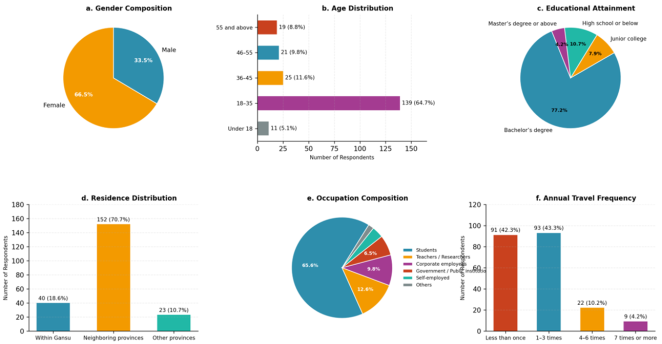
Figure 1. Basic sample characteristics (N=215).
4.1. Basic Sample Characteristics
To examine tourists’ perceptions of Tianshui’s urban tourism image, this study designed and distributed a structured questionnaire through the Wenjuanxing platform. After collection, invalid responses with excessively short completion times, patterned answers, or missing key information were removed, leaving 215 valid samples. The demographic characteristics of respondents, as shown in
Figure 1, present several notable features.
In terms of gender composition (
Figure 1a), female respondents accounted for 66.5% of the sample (143 respondents), while male respondents accounted for 33.5% (72 respondents). This suggests that women were more active in both new media tourism information dissemination and questionnaire participation. The age distribution (
Figure 1b) shows a clear tendency toward younger respondents. The 18–35 age group dominated the sample, accounting for 64.7% (139 respondents), which corresponds closely to the core user profile of new media platforms, especially short-video platforms and content communities. The educational structure (
Figure 1c) indicates a relatively high level of education among respondents. Those with a bachelor’s degree or above accounted for 81.4% (175 respondents), including 77.2% with a bachelor’s degree, suggesting relatively strong information acquisition and evaluation abilities.
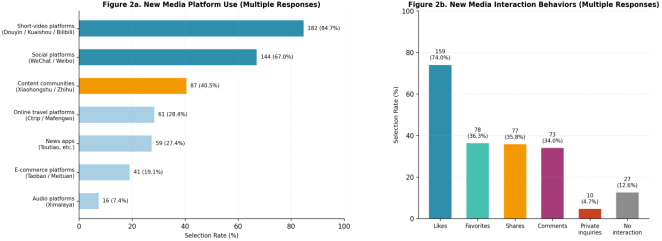
Figure 2. New media use characteristics and interactive behaviors of tourists (N=215).
The residence distribution (
Figure 1d) shows that respondents from neighboring provinces formed the largest group, accounting for 70.7% (152 respondents). Respondents from within Gansu Province accounted for 18.6% (40 respondents), while those from other provinces accounted for 10.7%. This spatial pattern is consistent with Tianshui’s source-market structure as a regional tourism destination, indicating that geographical proximity remains important in travel decision-making. In terms of occupation (
Figure 1e), students formed the largest group, accounting for 65.6% (141 respondents), followed by teachers and researchers (12.6%) and corporate employees (9.8%). Annual travel frequency (
Figure 1f) further shows that most respondents were low- to medium-frequency travelers, with those traveling less than once a year and one to three times a year together accounting for 85.6%.
4.2. New Media Use Characteristics and Tourism Information Acquisition
New media constitute the primary channel through which tourists perceive Tianshui’s tourism image. The questionnaire therefore examined respondents’ platform preferences, interactive behaviors, and exposure to tourism-related content, as shown in
Figure 2.
As shown in
Figure 2a, among the multiple-response items on new media platform use, short-video platforms, including Douyin, Kuaishou, and Bilibili, showed a clear advantage. In total, 84.7% of respondents (182 respondents) identified short-video platforms as their main channel for obtaining tourism information. Social platforms, such as WeChat and Weibo, ranked second, accounting for 67.0% (144 respondents). Content communities, including Xiaohongshu and Zhihu, and online travel platforms, such as Ctrip and Mafengwo, accounted for 40.5% and 28.4%, respectively. These results indicate that visual, fragmented short videos have become the most influential medium in shaping urban tourism images, while social sharing based on both strong and weak ties also remains important.
In terms of interactive behavior (
Figure 2b), respondents’ participation on new media platforms displayed a typical pattern of low-threshold interaction. Likes were the most common behavior, accounting for 74.0% (159 respondents), followed by favorites (36.3%), shares (35.8%), and comments (34.0%). Deeper forms of interaction, such as private inquiries, accounted for only 4.7%. This suggests that although new media content can effectively attract attention, its conversion into in-depth discussion or practical consultation remains limited. Content design should therefore place greater emphasis on guiding users toward deeper engagement.
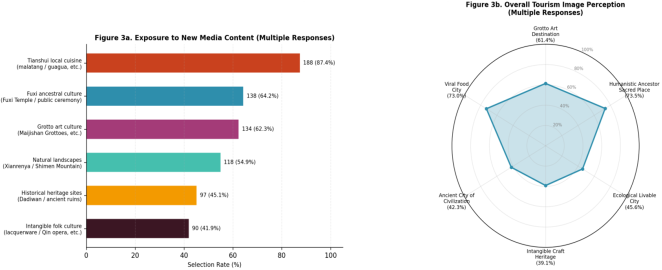
Figure 3. New media content exposure and overall tourism image perception (N=215).
4.3. Exposure to New Media Content and Overall Tourism Image Perception
Tourists’ preferences for new media content directly influence the formation of their overall destination image.
Figure 3 presents respondents’ exposure to Tianshui tourism-related content and the overall impressions shaped by such exposure.
In terms of content exposure (
Figure 3a), “Tianshui local cuisine,” including malatang and guagua, ranked first, with a notably high exposure rate of 87.4% (188 respondents). This finding corresponds closely to Tianshui’s recent rise in popularity driven by local food. Notably, “Fuxi ancestral culture” (64.2%) and “grotto art culture” (62.3%) also received considerable attention. This indicates that although cuisine serves as the initial entry point for online traffic, Tianshui’s deep historical and cultural resources remain important points of tourist interest and have the potential to become core tourism attractions.
Based on such content exposure, tourists formed an overall impression of Tianshui’s tourism image, as shown in the radar chart in
Figure 3b. The data reveal a dual-core image structure. Perceptions of Tianshui as a “sacred site associated with Fuxi, the cultural ancestor of Chinese civilization” and an “internet-famous culinary city” reached 73.5% and 73.0%, respectively. As an important supplementary image, “treasure house of grotto art” also received broad recognition, accounting for 61.4%. By contrast, perceptions of “intangible cultural heritage craftsmanship” (39.1%) and “ancient city of historical civilization” (42.3%) were relatively weak, suggesting that these deeper cultural connotations have not yet been fully presented or effectively communicated through new media.
4.4. Evaluation of Cognitive and Affective Perceptions of Tianshui’s Urban Tourism Image
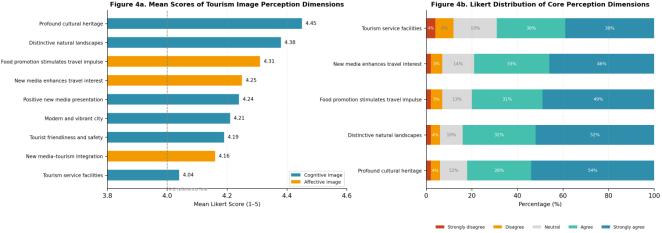
To measure the depth of tourists’ perceptions more accurately, the questionnaire used a five-point Likert scale, where 1 indicates “strongly disagree” and 5 indicates “strongly agree.” It assessed Tianshui’s tourism image from two dimensions: cognitive image and affective image, as shown in
Figure 4.
The mean-score ranking in
Figure 4a reflects tourists’ perceptual tendencies. Overall, all indicators had mean scores above 4.0, indicating that respondents held a highly positive attitude toward Tianshui’s tourism image. In the cognitive dimension, “profound cultural heritage” (mean = 4.39) and “distinctive natural landscapes” (mean = 4.38) received the highest scores, confirming Tianshui’s strong advantages in cultural and tourism resources. “Accessible new media information” (mean = 4.24) and “modern and vibrant city” (mean = 4.21) were also evaluated positively.
In the affective dimension, “food promotion stimulates travel impulse” (mean = 4.31) and “new media enhances travel interest” (mean = 4.25) ranked among the highest-scoring indicators. This suggests that new media plays a significant role in stimulating tourists’ travel motivation and building affective connections with the destination.
It should also be noted that “well-developed tourism service facilities” received the lowest score among all perception indicators, with a mean value of 4.04. The percentage distribution in
Figure 4b further shows that only 39% of respondents “strongly agreed” with this item, while 20% selected “neutral” or below. This indicates perceived weaknesses in Tianshui’s infrastructure and public services when accommodating large tourist flows, suggesting a need for further improvement.
Figure 4. Cognitive and affective evaluation of Tianshui’s urban tourism image (N=215).
5. Influencing Factors and Problem Analysis of Tianshui’s Tourism Image Perception in the New Media Era
5.1. Tourist Behavioral Characteristics and Travel Intentions
Tourists’ actual travel behaviors are closely associated with their perceptions of the destination.
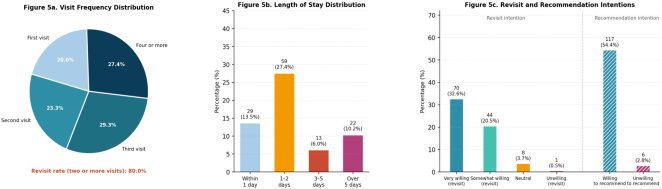
Figure 5 presents respondents’ visit frequency, length of stay, and revisit and recommendation intentions.
In terms of visit frequency (
Figure 5a), first-time visitors accounted for 20.0% of the respondents (43 individuals), whereas those who had visited twice or more accounted for 80.0% (172 individuals). This indicates that Tianshui already has a strong base of repeat visitors. For tourists from surrounding provinces in particular, the city has become a regular tourism destination.
In terms of length of stay (
Figure 5b), respondents were mainly concentrated in the “1–2 days” category (27.4%, 59 individuals) and the “within one day” category (13.5%, 29 individuals), which together accounted for 40.9% of the sample. This suggests that tourism in Tianshui remains dominated by short-distance and weekend trips. Visitors generally stay for a relatively short period, indicating insufficient in-depth destination experience.
Figure 5. Tourist behavioral characteristics and revisit-recommendation intentions (N=215).
In terms of revisit and recommendation intentions (
Figure 5c), respondents showed strong positive willingness. Those who were “very willing to revisit” and “relatively willing to revisit” together accounted for 53.0% of the sample (114 individuals), while the share of respondents willing to recommend Tianshui reached 54.4% (117 individuals). This indicates that, despite problems such as short length of stay, the overall tourism experience in Tianshui has been widely recognized by visitors and provides an important basis for converting temporary traffic into sustained retention.
5.2. Advantages, Problems, and Optimization Needs of New Media Communication
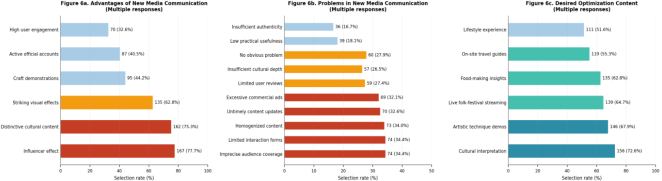
To assess the current state of Tianshui’s tourism image communication on new media, the questionnaire examined perceived communication advantages, existing problems, and tourists’ optimization needs, as shown in
Figure 6.
In terms of advantages (
Figure 6a), the two most recognized strengths were the “prominent viral effect” (77.7%, 167 individuals) and “distinctive cultural content” (75.3%, 162 individuals). This suggests that Tianshui has combined short-term online visibility with a deep cultural foundation, thereby generating distinctive momentum in new media communication. In addition, “striking visual effects” (62.8%) and “engaging craft demonstrations” (44.2%) also received relatively high evaluations, indicating that high-quality visual presentation is an important means of attracting tourists.
However, the results also reveal clear shortcomings in current new media communication (
Figure 6b). “Imprecise audience coverage” (34.4%, 74 individuals), “limited forms of interaction” (34.4%, 74 individuals), and “serious content homogenization” (34.0%, 73 individuals) ranked as the top three problems. This suggests that Tianshui’s new media marketing remains relatively extensive, with insufficient user profiling and differentiated content strategies. In addition, “untimely content updates” (32.6%) and “excessive commercial advertising” (32.1%) caused dissatisfaction among some tourists and may weaken the overall destination image.
In response to these problems, respondents expressed clear optimization needs (
Figure 6c). “In-depth cultural interpretation” (72.6%, 156 individuals) was the most urgent demand, echoing the problem of insufficient cultural depth. This indicates that tourists are no longer satisfied with superficial sightseeing or check-in-style visits; instead, they increasingly seek deeper cultural experiences. This was followed by “artistic technique demonstrations” (67.9%) and “live streaming of folk festivals” (64.7%), suggesting that Tianshui should make fuller use of live-streaming and video functions to present its intangible cultural heritage and folk traditions more effectively.
Figure 6. Advantages, problems, and optimization needs of new media communication in Tianshui (N=215).
5.3. Factors Influencing Destination Choice and Recommendation Intention
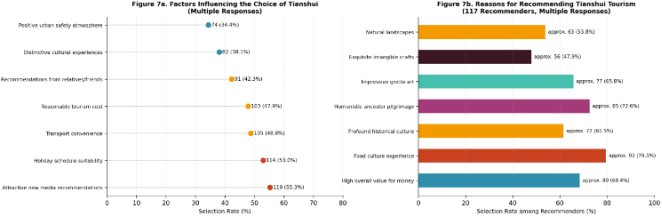
Based on push–pull theory, this study further analyzes the key factors influencing tourists’ choice of Tianshui as a tourism destination and their willingness to recommend it, as shown in
Figure 7.
Figure 7a shows that tourists’ choice of Tianshui is shaped by multiple factors. Among them, “attractive new media recommendations” ranked first, accounting for 55.3% (119 respondents), which confirms the pull effect of new media in destination marketing. It was followed by “holiday schedule suitability” (53.0%) and “transport convenience” (48.8%), indicating that travel decisions are strongly constrained by time availability and spatial accessibility. In addition, “reasonable tourism cost” (47.9%) and “recommendations from relatives and friends” (42.3%) were also important considerations, reflecting the role of value for money and trust-based endorsement in tourism decision-making. By contrast, “distinctive cultural experiences” (38.1%) and “positive urban safety perception” (34.4%) accounted for lower proportions, suggesting that Tianshui still has room to improve in deepening cultural experiences and shaping its urban safety image.
The questionnaire results show that 54.4% of respondents (117 individuals) were willing to recommend Tianshui tourism, as shown in
Figure 5c.
Figure 7b further analyzes the reasons given by these 117 recommenders. The results indicate that “food culture experience” (79.5%) and “pilgrimage to the sacred site of Fuxi culture” (72.6%) were the most important reasons for recommendation, further confirming the strong recognition of Tianshui’s dual-core tourism image. Meanwhile, “high overall value for money” (68.4%) and “impressive grotto art” (65.8%) also received high recognition, suggesting that Tianshui has clear advantages in offering cost-effective cultural tourism experiences.
Figure 7. Destination choice factors and recommendation intention analysis (N=215).
6. Strategies for Enhancing Tianshui’s Urban Tourism Image in the New Media Era
Based on the empirical analysis above, this study proposes strategies for enhancing Tianshui’s urban tourism image from three dimensions, with the aim of facilitating its transition from short-term online popularity to sustained long-term appeal.
6.1. Deepening Image Positioning: From a Single Viral Image to Multicultural Appeal
While consolidating its image as an “internet-famous culinary city,” Tianshui should further explore and strengthen the core connotations of its image as a “sacred site associated with Fuxi, the cultural ancestor of Chinese civilization” and a “treasure house of grotto art.” In response to tourists’ strong demand for “in-depth cultural interpretation” (72.6%), Tianshui should involve experts, scholars, and cultural figures in the production of new media content. It should launch high-quality short-video and documentary series on cultural interpretation, transforming profound cultural symbols such as Fuxi culture, Dadiwan culture, and the art of the Maijishan Grottoes into accessible, engaging, and memorable stories. Through cultural empowerment, Tianshui can enhance the depth and quality of its tourism image and achieve a strategic shift from a single viral food image to a diversified cultural tourism experience.
6.2. Optimizing the Communication Matrix: Building Precise and Differentiated Marketing
In response to “imprecise audience coverage,” “serious content homogenization,” and “limited forms of interaction” in current new media communication, Tianshui should optimize its new media communication matrix. First, it should implement differentiated multi-platform operation strategies. On short-video platforms such as Douyin and Kuaishou, the city may continue to emphasize striking visual effects and food appeal to attract broad online traffic. On content-based communities such as Xiaohongshu and Zhihu, it should focus on practical travel guides and cultural interpretation to reach tourists interested in in-depth travel more precisely.
Second, Tianshui should innovate interactive formats and organize integrated online–offline activities, such as “live streaming of folk festivals,” which corresponds to the needs of 64.7% of surveyed tourists. At the same time, it should establish a communication mechanism that combines official guidance with UGC, or user-generated content. By encouraging tourists to share authentic experiences, Tianshui can enrich the content ecosystem and enhance the authenticity and credibility of destination communication.
6.3. Upgrading Products and Services: Creating High-Quality Immersive Tourism Experiences
High-quality tourism experiences are essential for retaining visitors and promoting revisit and recommendation intentions. On the one hand, Tianshui should develop integrated cultural-tourism products by incorporating intangible cultural heritage demonstrations, such as carved lacquer craftsmanship, and folk cultural experiences into regular tourism routes. This would help extend tourists’ length of stay and enhance the distinctiveness of cultural experiences.
On the other hand, given tourists’ relatively weak perception of “well-developed tourism service facilities” (mean = 4.04), Tianshui must address shortcomings in basic infrastructure. This includes optimizing transport networks, improving public services in and around scenic areas, regulating the tourism market, reasonably controlling tourism costs, and improving smart tourism service systems to enhance tourists’ experience before, during, and after travel. Through the comprehensive upgrading of both infrastructure and services, Tianshui can strengthen tourists’ sense of security and satisfaction and further consolidate a positive urban tourism image.
7. Conclusions and Prospects
7.1. Research Conclusions
Taking Tianshui in Gansu Province as the research object, this study analyzes 215 valid questionnaire responses and reveals the perceived characteristics and challenges of Tianshui’s urban tourism image in the new media era. The findings are as follows. First, Tianshui has constructed a dual-core tourism image on new media platforms: an “internet-famous culinary city” and a “sacred site associated with Fuxi, the cultural ancestor of Chinese civilization.” Short-video platforms are the main channels through which tourists obtain information and form destination perceptions.
Second, new media content plays a significant role in stimulating tourists’ travel motivation and building affective connections. However, current communication practices still face problems such as content homogenization, limited interaction, and insufficient cultural depth. Third, tourists generally evaluate the overall tourism experience in Tianshui positively and show strong intentions to revisit and recommend the destination. Nevertheless, tourism service facilities and length of stay still require improvement. Accordingly, this study proposes a systematic strategy involving the deepening of image connotations, optimization of the communication matrix, and upgrading of the service experience.
7.2. Research Limitations and Future Prospects
Although this study has generated useful findings, several limitations remain. First, due to survey constraints, the sample size is relatively small, with 215 valid responses, and respondents are concentrated mainly among young and highly educated groups. Future research should expand the sample coverage to improve the generalizability of the conclusions. Second, this study mainly relies on cross-sectional data and therefore cannot dynamically trace the evolution of Tianshui’s tourism image over time.
Future studies may introduce advanced big data mining techniques, such as multimodal text analysis and affective computing, and combine them with longitudinal surveys. Such approaches would support more comprehensive and dynamic evaluations of the tourism images of Tianshui and other emerging internet-famous cities, as well as comparative research across destinations.
Abbreviations
TDI | Tourism Destination Image |
UGC | User-Generated Content |
NLP | Natural Language Processing |
Author Contributions
Mei Bai: Conceptualization, Methodology, Investigation, Formal analysis, Data curation, Writing – original draft, Writing – review and editing, Project administration, Funding acquisition
Funding
This research was supported by the 2023 Soft Science Special Project of the Gansu Provincial Basic Research Program, “Research on the Perception and Enhancement of Gansu’s Urban Tourism Image in the New Media Era” (Project No. 23JRZA479), and the Gansu Provincial Education Science and Technology Project, “Research on the Coupled and Coordinated Development of Intangible Cultural Heritage and the Tourism Industry in Gansu Province” (Project No. 2026A-163).
Conflicts of Interest
The authors declare no conflicts of interest.
References
| [1] |
Echtner, C. M., & Ritchie, J. R. B. (1991). The meaning and measurement of destination image. Journal of Tourism Studies, 2(2), 2–12.
|
| [2] |
Baloglu, S., & McCleary, K. W. (1999). A model of destination image formation. Annals of Tourism Research, 26(4), 868–897.
https://doi.org/10.1016/s0160-7383(99)00030-4
|
| [3] |
Crompton, J. L. (1979). Motivations for pleasure vacation. Annals of Tourism Research, 6(4), 408–424.
https://doi.org/10.1016/0160-7383(79)90004-5
|
| [4] |
Uysal, M., & Jurowski, C. (1994). Testing the push and pull factors. Annals of Tourism Research, 21(4), 844–846.
https://doi.org/10.1016/0160-7383(94)90091-4
|
| [5] |
Gartner, W. C. (1994). Image formation process. Journal of Travel & Tourism Marketing, 2(2–3), 191–216.
https://doi.org/10.1300/j073v02n02_12
|
| [6] |
Xiang, Z., & Gretzel, U. (2010). Role of social media in online travel information search. Tourism Management, 31(2), 179–188.
https://doi.org/10.1016/j.tourman.2009.02.016
|
| [7] |
Llodrà-Riera, I., Martínez-Ruiz, M. P., Jiménez-Zarco, A. I., & Izquierdo-Yusta, A. (2015). A multidimensional analysis of the information sources construct and its relevance for destination image formation. Tourism Management, 48, 319–328.
https://doi.org/10.1016/j.tourman.2014.11.012
|
| [8] |
Marine-Roig, E., & Anton Clavé, S. (2015). Tourism analytics with massive user-generated content: A case study of Barcelona. Journal of Destination Marketing & Management, 4, 162–172.
https://doi.org/10.1016/j.jdmm.2015.06.004
|
| [9] |
Munar, A. M., & Jacob, C. (2014). Motivations for sharing tourism experiences through social media. Tourism Management, 43, 46–54.
https://doi.org/10.1016/j.tourman.2014.01.012
|
| [10] |
Zeng, B., & Gerritsen, R. (2014). What do we know about social media in tourism? A review. Tourism Management Perspectives, 10, 27–36.
https://doi.org/10.1016/j.tmp.2014.01.001
|
| [11] |
Fan Mengyu, Zhang Hui, & Chen Yining. (2020). Spatiotemporal perception of Inner Mongolia’s visual tourism image: An analysis of geotagged photos based on DeepSentiBank. Journal of Arid Land Resources and Environment, 34(10), 194–200.
|
| [12] |
Li Fengjiao, Zhang Shuying, Liu Jiaming, Jiang Lili, & Gao Caixia. (2023). A comparative study of tourism image perception in the Beijing–Tianjin–Hebei and Yangtze River Delta urban agglomerations. Economic Geography, 43(4), 194–205.
|
| [13] |
Gao Xuemin, Dong Zhibao, Li Hao, & Liu Zhifang. (2026). Analysis of tourism image perception of Yardang landforms in the Qaidam Basin based on user-generated content (UGC) data. Journal of Desert Research, 46(4).
|
| [14] |
Tong Bisha, & Chen Guangpu. (2020). Research on tourism image perception of national park pilot units in China. Forestry Economics, 42(10), 85–96.
|
| [15] |
Yu Gouxiong, & Liu Bo. (2022). Research on the structure of urban night tourism image from the perspective of tourist perception: A case study of Guangzhou. Resource Development & Market, 38(10), 1248–1255.
|
| [16] |
Wu Chao, & Shao Xiuying. (2020). Research on tourism image perception of ancient villages based on UGC and questionnaire survey data: A case study of Qikou Ancient Town. Journal of Arid Land Resources and Environment, 34(12), 195–200.
|
| [17] |
Lin Xinying, Lai Pengcheng, Chen Jianling, Wu Yuanjing, & Huang Qitang. (2021). Research on tourism image perception of Yandang Mountain Scenic Area. Forest Resources Management, (2), 164–170.
|
| [18] |
Chun Yutong, Wang Chuansheng, Ji Weixing, & Deng Ning. (2021). Research on tourism image perception of revisit intention based on online text analysis: A case study of Xiamen Gulangyu Scenic Area and the Palace Museum in Beijing. Areal Research and Development, 40(4), 96–101.
|
| [19] |
Zhou Xiaobing, Wang Wei, & Cai Huanhuan. (2023). Research on tourism image perception of mountain scenic areas based on text mining: A case study of Yuntai Mountain Scenic Area. Journal of Northwest Normal University (Natural Science Edition), 59(3), 37–43.
|
| [20] |
Hu Juan, Chen Wanlin, & Xu Mengyuan. (2025). Tourism image perception of scenic traditional villages from the perspective of the “Three Ruralities”: A content analysis based on online texts from Zhejiang Province. Journal of Central China Normal University (Natural Sciences). Online first.
|
| [21] |
Xu Min, Xiao Yunlei, & Zhang Chen. (2025). Comparison and optimization of tourism image perception before and after the successful World Heritage inscription of Yancheng Yellow Sea Wetland: A data mining perspective. Journal of Nanjing Normal University (Natural Science Edition), 48(1), 38–46.
|
| [22] |
Wu Xinyang, & Wang Yuewei. (2020). Spatiotemporal differences in tourism image perception of the five northwestern provinces and regions along the Silk Road heritage corridor. Areal Research and Development, 39(4), 86–90+103.
|
| [23] |
Liu Yuxiao, & Zhang Jianguo. (2021). A comparative study of tourism image projection and perception in village scenic areas based on gaze theory: A case study of Tianmu Yuexiang in Hangzhou, Zhejiang Province. Journal of Southwest University (Natural Science Edition), 43(5), 18–26.
|
Cite This Article
-
APA Style
Bai, M. (2026). From Online Traffic to Tourist Retention: Perceived Characteristics and Optimization Strategies of Tianshui Urban Tourism Image of Tianshui in the New Media Era. International Journal of Hospitality & Tourism Management, 10(2), 176-185. https://doi.org/10.11648/j.ijhtm.20261002.11
 Copy
|
Copy
|
 Download
ACS Style
Bai, M. From Online Traffic to Tourist Retention: Perceived Characteristics and Optimization Strategies of Tianshui Urban Tourism Image of Tianshui in the New Media Era. Int. J. Hosp. Tour. Manag. 2026, 10(2), 176-185. doi: 10.11648/j.ijhtm.20261002.11
Copy
|
Download
AMA Style
Bai M. From Online Traffic to Tourist Retention: Perceived Characteristics and Optimization Strategies of Tianshui Urban Tourism Image of Tianshui in the New Media Era. Int J Hosp Tour Manag. 2026;10(2):176-185. doi: 10.11648/j.ijhtm.20261002.11
Copy
|
Download
-
@article{10.11648/j.ijhtm.20261002.11,
  author = {Mei Bai},
  title = {From Online Traffic to Tourist Retention: Perceived Characteristics and Optimization Strategies of Tianshui Urban Tourism Image of Tianshui in the New Media Era},
  journal = {International Journal of Hospitality & Tourism Management},
  volume = {10},
  number = {2},
  pages = {176-185},
  doi = {10.11648/j.ijhtm.20261002.11},
  url = {https://doi.org/10.11648/j.ijhtm.20261002.11},
  eprint = {https://article.sciencepublishinggroup.com/pdf/10.11648.j.ijhtm.20261002.11},
  abstract = {The new media era has profoundly reshaped how tourists perceive destinations. With its distinctive cuisine and rich cultural heritage, Tianshui has rapidly gained visibility on new media platforms. Transforming short-term online traffic into long-term tourism appeal, and thereby moving from online traffic to tourist retention, has become a central issue for the city’s high-quality development. Drawing on tourism destination image perception theory (TDI), push–pull theory, and media dependency theory, this study examines the perceived characteristics of Tianshui’s urban tourism image through a quantitative analysis of 215 questionnaire responses. The findings show that Tianshui’s tourism image is concentrated around two dominant associations: an “internet-famous culinary city” and a “sacred site associated with Fuxi, the cultural ancestor of Chinese civilization.” Short videos are the main channel through which tourists acquire destination information. However, current communication practices still face several problems, including content homogenization, insufficient exploration of cultural connotations, and relatively weak perceptions of tourism service facilities. Accordingly, this paper proposes optimization strategies from three dimensions: deepening image positioning, improving the new media communication matrix, and upgrading the service experience. The findings provide theoretical support and practical guidance for reconstructing Tianshui’s tourism image and promoting the sustainable development of Tianshui and other emerging internet-famous cities.},
 year = {2026}
}
Copy
|
Download
-
TY  - JOUR
T1  - From Online Traffic to Tourist Retention: Perceived Characteristics and Optimization Strategies of Tianshui Urban Tourism Image of Tianshui in the New Media Era
AU  - Mei Bai
Y1  - 2026/07/27
PY  - 2026
N1  - https://doi.org/10.11648/j.ijhtm.20261002.11
DO  - 10.11648/j.ijhtm.20261002.11
T2  - International Journal of Hospitality & Tourism Management
JF  - International Journal of Hospitality & Tourism Management
JO  - International Journal of Hospitality & Tourism Management
SP  - 176
EP  - 185
PB  - Science Publishing Group
SN  - 2640-1800
UR  - https://doi.org/10.11648/j.ijhtm.20261002.11
AB  - The new media era has profoundly reshaped how tourists perceive destinations. With its distinctive cuisine and rich cultural heritage, Tianshui has rapidly gained visibility on new media platforms. Transforming short-term online traffic into long-term tourism appeal, and thereby moving from online traffic to tourist retention, has become a central issue for the city’s high-quality development. Drawing on tourism destination image perception theory (TDI), push–pull theory, and media dependency theory, this study examines the perceived characteristics of Tianshui’s urban tourism image through a quantitative analysis of 215 questionnaire responses. The findings show that Tianshui’s tourism image is concentrated around two dominant associations: an “internet-famous culinary city” and a “sacred site associated with Fuxi, the cultural ancestor of Chinese civilization.” Short videos are the main channel through which tourists acquire destination information. However, current communication practices still face several problems, including content homogenization, insufficient exploration of cultural connotations, and relatively weak perceptions of tourism service facilities. Accordingly, this paper proposes optimization strategies from three dimensions: deepening image positioning, improving the new media communication matrix, and upgrading the service experience. The findings provide theoretical support and practical guidance for reconstructing Tianshui’s tourism image and promoting the sustainable development of Tianshui and other emerging internet-famous cities.
VL  - 10
IS  - 2
ER  -
Copy
|
Download





 Share This Article
 Twitter
 Linked In
 Facebook