Abstract
Privileged migrants forming residential enclaves is a familiar story in research on lifestyle migration and residential tourism. Less familiar, and less studied, is why some migrants instead build stronger everyday ties with the people already living there, and how the history between a sending country and a receiving one might shape that difference. Saly, Senegal is the case examined here, through sixteen semi-structured interviews with European residents, interviews with institutional and professional stakeholders, direct observation, and documentary material, all gathered during a broader doctoral study. An existing typology runs in the background throughout: secondary residents, entrepreneurial migrants, quasi-permanent residents, weekend visitors. It is not, however, this article's main object. Residential location does more of the explanatory work than migrant category does. Life in a gated, high-end extension gets organized around expatriate spaces, the bridge club, the pétanque club; a mixed neighbourhood brings considerably more everyday contact with Senegalese residents instead. There is a postcolonial thread running through the interviews as well. French migrants kept returning, unprompted, to linguistic ease, familiarity, a sense of being welcomed. Non-French Europeans settle in Saly for much the same reasons, climate, affordability, an expatriate infrastructure already in place, but the France-Senegal relationship specifically seems to be what explains how Saly became an established European destination in the first place.
Keywords
Lifestyle Migration, International Retirement Migration, Residential Tourism, Typology, Social Integration,
Residential Segregation, Saly, Senegal
1. Introduction
Research on lifestyle and retirement migration has expanded considerably since Cribier's
| [1] | Cribier, F. Retirement Migration in France: Materials for a Geography of the Third Age. Bulletin of the Association of French Geographers 1970, 47(381), 119–122. |
[1]
work on retirement mobility in France. It now includes North-South movements toward Mediterranean Europe, North Africa and West Africa
| [2] | Casado-Díaz, M. A. Retiring to Spain: An Analysis of Differences among North European Nationals. Journal of Ethnic and Migration Studies. 2006, 32(8), 1321–1339.
https://doi.org/10.1080/13691830600928714 |
| [3] | King, R.; Warnes, A. M.; Williams, A. M. Sunset Lives: British Retirement Migration to the Mediterranean. Berg: Oxford, UK, 2000. |
| [4] | Warnes, A. M.; Williams, A. M. Older Migrants in Europe: A New Focus for Migration Studies. Journal of Ethnic and Migration Studies. 2006, 32(8), 1257–1281.
https://doi.org/10.1080/13691830600927617 |
| [5] | Benson, M.; O’Reilly, K. Migration and the Search for a Better Way of Life: A Critical Exploration of Lifestyle Migration. The Sociological Review. 2009, 57(4), 608–625.
https://doi.org/10.1111/j.1467-954X.2009.01864.x |
[2-5]
. Much of this literature identifies climate, affordability and quality of life as recurring motivations, but fieldwork also shows that migrants arrive through different routes and experience very different forms of everyday life after settlement.
This distinction matters in Saly because a seasonal visitor, an entrepreneur and a quasi-permanent retiree do not place the same demands on housing, services or local institutions. The boundary between tourism, lifestyle migration and permanent settlement is fluid
, and the consequences of moving along that continuum remain less documented in many African destinations than in Spain, Portugal, Morocco or Thailand
| [7] | Gustafson, P. Retirement Migration and Transnational Lifestyles. Ageing & Society. 2001, 21(4), 371–394.
https://doi.org/10.1017/S0144686X01008327 |
| [8] | Le Bigot, B. Thinking about Relationships to Places in Privileged Mobilities: A Comparative Study of Backpackers in Thailand and Winter Residents in Morocco. Ph. D. Thesis, Paris 1 Panthéon-Sorbonne University, Paris, France, 2017. |
[7, 8]
.
Saly, on Senegal's Petite Côte, is a useful case. Since the 1970s it has attracted European residents, predominantly French, whose presence ranges from short visits to long-term settlement and whose involvement ranges from property acquisition and entrepreneurship to relative seclusion in gated estates. Previous work on Saly identified secondary residents, entrepreneurs, quasi-permanent residents and weekendistes (short-term, occasional visitors without an established residential project)
| [9] | Quashie, H. European Migrants on the Senegalese Coast (Petite Côte and Saloum): Opening of the Tourism Economy and Identity-Based Social Enclosure. Autrepart. 2016, 77(1), 125–141. https://doi.org/10.3917/autr.077.0125 |
| [10] | Sall, M. Characteristics and Challenges of the New Residential Economy in the Seaside Resort of Saly Portudal and on Senegal’s Petite Côte. 2009. |
[9, 10]
. The present article asks a different question: why do residents with broadly similar motivations end up with such different relationships with the society around them?
The article focuses on three questions: what forms European residential migration takes in Saly; what motivates different residential pathways; and how residential choices are related to integration or separation from the surrounding Senegalese society. The study does not attempt to estimate the total European population. Instead, it uses qualitative comparison to identify recurring patterns within a purposively diverse sample.
The analysis uses sixteen semi-structured interviews with European residents, complemented by interviews with institutional and professional stakeholders, direct observation and documentary analysis. All material was collected as part of a broader doctoral study of tourism planning, residential migration and healthcare access in Saly. The present article concentrates specifically on residents, their motivations, their lifestyles and their social relations.
2. Theoretical Framework
2.1. Lifestyle Migration and International Retirement Migration
Contemporary European migration toward Africa fits within a longer history of European mobility on the continent, according to Bredeloup
. Today's movements are associated with ageing, purchasing power and lifestyle choices rather than colonial administration, yet they remain connected to older relations between Europe and Africa. Migrants who explain their choices through climate, affordability, language or welcome are drawing, whether or not they realize it, on this longer historical backdrop.
Benson and O'Reilly
define lifestyle migration as the relocation of relatively affluent people seeking a better way of life. International retirement migration is one important form, often involving seasonal or permanent relocation while maintaining economic and family ties with the country of origin
| [2] | Casado-Díaz, M. A. Retiring to Spain: An Analysis of Differences among North European Nationals. Journal of Ethnic and Migration Studies. 2006, 32(8), 1321–1339.
https://doi.org/10.1080/13691830600928714 |
| [3] | King, R.; Warnes, A. M.; Williams, A. M. Sunset Lives: British Retirement Migration to the Mediterranean. Berg: Oxford, UK, 2000. |
| [4] | Warnes, A. M.; Williams, A. M. Older Migrants in Europe: A New Focus for Migration Studies. Journal of Ethnic and Migration Studies. 2006, 32(8), 1257–1281.
https://doi.org/10.1080/13691830600927617 |
[2-4]
. These approaches have also been criticized because such mobility depends on passports, pensions and accumulated capital. In a North-South context, the advantages migrants describe as affordability or freedom are inseparable from wider economic inequalities
.
Migration trajectories are rarely driven by one motive. Cribier
| [1] | Cribier, F. Retirement Migration in France: Materials for a Geography of the Third Age. Bulletin of the Association of French Geographers 1970, 47(381), 119–122. |
[1]
showed that retirement mobility combines climatic, financial, familial and biographical considerations. Later research similarly emphasizes a continuum between tourism and settlement, with individuals sometimes changing position over the life course
| [8] | Le Bigot, B. Thinking about Relationships to Places in Privileged Mobilities: A Comparative Study of Backpackers in Thailand and Winter Residents in Morocco. Ph. D. Thesis, Paris 1 Panthéon-Sorbonne University, Paris, France, 2017. |
[8]
.
2.2. Residential Typology and the Property Anchor
Quashie
| [9] | Quashie, H. European Migrants on the Senegalese Coast (Petite Côte and Saloum): Opening of the Tourism Economy and Identity-Based Social Enclosure. Autrepart. 2016, 77(1), 125–141. https://doi.org/10.3917/autr.077.0125 |
[9]
and Sall
| [10] | Sall, M. Characteristics and Challenges of the New Residential Economy in the Seaside Resort of Saly Portudal and on Senegal’s Petite Côte. 2009. |
[10]
each developed a typology of European residential migrants in Saly. The present study brings the two typologies together as background rather than as its principal object, treating the categories as fluid rather than fixed identities: an individual may enter Saly as a secondary resident and later become an entrepreneur, or settle more permanently.
Acquiring property can transform a visitor's relationship with a destination into a more durable attachment, as research on second homes and residential tourism has shown
| [12] | O’Reilly, K. The British on the Costa del Sol: Transnational Identities and Local Communities. Routledge: London, UK, 2000. |
[12]
. In Saly this plays out across gated estates, individually built villas in mixed areas, and rented accommodation, each carrying its own social meaning for the people who choose it. Buying a house here is rarely just a financial decision. It fixes where someone's daily routine happens, who their neighbours turn out to be, which social circle they end up in.
2.3. Enclaves and Integration
Auvray
| [13] | Auvray, B. The Tourist Enclave: An Exotic Variation of the Gated Community? URBIA – Les Cahiers du Développement Urbain Durable. 2012, 14, 85–104. |
[13]
describes tourism enclaves as forms of gated space where security, homogeneity and controlled access can reduce everyday contact with host populations. Enclave formation is not the only possibility, however. Some migrants learn local languages, attend community events or deliberately choose mixed neighbourhoods, and the Saly case is useful precisely because both tendencies appear within the same destination.
Time, motivation and space keep coming back throughout what follows, so it is worth being explicit about them here. Time is simply how long and how continuously someone is present, anywhere from a short visit to a permanent move. Motivation covers the weight a given migrant puts on climate, affordability, quality of life, entrepreneurship or social relations when they explain their own choices. Space matters most for this article's purposes: whether someone has settled in the historic resort core, in a gated or high-end extension, or in a more socially mixed neighbourhood turns out to predict lifestyle and integration outcomes better than which migrant category they fall into.
3. Materials and Methods
3.1. Research Design and Study Area
The study is based on qualitative material collected during a broader doctoral study of tourism planning, residential migration and healthcare access among ageing Europeans in Saly. No new fieldwork was undertaken specifically for this article. The existing corpus was reanalysed around migrants' socio-demographic profiles, motivations, lifestyles and social relationships.
Saly is located on Senegal's Petite Côte, about 80 km south of Dakar, in the department of Mbour. Developed from the 1970s as a planned seaside resort, it combines a continuing tourism function with a growing residential population. Three spatial sectors are particularly relevant here: the historic Cœur de station; extensions associated with foreign and Dakar-based residents, including gated estates and high-end villas; and more mixed popular extensions where migrant and local housing are closer together.
3.2. Empirical Material and Sampling
The corpus contains sixteen semi-structured interviews with European residential migrants, purposively selected to vary by nationality, age, gender, duration of residence, residential arrangement and neighbourhood. Additional interviews involved a residential-estate manager, pharmacists, a hotel manager and municipal officials. Direct observation covered residential, commercial and social spaces across the three sectors. Recruitment combined institutional contacts, direct approaches and snowball referrals.
Resident interviews addressed the first contact with Saly, migratory and residential trajectories, motivations, present lifestyle, social relations and perceptions of integration. The sample comprised eleven men and five women, aged approximately 60-75, with eight French participants and eight from other European nationalities (three Spanish, two German, two Belgian, one Italian). Interviews took place in private villas, commercial premises, cafés and residential common areas, allowing the surrounding setting to be observed alongside the interview material.
Table 1. Participant and residential profile summary.
Characteristic | Detail |
Sample size | 16 residents |
Gender | 11 men, 5 women |
Age range | 60–75 years |
Nationality | French (8), Spanish (3), German (2), Belgian (2), Italian (1) |
Residential sectors | Historic Resort Center (long-term residents and visitors); gated or high-end extensions (foreign and Dakar-based presence); mixed popular extensions (European residents living close to Senegalese neighbours) |
Migrant categories (porous, non-exclusive) | Secondary residents; quasi-permanent residents; weekendistes; entrepreneurial migrants |
3.3. Data Analysis, Ethics and Limitations
Fieldwork for the broader doctoral study took place in several phases between 2021 and 2024: preparatory work in 2021; exploratory missions and a pilot round of interviews in 2022, covering both the high and low tourist seasons; an extended six-month period from March to August 2023; and a short supplementary mission in October 2024. Interviews with resident participants lasted approximately 45 minutes on average and were conducted primarily in French, the language shared by the great majority of participants regardless of nationality; Wolof was used for interviews with Senegalese staff and institutional stakeholders. All interviews were audio-recorded with participants’ informed consent, complemented by handwritten field notes and photographic documentation, and were transcribed in full before coding began. The lead researcher, based in Senegal and working within a wider Franco-Senegalese research team, combined an insider familiarity with the local context with an outsider position relative to the European resident community under study; this dual positioning is taken into account in the interpretation of the interview material below. All interviews were conducted by the lead author.
Data were analysed thematically, using manual, inductive thematic coding informed by Miles and Huberman’s approach; a codebook was maintained and refined iteratively, and coding consistency was checked through repeated re-reading of coded material. Coding was carried out by a single coder, the lead author; to help offset the limits of single-coder analysis, preliminary categories and emerging themes were shared with participants for verification as part of a systematic member-checking process, and no major disagreements emerged. Existing categories from Quashie
| [9] | Quashie, H. European Migrants on the Senegalese Coast (Petite Côte and Saloum): Opening of the Tourism Economy and Identity-Based Social Enclosure. Autrepart. 2016, 77(1), 125–141. https://doi.org/10.3917/autr.077.0125 |
[9]
and Sall
| [10] | Sall, M. Characteristics and Challenges of the New Residential Economy in the Seaside Resort of Saly Portudal and on Senegal’s Petite Côte. 2009. |
[10]
supplied deductive codes; additional themes emerged from the interviews themselves. For each participant, coding tracked their residential category, their stated motivations, and descriptions of lifestyle and social relations, and these were considered together with residential location. Where a classification was ambiguous, it was checked against the full interview account and, where available, against institutional information.
Participation was voluntary and respondents are identified through anonymized descriptions. The purposive sample of sixteen residents cannot be used to estimate the prevalence of categories or motivations in the entire European population of Saly. The findings should therefore be understood as recurring qualitative patterns. The equal division between French and non-French participants in the sample also does not imply equal representation in the wider population, where French residents have historically been prominent.
4. Results
4.1. Sample, Typology and Motivations
The sixteen residents fall into four broad categories: secondary residents, entrepreneurial migrants, quasi-permanent residents and weekendistes. The boundaries are porous, since individual trajectories may move from one category to another. Climate and economic considerations were the most frequently cited motivations, mentioned by five and three respondents respectively. Quality of life, social integration, real-estate opportunities, security and the perceived warmth of the welcome also appeared.
Table 2. Major themes and supporting quotations.
Theme | Illustrative quotation |
Climate and quality of life | “The climate here is really pleasant, especially for people coming from colder regions.” - resident, 69, 6 years of presence |
Economic affordability | “The cost of living is far more affordable here than in France.” - resident, 69, 6 years of presence |
Deliberate integration | “I've always tried to integrate, to understand local customs and learn the language.” - secondary resident, 67, 5 years of presence |
Preference for expatriate circles | “I prefer to stay by myself, with people who understand me.” - quasi-permanent resident, 70, 9 years of presence |
Property as permanence | “That's one of the things that convinced me to buy my house here: you really get the feeling of settling permanently.” - secondary resident, 69, 6 years of presence |
Competitive pressure on hotels | “We are competing with residences that don't carry the same costs we do.” - hotel manager, 25 years of experience, Saly |
4.2. Lifestyle and Social Integration
Several respondents described settlement in Saly as a response to the pressures of life in Europe. Climate, lower living costs and quality of life were recurrent themes.
“The climate here is really pleasant, especially for people coming from colder regions. It's one of the first things that pushed me to settle here.”
— resident, 69, 6 years of presence
“The cost of living is far more affordable here than in France. It's let me live more serenely without sacrificing my quality of life.”
— resident, 69, 6 years of presence
“Life in Europe was becoming hard, everything is expensive, people are stressed... I came to settle in Saly to change my way of life.”
— quasi-permanent resident, 66, 5 years of presence
Sharing a motivation is not the same as sharing a lifestyle, though. Some residents actively seek out Senegalese neighbours, learn Wolof, go to local events. A good number simply do not; their social time stays largely inside expatriate circles. French smooths over most day-to-day exchanges, but Wolof is still what people hear spoken around them.
“I feel well received here, there's mutual respect, and even though I don't speak Wolof, we can always understand each other with a smile when I go out into the surrounding areas.”
— weekendiste/secondary resident, 63, 1 year of presence
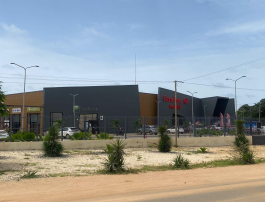
European associations also provide practical and social support, helping with administrative matters, healthcare, housing and leisure. A growing resident clientele has, in turn, shaped local commerce toward European-oriented retail and services, illustrated by a new 1,500 m2 Carrefour supermarket complex with an 11-shop retail gallery and several dining outlets that has become a fixture of expatriate daily life in Saly.
Figure 1. New Carrefour Market supermarket complex in Saly, catering substantially to the European resident clientele. Source: doctoral thesis (Samb), fieldwork photography.
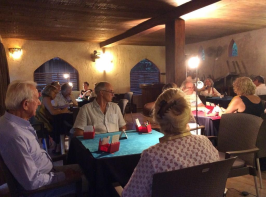
Two clubs come up again and again in interviews as the main expatriate meeting places, pétanque and bridge, and they function quite differently. Bridge stays largely European. Pétanque tournaments more often pull in Senegalese players too.
Figure 2. The pétanque club in Saly, a focal point of expatriate everyday sociability. Source: doctoral thesis (Samb), fieldwork photography.
Figure 3. The bridge club in Saly. Source: doctoral thesis (Samb), fieldwork photography.
Some described their integration as something they had worked at deliberately.
“I've always tried to integrate, to understand local customs and learn the language to make it easier to communicate with my neighbours. Taking part in community events has also helped me build ties with the local population.”
— secondary resident, 67, 5 years of presence
Others preferred a more closed social environment.
“I prefer to stay by myself, with people who understand me.”
— quasi-permanent resident, 70, 9 years of presence
The contrast between the two clubs illustrates this range of practices well. With roughly fifty members, the bridge club offers a clearly European social environment. Pétanque, although also central to expatriate life, is more porous: Senegalese residents join some of its tournaments.
4.3. Residential Segregation and Everyday Life
European residents concentrate in particular sectors of Saly. The luxury tourism and high-end residential areas sit apart from more modest neighbourhoods farther south and inland, where Senegalese residents and migrants from neighbouring countries also live. A resident of the historic resort core linked property ownership to a stronger sense of permanence:
“The private villas in this residence are private properties, and I'd say 70% of residents own their villas. That's one of the things that convinced me to buy my house here: you really get the feeling of settling permanently, rather than passing through as a tourist.”
— secondary resident, 69, 6 years of presence
Some interviewees were less positive about certain local practices, food that struck them as too spicy, the cost of ceremonies like weddings. These comments read as difficulties of adaptation on the migrants' part, not as accurate descriptions of Senegalese life. Domestic staff came up in a similar register: relationships that build genuine familiarity over the years, but that stay shaped by a real economic gap between employer and employee.
“We are competing with residences that don't carry the same costs we do. They offer stays at low prices, while we have to pay taxes and licences and manage a permanent staff.”
— hotel manager, 25 years of experience, Saly
Sall
| [10] | Sall, M. Characteristics and Challenges of the New Residential Economy in the Seaside Resort of Saly Portudal and on Senegal’s Petite Côte. 2009. |
[10]
documented a similar complaint years earlier: residential tourism, in his account too, had already begun absorbing part of the clientele hotels once served.
5. Discussion
5.1. Territorial Effects of Residential Segregation
Reliable statistics on the European resident population barely exist, so this article leans on qualitative indicators instead. One is club membership: who belongs to the bridge club as opposed to the pétanque club. Another is how residents themselves talk about a neighbourhood, as “foreign-only” or as “mixed.” Neither shows up in a census, but both say something about segregation that population counts, even where they exist, currently miss.
Hotels and tourist residences compete over the same clientele, and this adds a governance dimension to the picture. Residential tourism has grown up largely outside the regulatory model built for a hotel-centred resort, and taxes, licences, staffing and unequal competition are where that gap surfaces most concretely.
5.2. Beyond a European Lens: The France-Senegal Relationship
The main concepts used here, lifestyle migration, retirement migration, second-home tourism and enclave formation, were largely developed from European, North American and Mediterranean cases
| [4] | Warnes, A. M.; Williams, A. M. Older Migrants in Europe: A New Focus for Migration Studies. Journal of Ethnic and Migration Studies. 2006, 32(8), 1257–1281.
https://doi.org/10.1080/13691830600927617 |
| [5] | Benson, M.; O’Reilly, K. Migration and the Search for a Better Way of Life: A Critical Exploration of Lifestyle Migration. The Sociological Review. 2009, 57(4), 608–625.
https://doi.org/10.1111/j.1467-954X.2009.01864.x |
| [12] | O’Reilly, K. The British on the Costa del Sol: Transnational Identities and Local Communities. Routledge: London, UK, 2000. |
[4, 5, 12]
. They remain useful in Saly, but the historical relationship between France and Senegal changes the context in which these concepts operate.
French participants repeatedly referred to welcome, familiarity and the ease of communicating in French. These elements may be understood as resources for everyday interaction, but they also need to be considered against the longer history of colonial and postcolonial relations. The data do not allow this relationship to be reduced either to cultural proximity or to a simple continuation of colonial privilege.
Non-French Europeans in the sample reported broadly similar motivations and lifestyles. Climate, affordability and the established expatriate infrastructure therefore appear to attract Europeans more generally. The France-Senegal relationship specifically appears most decisive for French participants, rather than accounting for European settlement in Saly more broadly.
5.3. Typology and Motivations Revisited
Nothing in the interviews overturns the four-category typology, though it now looks more like a set of trajectories than a set of fixed identities. Climate and cost of living still account for a large share of the stated motivations. Entrepreneurial ambition and individual biography matter too, for a good number of respondents. None of that, category or motivation, explains the biggest gap the fieldwork turned up: between residents living in enclaves and residents living in mixed areas.
Where a person lives tracks their everyday social life closely, closely enough that it is worth pausing on. Gated-extension residents describe routines built around secured housing and European associations. Neighbours who live in mixed areas describe something else entirely: more frequent contact with Senegalese residents, day to day. Location is not a background fact about where someone happens to sleep at night. It is part of what appears to shape a lifestyle in the first place.
5.4. What Residential Location Actually Does to a Lifestyle
None of this should be read too rigidly, though. The same person can be open in one setting and withdrawn in another. Bridge and pétanque make the point well on their own: both are voluntary, freely chosen, and yet they end up offering very different degrees of contact between European and Senegalese participants. And living close to someone is not, on its own, enough to erase economic inequality, particularly where domestic staff are concerned.
5.5. Methodological Limits and Scientific Contribution
This article draws on the same doctoral corpus as the author’s broader study of tourism planning, residential migration and healthcare access in Saly, but pursues a distinct analytical object. The doctoral thesis centred on healthcare access and its implications for tourism planning
| [14] | Lessault, D.; Fleuret, S. Reflections at the Intersection of International Mobility and Health Issues in a Locality of the Global South: The Case of Saly, Senegal. HAL Open Science, 2023. |
[14]
; residential location and its relationship to everyday segregation were noted in that work but not developed as an independent focus. The present article isolates this dimension, treating the existing typologies as background rather than as its principal object, and asks specifically how residential location, rather than migrant category or motivation, shapes everyday social integration.
The study is based on sixteen interviews. This is sufficient for a qualitative exploration of meanings and trajectories, but not for estimating the prevalence of the four categories or the seven motivational themes in Saly as a whole. The counts should therefore be read as indicators of salience within the sample. A larger quantitative study would be needed to test their wider distribution.
Two existing typologies of European residents in Saly get folded together here, and their categories are treated as changing positions along a trajectory rather than as fixed labels. Beyond that synthesis, the fieldwork points to something else worth naming on its own: residential location shapes lifestyle and integration in its own right, and connects what an individual experiences to the broader socio-spatial transformation Saly is going through.
6. Conclusions
European residential migration in Saly is not a homogeneous phenomenon. The sixteen interviews reveal secondary residents, entrepreneurs, quasi-permanent residents and weekend visitors whose trajectories can overlap and change. Climate and cost of living are the most frequent motivations, but quality of life, entrepreneurship, security and social relations also enter individual decisions.
Residential location shows the sharpest contrast in this study, by a wide margin. Life in a gated, high-end extension tends to be expatriate-oriented. Life in a mixed neighbourhood looks different: considerably more everyday interaction with Senegalese residents ends up being the norm there. The two associative clubs described earlier illustrate the difference almost on their own.
Lifestyle-migration research generally has tended to ask who migrants are and why they moved. This case suggests where they settle deserves at least as much attention. Integration policy in Saly, specifically, cannot easily be separated from residential geography. Some of the groundwork already exists, too: associations and leisure spaces that already bring people into contact could serve as a starting point, rather than being shelved in favour of building something new from scratch.
Future research could test this typology against a larger sample, follow migrants over time rather than relying on retrospective accounts, and compare Saly with other Senegalese and West African destinations. Such comparisons would help settle whether the relationship between residential location, lifestyle and integration identified here is specific to Saly, or reflects a wider pattern of privileged residential migration across the Global South.
Author Contributions
Mohamadou Lamine Bara Samb: Conceptualization, Data curation, Formal Analysis, Investigation, Methodology, Writing – original draft, Writing – review & editing
Papa Elimane Faye: Writing – review & editing
Aliou Gaye: Writing – review & editing
Data Availability Statement
The data is available from the corresponding author upon reasonable request.
Conflicts of Interest
The author declares no conflicts of interest.
References
| [1] |
Cribier, F. Retirement Migration in France: Materials for a Geography of the Third Age. Bulletin of the Association of French Geographers 1970, 47(381), 119–122.
|
| [2] |
Casado-Díaz, M. A. Retiring to Spain: An Analysis of Differences among North European Nationals. Journal of Ethnic and Migration Studies. 2006, 32(8), 1321–1339.
https://doi.org/10.1080/13691830600928714
|
| [3] |
King, R.; Warnes, A. M.; Williams, A. M. Sunset Lives: British Retirement Migration to the Mediterranean. Berg: Oxford, UK, 2000.
|
| [4] |
Warnes, A. M.; Williams, A. M. Older Migrants in Europe: A New Focus for Migration Studies. Journal of Ethnic and Migration Studies. 2006, 32(8), 1257–1281.
https://doi.org/10.1080/13691830600927617
|
| [5] |
Benson, M.; O’Reilly, K. Migration and the Search for a Better Way of Life: A Critical Exploration of Lifestyle Migration. The Sociological Review. 2009, 57(4), 608–625.
https://doi.org/10.1111/j.1467-954X.2009.01864.x
|
| [6] |
Williams, A. M.; Hall, C. M. Tourism and Migration: New Relationships between Production and Consumption. Tourism Geographies. 2000, 2(1), 5–27.
https://doi.org/10.1080/146166800363420
|
| [7] |
Gustafson, P. Retirement Migration and Transnational Lifestyles. Ageing & Society. 2001, 21(4), 371–394.
https://doi.org/10.1017/S0144686X01008327
|
| [8] |
Le Bigot, B. Thinking about Relationships to Places in Privileged Mobilities: A Comparative Study of Backpackers in Thailand and Winter Residents in Morocco. Ph. D. Thesis, Paris 1 Panthéon-Sorbonne University, Paris, France, 2017.
|
| [9] |
Quashie, H. European Migrants on the Senegalese Coast (Petite Côte and Saloum): Opening of the Tourism Economy and Identity-Based Social Enclosure. Autrepart. 2016, 77(1), 125–141.
https://doi.org/10.3917/autr.077.0125
|
| [10] |
Sall, M. Characteristics and Challenges of the New Residential Economy in the Seaside Resort of Saly Portudal and on Senegal’s Petite Côte. 2009.
|
| [11] |
Bredeloup, S. From Europe to the Global South: New Forms of Mobility or Reverse Migration? Autrepart. 2016, 77(1), 3–15.
https://doi.org/10.3917/autr.077.0003
|
| [12] |
O’Reilly, K. The British on the Costa del Sol: Transnational Identities and Local Communities. Routledge: London, UK, 2000.
|
| [13] |
Auvray, B. The Tourist Enclave: An Exotic Variation of the Gated Community? URBIA – Les Cahiers du Développement Urbain Durable. 2012, 14, 85–104.
|
| [14] |
Lessault, D.; Fleuret, S. Reflections at the Intersection of International Mobility and Health Issues in a Locality of the Global South: The Case of Saly, Senegal. HAL Open Science, 2023.
|
Cite This Article
-
APA Style
Samb, M. L. B., Faye, P. E., Gaye, A. (2026). Residential Location, Postcolonial Familiarity and Everyday Segregation Among European Lifestyle Migrants in Saly, Senegal. International Journal of Hospitality & Tourism Management, 10(2), 231-238. https://doi.org/10.11648/j.ijhtm.20261002.15
 Copy
|
Copy
|
 Download
ACS Style
Samb, M. L. B.; Faye, P. E.; Gaye, A. Residential Location, Postcolonial Familiarity and Everyday Segregation Among European Lifestyle Migrants in Saly, Senegal. Int. J. Hosp. Tour. Manag. 2026, 10(2), 231-238. doi: 10.11648/j.ijhtm.20261002.15
Copy
|
Download
AMA Style
Samb MLB, Faye PE, Gaye A. Residential Location, Postcolonial Familiarity and Everyday Segregation Among European Lifestyle Migrants in Saly, Senegal. Int J Hosp Tour Manag. 2026;10(2):231-238. doi: 10.11648/j.ijhtm.20261002.15
Copy
|
Download
-
@article{10.11648/j.ijhtm.20261002.15,
  author = {Mohamadou Lamine Bara Samb and Papa Elimane Faye and Aliou Gaye},
  title = {Residential Location, Postcolonial Familiarity and Everyday Segregation Among European Lifestyle Migrants in Saly, Senegal},
  journal = {International Journal of Hospitality & Tourism Management},
  volume = {10},
  number = {2},
  pages = {231-238},
  doi = {10.11648/j.ijhtm.20261002.15},
  url = {https://doi.org/10.11648/j.ijhtm.20261002.15},
  eprint = {https://article.sciencepublishinggroup.com/pdf/10.11648.j.ijhtm.20261002.15},
  abstract = {Privileged migrants forming residential enclaves is a familiar story in research on lifestyle migration and residential tourism. Less familiar, and less studied, is why some migrants instead build stronger everyday ties with the people already living there, and how the history between a sending country and a receiving one might shape that difference. Saly, Senegal is the case examined here, through sixteen semi-structured interviews with European residents, interviews with institutional and professional stakeholders, direct observation, and documentary material, all gathered during a broader doctoral study. An existing typology runs in the background throughout: secondary residents, entrepreneurial migrants, quasi-permanent residents, weekend visitors. It is not, however, this article's main object. Residential location does more of the explanatory work than migrant category does. Life in a gated, high-end extension gets organized around expatriate spaces, the bridge club, the pétanque club; a mixed neighbourhood brings considerably more everyday contact with Senegalese residents instead. There is a postcolonial thread running through the interviews as well. French migrants kept returning, unprompted, to linguistic ease, familiarity, a sense of being welcomed. Non-French Europeans settle in Saly for much the same reasons, climate, affordability, an expatriate infrastructure already in place, but the France-Senegal relationship specifically seems to be what explains how Saly became an established European destination in the first place.},
 year = {2026}
}
Copy
|
Download
-
TY  - JOUR
T1  - Residential Location, Postcolonial Familiarity and Everyday Segregation Among European Lifestyle Migrants in Saly, Senegal
AU  - Mohamadou Lamine Bara Samb
AU  - Papa Elimane Faye
AU  - Aliou Gaye
Y1  - 2026/09/24
PY  - 2026
N1  - https://doi.org/10.11648/j.ijhtm.20261002.15
DO  - 10.11648/j.ijhtm.20261002.15
T2  - International Journal of Hospitality & Tourism Management
JF  - International Journal of Hospitality & Tourism Management
JO  - International Journal of Hospitality & Tourism Management
SP  - 231
EP  - 238
PB  - Science Publishing Group
SN  - 2640-1800
UR  - https://doi.org/10.11648/j.ijhtm.20261002.15
AB  - Privileged migrants forming residential enclaves is a familiar story in research on lifestyle migration and residential tourism. Less familiar, and less studied, is why some migrants instead build stronger everyday ties with the people already living there, and how the history between a sending country and a receiving one might shape that difference. Saly, Senegal is the case examined here, through sixteen semi-structured interviews with European residents, interviews with institutional and professional stakeholders, direct observation, and documentary material, all gathered during a broader doctoral study. An existing typology runs in the background throughout: secondary residents, entrepreneurial migrants, quasi-permanent residents, weekend visitors. It is not, however, this article's main object. Residential location does more of the explanatory work than migrant category does. Life in a gated, high-end extension gets organized around expatriate spaces, the bridge club, the pétanque club; a mixed neighbourhood brings considerably more everyday contact with Senegalese residents instead. There is a postcolonial thread running through the interviews as well. French migrants kept returning, unprompted, to linguistic ease, familiarity, a sense of being welcomed. Non-French Europeans settle in Saly for much the same reasons, climate, affordability, an expatriate infrastructure already in place, but the France-Senegal relationship specifically seems to be what explains how Saly became an established European destination in the first place.
VL  - 10
IS  - 2
ER  -
Copy
|
Download







 Share This Article
 Twitter
 Linked In
 Facebook