Research Article | | Peer-Reviewed

Chemical Concept Teaching That Integrates Experimental Exploration to Solve Real-life Problems----Taking "Molar Mass" as an Example

Received: 16 December 2025     Accepted: 29 December 2025     Published: 20 January 2026
Views:       Downloads:
Abstract

This paper analyzes the current status of existing teaching research on "molar mass." In response to the problem of lacking student learning experiences in traditional teaching, it proposes a chemistry concept teaching strategy that integrates experimental inquiry to solve real-world situational problems. Based on the requirements of the new curriculum standards for cultivating core disciplinary competencies and guided by constructivist learning theory and the SOLO taxonomy evaluation theory, specific strategies are formulated-including "creating real problem situations and integrating experimental inquiry activities," "implementing task-based learning and constructing cognitive models of knowledge," and "following the laws of knowledge generation and adopting concept formation strategies"-to design teaching approaches. In teaching, a real-life scenario of drinking water is used to pose the question, "How many water molecules are consumed in one sip?" thereby introducing the learning of molar mass. During the process of completing learning tasks, the concept of molar mass is constructed through concept formation strategies (including exemplification, induction, abstraction, deduction, and application), and a cognitive model for mutual conversion among mass, amount of substance, molar mass, and number of particles is established. Based on this model, students are guided to design experimental plans, which, combined with experimental inquiry, solve the problem of "How many water molecules are consumed in one sip?" In discussions and exchanges, students are prompted to evaluate the strengths and weaknesses of each plan, further helping them enhance their disciplinary abilities in learning comprehension, application practice, and transfer innovation, and implement core disciplinary competencies such as model cognition and social responsibility. The research results indicate that this teaching strategy can effectively address the challenge of the abstract nature of chemical concepts, deepen the understanding of the essence of chemical concepts, and reveal the intrinsic connections between knowledge. It can also significantly enhance students' learning initiative and problem-solving abilities, and strengthen their sense of learning experience and achievement.

Published in International Journal of Secondary Education (Volume 14, Issue 1)
DOI 10.11648/j.ijsedu.20261401.13
Page(s) 21-28
Creative Commons

This is an Open Access article, distributed under the terms of the Creative Commons Attribution 4.0 International License (http://creativecommons.org/licenses/by/4.0/), which permits unrestricted use, distribution and reproduction in any medium or format, provided the original work is properly cited.

Copyright

Copyright © The Author(s), 2026. Published by Science Publishing Group

Keywords

Experimental Exploration, Real Situation, Molar Mass, Core Competencies, Concept Teaching

1. Question Raising
Molar mass belongs to conceptual knowledge, which is abstract and difficult to understand. It is an important physical quantity connecting macro mass and micro particle number Its applicability is strong, and it is an important part of constructing a calculation model centered on the quantity of matter, which is often used in the calculation of macro micro exchange metrology and chemical equations. Learning molar mass well is very important for students to understand the relationship between macro matter and micro particles and master high school chemical calculation!
Sort out the research literature on the teaching of molar mass in recent years, and roughly understand its teaching status. Most of them introduce the concept by calculating the mass of NA particles, and then explain and calculate. Such as Xu Manling .
There are also teaching suggestions for introducing Molar Mass Learning through real-life problems. Zhu Zhijiang (2019) suggested combining real-life situations and using problem driven learning to improve Moore's quality, but did not propose specific teaching strategies . Zhang Yi et al. (2024) created scenarios through the measurement methods of some daily necessities, introduced the learning of material quantity, and guided students to learn about Molar Mass in the process of solving situational problems .
In addition, there are other teaching strategies used for teaching. Such as Huang Wenjun et al.(2021) organized students to discuss and summarize the mass laws of 1mol substances, and taught the definition and application of molar mass; Chen Hui (2024) introduced the concept of molar mass in teaching by explaining the history of quantitative chemistry of substances.
Representative research achievements in chemistry concept teaching over the past three years include the following: Jiang Huihui (2024), against the background of the history of chemistry, leveraged supporting means such as contexts, data, and questions to guide students to engage in deep learning and understand the concept and application of entropy . Lu Shanshan and Guo Peng (2025), based on the generative learning theory, analyzed the initiation, process, and internalization of understanding chemical concepts and proposed teaching suggestions of "selecting refined materials, providing strategic guidance, and leaving classroom space" . Chang Fangfang and Zhao Guoyan (2025), taking chemical bonds as an example and based on the abductive inquiry model system, designed a teaching process for abstract chemical concepts in high school, which includes "problem, abduction, hypothesis, argumentation, and explanation" .
The above achievements mostly guide students to learn about Molar Mass through concept explanation and calculation exercises, emphasizing its application in calculation and neglecting students' participation in concept construction. The teaching process is relatively dull. Although some achievements introduce Molar Mass learning in real-life situations, they do not solve situational problems through experiments, and students lack real feelings. As for research on the teaching of other chemical concepts, it mainly focuses on theory-guided teaching or instruction set against the background of the history of chemistry. Meanwhile, there are few examples of constructing chemical concepts by connecting with students' actual experiences and addressing real-world problems. Therefore, taking the teaching of molar mass as an example, this paper proposes how to integrate experimental exploration to improve the teaching effect of chemical concepts in solving real situation problems.
2. Strategy Improvement
Molar mass is a conceptual knowledge, which is obtained by definition in the textbook. It has certain provisions and is boring to learn. According to the constructivist learning theory, in the teaching process, we can contact some examples in STSE (Science, Technology, Society, and Environment.) to create real problem situations, use the concept formation strategy, through experimental exploration, guide students to participate in the concept construction process, cultivate students' ability to solve real situation problems, and further improve students' chemistry subject ability of "learning understanding, application practice, migration and innovation", so as to make the learning process lively and interesting. In addition, Based on The SOLO (Structure of the Observed Learning Outcome) taxonomy evaluation theory, design learning tasks, exercises, and questions to ensure that the teaching process is controllable, the learning outcomes are measurable, and the teaching objectives are evaluable, thereby achieving the integration of "teaching-learning-assessment".
This lesson envisages using the real situation of drinking water to ask the question "how many water molecules do you drink in a mouthful?" and guide students to actively participate in teaching activities. Through learning new knowledge and integrating experimental exploration, the concept of molar mass is constructed in the process of solving situational problems, which can not only deepen the understanding of molar mass, but also experience its practical application, so as to help students acquire chemical knowledge, improve their thinking ability and enhance their learning experience. The following strategies are mainly used in Teaching.
2.1. Create Real Problem Situations and Integrate Experimental Inquiry Activities
The core quality of chemistry is the ability to solve chemical problems in real situations . The new curriculum reform attaches importance to "quality-oriented" teaching, advocates the creation of real and specific STSE problem situations, and carries out a variety of inquiry activities focusing on chemical experiments, so as to promote the formation and development of students' core quality of chemistry . Molar mass is an important content of the compulsory course theme 1 Chemical Science and experimental exploration. In the teaching tips of the new curriculum standard, there is no specific situation material suggestion. In the actual teaching, there are few activities to carry out experimental inquiry with the theme of "quantity of material", and few teaching activities to integrate experimental inquiry learning with molar mass. Therefore, taking the molar mass as the teaching content, using the students' life experience of drinking water, we created a real situation, put forward the question of "how many water molecules do you drink in a sip?" and combined with the experimental exploration to implement the teaching, guided the students to implement the core quality of chemistry in the process of solving the real situation problems.
2.2. Implement Task-BASED Learning and Construct Knowledge Cognitive Model
Fang Yu and Xu Duanjun, the chief editors of the book "interpretation of chemistry curriculum standards for senior high schools (2017 Edition)", advocate that a chemistry course should be regarded as a system composed of multiple knowledge modules. In the specific teaching design, each knowledge module is a small topic. Based on the concept of research-based teaching design, each small topic should be analyzed, the key and difficult points and teaching strategies should be determined, and the teaching objectives should be implemented. In addition, the book also advocates dividing knowledge blocks into different learning tasks, implementing learning objectives through corresponding learning activities, and then structuring knowledge according to the logical relationship between knowledge points, which is conducive to the consolidation and understanding of knowledge. Therefore, the molar mass is regarded as a knowledge block. According to a certain logical relationship, it is decomposed into different learning tasks such as the construction of the concept of molar mass, related calculation and application. After completing each learning task, the calculation model among the related mass, molar mass, the amount of matter, Avogadro constant and particle number is constructed.
2.3. Follow the Law of Knowledge Generation and Adopt the Strategy of Concept Formation
Liu Zhixin's "chemistry teaching theory (Fifth Edition)" suggests that chemistry concept teaching should adopt concept formation strategies and concept assimilation strategies to help students construct concepts. Pan Rui and others believe that the teaching of conceptual knowledge requires teachers to adopt inquiry teaching rather than simple and direct traditional teaching methods . Molar mass is conceptual knowledge that follows the laws of concept formation. Therefore, concept formation teaching strategies should be adopted to inspire students to implement teaching through thinking methods such as examples, induction, abstraction, deduction, and application. First of all, create a real problem situation of macro micro connection, and combine the students' existing knowledge and experience to lead to the learning of Molar mass. Then, the concept of "induction and abstraction" is used to form teaching strategies, guide students to actively participate in learning activities, and help students complete the construction and understanding of molar mass. Finally, the molar mass is integrated into the experimental exploration. In the process of solving the real situation problems, we complete various learning tasks, experience the practical application of molar mass, and make the boring concept learning lively and interesting.
3. Teaching Practice
3.1. Content Analysis
Molar mass is an important component of the section "Quantity of Matter" in Chapter 2, Section 3 of Senior High School Chemistry Compulsory Book 1 (People's Education Press Edition), which mainly includes the definition of molar mass and related calculations .
“The New Curriculum Standards for High School Chemistry (2017 Edition, 2020 Revision)” (hereinafter referred to as the "New Curriculum Standards") for this part of the content are: to understand the meaning and application of molar mass, and to appreciate the important role of quantitative research in chemical science; Can use the relationship between the quantity and molar mass of matter for simple calculations; Be able to design experimental plans that solve simple problems based on the experimental objectives, and evaluate the experimental plans. From a cognitive perspective, molar mass belongs to a lower level of understanding and application; From a literacy perspective, Molar Mass helps cultivate students' core competencies of "model cognition" and requires a level 2 proficiency.
Students have already understood the concept of relative atomic (molecular) mass and know that macroscopic matter is measured by mass and volume, while microscopic particles are very small and difficult to measure. I also learned about the concept of the quantity of matter and Avogadro's constant, knowing that the quantity of matter is the bridge between macroscopic matter and microscopic particles, and mastering the conversion relationship between the quantity of matter and the number of particles. Students have the ability to design simple experimental plans and conduct preliminary evaluations, but there are difficulties in designing experiments to achieve specific macro micro metric conversions.
The teaching suggestions for molar mass in the "Teacher's Teaching Book" of the first compulsory chemistry textbook only emphasize two points: first, the numerical relationship between molar mass and relative atomic (molecular) mass. Secondly, for pure substances, their molar mass is fixed and unchanging. This lacks substantial guidance for teaching molar mass. There are no teaching prompts related to Molar Mass in the new curriculum standards.
3.2. Teaching Objectives
(1) Understand the meaning of Molar Mass, construct a cognitive model for the conversion between Molar Mass, Mass, Substance Quantity, and Particle Number, and be able to apply this model for simple calculations.
(2) By conducting experiments to explore how many water molecules can be consumed in one gulp, we can gain a quantitative understanding of the scientific research method that combines macro and micro elements, experience the thinking process of problem-solving, and strengthen our awareness of water conservation.
3.3. Teaching Ideas
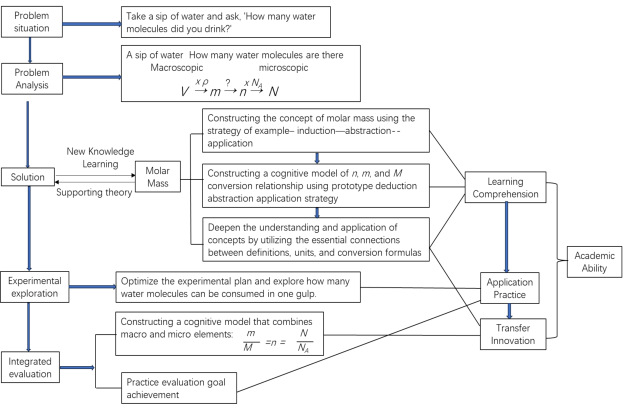
Using the exploration of "how many water molecules can be consumed in one sip?" as the guiding principle throughout teaching. Using "problem driven" as a hidden thread, connect the teaching process. Adopting the "concept formation strategy" to construct the concept of molar mass. Perform deep learning and establish computational models by completing each learning task one by one. Design exercises based on the SOLO classification theory to evaluate students' cognitive level. The specific teaching approach is shown in Figure 1.
Figure 1. Teaching Approach for Molar Mass.
3.4. Classroom Record
Teaching session 1: Problem situation
[teacher] What are the professional habits of chemistry teachers? (Drinking a sip of water from a measuring cup) That's right, it's just drinking water from a measuring cup. How many water molecules did I drink in one gulp?
Teaching session 2: Problem analysis
[teacher] What physical quantities can be used to measure a mouthful of water as a macroscopic substance?
[student] Volume or Mass
[teacher] Molecules are microscopic particles that are difficult to measure. So, which physical quantity can be used to connect macroscopic matter with microscopic particles? How to connect?
[student] amount of substance
[teacher] Guide students to analyze and write on the board:
A sip of water How many water molecules are there.
Macroscopic microscopic
V×ρm?n×NAN
Teaching session 3: Solution
[teacher] What are some solutions to solve the problem of "how many water molecules can be lost in one sip of water"?
[student] Option 1: If you know the number of water molecules in a certain mass of water, you can weigh the mass of a sip of water and calculate the number of water molecules it contains. Option 2: If the mass of one water molecule and a sip of water can be weighed, the number of water molecules contained in a sip of water can be calculated.
[teacher] A water molecule is difficult to weigh, so let's explore how many water molecules a certain mass of water has. Please complete learning task 1.
[student] Think, complete learning task 1, communicate.
(1) Read the second to seventh paragraphs on page 50 of the textbook, analyze examples, summarize the concept of abstract molar mass, and understand its symbols and units.
(2) Fill out the Table 1 and summarize the patterns.
Table 1. Relative mass, mass and molar mass of 1mol 12C or H2O.

Relative atomic (molecular) mass

The mass of 1mol substance

molar mass

12C

H2O

[teacher] Evaluate based on students' contact information and emphasize the similarities and differences of the three concepts on the board.
Table 2. Symbols, definitions and units of Molar Mass.

Molar mass

symbol

definition

unit

M

g/mol

[student] Complete learning task 2, communicate.
(1) Complete the Table 3
Table 3. Summary of the Relationship among Amount of Substance, Molar Mass, and Mass.

Amount of substance

Molar mass

Mass

H2O

1mol

2mol

9g

Conversion formula

(2) Reflect on the intrinsic connections among the definition, unit, and calculation formula of molar mass.
(3) What is the amount of substance for calculating 26.5g Na2CO3? How many Sodium Ion are contained in it?
[teacher] Guide students to deduce M=m/n through deduction and induction, and obtain n=m/M through deformation. Supplement the blackboard writing.
A sip of water How many water molecules are there.
Macroscopic microscopic
V×ρm÷Mn×NAN
[teacher] Guide students to analyze the intrinsic relationship between the definition, units, and calculation formulas of molar mass.
[student] Representing on Blackboard Calculus (3).
[teacher] Emphasize the calculation format and writing standards for various physical quantities.
Teaching session 4: Experimental exploration
[teacher] Based on the above relationship and the provided items, design a plan and conduct experiments to explore how many water molecules you can drink in one sip of water.
[student] Design and communicate to determine the plan, Complete learning task 3: Experimental exploration of "How many water molecules do you drink in one sip of water.
Instrument supplies:
500mL measuring cylinder, electronic scale, a bottle of 348mL Jingtian brand purified water.
Experimental procedure:
Scheme 1:
1) Look at the instructions and find the volume indicated in the Jingtian brand pure water bottle.
2) Drink a sip of water and then use a measuring cylinder to measure the remaining volume of water.
Scheme 2:
1) Look at the instructions and find the volume indicated in the Jingtian brand pure water bottle.
2) Drink a sip of water and then use an electronic scale to weigh the remaining water.
Scheme 3:
1) Weigh the quality of a bottle of Jingtian brand purified water.
2) Drink a sip of water and then use an electronic scale to weigh the remaining water.
......
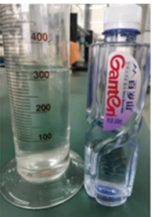
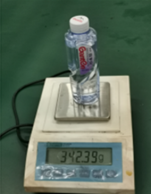
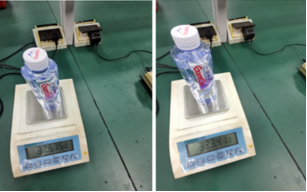
Measurement results: The measurement results of each scheme are shown in the figure.
Figure 2. (Measurement results of scheme 1).
Figure 3. (Measurement results of scheme 2).
Figure 4. (Measurement results of scheme 3).
Data recording:
Scheme 1 Measurement Data Record Sheet.

V1

V2

△V

Scheme 2 Measurement Data Record Sheet.

V1

m1

m2

△m

Scheme 3 Measurement Data Record Sheet X.

m1

m2

△m

Data processing: According to the measured data, calculate how many water molecules you drink in a sip.
Problem discussion: (1) Evaluate the advantages and disadvantages of the experimental scheme. (2) Communicate with the students about the experimental exploration.
[teacher] Guide students to experiment, correct wrong operation and answer questions.
[student] The representatives of each scheme report the process and results of the experiment.
[teacher] To evaluate students' experimental processes and results and guide reflection on the advantages and disadvantages of the experimental schemes: For Scheme 1, the initial volume was not measured, and the calculation is relatively complex; for Scheme 2, the initial volume was not measured, the calculation is relatively complex, and it cannot obtain the actual mass of a sip of water, so the scheme has flaws; for Scheme 3, all masses were actually measured, the calculation is relatively simple, making it the optimal scheme.
[student] Respond to situational questions and share the experience of experimental exploration: using the amount of matter to connect macro substances and micro particles, combined with the molar mass, we solved the practical problem of how many water molecules we drank in a sip of water. A sip of water in the macro contains a lot of water molecules.
Teaching link 5: integrated evaluation
[teacher] Everyone should drink up the remaining water. Don't waste a huge amount of water molecules! Guide students to integrate the conversion models of various physical quantities. Blackboard writing,
mM=n=NNA
Complete learning task 4.
1) The correct understanding of molar mass is ().
A. Molar mass is the relative molecular mass.
B. The mass of 1mol 12c is equal to its molar mass.
C. The molar mass of O2 is 32g/mol.
D. The molar mass of 9g H2O is 9g/mol.
2) Complete the Table 7
Table 7. Calculation table of physical quantity conversion model.

material

m/g

n/mol

n (molecule)

n (H)/mol

HCl

1

H2O

6.02 x 10²²

CH4

4

3) After class, consult relevant materials and estimate how many water molecules an adult needs to drink every day?
3.5. Teaching Effect
By analyzing the results of classroom observation, after-school quiz and interview, it is found that the teaching effect is relatively significant: First, students' enthusiasm for classroom participation is high, their thinking is active, they can conscientiously complete their learning tasks, actively carry out experimental exploration, and communicate and share. Second, students can deeply understand the concept of molar mass and well construct the calculation model between mass, quantity of matter, molar mass and particle number. Third, students can accurately grasp the internal relationship between knowledge, apply what they have learned, and well solve the practical problem of "how many water molecules do you drink in a sip?".
4. Research Conclusion
Through the integration of experimental exploration and the strategy of solving the real situation problems, the teaching of chemical concepts can effectively solve the abstract difficulties of chemical concepts, deepen the understanding of the essence of chemical concepts, and reveal the internal relationship between knowledge. It can significantly improve students' learning initiative and problem-solving ability, enhance their learning experience and sense of achievement, and make boring concept learning lively and interesting. It also further verifies the universal value of "learning by doing" and "learning by using" in the teaching of chemical concepts, and provides some reference for the subsequent learning of concepts such as "molar volume of gas" and "mass concentration of substance".
Abbreviations

STSE

Science, Technology, Society and Environment

SOLO

Structure of the Observed Learning Outcome

Author Contributions
Tan Gaoliang is the sole author. The author read and approved the final manuscript.
Funding
This article is the research result of the teaching reform projects of Lingnan Normal University, titled "Research on the Reform of High School Chemistry Experiment Teaching under the Guidance of 'Scientific Exploration'" [(2022) No. 154] ,"Middle School Chemistry Curriculum and Instruction Theory Offline First-Class Course" [(2024) No. 128] and "Research on the Teaching Skills Enhancement Strategy of Normal Students under the Background of New Normal Education: 'Promoting Learning through Competition and Combining Competition with Teaching'" [(2024) No. 129].
Conflicts of Interest
The authors state that there are no financial or non-financial conflicts of interest that could influence the results or interpretation of this study.
References
[1] Xu Manling, Zhu Yongfei. Project based teaching design of "quantity of matter" in high school chemistry [j]. Journal of Nanning Normal University (NATURAL SCIENCE EDITION), 2021(3): 168-172.
[2] Jiang Xianguang, Wang Mingyue. Research on teaching design to promote the understanding of the essence of the concept of "quantity of matter" [j]. chemistry teaching, 2023, 45(9): 51-55.
[3] Xu Rui et al. Teaching design of material quantity based on micro analysis and model construction [j]. Yunnan chemical industry, 2024(3): 187-192.
[4] Zhu Zhijiang. Existence and Breakthrough: literacy based knowledge understanding and teaching discussion -- Taking "quantity of matter" as an example [j]. chemistry teaching, 2019(4): 38-42.
[5] Zhang Yi, Sun Yi. Instructional design and practice based on real situation and model cognition -- Taking "the unit of material quantity - mole" as an example [j]. Yunnan chemical industry, 2024(10) 216-220.
[6] Huang Wenjun, Luo Xiaoyan, Zhang Junru. A teaching case based on the cognitive function of concepts -- Taking the "quantity of matter" as an example [j]. chemical education, 2021(21) 60-65.
[7] Chen Hui. Research on deep learning based on the history of Chemistry -- Taking the teaching of "unit of quantity of matter - mole" as an example [j]. chemistry teaching and learning, 2024(2): 20-24.
[8] Jiang, H. (2024). Teaching of chemical concepts based on deep learning-Entropy. Chemical Education (Chinese and English), 45(1), 47–51.
[9] Lu, S., & Guo, P. (2024). Connotation and teaching suggestions for understanding chemical concepts from the perspective of generative learning theory. Chemical Education (Chinese and English), 46(7), 9–14.
[10] Chang, F., & Zhao, G. (2025). Instructional design of abstract chemical concepts in high school based on abductive inquiry teaching model-Taking "chemical bonds" as an example. Chemistry Teaching, (12), 38–43.
[11] Zheng Changlong. Core literacy oriented chemistry teaching design [m]. Beijing: People's education press, 2021: 3.
[12] Chemistry curriculum standards for senior high schools (2017 edition, 2020 Revision) [m]. Beijing: People's education press, 2020: 73.
[13] Fang, Y., & Xu, D. (2018). Interpretation of the General Senior High School Chemistry Curriculum Standards (2017 Edition). Higher Education Press. (pp. 181–186). Beijing: Higher Education Press.
[14] Liu, Z. (Ed.). (2018). Chemistry Teaching Theory (5th ed.). Higher Education Press. (pp. 324–328). Beijing: Higher Education Press.
[15] Pan Rui et al. Guided inquiry teaching of chemical concepts in AP courses in the United States -- Taking "chemical equation" as an example [j]. Chemical Education (Chinese and English), 2020, (11): 45-48.
[16] General Senior High School Textbook (Compulsory Book 1: Chemistry). (2019). People's Education Press. (pp. 50–51). Beijing: People's Education Press.
[17] General Senior High School Chemistry Curriculum Standards (2017 Edition, Revised in 2020). (2020). People's Education Press. (pp. 11–14). Beijing: People's Education Press.
[18] Teacher's Guide for General Senior High School Textbook (Compulsory Book 1: Chemistry). (2020). People's Education Press. (p. 56). Beijing: People's Education Press.
Cite This Article
  • APA Style

    Gaoliang, T. (2026). Chemical Concept Teaching That Integrates Experimental Exploration to Solve Real-life Problems----Taking "Molar Mass" as an Example. International Journal of Secondary Education, 14(1), 21-28. https://doi.org/10.11648/j.ijsedu.20261401.13

    Copy | Download

    ACS Style

    Gaoliang, T. Chemical Concept Teaching That Integrates Experimental Exploration to Solve Real-life Problems----Taking "Molar Mass" as an Example. Int. J. Second. Educ. 2026, 14(1), 21-28. doi: 10.11648/j.ijsedu.20261401.13

    Copy | Download

    AMA Style

    Gaoliang T. Chemical Concept Teaching That Integrates Experimental Exploration to Solve Real-life Problems----Taking "Molar Mass" as an Example. Int J Second Educ. 2026;14(1):21-28. doi: 10.11648/j.ijsedu.20261401.13

    Copy | Download

  • @article{10.11648/j.ijsedu.20261401.13,
      author = {Tan Gaoliang},
      title = {Chemical Concept Teaching That Integrates Experimental Exploration to Solve Real-life Problems----Taking "Molar Mass" as an Example},
      journal = {International Journal of Secondary Education},
      volume = {14},
      number = {1},
      pages = {21-28},
      doi = {10.11648/j.ijsedu.20261401.13},
      url = {https://doi.org/10.11648/j.ijsedu.20261401.13},
      eprint = {https://article.sciencepublishinggroup.com/pdf/10.11648.j.ijsedu.20261401.13},
      abstract = {This paper analyzes the current status of existing teaching research on "molar mass." In response to the problem of lacking student learning experiences in traditional teaching, it proposes a chemistry concept teaching strategy that integrates experimental inquiry to solve real-world situational problems. Based on the requirements of the new curriculum standards for cultivating core disciplinary competencies and guided by constructivist learning theory and the SOLO taxonomy evaluation theory, specific strategies are formulated-including "creating real problem situations and integrating experimental inquiry activities," "implementing task-based learning and constructing cognitive models of knowledge," and "following the laws of knowledge generation and adopting concept formation strategies"-to design teaching approaches. In teaching, a real-life scenario of drinking water is used to pose the question, "How many water molecules are consumed in one sip?" thereby introducing the learning of molar mass. During the process of completing learning tasks, the concept of molar mass is constructed through concept formation strategies (including exemplification, induction, abstraction, deduction, and application), and a cognitive model for mutual conversion among mass, amount of substance, molar mass, and number of particles is established. Based on this model, students are guided to design experimental plans, which, combined with experimental inquiry, solve the problem of "How many water molecules are consumed in one sip?" In discussions and exchanges, students are prompted to evaluate the strengths and weaknesses of each plan, further helping them enhance their disciplinary abilities in learning comprehension, application practice, and transfer innovation, and implement core disciplinary competencies such as model cognition and social responsibility. The research results indicate that this teaching strategy can effectively address the challenge of the abstract nature of chemical concepts, deepen the understanding of the essence of chemical concepts, and reveal the intrinsic connections between knowledge. It can also significantly enhance students' learning initiative and problem-solving abilities, and strengthen their sense of learning experience and achievement.},
     year = {2026}
    }
    

    Copy | Download

  • TY  - JOUR
    T1  - Chemical Concept Teaching That Integrates Experimental Exploration to Solve Real-life Problems----Taking "Molar Mass" as an Example
    AU  - Tan Gaoliang
    Y1  - 2026/01/20
    PY  - 2026
    N1  - https://doi.org/10.11648/j.ijsedu.20261401.13
    DO  - 10.11648/j.ijsedu.20261401.13
    T2  - International Journal of Secondary Education
    JF  - International Journal of Secondary Education
    JO  - International Journal of Secondary Education
    SP  - 21
    EP  - 28
    PB  - Science Publishing Group
    SN  - 2376-7472
    UR  - https://doi.org/10.11648/j.ijsedu.20261401.13
    AB  - This paper analyzes the current status of existing teaching research on "molar mass." In response to the problem of lacking student learning experiences in traditional teaching, it proposes a chemistry concept teaching strategy that integrates experimental inquiry to solve real-world situational problems. Based on the requirements of the new curriculum standards for cultivating core disciplinary competencies and guided by constructivist learning theory and the SOLO taxonomy evaluation theory, specific strategies are formulated-including "creating real problem situations and integrating experimental inquiry activities," "implementing task-based learning and constructing cognitive models of knowledge," and "following the laws of knowledge generation and adopting concept formation strategies"-to design teaching approaches. In teaching, a real-life scenario of drinking water is used to pose the question, "How many water molecules are consumed in one sip?" thereby introducing the learning of molar mass. During the process of completing learning tasks, the concept of molar mass is constructed through concept formation strategies (including exemplification, induction, abstraction, deduction, and application), and a cognitive model for mutual conversion among mass, amount of substance, molar mass, and number of particles is established. Based on this model, students are guided to design experimental plans, which, combined with experimental inquiry, solve the problem of "How many water molecules are consumed in one sip?" In discussions and exchanges, students are prompted to evaluate the strengths and weaknesses of each plan, further helping them enhance their disciplinary abilities in learning comprehension, application practice, and transfer innovation, and implement core disciplinary competencies such as model cognition and social responsibility. The research results indicate that this teaching strategy can effectively address the challenge of the abstract nature of chemical concepts, deepen the understanding of the essence of chemical concepts, and reveal the intrinsic connections between knowledge. It can also significantly enhance students' learning initiative and problem-solving abilities, and strengthen their sense of learning experience and achievement.
    VL  - 14
    IS  - 1
    ER  - 

    Copy | Download

Author Information
  • Abstract
  • Keywords
  • Document Sections

    1. 1. Question Raising
    2. 2. Strategy Improvement
    3. 3. Teaching Practice
    4. 4. Research Conclusion
    Show Full Outline
  • Abbreviations
  • Author Contributions
  • Funding
  • Conflicts of Interest
  • References
  • Cite This Article
  • Author Information