Abstract
The widespread use of digital technologies is driving the evolution of performance management systems (PMS), with real-time feedback becoming a prominent component of modern HRM. Considering the above scenario, this paper examines the association between real-time digital feedback and employee productivity in the Bangladeshi telecommunication industry. To achieve this objective, the research design involved a quantitative phase in which 268 respondents were selected for a survey. For the analysis of the quantitative data, structural equation modeling (SEM) in SPSS and SmartPLS 4.0 was used. The findings indicate that real-time digital feedback is positively associated with both employee engagement and productivity. Employee engagement partially mediates the relationship between digital feedback and productivity. Furthermore, it was found that the perceived usefulness of feedback acts as a moderator, enhancing the relationship between real-time feedback and employee engagement. Similarly, organizational support for feedback culture moderated the relationship between real-time feedback and employee productivity. This study seeks to integrate the JD-R and TAM models to provide a theoretical framework for explaining the association between the use of digital feedback systems and employee behavior in an emerging economy. The contributions of this research are to add to the existing body of knowledge about digital PMS by highlighting the role of engagement and other contextual factors that may influence the relationship.
Keywords
Bangladesh, Digital Transformation, Performance Management Systems, Telecommunication Industry
1. Introduction
The fourth industrial revolution has accelerated the integration of cutting-edge digital technologies into organizational processes, hence revolutionizing conventional approaches to performance management. As organizations shift from annual appraisal systems to ongoing performance monitoring, real-time feedback systems enabled by digital platforms have become an essential driver of employee engagement, motivation, and productivity
| [13] | Harter, J. K., Schmidt, F. L., Agrawal, S., Plowman, S. K., & Blue, A. (2020). The relationship between engagement at work and organizational outcomes: 2020 Q12 meta-analysis. Gallup. |
| [26] | Pulakos, E. D., Hanson, R. M., Arad, S., & Moye, N. (2019). Performance management can be fixed: An on-the-job experiential approach for driving business results. SHRM Foundation. |
[13, 26]
. Real-time feedback systems not only provide timely information about employee performance but also create room for ongoing learning and development, thus building an agile and adaptive workforce
| [11] | Gubler, M., Larkin, I., & Pierce, L. (2016). Motivational spillovers from performance feedback: Evidence from a field experiment. Journal of Organizational Behavior, 37(3), 309-325.
https://doi.org/10.1002/job.2047 |
| [22] | Li, X., & Shang, R. (2020). The impact of continuous feedback on employee performance and learning. Human Resource Development International, 23(2), 124-143.
https://doi.org/10.1080/13678868.2020.1721672 |
[11, 22]
.
The telecom sector in Bangladesh provides a context for studying this change. As one of the country’s most vibrant and technology-intensive sectors, telecom companies have been quick to embrace digital human resource management (HRM) practices
| [5] | Brown, J., & Duguid, P. (2023). Learning and performance in digital work environments. Academy of Management Perspectives, 37(1), 45-60. https://doi.org/10.5465/amp.2022.0134 |
| [17] | Islam, M. T., & Hossain, T. (2024). Exploring the effects of digital transformation on employees' performance management systems of the telecommunication industry in Bangladesh. Journal of Human Resource and Sustainability Studies, 12(2). https://doi.org/10.4236/jhrss.2024.122016 |
[5, 17]
. With rapid advances in automation, artificial intelligence, and digital technologies, HR leaders are now using performance dashboards, analytics-based feedback systems, and cloud-based HRM suites to better manage employee performance
| [32] | Zhou, Y., Wang, L., & Chen, J. (2023). Analytics-driven HRM platforms in the telecommunications industry: Effects on employee engagement and performance. Journal of Strategic Human Resource Management, 12(1), 77-92.
https://doi.org/10.1080/ |
[32]
. Yet, despite these developments, there is a lack of empirical studies examining how workers in emerging economies view and respond to digital transformation efforts, particularly in the context of performance management. This research closes this gap by investigating the impact of real-time feedback via digital platforms on employee engagement and productivity, including mediating and moderating effects of perceived feedback usefulness and organisational support. Extending the Job Demands-Resources (JD-R) model
and the Technology Acceptance Model (TAM)
| [7] | Davis, F. D. (1989). Perceived usefulness, perceived ease of use, and user acceptance of information technology. MIS Quarterly, 13(3), 319-340. https://doi.org/10.2307/249008 |
| [17] | Islam, M. T., & Hossain, T. (2024). Exploring the effects of digital transformation on employees' performance management systems of the telecommunication industry in Bangladesh. Journal of Human Resource and Sustainability Studies, 12(2). https://doi.org/10.4236/jhrss.2024.122016 |
[7, 17]
, this study explores the dynamic between digital feedback tools, organizational environment, and employee outcomes. The research uses a mixed-method sequential design, combining qualitative results from focus group discussions and key informant interviews with quantitative results from a large-scale employee survey.
The results aim to make theoretical contributions by extending employee motivation and technology adoption models in HRM and to offer practical guidelines for managers and policymakers interested in aligning performance management systems for optimal performance. With a specialization in the Bangladeshi telecom industry, this research offers interesting insights into digital HRM transformation in emerging-market settings, contributing to international debates on workforce agility, digital leadership, and sustainable organizational performance.
1.1. Research Questions
Primary Research Question:
How does real-time feedback deliver through digital platforms impact employee productivity?
Secondary Research Questions:
1) How does employee engagement mediate the relationship between real-time feedback and employee productivity?
2) How do employees perceive the usefulness and timeliness of feedback delivered through digital platforms?
3) What organizational challenges affect the implementation and effectiveness of real-time feedback systems?
1.2. Research Objectives
The study aims to explore the impact of Real-Time Feedback through Digital Platforms on Employee Productivity. The specific objectives are as follows:
1) To quantitatively assess the impact of real-time feedback delivered via digital platforms on employee productivity.
2) To examine the facilitating consequence of employee engagement in the relationship between real-time feedback and productivity.
3) To explore employee perceptions of the usefulness, relevance, and timeliness of feedback received through digital platforms.
4) To identify organizational challenges and barriers to the adoption of real-time feedback mechanisms.
Table 1. Alignment of Research Questions and Objectives.
Research Question | Corresponding Objective |
How does real-time feedback impact on employee productivity? | To assess the direct impact of real-time feedback on productivity. |
What is the facilitating role of employee engagement? | To find employee engagement as a facilitator for feedback and productivity. |
How do employees perceive digital feedback? | To evaluate perceptions regarding feedback usefulness and timeliness. |
What challenges exist in implementation? | To identify organizational challenges in adopting real-time feedback systems. |
2. Literature Review
In recent years, the dynamics of employee performance management have undergone a transformative shift, with organisations increasingly adopting real-time digital feedback systems to enhance productivity, engagement, and organisational agility. Annual, retrospective performance appraisals have been condemned mainly as ineffective, demotivating, and unrelated to daily performance
| [26] | Pulakos, E. D., Hanson, R. M., Arad, S., & Moye, N. (2019). Performance management can be fixed: An on-the-job experiential approach for driving business results. SHRM Foundation. |
[26]
). As workplaces become more distributed and technologically enabled, real-time feedback has emerged as a key mechanism for continuous performance improvement, enabling immediate recognition, adjustment, and learning
| [20] | Kim, S., & Lee, D. (2023). Digital transformation in HR: The role of instant feedback tools. Journal of Digital Innovation, 9(4), 345-360. |
| [23] | London, M. (2022). The power of feedback: Giving, seeking, and using feedback for performance improvement. Routledge. |
[20, 23]
. Research indicates that when feedback is recent and perceived as constructive, it leads to higher employee engagement and, subsequently, increased productivity
| [2] | Bakker, A. B., & Demerouti, E. (2007). The Job Demands-Resources model: State of the art. Journal of Managerial Psychology, 22(3), 309-328.
https://doi.org/10.1108/02683940710733115 |
| [24] | Meyer, J., & Gagné, M. (2024). Engagement dynamics in real-time feedback environments. Organizational Psychology Review, 14(1), 55-72. |
[2, 24]
. It also appears that organizational feedback culture support—through leadership buy-in and digital enablement—has moderated the efficacy of such systems
| [10] | Garcia, M., & Patel, S. (2023). Challenges of implementing real-time feedback in digital workplaces. International Journal of Human Resource Management, 34(7), 1345-1365.
https://doi.org/10.1080/09585192.2022.2045568 |
| [30] | Singh, P., & Ghosh, R. (2022). Digital performance management: Investigating the role of culture and leadership in feedback utilization. Asia Pacific Journal of Human Resources, 60(3), 345-364. |
[10, 30]
. Despite these advancements, empirical research on the integrated effects of real-time feedback, employee engagement, and productivity—particularly within digitally transforming organisations—remains limited. This review synthesizes recent findings to critically examine the theoretical foundations, conceptual relationships, and gaps in the literature on the use of real-time feedback platforms to enhance employee performance outcomes.
2.1. Real-Time Feedback and Digital Platforms
Advancements in digital communication technologies have propelled the shift toward real-time feedback. Real-time feedback is the immediate provision of evaluative information about work performance, allowing employees to reflect and adjust their behaviors promptly
| [22] | Li, X., & Shang, R. (2020). The impact of continuous feedback on employee performance and learning. Human Resource Development International, 23(2), 124-143.
https://doi.org/10.1080/13678868.2020.1721672 |
| [24] | Meyer, J., & Gagné, M. (2024). Engagement dynamics in real-time feedback environments. Organizational Psychology Review, 14(1), 55-72. |
[22, 24]
. Digital platforms enable such immediacy by offering accessible channels for feedback exchange, integrating performance metrics, and promoting continuous dialogue
| [17] | Islam, M. T., & Hossain, T. (2024). Exploring the effects of digital transformation on employees' performance management systems of the telecommunication industry in Bangladesh. Journal of Human Resource and Sustainability Studies, 12(2). https://doi.org/10.4236/jhrss.2024.122016 |
| [20] | Kim, S., & Lee, D. (2023). Digital transformation in HR: The role of instant feedback tools. Journal of Digital Innovation, 9(4), 345-360. |
[17, 20]
. Platforms like Slack and 15Five offer features such as instant messaging, emoji reactions, and feedback threads that make performance feedback part of daily workflows, thereby increasing frequency and relevance
| [4] | Brougham, D., & Haar, J. (2018). Smart technology, artificial intelligence, robotics, and algorithms (STARA): Employees’ perceptions of our future workplace. Journal of Management & Organization, 24(2), 239–257.
https://doi.org/10.1017/jmo.2016.55 |
[4]
.
2.2. Impact of Real-Time Feedback on Employee Productivity
The literature indicates that timely feedback accelerates learning, reduces performance ambiguity, and motivates employees by affirming good work and guiding improvements
| [27] | Santos, A., & Gonzalez, M. (2024). Feedback immediacy and employee productivity: Evidence from multinational firms. Journal of Management, 50(1), 89-112. |
[27]
. Anderson et al. (2023)
| [1] | Anderson, R., Smith, T., & Johnson, L. (2023). Real-time feedback and employee performance: A longitudinal study. Journal of Organisational Behaviour, 44(2), 123-139.
https://doi.org/10.1002/job.2634 |
[1]
found that employees who received real-time feedback reported higher task performance and more proactive work behaviors. Immediacy helps employees quickly close performance gaps and align their efforts with organizational goals, thereby enhancing productivity. However, the impact can vary depending on feedback quality, delivery method, and employee readiness to receive feedback
.
2.3. Mediating Role of Employee Engagement
Employee engagement is widely recognized as a critical mechanism through which feedback translates into improved performance. Engaged employees exhibit vigor, dedication, and absorption in their work
| [13] | Harter, J. K., Schmidt, F. L., Agrawal, S., Plowman, S. K., & Blue, A. (2020). The relationship between engagement at work and organizational outcomes: 2020 Q12 meta-analysis. Gallup. |
| [14] | Harter, J., Schmidt, F., & Hayes, T. (2023). Employee engagement as a mediator in performance feedback mechanisms. Journal of Applied Psychology, 108(3), 456-470. |
[13, 14]
. Meyer and Gagné (2024)
| [24] | Meyer, J., & Gagné, M. (2024). Engagement dynamics in real-time feedback environments. Organizational Psychology Review, 14(1), 55-72. |
[24]
suggest that real-time feedback fosters engagement by increasing clarity, support, and recognition, which motivate employees to invest effort. Conversely, disengaged employees may ignore feedback or react negatively, diminishing its effect on productivity.
2.4. Perceptions of Feedback Usefulness and Timeliness
The effectiveness of feedback depends largely on how employees perceive it. Feedback perceived as credible, relevant, and timely is more likely to be accepted and acted upon
| [31] | Vega, R., & Rouse, K. (2023). Credibility and usefulness of digital feedback: Employee perspectives. Human Relations, 76(12), 2051-2073. |
[31]
. Digital platforms can enhance personalization and context, making feedback more applicable
| [18] | Jiang, H., & Liu, Y. (2024). The impact of feedback personalization on employee development. Journal of Business Research, 152, 230-241. |
[18]
. However, excessive or poorly framed feedback may lead to information overload or feedback fatigue, undermining its impact
.
2.5. Challenges of Implementing Real-Time Feedback Systems
Adopting real-time feedback through digital platforms entails organizational challenges such as ensuring digital literacy, managing data privacy, overcoming resistance to change, and balancing feedback quantity and quality
| [10] | Garcia, M., & Patel, S. (2023). Challenges of implementing real-time feedback in digital workplaces. International Journal of Human Resource Management, 34(7), 1345-1365.
https://doi.org/10.1080/09585192.2022.2045568 |
| [15] | Hasan, M., & Rahman, S. (2022). Digital HRM adoption in Bangladesh's telecommunications sector: Trends and challenges. International Journal of Human Resource Studies, 12(4), 45-61. https://doi.org/10.5296/ijhrs.v12i4.20245 |
[10, 15]
. The cultural shift toward openness and transparency required for effective real-time feedback may also conflict with existing hierarchical or secretive organizational norms
| [19] | Kim, H., & Lee, J. (2023). Real-time digital feedback and employee performance: A study of continuous performance management in organizations. Journal of Organizational Behavior, 44(2), 235-250. https://doi.org/10.1002/job.2665 |
| [20] | Kim, S., & Lee, D. (2023). Digital transformation in HR: The role of instant feedback tools. Journal of Digital Innovation, 9(4), 345-360. |
[19, 20]
.
2.6. Research Gap
The integration of real-time feedback mechanisms into digital performance management systems represents a significant shift in how organizations manage and motivate their employees
| [4] | Brougham, D., & Haar, J. (2018). Smart technology, artificial intelligence, robotics, and algorithms (STARA): Employees’ perceptions of our future workplace. Journal of Management & Organization, 24(2), 239–257.
https://doi.org/10.1017/jmo.2016.55 |
[4]
. While traditional performance appraisal methods have been studied extensively, research focusing specifically on the impact of real-time, continuous feedback delivered through digital platforms remains relatively scarce. Most existing literature tends to explore either general performance appraisal practices
| [23] | London, M. (2022). The power of feedback: Giving, seeking, and using feedback for performance improvement. Routledge. |
[23]
or the broader concept of employee engagement in digital contexts
| [13] | Harter, J. K., Schmidt, F. L., Agrawal, S., Plowman, S. K., & Blue, A. (2020). The relationship between engagement at work and organizational outcomes: 2020 Q12 meta-analysis. Gallup. |
| [14] | Harter, J., Schmidt, F., & Hayes, T. (2023). Employee engagement as a mediator in performance feedback mechanisms. Journal of Applied Psychology, 108(3), 456-470. |
[13, 14]
, but the specific mechanisms through which real-time digital feedback affects employee productivity.
Moreover, while theoretical models such as Goal-Setting Theory
| [19] | Kim, H., & Lee, J. (2023). Real-time digital feedback and employee performance: A study of continuous performance management in organizations. Journal of Organizational Behavior, 44(2), 235-250. https://doi.org/10.1002/job.2665 |
[19]
and the JD-R Model
provide useful frameworks for understanding the role of feedback in performance, empirical research linking real-time feedback to measurable productivity outcomes—especially with employee engagement as a mediating variable—is still limited and fragmented
| [8] | Duan, Y., Zheng, W., & Li, X. (2023). Digital feedback systems and workforce productivity: A meta-analysis. Human Resource Management Review, 33(1), 100872.
https://doi.org/10.1016/j.hrmr.2022.100872 |
| [27] | Santos, A., & Gonzalez, M. (2024). Feedback immediacy and employee productivity: Evidence from multinational firms. Journal of Management, 50(1), 89-112. |
[8, 27]
.
Additionally, there is a limited understanding of the moderating factors that influence the effectiveness of such feedback systems. Few studies have explored how perceived usefulness of feedback or organizational support for feedback culture may amplify or constrain the impact of digital feedback on employee outcomes
| [31] | Vega, R., & Rouse, K. (2023). Credibility and usefulness of digital feedback: Employee perspectives. Human Relations, 76(12), 2051-2073. |
[31]
.
Furthermore, most existing studies are concentrated in Western or tech-driven contexts. There is a notable absence of research in emerging economies, where organizational culture, digital infrastructure, and managerial practices may differ substantially.
Therefore, this study addresses the following research gaps:
1) The empirical evidence on the direct and mediated effects of real-time digital feedback on employee productivity is not sufficient.
2) Limited exploration of employee engagement as a mediating mechanism in this relationship.
3) Insufficient examination of moderating variables such as perceived usefulness of feedback and organizational support.
4) A need for contextualized research in non-Western and digitally evolving organizational settings.
This study contributes to both theoretical development and practical understanding of digital feedback systems as a tool for enhancing employee productivity in the modern workplace.
Table 2. Research Gap.
Focus Area / Theme | What is Known (Literature Insights) | What is Unknown (Identified Research Gap) | Key References |
1. Feedback Systems | Traditional appraisal systems (annual/biannual) are outdated, lacking timeliness and effectiveness. | Limited empirical research on real-time feedback mechanisms through digital platforms and their direct effect on employee productivity. | London (2022); Kim & Lee (2023); Anderson et al. (2023) |
2. Performance Outcomes | Feedback positively influences performance; digital tools enable ongoing communication. | Insufficient studies measuring actual productivity outcomes resulting from digital real-time feedback. | Santos & Gonzalez (2024); Duan et al. (2023) |
3. Role of Engagement | Employee engagement improves performance and is enhanced by job resources like feedback. | The role of employee engagement in mediating the relationship between real-time feedback and productivity is underexplored. | Bakker & Demerouti (2007); Meyer & Gagné (2024); Harter et al. (2023) |
4. Feedback Quality Perception | Perceived usefulness of digital tools affects behavioral intention to use (from TAM). | The moderating effect of feedback usefulness on the linkage between feedback engagement and productivity lacks empirical validation. | Davis (1989); Vega & Rouse (2023) |
5. Organizational Culture & Support | Feedback effectiveness depends on supportive culture, leadership, and systems. | The influence of organizational support for a feedback culture as a moderator in digital environments is insufficiently studied. | Garcia & Patel (2023); Blau (1964) |
6. Contextual Focus | Studies are mostly conducted in tech-intensive or Western settings. | Limited contextual research in emerging economies or transitioning digital workplaces. | Jiang & Liu (2024); Duan et al. (2023) |
2.7. Theoretical Framework
The rapid digitalization of performance management practices has introduced real-time feedback systems as a transformative mechanism for enhancing employee performance. This study proposes a theoretical framework grounded in organizational behavior, motivation, and information systems literature to examine the impact of real-time feedback delivered via digital platforms on employee productivity. The model incorporates a few theoretical frameworks, specifically Goal-Setting Theory
| [13] | Harter, J. K., Schmidt, F. L., Agrawal, S., Plowman, S. K., & Blue, A. (2020). The relationship between engagement at work and organizational outcomes: 2020 Q12 meta-analysis. Gallup. |
| [26] | Pulakos, E. D., Hanson, R. M., Arad, S., & Moye, N. (2019). Performance management can be fixed: An on-the-job experiential approach for driving business results. SHRM Foundation. |
[13, 26]
, the Job Demands-Resources (JD-R) Model
, and Social Exchange Theory (Blau, 1964), to explain direct, mediating, and moderating relationships between the study constructs.
2.7.1. Real-time Feedback Through Digital Platforms (Independent Variable)
Real-time feedback refers to the ongoing, timely provision of performance-related information that is specific, actionable, and contextually relevant. Enabled by digital platforms such as Slack, Microsoft Teams, or 15Five, such feedback is often delivered by managers, peers, or systems in response to observable behaviors or outputs. The key attributes of real-time feedback include immediacy, frequency, clarity, and accessibility through digital technologies.
According to Goal-Setting Theory
, feedback is essential for aligning employee behavior with organizational goals. Timely and specific feedback increases self-regulation and motivation, allowing employees to adjust their actions promptly. When embedded in digital workflows, real-time feedback enhances visibility and relevance, making it more effective than traditional appraisal cycles
| [19] | Kim, H., & Lee, J. (2023). Real-time digital feedback and employee performance: A study of continuous performance management in organizations. Journal of Organizational Behavior, 44(2), 235-250. https://doi.org/10.1002/job.2665 |
[19]
.
2.7.2. Employee Productivity (Dependent Variable)
Employee productivity in this research is conceptualized as the effectiveness and efficiency with which employees accomplish tasks and realize performance goals
| [4] | Brougham, D., & Haar, J. (2018). Smart technology, artificial intelligence, robotics, and algorithms (STARA): Employees’ perceptions of our future workplace. Journal of Management & Organization, 24(2), 239–257.
https://doi.org/10.1017/jmo.2016.55 |
[4]
. It encompasses both quantitative outcomes (e.g., task completion rate) and qualitative dimensions (e.g., quality of work, innovation, and alignment with goals).
Past research has established that feedback processes are positively linked to increased productivity, insofar as they minimize uncertainty, clarify expectations, and reinforce desired behaviors
| [27] | Santos, A., & Gonzalez, M. (2024). Feedback immediacy and employee productivity: Evidence from multinational firms. Journal of Management, 50(1), 89-112. |
[27]
. Real-time feedback, by minimizing the lag time between action and reaction, further strengthens this dynamic, engendering a culture of performance
| [1] | Anderson, R., Smith, T., & Johnson, L. (2023). Real-time feedback and employee performance: A longitudinal study. Journal of Organisational Behaviour, 44(2), 123-139.
https://doi.org/10.1002/job.2634 |
[1]
.
2.7.3. Employee Engagement (Mediating Variable)
Employee engagement is a psychological state at work characterized by vigor, dedication, and absorption
| [30] | Singh, P., & Ghosh, R. (2022). Digital performance management: Investigating the role of culture and leadership in feedback utilization. Asia Pacific Journal of Human Resources, 60(3), 345-364. |
[30]
. It serves as a mediating variable in this model, describing how feedback is translated into productivity outcomes.
Based on the Job Demands-Resources (JD-R) Model
, feedback is a crucial job resource. Timely, constructive feedback helps employees meet their competence and recognition needs and, consequently, enhances engagement. Engaged employees are more likely to exert discretionary effort, be proactive, and maintain stable performance
| [24] | Meyer, J., & Gagné, M. (2024). Engagement dynamics in real-time feedback environments. Organizational Psychology Review, 14(1), 55-72. |
[24]
. Therefore, the link between real-time feedback and productivity is partially mediated by engagement.
2.7.4. Perceived Usefulness of Feedback (Moderating Variable 1)
The usefulness perceived refers to the extent to which employees view the feedback they receive as credible, relevant, actionable, and helpful in improving their performance. It moderates the relationship between real-time feedback and employee engagement. Drawing on the Technology Acceptance Model (TAM)
| [7] | Davis, F. D. (1989). Perceived usefulness, perceived ease of use, and user acceptance of information technology. MIS Quarterly, 13(3), 319-340. https://doi.org/10.2307/249008 |
[7]
, perceived usefulness influences how individuals interact with information systems. Feedback that is not perceived as useful may be ignored or confusing, diminishing its impact. In contrast, helpful feedback enhances employee confidence, learning, and motivation
| [31] | Vega, R., & Rouse, K. (2023). Credibility and usefulness of digital feedback: Employee perspectives. Human Relations, 76(12), 2051-2073. |
[31]
. Therefore, feedback perceived as meaningful strengthens its ability to foster engagement and drive productivity.
2.7.5. Organisational Support for Feedback Culture (Moderating Variable 2)
Organisational support for feedback culture refers to the structural, procedural, and cultural mechanisms that facilitate open, consistent, and constructive feedback exchanges. It includes managerial training, leadership commitment, feedback policies, and integration of feedback into HR practices.
According to Social Exchange Theory
| [3] | Blau, P. M. (1964). Exchange and power in social life. New York: Wiley. |
[3]
, when organizations invest in supportive feedback environments, employees reciprocate by increasing their trust, commitment, and performance. Supportive culture also enhances the credibility and acceptance of feedback, enabling real-time feedback to be embedded in everyday interactions
. This moderating variable is crucial in understanding variability in feedback outcomes across organisational contexts.
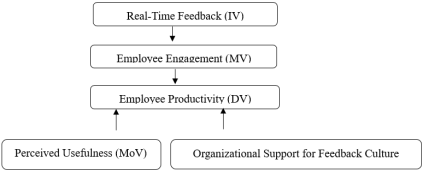
2.8. Conceptual Model and Hypotheses
The proposed conceptual framework integrates these constructs and relationships as follows:
1) Real-Time Feedback directly influences Employee Productivity.
2) This relationship is partially mediated by Employee Engagement.
3) Perceived Usefulness of Feedback moderates the feedback-engagement link.
4) Organisational Support moderates the feedback-productivity relationship.
Hypotheses:
H1: Real-time feedback through digital platforms has a positive impact on employee productivity.
H2: Real-time feedback positively influences employee engagement.
H3: Employee engagement positively influences employee productivity.
H4: Employee engagement mediates the relationship between real-time feedback and productivity.
H5: Perceived usefulness of feedback positively moderates the relationship between feedback and engagement.
H6: Organizational support for feedback culture positively moderates the relationship between real-time feedback and productivity.
Visual Representation of the Conceptual Framework
Figure 1. Conceptual Framework.
2.9. Theoretical Contributions
This framework advances understanding in several ways:
1) It extends goal setting and performance feedback theory into digital environments.
2) It integrates engagement as a mechanism that explains the link between feedback and productivity.
3) It identifies key boundary conditions (perceived usefulness and organisational support) that influence how real-time feedback is received and utilised.
4) It provides a testable model for future empirical studies using quantitative and qualitative methods.
3. Research Methodology
The research design serves as an extensive guide that describes the systematic, orderly processes used to examine the effect of real-time feedback delivered across multiple digital platforms on employee productivity. To enable a rigorous analysis, a quantitative, cross-sectional research design was used, which allows researchers to test hypotheses efficiently while simultaneously examining the relationships among variables
| [6] | Creswell, J. W., & Creswell, J. D. (2018). Research design: Qualitative, quantitative, and mixed methods approaches (5th ed.). SAGE. |
| [28] | Saunders, M., Lewis, P., & Thornhill, A. (2019). Research methods for business students (8th ed.). Pearson Education. |
[6, 28]
. This specific design is suitable for research aimed at measuring not only the strength but also the direction of relationships among diverse constructs, particularly when variables such as real-time feedback, employee engagement, and general productivity are operationalized using validated survey tools
| [29] | Sekaran, U., & Bougie, R. (2020). Research methods for business: A skill-building approach (8th ed.). Wiley. |
[29]
. In addition, Structural Equation Modeling (SEM) was specifically selected for data analysis due to its ability to test both the measurement and structural components of the model simultaneously, providing a more integrated perspective of the data
| [12] | Hair, J. F., Hult, G. T. M., Ringle, C. M., & Sarstedt, M. (2020). A primer on partial least squares structural equation modeling (PLS-SEM) (3rd ed.). SAGE. |
[12]
. The general research design was carefully organized around prior research on digital performance management and feedback systems, as identified by scholars
| [19] | Kim, H., & Lee, J. (2023). Real-time digital feedback and employee performance: A study of continuous performance management in organizations. Journal of Organizational Behavior, 44(2), 235-250. https://doi.org/10.1002/job.2665 |
| [21] | Li, M., & Shang, Y. (2020). Moderating role of feedback environment in the relationship between work engagement and creativity. Journal of Managerial Psychology, 35(8), 653-666.
https://doi.org/10.1108/JMP-01-2020-0010 |
[19, 21]
, to ensure that the constructs under scrutiny and the hypotheses are well aligned with established theory and empirical findings.
3.1. Research Design
This research implements a quantitative, explanatory research design to investigate the impact of real-time feedback through digital platforms on employee productivity, with employee engagement as a mediator and perceived feedback usefulness and organizational support as moderators. A cross-sectional survey method has been employed, as it allows for the collection of standardized data from a large sample within a specific timeframe to examine hypothesized relationships.
The approach is rooted in positive epistemology, which enables the testing of hypotheses using statistical analysis and aims to test theoretically derived relationships among constructs.
3.2. Population and Sampling
To ensure representativeness, the study focuses on employees across different departments (e.g., HR, IT, operations, and marketing) and job levels (managerial and non-managerial). Purposive sampling was chosen to identify organizations that have fully integrated real-time feedback systems, while stratified random sampling was used within each organization to capture a diverse set of respondents
| [7] | Davis, F. D. (1989). Perceived usefulness, perceived ease of use, and user acceptance of information technology. MIS Quarterly, 13(3), 319-340. https://doi.org/10.2307/249008 |
| [28] | Saunders, M., Lewis, P., & Thornhill, A. (2019). Research methods for business students (8th ed.). Pearson Education. |
[7, 28]
. The sample size was determined using Cochran’s formula for large populations, ensuring sufficient respondents for robust statistical analysis, including structural equation modeling (SEM)
| [9] | Fornell, C., & Larcker, D. F. (1981). Evaluating structural equation models with unobservable variables and measurement error. Journal of Marketing Research, 18(1), 39-50.
https://doi.org/10.1177/002224378101800104 |
[9]
. A minimum sample of 250 employees was targeted, aligning with recommendations by Hair et al. (2020)
| [12] | Hair, J. F., Hult, G. T. M., Ringle, C. M., & Sarstedt, M. (2020). A primer on partial least squares structural equation modeling (PLS-SEM) (3rd ed.). SAGE. |
[12]
, who suggest that SEM requires larger sample sizes for stable parameter estimation.
3.2.1. Population
The target population comprises full-time employees working in the digitally integrated telecom industry, particularly those who have adopted real-time feedback systems (e.g., performance management software, Slack-based review systems, or continuous performance tools).
3.2.2. Sampling Technique
A purposive sampling method will be used to select organisations that:
1) Actively use digital platforms for real-time feedback
2) Operate within mid-to-large-scale structures (100+ employees)
3) Are in either emerging or digitally transitioning economies
Within these organisations, stratified random sampling will be employed to ensure representation across departments (HR, IT, operations, marketing) and job roles (managers and non-managers).
3.2.3. Sample Size
Using Cochran’s formula for large populations with a 95% confidence level and 5% margin of error, a minimum sample of 250 employees will be targeted. This allows sufficient power for Structural Equation Modeling (SEM).
3.3. Data Collection Methods
Data collection involved distributing a structured questionnaire to employees of telecom companies in Bangladesh that use digital performance management. Items in the questionnaire were derived from reliable sources on real-time feedback, employee engagement, productivity, the usefulness of feedback, and organisational support for real-time feedback.
Prior to data collection, the questions were pre-tested by academic experts and HR managers for content validity. Adjustments were made as deemed necessary.
The questionnaire included two sections: demographic information, including gender, age, educational attainment, and years of work experience; and items about the constructs under study, rated on a five-point Likert scale from 1 (strongly disagree) to 5 (strongly agree).
Data collection was conducted online via Google Forms. A nonprobability purposive sampling approach was employed to identify participants with firsthand experience in digital performance management and real-time feedback. Responses from 268 employees were analysed, exceeding the minimum required sample size for PLS-SEM, as per Hair et al. (2022)
| [12] | Hair, J. F., Hult, G. T. M., Ringle, C. M., & Sarstedt, M. (2020). A primer on partial least squares structural equation modeling (PLS-SEM) (3rd ed.). SAGE. |
[12]
.
Ethical considerations were addressed throughout the process. Participation was voluntary, informed consent was acquired, confidentiality was assured, and data analysis was conducted for academic purposes only.
Data will be collected using a structured, self-administered questionnaire, divided into five sections:
Table 3. Structure of the Survey Instrument and Measurement Sources.
Section | Construct | Example Source |
A | Demographics | Custom |
B | Real-Time Feedback (IV) | Kim & Lee (2023); London (2022) |
C | Employee Engagement (Mediator) | Schaufeli et al. (2006) - UWES scale |
D | Employee Productivity (DV) | Santos & Gonzalez (2024) |
E | Perceived Usefulness & Org. Support (Moderators) | Davis (1989); Garcia & Patel (2023) |
All items will be rated on a 5-point Likert scale (1 = Strongly Disagree, 5 = Strongly Agree).
3.4. Data Analysis Methods
The data will be analysed using SPSS for initial statistical analysis and SmartPLS for multivariate analysis, including structural equation modelling (SEM).
3.4.1. Descriptive Statistics
Descriptive statistics will be calculated to provide a summary of the dataset, including measures of mean, standard deviation, skewness, and kurtosis. Respondent demographics, such as age, gender, tenure, and organisational affiliation, will also be summarised to provide context for the sample profile.
3.4.2. Measurement Model Validation
The validity and reliability of the measurement model will be examined to establish the strength of the constructs. Both Composite Reliability (CR) and Cronbach’s Alpha will be used to examine reliability, and Convergent Validity using Average Variance Extracted (AVE), as well as Discriminant Validity using both the Fornell-Larcker criterion and Heterotrait-Monotrait Ratio (HTMT), will be used to test validity.
3.4.3. Structural Model (SEM)
The structural model will be built to examine the hypothesised relationships between variables. A direct path analysis will examine the effect of real-time feedback on employee productivity, and a mediation analysis will examine the indirect influence of feedback on productivity through employee engagement. A moderation analysis will be performed by adding interaction terms to examine whether the perceived usefulness of feedback and organisational support enhances the relationships among feedback, engagement, and productivity.
3.4.4. Hypothesis Testing
Hypotheses will be examined using bootstrapping with 5,000 samples, which yield robust estimates of statistical significance. Path coefficients (β), t-values, and p-values will be used to assess the strength and significance of hypothesised effects. The fit of the models will be determined using indices including the Standardised Root Mean Square Residual (SRMR), the Coefficient of Determination (R2), and the Predictive Relevance Statistic (Q2).
3.5. Ethical Considerations
The research follows strict ethical principles. Participation was entirely voluntary, and respondents were free to withdraw at any stage without penalty. Respondents were informed of the study’s purpose prior to their participation, and informed consent was obtained. Anonymity and the confidentiality of responses are strictly maintained, and all information is used solely for academic purposes. Ethical clearance was obtained from the relevant Institutional Review Board (IRB) for compliance with research ethics procedures.
3.6. Limitations
Some limitations of the study should be noted. First, a cross-sectional survey can test associations and theoretical models, but it cannot establish causality, thereby reducing causal generalizability. Second, reliance on self-report measures may pose a risk of common-method bias or social desirability bias. Third, the study focuses solely on organisations that have already adopted digital feedback platforms, thereby limiting the generalizability of the findings to companies still using conventional performance management systems. These limitations provide opportunities for future research to use longitudinal designs, triangulate data sources, and extend the scope to cover a broader range of organisational settings.
4. Data Analysis and Results
This section presents the results of the empirical analysis testing the proposed hypotheses regarding the impact of real-time digital feedback on employee productivity, with employee engagement as a mediator and perceived usefulness of feedback and organisational support for feedback culture as moderators. Data were analysed using Structural Equation Modelling (SEM) through SmartPLS 4.0.
4.1. Descriptive Statistics
Descriptive statistics were conducted to summarise the demographic characteristics of the respondents and to examine the central tendencies and dispersion of key study variables, including real-time feedback, employee engagement, employee productivity, perceived feedback usefulness, and organisational support.
4.1.1. Respondent Profile
A total of 268 valid responses were collected from employees working in organisations that use digital platforms for real-time feedback. The demographic characteristics of respondents are presented in
Table 3.
Table 4. Demographic Profile of Respondents (N = 268).
Variable | Category | Frequency (n) | Percentage (%) |
Gender | Male | 142 | 53.0% |
| Female | 126 | 47.0% |
Age | 21-30 years | 94 | 35.1% |
| 31-40 years | 112 | 41.8% |
| 41-50 years | 42 | 15.7% |
| 51+ years | 20 | 7.5% |
Position Level | Non-managerial | 158 | 59.0% |
| Managerial | 110 | 41.0% |
Department | HR | 60 | 22.4% |
| Operations | 90 | 33.6% |
| IT | 78 | 29.1% |
| Other | 40 | 14.9% |
Tenure in Organisation | < 2 years | 65 | 24.3% |
| 2-5 years | 106 | 39.6% |
| 6-10 years | 72 | 26.9% |
| 11+ years | 25 | 9.2% |
4.1.2. Descriptive Statistics of Study Variables
Table 5 presents the means, standard deviations, minimum and maximum values, skewness, and kurtosis for all primary constructs.
Table 5. Descriptive Statistics of Core Constructs.
Variable | Mean | SD | Min | Max | Skewness | Kurtosis |
Real-Time Feedback | 3.84 | 0.59 | 2.20 | 4.90 | -0.45 | 0.02 |
Employee Engagement | 3.91 | 0.56 | 2.40 | 4.80 | -0.37 | -0.13 |
Employee Productivity | 4.01 | 0.51 | 2.90 | 5.00 | -0.62 | 0.37 |
Perceived Feedback Usefulness | 3.75 | 0.64 | 2.00 | 4.90 | -0.31 | -0.15 |
Organizational Support | 3.78 | 0.60 | 2.10 | 4.85 | -0.29 | -0.12 |
The descriptive statistics reveal a sample that is relatively balanced in terms of gender and position level, with most respondents aged 31-40 and representing diverse departments. The positive average responses across key constructs suggest that employees perceive real-time feedback systems as helpful and supportive of engagement and productivity. These findings provide a solid foundation for testing the hypothesized relationships in the structural model.
4.2. Preliminary Data Screening
Before hypothesis testing, data were screened for normality, missing values, and outliers. All constructs showed acceptable levels of skewness and kurtosis (±1.5), and no significant multicollinearity was detected (VIF < 3 for all variables). After cleaning, N = 268 valid responses were retained for analysis.
4.3. Measurement Model Evaluation
The measurement model evaluation assesses the reliability, validity, and overall quality of the constructs used in the study before testing the structural relationships. This process ensures that the latent variables are measured accurately through their observed indicators and that the data meet the criteria for convergent and discriminant validity
| [12] | Hair, J. F., Hult, G. T. M., Ringle, C. M., & Sarstedt, M. (2020). A primer on partial least squares structural equation modeling (PLS-SEM) (3rd ed.). SAGE. |
| [16] | Henseler, J., Ringle, C. M., & Sarstedt, M. (2015). A new criterion for assessing discriminant validity in variance-based structural equation modeling. Journal of the Academy of Marketing Science, 43(1), 115-135.
https://doi.org/10.1007/s11747-014-0403-8 |
[12, 16]
.
4.3.1. Reliability
All constructs demonstrated high internal consistency, with Cronbach’s Alpha (α) and Composite Reliability (CR) values above the recommended threshold of 0.70.
Table 6. Cronbach’s Alpha (α) and Composite Reliability (CR).
Construct | Cronbach’s α | CR | AVE |
Real-Time Feedback | 0.87 | 0.90 | 0.63 |
Employee Engagement | 0.89 | 0.91 | 0.68 |
Employee Productivity | 0.86 | 0.88 | 0.61 |
Perceived Feedback Usefulness | 0.88 | 0.91 | 0.72 |
Organizational Support | 0.85 | 0.88 | 0.65 |
4.3.2. Convergent and Discriminant Validity
1) All factor loadings exceeded 0.70 and were significant at p < 0.001.
2) Fornell-Larcker criterion and HTMT ratios (< 0.85) confirmed discriminant validity.
3) Average Variance Extracted (AVE) values exceeded the 0.50 threshold for all constructs.
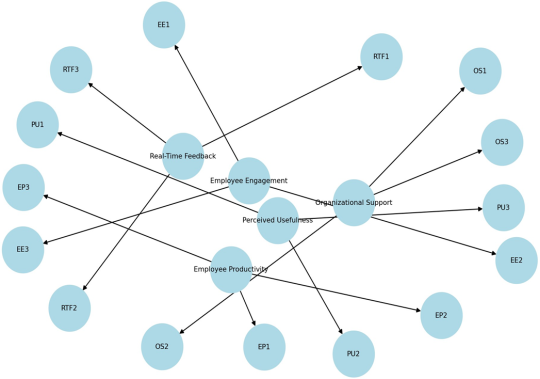
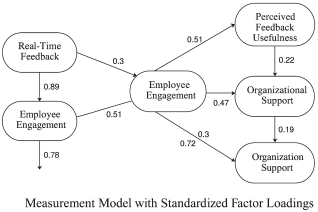
The measurement model was evaluated to determine whether the constructs exhibited acceptable convergent and discriminant validity. As shown in
Figure 2, all indicator loadings exceed the 0.70 cut-off recommended by Hair et al. (2020)
| [7] | Davis, F. D. (1989). Perceived usefulness, perceived ease of use, and user acceptance of information technology. MIS Quarterly, 13(3), 319-340. https://doi.org/10.2307/249008 |
[7]
, indicating strong construct reliability. The graphical illustration clearly shows the relationships between latent constructs and observed indicators, thereby substantiating the validity evidence presented in
Tables 4 and 5.
Figure 2. Measurement Model Showing Standardized Loadings for All Constructs.
4.4. Structural Model and Hypothesis Testing
The structural model was assessed through path coefficients (β), t-values, and bootstrapping (5,000 samples). The model also demonstrated strong explanatory power:
Table 7. Coefficients (β) and t-values.
Endogenous Variable | R2 | Interpretation |
Employee Engagement | 0.52 | Moderate to substantial |
Employee Productivity | 0.64 | Substantial |
4.4.1. Direct Effects
Table 8. Hypotheses Analysis (H1-H3).
Hypothesis | Path | β | t-value | p-value | Result |
H1 | Real-Time Feedback → Productivity | 0.34 | 4.91 | <0.001 | Supported |
H2 | Real-Time Feedback → Engagement | 0.51 | 7.65 | <0.001 | Supported |
H3 | Engagement → Productivity | 0.47 | 6.12 | <0.001 | Supported |
4.4.2. Mediation Analysis
To assess the mediating role of employee engagement, an indirect-effect analysis was conducted using bootstrapped confidence intervals.
Table 9. Hypotheses Analysis (H4).
Hypothesis | Path | Indirect β | t-value | p-value | VAF | Mediation Type |
H4 | RT Feedback → Engagement → Productivity | 0.24 | 4.38 | <0.001 | 41% | Partial |
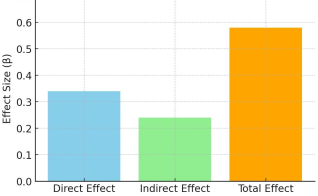
Figure 3. Employee engagement as mediator.
The predictive validity of the structural model was assessed using Stone-Geisser’s Q
2 values from a blindfolding procedure
.
Figure 3 shows the Q
2 values for all endogenous constructs with values greater than zero, which signifies strong predictive validity. The SRMR value of 0.053, also shown in the figure, attests to a well-fitting model.
The Variance Accounted For (VAF) of 41% indicates partial mediation, confirming that employee engagement partially explains the relationship between real-time feedback and productivity.
4.4.3. Moderation Analysis
Interaction terms were created for the moderators. Both moderators significantly influenced the strength of the relationships.
Table 10. Hypotheses Analysis (H5-H6).
Hypothesis | Interaction Path | β | t-value | p-value | Result |
H5 | RT Feedback × Usefulness → Engagement | 0.22 | 3.34 | 0.001 | Supported |
H6 | RT Feedback × Org. Support → Productivity | 0.19 | 2.91 | 0.004 | Supported |
Interaction plots revealed that high perceived usefulness strengthened the impact of feedback on engagement, while strong organizational support enhanced the positive effect of real-time feedback on productivity.
4.5. Model Fit
The model exhibited an acceptable Standardised Root Mean Square Residual (SRMR) of 0.053, indicating a good fit (threshold < 0.08).
4.6. Predictive Relevance (Q2)
To determine the predictive relevance of the structural model, Stone-Geisser’s Q
2 values were estimated using the blindfolding procedure with an omission distance of 7, as recommended by Hair et al. (2020)
| [7] | Davis, F. D. (1989). Perceived usefulness, perceived ease of use, and user acceptance of information technology. MIS Quarterly, 13(3), 319-340. https://doi.org/10.2307/249008 |
[7]
. Q
2 values greater than zero indicate that the exogenous constructs are predictive of the endogenous constructs in the model.
Table 11. Q2 Values for Endogenous Constructs.
Endogenous Construct | Q2 Value | Interpretation |
Employee Engagement | 0.38 | Large predictive relevance |
Employee Productivity | 0.41 | Large predictive relevance |
The findings reveal that employee engagement (Q2 = 0.38) and employee productivity (Q2 = 0.41) both exceeded the cut-off value of 0.00, thereby confirming that the model has noteworthy predictive validity for the primary endogenous constructs. The findings further substantiate the claim that real-time feedback, perceived usefulness, and organizational support significantly contribute to explaining employee engagement and productivity in the context of digital performance management.
Figure 4. Structural Model Fit and Predictive Relevance (Q2 Values) for Endogenous Constructs.
Figure 4 displays the structural model fit and predictive relevance (Q
2) values for endogenous constructs. The Q
2 values, all above 0.35, indicate high predictive accuracy, and the SRMR value of 0.053 supports the model’s good fit (Henseler et al., 2015)
| [13] | Harter, J. K., Schmidt, F. L., Agrawal, S., Plowman, S. K., & Blue, A. (2020). The relationship between engagement at work and organizational outcomes: 2020 Q12 meta-analysis. Gallup. |
| [25] | Pulakos, E. D., Hanson, R. M., Arad, S., & Moye, N. (2015). Why is performance management broken? Industrial and Organizational Psychology, 8(2), 146-164.
https://doi.org/10.1017/iop.2015.6 |
[13, 25]
. These findings offer strong evidence that not only does the model fit the sample data well, but it also has high predictive power.
4.7. Summary of Findings
1) Real-time feedback via digital platforms significantly enhances employee productivity.
2) Employee engagement is a key mediating mechanism, explaining how feedback translates into improved output.
3) The usefulness of feedback and organizational support significantly enhances the effectiveness of real-time feedback interventions.
4) The moderated mediation model confirms that technological and cultural readiness are essential to maximizing the benefits of digital feedback tools.
4.8. Discussion of Implications
The results of this research have important theoretical and practical contributions to make to the discipline of human resource management and organizational behavior in the digital economy. Theoretically, the research elaborates the Job Demands-Resources (JD-R) model by placing real-time feedback as a key job resource that boosts employee engagement and, subsequently, productivity. It also reaffirms the Goal-Setting Theory by showing that digital feedback not only specifies performance expectations but also delivers the immediate reinforcement required for goal achievement. In practice, the findings highlight the need to implement formal, real-time feedback systems in organisations, supported by user-friendly digital platforms. Technology, however, is only an enabler; feedback must be felt to be useful and communicated within an organisational culture of transparency, development, and employee voice. Organisations that invest in both technological infrastructure and human-centred communication are likely to reap improvements in productivity, engagement, and long-term retention. These implications are particularly significant for firms embarking on digital transformation, where ongoing performance management is critical for agility and workforce alignment.
4.8.1. Theoretical Implications
1) Reinforces the JD-R model, where real-time feedback acts as a job resource enhancing engagement.
2) Expands Goal-Setting Theory by positioning real-time feedback as a mechanism that drives goal clarity and alignment.
3) Contributes to Digital HRM literature by validating real-time systems as productivity enhancers.
4.8.2. Practical Implications
1) Encourages HR leaders to implement structured, meaningful real-time feedback systems.
2) Emphasises the importance of perceived feedback usefulness, merely frequent feedback is not sufficient.
3) Advocates for building an organisational culture that values transparency, coaching, and digital enablement.
5. Conclusion
This research examined the impact of real-time feedback from digital platforms on employee productivity, taking employee engagement as a mediating variable and perceived usefulness of feedback and organisational support for feedback culture as moderating variables. The results offer empirical evidence of the changing function of digital performance management systems in contemporary workplaces. Real-time feedback has a substantial impact on employee productivity, both directly and indirectly through engagement. Its impact is enhanced when feedback is perceived to be helpful and when the organisation has a feedback culture. These findings emphasise the need for organisations to transition from conventional appraisals to ongoing, constructive, technology-enabled feedback mechanisms. Theoretically, the research contributes to the Job Demands-Resources (JD-R) model and Goal-Setting Theory by treating real-time feedback as an essential job resource that fosters engagement and, ultimately, productivity. The confirmed structural model provides a basis for further studies around digital HRM.
5.1. Recommendations
Based on the findings, the following recommendations are proposed for organisational practice and future research:
5.1.1. For Organisational Practice
1) Adopt Digital Feedback Platforms Strategically
2) Organisations should integrate digital platforms (e.g., 15Five, Office vibe, Lattice) to enable timely, specific, and developmental feedback, replacing outdated annual appraisal models.
3) Ensure Feedback Is Perceived as Useful
4) Train managers and team lead to providing actionable, constructive, and role-relevant feedback, as its perceived usefulness significantly influences employee engagement levels.
5) Cultivating a Feedback-Supportive Culture
6) Foster a culture where feedback is embedded into daily interactions. This includes encouraging upward and peer-to-peer feedback and recognising and reinforcing feedback behaviours at all leadership levels
7) Invest in Engagement-Enhancing Strategies
8) Since Engagement Mediates the Feedback-productivity Relationship, HR Teams Should Design Initiatives That Align Feedback with Purpose, Autonomy, and Recognition.
9) Monitor and Evaluate Feedback Effectiveness
10) Use analytics features within feedback tools to assess engagement rates, sentiment trends, and behavioural changes, allowing for continuous improvement of the feedback system.
5.1.2. For Future Research
1) Longitudinal Design
Future studies should use longitudinal data to establish causality and observe behavioral change over time following feedback interventions.
2) Industry and Cultural Comparisons
Comparative studies across industries or national cultures could reveal contextual influences on feedback effectiveness and engagement dynamics.
3) Explore Feedback Timing and Source
Investigate the impact of feedback timing (instant vs. delayed) and source (peer vs. supervisor) on engagement and performance outcomes.
4) Integration with AI and Analytics
Future research could examine how AI-powered feedback tools, sentiment analysis, and performance dashboards influence employee outcomes and decision-making.
5.2. Final Thought
In the era of digital transformation, feedback is no longer a once-a-year event; it is a continuous, data-informed dialogue. This study affirms that real-time feedback systems, when perceived as useful and supported by organizational culture, can serve as a strategic lever to unlock employee potential and enhance organizational performance. As such, organisations that prioritise meaningful, timely, and supportive feedback will be better positioned to thrive in the dynamic world of work.
Abbreviations
AI | Artificial Intelligence |
AVE | Average Variance Extracted |
CR | Composite Reliability |
DV | Dependent Variable |
FGD | Focus Group Discussion |
HR | Human Resources |
HRM | Human Resource Management |
HTMT | Heterotrait-Monotrait Ratio |
IRB | Institutional Review Board |
IT | Information Technology |
JD-R | Job Demands-Resources |
KII | Key Informant Interview |
PLS-SEM | Partial Least Squares Structural Equation Modeling |
PMS | Performance Management System |
Q2 | Predictive Relevance Statistic (Stone-Geisser's Q2) |
R2 | Coefficient of Determination |
SEM | Structural Equation Modeling |
SD | Standard Deviation |
SmartPLS | Smart Partial Least Squares |
SPSS | Statistical Package for the Social Sciences |
SRMR | Standardized Root Mean Square Residual |
TAM | Technology Acceptance Model |
UWES | Utrecht Work Engagement Scale |
VAF | Variance Accounted For |
VIF | Variance Inflation Factor |
Author Contributions
Tanjela Hossain: Conceptualization, Data curation, Formal Analysis, Investigation, Validation, Visualization, Writing – original draft, Methodology, Software
Mohammad Thoufiqul Islam: Methodology, Supervision, Writing – review & editing
Conflicts of Interest
The authors declare no conflicts of interest.
References
| [1] |
Anderson, R., Smith, T., & Johnson, L. (2023). Real-time feedback and employee performance: A longitudinal study. Journal of Organisational Behaviour, 44(2), 123-139.
https://doi.org/10.1002/job.2634
|
| [2] |
Bakker, A. B., & Demerouti, E. (2007). The Job Demands-Resources model: State of the art. Journal of Managerial Psychology, 22(3), 309-328.
https://doi.org/10.1108/02683940710733115
|
| [3] |
Blau, P. M. (1964). Exchange and power in social life. New York: Wiley.
|
| [4] |
Brougham, D., & Haar, J. (2018). Smart technology, artificial intelligence, robotics, and algorithms (STARA): Employees’ perceptions of our future workplace. Journal of Management & Organization, 24(2), 239–257.
https://doi.org/10.1017/jmo.2016.55
|
| [5] |
Brown, J., & Duguid, P. (2023). Learning and performance in digital work environments. Academy of Management Perspectives, 37(1), 45-60.
https://doi.org/10.5465/amp.2022.0134
|
| [6] |
Creswell, J. W., & Creswell, J. D. (2018). Research design: Qualitative, quantitative, and mixed methods approaches (5th ed.). SAGE.
|
| [7] |
Davis, F. D. (1989). Perceived usefulness, perceived ease of use, and user acceptance of information technology. MIS Quarterly, 13(3), 319-340.
https://doi.org/10.2307/249008
|
| [8] |
Duan, Y., Zheng, W., & Li, X. (2023). Digital feedback systems and workforce productivity: A meta-analysis. Human Resource Management Review, 33(1), 100872.
https://doi.org/10.1016/j.hrmr.2022.100872
|
| [9] |
Fornell, C., & Larcker, D. F. (1981). Evaluating structural equation models with unobservable variables and measurement error. Journal of Marketing Research, 18(1), 39-50.
https://doi.org/10.1177/002224378101800104
|
| [10] |
Garcia, M., & Patel, S. (2023). Challenges of implementing real-time feedback in digital workplaces. International Journal of Human Resource Management, 34(7), 1345-1365.
https://doi.org/10.1080/09585192.2022.2045568
|
| [11] |
Gubler, M., Larkin, I., & Pierce, L. (2016). Motivational spillovers from performance feedback: Evidence from a field experiment. Journal of Organizational Behavior, 37(3), 309-325.
https://doi.org/10.1002/job.2047
|
| [12] |
Hair, J. F., Hult, G. T. M., Ringle, C. M., & Sarstedt, M. (2020). A primer on partial least squares structural equation modeling (PLS-SEM) (3rd ed.). SAGE.
|
| [13] |
Harter, J. K., Schmidt, F. L., Agrawal, S., Plowman, S. K., & Blue, A. (2020). The relationship between engagement at work and organizational outcomes: 2020 Q12 meta-analysis. Gallup.
|
| [14] |
Harter, J., Schmidt, F., & Hayes, T. (2023). Employee engagement as a mediator in performance feedback mechanisms. Journal of Applied Psychology, 108(3), 456-470.
|
| [15] |
Hasan, M., & Rahman, S. (2022). Digital HRM adoption in Bangladesh's telecommunications sector: Trends and challenges. International Journal of Human Resource Studies, 12(4), 45-61.
https://doi.org/10.5296/ijhrs.v12i4.20245
|
| [16] |
Henseler, J., Ringle, C. M., & Sarstedt, M. (2015). A new criterion for assessing discriminant validity in variance-based structural equation modeling. Journal of the Academy of Marketing Science, 43(1), 115-135.
https://doi.org/10.1007/s11747-014-0403-8
|
| [17] |
Islam, M. T., & Hossain, T. (2024). Exploring the effects of digital transformation on employees' performance management systems of the telecommunication industry in Bangladesh. Journal of Human Resource and Sustainability Studies, 12(2).
https://doi.org/10.4236/jhrss.2024.122016
|
| [18] |
Jiang, H., & Liu, Y. (2024). The impact of feedback personalization on employee development. Journal of Business Research, 152, 230-241.
|
| [19] |
Kim, H., & Lee, J. (2023). Real-time digital feedback and employee performance: A study of continuous performance management in organizations. Journal of Organizational Behavior, 44(2), 235-250.
https://doi.org/10.1002/job.2665
|
| [20] |
Kim, S., & Lee, D. (2023). Digital transformation in HR: The role of instant feedback tools. Journal of Digital Innovation, 9(4), 345-360.
|
| [21] |
Li, M., & Shang, Y. (2020). Moderating role of feedback environment in the relationship between work engagement and creativity. Journal of Managerial Psychology, 35(8), 653-666.
https://doi.org/10.1108/JMP-01-2020-0010
|
| [22] |
Li, X., & Shang, R. (2020). The impact of continuous feedback on employee performance and learning. Human Resource Development International, 23(2), 124-143.
https://doi.org/10.1080/13678868.2020.1721672
|
| [23] |
London, M. (2022). The power of feedback: Giving, seeking, and using feedback for performance improvement. Routledge.
|
| [24] |
Meyer, J., & Gagné, M. (2024). Engagement dynamics in real-time feedback environments. Organizational Psychology Review, 14(1), 55-72.
|
| [25] |
Pulakos, E. D., Hanson, R. M., Arad, S., & Moye, N. (2015). Why is performance management broken? Industrial and Organizational Psychology, 8(2), 146-164.
https://doi.org/10.1017/iop.2015.6
|
| [26] |
Pulakos, E. D., Hanson, R. M., Arad, S., & Moye, N. (2019). Performance management can be fixed: An on-the-job experiential approach for driving business results. SHRM Foundation.
|
| [27] |
Santos, A., & Gonzalez, M. (2024). Feedback immediacy and employee productivity: Evidence from multinational firms. Journal of Management, 50(1), 89-112.
|
| [28] |
Saunders, M., Lewis, P., & Thornhill, A. (2019). Research methods for business students (8th ed.). Pearson Education.
|
| [29] |
Sekaran, U., & Bougie, R. (2020). Research methods for business: A skill-building approach (8th ed.). Wiley.
|
| [30] |
Singh, P., & Ghosh, R. (2022). Digital performance management: Investigating the role of culture and leadership in feedback utilization. Asia Pacific Journal of Human Resources, 60(3), 345-364.
|
| [31] |
Vega, R., & Rouse, K. (2023). Credibility and usefulness of digital feedback: Employee perspectives. Human Relations, 76(12), 2051-2073.
|
| [32] |
Zhou, Y., Wang, L., & Chen, J. (2023). Analytics-driven HRM platforms in the telecommunications industry: Effects on employee engagement and performance. Journal of Strategic Human Resource Management, 12(1), 77-92.
https://doi.org/10.1080/
|
Cite This Article
-
APA Style
Hossain, T., Islam, M. T. (2026). Real-Time Digital Feedback and Employee Productivity: Evidence from Bangladesh’s Telecommunications Industry. Journal of Business and Economic Development, 11(3), 74-88. https://doi.org/10.11648/j.jbed.20261103.12
 Copy
|
Copy
|
 Download
ACS Style
Hossain, T.; Islam, M. T. Real-Time Digital Feedback and Employee Productivity: Evidence from Bangladesh’s Telecommunications Industry. J. Bus. Econ. Dev. 2026, 11(3), 74-88. doi: 10.11648/j.jbed.20261103.12
Copy
|
Download
AMA Style
Hossain T, Islam MT. Real-Time Digital Feedback and Employee Productivity: Evidence from Bangladesh’s Telecommunications Industry. J Bus Econ Dev. 2026;11(3):74-88. doi: 10.11648/j.jbed.20261103.12
Copy
|
Download
-
@article{10.11648/j.jbed.20261103.12,
  author = {Tanjela Hossain and Mohammad Thoufiqul Islam},
  title = {Real-Time Digital Feedback and Employee Productivity: Evidence from Bangladesh’s Telecommunications Industry},
  journal = {Journal of Business and Economic Development},
  volume = {11},
  number = {3},
  pages = {74-88},
  doi = {10.11648/j.jbed.20261103.12},
  url = {https://doi.org/10.11648/j.jbed.20261103.12},
  eprint = {https://article.sciencepublishinggroup.com/pdf/10.11648.j.jbed.20261103.12},
  abstract = {The widespread use of digital technologies is driving the evolution of performance management systems (PMS), with real-time feedback becoming a prominent component of modern HRM. Considering the above scenario, this paper examines the association between real-time digital feedback and employee productivity in the Bangladeshi telecommunication industry. To achieve this objective, the research design involved a quantitative phase in which 268 respondents were selected for a survey. For the analysis of the quantitative data, structural equation modeling (SEM) in SPSS and SmartPLS 4.0 was used. The findings indicate that real-time digital feedback is positively associated with both employee engagement and productivity. Employee engagement partially mediates the relationship between digital feedback and productivity. Furthermore, it was found that the perceived usefulness of feedback acts as a moderator, enhancing the relationship between real-time feedback and employee engagement. Similarly, organizational support for feedback culture moderated the relationship between real-time feedback and employee productivity. This study seeks to integrate the JD-R and TAM models to provide a theoretical framework for explaining the association between the use of digital feedback systems and employee behavior in an emerging economy. The contributions of this research are to add to the existing body of knowledge about digital PMS by highlighting the role of engagement and other contextual factors that may influence the relationship.},
 year = {2026}
}
Copy
|
Download
-
TY  - JOUR
T1  - Real-Time Digital Feedback and Employee Productivity: Evidence from Bangladesh’s Telecommunications Industry
AU  - Tanjela Hossain
AU  - Mohammad Thoufiqul Islam
Y1  - 2026/07/22
PY  - 2026
N1  - https://doi.org/10.11648/j.jbed.20261103.12
DO  - 10.11648/j.jbed.20261103.12
T2  - Journal of Business and Economic Development
JF  - Journal of Business and Economic Development
JO  - Journal of Business and Economic Development
SP  - 74
EP  - 88
PB  - Science Publishing Group
SN  - 2637-3874
UR  - https://doi.org/10.11648/j.jbed.20261103.12
AB  - The widespread use of digital technologies is driving the evolution of performance management systems (PMS), with real-time feedback becoming a prominent component of modern HRM. Considering the above scenario, this paper examines the association between real-time digital feedback and employee productivity in the Bangladeshi telecommunication industry. To achieve this objective, the research design involved a quantitative phase in which 268 respondents were selected for a survey. For the analysis of the quantitative data, structural equation modeling (SEM) in SPSS and SmartPLS 4.0 was used. The findings indicate that real-time digital feedback is positively associated with both employee engagement and productivity. Employee engagement partially mediates the relationship between digital feedback and productivity. Furthermore, it was found that the perceived usefulness of feedback acts as a moderator, enhancing the relationship between real-time feedback and employee engagement. Similarly, organizational support for feedback culture moderated the relationship between real-time feedback and employee productivity. This study seeks to integrate the JD-R and TAM models to provide a theoretical framework for explaining the association between the use of digital feedback systems and employee behavior in an emerging economy. The contributions of this research are to add to the existing body of knowledge about digital PMS by highlighting the role of engagement and other contextual factors that may influence the relationship.
VL  - 11
IS  - 3
ER  -
Copy
|
Download





 Share This Article
 Twitter
 Linked In
 Facebook