Research Article | | Peer-Reviewed

Cognitive Appraisal of Occupational Safety and Health Competencies Among Civil Engineers in Catanduanes, Philippines

Received: 9 January 2026     Accepted: 19 January 2026     Published: 30 January 2026
Views:       Downloads:
Abstract

Occupational Safety and Health (OSH) remain a critical concern in the construction industry due to persistent exposure to physical, mechanical, electrical, and environmental hazards. While regulatory frameworks exist, effective OSH implementation largely depends on the competencies of professionals responsible for construction planning and supervision. This study assessed the perceived Occupational Safety and Health (OSH) competencies of practicing civil engineers in Catanduanes, Philippines, focusing on their knowledge, skills, values and attitudes, and roles in OSH implementation. A descriptive cross-sectional research design employing quantitative methods was used. Data were collected from 31 licensed civil engineers actively involved in construction projects through a validated self-administered questionnaire grounded in Republic Act No. 11058 and related OSH standards. Descriptive statistical tools, including weighted mean and frequency distribution, were used for data analysis. Results indicate that civil engineers demonstrated strong awareness of OSH laws, general safety principles, and positive safety values, along with a high sense of responsibility in enforcing OSH policies. However, significant gaps were identified in advanced technical OSH skills, particularly in electrical hazard prevention, machine guarding application, operation of mechanical handling equipment, fire extinguishing techniques, workplace hazard evaluation using Work Environment Measurement (WEM), interpretation of Threshold Limit Values (TLVs), environmental control systems such as industrial ventilation, and OSH program development. These gaps were attributed to limited access to specialized, hands-on OSH training in a geographically isolated provincial context. The study underscores the need for competency-based, skills-oriented OSH training interventions targeting these identified technical areas to strengthen construction safety performance. The findings provide localized empirical evidence to support policy enhancement, professional development planning, and improved OSH implementation in provincial and developing-country construction settings.

Published in Journal of Civil, Construction and Environmental Engineering (Volume 11, Issue 1)
DOI 10.11648/j.jccee.20261101.13
Page(s) 22-29
Creative Commons

This is an Open Access article, distributed under the terms of the Creative Commons Attribution 4.0 International License (http://creativecommons.org/licenses/by/4.0/), which permits unrestricted use, distribution and reproduction in any medium or format, provided the original work is properly cited.

Copyright

Copyright © The Author(s), 2026. Published by Science Publishing Group

Keywords

Civil Engineers, Construction Industry, Knowledge Assessment, Occupational Safety and Health (OSH)

1. Introduction
Occupational Safety and Health (OSH) has become an increasingly critical concern in the construction industry due to the sector’s inherent exposure to physical, mechanical, electrical, and environmental hazards. Globally, construction consistently ranks among the most hazardous industries, accounting for a disproportionate number of occupational injuries, fatalities, and work-related illnesses. As construction activities expand in scale and complexity, the effective implementation of OSH policies relies not only on regulatory compliance but also on the competencies of professionals responsible for planning, supervision, and execution of construction works .
The presents an analysis of worldwide incident data involving powered access equipment, including Mobile Elevating Work Platforms (MEWPs), Mast Climbing Work Platforms (MCWPs), and construction hoists. In 2022, incident reporting increased significantly, with 759 reports from 34 countries, while fatalities declined by approximately 19% compared to 2021, indicating an overall improvement in safety outcomes. Despite this progress, serious incidents persist, with falls from the platform, overturns, electrocution, entrapment, and being struck by vehicles or objects remaining the leading causes of fatal and major injuries. Electrocution incidents, though less frequent, continue to have a disproportionately high fatality rate. The report emphasizes the critical importance of effective planning, risk assessment, proper equipment selection, operator training, and consistent incident reporting to further reduce accidents and improve global powered access safety performance.
In the Philippines, the enactment of Republic Act No. 11058 and its implementing rules underscores the government’s commitment to strengthening OSH compliance across industries, particularly construction. The Department of Labor and Employment (DOLE) has introduced training programs and regulatory mechanisms aimed at improving workplace safety. Nevertheless, construction-related accidents and unsafe work practices remain prevalent, indicating that compliance challenges extend beyond regulatory frameworks and may be rooted in human competency factors such as knowledge, skills, and attitudes toward OSH.
Civil engineers play a pivotal role in ensuring workplace safety, as they are directly involved in project management, site supervision, and decision-making processes that influence hazard control and risk mitigation. Beyond technical expertise, civil engineers are expected to possess adequate knowledge of OSH laws, practical safety skills, and positive attitudes toward safety culture to ensure effective implementation of occupational safety programs. However, evidence from developing countries suggests that despite the existence of national OSH legislation, gaps persist between policy provisions and actual safety practices on construction sites.
Recent studies on construction safety have largely focused on workers’ safety behavior, accident causation, and organizational safety climate. While these studies provide valuable insights, limited empirical research has examined OSH competencies specifically among civil engineers, particularly in provincial and geographically isolated contexts. Moreover, existing literature often treats OSH knowledge, skills, attitudes, and implementation as separate constructs, resulting in fragmented assessments that fail to capture the holistic competency profile required for effective safety management.
Catanduanes, a developing island province in the Philippines , is currently experiencing increased construction activity driven by national infrastructure programs such as “Build, Build, Build” and its successor initiatives. While these developments contribute to economic growth, they also intensify safety risks in construction environments that may lack sufficient technical resources, specialized training, and continuous professional development opportunities. To date, no empirical study has systematically examined the cognitive appraisal of OSH competencies among civil engineers operating in this localized and resource-constrained construction context.
Addressing this gap, the present study aims to assess the Occupational Safety and Health competencies of practicing civil engineers in Catanduanes, Philippines, by examining their acquired knowledge, skills, values and attitudes, and roles in the implementation of OSH laws. Using a descriptive quantitative research design, data were collected through a validated self-administered questionnaire grounded in national OSH regulations and prior empirical studies. By identifying competency strengths and gaps, this research seeks to contribute localized empirical evidence to the broader OSH literature and provide a basis for targeted training interventions, policy enhancement, and professional development programs aimed at strengthening safety performance in the construction industry.
2. Methods
2.1. Conceptual Framework
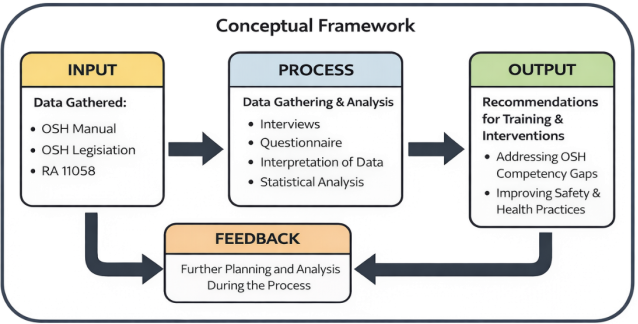
The study on COGNITIVE APPRAISAL OF OCCUPATIONAL SAFETY AND HEALTH COMPETENCIES AMONG CIVIL ENGINEERS IN CATANDUANES, PHILIPPINES, is anchored in the conceptual framework. This framework (Figure 1) looks at the system as an interrelated set of elements functioning . There are four (4) basic elements which consists of a conceptual framework. These are the input, process (technological or managerial), output and the feedback as shown in Figure 1. The input includes the data gathered from the documents which includes OSH Manual, OSH Legislation, and RA 11058. The process includes the data gathering procedures, interviews, questionnaire, interpretation of data, and statistical analysis. For the output, it presents the recommendation for training and interventions to address the gaps. It also includes feedback that shows further planning, and analysis must be done during the process.
Figure 1. Conceptual Framework of the study.
2.2. Research Design
This study utilized a descriptive cross-sectional research design employing quantitative methods to assess the Occupational Safety and Health (OSH) competencies of practicing civil engineers in Catanduanes, Philippines. The descriptive approach was appropriate because the study aimed to determine the existing levels of OSH knowledge, skills, values and attitudes, and implementation roles at a single point in time, without manipulating variables or establishing causal relationships .
2.3. Participants and Sampling Technique
Purposive sampling was used to select participants who met specific inclusion criteria according to , namely: (1) licensed civil engineers, and (2) direct involvement in construction site supervision, project management, or implementation activities. The respondents consisted of 31 out of 42 practicing civil engineers actively involved in construction projects across Catanduanes Province at the time of data collection. It consists of 7 Engineers from the Department of Public Works and Highways, 22 Engineers from the 11 Municipal Engineering Offices (2 engineers from each), 2 from the Provincial Engineering Office and another 11 from the Catanduanes Contractors Association.
Although the sample size is relatively small, it reflects the bounded and specialized population of civil engineers working in an island-province construction context. Similar small-sample descriptive studies have been considered acceptable in exploratory and context-specific OSH research, particularly in geographically isolated or developing regions where professional populations are limited. The findings are therefore intended to provide localized empirical insights rather than statistical generalizations.
2.4. Research Instrument
Data were collected using a self-administered structured questionnaire developed based on the provisions of Republic Act No. 11058, relevant OSH manuals, and validated instruments from prior studies in safety and health by . The questionnaire consisted of 40 items divided into four sections: Part I: Demographic and professional profile; Part II: Knowledge of OSH laws and principles; Part III: Skills related to OSH implementation; Part IV: Values, attitudes, and roles in OSH implementation. All perception-based items were measured using a 5-point Likert scale ranging from 1 (Strongly Disagree) to 5 (Strongly Agree) .
2.5. Validity and Reliability
Content validity of the instrument was established through expert review, involving professionals with experience in occupational safety and health and construction management. Minor revisions were made to improve clarity and contextual relevance. The instrument demonstrated acceptable internal consistency, indicating that the items were suitable for assessing the intended OSH competency dimensions.
2.6. Data Collection and Ethical Considerations
Prior to data collection, the purpose of the study was explained to all participants, and informed consent was obtained. Participation was voluntary, and anonymity and confidentiality of responses were strictly observed. Data were collected through on-site and online survey distribution, depending on participant availability.
2.7. Data Analysis
Collected data were tabulated and analyzed using descriptive statistical tools, including frequency distribution, percentage, and weighted mean. Descriptive statistics were considered appropriate given the exploratory nature of the study and the sample size.
3. Results and Discussion
Four sets of data were gathered on safety and health standards being adopted and practiced in the Construction Industry by CE practitioners from their own viewpoint. This is for the purpose of knowing their awareness on OSH in the industry and to validate the results gleaned from their superiors being referred to as the first set of respondents or the practitioner-respondents. Hence, the same sets of data were gathered and analyzed, re: a) acquired knowledge of CE Practitioners on OSH; b) acquired skills of CE Practitioners on OSH Law; c) acquired values and attitudes of CE practitioners on OSH; and d) CE practitioners’ role on the implementation of OSH in the industry.
3.1. Knowledge of OSH Among Civil Engineers
Results presented in Table 1 show that respondents demonstrated high levels of knowledge in fundamental OSH areas such as national OSH laws and regulations, safety and health program components, identification of unsafe acts and conditions, workplace housekeeping, manual material handling, and appropriate use of personal protective equipment (PPE). These findings indicate that regulatory awareness and basic safety principles are generally well understood among civil engineers in Catanduanes.
Table 1. Aquired knowledge of CE practioners in OSH.

Indicators

Weighted Mean

QnD

QlD

I know and understand the National Laws and Regulations on OSH.

3.58

4

A

I know the components of a safety and health program.

3.71

4

A

I know what is unsafe and unhealthy acts and conditions.

3.94

4

A

I know basic workplace housekeeping.

4.00

4

A

I know safe manual handling and storage of materials.

3.58

4

A

I know the process of evaluating different hazards in the workplace through Work Environment Measurement (WEM) including the instrument used and the standards to be observed.

3.39

3

U

I know the basic terms of electricity and the danger of electric shocks.

3.45

3

U

I can identify practical measures for preventing electric shocks accidents.

3.16

3

U

I can recognize the principles of machine guarding.

3.10

3

U

I know how to identify areas where machine guards are needed.

3.23

3

U

I can distinguish the appropriate type of PPE needed while working and its limitations.

4.06

4

A

I know how environmental control concepts, particularly industrial ventilation, can be applied to environmental hazards.

3.29

3

U

I know the concept of Threshold Limit Values (TVLs) and the interpretation of the numerical values.

2.94

3

U

General Weighted Mean

3.48

3

U

However, notable knowledge gaps were identified in more technical OSH domains, including electrical safety, machine guarding, hazard evaluation through Work Environment Measurement (WEM), interpretation of Threshold Limit Values (TLVs), and environmental control systems such as industrial ventilation. The general weighted mean of 3.48 (qualitatively described as “Undecided”) suggests that while respondents possess foundational knowledge, their understanding of advanced and specialized OSH concepts remains limited.
These gaps may be attributed to several contextual factors. As an island province, Catanduanes has limited access to accredited OSH training centers, specialized safety engineering courses, and advanced laboratory-based training for hazard measurement and environmental monitoring. Continuing professional development opportunities are often centralized in major urban areas, which restricts exposure of provincial practitioners to advanced OSH topics. Similar findings were reported in construction safety studies in Indonesia and Vietnam, where engineers demonstrated adequate awareness of OSH regulations but limited technical competence in hazard measurement, electrical safety, and industrial hygiene due to insufficient formal training and weak integration of OSH engineering concepts in professional education .
3.2. Skills on OSH Among Civil Engineers
As shown in Table 2, respondents reported competence in practical and routine safety-related skills such as identifying unsafe acts and conditions, conducting basic safety inspections, implementing housekeeping measures, properly using PPE, and participating in accident investigations. These skills are closely associated with daily site supervision and are often developed through on-the-job experience rather than formal training.
In contrast, respondents expressed uncertainty regarding skills related to mechanical handling equipment operation, fire extinguishing, electrical hazard prevention, machine guarding application, hazard evaluation through WEM, and development of comprehensive OSH programs. The general weighted mean of 3.42 indicates that respondents perceived their technical safety skills as only moderately developed.
Table 2. Acquired Skills of CE Practitioners on OSH.

Indicators

Weighted Mean

QnD

QlD

I have skills in basic housekeeping.

3.87

4

A

I have skills in identifying unsafe/unhealthy acts and conditions.

4.00

4

A

I have skills in safe and manual handling of materials.

3.58

4

A

I have skills in operating mechanical handling.

2.65

3

U

I have skills in basic fire extinguishing.

3.32

3

U

I have skills in preventing electric shocks.

3.00

3

U

I have skills in operating machines and proper usage of machine guarding.

2.84

3

U

I have skills in the proper use and wearing of PPE while at work.

4.03

4

A

I have skills in evaluating the different hazards in the workplace through Work Environment Measurement (WEM).

3.42

3

U

I have skills in identifying and using environmental control measures.

3.39

3

U

I have skills in safety and health inspections.

3.65

4

A

I have skills in conducting an accident investigation.

3.52

4

A

I have skills in developing an OSH Program.

3.19

3

U

General Weighted Mean

3.42

3

U

This skills gap reinforces the argument that awareness and experience alone do not translate into technical proficiency. Advanced OSH skills typically require structured, hands-on training, simulations, and supervised practice, which are often lacking in provincial settings. Comparable studies in Vietnam and Indonesia similarly found that construction professionals relied heavily on experiential learning and regulatory compliance training, with limited exposure to competency-based, skills-oriented OSH programs. This highlights a systemic issue in developing-country contexts, where OSH training tends to prioritize compliance over applied safety engineering competencies .
3.3. Acquired Values and Attitudes on OSH Among Civil Engineers
Table 3. Acquired Values and Attitudes of CE Practitioners on OSH.

Indicators

Weighted Mean

QnD

QlD

I appreciate the significance of OSH training.

4.65

5

SA

I display the core values of good workmanship and leadership in the performance of duties.

4.06

4

A

I am vigilant in observing the safe implementation of activities.

4.16

4

A

I believe that OSH policy is not only manifested in economic but in behavioral and social dimensions as well.

4.35

4

A

I have a wholesome work habits, attitudes, and values toward efficiency, productivity, and sustainability.

4.13

4

A

I value discipline, love for work, and empathy in dealing with the job.

4.19

4

A

I am responsive to the needs, problems and issues of the construction industry.

4.00

4

A

I am sensitive to the needs of the industry.

3.90

4

A

I am committed to participating in the OSH implementation in the workplace/industry.

4.42

4

A

General Weighted Mean

4.21

4

A

Table 3 reveals that respondents demonstrated strong positive values and attitudes toward OSH, with a high general weighted mean of 4.21. Civil engineers strongly appreciated the importance of OSH training, safety leadership, vigilance in safe work practices, discipline, and social responsibility. They recognized OSH as not only an economic concern but also a behavioral and social responsibility.
This positive safety orientation aligns with international literature emphasizing the role of safety culture in improving OSH performance. Studies in developing nations consistently show that when workers and professionals value safety, they are more receptive to safety programs and more willing to participate in OSH initiatives. However, evidence also suggests that positive attitudes alone are insufficient to significantly reduce workplace risks without corresponding technical competencies and institutional support .
3.4. Roles of Civil Engineers in OSH Implementation
Table 4. Role of Civil Engineers in OSH Implementation.

Indicators

Weighted Mean

QnD

QlD

I must be a part in the full implementation of the OSH Law in the industry.

4.81

5

SA

I must see to it that the safety programs are present in all project/programs.

4.74

5

SA

I must constantly evaluate and monitor the OSH program in the industry.

4.77

5

SA

I must equipped myself with the OSH Law.

4.81

5

SA

General Weighted Mean

4.78

4

SA

Results in Table 4 indicate that respondents strongly agreed on their critical role in OSH implementation. They emphasized full enforcement of OSH laws, the presence of safety programs in all projects, continuous monitoring and evaluation, and the need to equip themselves with comprehensive OSH knowledge. The high general weighted mean of 4.78 reflects a strong sense of professional responsibility and accountability.
These findings affirm the position of civil engineers as frontline enforcers and implementers of OSH policies in construction environments. However, the disparity between their strong sense of responsibility and their limited technical competencies suggests a misalignment between expectations and capacity. This gap underscores the need for competency-based professional development frameworks, particularly in geographically isolated provinces such as Catanduanes.
Overall, the results suggest that the observed OSH competency gaps are influenced by structural factors, including limited access to advanced training facilities, insufficient hands-on technical OSH programs, and the concentration of professional development opportunities in urban centers. Addressing these gaps requires localized, skills-based OSH training interventions, strengthened continuing professional education, and collaboration between regulatory agencies, academic institutions, and professional organizations to ensure that civil engineers are adequately equipped to fulfill their critical role in construction safety.
4. Conclusions
This study assessed the Occupational Safety and Health (OSH) competencies of practicing civil engineers in Catanduanes, Philippines, focusing on knowledge, skills, values and attitudes, and implementation roles. The findings indicate that civil engineers possess strong awareness of OSH laws, general safety principles, and demonstrate positive safety values and a high sense of professional responsibility in enforcing OSH policies. These strengths reflect a favorable safety culture within the local construction industry.
However, significant gaps were identified in advanced technical OSH competencies, particularly in electrical safety, machine guarding, hazard evaluation through Work Environment Measurement (WEM), interpretation of Threshold Limit Values (TLVs), environmental control systems, and OSH program development. These results suggest that regulatory awareness and positive attitudes alone are insufficient to ensure effective risk control without corresponding technical proficiency.
The observed gaps are largely attributed to limited access to specialized training and hands-on OSH programs in geographically isolated areas. The study underscores the need for competency-based, skills-oriented OSH training and strengthened continuing professional development to enhance construction safety performance in provincial and developing-country contexts.
Abbreviations

CE Practitioners

Civil Engineering Practitioners

DOLE

Department of Labor and Employment

OSH

Occupational Safety and Health

RA No. 11058

Republic Act Number 11058

TVLs

Threshold Limit Values

WEM

Work Environment Measurement

Acknowledgments
The authors would like to thank the CE practitioners who took time to answer the survey questionnaire for the study and those who have been instrumental on the completion of the study.
Author Contributions
Dexter Mendez Toyado: Conceptualization, Data curation, Formal Analysis, Investigation, Methodology, Project administration, Software, Validation, Visualization, Writing – original draft, Writing – review & editing
Arvin Roxas De La Cruz: Conceptualization, Methodology, Project administration, Supervision
Data Availability Statement
The data that support the findings of this study are available within the article. The raw data are available from the corresponding author, Dexter Mendez Toyado, upon reasonable request.
Conflicts of Interest
The authors declare no conflicts of interest.
References
[1] Occupational Safety and Health-Department of Labor and Employment, “OCCUPATIONAL SAFETY AND HEALTH STANDARDS,” 2019. Accessed: Oct. 20, 2023. Available:
[2] M. D. Keily and P. Douglas, “IPAF Global Safety Report 2022,” 2022, Available:
[3] J. C. Sarmiento and J. C. D. Cruz, “Digital Soil Mapping and Content Nutrient Prediction Modeling of Abaca Plantation,” in 2025 IEEE International Conference on Automatic Control and Intelligent Systems (I2CACIS), 2025, pp. 355–360.
[4] M. L. Rhodes, “Systems Theory,” International Encyclopedia of Housing and Home, pp. 134–137, Jan. 2011,
[5] J. W. Creswell and J. D. Creswell, Research design : qualitative, quantitative, and mixed methods approaches. California, United States: Thousand Oaks, California : SAGE Publications, Inc, 2023. Available:
[6] M. S. Setia, “Methodology series module 3: Cross-sectional studies,” Indian J. Dermatol., vol. 61, no. 3, pp. 261–264, 2016,
[7] K. Nikolopoulou, “What Is Non-Probability Sampling? | Types & Examples,” Scribbr.
[8] O. Tajik, J. Golzar, and S. Noor, “Purposive Sampling,” vol. 2, no. November, pp. 1–9, 2024.
[9] A. Kamoli, R. Adul Hamid, and Y. Hendra Binmahmud, “Roles of construction organizations in revitalizing occupational health and safety of the nigerian construction industry,” Journal of Advanced Research in Applied Sciences and Engineering Technology, vol. 26, no. 1, pp. 97–104, Mar. 2022,
[10] A. Joice Reyes-Garcia, K. R. Arenas, R. S. Donald Manzon, S. A. Loria Jr, and A. G. Galang, “Construction Safety Management Assessment of the Local Government Unit of Dingalan, Aurora Philippines,” 2021. Available:
[11] D. M. Toyado, “Health and Safety in the Construction Industry in Catanduanes, Philippines,” International Journal of Engineering and Management Research, vol. 11, no. 2, Apr. 2021.
[12] A. F. Kineber, M. F. Antwi-Afari, F. Elghaish, A. M. A. Zamil, M. Alhusban, and T. J. O. Qaralleh, “Benefits of Implementing Occupational Health and Safety Management Systems for the Sustainable Construction Industry: A Systematic Literature Review,” Sustainability (Switzerland), vol. 15, no. 17, Sep. 2023,
[13] V. Hong, S. Pham, T. D. Dau, and V. L. Nguyen, “Evaluating criteria influencing safety performance in metro construction,” Cogent Eng., vol. 12, no. 1, p., 2025,
[14] V. M. Phung, P. Manu, and A. M. Mahamadu, “A Study of Health and Safety Management Practices of Contractors in Southern Vietnam,” vol. 11, no. Iccepm, 2015.
Cite This Article
  • APA Style

    Toyado, D. M., Cruz, A. R. D. L. (2026). Cognitive Appraisal of Occupational Safety and Health Competencies Among Civil Engineers in Catanduanes, Philippines. Journal of Civil, Construction and Environmental Engineering, 11(1), 22-29. https://doi.org/10.11648/j.jccee.20261101.13

    Copy | Download

    ACS Style

    Toyado, D. M.; Cruz, A. R. D. L. Cognitive Appraisal of Occupational Safety and Health Competencies Among Civil Engineers in Catanduanes, Philippines. J. Civ. Constr. Environ. Eng. 2026, 11(1), 22-29. doi: 10.11648/j.jccee.20261101.13

    Copy | Download

    AMA Style

    Toyado DM, Cruz ARDL. Cognitive Appraisal of Occupational Safety and Health Competencies Among Civil Engineers in Catanduanes, Philippines. J Civ Constr Environ Eng. 2026;11(1):22-29. doi: 10.11648/j.jccee.20261101.13

    Copy | Download

  • @article{10.11648/j.jccee.20261101.13,
      author = {Dexter Mendez Toyado and Arvin Roxas De La Cruz},
      title = {Cognitive Appraisal of Occupational Safety and Health Competencies Among Civil Engineers in Catanduanes, Philippines},
      journal = {Journal of Civil, Construction and Environmental Engineering},
      volume = {11},
      number = {1},
      pages = {22-29},
      doi = {10.11648/j.jccee.20261101.13},
      url = {https://doi.org/10.11648/j.jccee.20261101.13},
      eprint = {https://article.sciencepublishinggroup.com/pdf/10.11648.j.jccee.20261101.13},
      abstract = {Occupational Safety and Health (OSH) remain a critical concern in the construction industry due to persistent exposure to physical, mechanical, electrical, and environmental hazards. While regulatory frameworks exist, effective OSH implementation largely depends on the competencies of professionals responsible for construction planning and supervision. This study assessed the perceived Occupational Safety and Health (OSH) competencies of practicing civil engineers in Catanduanes, Philippines, focusing on their knowledge, skills, values and attitudes, and roles in OSH implementation. A descriptive cross-sectional research design employing quantitative methods was used. Data were collected from 31 licensed civil engineers actively involved in construction projects through a validated self-administered questionnaire grounded in Republic Act No. 11058 and related OSH standards. Descriptive statistical tools, including weighted mean and frequency distribution, were used for data analysis. Results indicate that civil engineers demonstrated strong awareness of OSH laws, general safety principles, and positive safety values, along with a high sense of responsibility in enforcing OSH policies. However, significant gaps were identified in advanced technical OSH skills, particularly in electrical hazard prevention, machine guarding application, operation of mechanical handling equipment, fire extinguishing techniques, workplace hazard evaluation using Work Environment Measurement (WEM), interpretation of Threshold Limit Values (TLVs), environmental control systems such as industrial ventilation, and OSH program development. These gaps were attributed to limited access to specialized, hands-on OSH training in a geographically isolated provincial context. The study underscores the need for competency-based, skills-oriented OSH training interventions targeting these identified technical areas to strengthen construction safety performance. The findings provide localized empirical evidence to support policy enhancement, professional development planning, and improved OSH implementation in provincial and developing-country construction settings.},
     year = {2026}
    }
    

    Copy | Download

  • TY  - JOUR
    T1  - Cognitive Appraisal of Occupational Safety and Health Competencies Among Civil Engineers in Catanduanes, Philippines
    AU  - Dexter Mendez Toyado
    AU  - Arvin Roxas De La Cruz
    Y1  - 2026/01/30
    PY  - 2026
    N1  - https://doi.org/10.11648/j.jccee.20261101.13
    DO  - 10.11648/j.jccee.20261101.13
    T2  - Journal of Civil, Construction and Environmental Engineering
    JF  - Journal of Civil, Construction and Environmental Engineering
    JO  - Journal of Civil, Construction and Environmental Engineering
    SP  - 22
    EP  - 29
    PB  - Science Publishing Group
    SN  - 2637-3890
    UR  - https://doi.org/10.11648/j.jccee.20261101.13
    AB  - Occupational Safety and Health (OSH) remain a critical concern in the construction industry due to persistent exposure to physical, mechanical, electrical, and environmental hazards. While regulatory frameworks exist, effective OSH implementation largely depends on the competencies of professionals responsible for construction planning and supervision. This study assessed the perceived Occupational Safety and Health (OSH) competencies of practicing civil engineers in Catanduanes, Philippines, focusing on their knowledge, skills, values and attitudes, and roles in OSH implementation. A descriptive cross-sectional research design employing quantitative methods was used. Data were collected from 31 licensed civil engineers actively involved in construction projects through a validated self-administered questionnaire grounded in Republic Act No. 11058 and related OSH standards. Descriptive statistical tools, including weighted mean and frequency distribution, were used for data analysis. Results indicate that civil engineers demonstrated strong awareness of OSH laws, general safety principles, and positive safety values, along with a high sense of responsibility in enforcing OSH policies. However, significant gaps were identified in advanced technical OSH skills, particularly in electrical hazard prevention, machine guarding application, operation of mechanical handling equipment, fire extinguishing techniques, workplace hazard evaluation using Work Environment Measurement (WEM), interpretation of Threshold Limit Values (TLVs), environmental control systems such as industrial ventilation, and OSH program development. These gaps were attributed to limited access to specialized, hands-on OSH training in a geographically isolated provincial context. The study underscores the need for competency-based, skills-oriented OSH training interventions targeting these identified technical areas to strengthen construction safety performance. The findings provide localized empirical evidence to support policy enhancement, professional development planning, and improved OSH implementation in provincial and developing-country construction settings.
    VL  - 11
    IS  - 1
    ER  - 

    Copy | Download

Author Information
  • Abstract
  • Keywords
  • Document Sections

    1. 1. Introduction
    2. 2. Methods
    3. 3. Results and Discussion
    4. 4. Conclusions
    Show Full Outline
  • Abbreviations
  • Acknowledgments
  • Author Contributions
  • Data Availability Statement
  • Conflicts of Interest
  • References
  • Cite This Article
  • Author Information