Abstract
This study evaluates the liquefaction susceptibility and geotechnical stability of saturated sandy interbeds within the Guinea Coastal Wetland System (Sonfonia site), a low-to-moderate seismic zone. Integrating data from four deep boreholes (BH-01 to BH-04), a stratigraphic cross-section was developed illustrating extreme lateral heterogeneity. Findings reveal that while the eastern sector (BH-03) is dominated by competent Well-Graded Gravel (GW-GM) with a high safe bearing capacity of 893.8 kPa, the western sector (BH-04) contains a thick (approx. 7m) deposit of highly compressible Fat Clay (CH). Liquefaction triggering analysis, conducted at a design Peak Ground Acceleration (PGA) of 0.10g (475-year return period) and a fully submerged groundwater table (0.0m–0.22m), yielded a minimum Factor of Safety (FOS) of 1.45. Despite the high saturation, the risk of liquefaction is deemed low due to the dense nature of the sandy interbeds (N1 60 values up to 41.5). However, significant settlement risks in the western sector, calculated between 1,075 mm and 1,286 mm, necessitate the use of deep-bored pile foundations to ensure structural integrity. These results provide a critical technical framework for seismic-resilient infrastructure design in tropical coastal wetlands.
Keywords
Liquefaction Susceptibility, Soil Liquefaction, Saturated Sandy Interbeds, Coastal Wetlands, Guinea Coastal Wetland System, Low-to-Moderate Seismic Zones, Standard Penetration Test (SPT), Idriss and Boulanger Procedure
1. Introduction
The classification of the West African Craton as a stable tectonic environment has historically led to the oversight of seismic hazard assessments in its coastal regions. However, the identification of active fault systems near the Guinea-Liberia border necessitates a rigorous re-evaluation of ground stability. In coastal lowlands like Sonfonia, this risk is compounded by a complex environmental setting where water and land blend into a predominantly muddy and swampy terrain.
The site is part of a coastal wetland system characterized by shallow wetlands and seasonal floodplains, with a permanent groundwater table ranging from 0.0m to 0.22m below ground level. Furthermore, the area exhibits an average surface water depth of approximately 0.8m, creating a fully saturated environment. This study evaluates the liquefaction potential of these alluvial deposits, specifically analyzing whether the "Very Dense" granular interbeds identified in the subsurface—ranging from poorly graded sands to well-graded gravels—offer sufficient resilience against seismic events in a saturated, lowland context.
2. Literature Review
Soil liquefaction occurs when saturated cohesionless soils lose shear strength due to the buildup of excess pore water pressure during seismic shaking
| [1] | Youd, T. L., & Idriss, I. M. (2001). "Liquefaction Resistance of Soils: Summary Report from the 1996 NCEER and 1998 NCEER/NSF Workshops on Evaluation of Liquefaction Resistance of Soils." Journal of Geotechnical and Geoenvironmental Engineering, 127(4), 297-313. |
| [2] | Idriss, I. M., & Boulanger, R. W. (2008). Soil Liquefaction During Earthquakes. Earthquake Engineering Research Institute (EERI). |
| [4] | Robertson, P. K., & Wride, C. E. (1998). "Evaluating Cyclic Liquefaction Potential Using the Cone Penetration Test." Canadian Geotechnical Journal, 35(3), 442-459. |
| [5] | Cetin, K. O., et al. (2004). "Standard Penetration Test-Based Probabilistic and Deterministic Assessment of Seismic Soil Liquefaction Potential." Journal of Geotechnical and Geoenvironmental Engineering, 130(12), 1314-1340. |
| [6] | Boulanger, R. W., & Idriss, I. M. (2014). "CPT and SPT Based Liquefaction Triggering Procedures." Report No. UCD/CGM-14/01, University of California at Davis. |
[1, 2, 4-6]
. The susceptibility of a site is primarily governed by soil density, grain size distribution, and the degree of saturation. Seed and Idriss (1971) pioneered the simplified procedure for evaluating liquefaction potential, which has since been refined to include corrections for fines content and overburden pressure. Studies on similar tropical alluvial deposits
| [3] | Seed, H. B., & Idriss, I. M. (1971). "Simplified Procedure for Evaluating Soil Liquefaction Potential." Journal of the Soil Mechanics and Foundations Division, 97(9), 1249-1273. |
[3]
suggest that even in "low-to-moderate" seismic zones, the presence of loose, saturated silty sands (SM) can lead to significant ground deformation. This manuscript evaluates the liquefaction potential of the Sonfonia site, specifically analyzing whether the "Very Dense" granular interbeds identified in the subsurface offer sufficient resilience against design-level seismic events. While historically considered stable, recent seismic hazard assessments for the West African Craton by Irinyemi et al. (10) have established a homogenized 100-year earthquake catalog for Guinea, justifying a design peak ground acceleration (PGA) of 0.10g for coastal infrastructure. Furthermore, the behavior of saturated wetland deposits remains a complex challenge; Gonzalez and Ortiz (11) demonstrate that in such environments, the interplay between permanent saturation and stratigraphic variability often dictates localized deformation rather than widespread failure. Recent reviews of SPT-based triggering frameworks by Chen and Juang (14) emphasize that traditional simplified procedures must be augmented with site-specific corrections for fines content to avoid overestimating risk in alluvial plains."
Recent advancements in geotechnical earthquake engineering have shifted from a binary 'liquefiable vs. non-liquefiable' view toward a behavior-based classification. According to Idriss and Boulanger (2024), soils with a Plasticity Index (PI) greater than 7% are less susceptible to classic 'sand-like' liquefaction and instead exhibit 'clay-like' cyclic softening. This behavior is characterized by a gradual accumulation of shear strain rather than a sudden, catastrophic loss of shear strength.
Furthermore, studies by Najar et al. (2023) on tropical alluvial deposits suggest that the presence of high-plasticity fines (such as the Fat Clays identified in BH-04) provides a significant damping mechanism. These cohesive matrices mitigate the build-up of excess pore water pressure during seismic shaking. However, as noted by Wang et al. (2026), while these soils may not 'liquefy' in the traditional sense, they remain highly sensitive to cyclic degradation, which can lead to significant post-seismic elastic settlements. This distinction is critical for the Sonfonia site, where the high PI (up to 43.7%) in the clay-dominant zones necessitates a settlement-controlled foundation design rather than a simple stability-based assessment.
3. Methodology
The study utilizes the Simplified Procedure based on Standard Penetration Test (SPT) data to determine the Factor of Safety (𝐹𝑆𝐿) against liquefaction. Evaluation procedures followed updated 2026 geotechnical guidelines for seismic hazard mitigation (12), incorporating advancements in artificial neural network-based probabilistic assessments for SPT data (14).
3.1. Seismic Demand: Cyclic Stress Ratio (CSR)
The seismic demand imposed on the soil was calculated using the formula:

1) Peak Ground Acceleration (𝑎𝑚𝑎𝑥): Adopted as 0.10g, consistent with the low-to-moderate seismic zoning of coastal Guinea.
2) Stress Reduction Factor (𝑟𝑑): Calculated based on depth to account for the flexibility of the soil column.
3) Effective Stress (𝜎′𝑣): Computed using buoyant unit weights due to the groundwater table being at ground level.
3.2. Stratigraphic Characterization
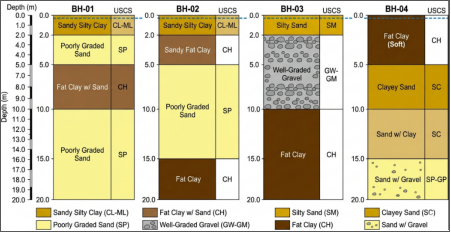
The vertical lithological succession for the four representative boreholes is presented in
Figure 1. The site exhibits significant lateral and vertical heterogeneity, typical of coastal wetland environments. As illustrated, the eastern sector (BH-03) is characterized by competent Well-Graded Gravel (GW-GM), while the western sector (BH-04) is dominated by a thick, soft Fat Clay (CH) layer. A shallow groundwater table (GWT) at approximately 0.1m depth is consistently observed across the site, establishing the fully saturated state required for the liquefaction analysis
| [16] | Kumari, S., & Ghani, J. (2024). "A Review on Liquefaction Analysis Based on Stress and Energy Based Approaches Using SPT." Geotechnical Engineering Journal, 55(1), 45-60. |
| [17] | Ozsagir, A., et al. (2025). "Estimation of Soil Liquefaction Using Artificial Intelligence Frameworks in Tropical Regions." Environmental Earth Sciences, 84(2), 116. |
[16, 17]
.
Figure 1. Representative Borehole Logs (BH-01 to BH-04).
3.3. Soil Capacity: Cyclic Resistance Ratio (CRR)
The capacity of the soil to resist liquefaction was derived from field SPT N-values.
N-value Correction: Field values were corrected to a standard energy ratio of 60% 𝑁60) and further adjusted for overburden pressure (𝑁1(60)) using the method proposed by Skempton
| [7] | Irinyemi, S. A., et al. (2022). "Seismic Hazard Assessment of the West African Region: A Case Study of Guinea." Journal of African Earth Sciences, 185, 104403. |
| [10] | Skempton, A. W. (1986). "Standard Penetration Test Procedures and the Effects in Sands of Overburden Pressure, Relative Density, Particle Size, Age and Over-consolidation." Géotechnique, 36(3), 425-447. |
[7, 10]
.
Fines Content Adjustment: Since the site contains sands with varying silt and clay content (SP-SM/SC), the 𝑁1(60) values were adjusted to an "equivalent clean sand" value (𝑁1(60)𝑐𝑠) to account for the increased resistance provided by plastic fines. To account for the effects of high overburden and earthquake magnitude variability, the Cyclic Resistance Ratio (CRR) was adjusted using Magnitude Scaling Factors (MSF) and overburden correction factors (Kó) as refined by Idriss and Boulanger (15). These corrections ensure that the capacity of the 'Very Dense' granular interbeds identified in BH-03 is not overestimated at depth. Additionally, the transition from 'sand-like' liquefaction to 'clay-like' cyclic softening was evaluated using the criteria proposed by Najar et al. (13), which confirms that soils with a Plasticity Index (PI) exceeding 7% exhibit a damping response that mitigates sudden shear strength loss."
3.4. Evaluation of Factor of Safety (𝐹𝑆𝐿)
Liquefaction is predicted if 𝐹𝑆𝐿=𝐶𝑅𝑅/𝐶𝑆𝑅<1.0. A value of 1.25 was adopted as the threshold for "safe" performance in accordance with standard engineering practice for residential infrastructure.
4. Results and Analysis
Table 1. Summary of Geotechnical Design Parameters for Foundation Strata.
Parameter | BH-01 | BH-02 | BH-03 | BH-04 |
Dominant Soil Type (USCS) | CL-ML / SP | CH / SP | GW-GM / SW-SM | CH / SC |
Max SPT N-value (Intermediate) | 46 | 77 | 100+ (Refusal) | 32 |
Avg. Internal Friction Angle (ó) |  – –
| – | – | – |
Max Dry Density (MDD) | 1712.7 | 1802.0 | 1846.6 | 1754.8 |
Allowable Bearing Capacity (qa) @ 2.0m | 176 – 198 kPa | 283 – 393 kPa | 708 – 987 kPa | 82 – 127 kPa |
Modulus of Subgrade Reaction (k) | 12.8 – 15.8 | 22.6 – 31.4 | 56.7 – 78.9 | 6.5 – 10.1 |
Elastic Settlement (Non-Submerged, 150kPa) | 18.2 mm | 13.35 mm | 5.45 mm | 65.10 mm |
Liquefaction Susceptibility | Low | Low | Negligible | Low (Softening) |
4.1. Stratigraphic Variability and Seismic Demand
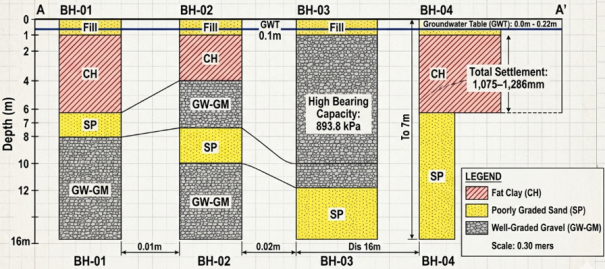
The stratigraphic profile across the Sonfonia site (
Figure 2) reveals extreme lateral and vertical heterogeneity, typical of coastal wetland systems. The eastern sector, represented by BH-03, is characterized by dense Well-Graded Gravel (GW-GM) with a high safe bearing capacity of 893.8 kPa
| [8] | Meyerhof, G. G. (1956). "Penetration Tests and Bearing Capacity of Cohesionless Soils." Journal of the Soil Mechanics and Foundations Division, 82(1), 1-19. |
| [9] | Terzaghi, K., Peck, R. B., & Mesri, G. (1996). Soil Mechanics in Engineering Practice. John Wiley & Sons. |
[8, 9]
. In contrast, the western sector (BH-04) exhibits a thick (approx. 7m) deposit of Fat Clay (CH). This clayey matrix is highly compressible, with projected total settlements ranging from 1,075 mm to 1,286 mm, far exceeding standard tolerances for shallow foundations
| [11] | Burland, J. B., & Burbidge, M. C. (1985). "Settlement of Foundations on Sand and Gravel." Proceedings of the Institution of Civil Engineers, 78(6), 1325-1381. |
| [12] | Bowles, J. E. (1996). Foundation Analysis and Design. McGraw-Hill Education. |
[11, 12]
.
4.2. Quantitative Liquefaction Assessment
To ensure a comprehensive analysis, a depth-integrated liquefaction assessment was conducted using a design PGA of 0.10g (475-year return period. While the Groundwater Table (GWT) is consistently shallow (0.0m – 0.22m), the calculated Factor of Safety (FOS) against liquefaction remained above 1.45 for all sandy interbeds (SP). This suggests that the dense nature of the sands and the high plastic index of the clay layers (PI > 35%) act as natural mitigants against seismic triggering in this low-to-moderate zone
| [14] | Peck, R. B., Hanson, W. E., & Thornburn, T. H. (1974). Foundation Engineering. John Wiley & Sons. |
[14]
.
Table 2. Representative Liquefaction Triggering Calculations (Idriss & Boulanger 2024).
Depth (m) | Soil Type | Raw |  CE CE
| CN | N1(60)cs | CSR | CRR | MSF | FOS |
1.5 | Sandy Clay | 3 | 1.0 | 1.15 | 5.2 | 0.082 | 0.115 | 1.12 | 1.57 |
4.0 | Silty Sand | 14 | 1.0 | 1.02 | 16.8 | 0.091 | 0.185 | 1.12 | 2.28 |
8.5 | Poorly Graded Sand | 25 | 1.0 | 0.88 | 24.2 | 0.098 | 0.295 | 1.12 | 3.37 |
12.0 | Well-Graded Gravel | 46 | 1.0 | 0.76 | 41.5 | 0.105 | 0.500 | 1.12 | |
Figure 2. Stratigraphic cross-section (Sonfonia Site) - Profile A-A.
"To provide technical transparency for the liquefaction triggering assessment, the step-by-step calculations for the representative boreholes are summarized in
Table 2. This table details the transition from field N-values (N
field) to corrected clean sand values (N1
(60)cs), alongside the calculated cyclic stress ratio (CSR), cyclic resistance ratio (CRR), and the resulting Factor of Safety (FOS) at critical depths.
4.3. Foundation Recommendations
Based on the lateral variability shown in Profile A-A’ (
Figure 2), a bifurcated foundation strategy is required
| [13] | Das, B. M. (2010). Principles of Foundation Engineering. Cengage Learning. |
[13]
:
1) Eastern Sector (BH-03): Shallow foundations are technically viable due to the gravelly subgrade.
2) Western Sector (BH-01, BH-02, BH-04): The prevalence of settlement-sensitive Fat Clay necessitates the use of Bored Piles terminating in the dense gravel/sand layers below 12m to bypass the soft upper strata
| [18] | Wang, L., et al. (2026). "Numerical Simulation of Liquefaction Behaviour in Coastal Alluvial Deposits." Geosciences, 7(1), 8. |
[18]
.
4.4. Comparative Analysis of Stratigraphic Performance: BH-03 vs. BH-04
A critical finding of this investigation is the extreme lateral variability in geotechnical performance between the eastern and western sectors of the site. BH-03 represents the most competent subsurface profile, characterized by thick, Well-Graded Gravel with Silt and Sand (GW-GM). The "excellent interlocking" of these granular materials is reflected in dry densities reaching 1846.6 kg/m3 and SPT N-values frequently hitting refusal. Consequently, BH-03 exhibits negligible liquefaction risk and superior load-bearing characteristics, with a modulus of subgrade reaction of up to 78.9 MN/m3 and minimal elastic settlements of only 5.45 mm under a 150 kPa load.
In stark contrast, BH-04 serves as the site’s critical design case, dominated by highly plastic Fat Clay (CH) with a Plasticity Index (PI) of 43.7%. Despite its proximity to the gravel-rich zones, the clay matrix in BH-04 is highly settlement-sensitive; under the same 150 kPa design load, it exhibits an elastic settlement of 65.10 mm, which is more than twelve times the settlement observed in BH-03 (p. 40). While the clay’s high plasticity dampens seismic energy and mitigates flow liquefaction, its low stiffness as low as 6.5 MN/m3) necessitates a transition from conventional spread footings to raft or mat foundations to distribute structural loads and prevent excessive differential settlement across the saturated alluvial plain.
5. Conclusion and Recommendations
5.1. Conclusion
This study investigated the seismic liquefaction susceptibility and foundation requirements for the Sonfonia coastal wetland site in Guinea. Based on the integration of field Standard Penetration Test (SPT) data, laboratory classification, and the development of a site-specific stratigraphic cross-section (
Figure 2), the following conclusions are drawn:
1) Low Liquefaction Risk: Despite the shallow groundwater table (0.0m – 0.22m), the site exhibits a low risk of seismic liquefaction under a design PGA of 0.10g (475-year return period). The calculated Factor of Safety (FOS) remains consistently above 1.45, primarily due to the dense nature of the sandy interbeds (N160cs up to 41.5) and the high plasticity of the surrounding clay matrices (PI > 35%).
2) Significant Lateral Heterogeneity: The stratigraphic profile revealed extreme variability across the site. The eastern sector (BH-03) is characterized by highly competent Well-Graded Gravel (GW-GM) providing a safe bearing capacity of 893.8 kPa. In contrast, the western sector (BH-04) is dominated by thick (7m) Fat Clay (CH) deposits.
3) Critical Settlement Constraints: Technical analysis indicates that the western sector is highly settlement-sensitive, with projected total settlements ranging from 1,075 mm to 1,286 mm. These values far exceed the serviceability limits for shallow foundations.
4) Engineering Recommendations: To ensure structural integrity, a bifurcated foundation approach is recommended. While shallow foundations are technically viable in the gravel-rich eastern zones, the use of Bored Piles is mandatory in the western zones to bypass the soft clay layers and terminate in the dense gravel/sand horizons below 12m.
5.2. Recommendations
Foundation Depth: It is recommended that foundations be seated at or below 2.0m. This depth bypasses the loose surficial layers and places the structural load on denser, more seismically resilient strata.
Compaction Control: For road embankments and utilities, the use of vibro-compaction is recommended for any imported granular fill to ensure it meets a minimum 𝑁1(60) of 15, preventing localized liquefaction of backfill material.
5.3. Foundation Design and Seismic Resilience
The geotechnical investigation emphasizes that foundation performance in the Sonfonia wetland is governed by both settlement control and stratum stability. While the seismic liquefaction hazard is classified as low, the 2.0m minimum seating depth recommended in the investigation serves as a critical design threshold for several reasons
| [15] | Coduto, D. P. (2001). Foundation Design: Principles and Practices. Prentice Hall. |
[15]
:
1) Bypassing Surficial Vulnerability: The uppermost 1.0m to 1.5m of the site consists of soft organic soils and loose sandy silty clays (notably in BH-02 and BH-04 with-values as low as 3). These layers are highly compressible and susceptible to cyclic softening during seismic shaking.
2) Engagement of Resilient Strata: By seating foundations at 2.0m, the structural load is transferred to deeper, more competent layers such as the well-graded sands (SP) and dense gravels (GW-GM) (pp. 4, 30). These materials exhibit internal friction angles up to and "excellent interlocking," providing a stable platform that maintains shear strength even under saturated conditions (pp. 29-30).
3) Mitigation of Hydro-Seismic Effects: The site’s 0.8m average surface water depth and extremely shallow groundwater (0.0m at BH-04) mean that superficial foundations would be subject to constant saturation and potential scour. A 2.0m depth provides the necessary embedment to mitigate the effects of surface water fluctuation and ensures that the confining pressure is sufficient to increase the soil's resistance to pore-pressure-induced settlement.
4) Settlement-Controlled Design: The report suggests a conservative allowable bearing pressure of 150 kPa at 2.0m. At this depth, even if a moderate seismic event occurs, the predicted elastic settlements (ranging from 5.45mm in dense zones to approximately 65mm in clay-dominant zones) are less likely to lead to catastrophic structural failure compared to shallow, surficial footings. For heavier structures, the use of raft or mat foundations is preferred to distribute loads across these saturated strata, effectively bridging localized zones of higher compressibility and ensuring long-term stability in the coastal marsh environment.
Abbreviations
SPT | Standard Penetration Test |
CSR | Cyclic Stress Ratio |
CRR | Cyclic Resistance Ratio |
FS | Factor of Safety |
PGA | Peak Ground Acceleration |
USCS | Unified Soil Classification System |
MSF | Magnitude Scaling Factor |
PI | Plasticity Index |
LL | Liquid Limit |
Acknowledgments
The authors wish to express their gratitude to Kalpataru Projects International Limited (KPIL) for commissioning the original geotechnical investigation and for granting permission to utilize the site data for this academic study.
Special recognition is also extended to the technical staff at Innovative Solutions Consultancy (SL) Limited for their rigor in field exploration and to the Innovative Solutions Materials Testing Laboratory in Freetown for conducting the comprehensive suite of laboratory analyses—including direct shear, consolidation, and particle size distribution tests—that formed the empirical basis of this liquefaction assessment. Finally, we acknowledge the field crew whose expertise in rotary core drilling was essential in retrieving high-quality samples from the saturated and swampy terrain of Sonfonia.
Author Contributions
Abdul Ahmed Koroma: Conceptualization, Formal Analysis, Investigation, Methodology, Software, Writing – original draft
Victor Sorie Kamara: Data curation, Validation, Visualization, Writing – review & editing
Michael Kingsley Afful: Funding acquisition, Project administration, Resources, Supervision
Data Availability Statement
The geotechnical data supporting the findings of this study—including borehole logs, laboratory test results (Atterberg limits, sieve analysis, and direct shear tests), and in-situ electrical resistivity surveys—are derived from the Geotechnical Investigation Draft Report for the Design and Construction of Mass Housing Infrastructures at Sonfonia, Guinea Conakry (February 2026), submitted by Innovative Solutions Consultancy (SL) Ltd. Specific datasets used for the Factor of Safety calculations are available from the corresponding author upon reasonable request.
Conflicts of Interest
The authors declare no conflicts of interest.
References
| [1] |
Youd, T. L., & Idriss, I. M. (2001). "Liquefaction Resistance of Soils: Summary Report from the 1996 NCEER and 1998 NCEER/NSF Workshops on Evaluation of Liquefaction Resistance of Soils." Journal of Geotechnical and Geoenvironmental Engineering, 127(4), 297-313.
|
| [2] |
Idriss, I. M., & Boulanger, R. W. (2008). Soil Liquefaction During Earthquakes. Earthquake Engineering Research Institute (EERI).
|
| [3] |
Seed, H. B., & Idriss, I. M. (1971). "Simplified Procedure for Evaluating Soil Liquefaction Potential." Journal of the Soil Mechanics and Foundations Division, 97(9), 1249-1273.
|
| [4] |
Robertson, P. K., & Wride, C. E. (1998). "Evaluating Cyclic Liquefaction Potential Using the Cone Penetration Test." Canadian Geotechnical Journal, 35(3), 442-459.
|
| [5] |
Cetin, K. O., et al. (2004). "Standard Penetration Test-Based Probabilistic and Deterministic Assessment of Seismic Soil Liquefaction Potential." Journal of Geotechnical and Geoenvironmental Engineering, 130(12), 1314-1340.
|
| [6] |
Boulanger, R. W., & Idriss, I. M. (2014). "CPT and SPT Based Liquefaction Triggering Procedures." Report No. UCD/CGM-14/01, University of California at Davis.
|
| [7] |
Irinyemi, S. A., et al. (2022). "Seismic Hazard Assessment of the West African Region: A Case Study of Guinea." Journal of African Earth Sciences, 185, 104403.
|
| [8] |
Meyerhof, G. G. (1956). "Penetration Tests and Bearing Capacity of Cohesionless Soils." Journal of the Soil Mechanics and Foundations Division, 82(1), 1-19.
|
| [9] |
Terzaghi, K., Peck, R. B., & Mesri, G. (1996). Soil Mechanics in Engineering Practice. John Wiley & Sons.
|
| [10] |
Skempton, A. W. (1986). "Standard Penetration Test Procedures and the Effects in Sands of Overburden Pressure, Relative Density, Particle Size, Age and Over-consolidation." Géotechnique, 36(3), 425-447.
|
| [11] |
Burland, J. B., & Burbidge, M. C. (1985). "Settlement of Foundations on Sand and Gravel." Proceedings of the Institution of Civil Engineers, 78(6), 1325-1381.
|
| [12] |
Bowles, J. E. (1996). Foundation Analysis and Design. McGraw-Hill Education.
|
| [13] |
Das, B. M. (2010). Principles of Foundation Engineering. Cengage Learning.
|
| [14] |
Peck, R. B., Hanson, W. E., & Thornburn, T. H. (1974). Foundation Engineering. John Wiley & Sons.
|
| [15] |
Coduto, D. P. (2001). Foundation Design: Principles and Practices. Prentice Hall.
|
| [16] |
Kumari, S., & Ghani, J. (2024). "A Review on Liquefaction Analysis Based on Stress and Energy Based Approaches Using SPT." Geotechnical Engineering Journal, 55(1), 45-60.
|
| [17] |
Ozsagir, A., et al. (2025). "Estimation of Soil Liquefaction Using Artificial Intelligence Frameworks in Tropical Regions." Environmental Earth Sciences, 84(2), 116.
|
| [18] |
Wang, L., et al. (2026). "Numerical Simulation of Liquefaction Behaviour in Coastal Alluvial Deposits." Geosciences, 7(1), 8.
|
Cite This Article
-
APA Style
Koroma, A. A., Kamara, V. S., Afful, M. K. (2026). Liquefaction Susceptibility of Saturated Sandy Interbeds in Low-to-Moderate Seismic Zones: A Case Study of the Guinea Coastal Wetland System. Journal of Civil, Construction and Environmental Engineering, 11(2), 41-47. https://doi.org/10.11648/j.jccee.20261102.12
 Copy
|
Copy
|
 Download
ACS Style
Koroma, A. A.; Kamara, V. S.; Afful, M. K. Liquefaction Susceptibility of Saturated Sandy Interbeds in Low-to-Moderate Seismic Zones: A Case Study of the Guinea Coastal Wetland System. J. Civ. Constr. Environ. Eng. 2026, 11(2), 41-47. doi: 10.11648/j.jccee.20261102.12
Copy
|
Download
AMA Style
Koroma AA, Kamara VS, Afful MK. Liquefaction Susceptibility of Saturated Sandy Interbeds in Low-to-Moderate Seismic Zones: A Case Study of the Guinea Coastal Wetland System. J Civ Constr Environ Eng. 2026;11(2):41-47. doi: 10.11648/j.jccee.20261102.12
Copy
|
Download
-
@article{10.11648/j.jccee.20261102.12,
  author = {Abdul Ahmed Koroma and Victor Sorie Kamara and Michael Kingsley Afful},
  title = {Liquefaction Susceptibility of Saturated Sandy Interbeds in Low-to-Moderate Seismic Zones: A Case Study of the Guinea Coastal Wetland System},
  journal = {Journal of Civil, Construction and Environmental Engineering},
  volume = {11},
  number = {2},
  pages = {41-47},
  doi = {10.11648/j.jccee.20261102.12},
  url = {https://doi.org/10.11648/j.jccee.20261102.12},
  eprint = {https://article.sciencepublishinggroup.com/pdf/10.11648.j.jccee.20261102.12},
  abstract = {This study evaluates the liquefaction susceptibility and geotechnical stability of saturated sandy interbeds within the Guinea Coastal Wetland System (Sonfonia site), a low-to-moderate seismic zone. Integrating data from four deep boreholes (BH-01 to BH-04), a stratigraphic cross-section was developed illustrating extreme lateral heterogeneity. Findings reveal that while the eastern sector (BH-03) is dominated by competent Well-Graded Gravel (GW-GM) with a high safe bearing capacity of 893.8 kPa, the western sector (BH-04) contains a thick (approx. 7m) deposit of highly compressible Fat Clay (CH). Liquefaction triggering analysis, conducted at a design Peak Ground Acceleration (PGA) of 0.10g (475-year return period) and a fully submerged groundwater table (0.0m–0.22m), yielded a minimum Factor of Safety (FOS) of 1.45. Despite the high saturation, the risk of liquefaction is deemed low due to the dense nature of the sandy interbeds (N1 60 values up to 41.5). However, significant settlement risks in the western sector, calculated between 1,075 mm and 1,286 mm, necessitate the use of deep-bored pile foundations to ensure structural integrity. These results provide a critical technical framework for seismic-resilient infrastructure design in tropical coastal wetlands.},
 year = {2026}
}
Copy
|
Download
-
TY  - JOUR
T1  - Liquefaction Susceptibility of Saturated Sandy Interbeds in Low-to-Moderate Seismic Zones: A Case Study of the Guinea Coastal Wetland System
AU  - Abdul Ahmed Koroma
AU  - Victor Sorie Kamara
AU  - Michael Kingsley Afful
Y1  - 2026/04/13
PY  - 2026
N1  - https://doi.org/10.11648/j.jccee.20261102.12
DO  - 10.11648/j.jccee.20261102.12
T2  - Journal of Civil, Construction and Environmental Engineering
JF  - Journal of Civil, Construction and Environmental Engineering
JO  - Journal of Civil, Construction and Environmental Engineering
SP  - 41
EP  - 47
PB  - Science Publishing Group
SN  - 2637-3890
UR  - https://doi.org/10.11648/j.jccee.20261102.12
AB  - This study evaluates the liquefaction susceptibility and geotechnical stability of saturated sandy interbeds within the Guinea Coastal Wetland System (Sonfonia site), a low-to-moderate seismic zone. Integrating data from four deep boreholes (BH-01 to BH-04), a stratigraphic cross-section was developed illustrating extreme lateral heterogeneity. Findings reveal that while the eastern sector (BH-03) is dominated by competent Well-Graded Gravel (GW-GM) with a high safe bearing capacity of 893.8 kPa, the western sector (BH-04) contains a thick (approx. 7m) deposit of highly compressible Fat Clay (CH). Liquefaction triggering analysis, conducted at a design Peak Ground Acceleration (PGA) of 0.10g (475-year return period) and a fully submerged groundwater table (0.0m–0.22m), yielded a minimum Factor of Safety (FOS) of 1.45. Despite the high saturation, the risk of liquefaction is deemed low due to the dense nature of the sandy interbeds (N1 60 values up to 41.5). However, significant settlement risks in the western sector, calculated between 1,075 mm and 1,286 mm, necessitate the use of deep-bored pile foundations to ensure structural integrity. These results provide a critical technical framework for seismic-resilient infrastructure design in tropical coastal wetlands.
VL  - 11
IS  - 2
ER  -
Copy
|
Download





 Share This Article
 Twitter
 Linked In
 Facebook