Abstract
As offshore wind power development continues to expand into deeper waters, floating offshore wind turbines have attracted widespread attention due to their excellent adaptability to varying water depths and their significant potential for harnessing wind energy resources. Yaw control, as a key technical means for improving the overall energy utilization efficiency of wind farms, can enhance the power generation performance of the entire wind farm by actively altering the direction of the wake to improve the inflow conditions for downstream turbines. However, the mechanism of a platform motion affecting the yaw control remains unclear, particularly the coupled effects of platform motion and yaw action under varying sea conditions, which have yet to be systematically studied experimentally. This study utilizes a combined wind and wave experimental platform, using a downscaled NREL 5 MW wind turbine as a prototype, to investigate wake characteristics under different sea conditions and yaw angles. This study examines wake characteristics from two perspectives: the evolution of wake morphology and wake displacement analysis. By comparing the differences in wake loss and displacement between the floating and the monopile wind turbine, the effects of yaw angle and platform motion are analyzed, and further the modulating role of sea state variations on wake development patterns is explored. The results indicate that changes in sea conditions primarily influence the wake mixing process through the platform motion. Compared to monopile wind turbines, the wake cross-section of floating wind turbines is more likely to exhibit widening and flattening characteristics under stronger sea conditions. A yaw operation effectively enhances the lateral wake displacement and forms an asymmetric wake structure. Overall, the platform motion exerts a significant influence on the wake recovery process, altering the differences in wake evolution between the floating and the monopile wind turbine. The findings of this study provide an experimental evidence and reference for optimizing yaw control strategies and managing wakes in floating offshore wind farms.
|
Published in
|
Journal of Energy and Natural Resources (Volume 15, Issue 3)
|
|
DOI
|
10.11648/j.jenr.20261503.11
|
|
Page(s)
|
64-71 |
|
Creative Commons
|

This is an Open Access article, distributed under the terms of the Creative Commons Attribution 4.0 International License (http://creativecommons.org/licenses/by/4.0/), which permits unrestricted use, distribution and reproduction in any medium or format, provided the original work is properly cited.
|
|
Copyright
|
Copyright © The Author(s), 2026. Published by Science Publishing Group
|
Keywords
Floating Wind Turbine, Monopile Wind Turbine, Yaw Control, Wake Steering, Sea Conditions
1. Introduction
As offshore wind power gradually expands into deeper water and wind farms continue to grow in scale, the impact of wake interactions between turbines on the overall operational stability and energy utilization efficiency of wind farms is becoming increasingly significant. The wakes generated by upstream turbines can reduce the wind speed and increase turbulence in the inflow to downstream turbines, resulting in power losses and increased fatigue loads. Therefore, research on wake characteristics has become a crucial foundation for optimizing the layout and operational management of offshore wind farms.
For a long time, experimental research
| [1] | F Meng, WH Lio, A Pegalajar-Jurado, et al. Experimental study of floating wind turbine control on a TetraSub floater with tower velocity feedback gain [J]. Renewable Energy, 2023, 205: 509-524.
https://doi.org/10.1016/j.renene.2023.01.073 |
| [2] | T Messmer, M Hölling, J Peinke. Enhanced recovery caused by nonlinear dynamics in the wake of a floating offshore wind turbine [J]. Journal of Fluid Mechanics, 2024, 985: A32. https://doi.org/10.1017/jfm.2024.175 |
| [3] | Fontanella A, Fusetti A, Cioni S, et al. Wake development in floating wind turbines: new insights and an open dataset from wind tunnel experiments [J]. Wind Energy Science, 2025, 10: 1369-1387.
https://doi.org/10.5194/wes-10-1369-2025 |
[1-3]
on wake flow has primarily focused on two aspects: first, the formation and recovery mechanisms of wake velocity loss, broadening, and turbulence enhancement
| [4] | H Hu, Z Yang, P Sarkar. Dynamic wind loads and wake characteristics of a wind turbine model in an atmospheric boundary layer wind [J]. Experiments in Fluids, 2012, 52: 1277-1294. https://doi.org/10.1007/s00348-011-1253-5 |
| [5] | L Lignarolo, D Ragni, C Krishnaswami, et al. Experimental analysis of the wake of a horizontal-axis wind-turbine model [J]. Renewable Energy, 2014, 70: 31-46.
https://doi.org/10.1016/j.renene.2014.01.020 |
[4, 5]
and second, the analysis of wake displacement, cross-sectional asymmetry, and recovery differences under yaw, unsteady inflow, and platform motion conditions
| [6] | S Cioni, F Papi, L Pagamonci, et al. On the characteristics of the wake of a wind turbine undergoing large motions caused by a floating structure: an insight based on experiments and multi-fidelity simulations from the OC6 project Phase III [J]. Wind Energy Science, 2023, 8: 1659-1691.
https://doi.org/10.5194/wes-8-1659-2023 |
[6]
. Wind tunnel experiments provide controlled and stable conditions for elucidating the effects of near-wake tip vortices, root vortices, hub wake, and shear layer structure on the diffusion and recovery of the far-wake; meanwhile, field measurement techniques such as lidar
| [7] | RJ Barthelmie, L Folkerts, FT Ormel, et al. Offshore wind turbine wakes measured by sodar [J]. Journal of Atmospheric and Oceanic Technology, 2003, 20(4): 466-477.
https://doi.org/10.1175/1520-0426(2003)20<466:OWTWMB>2.0.CO;2 |
| [8] | D Conti, V Pettas, N Dimitrov, et al. Wind turbine load validation in wakes using wind field reconstruction techniques and nacelle lidar wind retrievals [J]. Wind Energy Science, 2021, 6: 841-866. https://doi.org/10.5194/wes-6-841-2021 |
[7, 8]
and SODAR
| [9] | F Bingöl, J Mann, GC Larsen. Light detection and ranging measurements of wake dynamics. Part I: One-dimensional scanning [J]. Wind Energy, 2010, 13(1): 51-61.
https://doi.org/10.1002/we.352 |
[9]
have verified the evolutionary characteristics of wakes in real wind fields, thereby advancing the refinement and validation of wake models. In recent years, yaw control has garnered widespread attention as an active wake regulation method. Studies have shown that yaw not only causes a shift in the wake center
| [10] | J Schottler, J Bartl, F Mühle, et al. Wind tunnel experiments on wind turbine wakes in yaw: redefining the wake width [J]. Wind Energy Science, 2018, 3: 257-273.
https://doi.org/10.5194/wes-3-257-2018 |
| [11] | P Brugger, M Debnath, A Scholbrock, et al. Lidar measurements of yawed-wind-turbine wakes: characterization and validation of analytical models [J]. Wind Energy Science, 2020, 5: 1253-1272. https://doi.org/10.5194/wes-5-1253-2020 |
[10, 11]
but also alters the morphology of the wake cross-sectional velocity deficit.
For floating wind turbines, the continuous motion of the platform under the combined action of wind and waves alters the inflow conditions of the rotor and the evolution of the wake, resulting in complex unsteady characteristics of the wake. Previous studies have indicated that a platform motion influences the fluctuations and recovery patterns of the wake velocity
| [12] | J Bossuyt, O Fercak, Z Sadek, et al. Floating wind farm experiments through scaling for wake characterization, power extraction, and turbine dynamics [J]. Physical Review Fluids, 2023, 8(12): 120501.
https://doi.org/10.1103/PhysRevFluids.8.120501 |
| [13] | D van den Berg, D van der Hoek, D De Tavernier, et al. Phase controlling the yaw motion of floating wind turbines with the helix wake mixing method to reduce wake interactions: An experimental investigation [J]. Wind Energy Science, 2026, 11: 679-692. https://doi.org/10.5194/wes-11-679-2026 |
[12, 13]
and interacts with the yaw motion to produce coupled effects. Nevertheless, the overall number of wake experiments on floating wind turbines remains limited, with a particular lack of systematic comparisons of wake characteristics between floating and monopile wind turbines under different sea states and yaw angles.
To address this gap, this study utilizes a combined wind tunnel-wave tank experimental platform and employs a downscaled NREL 5 MW wind turbine as a prototype to conduct comparative experiments on the wake characteristics of floating and monopile wind turbines under different sea conditions and yaw angles. By examining both the evolution of wake morphology and wake displacement, this study analyzes the impact of platform motion on the wake mixing process and reveals the modulation mechanisms of wake structure evolution under varying sea conditions and yaw angles.
2. Experimental Setup
This study utilizes a combined wind tunnel-wave tank experimental platform to conduct comparative wake experiments on floating and monopile offshore wind turbines under various sea conditions and yaw angles. Using a downscaled NREL 5 MW wind turbine as a prototype, scaled models were constructed based on the Froude similarity rule. Both floating and monopile support configurations were designed simultaneously; the floating wind turbine utilized a tension-leg platform (TLP) to investigate the impact of platform motion on the wake, while the monopile configuration served as the control group.
2.1. Wind Turbine and Blade Design
This experiment uses the NREL 5MW wind turbine, developed by the National Renewable Energy Laboratory (NREL), as the prototype. The scale model strictly adheres to the Froude similarity criterion
| [14] | Hezha Lutfalla Sadraddin, Xiaoyun Shao. State-of-the-art of experimental methods for floating wind turbines [J]. Journal of Renewable and Sustainable Energy, 2022, 14(3): 032701.
https://doi.org/10.1063/5.0071943 |
[14]
, which applies to systems where flow and structural motion are dominated by gravity. The core of this criterion is to ensure a dynamic similarity between the model and the prototype. The similarity criterion
| [15] | AM Urbán, R Guanche. Wind turbine aerodynamics scale-modeling for floating offshore wind platform testing [J]. Journal of Wind Engineering and Industrial Aerodynamics, 2019, 186: 49-57. https://doi.org/10.1016/j.jweia.2018.12.021 |
[15]
is expressed as follows:
where U is the wind speed; g is the acceleration due to gravity; L is the characteristic length (encompassing key dimensions such as rotor diameter, blade length, and tower height).
According to the Froude similarity theory, the model and the prototype should satisfy:
Taking into account the dimensions of the test site and the wind tunnel operating conditions, a model scale factor of λ= 1/126 was ultimately selected. The structural parameters of the wind turbine, tower, and floating platform were scaled according to this ratio to ensure that the test results accurately reflect the aerodynamic and dynamic characteristics of the full-scale unit.
Table 1. Comparison of Key Parameters Between Wind Turbine Prototypes and Models.
Parameters | NREL 5MW turbine | Experimental model |
Blade Length | 61.5 m | 50 cm |
Tower Height | 87.6 m | 155 cm |
Rated Wind Speed | 11.4 m/s | 1.8 m/s |
Rated Rotational Speed | 12.1 RPM | 10.8 RPM |
Nacelle Weight | - | 10.2 kg |
2.2. Platform Model
This study employs a Tension Leg Platform (TLP) and a monopile to represent the floating and the fixed offshore wind turbine support structures, respectively. TLPs are connected to the seabed anchoring system via pre-tensioned tension legs, providing strong vertical restraint capabilities. They effectively suppress motion responses such as vertical heave, pitch, and roll, thereby enhancing the platform stability; as a result, they are widely regarded as one of the key platform configurations for deep-sea floating wind power.
Based on the structure of a downscaled DTU 10MW floating platform
| [16] | FJ Madsen, TRL Nielsen, T Kim, et al. Experimental analysis of the scaled DTU10MW TLP floating wind turbine with different control strategies [J]. Renewable Energy, 2020, 155: 330-346. https://doi.org/10.1016/j.renene.2020.03.145 |
[16]
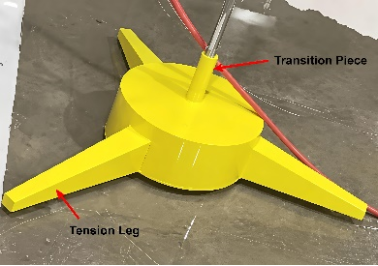
, and taking into account the dimensions of the experimental tank and the scale-down requirements, the key parameters and schematic diagram are shown in
Table 1 and
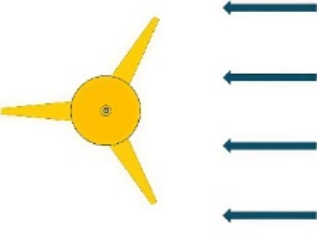
Figure 3. In the experiments, the floating wind turbine was supported by a TLP platform and oriented in the direction of the incoming flow, concentrating the platform’s primary motion in the heave and in the pitch directions to minimize the impact of lateral motion on the wake measurement results. Under the coupled action of wind and waves, the platform’s motion alters the rotor’s inflow conditions, which in turn affects the development and recovery processes of the wake.
Figure 3. Floating Platform.
Figure 4. Direction of inflow.
As a reference scenario, a monopile wind turbine is equipped with a rigid fixed foundation; its rotor, tower, and installation height are identical to those of the floating wind turbine, with the platform’s degrees of freedom eliminated solely through fixed constraints. By comparing the differences in wake response between the two support configurations under identical sea conditions and yaw conditions, it is possible to further analyze the impact of platform motion on wake displacement, velocity loss distribution, and yaw control performance.
Figure 5. Monopile Platform.
2.3. Operating Conditions
This experiment was designed to simulate two types of wave conditions: typical and severe (designated as Case A and Case B, respectively). The prototype parameters for all operating conditions were derived from the design water level and design wave parameters established by the State Power Investment Corporation (SPIC) for the NREL 5MW wind turbine. Combining these with the model’s Froude number (λ = 1/126), the corresponding wave parameters for the experimental model were calculated using similarity criteria. The specific operating conditions are shown in
Table 2.
Table 2. Experimental wave conditions (Case A-Case B).
Case | Case A | Case B |
Prototype significant wave height (m) | 5.04 | 6.18 |
Prototype wave period (s) | 8.626 | 8.9 |
Experimental significant wave height (m) | 0.04 | 0.049 |
Experimental wave period (s) | 0.768 | 0.7929 |
2.4. Test Conditions and Measurement Point Layout
To investigate the effects of platform type, yaw angle, and sea conditions on the wake characteristics of wind turbines, this study selected the wind turbine type, yaw angle, and sea conditions as the primary control variables. The wind turbine types include floating wind turbines and monopile wind turbines; both models are identical in terms of rotor parameters, tower structure, and installation height, differing only in foundation type. The yaw angles were set to 0°, 10°, and 20°, the wind tunnel inflow direction was taken as the 0° reference; sea conditions included two categories: typical and adverse. Taking all influencing factors into account, a total of 2×2×3 experimental conditions were established.
The experimental wind speed was set to 1.8 m/s, corresponding to an optimal tip speed ratio of 4.8 and an optimal rotational speed of 165 rpm for the model wind turbine. To investigate the spatial evolution of the wake, five measurement sections were arranged axially downstream of the wind turbine, located at 2.5D, 3.5D, 4.5D, 5.5D, and 6.5D (where D represents the rotor diameter).
In addition, based on the axial sections, a denser grid of measurement points was arranged transversely along the wake center to analyze the patterns of wake displacement and velocity loss. By measuring and comparing the wake velocity fields under different operating conditions, it is possible to further evaluate the wake evolution characteristics and yaw control performance of floating and monopile wind turbines under various sea states and yaw conditions.
3. Analysis of Wake Characteristics
To evaluate the yaw control performance of floating and monopile wind turbines under different sea conditions, this section focuses on analyzing the distribution of wake velocity losses and the patterns of wake displacement under typical and severe sea conditions, based on experimentally measured wake velocity field data. By comparing the wake response characteristics of different foundation types under yaw conditions, this study reveals the impact of platform motion on wake redirection capability and the effectiveness of yaw control.
3.1. Patterns of Wake Evolution Under Different Sea Conditions
This subsection groups the data based on the two sea conditions defined in the experiment. Within each group, using the 0° yaw angle as the reference, it analyzes the evolution of wake patterns at 10° and 20° yaw angles, while comparing the differences in wake patterns between the floating and monopile wind turbines.
3.1.1. Typical Sea Conditions
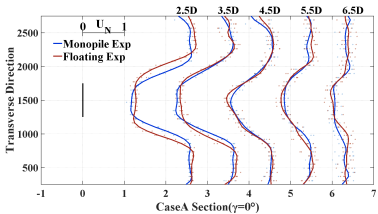
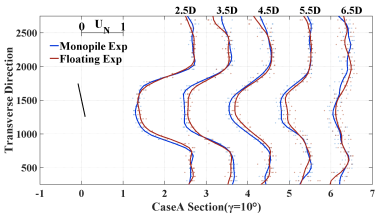
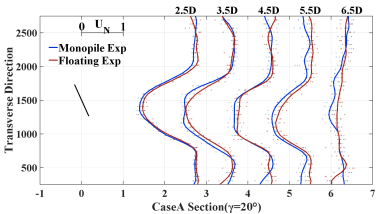
The following figure compares wake characteristics under typical sea states.
Figure 6. Typical sea conditions yaw angle 0°.
Figure 7. Typical sea conditions yaw angle 10°.
Figure 8. Typical sea conditions yaw angle 20°.
Under typical sea conditions (Case A), the wake of both floating and monopile wind turbines exhibits distinct yaw reorientation characteristics. As the yaw angle increases from 0° to 20°, the center of the wake continuously shifts toward the yaw side, and the magnitude of this shift gradually increases with downstream distance, indicating that the yaw angle is the dominant factor determining the wake shift pattern. At the same time, the platform motion enhances a momentum exchange between the wake and the surrounding high-velocity fluid, causing the wake of the floating wind turbine to exhibit more pronounced broadening and flattening characteristics in the near-wake region, and promoting the wake recovery process. Compared to the monopile wind turbine, the cross-sectional morphology of the wake from the floating wind turbine differs to some extent, but the wake shift trends of the two remain generally consistent. This suggests that under typical sea conditions, a platform motion primarily affects the wake recovery and the distribution of velocity losses, without altering the wake redirection patterns formed by the yaw control.
3.1.2. Adverse Sea Conditions
The following figure shows the comparison under adverse sea states.
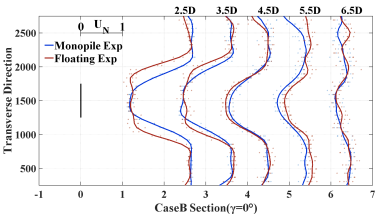
Figure 9. Adverse sea conditions yaw angle 0°.
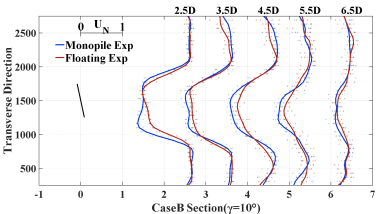
Figure 10. Adverse sea conditions yaw angle 10°.
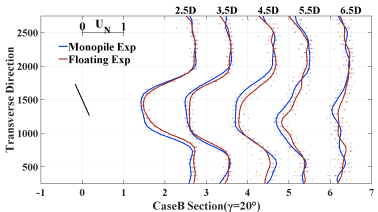
Figure 11. Adverse sea conditions yaw angle 20°.
As the yaw angle increases, the offset of the wake center is similar to that under typical operating conditions, and significant local morphological deviations occur in the near-wake region; as the wake continues to evolve downwards, the differences between the two gradually dissipate in the far-wake region and converge. A comprehensive comparison of these five operating conditions reveals that, in terms of recovery characteristics, the floating unit exhibits a faster speed recovery in most conditions due to the platform motion; this difference becomes more pronounced as sea conditions intensify. As the platform motion increases, the momentum exchange between the wake and the surrounding inflow becomes more thorough, which is one of the primary reasons for the faster recovery speed of the floating unit in the mid-to-far field.
3.2. Comparison of Wake Shift Under Different Sea Conditions
3.2.1. Theoretical Basis
Based on experimental findings, the following semi-empirical relationships are used to estimate the wake displacement for single-pile and floating structures, respectively. For single-pile structures, since the foundation is fixed, its wake displacement is primarily determined by the combined effects of yaw and downstream development, and can be expressed as:
(3)
is the center offset of the wake of a single-pile wind turbine; D is the rotor diameter; γ is the yaw angle; x is the downstream distance; represents the lateral displacement caused by yaw; is the yaw response coefficient, characterizing the sensitivity of the wake displacement to the yaw angle; is the downstream development coefficient, describing the rate at which the wake displacement grows in the downstream direction; both are empirical parameters determined by fitting experimental data; the exponential term describes the development process of the displacement in the downstream direction.
Compared to monopile wind turbine, floating wind turbine is subject not only to yaw forces but also to changes in the relative inflow caused by platform motion; therefore, the wake shift can be further expressed as:
(4)
where represents the center offset of the wake of a floating wind turbine; can be expressed in terms of the amplitude of the platform's longitudinal sway, the natural frequency, and the incident wind speed, and is defined as:
where is the amplitude of the platform's longitudinal oscillation; is the natural frequency of the platform's longitudinal oscillation; is the inflow velocity at the hub height.
This does not alter the overall pattern in which the offset gradually decreases with increasing downstream distance; rather, it primarily manifests as an increase in the magnitude of the offset. In other words, floating wind turbines and monopile wind turbines exhibit consistent patterns in the development of wake offset; however, under rough sea conditions, platform motion causes the wake offset of floating wind turbines to exhibit an additional increase at the same yaw angle.
3.2.2. Experimental Results
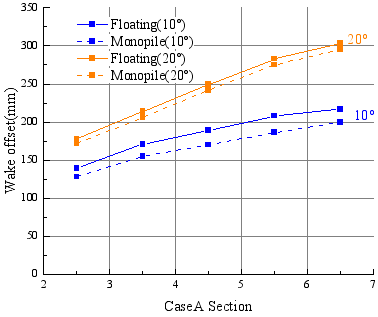
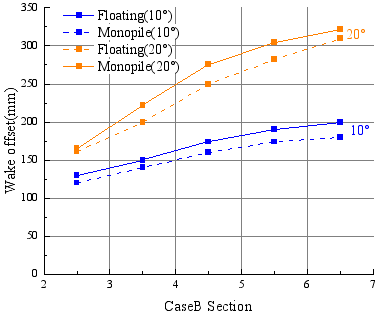
The figure below shows the variation in wake center offset as a function of the downstream interface position under two sea conditions, and compares the offset differences between the floating wind turbine and monopile wind turbine at two yaw angles.
Figure 12. Typical sea conditions.
Figure 13. Adverse sea conditions.
Comparing typical sea conditions with adverse sea conditions, it is evident that the wake offset increases gradually with increasing the downstream distance, and exhibits a slowing rate of increase in the rear section. This indicates that the lateral displacement of the yaw wake does not develop at a constant rate throughout the entire downstream region; rather, it occurs more rapidly in the near-field to mid-field areas. As the wake moves further downstream, an increased lateral diffusion and a gradually widening distribution of velocity loss cause the magnitude of the wake’s shift toward the yaw side to decrease, resulting in a curve that exhibits an overall pattern of initial growth followed by a subsequent slowdown. Regarding the influence of the yaw angle, a consistent pattern was observed under both sea conditions: the larger the yaw angle, the greater the wake offset, and the curves for the 10° and 20° groups consistently maintained a stable stratification relationship across all cross-sections. This indicates that in this experiment, the yaw angle remains the primary factor determining the magnitude of the wake offset; while changes in sea conditions modulate the offset, they do not alter the fundamental pattern of the offset increasing with increasing yaw angle.
The differences between the floating and monopile platforms are primarily evident at the mid-to-far-field interface. At the same yaw angle, the displacement of the floating platform is generally slightly greater than that of the monopile platform, and the difference becomes more pronounced as the yaw angle increases. This indicates that the platform motion does not act independently of the yaw effect but rather builds upon the lateral displacement of the wake, further amplifying the magnitude of the displacement. Particularly in the mid-to-far field regions, where the wake structure is fully developed, disturbances caused by the platform motion are more easily accumulated in the time-averaged results; therefore, the differences are more pronounced in the range of 3.5D-6.5D.
4. Conclusions
Based on the results of wind-wave coupling experiments, this paper conducted a comparative analysis of the wake evolution of a floating and a monopile wind turbines under different yaw angles and sea conditions. Starting with wake morphology, the study compared the distribution of wake velocity loss, diffusion characteristics, and recovery processes for each yaw angle under two sea conditions, with a focus on yaw-induced lateral wake displacement and asymmetric wake structures. The conclusions are as follows: (1) Under stronger sea conditions, the coupling effect of platform motion is more pronounced, and the near-field wake structure is more easily disturbed. The originally distinct asymmetric or bimodal features are more likely to broaden and merge, while the morphology of the wake loss zone tends to become flatter and more dispersed, reflecting the significant influence of platform motion on the near-field wake structure. (2) The offset of the far-field wake centerline remains primarily driven by the yaw, while the periodic motion induced by the platform makes a relatively limited contribution to the average offset on the temporal scale. Therefore, the primary effect of sea conditions is manifested in the intensity of wake diffusion and recovery.
Abbreviations
NREL | National Renewable Energy Laboratory |
TLP | Tension Leg Platform |
DTU | Technical University of Denmark |
SPIC | State Power Investment Corporation |
Author Contributions
Jie Zhang: Conceptualization, Visualization, Writing – original draft
Shuyu Shen: Data curation, Investigation, Methodology
Wenzhong Shen: Resources, Supervision, Writing – review & editing
Funding
This research was funded by the 2024 Jiangsu Provincial Carbon Peaking and Carbon Neutrality Science and Technology Innovation Special Project (No. BT2024003) under Jiangsu Province Department of Science and Technology, China, the Key Laboratory on Offshore Wind Energy Research (No. YZ2023247) under Yangzhou Science and Technology Bureau, China, the starting grant of Yangzhou University, China for Professor Wen Zhong Shen.
Data Availability Statement
The data is available from the corresponding author upon reasonable request.
Conflicts of Interest
The authors declare no conflicts of interest.
References
| [1] |
F Meng, WH Lio, A Pegalajar-Jurado, et al. Experimental study of floating wind turbine control on a TetraSub floater with tower velocity feedback gain [J]. Renewable Energy, 2023, 205: 509-524.
https://doi.org/10.1016/j.renene.2023.01.073
|
| [2] |
T Messmer, M Hölling, J Peinke. Enhanced recovery caused by nonlinear dynamics in the wake of a floating offshore wind turbine [J]. Journal of Fluid Mechanics, 2024, 985: A32.
https://doi.org/10.1017/jfm.2024.175
|
| [3] |
Fontanella A, Fusetti A, Cioni S, et al. Wake development in floating wind turbines: new insights and an open dataset from wind tunnel experiments [J]. Wind Energy Science, 2025, 10: 1369-1387.
https://doi.org/10.5194/wes-10-1369-2025
|
| [4] |
H Hu, Z Yang, P Sarkar. Dynamic wind loads and wake characteristics of a wind turbine model in an atmospheric boundary layer wind [J]. Experiments in Fluids, 2012, 52: 1277-1294.
https://doi.org/10.1007/s00348-011-1253-5
|
| [5] |
L Lignarolo, D Ragni, C Krishnaswami, et al. Experimental analysis of the wake of a horizontal-axis wind-turbine model [J]. Renewable Energy, 2014, 70: 31-46.
https://doi.org/10.1016/j.renene.2014.01.020
|
| [6] |
S Cioni, F Papi, L Pagamonci, et al. On the characteristics of the wake of a wind turbine undergoing large motions caused by a floating structure: an insight based on experiments and multi-fidelity simulations from the OC6 project Phase III [J]. Wind Energy Science, 2023, 8: 1659-1691.
https://doi.org/10.5194/wes-8-1659-2023
|
| [7] |
RJ Barthelmie, L Folkerts, FT Ormel, et al. Offshore wind turbine wakes measured by sodar [J]. Journal of Atmospheric and Oceanic Technology, 2003, 20(4): 466-477.
https://doi.org/10.1175/1520-0426(2003)20<466:OWTWMB>2.0.CO;2
|
| [8] |
D Conti, V Pettas, N Dimitrov, et al. Wind turbine load validation in wakes using wind field reconstruction techniques and nacelle lidar wind retrievals [J]. Wind Energy Science, 2021, 6: 841-866.
https://doi.org/10.5194/wes-6-841-2021
|
| [9] |
F Bingöl, J Mann, GC Larsen. Light detection and ranging measurements of wake dynamics. Part I: One-dimensional scanning [J]. Wind Energy, 2010, 13(1): 51-61.
https://doi.org/10.1002/we.352
|
| [10] |
J Schottler, J Bartl, F Mühle, et al. Wind tunnel experiments on wind turbine wakes in yaw: redefining the wake width [J]. Wind Energy Science, 2018, 3: 257-273.
https://doi.org/10.5194/wes-3-257-2018
|
| [11] |
P Brugger, M Debnath, A Scholbrock, et al. Lidar measurements of yawed-wind-turbine wakes: characterization and validation of analytical models [J]. Wind Energy Science, 2020, 5: 1253-1272.
https://doi.org/10.5194/wes-5-1253-2020
|
| [12] |
J Bossuyt, O Fercak, Z Sadek, et al. Floating wind farm experiments through scaling for wake characterization, power extraction, and turbine dynamics [J]. Physical Review Fluids, 2023, 8(12): 120501.
https://doi.org/10.1103/PhysRevFluids.8.120501
|
| [13] |
D van den Berg, D van der Hoek, D De Tavernier, et al. Phase controlling the yaw motion of floating wind turbines with the helix wake mixing method to reduce wake interactions: An experimental investigation [J]. Wind Energy Science, 2026, 11: 679-692.
https://doi.org/10.5194/wes-11-679-2026
|
| [14] |
Hezha Lutfalla Sadraddin, Xiaoyun Shao. State-of-the-art of experimental methods for floating wind turbines [J]. Journal of Renewable and Sustainable Energy, 2022, 14(3): 032701.
https://doi.org/10.1063/5.0071943
|
| [15] |
AM Urbán, R Guanche. Wind turbine aerodynamics scale-modeling for floating offshore wind platform testing [J]. Journal of Wind Engineering and Industrial Aerodynamics, 2019, 186: 49-57.
https://doi.org/10.1016/j.jweia.2018.12.021
|
| [16] |
FJ Madsen, TRL Nielsen, T Kim, et al. Experimental analysis of the scaled DTU10MW TLP floating wind turbine with different control strategies [J]. Renewable Energy, 2020, 155: 330-346.
https://doi.org/10.1016/j.renene.2020.03.145
|
Cite This Article
-
APA Style
Zhang, J., Shen, S., Shen, W. (2026). Wake Evolution and Deflection of a Floating and a Monopile Wind Turbine Under Varying Sea States and Yaw Angles. Journal of Energy and Natural Resources, 15(3), 64-71. https://doi.org/10.11648/j.jenr.20261503.11
 Copy
|
Copy
|
 Download
ACS Style
Zhang, J.; Shen, S.; Shen, W. Wake Evolution and Deflection of a Floating and a Monopile Wind Turbine Under Varying Sea States and Yaw Angles. J. Energy Nat. Resour. 2026, 15(3), 64-71. doi: 10.11648/j.jenr.20261503.11
Copy
|
Download
AMA Style
Zhang J, Shen S, Shen W. Wake Evolution and Deflection of a Floating and a Monopile Wind Turbine Under Varying Sea States and Yaw Angles. J Energy Nat Resour. 2026;15(3):64-71. doi: 10.11648/j.jenr.20261503.11
Copy
|
Download
-
@article{10.11648/j.jenr.20261503.11,
  author = {Jie Zhang and Shuyu Shen and Wenzhong Shen},
  title = {Wake Evolution and Deflection of a Floating and a Monopile Wind Turbine Under Varying Sea States and Yaw Angles},
  journal = {Journal of Energy and Natural Resources},
  volume = {15},
  number = {3},
  pages = {64-71},
  doi = {10.11648/j.jenr.20261503.11},
  url = {https://doi.org/10.11648/j.jenr.20261503.11},
  eprint = {https://article.sciencepublishinggroup.com/pdf/10.11648.j.jenr.20261503.11},
  abstract = {As offshore wind power development continues to expand into deeper waters, floating offshore wind turbines have attracted widespread attention due to their excellent adaptability to varying water depths and their significant potential for harnessing wind energy resources. Yaw control, as a key technical means for improving the overall energy utilization efficiency of wind farms, can enhance the power generation performance of the entire wind farm by actively altering the direction of the wake to improve the inflow conditions for downstream turbines. However, the mechanism of a platform motion affecting the yaw control remains unclear, particularly the coupled effects of platform motion and yaw action under varying sea conditions, which have yet to be systematically studied experimentally. This study utilizes a combined wind and wave experimental platform, using a downscaled NREL 5 MW wind turbine as a prototype, to investigate wake characteristics under different sea conditions and yaw angles. This study examines wake characteristics from two perspectives: the evolution of wake morphology and wake displacement analysis. By comparing the differences in wake loss and displacement between the floating and the monopile wind turbine, the effects of yaw angle and platform motion are analyzed, and further the modulating role of sea state variations on wake development patterns is explored. The results indicate that changes in sea conditions primarily influence the wake mixing process through the platform motion. Compared to monopile wind turbines, the wake cross-section of floating wind turbines is more likely to exhibit widening and flattening characteristics under stronger sea conditions. A yaw operation effectively enhances the lateral wake displacement and forms an asymmetric wake structure. Overall, the platform motion exerts a significant influence on the wake recovery process, altering the differences in wake evolution between the floating and the monopile wind turbine. The findings of this study provide an experimental evidence and reference for optimizing yaw control strategies and managing wakes in floating offshore wind farms.},
 year = {2026}
}
Copy
|
Download
-
TY  - JOUR
T1  - Wake Evolution and Deflection of a Floating and a Monopile Wind Turbine Under Varying Sea States and Yaw Angles
AU  - Jie Zhang
AU  - Shuyu Shen
AU  - Wenzhong Shen
Y1  - 2026/08/13
PY  - 2026
N1  - https://doi.org/10.11648/j.jenr.20261503.11
DO  - 10.11648/j.jenr.20261503.11
T2  - Journal of Energy and Natural Resources
JF  - Journal of Energy and Natural Resources
JO  - Journal of Energy and Natural Resources
SP  - 64
EP  - 71
PB  - Science Publishing Group
SN  - 2330-7404
UR  - https://doi.org/10.11648/j.jenr.20261503.11
AB  - As offshore wind power development continues to expand into deeper waters, floating offshore wind turbines have attracted widespread attention due to their excellent adaptability to varying water depths and their significant potential for harnessing wind energy resources. Yaw control, as a key technical means for improving the overall energy utilization efficiency of wind farms, can enhance the power generation performance of the entire wind farm by actively altering the direction of the wake to improve the inflow conditions for downstream turbines. However, the mechanism of a platform motion affecting the yaw control remains unclear, particularly the coupled effects of platform motion and yaw action under varying sea conditions, which have yet to be systematically studied experimentally. This study utilizes a combined wind and wave experimental platform, using a downscaled NREL 5 MW wind turbine as a prototype, to investigate wake characteristics under different sea conditions and yaw angles. This study examines wake characteristics from two perspectives: the evolution of wake morphology and wake displacement analysis. By comparing the differences in wake loss and displacement between the floating and the monopile wind turbine, the effects of yaw angle and platform motion are analyzed, and further the modulating role of sea state variations on wake development patterns is explored. The results indicate that changes in sea conditions primarily influence the wake mixing process through the platform motion. Compared to monopile wind turbines, the wake cross-section of floating wind turbines is more likely to exhibit widening and flattening characteristics under stronger sea conditions. A yaw operation effectively enhances the lateral wake displacement and forms an asymmetric wake structure. Overall, the platform motion exerts a significant influence on the wake recovery process, altering the differences in wake evolution between the floating and the monopile wind turbine. The findings of this study provide an experimental evidence and reference for optimizing yaw control strategies and managing wakes in floating offshore wind farms.
VL  - 15
IS  - 3
ER  -
Copy
|
Download




 Share This Article
 Twitter
 Linked In
 Facebook