Research Article | | Peer-Reviewed

Mineral Content Assessment and Bioavailability in Amaranth Leaves Cooked in Water and Steamed with Four Types of Piper Nigrum

Received: 28 May 2026     Accepted: 11 June 2026     Published: 29 June 2026
Views:       Downloads:
Abstract

Leafy green vegetables such as amaranth constitute an important source of minerals that can help filling certain deficiencies. However, minerals bioavailability is hindered by antinutritional factors and cooking process induces their losses by leaching and by heat destruction. There is therefore a need to improve their bioavailability during cooking. For this, amaranth leaves were cooked and steamed with four types of peppers (Piper nigrum) during 10, 20 and 30 minutes. Minerals, antinutritional factors and minerals’ bioavailability were determined. The results revealed that. However, in steamed and water-cooked amaranth leaves with black pepper for 10 minutes calcium (21.8 - 23.39%), magnesium (24.19 - 25.16%), phosphorus (22.32 - 23.20%), potassium (20.56 - 20.92%), sodium (22.70 - 23.51%) and iron (13.02 - 13.48%) losses were reduced compared to cooking without pepper. Moreover, at the same time and with the same cooking process, phytate/mineral ratios (0.35-0.43 Ca; 0.09-0.10 Mg; 0.06-0.08 K), oxalate/mineral ratios (0.62-0.64 Ca; 0.14-0.15 Mg; 0.11-0.12 K) and Ca/P (0.32-0.42) ratio were lower than the thresholds showing that calcium, phosphorus, magnesium and potassium are bioavailable. But, the high phytate/iron ratio (0.73-1.14) indicate a reduction in iron bioavailability. From 10 to 30 minutes of steam cooking, the mineral contents (mg/100 g) of amaranth leaves cooked with peppers decreased from 80.00 ± 0.04 to 58.20 ± 0.19 for calcium, from 337.19 ± 0.99 to 237.02 ± 0.64 for magnesium, from 194.10 ± 0.28 to 141.51 ± 1.20 for phosphorus, from 429.39 ± 0.49 to 331.75 ± 0.46 for potassium, from 209.03 ± 0.54 to 152.28 ± 0.49 for sodium and from 42.20 ± 0.17 to 28.21 ± 0.08 for iron; against respectively 62.90 ± 0.05 to 50.70 ± 0.08, 246.36 ± 0.20 to 205.97 ± 0.08, 145.02 ± 0.61 to 115.47 ± 0.44, 333.24 ± 0.13 to 262.67 ± 0.26, 156.72 ± 0.19 to 111.43 ± 0.07 and 33.69 ± 0.08 to 24.10 ± 0.12 mg/100 g for leaves cooked without peppers. Steaming amaranth leaves for 10 minutes with black or red pepper better preserve minerals and improve their bioavailability.

Published in Journal of Food and Nutrition Sciences (Volume 14, Issue 3)
DOI 10.11648/j.jfns.20261403.13
Page(s) 194-206
Creative Commons

This is an Open Access article, distributed under the terms of the Creative Commons Attribution 4.0 International License (http://creativecommons.org/licenses/by/4.0/), which permits unrestricted use, distribution and reproduction in any medium or format, provided the original work is properly cited.

Copyright

Copyright © The Author(s), 2026. Published by Science Publishing Group

Keywords

Amaranth Leaves, Piper Nigrum, Cooking, Mineral Content, Bioavailability, Antinutritional Factors

1. Introduction
In several African countries, traditional leafy vegetables take an important place in diets and are sustainable option to fight against micronutrients deficiencies and non-communicable diseases related to diet . In Côte d’Ivoire, numerous traditional leafy vegetable species with particularly high nutritional value are cultivated in urban and peri-urban market gardening areas. Among these species amaranth (Amaranthus hybridus) is one of the five leafy vegetables commonly sold in local markets and constitute a significant part of population's diet due to its affordability and taste .
Amaranthus hybridus contains micronutrients, including minerals (calcium, magnesium, phosphorus, potassium, iron, and zinc), which contribute to the body's well-being . However, their bioavailability is reduced by anti-nutritional factors such as oxalates and phytates, which can form insoluble complexes with them . To eliminate these anti-nutritional factors and improve the texture, the flavor, and the digestibility of the leaves, cooking is necessary. However, cooking leads to mineral losses and the extent of these losses depend both on cooking time and cooking process .
To reduce these losses, spices, like pepper, can be used. Indeed, several studies suggest that adding spices during the cooking of leafy vegetables could reduce the loss of essential compounds and improve mineral bioavailability . Thus, pepper, the fruit of the pepper plant (Piper nigrum L.), considered the "queen of spices," could improve the nutritional quality of amaranth leaves due to its terpenoids, antioxidant (piperine and related compounds) and antimicrobial alkaloids contents . However, Piper nigrum can be found in four types or colors (green, black, white or red) which have specific flavor and antioxidant potentialities .
So, this study was conducted in the aim to evaluate the effect of black, white, red, and green peppers on mineral composition and their bioavailability during amaranth leaves cooking water and steaming.
2. Material and Methods
2.1. Material
The plant material used in this study consisted, on one hand, of amaranth leaves (Amaranthus hybridus) grown on a plot located in the Adiopodoume district of Songon, a municipality of Abidjan (5°20'27" N latitude and 4°08'02" W longitude) in Côte d’Ivoire. The plants were regularly watered, and the leaves were harvested after three weeks of growth.
Pepper fruits at various stages of maturity were collected from a pepper plantation in Brofodoume, located 22 km from Abidjan (5°31' N latitude and 3°56' W longitude) in Côte d’Ivoire.
2.2. Methods
2.2.1. Sampling
Five kilograms (5 kg) of amaranth leaves were harvested and transported to the laboratory for cooking and analysis. The leaves were stripped, cleaned, washed with running water, cut, and divided into three batches. One batch stayed in raw form and the two others was used for cooking with water and steaming respectively. Each batch were then divided in five for addition of pepper type or not.
Colored peppers (black, white, red, and green) were elaborated on field before been transported to the laboratory for cooking and analysis. There, they were ground and sieved.
2.2.2. Pepper Processing
Immature fruits were sorted, washed, and blanched (1 kg/4 L of water, 100°C) for 2 minutes, then immediately cooled in cold water for 2 minutes, drained, and shade-dried for one week to obtain green pepper. Fully mature fruits were sorted, washed, and drained, then divided into two portions. One portion was sun-dried for one week to obtain black pepper. The other portion was placed in a polypropylene bag and fermented (1 kg/4 L of water) for two weeks. The fermented product was depulped, washed, drained, and sun-dried for one week to produce white pepper. To obtain red pepper, fully ripened fruits were sorted, washed, and blanched (1 kg/4 L of water) for 5 minutes, then immediately cooled in cold water for 5 minutes. They were then drained and sun-dried for a week to obtain the red pepper.
2.2.3. Cooking Method
Cooked-water of amaranth leaves was carried out for 10, 20, and 30 minutes at 100°C on a hot plate (Severin KP 19091) with or without pepper, using proportions of 100 g of amaranth leaves and 1 g of pepper in 500 ml of water. Freshly cut leaves were steamed under the same conditions in a stainless-steel couscous steamer placed over a container of boiling water. The cooked samples were dried at 60°C for 72 hours in an oven-dried (Memmert, 854, Schwabach, Germany) and ground using a blender (Binatone).
2.2.4. Determination of Cooking Loss
Cooking loss was determined by measuring the difference in content before and after cooking.
Loss%=1-Q1Q0× 100(1)
Q1: amount of nutrients in cooked leaves
Q0: amount of nutrients in raw leaves
2.2.5. Mineral Content Determination
Mineral analysis was performed according to the method described by using Inductively Coupled Plasma Mass Spectrometry (ICP-MS). The dried powdered samples (5 g) were incinerated to ash in a muffle furnace (Pyrolabo, Germany). Then, 0.25 g of the resulting ash was homogenized in 10 ml of a mixture of hydrochloric acid (50%) and nitric acid (50%). The obtained mixture was filtered, and the filtrate was made up to 100 ml with distilled water. Minerals such as iron, phosphorus, magnesium, potassium, sodium, and calcium were atomized and ionized in an argon plasma, and the resulting ions were qualitatively and quantitatively analyzed using a spectrometer with a mineral standard solution. The optical density was measured at 318 nm for calcium, 280 nm for magnesium, 238 nm for iron, 590 nm for sodium, 214 nm for phosphorus and 766 nm for potassium.
2.2.6. Antinutritional Compounds Determination
(i). Determination of Phytate
Phytate content of the various amaranth and pepper samples was determined according to the method of using Wade’s reagent. One gram (1 g) of ground and dried sample was homogenized in 20 ml of 0.65 N HCl. The mixture was stirred for 12 hours at room temperature (28°C), then centrifuged at 3000 rpm for 40 minutes. To 0.5 ml of the supernatant, 3 ml of Wade’s reagent was added. The tubes were then allowed to stand for 20 minutes in the dark, and the absorbance was measured at 490 nm against a reagent blank without sample. A calibration curve was prepared using phytic acid concentrations ranging from 0 to 10 mg/ml. Results were expressed as mg phytic acid equivalent (PAE) per 100 g dry matter (DM).
(ii). Determination of Oxalate Content
Oxalate contents of amaranth and pepper samples was determined according to the method described by . A mass (me) of 2 g of dried and ground sample was homogenized in 75 ml of 3 M H₂SO₄. The resulting mixture was stirred magnetically for 1 h at room temperature (25°C). The mixture was then filtered through Whatman No. 4 filter paper. Subsequently, 25 ml of the filtrate were titrated while hot with 0.05 M potassium permanganate (KMnO₄) solution until a persistent pink endpoint was reached. The volume (Veq) of KMnO₄ used at equivalence was recorded. The oxalate content was calculated using the following equation:
Oxalate (mg/100g) = (2.2×Veq×100)/me(2)
Veq: Volume of KMnO₄ used at equivalence.
(iii). Determination of Tannins Content
Total tannin content was determined according to the method described by . A volume of 1 ml of each methanolic extract was pipetted, and 5 mL of vanillin reagent (0.1 mg/ml vanillin in 70% (v/v) sulfuric acid) was added. Each tube was then allowed to stand for 20 minutes in the dark, and the optical density was measured at 500 nm against a blank (methanolic extract + distilled water) using a spectrophotometer. A calibration curve was established using tannic acid concentrations ranging from 0 to 0.1 mg/ml. Results were expressed as mg tannic acid equivalent (TAE) per 100 g dry matter (DM).
2.2.7. Bioavailability of Minerals
To predict the bioavailability of minerals, the phytate/mineral, oxalate/mineral and calcium/Phosphorus molar ratios were calculated .
2.2.8. Statistical Analysis
All measurements were performed in triplicate and data analysis and graphic representations were made with Graph Pad Prism 10.4.2 or Excel. One-way analysis of variance (ANOVA) was performed to compare the means. Differences between means were evaluated by Tukey’s test. Statistically significant difference was stated at p ≤ 0.05.
3. Results
3.1. Mineral Content
Tables 1 and 2 evaluate respectively the impact of water cooking and steaming on mineral constituent composition of peppers and amaranth leaves raw and cooked with or without peppers. The losses percentage reflect mineral contents reduction after cooking compared to the raw state. Statistical analyses showed significant differences (p<0.05; Tukey test) between the mineral contents of the evaluated samples. The mineral contents of cooked leaves (T10, T20 and T30) are lower than those of raw leaves (T0). More or less significant reductions in the contents of each mineral are observed during cooking. However, the mineral contents of raw amaranth (Am T0) which were the highest (89.40 ± 0.36 mg/100g for Ca, 365.40 ± 0.07 mg/100g for Mg, 467.40 ± 0.54 mg/100g for K, 215.40 ± 0.19 mg/100g for P, 241.20 ± 0.03 mg/100g for Na, and 50.20 ± 0.01 mg/100g for Fe) drop sharply after each cooking (Table 1).
Water cooking is associated with higher mineral losses than steam cooking which is less destructive for minerals, with systematically lower losses. This is the case for leaves without pepper (Am), where the loss of Ca after 30 minutes is about 56.23% for water cooking compared to 43.29% for steaming. Mineral losses increase regularly with cooking duration, regardless of the method. Notably for Am from T10 to T30 in water, where the loss of K goes from 31.40% to 45.68%. After each cooking (T10, T20 and T30) with peppers, those with black pepper (Am P. N) reveal the highest values for most minerals (72.60 ± 0.45 mg/100g and 80.00 ± 0.04 mg/100g of Ca, 330.10 ± 0.29 mg/100g and 337.19 ± 0.99 mg/100g of Mg, 415.10 ± 0.42 mg/100g and 429.39 ± 0.49 mg/100g of K, 187.80 ± 0.61 mg/100g and 194.10 ± 0.28 mg/100g of P, 205.60 ± 0.05 mg/100g and 209.03 ± 0.54 mg/100g of Na at T10 respectively for water cooking and steaming) while amaranth cooked with red pepper (Am P. R) contains the highest iron contents (35.80 ± 0.33 mg/100g for cooking water and 42.20 ± 0.17 mg/100g for steaming at T10). Amaranth cooked with white pepper (Am P. B) presents the lowest contents of all minerals. The addition of peppers systematically reduces mineral losses, although the effect varies according to cooking method, pepper and the mineral considered. P. N shows reduced losses notably for K (7.78% at T10 in steam compared to 28.70% without pepper). P. R meanwhile better preserves Fe with only 12.63% loss at T10 in steam compared to 32.89% without pepper (Table 2).
Table 1. Mineral composition in mg/100g of peppers and raw or water-cooked amaranth leaves.

Samples

Ca

Mg

P

K

Na

Fe

Am T0

89.40±0.36b

365.40±0.07a

215.40±0.19a

467.40±0.54a

241.20±0.03a

50.20±0.01a

AmT10

54.47±0.05l

242.80±0.29n

140.60±0.24p

320.60±0.12n

151.30±0.12r

27.04±0.11h

AmT20

52.98±0.12lm

225.50±0.09p

135.20±0.42q

291.90±0.12q

134.50±0.29s

17.74±0.29k

AmT30

39.13±0.94r

205.80±0.24q

111.50±0.12s

253.90±0.03r

112.20±0.36t

17.82±0.58k

P.N

91.06±0.41a

203.44±0.77r

103.22±0.60t

222.41±0.15s

71.41±0.50u

13.54±0.05l

Am P.N T0

86.10±0.17d

364.20±0.04b

214.40±0.04b

465.60±0.08b

238.40±0.01b

46.30±0.42c

Am P.N T10

72.60±0.45g

330.10±0.29d

187.80±0.61f

415.10±0.42e

205.60±0.05f

31.18±0.32fg

Am P.N T20

70.68±0.69h

324.30±0.04e

172.90±0.01g

406.80±0.17f

195.60±0.17g

31.69±0.17fg

Am P.N T30

60.47±0.56j

286.80±0.36h

156.70±0.05l

370.50±0.17h

185.20±0.12j

22.46±0.87j

P.B

86.95±0.13cd

197.35±0.32t

97.85±0.19v

218.12±0.30u

70.97±0.41u

13.86±0.09l

Am P.B T0

80.70±0.07f

360.62±0.12c

205.90±0.09e

460.60±0.50d

235.10±0.08c

45.50±0.03cd

Am P.B T10

58.75±0.19k

278.90±0.19j

160.50±0.07j

364.99±0.01i

190.50±0.19h

30.29±0.01g

Am P.B T20

48.92±0.87pq

272.29±0.04m

152.90±0.29m

354.10±0.05l

181.60±0.04k

25.52±0.12i

Am P.B T30

47.69±0.78q

233.75±0.03o

132.40±0.17r

316.80±0.29p

167.50±0.08o

24.58±0.97i

P.R

90.06±0.12ab

200.05±0.33s

100.44±0.19u

219.12±0.09t

66.09±0.12w

14.88±0.54l

Am P.R T0

83.50±0.61e

363.60±0.54b

210.50±0.29c

462.10±0.54c

231.00±0.24e

48.30±0.12b

Am P.R T10

64.67±0.83i

311.50±0.05f

172.20±0.08g

386.80±0.07g

177.10±0.04m

35.80±0.33e

Am P.R T20

65.32±0.54i

300.50±0.29g

165.50±0.24i

358.60±0.12j

170.50±0.01n

34.90±0.21e

Am P.R T30

52.07±0.36mn

277.80±0.08k

149.20±0.01n

327.70±0.19m

154.30±0.61q

32.45±1.07f

P.V

87.77±0.54c

199.85±0.21s

99.68±0.44u

218.68±0.40tu

68.22±0.15v

12.04±0.20m

Am P.V T0

81.91±0.05f

361.25±0.28c

208.99±0.41d

461.43±0.09c

234.21±0.29d

44.10±0.46d

Am P.V T10

60.86±0.48j

280.31±0.05i

166.52±0.28h

365.67±0.21i

188.72±0.29i

25.99±0.52hi

Am P.V T20

50.58±0.05no

273.19±0.03l

159.63±0.08k

356.50±0.21k

180.14±0.08l

24.68±0.05i

Am P.V T30

50.19±0.25op

234.10±0.15o

142.61±0.12o

318.12±0.07o

160.66±0.24p

21.60±0.73j

In the column, numbers marked with the same letter do not differ significantly (p < 0.05; Tukey's test).
T0: raw state; T10: 10 minutes of cooking; T20: 20 minutes of cooking; T30: 30 minutes of cooking.
Am: amaranth; P. N: black pepper; P. B: white pepper; P. R: red pepper; P. V: green pepper.
Table 2. Mineral composition in mg/100g of peppers and raw or steamed cooked amaranth leaves.

Samples

Ca

Mg

P

K

Na

Fe

Am T0

89.40±0.36b

365.40±0.07a

215.40±0.19a

467.40±0.54a

241.20±0.03a

50.20±0.01a

AmT10

62.90±0.05o

246.36±0.20n

145.02±0.61k

333.24±0.13o

156.72±0.19m

33.69±0.08k

AmT20

59.40±0.03q

239.87±0.38o

140.30±0.24l

303.55±0.08q

138.37±0.82o

27.50±0.24n

AmT30

50.70±0.08s

205.97±0.08q

115.47±0.44m

262.67±0.26r

111.43±0.07p

24.10±0.12o

P.N

91.06±0.41a

203.44±0.77r

103.22±0.60n

222.41±0.15s

71.41±0.50q

13.54±0.05q

Am P.N T0

86.10±0.17e

364.20±0.04ab

214.40±0.04a

465.60±0.08b

238.40±0.01b

46.30±0.42c

Am P.N T10

80.00±0.04h

337.19±0.99d

194.10±0.28d

429.39±0.49e

209.03±0.54e

37.10±0.12i

Am P.N T20

78.40±0.01i

323.260±0.85e

180.61±0.17e

425.65±0.11f

183.12±0.20i

35.30±0.09j

Am P.N T30

69.00±0.17l

283.630±0.22j

167.11±0.61g

377.00±0.69j

188.46±0.09g

33.20±0.29kl

P.B

86.95±0.13d

197.35±0.32t

97.85±0.19p

218.12±0.30t

70.97±0.41q

13.86±0.09q

Am P.B T0

80.70±0.07h

360.62±0.12c

205.90±0.09c

460.60±0.50d

235.10±0.08c

45.50±0.03d

Am P.B T10

66.20±0.17n

287.17±0.42i

166.49±0.32g

380.77±0.01i

194.11±0.28f

34.90±0.24j

Am P.B T20

60.40±0.08p

274.94±0.03k

158.24±0.57i

369.05±0.53k

185.65±0.11h

33.30±0.04kl

Am P.B T30

58.20±0.19r

237.02±0.64p

148.01±0.56j

331.75±0.46p

169.90±0.41k

31.20±0.36m

P.R

90.06±0.12b

200.05±0.33s

100.44±0.19o

219.12±0.09t

66.09±0.12s

14.88±0.54p

Am P.R T0

83.50±0.61f

363.60±0.54b

210.50±0.29b

462.10±0.54c

231.00±0.24d

48.30±0.12b

Am P.R T10

72.80±0.29j

319.80±0.46f

181.40±1.07e

400.33±0.12g

181.00±0.73j

42.20±0.17f

Am P.R T20

70.50±0.29k

305.68±0.73g

167.60±0.45h

369.68±0.40k

179.62±0.03j

41.40±0.07g

Am P.R T30

63.30±0.17o

271.83±0.49l

160.85±0.83o

341.32±0.28m

152.28±0.49n

39.10±0.05h

P.V

87.77±0.54c

199.85±0.21s

99.68±0.44b

218.68±0.40t

68.22±0.15r

12.04±0.20r

Am P.V T0

81.91±0.05g

361.25±0.28c

208.99±0.41f

461.43±0.09cd

234.21±0.29c

44.10±0.46e

Am P.V T10

67.30±0.12m

291.46±0.15h

173.84±0.37g

382.43±0.09h

192.71±0.22f

32.89±0.28l

Am P.V T20

62.81±0.16o

276.20±0.34k

157.30±0.05i

351.04±0.21l

182.95±1.19i

31.27±0.15m

Am P.V T30

59.23±0.28q

261.47±0.87m

141.51±1.20l

339.86±0.48n

163.98±0.82l

28.21±0.08n

In the column, numbers marked with the same letter do not differ significantly (p < 0.05; Tukey's test).
T0: raw state; T10: 10 minutes of cooking; T20: 20 minutes of cooking; T30: 30 minutes of cooking.
Am: amaranth; P. N: black pepper; P. B: white pepper; P. R: red pepper; P. V: green pepper.
3.2. Antinutritional Factor Rates
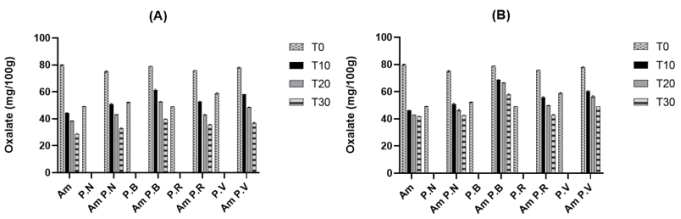
Figure 1 highlights the progression of oxalate content, an antinutritional factor, in amaranth leaves treated by water and steam cooking, in the presence or absence of four peppers at different cooking times. A significant reduction of oxalates is observed for all cooking conditions, with losses reaching up to 47.63% (Am T30 in steam) and 63.95% (Am T30 in water). It is noted in these Figures that water cooking reduces oxalates more than steaming. Furthermore, losses systematically increase from T10 to T30. This is confirmed for Am P. N which goes from 31.91% (T10) to 56.14% (T30) in water. On the other hand, the addition of P. B causes the minimal losses (12.85% at T10 in steam) compared to other peppers which eliminate more oxalates. This is the case for black and red peppers which promote more marked decreases (52.79% for Am P. R T30 in water). Finally, green pepper shows intermediate losses (52.64% at T30 in water) close to P. N and P. R.
Figure 1. Oxalate content of peppers and raw or cooked amaranth leaves in water (A) and in steam (B).
T0: raw state; T10: 10 minutes of cooking; T20: 20 minutes of cooking; T30: 30 minutes of cooking.
Am: amaranth; P. N: black pepper; P. B: white pepper; P. R: red pepper; P. V: green pepper.
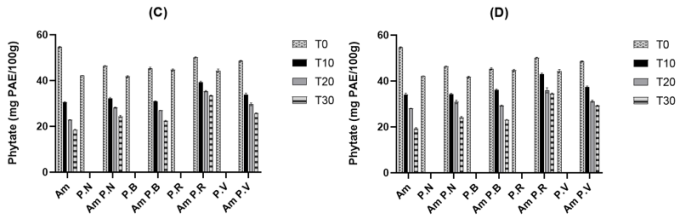
Phytate content of raw or cooked amaranth leaves in water or steam with or without peppers and the resulting losses are overall statistically different (p<0.05) from each other (Figure 2). These results show that the longer the cooking time, the more the phytate content decreases thus causing increasing losses. For amaranth without pepper, water cooking for 30 minutes causes a loss of 66.10% of phytates, compared to 43.99% for T10. Water cooking reduces phytates better than steam cooking. This is seen for Am T20, where the loss is 58.09% in water compared to 48.55% in steam. The addition of P. R and P. V promotes a less pronounced decrease in phytates, as shown by the lower loss for Am P. R T30 (33.47% in water and 31.26% in steam) and for Am P. V T30 (47.06% in water and 39.84% in steam) compared to Am P. N T30 (47.47% in water and 47.86% in steam). P. N and P. B show more marked losses, with P. B values reaching 50.70% and 49.08% respectively for leaves cooked in water and steam for 30 minutes.
Figure 2. Phytate content of peppers and raw or cooked amaranth leaves in water (C) and in steam (D).
T0: raw state; T10: 10 minutes of cooking; T20: 20 minutes of cooking; T30: 30 minutes of cooking.
Am: amaranth; P. N: black pepper; P. B: white pepper; P. R: red pepper; P. V: green pepper.
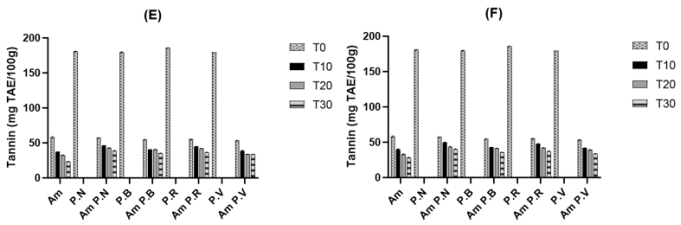
Figure 3 highlights the combined effect of cooking method, cooking time and enrichment with peppers on tannin losses in amaranth leaves. A decrease in tannin content is observed with increasing cooking time, regardless of the cooking method or peppers. Thus, for raw amaranth, the tannin content is 58.43 ± 0.85 mg TAE/100g, while after 30 minutes of cooking (Am T30), it drops to 23.34 ± 0.46 mg TAE/100g (water cooking) and 28.36 ± 0.70 mg TAE/100g (steam cooking), i.e., respective losses of 60.05% and 51.46%. Water cooking causes higher tannin losses than steam cooking. This is observed for Am P. N T10, where the loss is about 19.67% in water cooking compared to 13.21% in steaming. A reduction in losses, consecutive to the addition of pepper during cooking, is systematically noted, with less marked losses for black pepper. This is the case for Am P. N T30 which shows a loss of 31.96% and 29.81% compared to 35.46% and 34.66% for Am P. B T30, 33.17% and 31.77% for Am P. R T30 and 36.79% and 36.12% for Am P. V T30 respectively in water cooking and steaming.
Figure 3. Tannin content of peppers and raw or cooked amaranth leaves in water (E) and in steam (F).

T0: raw state; T10: 10 minutes of cooking; T20: 20 minutes of cooking; T30: 30 minutes of cooking.
Am: amaranth; P. N: black pepper; P. B: white pepper; P. R: red pepper; P. V: green pepper.
3.3. Mineral Availability
The bioavailability of minerals from ratios between minerals, oxalate and phytate content in water-cooked leaves (Table 3) and steam-cooked leaves (Table 4) was determined. The different value ranges obtained varied from 0.54 to 1.10 for oxalate/Ca, from 0.11 to 0.26 for oxalate/Mg, from 0.09 to 0.24 for oxalate/K and from 1.10 to 4.08 for oxalate/Fe. These oxalate/mineral concentration ratios presented values lower than the critical levels for all amaranth leaves cooked in water and steam with or without peppers. Furthermore, for all the samples analyzed, Na/K and Ca/P ratios lower than and close to the threshold were observed with values oscillating respectively from 0.30 to 0.53 and from 0.32 to 0.90. In addition, low ratios were observed for the phytate/mineral concentration ratios for magnesium and potassium varying from 0.09 to 0.22 and from 0.06 to 0.20 respectively. However larger values but close to the thresholds were recorded for the phytate/Ca and phytate/Fe ratios ranging respectively from 0.35 to 0.64 and from 0.73 to 3.68. Nevertheless, for a duration of 10 minutes, with amaranth leaves added with black pepper the phytate/Ca ratio (0.45 in water and 0.43 in steam) presented values lower than the threshold.
Table 3. Bioavailability of minerals in water-cooked amaranth leaves with or without peppers.

Samples

Oxalate

Oxalate

Oxalate

Oxalate

Phytate

Phytate

Phytate

Phytate

/Ca

/Mg

/K

/Fe

/Ca

/Mg

/K

/Fe

Ca/P

2.5 *

2.5 *

2.5 *

2.5 *

0.5 *

0.24 *

0.24 *

0.4 *

1 *

Am T0

0.89

0.22

0.17

1.59

0.61

0.15

0.12

1.09

0.42

AmT10

0.81

0.18

0.14

1.64

0.56

0.13

0.10

1.13

0.39

AmT20

0.72

0.17

0.13

2.16

0.43

0.10

0.08

1.29

0.39

AmT30

0.74

0.14

0.11

1.62

0.47

0.09

0.07

1.04

0.35

P.N

0.54

0.24

0.22

3.64

0.46

0.21

0.19

3.11

0.88

Am P.N T0

0.87

0.21

0.16

1.62

0.54

0.13

0.10

1.00

0.40

Am P.N T10

0.70

0.15

0.12

1.64

0.45

0.10

0.08

1.04

0.39

Am P.N T20

0.61

0.13

0.11

1.36

0.40

0.09

0.07

0.89

0.41

Am P.N T30

0.54

0.11

0.09

1.47

0.40

0.09

0.07

1.09

0.39

P.B

0.60

0.26

0.24

3.77

0.48

0.21

0.19

3.02

0.89

Am P.B T0

0.98

0.22

0.17

1.73

0.56

0.13

0.10

1.00

0.39

Am P.B T10

1.04

0.22

0.17

2.03

0.53

0.11

0.09

1.02

0.37

Am P.B T20

1.08

0.19

0.15

2.06

0.55

0.10

0.08

1.06

0.32

Am P.B T30

0.84

0.17

0.13

1.63

0.47

0.10

0.07

0.91

0.36

P.R

0.55

0.25

0.22

3.30

0.50

0.22

0.20

3.00

0.90

Am P.R T0

0.91

0.21

0.16

1.57

0.60

0.14

0.11

1.04

0.40

Am P.R T10

0.82

0.17

0.14

1.47

0.61

0.13

0.10

1.10

0.38

Am P.R T20

0.66

0.14

0.12

1.23

0.54

0.12

0.10

1.01

0.39

Am P.R T30

0.69

0.13

0.11

1.10

0.64

0.12

0.10

1.03

0.35

P.V

0.56

0.25

0.22

4.08

0.51

0.22

0.20

3.68

0.88

Am P.V T0

0.95

0.22

0.17

1.77

0.59

0.13

0.11

1.10

0.39

Am P.V T10

0.96

0.21

0.16

2.24

0.56

0.12

0.09

1.31

0.37

Am P.V T20

0.96

0.18

0.14

1.97

0.59

0.11

0.08

1.20

0.32

Am P.V T30

0.74

0.16

0.12

1.71

0.51

0.11

0.08

1.19

0.35

* Critical value. T0: raw state; T10: 10 minutes of cooking; T20: 20 minutes of cooking; T30: 30 minutes of cooking. Am: amaranth; P. N: black pepper; P. B: white pepper; P. R: red pepper; P. V: green pepper.
Table 4. Bioavailability of minerals in steamed amaranth leaves with or without peppers.

Samples

Oxalate

Oxalate

Oxalate

Oxalate

Phytate

Phytate

Phytate

Phytate

Ca/P

/Ca

/Mg

/K

/Fe

/Ca

/Mg

/K

/Fe

1 *

2.5 *

2.5 *

2.5 *

2.5 *

0.5 *

0.24 *

0.24 *

0.4 *

Am T0

0.89

0.22

0.17

1.59

0.61

0.15

0.12

1.09

0.42

AmT10

0.74

0.19

0.14

1.38

0.54

0.14

0.10

1.02

0.43

AmT20

0.72

0.18

0.14

1.56

0.47

0.12

0.09

1.02

0.42

AmT30

0.83

0.20

0.16

1.74

0.38

0.09

0.07

0.80

0.44

P.N

0.54

0.24

0.22

3.64

0.46

0.21

0.19

3.11

0.88

Am P.N T0

0.87

0.21

0.16

1.62

0.54

0.13

0.10

1.00

0.40

Am P.N T10

0.64

0.15

0.12

1.38

0.43

0.10

0.08

0.93

0.41

Am P.N T20

0.59

0.14

0.11

1.32

0.39

0.10

0.07

0.88

0.43

Am P.N T30

0.62

0.15

0.11

1.28

0.35

0.09

0.06

0.73

0.41

P.B

0.60

0.26

0.24

3.77

0.48

0.21

0.19

3.02

0.89

Am P.B T0

0.98

0.22

0.17

1.73

0.56

0.13

0.10

1.00

0.39

Am P.B T10

1.04

0.24

0.18

1.97

0.55

0.13

0.10

1.04

0.40

Am P.B T20

1.10

0.24

0.18

2.00

0.49

0.11

0.08

0.88

0.38

Am P.B T30

1.00

0.24

0.17

1.86

0.40

0.10

0.07

0.74

0.39

P.R

0.55

0.25

0.22

3.30

0.50

0.22

0.20

3.00

0.90

Am P.R T0

0.91

0.21

0.16

1.57

0.60

0.14

0.11

1.04

0.40

Am P.R T10

0.77

0.18

0.14

1.33

0.59

0.14

0.11

1.02

0.40

Am P.R T20

0.71

0.16

0.13

1.21

0.51

0.12

0.10

0.87

0.42

Am P.R T30

0.68

0.16

0.13

1.10

0.55

0.13

0.10

0.88

0.39

P.V

0.56

0.25

0.22

4.08

0.51

0.22

0.20

3.68

0.88

Am P.V T0

0.95

0.22

0.17

1.77

0.59

0.13

0.11

1.10

0.39

Am P.V T10

0.90

0.21

0.16

1.84

0.56

0.13

0.10

1.14

0.39

Am P.V T20

0.90

0.20

0.16

1.80

0.50

0.11

0.09

1.00

0.40

Am P.V T30

0.83

0.19

0.15

1.75

0.49

0.11

0.09

1.04

0.42

* Critical value. T0: Raw state; T10: 10 minutes of cooking; T20: 20 minutes of cooking; T30: 30 minutes of cooking. Am: Amaranth; P. N: Black Pepper; P. B: White Pepper; P. R: Red Pepper.
4. Discussion
The results reveal that the studied leaves of amaranths contain overall appreciable quantities of minerals. Amaranth leaves could therefore be considered as an excellent source of minerals. Consumed in sufficient quantity, they could therefore cover the daily needs of an adult which rise according to to 1000 mg/day, 400 mg/day, 700 mg/day, 2000 mg/day, 9-10 mg/day and 2000 mg/day respectively for Ca, Mg, P, K, Fe and Na. For sodium, such rate will contribute thus, to the maintenance of hydric balance and of normal osmotic pressure in the organism for cellular activities . However, an intake lower than 2000 mg/day increases urinary calcium losses, and high intakes (higher than 5000 mg/day) could contribute to hypertension for certain people . Consequently, the average sodium content of amaranth leaves is suitable because it is added in almost all households to culinary preparations as condiments, in the form of table salt. The estimated content would also be adapted to food diets restricted in sodium. Concerning phosphorus, it is a constituent of cytoplasmic and nuclear proteins, phospholipids and nucleic acids, playing an important role in carbohydrate metabolism and contributing essentially, with calcium, to the maintenance of bones, teeth and muscles . Relatively to magnesium, this mineral is known to prevent cardiomyopathy, muscular degeneration, growth retardation, congenital malformations and hemorrhagic disorders . Furthermore, iron plays an important role in the prevention of anemia . As for potassium it is a primary electrolyte and a major cation inside the cell whose low blood level is potentially fatal .
The raw leaves of Amaranthus hybridus analyzed in mg/100g by present lower contents (44.15 of Ca, 231.22 of Mg, 34.91 of P, 54.20 of K, 13.58 of Fe and 7.43 of Na) than those found in this study. In these same raw Amaranthus hybridus leaves, the contents of Ca, Mg, P, K and Fe observed are lower than those reported by which are respectively 932.60 mg/100g, 497.75 mg/100g, 368.69 mg/100g, 1989.32 mg/100g and 77.88 mg/100g while the Na content (94.39 mg/100g) obtained by these authors remains lower than that of the present study. also noted higher values (1901 mg/100g of Ca, 727 mg/100g of Mg, 1721 mg/100g of P and 9182 mg/100g of K) with nevertheless a similar Fe content (56 mg/100g). These differences could be explained by the agronomic conditions of culture and the harvest stage of amaranth leaves.
However, in accordance with the literature, our results confirm that cooking amaranth leaves with or without pepper causes a reduction in mineral content with more marked losses for water cooking than for steaming and variable according to the mineral, and this, proportionally to the lengthening of cooking time. This loss would be mainly attributable on the one hand, to the transfer of these compounds towards the cooking water and on the other hand, to a lesser extent for minerals, to thermal degradation . Steam cooking, by limiting contact with water, better preserves minerals, which would explain the less significant losses compared to water cooking. Many studies attest to these observations. Thus, enumerated losses during cooking of Amaranthus hybridus leaves of the order of 34.89 and 25.09% (Ca), 44 and 36% (Mg), 55.04 and 09.76% (K) and 20.83 and 16.67% (Fe) respectively in water and steam. Our results also join those reported by who observed on Amaranthus hybridus leaves losses of [09-25%, 12-50%, 0.7-35%, 4-50%, 08-50%] and [0.1-35%] respectively for Ca, Mg, P, K, Fe and Na during steam cooking for 15 to 45 min. Moreover, also reported decreases induced by a 10-minute water cooking of Amaranthus cruentus leaves of 38.50% (Mg), 75.10% (K), 45.83% (Fe), and 38.37% (Na).
The addition of pepper systematically attenuated the mineral losses induced by cooking with variable effects according to the pepper added and the mineral analyzed. Black and red peppers thus better-preserved potassium, magnesium, phosphorus, calcium and iron while black and white peppers significantly reduced sodium losses. The variations in preservation efficiency observed between different peppers could result from their harvest stage as well as distinct post-harvest treatments, likely to influence their biochemical composition. These lesser losses caused by the addition of peppers would be due to their richness in phenolic compounds and piperine which would improve mineral bioavailability . These compounds possess a strong antioxidant capacity able to fix complexes with minerals in order to reduce their solubility in cooking water, thus limiting their diffusion. also highlighted the protective role of spices (turmeric, pepper) on carotenoids and minerals during cooking of African leafy vegetables. In short, a 10 minutes steam cooking of amaranth leaves correlated with the addition of black or red pepper would be strongly recommended as a culinary practice to better preserve minerals.
Amaranth leaves contain antinutritional compounds that interfere with digestion, absorption and assimilation of nutrients such as proteins and minerals by forming insoluble complexes thus reducing their bioavailability. These compounds are often present in variable quantities depending on the species . Their reduction during cooking would therefore allow improvement of the nutritional value of amaranth leaves.
Although being polyphenols gifted with antioxidant activity, tannins, in large quantity, represent antinutritional factors just like phytates and oxalates. In this work, raw amaranth leaves present a high content of tannins, phytates and oxalates. This would be due to the fact that they are widespread in leafy vegetables. Several studies enumerate the contents of these antinutritional factors, this is the case of who provide in raw Amaranthus hybridus contents close to those obtained in this work of about 65 mg/100 g and 32 mg/100 g respectively for oxalates and phytates. observed higher values of tannins (7530.21 mg/100 g), phytates (1326.92 mg/100g) and oxalates (202 mg/100g) in Amaranthus viridis. Cassava leaves contain tannin (50.37 ± 0.82 mg TAE/100g) and phytate (40.20 ± 0.52 mg PAE/100 g) contents close to our results with however a higher oxalate content (612.33 ± 6.35 mg/100 g) according to .
Cooking appears as a detoxification process by eliminating antinutritional factors thereby improving consumers’ health status . Cooking caused a significant reduction of these contents of tannins, phytates and oxalates, accentuated by the lengthening of cooking duration. The losses are more marked following water cooking compared to steaming confirming that boiling would favor the diffusion and/or thermal degradation of antinutritional factors more than steaming . However, steaming would be recommended because it allows better preservation of nutrients while reducing these antinutritional factors.
The reduction of these antinutritional factors could improve on the one hand the bioavailability of minerals, notably iron, calcium and zinc and reduce notably indigestion and flatulence due to phytates. On the other hand, it could favor protein digestibility thus reducing the risk of protein deficiency syndrome (kwashiorkor) caused by tannins while limiting the formation of kidney stones engendered by a diet high in oxalate . This state of fact joins the results of many authors such as who highlighted oxalate losses respectively of 40.2% (in water) in Amaranthus hybridus leaves and of 20% (in water) and 30% (in steam) in 20 minutes of cooking in Malabar spinach leaves. noticed losses of 3.58% (oxalates) and 68.02% (phytates) after 15 minutes of steam cooking. also observed tannin and phytate losses respectively of 47%, and 79.22% in pumpkin leaves following water cooking. noted in bean grains phytate losses of 20% and 30% and oxalate losses of 63% and 38% respectively for water and steam cooking.
The losses observed during cooking of plain amaranth leaves are reduced with the addition of peppers suggesting an interaction between the phenolic compounds of peppers and those of amaranth. Black pepper, rich in piperine and polyphenols, are the most protective in tannins phytates oxalates. This lesser loss of tannins phytates and oxalates could reflect their stabilization by the antioxidant action of peppers . However, this protection could limit the reduction of these antinutritional factors. In short, a short steam cooking correlated with the addition of black pepper could sufficiently reduce these antinutrients.
The cooked amaranth leaves evaluated certainly present important quantities of minerals. However, neither the total content nor the nutritional density of each food constitutes a precise guide for the choice of dietary sources of minerals. It is rather the bioavailability of the minerals present in a meal, which depends on its form and the presence or absence of factors influencing absorption and the body's mineral needs, which ultimately determines the quantity of minerals actually supplied to the body. In order to predict this bioavailability, the anti-nutrient/mineral and mineral/mineral ratios were calculated. The oxalate/mineral ratios estimated for water-cooked and steam-cooked leaves with or without pepper were lower than the critical level of 2.5 known to alter the bioavailability of Ca, Mg, K and Fe . These low ratios would indicate that amaranth leaves would contain sufficient Ca, Mg, K and Fe to limit the risk of absorption of soluble oxalate responsible for kidney stones. The sodium/potassium (Na/K) ratio in the body is an important factor for the prevention of arterial hypertension. A ratio lower than 1 is recommended . Consequently, the consumption of amaranth leaves would not contribute to the risks of arterial hypertension, because the Na/K ratios of this study are lower than 1. For a good intestinal absorption of calcium and phosphorus, the Ca/P ratio should be close to 1 . The ratios evaluated in this work meet this requirement and therefore predict a good intestinal absorption of calcium and phosphorus contained in cooked amaranth leaves. As for the phytate/mineral ratio, it presents on the one hand values lower than the threshold for phytate/Mg and phytate/K indicating that phytate, the main chelating agent reducing the bioavailability of divalent cations , has no inhibitory effect on the bioavailability of these two minerals. On the other hand, the phytate/Ca and phytate/Fe ratios proved to be overall above the critical levels known to alter the bioavailability of these minerals. This denotes a reduction in the bioavailability of calcium and iron by phytates. However, the phytate concentration of leaves cooked in water or steamed for 10 minutes with black pepper is insufficient to reduce the bioavailability of available calcium. This result rhymes with the observation of who maintains that the addition of certain spices would improve the bioavailability of minerals.
5. Conclusion
In conclusion, it is important to note that amaranth leaves are a good source of minerals. However, cooking them inevitably induces losses which vary according to the mineral and the cooking time. These losses are significantly reduced after steaming for 10 minutes with black and red peppers. This study also reveals that the antinutritional factors present in these leaves reduce the bioavailability of iron but have no impact on the other minerals of the leaves cooked with black pepper. It will be interesting, in future studies to check if such pepper capacities on minerals losses reduction is due to their antioxidant potentialities.
Abbreviations

ICP-MS

Inductively Coupled Plasma Mass Spectrometry

PAE

Phytic Acid Equivalent

TAE

Tannin Acid Equivalent

Author Contributions
Ahiba Cedric Donald: Data curation, Formal Analysis, Investigation, Methodology, Software, Funding acquisition, Writing – original draft
Agbo Adouko Edith: Conceptualization, Data curation, Funding acquisition, Methodology, Resources, Supervision, Visualization, Validation, Writing – review & editing
Digbeu Dogore Yolande: Methodology, Resources, Visualization, Validation, Writing – review & editing
Gbogouri Grodji Albarin: Supervision, Visualization, Writing – review & editing
Funding
This work was carried out using the authors' own resources, without any specific funding.
Conflicts of Interest
The authors declare no conflicts of interest.
References
[1] Ejoh R. A., Djuikwo V. N., Gouado I. & Mbofung C. M. (2007). Nutritional components of some non-conventional leafy vegetables consumed in Cameroon. Pakistan Journal of Nutrition, 6 (6), 712-717.
[2] Smith I. F. & Eyzaguirre P. (2007). African leafy vegetables: their role in the World Health Organization’s global fruit and vegetable initiative. African journal of Food, Agriculture, Nutrition and Development, 7(3), 1-17.
[3] CNRA (2012). The socio-economic importance of leafy vegetable for the urban population of Côte d’Ivoire. In CNRA 2011, National Center for Agronomic Research, pp 8-9.
[4] Agbo A. E., Kouame C., Anin A. O. L., Soro L. C., N’zi J.-C., Fondio L. & D. Gnakri. (2014). Seasonal variation in nutritional compositions of spider plant (Cleome gynandra L.) in South Côte d’Ivoire. International Journal of Agriciltural Policy and Research, 2 (11), 406-413.
[5] Ocho-Anin Atchibri, A. L., Soro, L. C., Kouame, C., Agbo, E. A. & Kouadio, K. K. A. (2012). Nutritional value of leafy vegetables consumed in Côte d’Ivoire. International Journal of Biological and Chemical Sciences, 6 (1), 128-135.
[6] Ogwu M. C. (2020). Value of Amaranthus [L.] Species in Nigeria. In Nutritional Value of Amaranth; Intech Open: London, UK, p. 37.
[7] Gayathri, G. N., Platel, K., Prakash, J. & Srinivasan, K., (2004). Influence of antioxidant spices on the retention of β-carotene in vegetables during domestic cooking processes. Food Chemistry, 84, 35-43.
[8] Zhang, W., Zheng, Q., Song, M., Xiao, J., Cao, Y., Huang, Q., Ho, C.-T. & Lu, M. (2021). A review on the bioavailability, bio-efficacies and novel delivery systems for piperine. Food & Function, 12(19), 8867-8881.
[9] Srinivasan, K. (2007). Black pepper and its pungent principle-piperine: a review of diverse physiological effects. Critical Reviews in Food Science and Nutrition, 47(8), 735-748.
[10] Morm E., Ma K., Horn S., Debaste F., Haut B. & In S. (2020). Experimental Characterization of the Drying of Kampot Red Pepper (Piper nigrum L.). Foods, 9: 15-32.
[11] CEAEQ (2013). Mineral determination. Argon plasma spectrometry method. MA 200- Met 1.2, Rev 4. Quebec, 24 p.
[12] Latta M., Eskin M. (1980). A simple and rapid colorimetric method for phytate determination. Journal of Agriculture and Food Chemistry, 28, 1313-1315.
[13] Day R. A. & Underwood A. L. (1986). Quantitative Analysis. 5th ed. Prentice Hall, p. 701.
[14] Bainbridge Z., Tom lins K. & Westby A. (1996). Analysis of condensed tannins using acidified vanillin. Journal of Food Science, 29: 77-79.
[15] Gibson, R. S., Bailey, K. B., Gibbs, M. & Ferguson, E. L. (2010). Phytate, iron, zinc, and calcium concentrations in plant-based complementary foods used in low-income countries and implications for bioavailability. Food and Nutrition Bulletin 31, 134-146.
[16] FAO (2004). Human vitamin and mineral requirements. FAO Ed, p. 361.
[17] Aliyu, H. M. & Morufu, A. I. (2006). Proximate analysis of some leafy vegetables (Roselle, jute and bitter leaf). International Journal of Foods and Agricultural Research. 3 (1), 194 - 198.
[18] Tietz, N. W., Carl, A. B. & Edward, R. A. (1994). Tietz test book of Clinical Chemistry. 2nd Edition, Pp 1184-1235, W. B. Saunders Company London.
[19] Turan M, Kordali S, Zengin H, Dursun A & Sezen Y. (2003). Macro and Micro- Mineral content of some wild edible leaves consumed in Eastern Anatolia. Acta Agriculturae Scandinavica, Section B, Plant Soil Sciences, 53: 129-137.
[20] Chaturvedi V. C., Shrivastava R. & Upreti R. K. (2004). Viral infections and trace elements: A complex trace element. Current Science, 87: 1536-1554.
[21] Wardlaw GM & Kessel M (2002). Perspective in Nutrition (5th ed). McGraw-Hill, Boston, pp. 271-274.
[22] Akubugwo I. E., Obasi A. N. & Ginika S. C. (2007). Nutritional Potential of the Leaves and Seeds of Black Nightshade- Solanum nigrum L. Var virginicum from Afikpo-Nigeria. Pakistan Journal of Nutrition, 6 (4): 323-326.
[23] Oulai, P. D., Zoue, L. T. & Niamke, S. (2015). Evaluation of nutritive and antioxidant properties of blanched leafy vegetables consumed in northern Côte d’Ivoire. Polish Journal of Food Nutrition Sciences. 65 (1), 31-38.
[24] Nicoli, M. C., Anese, M. & Parpinel, M. (1998). Influence of processing on the antioxidant properties of fruit and vegetables. Trends Food Sci. Technol. 10, 94-100.
[25] Vodouhe S., Dovoedo A., Anihouvi V. B., Tossou R C. & Soumanou M. M (2012). Influence of cooking method on the nutritional value of Solanum macrocarpon, Amaranthus hybridus and Ocimum gratissimum, three traditional leafy vegetable acclimatized in Benin. International Journal of Biological and Chemical Sciences. 6(5): 1926-1937.
[26] Ogbadoyi, E. O., Musa, A., Oladiran, J. A., Ezenwa, M. I. S., & Akanya, F. H. (2011). Effect of processing methods on some nutrients, antinutrients and toxic substances in Amaranthus cruentus. International Journal of Applied Biology and Pharmaceutical Technology, 2 (2): 484-97.
[27] Umar, K. J., Hassan, L. G., Dangoggo, S. M., Maigandi, S. A. & Sani, N. A. (2012). Nutritional and anti-nutritional profile of Spiny Amaranth (Amaranthus viridis Linn). Studia Universitatis "Vasile Goldiş", Seria Ştiinţele Vieţii, 21 (4), 727-737.
[28] Kouakou, A. A. (2017). Comparative study of the biochemical and physico-chemical composition of leaves of three cassava varieties (Manihot esculenta Crantz) cultivated in Côte d'Ivoire. Master 2 Thesis, Nangui Abrogoua University, Abidjan, Côte d’Ivoire, 60 p.
[29] Ekop A. S. & Eddy N. O., (2005). Comparative studies of the level of toxicants in the seed of Indian almond (Terminalia catappa) and African walnut (Coula edulis). ChemClass Journal, 2, 74-76.
[30] Wanasundera, J. P. D. & Ravindran, G. (1992). Effects of cooking on the nutrient and antinutrient contents of yam tubers (Dioscorea alata and Dioscorea esculenta). Food Chemistry, 45(4), 247-250.
[31] Chai, W. & Liebman, M. (2005). Oxalate content of legumes, nuts, and grain-based flours. Journal of Food Composition and Analysis, 18 (8), 723-729.
[32] Mziray, R. S., Imungi, J. K. & Karuri, E. G. (2001). Nutrient and antinutrient in contents of raw and cooked Amaranthus hybridus. Ecology of Food and Nutrition, 40, 53-65.
[33] Agbo, A. E., Gbogouri, A. G., N’Zi, J. C., Kouassi, K., Fondio, L. & Kouame, C. (2019). Evaluation of micronutrient and oxalate losses during water and steam cooking of Malabar spinach (Basella alba) and celosia (Celosia argentea) leaves. African Agronomy, 31 (2), 100-110.
[34] Mashitoa, F. M., Manhivi, V., Slabbert, R. M., Shai, J. L. & Sivakumar, D. (2021). Changes in antinutrients, phenolics, antioxidant activities and in vitro α-glucosidase inhibitory activity in pumpkin leaves (Cucurbita moschata) during different domestic cooking methods. The Korean Society of Food Science and Biotechnology, 30(6), 793-800.
[35] Kouakou K. J-M. (2016). Influence of hydrothermal processing on the physico-chemical characteristics of white bean (Phaseolus vulgaris). Master 2 Thesis, Nangui Abrogoua University, Abidjan, Côte d’Ivoire, 53 p.
[36] Hassan, L. G., Dangoggo, S. M., Hassan, S. W., Muhammad, S. & Umar, K. J. (2011). Serum biochemical response of rats fed with Sclerocarya birrea juice. African Journal of Food Science, 5(4): 208 - 212.
[37] Umar K. J., Hassan L. G., Dangoggo S. M., Inuwa M. & Amustapha M. N., (2007). Nutritional content of Melochia corchorifolia (Linn.) leaves. International Journal of Biological and Chemical Sciences, 1: 250-255.
[38] FND (2002). Food and nutrition board, Institute of medicine. National Academy of Sciences. Dietary reference Intake for Energy, Carbohydrate, Fibre, Fat, Fatty Acids, Cholesterol, protein and Amino acid (micro-nutrients).
[39] Guil-Guerrero J. L., Gimenez-Gimemez A., Rodriguez-Garcia I. & Torija-Isasa M. E. (1998). Nutritional composition of Sonchus Species (S. asper L, S. oleraceus L, and S. tenerrimus L.). Journal of the Science of Food and Agriculture, 76: 628-632.
[40] Weaver C. M. & Kannan S. T. (2002). Phytate and mineral bioavailability. In: Reddy NR Sathe SK, eds. Food phytates. Boca Raton, F L: CRC Press: 211-224.
[41] Schneider, A. & Huyghe, C. (2015). Role of legumes in French agriculture. In Legumes for Sustainable Agricultural and Food Systems, p. 11.
Cite This Article
  • APA Style

    Donald, A. C., Edith, A. A., Yolande, D. D., Albarin, G. G. (2026). Mineral Content Assessment and Bioavailability in Amaranth Leaves Cooked in Water and Steamed with Four Types of Piper Nigrum. Journal of Food and Nutrition Sciences, 14(3), 194-206. https://doi.org/10.11648/j.jfns.20261403.13

    Copy | Download

    ACS Style

    Donald, A. C.; Edith, A. A.; Yolande, D. D.; Albarin, G. G. Mineral Content Assessment and Bioavailability in Amaranth Leaves Cooked in Water and Steamed with Four Types of Piper Nigrum. J. Food Nutr. Sci. 2026, 14(3), 194-206. doi: 10.11648/j.jfns.20261403.13

    Copy | Download

    AMA Style

    Donald AC, Edith AA, Yolande DD, Albarin GG. Mineral Content Assessment and Bioavailability in Amaranth Leaves Cooked in Water and Steamed with Four Types of Piper Nigrum. J Food Nutr Sci. 2026;14(3):194-206. doi: 10.11648/j.jfns.20261403.13

    Copy | Download

  • @article{10.11648/j.jfns.20261403.13,
      author = {Ahiba Cedric Donald and Agbo Adouko Edith and Digbeu Dogore Yolande and Gbogouri Grodji Albarin},
      title = {Mineral Content Assessment and Bioavailability in Amaranth Leaves Cooked in Water and Steamed with Four Types of Piper Nigrum},
      journal = {Journal of Food and Nutrition Sciences},
      volume = {14},
      number = {3},
      pages = {194-206},
      doi = {10.11648/j.jfns.20261403.13},
      url = {https://doi.org/10.11648/j.jfns.20261403.13},
      eprint = {https://article.sciencepublishinggroup.com/pdf/10.11648.j.jfns.20261403.13},
      abstract = {Leafy green vegetables such as amaranth constitute an important source of minerals that can help filling certain deficiencies. However, minerals bioavailability is hindered by antinutritional factors and cooking process induces their losses by leaching and by heat destruction. There is therefore a need to improve their bioavailability during cooking. For this, amaranth leaves were cooked and steamed with four types of peppers (Piper nigrum) during 10, 20 and 30 minutes. Minerals, antinutritional factors and minerals’ bioavailability were determined. The results revealed that. However, in steamed and water-cooked amaranth leaves with black pepper for 10 minutes calcium (21.8 - 23.39%), magnesium (24.19 - 25.16%), phosphorus (22.32 - 23.20%), potassium (20.56 - 20.92%), sodium (22.70 - 23.51%) and iron (13.02 - 13.48%) losses were reduced compared to cooking without pepper. Moreover, at the same time and with the same cooking process, phytate/mineral ratios (0.35-0.43 Ca; 0.09-0.10 Mg; 0.06-0.08 K), oxalate/mineral ratios (0.62-0.64 Ca; 0.14-0.15 Mg; 0.11-0.12 K) and Ca/P (0.32-0.42) ratio were lower than the thresholds showing that calcium, phosphorus, magnesium and potassium are bioavailable. But, the high phytate/iron ratio (0.73-1.14) indicate a reduction in iron bioavailability. From 10 to 30 minutes of steam cooking, the mineral contents (mg/100 g) of amaranth leaves cooked with peppers decreased from 80.00 ± 0.04 to 58.20 ± 0.19 for calcium, from 337.19 ± 0.99 to 237.02 ± 0.64 for magnesium, from 194.10 ± 0.28 to 141.51 ± 1.20 for phosphorus, from 429.39 ± 0.49 to 331.75 ± 0.46 for potassium, from 209.03 ± 0.54 to 152.28 ± 0.49 for sodium and from 42.20 ± 0.17 to 28.21 ± 0.08 for iron; against respectively 62.90 ± 0.05 to 50.70 ± 0.08, 246.36 ± 0.20 to 205.97 ± 0.08, 145.02 ± 0.61 to 115.47 ± 0.44, 333.24 ± 0.13 to 262.67 ± 0.26, 156.72 ± 0.19 to 111.43 ± 0.07 and 33.69 ± 0.08 to 24.10 ± 0.12 mg/100 g for leaves cooked without peppers. Steaming amaranth leaves for 10 minutes with black or red pepper better preserve minerals and improve their bioavailability.},
     year = {2026}
    }
    

    Copy | Download

  • TY  - JOUR
    T1  - Mineral Content Assessment and Bioavailability in Amaranth Leaves Cooked in Water and Steamed with Four Types of Piper Nigrum
    AU  - Ahiba Cedric Donald
    AU  - Agbo Adouko Edith
    AU  - Digbeu Dogore Yolande
    AU  - Gbogouri Grodji Albarin
    Y1  - 2026/06/29
    PY  - 2026
    N1  - https://doi.org/10.11648/j.jfns.20261403.13
    DO  - 10.11648/j.jfns.20261403.13
    T2  - Journal of Food and Nutrition Sciences
    JF  - Journal of Food and Nutrition Sciences
    JO  - Journal of Food and Nutrition Sciences
    SP  - 194
    EP  - 206
    PB  - Science Publishing Group
    SN  - 2330-7293
    UR  - https://doi.org/10.11648/j.jfns.20261403.13
    AB  - Leafy green vegetables such as amaranth constitute an important source of minerals that can help filling certain deficiencies. However, minerals bioavailability is hindered by antinutritional factors and cooking process induces their losses by leaching and by heat destruction. There is therefore a need to improve their bioavailability during cooking. For this, amaranth leaves were cooked and steamed with four types of peppers (Piper nigrum) during 10, 20 and 30 minutes. Minerals, antinutritional factors and minerals’ bioavailability were determined. The results revealed that. However, in steamed and water-cooked amaranth leaves with black pepper for 10 minutes calcium (21.8 - 23.39%), magnesium (24.19 - 25.16%), phosphorus (22.32 - 23.20%), potassium (20.56 - 20.92%), sodium (22.70 - 23.51%) and iron (13.02 - 13.48%) losses were reduced compared to cooking without pepper. Moreover, at the same time and with the same cooking process, phytate/mineral ratios (0.35-0.43 Ca; 0.09-0.10 Mg; 0.06-0.08 K), oxalate/mineral ratios (0.62-0.64 Ca; 0.14-0.15 Mg; 0.11-0.12 K) and Ca/P (0.32-0.42) ratio were lower than the thresholds showing that calcium, phosphorus, magnesium and potassium are bioavailable. But, the high phytate/iron ratio (0.73-1.14) indicate a reduction in iron bioavailability. From 10 to 30 minutes of steam cooking, the mineral contents (mg/100 g) of amaranth leaves cooked with peppers decreased from 80.00 ± 0.04 to 58.20 ± 0.19 for calcium, from 337.19 ± 0.99 to 237.02 ± 0.64 for magnesium, from 194.10 ± 0.28 to 141.51 ± 1.20 for phosphorus, from 429.39 ± 0.49 to 331.75 ± 0.46 for potassium, from 209.03 ± 0.54 to 152.28 ± 0.49 for sodium and from 42.20 ± 0.17 to 28.21 ± 0.08 for iron; against respectively 62.90 ± 0.05 to 50.70 ± 0.08, 246.36 ± 0.20 to 205.97 ± 0.08, 145.02 ± 0.61 to 115.47 ± 0.44, 333.24 ± 0.13 to 262.67 ± 0.26, 156.72 ± 0.19 to 111.43 ± 0.07 and 33.69 ± 0.08 to 24.10 ± 0.12 mg/100 g for leaves cooked without peppers. Steaming amaranth leaves for 10 minutes with black or red pepper better preserve minerals and improve their bioavailability.
    VL  - 14
    IS  - 3
    ER  - 

    Copy | Download

Author Information