Research Article | | Peer-Reviewed

Triple Burden of Malnutrition and Its Sociodemographic Determinants Among School Adolescents in Toumodi, Côte d'Ivoire

Received: 12 September 2026     Accepted: 21 September 2026     Published: 23 October 2026
Views:       Downloads:
Abstract

This cross-sectional study assessed the prevalence of stunting, thinness, and overweight/obesity among school adolescents in Toumodi, Côte d'Ivoire. It also identified their sociodemographic and familial determinants. The sample included 253 adolescents (53.0% male; mean age 13.8 ± 1.5 years) enrolled in Grade 6 and Grade 7 of public secondary schools. Height and weight were converted into body-mass-index-for-age (BAZ) and height-for-age (HAZ) Z-scores, using World Health Organization growth references. Stunting was defined as HAZ below -2, thinness as BAZ below -2, and overweight/obesity as BAZ above +1. Associations with sex, age, area of residence, living companions, family size, and parental education were assessed. Chi-square tests and multivariable logistic regression were used. Stunting affected 40.1% of children (95% confidence interval [CI] 34.0-46.1%). Thinness affected 8.4% (95% CI 5.0-11.8%), and overweight/obesity affected 21.2% (95% CI 16.1-26.3%), confirming a triple burden of malnutrition. Concurrent stunting and thinness affected 4.0% of children. Stunting prevalence increased sharply with age, from 17.0% among 10-12-year-olds to 63.3% among 16-18-year-olds. It was independently associated with older age (adjusted odds ratio [aOR] 1.57 per year, 95% CI 1.28-1.93) and male sex (aOR 1.79, 95% CI 1.02-3.13). Overweight/obesity was independently associated with younger age (aOR 0.72 per year, 95% CI 0.57-0.91). No sociodemographic or familial variable was significantly associated with thinness. Family size and parental education were not significantly associated with any of the three nutritional outcomes. These findings confirm a substantial triple burden of malnutrition, dominated by stunting, among adolescents in Toumodi. Age and sex, rather than family size or parental education, emerged as the main sociodemographic determinants. The results support the need for age- and sex-targeted nutritional interventions. They also reinforce the importance of extending nutrition surveillance beyond early childhood to explicitly include adolescents in West African school-age populations.

Published in Journal of Food and Nutrition Sciences (Volume 14, Issue 5)
DOI 10.11648/j.jfns.20261405.20
Page(s) 365-374
Creative Commons

This is an Open Access article, distributed under the terms of the Creative Commons Attribution 4.0 International License (http://creativecommons.org/licenses/by/4.0/), which permits unrestricted use, distribution and reproduction in any medium or format, provided the original work is properly cited.

Copyright

Copyright © The Author(s), 2026. Published by Science Publishing Group

Keywords

Stunting, Thinness, Overweight, Triple Burden of Malnutrition, Adolescents, Determinants, Côte d'Ivoire, Sub-Saharan Africa

1. Introduction
Many low- and middle-income countries, including in Sub-Saharan Africa, are undergoing a rapid nutrition transition. This transition is marked by the coexistence of undernutrition (stunting, wasting or thinness) and overnutrition (overweight, obesity). Both forms can occur within the same population, household, or even the same individual. This is termed the double burden of malnutrition, or the triple burden when all three forms coexist . In this article, the term is used in an anthropometric sense: the triple burden refers specifically to the co-occurrence of stunting, thinness, and overweight/obesity as three distinct nutritional outcomes, rather than to the alternative framework in which the third element is micronutrient deficiency. This distinction is made explicit because stunting and thinness, although often collapsed into a single ‘undernutrition’ category in double-burden studies, reflect different underlying processes—chronic, cumulative growth faltering versus current or acute energy deficit—and are therefore treated here as separate components of the triple burden. The transition is driven by aetiological pathways acting across the life course, including early-life growth faltering, shifting dietary patterns, and reduced physical activity. It therefore poses a distinct policy challenge, requiring strategies that address deficiency and excess simultaneously rather than a single form of malnutrition . Globally, an estimated 148 million children under five were stunted, 45 million wasted, and 37 million overweight in 2022 . Progress towards international nutrition targets remains insufficient in most regions.
Stunting (low height-for-age) reflects cumulative long-term nutritional and health deficits. It has well-documented consequences for cognitive development, school performance, and adult productivity . Explanatory factors for stunting and wasting differ from one another. Their patterns by age and context can also diverge considerably within the same population. This underscores the value of examining both indicators together, rather than relying on a single anthropometric marker . Adolescence is a second major window of physical growth after early childhood. During this period, nutritional deficits accumulated earlier in life may persist, worsen, or begin to resolve. New risk behaviours related to diet can also emerge. However, adolescents remain comparatively understudied relative to children under five in regional nutrition surveillance systems .
In Côte d'Ivoire, the 2019 national Nutritional Status Assessment Survey estimated chronic malnutrition (stunting) at 22.4% among children aged 0-59 months. Global acute malnutrition affected 6.8% of children, and underweight affected 11.7% . Overweight and obesity were emerging, particularly among women of reproductive age and in urban settings . Among school-aged children in Abidjan, one study found that only 54.2% of 1251 children had a normal weight. Diet and high parental socioeconomic status were identified as factors favoring overweight . More broadly, West Africa is at an early stage of the nutrition transition. This stage is characterized by rapid urbanization and rising consumption of energy-dense processed foods. An emerging overweight/obesity transition has been documented among school-aged children and youth, alongside persistent undernutrition . A scoping review of adolescent nutrition studies in Côte d'Ivoire (2000-2019) found that research has focused predominantly on anaemia and micronutrient status. Comparatively limited evidence exists on anthropometric status and its sociodemographic and familial determinants among adolescents specifically. No study was identified that simultaneously assessed stunting, thinness, and overweight/obesity in this population .
The present study therefore had two aims. First, it aimed to determine the prevalence of stunting, thinness, and overweight/obesity among school adolescents in Toumodi, Côte d'Ivoire. This assessment used simultaneous BMI-for-age (BAZ) and height-for-age (HAZ) Z-scores. Second, it aimed to identify sociodemographic and familial determinants of each nutritional outcome. These determinants included sex, age, area of residence, living companions, family size, and parental education.
We formulated three a priori hypotheses. H1: stunting, thinness, and overweight/obesity coexist within this population, confirming a triple burden of malnutrition. H2: stunting prevalence increases with age across adolescence. H3: family size and parental education are associated with nutritional status, independently of age, sex, and area of residence.
2. Materials and Methods
2.1. Study Design, Setting and Participants
A cross-sectional study was conducted among schoolchildren in Toumodi, Côte d'Ivoire. Participants were enrolled in Grade 6 (6ème) and Grade 7 (5ème) of public secondary schools. Children were eligible if enrolled in the target grades and present on the day of data collection. Assent was required from each child, alongside parental or guardian informed consent. Records with biologically implausible birth dates or anthropometric values were excluded during data cleaning (see Statistical Analysis). This yielded a final analytic sample of 253 children (134 boys, 119 girls; mean age 13.8 ± 1.5 years). No formal a priori sample size calculation was performed. The achieved sample size is comparable to those used in similar school-based nutritional surveys of adolescents in the sub-region . The study was conducted in accordance with the Declaration of Helsinki (1964) and was approved by the Institutional Review Board (Ethics Committee) of the Institut National de la Jeunesse et des Sports (INJS) / École Normale Supérieure de l’Education Physique et Sportive (ENSEPS), Côte d’Ivoire (protocol code 000477/MS/INJS/ENSEPS, approved on 22 February 2025). Written informed consent was obtained from the parents or legal guardians of all participating schoolchildren, and assent was also obtained from the children themselves prior to data collection. This manuscript does not contain any individual person’s data, images, or case details.
2.2. Anthropometric Assessment
Height and weight were measured in light clothing and without shoes. A calibrated stadiometer and scale were used, following standardized anthropometric procedures. Body mass index (BMI) was calculated as weight (kg) divided by height squared (m2). BMI-for-age (BAZ) and height-for-age (HAZ) Z-scores were then derived. These used the World Health Organization (WHO) growth reference for children and adolescents aged 5-19 years, constructed with the LMS method . Stunting was defined as HAZ < -2, thinness as BAZ < -2, and overweight/obesity as BAZ > +1. The International Obesity Task Force cut-offs proposed by Cole et al. are also widely used internationally . However, the WHO BAZ-based classification was retained here, for consistency with the national nutrition surveillance system in Côte d'Ivoire . Concurrent stunting and thinness (i.e., both conditions in the same child) was also examined. This reflects evidence that children with combined anthropometric deficits face a substantially elevated mortality risk, compared with either deficit alone . Z-score values outside the WHO plausibility limits (BAZ: -5/+5; HAZ: -6/+6) were treated as missing for the corresponding classification.
2.3. Sociodemographic and Familial Variables
Sex, age, and area of residence (urban/rural) were collected by questionnaire. Living companions were also recorded, categorized as with parents, with siblings, or alone/other. Family size and parental (father's and mother's) education level (none, primary, secondary, university) were collected as well. Family size was categorized as small (≤5 members), medium (6-9 members), or large (≥10 members). A similar small-family threshold (fewer than five members) has been used elsewhere to examine family size as a determinant of adolescent malnutrition .
2.4. Statistical Analysis
Prevalence estimates with 95% confidence intervals (Wald method) were calculated for stunting, thinness, and overweight/obesity. Bivariate associations between each nutritional outcome and sociodemographic/familial variables were assessed. The chi-square test was used for categorical predictors, and Welch's t-test for age as a continuous predictor. Multivariable logistic regression was used to identify independent determinants of each nutritional outcome (stunting, thinness, overweight/obesity). Models adjusted simultaneously for sex, age, area of residence, family size, and father's education. Adjusted odds ratios (aOR) with 95% confidence intervals are reported. A p-value < 0.05 was considered statistically significant. Statistical analyses were performed using Python (pandas, SciPy, statsmodels). Reporting of this cross-sectional study followed the STROBE guidelines .
3. Results
A total of 253 schoolchildren were included in the final analysis after data cleaning (see Materials and Methods). Sample characteristics are presented in Table 1.
3.1. Sample Characteristics
Table 1. Sociodemographic, familial, and parental education characteristics of the overall study sample.

Variable

Modality

Overall Sample (n = 253)

Sex, n (%)

Male

134 (53.0%)

Female

119 (47.0%)

Age (years),

Mean ± SD

13.8 ± 1.5

Area of residence

Urban

229 (90.5%)

Rural

24 (9.5%)

Living companions

Parents

73 (28.9%)

Siblings

172 (68.0%)

Alone/Other

8 (3.2%)

Family size

Small (≤5)

80 (31.7%)

Medium (6-9)

129 (51.2%)

Large (≥10)

43 (17.1%)

Father's education

No education

52 (20.6%)

Primary

67 (26.6%)

Secondary

83 (32.9%)

University

50 (19.8%)

Mother's education

No education

108 (42.9%)

Primary

63 (25.0%)

Secondary

53 (21.0%)

University

28 (11.1%)

SD: standard deviation.
3.2. Prevalence of the Triple Burden of Malnutrition
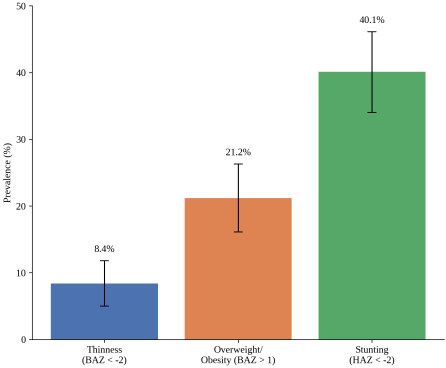
Stunting, thinness, and overweight/obesity all coexisted within this sample, confirming a triple burden of malnutrition (Table 2, Figure 1). Stunting was the most prevalent form, affecting 40.1% of children. This was more than four times the prevalence of thinness (8.4%). Concurrent stunting and thinness (i.e., both conditions in the same child) affected 4.0% of children with valid data for both indicators. This subgroup represents the most nutritionally vulnerable children.
Figure 1. Prevalence (%) of thinness, overweight/obesity, and stunting among schoolchildren in Toumodi (n = 253), with 95% confidence intervals.
Table 2. Prevalence of stunting, thinness, and overweight/obesity.

Indicator

Definition

n/N

Prevalence (%)

95% CI

Thinness

BAZ < -2 SD

21/250

8.4

5.0-11.8

Overweight/Obesity

BAZ > +1 SD

53/250

21.2

16.1-26.3

Stunting

HAZ < -2 SD

101/252

40.1

34.0-46.1

BAZ: BMI-for-age Z-score; HAZ: height-for-age Z-score; CI: confidence interval; WHO growth reference, 5-19 years.
3.3. Determinants of Stunting
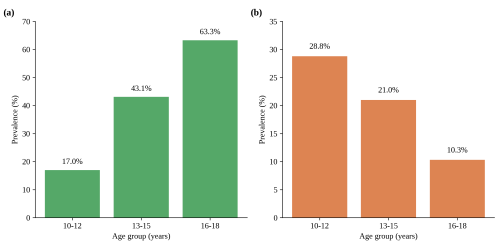
In bivariate analysis, stunting prevalence increased sharply and significantly with age. It rose from 17.0% among 10-12-year-olds to 43.1% among 13-15-year-olds. It reached 63.3% among 16-18-year-olds (p < 0.001) (Table 3, Figure 2a). A non-significant trend toward higher stunting prevalence was observed in boys (45.9%) than girls (33.6%; p = 0.064). No significant associations were found between stunting and area of residence, living companions, family size, or parental education (all p > 0.05).
Table 3. Bivariate associations between stunting and sociodemographic/familial characteristics.

Variable

Modality

n Stunted/Total

% Stunted

p-value

Sex

Female

40/119

33.6%

0.064

Male

61/133

45.9%

Age group (Years)

10-12

9/53

17.0%

<0.001

13-15

72/167

43.1%

16-18

19/30

63.3%

Residence

Rural

9/24

37.5%

0.958

Urban

92/228

40.4%

Living companions

Parents

29/73

39.7%

0.985

siblings

69/171

40.4%

Alone/Other

3/8

37.5%

Family size

Small (≤5)

36/80

45.0%

0.571

Medium (6-9)

49/128

38.3%

Large (≥10)

16/43

37.2%

Father's education

No education

21/52

40.4%

0.129

Primary

26/67

38.8%

Secondary

40/82

48.8%

University

14/50

28.0%

Mother's education

No education

41/107

38.3%

0.696

Primary

26/63

41.3%

Secondary

20/53

37.7%

University

14/28

50.0%

Chi-square test for categorical variables (Welch's t-test used for the underlying continuous age comparison, summarized here by age group).
Figure 2. (a) Stunting prevalence by age group; (b) Overweight/obesity prevalence by age group.
3.4. Multivariable Determinants of Stunting, Thinness, and Overweight/Obesity
In multivariable logistic regression models, age remained a strong independent predictor of both outcomes. Models adjusted simultaneously for sex, age, area of residence, family size, and father's education. Age predicted stunting (aOR = 1.57 per year, 95% CI 1.28-1.93, p < 0.001) and overweight/obesity (aOR = 0.72 per year, 95% CI 0.57-0.91, p = 0.007), but in opposite directions. The odds of stunting increased with age, whereas the odds of overweight/obesity decreased with age. Male sex was independently associated with higher odds of stunting (aOR = 1.79, 95% CI 1.02-3.13, p = 0.041). No sociodemographic or familial variable was significantly associated with thinness in the adjusted model. Family size and father's education were not significantly associated with any of the three nutritional outcomes after adjustment (Table 4).
Table 4. Multivariable logistic regression: adjusted determinants of stunting, thinness, and overweight/obesity.

Outcome

Predictor

aOR

95% CI

p-value

Stunting

Family size: Medium (ref: Small)

1.21

0.56-2.64

0.626

Stunting

Family size: Small (ref: Large)

1.72

0.76-3.86

0.192

Stunting

Father's education: Primary (ref: None)

0.92

0.42-2.04

0.847

Stunting

Father's education: Secondary (ref: None)

1.43

0.67-3.04

0.357

Stunting

Father's education: University (ref: None)

0.81

0.32-2.04

0.655

Stunting

Sex (male vs female)

1.79

1.02-3.13

0.041

Stunting

Age (years)

1.57

1.28-1.93

<0.001

Stunting

Residence (urban vs rural)

1.26

0.49-3.22

0.630

Thinness

Family size: Medium (ref: Small)

1.16

0.33-4.10

0.821

Thinness

Family size: Small (ref: Large)

0.97

0.25-3.81

0.967

Thinness

Father's education: Primary (ref: None)

2.06

0.58-7.29

0.263

Thinness

Father's education: Secondary (ref: None)

0.98

0.25-3.75

0.974

Thinness

Father's education: University (ref: None)

0.65

0.10-4.05

0.640

Thinness

Sex (male vs female)

0.94

0.37-2.39

0.904

Thinness

Age (years)

1.27

0.92-1.74

0.144

Thinness

Residence (urban vs rural)

2.66

0.33-21.20

0.355

Overweight/Obesity

Family size: Medium (ref: Small)

0.67

0.27-1.66

0.385

Overweight/Obesity

Family size: Small (ref: Large)

0.98

0.38-2.50

0.965

Overweight/Obesity

Father's education: Primary (ref: None)

1.32

0.52-3.37

0.556

Overweight/Obesity

Father's education: Secondary (ref: None)

1.06

0.42-2.65

0.907

Overweight/Obesity

Father's education: University (ref: None)

0.97

0.34-2.76

0.958

Overweight/Obesity

Sex (male vs female)

1.66

0.87-3.17

0.124

Overweight/Obesity

Age (years)

0.72

0.57-0.91

0.007

Overweight/Obesity

Residence (urban vs rural)

0.39

0.15-1.01

0.053

aOR: adjusted odds ratio; CI: confidence interval. Each model adjusted simultaneously for sex, age, area of residence, family size, and father's education. Reference categories: sex = female; residence = rural; family size = large (≥10); father's education = no education.
4. Discussion
This study confirms a triple burden of malnutrition among school adolescents in Toumodi, Côte d'Ivoire. Stunting (40.1%), overweight/obesity (21.2%), and thinness (8.4%) were all present within the same population, supporting H1. This pattern is consistent with the broader double/triple burden of malnutrition increasingly documented across low- and middle-income countries undergoing nutrition transition . The specific profile observed here, however, differs from that reported in comparable adolescent populations elsewhere in Sub-Saharan Africa. A pooled meta-analysis of Ethiopian adolescents estimated stunting at 20.06%, thinness at 21.68%, and overweight/obesity at 10.63% . A comparative study of adolescents in two Nigerian cities reported a population-level thinness prevalence of 6.8% and overweight/obesity of 12.4% . A broader multi-country analysis of school-going adolescents across seven African countries similarly documented wide cross-country variation in the prevalence of underweight, overweight, and obesity , reinforcing the heterogeneity of the triple burden's composition across the region. Relative to these estimates, adolescents in Toumodi showed a markedly higher stunting burden and a lower thinness burden. They also showed a higher prevalence of overweight/obesity than reported in Nigeria. This suggests that the composition of the triple burden - which specific forms of malnutrition predominate - can vary considerably even within West Africa. This variation likely reflects differences in local food environments, socioeconomic conditions, and the age structure of the samples studied.
The stunting prevalence observed here (40.1%) is notably higher than the national estimate of chronic malnutrition. That estimate was 22.4%, reported in the 2019 national Nutritional Status Assessment Survey . However, that survey covered a younger age range and the full national territory. This sample instead comprised older schoolchildren from a single locality. Stunting prevalence rose sharply with age, from 17.0% to 63.3% between the youngest and oldest groups. This gradient was robust in both bivariate and multivariable analysis, supporting H2. Two explanations are possible. First, it may reflect a cumulative, progressive process of growth faltering across adolescence. Second, it may reflect a cohort effect, whereby older adolescents faced harsher early-life nutritional conditions than younger ones. The cross-sectional design cannot distinguish between these explanations. A comparable positive association between age and stunting has been repeatedly reported across Sub-Saharan Africa . Explanatory factors for stunting are also known to differ by age. This supports the value of stratified, age-sensitive analyses such as the one performed here . Stunting has well-documented consequences for cognitive development, educational attainment, and adult productivity . This age gradient is therefore of particular public health concern. It warrants longitudinal investigation, to determine whether it reflects ongoing growth faltering, a birth-cohort effect, or catch-up growth not yet captured cross-sectionally.
The independent association between male sex and higher odds of stunting (aOR = 1.79) is consistent with a well-documented regional pattern. A meta-analysis of 16 Demographic and Health Surveys across ten Sub-Saharan African countries examined this pattern . It found stunting consistently lower in girls than boys (36% versus 40% pooled prevalence; adjusted odds ratio 1.18). The authors suggested this may reflect greater biological vulnerability of male children in early life, rather than differential care alone. Multi-country analyses of household and maternal determinants of stunting have reached similar conclusions . They identify male sex as one of the most consistent individual-level risk factors, alongside increasing child age. Our finding was only borderline significant in bivariate analysis (p = 0.064) before covariate adjustment. It is nonetheless directionally consistent with this broader evidence base. The precise biological or behavioural mechanisms underlying the sex difference, however, remain incompletely understood. Further study is warranted in adolescent, rather than under-five, populations specifically.
Contrary to H3, family size and parental education were not significantly associated with any nutritional outcome in this sample. This included stunting, thinness, and overweight/obesity, in both bivariate and multivariable analysis. This null finding contrasts with a substantial body of literature from elsewhere in Sub-Saharan Africa. A pooled analysis of 35 countries found that maternal education, household wealth, and family structure were all independently associated with stunting . A community-based study in northwest Ethiopia found that larger families (six or more members) had higher odds of stunting. In that study, secondary paternal education was protective . A systematic review of adolescents in Ethiopia identified small family size (under five members) as protective against both stunting and thinness . A related study among school-aged children in Abidjan identified diet and high parental socioeconomic status as factors associated with overweight . Several explanations may account for the discrepancy between these findings and our null result. First, our school-based sampling frame excludes children not enrolled in Grade 6/7. These children may disproportionately come from lower-education or larger households, restricting the socioeconomic range captured here. Second, the relatively modest sample size may have limited statistical power. Confidence intervals around several point estimates were correspondingly wide (Table 4). This may have prevented detection of socioeconomic effects of the modest magnitude typically reported in larger surveys. Third, self- or child-reported family size and parental education may be subject to misclassification in a school-based questionnaire. This could have attenuated true associations. Finally, family size and parental education may genuinely exert less influence on nutritional status than age and sex in this peri-urban locality. Other unmeasured factors, such as dietary diversity, food security, or household wealth, may instead play a more prominent role.
Overweight/obesity showed the opposite age pattern to stunting. It declined from 28.8% among 10-12-year-olds to 10.3% among 16-18-year-olds. It was independently associated with younger age after adjustment. This is broadly consistent with reports of an emerging overweight/obesity transition among school-aged children and youth across Sub-Saharan Africa . This transition has so far been most pronounced at younger ages and in urban settings, before shifting toward older age groups as it matures. Whether this age pattern in Toumodi reflects a genuine biological or behavioural phenomenon cannot be determined from this cross-sectional design. Possible mechanisms include increasing energy expenditure or decreasing parental feeding control with age. Alternatively, it may reflect a cohort effect linked to more recent exposure to obesogenic food environments among younger children. This is an important question for the longitudinal nutrition research agenda in Côte d'Ivoire .
Concurrent stunting and thinness affected 4.0% of children with valid data for both indicators. Most evidence on this combined anthropometric deficit comes from children under five. In that age group, it has been associated with a substantially elevated mortality risk compared with either deficit alone . Its occurrence among older schoolchildren in this sample suggests something important. A small but identifiable subgroup of adolescents in Toumodi carries a particularly high nutritional burden. This subgroup may warrant prioritized clinical and nutritional follow-up.
This study has several limitations. First, its cross-sectional design precludes causal inference. This particularly concerns the observed age gradients in stunting and overweight/obesity. These gradients may reflect cumulative growth faltering, cohort effects, or both. Second, the single-site, school-based convenience sample from Toumodi limits generalizability. Findings may not extend to other Ivorian regions or to out-of-school adolescents. These groups may differ systematically in nutritional status and socioeconomic profile. Third, family size, living companions, and parental education were based on child- or parent-reported questionnaire data. These may be subject to recall or reporting inaccuracies. Fourth, no formal a priori sample size calculation was performed. Several point estimates in the multivariable models (Table 4) had wide confidence intervals. This indicates limited power to detect modest associations, particularly for thinness. Fifth, this study did not collect dietary intake, food security, or household wealth data. These are recognized determinants of nutritional status elsewhere in the region . Collecting them would have allowed a more complete determinants model than sociodemographic and family-structure variables alone. Reporting of this cross-sectional study followed the STROBE guidelines . These limitations are made explicit in that spirit.
Future research in this population should prioritize longitudinal designs. These designs can distinguish cumulative growth faltering from cohort effects in the observed age gradients. Future studies should also incorporate dietary diversity, food security, and household wealth indicators. These should be examined alongside the sociodemographic and familial variables studied here, in line with recommendations from recent reviews of adolescent nutrition research gaps in Côte d'Ivoire . Larger, multisite studies with formal power calculations are also needed. These would help clarify whether the null findings for family size and parental education reflect a genuine absence of association, or insufficient statistical power. They would also allow more precise estimation of the true composition of the triple burden of malnutrition among Ivorian adolescents.
5. Conclusions
A substantial triple burden of malnutrition was observed among school adolescents in Toumodi, Côte d'Ivoire. Stunting affected two in five children. Overweight/obesity showed a non-negligible prevalence, and thinness a smaller but clinically important burden. A subgroup with concurrent stunting and thinness was also identified. Age and sex, rather than family size or parental education, emerged as the main sociodemographic determinants. The odds of stunting increased across adolescence, while the odds of overweight/obesity decreased. These findings indicate that stunting reduction cannot be assumed complete by secondary school age in this setting. Nutrition surveillance and intervention in Côte d'Ivoire should extend beyond the under-five age group, to explicitly include adolescents. This aligns with global calls to address all forms of malnutrition simultaneously, rather than sequentially . Practically, these results support prioritizing older and male adolescents in school-based nutrition and growth-monitoring programmes in Toumodi. Longitudinal, multisite research incorporating dietary and food-security data is still needed. Such research would help establish the causal pathways underlying the age- and sex-patterned triple burden identified here. It would also guide the design of age- and sex-sensitive interventions.
Abbreviations

BAZ

BMI-for-age Z-score

HAZ

Height-for-age Z-score

BMI

Body Mass Index

SD

Standard Deviation

CI

Confidence Interval

aOR

Adjusted Odds Ratio

WHO

World Health Organization

IRB

Institutional Review Board

Acknowledgments
The authors thank the school administration, teachers, and schoolchildren of Toumodi who participated in this study. This manuscript was prepared through the joint contributions of all authors, particularly with respect to the study design, data collection and analysis, content development, results, interpretation, and scientific work. The authors acknowledge the use of Claude, Anthropic to assist with grammatical proofreading, language refinement, and reference formatting. These AI-assisted tools were not used as authors and did not replace the authors' intellectual contributions or scientific judgment.
Author Contributions
Koffi Diallo: Conceptualization, Data curation, Formal Analysis, Investigation, Methodology, Resources, Software, Visualization, Writing – original draft
Konan Amoin Georgette: Investigation, Validation, Writing – review & editing
Zahé Kollet Yao Aimé Sylvère: Data curation, Investigation, Validation, Writing – original draft
Bini Adamou Thérèse d’Avila: Investigation
Assa Rebecca Yao: Validation, Writing – review & editing
Soro Doudjo: Supervision, Writing – review & editing
Assidjo Nogbou Emmanuel: Conceptualization, Supervision, Writing – review & editing.
Conflicts of Interest
The authors declare no conflicts of interest.
References
[1] Popkin, B. M., Corvalan, C., Grummer-Strawn, L. M. Dynamics of the Double Burden of Malnutrition and the Changing Nutrition Reality. The Lancet. 2020, 395(10217), 65-74.
[2] Victora, C. G., Adair, L., Fall, C., Hallal, P. C., Martorell, R., Richter, L., Sachdev, H. S. Maternal and Child Undernutrition: Consequences for Adult Health. The Lancet. 2008, 371(9609), 340-357.
[3] Conseil National pour la Nutrition, l'Alimentation et le Développement de la Petite Enfance (CONNAPE), Institut National de la Statistique (INS). Synthèse des Études Réalisées de 2016 à 2020 en Côte d'Ivoire dans le Domaine de la Nutrition. Abidjan, Côte d'Ivoire: CONNAPE/INS; 2021.
[4] Fossou, A. F., Ahui Bitty, M. L., Coulibaly, T. J., Bataï, N. F., Touré, M. F., Zahé, K. Y. A. S. Prevalence of Obesity in Children Enrolled in Private and Public Primary Schools. Clinical Nutrition ESPEN. 2020, 40, 115-120.
[5] De Onis, M., Onyango, A. W., Borghi, E., Siyam, A., Nishida, C., Siekmann, J. Development of a WHO Growth Reference for School-Aged Children and Adolescents. Bulletin of the World Health Organization. 2007, 85(9), 660-667.
[6] Wariri, O., Akhimienho, K. I., Alhassan, J. A. K., Jalo, I., Oloyede, I. P., Nyong, E. E., Bode-Thomas, F. Population and Individual-Level Double Burden of Malnutrition Among Adolescents in Two Emerging Cities in Northern and Southern Nigeria: A Comparative Cross-Sectional Study. Annals of Global Health. 2020, 86(1), 153.
[7] Wamani, H., Åstrøm, A. N., Peterson, S., Tumwine, J. K., Tylleskär, T. Boys Are More Stunted Than Girls in Sub-Saharan Africa: A Meta-Analysis of 16 Demographic and Health Surveys. BMC Pediatrics. 2007, 7, 17.
[8] Akombi, B. J., Agho, K. E., Hall, J. J., Wali, N., Renzaho, A. M. N., Merom, D. Stunting, Wasting and Underweight in Sub-Saharan Africa: A Systematic Review. International Journal of Environmental Research and Public Health. 2017, 14(8), 863.
[9] Cole, T. J., Green, P. J. Smoothing Reference Centile Curves: The LMS Method and Penalized Likelihood. Statistics in Medicine. 1992, 11(10), 1305-1319.
[10] Jesson, J., Kouakou, E. K. V., Kumaran, K., Adonis, L., Wrottesley, S. V., Leroy, V., Fall, C. A Scoping Review of Literature Describing the Nutritional Status and Diets of Adolescents in Côte d'Ivoire. Public Health Nutrition. 2021, 24(15), 5261-5276.
[11] Black, R. E., Victora, C. G., Walker, S. P., Bhutta, Z. A., Christian, P., de Onis, M., Ezzati, M., Grantham-McGregor, S., Katz, J., Martorell, R., Uauy, R. Maternal and Child Undernutrition and Overweight in Low-Income and Middle-Income Countries. The Lancet. 2013, 382(9890), 427-451.
[12] Patton, G. C., Sawyer, S. M., Santelli, J. S., Ross, D. A., Afifi, R., Allen, N. B., Arora, M., Azzopardi, P., Baldwin, W., Bonell, C. Our Future: A Lancet Commission on Adolescent Health and Wellbeing. The Lancet. 2016, 387(10036), 2423-2478.
[13] Muthuri, S. K., Francis, C. E., Wachira, L. J., LeBlanc, A. G., Sampson, M., Onywera, V. O., Tremblay, M. S. Evidence of an Overweight/Obesity Transition Among School-Aged Children and Youth in Sub-Saharan Africa: A Systematic Review. PLOS ONE. 2014, 9(3), e92846.
[14] Bosu, W. K. An Overview of the Nutrition Transition in West Africa: Implications for Non-Communicable Diseases. Proceedings of the Nutrition Society. 2015, 74(4), 466-477.
[15] Wells, J. C., Sawaya, A. L., Wibaek, R., Mwangome, M., Poullas, M. S., Yajnik, C. S., Demaio, A. The Double Burden of Malnutrition: Aetiological Pathways and Consequences for Health. The Lancet. 2020, 395(10217), 75-88.
[16] Manyanga, T., El-Sayed, H., Doku, D. T., Randall, J. R. The Prevalence of Underweight, Overweight, Obesity and Associated Risk Factors Among School-Going Adolescents in Seven African Countries. BMC Public Health. 2014, 14, 887.
[17] Khara, T., Mwangome, M., Ngari, M., Dolan, C. Children Concurrently Wasted and Stunted: A Meta-Analysis of Prevalence Data of Children 6-59 Months from 84 Countries. Maternal & Child Nutrition. 2018, 14(2), e12516.
[18] Cole, T. J., Bellizzi, M. C., Flegal, K. M., Dietz, W. H. Establishing a Standard Definition for Child Overweight and Obesity Worldwide: International Survey. BMJ. 2000, 320(7244), 1240-1243.
[19] von Elm, E., Altman, D. G., Egger, M., Pocock, S. J., Gøtzsche, P. C., Vandenbroucke, J. P. The Strengthening the Reporting of Observational Studies in Epidemiology (STROBE) Statement: Guidelines for Reporting Observational Studies. The Lancet. 2007, 370(9596), 1453-1457.
[20] Yaya, S., Oladimeji, O., Odusina, E. K., Bishwajit, G. Household Structure, Maternal Characteristics and Children's Stunting in Sub-Saharan Africa: Evidence from 35 Countries. International Health. 2022, 14(4), 381-389.
[21] Geberselassie, S. B., Abebe, S. M., Melsew, Y. A., Mutuku, S. M., Wassie, M. M. Prevalence of Stunting and Its Associated Factors Among Children 6-59 Months of Age in Libo-Kemekem District, Northwest Ethiopia: A Community Based Cross Sectional Study. PLOS ONE. 2018, 13(6), e0195361.
[22] Gezaw, A., Melese, W., Getachew, B., Belachew, T. Double Burden of Malnutrition and Associated Factors Among Adolescent in Ethiopia: A Systematic Review and Meta-Analysis. PLOS ONE. 2023, 18(4), e0282240.
[23] Getacher, L., Ademe, B. W., Belachew, T. Double Burden of Malnutrition and Its Associated Factors Among Adolescents in Debre Berhan Regiopolitan City, Ethiopia: A Multinomial Regression Model Analysis. Frontiers in Nutrition. 2023, 10, 1187875.
[24] Martorell, R., Young, M. F. Patterns of Stunting and Wasting: Potential Explanatory Factors. Advances in Nutrition. 2012, 3(2), 227-233.
[25] UNICEF, WHO, World Bank Group. Levels and Trends in Child Malnutrition: UNICEF/WHO/World Bank Group Joint Child Malnutrition Estimates: Key Findings of the 2023 Edition. Geneva, Switzerland: World Health Organization; 2023.
Cite This Article
  • APA Style

    Diallo, K., Georgette, K. A., Sylvère, Z. K. Y. A., d'Avila, B. A. T., Yao, A. R., et al. (2026). Triple Burden of Malnutrition and Its Sociodemographic Determinants Among School Adolescents in Toumodi, Côte d'Ivoire. Journal of Food and Nutrition Sciences, 14(5), 365-374. https://doi.org/10.11648/j.jfns.20261405.20

    Copy | Download

    ACS Style

    Diallo, K.; Georgette, K. A.; Sylvère, Z. K. Y. A.; d'Avila, B. A. T.; Yao, A. R., et al. Triple Burden of Malnutrition and Its Sociodemographic Determinants Among School Adolescents in Toumodi, Côte d'Ivoire. J. Food Nutr. Sci. 2026, 14(5), 365-374. doi: 10.11648/j.jfns.20261405.20

    Copy | Download

    AMA Style

    Diallo K, Georgette KA, Sylvère ZKYA, d'Avila BAT, Yao AR, et al. Triple Burden of Malnutrition and Its Sociodemographic Determinants Among School Adolescents in Toumodi, Côte d'Ivoire. J Food Nutr Sci. 2026;14(5):365-374. doi: 10.11648/j.jfns.20261405.20

    Copy | Download

  • @article{10.11648/j.jfns.20261405.20,
      author = {Koffi Diallo and Konan Amoin Georgette and Zahé Kollet Yao Aimé Sylvère and Bini Adamou Thérèse d'Avila and Assa Rebecca Yao and Soro Doudjo and Assidjo Nogbou Emmanuel},
      title = {Triple Burden of Malnutrition and Its Sociodemographic Determinants Among School Adolescents in Toumodi, Côte d'Ivoire},
      journal = {Journal of Food and Nutrition Sciences},
      volume = {14},
      number = {5},
      pages = {365-374},
      doi = {10.11648/j.jfns.20261405.20},
      url = {https://doi.org/10.11648/j.jfns.20261405.20},
      eprint = {https://article.sciencepublishinggroup.com/pdf/10.11648.j.jfns.20261405.20},
      abstract = {This cross-sectional study assessed the prevalence of stunting, thinness, and overweight/obesity among school adolescents in Toumodi, Côte d'Ivoire. It also identified their sociodemographic and familial determinants. The sample included 253 adolescents (53.0% male; mean age 13.8 ± 1.5 years) enrolled in Grade 6 and Grade 7 of public secondary schools. Height and weight were converted into body-mass-index-for-age (BAZ) and height-for-age (HAZ) Z-scores, using World Health Organization growth references. Stunting was defined as HAZ below -2, thinness as BAZ below -2, and overweight/obesity as BAZ above +1. Associations with sex, age, area of residence, living companions, family size, and parental education were assessed. Chi-square tests and multivariable logistic regression were used. Stunting affected 40.1% of children (95% confidence interval [CI] 34.0-46.1%). Thinness affected 8.4% (95% CI 5.0-11.8%), and overweight/obesity affected 21.2% (95% CI 16.1-26.3%), confirming a triple burden of malnutrition. Concurrent stunting and thinness affected 4.0% of children. Stunting prevalence increased sharply with age, from 17.0% among 10-12-year-olds to 63.3% among 16-18-year-olds. It was independently associated with older age (adjusted odds ratio [aOR] 1.57 per year, 95% CI 1.28-1.93) and male sex (aOR 1.79, 95% CI 1.02-3.13). Overweight/obesity was independently associated with younger age (aOR 0.72 per year, 95% CI 0.57-0.91). No sociodemographic or familial variable was significantly associated with thinness. Family size and parental education were not significantly associated with any of the three nutritional outcomes. These findings confirm a substantial triple burden of malnutrition, dominated by stunting, among adolescents in Toumodi. Age and sex, rather than family size or parental education, emerged as the main sociodemographic determinants. The results support the need for age- and sex-targeted nutritional interventions. They also reinforce the importance of extending nutrition surveillance beyond early childhood to explicitly include adolescents in West African school-age populations.},
     year = {2026}
    }
    

    Copy | Download

  • TY  - JOUR
    T1  - Triple Burden of Malnutrition and Its Sociodemographic Determinants Among School Adolescents in Toumodi, Côte d'Ivoire
    AU  - Koffi Diallo
    AU  - Konan Amoin Georgette
    AU  - Zahé Kollet Yao Aimé Sylvère
    AU  - Bini Adamou Thérèse d'Avila
    AU  - Assa Rebecca Yao
    AU  - Soro Doudjo
    AU  - Assidjo Nogbou Emmanuel
    Y1  - 2026/10/23
    PY  - 2026
    N1  - https://doi.org/10.11648/j.jfns.20261405.20
    DO  - 10.11648/j.jfns.20261405.20
    T2  - Journal of Food and Nutrition Sciences
    JF  - Journal of Food and Nutrition Sciences
    JO  - Journal of Food and Nutrition Sciences
    SP  - 365
    EP  - 374
    PB  - Science Publishing Group
    SN  - 2330-7293
    UR  - https://doi.org/10.11648/j.jfns.20261405.20
    AB  - This cross-sectional study assessed the prevalence of stunting, thinness, and overweight/obesity among school adolescents in Toumodi, Côte d'Ivoire. It also identified their sociodemographic and familial determinants. The sample included 253 adolescents (53.0% male; mean age 13.8 ± 1.5 years) enrolled in Grade 6 and Grade 7 of public secondary schools. Height and weight were converted into body-mass-index-for-age (BAZ) and height-for-age (HAZ) Z-scores, using World Health Organization growth references. Stunting was defined as HAZ below -2, thinness as BAZ below -2, and overweight/obesity as BAZ above +1. Associations with sex, age, area of residence, living companions, family size, and parental education were assessed. Chi-square tests and multivariable logistic regression were used. Stunting affected 40.1% of children (95% confidence interval [CI] 34.0-46.1%). Thinness affected 8.4% (95% CI 5.0-11.8%), and overweight/obesity affected 21.2% (95% CI 16.1-26.3%), confirming a triple burden of malnutrition. Concurrent stunting and thinness affected 4.0% of children. Stunting prevalence increased sharply with age, from 17.0% among 10-12-year-olds to 63.3% among 16-18-year-olds. It was independently associated with older age (adjusted odds ratio [aOR] 1.57 per year, 95% CI 1.28-1.93) and male sex (aOR 1.79, 95% CI 1.02-3.13). Overweight/obesity was independently associated with younger age (aOR 0.72 per year, 95% CI 0.57-0.91). No sociodemographic or familial variable was significantly associated with thinness. Family size and parental education were not significantly associated with any of the three nutritional outcomes. These findings confirm a substantial triple burden of malnutrition, dominated by stunting, among adolescents in Toumodi. Age and sex, rather than family size or parental education, emerged as the main sociodemographic determinants. The results support the need for age- and sex-targeted nutritional interventions. They also reinforce the importance of extending nutrition surveillance beyond early childhood to explicitly include adolescents in West African school-age populations.
    VL  - 14
    IS  - 5
    ER  - 

    Copy | Download

Author Information
  • Multidisciplinary Laboratory of Human Movement Sciences, Development and Well-Being (LaP-SMHDBE), National Institute of Youth and Sports (INJS), Abidjasn, Côte d'Ivoire;Department of Chemical and Agri-Food Engineering, Félix Houphouët-Boigny National Polytechnic Institute (INP-HB), Yamoussoukro, Côte d'Ivoire

  • Training and Research Unit (UFR) of Science and Technology, Université Alassane OUATTARA, Bouaké, Côte d'Ivoire;Food Security and Nutrition Research Group, Centre Suisse de Recherches Scientifiques en Côte d'Ivoire, Adiopodoumé, Côte d'Ivoire

  • Laboratory of Nutrition, Pharmacology and Toxicology, Félix Houphouët-Boigny University, Abidjan, Côte d'Ivoire

  • Multidisciplinary Laboratory of Human Movement Sciences, Development and Well-Being (LaP-SMHDBE), National Institute of Youth and Sports (INJS), Abidjasn, Côte d'Ivoire

  • Laboratory of Nutrition, Pharmacology and Toxicology, Félix Houphouët-Boigny University, Abidjan, Côte d'Ivoire

  • Department of Chemical and Agri-Food Engineering, Félix Houphouët-Boigny National Polytechnic Institute (INP-HB), Yamoussoukro, Côte d'Ivoire

  • Department of Chemical and Agri-Food Engineering, Félix Houphouët-Boigny National Polytechnic Institute (INP-HB), Yamoussoukro, Côte d'Ivoire

  • Abstract
  • Keywords
  • Document Sections

    1. 1. Introduction
    2. 2. Materials and Methods
    3. 3. Results
    4. 4. Discussion
    5. 5. Conclusions
    Show Full Outline
  • Abbreviations
  • Acknowledgments
  • Author Contributions
  • Conflicts of Interest
  • References
  • Cite This Article
  • Author Information