
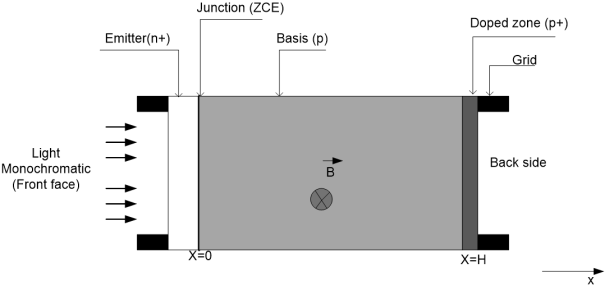
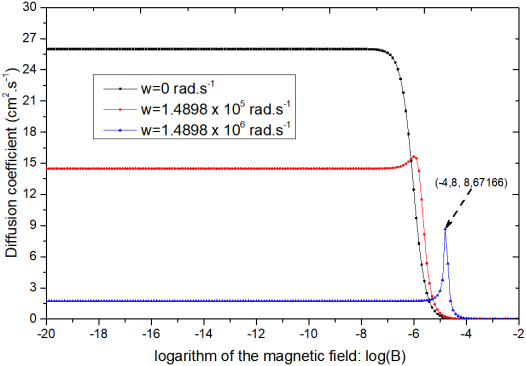
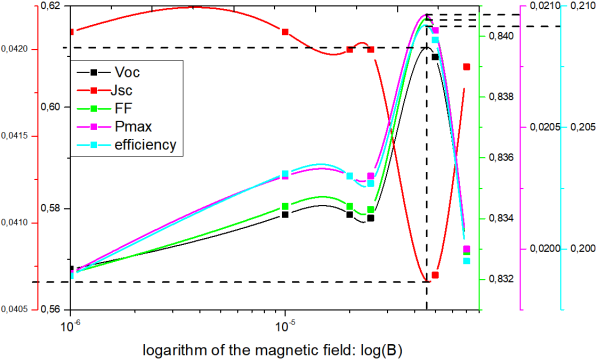
In this article, we present a theoretical study of the electrical performance of a photovoltaic cell subjected to a magnetic field, taking into account the thermal effects induced by the mobility of excess charge carriers within the cell. When a solar cell is illuminated, several phenomena occur, such as the generation, diffusion, and recombination of charge carriers. All these phenomena are governed by the charge conservation equation known as the continuity equation for the density of excess minority carriers. Solving the continuity equation for front-side illumination in the frequency regime allowed us to obtain analytical expressions for the photocurrent density and the photovoltaic voltage. These expressions were then used to evaluate the electrical performance of the proposed model. The results show that the maximum power (Pmax), open-circuit voltage (Voc), fill factor (FF), and conversion efficiency initially increase with the magnetic field strength, reaching a maximum value before decreasing. In contrast, the short-circuit current density (Jsc) exhibits an inverse trend. Furthermore, the diffusion coefficient remains constant for low values because the system is in steady state. It decreases with the logarithm of the magnetic field. This decrease is explained by the fact that an increasing magnetic field generates a force called the Lorentz force, which slows the movement of charge carriers and therefore prevents them from moving within the basis.
| Published in | Journal of Photonic Materials and Technology (Volume 11, Issue 1) |
| DOI | 10.11648/j.jpmt.20261101.13 |
| Page(s) | 16-22 |
| Creative Commons |
This is an Open Access article, distributed under the terms of the Creative Commons Attribution 4.0 International License (http://creativecommons.org/licenses/by/4.0/), which permits unrestricted use, distribution and reproduction in any medium or format, provided the original work is properly cited. |
| Copyright |
Copyright © The Author(s), 2026. Published by Science Publishing Group |
Electrical Performance, Magnetic Field, Thermal Effect, Photovoltaic Cell
B(T) | Voc (V) | Jsc (A/cm2) | FF | Pmax (W/cm2) | Rend |
|---|---|---|---|---|---|
1.00E-06 | 0.5680 | 0.0421 | 0.8322 | 0.0199 | 0.1989 |
1.00E-05 | 0.5788 | 0.0421 | 0.8344 | 0.0203 | 0.2031 |
2.00E-05 | 0.5788 | 0.042 | 0.8344 | 0.0203 | 0.2030 |
2.50E-05 | 0.5781 | 0.042 | 0.8343 | 0.0203 | 0.2027 |
5.00E-05 | 0.6099 | 0.0407 | 0.8402 | 0.0209 | 0.2086 |
7.00E-05 | 0.5716 | 0.0419 | 0.8329 | 0.0200 | 0.1995 |
ZCE | Space Charge Zone |
Jsc | Short Circuit Current |
Voc | Open-circuit Voltage |
FF | Form Factor |
Pmax | Maximum Electrical Power |
| Cyclotron Frequency |
| Angular Frequency |
Sf | Recombination Velocity at the Junction |
Sb | Recombination Speed on the Rear Side |
Jph | Photocurrent Density |
Rend | Efficiency |
| Complex Diffusion Coefficient as a Function of the Magnetic |
Jmax | Maximum Current |
B | Magnetic Field |
Nb | The Doping Rate of the Base (Nb=1016cm-3) |
| The Intrinsic Density of Minority Shareholders =1010cm-3 |
| Thermal Tension |
| Boltzmann's Constant |
| The Charge of the Electron |
| The Absolute Temperature at Thermal Equilibrium (T=300°K) |
| Photovoltage |
x | Base Depth |
| Optical Absorption Coefficient as a Function of Wavelength |
| Incident Photon Flux |
| Reflection Coefficient as a Function of Wavelength |
L( | Broadcast Length |
H | Base Thickness |
| [1] | I. Ly, O. H. Lemrabott, B. Dieng, I. Gaye, S. Gueye, M. S. Diouf and G. Sissoko, “Techniques for determining the recombination parameters and the range of their validity of a bifacial photovoltaic cell made of polycrystalline silicon under constant multispectral illumination in static regime”, Renewable Energy Review Vol. 15 No. 2 (2012) 187-206. |
| [2] | Alfred DIENG, Ndeye THIAM, Mamadou Lamine SAMB, Amadou Seïdou MAIGA, Fabé Idrissa BARRO, Grégoire SISSOKO, “3D STUDY OF A POLYCRYSTALLINE SILICON PHOTOCELL: INFLUENCE OF GRAIN SIZE AND GRAIN JOINTS RECOMMENDATION SPEED ON ELECTRICAL PARAMETERS”, A. Dieng et al / J. Sci. Vol. 9, No. 1 (2009) 51-63. |
| [3] | M. Ndiaye, Z. Nouhou Bako, I. Zerbo, A. Dieng, F. I. Barro, G. Sissoko, “Determination of the electrical parameters of a photovoltaic cell under monochromatic illumination in frequency modulation, from Bode and Nyquist diagrams”, M. Ndiaye et al / J. Sci, Vol 8, pp 59-68, 2008. |
| [4] | Idrissa Sourabié, Issa Zerbo, Martial Zoungrana, Dioari Ulrich Combari, Dieudonné Joseph Bathiebo Effect of the angle of incidence of the magnetic field on the performance of a polycrystalline silicon solar cell under multispectral illumination, Smart Grid and Renewable Energy, 2017, 8, 325-335. |
| [5] | Sourabié, I., Barandja, V., Savadogo, M., Konaté, R., Gnabahou, A., Zoungra, M., Zerbo, I. and Ouattara, F. (2022) “Three-dimensional study of the effect of the angle of incidence of a magnetic field on the electrical power and the conversion efficiency of a polycrystalline silicon solar cell under multispectral lighting”, Smart Grid and renewable energies, 13, 295-304. |
| [6] | M. Zoungrana, I. Zerbo, F. I. Barro, R. Sam, F. Touré, M. L. Samb and F. Zougmoré, “3-D modeling of the influence of grain size and recombination speed at grain boundaries on a polycrystalline silicon photovoltaic cell under concentrated illumination”, Renewable Energy Review Vol. 14 No. 4 (2011) 649-664. |
| [7] | Cheikh Thiaw, Mamadou Lamine Ba, Mamour Amadou Ba, Gora Diop, Ibrahima Diatta, Mor Ndiaye, Gregoire Sissoko, « n+-p-p+ Silicon Solar Cell Base Optimum Thickness Determination under Magnetic Field », Journal of Electromagnetic Analysis and Applications, 2020, 12, 103-113. |
| [8] | G. Diop, O. Sow, M. Thiame, R. Mane, I. Diatta, K. Loum, S. Gueye, M. Wade, G. Sissoko, « Diffusion Coefficient at Double Resonances in Frequency and Temperature, Applied to (n+/p/p+) Silicon Solar Cell Base Thickness Optimization under Long Wavelength Illumination », Journal of Electromagnetic Analysis and Applications, vol 14, pp 89-103, 2022. |
| [9] | Nouh Mohamed Moctar Ould Mohamed, O. Sow, S. Gueye, Y. Traore, I. Diatta, A. Thiam, M. A. Ba, R. Mane, I. Ly, G. Sissoko,« Influence of Both Magnetic Field and Temperature on Silicon Solar Cell Base Optimum Thickness Determination », Journal of Modern Physics, 2019, 10, 1596-1605. |
| [10] | R. Mane, I. Ly, M. Wade, I. Datta, M. S. Douf, Y. Traore, M. Ndiaye, S. Tamba, G. Sissoko, « Minority Carrier Diffusion Coefficient D*(B, T): Study in Temperature on a Silicon Solar Cell under Magnetic Field », Energy and Power Engineering, vol 9, pp 1-10, 2017. |
| [11] | A Dieng, I Zerbo, M Wade, A S Maiga and G Sissoko, « Three-dimensional study of a polycrystalline silicon solar cell: the influence of the applied magnetic field on the electrical parameters », Semicond. Sci. Technol. 26 (2011) 095023 (9pp). |
| [12] | A. Diao, N. Thiam, M. Zoungrana, G. Sahin, M. Ndiaye, G. Sissoko, « Diffusion Coefficient in Silicon Solar Cell with Applied Magnetic Field and under Frequency: Electric Equivalent Circuits », World Journal of Condensed Matter Physics vol 4, pp 84-92, 2014. |
| [13] | Nd. Thiam, A. Diao, M. Ndiaye, A. Dieng, A. Thiam, M. Sarr, A. S. Maiga and G. Sissoko, « Electric Equivalent Models of Intrinsic Recombination Velocities of a Bifacial Silicon Solar Cell under Frequency Modulation and Magnetic Field Effect », Research Journal of Applied Sciences, Engineering and Technology, vol 4, pp 4646-4655, 2012. |
| [14] | Basu, P. K. and Singh, S. N. (1994) On The Determination of Minority Carrier Diffusion Length in the Base Region of n+ -p-p+ Silicon Solar Cells Using Photoresponse Methods. Solar Energy Materials and Solar Cells, 33, 317-329. |
| [15] | Mamadou Sall, Dianguina Diarisso, Mame Faty Mbaye Fall, Gora Diop, Mor Ndiaye, Khady Loum, Gregoire Sissoko. Back Illuminated N/P/P+ Bifacial Silicon Solar Cell under Modulated Short-Wavelength: Determination of Base Optimum Thickness Energy and Power Engineering, 2021, 13, 207-220. |
| [16] | M. Zoungrana, I. Zerbo, B. Soro, M. Savadogo, S. Tiedrebeogo, D. J. Bathiebo, «THE EFFECT OF MAGNETIC FIELD ON THE EFFICIENCY OF A SILICON SOLAR CELL UNDER AN INTENSE LIGHT CONCENTRATION», Advances in Science and Technology Research Journal, Volume 11, Issue 2, June 2017, pp 133-138. |
| [17] | Issa ZERBO, Martial ZOUNGRANA, Idrissa SOURABIE, Adama OUEDRAOGO, Bernard ZOUMA, Dieudonne Joseph BATHIEBO, «External magnetic field effect on bifacial silicon solar cell’s electric power and conversion efficiency», Turk J Phys (2015) 39: 288-294. |
| [18] | Dioari Ulrich Combari, Issa Zerbo, Martial Zoungrana, Emmanuel Wendsongre Ramde, Dieudonné Joseph Bathiebo, « Modelling Study of Magnetic Field Effect on the Performance of a Silicon Photovoltaic Module », Energy and Power Engineering, 2017, 9, 419-429. |
APA Style
Thiam, O., Ndiaye, M., Kharma, G., Ndiaye, P. G., Diagne, I. (2026). Performance Analysis of a Photovoltaic Cell Under a Magnetic Field Considering Thermal Effects Induced by Excess Charge Carrier Mobility. Journal of Photonic Materials and Technology, 11(1), 16-22. https://doi.org/10.11648/j.jpmt.20261101.13
ACS Style
Thiam, O.; Ndiaye, M.; Kharma, G.; Ndiaye, P. G.; Diagne, I. Performance Analysis of a Photovoltaic Cell Under a Magnetic Field Considering Thermal Effects Induced by Excess Charge Carrier Mobility. J. Photonic Mater. Technol. 2026, 11(1), 16-22. doi: 10.11648/j.jpmt.20261101.13
@article{10.11648/j.jpmt.20261101.13,
  author = {Ousmane Thiam and Mor Ndiaye and Gaye Kharma and Pape Gueye Ndiaye and Issa Diagne},
  title = {Performance Analysis of a Photovoltaic Cell Under a Magnetic Field Considering Thermal Effects Induced by Excess Charge Carrier Mobility},
  journal = {Journal of Photonic Materials and Technology},
  volume = {11},
  number = {1},
  pages = {16-22},
  doi = {10.11648/j.jpmt.20261101.13},
  url = {https://doi.org/10.11648/j.jpmt.20261101.13},
  eprint = {https://article.sciencepublishinggroup.com/pdf/10.11648.j.jpmt.20261101.13},
  abstract = {In this article, we present a theoretical study of the electrical performance of a photovoltaic cell subjected to a magnetic field, taking into account the thermal effects induced by the mobility of excess charge carriers within the cell. When a solar cell is illuminated, several phenomena occur, such as the generation, diffusion, and recombination of charge carriers. All these phenomena are governed by the charge conservation equation known as the continuity equation for the density of excess minority carriers. Solving the continuity equation for front-side illumination in the frequency regime allowed us to obtain analytical expressions for the photocurrent density and the photovoltaic voltage. These expressions were then used to evaluate the electrical performance of the proposed model. The results show that the maximum power (Pmax), open-circuit voltage (Voc), fill factor (FF), and conversion efficiency initially increase with the magnetic field strength, reaching a maximum value before decreasing. In contrast, the short-circuit current density (Jsc) exhibits an inverse trend. Furthermore, the diffusion coefficient remains constant for low values because the system is in steady state. It decreases with the logarithm of the magnetic field. This decrease is explained by the fact that an increasing magnetic field generates a force called the Lorentz force, which slows the movement of charge carriers and therefore prevents them from moving within the basis.},
 year = {2026}
}
TY  - JOUR
T1  - Performance Analysis of a Photovoltaic Cell Under a Magnetic Field Considering Thermal Effects Induced by Excess Charge Carrier Mobility
AU  - Ousmane Thiam
AU  - Mor Ndiaye
AU  - Gaye Kharma
AU  - Pape Gueye Ndiaye
AU  - Issa Diagne
Y1  - 2026/06/29
PY  - 2026
N1  - https://doi.org/10.11648/j.jpmt.20261101.13
DO  - 10.11648/j.jpmt.20261101.13
T2  - Journal of Photonic Materials and Technology
JF  - Journal of Photonic Materials and Technology
JO  - Journal of Photonic Materials and Technology
SP  - 16
EP  - 22
PB  - Science Publishing Group
SN  - 2469-8431
UR  - https://doi.org/10.11648/j.jpmt.20261101.13
AB  - In this article, we present a theoretical study of the electrical performance of a photovoltaic cell subjected to a magnetic field, taking into account the thermal effects induced by the mobility of excess charge carriers within the cell. When a solar cell is illuminated, several phenomena occur, such as the generation, diffusion, and recombination of charge carriers. All these phenomena are governed by the charge conservation equation known as the continuity equation for the density of excess minority carriers. Solving the continuity equation for front-side illumination in the frequency regime allowed us to obtain analytical expressions for the photocurrent density and the photovoltaic voltage. These expressions were then used to evaluate the electrical performance of the proposed model. The results show that the maximum power (Pmax), open-circuit voltage (Voc), fill factor (FF), and conversion efficiency initially increase with the magnetic field strength, reaching a maximum value before decreasing. In contrast, the short-circuit current density (Jsc) exhibits an inverse trend. Furthermore, the diffusion coefficient remains constant for low values because the system is in steady state. It decreases with the logarithm of the magnetic field. This decrease is explained by the fact that an increasing magnetic field generates a force called the Lorentz force, which slows the movement of charge carriers and therefore prevents them from moving within the basis.
VL  - 11
IS  - 1
ER  -
Department of Physics, Cheikh Anta Diop University of Dakar, Dakar, Senegal
Department of Physics, Cheikh Anta Diop University of Dakar, Dakar, Senegal
Department of Physics, Cheikh Anta Diop University of Dakar, Dakar, Senegal
Department of Physics, Cheikh Anta Diop University of Dakar, Dakar, Senegal
Department of Physics, Cheikh Anta Diop University of Dakar, Dakar, Senegal

Information



 Share This Article
 Twitter
 Linked In
 Facebook
 Copy
Copy Download