
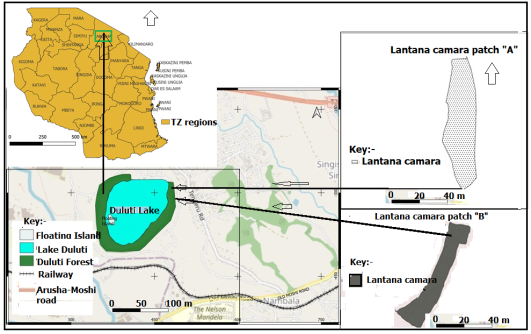
The eastern ridge of Duluti Lake Catchment Forest (DLCF) harbors high plant species diversity within the bush land and woodland. Concentric plots were established to analyze the existing plant species of the area. The recorded plant species were indicated for whether indigenous, alien, alien and invasive. Shannon Wiener Diversity index was applied to calculate diversity index of shrubs and trees. Trees and shrub densities were calculated. Herbaceous plants, shrubs, and trees distribution were evaluated. During this study, a total of 113 herbaceous plants, shrubs, and trees were recorded. The calculated Hꞌ for shrubs and trees ranged from ≤3.5 - ≥1.5 an implication of high diversity. The densest plant species was an alien invasive plant, Lantana camara L. indicating that the area is dominated by alien invasive plants. The eastern ridge of Duluti Lake Catchment Forest accommodates high plant species diversity that requires management. Further study is needed, control alien invasive plants, replace the existing alien plants with indigenous plants.
| Published in | Journal of Plant Sciences (Volume 14, Issue 1) |
| DOI | 10.11648/j.jps.20261401.11 |
| Page(s) | 1-16 |
| Creative Commons |
This is an Open Access article, distributed under the terms of the Creative Commons Attribution 4.0 International License (http://creativecommons.org/licenses/by/4.0/), which permits unrestricted use, distribution and reproduction in any medium or format, provided the original work is properly cited. |
| Copyright |
Copyright © The Author(s), 2026. Published by Science Publishing Group |
Alien Plants, Duluti Lake Catchment Forest Reserve, Index of Diversity, Invasive Plant
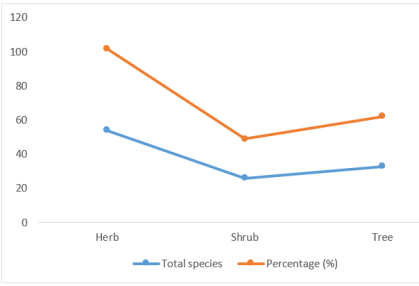
Growth form | Total species | Percentage (%) | H’ |
|---|---|---|---|
Herb | 54 | 47.8 | - |
Shrub | 26 | 23.0 | 2.0 |
Tree | 33 | 29.2 | 2.8 |
Total | 113 | 100 |
S/N | Botanical name | Author | Family | IN | A | IS | TTC | F | H' | D/ha | RF | RD/ha | IVI |
|---|---|---|---|---|---|---|---|---|---|---|---|---|---|
1 | Albizia glaberrima | (Schum.& Thonn) Benth | Fabaceae | 1 | 0 | 0 | 2 | 1 | 0.04 | 7.7 | 1.20 | 0.93 | 2.13 |
2 | Albizia petersiana | (Bolle) Oliv. | Fabaceae | 1 | 0 | 0 | 7 | 1 | 0.11 | 26.9 | 1.20 | 3.24 | 4.45 |
3 | Allophylus africanus | P. Beauv. | Sapindaceae | 1 | 0 | 0 | 5 | 3 | 0.09 | 19.2 | 3.61 | 2.31 | 5.93 |
4 | Cedrella odorata | L. | Meliaceae | 0 | 1 | 1 | 2 | 2 | 0.04 | 7.7 | 2.41 | 0.93 | 3.34 |
5 | Clausena anista | (Willd.) Hook. f. ex Benth. | Rutaceae | 1 | 0 | 0 | 1 | 1 | 0.02 | 3.8 | 1.20 | 0.46 | 1.67 |
6 | Combretum molle | R. Br. ex G. Don | Combretaceae | 1 | 0 | 0 | 9 | 6 | 0.13 | 34.6 | 7.23 | 4.17 | 11.40 |
7 | Croton macrostachyus | Hochst. ex Delile | Euphorbiaceae | 1 | 0 | 0 | 6 | 2 | 0.10 | 23.1 | 2.41 | 2.78 | 5.19 |
8 | Croton megalocarpus | Hutch. | Euphorbiaceae | 1 | 0 | 0 | 27 | 9 | 0.26 | 103.8 | 10.84 | 12.50 | 23.34 |
9 | Diospyros abyssinica | (Hiern) F. White | Ebenaceae | 1 | 0 | 0 | 2 | 1 | 0.04 | 7.7 | 1.20 | 0.93 | 2.13 |
10 | Dombeya rotundifolia | (Hochst.) Planch | Malvaceae | 1 | 0 | 0 | 2 | 1 | 0.04 | 7.7 | 1.20 | 0.93 | 2.13 |
11 | Ekebergia capensis | Sparrm | Meliaceae | 1 | 0 | 0 | 1 | 5 | 0.02 | 3.8 | 6.02 | 0.46 | 6.49 |
12 | Erythrina abyssimia | Lam. ex DC. | Fabaceae | 1 | 0 | 0 | 1 | 1 | 0.02 | 3.8 | 1.20 | 0.46 | 1.67 |
13 | Euclea divinorum | Hiern. | Ebenaceae | 1 | 0 | 0 | 2 | 1 | 0.04 | 7.7 | 1.20 | 0.93 | 2.13 |
14 | Ficus exasperata | Vahl. | Moraceae | 1 | 0 | 0 | 1 | 1 | 0.02 | 3.8 | 1.20 | 0.46 | 1.67 |
15 | Ficus lutea | Vahl. | Moraceae | 1 | 0 | 0 | 1 | 1 | 0.02 | 3.8 | 1.20 | 0.46 | 1.67 |
16 | Flueggea virosa | (Roxb. ex Willd.) Royle | Phyllanthaceae | 1 | 0 | 0 | 7 | 2 | 0.11 | 26.9 | 2.41 | 3.24 | 5.65 |
17 | Grevillae robusta | A. Cunn. ex R. Br | Proteaceae | 0 | 1 | 0 | 11 | 5 | 0.15 | 42.3 | 6.02 | 5.09 | 11.12 |
18 | Leucaena leucocephala | (Lam.) de Wit | Fabaceae | 0 | 1 | 1 | 2 | 1 | 0.04 | 7.7 | 1.20 | 0.93 | 2.13 |
19 | Markhamia lutea | (Benth.) K. Schum. | Bignoniaceae | 1 | 0 | 0 | 1 | 1 | 0.02 | 3.8 | 1.20 | 0.46 | 1.67 |
20 | Montanoa hibiscifolia | Benth. | Asteraceae | 0 | 1 | 1 | 2 | 1 | 0.04 | 7.7 | 1.20 | 0.93 | 2.13 |
21 | Neubotonia macrocalyx | Pax | Euphorbiaceae | 1 | 0 | 0 | 1 | 1 | 0.02 | 3.8 | 1.20 | 0.46 | 1.67 |
22 | Oncoba spinosa | Forssk. | Flacourtiaceae | 1 | 0 | 0 | 2 | 1 | 0.04 | 7.7 | 1.20 | 0.93 | 2.13 |
23 | Opuntia ficus-indica | (L.) Mill. | Cactaceae | 0 | 1 | 1 | 1 | 1 | 0.02 | 3.8 | 1.20 | 0.46 | 1.67 |
24 | Osyris lanceolata | (Hochst.) Steud. | Santalaceae | 1 | 0 | 0 | 25 | 8 | 0.25 | 96.2 | 9.64 | 11.57 | 21.21 |
25 | Ozoroa insigns | Delile | Anacardiaceae | 1 | 0 | 0 | 2 | 1 | 0.04 | 7.7 | 1.20 | 0.93 | 2.13 |
26 | Phillenoptera eriocalyx | (Harms) Schrire | Fabaceae | 1 | 0 | 0 | 1 | 1 | 0.02 | 3.8 | 1.20 | 0.46 | 1.67 |
27 | Searsia natalensis | (Bernh. ex C. Krauss) F. A. Barkley | Anacardiaceae | 1 | 0 | 0 | 4 | 3 | 0.07 | 15.4 | 3.61 | 1.85 | 5.47 |
28 | Searsia vulgaris | Meikle | Anacardiaceae | 1 | 0 | 0 | 4 | 1 | 0.07 | 15.4 | 1.20 | 1.85 | 3.06 |
29 | Senna siamea | (Lam.) H. S. Irwin & Barneby | Fabaceae | 1 | 0 | 0 | 10 | 4 | 0.14 | 38.5 | 4.82 | 4.63 | 9.45 |
30 | Senna spectabilis | (DC.) H. S. Irwin & Barneby | Fabaceae | 1 | 0 | 0 | 14 | 3 | 0.18 | 53.8 | 3.61 | 6.48 | 10.10 |
31 | Turrae robusta | Gurke | Meliaceae | 1 | 0 | 0 | 6 | 3 | 0.10 | 23.1 | 3.61 | 2.78 | 6.39 |
32 | Vangueria madagascariensis | J. F. Gmelin | Rubiaceae | 1 | 0 | 0 | 52 | 9 | 0.34 | 200.0 | 10.84 | 24.07 | 34.92 |
33 | Vernonia amygdalina | Del. | Asteraceae | 1 | 0 | 0 | 2 | 1 | 0.04 | 7.7 | 1.20 | 0.93 | 2.13 |
Total | 28 | 5 | 4 | 216 | 83 | 2.77 | 830.8 | 100 | 100 | 200 | |||
Percentage (%) | 85 | 17 | 13 |
S/N | Botanical name | Author | Family | TRGTTC | TTTC | H'TRG | H'T |
|---|---|---|---|---|---|---|---|
1 | Albizia glaberrima | (Schumach. & Thonn.) Benth. | Fabaceae | 0 | 2 | 0.00 | 0.04 |
2 | Albizia peterisiana | (Bolle) Oliv. | Fabaceae | 3 | 7 | 0.06 | 0.11 |
3 | Albizia schimperiana | Oliv. | Fabaceae | 3 | 0 | 0.06 | 0.00 |
4 | Allophyllus africanus | P. Beauv. | Sapindaceae | 2 | 5 | 0.04 | 0.09 |
5 | Cedrella odorata | L. | Meliaceae | 0 | 2 | 0.00 | 0.04 |
6 | Celtis africana | Burm. f. | Cannabaceae | 1 | 0 | 0.03 | 0.00 |
7 | Clausena anisata | (Willd.) Hook. f. ex Benth. | Rutaceae | 18 | 1 | 0.21 | 0.02 |
8 | Combretum molle | R. Br. ex G. Don | Combretaceae | 6 | 9 | 0.10 | 0.13 |
9 | Commiphora eminii | Engl. | Burseraceae | 2 | 0 | 0.04 | 0.00 |
10 | Croton macrostachyus | Hochst. ex Delile | Euphorbiaceae | 0 | 6 | 0.00 | 0.10 |
11 | Croton megalocarpus | Hutch. | Euphorbiaceae | 2 | 27 | 0.04 | 0.26 |
12 | Diospyros abyssinica | (Hiern) F. White | Ebenaceae | 0 | 2 | 0.00 | 0.04 |
13 | Dombeya rotundifolia | (Hochst.) Planch. | Malvaceae | 7 | 2 | 0.11 | 0.04 |
14 | Ekebergia capensis | Sparrm. | Meliaceae | 2 | 1 | 0.04 | 0.02 |
15 | Erythrina abyssimia | Lam. ex DC. | Fabaceae | 0 | 1 | 0.00 | 0.02 |
16 | Euclea divinorum | Hiern | Ebenaceae | 11 | 2 | 0.15 | 0.04 |
17 | Ficus exasperata | Vahl. | Moraceae | 0 | 1 | 0.00 | 0.02 |
18 | Ficus lutea | Vahl. | Moraceae | 0 | 1 | 0.00 | 0.02 |
19 | Flueggea virosa | (Roxb. ex Willd.) Royle | Phyllanthaceae | 6 | 7 | 0.10 | 0.11 |
20 | Grevillea robusta | A. Cunn. ex R. Br. | Proteaceae | 0 | 11 | 0.00 | 0.15 |
21 | Gymmosporia heterophylla | (Eckl. & Zeyh.) Loes. | Celasteraceae | 3 | 0 | 0.06 | 0.00 |
22 | Jacaranda mimosifolia | D. Don | Bignoniaceae | 8 | 0 | 0.12 | 0.00 |
23 | Leuceana leucocephala | (Lam.) de Wit | Fabaceae | 5 | 2 | 0.09 | 0.04 |
24 | Markhamia lutea | (Benth.) K. Schum | Bignoniaceae | 0 | 1 | 0.00 | 0.02 |
25 | Montanoa hibiscifolia | Benth | Asteraceae | 0 | 2 | 0.00 | 0.04 |
26 | Neubotonia macrocalyx | Pax | Euphorbiaceae | 5 | 1 | 0.09 | 0.02 |
27 | Oncoba spinosa | Forssk | Flacourtiaceae | 0 | 2 | 0.00 | 0.04 |
28 | Opuntia ficus-indica | (L.) Milli | Cactaceae | 0 | 1 | 0.00 | 0.02 |
29 | Osyris lanceolata | Hochst. & Steud. | Santalaceae | 24 | 25 | 0.25 | 0.25 |
30 | Ozoroa insigns | Delile | Anacardiaceae | 0 | 1 | 0.00 | 0.02 |
31 | Phillenoptera eriocalyx | (Harms) Schrire | Fabaceae | 0 | 1 | 0.00 | 0.02 |
32 | Psychotria riparia | (K. Schum. & K. Krause) Petit | Rubiaceae | 2 | 0 | 0.04 | 0.00 |
33 | Searsia longipes | (Engl.) Moffett | Anacardiaceae | 0 | 4 | 0.00 | 0.07 |
34 | Searsia natalensis | (Bernh. ex Krauss) F. A. Barkley | Anacardiaceae | 10 | 0 | 0.14 | 0.00 |
35 | Searsia vulgaris | Anacardiaceae | 0 | 4 | 0.00 | 0.07 | |
36 | Senna siamea | (Lam.) H. S. Irwin & Barneby | Fabaceae | 15 | 10 | 0.19 | 0.14 |
37 | Senna spectabilis | (DC.) H. S. Irwin & Barneby | Fabaceae | 33 | 14 | 0.29 | 0.18 |
38 | Stryclinos mitis | S. Moore | Loganiaceae | 6 | 0 | 0.10 | 0.00 |
39 | Turraea robusta | Gurke | Meliaceae | 15 | 6 | 0.19 | 0.10 |
40 | Vachellia sieberiana | (DC.) Kyal. & Boatwr. | Fabaceae | 3 | 0 | 0.06 | 0.00 |
41 | Vangueria madagascariensis | J. F. Gmel. | Rubiaceae | 0 | 52 | 0.00 | 0.34 |
42 | Vepris simplicifolia | (Engl.) Mziray | Rutaceae | 17 | 0 | 0.20 | 0.00 |
43 | Vernonia amygdalina | Del. | Asteraceae | 3 | 2 | 0.06 | 0.04 |
Total | 212 | 215 | 2.88 | 2.76 |
S/N | Botanical name | Author | Family | IN | A | IS | TTC | F | H' | D/ha | RF | RD/ha | IVI |
|---|---|---|---|---|---|---|---|---|---|---|---|---|---|
1 | Acalypha fruticosa | Forssk | Phyllanthaceae | 1.0 | 0.0 | 0.0 | 125 | 12 | 0.28 | 1,602.6 | 13.48 | 14.57 | 28.05 |
2 | Acalypha ornata | Hochst. ex A. Rich. | Phyllanthaceae | 1.0 | 0.0 | 0.0 | 12 | 1 | 0.06 | 153.8 | 1.12 | 1.40 | 2.52 |
3 | Caesapinia decapetala | (Roth) Alston | Fabaceae | 0.0 | 0.0 | 0.0 | 32 | 7 | 0.12 | 410.3 | 7.87 | 3.73 | 11.59 |
4 | Ocimum gratissimum | L. | Lamiaceae | 1.0 | 0.0 | 0.0 | 7 | 1 | 0.04 | 89.7 | 1.12 | 0.82 | 1.94 |
5 | Clematis sinensis | Lour. | Ranunculaceae | 1.0 | 0.0 | 0.0 | 5 | 2 | 0.03 | 64.1 | 2.25 | 0.58 | 2.83 |
6 | Conyza newii | Oliv. & Hiern | Asteraceae | 1.0 | 0.0 | 0.0 | 3 | 1 | 0.02 | 38.5 | 1.12 | 0.35 | 1.47 |
7 | Grewia similis | K. Schum. | Malvaceae | 1.0 | 0.0 | 0.0 | 17 | 3 | 0.08 | 217.9 | 3.37 | 1.98 | 5.35 |
8 | Helinus integrifolius | (Lam.) Kuntze | Rhamnaceae | 1.0 | 0.0 | 0.0 | 3 | 1 | 0.02 | 38.5 | 1.12 | 0.35 | 1.47 |
9 | Hibiscus micranthus | L. fil | Malvaceae | 1.0 | 0.0 | 0.0 | 9 | 3 | 0.05 | 115.4 | 3.37 | 1.05 | 4.42 |
10 | Hoslundia opposita | Vahl. | Lamiaceae | 1.0 | 0.0 | 0.0 | 36 | 7 | 0.13 | 461.5 | 7.87 | 4.20 | 12.06 |
11 | Indigofera rynhocarpa | Welw. Ex Baker | Fabaceae | 1.0 | 0.0 | 0.0 | 6 | 2 | 0.03 | 76.9 | 2.25 | 0.70 | 2.95 |
12 | Landolphia buchananii | (Hallier f.) Stapf | Apocynaceae | 1.0 | 0.0 | 0.0 | 3 | 1 | 0.02 | 38.5 | 1.12 | 0.35 | 1.47 |
13 | Lantana camara | L. | Lamiaceae | 0.0 | 1.0 | 1.0 | 411 | 10 | 0.35 | 5,269.2 | 11.24 | 47.90 | 59.14 |
14 | Lippia javanica | (Burm. f.) Spreng. | Lamiaceae | 1.0 | 0.0 | 0.0 | 87 | 10 | 0.23 | 1,115.4 | 11.24 | 10.14 | 21.38 |
15 | Microglossa pyrifolia | (Lam.) Kuntze | Asteraceae | 1.0 | 0.0 | 0.0 | 10 | 2 | 0.05 | 128.2 | 2.25 | 1.17 | 3.41 |
16 | Microglossa pyropappa | (A. Rich.) Agnew | Asteraceae | 1.0 | 0.0 | 0.0 | 12 | 2 | 0.06 | 153.8 | 2.25 | 1.40 | 3.65 |
17 | Monanthotaxis buchananii | (Engl.) Verdc. | Annonaceae | 1.0 | 0.0 | 0.0 | 5 | 1 | 0.03 | 64.1 | 1.12 | 0.58 | 1.71 |
18 | Phyllanthus recticulatus | Poir | Phyllanthaceae | 1.0 | 0.0 | 0.0 | 2 | 1 | 0.01 | 25.6 | 1.12 | 0.23 | 1.36 |
19 | Plectrunthus barbatus | Andrews | Lamiaceae | 1.0 | 0.0 | 0.0 | 2 | 1 | 0.01 | 25.6 | 1.12 | 0.23 | 1.36 |
20 | Psiadia punctulata | Vatke | Asteraceae | 1.0 | 0.0 | 0.0 | 19 | 4 | 0.08 | 243.6 | 4.49 | 2.21 | 6.71 |
21 | Pterolobium stellatum | (Forssk.) Brenan | Fabaceae | 1.0 | 0.0 | 0.0 | 7 | 1 | 0.04 | 89.7 | 1.12 | 0.82 | 1.94 |
22 | Rhoicissus tridentata | (L. f.) Wild & R. B. Drumm. | Vitaceae | 1.0 | 0.0 | 0.0 | 2 | 1 | 0.01 | 25.6 | 1.12 | 0.23 | 1.36 |
23 | Rotheca myricoides | (Hochst.) Steane | Verbenaceae | 1.0 | 0.0 | 0.0 | 7 | 3 | 0.04 | 89.7 | 3.37 | 0.82 | 4.19 |
24 | Senna bicapsularis | (L.) Roxb | Fabaceae | 0.0 | 1.0 | 0.0 | 14 | 7 | 0.07 | 179.5 | 7.87 | 1.63 | 9.50 |
25 | Toddalia asiatica | (L.) Lam | Rutaceae | 1.0 | 0.0 | 0.0 | 12 | 3 | 0.06 | 153.8 | 3.37 | 1.40 | 4.77 |
26 | Vernonia sp | Asteraceae | 1.0 | 0.0 | 0.0 | 10 | 2 | 0.05 | 128.2 | 2.25 | 1.17 | 3.41 | |
Total | 23.0 | 2.0 | 1.0 | 858 | 89 | 2.00 | 11000 | 100 | 100 | 200 | |||
Percentage | 88.5 | 7.7 | 3.8 |
S/N | Botanical name | Author | Family | IN | A | IS | PC | MPC | F | RF |
|---|---|---|---|---|---|---|---|---|---|---|
1 | Acalypha volkensii | Pax | Phyllanthaceae | 1 | 0 | 0 | 20 | 0.77 | 2 | 1.54 |
2 | Acanthospermum hispidum | DC | Asteraceae | 0 | 1 | 1 | 15 | 0.58 | 1 | 0.77 |
3 | Acmella uliginosa | (Swartz.) Cass | Asteraceae | 1 | 0 | 0 | 15 | 0.58 | 2 | 1.54 |
4 | Ageratum conyzoides | L. | Asteraceae | 0 | 1 | 1 | 265 | 10.19 | 14 | 10.77 |
5 | Argemone mexicana | L. | Papaveraceae | 0 | 1 | 1 | 5 | 0.19 | 1 | 0.77 |
6 | Aristida adscensionis | L. | Poaceae | 1 | 0 | 0 | 50 | 1.92 | 3 | 2.31 |
7 | Asparagus racemosus | Willd. | Asparagaceae | 1 | 0 | 0 | 30 | 1.15 | 3 | 2.31 |
8 | Bidens pilosa | L | Asteraceae | 1 | 0 | 0 | 200 | 7.69 | 11 | 8.46 |
9 | Chamaecrista mimosoides | (L.) Greene | Fabaceae | 1 | 0 | 0 | 5 | 0.19 | 1 | 0.77 |
10 | Chloris pycnothryx | Trin | Poaceae | 1 | 0 | 0 | 60 | 2.31 | 2 | 1.54 |
11 | Cissus rotundifolia | Lam | Vitaceae | 1 | 0 | 0 | 25 | 0.96 | 3 | 2.31 |
12 | Clinopodium abyssinicum | (Benth.) Kuntze | Lamiaceae | 1 | 0 | 0 | 15 | 0.58 | 1 | 0.77 |
13 | Commelina benghalensis | L. | Commelinaceae | 1 | 0 | 0 | 140 | 5.38 | 5 | 3.85 |
14 | Crotalaria pallida | Aiton | Fabaceae | 1 | 0 | 0 | 5 | 0.19 | 1 | 0.77 |
15 | Cynodon dactylon | (L.) Pers | Poaceae | 1 | 0 | 0 | 10 | 0.38 | 1 | 0.77 |
16 | Cyphostemma adenocaule | (Steud. ex A. Rich.) Desc. ex Wild & R. B. Drumm. | Vitaceae | 1 | 0 | 0 | 15 | 0.58 | 2 | 1.54 |
17 | Desmodium salicifolium | (Poir.) DC | Fabaceae | 1 | 0 | 0 | 65 | 2.50 | 2 | 1.54 |
18 | Dichanthium flaveolatum | (Delile) Roberty | Poaceae | 1 | 0 | 0 | 135 | 5.19 | 3 | 2.31 |
19 | Digitaria abyssimica | (Hochst. ex A. Rich.) Stapf | Poaceae | 1 | 0 | 0 | 45 | 1.73 | 4 | 3.08 |
20 | Erigeron bonariensis | L. | Asteraceae | 0 | 1 | 1 | 60 | 2.31 | 2 | 1.54 |
21 | Euphorbia heterophylla | L. | Euphorbiaceae | 0 | 1 | 1 | 10 | 0.38 | 2 | 1.54 |
22 | Euphorbia hirta | L. | Euphorbiaceae | 1 | 0 | 0 | 5 | 0.19 | 1 | 0.77 |
23 | Hibiscus cannabinus | L. | Malvaceae | 1 | 0 | 0 | 15 | 0.58 | 1 | 0.77 |
24 | Indigofera atriceps | Hook. f. | Fabaceae | 1 | 0 | 0 | 20 | 0.77 | 2 | 1.54 |
25 | Jasmimum fluminense | Vell. | Oleaceae | 1 | 0 | 0 | 10 | 0.38 | 1 | 0.77 |
26 | Justicia flava | (Forssk.) Vahl. | Acanthaceae | 1 | 0 | 0 | 10 | 0.38 | 1 | 0.77 |
27 | Justicia striata | (Klotzsch.) Bullock | Acanthaceae | 1 | 0 | 0 | 120 | 4.62 | 2 | 1.54 |
28 | Kalanchoe densiflora | Rolfe | Crassulaceae | 1 | 0 | 0 | 15 | 0.58 | 2 | 1.54 |
29 | Leucas grandis | Vatke | Lamiaceae | 1 | 0 | 0 | 55 | 2.12 | 5 | 3.85 |
30 | Melhania velutina | Forssk. | Malvaceae | 1 | 0 | 0 | 10 | 0.38 | 2 | 1.54 |
31 | Melinis repens | (Willd.) Zizka | Poaceae | 1 | 0 | 0 | 30 | 1.15 | 2 | 1.54 |
32 | Momordica foetida | Schum. | Cucurbitaceae | 1 | 0 | 0 | 25 | 0.96 | 2 | 1.54 |
33 | Neorautanenia mitis | (A. Rich.) Verdc | Fabaceae | 1 | 0 | 0 | 100 | 3.85 | 3 | 2.31 |
34 | Nicandra physaloides | (L.) Gaertn. | Solanaceae | 0 | 1 | 1 | 5 | 0.19 | 1 | 0.77 |
35 | Ocimum gratissium | L. | Lamiaceae | 1 | 0 | 0 | 25 | 0.96 | 3 | 2.31 |
36 | Osplismamus hirtellus | (L.) Beauv. | Poaceae | 1 | 0 | 0 | 95 | 3.65 | 1 | 0.77 |
37 | Oxalis corniculata | L. | Oxalidaceae | 1 | 0 | 0 | 40 | 1.54 | 2 | 1.54 |
38 | Oxalis latifolia | Kunth | Oxalidaceae | 1 | 0 | 0 | 40 | 1.54 | 2 | 1.54 |
39 | Oxygonum sinuatum | (Hochst. & Steud. ex Meisn.) Dammer | Polygonaceae | 1 | 0 | 0 | 10 | 0.38 | 1 | 0.77 |
40 | Panicum maximum | Jacq. | Poaceae | 1 | 0 | 0 | 20 | 0.77 | 2 | 1.54 |
41 | Pellaea longipilosa | Bonap. | Adianthaceae | 1 | 0 | 0 | 80 | 3.08 | 4 | 3.08 |
42 | Rhynchosia sublobata | (Schumach.) Meikle | Fabaceae | 1 | 0 | 0 | 75 | 2.88 | 2 | 1.54 |
43 | Richardia brassihensis | Gomes | Rubiaceae | 0 | 1 | 1 | 35 | 1.35 | 2 | 1.54 |
44 | Salvia nilotica | Juss. ex Jacq | Lamiaceae | 1 | 0 | 0 | 5 | 0.19 | 1 | 0.77 |
45 | Schukuhria pinnata | (Lam.) Thell. | Asteraceae | 0 | 1 | 1 | 55 | 2.12 | 3 | 2.31 |
46 | Secamone punctulata | Decne | Apocynaceae | 1 | 0 | 0 | 15 | 0.58 | 1 | 0.77 |
47 | Sida acuta | Burm. f. | Malvaceae | 1 | 0 | 0 | 45 | 1.73 | 3 | 2.31 |
48 | Solanecio angulatus | (Vahl) C. Jeffrey | Asteraceae | 1 | 0 | 0 | 50 | 1.92 | 2 | 1.54 |
49 | Solanum campylacanthum | Hochst. ex A. Rich. | Solanaceae | 1 | 0 | 0 | 12 | 0.46 | 2 | 1.54 |
50 | Sonchus schweinfurthii | Oliv. & Hiern | Asteraceae | 1 | 0 | 0 | 5 | 0.19 | 1 | 0.77 |
51 | Sporobolus pyramidalis | P. Beauv. | Poaceae | 1 | 0 | 0 | 15 | 0.58 | 1 | 0.77 |
52 | Tephrosia villosa | (L.) Pers. | Fabaceae | 1 | 0 | 0 | 15 | 0.58 | 2 | 1.54 |
53 | Tridax procumbeus | L. | Asteraceae | 0 | 1 | 1 | 35 | 1.35 | 3 | 2.31 |
54 | Triumfetta rhomboidea | Jacq. | Tiliaceae | 1 | 0 | 0 | 15 | 0.58 | 1 | 0.77 |
Total | 45 | 9 | 9 | 2297 | 88.35 | 130 | 100 | |||
Percentage | 83.3 | 16.7 | 16.7 |
Growth form | Tree species recorded | Indigenous | Alien | Invasive |
|---|---|---|---|---|
Herbaceous | 54 | 45 | 9 | 9 |
Shrub (s) | 26 | 23 | 2 | 1 |
Tree (s) | 33 | 28 | 5 | 4 |
Total | 113 | 96 | 16 | 14 |
Percentage | 100 | 85.0 | 14.2 | 12.4 |
Category | Total plant species | Percentage (%) |
|---|---|---|
Both regeneration and mature tree level | 16 | 37.2 |
Mature trees level only | 17 | 39.5 |
Tree regeneration level only | 10 | 23.3 |
Total | 43 | 100 |
A | Alien |
D/Ha | Density per Hectare |
DLCFR | Duluti Lake Catchment Forest Reserve |
F | Frequency |
H’ | Shannon Weaner Diversity Index |
H’ | Shannon Weaner Diversity Index Total |
H’TRG | Shannon Weaner Diversity Index Total for Tree Regeneration |
IAS | Invasive Alien Species |
IN | Indigenous |
IS | Invasive |
IVI | Importance Value Index |
MNRT | Ministry of Natural Resources and Tourism |
MPC | Mean perceNtage Cover |
PC | Percentage Cover |
RF | Relative Frequency |
RD/Ha | Relative Density per Hectare |
RF | Relative Frequency |
TRGTTC | Tree Regeneration Total Count |
TTTC | Tree Total Count |
| [1] | Abdallah, J. M., Katani, J. Z., Augustino, S. N., Woiso, D. A. and Ishengoma, R. C. (2019). Understanding plantation and Natural Forests. A Handbook for Forestry Practioners. E & D Vision Publishing, Dar es Salaam. |
| [2] |
Aid, W. M., Zulkarnaen, R. N. (2025). Mohammad, Urban invasive plants in Brunei Darussalam – Distribution, Impact, and Management. BIO Web of Conferences 167, 03014 (2025)
https://doi.org/10.1051/bioconf/202516703014 ICoSIA 2024 |
| [3] | Artaxo, P., Hansson, H. C., Lat, M. and Rizzo, L. V. (2022). Tropical forests are crucial in Regulating the climate on Earth. PLOS Climate, 1(8): e0000540. |
| [4] | Bhatta, M. (2018): Exploration of Plant Species in Relation to Invasive Alien Species in Natural and Man-made Ecosystem Services. International Journal of Science and Research (IJSR). |
| [5] | Bhatta, S., Shrestha, B. B., Pyšek, P. (2023). Invasive alien plants in South Asia: Impacts and management. NeoBiota, 88: 135-16. |
| [6] | Bigirimana, J., Bogaert, J., De Carniere, C., Lejoly, J. (2011). Alien plant species dominate the vegetation in a city of Sub-Saharan Africa. Landscape and Urban Planning, 100(3): 251-267. |
| [7] | Boadie-Ampong, M., Nishi, M. (2024). Exploring the benefits of invasive alien plant Species for human well-being: a systematic review of the state-of-the-art and directions for prospective research. Discover Sustainability 5, 329. |
| [8] | Bobuľská, L., Demková, L., Pinčáková, G. and Lošák, T. (2025). Alien Plant Invasion: Are They Strictly Nature’s Enemy and How Can We Use Their Supremacy? Land, 14(1), 107; |
| [9] | Boy, G. and Witt, A. (2013). Invasive Alien Plants and Their Management in Africa, UNEP/GEF Removing Barriers to Invasive Plant Management Project International Coordination Unit CABI Africa United Nations Avenue, Gigiri, Nairobi, Kenya. Gutenberg Press Limited, Malta. |
| [10] | Catella, S. A. and Abbott, K. C. (2023). Effects of abiotic heterogeneity on species Densities and interaction strengths lead to different spatial biodiversity patterns. Front. Ecol. Evol., Sec. Biogeography and Macroecology 11 - 2023 |
| [11] | Djordjević, V., Stanković, V., Kabaš, E., Lazarević, E., Verloove, F., Šinžar-Sekulić, J. (2025). Diversity Patterns of Alien Plant Species in Mountainous Areas: A Case Study from the Central Balkans. Diversity, 17(11): 774-774; |
| [12] | Du Puy, D. J., Labatt, J. N., Rabevohitra, R., Villiers, F. F., Bosser, J. and Moat, J. (2002). The Leguminosae of Madagascar, Royal Botanical Gardens Kew, United Kingdom. |
| [13] | Eviner, V. T., Garbach, K., Baty, J. H. and Hoskinson, S. A. (2012). Measuring the Effects of Invasive Plants on Ecosystem Services: Challenges and Prospects. Invasive Plant Science and Management, 5(1): 125 – 136. |
| [14] | Foxcroft, L. C., Richardson, D. M., Rejemanek, M. and Pysek, P. (2010). Alien Plant Invasions in Tropical and Sub-tropical Savannas Patterns Processes and Prospects. Biological Invasions, 12: 3913 – 3933. |
| [15] | Goncalves, E., Herrera, I., Duarte, M., Bustamante, R. O., Lampo, M., Velásquez, G., Sharma, G. P. and García-Rangel, S. (2014) Global Invasion of Lantana camara: Has the Climatic Niche Been Conserved across Continents? PLoS One, 24; 9(10): e111468. |
| [16] | Gunton, R. M. and Kunini, W. E. (2007). Density effects at multiple scales in an Experimental plant population. Journal of Ecology, 95(3): 435 – 445. |
| [17] | Harris, D. J. and Wortly, A. H. (2008). Sangha Trees. An Illustrated Identification Manual. Royal Botanic Gardens Edinburgh. Edinburgh, EH3%LR, United Kingdom. |
| [18] | Herrera, A. M., Riera, R. and Rodríguez de la Vega, R. A. (2023). Alpha species diversity Measured by Shannon's H-index: Some misunderstandings and Underexplored traits, and its key role in exploring the trophodynamic stability of dynamic multiscapes. Ecological Indicators, 156(1): 111118. |
| [19] | IUCN. (2013). Invasive Plants Affecting Protected Areas of West Africa. Management For Reduction of Risk For Biodiversity. IUCN-West and Central African Protected Areas Programme. IUCN, Gland, Switzerland and Ouagadougou, Burkina Faso. IUCN – West and Central African Programme 01 BP 1618 Ouagadougou 01, Burkina Faso. |
| [20] | Jones, V. L., Grenz, J. (2023). A review of the impacts and management of invasive Plants in forestry. CABI Reviews. |
| [21] | Kacheche, R. D. and Mzuza, M. K. (2021). Environmental Impacts of Invasive Alien Plant Species on the Biodiversity of the Nyika National Park, Rumphi District, Malawi. American Journal of Plant Sciences, 12(10): 1503 - 1514. |
| [22] | Kideghesho, J. R., Rija, A. A., Mwamende, K. A., Selemani, I. S. (2023). Emerging Issues and challenges in conservation of biodiversity in the rangelands of Tanzania. Nature Conservation, 6: 1 – 9. |
| [23] | Kikoti, I., Mligo, C. and Ndangalasi, H. J. (2022). Assessment of plant species Composition and natural regeneration in abandoned Settlements in the lower montane forest of Kilimanjaro National Park, Tanzania. Southern Forests: Journal of Forest Science 84(1): 1-10. |
| [24] | Kikoti, I. A., Ndangalasi, H. J., & Andrew, S. M. (2025). The Influence of Environmental and Disturbance Factors on Plant Species Diversity, Composition, and Distribution in the Lower Montane Forest of Kilimanjaro National Park, Tanzania. Journal of Sustainable Forestry, 1–26. |
| [25] | Liu, C., Wolter, C., Xian, W. and Jeschke, J. M. (2020). Most invasive species largely Conserve their climatic. Proc Natl Acad Sci U S A. 117(38): 23643 – 23651. |
| [26] | Mhache, E. P. (2023). The Contribution of the Udzungwa Mountain National Park to the Livelihoods of Communities in the Morogoro Region of Tanzania. Ghana Journal of Geography, 15(1): 62-83. |
| [27] | MNRT. (2004). The Forest Regulations. Government Notice No. 153. United Republic of Tanzania. |
| [28] | Mwendwa, B. A., Omega E. Kaaya, O. E., Charles J. Kilawe, C. J. and Treydte, A. C. (2020). Spatio-temporal invasion dynamics of Maesopsis eminii in Amani Nature Forest Reserve, Tanzania. Forest Ecology and Management, 465(1), |
| [29] | Nchimbi, G. (2021). Tree Species Diversity, Composition, Population Structure and Associated Herbivore Abundance in Human-Impacted and Nonimpacted Areas of Marang’ Forest, Northern Tanzania. A Dissertation Submitted in Partial Fulfillment of the Requirements for the Degree of Master’s in Life Sciences of the Nelson Mandela African Institution of Science and Technology. Arusha, Tanzania. |
| [30] | Parsons, C. R., Cunningham, S., Le Roux, D. S. and Gibbons, P. (2023). The impact of Greenfield residential development on mature trees. Urban Forestry & Urban Greening, 86, 12800 |
| [31] | Pywell, R. F., Bullock, J. M., Roy, D. B., Warman, L., Walker, K. J. and Rothery, P. (2003). Plant traits as predictors of performance in ecological restoration. Journal of Applied Ecology, 40(1): 65 – 77. |
| [32] | Ract, C., Burgess, N. D., Dinesen, L., Sumbi, P., Malugu, I., Latham, J., Anderson, L., Gereau, R. E., Gonçalves de Lima, M., Akida, A., Nashanda, E., Shabani, Z. and Tango, Y. (2024). Nature Forest Reserves in Tanzania and their importance for conservation. PLos ONE 19(2), e0281408. |
| [33] | Rai, P. K. and Singh, J. S. (2020). Invasive alien plant species: Their impact on Environment, ecosystem services and human health. Ecological Indicators, 111: 106020. |
| [34] | Radjenovic, T., Veselinovic, N., Vujovic, S., Krstic, B. and Zivkovic, S. (2022). Sustainable Tourism in the protected areas: The evidence from Kopaonik national park. Journal of Economic and Social Development (JESD) – Resilient Society, 9(2): 36 – 44. |
| [35] | Regen, A. (2024). The effect of invasive alien plant species richness on the regeneration of threatened endemic woody species on Reunion Island (Indian Ocean). Degree project in biology, Master of Science (2 years), Examensarbete i biologi 45 hp till masterexamen, 2024 Biology Education Centre and Department of Ecology and Genetics, Uppsala University. |
| [36] | Sampaio, J. A. G., Gonçalves Reis, C. R., Cunha-Lignon, M., Nardoto, G. B., Salemi, L. F. (2021). Plant invasion affects vegetation structure and sediment nitrogen stocks in subtropical mangroves Marine Environmental Research, 72: 105506. |
| [37] | Shah, K. K., Tiwari, I., Tripathi, S., Subedi, S. and Shrestha, J. (2020). Agriways, 8(1): 62-73. |
| [38] | Shiferaw, H., Kassawmar, T. and Zeleke, G. (2022). Above and belowground woody-Biomass and carbon stock estimations at Kunzila watershed, Northwest Ethiopia. Trees, Forests and People, (7), |
| [39] | Singini, E. J. and Baso, N. C. (2025). Land use change, invasive species, and climate change: Drivers of Biodiversity decline across IUCN conservation categories. South African Journal of Botany, 180: 730 – 739. |
| [40] | State, J., Mustapha, N. Y., Adamu, S., Inuwa, A. (2022). Importance Value Index (IVI) of Tree Species and Diversity of Baturiya Hadejia Wetland National Park. International Journal of Trend in Scientific Research and Development (IJTSRD), 6(2): 876-883. |
| [41] | Tietje, M., Antonelli, A., Baker, W. J., Govaerts, R., Smith, S. A. and Eiserhardt, W. L. (2022). Global variation in diversification rate and species richness are unlinked in plants. 29; 119(27): e2120662119. |
| [42] |
TFS. (2024). Lake Duluti Forest Reserve (LDFR).
https://ww.tfs.go.tz/forests/destination//lake_dulutiforestreserve Cited in October 2025. |
| [43] | Uvere, F. N. and Onyekwelu, J. C. (2024). Assessing the Importance Value Index (IVI) of Forest Tree Species Under a Changing Climate - a Novel Approach. |
| [44] | Uzomachukwu, U. E., I O Kehinde, I. O., Mahama, M. and Mariam Hamzat, M. (2024). Prevalence of Invasive Plant Species, Its Effects on Biodiversity Conservation, Challenges and Opportunities for Management in Africa: A Review. Biological and Environmental Sciences Journal for the Tropics, 21(1): 51-80, |
| [45] | Vila, M., Espinar, J. L., Hejda, M. and Hulme, P. (2011). Ecological impacts of invasive Alien plants: A Meta-analysis of their effects on species, communities and ecosystems. Ecology Letters, 14(7): 702 – 8, |
| [46] | Wang, G., bYang, L., Wu, X., Wang, T., Liu, H., Chen, Z., Yu, C., Liu, S. and Li, Z. (2025). Density-dependent selection effect of dominant species rather than species diversity increased aboveground biomass accumulation in a temperate oak forest. Forest Ecology and Management, 582, 15. |
| [47] | Witt, A. and Luke Q. (2007). Guide to the Naturalized and Invasive Plants of Eastern Africa. JRS Biodiversity Foundation. CABI, Newsworthy Way. Wallingford, Oxfordshire OX 10 8DE, UK. |
| [48] | Witt, A., Beale, T., Van Wilgen, B. W. (2018). An assessment of the distribution and Potential Ecological impacts of invasive alien plant species in eastern Africa. 217-236. |
| [49] | Wu, W., Hu, Y., Li, Y., Gong, J., Chen, L. and Chang, Y. and Xiong, Z. (2016). Plant Diversity and Vegetation Structures in the Understory of Mixed Boreal Forests under Different Management Regimes. Pol. J. Environ. Stud. 25(4): 1749-1757, |
| [50] | Xiao, Y., Wu, X., Duan, H., Ren, Z., Jiang, Z., Dong, T., Li, Y., Hu, J. and Geng, Y. (2025). Environmental drivers and future distribution of invasive alien plant species in the Gaoligong Mountains, southwestern China. Plant Diversity, 47(5): 814 – 823. |
| [51] | Yadav, S. P. S., Mehata, D. K., Shobha Pokhrel, S., Ghimire, N. G., Gyawali, P., Katel, S. and Timilsina, U. (2024). Invasive alien plant species (Banmara): Investigating its invasive potential, ecological consequences on biodiversity, and management strategies. Journal of Agriculture and Food Research, 15, |
| [52] | Zang, Z., Zeng, Y., Wang, D., Shi, F., Dong, Y., Liu, N. and Liang, Y. (2022). Species- Abundance Distribution Patterns of Plant Communities in the Gurbantünggüt Desert, China. Sustainability, 14(20), 12957; |
APA Style
Kayombo, C. J., Rwekaza, G. D. (2026). Plant Species Composition and Structure in Areas Impacted with Invasive Alien Plants (IAS) at Eastern Ridge Top of Duluti Lake Catchment Forest Reserve, Northern Tanzania. Journal of Plant Sciences, 14(1), 1-16. https://doi.org/10.11648/j.jps.20261401.11
ACS Style
Kayombo, C. J.; Rwekaza, G. D. Plant Species Composition and Structure in Areas Impacted with Invasive Alien Plants (IAS) at Eastern Ridge Top of Duluti Lake Catchment Forest Reserve, Northern Tanzania. J. Plant Sci. 2026, 14(1), 1-16. doi: 10.11648/j.jps.20261401.11
AMA Style
Kayombo CJ, Rwekaza GD. Plant Species Composition and Structure in Areas Impacted with Invasive Alien Plants (IAS) at Eastern Ridge Top of Duluti Lake Catchment Forest Reserve, Northern Tanzania. J Plant Sci. 2026;14(1):1-16. doi: 10.11648/j.jps.20261401.11
@article{10.11648/j.jps.20261401.11,
  author = {Canisius John Kayombo and Godlove Deodatus Rwekaza},
  title = {Plant Species Composition and Structure in Areas Impacted with Invasive Alien Plants (IAS) at Eastern Ridge Top of Duluti Lake Catchment Forest Reserve, Northern Tanzania},
  journal = {Journal of Plant Sciences},
  volume = {14},
  number = {1},
  pages = {1-16},
  doi = {10.11648/j.jps.20261401.11},
  url = {https://doi.org/10.11648/j.jps.20261401.11},
  eprint = {https://article.sciencepublishinggroup.com/pdf/10.11648.j.jps.20261401.11},
  abstract = {The eastern ridge of Duluti Lake Catchment Forest (DLCF) harbors high plant species diversity within the bush land and woodland. Concentric plots were established to analyze the existing plant species of the area. The recorded plant species were indicated for whether indigenous, alien, alien and invasive. Shannon Wiener Diversity index was applied to calculate diversity index of shrubs and trees. Trees and shrub densities were calculated. Herbaceous plants, shrubs, and trees distribution were evaluated. During this study, a total of 113 herbaceous plants, shrubs, and trees were recorded. The calculated Hꞌ for shrubs and trees ranged from ≤3.5 - ≥1.5 an implication of high diversity. The densest plant species was an alien invasive plant, Lantana camara L. indicating that the area is dominated by alien invasive plants. The eastern ridge of Duluti Lake Catchment Forest accommodates high plant species diversity that requires management. Further study is needed, control alien invasive plants, replace the existing alien plants with indigenous plants.},
 year = {2026}
}
TY  - JOUR
T1  - Plant Species Composition and Structure in Areas Impacted with Invasive Alien Plants (IAS) at Eastern Ridge Top of Duluti Lake Catchment Forest Reserve, Northern Tanzania
AU  - Canisius John Kayombo
AU  - Godlove Deodatus Rwekaza
Y1  - 2026/01/26
PY  - 2026
N1  - https://doi.org/10.11648/j.jps.20261401.11
DO  - 10.11648/j.jps.20261401.11
T2  - Journal of Plant Sciences
JF  - Journal of Plant Sciences
JO  - Journal of Plant Sciences
SP  - 1
EP  - 16
PB  - Science Publishing Group
SN  - 2331-0731
UR  - https://doi.org/10.11648/j.jps.20261401.11
AB  - The eastern ridge of Duluti Lake Catchment Forest (DLCF) harbors high plant species diversity within the bush land and woodland. Concentric plots were established to analyze the existing plant species of the area. The recorded plant species were indicated for whether indigenous, alien, alien and invasive. Shannon Wiener Diversity index was applied to calculate diversity index of shrubs and trees. Trees and shrub densities were calculated. Herbaceous plants, shrubs, and trees distribution were evaluated. During this study, a total of 113 herbaceous plants, shrubs, and trees were recorded. The calculated Hꞌ for shrubs and trees ranged from ≤3.5 - ≥1.5 an implication of high diversity. The densest plant species was an alien invasive plant, Lantana camara L. indicating that the area is dominated by alien invasive plants. The eastern ridge of Duluti Lake Catchment Forest accommodates high plant species diversity that requires management. Further study is needed, control alien invasive plants, replace the existing alien plants with indigenous plants.
VL  - 14
IS  - 1
ER  -
Department of Community Development, Tengeru Institute of Community Development (TICD), Arusha, Tanzania

Information



 Share This Article
 Twitter
 Linked In
 Facebook
 Copy
Copy Download