Research Article | | Peer-Reviewed

A Review of Colonial Errors in Boundary Delineation and Impact on Medical Care Among the Okun-Yoruba People; 1892-1947

Received: 28 July 2026     Accepted: 10 August 2026     Published: 12 November 2026
Views:       Downloads:
Abstract

This study examines how errors in colonial boundary demarcation between 1892-1947 disrupted the continuity of the cultural idea of medical care, broke the monopoly of traditional medical care but created new challenges of health infrastructural inequalities and services among the Okun-Yoruba People. Drawing on archival records from the national archives Ibadan, Kaduna and other secondary sources. Findings from the sources distilled discovered that mere lines drawn by colonial cartographers and surveyors, depleted social communal relations of the Okun-Yoruba and split their communities without consideration to ethnographic realities and ancestral healthcare networks. Despite this errors, this mere numbers and lines was backed with meaning and authority for arbitrary boundary creation of the Northern and Southern Protectorates of British colonial Nigeria. d. Colonial health failed in Okunland because propaganda was not in Yoruba. A 1947 correspondence between the Kabba Resident and the Secretary, Northern Provinces shows that 10,000 pamphlets were budgeted only in Hausa and English, with no Yoruba version. This linguistic exclusion meant monolingual Yoruba speakers could not access the information. Correcting the colonial error requires more than redrawing maps; it requires redrawing health policy, language policy, and funding formulas to align administration with culture, so that the Okun-Yoruba are no longer administratively Northern but medically isolate

Published in Medicine and Health Sciences (Volume 2, Issue 5)
DOI 10.11648/j.mhs.20260205.11
Page(s) 132-139
Creative Commons

This is an Open Access article, distributed under the terms of the Creative Commons Attribution 4.0 International License (http://creativecommons.org/licenses/by/4.0/), which permits unrestricted use, distribution and reproduction in any medium or format, provided the original work is properly cited.

Copyright

Copyright © The Author(s), 2026. Published by Science Publishing Group

Keywords

Colonial Errors, Boundary Delineation, Medical Care, Okun-Yoruba

1. Introduction
Health remains an important aspect of human socio-economic development. Disease know no boundaries. The concept of disease prevention and treatment dates back to the origin of human societies. Among the Okun-Yoruba people the education and practice of disease prevention and treatment was interwoven in the fine line of her social cultural and religious belief. This idea of medical care was known as traditional medical care rooted in their cultural cosmology and served as the primary source of disease prevention and treatment prior to colonial contact. Emphasizing the decisive importance of medical care, people from the beginning of ancient cultural organization had knowledge and expertise in the use of herbal remedy. Nature was inexhaustible and no plant in it was useless. The fact that human survival was dependent on the consumption of edible plants before gravitating into food and soup processing was the beginning of medical care. It is difficult to underestimate the importance of the latter, as it demonstrate empirically the position of food as medicine, showing that diet directly impacts disease prevention, survival, and recovery. Historically this made the origin and practice of medical care common with humanity and as old as man itself. According to Samuel Johnson, clans amongst Yoruba speaking groups were recognized and accorded positions of prestige by their various communities for their expertise and powers to cure the invalid. Various authors like J.A Elewude, and O.O Ogunyemi, traces the historical origins of the idea of medical care amongst Yoruba cultural groups to individuals with the ability of supernatural communication and skill to time travel through trance where plants with therapeutic powers was revealed to them before the interface with colonisation and western medicine.
However, political and legal questions created by colonization in the interface between the idea of traditional medical care and western medical care became a primary challenge for the unjust condemnation and subjugation of the idea of traditional medical care of the Okun-Yoruba people. Colonial administrators turned to a culturally motivated form of subjugation based on accusations of diabolism. Charges of witchcraft, sorcery, charlatans and fraud was used to subjugate the cultural idea of traditional medical care. The iron discipline of the British colonial constabulary was used to redefine colonial administrative position in the colonies and society through establishing a new system of medical care that undergirded colonial rule. These strategies served not only to attack the indigenous culture of the idea of traditional medical care under colonial tutelage, but also connected health to mere lines and spatial data. The renewed idea of health under colonial rule was never just about medicine. It was also about maps, power, and who got to define care. New colonial laws destroyed the autonomy of indigenous ideas of medical care and social cultural relations. It became apparent that the push and pull of colonial subjugation of the Okun-Yoruba idea of medical care was articulated primarily through cultural difference. Though it provided the legal basis through which colonialism could be justified. The colonial encounter posed significant challenges to the concept of medical care. First, the universalist Eurocentric superiority of western medical care. Second, ethnographic errors accompanied colonial boundary creations. The representation of health system under colonial administration by spatial data and cartography created inequalities in health infrastructure and services. This ultimately made the Okun-Yoruba peoples and other indigenous groups under British colonial territories of West Africa to labour under the remnants of white perception of the indigenous people as mentally inferior.
2. Conceptual Defination of Terms
The stark historical gaps the study intends to fill is linking critical cartography to health inequity at the sub group level. Factors central in the making of this finding are response to key questions:
2.1. What is Colonial Errors
In some respect this is a trick question, in that it conceals from view more than it opens to enquiry in the context of colonialism. There are Eurocentric and afro centric perception on colonialism creating complexity that resists any single definition. To say what colonial errors “is” runs the risk of reducing encompassing historical specific configurations of social relations and processes. Scott describes “colonial errors” as the state’s attempt to make society “legible” through maps, censuses, and standardized boundaries that ignored local practice. He calls these “high-modernist errors” where schemes that were legible and administratively convenient created catastrophic consequences” because they failed to take into account local knowledge. For example, the splitting of Okun-Yoruba sub groups across Northern and Southern Protectorate, as Kabba, Ilorin, and Ondo Provinces was a “colonial error” in ethnic administration.
2.2. Boundary Delineation
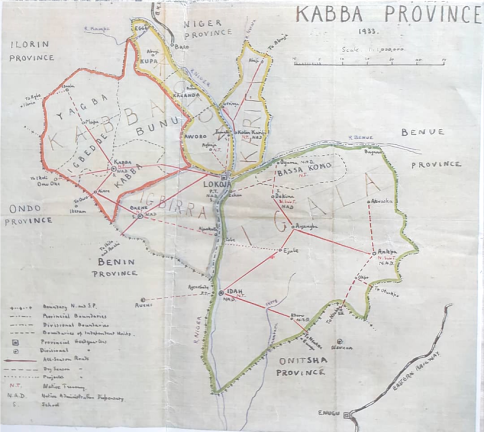
What is boundary delineation? Most broadly defined, by Kirk-Greene, boundary delineation under colonization was “the fixing of administrative limits by colonial officers using compass bearings and natural features, which were then mapped and proclaimed to define the jurisdiction of Native Authorities”. He calls it “the territorial basis of indirect rule”. Which explains the legal weight given to lines on the 1933 Kabba Province Map.
Figure 1. 1933 Kabba Province Map.
2.3. Medical Care
What is medical care? Medical care in the African context is the provision of preventive, curative, and rehabilitative health services through both orthodox and traditional systems aimed at ensuring the wellbeing of individuals and communities. Taking the Okun-Yoruba as a sub-group and object of study in colonial errors in boundary delineation and impact on health inequalities. The conceptual definition of the term medical care is measured by the location, accessibility, and type of care available to Okun-Yoruba communities between 1892-1947 as recorded in colonial medical report.
2.4. Okun-Yoruba
Who are the Okun-Yorubas’? “The Yoruba of Kabba Province, popularly called Okun-Yoruba, comprise Yagba, Bunu, Ijumu, Oworo, and others. They are classified as Northwestern Yoruba sub-group due to their location and dialectical variation.” See Figure 1 (1933 Map of Kabba Province) According to Colonial Office Report of 1933,”the Okun-Yoruba are a sub-group in Kabba Province generally known as Okun. They inhabit Yagba, Ijumu, Kabba and Bunu Divisions and number approximately 150,000.”
In summary this study offers a counter-history to the many narratives of colonialism and medical history. It conceptualizes the relationship between these terms as follows: Colonial errors in boundary delineation produced new spatial and administrative order that determined where colonial medical care was located. Because the Okun-Yoruba were split across these arbitrary boundaries, their access to health services was unequal, and their indigenous medical systems were delegitimized. In this sense, the conceptualization structures the supremacy of colonial administrators in the interface with indigenous people and their ideas. This aligns with Kees van der Pijl views of International Relations as ‘a set of theories which translate Western supremacy into intellectual hegemony.’ Aptly demonstrated in reality the relationship that existed in the interface between Western ideas of colonial boundary demarcation, inter-communal relationship and health care with the indigenous Okun-Yoruba subgroups and Europeans under colonial administration was that of Western supremacy.
3. From Indigenous Territoriality to Colonial Cartography
The origin of territorial sovereignty, boundary formation and modern state have been overwhelmingly characterized by two competing logics of explanation: the endogenous/internalist and the exogenous/externalist. The argument presented by the exogenous perspective, in contrast, contends that the origin of modern territorial state and its fixed boundaries were imposed from outside particularly through European colonialism and the 1884 Berlin Conference. In Africa borders were drawn by colonial officials to serve imperial administration rather than indigenous realities. For example the iron discipline of the British colonial constabulary was one of the fundamental lever through which modern state boundary formation evolved in British colonial Nigeria. Lieutenant Colonel William Bower was the key military figure that kicked off British conquest in Yorubaland under Governor Gilbert Carter. He was the constabulary commander under Governor Gilbert T.Carter of Lagos. He led the 1892 Lagos constabulary expedition against Ijebu-Ode, which resulted in the pivotal defeat of the Awujale, Anikilaya, and the Ijebu Kingdom. That victory was decisive because Ijebu was the gateway that controlled trade routes from the Lagos hinterland through Oyo to the North. Accompanying this victory, Lieutenant Colonel William Bower removed the strongest military and commercial barrier between Lagos Colony and the Yoruba hinterland. With Ijebu’s walls breached and trade routes secured, British forces could project power northward without resistance. This made it easy for Oba Adeyemi I of Oyo to be defeated in 1897 during the British-backed intervention in the Yoruba Civil wars. Following these conquests, Governor Gilbert Carter and Commander William Bower established what historians call the “Carter-Bower Zone”, a network of military posts, police stations, and administrative settlements stretching from Lagos through Abeokuta, Ibadan, and into Kabba Province. This zones served two purposes: First, it was a military settlement for the British Constabulary, barracks and supply depots were built to garrison conquered territories. Second, administrative boundary-making.The posts became the anchor points from which colonial surveyors drew provincial lines.Towns loyal to Britain were grouped together, while others were cut off. Consequently, for the Okun-Yoruba, their territory was incorporated into the new Kabba Province in 1900, separating them from other Yoruba in Ibadan and Ilorin Provinces.The “Carter-Bower Zone” thus became both the instrument of conquest and the template for the modern state boundaries that would determine access to Native Administration Services, including medical care.
However, both frameworks tend to assume that prior to the modern state, communities lacked coherent notions of territory.This assumption is problematic. Prior to colonization, organized traditions and cultures, had knowledge of their boundary lines. According to Asiwaju and Ikime African societies, pre-colonial communities maintained clearly understood frontiers marked by rivers, hills, sacred groves, and oral treaties. Although these boundaries were not represented on maps, mere lines which was referred to as spatial data, or colonial statistics, but were socially, respected, trusted, legally binding, and culturally legitimized. The colonial error therefore was not the introduction of boundaries, but the replacement of flexible, negotiated territoriality with fixed, cartographic lines designed for administration and extraction. So on these two critical logic of the endogenous and exogenous origin of territorial sovereignty, boundary formation and modern state for the Okun-Yoruba, meant that while indigenous territoriality was erased from official maps, it continued to shape claims to land, identity, and access to medical care under new colonial boundaries.
4. Health Impact in the Transition From Mere Lines to Law:A Twist of Fate For the Okun-Yoruba Subgroup
By 31st December 1899, the charter of the Royal Niger Company was revoked by the British government. In 1900, British colonial officials for Nigeria were appointed by the colonial office in London which held direct authority over the newly established Northern and Southern Protectorates. While the colonial office in Britain made the appointments, the officials on the ground such as Governors and High Commissioners for the different protectorate managed the administration in Nigeria. For example Sir Fredrick Lugard was appointed as High Commissioner for Northern Protectorate, and Sir Ralph Moore was the first High Commissioner for Southern Nigeria protectorate, both roles coming under the ultimate authority of the colonial office. In this determination of British Colonial Rule, Sir Fredrick Lugard, Governor of the Northern Protectorate formed a system of government structured into three levels: the District, Division, and Province. And Kabba Province became one of the first provinces created under the Northern Protectorate. Thus, the mere lines from the Carter-Bower zone transitioned from military achievement into a colonial spatial data for the establishment of Northern and Southern Protectorate of British colonial administration of Nigeria. Consequently, in a twist of fate, the Okun-Yoruba of Kabba Province suffered a double disadvantage under the new British colonial reorganization. First, their incorporation into Kabba Province in 1900 placed them under the Northern Provinces administration, which received far less medical funding than the Western Province . Using the 1933 Kabba Province Map, the study shows how provincial boundaries spatially severed Okun-Yorubaland from Southern Yoruba missionary and medical networks in Ondo and Benin Provinces (See Figure 1).
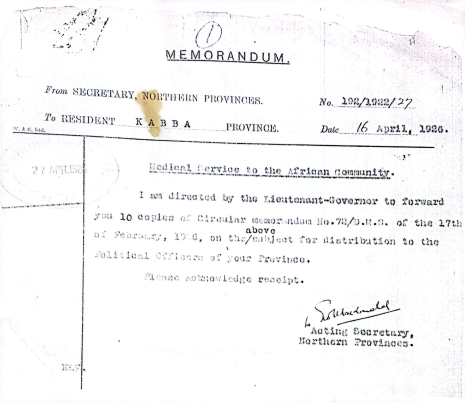
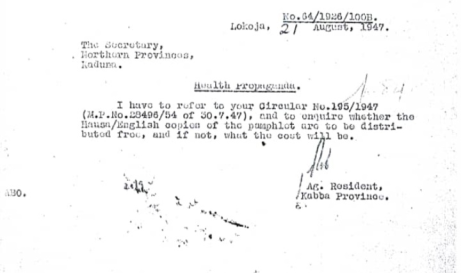
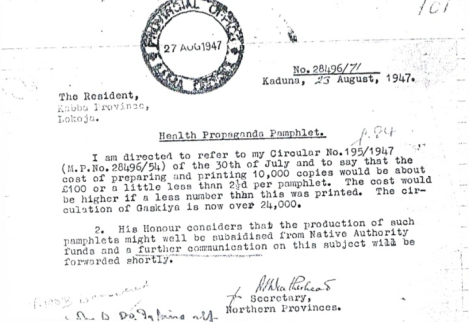
Second, the Carter-Bower settlements bypassed most Okun towns. Dispensaries were built along the Ibadan-Oyo-Ilorin axis, leaving Yagba, Ijumu, Bunu, and Kabba divisions with minimal or no Western Medical facilities until the 1930’s. The unevenness in health care infrastructure are visible on the 1933 Kabba Province Map, Native Administration Dispensary (N.A.D) symbols are clustered at Lokoja, Idah, and Ankpa with few nodes in Okunland indicating uneven infrastructure (See Figure 1). Thus, the same boundary delineation that emerged from Bowers conquest and Carters administration formed a geopolitical British colonial rule of the Northern and Southern protectorate which redirected imperial concern that created a cartographic reality where the Okun-Yoruba were administratively “Northern” but culturally “Western”. This colonial error meant that while their kinsmen in Ibadan had access to Wesleyan and government hospitals by 1905, Okun-Yoruba communities still relied predominantly on traditional medical care practitioners like Onisegun and Babalawo because the nearest colonial clinic was over 100 miles away in Lokoja or Ilorin. The mere lines obtained by colonial military expeditions designed for conquest became institutionalized in the establishment of British colonial rule created unequal access to medical care that persisted throughout the colonial period. Archival memoranda from the national archives Kaduna confirms this disparity. A 16 April 1927 memorandum on “medical service to the African community”(Figure 2) and a 27 August 1947 memo on “Health propaganda Pamphlets”(Figure 3 and 4) titled Gaskiya reveal late reactive, and logically constrained public health interventions for Okun-Yoruba communities.
Figure 2. Medical service to the African community.
Figure 3. Health Propaganda.
Figure 4. Health Propaganda Pamphlet.
5. Comparative Table
Table 1. Native Administeration Dispensaries in Okun-Yorubaland, Kabba Province Versus Western Province, 1900-1947.

Period/Indicator

Okun-Yorubaland, Kabba Province

Western Provinces Ibadan, Abeokuta, Ijebu, Ondo, Ekiti

Administrative Status

Under Northern Provinces from 1900.Revenue controlled by Kaduna.Low health budget allocation

Under Southern Nigeria/Western Province from 1906.Revenue controlled by Lagos

1900-1914 Early Native Administration Dispensaries

Zero Government Native Administration Dispensaries in Okun Divisions.Lokoja Hospital served colonial staff only

Ibadan: Oranyan Dispensary 1901.Abeokuta Government Dispensary 1903. Ijebu-Ode Dispensary 1908.

1914-1930: Expansion under Indirect Rule

Mission Supervised Dispensary by 1928, Agbaja, and Ife, Yagba in Kabba Division, Qua-Iboe supervised Adoou Native Administration Dispensary in Igala Division

12+ Native Administeration Dispensaries by 1925:Abeokuta, Ondo.Ibadan, Oyo, Ilesha, Ede, Ijebu-Ode, Native Authority funded and staffed.

1930-1933 Depression Era

No New Native Administration Dispensaries. Reliance on Missions: Medical Missions treated 26,060 patients in 1928 at Akwacha/Anyigba

1933: 628,065 patients treated at Native Administration Dispensaries across Western Province alone.

1934-1940, Grant-in-Aid to Missions

No Native Administration Grant -in-Aid recorded for Okun Missions Sudan Interior Mission and Qua-Iboe, self funded

1936: CMS awarded 150 Pound/year for Ado-Ekiti hospital.1939: Methodist awarded 200 Pound/year for Ikole/Ekiti dispensary supervision.

1941-1947:War and Post War

1947: Health Propaganda still only in Hausa/English. No Yoruba Pamphlets. Distribution hindered by cost in Native Administeration

Yoruba language health Pamphlets and radio broadcasts used. Native Administeration Dispensaries in every major Yoruba town.

Total Administration Dispensaries 1947

~3-4 Including mission supervised ones in Okun divisions

25+ government + Native Administeration Dispensaries across Western Yorubaland

Key Findings from the Table
Quantitative Disparity: By 1947 Western Province had at least 6x more Native Administration Dispensaries than Okun-Yorubaland. Western Native Administration could treat over 600,000 patients in a single year while Kabba relied on mission throughout.
Funding Model: Western Province Native Administration received direct grants-in-aid from Lagos and could subsidize missions. While Kabba Province Native Administration struggled with funding, for example the Native Administration was told in 1947 to “subsidies” 100 Pound Pamphlets from its own funds which became a huge burden.
Language Logistics/Barrier: Western Province campaigns used Yoruba. Kabba Province campaigns used Hausa and English, excluding monolingual Yoruba speakers in Okunland.
6. Conclusion
Colonial health campaigns in the Okun-Yoruba division of Kabba Province were undermined by two structural constraints: inadequate resources and flawed logistics rooted in administrative misclassification. The Okun-Yoruba were culturally Western and Yoruba speaking, but were administratively placed under the Northern Protectorate in 1900.This meant that all public health directives, funding, and propaganda emanated from Kaduna rather than Ibadan. A huge colonial delineation error which created a history of health inequalities.
7. Recommendation
Official acknowledgement of colonial misclassification. The Federal and State governments should commission a white paper acknowledging that the the 1900 incorporation of Okun-Yoruba into Kabba Province was an administrative convenience, not a reflection of cultural affinity. This will provide a historical basis for geo-rectification of present inequities in resource allocation. The rationale as shown in 1947, health campaigns failed because policy was designed for Hausa/English speakers, not Yoruba speakers.
Second, Boundary Review commissions should factor ethno-linguistic data in future boundary adjustments in Kogi State and Nigeria guided by cultural and historical data, not just 1900 military posts.The post colonial state creation repeated the error by keeping the Okun-Yoruba under a Northern State.
Abbreviations and Glossary

CMS

Christian Missionary Society

N.A.D

Native Administeration Dispensaries

Lt.Col

Lieutenant Colonel

Babalawo

Diviner

Onisegun

Herbalist

Bunu, Ijumu, Kabba, Ijumu

Ancestral Communities of the Okun-Yoruba People and Each has a Distinct Dialect

Oranyan

A Community in Ibadan

Abeokuta

A Yoruba Community Where Egba is the Dialect Spoken

Agbaja

A Community with People That are Mostly Okun-Yoruba Speaking Okun Dialect

Ondo

A Yoruba Community That Speaks Ondo Dialect

Ilesa

A Yoruba Community That Speaks Ijesa Dialect

Ede

A Yoruba Community That Speaks the Ede Dialect

Ijebu-Ode

A Yoruba Community That Speaks the Ijebu Dialect

Gaskiya

An Hausa Word for Truth, Honesty or Fact

Ife

An Okun-Yoruba Community in Ijumu That Speaks Okun Dialect

Author Contributions
Aiyemowa Bamidele: Conceptualization
Conflict of Interest
The author declares no conflict of interest.
References
[1] Basil Davidson. The African Past:Chronicles from Antiquity to Modern Times. Boston, Little, Brown and Company, 1964: 239-243.
[2] J. A. Elewude. Personal Communication:The Consultant Herbalist.Obafemi Awolowo University, Ile-Ife, Nigeria, 1980: 7.
[3] O. O. Ogunyemi. The Origin and Spread of Herbalism.In Abayomi Sofowora (eds) Nigeria in Africa Medicinal Plants. University of Ife Press, Nigeria, 1979: 13-20.
[4] A. A. Lawal. Alternative Medicine in the West Africa Sub-Region:A Pan Africanist Perspective. Global Health Histories Symposium, Organised by the National Health Institutees of Health, November 3-4, 2005, Bethesda, Maryland USA: 1-2.
[5] J. C.Scott. Seeing Like a State:How Certain Schemes to Improve the Human Condition Have Failed.Yale University Press, 1998: 11-22.
[6] A. H. M. Kirk-Greene.The Principles of Native Administeration in Nigeria.Oxford University Press, 1965: 23-29.
[7] National Archives Ibadan.Kabba Province Map. CS 026 12941.
[8] K. J. Arrow. Uncertainity and the Welfare Economics of Medical Care.Journal of American Economic Review Vol. 53, No. 5, 1963: 941-973.
[9] J. D. Y. Peel. Religious Encounter and the Making of the Yoruba.Indiana University Press, 2000: 34-36.
[10] Colonial Office Report. Kabba Province Annual Report, 1933.Government Printer, Lagos: 5-6.
[11] Kees van der Pijl. The Discipline of Western Supremacy: Modes of Foreign Relations and Political Economy. Vol. III, Pluto, London, 2014: 288.
[12] J. H. Herz. The Rise and Demise of the Territorial State. World Politics, Volume 9 No. 4, 1957: 473-493.
[13] T. Barkawi and M. Laffey. The Post Colonial Moment in Security Studies. Review of International Studies, Volume 32 No. 2, 2006: 329-352.
[14] I. A. Akinjogbin. The Civil Wars of Yorubaland. Lagos University Press, 1992.
[15] J. F. A. Ajayi. Christian Missions in Nigeria 1841-1891. Longmann, London, 1965.
[16] Michael Crowder. The Story of Nigeria.Faber, London, 1962.
[17] R. S. Smith. Kingdoms of the Yoruba.Methuen, London 1988.
[18] A. I. Asiwaju. Partitioned Africans. C Hurst, London 1984.
[19] S. G. Ikime. Nigeria: The Colonial Experience. Heinemann, London 1980.
[20] Independent Nigeria. Encyclopaedia Britanica. Retrieved 22 January 2020.
[21] Colonial Office. Kabba Province Annual Report London. HMSO 1933.
[22] O. O. Ajibade. A History of Okunland.Olu-Ajibade and Sons, 2003: 87.
[23] Kabba Province.Memorandum. (Letter No. 192/1922/27). National Archive Kaduna, 16 April, 1926.
[24] Kabba Province.Health Propaganda (Letter No. 34/1926/100B). National Archive Kaduna, August 21, 1947.
[25] Secretary, Northern Provinces. Health Propaganda Pamphlet, Circular No. 28196/71. National Archive Kaduna, August 25, 1947.
[26] Colonial Office. Annual Medical Report, Southern Nigeria. London: HMSO, 1910.
[27] W. O. P. Rosedale. Who Cares for the Newborn? Infant Care in Kabba Province, 1900-1960. Brill, 1933.
[28] PMC. Chief and Rural Health Services in South-Western Nigeria, c.1920-c. Journal of African History, 1950.
Cite This Article
  • APA Style

    Bamidele, A. (2026). A Review of Colonial Errors in Boundary Delineation and Impact on Medical Care Among the Okun-Yoruba People; 1892-1947. Medicine and Health Sciences, 2(5), 132-139. https://doi.org/10.11648/j.mhs.20260205.11

    Copy | Download

    ACS Style

    Bamidele, A. A Review of Colonial Errors in Boundary Delineation and Impact on Medical Care Among the Okun-Yoruba People; 1892-1947. Med. Health Sci. 2026, 2(5), 132-139. doi: 10.11648/j.mhs.20260205.11

    Copy | Download

    AMA Style

    Bamidele A. A Review of Colonial Errors in Boundary Delineation and Impact on Medical Care Among the Okun-Yoruba People; 1892-1947. Med Health Sci. 2026;2(5):132-139. doi: 10.11648/j.mhs.20260205.11

    Copy | Download

  • @article{10.11648/j.mhs.20260205.11,
      author = {Aiyemowa Bamidele},
      title = {A Review of Colonial Errors in Boundary Delineation and Impact on Medical Care Among the Okun-Yoruba People; 1892-1947},
      journal = {Medicine and Health Sciences},
      volume = {2},
      number = {5},
      pages = {132-139},
      doi = {10.11648/j.mhs.20260205.11},
      url = {https://doi.org/10.11648/j.mhs.20260205.11},
      eprint = {https://article.sciencepublishinggroup.com/pdf/10.11648.j.mhs.20260205.11},
      abstract = {This study examines how errors in colonial boundary demarcation between 1892-1947 disrupted the continuity of the cultural idea of medical care, broke the monopoly of traditional medical care but created new challenges of health infrastructural inequalities and services among the Okun-Yoruba People. Drawing on archival records from the national archives Ibadan, Kaduna and other secondary sources. Findings from the sources distilled discovered that mere lines drawn by colonial cartographers and surveyors, depleted social communal relations of the Okun-Yoruba and split their communities without consideration to ethnographic realities and ancestral healthcare networks. Despite this errors, this mere numbers and lines was backed with meaning and authority for arbitrary boundary creation of the Northern and Southern Protectorates of British colonial Nigeria. d. Colonial health failed in Okunland because propaganda was not in Yoruba. A 1947 correspondence between the Kabba Resident and the Secretary, Northern Provinces shows that 10,000 pamphlets were budgeted only in Hausa and English, with no Yoruba version. This linguistic exclusion meant monolingual Yoruba speakers could not access the information. Correcting the colonial error requires more than redrawing maps; it requires redrawing health policy, language policy, and funding formulas to align administration with culture, so that the Okun-Yoruba are no longer administratively Northern but medically isolate},
     year = {2026}
    }
    

    Copy | Download

  • TY  - JOUR
    T1  - A Review of Colonial Errors in Boundary Delineation and Impact on Medical Care Among the Okun-Yoruba People; 1892-1947
    AU  - Aiyemowa Bamidele
    Y1  - 2026/11/12
    PY  - 2026
    N1  - https://doi.org/10.11648/j.mhs.20260205.11
    DO  - 10.11648/j.mhs.20260205.11
    T2  - Medicine and Health Sciences
    JF  - Medicine and Health Sciences
    JO  - Medicine and Health Sciences
    SP  - 132
    EP  - 139
    PB  - Science Publishing Group
    SN  - 3070-6300
    UR  - https://doi.org/10.11648/j.mhs.20260205.11
    AB  - This study examines how errors in colonial boundary demarcation between 1892-1947 disrupted the continuity of the cultural idea of medical care, broke the monopoly of traditional medical care but created new challenges of health infrastructural inequalities and services among the Okun-Yoruba People. Drawing on archival records from the national archives Ibadan, Kaduna and other secondary sources. Findings from the sources distilled discovered that mere lines drawn by colonial cartographers and surveyors, depleted social communal relations of the Okun-Yoruba and split their communities without consideration to ethnographic realities and ancestral healthcare networks. Despite this errors, this mere numbers and lines was backed with meaning and authority for arbitrary boundary creation of the Northern and Southern Protectorates of British colonial Nigeria. d. Colonial health failed in Okunland because propaganda was not in Yoruba. A 1947 correspondence between the Kabba Resident and the Secretary, Northern Provinces shows that 10,000 pamphlets were budgeted only in Hausa and English, with no Yoruba version. This linguistic exclusion meant monolingual Yoruba speakers could not access the information. Correcting the colonial error requires more than redrawing maps; it requires redrawing health policy, language policy, and funding formulas to align administration with culture, so that the Okun-Yoruba are no longer administratively Northern but medically isolate
    VL  - 2
    IS  - 5
    ER  - 

    Copy | Download

Author Information